

- Industry Size (2026)
- USD 4.70 Bn
- Forecast (2036)
- USD 29.13 Bn
- CAGR (2026 to 2036)
- 20.0%
Aeroponic Market Size, Market Forecast and Outlook By FMI
The aeroponic market is expected to expand from USD 4.70 billion in 2026 to USD 29.13 billion by 2036. The market is anticipated to register 20.0% CAGR during the forecast period. Irrigation components are likely to lead with 28.0% share, and indoor farming is projected to account for 68.0% of the farming method segment in 2026.
Summary of the Aeroponic Market
- Demand and Growth Drivers
- Urban farming investment is expected to increase adoption of aeroponic systems across controlled food production facilities.
- Water-efficient cultivation needs are likely to raise interest in mist-based nutrient delivery across dense urban markets.
- Food security programs are anticipated to encourage investment in controlled environment agriculture across developed and emerging economies.
- Product and Segment View
- Irrigation components are expected to lead the component segment as misting systems guide plant nutrition delivery.
- Indoor farming is likely to dominate demand as vertical farming facilities expand near major consumption centers.
- Commercial applications are anticipated to account for the largest share as operators scale controlled crop production facilities.
- Geography and Competitive Outlook
- The USA is expected to lead country-level expansion as venture funding strengthens vertical farming infrastructure.
- South Korea is likely to record strong adoption as smart farming programs improve controlled agriculture investment.
- Companies with strong automation platforms are anticipated to gain stronger positions across commercial aeroponic projects.
- Analyst Opinion
- Nandini Roy Choudhury, Principal Consultant for Food and Beverage at FMI, suggests, “The aeroponic market is likely to shift toward operators able to combine water efficiency with reliable crop output. Commercial farms using advanced misting systems are expected to gain advantage as buyers seek local produce. Lighting and climate systems are also likely to improve supply consistency for large operators.”
- Aeroponic Market Value Analysis
- The aeroponic market is moving from experimental controlled farming toward larger commercial production systems.
- Demand is expected to rise as water-efficient agriculture gains attention across urban food production networks.
- Adoption is likely to increase as LED lighting and automation costs improve project economics.
- Spending is anticipated to be backed by vertical farm investment and stronger interest in resilient food supply models.
Aeroponic Market key Takeaways
| Parameter | Details |
|---|---|
| Market value (2026) | USD 4.70 billion |
| Forecast value (2036) | USD 29.13 billion |
| CAGR (2026 to 2036) | 20.0% |
| Estimated market value (2025) | USD 3.92 billion |
| Incremental opportunity | USD 24.42 billion |
| Leading component | Irrigation Component (28.0%) |
| Leading farming method | Indoor Farming (68.0%) |
| Leading application | Commercial (72.0%) |
| Key players | AeroFarms, LettUs Grow Ltd., Plenty Unlimited Inc., Freight Farms, BrightFarms |
Source: Future Market Insights, 2026
The aeroponic market is growing quickly by double digits because of three things. First, cities are investing more in urban vertical farming because they want to be able to grow their own food. Aeroponic systems use 95% less water and can produce up to 390 times more food per square meter than traditional farming. Second, worries about food security and supply chain disruptions are making both the government and private businesses invest in infrastructure for controlled environment agriculture. Third, the cost of technology for LED lighting, automated nutrient delivery, and climate control systems is going down, making it more possible for aeroponic operations to make money on a commercial scale.
The USA is ahead of the rest of the world with a 20.3% CAGR. Next is South Korea with 20.2%. The EU comes next with 20.0%. Japan comes in second with 19.9%. The UK comes in second with 19.8%.
Aeroponic Market Definition
The aeroponic market includes systems, parts, and solutions for growing plants in air or mist environments without soil or other types of media. Products include irrigation parts (like misting systems and nutrient delivery), lighting systems, climate control, sensors, and automation platforms for indoor and outdoor farming, as well as hybrid setups for commercial, research, and residential use with leafy greens, herbs, fruiting vegetables, and other crops.
Aeroponic Market Inclusions
Market scope includes all aeroponic systems that are bought and sold, broken down by component, farming method, solutions, application, crop type, and end user. The time frame for revenue sizing is 2026 to 2036.
Aeroponic Market Exclusions
The scope does not include traditional soil-based vertical farming, aquaponic systems that combine fish farming with plant growing, or regular hydroponic systems that don't have aeroponic misting capabilities.
Aeroponic Market Research Methodology
- Primary Research: FMI analysts talked to vertical farming operators, aeroponic system makers, and controlled environment agriculture technology providers in North America, Europe, and Asia-Pacific.
- Desk Research: The data collection included statistics on the vertical farming industry, investment data for controlled environment agriculture, cost benchmarks for technology, and financial disclosures from manufacturers.
- Market Sizing and Forecasting: Baseline values come from adding up all the aeroponic system installations and component sales in commercial, research, and residential settings, using regional adoption curves and technology cost reduction trajectories.
- Cycle for validating and updating data: Every three months, projections are checked against investment data from the vertical farming industry, production statistics from controlled environment agriculture, and order disclosures from system manufacturers.
Why is the Aeroponic Market Growing?
- The main reason for growth in urban vertical farming is investment, which is made easier by aeroponic systems that save 95% of water and produce much higher yields per square meter than traditional farming.
- Governments and businesses are putting money into controlled environment agriculture infrastructure in both developed and developing markets because they are worried about food security and the resilience of the supply chain.
- All tracked regions show a CAGR of about 20.0%, which shows that investment in vertical farming technology is happening all over the world as the growth of urban populations makes it harder to grow food..
The aeroponic market is growing quickly because of investments in urban farming, rules about how to use water more efficiently, and the development of controlled environment agriculture technology. Aeroponics is the best way to grow plants without soil because it uses the least amount of water. It sends nutrients to plant roots through fine mist in enclosed chamber systems.
72.0% of demand comes from commercial uses, and large-scale vertical farming companies are putting money into aeroponic infrastructure to grow leafy greens, herbs, and microgreens. These businesses sell locally grown, pesticide-free fruits and vegetables to urban food service, retail, and institutional customers who want to buy them with as little transportation as possible.
Lowering the cost of technology is the most important thing that makes market growth possible. The price of LED lights has dropped by 85% in the past ten years, and sensor technology, automated nutrient dosing, and climate control systems have all become much more affordable. These cost cuts are making it possible for commercial aeroponic operations to work with a wider range of crops and locations..
Segmental Analysis
- 28.0% of the irrigation component is made up of lead components. Misting and nutrient delivery systems are the main technology that sets aeroponic operations apart.
- 68% of farms use indoor farming, and the demand for the system is driven by purpose-built vertical farming facilities in cities.
- Commercial at 72.0% means that most of the procurement volume comes from large-scale controlled environment agriculture operations.
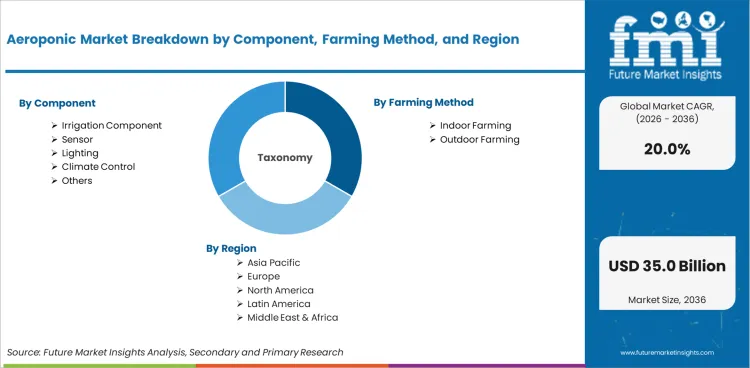
- The aeroponic market is divided into parts, farming methods, solutions, uses, crop types, and end users. By component, it has an irrigation component (misting and nutrient delivery), lighting systems, climate control, sensors, and automation. There are three types of farming: indoor, outdoor, and hybrid.
Insights into the Irrigation Component Component Segment
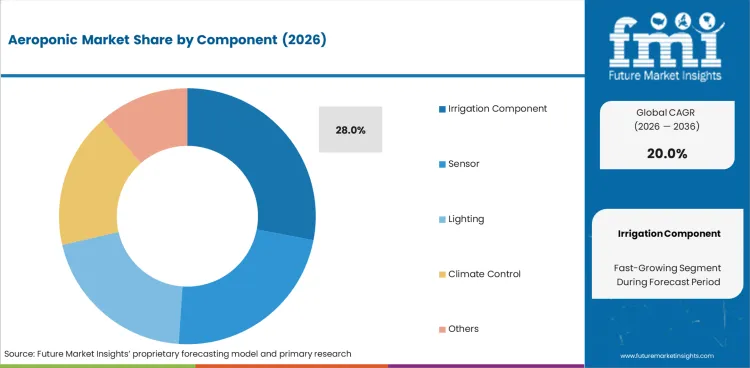
With a 28.0% share, the Irrigation Component is the leader. Misting nozzles, nutrient solution delivery pumps, and timing control systems are the main technical differences between aeroponic growing and other soilless methods.
Lighting, climate control, and sensor parts help the growing environment, but they are also used in other controlled environment agriculture settings.
Insights into the Indoor Farming Farming Method Segment
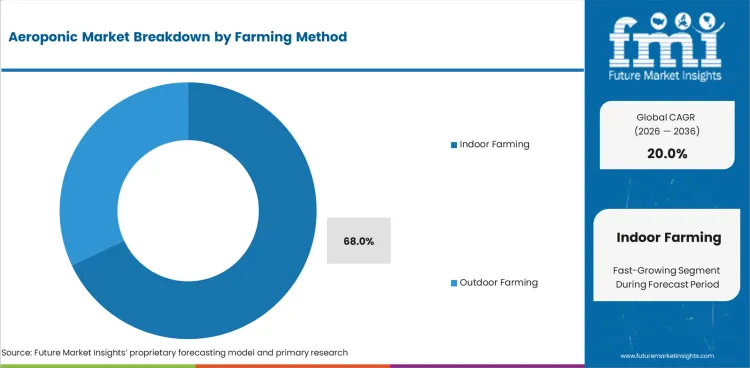
ndoor farming has a 68.0% market share because of purpose-built vertical farming facilities in cities and suburbs where land is limited and being close to customers makes it worth the extra cost of building infrastructure.
Outdoor and hybrid aeroponic systems are useful for agricultural research, greenhouse integration, and commercial operations in temperate climates that need to save money.
What are the Drivers, Restraints, and Key Trends of the Aeroponic Market?
Urban food security worries and investments in vertical farming are the main things that drive demand. Governments and private investors pay for the infrastructure for controlled environment agriculture.
The main reason people don't use commercial aeroponic facilities is that they cost a lot of money to set up at first. Depending on the crop and market prices, it can take 3 to 7 years to get your money back.
The convergence of IoT sensors, AI-driven climate optimization, and automated nutrient dosing is lowering costs and making crop yields more consistent.
The aeroponic market is growing quickly because of investments in urban farming, rules about water efficiency, and lower technology costs. Even though it takes a lot of money to get started, there are a lot of chances for growth in urban food production, growing leafy greens, and growing plants for pharmaceutical use.
Urban Vertical Farming Investment
Cities around the world are putting money into infrastructure for local food production to make the supply chain less vulnerable, lower transportation emissions, and make it easier for people to get fresh produce. Aeroponic systems are the best technology choice for urban vertical farms because they have the highest water efficiency and yield density of all soilless growing methods.
Capital Expenditure Barriers
Building a commercial aeroponic facility costs between USD 500 and USD 2,000 per square meter of growing area. This makes it expensive to set up, which means that only well-funded operators can use it. To make money, you need to wait 3 to 7 years for your money to come back and pay a premium for your produce.
Technology Cost Reduction
The costs of LED lighting, sensors, and automation keep going down, making commercial aeroponics more economically feasible. AI-driven climate optimization and automated nutrient management cut down on the amount of work that needs to be done and make crops more consistent.
Crop Diversification Beyond Leafy Greens
Operators are branching out into fruiting vegetables, strawberries, and pharmaceutical-grade plant cultivation in order to make more money and use their facilities more efficiently, even though leafy greens and herbs are still the main crops grown in aeroponic systems.
Analysis of Aeroponic Market By Key Countries
.webp "Top Country Growth Comparison Aeroponic Market Cagr (2026 2036)")
| Country | CAGR |
|---|---|
| USA | 20.3% |
| UK | 19.8% |
| EU | 20.0% |
| Japan | 19.9% |
| Sputh Korea | 20.2% |
Source: FMI analysis based on primary research and proprietary forecasting model
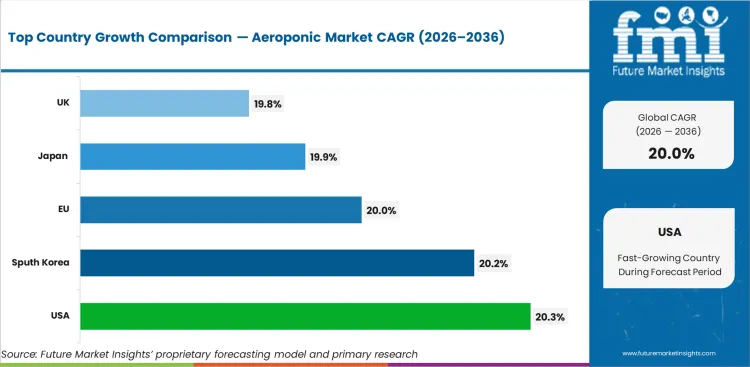
- The USA is in the lead with a 20.3% CAGR, thanks to a lot of venture capital going into vertical farming startups, urban food production projects, and tech innovation from companies like AeroFarms and Plenty.
- South Korea's 20.2% shows that the government is investing in smart farming and supporting urban agriculture policies that help people use controlled environment technology.
- The EU's 20.0% growth is fueled by investments in sustainable agriculture, rules that require water-saving measures, and building infrastructure for urban farming.
- Japan (19.9%) and the UK (19.8%) are both growing steadily thanks to policies that protect food security, limited agricultural land availability, and high demand for premium urban produce.
The aeroponic market is projected to grow globally at a CAGR of 20.0% from 2026 to 2036. The analysis spans over 30 countries, with the leading markets detailed below.
Demand Outlook for Aeroponic Market in the United States
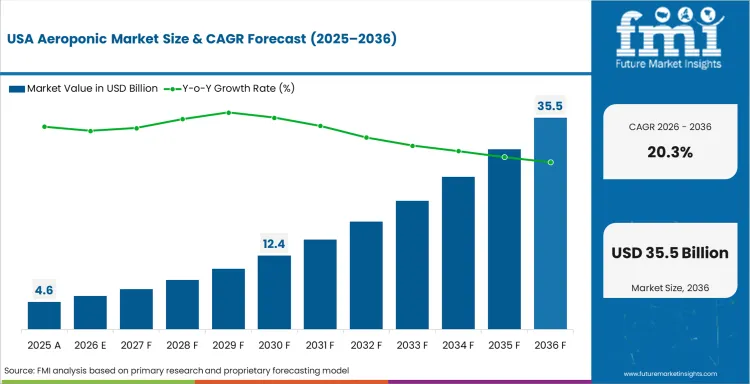
The United States is expected to grow at a CAGR of 20.3% until 2036, thanks to venture capital investment in vertical farming, urban food production projects, and new technologies. AeroFarms and Plenty Unlimited are the top two companies in the US because they run large-scale commercial aeroponic farms.
- Venture capital funds the growth of vertical farming.
- Urban food projects lead to investments in infrastructure.
- New technologies lower the costs of doing business..
Future Outlook for Aeroponic Market in the United Kingdom
Through 2036, the UK is expected to grow at a CAGR of 19.8%. This is because of policies that support food security, a lack of available agricultural land, and high demand for premium urban produce, which is driving investment in controlled environment agriculture.
- Food security policy helps farmers invest in their businesses.
- The lack of land for farming makes vertical farming more popular.
- Pricing for premium urban produce.
Opportunity Analysis of Aeroponic Market in Germany
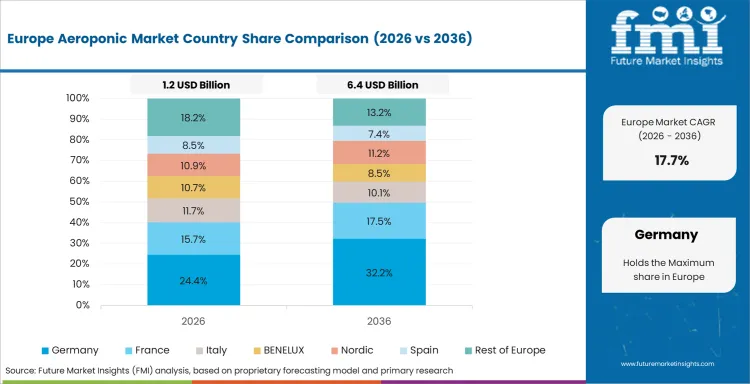
Germany's economy will keep growing until 2036. This is because of EU sustainability mandates, a strong agricultural technology infrastructure, and more money being put into urban food production systems.
- EU rules on sustainability encourage investment.
- Infrastructure for agricultural technology makes it possible to adopt.
- Investment in urban food production is on the rise.
In-depth Analysis of Aeroponic Market in Japan
Japan is expected to grow at a rate of 19.9% per year until 2036. This is because of limited agricultural land, a culture of adopting advanced technology, and government support for smart farming and controlled environment agriculture.
- Vertical farming is driven by the lack of space for farming.
- Culture of advanced technology makes adoption possible.
- The government's smart-farming policy encourages investment..
Sales Analysis of Aeroponic Market in China
China will keep growing until 2036 because of urbanization putting pressure on farmland, the government's investment in food security, and the growing use of controlled environment agriculture technology in tier-1 cities.
- Urbanization pressure leads to alternative farming.
- Investing in food security helps build infrastructure.
- Adoption of technology is speeding up in big cities..
In-depth Analysis of Aeroponic Market in India
India is showing signs of growth through 2036. This is because water shortages are making people interested in water-efficient farming, the urban population is growing, which is creating a demand for local food production, and the agri-tech startup ecosystem is growing.
- People are interested in how well aeroponics works because of water shortages.
- The growth of cities' populations creates a need for food production.
- The ecosystem for agri-tech startups is growing..
Competitive Landscape of Aeroponic Market
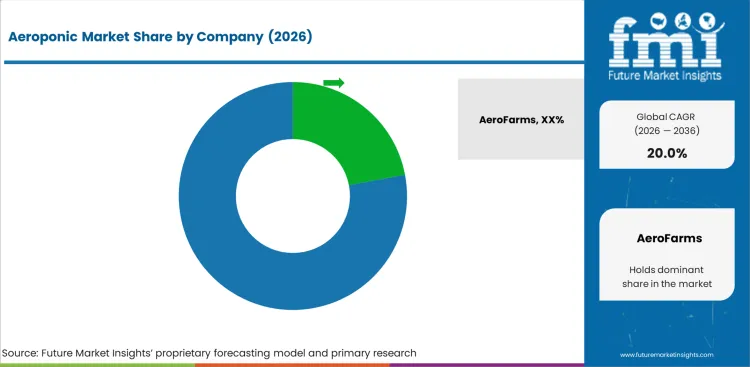
AeroFarms is the leader in commercial aeroponic farming on a large scale and has its own technology platform.
Plenty Unlimited and BrightFarms use a lot of venture capital and set up urban vertical farms.
New companies like LettUs Grow and Freight Farms offer modular and containerized aeroponic solutions for smaller-scale uses.
AeroFarms is the leader in the field because it has the biggest indoor aeroponic farms in the world, its own growing technology, and business relationships with major retailers and food service companies.
LettUs Grow Ltd. makes modular aeroponic systems that use their own ultrasonic misting technology. Plenty Unlimited runs big vertical farms that get a lot of money from venture capitalists, including the SoftBank Vision Fund.
Freight Farms sends out containerized aeroponic growing systems that make it possible to farm in different parts of a city. BrightFarms runs commercial greenhouses that use aeroponic technology.
To get into the business, you need a lot of money, technology IP, good relationships with retail buyers in the supply chain, and the know-how to run a business that can consistently grow crops on a large scale..
Major Industry Players
Key global companies leading the aeroponic market include:
- Some of the best companies in the global aeroponic market are AeroFarms (USA), LettUs Grow Ltd. (UK), Plenty Unlimited Inc. (USA), and Freight Farms (USA). These companies have strong proprietary growing technology, the ability to run operations on a commercial scale, and established supply relationships with retail and foodservice buyers.
- BrightFarms (USA) and local vertical farming companies have made a name for themselves by running commercial greenhouses and indoor farms that sell food to local markets.
- Emerging aeroponic technology companies in Europe, Asia, and other places have set themselves apart from other startups and small and medium-sized businesses by getting strong footholds in modular systems, containerized solutions, and research-grade aeroponic platforms. This shows that they could become market leaders in the future..
Competitive Benchmarking: Aeroponic Market
| Company | Technology IP | Commercial Scale | Funding/Capital | Geographic Footprint |
|---|---|---|---|---|
| AeroFarms | High | High | High | N. America |
| LettUs Grow Ltd. | High | Medium | Medium | UK, Europe |
| Plenty Unlimited | High | High | High | N. America |
| Freight Farms | High | Medium | Medium | N. America, Global |
| BrightFarms | Medium | High | Medium | N. America |
Source: Future Market Insights competitive analysis, 2026. Ratings reflect relative positioning based on technology IP, commercial scale, capital access, and distribution scope.
Key Developments in Aeroponic Market
- In 2025, AeroFarms built a new large-scale vertical farm to increase its commercial aeroponic production capacity. This farm will supply major US retail chains with high-quality leafy greens.
- In 2025, LettUs Grow Ltd. released new ultrasonic aeroponic modules that can be used in modular setups in urban vertical farming facilities all over Europe..
Key Players in the Aeroponic Market:
Major Global Players:
- AeroFarms
- LettUs Grow Ltd.
- Plenty Unlimited Inc.
- Freight Farms
- BrightFarms
Emerging Players/Startups
- Emerging aeroponic technology companies in Europe and Asia
Scope of the report
| Parameter | Details |
|---|---|
| Quantitative Units | USD 4.70 billion to USD 29.13 billion, at a CAGR of 20.0% |
| Market Definition | The aeroponic market encompasses systems, components, and solutions for growing plants in air or mist environments without soil for commercial, research, and residential applications. |
| Regions Covered | North America, Latin America, Europe, East Asia, South Asia and Pacific, Middle East and Africa |
| Countries Covered | USA, UK, EU, Japan, South Korea, China, India, Germany, 30 plus countries |
| Key Companies Profiled | AeroFarms, LettUs Grow Ltd., Plenty Unlimited Inc., Freight Farms, BrightFarms |
| Forecast Period | 2026 to 2036 |
| Approach | Hybrid bottom-up and top-down methodology starting with verified transaction data, projecting adoption velocity across segments and regions. |
Aeroponic Market by Segments
Aeroponic Market Market Segmented by Component:
- Irrigation Component
- Sensor
- Lighting
- Climate Control
- Others
Aeroponic Market Market Segmented by Farming Method:
- Indoor Farming
- Outdoor Farming
Aeroponic Market Market Segmented by Solutions:
- Conventional
- Organic
Aeroponic Market Market Segmented by Application:
- Commercial
- Residential
Aeroponic Market Market by Region:
- North America
- USA
- Canada
- Mexico
- Latin America
- Brazil
- Chile
- Rest of Latin America
- Western Europe
- Germany
- UK
- Italy
- Spain
- France
- Nordic
- BENELUX
- Rest of Western Europe
- Eastern Europe
- Russia
- Poland
- Hungary
- Balkan & Baltic
- Rest of Eastern Europe
- East Asia
- China
- Japan
- South Korea
- South Asia and Pacific
- India
- ASEAN
- Australia & New Zealand
- Rest of South Asia and Pacific
- Middle East & Africa
- Kingdom of Saudi Arabia
- Other GCC Countries
- Turkiye
- South Africa
- Other African Union
- Rest of Middle East & Africa
Bibliography
- 1. Group for Vertical Farming. (2025). AVF Global Census of Vertical Farming. AVF.
- 2. Organization for Food and Agriculture. (2025). Report on Controlled Environment Production and Urban Agriculture from the FAO. FAO.
- 3. The United States Department of Agriculture. (2024). Summary of USDA Controlled Environment Agriculture Research. USDA.
- 4. The European Commission. (2024). Innovation in sustainable food systems through the EU Farm to Fork Strategy. EC.
- 5. The International Society for Horticultural Science. (2025). Report on ISHS Soilless Culture and Protected Agriculture. ISHS.
This bibliography is for readers to use as a reference. The complete FMI report has the full list of references and the main research documents..
Frequently Asked Questions
How big is the global market for Aeroponic systems in 2026?
The global market for aeroponic systems is expected to be worth $4.70 billion by 2026.
How big will the Aeroponic Market be in 2036?
By 2036, the aeroponics market is expected to be worth $29.13 billion.
How much will the demand for Aeroponics grow from 2026 to 2036?
Between 2026 and 2036, the demand for aeroponic systems is expected to grow at a rate of 20.0% per year.
Which part is likely to be the best-selling in the world by 2026?
In 2026, the Irrigation Component will make up 28.0% of the total. This shows how important misting and nutrient delivery systems are for aeroponic growing operations.
How is indoor farming helping aeroponic systems become more popular?
Indoor farming makes up 68.0% of the farming method segment. This is because purpose-built vertical farming facilities in cities are driving up demand for aeroponic systems.
What is causing the demand in the US?
The USA has a 20.3% CAGR through 2036, thanks to venture capital funding for vertical farming, urban food production projects, and new technologies.
What does this report say about the Aeroponic Market definition?
The aeroponic market includes systems and parts for growing plants in the air or mist without soil. These systems are used for business, research, and home purposes.
How does FMI make the Aeroponic Market forecast and check it?
Forecasting models use a mix of top-down and bottom-up methods. They start with verified data on system installations and then check it against investment statistics from the vertical farming industry and manufacturer order disclosures.
Preview the report firsthand - request a free sample
Get SampleGet the brochure for pricing and purchase details.
Get PDFTable of Content
- Executive Summary
- Global Market Outlook
- Demand-side Trends
- Supply-side Trends
- Technology Roadmap Analysis
- Analysis and Recommendations
- Market Overview
- Market Coverage / Taxonomy
- Market Definition / Scope / Limitations
- Research Methodology
- Chapter Orientation
- Analytical Lens and Working Hypotheses
- Market Structure, Signals, and Trend Drivers
- Benchmarking and Cross-market Comparability
- Market Sizing, Forecasting, and Opportunity Mapping
- Research Design and Evidence Framework
- Desk Research Programme (Secondary Evidence)
- Company Annual and Sustainability Reports
- Peer-reviewed Journals and Academic Literature
- Corporate Websites, Product Literature, and Technical Notes
- Earnings Decks and Investor Briefings
- Statutory Filings and Regulatory Disclosures
- Technical White Papers and Standards Notes
- Trade Journals, Industry Magazines, and Analyst Briefs
- Conference Proceedings, Webinars, and Seminar Materials
- Government Statistics Portals and Public Data Releases
- Press Releases and Reputable Media Coverage
- Specialist Newsletters and Curated Briefings
- Sector Databases and Reference Repositories
- FMI Internal Proprietary Databases and Historical Market Datasets
- Subscription Datasets and Paid Sources
- Social Channels, Communities, and Digital Listening Inputs
- Additional Desk Sources
- Expert Input and Fieldwork (Primary Evidence)
- Primary Modes
- Qualitative Interviews and Expert Elicitation
- Quantitative Surveys and Structured Data Capture
- Blended Approach
- Why Primary Evidence is Used
- Field Techniques
- Interviews
- Surveys
- Focus Groups
- Observational and In-context Research
- Social and Community Interactions
- Stakeholder Universe Engaged
- C-suite Leaders
- Board Members
- Presidents and Vice Presidents
- R&D and Innovation Heads
- Technical Specialists
- Domain Subject-matter Experts
- Scientists
- Physicians and Other Healthcare Professionals
- Governance, Ethics, and Data Stewardship
- Research Ethics
- Data Integrity and Handling
- Primary Modes
- Tooling, Models, and Reference Databases
- Desk Research Programme (Secondary Evidence)
- Data Engineering and Model Build
- Data Acquisition and Ingestion
- Cleaning, Normalisation, and Verification
- Synthesis, Triangulation, and Analysis
- Quality Assurance and Audit Trail
- Market Background
- Market Dynamics
- Drivers
- Restraints
- Opportunity
- Trends
- Scenario Forecast
- Demand in Optimistic Scenario
- Demand in Likely Scenario
- Demand in Conservative Scenario
- Opportunity Map Analysis
- Product Life Cycle Analysis
- Supply Chain Analysis
- Investment Feasibility Matrix
- Value Chain Analysis
- PESTLE and Porter’s Analysis
- Regulatory Landscape
- Regional Parent Market Outlook
- Production and Consumption Statistics
- Import and Export Statistics
- Market Dynamics
- Global Market Analysis 2021 to 2025 and Forecast, 2026 to 2036
- Historical Market Size Value (USD Billion) Analysis, 2021 to 2025
- Current and Future Market Size Value (USD Billion) Projections, 2026 to 2036
- Y-o-Y Growth Trend Analysis
- Absolute $ Opportunity Analysis
- Global Market Pricing Analysis 2021 to 2025 and Forecast 2026 to 2036
- Global Market Analysis 2021 to 2025 and Forecast 2026 to 2036, By Component
- Introduction / Key Findings
- Historical Market Size Value (USD Billion) Analysis By Component , 2021 to 2025
- Current and Future Market Size Value (USD Billion) Analysis and Forecast By Component , 2026 to 2036
- Irrigation Component
- Sensor
- Lighting
- Climate Control
- Others
- Irrigation Component
- Y-o-Y Growth Trend Analysis By Component , 2021 to 2025
- Absolute $ Opportunity Analysis By Component , 2026 to 2036
- Global Market Analysis 2021 to 2025 and Forecast 2026 to 2036, By Farming Method
- Introduction / Key Findings
- Historical Market Size Value (USD Billion) Analysis By Farming Method, 2021 to 2025
- Current and Future Market Size Value (USD Billion) Analysis and Forecast By Farming Method, 2026 to 2036
- Indoor Farming
- Outdoor Farming
- Indoor Farming
- Y-o-Y Growth Trend Analysis By Farming Method, 2021 to 2025
- Absolute $ Opportunity Analysis By Farming Method, 2026 to 2036
- Global Market Analysis 2021 to 2025 and Forecast 2026 to 2036, By Solutions
- Introduction / Key Findings
- Historical Market Size Value (USD Billion) Analysis By Solutions, 2021 to 2025
- Current and Future Market Size Value (USD Billion) Analysis and Forecast By Solutions, 2026 to 2036
- Conventional
- Organic
- Conventional
- Y-o-Y Growth Trend Analysis By Solutions, 2021 to 2025
- Absolute $ Opportunity Analysis By Solutions, 2026 to 2036
- Global Market Analysis 2021 to 2025 and Forecast 2026 to 2036, By Application
- Introduction / Key Findings
- Historical Market Size Value (USD Billion) Analysis By Application, 2021 to 2025
- Current and Future Market Size Value (USD Billion) Analysis and Forecast By Application, 2026 to 2036
- Commercial
- Residential
- Commercial
- Y-o-Y Growth Trend Analysis By Application, 2021 to 2025
- Absolute $ Opportunity Analysis By Application, 2026 to 2036
- Global Market Analysis 2021 to 2025 and Forecast 2026 to 2036, By Region
- Introduction
- Historical Market Size Value (USD Billion) Analysis By Region, 2021 to 2025
- Current Market Size Value (USD Billion) Analysis and Forecast By Region, 2026 to 2036
- North America
- Latin America
- Western Europe
- Eastern Europe
- East Asia
- South Asia and Pacific
- Middle East & Africa
- Market Attractiveness Analysis By Region
- North America Market Analysis 2021 to 2025 and Forecast 2026 to 2036, By Country
- Historical Market Size Value (USD Billion) Trend Analysis By Market Taxonomy, 2021 to 2025
- Market Size Value (USD Billion) Forecast By Market Taxonomy, 2026 to 2036
- By Country
- USA
- Canada
- Mexico
- By Component
- By Farming Method
- By Solutions
- By Application
- By Country
- Market Attractiveness Analysis
- By Country
- By Component
- By Farming Method
- By Solutions
- By Application
- Key Takeaways
- Latin America Market Analysis 2021 to 2025 and Forecast 2026 to 2036, By Country
- Historical Market Size Value (USD Billion) Trend Analysis By Market Taxonomy, 2021 to 2025
- Market Size Value (USD Billion) Forecast By Market Taxonomy, 2026 to 2036
- By Country
- Brazil
- Chile
- Rest of Latin America
- By Component
- By Farming Method
- By Solutions
- By Application
- By Country
- Market Attractiveness Analysis
- By Country
- By Component
- By Farming Method
- By Solutions
- By Application
- Key Takeaways
- Western Europe Market Analysis 2021 to 2025 and Forecast 2026 to 2036, By Country
- Historical Market Size Value (USD Billion) Trend Analysis By Market Taxonomy, 2021 to 2025
- Market Size Value (USD Billion) Forecast By Market Taxonomy, 2026 to 2036
- By Country
- Germany
- UK
- Italy
- Spain
- France
- Nordic
- BENELUX
- Rest of Western Europe
- By Component
- By Farming Method
- By Solutions
- By Application
- By Country
- Market Attractiveness Analysis
- By Country
- By Component
- By Farming Method
- By Solutions
- By Application
- Key Takeaways
- Eastern Europe Market Analysis 2021 to 2025 and Forecast 2026 to 2036, By Country
- Historical Market Size Value (USD Billion) Trend Analysis By Market Taxonomy, 2021 to 2025
- Market Size Value (USD Billion) Forecast By Market Taxonomy, 2026 to 2036
- By Country
- Russia
- Poland
- Hungary
- Balkan & Baltic
- Rest of Eastern Europe
- By Component
- By Farming Method
- By Solutions
- By Application
- By Country
- Market Attractiveness Analysis
- By Country
- By Component
- By Farming Method
- By Solutions
- By Application
- Key Takeaways
- East Asia Market Analysis 2021 to 2025 and Forecast 2026 to 2036, By Country
- Historical Market Size Value (USD Billion) Trend Analysis By Market Taxonomy, 2021 to 2025
- Market Size Value (USD Billion) Forecast By Market Taxonomy, 2026 to 2036
- By Country
- China
- Japan
- South Korea
- By Component
- By Farming Method
- By Solutions
- By Application
- By Country
- Market Attractiveness Analysis
- By Country
- By Component
- By Farming Method
- By Solutions
- By Application
- Key Takeaways
- South Asia and Pacific Market Analysis 2021 to 2025 and Forecast 2026 to 2036, By Country
- Historical Market Size Value (USD Billion) Trend Analysis By Market Taxonomy, 2021 to 2025
- Market Size Value (USD Billion) Forecast By Market Taxonomy, 2026 to 2036
- By Country
- India
- ASEAN
- Australia & New Zealand
- Rest of South Asia and Pacific
- By Component
- By Farming Method
- By Solutions
- By Application
- By Country
- Market Attractiveness Analysis
- By Country
- By Component
- By Farming Method
- By Solutions
- By Application
- Key Takeaways
- Middle East & Africa Market Analysis 2021 to 2025 and Forecast 2026 to 2036, By Country
- Historical Market Size Value (USD Billion) Trend Analysis By Market Taxonomy, 2021 to 2025
- Market Size Value (USD Billion) Forecast By Market Taxonomy, 2026 to 2036
- By Country
- Kingdom of Saudi Arabia
- Other GCC Countries
- Turkiye
- South Africa
- Other African Union
- Rest of Middle East & Africa
- By Component
- By Farming Method
- By Solutions
- By Application
- By Country
- Market Attractiveness Analysis
- By Country
- By Component
- By Farming Method
- By Solutions
- By Application
- Key Takeaways
- Key Countries Market Analysis
- USA
- Pricing Analysis
- Market Share Analysis, 2025
- By Component
- By Farming Method
- By Solutions
- By Application
- Canada
- Pricing Analysis
- Market Share Analysis, 2025
- By Component
- By Farming Method
- By Solutions
- By Application
- Mexico
- Pricing Analysis
- Market Share Analysis, 2025
- By Component
- By Farming Method
- By Solutions
- By Application
- Brazil
- Pricing Analysis
- Market Share Analysis, 2025
- By Component
- By Farming Method
- By Solutions
- By Application
- Chile
- Pricing Analysis
- Market Share Analysis, 2025
- By Component
- By Farming Method
- By Solutions
- By Application
- Germany
- Pricing Analysis
- Market Share Analysis, 2025
- By Component
- By Farming Method
- By Solutions
- By Application
- UK
- Pricing Analysis
- Market Share Analysis, 2025
- By Component
- By Farming Method
- By Solutions
- By Application
- Italy
- Pricing Analysis
- Market Share Analysis, 2025
- By Component
- By Farming Method
- By Solutions
- By Application
- Spain
- Pricing Analysis
- Market Share Analysis, 2025
- By Component
- By Farming Method
- By Solutions
- By Application
- France
- Pricing Analysis
- Market Share Analysis, 2025
- By Component
- By Farming Method
- By Solutions
- By Application
- India
- Pricing Analysis
- Market Share Analysis, 2025
- By Component
- By Farming Method
- By Solutions
- By Application
- ASEAN
- Pricing Analysis
- Market Share Analysis, 2025
- By Component
- By Farming Method
- By Solutions
- By Application
- Australia & New Zealand
- Pricing Analysis
- Market Share Analysis, 2025
- By Component
- By Farming Method
- By Solutions
- By Application
- China
- Pricing Analysis
- Market Share Analysis, 2025
- By Component
- By Farming Method
- By Solutions
- By Application
- Japan
- Pricing Analysis
- Market Share Analysis, 2025
- By Component
- By Farming Method
- By Solutions
- By Application
- South Korea
- Pricing Analysis
- Market Share Analysis, 2025
- By Component
- By Farming Method
- By Solutions
- By Application
- Russia
- Pricing Analysis
- Market Share Analysis, 2025
- By Component
- By Farming Method
- By Solutions
- By Application
- Poland
- Pricing Analysis
- Market Share Analysis, 2025
- By Component
- By Farming Method
- By Solutions
- By Application
- Hungary
- Pricing Analysis
- Market Share Analysis, 2025
- By Component
- By Farming Method
- By Solutions
- By Application
- Kingdom of Saudi Arabia
- Pricing Analysis
- Market Share Analysis, 2025
- By Component
- By Farming Method
- By Solutions
- By Application
- Turkiye
- Pricing Analysis
- Market Share Analysis, 2025
- By Component
- By Farming Method
- By Solutions
- By Application
- South Africa
- Pricing Analysis
- Market Share Analysis, 2025
- By Component
- By Farming Method
- By Solutions
- By Application
- USA
- Market Structure Analysis
- Competition Dashboard
- Competition Benchmarking
- Market Share Analysis of Top Players
- By Regional
- By Component
- By Farming Method
- By Solutions
- By Application
- Competition Analysis
- Competition Deep Dive
- AeroFarms
- Overview
- Product Portfolio
- Profitability by Market Segments (Product/Age /Sales Channel/Region)
- Sales Footprint
- Strategy Overview
- Marketing Strategy
- Product Strategy
- Channel Strategy
- LettUs Grow Ltd.
- Plenty Unlimited Inc.
- Freight Farms
- BrightFarms
- Other Key Players
- AeroFarms
- Competition Deep Dive
- Assumptions & Acronyms Used


