

- Industry Size (2026)
- USD 9.73 Bn
- Forecast (2036)
- USD 29.67 Bn
- CAGR (2026 to 2036)
- 11.8%
Biochips Market Size, Market Forecast and Outlook By FMI
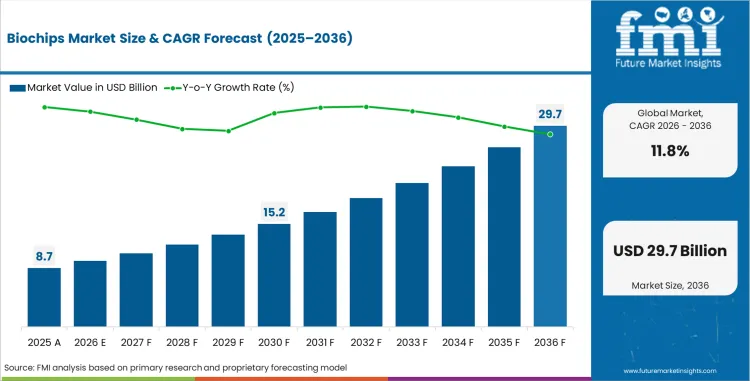
The biochips market was valued at USD 8.70 billion in 2025, projected to reach USD 9.73 billion in 2026, and is forecast to expand to USD 29.67 billion by 2036 at an 11.8% CAGR. Expanding pharmaceutical R&D pipelines, precision medicine adoption in oncology and rare disease diagnostics, and the miniaturization of analytical workflows onto microarray and microfluidic platforms are the convergent forces driving biochip procurement across life science, pharmaceutical, and clinical laboratory end users. FMI is of the opinion that the transition from centralized laboratory testing to point-of-care and near-patient diagnostic workflows is the single largest structural shift reshaping biochip product architectures and pricing models.
Summary of Biochips Market
- The market is forecast to reach USD 29.67 billion by 2036.
- The market is expected to grow at a CAGR of 11.8% from 2026 to 2036.
- The market was estimated at USD 8.70 billion in 2025.
- The forecast period represents an incremental opportunity of USD 19.95 billion.
- DNA Chip accounts for 41.8% of the product segment in 2026, anchored by genomic profiling applications in oncology and pharmacogenomics.
- Drug Discovery & Development holds 29.5% of the application segment, supported by expanding pharmaceutical R&D pipelines and precision medicine adoption.
- Biotech & Life Science Companies capture 34.5% of the end user segment, reflecting the concentration of biochip procurement in molecular analysis and high-throughput screening workflows.
- China leads country-level growth at 15.9% CAGR, driven by the National Key R&D Programme allocation for precision medicine infrastructure.
The USD 19.95 billion incremental opportunity between 2026 and 2036 reflects the expanding role of biochips across the drug development lifecycle, from target identification through companion diagnostic co-development, and the parallel growth of clinical diagnostic applications where multiplexed testing on a single chip replaces multiple conventional assays. As per FMI, DNA chips command 41.8% share in 2026, anchored by genomic profiling applications in oncology and pharmacogenomics, while lab-on-a-chip platforms are registering the fastest growth as integrated sample-to-answer devices for infectious disease and food safety testing.
China leads at 15.9% CAGR, driven by the National Key R&D Programme allocation for precision medicine infrastructure and the concentration of genomics sequencing capacity expansion in Beijing and Shanghai biotech clusters. India follows at 14.8%, supported by the Department of Biotechnology genome mapping initiatives and the expansion of molecular diagnostic laboratory networks under the Ayushman Bharat Health Infrastructure Mission. Germany registers 13.6%, anchored by the Federal Ministry of Education and Research (BMBF) funding for microfluidics research and the established in-vitro diagnostics regulatory framework. France tracks at 12.4%, the UK at 11.2%, the USA at 10.0%, and Brazil at 8.9%.
Summary of Biochips Market
- Market Overview
- The market is valued at USD 8.70 billion in 2025 and is projected to reach USD 29.67 billion by 2036.
- The industry is expected to grow at a 11.8% CAGR from 2026 to 2036, creating an incremental opportunity of USD 19.95 billion.
- The market is a technology-convergent life sciences platform category where miniaturization trends, precision medicine adoption, and point-of-care diagnostic decentralization are expanding the addressable application set and end-user base for chip-based molecular analysis.
- Demand and Growth Drivers
- Expanding pharmaceutical R&D pipelines and precision medicine adoption in oncology are increasing demand for high-throughput molecular profiling on DNA and protein chip platforms.
- The transition from centralized laboratory testing to point-of-care diagnostic workflows is driving lab-on-a-chip platform development for integrated sample-to-answer infectious disease testing.
- Companion diagnostic co-development requirements attached to targeted therapy approvals are creating a regulatory-mandated demand for biochip-based patient stratification tools.
- Among key countries, China leads at 15.9% CAGR, followed by India at 14.8%, Germany at 13.6%, France at 12.4%, the UK at 11.2%, the USA at 10.0%, and Brazil at 8.9%.
- Product and Segment View
- The market covers miniaturized molecular analysis platforms including DNA microarrays, protein chips, and lab-on-a-chip microfluidic devices integrating biological recognition elements onto solid substrates.
- Applications span pharmaceutical target identification, clinical companion diagnostics, food pathogen detection, population-scale genomic profiling, and environmental monitoring.
- DNA Chip leads by product with 41.8% share in 2026, anchored by genomic profiling applications in oncology and pharmacogenomics.
- Drug Discovery & Development leads by application with 29.5% share in 2026. Biotech & Life Science Companies command 34.5% share by end user.
- Scope excludes conventional microtiter plate assays, standalone sequencing instruments, and semiconductor chips for non-biological computing.
- Geography and Competitive Outlook
- China and India are the fastest-growing markets, driven by national precision medicine infrastructure investments and molecular diagnostic laboratory network expansion.
- Germany leads European growth through BMBF microfluidics research funding and the established IVD regulatory framework, while the USA remains the largest value market with the deepest pharmaceutical R&D spending base.
- Competition is shaped by technology portfolios, regulatory registration depth, and supply chain integration, with key players including Agilent Technologies, Thermo Fisher Scientific, Takara Bio Inc., Cepheid Inc., Bio-Rad Laboratories, Fluidigm Corporation, PerkinElmer Inc., Illumina, Inc., OcimumBiosolutions Ltd..
- Analyst Opinion at FMI
- Sudip saha, Principal Consultant for Healthcare, opines: 'In my analysis, I have observed that the biochips market is at an inflection point where lab-on-a-chip platforms are transitioning from research tools to regulated clinical diagnostic devices. Companies that secure regulatory clearance for point-of-care biochip diagnostics ahead of competitors establish installed base positions that generate recurring consumable revenue streams across multi-year laboratory contracts.'
- Strategic Implications / Executive Takeaways
- Biochip manufacturers must prioritize regulatory clearance for point-of-care lab-on-a-chip diagnostic devices to capture the decentralization trend reshaping clinical laboratory procurement.
- Pharmaceutical companies should integrate biochip-based companion diagnostic co-development into early-stage clinical programs to meet regulatory stratification requirements at approval filing.
- Life science research procurement teams must evaluate multiplexed biochip platforms that consolidate multiple conventional assays onto single-chip workflows to reduce per-test costs and turnaround times.
Biochips Market Key Takeaways
| Metric | Details |
|---|---|
| Industry Size (2026) | USD 9.73 billion |
| Industry Value (2036) | USD 29.67 billion |
| CAGR (2026-2036) | 11.8% |
Source: Future Market Insights, 2026
Biochips Market Definition
Biochips are miniaturized platforms that integrate biological recognition elements (DNA probes, protein arrays, or cell-based sensors) onto solid substrates or microfluidic architectures for high-throughput molecular analysis. Product categories include DNA chips (microarrays), protein chips, and lab-on-a-chip (microfluidic) devices. Applications span drug discovery and development, disease diagnostics, food safety testing, genomics research, and non-biological analytical applications.
Biochips Market Inclusions
Market scope covers global and regional revenue sizing for biochip platforms across all product types and applications. The forecast spans 2026 to 2036 with segmentation by product, application, and end user. Technology platform migration tracking and regulatory clearance mapping for diagnostic applications are included.
Biochips Market Exclusions
The scope excludes conventional microtiter plate-based assays without chip-based miniaturization, standalone DNA sequencing instruments without integrated chip platforms, and semiconductor chips used in non-biological computing applications.
Biochips Market Research Methodology
- Primary Research: Analysts engaged with production facility managers, procurement specialists, and downstream application engineers to map the decision gates triggering technology adoption and supplier qualification.
- Desk Research: Data collection phases aggregated regulatory compliance schedules, industry standards ratification timelines, and public procurement disclosure databases from primary source institutions.
- Market-Sizing and Forecasting: Baseline values derive from a bottom-up aggregation of product volumes and average selling prices, applying region-specific adoption curves to project future demand velocity.
- Data Validation and Update Cycle: Projections are tested against publicly reported financial guidance from leading producers and cross-referenced with trade body shipment statistics.
Why is the Biochips Market Growing?
Market Overview:
The biochips market is experiencing accelerated growth, driven by advancements in molecular biology, genomics, and proteomics that are transforming healthcare and life sciences research. Increasing applications in diagnostics, drug development, and personalized medicine are fueling adoption across both academic and commercial sectors. Biochips are being widely utilized due to their ability to enable high-throughput screening, real-time monitoring, and miniaturized analysis with improved accuracy and efficiency.
Technological progress in microarray fabrication, nanotechnology, and microfluidics has enhanced performance and lowered costs, making biochips more accessible for clinical and research applications. Rising demand for early disease detection and precision medicine is pushing laboratories and healthcare providers to integrate biochip-based platforms into routine workflows.
Strong investments from both public and private entities in biotechnology and life sciences infrastructure are reinforcing growth As healthcare systems worldwide shift toward preventive and personalized treatment approaches, the biochips market is expected to maintain robust expansion, supported by innovation in multiplexing capabilities, automation, and data integration tools.
Segmental Analysis
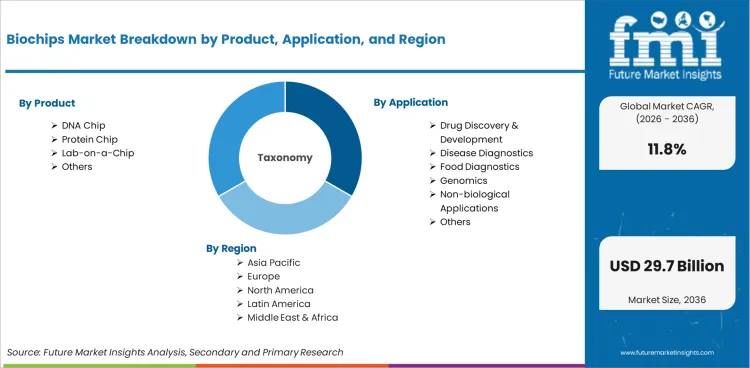
The biochips market is segmented by product, application, end user, and geographic regions. By product, biochips market is divided into DNA Chip (DNA Microarray), Protein Chip (Protein Microarray), Lab-on-a-Chip (Microfluidic Chip), and Others. In terms of application, biochips market is classified into Drug Discovery & Development, Disease Diagnostics, Food Diagnostics, Genomics, Non-biological Applications, and Others. Based on end user, biochips market is segmented into Biotech & Life Science Companies, Pharmaceutical Companies, Hospital & Diagnostic Centers, Health Research Institutes, and Others. Regionally, the biochips industry is classified into North America, Latin America, Western Europe, Eastern Europe, Balkan & Baltic Countries, Russia & Belarus, Central Asia, East Asia, South Asia & Pacific, and the Middle East & Africa.
Insights into the DNA Chip Product Segment
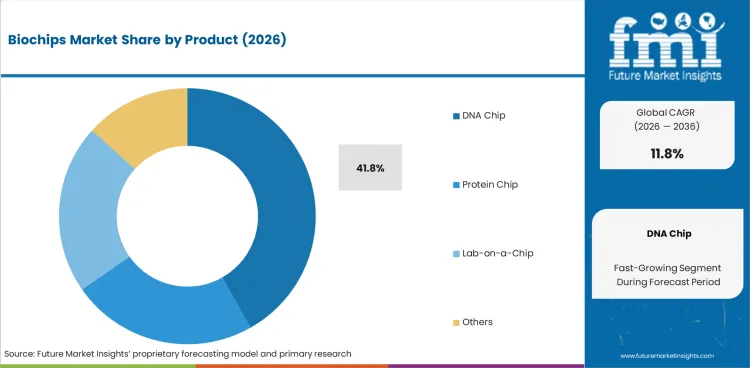
The DNA chip segment, also known as DNA microarray, is projected to hold 41.8% of the biochips market revenue share in 2026, making it the leading product category. Its dominance is being supported by its critical role in gene expression profiling, genotyping, and sequencing applications. DNA chips allow researchers to analyze thousands of genetic sequences simultaneously, providing rapid and precise insights into genetic variations and disease associations.
This efficiency is contributing significantly to the advancement of personalized medicine, where treatments are tailored to individual genetic profiles. The ability of DNA chips to facilitate large-scale genomic studies is also accelerating drug discovery and biomarker identification, strengthening their position in the market.
Continuous improvements in fabrication technologies, coupled with increasing integration with next-generation sequencing and computational biology tools, are enhancing their accuracy and cost-effectiveness With rising global focus on genetic research and growing prevalence of genetic disorders, the DNA chip segment is expected to maintain its leadership as the most widely adopted biochip product type.
Insights into the Drug Discovery and Development Application Segment
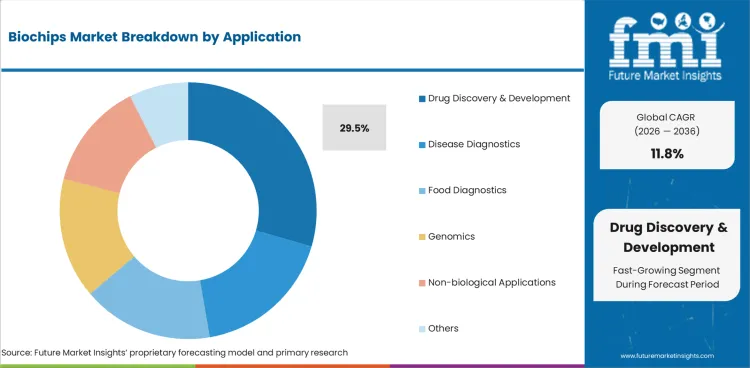
The drug discovery and development segment is anticipated to account for 29.5% of the biochips market revenue share in 2026, positioning it as the leading application segment. This leadership is being driven by the growing use of biochips for high-throughput screening, target validation, and toxicity testing. Biochips enable researchers to conduct parallel experiments on a single platform, significantly reducing both time and costs associated with early-stage drug development.
Their ability to provide precise molecular data is improving the efficiency of identifying potential drug candidates and optimizing therapeutic compounds. The integration of biochips into pharmaceutical R&D pipelines is enhancing predictive modeling and reducing failure rates in clinical trials.
Increasing demand for personalized and precision therapies is further boosting adoption, as biochips facilitate rapid analysis of genetic markers that influence drug response With biopharmaceutical companies investing heavily in accelerating drug discovery timelines and improving efficiency, biochips are expected to play a central role in shaping the future of therapeutic development.
Insights into the Biotech and Life Science Companies End User Segment
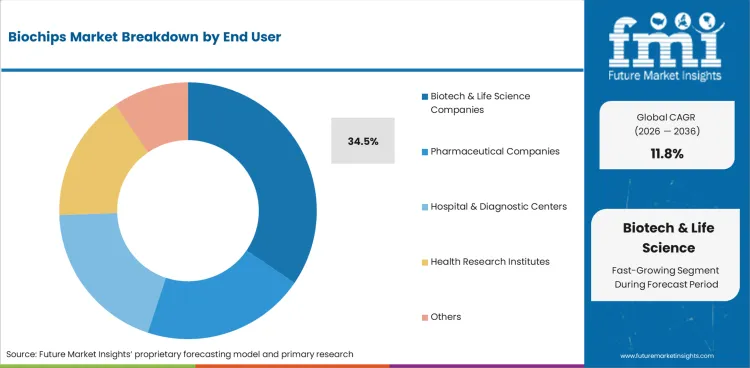
The biotech and life science companies segment is expected to capture 34.5% of the biochips market revenue share in 2026, making it the largest end user category. This dominance is being supported by the increasing reliance of these companies on biochip technologies to drive innovation in genomics, proteomics, and pharmacogenomics.
Biochips are being extensively used in these organizations to streamline workflows, improve productivity, and enhance the accuracy of research outcomes. The segment’s growth is further reinforced by rising investments in biotechnology research and development aimed at advancing diagnostic tools, therapeutic solutions, and next-generation sequencing platforms.
The ability of biochips to deliver scalable and cost-efficient solutions is enabling companies to accelerate their product pipelines and strengthen competitiveness in the global market As biotech and life science companies continue to expand their role in healthcare innovation, their adoption of biochips for both research and commercialization purposes is expected to remain strong, ensuring their leadership in the end-user landscape.
Market Overview
Biochips are small devices resembling integrated circuits built from organic molecules and used for analyzing organic molecules related to living organisms. Biochips are developed based on microfluidic and microarray technology. One type of theoretical biochip is a small device built from large organic molecules such as proteins that can perform the functions like processing and data storage like an electronic computer.
Another type of biochip is a small device that can perform rapid, small-scale biochemical reactions to identify genetic sequences, airborne toxins, environmental pollutants, or other biochemical constituents. Biochips, e.g., lab-on-a-chip, act as minilabs to simultaneously test multiple analyses from a single sample. Biochips save a lot of resources, costs, and time. The device can be used to rapidly screen a wide variety of biological samples in a single system for a wide range of applications, including the detection of hazardous biological agents and disease diagnosis.
2026 to 2026 Biochips Market Demand Outlook Compared to 2026 to 2026 Forecast
The biochips market is estimated to grow at a CAGR of 11.8% for the forecast period.
The use of biochips for disease diagnosis and treatment opens new doors for the biochip industry in the global market. Biochips are increasingly being used as diagnostic tools for diseases such as cancer, as biochips allow doctors to monitor biological processes in patients without the need for invasive procedures such as biopsies.
It also helps detect early signs of illness before symptoms appear, thus allowing doctors to treat patients effectively and prevent full-blown illness later. Biochips can also be embedded in medical devices such as pacemakers and insulin pumps.
This trend will increase the potential for biochips as more patients choose biochips over traditional treatments such as surgery and drugs due to their fewer side effects and improved quality of life.
Increasing use of biochips in personalized medicine
Biochips play an important role in point-of-care diagnostics and molecular diagnostics and are expected to lead to increased demand for biochips in the development of personalized medicine. It is very useful to distinguish between proteins in cancer cells and normal cells. Biochips enable rapid analysis of the entire proteome for protein-based therapeutics. Moreover, these chips are reliable tools for detecting various biomarkers in a limited number of samples and can diagnose and treat diseases, thus increasing the demand for these chips in personalized medicine.
Analysis of Biochips Market By Key Countries
.webp "Top Country Growth Comparison Biochips Market Cagr (2026 2036)")
| Country | CAGR |
|---|---|
| China | 15.9% |
| India | 14.8% |
| Germany | 13.6% |
| France | 12.4% |
| UK | 11.2% |
| USA | 10.0% |
| Brazil | 8.9% |
Country-wise Analysis
The Biochips Market is expected to register a CAGR of 11.8% during the forecast period, exhibiting varied country level momentum. China leads with the highest CAGR of 15.9%, followed by India at 14.8%. Developed markets such as Germany, France, and the UK continue to expand steadily, while the USA is likely to grow at consistent rates. Brazil posts the lowest CAGR at 8.9%, yet still underscores a broadly positive trajectory for the global Biochips Market. In 2024, Germany held a dominant revenue in the Western Europe market and is expected to grow with a CAGR of 13.6%. The USA Biochips Market is estimated to be valued at USD 3.2 billion in 2036 and is anticipated to reach a valuation of USD 8.4 billion by 2026. Sales are projected to rise at a CAGR of 10.0% over the forecast period between 2036 and 2026. While Japan and South Korea markets are estimated to be valued at USD 444.4 million and USD 222.1 million respectively in 2036.
Key Players in the Biochips Market
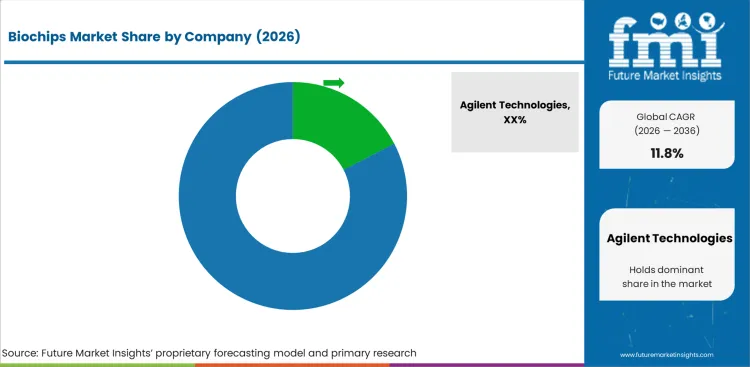
- Agilent Technologies
- Thermo Fisher Scientific
- Takara Bio Inc.
- Cepheid Inc.
- Bio-Rad Laboratories
- Fluidigm Corporation
- PerkinElmer Inc.
- Illumina, Inc.
- OcimumBiosolutions Ltd.
Scope of the Report
| Metric | Value |
|---|---|
| Quantitative Units | USD 9.73 billion to USD 29.67 billion, at a CAGR of 11.8% |
| Market Definition | Biochips are miniaturized platforms that integrate biological recognition elements (DNA probes, protein arrays, or cell-based sensors) onto solid substrates or microfluidic architectures for high-throughput molecular analysis. Product categories include DNA chips (microarrays), protein chips, and lab-on-a-chip (microfluidic) devices. Applications span drug discovery and development, disease diagnostics, food safety testing, genomics research, and non-biological analytical applications. |
| Segmentation | Product: DNA Chip, Protein Chip, Lab-on-a-Chip, Others; Application: Drug Discovery & Development, Disease Diagnostics, Food Diagnostics, Genomics, Non-biological Applications, Others; End User: Biotech & Life Science Companies, Pharmaceutical Companies, Hospital & Diagnostic Centers, Health Research Institutes, Others |
| Regions Covered | North America, Latin America, Europe, East Asia, South Asia, Oceania, Middle East & Africa |
| Countries Covered | China, India, Germany, France, UK, USA, Brazil, and 40 plus countries |
| Key Companies Profiled | Agilent Technologies, Thermo Fisher Scientific, Takara Bio Inc., Cepheid Inc., Bio-Rad Laboratories, Fluidigm Corporation, PerkinElmer Inc., Illumina, Inc., OcimumBiosolutions Ltd. |
| Forecast Period | 2026 to 2036 |
| Approach | Forecasting models apply a bottom-up methodology starting with global production and consumption metrics and projecting adoption rates by region. |
Biochips Market by Segments
By Product:
- DNA Chip (DNA Microarray)
- Protein Chip (Protein Microarray)
- Lab-on-a-Chip (Microfluidic Chip)
- Others
By Application:
- Drug Discovery & Development
- Disease Diagnostics
- Food Diagnostics
- Genomics
- Non-biological Applications
- Others
By End User:
- Biotech & Life Science Companies
- Pharmaceutical Companies
- Hospital & Diagnostic Centers
- Health Research Institutes
- Others
By Region:
- North America
- USA
- Canada
- Mexico
- Latin America
- Brazil
- Chile
- Rest of Latin America
- Western Europe
- Germany
- UK
- Italy
- Spain
- France
- Nordic
- BENELUX
- Rest of Western Europe
- Eastern Europe
- Russia
- Poland
- Hungary
- Balkan & Baltic
- Rest of Eastern Europe
- East Asia
- China
- Japan
- South Korea
- South Asia and Pacific
- India
- ASEAN
- Australia & New Zealand
- Rest of South Asia and Pacific
- Middle East & Africa
- Kingdom of Saudi Arabia
- Other GCC Countries
- Turkiye
- South Africa
- Other African Union
- Rest of Middle East & Africa
Bibliography
- 1. Ministry of Science and Technology, China. (2025). National Key R&D Programme: Precision medicine and genomics infrastructure. MOST.
- 2. Department of Biotechnology, India. (2025). Genome India Project: Progress report and molecular diagnostics expansion. DBT.
- 3. German Federal Ministry of Education and Research. (2024). Microfluidics and lab-on-a-chip research funding programme. BMBF.
- 4. USA Food and Drug Administration. (2025). In vitro diagnostics: Microarray and microfluidic device clearance database. FDA.
- 5. European Commission. (2024). In Vitro Diagnostic Regulation (IVDR 2017/746): Implementation progress for chip-based devices. European Commission.
- 6. World Health Organization. (2025). Essential diagnostics list: Point-of-care molecular testing platforms. WHO.
This bibliography is provided for reader reference. The full Future Market Insights report contains the complete reference list with primary research documentation.
Frequently Asked Questions
How large is the demand for Biochips in the global market in 2026?
Demand for biochips in the global market is estimated to be valued at USD 9.73 billion in 2026.
What will be the market size of Biochips in the global market by 2036?
Market size for biochips is projected to reach USD 29.67 billion by 2036.
What is the expected demand growth for Biochips between 2026 and 2036?
Demand for biochips is expected to grow at a CAGR of 11.8% between 2026 and 2036.
Which Product is poised to lead global sales by 2026?
DNA Chip accounts for 41.8% share in 2026, reflecting its established commercial scale and procurement volume concentration.
How is Application distributed in 2026?
Drug Discovery & Development leads with 29.5% share in 2026, driven by regulatory compliance requirements and end-user specification mandates.
What is China's growth outlook in this report?
China is projected to grow at a CAGR of 15.9% during 2026 to 2036.
What is the scope of this Biochips report?
The report covers market sizing, segmentation analysis, regional forecasts, competitive assessment, and regulatory compliance mapping for the biochips market from 2026 to 2036.
How does FMI build and validate the Biochips forecast?
Forecasting models apply a bottom-up methodology starting with global production and consumption metrics and cross-validate projections against public financial disclosures and trade body statistics.
Preview the report firsthand - request a free sample
Get SampleGet the brochure for pricing and purchase details.
Get PDFTable of Content
- Executive Summary
- Global Market Outlook
- Demand-side Trends
- Supply-side Trends
- Technology Roadmap Analysis
- Analysis and Recommendations
- Market Overview
- Market Coverage / Taxonomy
- Market Definition / Scope / Limitations
- Research Methodology
- Chapter Orientation
- Analytical Lens and Working Hypotheses
- Market Structure, Signals, and Trend Drivers
- Benchmarking and Cross-market Comparability
- Market Sizing, Forecasting, and Opportunity Mapping
- Research Design and Evidence Framework
- Desk Research Programme (Secondary Evidence)
- Company Annual and Sustainability Reports
- Peer-reviewed Journals and Academic Literature
- Corporate Websites, Product Literature, and Technical Notes
- Earnings Decks and Investor Briefings
- Statutory Filings and Regulatory Disclosures
- Technical White Papers and Standards Notes
- Trade Journals, Industry Magazines, and Analyst Briefs
- Conference Proceedings, Webinars, and Seminar Materials
- Government Statistics Portals and Public Data Releases
- Press Releases and Reputable Media Coverage
- Specialist Newsletters and Curated Briefings
- Sector Databases and Reference Repositories
- FMI Internal Proprietary Databases and Historical Market Datasets
- Subscription Datasets and Paid Sources
- Social Channels, Communities, and Digital Listening Inputs
- Additional Desk Sources
- Expert Input and Fieldwork (Primary Evidence)
- Primary Modes
- Qualitative Interviews and Expert Elicitation
- Quantitative Surveys and Structured Data Capture
- Blended Approach
- Why Primary Evidence is Used
- Field Techniques
- Interviews
- Surveys
- Focus Groups
- Observational and In-context Research
- Social and Community Interactions
- Stakeholder Universe Engaged
- C-suite Leaders
- Board Members
- Presidents and Vice Presidents
- R&D and Innovation Heads
- Technical Specialists
- Domain Subject-matter Experts
- Scientists
- Physicians and Other Healthcare Professionals
- Governance, Ethics, and Data Stewardship
- Research Ethics
- Data Integrity and Handling
- Primary Modes
- Tooling, Models, and Reference Databases
- Desk Research Programme (Secondary Evidence)
- Data Engineering and Model Build
- Data Acquisition and Ingestion
- Cleaning, Normalisation, and Verification
- Synthesis, Triangulation, and Analysis
- Quality Assurance and Audit Trail
- Market Background
- Market Dynamics
- Drivers
- Restraints
- Opportunity
- Trends
- Scenario Forecast
- Demand in Optimistic Scenario
- Demand in Likely Scenario
- Demand in Conservative Scenario
- Opportunity Map Analysis
- Product Life Cycle Analysis
- Supply Chain Analysis
- Investment Feasibility Matrix
- Value Chain Analysis
- PESTLE and Porter’s Analysis
- Regulatory Landscape
- Regional Parent Market Outlook
- Production and Consumption Statistics
- Import and Export Statistics
- Market Dynamics
- Global Market Analysis 2021 to 2025 and Forecast, 2026 to 2036
- Historical Market Size Value (USD Million) Analysis, 2021 to 2025
- Current and Future Market Size Value (USD Million) Projections, 2026 to 2036
- Y-o-Y Growth Trend Analysis
- Absolute $ Opportunity Analysis
- Global Market Pricing Analysis 2021 to 2025 and Forecast 2026 to 2036
- Global Market Analysis 2021 to 2025 and Forecast 2026 to 2036, By Product
- Introduction / Key Findings
- Historical Market Size Value (USD Million) Analysis By Product , 2021 to 2025
- Current and Future Market Size Value (USD Million) Analysis and Forecast By Product , 2026 to 2036
- DNA Chip
- Protein Chip
- Lab-on-a-Chip
- Others
- DNA Chip
- Y-o-Y Growth Trend Analysis By Product , 2021 to 2025
- Absolute $ Opportunity Analysis By Product , 2026 to 2036
- Global Market Analysis 2021 to 2025 and Forecast 2026 to 2036, By Application
- Introduction / Key Findings
- Historical Market Size Value (USD Million) Analysis By Application, 2021 to 2025
- Current and Future Market Size Value (USD Million) Analysis and Forecast By Application, 2026 to 2036
- Drug Discovery & Development
- Disease Diagnostics
- Food Diagnostics
- Genomics
- Non-biological Applications
- Others
- Drug Discovery & Development
- Y-o-Y Growth Trend Analysis By Application, 2021 to 2025
- Absolute $ Opportunity Analysis By Application, 2026 to 2036
- Global Market Analysis 2021 to 2025 and Forecast 2026 to 2036, By End User
- Introduction / Key Findings
- Historical Market Size Value (USD Million) Analysis By End User, 2021 to 2025
- Current and Future Market Size Value (USD Million) Analysis and Forecast By End User, 2026 to 2036
- Biotech & Life Science Companies
- Pharmaceutical Companies
- Hospital & Diagnostic Centers
- Health Research Institutes
- Others
- Biotech & Life Science Companies
- Y-o-Y Growth Trend Analysis By End User, 2021 to 2025
- Absolute $ Opportunity Analysis By End User, 2026 to 2036
- Global Market Analysis 2021 to 2025 and Forecast 2026 to 2036, By Region
- Introduction
- Historical Market Size Value (USD Million) Analysis By Region, 2021 to 2025
- Current Market Size Value (USD Million) Analysis and Forecast By Region, 2026 to 2036
- North America
- Latin America
- Western Europe
- Eastern Europe
- East Asia
- South Asia and Pacific
- Middle East & Africa
- Market Attractiveness Analysis By Region
- North America Market Analysis 2021 to 2025 and Forecast 2026 to 2036, By Country
- Historical Market Size Value (USD Million) Trend Analysis By Market Taxonomy, 2021 to 2025
- Market Size Value (USD Million) Forecast By Market Taxonomy, 2026 to 2036
- By Country
- USA
- Canada
- Mexico
- By Product
- By Application
- By End User
- By Country
- Market Attractiveness Analysis
- By Country
- By Product
- By Application
- By End User
- Key Takeaways
- Latin America Market Analysis 2021 to 2025 and Forecast 2026 to 2036, By Country
- Historical Market Size Value (USD Million) Trend Analysis By Market Taxonomy, 2021 to 2025
- Market Size Value (USD Million) Forecast By Market Taxonomy, 2026 to 2036
- By Country
- Brazil
- Chile
- Rest of Latin America
- By Product
- By Application
- By End User
- By Country
- Market Attractiveness Analysis
- By Country
- By Product
- By Application
- By End User
- Key Takeaways
- Western Europe Market Analysis 2021 to 2025 and Forecast 2026 to 2036, By Country
- Historical Market Size Value (USD Million) Trend Analysis By Market Taxonomy, 2021 to 2025
- Market Size Value (USD Million) Forecast By Market Taxonomy, 2026 to 2036
- By Country
- Germany
- UK
- Italy
- Spain
- France
- Nordic
- BENELUX
- Rest of Western Europe
- By Product
- By Application
- By End User
- By Country
- Market Attractiveness Analysis
- By Country
- By Product
- By Application
- By End User
- Key Takeaways
- Eastern Europe Market Analysis 2021 to 2025 and Forecast 2026 to 2036, By Country
- Historical Market Size Value (USD Million) Trend Analysis By Market Taxonomy, 2021 to 2025
- Market Size Value (USD Million) Forecast By Market Taxonomy, 2026 to 2036
- By Country
- Russia
- Poland
- Hungary
- Balkan & Baltic
- Rest of Eastern Europe
- By Product
- By Application
- By End User
- By Country
- Market Attractiveness Analysis
- By Country
- By Product
- By Application
- By End User
- Key Takeaways
- East Asia Market Analysis 2021 to 2025 and Forecast 2026 to 2036, By Country
- Historical Market Size Value (USD Million) Trend Analysis By Market Taxonomy, 2021 to 2025
- Market Size Value (USD Million) Forecast By Market Taxonomy, 2026 to 2036
- By Country
- China
- Japan
- South Korea
- By Product
- By Application
- By End User
- By Country
- Market Attractiveness Analysis
- By Country
- By Product
- By Application
- By End User
- Key Takeaways
- South Asia and Pacific Market Analysis 2021 to 2025 and Forecast 2026 to 2036, By Country
- Historical Market Size Value (USD Million) Trend Analysis By Market Taxonomy, 2021 to 2025
- Market Size Value (USD Million) Forecast By Market Taxonomy, 2026 to 2036
- By Country
- India
- ASEAN
- Australia & New Zealand
- Rest of South Asia and Pacific
- By Product
- By Application
- By End User
- By Country
- Market Attractiveness Analysis
- By Country
- By Product
- By Application
- By End User
- Key Takeaways
- Middle East & Africa Market Analysis 2021 to 2025 and Forecast 2026 to 2036, By Country
- Historical Market Size Value (USD Million) Trend Analysis By Market Taxonomy, 2021 to 2025
- Market Size Value (USD Million) Forecast By Market Taxonomy, 2026 to 2036
- By Country
- Kingdom of Saudi Arabia
- Other GCC Countries
- Turkiye
- South Africa
- Other African Union
- Rest of Middle East & Africa
- By Product
- By Application
- By End User
- By Country
- Market Attractiveness Analysis
- By Country
- By Product
- By Application
- By End User
- Key Takeaways
- Key Countries Market Analysis
- USA
- Pricing Analysis
- Market Share Analysis, 2025
- By Product
- By Application
- By End User
- Canada
- Pricing Analysis
- Market Share Analysis, 2025
- By Product
- By Application
- By End User
- Mexico
- Pricing Analysis
- Market Share Analysis, 2025
- By Product
- By Application
- By End User
- Brazil
- Pricing Analysis
- Market Share Analysis, 2025
- By Product
- By Application
- By End User
- Chile
- Pricing Analysis
- Market Share Analysis, 2025
- By Product
- By Application
- By End User
- Germany
- Pricing Analysis
- Market Share Analysis, 2025
- By Product
- By Application
- By End User
- UK
- Pricing Analysis
- Market Share Analysis, 2025
- By Product
- By Application
- By End User
- Italy
- Pricing Analysis
- Market Share Analysis, 2025
- By Product
- By Application
- By End User
- Spain
- Pricing Analysis
- Market Share Analysis, 2025
- By Product
- By Application
- By End User
- France
- Pricing Analysis
- Market Share Analysis, 2025
- By Product
- By Application
- By End User
- India
- Pricing Analysis
- Market Share Analysis, 2025
- By Product
- By Application
- By End User
- ASEAN
- Pricing Analysis
- Market Share Analysis, 2025
- By Product
- By Application
- By End User
- Australia & New Zealand
- Pricing Analysis
- Market Share Analysis, 2025
- By Product
- By Application
- By End User
- China
- Pricing Analysis
- Market Share Analysis, 2025
- By Product
- By Application
- By End User
- Japan
- Pricing Analysis
- Market Share Analysis, 2025
- By Product
- By Application
- By End User
- South Korea
- Pricing Analysis
- Market Share Analysis, 2025
- By Product
- By Application
- By End User
- Russia
- Pricing Analysis
- Market Share Analysis, 2025
- By Product
- By Application
- By End User
- Poland
- Pricing Analysis
- Market Share Analysis, 2025
- By Product
- By Application
- By End User
- Hungary
- Pricing Analysis
- Market Share Analysis, 2025
- By Product
- By Application
- By End User
- Kingdom of Saudi Arabia
- Pricing Analysis
- Market Share Analysis, 2025
- By Product
- By Application
- By End User
- Turkiye
- Pricing Analysis
- Market Share Analysis, 2025
- By Product
- By Application
- By End User
- South Africa
- Pricing Analysis
- Market Share Analysis, 2025
- By Product
- By Application
- By End User
- USA
- Market Structure Analysis
- Competition Dashboard
- Competition Benchmarking
- Market Share Analysis of Top Players
- By Regional
- By Product
- By Application
- By End User
- Competition Analysis
- Competition Deep Dive
- Agilent Technologies
- Overview
- Product Portfolio
- Profitability by Market Segments (Product/Age /Sales Channel/Region)
- Sales Footprint
- Strategy Overview
- Marketing Strategy
- Product Strategy
- Channel Strategy
- Thermo Fisher Scientific
- Takara Bio Inc.
- Cepheid Inc.
- Bio-Rad Laboratories
- Fluidigm Corporation
- PerkinElmer Inc.
- Illumina, Inc.
- OcimumBiosolutions Ltd.
- Agilent Technologies
- Competition Deep Dive
- Assumptions & Acronyms Used


