

- Industry Size (2025)
- USD 51.7 Mn
- Forecast (2035)
- USD 130.4 Mn
- CAGR (2025 to 2035)
- 9.6%
Dissolving Microneedle Market Size, Market Forecast and Outlook By FMI
The dissolving microneedle market is expected to expand from USD 51.7 million in 2025 to USD 130.4 million by 2035. The market is anticipated to register a 9.6% CAGR during the forecast period. Wrinkle treatment is likely to lead with an 85.3% share, and online stores are projected to account for 41.0% of distribution channel revenue in 2025.
Summary of the Dissolving Microneedle Market
- Demand and Growth Drivers
- Consumer interest in pain-light skincare is expected to lift demand for dissolving microneedle patches across home routines.
- Aesthetic clinics are anticipated to use these patches with serums and procedures for smoother wrinkle care programs.
- Drug delivery research is likely to broaden adoption as patches offer a low-discomfort option for active ingredients.
- Product and Segment View
- Wrinkle treatment is expected to lead the application segment as anti-aging patches match frequent consumer skincare purchases.
- Online stores are likely to keep strong distribution share as buyers use reviews and subscription kits for product selection.
- Acne treatment and clinic-based use are anticipated to add steady demand across dermatology-led skin care programs.
- Geography and Competitive Outlook
- Germany is expected to record the fastest country-level expansion as dermal delivery research gains stronger clinical interest.
- The United Kingdom is likely to advance as chronic disease care and aesthetic use increase device interest.
- Manufacturers with stronger material science and digital retail access are anticipated to strengthen their market position.
- Analyst Opinion
- Sabyasachi Ghosh, Principal Consultant for Healthcare at FMI, suggests, “The dissolving microneedle market is likely to move toward manufacturers able to combine safe biocompatible materials with consumer-friendly patch formats. Brands with stronger dermatology evidence and online selling capability are expected to gain advantage as users seek low-discomfort skincare and future drug delivery options.”
- Dissolving Microneedle Market Value Analysis
- Dissolving microneedle demand is moving from early aesthetic use into a broader skin delivery platform.
- Spending is likely to rise as wrinkle patches offer active ingredient delivery without injections or clinic downtime.
- Adoption is expected to gain traction through online stores as product education improves purchase confidence.
- Investment is anticipated to focus on biodegradable materials and drug delivery trials across cosmetic and therapeutic uses.
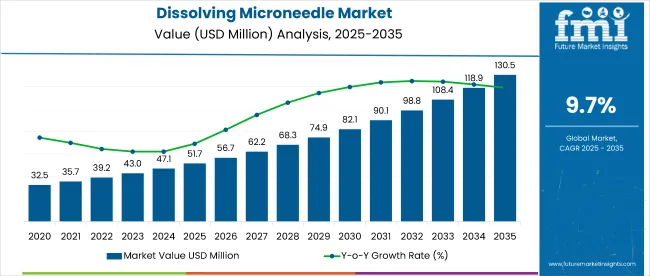
Key Takeaways, Market Size, and Forecast
| Metric | Value |
|---|---|
| Market Size (2025) | USD 51.7 Million |
| Market Size (2035) | USD 130.4 Million |
| CAGR (2025–2035) | 9.6% |
| Leading Application (2025) | Wrinkle Treatment |
| Wrinkle Treatment Share (2025) | 85.3% |
| Leading Distribution Channel (2025) | Online Stores |
| Online Stores Share (2025) | 41.0% |
| Fastest-Growing Country | Germany |
| Germany CAGR | 14.1% |
| Attributes | Details |
|---|---|
| Dissolving Microneedle Market Size (2025) | USD 51.7 million |
| Dissolving Microneedle Market Forecasted Size (2035) | USD 130.4 million |
| Projected Value CAGR (2025 to 2035) | 9.6% |
Analyzing Dissolving Microneedle Market by Top Investment Segments
Wrinkle Treatment Dominates as Aesthetic Demand Soars
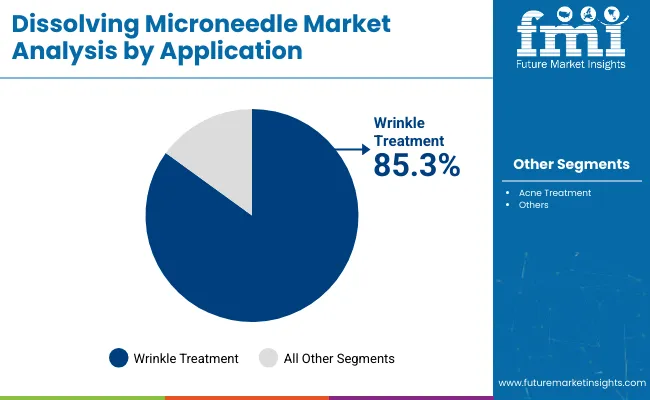
By application, wrinkle treatment holds the dominant position with an 85.3% market share in 2024. This category remains the primary driver of dissolving microneedle adoption, especially among consumers aged 30 and above. These microneedle patches are designed to deliver anti-aging actives directly into the dermal layer without discomfort or downtime.
In 2025, major beauty brands are emphasizing this application in product launches, bundling wrinkle-specific patches with collagen boosters and under-eye serums. Their easy usability and visible results have made them popular for at-home self-care, especially in Asia and North America. Other applications-such as scar reduction, acne treatment, and hyperpigmentation-are gradually gaining momentum, but remain secondary in market share.
Dermatology clinics and medispas are also adopting microneedles for combination treatments. However, over-the-counter availability and the convenience of at-home wrinkle kits continue to dominate the sales landscape. With increasing R&D focused on multi-functional formulations, wrinkle treatment is expected to retain its lead as the most lucrative and innovation-rich segment in the dissolving microneedle space.
Online Channels Lead Distribution with Digital-First Surge
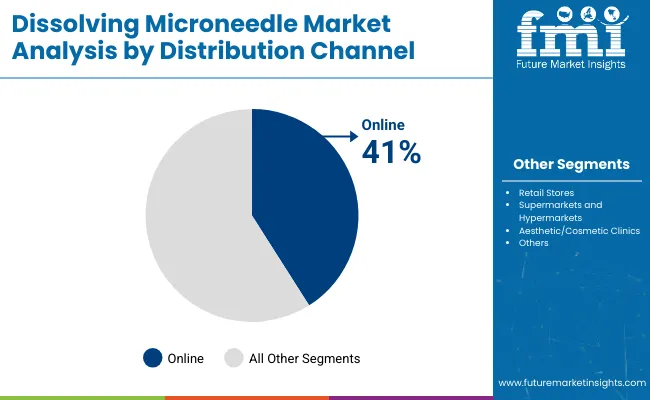
By distribution channel, online stores accounted for 41.0% of the market in 2024 and are expected to maintain momentum through 2035. Digital retail platforms are driving most of the dissolving microneedle sales, supported by influencer marketing, social media engagement, and global logistics reach.
In 2025, skincare brands are offering customized kits via their own websites, marketplaces, and subscription-based delivery. These platforms provide direct consumer feedback, rapid trials, and targeted promotion, especially among younger demographics. Retail pharmacies, assumed to hold around 35% market share, remain important but face limitations in stocking variety and user education.
Clinics and dermatology offices contribute to the remaining share, typically through bundled procedures or targeted in-office sales. In emerging markets, online platforms offer wider access to premium skincare tools not always available in physical retail. As e-commerce ecosystems become more sophisticated and skincare becomes more personalized, online channels are likely to retain their leadership position—driven by convenience, product variety, and digitally native consumer behavior.
2025: Emerging Role of Dissolving Microneedles Market in Diagnostics and Monitoring
Dissolving microneedles are increasingly gaining attention in the field of diagnostics and real-time patient monitoring, especially due to their painless application and biocompatibility. Researchers are leveraging these microneedle arrays to access interstitial fluid (ISF), which contains a wide range of physiological biomarkers comparable to blood. Unlike conventional blood sampling, this method does not require venipuncture, making it suitable for continuous, non-invasive monitoring in clinical and home settings.
- Dissolving microneedles are being developed to painlessly access interstitial fluid, offering a non-invasive alternative to blood sampling for diagnostic purposes.
- These microneedles can detect biomarkers such as glucose, lactate, cortisol, and cytokines, supporting early diagnosis and continuous health monitoring.
- Glucose-monitoring microneedle patches are being designed to help diabetic patients manage their condition without finger pricks or bulky sensors.
Government Regulations in the Dissolving Microneedle Market
Governments across key markets have started formalizing regulations for dissolving microneedles to ensure safe, effective, and standardized use in both cosmetic and pharmaceutical applications. These regulations vary by region but generally assess product safety, material composition, skin penetration depth, and whether the device delivers active ingredients.
- According to the U.S. Food and Drug Administration (FDA), microneedling devices, including dissolving microneedles, are classified either as medical devices or combination products depending on their purpose and composition.
- In Europe, dissolving microneedle products intended for systemic delivery are assessed under existing transdermal patch regulations. The European Medicines Agency (EMA) requires validation of critical product characteristics such as adhesion strength, drug release consistency, and skin permeation performance before market approval is granted.
- In Japan, dissolving microneedle devices are governed by the Pharmaceuticals and Medical Devices Act (PMD Act). These devices are evaluated by the Pharmaceuticals and Medical Devices Agency (PMDA) under a four-tier risk classification system.
Dissolving Microneedle Market Trends and Opportunities
| Attributes | Details |
|---|---|
| Trends |
|
| Opportunities |
|
Dissolving Microneedle Industry Analysis by Region
The scope of dissolving microneedles is lucrative in Europe, owing to inflating discretionary income and a high degree of willingness for cosmetic treatments. Two important places where demand and sales of dissolving microneedles are predicted to be high are Germany and the United Kingdom. Meanwhile, North America is expected to register a comparatively lower demand for dissolving microneedles.
Consumption of this instrument is predicted to expand on account of the rising concentration of manufacturers, amplified marketing, and increasing desire to undergo minimally invasive aesthetic procedures, and continuous advancements.
The promising growth of dissolving microneedle business in the Asia Pacific is predicted to propel investors and stakeholders to increase their stake in this region. The significant influence of the West is predicted to be a key catalyst for the sales of dissolving microneedles for aesthetic purposes. Additionally, increasing the use of these needles for the transdermal delivery of several drugs is predicted to advance the regional market.
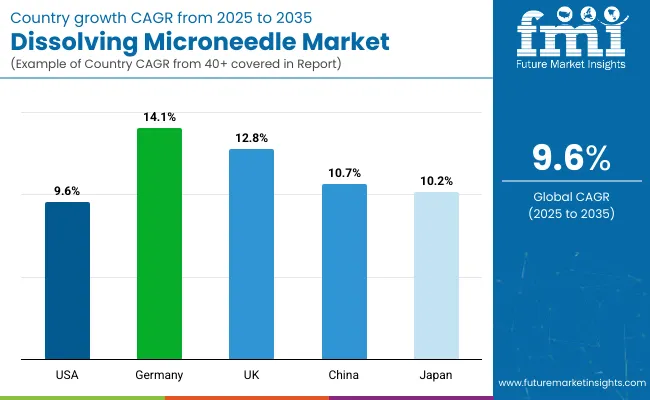
| Country | Forecasted CAGR (2025 to 2035) |
|---|---|
| The United States | 9.6% |
| Germany | 14.1% |
| The United Kingdom | 12.8% |
| China | 10.7% |
| Japan | 10.2% |
The United States is Witnessing Rising Use of Dissolving Microneedles to Deliver Drugs
The United States dissolving microneedle market is expected to lead in North America by a substantial market share. As per the latest estimates by FMI analysts, the market in the United States is projected to register a promising 9.6% CAGR through 2035. Following factors back this growth:
- Surge in consumer spending on cosmetic treatments like acne treatment and wrinkle treatment.
- Increasingly occurring skin diseases in the country.
- Advancing technology of dissolving microneedles allowing it to be used to administer various medications directly into the skin. In 2020, for instance, microneedles were used to deliver viral proteins into the skin to induce an immune response by the University of Connecticut, Vaxess, and Verndari.
- Rising investments in research and development activities to increase the applications of dissolving microneedles.
- Growing concentration of leading manufacturers in the United States.
Dissolving Microneedle Manufacturers Find More Openness for These Instruments in Germany
Germany is a notable market for dissolving microneedles in Europe. The country is estimated by FMI analysts to record an impressive CAGR of 14.1% through 2035. Key factors that are driving this growth are:
- Increasing use of dissolving microneedles to efficiently enhance dermal drug delivery.
- Significant progress made by dissolving microneedles in the field of vaccine delivery, disease diagnosis, and monitoring.
- This instrument exhibits significant potential in clinical treatment. Therefore, manufacturers in the country are investing and increasing their capacity to make full use of this latent opportunity.
- Some common factors that are propelling market growth include the expanding geriatric population, rising patient awareness, and increasing healthcare infrastructure.
Versatility of Dissolving Microneedles in Raising its Application in the United Kingdom
Consumption of dissolving microneedles in the United Kingdom is predicted to shoot up at a CAGR of 12.8% through 2035. Given below are some of the salient growth factors:
- Surging use of dissolving microneedles for the transdermal delivery of several drugs as they are emerging as a versatile drug delivery system.
- Key players in the country are undertaking strategic initiatives like agreements, partnerships, collaboration, and others.
- Increasing market for dissolving microneedles as patients of infectious and chronic diseases is rising at a consistent rate.
Growing Preference for Modern Therapeutic Methods in China is Cultivating a Market for Dissolving Microneedle
The dissolving microneedle market in China is expected to surge at a compounded rate of 10.7% through 2035. The adoption of dissolving microneedles is driven by:
- Accelerating use of dissolving microneedles to deliver drugs into the patient’s body.
- Frequent use of dissolving microneedles in aesthetic procedures like hair development and skin care.
- Emerging demand for cutting-edge therapeutic and medical methods among consumers in China is increasing investments in dissolving microneedles.
Commercialization of Advanced Dissolving Microneedles in Japan Elevating the Market Scope
In Japan, the consumption of dissolving microneedles is projected to increase at a CAGR of 10.2%. The market is supported by following factors:
- Increasing commercialization of dissolving microneedles in Japan is enhancing the market scope in the country.
- Surging rate of skin disorders in the country.
- Rising demand for cutting-edge dermal acne patches.
Top Growth Strategies for the Dissolving Microneedle Market Players in 2024 and Beyond
Several strategies have been devised to help businesses and manufacturers bump up their position in the dissolving microneedle industry. Some of these strategies have been outlined below:
- Diversification of dissolving microneedle offerings beyond primary applications like wrinkle treatment into fields like pain management, vaccine delivery, and chronic disease monitoring.
- Improvement of microneedle designs to enhance drug delivery, elevate user comfort, and target certain skin layers.
- Increase investment in the research of biocompatible and biodegradable materials with improved functionality and safety.
- Capturing new markets in emerging economies that have significant growth potential.
- Strengthening distribution channel of dissolving microneedle by offering them via direct-to-consumer models, online platforms, and partnerships with beauty retailers and pharmacies.
Recent Developments in the Dissolving Microneedle Market
- In 2024, CD Formulation, a contract pharmaceutical formulation development services, declared that it is introducing dissolving microneedle preparation services. This competitive innovation in drug delivery technology offers to revolutionize the healthcare sector and enhance the efficiency and patient comfort.
- Raphas Co., Ltd., in February 2022, reportedly formed a research partnership with Johnson & Johnson to bring progress in skin health solutions. The partnership is aimed at exclusively developing and applying microneedle particles, made of Raphas’ patented Droplet Extension (DEN) technology in skin care products.
- Vice Reversa, which is a next-Gen precision skincare firm, announced in October 2021 that it is investing to expand the company’s geographical presence.
Key Dissolving Microneedle Manufacturers
- CosMED Pharmaceutical Co.Ltd.
- Micron Biomedical, Inc.
- Raphas Co., Ltd
- Nissha Co., Ltd
- Micropoint Technologies
- Small Lab
- Vice Reversa
- NINGBO CHIMED TECHNOLOGY CO., LTD
- Vaxess Technologies, Inc.
- QuadMedicine
- Others
Report Scope Table - Dissolving Microneedle Market
| Report Attributes | Details |
|---|---|
| Current Total Market Size (2025) | USD 51.7 million |
| Projected Market Size (2035) | USD 130.4 million |
| CAGR (2025 to 2035) | 9.6% |
| Base Year for Estimation | 2024 |
| Historical Period | 2020 to 2024 |
| Projections Period | 2025 to 2035 |
| Quantitative Units | USD million for value; Thousand units for volume |
| Applications Analyzed (Segment 1) | Wrinkle Treatment, Acne Treatment |
| Distribution Channels Analyzed (Segment 2) | Retail Stores, Supermarkets and Hypermarkets, Online Stores, Aesthetic/Cosmetic Clinics |
| Regions Covered | North America; Latin America; Western Europe; Eastern Europe; South Asia and Pacific; East Asia; Middle East & Africa |
| Countries Covered | United States, Canada, Germany, United Kingdom, France, Japan, China, India, South Korea, Brazil |
| Key Players Influencing the Market | CosMED Pharmaceutical Co. Ltd., Micron Biomedical, Inc., Raphas Co. Ltd., Nissha Co. Ltd., Micropoint Technologies, Small Lab, Vice Reversa, NINGBO CHIMED TECHNOLOGY CO., LTD, Vaxess Technologies, Inc., QuadMedicine |
| Additional Attributes | Growth in aesthetic and non-invasive skincare, Increased consumer preference for home-based treatments, Rising popularity of online skincare retail |
| Customization and Pricing | Customization and Pricing Available on Request |
Key Segments in the Dissolving Microneedle Market Report
By Application:
- Wrinkle Treatment
- Acne Treatment
By Distribution Channel:
- Retail Stores
- Supermarkets and Hypermarkets
- Online Stores
- Aesthetic/Cosmetic Clinics
By Region:
- North America
- Latin America
- Europe
- Asia Pacific
- Middle East and Africa
Frequently Asked Questions
How Big is the Dissolving Microneedle Market?
The dissolving microneedle industry is estimated to be valued at USD 51.7 million in 2025.
What is the Future Forecast of the Dissolving Microneedle Market?
The dissolving microneedle market size is forecast to surpass USD 130.4 million by 2035.
What is the Projected CAGR for the Dissolving Microneedle Industry?
The CAGR of the dissolving microneedle industry is projected to be around 9.6% through 2035.
Which are the Leading Companies offering Dissolving Microneedle?
CosMED Pharmaceutical Co.Ltd., Micron Biomedical, Inc., and Raphas Co., Ltd are dissolving microneedle industry leaders.
Which Region is Projected to Significantly Appreciate the Market’s Growth?
Europe is expected to make a significant contribution to the overall market growth.
Preview the report firsthand - request a free sample
Get SampleGet the brochure for pricing and purchase details.
Get PDFTable of Content
- 1. Executive Summary
- 2. Market Overview
- 3. Market Background
- 4. Global Market Analysis 2020 to 2024 and Forecast, 2025 to 2035
- 5. Global Market Analysis 2020 to 2024 and Forecast 2025 to 2035, By Application
- 5.1. Wrinkle Treatment
- 5.2. Acne Treatment
- 6. Global Market Analysis 2020 to 2024 and Forecast 2025 to 2035, By Distribution Channel
- 6.1. Retail Stores
- 6.2. Supermarkets & Hypermarkets
- 6.3. Online Stores
- 6.4. Aesthetic/Cosmetic Clinics
- 7. Global Market Analysis 2020 to 2024 and Forecast 2025 to 2035, By Region
- 7.1. North America
- 7.2. Latin America
- 7.3. Western Europe
- 7.4. Eastern Europe
- 7.5. South Asia and Pacific
- 7.6. East Asia
- 7.7. Middle East and Africa
- 8. North America Market Analysis 2020 to 2024 and Forecast 2025 to 2035, By Country
- 9. Latin America Market Analysis 2020 to 2024 and Forecast 2025 to 2035, By Country
- 10. Western Europe Market Analysis 2020 to 2024 and Forecast 2025 to 2035, By Country
- 11. Eastern Europe Market Analysis 2020 to 2024 and Forecast 2025 to 2035, By Country
- 12. South Asia and Pacific Market Analysis 2020 to 2024 and Forecast 2025 to 2035, By Country
- 13. East Asia Market Analysis 2020 to 2024 and Forecast 2025 to 2035, By Country
- 14. Middle East and Africa Market Analysis 2020 to 2024 and Forecast 2025 to 2035, By Country
- 15. Key Countries Market Analysis
- 16. Market Structure Analysis
- 17. Competition Analysis
- 17.1. CosMED Pharmaceutical Co.Ltd.
- 17.2. Micron Biomedical, Inc.
- 17.3. Raphas Co., Ltd
- 17.4. Nissha Co., Ltd
- 17.5. Micropoint Technologies
- 17.6. Vice Reversa
- 17.7. NINGBO CHIMED TECHNOLOGY CO., LTD
- 17.8. Vaxess Technologies, Inc.
- 17.9. QuadMedicine
- 18. Assumptions & Acronyms Used
- 19. Research Methodology


