

- Industry Size (2026)
- USD 1.88 Bn
- Forecast (2036)
- USD 2.38 Bn
- CAGR (2026 to 2036)
- 2.7%
Perchloroethylene Market Size, Market Forecast and Outlook By FMI
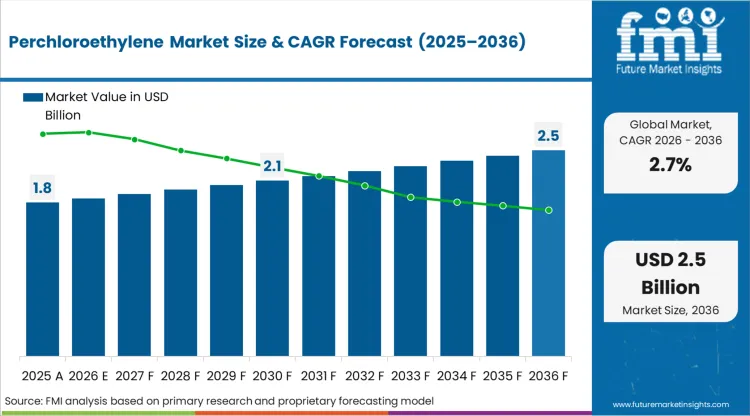
In 2025, the perchloroethylene market was valued at USD 1.83 billion. Based on Future Market Insights' analysis, demand is estimated to reach USD 1.88 billion in 2026 and USD 2.38 billion by 2035, before rising further to approximately USD 2.45 billion by 2036. This trajectory reflects a CAGR of 2.7% during the forecast period.
Absolute dollar growth of more than USD 570 million between 2026 and 2036 signals a market expanding at a modest pace, constrained by regulatory restrictions and substitution pressures while maintaining baseline demand in established industrial applications. This value uplift reflects price adjustments and sustained consumption in niche applications rather than significant volume expansion.
Summary of Perchloroethylene Market
- Demand Drivers in the Market:
- Dry cleaning industry requirements where PCE remains the solvent of record for professional fabric cleaning, accounting for 39.5% of market consumption due to its effectiveness on oil-based stains, safety for user when properly handled, and minimal fabric shrinkage.
- Metal degreasing applications in automotive, aerospace, and general manufacturing where PCE's solvency power removes oils and greases from metal parts without residue.
- Chemical intermediate uses in the production of fluorocarbons and other specialty chemicals, providing baseline demand independent of solvent applications.
- Key Segments Analyzed in the FMI Report:
- Production Method: Ethylene oxychlorination, which accounts for 47.2% of market value in 2026 due to higher yield, lower production costs, and reduced environmental impact compared to alternative processes.
- Application: Dry cleaning, capturing 39.5% of market value as the largest application segment, driven by professional fabric cleaning requirements.
- Analyst Opinion at FMI:
- Nikhil Kaitwade, principal consultant for Chemicals & Materials at Future Market Insights states, "In the updated Perchloroethylene Market Report, procurement specialists and environmental compliance officers will observe how regulatory pressure has bifurcated the market into regulated regions with declining consumption and industrializing regions with sustained demand. The EPA's active promotion of safe handling and disposal practices, combined with state-level restrictions, shapes North American consumption patterns."
- Strategic Implications/Executive Takeaways:
- Prioritize closed-loop recycling and recovery system development that enables customers to meet emission standards while maintaining PCE consumption in regulated markets.
- Align product portfolios with industrial degreasing applications where substitution pressures are less intense than in dry cleaning, focusing on automotive and aerospace manufacturing requirements.
- Build technical service capabilities that help customers optimize solvent use, implement recovery systems, and navigate compliance documentation, creating value beyond solvent supply.
- Methodology:
- The market view is grounded in primary input from dry cleaning equipment manufacturers, industrial cleaning service providers, and chemical distributors, and in regulatory and technical sources focused on solvent regulations and industrial cleaning, avoiding reliance on secondary market research reports from competing providers.
North America, Europe, and Asia-Pacific account for the bulk of revenues through 2036, but the underlying demand logic is distinct in each region. In North America, EPA regulations governing PCE handling and emission controls shape consumption patterns, with dry cleaning and metal degreasing remaining core applications despite compliance costs.
In Europe, stringent REACH restrictions and national phase-outs drive substitution toward alternative cleaning technologies, limiting growth potential. Across Asia-Pacific, industrial expansion in manufacturing and metalworking sustains demand, though tightening environmental enforcement gradually influences consumption patterns.
Perchloroethylene Market Definition
Perchloroethylene (PCE), also known as tetrachloroethylene, is a chlorinated solvent with high solvency power, chemical stability, and non-flammability, produced primarily through ethylene oxychlorination and other chlorination processes. For this report, the market covers PCE used in dry cleaning operations, metal degreasing applications, chemical intermediate production, and automotive manufacturing processes where its unique solvent properties enable cleaning and degreasing functions that alternative chemistries cannot fully replicate.
Perchloroethylene Market Inclusions
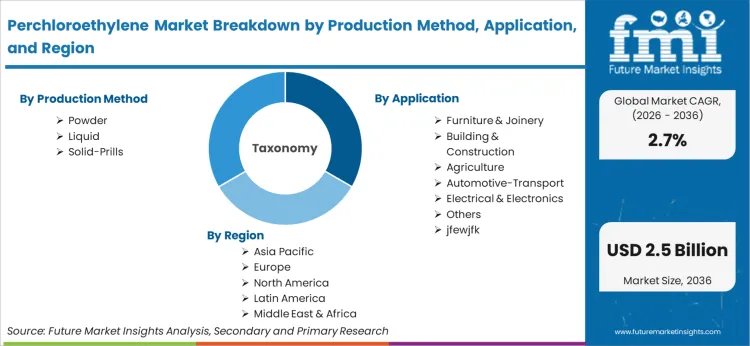
The report provides a comprehensive analysis of the perchloroethylene market, covering global and regional market sizes in value terms and a 10-year forecast from 2026 to 2036. It includes segmental breakdowns by production method and application, across core regions including North America, Latin America, Western Europe, Eastern Europe, East Asia, South Asia & Pacific, and the Middle East & Africa.
Perchloroethylene Market Exclusions
The scope excludes other chlorinated solvents such as trichloroethylene, methylene chloride, and carbon tetrachloride unless they are part of a product family marketed primarily as perchloroethylene. It also omits PCE used as a feedstock for fluorocarbon production where the end use falls outside traditional solvent applications. Very low-volume, custom-formulated PCE grades for specialized research applications that do not contribute meaningfully to global revenue pools are likewise outside the quantified scope.
Perchloroethylene Market Research Methodology
- Primary research: Structured interviews were conducted with dry cleaning equipment manufacturers, industrial cleaning service providers, metalworking facility managers, and chemical distributors on consumption patterns, substitution pressures, pricing dynamics, and regional regulatory impacts.
- Desk research: Technical documentation and application guides from major perchloroethylene manufacturers, together with government publications on solvent regulations and industry association reports on cleaning technologies, were assessed to benchmark performance and to align market modeling with the latest data on regulatory developments and industrial activity.
- Market-sizing and forecasting: A hybrid top-down and bottom-up modeling framework was applied, reconstructing perchloroethylene demand from dry cleaning establishment counts, metalworking industry output, and chemical intermediate production, then validating outputs against publicly available data from government statistical agencies and industry associations.
- Data validation and update cycle: Model outputs undergo consistency checks across regions, production methods, and applications, with iterative calibration using new regulatory guidance, manufacturer capacity announcements, and emerging substitution technology adoption data.
Segment Analaysis
Perchloroethylene Market Analysis by Production Method
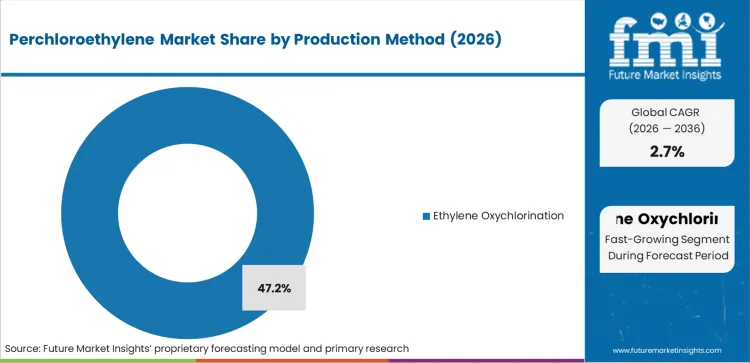
Based on FMI's perchloroethylene market assessment, Ethylene Oxychlorination constitutes 47.2% of global market value in 2025, establishing its position as the leading production technology. This method's dominance reflects its superior yield from raw materials, lower production costs, and reduced environmental footprint compared to alternative processes. The catalytic process requires ethylene, hydrogen chloride, and oxygen, enabling more sustainable and commercially viable operation than traditional chlorination methods.
The ethylene oxychlorination method provides better selectivity, lower energy consumption, and produces perchloroethylene at higher purity levels with fewer impurities. As environmental regulations tighten globally, manufacturers increasingly adopt this cleaner production approach, reinforcing its market leadership. Ongoing improvements in catalysis technology continue to enhance production efficiency and environmental performance, further strengthening this method's position.
Perchloroethylene Market Analysis by Application
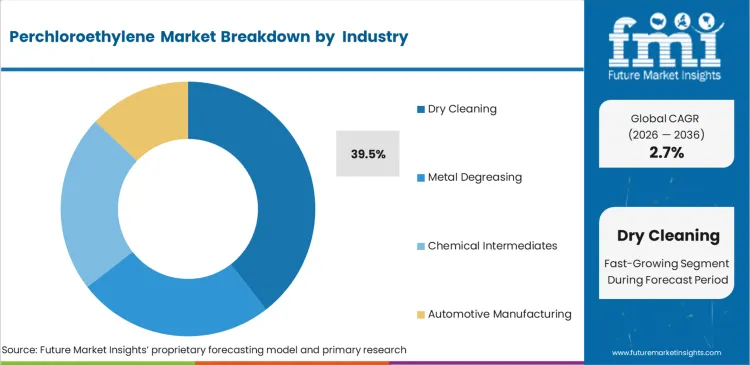
Dry Cleaning represents the largest application segment for perchloroethylene, capturing 39.5% of market value in 2025. PCE remains the industry standard solvent for professional fabric cleaning due to its exceptional effectiveness on oil-based stains, safety profile when properly handled, and minimal fabric shrinkage compared to water-based alternatives. Despite competition from hydrocarbon and silicone-based cleaning agents positioned as safer alternatives, PCE maintains its dominant position due to established equipment infrastructure and proven cleaning performance.
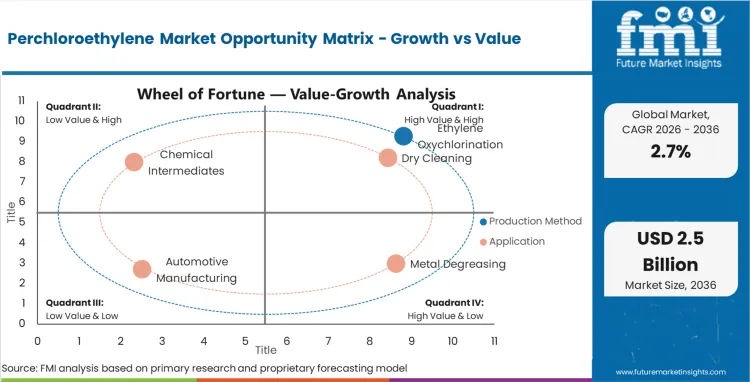
Metal Degreasing applications consume significant PCE volumes in automotive manufacturing, aerospace component cleaning, and general industrial parts washing. PCE's solvency power removes oils, greases, and machining fluids without leaving residues that could interfere with subsequent coating or assembly operations. Chemical Intermediates applications include PCE use in fluorocarbon production and other specialty chemical synthesis. Automotive Manufacturing encompasses additional cleaning applications throughout vehicle production.
Perchloroethylene Market Drivers, Restraints, Opportunities and Trends
Drivers
Dry Cleaning Industry Infrastructure
The professional dry cleaning industry's substantial installed equipment base designed specifically for PCE creates structural demand that persists despite regulatory pressure. Dry cleaning machines engineered for PCE operation, solvent recovery systems, and established cleaning procedures represent capital investments that operators cannot quickly abandon . PCE's unmatched ability to remove oil-based stains from delicate fabrics while preserving garment integrity maintains its position as the solvent of record for professional cleaners.
Metalworking Industry Requirements
Automotive, aerospace, and general manufacturing industries require precision cleaning of metal components before assembly, coating, or inspection. PCE's high solvency power, chemical stability, and non-flammability make it effective for removing oils, greases, and machining fluids from complex part geometries . Critical applications where cleaning failures could cause product defects or performance issues drive continued specification.
Chemical Intermediate Demand
PCE serves as a feedstock for fluorocarbon production and other specialty chemical synthesis, creating demand independent of solvent applications. These chemical intermediate uses often occur in controlled industrial settings where emission controls and worker protection measures can be implemented more readily than in distributed dry cleaning operations .
Restraints
Stringent Environmental Regulations
Perchloroethylene faces extensive regulatory restrictions across major markets due to environmental persistence and potential health impacts. The EPA has implemented strict requirements for PCE handling, emission controls, and disposal, increasing compliance costs for users . The European Union has restricted PCE use in certain applications, driving substitution toward alternative cleaning technologies. These regulatory pressures limit market expansion and accelerate decline in regulated regions.
Health and Safety Concerns
PCE exposure is linked to neurological effects and classified as a potential carcinogen, creating health concerns for workers in dry cleaning and industrial cleaning applications. Growing awareness of these risks drives some users to substitute alternative cleaning technologies despite higher costs or performance trade-offs. Occupational safety requirements increase operating costs for facilities continuing PCE use.
Opportunities
Closed-Loop Recovery Systems
Development of advanced solvent recovery and recycling systems enables PCE users to meet emission standards while maintaining solvent consumption. Closed-loop equipment that captures and recycles PCE reduces environmental releases and solvent purchase requirements, improving economic and environmental performance. Manufacturers supplying integrated systems that combine PCE with recovery technology capture value beyond solvent sales.
Specialized Industrial Applications
In precision manufacturing applications where alternative cleaning technologies cannot match PCE's performance, sustained demand creates opportunities for suppliers focused on industrial segments. Aerospace component cleaning, critical automotive parts and specialty manufacturing applications where cleaning failures risk product performance provide niches where PCE remains essential.
Regional Analysis
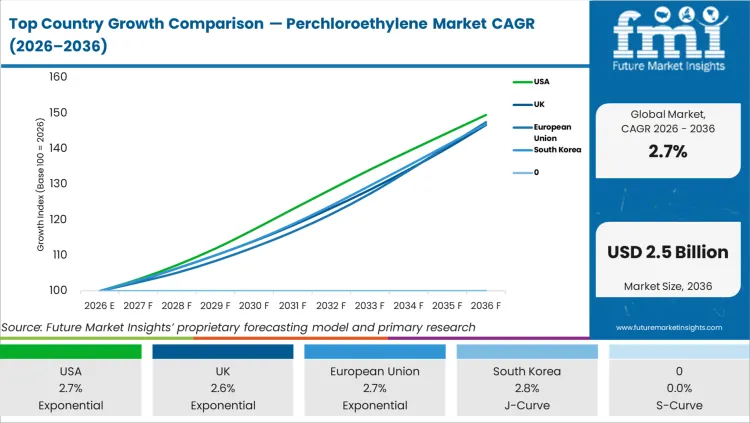
| Countries | Value CAGR (2026 to 2036) |
|---|---|
| United States | 2.7% |
| United Kingdom | 2.6% |
| European Union | 2.7% |
| South Korea | 2.8% |
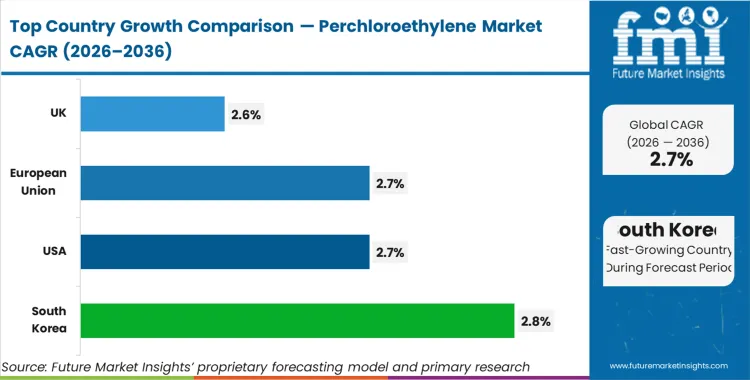
Source: Future Market Insights analysis, supported by proprietary forecasting model and primary research
United States
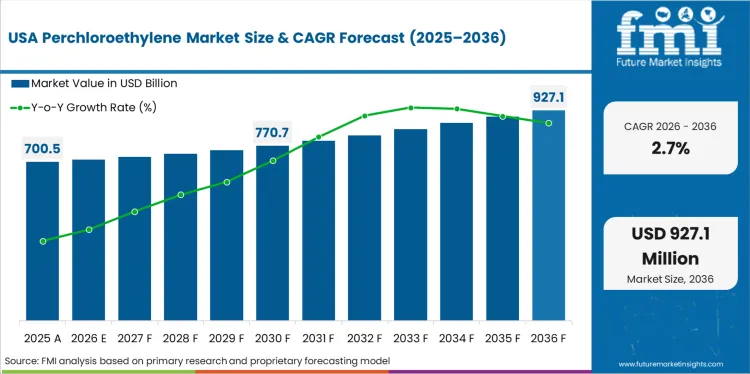
The United States perchloroethylene market is projected to grow at a 2.7% CAGR from 2026 to 2036, reflecting steady demand from dry cleaning, metal degreasing, and chemical manufacturing applications. The EPA has been active in promoting safe handling and disposal practices, with regulations shaping consumption patterns without eliminating PCE use entirely. Research and development efforts focused on eco-friendly substitutes have gained momentum, with companies developing PCE-based solutions aligned with evolving environmental standards.
United Kingdom
The United Kingdom's market is forecast to grow at a 2.6% CAGR from 2026 to 2036, shaped by evolving environmental policies and substitution pressures. Despite increasingly stringent environmental oversight, demand continues in niche cleaning applications and selected industrial uses. Ongoing research into eco-friendly solutions influences market dynamics while maintaining baseline PCE consumption in applications where alternatives cannot match performance.
European Union
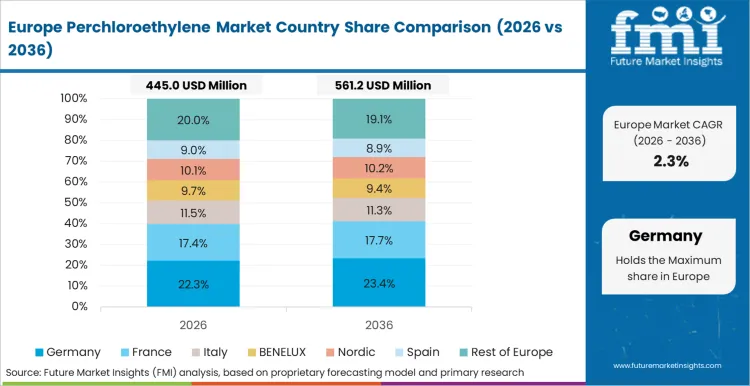
The European Union perchloroethylene market is projected to grow at a 2.7% CAGR from 2026 to 2036. Strict environmental regulations shape market development, with PCE use limited in dry cleaning and other applications . Demand persists for precision degreasing and chemical production processes where alternatives have not achieved full performance equivalence. Member states including Germany and France invest in technologies enabling compliance with eco-friendly chemical production requirements.
South Korea
South Korea's perchloroethylene market is expected to grow at a 2.8% CAGR from 2026 to 2036, the highest among key countries. Application in manufacturing and industrial cleaning drives demand, supported by the country's automotive and electronics production. Increasing environmental awareness promotes gradual adoption of alternative solvents, though cost-effective production methods and continued industrial expansion sustain PCE consumption. Investment in waste management enhancement and safety system improvements shapes market practices.
Competitive Aligners for Market Players
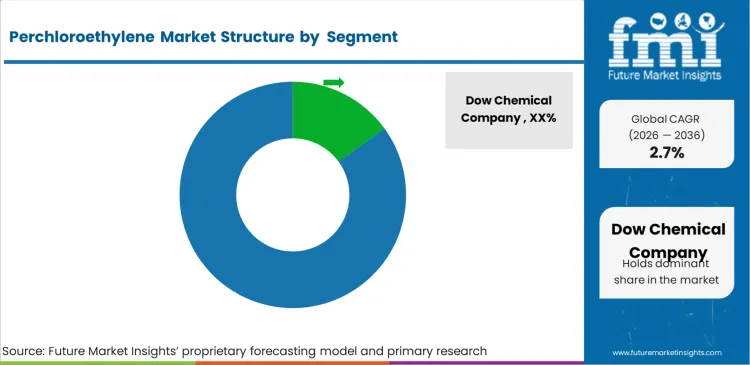
The perchloroethylene market features a concentrated group of global chemical manufacturers with integrated chlor-alkali production and chlorinated solvent expertise. Competitive positioning hinges on production efficiency, environmental compliance capabilities, and relationships with industrial customers.
Leading players such as Dow Chemical Company, Occidental Chemical Corporation, and Westlake Chemical Corporation leverage their integrated production networks and chlorinated solvent experience to serve dry cleaning, metalworking, and chemical intermediate customers.
Their scale provides cost advantages in ethylene oxychlorination production and resources to invest in environmental compliance systems. Solvay S.A. brings specialty chemical expertise and high-purity grades for electronics applications . PPG Industries, Inc. integrates PCE into industrial coatings formulations, creating captive demand through vertical integration.
From a strategic perspective, differentiation is moving beyond basic solvent production toward demonstrable capability in three areas. These include closed-loop recovery system integration that helps customers meet emission standards; regulatory compliance support navigating complex environmental requirements; and alternative technology development positioning for market transition.
Recent Developments:
- Dow Chemical Company launched an eco-friendly perchloroethylene variant with lower emissions in March 2024 and expanded its North American production capacity in January 2025, demonstrating commitment to the market while addressing environmental concerns.
- Occidental Chemical Corporation enhanced its waste management system for safer PCE residue disposal in April 2024 and partnered with environmental agencies to improve regulatory compliance in February 2025.
- Solvay S.A. introduced a high-purity grade perchloroethylene for the electronics sector in May 2024 and developed a closed-loop recycling system to minimize solvent waste in March 2025.
- Westlake Chemical Corporation expanded its Asia-Pacific distribution network in June 2024 and invested in research and development for biodegradable solvent alternatives in February 2025.
Key Players Profiled
- Dow Chemical Company
- Occidental Chemical Corporation
- Solvay S.A.
- Westlake Chemical Corporation
- PPG Industries, Inc.
- Arkema S.A.
- INEOS Group
- AGC Inc.
- Kanto Denka Kogyo Co., Ltd.
- Gujarat Alkalies and Chemicals Limited
Scope of the Report
| Metric | Value |
|---|---|
| Quantitative Units | USD 1.88 billion (2026) to approximately USD 2.45 billion (2036), at a CAGR of 2.7%, with 2025 historic value of USD 1.83 billion |
| Market Definition | Perchloroethylene (PCE) is a chlorinated solvent with high solvency power, chemical stability, and non-flammability, produced primarily through ethylene oxychlorination, used in dry cleaning, metal degreasing, chemical intermediates, and automotive manufacturing. |
| Production Method Segmentation | Ethylene Oxychlorination (47.2% in 2025); Others |
| Application Coverage | Dry Cleaning (39.5% in 2025); Metal Degreasing; Chemical Intermediates; Automotive Manufacturing; Others |
| Regions Covered | North America, Latin America, Western Europe, Eastern Europe, East Asia, South Asia & Pacific, Middle East & Africa |
| Countries Covered | United States, United Kingdom, European Union, South Korea |
| Key Companies Profiled | Dow Chemical Company; Occidental Chemical Corporation; Solvay S.A.; Westlake Chemical Corporation; PPG Industries, Inc.; Arkema S.A.; INEOS Group; AGC Inc.; Kanto Denka Kogyo Co., Ltd.; Gujarat Alkalies and Chemicals Limited |
| Forecast Period | 2026 to 2036 |
| Approach | Hybrid top-down and bottom-up market modeling validated through primary interviews with dry cleaning equipment manufacturers, industrial cleaning service providers, and chemical distributors, supported by benchmarking against regulatory impact assessments and industrial production statistics. |
Perchloroethylene Market Analysis by Segments
Production Method:
- Ethylene Oxychlorination
- Others
Application:
- Dry Cleaning
- Metal Degreasing
- Chemical Intermediates
- Automotive Manufacturing
- Others
Region:
- North America
- Latin America
- Western Europe
- Eastern Europe
- East Asia
- South Asia & Pacific
- Middle East & Africa
Bibliography
- USA Environmental Protection Agency. (2025). Perchloroethylene (PCE) regulation and safe handling guidelines. EPA Chemical Data Reporting.
- European Chemicals Agency. (2024). Perchloroethylene restriction under REACH. ECHA.
- International Agency for Research on Cancer. (2023). Tetrachloroethylene (IARC Monographs on the Evaluation of Carcinogenic Risks to Humans). IARC.
- United Nations Environment Programme. (2025). Global chemicals outlook. UNEP.
- International Labour Organization. (2024). Occupational safety and health guidelines for chlorinated solvent use. ILO.
- U.S. Geological Survey. (2025). Mineral commodity summaries: Chlorine and chlorinated solvents. USGS.
- European Commission. (2024). Study on the substitution of hazardous chemicals in industrial applications. Publications Office of the European Union.
- American Dry Cleaning Institute. (2025). Industry technology and solvent use survey. ADCI.
- National Association of Chemical Distributors. (2024). Chlorinated solvents handling and compliance guide. NACD.
- United Nations Comtrade Database. (2025). Chemical products international trade statistics. UN Comtrade.
- United Nations Industrial Development Organization. (2025). International Yearbook of Industrial Statistics. UNIDO.
- German Federal Environment Agency. (2024). Perchloroethylene emissions and control technologies. UBA.
- Ministry of Environment, South Korea. (2025). Chemical substances management and safety standards. MOE Korea.
- UK Health and Safety Executive. (2024). Perchloroethylene in dry cleaning: Workplace exposure limits. HSE.
This Report Addresses
- Market intelligence to enable structured strategic decision-making across perchloroethylene manufacturers, industrial cleaning service providers, and industry investors.
- Market size estimation and 10-year revenue forecasts from 2026 to 2036, including validated CAGR and absolute dollar opportunity sizing.
- Growth opportunity mapping across Production Method, Application, and regional demand pockets, with emphasis on ethylene oxychlorination production and dry cleaning consumption patterns.
- Segment and regional forecasting covering ethylene oxychlorination production and dry cleaning applications, alongside application-specific demand trajectories across metal degreasing and chemical intermediates.
- Competition strategy assessment, including production efficiency, environmental compliance capabilities, and buyer leverage dynamics shaping sourcing decisions.
- Product and technology tracking focused on closed-loop recovery systems, emission control technologies, and alternative solvent development.
- Regional regulatory analysis covering environmental restrictions, substitution pressures, and industrial activity trends influencing perchloroethylene procurement.
- Report delivery in PDF, Excel, and presentation-ready formats to support executive planning, capacity investment decisions, and competitive benchmarking.
Frequently Asked Questions
What is the size of the global perchloroethylene market in 2025 and how fast is it expected to grow through 2036?
The global perchloroethylene market is valued at USD 1.83 billion in 2025 and is projected to grow at a 2.7% CAGR, reaching about USD 1.88 billion in 2026 and approximately USD 2.45 billion by 2036.
Why does Ethylene Oxychlorination hold 47.2% of the market in 2025?
Ethylene oxychlorination leads because it provides higher yield from raw materials, lower production costs, and reduced environmental impact compared to alternative processes. The catalytic process using ethylene, hydrogen chloride, and oxygen enables more sustainable and commercially viable operation.
What drives Dry Cleaning as the largest application segment at 39.5%?
Dry cleaning represents the largest application due to PCE's unmatched effectiveness on oil-based stains, safety profile when properly handled, minimal fabric shrinkage, and substantial installed equipment base designed specifically for PCE operation.
How do environmental regulations affect perchloroethylene consumption?
Stringent regulations including EPA handling requirements and European Union restrictions limit market expansion and accelerate substitution in regulated regions. Compliance costs increase operating expenses, while outright bans in certain applications eliminate consumption.
What role does the metalworking industry play in market demand?
Automotive, aerospace, and general manufacturing require precision cleaning of metal components before assembly or coating. PCE's high solvency power, chemical stability, and non-flammability make it effective for removing oils and greases from complex part geometries.
Why is the United States market projected to grow at a 2.7% CAGR?
The United States' 2.7% CAGR reflects steady demand from dry cleaning, metal degreasing, and chemical manufacturing applications, shaped by EPA regulations promoting safe handling without eliminating PCE use entirely.
What drives the European Union's 2.7% growth forecast?
The European Union's 2.7% CAGR reflects demand persistence in precision degreasing and chemical production where alternatives have not achieved full performance equivalence, despite strict regulatory restrictions limiting dry cleaning applications.
How does South Korea achieve 2.8% growth?
South Korea's 2.8% CAGR is driven by manufacturing and industrial cleaning demand supporting automotive and electronics production, though increasing environmental awareness promotes gradual adoption of alternative solvents .
What factors contribute to the United Kingdom's 2.6% growth forecast?
The United Kingdom's 2.6% CAGR reflects evolving environmental policies and substitution pressures, with demand continuing in niche cleaning applications and selected industrial uses where alternatives cannot match performance .
How are leading manufacturers like Dow Chemical positioning in the market?
Dow Chemical launched an eco-friendly perchloroethylene variant with lower emissions and expanded North American production capacity, demonstrating commitment to the market while addressing environmental concerns through product innovation.
What is Occidental Chemical Corporation's strategic focus?
Occidental enhanced its waste management system for safer PCE residue disposal and partnered with environmental agencies to improve regulatory compliance, focusing on responsible solvent management.
How does Solvay address specialty applications?
Solvay introduced high-purity grade perchloroethylene for the electronics sector and developed a closed-loop recycling system to minimize solvent waste, targeting specialized industrial segments with premium products.
What are the main health concerns associated with PCE exposure?
PCE exposure is linked to neurological effects and classified as a potential carcinogen, creating health concerns for workers in dry cleaning and industrial cleaning applications that drive some users toward alternative technologies.
How do closed-loop recovery systems create market opportunities?
Advanced solvent recovery and recycling systems enable PCE users to meet emission standards while maintaining solvent consumption. Equipment capturing and recycling PCE reduces environmental releases and solvent purchase requirements.
What opportunities exist in specialized industrial applications?
In precision manufacturing applications where alternative cleaning technologies cannot match PCE's performance, sustained demand creates niches where PCE remains essential.
How do chemical intermediate applications differ from solvent uses?
PCE serving as feedstock for fluorocarbon production and specialty chemical synthesis occurs in controlled industrial settings where emission controls and worker protection measures can be implemented more readily than in distributed dry cleaning operations.
What role does the installed equipment base play in market persistence?
Dry cleaning machines engineered for PCE operation, solvent recovery systems, and established cleaning procedures represent capital investments that operators cannot quickly abandon, creating structural demand that persists despite regulatory pressure.
How do substitution pressures vary by application?
Substitution pressures are most intense in dry cleaning where alternative solvents including hydrocarbons and silicone-based cleaners compete, while industrial degreasing applications where cleaning failures risk product performance face less substitution pressure.
Preview the report firsthand - request a free sample
Get SampleGet the brochure for pricing and purchase details.
Get PDFTable of Content
- Executive Summary
- Global Market Outlook
- Demand-side Trends
- Supply-side Trends
- Technology Roadmap Analysis
- Analysis and Recommendations
- Market Overview
- Market Coverage / Taxonomy
- Market Definition / Scope / Limitations
- Research Methodology
- Chapter Orientation
- Analytical Lens and Working Hypotheses
- Market Structure, Signals, and Trend Drivers
- Benchmarking and Cross-market Comparability
- Market Sizing, Forecasting, and Opportunity Mapping
- Research Design and Evidence Framework
- Desk Research Programme (Secondary Evidence)
- Company Annual and Sustainability Reports
- Peer-reviewed Journals and Academic Literature
- Corporate Websites, Product Literature, and Technical Notes
- Earnings Decks and Investor Briefings
- Statutory Filings and Regulatory Disclosures
- Technical White Papers and Standards Notes
- Trade Journals, Industry Magazines, and Analyst Briefs
- Conference Proceedings, Webinars, and Seminar Materials
- Government Statistics Portals and Public Data Releases
- Press Releases and Reputable Media Coverage
- Specialist Newsletters and Curated Briefings
- Sector Databases and Reference Repositories
- FMI Internal Proprietary Databases and Historical Market Datasets
- Subscription Datasets and Paid Sources
- Social Channels, Communities, and Digital Listening Inputs
- Additional Desk Sources
- Expert Input and Fieldwork (Primary Evidence)
- Primary Modes
- Qualitative Interviews and Expert Elicitation
- Quantitative Surveys and Structured Data Capture
- Blended Approach
- Why Primary Evidence is Used
- Field Techniques
- Interviews
- Surveys
- Focus Groups
- Observational and In-context Research
- Social and Community Interactions
- Stakeholder Universe Engaged
- C-suite Leaders
- Board Members
- Presidents and Vice Presidents
- R&D and Innovation Heads
- Technical Specialists
- Domain Subject-matter Experts
- Scientists
- Physicians and Other Healthcare Professionals
- Governance, Ethics, and Data Stewardship
- Research Ethics
- Data Integrity and Handling
- Primary Modes
- Tooling, Models, and Reference Databases
- Desk Research Programme (Secondary Evidence)
- Data Engineering and Model Build
- Data Acquisition and Ingestion
- Cleaning, Normalisation, and Verification
- Synthesis, Triangulation, and Analysis
- Quality Assurance and Audit Trail
- Market Background
- Market Dynamics
- Drivers
- Restraints
- Opportunity
- Trends
- Scenario Forecast
- Demand in Optimistic Scenario
- Demand in Likely Scenario
- Demand in Conservative Scenario
- Opportunity Map Analysis
- Product Life Cycle Analysis
- Supply Chain Analysis
- Investment Feasibility Matrix
- Value Chain Analysis
- PESTLE and Porter’s Analysis
- Regulatory Landscape
- Regional Parent Market Outlook
- Production and Consumption Statistics
- Import and Export Statistics
- Market Dynamics
- Global Market Analysis 2021 to 2025 and Forecast, 2026 to 2036
- Historical Market Size Value (USD Million) Analysis, 2021 to 2025
- Current and Future Market Size Value (USD Million) Projections, 2026 to 2036
- Y-o-Y Growth Trend Analysis
- Absolute $ Opportunity Analysis
- Global Market Pricing Analysis 2021 to 2025 and Forecast 2026 to 2036
- Global Market Analysis 2021 to 2025 and Forecast 2026 to 2036, By Production Method
- Introduction / Key Findings
- Historical Market Size Value (USD Million) Analysis By Production Method , 2021 to 2025
- Current and Future Market Size Value (USD Million) Analysis and Forecast By Production Method , 2026 to 2036
- Ethylene Oxychlorination
- Ethylene Oxychlorination
- Y-o-Y Growth Trend Analysis By Production Method , 2021 to 2025
- Absolute $ Opportunity Analysis By Production Method , 2026 to 2036
- Global Market Analysis 2021 to 2025 and Forecast 2026 to 2036, By Application
- Introduction / Key Findings
- Historical Market Size Value (USD Million) Analysis By Application, 2021 to 2025
- Current and Future Market Size Value (USD Million) Analysis and Forecast By Application, 2026 to 2036
- Dry Cleaning
- Metal Degreasing
- Chemical Intermediates
- Automotive Manufacturing
- Dry Cleaning
- Y-o-Y Growth Trend Analysis By Application, 2021 to 2025
- Absolute $ Opportunity Analysis By Application, 2026 to 2036
- Global Market Analysis 2021 to 2025 and Forecast 2026 to 2036, By Region
- Introduction
- Historical Market Size Value (USD Million) Analysis By Region, 2021 to 2025
- Current Market Size Value (USD Million) Analysis and Forecast By Region, 2026 to 2036
- North America
- Latin America
- Western Europe
- Eastern Europe
- East Asia
- South Asia and Pacific
- Middle East & Africa
- Market Attractiveness Analysis By Region
- North America Market Analysis 2021 to 2025 and Forecast 2026 to 2036, By Country
- Historical Market Size Value (USD Million) Trend Analysis By Market Taxonomy, 2021 to 2025
- Market Size Value (USD Million) Forecast By Market Taxonomy, 2026 to 2036
- By Country
- USA
- Canada
- Mexico
- By Production Method
- By Application
- By Country
- Market Attractiveness Analysis
- By Country
- By Production Method
- By Application
- Key Takeaways
- Latin America Market Analysis 2021 to 2025 and Forecast 2026 to 2036, By Country
- Historical Market Size Value (USD Million) Trend Analysis By Market Taxonomy, 2021 to 2025
- Market Size Value (USD Million) Forecast By Market Taxonomy, 2026 to 2036
- By Country
- Brazil
- Chile
- Rest of Latin America
- By Production Method
- By Application
- By Country
- Market Attractiveness Analysis
- By Country
- By Production Method
- By Application
- Key Takeaways
- Western Europe Market Analysis 2021 to 2025 and Forecast 2026 to 2036, By Country
- Historical Market Size Value (USD Million) Trend Analysis By Market Taxonomy, 2021 to 2025
- Market Size Value (USD Million) Forecast By Market Taxonomy, 2026 to 2036
- By Country
- Germany
- UK
- Italy
- Spain
- France
- Nordic
- BENELUX
- Rest of Western Europe
- By Production Method
- By Application
- By Country
- Market Attractiveness Analysis
- By Country
- By Production Method
- By Application
- Key Takeaways
- Eastern Europe Market Analysis 2021 to 2025 and Forecast 2026 to 2036, By Country
- Historical Market Size Value (USD Million) Trend Analysis By Market Taxonomy, 2021 to 2025
- Market Size Value (USD Million) Forecast By Market Taxonomy, 2026 to 2036
- By Country
- Russia
- Poland
- Hungary
- Balkan & Baltic
- Rest of Eastern Europe
- By Production Method
- By Application
- By Country
- Market Attractiveness Analysis
- By Country
- By Production Method
- By Application
- Key Takeaways
- East Asia Market Analysis 2021 to 2025 and Forecast 2026 to 2036, By Country
- Historical Market Size Value (USD Million) Trend Analysis By Market Taxonomy, 2021 to 2025
- Market Size Value (USD Million) Forecast By Market Taxonomy, 2026 to 2036
- By Country
- China
- Japan
- South Korea
- By Production Method
- By Application
- By Country
- Market Attractiveness Analysis
- By Country
- By Production Method
- By Application
- Key Takeaways
- South Asia and Pacific Market Analysis 2021 to 2025 and Forecast 2026 to 2036, By Country
- Historical Market Size Value (USD Million) Trend Analysis By Market Taxonomy, 2021 to 2025
- Market Size Value (USD Million) Forecast By Market Taxonomy, 2026 to 2036
- By Country
- India
- ASEAN
- Australia & New Zealand
- Rest of South Asia and Pacific
- By Production Method
- By Application
- By Country
- Market Attractiveness Analysis
- By Country
- By Production Method
- By Application
- Key Takeaways
- Middle East & Africa Market Analysis 2021 to 2025 and Forecast 2026 to 2036, By Country
- Historical Market Size Value (USD Million) Trend Analysis By Market Taxonomy, 2021 to 2025
- Market Size Value (USD Million) Forecast By Market Taxonomy, 2026 to 2036
- By Country
- Kingdom of Saudi Arabia
- Other GCC Countries
- Turkiye
- South Africa
- Other African Union
- Rest of Middle East & Africa
- By Production Method
- By Application
- By Country
- Market Attractiveness Analysis
- By Country
- By Production Method
- By Application
- Key Takeaways
- Key Countries Market Analysis
- USA
- Pricing Analysis
- Market Share Analysis, 2025
- By Production Method
- By Application
- Canada
- Pricing Analysis
- Market Share Analysis, 2025
- By Production Method
- By Application
- Mexico
- Pricing Analysis
- Market Share Analysis, 2025
- By Production Method
- By Application
- Brazil
- Pricing Analysis
- Market Share Analysis, 2025
- By Production Method
- By Application
- Chile
- Pricing Analysis
- Market Share Analysis, 2025
- By Production Method
- By Application
- Germany
- Pricing Analysis
- Market Share Analysis, 2025
- By Production Method
- By Application
- UK
- Pricing Analysis
- Market Share Analysis, 2025
- By Production Method
- By Application
- Italy
- Pricing Analysis
- Market Share Analysis, 2025
- By Production Method
- By Application
- Spain
- Pricing Analysis
- Market Share Analysis, 2025
- By Production Method
- By Application
- France
- Pricing Analysis
- Market Share Analysis, 2025
- By Production Method
- By Application
- India
- Pricing Analysis
- Market Share Analysis, 2025
- By Production Method
- By Application
- ASEAN
- Pricing Analysis
- Market Share Analysis, 2025
- By Production Method
- By Application
- Australia & New Zealand
- Pricing Analysis
- Market Share Analysis, 2025
- By Production Method
- By Application
- China
- Pricing Analysis
- Market Share Analysis, 2025
- By Production Method
- By Application
- Japan
- Pricing Analysis
- Market Share Analysis, 2025
- By Production Method
- By Application
- South Korea
- Pricing Analysis
- Market Share Analysis, 2025
- By Production Method
- By Application
- Russia
- Pricing Analysis
- Market Share Analysis, 2025
- By Production Method
- By Application
- Poland
- Pricing Analysis
- Market Share Analysis, 2025
- By Production Method
- By Application
- Hungary
- Pricing Analysis
- Market Share Analysis, 2025
- By Production Method
- By Application
- Kingdom of Saudi Arabia
- Pricing Analysis
- Market Share Analysis, 2025
- By Production Method
- By Application
- Turkiye
- Pricing Analysis
- Market Share Analysis, 2025
- By Production Method
- By Application
- South Africa
- Pricing Analysis
- Market Share Analysis, 2025
- By Production Method
- By Application
- USA
- Market Structure Analysis
- Competition Dashboard
- Competition Benchmarking
- Market Share Analysis of Top Players
- By Regional
- By Production Method
- By Application
- Competition Analysis
- Competition Deep Dive
- Dow Chemical Company
- Overview
- Product Portfolio
- Profitability by Market Segments (Product/Age /Sales Channel/Region)
- Sales Footprint
- Strategy Overview
- Marketing Strategy
- Product Strategy
- Channel Strategy
- Occidental Chemical Corporation
- Solvay S.A.
- Westlake Chemical Corporation
- PPG Industries, Inc.
- Arkema S.A.
- INEOS Group
- Dow Chemical Company
- Competition Deep Dive
- Assumptions & Acronyms Used


