

- Industry Size (2026)
- USD 85.0 Mn
- Forecast (2036)
- USD 138.5 Mn
- CAGR (2026 to 2036)
- 5.00%
Gorse Market Size, Market Forecast and Outlook By FMI
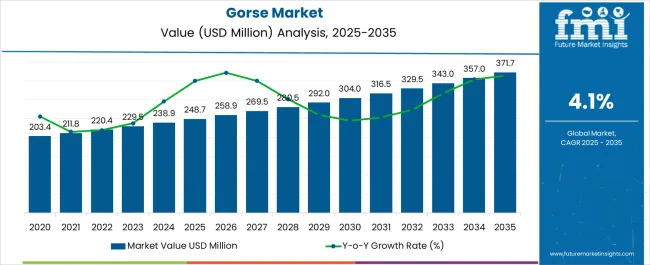
In 2025, the gorse market secured a valuation of USD 81.0 million. Based on Future Market Insights’ analysis, demand for gorse is estimated to grow to USD 85.0 million in 2026 and USD 138.5 million by 2036. FMI projects a CAGR of 5.00% during the forecast period.
Industry is facing a "Compliance Gate," where the loose regulatory environment for botanical extracts is tightening into a strict pharmaceutical regime. Manufacturers are forced to upgrade from artisanal processing to GMP-compliant extraction lines to meet FDA and EMA standards, creating a capital barrier that excludes smaller, non-compliant players while favoring vertically integrated leaders. This shift is turning medicinal and aromatic plant supply chains into high-stakes infrastructure, where the ability to validate purity data commands a premium over simple volume.
Summary of Gorse Market
- Gorse Market Definition:
- The industry covers the dual-use utilization of Ulex europaeus for therapeutic extracts and sustainable biomass energy.
- Demand Drivers in the Market:
- Rising global trade in traditional medicines and herb and spice extracts.
- Regulatory push for Sustainable Aviation Fuel (SAF) utilizing invasive species biomass.
- Increasing consumer preference for natural adaptogens and stress-relief remedies.
- Key Segments Analyzed in the FMI Report:
- Form: Liquid Extract (55%) dominates due to homeopathic applications.
- Application: Pharmaceuticals (40%) leads value capture.
- Geography: High-growth Asia-Pacific versus regulatory-heavy Europe.
- Analyst Opinion at FMI:
- Nandini Roy Choudhury, Principal Consultant for Food and Beverage at Future Market Insights, opines, “In our latest Gorse Market Report for 2026 to 2036, CXOs will gain strategic clarity into how the value chain is fundamentally restructuring. My research highlights the accelerating rise of Scientific Herbalism, where consistent, validated feedstock becomes the single biggest determinant of market success. As FDA oversight intensifies, leadership will belong to companies that embrace data‑driven compliance and elevate botanical sourcing to pharmaceutical precision.”
- Strategic Implications/Executive Takeaways:
- Secure backward integration to ensure GMP-compliant raw material supply.
- Invest in botanical CO2 extracts technology for higher purity and yield.
- Leverage invasive species status to access government bio-control funding.
- Methodology:
- Validated through first-hand corporate production and capacity data.
- Zero reliance on speculative third-party market research reports.
- Based on verifiable industrial benchmarks and verified sources.
As Emer Cooke, Executive Director of the European Medicines Agency, noted regarding supply chain fragility, “In 2024, medicine shortages remained a high priority on the public health agenda. The reasons for shortages are always multifaceted but a specific case of difficult supply-and-demand dynamics emerged in 2024 with shortages of GLP-1 receptor agonist medicines. Increased demand for these medicines for both diabetes and obesity, coupled with significant supply challenges, jeopardised treatment programmes for many patients” [1]. This regulatory pressure forces companies to secure stable, traceable sources of herbal medicinal products to prevent market exclusion.
China’s demand for gorse is projected to grow at a CAGR of 6.50% through 2036, followed by India at 6.00%, reflecting strong expansion across Asia. Growth in Europe is comparatively moderate, with Germany expected to rise at 4.50% CAGR and the United Kingdom at 3.50%. In North America, the United States is forecast to increase at 4.00% CAGR through 2036, indicating steady but regulated‑market growth.
Gorse Market Definition
The gorse (Ulex europaeus) market comprises the commercial value chain of harvesting, processing, and trading gorse biomass and its derivatives. This includes flower extract production for homeopathy (such as Bach remedies) and industrial processing for bioenergy feedstocks.
Gorse Market Inclusions
The report includes a comprehensive analysis of market dynamics, featuring global trade in botanical ingredients derived from Ulex europaeus. It covers segmental breakdowns by form (Liquid Extract, Powder), application (Pharmaceuticals, Personal Care, Food & Beverages), and end-users (Homeopathic Manufacturers, Bio-refineries).
Gorse Market Exclusions
The scope excludes non-commercial land clearing activities where biomass is incinerated without energy recovery. It also omits general landscaping services unless directly tied to a commercial biomass supply chain.
Gorse Market Research Methodology
- Primary Research: Interviews were conducted with herbal extract producers, bioenergy project developers, and regulatory compliance officers.
- Desk Research: Export data from national trade bodies, AYUSH ministry reports, and pharmaceutical registry filings supported volume benchmarking.
- Market-Sizing and Forecasting: A hybrid top-down and bottom-up model was developed, reconciling herbal nutraceuticals production data with harvestable acreage estimates.
- Data Validation and Update Cycle: Outputs undergo variance checks against corporate revenue reports and government trade statistics.
Segmental Analysis
Gorse Market Analysis by Application
The pharmaceutical application segment is the primary revenue driver, accounting for 40.0% of the market share. As per FMI's projection, this dominance is reinforced by the institutionalization of traditional medicine systems, with manufacturing in India's AYUSH sector reaching USD 24 billion in 2024 [2]. The demand is particularly strong for standardized preparations used in herbal supplements for emotional well-being, such as those produced by Nelsons.
- Pharmaceuticals: Growth is supported by the 21.46% increase in the quantity of AYUSH and herbal product exports from India in FY25, signaling a robust global appetite for therapeutic plant derivatives [3].
- Personal Care: Utilization in herbal beauty products is expanding as consumers seek natural ingredients for skin soothing.
- Food & Beverages: Niche demand exists for botanical flavors and functional additives.
Gorse Market Analysis by Form
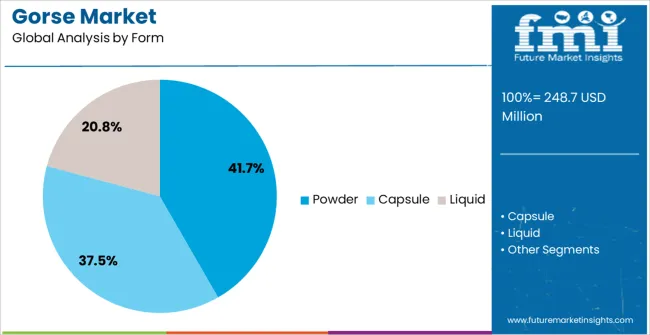
Liquid extracts hold the majority share, estimated at 55.0%, driven by the prevalence of tincture-based homeopathic remedies. According to FMI's estimates, the need for precise dosing in floral extract formulations sustains the preference for liquid formats over powders. However, advanced processing is enabling high-potency powders for the herbal fragrance ingredients sector.
- Liquid Extract: Dominance is maintained by heritage brands using traditional maceration and solar infusion techniques for products like yuzu flavor extracts and flower remedies.
- Powder: Increasing adoption in solid dosage forms, including green tea extracts blends and capsules.
- Others: Emerging interest in fucoidan extract compatible delivery systems.
Gorse Market Drivers, Restraints, and Opportunities
The market is driven by the global renaissance in traditional herbal medicine. China's export of extracts and essences reached USD 163.6 million in 2024, signaling robust international appetite for botanical inputs [4]. This demand is further catalyzed by the "Green Chemistry" movement, where manufacturers seek sustainable alternatives to synthetic ingredients, boosting the profile of herbal personal care products.
Regulatory bottlenecks pose a significant restraint. The pharmaceuticalization of herbal products means that unverified formulations face market exclusion. Conversely, the bioeconomy offers a massive opportunity; projects like SkyNRG's DSL-01 facility are proving that waste biomass can be converted into Sustainable Aviation Fuel (SAF) with high GHG reduction potential, turning invasive gorse from a pest into a profit center [5].
- Traditional Medicine Expansion: The trade value of Traditional Chinese Medicine (TCM) reached USD 3.46 billion in early 2024, accounting for 4.3% of China's pharma trade [6].
- Bio-Energy Integration: New Zealand's Foresta facility aims to reshape the biomass sector by utilizing forestry residues and pest plants for energy [7].
- Corporate Growth: Healing Hands & Herbs reported a 91% CAGR in revenue, highlighting the scalability of compliant herbal enterprises [8].
Regional Analysis
The global market is segmented into North America, Latin America, Europe, East Asia, South Asia, Oceania, and Middle East & Africa.
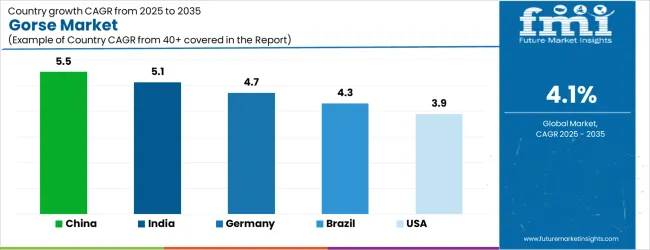
| Country | CAGR (2026 to 2036) |
|---|---|
| China | 6.50% |
| India | 6.00% |
| Germany | 4.50% |
| United States | 4.00% |
| United Kingdom | 3.50% |
Source: Future Market Insights (FMI) analysis, based on proprietary forecasting model and primary research
Asia Pacific Gorse Market Analysis
Asia Pacific is the engine of global supply, leveraging deep cultural roots in herbal medicine and low-cost manufacturing bases. The region is transitioning from raw material export to value-added processing, with India and China investing heavily in upgrading their extraction infrastructure to meet Western purity standards.
- China: Demand is projected to rise at 6.50% CAGR through 2036. The nation's status as a top goods trader is reinforced by export volumes of over 18 million kg of extracts in 2024, underscoring its pivotal role in the global supply chain [4].
- India: The sector is expected to expand at 6.00% CAGR through 2036. Government support is evident with the AYUSH sector's exports growing 5.86% in FY25, driven by policy initiatives to globalize traditional Indian remedies [3].
FMI’s report includes a detailed analysis of growth in the Asia Pacific region, along with a country-wise assessment that includes China and India. Readers can also find regional trends, regulations, and market growth based on different segments and countries in Asia Pacific.
Europe Gorse Market Analysis
Europe represents the "Quality Standard" for the market, driven by strict EMA regulations and high consumer awareness of herbal supplements. The region is also pioneering the industrial use of biomass for decarbonization, creating a dual-track market for high-grade extracts and industrial fuel feedstocks.
- Germany: Demand analysis predicts spike at 4.50% CAGR through 2036. The country remains a key importer, bringing in USD 2.88 million of extracts from China in 2024 to support its advanced phyto-pharmaceutical industry [9].
- United Kingdom: Sales are projected to rise at 3.50% CAGR through 2036. The market is anchored by established brands like Nelsons, with import values of USD 366,000 from Chinese suppliers in 2024, reflecting steady demand for homeopathic inputs [10].
FMI’s report includes a detailed analysis of growth in the Europe region, along with a country-wise assessment that includes Germany and United Kingdom. Readers can also find regional trends, regulations, and market growth based on different segments and countries in Europe.
North America Gorse Market Analysis
North America is a critical consumption market where regulatory scrutiny is reshaping the landscape for homeopathic and botanical products. Manufacturers are increasingly prioritizing "pass-through" compliance, ensuring that every batch of imported extract meets rigorous safety testing before reaching retail shelves.
- United States: Industry is poised to expand at 4.00% CAGR through 2036. The market imported USD 28.5 million in extracts from China in 2024, reflecting strong consumer demand for natural remedies despite tighter FDA oversight [11].
FMI’s report includes a detailed analysis of growth in the North America region, along with a country-wise assessment that includes United States. Readers can also find regional trends, regulations, and market growth based on different segments and countries in North America.
Competitive Aligners for Market Players
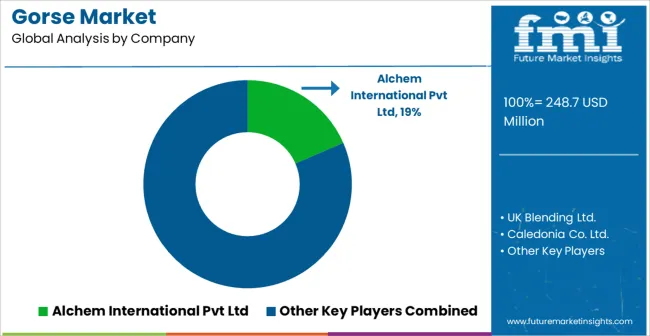
The competitive landscape is defined by the divide between heritage homeopathic brands and emerging industrial biomass players. Nelsons leads the pharmaceutical segment with a 20% market share, leveraging decades of brand equity and vertical integration to navigate regulatory complexities. These established players focus on maintaining rigorous quality control to satisfy EMA and FDA requirements, using their compliance capabilities as a barrier to entry.
The industrial segment is characterized by partnerships between technology providers and resource managers. Companies are seeking to monetize invasive species through "waste-to-energy" models, requiring expertise in logistics and chemical engineering rather than botanical formulation. The ability to secure long-term access to land for biomass harvesting is a critical competitive advantage in this sub-sector.
Recent financial activities highlight the sector's vitality. For instance, Healing Hands & Herbs generated INR 4.54 Crore in revenue for FY2024, demonstrating that focused herbal enterprises can achieve rapid growth even in competitive markets [8]. This success encourages further investment in capacity and quality assurance across the industry.
Recent Developments:
The report includes full coverage of key trends from competitive benchmarking. Some of the recent developments covered in the reports:
- In February 2026, SkyNRG reached financial close for the DSL-01 facility, which will produce 100,000 tonnes of Sustainable Aviation Fuel annually using renewable feedstocks.[5]
- In November 2025, Foresta began construction of an integrated torrefied pellet facility in New Zealand to convert biomass into sustainable fuel alternatives.[7]
Key Players in Gorse Market
- Nelsons
- Healing Herbs
- Crystal Herbs
- Ainsworths
- Bach Flower
- SkyNRG
- Foresta
- Circularity Fuels
- Healing Hands & Herbs
- Gracefruit
Scope of the Report
| Metric | Value |
|---|---|
| Quantitative Units | USD 85.0 million (2026) to USD 138.5 million (2036), at a CAGR of 5.00% |
| Market Definition | The Gorse market comprises the commercial trade of Ulex europaeus biomass and extracts for pharmaceutical, personal care, and industrial applications. |
| Form Segmentation | Liquid Extract, Powder |
| Application Segmentation | Pharmaceuticals, Personal Care, Food & Beverages, Others |
| Application Coverage | Homeopathic Remedies, Functional Foods, Biofuels, Animal Feed |
| Regions Covered | North America, Latin America, Europe, East Asia, South Asia, Oceania, Middle East & Africa |
| Countries Covered | China, India, Germany, United States, United Kingdom |
| Key Companies Profiled | Nelsons, Healing Herbs, Crystal Herbs, Ainsworths, Bach Flower, SkyNRG, Foresta, Circularity Fuels |
| Forecast Period | 2026 to 2036 |
| Approach | Hybrid top-down and bottom-up model validated through primary interviews and trade data analysis |
Gorse Market Analysis by Segments
Form:
- Liquid Extract
- Powder
Application:
- Pharmaceuticals
- Personal Care
- Food & Beverages
- Others
Region:
- Asia Pacific
- India
- China
- Japan
- South Korea
- Indonesia
- Australia & New Zealand
- ASEAN
- Rest of Asia Pacific
- Europe
- Germany
- Italy
- France
- United Kingdom
- Spain
- Benelux
- Nordics
- Central & Eastern Europe
- Rest of Europe
- North America
- United States
- Canada
- Mexico
- Latin America
- Brazil
- Argentina
- Chile
- Rest of Latin America
- Middle East & Africa
- Kingdom of Saudi Arabia
- United Arab Emirates
- South Africa
- Turkey
- Rest of Middle East & Africa
Bibliography
- [1] European Medicines Agency (EMA). (2025). Medicine shortages remained a high priority in 2024, coupled with significant supply challenges (EMA annual reporting / shortages section). EMA.
- [2] India Brand Equity Foundation (IBEF). (2024). AYUSH Industry in India: Growth, Market Size & Opportunities (Manufacturing reached US$ 24 billion by 2024). IBEF.
- [3] India Brand Equity Foundation (IBEF). (2025). AYUSH Industry update (Exports of AYUSH and herbal products in FY 2024-25 grew 5.86%). IBEF.
- [4] World Integrated Trade Solution (WITS). (2024). China exports of “Extracts, essences, concentrates and preparations” (Value: USD 163,673.27K). WITS (World Bank / UN Comtrade).
- [5] SkyNRG. (2026). Financial close and start of construction: DSL-01 SAF plant (Delfzijl, the Netherlands) (Lifecycle GHG reduction expected to rise from ~80% to >90%). SkyNRG (Company announcement).
- [6] Frontiers in Public Health. (2025). Traditional Chinese medicine trade among RCEP countries (Jan-May 2024 TCM trade value: USD 3.461 billion; 4.3% of China’s total pharmaceutical trade). Frontiers.
- [7] Bioenergy Insight. (2025). Project update on regional biomass decarbonisation (Project positioned to reshape the biomass sector and contribute to decarbonisation). Bioenergy Insight.
- [8] Ministry of Corporate Affairs (MCA). (2024). Company financial filings for HEALING HANDS & HERBS PRIVATE LIMITED (Revenue: ₹4.54 crore; FY ending 31 March 2024). MCA (via company financial intelligence platform).
- [9] World Integrated Trade Solution (WITS). (2024). Germany imports of “Extracts, essences, concentrates and preparations” from China (Value: USD 2,882.65K). WITS (World Bank / UN Comtrade).
- [10] World Integrated Trade Solution (WITS). (2024). United Kingdom imports of “Extracts, essences, concentrates and preparations” from China (Value: USD 366.76K). WITS (World Bank / UN Comtrade).
- [11] World Integrated Trade Solution (WITS). (2024). United States imports of “Extracts, essences, concentrates and preparations” from China (Value: USD 28,547.22K). WITS (World Bank / UN Comtrade).
This Report Addresses
- Market intelligence to enable structured strategic decision making across mature and emerging herbal economies
- Market size estimation and 10 year revenue forecasts from 2026 to 2036, supported by validated capacity and trade benchmarks
- Growth opportunity mapping across liquid and powder forms with emphasis on pharmaceutical compliance
- Segment and regional revenue forecasts covering pharmaceuticals, personal care, and food & beverage applications
- Competition strategy assessment including integration models, cost survivability positioning, and compliance capability benchmarking
- Product reformulation and emission compliance tracking including FDA and EMA aligned grades
- Regulatory impact analysis covering homeopathic mandates, quality thresholds, and export driven specification upgrades
- Market report delivery in PDF, Excel, PPT, and interactive dashboard formats for executive and operational use
Frequently Asked Questions
How large is the demand for Gorse Market in the global market in 2026?
Demand for Gorse Market in the global market is estimated to be valued at USD 85.0 million in 2026.
What will be the market size of Gorse Market in the global market by 2036?
Market size for Gorse Market is projected to reach USD 138.5 million by 2036.
What is the expected demand growth for Gorse Market in the global market between 2026 and 2036?
Demand for Gorse Market in the global market is expected to grow at a CAGR of 5.00% between 2026 and 2036.
Which Form is poised to lead global sales by 2026?
Liquid Extract is expected to be the dominant form, capturing approximately 55.0% of global market share in 2026 due to its prevalence in homeopathic tinctures.
How significant is the role of Pharmaceuticals in driving Gorse Market adoption in 2026?
Pharmaceuticals represents a critical segment, projected to hold a substantial 40.00% share of the total market in 2026 as institutionalized herbal medicine expands.
What is driving demand in China?
Demand is driven by robust export volumes of botanical extracts and a thriving Traditional Chinese Medicine sector.
What compliance standards or regulations are referenced for China?
China's General Administration of Customs and its zero-tariff treatments are key regulatory benchmarks impacting trade.
What is the China growth outlook in this report?
China is projected to grow at a CAGR of 6.50% during 2026 to 2036.
Why is Europe described as a priority region in this report?
Europe is a regulatory hub where strict EMA standards drive demand for high-quality, compliant herbal medicinal products.
What type of demand dominates in Europe?
Replacement driven demand for premium grade, highly regulated homeopathic ingredients dominates regional consumption.
What is India growth outlook in this report?
India is projected to expand at a CAGR of 6.00% during 2026 to 2036.
Does the report cover Germany in its regional analysis?
Yes, Germany is included within Europe under the regional scope of analysis.
What are the sources referred to for analyzing Germany?
World Integrated Trade Solution (WITS) import data is used to analyze Germany's intake of botanical extracts.
What is the main demand theme linked to Germany in its region coverage?
Germany's demand is linked to high consumption of natural extracts for personal care and medicinal applications.
Does the report cover United States in its regional analysis?
Yes, United States is included within North America under the regional coverage framework.
What is the main United States related demand theme in its region coverage?
Demand is associated with a strong market for herbal supplements, despite tightening FDA regulatory oversight.
Which product formats or configurations are strategically important for Asia Pacific supply chains?
Powder and bulk liquid extracts are prioritized to support large-scale export and manufacturing activities.
What is Gorse Market and what is it mainly used for?
Gorse Market refers to the commercial trade of Ulex europaeus derivatives, mainly used for homeopathic remedies and biomass energy.
What does Gorse Market mean in this report?
Gorse Market refers to the global ecosystem of harvesting, processing, and selling gorse-based products.
What is included in the scope of this Gorse Market report?
Scope covers gorse derivatives by form, key applications like pharmaceuticals and bioenergy, and end use industries.
What is excluded from the scope of this report?
Non-commercial land clearing and general landscaping activities are excluded unless part of a biomass supply chain.
What does market forecast mean on this page?
Market forecast represents a model based projection built on defined assumptions for strategic planning purposes.
How does FMI build and validate the Gorse Market forecast?
Forecast is developed using hybrid top down and bottom up modeling validated through trade data and primary interviews.
Preview the report firsthand - request a free sample
Get SampleGet the brochure for pricing and purchase details.
Get PDFTable of Content
- Executive Summary
- Global Market Outlook
- Demand-side Trends
- Supply-side Trends
- Technology Roadmap Analysis
- Analysis and Recommendations
- Market Overview
- Market Coverage / Taxonomy
- Market Definition / Scope / Limitations
- Research Methodology
- Chapter Orientation
- Analytical Lens and Working Hypotheses
- Market Structure, Signals, and Trend Drivers
- Benchmarking and Cross-market Comparability
- Market Sizing, Forecasting, and Opportunity Mapping
- Research Design and Evidence Framework
- Desk Research Programme (Secondary Evidence)
- Company Annual and Sustainability Reports
- Peer-reviewed Journals and Academic Literature
- Corporate Websites, Product Literature, and Technical Notes
- Earnings Decks and Investor Briefings
- Statutory Filings and Regulatory Disclosures
- Technical White Papers and Standards Notes
- Trade Journals, Industry Magazines, and Analyst Briefs
- Conference Proceedings, Webinars, and Seminar Materials
- Government Statistics Portals and Public Data Releases
- Press Releases and Reputable Media Coverage
- Specialist Newsletters and Curated Briefings
- Sector Databases and Reference Repositories
- FMI Internal Proprietary Databases and Historical Market Datasets
- Subscription Datasets and Paid Sources
- Social Channels, Communities, and Digital Listening Inputs
- Additional Desk Sources
- Expert Input and Fieldwork (Primary Evidence)
- Primary Modes
- Qualitative Interviews and Expert Elicitation
- Quantitative Surveys and Structured Data Capture
- Blended Approach
- Why Primary Evidence is Used
- Field Techniques
- Interviews
- Surveys
- Focus Groups
- Observational and In-context Research
- Social and Community Interactions
- Stakeholder Universe Engaged
- C-suite Leaders
- Board Members
- Presidents and Vice Presidents
- R&D and Innovation Heads
- Technical Specialists
- Domain Subject-matter Experts
- Scientists
- Physicians and Other Healthcare Professionals
- Governance, Ethics, and Data Stewardship
- Research Ethics
- Data Integrity and Handling
- Primary Modes
- Tooling, Models, and Reference Databases
- Desk Research Programme (Secondary Evidence)
- Data Engineering and Model Build
- Data Acquisition and Ingestion
- Cleaning, Normalisation, and Verification
- Synthesis, Triangulation, and Analysis
- Quality Assurance and Audit Trail
- Market Background
- Market Dynamics
- Drivers
- Restraints
- Opportunity
- Trends
- Scenario Forecast
- Demand in Optimistic Scenario
- Demand in Likely Scenario
- Demand in Conservative Scenario
- Opportunity Map Analysis
- Product Life Cycle Analysis
- Supply Chain Analysis
- Investment Feasibility Matrix
- Value Chain Analysis
- PESTLE and Porter’s Analysis
- Regulatory Landscape
- Regional Parent Market Outlook
- Production and Consumption Statistics
- Import and Export Statistics
- Market Dynamics
- Global Market Analysis 2021 to 2025 and Forecast, 2026 to 2036
- Historical Market Size Value (USD Million) Analysis, 2021 to 2025
- Current and Future Market Size Value (USD Million) Projections, 2026 to 2036
- Y-o-Y Growth Trend Analysis
- Absolute $ Opportunity Analysis
- Global Market Pricing Analysis 2021 to 2025 and Forecast 2026 to 2036
- Global Market Analysis 2021 to 2025 and Forecast 2026 to 2036, By Form
- Introduction / Key Findings
- Historical Market Size Value (USD Million) Analysis By Form , 2021 to 2025
- Current and Future Market Size Value (USD Million) Analysis and Forecast By Form , 2026 to 2036
- Liquid
- Powder
- Others
- Liquid
- Y-o-Y Growth Trend Analysis By Form , 2021 to 2025
- Absolute $ Opportunity Analysis By Form , 2026 to 2036
- Global Market Analysis 2021 to 2025 and Forecast 2026 to 2036, By Application
- Introduction / Key Findings
- Historical Market Size Value (USD Million) Analysis By Application, 2021 to 2025
- Current and Future Market Size Value (USD Million) Analysis and Forecast By Application, 2026 to 2036
- Pharmaceuticals
- Personal Care
- Food & Beverages
- Pharmaceuticals
- Y-o-Y Growth Trend Analysis By Application, 2021 to 2025
- Absolute $ Opportunity Analysis By Application, 2026 to 2036
- Global Market Analysis 2021 to 2025 and Forecast 2026 to 2036, By Region
- Introduction
- Historical Market Size Value (USD Million) Analysis By Region, 2021 to 2025
- Current Market Size Value (USD Million) Analysis and Forecast By Region, 2026 to 2036
- North America
- Latin America
- Western Europe
- Eastern Europe
- East Asia
- South Asia and Pacific
- Middle East & Africa
- Market Attractiveness Analysis By Region
- North America Market Analysis 2021 to 2025 and Forecast 2026 to 2036, By Country
- Historical Market Size Value (USD Million) Trend Analysis By Market Taxonomy, 2021 to 2025
- Market Size Value (USD Million) Forecast By Market Taxonomy, 2026 to 2036
- By Country
- USA
- Canada
- Mexico
- By Form
- By Application
- By Country
- Market Attractiveness Analysis
- By Country
- By Form
- By Application
- Key Takeaways
- Latin America Market Analysis 2021 to 2025 and Forecast 2026 to 2036, By Country
- Historical Market Size Value (USD Million) Trend Analysis By Market Taxonomy, 2021 to 2025
- Market Size Value (USD Million) Forecast By Market Taxonomy, 2026 to 2036
- By Country
- Brazil
- Chile
- Rest of Latin America
- By Form
- By Application
- By Country
- Market Attractiveness Analysis
- By Country
- By Form
- By Application
- Key Takeaways
- Western Europe Market Analysis 2021 to 2025 and Forecast 2026 to 2036, By Country
- Historical Market Size Value (USD Million) Trend Analysis By Market Taxonomy, 2021 to 2025
- Market Size Value (USD Million) Forecast By Market Taxonomy, 2026 to 2036
- By Country
- Germany
- UK
- Italy
- Spain
- France
- Nordic
- BENELUX
- Rest of Western Europe
- By Form
- By Application
- By Country
- Market Attractiveness Analysis
- By Country
- By Form
- By Application
- Key Takeaways
- Eastern Europe Market Analysis 2021 to 2025 and Forecast 2026 to 2036, By Country
- Historical Market Size Value (USD Million) Trend Analysis By Market Taxonomy, 2021 to 2025
- Market Size Value (USD Million) Forecast By Market Taxonomy, 2026 to 2036
- By Country
- Russia
- Poland
- Hungary
- Balkan & Baltic
- Rest of Eastern Europe
- By Form
- By Application
- By Country
- Market Attractiveness Analysis
- By Country
- By Form
- By Application
- Key Takeaways
- East Asia Market Analysis 2021 to 2025 and Forecast 2026 to 2036, By Country
- Historical Market Size Value (USD Million) Trend Analysis By Market Taxonomy, 2021 to 2025
- Market Size Value (USD Million) Forecast By Market Taxonomy, 2026 to 2036
- By Country
- China
- Japan
- South Korea
- By Form
- By Application
- By Country
- Market Attractiveness Analysis
- By Country
- By Form
- By Application
- Key Takeaways
- South Asia and Pacific Market Analysis 2021 to 2025 and Forecast 2026 to 2036, By Country
- Historical Market Size Value (USD Million) Trend Analysis By Market Taxonomy, 2021 to 2025
- Market Size Value (USD Million) Forecast By Market Taxonomy, 2026 to 2036
- By Country
- India
- ASEAN
- Australia & New Zealand
- Rest of South Asia and Pacific
- By Form
- By Application
- By Country
- Market Attractiveness Analysis
- By Country
- By Form
- By Application
- Key Takeaways
- Middle East & Africa Market Analysis 2021 to 2025 and Forecast 2026 to 2036, By Country
- Historical Market Size Value (USD Million) Trend Analysis By Market Taxonomy, 2021 to 2025
- Market Size Value (USD Million) Forecast By Market Taxonomy, 2026 to 2036
- By Country
- Kingdom of Saudi Arabia
- Other GCC Countries
- Turkiye
- South Africa
- Other African Union
- Rest of Middle East & Africa
- By Form
- By Application
- By Country
- Market Attractiveness Analysis
- By Country
- By Form
- By Application
- Key Takeaways
- Key Countries Market Analysis
- USA
- Pricing Analysis
- Market Share Analysis, 2025
- By Form
- By Application
- Canada
- Pricing Analysis
- Market Share Analysis, 2025
- By Form
- By Application
- Mexico
- Pricing Analysis
- Market Share Analysis, 2025
- By Form
- By Application
- Brazil
- Pricing Analysis
- Market Share Analysis, 2025
- By Form
- By Application
- Chile
- Pricing Analysis
- Market Share Analysis, 2025
- By Form
- By Application
- Germany
- Pricing Analysis
- Market Share Analysis, 2025
- By Form
- By Application
- UK
- Pricing Analysis
- Market Share Analysis, 2025
- By Form
- By Application
- Italy
- Pricing Analysis
- Market Share Analysis, 2025
- By Form
- By Application
- Spain
- Pricing Analysis
- Market Share Analysis, 2025
- By Form
- By Application
- France
- Pricing Analysis
- Market Share Analysis, 2025
- By Form
- By Application
- India
- Pricing Analysis
- Market Share Analysis, 2025
- By Form
- By Application
- ASEAN
- Pricing Analysis
- Market Share Analysis, 2025
- By Form
- By Application
- Australia & New Zealand
- Pricing Analysis
- Market Share Analysis, 2025
- By Form
- By Application
- China
- Pricing Analysis
- Market Share Analysis, 2025
- By Form
- By Application
- Japan
- Pricing Analysis
- Market Share Analysis, 2025
- By Form
- By Application
- South Korea
- Pricing Analysis
- Market Share Analysis, 2025
- By Form
- By Application
- Russia
- Pricing Analysis
- Market Share Analysis, 2025
- By Form
- By Application
- Poland
- Pricing Analysis
- Market Share Analysis, 2025
- By Form
- By Application
- Hungary
- Pricing Analysis
- Market Share Analysis, 2025
- By Form
- By Application
- Kingdom of Saudi Arabia
- Pricing Analysis
- Market Share Analysis, 2025
- By Form
- By Application
- Turkiye
- Pricing Analysis
- Market Share Analysis, 2025
- By Form
- By Application
- South Africa
- Pricing Analysis
- Market Share Analysis, 2025
- By Form
- By Application
- USA
- Market Structure Analysis
- Competition Dashboard
- Competition Benchmarking
- Market Share Analysis of Top Players
- By Regional
- By Form
- By Application
- Competition Analysis
- Competition Deep Dive
- Nelsons
- Overview
- Product Portfolio
- Profitability by Market Segments (Product/Age /Sales Channel/Region)
- Sales Footprint
- Strategy Overview
- Marketing Strategy
- Product Strategy
- Channel Strategy
- Healing Herbs
- Crystal Herbs
- Ainsworths
- Bach Flower
- SkyNRG
- Foresta
- Circularity Fuels
- Nelsons
- Competition Deep Dive
- Assumptions & Acronyms Used


