

- Industry Size (2026)
- USD 386.1 Mn
- Forecast (2036)
- USD 685.0 Mn
- CAGR (2026 to 2036)
- 5.9%
Honeysuckle Market Size, Market Forecast and Outlook By FMI
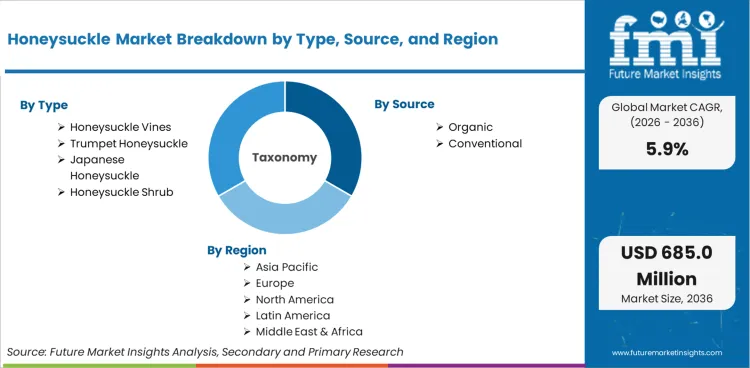
In 2025, the honeysuckle market was valued at USD 364.6 million Based on Future Market Insights' analysis, demand for honeysuckle is estimated to grow to USD 386.1 million in 2026 and USD 685.0 million by 2036. FMI projects a CAGR of 5.9% during the forecast period.
Absolute dollar growth of USD 298.9 million over the decade reflects a market undergoing active category expansion rather than simple volume accumulation. The organic segment, commanding 57.8% share, anchors pricing power as ingredient buyers across pharmaceutical and personal care formulations shift specifications toward certified botanical inputs. In February 2026, Givaudan officially inaugurated '10 Capital,' a new fragrance creative center in Jakarta, Indonesia, designed to accelerate the launch of locally tailored personal care and fragrance products featuring botanical notes like honeysuckle for the high-growth Southeast Asian market, signalling accelerating commercial demand for traceable botanical sourcing. [1]
Summary of Honeysuckle Market
- Honeysuckle Market Definition
- The market covers globally traded Lonicera species botanical ingredients in raw, dried, and extract form, serving pharmaceutical, cosmetic, and food and beverage manufacturing industries.
- Demand Drivers in the Market
- Rising pharmaceutical procurement of standardized chlorogenic acid extracts for anti-inflammatory and antiviral applications drives volume growth in regulated markets.
- Organic-certified sourcing at 57.8% share commands formulation premiums as cosmetic and supplement brands respond to clean-label positioning requirements.
- China's 8.0% CAGR growth anchors global supply expansion, with domestic pharmaceutical policy encouraging botanical active ingredient integration into traditional medicine protocols.
- Key Segments Analyzed in the FMI Report
- Type: Honeysuckle Vines lead at 34.7% share, valued for high bioactive compound density in pharmaceutical-grade extraction.
- Application: Pharmaceutical Industry captures 41.6% of demand, driven by anti-inflammatory and antimicrobial formulation requirements.
- Source: Organic accounts for 57.8% of the market, reflecting premium positioning across personal care and nutraceutical channels.
- Analyst Opinion at FMI
- Nandini Roy Choudhury, Principal Consultant for Food & Beverage Industry at Future Market Insights, opines, "In the updated version of the Honeysuckle Market Report for 2026 to 2036, CXOs will find that the market's growth trajectory is fundamentally tied to two structural pressures. First, the absence of harmonized international pharmacopoeial standards for Lonicera extract purity creates formulation risk for pharmaceutical buyers sourcing across China and Southeast Asian origins. Second, the organic premium commands 57.8% of supply, yet certification infrastructure outside China remains thin, exposing supply chains to compliance gaps as European and North American regulatory scrutiny of botanical ingredient traceability intensifies."
- Strategic Implications / Executive Takeaways
- Invest in supplier-level organic certification infrastructure in non-Chinese origins to reduce single-source regulatory exposure.
- Prioritize pharmaceutical-grade extract standardization partnerships to capture margin uplift from clinical validation in anti-inflammatory applications.
- Establish traceability protocols aligned with EU botanical ingredient regulations before 2027 to maintain market access in premium European personal care channels.
- Methodology
- Validated through primary interviews with botanical cultivators, extract processors, and pharmaceutical procurement specialists.
- Zero reliance on speculative third-party market research reports.
- Based on verifiable trade data, agricultural production statistics, and industry association benchmarks.
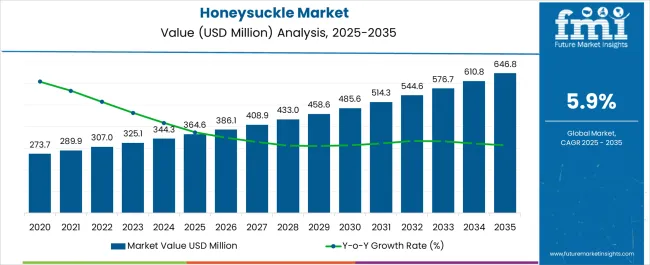
China leads regional growth at an 8.0% CAGR, underpinned by its dominant position in raw extract supply and growing domestic pharmaceutical procurement. Japan holds a substantial 2026 market value of USD 273.7 million, reflecting deep penetration in cosmetic and traditional medicine channels. The United States generates USD 143.9 million in 2026 demand, driven by premium botanical supplement formulations. South Korea, at USD 12.1 million, contributes through its K-beauty driven personal care manufacturing base. Honeysuckle Vines represent the leading type at 34.7% share, while the pharmaceutical industry captures 41.6% of application demand, reflecting the ingredient's established role in anti-inflammatory and antimicrobial formulations.
Honeysuckle Market Definition
The honeysuckle marketcomprisesthe global production, processing, and trade of botanical raw materials derived from Lonicera species, including dried flowers, stems, leaves, and standardized extracts used across pharmaceutical, cosmetic, and food and beverage applications. Honeysuckle is cultivated primarily for its bioactive compounds, including chlorogenic acid and luteolin, which confer anti-inflammatory, antiviral, and antioxidant properties. The market encompasses both organic and conventional supply chains, covering cultivation, primary extraction, and ingredient distribution to downstream industrial users.
Honeysuckle Market Inclusions
The report includes comprehensive analysis of global and regional market sizes by volume and value, with a 10-year forecast from 2026 to 2036. Coverage spans segmental breakdowns by botanical type (Honeysuckle Vines, Trumpet Honeysuckle, Japanese Honeysuckle, Honeysuckle Shrub), source classification (Organic, Conventional), and application end-use (Pharmaceutical Industry, Cosmetic, Food and Beverage). Regional and country-level demand analysis is included across North America, Europe, Asia Pacific, Latin America, and the Middle East and Africa.
Honeysuckle Market Exclusions
The scope excludes finished pharmaceutical drug products where honeysuckle extract is a minor excipient rather than the primary active ingredient. It does not cover ornamental horticulture or landscape gardening uses of honeysuckle plants, nor finished consumer retail products such as teas, packaged beverages, and skincare creams, focusing strictly on the raw botanical material and standardized extract ingredient layer. Speculative non-commercial research applications and negligible artisanal end-uses are also excluded.
Honeysuckle Market Research Methodology
- Primary Research: Interviews were conducted with honeysuckle cultivators, botanical extract manufacturers, cosmetic ingredient distributors, pharmaceutical procurement specialists, and compliance consultants across China, Japan, South Korea, and North America. Organic certification bodies provided context on supply chain traceability requirements.
- Desk Research: Production data from national agricultural ministries, UN Comtrade trade codes for botanical extracts, and industry association publications from natural ingredient bodies supported volume benchmarking.
- Market-Sizing and Forecasting: A hybrid top-down and bottom-up model was applied. Demand was reconstructed from pharmaceutical procurement volumes, cosmetic formulation data, and food ingredient import records, then validated against cultivated area statistics and processing plant output data.
- Data Validation and Update Cycle: Outputs undergo anomaly screening, variance checks against trade datasets and production records, and structured peer review prior to release.
Why is the Honeysuckle Market Growing?
The Honeysuckle market is experiencing steady growth, driven by increasing demand for natural and plant-based ingredients across pharmaceutical, cosmetic, and nutraceutical industries. Rising consumer awareness regarding the benefits of organic and herbal products has fueled adoption of honeysuckle extracts for medicinal and therapeutic applications. The market is further supported by advancements in extraction and processing techniques, which enhance the potency and bioavailability of active compounds.
Growing emphasis on sustainable sourcing, organic cultivation practices, and clean-label formulations is shaping market dynamics. Investments in research and development for bioactive properties of honeysuckle, including anti-inflammatory, antioxidant, and antimicrobial effects, are accelerating its integration into pharmaceutical and healthcare applications.
Regulatory approvals for herbal and organic ingredients are enhancing confidence among manufacturers and consumers, while increasing global health consciousness continues to drive demand As industries prioritize natural alternatives and functional ingredients, the Honeysuckle market is poised for continued expansion, with opportunities emerging from pharmaceutical applications, wellness products, and organic sourcing initiatives.
Segmental Analysis
The honeysuckle market is segmented by type, source, application, distribution channel, and geographic regions. By type, honeysuckle market is divided into Honeysuckle Vines, Trumpet Honeysuckle, Japanese Honeysuckle, and Honeysuckle Shrub. In terms of source, honeysuckle market is classified into Organic and Conventional. Based on application, honeysuckle market is segmented into Pharmaceutical Industry, Cosmetic, and Food And Beverage. By distribution channel, honeysuckle market is segmented into Store Based Retail, Specialty Stores, Online Retail, Supermarkets, and Hypermarkets. Regionally, the honeysuckle industry is classified into North America, Latin America, Western Europe, Eastern Europe, Balkan & Baltic Countries, Russia & Belarus, Central Asia, East Asia, South Asia & Pacific, and the Middle East & Africa.
Insights into the Honeysuckle Vines Type Segment
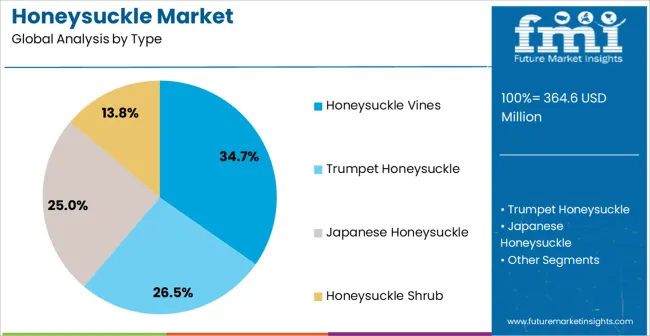
The honeysuckle vines type segment is projected to hold 34.7% of the market revenue in 2026, establishing it as the leading type. Its growth is being driven by the widespread availability and adaptability of vines for large-scale cultivation, which supports consistent supply and high-quality extract production.
The versatility of vines allows for efficient harvesting and processing, enabling the extraction of bioactive compounds for use in pharmaceuticals, nutraceuticals, and cosmetic formulations. The high content of active compounds in vines contributes to their preference over other honeysuckle types, providing superior efficacy in therapeutic applications.
Increasing investments in organic and sustainable cultivation practices have further strengthened the market position of the vines segment As demand for natural ingredients continues to rise in the pharmaceutical and wellness sectors, the honeysuckle vines type is expected to maintain its leadership, supported by reliable supply chains, high bioactive content, and growing industrial adoption across multiple end-use sectors.
Insights into the Organic Source Segment
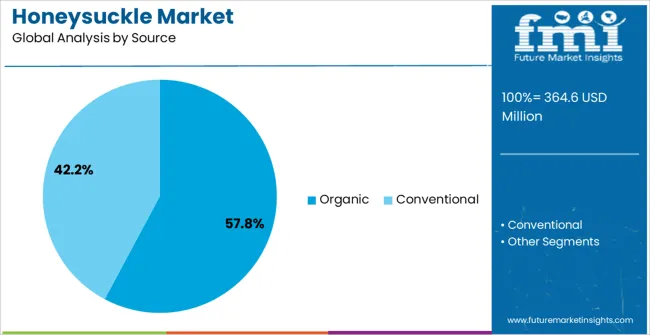
The organic source segment is anticipated to account for 57.8% of the market revenue in 2026, making it the leading source category. Growth in this segment is being driven by increasing consumer preference for organic and sustainably sourced ingredients in healthcare, pharmaceutical, and cosmetic products. Organic honeysuckle is recognized for its higher purity, safety, and consistency, which enhances efficacy and reduces potential contaminants.
The segment benefits from stringent quality control measures, certification standards, and sustainable farming practices, which strengthen trust among manufacturers and end users. Rising health consciousness and the demand for plant-based remedies have further accelerated adoption of organic honeysuckle.
Its application in functional formulations, herbal medicines, and therapeutic products aligns with growing interest in preventive healthcare and natural wellness solutions As pharmaceutical and consumer product industries prioritize organic ingredients for enhanced quality and regulatory compliance, the organic source segment is expected to retain its market dominance, supported by strong consumer acceptance and scalable cultivation practices.
Insights into the Pharmaceutical Industry Application Segment
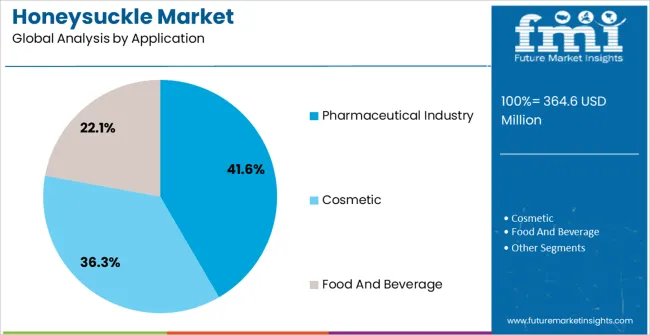
The pharmaceutical industry application segment is projected to hold 41.6% of the market revenue in 2026, establishing it as the leading application area. Growth is being driven by the increasing use of honeysuckle extracts in therapeutic formulations, including anti-inflammatory, antiviral, and antioxidant medications. The bioactive compounds present in honeysuckle have been validated for efficacy in treating a range of conditions, which has enhanced clinical adoption.
Pharmaceutical manufacturers are increasingly leveraging honeysuckle for functional and herbal medicine products, where safety, efficacy, and regulatory compliance are paramount. Research into standardized extracts and active compound optimization has improved consistency and performance in formulations.
Rising demand for plant-based alternatives in healthcare, coupled with consumer interest in natural remedies, is further supporting adoption As pharmaceutical companies continue to integrate herbal and organic ingredients into treatment regimens, the honeysuckle segment is expected to remain a key driver of market growth, supported by scientific validation, regulatory compliance, and increasing global health awareness.
Analysis of Honeysuckle Market By Key Countries
.webp "Top Country Growth Comparison Honeysuckle Market Cagr (2026 2036)")
| Country | CAGR |
|---|---|
| China | 8.0% |
| India | 7.4% |
| Germany | 6.8% |
| Brazil | 6.2% |
| USA | 5.6% |
| UK | 5.0% |
| Japan | 4.4% |
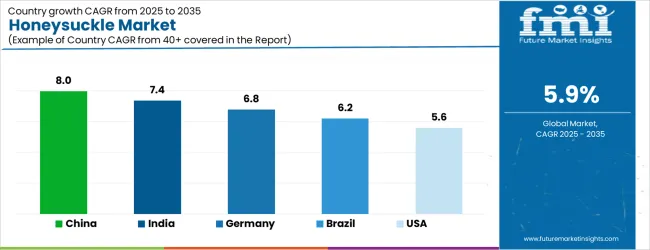
The Honeysuckle Market is expected to register a CAGR of 5.9% during the forecast period, exhibiting varied country level momentum. China leads with the highest CAGR of 8.0%, followed by India at 7.4%. Developed markets such as Germany, France, and the UK continue to expand steadily, while the USA is likely to grow at consistent rates. Japan posts the lowest CAGR at 4.4%, yet still underscores a broadly positive trajectory for the global Honeysuckle Market. In 2024, Germany held a dominant revenue in the Western Europe market and is expected to grow with a CAGR of 6.8%.
The USA Honeysuckle Market is estimated to be valued at USD 131.8 million in 2025 and is anticipated to reach a valuation of USD 131.8 million by 2035. Sales are projected to rise at a CAGR of 0.0% over the forecast period between 2025 and 2035. While Japan and South Korea markets are estimated to be valued at USD 19.2 million and USD 11.8 million respectively in 2025.
Key Players in the Honeysuckle Market
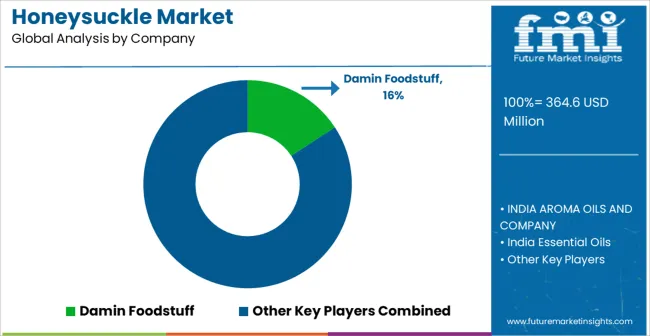
- Damin Foodstuff
- INDIA AROMA OILS AND COMPANY
- India Essential Oils
- Nutra Green Biotechnology
- The Bach Centre
- Shannxi Undersun Biomedtech
- Ecuadorian Rainforest
- Novoherb Technologies
- Mountain Rose Herbs
Recent Developments
The report includes full coverage of key trends from competitive benchmarking. Some of the recent developments covered in the reports:
- In February 2026, Givaudan officially inaugurated '10 Capital,' a new fragrance creative center in Jakarta, Indonesia, designed to accelerate the launch of locally tailored personal care and fragrance products featuring botanical notes like honeysuckle for the high-growth Southeast Asian market. [1]
- In January 2026, Star Roses and Plants (a subsidiary of Ball Horticultural Company) confirmed the 2026 North American retail launch of the Martha Stewart Rose, a new variety incorporating honeysuckle-inspired fragrance breeding for the premium ornamental botanical segment. [2]
Scope of the Report
| Metric | Value |
|---|---|
| Quantitative Units | USD 386.1 million (2026) to USD 685.0 million (2036), at a CAGR of 5.9% |
| Market Definition | The honeysuckle market comprises global production, processing, and trade of Lonicera species botanical materials and standardized extracts used in pharmaceutical, cosmetic, and food and beverage manufacturing. |
| Type Segmentation | Honeysuckle Vines, Trumpet Honeysuckle, Japanese Honeysuckle, Honeysuckle Shrub |
| Source Segmentation | Organic, Conventional |
| Application Coverage | Pharmaceutical Industry, Cosmetic, Food and Beverage |
| Regions Covered | North America, Latin America, Europe, East Asia, South Asia, Oceania, Middle East and Africa |
| Countries Covered | United States, China, Japan, South Korea, Germany, France, United Kingdom, India, Australia and 40 plus countries |
| Key Companies Profiled | Damin Foodstuff, INDIA AROMA OILS AND COMPANY, India Essential Oils, Nutra Green Biotechnology, The Bach Centre, Shannxi Undersun Biomedtech, Ecuadorian Rainforest, Novoherb Technologies, Mountain Rose Herbs, Haykingdom |
| Forecast Period | 2026 to 2036 |
| Approach | Hybrid top-down and bottom-up market modeling validated through primary interviews with botanical cultivators, extract manufacturers, and pharmaceutical ingredient buyers, supported by trade data benchmarking and agricultural output verification |
Honeysuckle Market by Segments
Type:
- Honeysuckle Vines
- Trumpet Honeysuckle
- Japanese Honeysuckle
- Honeysuckle Shrub
Source:
- Organic
- Conventional
Application:
- Pharmaceutical Industry
- Cosmetic
- Food And Beverage
Distribution Channel:
- Store Based Retail
- Specialty Stores
- Online Retail
- Supermarkets
- Hypermarkets
Region:
- North America
- USA
- Canada
- Mexico
- Latin America
- Brazil
- Chile
- Rest of Latin America
- Western Europe
- Germany
- UK
- Italy
- Spain
- France
- Nordic
- BENELUX
- Rest of Western Europe
- Eastern Europe
- Russia
- Poland
- Hungary
- Balkan & Baltic
- Rest of Eastern Europe
- East Asia
- China
- Japan
- South Korea
- South Asia and Pacific
- India
- ASEAN
- Australia & New Zealand
- Rest of South Asia and Pacific
- Middle East & Africa
- Kingdom of Saudi Arabia
- Other GCC Countries
- Turkiye
- South Africa
- Other African Union
- Rest of Middle East & Africa
Bibliography
- [1] Givaudan. (2026). Givaudan opens fragrance creative centre in Jakarta. Trade Media Release, February 2026.
- [2] Ball Horticultural Company / Star Roses and Plants. (2026). Martha Stewart Rose confirmed for 2026 North American retail launch. GPNmag, January 2026.
- [3] Nutritional Outlook. (2024). 2024 flavor trends for food and beverage. Nutritional Outlook.
- [4] Shaanxi Undersun Biomedtech Co., Ltd. (2025). Product line expansion for honeysuckle-based botanical extracts. Company Announcement, June 2025.
This Report Addresses
- Market intelligence to enable structured procurement and sourcing decisions across organic and conventional honeysuckle supply chains
- Market size estimation and 10-year revenue forecasts from 2026 to 2036, supported by validated agricultural production and trade data benchmarks
- Growth opportunity mapping across pharmaceutical, cosmetic, and food and beverage applications with emphasis on organic-certified ingredient transitions
- Segment and regional revenue forecasts covering Type, Source, and Application breakdowns across 40 plus countries
- Competition strategy assessment including supply chain integration models, certification positioning, and key supplier capability profiling
- Botanical ingredient compliance tracking including organic certification requirements, residue standards, and pharmacopoeial specification benchmarks
- Regulatory impact analysis covering botanical ingredient regulations in the EU, US FDA, and Asian markets
- Market report delivery in PDF, Excel, PPT, and interactive dashboard formats for executive and operational use
Frequently Asked Questions
How large is the demand for Honeysuckle in the global market in 2026?
Demand for Honeysuckle in the global market is estimated to be valued at USD 386.1 million in 2026.
What will the market size of Honeysuckle be by 2036?
Market size for Honeysuckle is projected to reach USD 685.0 million by 2036.
What is the expected CAGR for the Honeysuckle Market between 2026 and 2036?
Demand for Honeysuckle in the global market is expected to grow at a CAGR of 5.9% between 2026 and 2036.
Which Type segment is poised to lead global Honeysuckle sales by 2026?
Honeysuckle Vines are expected to be the dominant type, capturing approximately 34.7% of global market share in 2026.
How significant is the Pharmaceutical Industry Application in driving Honeysuckle demand?
The Pharmaceutical Industry represents the leading application segment, projected to hold 41.6% share of total demand in 2026, driven by anti-inflammatory and antimicrobial formulation requirements.
What is the role of China in the global Honeysuckle Market?
China is the fastest-growing market at 8.0% CAGR through 2036, underpinned by its dominant position in raw extract supply and growing domestic pharmaceutical and cosmetic procurement.
What drives demand for Honeysuckle in Japan?
Japan holds the largest single-country 2026 market value at USD 273.7 million, driven by deep penetration in cosmetic formulations and traditional herbal medicine channels.
What is the United States growth outlook for the Honeysuckle Market?
The United States generates USD 143.9 million in 2026 demand, supported by premium botanical supplement formulations and clean-label personal care ingredient requirements.
What does the Honeysuckle Market include in its scope?
The scope covers global production and trade of Lonicera species botanical materials in raw, dried, and extract forms for pharmaceutical, cosmetic, and food and beverage applications.
What is excluded from the scope of this Honeysuckle Market report?
Finished pharmaceutical drug products, ornamental horticulture uses, retail packaged consumer products, and non-commercial laboratory research applications are excluded.
How does FMI build and validate its Honeysuckle Market forecast?
The forecast uses a hybrid top-down and bottom-up model validated through primary interviews, agricultural production statistics, and trade benchmarking with no reliance on speculative third-party estimates.
Preview the report firsthand - request a free sample
Get SampleGet the brochure for pricing and purchase details.
Get PDFTable of Content
- Executive Summary
- Global Market Outlook
- Demand-side Trends
- Supply-side Trends
- Technology Roadmap Analysis
- Analysis and Recommendations
- Market Overview
- Market Coverage / Taxonomy
- Market Definition / Scope / Limitations
- Research Methodology
- Chapter Orientation
- Analytical Lens and Working Hypotheses
- Market Structure, Signals, and Trend Drivers
- Benchmarking and Cross-market Comparability
- Market Sizing, Forecasting, and Opportunity Mapping
- Research Design and Evidence Framework
- Desk Research Programme (Secondary Evidence)
- Company Annual and Sustainability Reports
- Peer-reviewed Journals and Academic Literature
- Corporate Websites, Product Literature, and Technical Notes
- Earnings Decks and Investor Briefings
- Statutory Filings and Regulatory Disclosures
- Technical White Papers and Standards Notes
- Trade Journals, Industry Magazines, and Analyst Briefs
- Conference Proceedings, Webinars, and Seminar Materials
- Government Statistics Portals and Public Data Releases
- Press Releases and Reputable Media Coverage
- Specialist Newsletters and Curated Briefings
- Sector Databases and Reference Repositories
- FMI Internal Proprietary Databases and Historical Market Datasets
- Subscription Datasets and Paid Sources
- Social Channels, Communities, and Digital Listening Inputs
- Additional Desk Sources
- Expert Input and Fieldwork (Primary Evidence)
- Primary Modes
- Qualitative Interviews and Expert Elicitation
- Quantitative Surveys and Structured Data Capture
- Blended Approach
- Why Primary Evidence is Used
- Field Techniques
- Interviews
- Surveys
- Focus Groups
- Observational and In-context Research
- Social and Community Interactions
- Stakeholder Universe Engaged
- C-suite Leaders
- Board Members
- Presidents and Vice Presidents
- R&D and Innovation Heads
- Technical Specialists
- Domain Subject-matter Experts
- Scientists
- Physicians and Other Healthcare Professionals
- Governance, Ethics, and Data Stewardship
- Research Ethics
- Data Integrity and Handling
- Primary Modes
- Tooling, Models, and Reference Databases
- Desk Research Programme (Secondary Evidence)
- Data Engineering and Model Build
- Data Acquisition and Ingestion
- Cleaning, Normalisation, and Verification
- Synthesis, Triangulation, and Analysis
- Quality Assurance and Audit Trail
- Market Background
- Market Dynamics
- Drivers
- Restraints
- Opportunity
- Trends
- Scenario Forecast
- Demand in Optimistic Scenario
- Demand in Likely Scenario
- Demand in Conservative Scenario
- Opportunity Map Analysis
- Product Life Cycle Analysis
- Supply Chain Analysis
- Investment Feasibility Matrix
- Value Chain Analysis
- PESTLE and Porter’s Analysis
- Regulatory Landscape
- Regional Parent Market Outlook
- Production and Consumption Statistics
- Import and Export Statistics
- Market Dynamics
- Global Market Analysis 2021 to 2025 and Forecast, 2026 to 2036
- Historical Market Size Value (USD Million) Analysis, 2021 to 2025
- Current and Future Market Size Value (USD Million) Projections, 2026 to 2036
- Y-o-Y Growth Trend Analysis
- Absolute $ Opportunity Analysis
- Global Market Pricing Analysis 2021 to 2025 and Forecast 2026 to 2036
- Global Market Analysis 2021 to 2025 and Forecast 2026 to 2036, By Type
- Introduction / Key Findings
- Historical Market Size Value (USD Million) Analysis By Type , 2021 to 2025
- Current and Future Market Size Value (USD Million) Analysis and Forecast By Type , 2026 to 2036
- Honeysuckle Vines
- Trumpet Honeysuckle
- Japanese Honeysuckle
- Honeysuckle Shrub
- Honeysuckle Vines
- Y-o-Y Growth Trend Analysis By Type , 2021 to 2025
- Absolute $ Opportunity Analysis By Type , 2026 to 2036
- Global Market Analysis 2021 to 2025 and Forecast 2026 to 2036, By Source
- Introduction / Key Findings
- Historical Market Size Value (USD Million) Analysis By Source, 2021 to 2025
- Current and Future Market Size Value (USD Million) Analysis and Forecast By Source, 2026 to 2036
- Organic
- Conventional
- Organic
- Y-o-Y Growth Trend Analysis By Source, 2021 to 2025
- Absolute $ Opportunity Analysis By Source, 2026 to 2036
- Global Market Analysis 2021 to 2025 and Forecast 2026 to 2036, By Application
- Introduction / Key Findings
- Historical Market Size Value (USD Million) Analysis By Application, 2021 to 2025
- Current and Future Market Size Value (USD Million) Analysis and Forecast By Application, 2026 to 2036
- Pharmaceutical Industry
- Cosmetic
- Food And Beverage
- Pharmaceutical Industry
- Y-o-Y Growth Trend Analysis By Application, 2021 to 2025
- Absolute $ Opportunity Analysis By Application, 2026 to 2036
- Global Market Analysis 2021 to 2025 and Forecast 2026 to 2036, By Region
- Introduction
- Historical Market Size Value (USD Million) Analysis By Region, 2021 to 2025
- Current Market Size Value (USD Million) Analysis and Forecast By Region, 2026 to 2036
- North America
- Latin America
- Western Europe
- Eastern Europe
- East Asia
- South Asia and Pacific
- Middle East & Africa
- Market Attractiveness Analysis By Region
- North America Market Analysis 2021 to 2025 and Forecast 2026 to 2036, By Country
- Historical Market Size Value (USD Million) Trend Analysis By Market Taxonomy, 2021 to 2025
- Market Size Value (USD Million) Forecast By Market Taxonomy, 2026 to 2036
- By Country
- USA
- Canada
- Mexico
- By Type
- By Source
- By Application
- By Country
- Market Attractiveness Analysis
- By Country
- By Type
- By Source
- By Application
- Key Takeaways
- Latin America Market Analysis 2021 to 2025 and Forecast 2026 to 2036, By Country
- Historical Market Size Value (USD Million) Trend Analysis By Market Taxonomy, 2021 to 2025
- Market Size Value (USD Million) Forecast By Market Taxonomy, 2026 to 2036
- By Country
- Brazil
- Chile
- Rest of Latin America
- By Type
- By Source
- By Application
- By Country
- Market Attractiveness Analysis
- By Country
- By Type
- By Source
- By Application
- Key Takeaways
- Western Europe Market Analysis 2021 to 2025 and Forecast 2026 to 2036, By Country
- Historical Market Size Value (USD Million) Trend Analysis By Market Taxonomy, 2021 to 2025
- Market Size Value (USD Million) Forecast By Market Taxonomy, 2026 to 2036
- By Country
- Germany
- UK
- Italy
- Spain
- France
- Nordic
- BENELUX
- Rest of Western Europe
- By Type
- By Source
- By Application
- By Country
- Market Attractiveness Analysis
- By Country
- By Type
- By Source
- By Application
- Key Takeaways
- Eastern Europe Market Analysis 2021 to 2025 and Forecast 2026 to 2036, By Country
- Historical Market Size Value (USD Million) Trend Analysis By Market Taxonomy, 2021 to 2025
- Market Size Value (USD Million) Forecast By Market Taxonomy, 2026 to 2036
- By Country
- Russia
- Poland
- Hungary
- Balkan & Baltic
- Rest of Eastern Europe
- By Type
- By Source
- By Application
- By Country
- Market Attractiveness Analysis
- By Country
- By Type
- By Source
- By Application
- Key Takeaways
- East Asia Market Analysis 2021 to 2025 and Forecast 2026 to 2036, By Country
- Historical Market Size Value (USD Million) Trend Analysis By Market Taxonomy, 2021 to 2025
- Market Size Value (USD Million) Forecast By Market Taxonomy, 2026 to 2036
- By Country
- China
- Japan
- South Korea
- By Type
- By Source
- By Application
- By Country
- Market Attractiveness Analysis
- By Country
- By Type
- By Source
- By Application
- Key Takeaways
- South Asia and Pacific Market Analysis 2021 to 2025 and Forecast 2026 to 2036, By Country
- Historical Market Size Value (USD Million) Trend Analysis By Market Taxonomy, 2021 to 2025
- Market Size Value (USD Million) Forecast By Market Taxonomy, 2026 to 2036
- By Country
- India
- ASEAN
- Australia & New Zealand
- Rest of South Asia and Pacific
- By Type
- By Source
- By Application
- By Country
- Market Attractiveness Analysis
- By Country
- By Type
- By Source
- By Application
- Key Takeaways
- Middle East & Africa Market Analysis 2021 to 2025 and Forecast 2026 to 2036, By Country
- Historical Market Size Value (USD Million) Trend Analysis By Market Taxonomy, 2021 to 2025
- Market Size Value (USD Million) Forecast By Market Taxonomy, 2026 to 2036
- By Country
- Kingdom of Saudi Arabia
- Other GCC Countries
- Turkiye
- South Africa
- Other African Union
- Rest of Middle East & Africa
- By Type
- By Source
- By Application
- By Country
- Market Attractiveness Analysis
- By Country
- By Type
- By Source
- By Application
- Key Takeaways
- Key Countries Market Analysis
- USA
- Pricing Analysis
- Market Share Analysis, 2025
- By Type
- By Source
- By Application
- Canada
- Pricing Analysis
- Market Share Analysis, 2025
- By Type
- By Source
- By Application
- Mexico
- Pricing Analysis
- Market Share Analysis, 2025
- By Type
- By Source
- By Application
- Brazil
- Pricing Analysis
- Market Share Analysis, 2025
- By Type
- By Source
- By Application
- Chile
- Pricing Analysis
- Market Share Analysis, 2025
- By Type
- By Source
- By Application
- Germany
- Pricing Analysis
- Market Share Analysis, 2025
- By Type
- By Source
- By Application
- UK
- Pricing Analysis
- Market Share Analysis, 2025
- By Type
- By Source
- By Application
- Italy
- Pricing Analysis
- Market Share Analysis, 2025
- By Type
- By Source
- By Application
- Spain
- Pricing Analysis
- Market Share Analysis, 2025
- By Type
- By Source
- By Application
- France
- Pricing Analysis
- Market Share Analysis, 2025
- By Type
- By Source
- By Application
- India
- Pricing Analysis
- Market Share Analysis, 2025
- By Type
- By Source
- By Application
- ASEAN
- Pricing Analysis
- Market Share Analysis, 2025
- By Type
- By Source
- By Application
- Australia & New Zealand
- Pricing Analysis
- Market Share Analysis, 2025
- By Type
- By Source
- By Application
- China
- Pricing Analysis
- Market Share Analysis, 2025
- By Type
- By Source
- By Application
- Japan
- Pricing Analysis
- Market Share Analysis, 2025
- By Type
- By Source
- By Application
- South Korea
- Pricing Analysis
- Market Share Analysis, 2025
- By Type
- By Source
- By Application
- Russia
- Pricing Analysis
- Market Share Analysis, 2025
- By Type
- By Source
- By Application
- Poland
- Pricing Analysis
- Market Share Analysis, 2025
- By Type
- By Source
- By Application
- Hungary
- Pricing Analysis
- Market Share Analysis, 2025
- By Type
- By Source
- By Application
- Kingdom of Saudi Arabia
- Pricing Analysis
- Market Share Analysis, 2025
- By Type
- By Source
- By Application
- Turkiye
- Pricing Analysis
- Market Share Analysis, 2025
- By Type
- By Source
- By Application
- South Africa
- Pricing Analysis
- Market Share Analysis, 2025
- By Type
- By Source
- By Application
- USA
- Market Structure Analysis
- Competition Dashboard
- Competition Benchmarking
- Market Share Analysis of Top Players
- By Regional
- By Type
- By Source
- By Application
- Competition Analysis
- Competition Deep Dive
- Damin Foodstuff
- Overview
- Product Portfolio
- Profitability by Market Segments (Product/Age /Sales Channel/Region)
- Sales Footprint
- Strategy Overview
- Marketing Strategy
- Product Strategy
- Channel Strategy
- INDIA AROMA OILS AND COMPANY
- India Essential Oils
- Nutra Green Biotechnology
- The Bach Centre
- Shannxi Undersun Biomedtech
- Ecuadorian Rainforest
- Novoherb Technologies
- Mountain Rose Herbs
- Damin Foodstuff
- Competition Deep Dive
- Assumptions & Acronyms Used


