

- Market Size (2026)
- USD 85.7 Mn
- Forecast (2036)
- USD 140.9 Mn
- CAGR (2026 to 2036)
- 5.1%
Hydroxyproline Market Size, Market Forecast and Outlook By FMI
Summary of the Hydroxyproline Market
- Demand and Growth Drivers
- Sustained pharmaceutical manufacturing demand for collagen synthesis intermediates and amino acid building blocks is expected to support stable growth in hydroxyproline consumption.
- Cosmetics industry adoption of collagen-supporting ingredients and anti-aging formulation trends is creating incremental demand for cosmetic-grade hydroxyproline.
- Dietary supplement market expansion, particularly in collagen-based products, is broadening consumer-facing demand channels for food-grade hydroxyproline.
- Product and Segment View
- Pharmaceutical grade is expected to account for 61.0% of the form segment in 2026, reflecting hydroxyproline's established role as a pharmaceutical intermediate.
- Pharmaceutical intermediate applications are projected to lead at 33.0%, as hydroxyproline serves as a key building block in hydroxyprolyl-containing peptide drugs.
- Pharmaceutical end users are expected to hold 41.0% of the end user segment, driven by drug manufacturing demand for high-purity amino acid inputs.
- Geography and Competitive Outlook
- USA (5.4%) is expected to lead growth, supported by pharmaceutical manufacturing demand and expanding collagen supplement market.
- Japan and South Korea sustain demand through cosmetics manufacturing and pharmaceutical production infrastructure.
- Evonik Industries AG holds an estimated 23.0% share, supported by integrated amino acid production and pharmaceutical-grade quality systems.
- Analyst Opinion
- 'Companies that can maintain pharmaceutical-grade production consistency while developing cost-competitive supply for the expanding collagen supplement and cosmetics ingredient markets are likely to capture cross-industry demand growth.'
- The hydroxyproline market reflects the convergence of pharmaceutical manufacturing, cosmetics formulation, and dietary supplement demand for high-purity amino acid ingredients.
- Adoption in cosmetics is increasing due to consumer interest in collagen-supporting skincare ingredients.
- Demand is further shaped by the growth of collagen peptide dietary supplements in North America, Europe, and East Asia.
Key Takeaways, Market Size, and Forecast
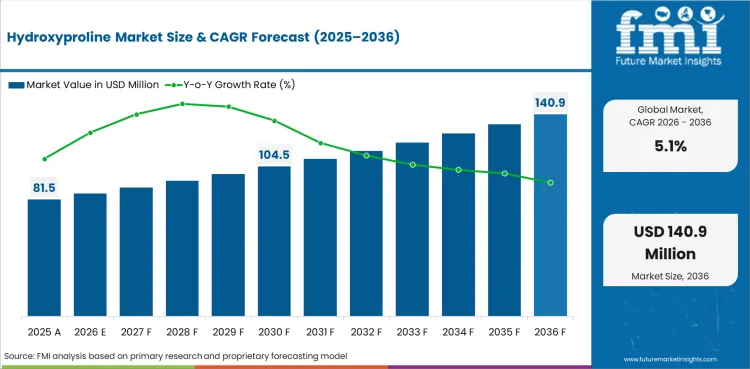
- The hydroxyproline market was valued at USD 81.5 million in 2025 and is expected to reach USD 85.7 million by the end of 2026.
- The market is projected to grow at a CAGR of 5.1% from 2026 to 2036, reaching USD 140.9 million by 2036.
- The market was valued at USD 70.21 million in 2025.
- By 2036, the market is expected to reach approximately USD 140.88 million.
- From 2026 to 2036, the market is projected to expand at a CAGR of 5.1%.
- The market is expected to create an incremental opportunity of USD 55.21 million between 2026 and 2036.
- In 2026, pharmaceutical grade is expected to account for 61.0% of the form segment, driven by strong demand from pharmaceutical synthesis, collagen-based formulations, and dietary supplement manufacturing requiring high-purity amino acid inputs.
- Pharmaceutical intermediate is expected to hold a 33.0% share, supported by its role in drug formulation processes.
- The USA (5.4%) and Japan (5.1%) are among the fastest-growing markets globally.
Hydroxyproline Market Definition
The hydroxyproline market includes pharmaceutical-grade and industrial-grade hydroxyproline amino acid compounds used as pharmaceutical intermediates, cosmetics ingredients, food additives, and dietary supplement components. Hydroxyproline is a key building block in collagen synthesis and serves multiple end-use industries.
Hydroxyproline Market Inclusions
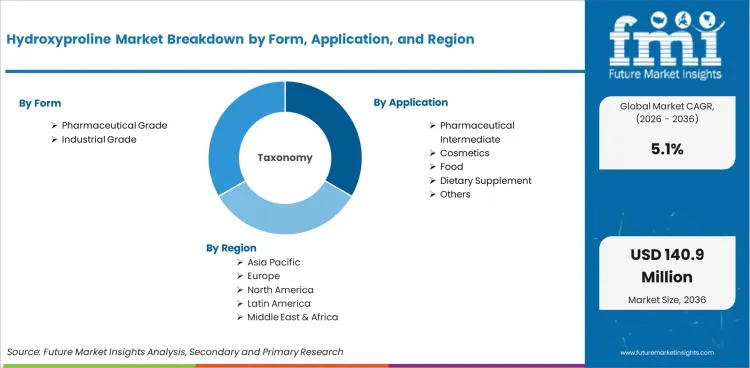
Market scope encompasses all commercially available hydroxyproline products categorized by form (pharmaceutical grade, industrial grade), application (pharmaceutical intermediate, cosmetics, food, dietary supplement, others), grade (food grade, pharmaceutical grade, industrial grade), and end user (pharmaceutical, food and beverage, cosmetics). The range of revenue sizes is from 2026 to 2036.
Hydroxyproline Market Exclusions
The scope does not include general amino acid supplements not specifically containing hydroxyproline, collagen peptide products where hydroxyproline is not the primary active component, or synthetic proline analogs.
Hydroxyproline Market Research Methodology
- Primary Research: FMI analysts conducted interviews with amino acid producers, pharmaceutical intermediate buyers, cosmetics ingredient formulators, and dietary supplement manufacturers in key markets.
- Desk Research: Combined data from chemical regulatory databases, pharmaceutical excipient specifications, amino acid trade statistics, and dietary supplement market reports.
- Market Sizing and Forecasting: Bottom-up approach aggregating data across segments and regions, with regional adoption curves.
- Data Validation: Cross-checked quarterly against industry production data and manufacturer disclosures.
Why is the Hydroxyproline Market Growing?
- Pharmaceutical manufacturing demand for collagen synthesis intermediates sustains the core consumption base for hydroxyproline.
- Collagen supplement market expansion in North America, Europe, and East Asia creates consumer-facing demand growth for food-grade hydroxyproline.
- USA (5.4%) leads growth, supported by pharmaceutical production infrastructure and the expanding collagen-based dietary supplement market.
The hydroxyproline market reflects stable demand dynamics rooted in pharmaceutical manufacturing, cosmetics formulation, and the growing dietary supplement sector. Pharmaceutical grade holds 61.0% of the form segment, as drug manufacturers require high-purity hydroxyproline for collagen-related pharmaceutical synthesis and medical device formulation.
Pharmaceutical intermediate applications lead at 33.0%, reflecting hydroxyproline's role as a structural amino acid in collagen-based medical products. Cosmetics applications are growing as anti-aging formulations increasingly incorporate collagen-supporting ingredients. Food-grade demand is expanding through the collagen peptide supplement market.
China-based manufacturers account for a significant share of global hydroxyproline production capacity, serving both domestic pharmaceutical and export markets. Japanese and German manufacturers serve premium pharmaceutical and cosmetics-grade segments where quality certification is a procurement differentiator.
Market Segmentation Analysis
- Pharmaceutical Grade holds 61% of the form segment, reflecting its established market position.
- Pharmaceutical Intermediate leads the application segment at 33%, supported by strong demand fundamentals.
- Food grade accounts for 49% of the grade segment, driven by dominant end-use demand patterns.
The hydroxyproline market is segmented by form, application, grade, end user. Each segment reflects distinct procurement patterns and end-use requirements.
Insights into the Pharmaceutical Grade Form Segment
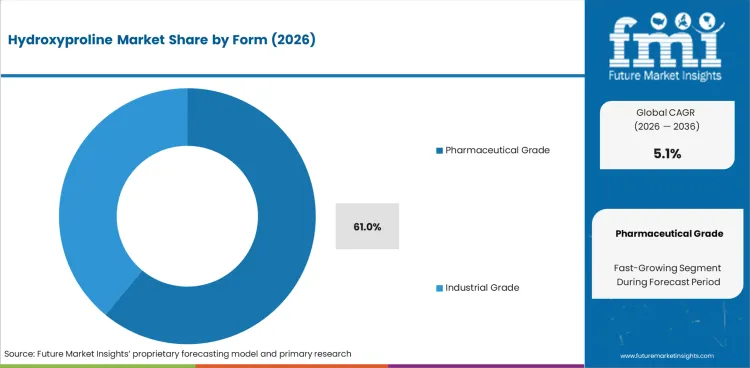
In 2026, Pharmaceutical Grade is expected to account for 61.0% of the form segment. Drug manufacturers require high-purity hydroxyproline for use in collagen-related pharmaceutical synthesis, peptide drug manufacturing, and medical device formulation. The stringent quality requirements of pharmaceutical-grade production, including USP and EP compliance, create premium pricing and limited supplier qualification.
Insights into the Pharmaceutical Intermediate Application Segment
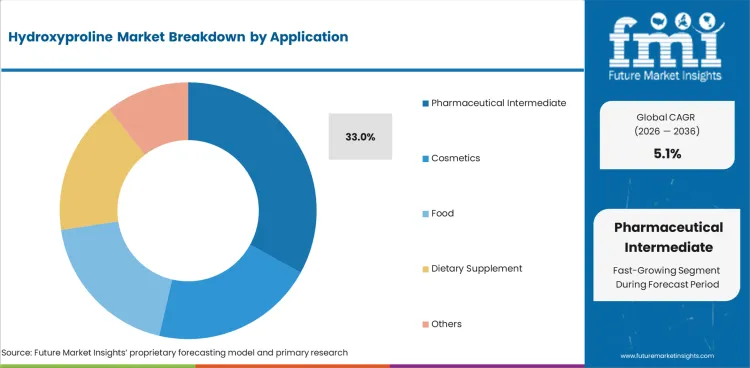
In 2026, Pharmaceutical Intermediate is expected to hold 33.0% of the application segment. Hydroxyproline serves as a structural amino acid in collagen-based medical products and as a chiral building block in peptide drug synthesis. Cosmetics and dietary supplement applications represent growing segments as collagen-based consumer products expand.
Hydroxyproline Market Drivers, Restraints, and Opportunities
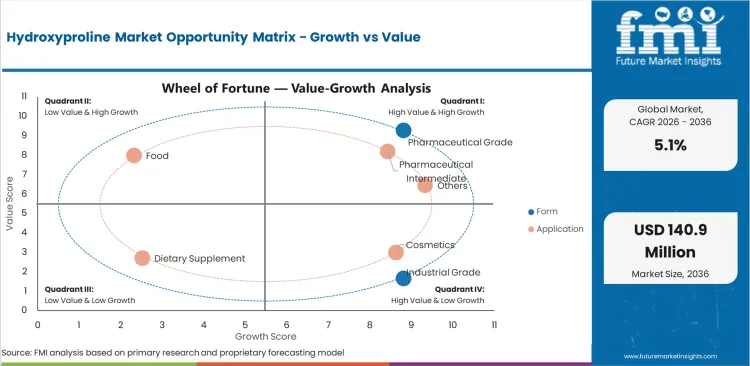
- Pharmaceutical manufacturing demand provides the stable core of hydroxyproline consumption.
- Collagen supplement and cosmetics ingredient markets are creating incremental growth channels.
- China-based production capacity expansion is influencing global pricing dynamics.
The hydroxyproline market is shaped by pharmaceutical manufacturing demand stability, collagen supplement market growth, cosmetics ingredient trends, and production capacity dynamics.
Pharmaceutical Manufacturing Demand
Demand reflects the established requirement for high-purity hydroxyproline in pharmaceutical synthesis, peptide drug manufacturing, and collagen-based medical product formulation. This application generates stable, recurring procurement volumes.
Collagen Supplement Market Growth
Growth is supported by the expansion of collagen peptide dietary supplements, where hydroxyproline content is both a quality marker and functional ingredient. North America, Europe, and East Asia represent the primary consumer markets.
Production Capacity and Pricing Dynamics
Adoption patterns are influenced by China-based production capacity expansion, which affects global pricing. Pharmaceutical-grade hydroxyproline commands premium pricing, while industrial-grade faces price pressure from capacity additions.
Analysis of Hydroxyproline Market By Key Countries
.webp "Top Country Growth Comparison Hydroxyproline Market Cagr (2026 2036)")
| Country | CAGR |
|---|---|
| USA | 5.4% |
| Japan | 5.1% |
| South Korea | 5% |
| UK | 4.9% |
| Europe | 4.8% |
Source: FMI analysis based on primary research and proprietary forecasting model
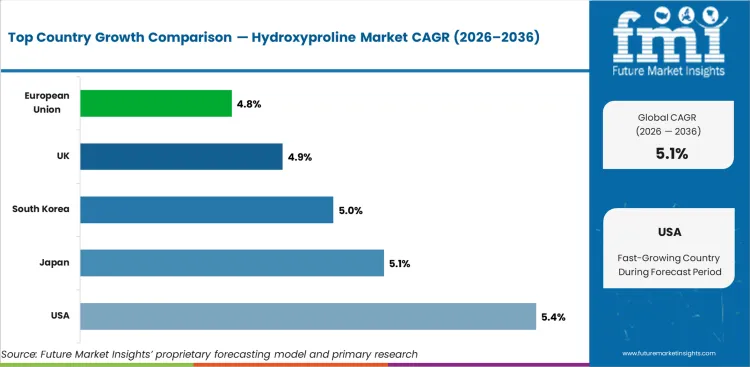
- USA leads growth at 5.4% CAGR, supported by pharmaceutical manufacturing demand and expanding collagen supplement market.
- Japan at 5.1% shows strong demand due to cosmetics manufacturing base and pharmaceutical production infrastructure.
- South Korea (5.0%) and UK (4.9%) sustain growth through cosmetics industry expansion and pharmaceutical production.
The global hydroxyproline market is projected to grow at 5.1% CAGR from 2026 to 2036. The analysis covers more than 30 countries, with the following markets showing the strongest growth trajectories.
Demand Outlook for Hydroxyproline Market in USA
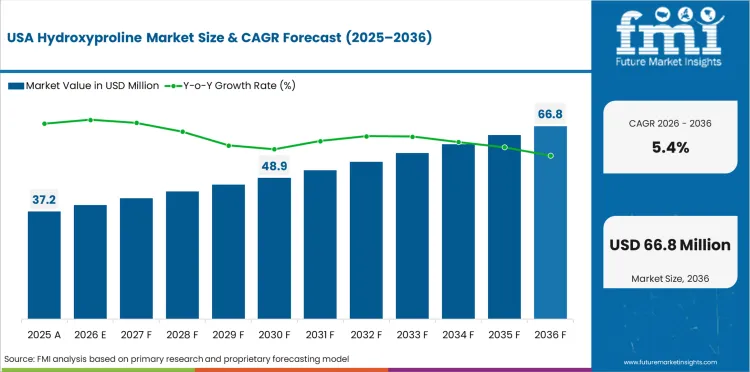
USA is projected to grow at 5.4% through 2036, supported by pharmaceutical manufacturing demand and expanding collagen supplement market.
- Pharmaceutical manufacturing demand sustains high-purity hydroxyproline procurement.
- Collagen supplement market expansion creates food-grade demand growth.
- Cosmetics ingredient innovation supports cosmetic-grade adoption.
Future Outlook for Hydroxyproline Market in Japan
Japan is projected to grow at 5.1% through 2036, supported by cosmetics manufacturing base and pharmaceutical production infrastructure.
- Established cosmetics manufacturing base creates cosmetic-grade demand.
- Pharmaceutical production infrastructure maintains pharmaceutical-grade procurement.
- Amino acid production technology leadership supports manufacturing.
Opportunity Analysis of Hydroxyproline Market in South Korea
South Korea is projected to grow at 5% through 2036, supported by cosmetics industry growth and collagen-based product manufacturing.
- Cosmetics industry growth drives collagen-supporting ingredient demand.
- Dietary supplement market expansion creates consumer-facing demand.
- K-beauty formulation innovation supports specialty ingredient adoption.
In-depth Analysis of Hydroxyproline Market in UK
UK is projected to grow at 4.9% through 2036, supported by pharmaceutical production and personal care ingredient procurement.
- Pharmaceutical production maintains grade-specific procurement volumes.
- Personal care formulation development supports ingredient innovation.
- Collagen supplement retail growth creates incremental demand.
Sales Analysis of Hydroxyproline Market in Europe
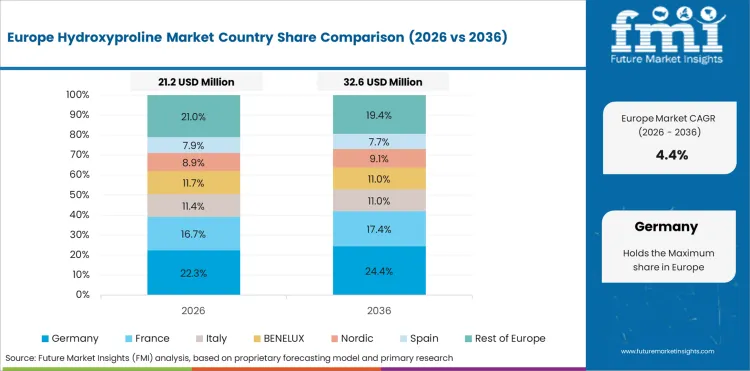
Europe is projected to grow at 4.8% through 2036, supported by cosmetics regulatory framework and pharmaceutical manufacturing standards.
- Cosmetics regulatory compliance influences ingredient grade requirements.
- Pharmaceutical manufacturing standards sustain premium-grade demand.
- Specialty chemical supply chains support multi-grade distribution.
Competitive Landscape and Strategic Positioning
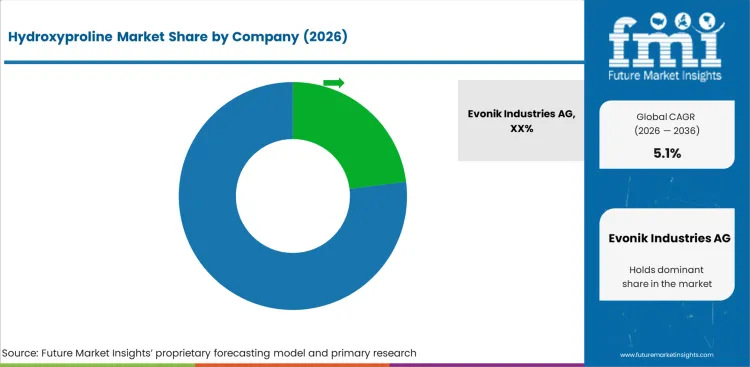
- Evonik Industries AG leads with an estimated 23.0% share, supported by integrated amino acid production and pharmaceutical-grade quality capabilities.
- Ajinomoto and Kyowa Hakko serve premium pharmaceutical and cosmetics-grade segments.
- China-based manufacturers dominate production volume and influence global pricing.
Evonik Industries AG leads through its integrated amino acid production platform, which includes hydroxyproline manufactured under pharmaceutical-grade quality systems.
Ajinomoto Co., Inc. and KYOWA HAKKO BIO CO., LTD. serve premium-grade segments from Japanese manufacturing bases.
China-based manufacturers including Wuhan Yuancheng, Sichuan Tongsheng, Zhejiang NHU account for the majority of global production capacity.
Competitive dynamics are shaped by grade purity, regulatory certification, production cost, and supply reliability.
Key Companies in the Hydroxyproline Market
Key global companies leading the hydroxyproline market include:
- Evonik Industries AG (Germany), Ajinomoto Co., Inc. (Japan), KYOWA HAKKO BIO CO., LTD. (Japan) hold leading positions through quality-certified amino acid production.
- Wuhan Yuancheng (China), Sichuan Tongsheng (China), Zhejiang NHU (China) serve volume production with cost-competitive supply.
- Shijiazhuang Jirong (China), Shaanxi Jiahe (China), Hubei Bafeng (China) represent emerging production capacity.
Competitive Benchmarking: Hydroxyproline Market
| Company | Amino Acid Production Scale | Pharma Grade Capability | Multi-Industry Supply | Geographic Distribution |
|---|---|---|---|---|
| Evonik Industries AG | High | High | Strong | Global |
| Ajinomoto Co., Inc. | High | High | Strong | Global |
| KYOWA HAKKO BIO CO., LTD. | Medium | High | Moderate | Regional |
| Wuhan Yuancheng Gongchuang Technology Co., Ltd. | Medium | High | Moderate | Regional |
| Sichuan Tongsheng Amino Acid Co., Ltd. | Medium | Medium | Low | Regional |
| Zhejiang NHU Co., Ltd. | Medium | Medium | Low | Regional |
| Shijiazhuang Jirong Pharmaceutical Co., Ltd. | Medium | Medium | Low | Regional |
| Shaanxi Jiahe Phytochem Co., Ltd. | Medium | Medium | Low | Regional |
Source: Future Market Insights competitive analysis, 2026.
Key Developments in Hydroxyproline Market
- In 2025, Evonik Industries expanded pharmaceutical-grade hydroxyproline production capacity at its European manufacturing facility.
- In 2025, Ajinomoto Co., Inc. launched a cosmetic-grade hydroxyproline product line targeting anti-aging skincare formulation customers in East Asian markets.
Key Players in the Hydroxyproline Market
Major Global Players
- Evonik Industries AG
- Ajinomoto Co., Inc.
- KYOWA HAKKO BIO CO., LTD.
- Wuhan Yuancheng Gongchuang Technology Co., Ltd.
- Sichuan Tongsheng Amino Acid Co., Ltd.
Emerging Players/Startups
- Wuhan Yuancheng Gongchuang Technology Co., Ltd.
- Sichuan Tongsheng Amino Acid Co., Ltd.
- Zhejiang NHU Co., Ltd.
- Shijiazhuang Jirong Pharmaceutical Co., Ltd.
- Shaanxi Jiahe Phytochem Co., Ltd.
- Hubei Bafeng Pharmaceutical & Chemical Co., Ltd.
Report Scope and Coverage
| Parameter | Details |
|---|---|
| Quantitative Units | USD 85.67 million to USD 140.88 million, at a CAGR of 5.1% |
| Market Definition | The hydroxyproline market includes pharmaceutical-grade and industrial-grade hydroxyproline amino acid compounds used as pharmaceutical intermediates, cosmetics ingredients, food additives, and dietar... |
| Regions Covered | North America, Latin America, Europe, East Asia, South Asia and Pacific, Middle East and Africa |
| Countries Covered | USA, Japan, South Korea, UK, Europe, 30 plus countries |
| Key Companies Profiled | Evonik Industries AG, Ajinomoto Co., Inc., KYOWA HAKKO BIO CO., LTD., Wuhan Yuancheng Gongchuang Technology Co., Ltd., Sichuan Tongsheng Amino Acid Co., Ltd., Zhejiang NHU Co., Ltd., Shijiazhuang Jirong Pharmaceutical Co., Ltd., Shaanxi Jiahe Phytochem Co., Ltd., Hubei Bafeng Pharmaceutical & Chemical Co., Ltd. |
| Forecast Period | 2026 to 2036 |
| Approach | Hybrid bottom-up and top-down methodology starting with verified transaction data, projecting adoption velocity across segments and regions. |
Segmentation
Hydroxyproline Market Market Segmented by Form:
- Pharmaceutical Grade
- Industrial Grade
Hydroxyproline Market Market Segmented by Application:
- Pharmaceutical Intermediate
- Cosmetics
- Food
- Dietary Supplement
- Others
Hydroxyproline Market Market Segmented by Grade:
- Food grade
- Pharmaceutical grade
- Industrial grade
Hydroxyproline Market Market Segmented by End User:
- Pharmaceutical
- Food & beverage
- Cosmetics
Hydroxyproline Market Market by Region:
- North America
- USA
- Canada
- Mexico
- Latin America
- Brazil
- Chile
- Rest of Latin America
- Western Europe
- Germany
- UK
- Italy
- Spain
- France
- Nordic
- BENELUX
- Rest of Western Europe
- Eastern Europe
- Russia
- Poland
- Hungary
- Balkan & Baltic
- Rest of Eastern Europe
- East Asia
- China
- Japan
- South Korea
- South Asia and Pacific
- India
- ASEAN
- Australia & New Zealand
- Rest of South Asia and Pacific
- Middle East & Africa
- Kingdom of Saudi Arabia
- Other GCC Countries
- Turkiye
- South Africa
- Other African Union
- Rest of Middle East & Africa
Research Sources and Bibliography
- 1. European Chemicals Agency. (2024). ECHA REACH Registration Data: Hydroxyproline Compound Assessment. ECHA.
- 2. USA Pharmacopeia. (2025). USP Monograph: L-Hydroxyproline Reference Standards. USP.
- 3. Food and Agriculture Organization. (2024). FAO/WHO Expert Committee on Food Additives: Amino Acid Assessment. FAO.
- 4. International Federation of Pharmaceutical Manufacturers. (2025). IFPMA Report on Amino Acid APIs. IFPMA.
- 5. Evonik Industries AG. (2025). Evonik Annual Report 2025: Health and Care Division. Evonik.
This bibliography is provided for reader reference. The full Future Market Insights report contains the complete reference list with publication dates, URLs, and supporting data for all cited works.
This Report Answers
- Estimating the size of the market and revenue from 2026 to 2036.
- Segmentation analysis across form, application, grade, end user.
- Insights about more than 30 regional markets.
- Assessment of the competitive landscape.
- Company profiling and strategic positioning analysis.
- Investment opportunity identification across key segments and regions.
- Supply chain and procurement structure analysis.
- Delivery of data in PDF and Excel formats.
Frequently Asked Questions
What is the global market demand for Hydroxyproline in 2026?
In 2026, the global hydroxyproline market is expected to be worth USD 85.67 million.
How big will the Hydroxyproline Market be in 2036?
By 2036, the hydroxyproline market is expected to be worth USD 140.88 million.
How much is demand expected to grow between 2026 and 2036?
Between 2026 and 2036, demand is expected to grow at a CAGR of 5.1%.
Which form segment is likely to lead globally by 2026?
Pharmaceutical Grade is expected to account for 61.0% of the form segment in 2026.
What is causing demand to rise in the USA?
USA is expected to grow at 5.4% CAGR through 2036, supported by pharmaceutical manufacturing demand and expanding collagen supplement market.
What is causing demand to rise in Japan?
Japan is expected to grow at 5.1% CAGR through 2036, supported by cosmetics manufacturing base and pharmaceutical production infrastructure.
What does this report mean by Hydroxyproline Market definition?
The hydroxyproline market includes pharmaceutical-grade and industrial-grade hydroxyproline amino acid compounds used as pharmaceutical intermediates, cosmetics ingredients, food additives, and dietary supplement components.
How does FMI make the forecast?
Forecasting models use a hybrid bottom-up and top-down approach, starting with verified transaction data and checking it against industry production statistics and manufacturer disclosures.
Preview the report firsthand - request a free sample
Get SampleGet the brochure for pricing and purchase details.
Get PDFTable of Content
- Executive Summary
- Global Market Outlook
- Demand-side Trends
- Supply-side Trends
- Technology Roadmap Analysis
- Analysis and Recommendations
- Market Overview
- Market Coverage / Taxonomy
- Market Definition / Scope / Limitations
- Research Methodology
- Chapter Orientation
- Analytical Lens and Working Hypotheses
- Market Structure, Signals, and Trend Drivers
- Benchmarking and Cross-market Comparability
- Market Sizing, Forecasting, and Opportunity Mapping
- Research Design and Evidence Framework
- Desk Research Programme (Secondary Evidence)
- Company Annual and Sustainability Reports
- Peer-reviewed Journals and Academic Literature
- Corporate Websites, Product Literature, and Technical Notes
- Earnings Decks and Investor Briefings
- Statutory Filings and Regulatory Disclosures
- Technical White Papers and Standards Notes
- Trade Journals, Industry Magazines, and Analyst Briefs
- Conference Proceedings, Webinars, and Seminar Materials
- Government Statistics Portals and Public Data Releases
- Press Releases and Reputable Media Coverage
- Specialist Newsletters and Curated Briefings
- Sector Databases and Reference Repositories
- FMI Internal Proprietary Databases and Historical Market Datasets
- Subscription Datasets and Paid Sources
- Social Channels, Communities, and Digital Listening Inputs
- Additional Desk Sources
- Expert Input and Fieldwork (Primary Evidence)
- Primary Modes
- Qualitative Interviews and Expert Elicitation
- Quantitative Surveys and Structured Data Capture
- Blended Approach
- Why Primary Evidence is Used
- Field Techniques
- Interviews
- Surveys
- Focus Groups
- Observational and In-context Research
- Social and Community Interactions
- Stakeholder Universe Engaged
- C-suite Leaders
- Board Members
- Presidents and Vice Presidents
- R&D and Innovation Heads
- Technical Specialists
- Domain Subject-matter Experts
- Scientists
- Physicians and Other Healthcare Professionals
- Governance, Ethics, and Data Stewardship
- Research Ethics
- Data Integrity and Handling
- Primary Modes
- Tooling, Models, and Reference Databases
- Desk Research Programme (Secondary Evidence)
- Data Engineering and Model Build
- Data Acquisition and Ingestion
- Cleaning, Normalisation, and Verification
- Synthesis, Triangulation, and Analysis
- Quality Assurance and Audit Trail
- Market Background
- Market Dynamics
- Drivers
- Restraints
- Opportunity
- Trends
- Scenario Forecast
- Demand in Optimistic Scenario
- Demand in Likely Scenario
- Demand in Conservative Scenario
- Opportunity Map Analysis
- Product Life Cycle Analysis
- Supply Chain Analysis
- Investment Feasibility Matrix
- Value Chain Analysis
- PESTLE and Porter’s Analysis
- Regulatory Landscape
- Regional Parent Market Outlook
- Production and Consumption Statistics
- Import and Export Statistics
- Market Dynamics
- Global Market Analysis 2021 to 2025 and Forecast, 2026 to 2036
- Historical Market Size Value (USD Million) Analysis, 2021 to 2025
- Current and Future Market Size Value (USD Million) Projections, 2026 to 2036
- Y-o-Y Growth Trend Analysis
- Absolute $ Opportunity Analysis
- Global Market Pricing Analysis 2021 to 2025 and Forecast 2026 to 2036
- Global Market Analysis 2021 to 2025 and Forecast 2026 to 2036, By Form
- Introduction / Key Findings
- Historical Market Size Value (USD Million) Analysis By Form , 2021 to 2025
- Current and Future Market Size Value (USD Million) Analysis and Forecast By Form , 2026 to 2036
- Pharmaceutical Grade
- Industrial Grade
- Pharmaceutical Grade
- Y-o-Y Growth Trend Analysis By Form , 2021 to 2025
- Absolute $ Opportunity Analysis By Form , 2026 to 2036
- Global Market Analysis 2021 to 2025 and Forecast 2026 to 2036, By Application
- Introduction / Key Findings
- Historical Market Size Value (USD Million) Analysis By Application, 2021 to 2025
- Current and Future Market Size Value (USD Million) Analysis and Forecast By Application, 2026 to 2036
- Pharmaceutical Intermediate
- Cosmetics
- Food
- Dietary Supplement
- Others
- Pharmaceutical Intermediate
- Y-o-Y Growth Trend Analysis By Application, 2021 to 2025
- Absolute $ Opportunity Analysis By Application, 2026 to 2036
- Global Market Analysis 2021 to 2025 and Forecast 2026 to 2036, By Grade
- Introduction / Key Findings
- Historical Market Size Value (USD Million) Analysis By Grade, 2021 to 2025
- Current and Future Market Size Value (USD Million) Analysis and Forecast By Grade, 2026 to 2036
- Food grade
- Pharmaceutical grade
- Industrial grade
- Food grade
- Y-o-Y Growth Trend Analysis By Grade, 2021 to 2025
- Absolute $ Opportunity Analysis By Grade, 2026 to 2036
- Global Market Analysis 2021 to 2025 and Forecast 2026 to 2036, By End User
- Introduction / Key Findings
- Historical Market Size Value (USD Million) Analysis By End User, 2021 to 2025
- Current and Future Market Size Value (USD Million) Analysis and Forecast By End User, 2026 to 2036
- Pharmaceutical
- Food & beverage
- Cosmetics
- Pharmaceutical
- Y-o-Y Growth Trend Analysis By End User, 2021 to 2025
- Absolute $ Opportunity Analysis By End User, 2026 to 2036
- Global Market Analysis 2021 to 2025 and Forecast 2026 to 2036, By Region
- Introduction
- Historical Market Size Value (USD Million) Analysis By Region, 2021 to 2025
- Current Market Size Value (USD Million) Analysis and Forecast By Region, 2026 to 2036
- North America
- Latin America
- Western Europe
- Eastern Europe
- East Asia
- South Asia and Pacific
- Middle East & Africa
- Market Attractiveness Analysis By Region
- North America Market Analysis 2021 to 2025 and Forecast 2026 to 2036, By Country
- Historical Market Size Value (USD Million) Trend Analysis By Market Taxonomy, 2021 to 2025
- Market Size Value (USD Million) Forecast By Market Taxonomy, 2026 to 2036
- By Country
- USA
- Canada
- Mexico
- By Form
- By Application
- By Grade
- By End User
- By Country
- Market Attractiveness Analysis
- By Country
- By Form
- By Application
- By Grade
- By End User
- Key Takeaways
- Latin America Market Analysis 2021 to 2025 and Forecast 2026 to 2036, By Country
- Historical Market Size Value (USD Million) Trend Analysis By Market Taxonomy, 2021 to 2025
- Market Size Value (USD Million) Forecast By Market Taxonomy, 2026 to 2036
- By Country
- Brazil
- Chile
- Rest of Latin America
- By Form
- By Application
- By Grade
- By End User
- By Country
- Market Attractiveness Analysis
- By Country
- By Form
- By Application
- By Grade
- By End User
- Key Takeaways
- Western Europe Market Analysis 2021 to 2025 and Forecast 2026 to 2036, By Country
- Historical Market Size Value (USD Million) Trend Analysis By Market Taxonomy, 2021 to 2025
- Market Size Value (USD Million) Forecast By Market Taxonomy, 2026 to 2036
- By Country
- Germany
- UK
- Italy
- Spain
- France
- Nordic
- BENELUX
- Rest of Western Europe
- By Form
- By Application
- By Grade
- By End User
- By Country
- Market Attractiveness Analysis
- By Country
- By Form
- By Application
- By Grade
- By End User
- Key Takeaways
- Eastern Europe Market Analysis 2021 to 2025 and Forecast 2026 to 2036, By Country
- Historical Market Size Value (USD Million) Trend Analysis By Market Taxonomy, 2021 to 2025
- Market Size Value (USD Million) Forecast By Market Taxonomy, 2026 to 2036
- By Country
- Russia
- Poland
- Hungary
- Balkan & Baltic
- Rest of Eastern Europe
- By Form
- By Application
- By Grade
- By End User
- By Country
- Market Attractiveness Analysis
- By Country
- By Form
- By Application
- By Grade
- By End User
- Key Takeaways
- East Asia Market Analysis 2021 to 2025 and Forecast 2026 to 2036, By Country
- Historical Market Size Value (USD Million) Trend Analysis By Market Taxonomy, 2021 to 2025
- Market Size Value (USD Million) Forecast By Market Taxonomy, 2026 to 2036
- By Country
- China
- Japan
- South Korea
- By Form
- By Application
- By Grade
- By End User
- By Country
- Market Attractiveness Analysis
- By Country
- By Form
- By Application
- By Grade
- By End User
- Key Takeaways
- South Asia and Pacific Market Analysis 2021 to 2025 and Forecast 2026 to 2036, By Country
- Historical Market Size Value (USD Million) Trend Analysis By Market Taxonomy, 2021 to 2025
- Market Size Value (USD Million) Forecast By Market Taxonomy, 2026 to 2036
- By Country
- India
- ASEAN
- Australia & New Zealand
- Rest of South Asia and Pacific
- By Form
- By Application
- By Grade
- By End User
- By Country
- Market Attractiveness Analysis
- By Country
- By Form
- By Application
- By Grade
- By End User
- Key Takeaways
- Middle East & Africa Market Analysis 2021 to 2025 and Forecast 2026 to 2036, By Country
- Historical Market Size Value (USD Million) Trend Analysis By Market Taxonomy, 2021 to 2025
- Market Size Value (USD Million) Forecast By Market Taxonomy, 2026 to 2036
- By Country
- Kingdom of Saudi Arabia
- Other GCC Countries
- Turkiye
- South Africa
- Other African Union
- Rest of Middle East & Africa
- By Form
- By Application
- By Grade
- By End User
- By Country
- Market Attractiveness Analysis
- By Country
- By Form
- By Application
- By Grade
- By End User
- Key Takeaways
- Key Countries Market Analysis
- USA
- Pricing Analysis
- Market Share Analysis, 2025
- By Form
- By Application
- By Grade
- By End User
- Canada
- Pricing Analysis
- Market Share Analysis, 2025
- By Form
- By Application
- By Grade
- By End User
- Mexico
- Pricing Analysis
- Market Share Analysis, 2025
- By Form
- By Application
- By Grade
- By End User
- Brazil
- Pricing Analysis
- Market Share Analysis, 2025
- By Form
- By Application
- By Grade
- By End User
- Chile
- Pricing Analysis
- Market Share Analysis, 2025
- By Form
- By Application
- By Grade
- By End User
- Germany
- Pricing Analysis
- Market Share Analysis, 2025
- By Form
- By Application
- By Grade
- By End User
- UK
- Pricing Analysis
- Market Share Analysis, 2025
- By Form
- By Application
- By Grade
- By End User
- Italy
- Pricing Analysis
- Market Share Analysis, 2025
- By Form
- By Application
- By Grade
- By End User
- Spain
- Pricing Analysis
- Market Share Analysis, 2025
- By Form
- By Application
- By Grade
- By End User
- France
- Pricing Analysis
- Market Share Analysis, 2025
- By Form
- By Application
- By Grade
- By End User
- India
- Pricing Analysis
- Market Share Analysis, 2025
- By Form
- By Application
- By Grade
- By End User
- ASEAN
- Pricing Analysis
- Market Share Analysis, 2025
- By Form
- By Application
- By Grade
- By End User
- Australia & New Zealand
- Pricing Analysis
- Market Share Analysis, 2025
- By Form
- By Application
- By Grade
- By End User
- China
- Pricing Analysis
- Market Share Analysis, 2025
- By Form
- By Application
- By Grade
- By End User
- Japan
- Pricing Analysis
- Market Share Analysis, 2025
- By Form
- By Application
- By Grade
- By End User
- South Korea
- Pricing Analysis
- Market Share Analysis, 2025
- By Form
- By Application
- By Grade
- By End User
- Russia
- Pricing Analysis
- Market Share Analysis, 2025
- By Form
- By Application
- By Grade
- By End User
- Poland
- Pricing Analysis
- Market Share Analysis, 2025
- By Form
- By Application
- By Grade
- By End User
- Hungary
- Pricing Analysis
- Market Share Analysis, 2025
- By Form
- By Application
- By Grade
- By End User
- Kingdom of Saudi Arabia
- Pricing Analysis
- Market Share Analysis, 2025
- By Form
- By Application
- By Grade
- By End User
- Turkiye
- Pricing Analysis
- Market Share Analysis, 2025
- By Form
- By Application
- By Grade
- By End User
- South Africa
- Pricing Analysis
- Market Share Analysis, 2025
- By Form
- By Application
- By Grade
- By End User
- USA
- Market Structure Analysis
- Competition Dashboard
- Competition Benchmarking
- Market Share Analysis of Top Players
- By Regional
- By Form
- By Application
- By Grade
- By End User
- Competition Analysis
- Competition Deep Dive
- Evonik Industries AG
- Overview
- Product Portfolio
- Profitability by Market Segments (Product/Age /Sales Channel/Region)
- Sales Footprint
- Strategy Overview
- Marketing Strategy
- Product Strategy
- Channel Strategy
- Ajinomoto Co., Inc.
- KYOWA HAKKO BIO CO., LTD.
- Wuhan Yuancheng Gongchuang Technology Co., Ltd.
- Sichuan Tongsheng Amino Acid Co., Ltd.
- Zhejiang NHU Co., Ltd.
- Shijiazhuang Jirong Pharmaceutical Co., Ltd.
- Shaanxi Jiahe Phytochem Co., Ltd.
- Hubei Bafeng Pharmaceutical & Chemical Co., Ltd.
- Other Companies
- Evonik Industries AG
- Competition Deep Dive
- Assumptions & Acronyms Used


