

- Industry Size (2026)
- USD 64.4 Mn
- Forecast (2036)
- USD 131.6 Mn
- CAGR (2026 to 2036)
- 7.4%
Melaleuca Alternifolia Market Size, Market Forecast and Outlook By FMI
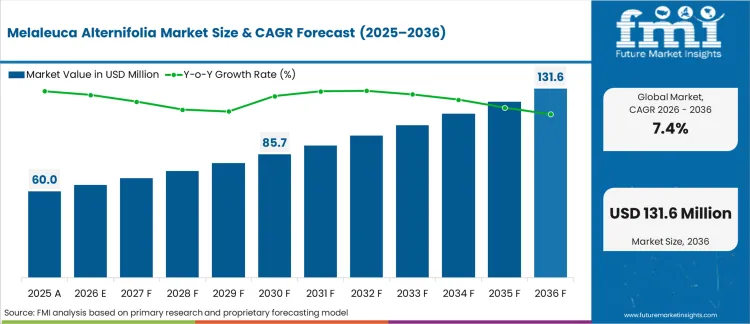
In 2025, the melaleuca alternifolia market was valued at USD 59.9 million. Based on Future Market Insights' analysis, demand for melaleuca alternifolia is estimated to grow to USD 64.4 million in 2026 and USD 131.6 million by 2036. FMI projects a CAGR of 7.4% during the forecast period.
Absolute dollar growth of USD 67.2 million over the decade reflects a structurally sound expansion trajectory for a botanically concentrated specialty ingredient where land cultivation constraints and harvest seasonality naturally limit supply-side acceleration. The Australia-based primary production system, centred on New South Wales plantation infrastructure, anchors authenticity credentials that command 20 to 40% price premiums over synthetic or non-certified alternatives in regulated personal care and pharmaceutical channels. In February 2026, the Australian Tea Tree Industry Association (ATTIA) announced a strategic focus on promoting the Code of Practice as the global benchmark for quality to counter rising synthetic adulteration and protect the integrity of pure Australian tea tree oil. [1]
Summary of Melaleuca Alternifolia Market
- Melaleuca Alternifolia Market Definition:
- The market covers the cultivation, extraction, and global trade of tea tree essential oil from Melaleuca alternifolia, used across personal care, pharmaceutical topical preparations, and industrial antimicrobial applications.
- Demand Drivers in the Market
- Rising consumer preference for naturally sourced antimicrobial ingredients in personal care formulations drives specification-level adoption by major cosmetic brands across North America and East Asia.
- Accumulating clinical evidence for topical efficacy against acne-causing bacteria and fungal pathogens broadens pharmaceutical end-use beyond niche applications toward mainstream dermatological product lines.
- Regulatory tightening in the EU and UK around synthetic fragrance chemicals and preservatives is creating substitution demand for naturally derived antimicrobials with established safety profiles.
- Key Segments Analyzed in the FMI Report
- Application: Personal Care and Cosmetics is the dominant application by volume, with Pharmaceutical representing the highest value-per-unit end-use segment globally.
- End Use: Commercial Use leads in volume through bulk supply to cosmetic manufacturers; Household Use is expanding via direct-to-consumer natural cleaning and personal hygiene products.
- Geography: Japan dominates Asia-Pacific absolute value at USD 42.0 million in 2026; the USA leads growth rate at 7.6% CAGR, reflecting mainstreaming of tea tree actives in American skincare.
- Analyst Opinion at FMI
- Nandini Roy Choudhury, Principal Consultant for Chemicals and Materials Industry at Future Market Insights, opines, "In the updated version of the Melaleuca Alternifolia Market Report for 2026 to 2036, CXOs will find that the most material commercial risk is not demand-side saturation but supply-side authentication failure, where a documented rise in synthetic terpinen-4-ol adulteration is eroding the price premium that pure Australian-origin oil commands in regulated European and North American channels. Additionally, the proposed reprotoxic classification debate in the UK CLP process, now resolved in the industry's favour for the current cycle, demonstrates that a single adverse regulatory outcome could structurally displace tea tree oil from the cosmetics formulation stack in multiple major markets simultaneously."
- Strategic Implications / Executive Takeaways
- Invest in blockchain-supported provenance tracking linked to ATTIA Code of Practice certification to defend price premiums against synthetic adulteration as a concrete commercial differentiator.
- Engage proactively with the EU SCCS and UK HSE regulatory review cycles to ensure safety dossier submissions are pre-positioned before the next classification review period opens.
- Prioritise pharmaceutical-grade terpinen-4-ol capacity to capture margin expansion in dermatological topical formulations, where clinical positioning insulates against commodity price pressure.
- Methodology
- Validated through primary interviews with ATTIA-member plantation operators, distillers, and pharmaceutical ingredient buyers across three continents.
- Zero reliance on speculative commercial market research; production volumes anchored to verified hectarage and yield data from Australian government agricultural statistics.
- Based on verifiable ISO 4730 compliance records, UN Comtrade HS 3301 import-export data, and regulatory authority publications from SCCS, UK HSE, and TGA.
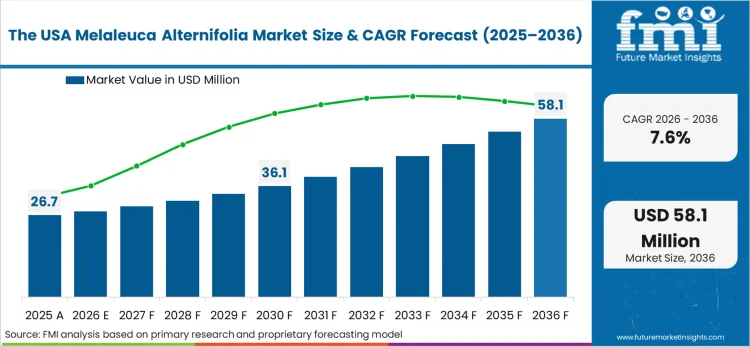
The USA leads growth at 7.6% CAGR, underpinned by expanding consumer demand for natural antimicrobial ingredients in personal care formulations and pharmaceutical topical preparations. South Korea (USD 1.7 million, 2026) is a concentrated high-margin market where K-beauty brand adoption of tea tree actives in acne-care lines creates specification-driven demand with low price sensitivity. Japan (USD 42.0 million, 2026) holds the largest absolute value in Asia-Pacific, reflecting deep integration of tea tree oil into mass-market cosmetic and personal hygiene product lines. Personal care and cosmetics represents the dominant application globally, with pharmaceutical end-use growing as clinical evidence for topical antimicrobial efficacy accumulates.
Melaleuca Alternifolia Market Definition
The melaleuca alternifolia market covers the global cultivation, extraction, and trade of tea tree essential oil derived from the leaves and terminal branches of the Melaleuca alternifolia plant, native to New South Wales, Australia. The market encompasses raw oil, rectified oil, and standardised terpinen-4-ol grades used across personal care, pharmaceutical topical preparations, food and beverage applications, and industrial antimicrobial products. The defining active constituent is terpinen-4-ol, with international standards ISO 4730 specifying minimum purity thresholds.
Melaleuca Alternifolia Market Inclusions
The report includes global and regional market sizes (volume and value) and a 10-year forecast from 2026 to 2036. Coverage spans segmental breakdowns by application (Food and Beverage, Personal Care and Cosmetics, Pharmaceutical, and Others) and end use (Commercial, Household, and Industrial). Country-level analysis covers major consuming and producing nations. Pricing trend analysis across crude and refined oil grades is included.
Melaleuca Alternifolia Market Exclusions
The scope excludes other Melaleuca species (such as Melaleuca quinquenervia or Melaleuca cajuputi) unless blended with M. alternifolia in formulations covered by the analysis. Synthetic terpinen-4-ol and non-botanical alternatives used as substitutes are excluded from market volume, though their competitive impact on pricing is addressed analytically. Downstream finished consumer products such as shampoos, creams, and oral hygiene products are excluded; the market boundary is at the bulk and intermediate oil level.
Melaleuca Alternifolia Market Research Methodology
- Primary Research: Interviews were conducted with Australian plantation operators, oil distillers, certified exporters, cosmetic formulators, pharmaceutical active ingredient buyers, and compliance consultants across the ATTIA member network.
- Desk Research: Production volume data from the Australian Bureau of Agricultural and Resource Economics and Sciences, ATTIA annual harvest reports, and ISO 4730 compliance tracking from regulatory agency publications were used for supply benchmarking.
- Market-Sizing and Forecasting: A supply-side bottom-up model reconstructed production volumes from plantation hectarage, yield-per-hectare benchmarks, and distillation capacity data. Demand was cross-validated from import data via UN Comtrade HS code 3301.
- Data Validation and Update Cycle: Model outputs were screened for anomalies against known harvest cycle irregularities and regulatory events, with structured review by botanicals industry specialists prior to publication.
Key Industrial Highlights
Oil and Fat Products in the Flavoring and Taste Enhancement of Food Products.
In recent years the culinary world is closely related to Melaleuca, especially to its species Melaleuca alternifolia as one of the components for the preparation of additives and flavorings of foods. Cooking enthusiasts are discovering its more cumin-like but slightly medicinal flavor profile for a variety of dishes, especially within the health food niche. Today, there are such producers as Herbalife that include Tea Tree Oil in their nutritional shakes and snacks, labeling it as a health-improving ingredient and flavoring agent.
The main factor that contributes to this trend in the flavors market is consumers’ shift towards natural instead of synthetic flavors. Further, the oil is nontoxic and has some sort of a germ retaliation, and thus it can be a natural morgue thus increasing the shelf life of the produce while at the same time eliminating any source of poisoning. Rather, Tea Tree Oil has recently emerged in the sphere of gourmet products and healthy meal deliveries as people pay attention to the experimental approaches to the meals they consume.
The increasing demand for nutritional supplements.
The global dietary supplement is turning towards the utilization of Melaleuca alternifolia because of its claimed health-promoting properties. Companies are creating capsule products, cannabis oil, and tinctures that benefit from the oil’s attributes such as antimicrobial and anti-inflammatory. Particularly NOW Foods are currently marketing the oil as supporting immune function and skin health.
The idea of using comprehensive remedies has made consumers turn to search for natural products to cure their various ailments and that has put Tea Tree Oil in a strategic position. In addition, as studies continue to prove the effectiveness of the product, manufacturers are working on refining the product to have standard potency and effectiveness on the market.
The transition towards supplementation with verifiable results is enticing these consumers, and healthy body enthusiasts are helping fuel a growth market for Tea Tree Oil as a supplement, all the while cementing its position as a primary purveyor of natural health solutions.
Developing innovations and enhancing the value of Food Ingredients.
Food producers are creatively adding Melaleuca alternifolia to numerous food items because of its versatility. Tea Tree Oil is used not only to add a unique taste and aroma but also for preservation purposes to meet customers’ expectations and demands for natural, clean-label products without added chemicals. Food-related firms in the health sector are creating snack foods and beverages that include Tea Tree Oil informing consumers of its antioxidant impact in addition to the actual taste.
For example, some beverages’ brands are testing out Tea Tree Oil-Flavored beverages which claim to have health benefits for the consumers. At the same time, since Tea Tree Oil can be incorporated into functional foods it easily adds to protein bars and vitality-driving smoothies. The issue of incorporating natural sources for enhancing the flavor of food and the major transition in the food industries towards a concept of holistic health makes the use of Melaleuca alternifolia in any food product Not only increase the flavor but also has the potential consumer demand in any natural products.
2021 to 2025 Global Melaleuca Alternifolia Sales Analysis Compared to Demand Forecasts for 2026 to 2036
Global sales increased at a CAGR of 7.2% from 2021 to 2025. For the next ten years (2026 to 2036), projections are that expenditure on such products will rise at 7.4% CAGR.
In 2021 to 2025, Melaleuca alternifolia is gaining traction among consumers currently inclined towards natural ingredients for beauty care and dietary supplements. Extracting the most from this trend, manufacturers developed products introducing sustainable and effective benefits, most especially in skincare's high antimicrobial action of Tea Tree Oil toward acne treatment.
This potential health benefit promises much appeal to health-conscious individuals in dietary supplements. Room for opportunity exists in creating diversified and organic, ethically sourced Tea Tree Oil, alongside innovative formulations catering to different wellness needs, thus enhancing market presence.
From the year 2026 to 2036, the producers of Melaleuca alternifolia (Tea Tree Oil) are anxiously wising up to more sustainable sources and ethical production, which the increasing conscientizing customer demands. The recent evolution of Tea Tree Oil as a micro-zone solution points toward the beauty industry where brands are using the two powerful attributes of Tea Tree Oil such as antimicrobial and anti-inflammatory effects to come up with acne and blemish-controlled skincare products.
This has placed these companies in a vantage ground of presenting their products to health-conscious individuals in search of natural products thus improving their market status due to the advancement of e-commerce. New opportunities include unique applications that integrate Tea Tree Oil with other plant-based oils, and new non-alcoholic beverages that incorporate Tea Tree Oil’s health-enhancing properties into our concept of healthful eating in the next few years.
Market Concentration
Tier 1 manufacturers of Melaleuca alternifolia are the industry mainstays with leading technologies such as steam distillation used to extract Tea Tree Oil of high purity and quality. Brands, for instance, doTERRA and Young Living use very stringent quality assurance measures to make their essential oils perfect for the manufacture of high-quality cosmetics, skincare products, and even therapeutic products. They concentrate on the use of Tea Tree Oil in marketing luxurious skin care products and incorporating the natural substance into the formation of health-enhancing supplements is efficient in fighting acne and enhancing skin health.
Tier 2 Manufactures, Thursday Plantation has a raw extraction technique using; steam distillation and cold pressing to extract the tea tree oil while considering the cost and quality of their production. Many of these brands focus on the middle market and make utility oils that are suitable for use in commodities that are applied in both the medical field and for cleaning. Some of those industries include natural remedies for skin treatment and environmentally friendly cleaning agents to mention but a few, these products are welcomed by people who would like to get the best for less.
Tier 3 manufacturers generally serve the local market and engage in low throughput processes of manufacture- solvent extraction or basic distillations. These producers offer Tea Tree Oil at relatively cheaper prices common with most cheap brands in the market. Suggested uses from these manufacturers comprise common body products including soap and simple ointments, and cooking purposes in gourmet markets as the oil is sold as a spicing up or preserving source.
Country-wise Insights
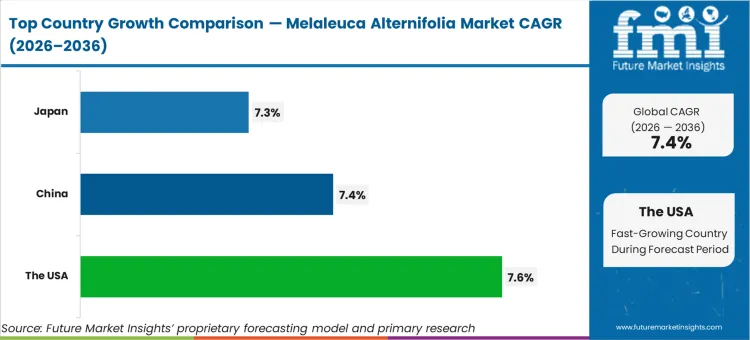
The following table shows the estimated growth rates of the top three territories. The USA, China, and Japan are set to exhibit high consumption, recording CAGRs of 7.6%, 7.4%, and 7.3%, respectively, through 2035.
.webp "Top Country Growth Comparison Melaleuca Alternifolia Market Cagr (2026 2036)")
| Country | CAGR (2025 to 2035) |
|---|---|
| The USA | 7.6% |
| China | 7.4% |
| Japan | 7.3% |
Manufacturing Outlook for Japan.
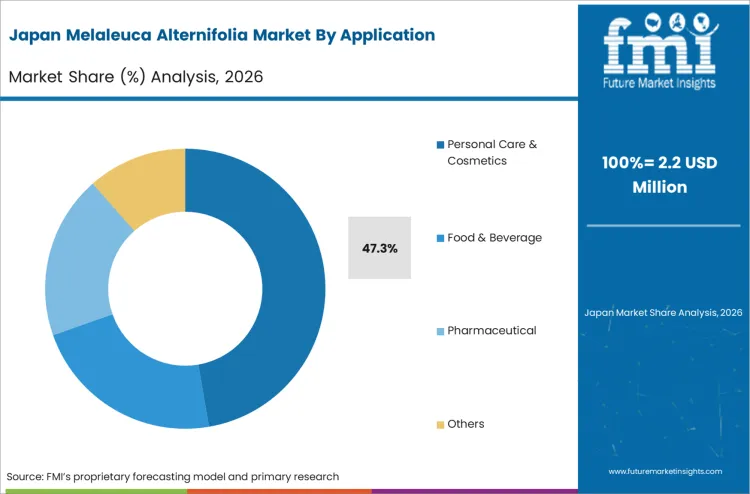
The manufacturing prospects for Melaleuca alternifolia in Japan should be organic and effective due to the consumer’s inclination to use natural products in the skincare and wellness industry. Japanese manufacturers prefer steam distillation as the main extraction method, thus preserving the strong antiseptic and anti-inflammatory effects of pure essential oil. This method also follows the principles of traditional Japanese washoku cuisine which has a focus on high purity and high efficiency.
Furthermore, there are trends in using Tea Tree Oil together with other plant-based fragrances and components to increase its application in cosmetic products and additionally in the manufacture of food products. For instance, Kagoshima based company Kurobuta has gotten it right by putting Tea Tree Oil together with yuzu and green tea extracts for its organic skin care products. This combination is not only physical but also increases the therapeutic value, which creates high consumer appeal.
These new formulations help consumers combine the skin-healing power of Tea Tree Oil with the tastes of Japanese cuisine, enhancing both therapeutic and food values. Such strategic blends are anticipated to increase in popularity in the future due to the dynamic market within both consumers’ and manufacturers’ favor.
United States industries venturing into functional foods and new-generation skin care products with the concept of Tea Tree Oil.
Tea Tree Oil is gradually finding its way into functional foods and other effective. Consumer skincare products in the United States as the producer seeks to capitalize on the growing demand for plant-derived commodities. Brands like Herbivore Botanicals and Mad Hippie are currently dominating the skincare industry for using Tea Tree Oil for its rich antimicrobial benefits. These brands prepare serums and moisturizers that treat acne and blemishes, which are relatable to the health-conscious consumer looking for an excellent solution that does not include harmful chemicals.
On the food side, Tea Tree Oil Infusions is working with Tea Tree Oil in identifying its food uses, as a natural food flavoring agent and food preservative in a niche range of/products. The oil is ideal for enhancing sauces and marinades, flavors, and nutritional health and well-being food products, for the new generation of consumers seeking functional foods. These trends are not mutually exclusive but rather are signaling an orientation by the consumer towards clear labeling and effective formulations of cosmetic products as well as food products.
Rather than only using Tea Tree Oil’s positive qualities to make the product look more attractive, these manufacturers also inform the buyer about its versatility. It shapes customer loyalty for the organization alongside meeting the growing need for natural, plant-based products in all products across the US thereby making it a multi-purpose oil in the market.
Chinese manufacturers use Tea Tree Oil to be fused into supplements and complementary medicine.
Tea Tree Oil is gradually finding its way into functional foods and other effective. Consumer skincare products in the United States as the producer seeks to capitalize on the growing demand for plant-derived commodities. Brands like Herbivore Botanicals and Mad Hippie are currently dominating the skincare industry for using Tea Tree Oil for its rich antimicrobial benefits. These brands prepare serums and moisturizers that treat acne and blemishes, which are relatable to the health-conscious consumer looking for an excellent solution that does not include harmful chemicals.
On the food side, Tea Tree Oil Infusions is working with Tea Tree Oil in identifying its food uses, as a natural food flavoring agent and food preservative in a niche range of/products. The oil is ideal for enhancing sauces and marinades, flavors, and nutritional health and well-being food products, for the new generation of consumers seeking functional foods. These trends are not mutually exclusive but rather are signaling an orientation by the consumer towards clear labeling and effective formulations of cosmetic products as well as food products.
Rather than only using Tea Tree Oil’s positive qualities to make the product look more attractive, these manufacturers also inform the buyer about its versatility. It shapes customer loyalty for the organization alongside meeting the growing need for natural, plant-based products in all products across the US thereby making it a multi-purpose oil in the market.
Category-Wise Insights
Personal Care & Cosmetics are raising the demand for Melaleuca alternifolia.
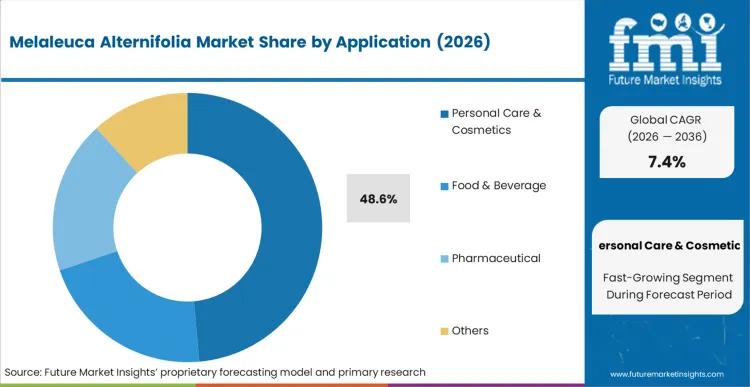
| Segment | Value Share (2025) |
|---|---|
| Personal Care & Cosmetics (By Application) | 48.6% |
Tea Tree Oil is gradually finding its way into functional foods and other effective. Consumer skincare products in the United States as the producer seeks to capitalize on the growing demand for plant-derived commodities. Brands like Herbivore Botanicals and Mad Hippie are currently dominating the skincare industry for using Tea Tree Oil for its rich antimicrobial benefits. These brands prepare serums and moisturizers that treat acne and blemishes, which are relatable to the health-conscious consumer looking for an excellent solution that does not include harmful chemicals.
On the food side, Tea Tree Oil Infusions is working with Tea Tree Oil in identifying its food uses, as a natural food flavoring agent and food preservative in a niche range of/products. The oil is ideal for enhancing sauces and marinades, flavors, and nutritional health and well-being food products, for the new generation of consumers seeking functional foods. These trends are not mutually exclusive but rather are signaling an orientation by the consumer towards clear labeling and effective formulations of cosmetic products as well as food products.
Rather than only using Tea Tree Oil’s positive qualities to make the product look more attractive, these manufacturers also inform the buyer about its versatility. It shapes customer loyalty for the organization alongside meeting the growing need for natural, plant-based products in all products across the US thereby making it a multi-purpose oil in the market.
Commercial Use of Melaleuca Alternifolia is generating the most sales for Producers.
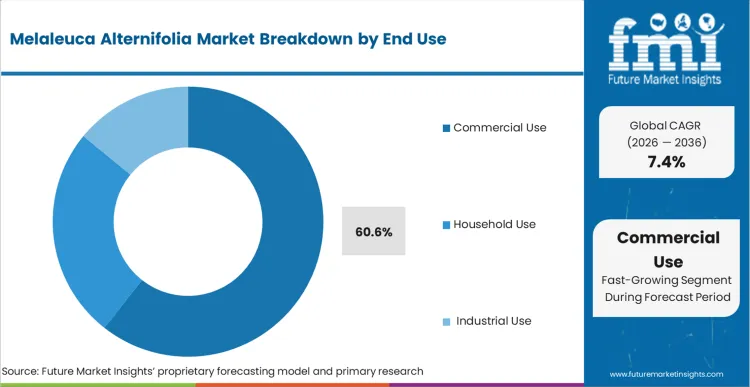
| Segment | Value Share (2025) |
|---|---|
| Commercial Use (By End Use) | 60.6% |
The Melaleuca alternifolia (Tea Tree Oil) is gaining further strides primarily in the commercial use of the commodity at the level of sales to producers in the food and supplements line. Thus, more companies are focusing on developing their products for the health-conscious consumer and the wellness industry-oriented businesses seeking natural, functional ingredients. An example of this is the successful production of dietary supplements with Tea Tree Oil for immune boosting and antimicrobial properties by brands such as Nature's Way and Zahler; such products are mainly directed towards preventive health solutions for a target population in growth.
In food, however, innovative producers are making gourmet products such as infused oils and natural flavorings with Tea Tree Oil in them. Herbs of the Earth, for example, try in cooking, thus raising the eyebrows of chefs and home cooks looking for different tastes but also health. It should be remembered that utilizing social media marketing for the direct target audience of end users is just one of the ways manufacturers are using digital marketing strategies to reach the intended audience.
They develop a successful informative campaign that pushes toward creating content such as blogs and videos to inform consumers about the benefits and proper use of Tea Tree Oil. In tandem, the aforementioned direct and easily understandable breakdown transforms into consumer trust and enticement towards use. Thus, these producers will not only be involved in the competition of producer market acquisition but also contribute significantly toward creating a well-loyal consumer base in this increasing health and wellness domain.
Competition Outlook
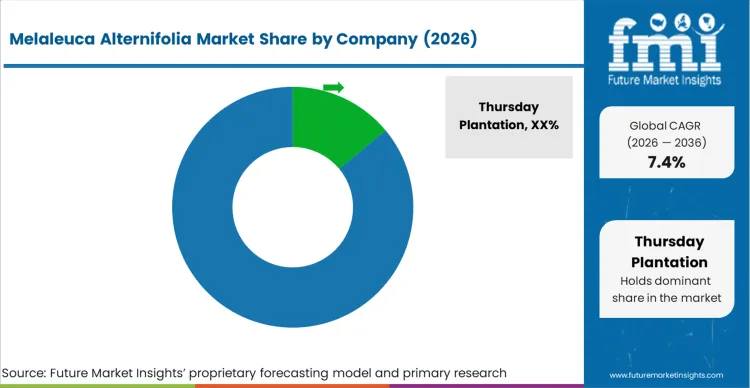
The global segment of Melaleuca Alternifolias is crowded and very competitive, with several leading companies. Advancements in biotechnology have attracted top producers like Novozymes, DSM, and Amano Enzyme for enzyme production improvement. Other major contributors to the field are BASF and Kraft Heinz, who have Melaleuca alternifolia in their diverse applications. These producers are focused on improving their products and production processes to increase their share of the growing industries for green solutions, ensuring that they will be well placed to compete in the future of the Melaleuca Alternifolia industries.
Recent Developments
The report includes full coverage of key trends from competitive benchmarking. Some of the recent developments covered in the reports:
- In February 2026, the Australian Tea Tree Industry Association (ATTIA) announced a strategic focus on promoting the Code of Practice as the global benchmark for quality to counter rising synthetic adulteration and protect the integrity of pure Australian tea tree oil. [1]
- In January 2026, the UK Government published a new Statutory Instrument (SI 2026/23) amending the UK Cosmetics Regulation, aligning British standards more closely with EU safety restrictions regarding chemical substances used in personal care formulations. [2]
- In August 2025, the UK Health and Safety Executive (HSE) issued a final opinion on the mandatory classification of tea tree oil under GB CLP regulations, removing a previously proposed reprotoxic classification after reviewing additional industry data. [3]
Leading Brands
- Thursday Plantation
- Eucalyptus Distillers
- Melaleuca, Inc.
- Tasmannia
- Plant Therapy
- doTERRA
- Young Living
- Aromatics
- Nature’s Sunshine
- Additional On Request
Scope of the Report
| Metric | Value |
|---|---|
| Quantitative Units | USD 64.4 million (2026) to USD 131.6 million (2036), at a CAGR of 7.4% |
| Market Definition | The melaleuca alternifolia market covers global cultivation, extraction, and trade of tea tree essential oil from M. alternifolia, used in personal care, pharmaceutical topical preparations, food and beverage, and industrial antimicrobial applications. |
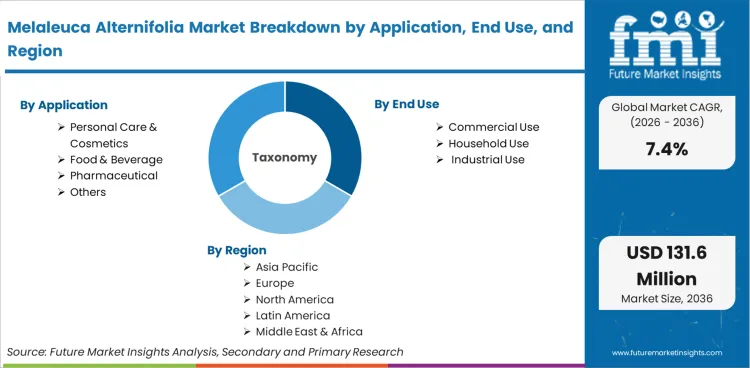
| Application Segmentation | Food and Beverage, Personal Care and Cosmetics, Pharmaceutical, Others |
| End Use Segmentation | Commercial Use, Household Use, Industrial Use |
| Regions Covered | North America, Latin America, Europe, East Asia, South Asia, Oceania, Middle East and Africa |
| Countries Covered | United States, Canada, Australia, United Kingdom, Germany, France, Japan, South Korea, China, India and 40 plus countries |
| Key Companies Profiled | Thursday Plantation, Eucalyptus Distillers, Melaleuca Inc., Tasmannia, Plant Therapy, doTERRA, Young Living, Aromatics, Nature's Sunshine |
| Forecast Period | 2026 to 2036 |
| Approach | Supply-side bottom-up modeling from plantation hectarage and distillation capacity, validated through primary interviews with ATTIA members and cross-checked against UN Comtrade HS 3301 import-export flows |
Key Segments of the Report
By Application:
According to the Application, the segment has been categorized into Food & Beverage, Personal Care & Cosmetics, Pharmaceutical, and Others.
By End Use:
According to the End Use, the segment has been categorized into Commercial Use, Household Use, and Industrial Use.
By Distribution Channel:
According to the Distribution Channel, the segment has been categorized into Offline and Online.
By Region:
Regional analysis has been carried out in key countries of North America, Latin America, Europe, East Asia, South Asia, Oceania, and the Middle East & Africa.
Bibliography
- [1] Australian Tea Tree Industry Association (ATTIA). (2026). ATTIA Code of Practice promotion as global benchmark against synthetic adulteration. Association Announcement, February 2026.
- [2] UK Government. (2026). The Cosmetic Products (Safety) (Amendment) Regulations 2026, SI 2026/23. UK Statutory Instrument, January 2026.
- [3] UK Health and Safety Executive (HSE). (2025). Final opinion on tea tree oil classification under GB CLP: reprotoxic category not applied. Official Regulatory Opinion, August 2025.
- [4] ISO. (2017). ISO 4730:2017 - Oil of Melaleuca, terpinen-4-ol type (tea tree oil). International Organization for Standardization.
- [5] Australian Bureau of Agricultural and Resource Economics and Sciences (ABARES). (2025). Australian crop and horticulture statistics: tea tree oil production volumes. Commonwealth of Australia.
- [6] UN Comtrade. (2025). HS Code 3301 essential oils trade flows by origin country. United Nations Statistics Division.
This bibliography is provided for reader reference and is not exhaustive. The full report contains the complete reference list and detailed citations.
This Report Addresses
- Market intelligence to enable structured strategic decision making for plantation operators, cosmetic formulators, and pharmaceutical ingredient buyers in the Australian tea tree oil supply chain.
- Market size estimation and 10-year revenue forecasts from 2026 to 2036, supported by validated plantation hectarage, yield benchmarks, and UN Comtrade import-export data.
- Growth opportunity mapping across Personal Care, Pharmaceutical, and Food and Beverage applications with emphasis on ISO-certified and ATTIA-compliant premium oil grades.
- Segment and regional revenue forecasts covering commercial, household, and industrial end-use channels across North America, Europe, Asia-Pacific, and Oceania.
- Competition strategy assessment including provenance authentication models, certification programme participation, and supply chain resilience benchmarking.
- Regulatory impact analysis covering EU SCCS opinions, UK CLP classification updates, TGA requirements, and ISO 4730 compliance standards.
- Market report delivery in PDF, Excel, PPT, and interactive dashboard formats for executive and operational use.
Frequently Asked Questions
How large is the melaleuca alternifolia market in 2026?
The melaleuca alternifolia market is estimated to be valued at USD 64.4 million in 2026, anchored by established demand in personal care and growing pharmaceutical topical end-use.
What will the market size be by 2036?
The market is projected to reach USD 131.6 million by 2036, growing at a CAGR of 7.4% between 2026 and 2036.
What is driving growth in the USA for melaleuca alternifolia?
The USA leads with a 7.6% CAGR, driven by mainstreaming of tea tree actives in American skincare, demand for natural antimicrobial preservatives, and expanded pharmaceutical topical formulation activity.
Why is Japan a significant market for melaleuca alternifolia?
Japan holds USD 42.0 million in 2026, the largest absolute value in Asia-Pacific, reflecting deep integration of tea tree oil into mass-market cosmetic and personal hygiene product lines across domestic brands.
What regulatory risks apply to this market?
The UK CLP classification review for reprotoxicity is the most recently resolved risk, with the proposed adverse classification removed in August 2025. Future EU SCCS periodic safety assessments and potential concentration restriction updates remain the primary ongoing regulatory exposure for formulators.
What is excluded from this market report?
Other Melaleuca species, synthetic terpinen-4-ol substitutes, and downstream finished consumer products such as shampoos and creams are excluded. The market boundary is at the bulk and intermediate oil level.
How does FMI build the melaleuca alternifolia market forecast?
The forecast uses a supply-side bottom-up model anchored to plantation hectarage and distillation capacity data, validated through primary research with ATTIA-member producers and cross-checked against UN Comtrade HS 3301 import-export flows.
Preview the report firsthand - request a free sample
Get SampleGet the brochure for pricing and purchase details.
Get PDFTable of Content
- Global Market Outlook
- Demand-side Trends
- Technology Roadmap Analysis
- Analysis and Recommendations
- Market Overview
- Market Coverage / Taxonomy
- Market Definition / Scope / Limitations
- Research Methodology
- Chapter Orientation
- Analytical Lens and Working Hypotheses
- Market Structure, Signals, and Trend Drivers
- Company Annual and Sustainability Reports
- Peer-reviewed Journals and Academic Literature
- Corporate Websites, Product Literature, and Technical Notes
- Earnings Decks and Investor Briefings
- Statutory Filings and Regulatory Disclosures
- Technical White Papers and Standards Notes
- Trade Journals, Industry Magazines, and Analyst Briefs
- Conference Proceedings, Webinars, and Seminar Materials
- Government Statistics Portals and Public Data Releases
- Press Releases and Reputable Media Coverage
- Specialist Newsletters and Curated Briefings
- Sector Databases and Reference Repositories
- FMI Internal Proprietary Databases and Historical Market Datasets
- Subscription Datasets and Paid Sources
- Social Channels, Communities, and Digital Listening Inputs
- Additional Desk Sources
- Expert Input and Fieldwork (Primary Evidence)
- Primary Modes
- Qualitative Interviews and Expert Elicitation
- Quantitative Surveys and Structured Data Capture
- Blended Approach
- Why Primary Evidence is Used
- Field Techniques
- Interviews
- Surveys
- Focus Groups
- Observational and In-context Research
- Social and Community Interactions
- Stakeholder Universe Engaged
- C-suite Leaders
- Board Members
- Presidents and Vice Presidents
- R&D and Innovation Heads
- Technical Specialists
- Domain Subject-matter Experts
- Scientists
- Physicians and Other Healthcare Professionals
- Governance, Ethics, and Data Stewardship
- Research Ethics
- Data Integrity and Handling
- Primary Modes
- Tooling, Models, and Reference Databases
- Data Engineering and Model Build
- Data Acquisition and Ingestion
- Cleaning, Normalisation, and Verification
- Synthesis, Triangulation, and Analysis
- Quality Assurance and Audit Trail
- Market Background
- Market Dynamics
- Drivers
- Restraints
- Opportunity
- Trends
- Scenario Forecast
- Demand in Optimistic Scenario
- Demand in Likely Scenario
- Demand in Conservative Scenario
- Opportunity Map Analysis
- Product Life Cycle Analysis
- Supply Chain Analysis
- Investment Feasibility Matrix
- Value Chain Analysis
- PESTLE and Porter’s Analysis
- Regulatory Landscape
- Regional Parent Market Outlook
- Production and Consumption Statistics
- Import and Export Statistics
- Market Dynamics
- Global Market Analysis 2021 to 2025 and Forecast, 2026 to 2036
- Historical Market Size Value (USD Million) Analysis, 2021 to 2025
- Current and Future Market Size Value (USD Million) Projections, 2026 to 2036
- Y-o-Y Growth Trend Analysis
- Absolute $ Opportunity Analysis
- Global Market Pricing Analysis 2021 to 2025 and Forecast 2026 to 2036
- Global Market Analysis 2021 to 2025 and Forecast 2026 to 2036, By Application
- Introduction / Key Findings
- Historical Market Size Value (USD Million) Analysis By Application , 2021 to 2025
- Current and Future Market Size Value (USD Million) Analysis and Forecast By Application , 2026 to 2036
- Personal Care & Cosmetics
- Food & Beverage
- Pharmaceutical
- Others
- Personal Care & Cosmetics
- Y-o-Y Growth Trend Analysis By Application , 2021 to 2025
- Absolute $ Opportunity Analysis By Application , 2026 to 2036
- Global Market Analysis 2021 to 2025 and Forecast 2026 to 2036, By End Use
- Introduction / Key Findings
- Historical Market Size Value (USD Million) Analysis By End Use, 2021 to 2025
- Current and Future Market Size Value (USD Million) Analysis and Forecast By End Use, 2026 to 2036
- Commercial Use
- Household Use
- Industrial Use
- Commercial Use
- Y-o-Y Growth Trend Analysis By End Use, 2021 to 2025
- Absolute $ Opportunity Analysis By End Use, 2026 to 2036
- Global Market Analysis 2021 to 2025 and Forecast 2026 to 2036, By Region
- Introduction
- Historical Market Size Value (USD Million) Analysis By Region, 2021 to 2025
- Current Market Size Value (USD Million) Analysis and Forecast By Region, 2026 to 2036
- North America
- Latin America
- Western Europe
- Eastern Europe
- East Asia
- South Asia and Pacific
- Middle East & Africa
- Market Attractiveness Analysis By Region
- North America Market Analysis 2021 to 2025 and Forecast 2026 to 2036, By Country
- Historical Market Size Value (USD Million) Trend Analysis By Market Taxonomy, 2021 to 2025
- Market Size Value (USD Million) Forecast By Market Taxonomy, 2026 to 2036
- By Country
- USA
- Canada
- Mexico
- By Application
- By End Use
- By Country
- Market Attractiveness Analysis
- By Country
- By Application
- By End Use
- Key Takeaways
- Latin America Market Analysis 2021 to 2025 and Forecast 2026 to 2036, By Country
- Historical Market Size Value (USD Million) Trend Analysis By Market Taxonomy, 2021 to 2025
- Market Size Value (USD Million) Forecast By Market Taxonomy, 2026 to 2036
- By Country
- Brazil
- Chile
- Rest of Latin America
- By Application
- By End Use
- By Country
- Market Attractiveness Analysis
- By Country
- By Application
- By End Use
- Key Takeaways
- Western Europe Market Analysis 2021 to 2025 and Forecast 2026 to 2036, By Country
- Historical Market Size Value (USD Million) Trend Analysis By Market Taxonomy, 2021 to 2025
- Market Size Value (USD Million) Forecast By Market Taxonomy, 2026 to 2036
- By Country
- Germany
- UK
- Italy
- Spain
- France
- Nordic
- BENELUX
- Rest of Western Europe
- By Application
- By End Use
- By Country
- Market Attractiveness Analysis
- By Country
- By Application
- By End Use
- Key Takeaways
- Eastern Europe Market Analysis 2021 to 2025 and Forecast 2026 to 2036, By Country
- Historical Market Size Value (USD Million) Trend Analysis By Market Taxonomy, 2021 to 2025
- Market Size Value (USD Million) Forecast By Market Taxonomy, 2026 to 2036
- By Country
- Russia
- Poland
- Hungary
- Balkan & Baltic
- Rest of Eastern Europe
- By Application
- By End Use
- By Country
- Market Attractiveness Analysis
- By Country
- By Application
- By End Use
- Key Takeaways
- East Asia Market Analysis 2021 to 2025 and Forecast 2026 to 2036, By Country
- Historical Market Size Value (USD Million) Trend Analysis By Market Taxonomy, 2021 to 2025
- Market Size Value (USD Million) Forecast By Market Taxonomy, 2026 to 2036
- By Country
- China
- Japan
- South Korea
- By Application
- By End Use
- By Country
- Market Attractiveness Analysis
- By Country
- By Application
- By End Use
- Key Takeaways
- South Asia and Pacific Market Analysis 2021 to 2025 and Forecast 2026 to 2036, By Country
- Historical Market Size Value (USD Million) Trend Analysis By Market Taxonomy, 2021 to 2025
- Market Size Value (USD Million) Forecast By Market Taxonomy, 2026 to 2036
- By Country
- India
- ASEAN
- Australia & New Zealand
- Rest of South Asia and Pacific
- By Application
- By End Use
- By Country
- Market Attractiveness Analysis
- By Country
- By Application
- By End Use
- Key Takeaways
- Middle East & Africa Market Analysis 2021 to 2025 and Forecast 2026 to 2036, By Country
- Historical Market Size Value (USD Million) Trend Analysis By Market Taxonomy, 2021 to 2025
- Market Size Value (USD Million) Forecast By Market Taxonomy, 2026 to 2036
- By Country
- Kingdom of Saudi Arabia
- Other GCC Countries
- Turkiye
- South Africa
- Other African Union
- Rest of Middle East & Africa
- By Application
- By End Use
- By Country
- Market Attractiveness Analysis
- By Country
- By Application
- By End Use
- Key Takeaways
- Key Countries Market Analysis
- USA
- Pricing Analysis
- Market Share Analysis, 2025
- By Application
- By End Use
- Canada
- Pricing Analysis
- Market Share Analysis, 2025
- By Application
- By End Use
- Mexico
- Pricing Analysis
- Market Share Analysis, 2025
- By Application
- By End Use
- Brazil
- Pricing Analysis
- Market Share Analysis, 2025
- By Application
- By End Use
- Chile
- Pricing Analysis
- Market Share Analysis, 2025
- By Application
- By End Use
- Germany
- Pricing Analysis
- Market Share Analysis, 2025
- By Application
- By End Use
- UK
- Pricing Analysis
- Market Share Analysis, 2025
- By Application
- By End Use
- Italy
- Pricing Analysis
- Market Share Analysis, 2025
- By Application
- By End Use
- Spain
- Pricing Analysis
- Market Share Analysis, 2025
- By Application
- By End Use
- France
- Pricing Analysis
- Market Share Analysis, 2025
- By Application
- By End Use
- India
- Pricing Analysis
- Market Share Analysis, 2025
- By Application
- By End Use
- ASEAN
- Pricing Analysis
- Market Share Analysis, 2025
- By Application
- By End Use
- Australia & New Zealand
- Pricing Analysis
- Market Share Analysis, 2025
- By Application
- By End Use
- China
- Pricing Analysis
- Market Share Analysis, 2025
- By Application
- By End Use
- Japan
- Pricing Analysis
- Market Share Analysis, 2025
- By Application
- By End Use
- South Korea
- Pricing Analysis
- Market Share Analysis, 2025
- By Application
- By End Use
- Russia
- Pricing Analysis
- Market Share Analysis, 2025
- By Application
- By End Use
- Poland
- Pricing Analysis
- Market Share Analysis, 2025
- By Application
- By End Use
- Hungary
- Pricing Analysis
- Market Share Analysis, 2025
- By Application
- By End Use
- Kingdom of Saudi Arabia
- Pricing Analysis
- Market Share Analysis, 2025
- By Application
- By End Use
- Turkiye
- Pricing Analysis
- Market Share Analysis, 2025
- By Application
- By End Use
- South Africa
- Pricing Analysis
- Market Share Analysis, 2025
- By Application
- By End Use
- USA
- Market Structure Analysis
- Competition Dashboard
- Competition Benchmarking
- Market Share Analysis of Top Players
- By Regional
- By Application
- By End Use
- Competition Analysis
- Competition Deep Dive
- Thursday Plantation
- Overview
- Product Portfolio
- Profitability by Market Segments (Product/Age /Sales Channel/Region)
- Sales Footprint
- Strategy Overview
- Marketing Strategy
- Product Strategy
- Channel Strategy
- Eucalyptus Distillers
- Melaleuca, Inc.
- Tasmannia
- Plant Therapy
- doTERRA
- Young Living
- Aromatics
- Nature’s Sunshine
- Additional On Request
- Thursday Plantation
- Competition Deep Dive
- Assumptions & Acronyms Used


