
- Market Size (2026)
- USD 78.5 Mn
- Forecast (2036)
- USD 181.6 Mn
- CAGR (2026 to 2036)
- 8.7%
How big is Breadnut Market in 2026?
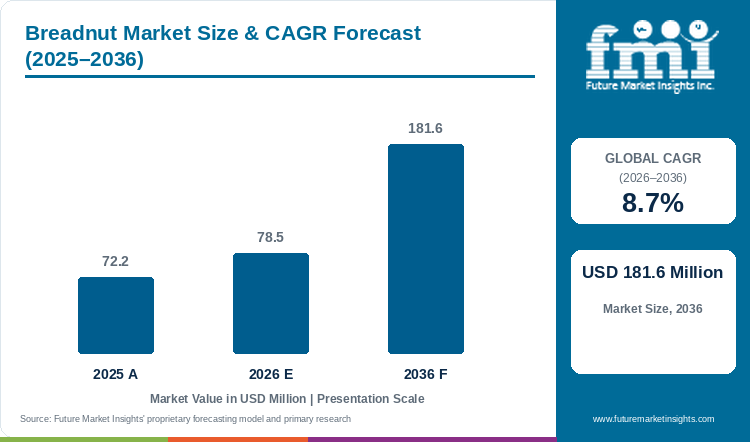
Starting from USD 72.2 million in 2025, the breadnut market valuation advanced to USD 78.5 million in 2026, with projections pointing toward USD 181.6 million by 2036 at a CAGR of 8.7%.
Consumer inclination toward gluten-free, plant-protein bakery products and caffeine-free herbal beverages is steadily expanding commercial demand for breadnut ingredients. Global breadnut market valuation was assessed at USD 72.2 million in 2025 and rises to USD 78.5 million in 2026. Overall market size is projected to attain USD 181.6 million by 2036, reflecting an 8.7% annual growth pace over the ten-year forecast horizon to 2036. Milled Breadnut and Maya Nut Flour accounts for 48.4% of 2026 product type demand because drying and milling fresh rainforest seeds cuts shipping weight in half and prevents mold spoilage during ocean transit. Specialty bakers are adopting breadnut flour to improve the nutritional profile of gluten-free breads and tortillas that otherwise rely on low-nutrient starches. September 2025 compositional analysis in the JAFC food-chemistry journal confirmed that Brosimum alicastrum seeds supply 9.85 to 10.69 g per 100 g protein and 14.47% to 17.88% insoluble fiber with 1,427.61 mg per 100 g potassium and zero gluten. This rich mineral and amino-acid content gives breadnut flour a strong nutritional advantage over conventional commercial gluten-free flours in health-food stores. However, a January 2026 Planta study showed that fresh breadnut seeds contain 55.6% to 57.2% water and spoil rapidly unless kept at 15 degrees Celsius or dried immediately after harvest. FMI market monitoring confirms that European Union Regulation 2015/2283 Novel Food approval requirements slow down new retail launches in Europe and keep near-term growth concentrated in North America and Latin America through 2036.
Key Market Trends & Insights
- By product type: Milled Breadnut and Maya Nut Flour holds an estimated 48.4% share in 2026 because fine-milled seed flour provides shelf-stable fiber and protein fortification for tortillas and bars.
- By nature: Wild-Harvested Rainforest and Organic supply represents 69.2% in 2026 since mature Brosimum alicastrum canopy trees across Peten and Chiapas with Yucatan yield chemical-free forest harvests.
- By end-use application: Gluten-Free Bakery and Tortilla Formulations account for 44.6% in 2026 as specialty bakers replace low-fiber rice and tapioca starches with mineral-rich Maya nut flour.
- By beverage functionality: Roasted Ground Coffee-Alternative Powder gains retail traction as caffeine-sensitive shoppers buy dark-roasted Maya nut drinks with natural cocoa and coffee notes.
- By cooperative sourcing: Direct regenerative agroforestry contracts expand across Mexico and Guatemala as well as Peru while brands audit rainforest conservation and rural women's income.
Regional Highlights
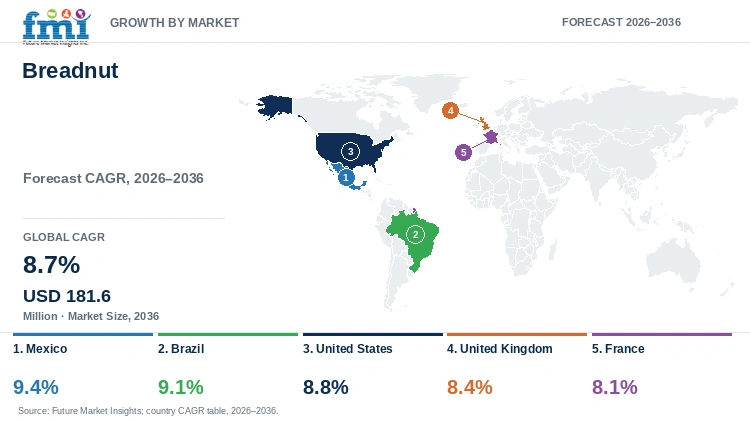
- Top national expansion: Mexico leads national growth projections at a 9.4% CAGR through 2036 under expanding Yucatan and Chiapas agroforestry milling and fortified tortilla production.
- Broader country progression: Brazil tracks at a 9.1% CAGR ahead of the United States at 8.8% and the United Kingdom at 8.4%, whereas France records an 8.1% CAGR.
Market Size & Forecast
Table 1: Market Size and Forecast for the Breadnut Market (USD million and CAGR percentage), 2025 to 2036
| Metric | Value |
|---|---|
| 2025 Market Size | USD 72.2 million |
| Estimated Market Size in 2026 | USD 78.5 million |
| Projected Market Size by 2036 | USD 181.6 million |
| CAGR, 2026 to 2036 | 8.7% |
| Added Market Value, 2026 to 2036 | USD 103.1 million |
Gluten-free bakeries and snack-bar makers often struggle with dry, crumbly dough texture and poor nutritional value when formulating with refined corn or potato starch. Milled Brosimum alicastrum and Artocarpus camansi seed flour solves both issues by binding water in the dough while adding plant protein and dietary fiber without nut allergens. According to a January 2026 study in Scientific Reports, replacing 10% of standard flour with breadnut powder in gnocchi dough raised dietary fiber to 5.73% and absorbed 7.09 g of water per gram of dry matter. Because of this high moisture retention, clean-label bakeries blend breadnut flour with allergen-free tiger nut powders to keep gluten-free breads soft and fresh.
Dehydrated Seed Volume and Active-Flour Sizing
Table 2: Dehydrated Seed Volume and Flour Sizing for the Breadnut Market (USD million, thousand metric tons, and USD per kilogram), 2025 to 2036
| Metric | 2025 | 2026 | 2036 |
|---|---|---|---|
| Market size (USD million) | 72.2 | 78.5 | 181.6 |
| Commercial dried breadnut & Maya nut seed volume (thousand metric tons) | 16.2 to 17.8 | 17.5 to 19.2 | 37.0 to 40.8 |
| Milled flour & roasted beverage powder volume (thousand metric tons) | 12.1 to 13.4 | 13.1 to 14.5 | 28.5 to 31.5 |
| Average commercial breadnut ingredient valuation per kilogram (USD) | 4.1 to 4.5 | 4.1 to 4.5 | 4.5 to 4.9 |
Operational note: Dehydrated seed figures track commercial Brosimum alicastrum (Maya nut / ramon) and Artocarpus camansi (Caribbean breadnut) flour and roasted beverage powder shipments.
Food manufacturers extracting plant proteins from underutilized tropical seeds are also adopting ultrasound and enzymatic processing to improve solubility in dairy-free shakes and bakery batters. When raw breadnut meal is simply ground without pretreatment, its compact seed globulins settle out in liquid beverages. A September 2024 study in Foods by researchers in Yucatan demonstrated that combining pH modulation with ultrasound-assisted extraction and enzymatic hydrolysis measurably boosts Brosimum alicastrum nut protein yield and emulsifying capacity with strong anti-inflammatory bioactivity. Rural processing hubs pair these protein extraction methods with solar-tunnel seed drying and package milled Maya nut with nutrient-dense amaranth flours and whole-grain teff flours for export.
Per Capita & Specialty Bakery Line Sizing
Table 3: Per Capita and Specialty Line Valuation Indicators for the Breadnut Market (USD and percentage share), 2025 to 2036
| Metric | 2025 | 2026 | 2036 |
|---|---|---|---|
| World population (billion) | 8.2 | 8.3 | 9.0 |
| Market value per 1,000 people (USD) | 8.8 | 9.5 | 20.2 |
| Annual market value per gluten-free & herbal roasting line (USD thousand) | 11.2 to 12.8 | 12.2 to 13.8 | 26.5 to 30.2 |
| Wild-harvested & certified organic share (%) | 68.0% to 70.5% | 68.2% to 70.8% | 71.5% to 74.0% |
Table 4: Industrial Milling and Channel Valuation Indicators for the Breadnut Market (USD million and line count), 2026
| Metric | Value | Institutional Reference Basis |
|---|---|---|
| Market size, 2026 | USD 78.5 million | 2026 global market valuation baseline |
| Specialty gluten-free bakery, tortilla & herbal roasting lines | 6,100 lines | Commercial ancient-grain bakery, bar, and coffee-substitute lines |
| Market value per specialty line | USD 12,868.9 | Annualized breadnut ingredient procurement valuation |
| Milled flour segment market value, 2026 | USD 38.0 million | 48.4% product type allocation |
Consumer interest in caffeine-free evening drinks is also creating strong demand for roasted breadnut powder as a natural coffee substitute. When dried Maya nut seeds are roasted in rotating drums at 170 to 195 degrees Celsius, they develop a rich dark-chocolate and roasted-coffee flavor with zero caffeine or stomach-irritating acids. Specialty beverage brands blend roasted Maya nut granules with high-fiber coconut flours and roasted chicory root coffee substitutes to sell ready-to-brew herbal espresso pouches.
Analyst Perspective
"Specialty bakery and functional beverage buyers do not treat breadnut as a folkloric rainforest curiosity, because they value its 10% complete protein and 1,427 mg per 100 g potassium load with a zero-caffeine roast profile. Suppliers that standardize solar-tunnel seed dehydration below 10% moisture and document zero aflatoxin contamination will win clean-label contracts in North America and Europe through 2036."
- Nandini Roy Choudhury, Principal Consultant, Future Market Insights.
How is the breadnut market segmented?
The breadnut market is segmented by product type and nature with end-use application. In 2026, Milled Breadnut and Maya Nut Flour is projected at 48.4% and Wild-Harvested Rainforest and Organic at 69.2%, while Gluten-Free Bakery and Tortilla Formulations account for 44.6%.
By product type: Milled Breadnut and Maya Nut Flour with Roasted Ground Coffee-Alternative Powder as well as Whole Boiled and Dried Breadnut Seeds plus Breadnut Protein Isolates and Starch.
By nature: Wild-Harvested Rainforest and Organic and Agroforestry Cultivated Conventional.
By end-use application: Gluten-Free Bakery and Tortilla Formulations with Caffeine-Free Roasted Herbal Beverages as well as Infant Porridges and Nutritional Bars plus Artisanal Confectionery and Savories.
Why does Milled Breadnut and Maya Nut Flour lead the product type category?
Milled Breadnut and Maya Nut Flour holds an estimated 48.4% of product type demand in 2026, anchored by high resistant starch and gluten-free baking versatility.
Table 5: Product Type Share for the Breadnut Market (percentage share), 2026
| Product Type | Share (2026) |
|---|---|
| Milled Breadnut and Maya Nut Flour | 48.4% |
| Other Segments Combined | 51.6%* |
| Total | 100.0% |
*Note: Secondary product type categories (Roasted Ground Coffee-Alternative Powder with Whole Boiled and Dried Breadnut Seeds and Breadnut Protein Isolates and Starch) supply the rest of 2026 breadnut demand.
Table 6: Product Type Leadership and Market Growth for the Breadnut Market (segment share and CAGR percentage), 2026 to 2036
| Metric | Value |
|---|---|
| Global CAGR (2026 to 2036) | 8.7% |
| Leading Segment | Milled Breadnut and Maya Nut Flour (48.4% share in 2026) |
Commercial bakeries and tortilla plants prefer fine-milled breadnut flour because it can replace 15% to 30% of regular wheat or corn masa on existing dough lines without equipment changes. Unlike raw whole seeds that require boiling and peeling, dry milled flour pours straight from 25-kilogram sacks into industrial mixers. Bakers formulating specialty high-protein flours use milled breadnut flour to boost fiber and resistant starch while keeping loaves cohesive and easy to slice.
- Milled Breadnut and Maya Nut Flour holds 48.4% of product type value in 2026 because dry-milled flour cuts ocean freight weight by more than 50% compared to fresh seeds.
- Technical specifications published by Ingredion for its Homecraft Create GF 10 gluten-free functional flour confirm that identity-preserved non-GMO ancient and specialty flours eliminate grittiness and crumbliness across commercial muffin and cake lines.
What sustains Wild-Harvested Rainforest and Organic leadership in nature?
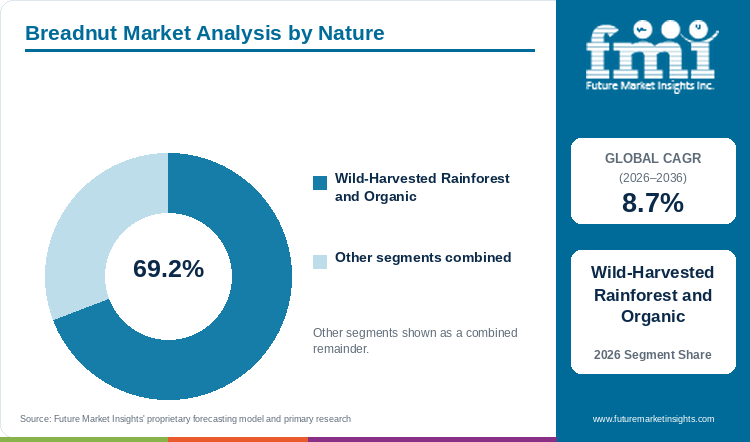
Wild-Harvested Rainforest and Organic supply represents 69.2% of the nature category in 2026, supported by mature Maya Biosphere and Amazonian forest stands.
Newly planted breadnut trees take 8 to 12 years to reach full seed production, which means commercial supply still relies heavily on mature wild trees growing in protected rainforest reserves. Rural women's cooperatives gather naturally fallen seeds from these forest stands without using chemical fertilizers or pesticides, making organic certification straightforward. Health-food brands selling single-serve plant protein sachets feature this wild-harvested rainforest origin on packaging to appeal to eco-conscious shoppers.
- Wild-Harvested Rainforest and Organic accounts for 69.2% of nature demand in 2026 as forest cooperatives harvest chemical-free seeds across Mexico and Guatemala.
- In March 2026, genomics researchers published the complete genome sequence of Brosimum alicastrum in Biodiversity Genomes (PMCID PMC13048333) to help breeders select faster-growing plantation trees.
How do Gluten-Free Bakery and Tortilla Formulations lead end-use applications?
Gluten-Free Bakery and Tortilla Formulations account for 44.6% of application value in 2026, driven by clean-label tortilla, pasta, and biscuit reformulation.
Celiac disease awareness and consumer demand for lower-carbohydrate baked goods are driving tortilla and biscuit makers to blend breadnut flour into everyday products. Maya nut flour blended into corn tortillas and gluten-free cookies increases calcium and potassium levels while giving baked goods a pleasant nutty flavor. Bakery R&D teams pairing breadnut flour with high-protein infant nutrition ingredients and commercial tortilla improver systems achieve flexible tortilla folding and slower starch digestion.
- Gluten-Free Bakery and Tortilla Formulations secure 44.6% of end-use demand in 2026 because lab-verified gluten-free breadnut flour fits both celiac and paleo diet labels.
- Per a May 2026 review in the International Journal of Food Science, combining high-fiber botanical flours with natural dough conditioners prevents hard crumb texture in gluten-free bread.
Why does Roasted Ground Coffee-Alternative Powder expand beverage demand?
Roasted Ground Coffee-Alternative Powder represents the second-largest product type tier in 2026, anchored by caffeine-free dark-roast herbal infusions.
Many consumers want the warm ritual and rich aroma of morning coffee without experiencing caffeine jitters or disrupted sleep. Dark-roasted ground Maya nut brews just like regular ground coffee in drip machines and French presses, delivering a smooth mocha taste that is naturally 100% caffeine-free without chemical decaffeination solvents.
- Roasted Ground Coffee-Alternative Powder captures growing health-store and online demand in 2026 among pregnant women and caffeine-sensitive shoppers.
- A September 2025 study in Natural Product Research quantified natural coumarin compounds and confirmed blood-sugar-lowering activity from Brosimum alicastrum seed extracts at 40 mg per kg.
How do Infant Porridges and Protein Isolates broaden nutritional channels?
Infant Porridges, Nutritional Bars, and Breadnut Protein Isolates expand institutional and B2B nutraceutical demand through 2036.
Public school-feeding programs in Latin America and nutrition bar makers in North America use cooked breadnut flour as an affordable, allergen-free source of complete protein and minerals. Abundant tryptophan and potassium at 1,427.61 mg per 100 g with calcium at 168.84 mg per 100 g make breadnut flour well suited for infant weaning porridges and plant-protein shakes.
- Alkaline and enzymatic extraction of protein concentrates from defatted breadnut seed meal gives supplement brands a hypoallergenic alternative to soy and tree-nut proteins.
- An April 2024 study in Animals (Basel) at the University of Yucatan confirmed that Brosimum alicastrum agroforestry systems yield up to 2 tons of dry matter per hectare annually with 86.6% organic matter fermentation.
What are the drivers, restraints, and opportunities in the breadnut market?
In the breadnut market, gluten-free bakery fortification and caffeine-free herbal coffee demand drive adoption whereas recalcitrant seed moisture and EU Novel Food gates restrain trade and genome-guided agroforestry supports scalable supply.
- Driver: Clean-label bakeries and herbal beverage brands adopt gluten-free Maya nut and Caribbean breadnut flours for high fiber and potassium with caffeine-free roast flavor.
- Restraint: High 55.6% to 57.2% fresh seed moisture causes rapid post-harvest spoilage and EU Regulation 2015/2283 Novel Food compliance delays European Union retail launches.
- Opportunity: Complete Brosimum alicastrum genome sequencing and solar-biomass cooperative drying hubs enable standardized low-glycemic flour and protein isolate supply.
Growth Analysis and Future Potential: Qualitative Demand Catalysts
Consumer demand for sustainable, drought-tolerant superfoods that deliver complete protein and high fiber is pushing breadnut from local village markets into international health-food stores. In January 2026, Kerry Group published its 2026 Taste Charts highlighting consumer appetite for heritage botanicals and cocoa-adjacent roasted flavor notes across bakery and beverage formats. In parallel, bakery ingredient supplier Corbion showcased clean-label dough conditioning solutions at IBIE in September 2025 that help bakers integrate non-wheat flours without sacrificing shelf life. These formulation advances are encouraging gluten-free bakeries and herbal tea brands across North America and Latin America to launch Maya nut product lines.
Risk Assessment of the Breadnut Market: Operational and Formulation Friction
Rapid spoilage of wet freshly harvested seeds and sugar-reduction texture hurdles in specialty baking represent the two main factors restraining faster breadnut market growth. Because freshly fallen rainforest seeds carry over 55% moisture, rural collection centers must dry them within 24 to 48 hours to prevent mold and sprouting. On the bakery formulation side, replacing refined wheat flour and sugar with high-fiber botanical flours can stiffen cookie and cake batters, prompting enzyme specialist Novonesis to launch its Optiva LS Prime solution in June 2025 to maintain soft crumb texture while cutting added sugar by up to 50%.
Commercial Opportunity Analysis: Formulation Differentiation and Value-Add Formats
Suppliers are creating profitable growth avenues by investing in cooperative solar-drying centers and partnering with industrial bakery-ingredient houses on ready-to-bake gluten-free mixes. In May 2025, Puratos Group introduced new sourdough and grain-texture innovations at iba 2025 designed to improve flavor and moisture retention in plant-based and ancient-grain baked goods. In June 2025, Roquette Freres also expanded its plant-protein and gluten-free bakery ingredient portfolio to support high-protein bread and snack extrusion. Exporters that combine USDA Organic and Fair Trade certifications with lab-tested mycotoxin-free flour specifications are securing multi-year accounts with specialty grocers through 2036.
Breadnut Market by Country (2026 to 2036)
FMI country modeling indicates that Mexico leads breadnut market expansion at a 9.4% CAGR from 2026 to 2036, followed by Brazil at 9.1% and the United States at 8.8%. The United Kingdom advances at 8.4%, whereas France progresses at an 8.1% CAGR.
Table 7: Country CAGR and Primary Growth Levers for the Breadnut Market (CAGR percentage), 2026 to 2036
| Country | CAGR (2026 to 2036) | Primary Growth Lever |
|---|---|---|
| Mexico | 9.4% | Yucatan and Chiapas ramon seed agroforestry and fortified tortilla and beverage milling |
| Brazil | 9.1% | Amazonian Brosimum alicastrum bioeconomy cooperatives and gluten-free bakery blends |
| United States | 8.8% | Organic caffeine-free Maya nut coffee alternatives and paleo/celiac snack bars |
| United Kingdom | 8.4% | Caribbean Artocarpus camansi diaspora foodservice and specialty organic grocers |
| France | 8.1% | French West Indies valorization research and organic gluten-free patisserie trials |
Source: Future Market Insights analysis
Mexico Breadnut Market Outlook (2026 to 2036)
Mexico leads global expansion at a 9.4% annual pace through 2036 because domestic food processors use native ramon (Brosimum alicastrum) seeds grown in Yucatan and Chiapas agroforestry plantations for everyday tortilla masa and health drinks. Ranchers and rural cooperatives plant ramon trees to restore cattle pastures and harvest the fallen seeds for local flour mills. Per the July 2025 USDA Mexico City attaché report MX2025-0031, consumer-oriented food demand rose by 13% as retail supermarket and commercial baking chains expanded across major metropolitan centers. Domestic food mills blend roasted and raw ramon flour into packaged corn tortillas and school breakfast drinks across southern and central Mexico.
Key takeaway: In Mexico, Yucatan and Chiapas agroforestry milling and low-glycemic tortilla and herbal drink formulations drive a leading 9.4% CAGR.
Brazil Breadnut Market Outlook (2026 to 2036)
Government support for Amazonian forest bioeconomy cooperatives and rising domestic demand for gluten-free snacks carry the Brazil breadnut market at a 9.1% annual rate through 2036. Forest communities in Acre and Amazonas collect native Brosimum alicastrum and Caribbean breadnut seeds and dry them for regional ingredient mills. Agricultural monitoring in the October 2026 USDA Brasilia attaché report BR2026-0040 showed that severe El Nino drought episodes across the Amazon Basin have accelerated federal and cooperative investment in drought-resilient native agroforestry tree crops. Bakery and granola makers in Sao Paulo and Para blend milled breadnut flour with native cassava starch to sell high-fiber breakfast bars across national grocers.
Key takeaway: In Brazil, Amazonian extractive-reserve cooperatives and gluten-free cassava-breadnut bakery blends support a 9.1% annual growth rate.
United States Breadnut Market Outlook (2026 to 2036)
The United States breadnut market grows at an 8.8% CAGR through 2036, driven by health-conscious shoppers buying caffeine-free roasted Maya nut coffee substitutes and grain-free paleo baking mixes. Unlike buyers in Latin America focused on staple tortillas, U.S. brands market organic Maya nut as a rainforest superfood in natural grocery chains and online stores. In March 2025, ADM noted in its 2025 Protein Report that U.S. consumers actively seek sustainable, minimally processed ancient seeds and plant proteins with clean ingredient labels. Domestic supplement and snack-bar makers import USDA Organic certified Maya nut flour from Mesoamerican women's cooperatives for national retail and online distribution across North America.
Key takeaway: In the United States, caffeine-free roasted Maya nut coffee substitutes and certified gluten-free baking mixes sustain an 8.8% CAGR.
United Kingdom Breadnut Market Outlook (2026 to 2036)
The United Kingdom advances at an 8.4% annual rate through 2036 because it combines Caribbean diaspora grocers importing Artocarpus camansi chataigne seeds with organic health stores selling roasted Maya nut powders. Specialty food importers in London and Birmingham distribute boiled and dried Caribbean breadnut seeds with fair-trade Mesoamerican flours for retail grocers. Supermarket tracking in the November 2025 USDA London retail report UK2025-0035 confirms that rising shopper demand for specialty ethnic foods and sustainable plant-based ingredients is expanding shelf space across national grocery chains in the United Kingdom. Ethical-food brands across the UK market dark-roasted Maya nut as a sustainable caffeine-free coffee alternative for evening household consumption.
Key takeaway: In the United Kingdom, Caribbean diaspora foodservice demand and ethical organic health-store distribution underpin an 8.4% CAGR through 2036.
France Breadnut Market Outlook (2026 to 2036)
France progresses at an 8.1% annual expansion rate from 2026 through 2036, shaped by agricultural processing in its overseas territories of Guadeloupe and Martinique and gluten-free baking trials on the mainland. Food technologists in the French West Indies mill local Artocarpus camansi breadnut into high-fiber composite flours for pasta and gluten-free biscuits. Bakery sector findings in the April 2025 USDA Paris report FR2025-0004 indicate that 19,000 domestic food processing enterprises across metropolitan regions are actively expanding clean-label bakery and specialty flour lines. Established French Caribbean breadnut seed trade and mainland organic patisserie innovation support steady demand growth across specialty organic food shops in France.
Key takeaway: In France, French West Indies agro-processing valorization and high-fiber gluten-free dough formulations support an 8.1% annual growth rate.
Full report country CAGRs cover North America and Latin America with Western and Eastern Europe. Geographic modeling also tracks East Asia and South Asia and Pacific with the Middle East and Africa.
Who are the notable companies in the breadnut market?
Maya Nut Institute Cooperative Partners and Inca Organics with Caribbean Exotic Foods Ltd., Tropic Foods B.V., Ujei Maya Nut Producers and Rainforest Foods Ltd. are the notable companies in the breadnut market.
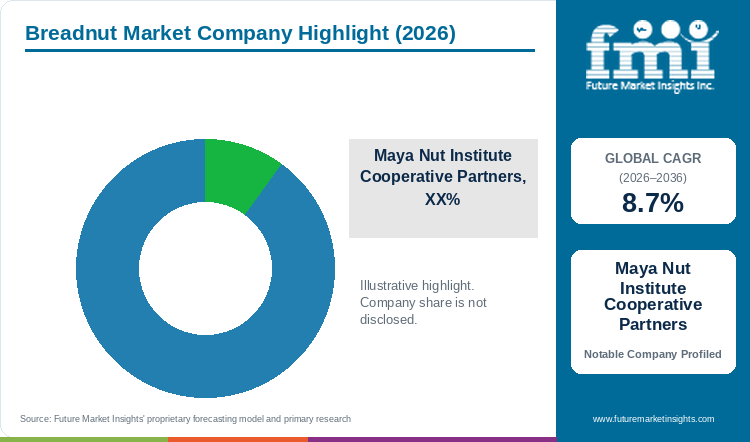
Competitive positioning in the breadnut industry separates Mesoamerican women's harvesting cooperatives and organic superfood exporters from Caribbean whole-seed processors and European specialty distributors.
- Mesoamerican Rainforest Harvesting Cooperatives and Producers: Maya Nut Institute Cooperative Partners and Ujei Maya Nut Producers coordinate wild-harvest Brosimum alicastrum seed collection and solar drying with drum roasting across Mexico and Central America.
- Certified Organic Superfood Exporters and B2B Ingredient Suppliers: Inca Organics and Rainforest Foods Ltd. supply organic certified Maya nut flours and roasted coffee-alternative powders with rainforest superfood blends to brands in North America and Europe.
- Caribbean Whole-Seed Processors and Exotic Produce Distributors: Caribbean Exotic Foods Ltd. and Tropic Foods B.V. process and distribute boiled and vacuum-packed Artocarpus camansi breadnut seeds with milled flours across diaspora and specialty retail channels.
Competitive Benchmarking: Breadnut Market
Table 8: Competitive Benchmarking for the Breadnut Market (qualitative capability ratings and geographic reach)
| Company | Solar & Mechanical Seed Drying | Flour & Roast Standardization | Certified Organic & Fair Trade | Geographic Reach |
|---|---|---|---|---|
| Maya Nut Institute Cooperative Partners | High | High | High | Mesoamerica, Mexico, Peru, and United States cooperative supply network |
| Inca Organics | High | High | High | South America and North America USDA Organic superfood powder and flour export |
| Caribbean Exotic Foods Ltd. | High | Medium | Medium | Caribbean and United Kingdom boiled, dried, and milled Artocarpus camansi supply |
| Tropic Foods B.V. | Medium | Medium | Medium | Netherlands and Western European tropical and Caribbean specialty food distribution |
| Ujei Maya Nut Producers | High | High | High | Mexico and Guatemala rural women's cooperative roasting and flour milling |
| Rainforest Foods Ltd. | Medium | High | High | United Kingdom and European organic rainforest superfood powder formulation |
Scoring basis: Solar & Mechanical Seed Drying evaluates post-harvest dehydration infrastructure capable of dropping recalcitrant seed moisture from 56% to below 10% without mold, whereas Flour & Roast Standardization rates particle-size milling and Maillard roast uniformity. Certified Organic & Fair Trade measures third-party rainforest sustainability and organic audits.
Key Developments in the Breadnut Market
- Genomics researchers published the first complete nuclear genome sequence of the breadnut tree (Brosimum alicastrum) in Biodiversity Genomes in March 2026, enabling marker-assisted agroforestry breeding.
- Food scientists at the University of the Antilles demonstrated in Scientific Reports in January 2026 that 10% breadnut powder fortification raises gnocchi dietary fiber to 5.73% with 7.09 g water per gram dry matter absorption.
- Seed physiologists at the Royal Botanic Gardens, Kew reported in Planta in January 2026 that cuticular wax preservation and 15 degrees Celsius handling govern desiccation survival in recalcitrant Brosimum alicastrum seeds.
- Analytical chemists writing in the September 2025 JAFC seed-quality study validated that Brosimum alicastrum seed flours deliver 9.85 to 10.69 g per 100 g protein and 67.34% to 70.73% protein digestibility with zero gluten.
Key Players in the Breadnut Market
Mesoamerican Rainforest Harvesting Cooperatives and Producers
- Maya Nut Institute Cooperative Partners
- Ujei Maya Nut Producers
Certified Organic Superfood Exporters and B2B Ingredient Suppliers
- Inca Organics
- Rainforest Foods Ltd.
Caribbean Whole-Seed Processors and Exotic Produce Distributors
- Caribbean Exotic Foods Ltd.
- Tropic Foods B.V.
Breadnut Market - Report Scope
Table 9: Report Scope for the Breadnut Market (coverage fields and definitions), 2026 to 2036
| Coverage field | Report scope |
|---|---|
| Market breakdown | Product Type and Nature with End-Use Application |
| Quantitative Units | USD Million |
| Market Definition | Commercial B2B and specialty ingredient valuation of Brosimum alicastrum (Maya nut / ramon) and Artocarpus camansi (Caribbean breadnut) products including milled flours and roasted coffee-alternative powders with whole boiled/dried seeds and extracted protein isolates. Excludes seedless breadfruit (Artocarpus altilis) and jackfruit (Artocarpus heterophyllus). |
| Regions Covered | North America and Latin America with Western Europe, Eastern Europe, East Asia, South Asia and Pacific and Middle East and Africa |
| Countries Covered | United States and United Kingdom with Mexico, Brazil and France plus additional national markets |
| Key Companies Covered | Maya Nut Institute Cooperative Partners and Inca Organics with Caribbean Exotic Foods Ltd., Tropic Foods B.V., Ujei Maya Nut Producers and Rainforest Foods Ltd. |
| Forecast Period | 2026 to 2036 |
| Approach | Primary and secondary research with top-down ancient-grain and herbal-coffee baselines reconciled against bottom-up dehydrated breadnut seed tonnage. |
Breadnut Market - Research Methodology
Table 10: Research Methodology for the Breadnut Market (research methods and approaches)
| Method | Approach |
|---|---|
| Primary Research | Structured interviews with Maya nut cooperative directors in Mexico and Guatemala and Caribbean breadnut processors with gluten-free bakery formulators and herbal coffee roasters to validate fresh-to-dry seed conversion ratios. |
| Secondary Research | Analysis of peer-reviewed Brosimum alicastrum nutritional assays and Planta seed desiccation studies with Scientific Reports bakery trials and Biodiversity Genomes sequencing data. |
| Market Sizing and Forecasting | Top-down specialty gluten-free flour and botanical coffee-substitute baselines reconciled against bottom-up commercial dried breadnut seed tonnage (17.5K to 19.2K MT in 2026) and average kilogram values from 2026 to 2036. |
| Country Forecasting Model | Econometric national projections weight Mesoamerican agroforestry harvesting capacity and North America gluten-free and herbal coffee adoption with European Novel Food and Caribbean diaspora channels across five priority countries. |
| Operational Benchmark Traceability | Dehydrated seed volume and specialty line indicators in Tables 2, 3, and 4 trace to Planta 55.6% to 57.2% seed moisture measurements and peer-reviewed Brosimum alicastrum protein and mineral profiles with Scientific Reports dough absorption metrics. |
| Data Triangulation and Validation | Valuation estimates isolate commercial Brosimum alicastrum and Artocarpus camansi seed, flour, roast powder, and isolate trade while strictly excluding uncommercialized subsistence foraging and seedless breadfruit produce. |
Breadnut Market by Segments
Breadnut Market segmented by Product Type:
- Milled Breadnut and Maya Nut Flour
- Roasted Ground Coffee-Alternative Powder
- Whole Boiled and Dried Breadnut Seeds
- Breadnut Protein Isolates and Starch
Breadnut Market segmented by Nature:
- Wild-Harvested Rainforest and Organic
- Agroforestry Cultivated Conventional
Breadnut Market segmented by End-Use Application:
- Gluten-Free Bakery and Tortilla Formulations
- Caffeine-Free Roasted Herbal Beverages
- Infant Porridges and Nutritional Bars
- Artisanal Confectionery and Savories
Breadnut Market by Region
- North America
- United States
- Canada
- Latin America
- Brazil
- Mexico
- Argentina
- Chile
- Western Europe
- Germany
- France
- United Kingdom
- Italy
- Spain
- Benelux
- Nordics
- Eastern Europe
- Poland
- Czech Republic
- Romania
- Hungary
- East Asia
- China
- Japan
- South Korea
- South Asia and Pacific
- India
- ASEAN
- Australia and New Zealand
- Middle East and Africa
- GCC Countries
- South Africa
- Türkiye
- Israel
Research Sources and Bibliography
- [1] Nazir, H. F., Tapia-Tussell, R., Nosworthy, M. G., Sanchez-Velazquez, O. A., Dowle, A., Ifie, I., & Hernandez-Alvarez, A. J. (2025, September 5). Nutritional Value, Antinutritional Factors, and Protein Quality of Brosimum alicastrum Seeds: A Sustainable Protein Source. Journal of Agricultural and Food Chemistry, 73(37), 23580 to 23594 (PMCID PMC12447510).
- [2] Colville, L., Marks, T. R., Lopez-Alquijay, A., Stuppy, W., Nadarajan, J., Pritchard, H. W., & Monro, A. (2026, January 3). Exceptional desiccation resistance in recalcitrant seeds of Brosimum alicastrum may confer ecological advantage. Planta, 263(2), 36 (PMCID PMC12764665).
- [3] Masiala, A., Aurore, G., Pejcz, E., Wojciechowicz-Budzisz, A., Oledzki, R., Zajac, A., Gorska, K., Harasym, J., & Vingadassalon, A. (2026, January 14). Valorization of breadnut (Artocarpus camansi) leaves in gnocchi-type product. Scientific Reports, 16, 5206 (PMCID PMC12881552).
- [4] Leon-Castillo, G., Jara-Munoz, O. A., Pirro, S., Pulido-Santacruz, P., & Silva-Arias, G. A. (2026, March 24). The Complete Genome Sequence of the Breadnut (Brosimum alicastrum). Biodiversity Genomes, 2026, 159381 (PubMed PMID 41938828).
- [5] Barragan-Mendoza, L., Garnica-Lopez, R., Gaitan-Hinojosa, M. A., Dalla Via, L., Ceballos-Magana, S. G., & Parra-Delgado, H. (2025, September 6). Anti-hyperglycaemic effect of aqueous extract from Brosimum alicastrum: in vivo evaluation and quantification of its components by HPLC-DAD. Natural Product Research, 39, 1 to 7 (PubMed PMID 40913521).
- [6] USDA Foreign Agricultural Service. (2025, July 3). Mexico: Exporter Guide Annual. U.S. Department of Agriculture GAIN Report MX2025-0031.
- [7] Alibekova, Z., Bayisbayeva, M., Shamsudin, R., Bakhtybekova, A., Alibekov, R., & Aimenov, Z. (2026, May 11). Problems and Approaches in the Improvement of Gluten-Free Bread Texture: A Comprehensive Review. International Journal of Food Science, 2026, 5214023 (PMCID PMC13159086).
- [8] Corbion. (2025, September 2). Corbion leads clean-label reformulation forward at IBIE 2025. Corbion N.V. Media Releases.
- [9] Puratos. (2025, May 7). Puratos brings a trio of transformative innovations to iba 2025. Puratos Group Press Room.
- [10] Novonesis. (2025, June 11). Novonesis launches Optiva LS Prime, helping bakers cut up to 50% added sugar and create more cost-effective baked goods. Novonesis Corporate Newsroom.
- [11] Suarez-Hernandez, M. F., Posada Ramirez, S. G., Castillo Cruz, D. D. C., Higuera Ciapara, I., Pacheco Lopez, N. A., Herrera Pool, I. E., & Ruiz-Ruiz, J. C. (2024, September 11). Effect of Integrated Extraction Techniques on the Technofunctional and Bioactive Properties of Brosimum alicastrum Swartz Proteins. Foods, 13(18), 2875 (PMCID PMC11431744).
- [12] Valdivia-Salgado, V., Flores-Santiago, E. D. J., Ramirez-Aviles, L., Segura-Correa, J. C., Calzada-Marin, J. M., & Ku-Vera, J. C. (2024, April 9). Effect of Brosimum alicastrum Foliage on Intake, Kinetics of Fermentation and Passage and Microbial N Supply in Sheep Fed Megathyrsus maximus Hay. Animals (Basel), 14(8), 1144 (PMCID PMC11047426).
- [13] Archer Daniels Midland Company. (2025, March 18). ADM's 2025 Protein Report: The Powerful Trends That Are Shaping Alternative Protein Innovation. ADM Corporate Newsroom.
- [14] USDA Foreign Agricultural Service. (2026, October 13). Brazil: Bracing for Impact as the 2026 El Nino Affects Agriculture in Brazil. U.S. Department of Agriculture GAIN Report BR2026-0040.
- [15] USDA Foreign Agricultural Service. (2025, November 19). United Kingdom: Retail Foods Annual. U.S. Department of Agriculture GAIN Report UK2025-0035.
- [16] Roquette Freres. (2025, June 17). Roquette Grows NUTRALYS Plant Protein Portfolio with Addition of New Textured Proteins and Gluten-Free Bakery Solutions. Roquette Corporate Press Releases.
- [17] USDA Foreign Agricultural Service. (2025, April 2). France: Food Processing Ingredients Annual. U.S. Department of Agriculture GAIN Report FR2025-0004.
- [18] Ingredion Incorporated. (2025, March 14). HOMECRAFT Create GF 10 Functional Flour Technical Specification for Gluten-Free Bakery. Ingredion North America Technical Documents.
- [19] Kerry Group. (2026, January 12). Driving Flavour Innovation in 2026 with Taste Charts. Kerry Group Digest Insights.
This bibliography is provided for reader reference and is not exhaustive. The full report contains the complete reference list and detailed citations.
This Report Answers
- How large is the breadnut market in 2026 and what is forecast for 2036?
- Which gluten-free bakery fortification and caffeine-free beverage trends support breadnut demand?
- Why does Milled Breadnut and Maya Nut Flour lead the product type category?
- Why does Wild-Harvested Rainforest and Organic lead the nature category globally?
- How do growth rates differ across Mexico and Brazil compared with the United States and the United Kingdom?
- Which leading cooperatives and exporters supply certified organic Maya nut versus Caribbean breadnut?
- What recalcitrant seed moisture and EU Novel Food hurdles restrain breadnut market expansion?
- What should bakery and beverage buyers evaluate when sourcing dehydrated breadnut flour and roast powders?
Table of Content
- Key Takeaways
- Market Size and CAGR
- Top Growth Driver
- Fastest Growing Segment
- Leading Region
- Key Companies
- Emerging Opportunities
- Executive Summary
- Global Market Outlook
- Demand-side Trends
- Supply-side Trends
- Technology Roadmap Analysis
- Analysis and Recommendations
- Analyst Perspective (What is happening? Why now? What should investors know?)
- Key Questions Answered
- How large is the market?
- What is the CAGR?
- What are key trends?
- Which region dominates?
- Who are the leaders?
Read More...
- Market Overview
- Market Coverage / Taxonomy
- Market Definition / Scope / Limitations
- Research Methodology
- Chapter Orientation
- Analytical Lens and Working Hypotheses
- Market Structure, Signals, and Trend Drivers
- Benchmarking and Cross-market Comparability
- Market Sizing, Forecasting, and Opportunity Mapping
- Research Design and Evidence Framework
- Desk Research Programme (Secondary Evidence)
- Expert Input and Fieldwork (Primary Evidence)
- Tooling, Models, and Reference Databases
- Data Engineering and Model Build
- Quality Assurance and Audit Trail
- Market Background
- Market Dynamics (Drivers, Restraints, Opportunity, Trends)
- Scenario Forecast (Optimistic, Likely, Conservative)
- Impact Analysis
- AI Impact
- Sustainability Impact
- Regulatory Impact
- Technology Impact
- Consumer / Buyer Analysis
- Purchase Drivers
- Adoption Barriers
- Buyer Journey
- Opportunity Map Analysis
- Product Life Cycle Analysis
- Supply Chain Analysis
- Investment Feasibility Matrix
- Value Chain Analysis
- PESTLE and Porter's Analysis
- Regulatory Landscape
- Regional Parent Market Outlook
- Production and Consumption Statistics
- Import and Export Statistics
- Global Market Analysis and Forecast, 2021 to 2036
- Historical Market Size Value (USD Million) Analysis, 2021 to 2025
- Current and Future Market Size Value (USD Million) Projections, 2026 to 2036
- Y-o-Y Growth Trend Analysis
- Absolute $ Opportunity Analysis
- Global Market Pricing Analysis, 2021 to 2036
- Global Market Analysis and Forecast, By Product Type, 2021 to 2036
- Introduction / Key Findings
- Historical Market Size Value (USD Million) Analysis By Product Type, 2021 to 2025
- Current and Future Market Size Value (USD Million) Analysis and Forecast By Product Type, 2026 to 2036
- Milled Breadnut and Maya Nut Flour
- Roasted Ground Coffee-Alternative Powder
- Whole Boiled and Dried Breadnut Seeds
- Breadnut Protein Isolates and Starch
- Y-o-Y Growth Trend Analysis By Product Type, 2021 to 2025
- Absolute $ Opportunity Analysis By Product Type, 2026 to 2036
- Global Market Analysis and Forecast, By Nature, 2021 to 2036
- Introduction / Key Findings
- Historical Market Size Value (USD Million) Analysis By Nature, 2021 to 2025
- Current and Future Market Size Value (USD Million) Analysis and Forecast By Nature, 2026 to 2036
- Wild-Harvested Rainforest and Organic
- Agroforestry Cultivated Conventional
- Y-o-Y Growth Trend Analysis By Nature, 2021 to 2025
- Absolute $ Opportunity Analysis By Nature, 2026 to 2036
- Global Market Analysis and Forecast, By End-Use Application, 2021 to 2036
- Introduction / Key Findings
- Historical Market Size Value (USD Million) Analysis By End-Use Application, 2021 to 2025
- Current and Future Market Size Value (USD Million) Analysis and Forecast By End-Use Application, 2026 to 2036
- Gluten-Free Bakery and Tortilla Formulations
- Caffeine-Free Roasted Herbal Beverages
- Infant Porridges and Nutritional Bars
- Artisanal Confectionery and Savories
- Y-o-Y Growth Trend Analysis By End-Use Application, 2021 to 2025
- Absolute $ Opportunity Analysis By End-Use Application, 2026 to 2036
- Global Market Analysis and Forecast, By Region, 2021 to 2036
- Introduction
- Historical Market Size Value (USD Million) Analysis By Region, 2021 to 2025
- Current Market Size Value (USD Million) Analysis and Forecast By Region, 2026 to 2036
- North America
- Latin America
- Western Europe
- Eastern Europe
- East Asia
- South Asia and Pacific
- Middle East and Africa
- Market Attractiveness Analysis By Region
- North America Market Analysis and Forecast, By Country, 2021 to 2036
- Historical Market Size Value (USD Million) Trend Analysis By Market Taxonomy, 2021 to 2025
- Market Size Value (USD Million) Forecast By Market Taxonomy, 2026 to 2036
- By Country
- United States
- Canada
- By Product Type
- By Nature
- By End-Use Application
- By Country
- Market Attractiveness Analysis
- By Country
- By Product Type
- By Nature
- By End-Use Application
- Key Takeaways
- Latin America Market Analysis and Forecast, By Country
- Historical Market Size Value (USD Million) Trend Analysis By Market Taxonomy, 2021 to 2025
- Market Size Value (USD Million) Forecast By Market Taxonomy, 2026 to 2036
- By Country
- Brazil
- Mexico
- Argentina
- Chile
- By Product Type
- By Nature
- By End-Use Application
- By Country
- Market Attractiveness Analysis
- By Country
- By Product Type
- By Nature
- By End-Use Application
- Key Takeaways
- Western Europe Market Analysis and Forecast, By Country
- Historical Market Size Value (USD Million) Trend Analysis By Market Taxonomy, 2021 to 2025
- Market Size Value (USD Million) Forecast By Market Taxonomy, 2026 to 2036
- By Country
- Germany
- France
- United Kingdom
- Italy
- Spain
- Benelux
- Nordics
- By Product Type
- By Nature
- By End-Use Application
- By Country
- Market Attractiveness Analysis
- By Country
- By Product Type
- By Nature
- By End-Use Application
- Key Takeaways
- Eastern Europe Market Analysis and Forecast, By Country
- Historical Market Size Value (USD Million) Trend Analysis By Market Taxonomy, 2021 to 2025
- Market Size Value (USD Million) Forecast By Market Taxonomy, 2026 to 2036
- By Country
- Poland
- Czech Republic
- Romania
- Hungary
- By Product Type
- By Nature
- By End-Use Application
- By Country
- Market Attractiveness Analysis
- By Country
- By Product Type
- By Nature
- By End-Use Application
- Key Takeaways
- East Asia Market Analysis and Forecast, By Country
- Historical Market Size Value (USD Million) Trend Analysis By Market Taxonomy, 2021 to 2025
- Market Size Value (USD Million) Forecast By Market Taxonomy, 2026 to 2036
- By Country
- China
- Japan
- South Korea
- By Product Type
- By Nature
- By End-Use Application
- By Country
- Market Attractiveness Analysis
- By Country
- By Product Type
- By Nature
- By End-Use Application
- Key Takeaways
- South Asia and Pacific Market Analysis and Forecast, By Country
- Historical Market Size Value (USD Million) Trend Analysis By Market Taxonomy, 2021 to 2025
- Market Size Value (USD Million) Forecast By Market Taxonomy, 2026 to 2036
- By Country
- India
- ASEAN
- Australia and New Zealand
- By Product Type
- By Nature
- By End-Use Application
- By Country
- Market Attractiveness Analysis
- By Country
- By Product Type
- By Nature
- By End-Use Application
- Key Takeaways
- Middle East and Africa Market Analysis and Forecast, By Country
- Historical Market Size Value (USD Million) Trend Analysis By Market Taxonomy, 2021 to 2025
- Market Size Value (USD Million) Forecast By Market Taxonomy, 2026 to 2036
- By Country
- GCC Countries
- South Africa
- Türkiye
- Israel
- By Product Type
- By Nature
- By End-Use Application
- By Country
- Market Attractiveness Analysis
- By Country
- By Product Type
- By Nature
- By End-Use Application
- Key Takeaways
- Key Countries Market Analysis
- United States
- Pricing Analysis
- Market Share Analysis, 2025
- By Product Type
- By Nature
- By End-Use Application
- Canada
- Pricing Analysis
- Market Share Analysis, 2025
- By Product Type
- By Nature
- By End-Use Application
- Mexico
- Pricing Analysis
- Market Share Analysis, 2025
- By Product Type
- By Nature
- By End-Use Application
- Brazil
- Pricing Analysis
- Market Share Analysis, 2025
- By Product Type
- By Nature
- By End-Use Application
- Chile
- Pricing Analysis
- Market Share Analysis, 2025
- By Product Type
- By Nature
- By End-Use Application
- Germany
- Pricing Analysis
- Market Share Analysis, 2025
- By Product Type
- By Nature
- By End-Use Application
- United Kingdom
- Pricing Analysis
- Market Share Analysis, 2025
- By Product Type
- By Nature
- By End-Use Application
- Italy
- Pricing Analysis
- Market Share Analysis, 2025
- By Product Type
- By Nature
- By End-Use Application
- Spain
- Pricing Analysis
- Market Share Analysis, 2025
- By Product Type
- By Nature
- By End-Use Application
- France
- Pricing Analysis
- Market Share Analysis, 2025
- By Product Type
- By Nature
- By End-Use Application
- India
- Pricing Analysis
- Market Share Analysis, 2025
- By Product Type
- By Nature
- By End-Use Application
- ASEAN
- Pricing Analysis
- Market Share Analysis, 2025
- By Product Type
- By Nature
- By End-Use Application
- Australia and New Zealand
- Pricing Analysis
- Market Share Analysis, 2025
- By Product Type
- By Nature
- By End-Use Application
- China
- Pricing Analysis
- Market Share Analysis, 2025
- By Product Type
- By Nature
- By End-Use Application
- Japan
- Pricing Analysis
- Market Share Analysis, 2025
- By Product Type
- By Nature
- By End-Use Application
- South Korea
- Pricing Analysis
- Market Share Analysis, 2025
- By Product Type
- By Nature
- By End-Use Application
- Poland
- Pricing Analysis
- Market Share Analysis, 2025
- By Product Type
- By Nature
- By End-Use Application
- Hungary
- Pricing Analysis
- Market Share Analysis, 2025
- By Product Type
- By Nature
- By End-Use Application
- Türkiye
- Pricing Analysis
- Market Share Analysis, 2025
- By Product Type
- By Nature
- By End-Use Application
- South Africa
- Pricing Analysis
- Market Share Analysis, 2025
- By Product Type
- By Nature
- By End-Use Application
- United States
- Market Structure Analysis
- Competition Dashboard
- Competition Benchmarking
- Market Share Analysis of Top Players
- By Regional
- By Product Type
- By Nature
- By End-Use Application
- Emerging Startups
- Innovation Benchmarking
- Competition Analysis
- Competition Deep Dive
- Maya Nut Institute Cooperative Partners
- Overview
- Product Portfolio
- Profitability by Market Segments
- Sales Footprint
- Strategy Overview
- Marketing Strategy
- Product Strategy
- Channel Strategy
- Inca Organics
- Caribbean Exotic Foods Ltd.
- Tropic Foods B.V.
- Ujei Maya Nut Producers
- Rainforest Foods Ltd.
- Maya Nut Institute Cooperative Partners
- Case Studies
- Success Stories
- Recent Developments
- Competition Deep Dive
- Assumptions & Acronyms Used
List of Tables
- Table 1: Global Market Value (USD Million) Forecast by Region, 2021 to 2036
- Table 2: Global Market Value (USD Million) Forecast by Product Type, 2021 to 2036
- Table 3: Global Market Value (USD Million) Forecast by Nature, 2021 to 2036
- Table 4: Global Market Value (USD Million) Forecast by End-Use Application, 2021 to 2036
- Table 5: North America Market Value (USD Million) Forecast by Country, 2021 to 2036
- Table 6: North America Market Value (USD Million) Forecast by Product Type, 2021 to 2036
- Table 7: North America Market Value (USD Million) Forecast by Nature, 2021 to 2036
- Table 8: North America Market Value (USD Million) Forecast by End-Use Application, 2021 to 2036
- Table 9: Latin America Market Value (USD Million) Forecast by Country, 2021 to 2036
- Table 10: Latin America Market Value (USD Million) Forecast by Product Type, 2021 to 2036
- Table 11: Latin America Market Value (USD Million) Forecast by Nature, 2021 to 2036
- Table 12: Latin America Market Value (USD Million) Forecast by End-Use Application, 2021 to 2036
- Table 13: Western Europe Market Value (USD Million) Forecast by Country, 2021 to 2036
- Table 14: Western Europe Market Value (USD Million) Forecast by Product Type, 2021 to 2036
- Table 15: Western Europe Market Value (USD Million) Forecast by Nature, 2021 to 2036
- Table 16: Western Europe Market Value (USD Million) Forecast by End-Use Application, 2021 to 2036
- Table 17: Eastern Europe Market Value (USD Million) Forecast by Country, 2021 to 2036
- Table 18: Eastern Europe Market Value (USD Million) Forecast by Product Type, 2021 to 2036
- Table 19: Eastern Europe Market Value (USD Million) Forecast by Nature, 2021 to 2036
- Table 20: Eastern Europe Market Value (USD Million) Forecast by End-Use Application, 2021 to 2036
- Table 21: East Asia Market Value (USD Million) Forecast by Country, 2021 to 2036
- Table 22: East Asia Market Value (USD Million) Forecast by Product Type, 2021 to 2036
- Table 23: East Asia Market Value (USD Million) Forecast by Nature, 2021 to 2036
- Table 24: East Asia Market Value (USD Million) Forecast by End-Use Application, 2021 to 2036
- Table 25: South Asia and Pacific Market Value (USD Million) Forecast by Country, 2021 to 2036
- Table 26: South Asia and Pacific Market Value (USD Million) Forecast by Product Type, 2021 to 2036
- Table 27: South Asia and Pacific Market Value (USD Million) Forecast by Nature, 2021 to 2036
- Table 28: South Asia and Pacific Market Value (USD Million) Forecast by End-Use Application, 2021 to 2036
- Table 29: Middle East and Africa Market Value (USD Million) Forecast by Country, 2021 to 2036
- Table 30: Middle East and Africa Market Value (USD Million) Forecast by Product Type, 2021 to 2036
- Table 31: Middle East and Africa Market Value (USD Million) Forecast by Nature, 2021 to 2036
- Table 32: Middle East and Africa Market Value (USD Million) Forecast by End-Use Application, 2021 to 2036
List of Figures
- Figure 1: Global Market Pricing Analysis
- Figure 2: Global Market Value (USD Million) Forecast 2021-2036
- Figure 3: Global Market Value Share and BPS Analysis by Product Type, 2026 and 2036
- Figure 4: Global Market Y-o-Y Growth Comparison by Product Type, 2026-2036
- Figure 5: Global Market Attractiveness Analysis by Product Type
- Figure 6: Global Market Value Share and BPS Analysis by Nature, 2026 and 2036
- Figure 7: Global Market Y-o-Y Growth Comparison by Nature, 2026-2036
- Figure 8: Global Market Attractiveness Analysis by Nature
- Figure 9: Global Market Value Share and BPS Analysis by End-Use Application, 2026 and 2036
- Figure 10: Global Market Y-o-Y Growth Comparison by End-Use Application, 2026-2036
- Figure 11: Global Market Attractiveness Analysis by End-Use Application
- Figure 12: Global Market Value (USD Million) Share and BPS Analysis by Region, 2026 and 2036
- Figure 13: Global Market Y-o-Y Growth Comparison by Region, 2026-2036
- Figure 14: Global Market Attractiveness Analysis by Region
- Figure 15: North America Market Incremental Dollar Opportunity, 2026-2036
- Figure 16: Latin America Market Incremental Dollar Opportunity, 2026-2036
- Figure 17: Western Europe Market Incremental Dollar Opportunity, 2026-2036
- Figure 18: Eastern Europe Market Incremental Dollar Opportunity, 2026-2036
- Figure 19: East Asia Market Incremental Dollar Opportunity, 2026-2036
- Figure 20: South Asia and Pacific Market Incremental Dollar Opportunity, 2026-2036
- Figure 21: Middle East and Africa Market Incremental Dollar Opportunity, 2026-2036
- Figure 22: North America Market Value Share and BPS Analysis by Country, 2026 and 2036
- Figure 23: North America Market Value Share and BPS Analysis by Product Type, 2026 and 2036
- Figure 24: North America Market Y-o-Y Growth Comparison by Product Type, 2026-2036
- Figure 25: North America Market Attractiveness Analysis by Product Type
- Figure 26: North America Market Value Share and BPS Analysis by Nature, 2026 and 2036
- Figure 27: North America Market Y-o-Y Growth Comparison by Nature, 2026-2036
- Figure 28: North America Market Attractiveness Analysis by Nature
- Figure 29: North America Market Value Share and BPS Analysis by End-Use Application, 2026 and 2036
- Figure 30: North America Market Y-o-Y Growth Comparison by End-Use Application, 2026-2036
- Figure 31: North America Market Attractiveness Analysis by End-Use Application
- Figure 32: Latin America Market Value Share and BPS Analysis by Country, 2026 and 2036
- Figure 33: Latin America Market Value Share and BPS Analysis by Product Type, 2026 and 2036
- Figure 34: Latin America Market Y-o-Y Growth Comparison by Product Type, 2026-2036
- Figure 35: Latin America Market Attractiveness Analysis by Product Type
- Figure 36: Latin America Market Value Share and BPS Analysis by Nature, 2026 and 2036
- Figure 37: Latin America Market Y-o-Y Growth Comparison by Nature, 2026-2036
- Figure 38: Latin America Market Attractiveness Analysis by Nature
- Figure 39: Latin America Market Value Share and BPS Analysis by End-Use Application, 2026 and 2036
- Figure 40: Latin America Market Y-o-Y Growth Comparison by End-Use Application, 2026-2036
- Figure 41: Latin America Market Attractiveness Analysis by End-Use Application
- Figure 42: Western Europe Market Value Share and BPS Analysis by Country, 2026 and 2036
- Figure 43: Western Europe Market Value Share and BPS Analysis by Product Type, 2026 and 2036
- Figure 44: Western Europe Market Y-o-Y Growth Comparison by Product Type, 2026-2036
- Figure 45: Western Europe Market Attractiveness Analysis by Product Type
- Figure 46: Western Europe Market Value Share and BPS Analysis by Nature, 2026 and 2036
- Figure 47: Western Europe Market Y-o-Y Growth Comparison by Nature, 2026-2036
- Figure 48: Western Europe Market Attractiveness Analysis by Nature
- Figure 49: Western Europe Market Value Share and BPS Analysis by End-Use Application, 2026 and 2036
- Figure 50: Western Europe Market Y-o-Y Growth Comparison by End-Use Application, 2026-2036
- Figure 51: Western Europe Market Attractiveness Analysis by End-Use Application
- Figure 52: Eastern Europe Market Value Share and BPS Analysis by Country, 2026 and 2036
- Figure 53: Eastern Europe Market Value Share and BPS Analysis by Product Type, 2026 and 2036
- Figure 54: Eastern Europe Market Y-o-Y Growth Comparison by Product Type, 2026-2036
- Figure 55: Eastern Europe Market Attractiveness Analysis by Product Type
- Figure 56: Eastern Europe Market Value Share and BPS Analysis by Nature, 2026 and 2036
- Figure 57: Eastern Europe Market Y-o-Y Growth Comparison by Nature, 2026-2036
- Figure 58: Eastern Europe Market Attractiveness Analysis by Nature
- Figure 59: Eastern Europe Market Value Share and BPS Analysis by End-Use Application, 2026 and 2036
- Figure 60: Eastern Europe Market Y-o-Y Growth Comparison by End-Use Application, 2026-2036
- Figure 61: Eastern Europe Market Attractiveness Analysis by End-Use Application
- Figure 62: East Asia Market Value Share and BPS Analysis by Country, 2026 and 2036
- Figure 63: East Asia Market Value Share and BPS Analysis by Product Type, 2026 and 2036
- Figure 64: East Asia Market Y-o-Y Growth Comparison by Product Type, 2026-2036
- Figure 65: East Asia Market Attractiveness Analysis by Product Type
- Figure 66: East Asia Market Value Share and BPS Analysis by Nature, 2026 and 2036
- Figure 67: East Asia Market Y-o-Y Growth Comparison by Nature, 2026-2036
- Figure 68: East Asia Market Attractiveness Analysis by Nature
- Figure 69: East Asia Market Value Share and BPS Analysis by End-Use Application, 2026 and 2036
- Figure 70: East Asia Market Y-o-Y Growth Comparison by End-Use Application, 2026-2036
- Figure 71: East Asia Market Attractiveness Analysis by End-Use Application
- Figure 72: South Asia and Pacific Market Value Share and BPS Analysis by Country, 2026 and 2036
- Figure 73: South Asia and Pacific Market Value Share and BPS Analysis by Product Type, 2026 and 2036
- Figure 74: South Asia and Pacific Market Y-o-Y Growth Comparison by Product Type, 2026-2036
- Figure 75: South Asia and Pacific Market Attractiveness Analysis by Product Type
- Figure 76: South Asia and Pacific Market Value Share and BPS Analysis by Nature, 2026 and 2036
- Figure 77: South Asia and Pacific Market Y-o-Y Growth Comparison by Nature, 2026-2036
- Figure 78: South Asia and Pacific Market Attractiveness Analysis by Nature
- Figure 79: South Asia and Pacific Market Value Share and BPS Analysis by End-Use Application, 2026 and 2036
- Figure 80: South Asia and Pacific Market Y-o-Y Growth Comparison by End-Use Application, 2026-2036
- Figure 81: South Asia and Pacific Market Attractiveness Analysis by End-Use Application
- Figure 82: Middle East and Africa Market Value Share and BPS Analysis by Country, 2026 and 2036
- Figure 83: Middle East and Africa Market Value Share and BPS Analysis by Product Type, 2026 and 2036
- Figure 84: Middle East and Africa Market Y-o-Y Growth Comparison by Product Type, 2026-2036
- Figure 85: Middle East and Africa Market Attractiveness Analysis by Product Type
- Figure 86: Middle East and Africa Market Value Share and BPS Analysis by Nature, 2026 and 2036
- Figure 87: Middle East and Africa Market Y-o-Y Growth Comparison by Nature, 2026-2036
- Figure 88: Middle East and Africa Market Attractiveness Analysis by Nature
- Figure 89: Middle East and Africa Market Value Share and BPS Analysis by End-Use Application, 2026 and 2036
- Figure 90: Middle East and Africa Market Y-o-Y Growth Comparison by End-Use Application, 2026-2036
- Figure 91: Middle East and Africa Market Attractiveness Analysis by End-Use Application
- Figure 92: Global Market - Tier Structure Analysis
- Figure 93: Global Market - Company Share Analysis
Frequently Asked Questions
How big is the breadnut market in 2026, and what is forecast for 2036?
FMI estimates that the global breadnut market size stood at USD 72.2 million in 2025 and reached USD 78.5 million in 2026. Overall industry valuation is projected to reach USD 181.6 million by 2036 as gluten-free bakeries and herbal coffee brands adopt nutrient-dense Maya nut and Caribbean breadnut ingredients.
What is the CAGR for the breadnut market from 2026 to 2036?
The breadnut sector is projected to expand at an 8.7% CAGR over the 2026 to 2036 forecast window, generating USD 103.1 million in incremental market value.
Which product type segment leads the breadnut market?
Milled Breadnut and Maya Nut Flour secures 48.4% of 2026 product type demand since dehydrated seed flour integrates directly into gluten-free tortillas and nutritional bars.
Which nature segment leads the breadnut market?
Wild-Harvested Rainforest and Organic supply represents 69.2% of the nature category in 2026 as rural cooperatives collect chemical-free seeds from mature rainforest canopy trees across Mexico and Central America.
Which country has a notable growth outlook during the assessment period?
Mexico paces country-level breadnut growth at a 9.4% annual rate through 2036 via Yucatan and Chiapas agroforestry plantations and fortified tortilla milling.
Who are the key players in the market?
Maya Nut Institute Cooperative Partners and Inca Organics with Caribbean Exotic Foods Ltd. and Tropic Foods B.V. plus Ujei Maya Nut Producers and Rainforest Foods Ltd. form the supplier group covered.
Preview the report firsthand - request a free sample
Get SampleGet the brochure for pricing and purchase details.
Get PDF
