

- Industry Size (2025)
- USD 5.5 Bn
- Forecast (2035)
- USD 7.9 Bn
- CAGR (2025 to 2035)
- 3.6%
Broth Market Size and Share Forecast Outlook 2025 to 2035
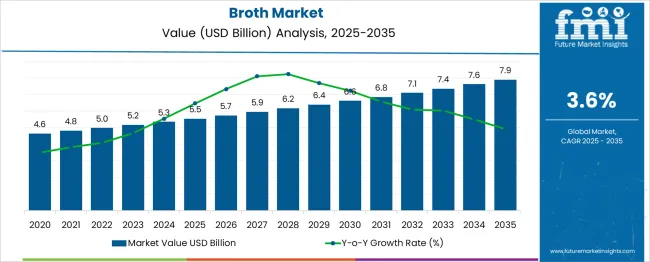
The Broth Market is estimated to be valued at USD 5.5 billion in 2025 and is projected to reach USD 7.9 billion by 2035, registering a compound annual growth rate (CAGR) of 3.6% over the forecast period. A Saturation Point Analysis reveals a gradual approach to market maturity as the market value increases over time. Between 2025 and 2029, the market grows from USD 5.5 billion to USD 6.4 billion, demonstrating a steady increase, driven by consistent demand for both conventional and plant-based broths.
During this period, the market experiences an annual average growth of USD 0.3 billion, with a CAGR of 3.0%, reflecting moderate expansion as the product category gains wider acceptance in the culinary industry and among health-conscious consumers. From 2029 to 2035, the market continues to rise, reaching USD 7.9 billion by 2035, contributing an additional USD 1.5 billion in growth.
The growth rate slightly stabilizes at CAGR 3.9% during this period, indicating that the market is nearing its saturation point. While demand remains strong, particularly in the health and wellness sector, the growth rate slows as the market matures and competition increases.
This suggests that by the latter half of the forecast period, the market will experience diminishing growth increments, signaling a phase of market saturation where the consumer base stabilizes, and demand becomes more aligned with steady consumption trends.
Quick Stats for Broth Market
- Broth Market Value (2025): USD 5.5 billion
- Broth Market Forecast Value (2035): USD 7.9 billion
- Broth Market Forecast CAGR: 3.6%
- Leading Segment in Broth Market in 2025: Shelf Stable (60.0%)
- Key Growth Regions in Broth Market: North America, Asia-Pacific, Europe
- Top Key Players in Broth Market: Campbell Soup Company, Del Monte Foods (College Inn), Unilever (Knorr), Pacific Foods of Oregon, Manischewitz, General Mills (Progresso)
Broth Market Key Takeaways
| Metric | Value |
|---|---|
| Broth Market Estimated Value in (2025 E) | USD 5.5 billion |
| Broth Market Forecast Value in (2035 F) | USD 7.9 billion |
| Forecast CAGR (2025 to 2035) | 3.6% |
Why is the Broth Market Growing?
The broth market is undergoing a shift fueled by growing demand for high-protein, convenient nutrition formats aligned with evolving wellness trends. Consumer interest in functional foods, particularly those supporting digestive health, immunity, and clean-label formulations, has reinforced market expansion.
Shelf stability, longer product life cycles, and simplified distribution have contributed to increased retail penetration across both developed and emerging economies. Foodservice and retail collaborations, combined with product innovation focused on organic, low-sodium, and allergen-free varieties, are unlocking new value pools.
Additionally, rising awareness of animal-based collagen and amino acid benefits is strengthening broth's positioning as a staple in health-oriented diets. Forward growth is anticipated from the convergence of clean eating preferences, sustainable packaging innovations, and increased at-home cooking trends.
Segmental Analysis
The broth market is segmented by type, and geographic regions. By type of the broth market is divided into Shelf StableRefrigerated. Regionally, the broth industry is classified into North America, Latin America, Western Europe, Eastern Europe, Balkan & Baltic Countries, Russia & Belarus, Central Asia, East Asia, South Asia & Pacific, and the Middle East & Africa.
Insights into the Shelf Stable Type Segment
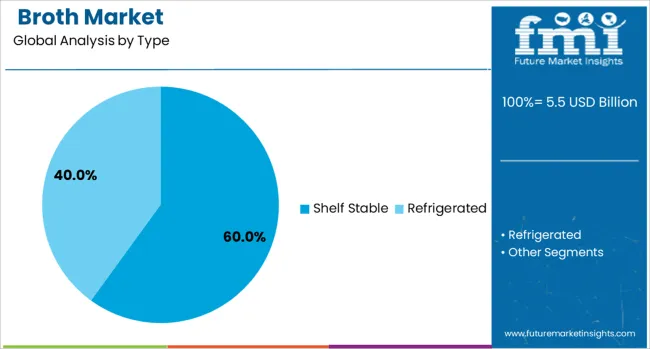
Shelf stable broth is projected to lead the market with a 60.0% revenue share in 2025, establishing it as the dominant product type. This segment’s leadership is attributed to its long shelf life, ambient storage capability, and compatibility with mass retail distribution networks.
Manufacturers have increasingly prioritized shelf-stable formulations to reduce cold chain dependency and expand product reach through both physical and online retail. The format’s ability to retain nutritional value and flavor integrity without refrigeration has aligned with growing consumer demand for convenient, pantry-ready solutions.
As at-home cooking habits persist and single-serve packaging formats become more prevalent, shelf-stable broth continues to gain traction among health-conscious and time-sensitive consumers.
What are the Drivers, Restraints, and Key Trends of the Broth Market?
The demand for broth is growing as consumers increasingly seek convenient, nutritious, and flavorful meal options. With a shift towards healthier and more natural alternatives, particularly in soups, sauces, and ready-to-eat meals, broth is becoming a popular choice due to its nutritional benefits, including being a rich source of collagen, protein, and essential amino acids. The market is further fueled by the rise in demand for plant-based and organic broths. Despite challenges related to packaging and production costs, the market presents ample opportunities for innovation and product diversification.
Growing Demand for Convenient and Nutritious Products
The demand for broth is being driven by the increasing preference for convenient, ready-to-use, and nutritious food options. Consumers are seeking healthier alternatives in their diets, and broth, known for its rich nutritional profile, offers an easy way to incorporate essential vitamins, minerals, and collagen into everyday meals. The rise of busy lifestyles and the shift toward more convenient meal solutions, such as ready-to-eat soups and broths, is fueling market growth. The growing focus on clean-label products, organic ingredients, and transparency in food sourcing also contributes to the rising demand for high-quality broths. With growing health awareness, broth is seen as a functional food that adds flavor while offering health benefits.
Packaging Costs and Consumer Preferences
The broth market faces challenges related to packaging costs, particularly in preserving the freshness and quality of the product. Broth often requires specific packaging, such as vacuum-sealed or tetra pack cartons, to maintain shelf life and prevent spoilage. These packaging methods, while effective, come with high production and material costs. Consumer preferences for convenience and taste are continuously evolving. The growing trend toward plant-based and organic foods also poses a challenge for traditional broth producers, who must adapt to these preferences by offering a variety of flavors and formulations. Maintaining consistency in taste and quality while meeting increasing consumer demand for healthier options remains an ongoing challenge in the market.
Innovation in Plant-Based and Organic Broths
The broth market presents significant opportunities driven by innovations in plant-based and organic offerings. With an increasing number of consumers adopting plant-based diets and seeking natural, minimally processed ingredients, there is a growing demand for plant-based broths. This has led to the development of vegetable-based, vegan, and organic broths, catering to the rising health-conscious and environmentally aware consumer base. The demand for functional broths, such as those enriched with collagen, bone broth, and superfoods like turmeric and ginger, is on the rise. These innovations not only expand product offerings but also tap into a niche market seeking nutritious, clean-label, and functional food options, further driving the growth of the broth industry.
Rise of Bone Broth and Functional Ingredients
The broth market is witnessing a growing trend in the popularity of bone broth, driven by its perceived health benefits such as joint support, digestive health, and skin elasticity due to its collagen content. This trend is particularly prominent in the health and wellness space, where consumers are increasingly looking for functional foods that offer more than basic nutrition.The incorporation of superfoods and functional ingredients such as turmeric, ginger, and adaptogens into broths is becoming a key trend. These ingredients are marketed for their anti-inflammatory and immune-boosting properties, catering to a consumer base interested in both flavor and health benefits. These trends are reshaping the broth market, with new product offerings that align with modern dietary preferences.
Analysis of Broth Market By Key Countries
| Country | CAGR |
|---|---|
| China | 4.9% |
| India | 4.5% |
| Germany | 4.1% |
| France | 3.8% |
| UK | 3.4% |
| USA | 3.1% |
| Brazil | 2.7% |
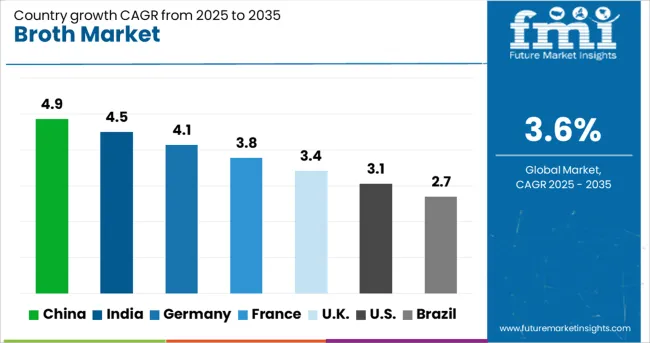
The broth market is projected to grow at a CAGR of 3.6% from 2025 to 2035. Among the top profiled markets, China leads at 4.9%, followed by India at 4.5%, France at 3.8%, the United Kingdom at 3.4%, and the United States at 3.1%. These growth rates reflect stronger momentum from BRICS nations like China and India, driven by increasing urbanization, rising middle-class income, and the adoption of ready-to-eat foods. In contrast, developed OECD countries such as the USA and the UK show steady growth, fueled by ongoing consumer demand for healthy, convenient meal options, particularly those that align with trends in wellness and functional foods. The market in Europe benefits from a strong culinary culture, while in China and India, the growing working population and changing eating habits drive significant market demand. The analysis spans over 40+ countries, with the top countries shown below.
Sales Analysis of Broth Market in China
China is projected to grow at a CAGR of 4.9% through 2035, with demand driven by the increasing preference for convenient food options and the growing middle class. The rise in disposable income, coupled with urbanization, is increasing consumer demand for ready-to-cook and ready-to-eat meal solutions, including broths. The adoption of Western diets, which include soups and broths, is also influencing the market. Health-conscious consumers in China are also seeking broths with functional ingredients, such as collagen and bone broth, known for their health benefits, including improved joint and skin health. Moreover, the government’s focus on improving food safety and the growing food delivery industry are expected to further drive market demand.
- Urbanization and growing middle-class demand for convenient meals fuel growth.
- Health trends, especially the demand for bone broth, boost market adoption.
- Government regulations and food delivery services further accelerate demand.
In-depth Analysis of Broth Market in India
India is expected to grow at a CAGR of 4.5% through 2035, driven by the increasing demand for convenient and healthy meal solutions. The growing middle class and urbanization in India are driving the demand for ready-to-eat products, including broths used in soups, sauces, and ready-to-cook meals. As consumers become more health-conscious, there is a rising preference for broths made from organic, clean-label ingredients. The demand for plant-based and low-sodium broths is also on the rise, aligning with the increasing adoption of vegetarian and vegan diets in urban areas. Additionally, the expansion of global food brands in India further supports the market growth, as they introduce various broth options catering to the evolving tastes and preferences of Indian consumers.
- Demand for ready-to-eat and convenient meals fuels growth.
- Increasing health-consciousness drives demand for clean-label, plant-based broths.
- Expansion of global food brands supports market diversification.
Opportunity Analysis of Broth Market in France
France is expected to grow at a CAGR of 3.8% through 2035, supported by the increasing demand for ready-to-cook meal solutions, particularly in urban areas. The French market is characterized by a preference for high-quality, flavorful broths, which are used extensively in traditional French cuisine. As French consumers continue to embrace convenience foods, the demand for broths in packaged forms is on the rise. Additionally, the growing interest in functional foods and health-enhancing ingredients, such as collagen-rich broths, is contributing to market expansion. The market is also influenced by France’s emphasis on using natural and locally sourced ingredients, which boosts demand for organic and premium broths. Furthermore, with the rise of online food delivery services, the market for broths in ready-made meals and soups continues to grow.
- Demand for high-quality, flavorful broths supports market growth.
- Health trends and collagen-rich broths drive demand in urban areas.
- Online food delivery services expand the market for ready-made broths.
Demand Outlook for Broth Market in the United States
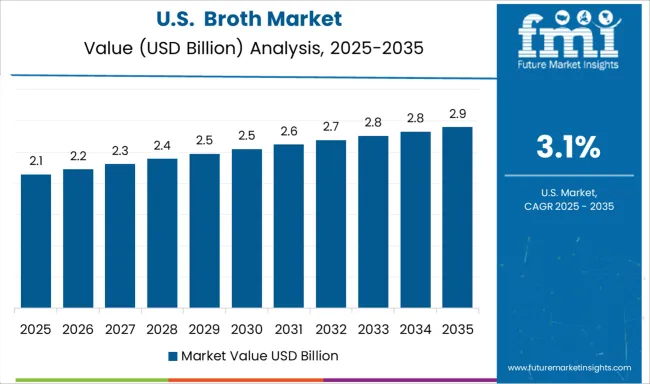
The United States is projected to grow at a CAGR of 3.1% through 2035, with steady demand for broths driven by an increasing focus on health and convenience. The USA market is witnessing a surge in demand for bone broth, which is promoted for its health benefits, such as improved gut health and joint repair. The increasing popularity of ready-to-eat meals, particularly soups and broths, is contributing to market growth, as busy lifestyles push consumers toward convenient and nutritious food options. Furthermore, the demand for clean-label and organic broths is rising as consumers seek transparency in food sourcing and ingredients. The growing adoption of plant-based diets also contributes to the demand for vegetable-based and vegan broths.
- Bone broth demand, driven by health benefits, fuels growth.
- Consumer preference for clean-label and organic broths continues to rise.
- Growing plant-based food trends drive demand for vegan broths.
Demand Analysis for Broth Market in the United Kingdom
The United Kingdom is projected to grow at a CAGR of 3.4% through 2035, driven by a steady demand for broths in the ready-to-eat food sector. As consumer preferences shift toward convenience and healthy eating, broths made with organic and clean-label ingredients are increasingly popular. The UK market is influenced by rising interest in functional foods such as bone broth, which is perceived as beneficial for gut health and overall wellness. The growing popularity of plant-based diets also contributes to the demand for vegetable and plant-based broths. The UK’s emphasis on health-conscious eating and a rising interest in premium food products are further propelling the demand for high-quality broths. Retailers and foodservice providers in the UK are responding to this demand by expanding their offerings of ready-to-eat soups, broths, and stocks.
- Rising demand for healthy, functional foods drives broth consumption.
- Popularity of bone broth for its health benefits boosts market growth.
- Plant-based food trends increase the demand for vegetable broths.
Competitive Landscape of Broth Market
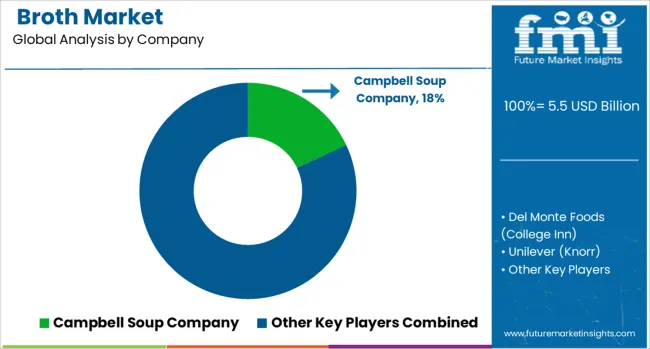
The broth market is driven by leading food companies offering a wide range of ready-to-use, nutritious broths for both culinary and convenience purposes. Campbell Soup Company is a dominant player with its well-established Swanson brand, providing both traditional and organic broths catering to consumers seeking quick and flavorful cooking bases.
Unilever (Knorr) offers a global portfolio of broths and stock cubes, focusing on flavor enhancement and convenience, making it a major competitor in both retail and foodservice markets.
Del Monte Foods stands out with its College Inn brand, known for high-quality broths used in soups, stews, and cooking. Pacific Foods of Oregon specializes in organic broths and stocks, emphasizing sustainability and premium ingredients, appealing to health-conscious consumers. Manischewitz caters to the Jewish market with kosher-certified broths, positioning itself as a go-to brand for religious and cultural dietary needs.
General Mills (Progresso) brings strong competition with its extensive range of broths, primarily focusing on both standard and reduced-sodium options that appeal to a broad consumer base seeking flavor and health-conscious choices. Competitive differentiation in the broth market relies on product quality, taste, ingredient transparency, and alignment with health trends, such as organic, gluten-free, or low-sodium offerings.
Barriers to entry include high brand loyalty, supply chain capabilities, and regulatory compliance for food safety standards. Strategic priorities include developing plant-based broth alternatives, expanding product lines to meet dietary needs, and integrating clean-label ingredients for broader consumer appeal.
Key Developments in Broth Market
- In June 2024, Campbell introduced a new line of spicy broths under its Swanson brand, featuring flavors like spicy chicken and beef broths infused with jalapeño and chili peppers.
- In 2025, Manischewitz introduced new soup options to complement its traditional offerings, aiming to cater to evolving consumer tastes and dietary preferences.
Scope of the Report
| Item | Value |
|---|---|
| Quantitative Units | USD 5.5 Billion |
| Type | Shelf Stable and Refrigerated |
| Regions Covered | North America, Europe, Asia-Pacific, Latin America, Middle East & Africa |
| Country Covered | United States, Canada, Germany, France, United Kingdom, China, Japan, India, Brazil, South Africa |
| Key Companies Profiled | Campbell Soup Company, Del Monte Foods (College Inn), Unilever (Knorr), Pacific Foods of Oregon, Manischewitz, and General Mills (Progresso) |
| Additional Attributes | Dollar sales by product type (vegetable broth, chicken broth, beef broth, plant-based broth) and end-use segments (retail, foodservice, home cooking). Demand dynamics are driven by increasing consumer preference for convenient, ready-to-use broths, growth in plant-based diets, and a rising focus on health-conscious products with reduced sodium and clean-label ingredients. Regional trends indicate North America and Europe as leading markets, with North America focusing on organic and low-sodium options, while Asia-Pacific shows increasing interest in broth-based culinary traditions. |
Broth Market by Segments
Type:
- Shelf Stable
- Refrigerated
Region:
- North America
- USA
- Canada
- Mexico
- Latin America
- Brazil
- Chile
- Rest of Latin America
- Western Europe
- Germany
- UK
- Italy
- Spain
- France
- Nordic
- BENELUX
- Rest of Western Europe
- Eastern Europe
- Russia
- Poland
- Hungary
- Balkan & Baltic
- Rest of Eastern Europe
- East Asia
- China
- Japan
- South Korea
- South Asia and Pacific
- India
- ASEAN
- Australia & New Zealand
- Rest of South Asia and Pacific
- Middle East & Africa
- Kingdom of Saudi Arabia
- Other GCC Countries
- Turkiye
- South Africa
- Other African Union
- Rest of Middle East & Africa
Frequently Asked Questions
How big is the broth market in 2025?
The global broth market is estimated to be valued at USD 5.5 billion in 2025.
What will be the size of broth market in 2035?
The market size for the broth market is projected to reach USD 7.9 billion by 2035.
How much will be the broth market growth between 2025 and 2035?
The broth market is expected to grow at a 3.6% CAGR between 2025 and 2035.
What are the key product types in the broth market?
The key product types in broth market are shelf stable, _product, _distribution channel, refrigerated, _product and _ distribution channel.
Which segment to contribute significant share in the broth market in 2025?
In terms of , segment to command 0.0% share in the broth market in 2025.
Preview the report firsthand - request a free sample
Get SampleGet the brochure for pricing and purchase details.
Get PDFTable of Content
- Executive Summary
- Global Market Outlook
- Demand-side Trends
- Supply-side Trends
- Technology Roadmap Analysis
- Analysis and Recommendations
- Market Overview
- Market Coverage / Taxonomy
- Market Definition / Scope / Limitations
- Market Background
- Market Dynamics
- Drivers
- Restraints
- Opportunity
- Trends
- Scenario Forecast
- Demand in Optimistic Scenario
- Demand in Likely Scenario
- Demand in Conservative Scenario
- Opportunity Map Analysis
- Product Life Cycle Analysis
- Supply Chain Analysis
- Investment Feasibility Matrix
- Value Chain Analysis
- PESTLE and Porter’s Analysis
- Regulatory Landscape
- Regional Parent Market Outlook
- Production and Consumption Statistics
- Import and Export Statistics
- Market Dynamics
- Global Broth Market Analysis 2020-2024 and Forecast, 2025-2035
- Historical Market Size Value (USD Mn) Analysis, 2020-2024
- Current and Future Market Size Value (USD Mn) Projections, 2025-2035
- Y-o-Y Growth Trend Analysis
- Absolute Dollar Opportunity Analysis
- Global Broth Market Pricing Analysis 2020-2024 and Forecast 2025-2035
- Global Broth Market Analysis 2020-2024 and Forecast 2025-2035, By Type
- Introduction / Key Findings
- Historical Market Size Value (USD Mn) Analysis By Type , 2020-2024
- Current and Future Market Size Value (USD Mn) Analysis and Forecast By Type , 2025-2035
- Shelf Stable
- Product
- Distribution Channel
- Refrigerated
- Product
- Distribution Channel
- Shelf Stable
- Y-o-Y Growth Trend Analysis By Type , 2020-2024
- Absolute Dollar Opportunity Analysis By Type , 2025-2035
- Global Broth Market Analysis 2020-2024 and Forecast 2025-2035, By Region
- Introduction
- Historical Market Size Value (USD Mn) Analysis By Region, 2020-2024
- Current Market Size Value (USD Mn) Analysis and Forecast By Region, 2025-2035
- North America
- Latin America
- Western Europe
- Eastern Europe
- East Asia
- South Asia and Pacific
- Middle East & Africa
- Market Attractiveness Analysis By Region
- North America Broth Market Analysis 2020-2024 and Forecast 2025-2035, By Country
- Historical Market Size Value (USD Mn) Trend Analysis By Market Taxonomy, 2020-2024
- Market Size Value (USD Mn) Forecast By Market Taxonomy, 2025-2035
- By Country
- USA
- Canada
- Mexico
- By Type
- By Country
- Market Attractiveness Analysis
- By Country
- By Type
- Key Takeaways
- Latin America Broth Market Analysis 2020-2024 and Forecast 2025-2035, By Country
- Historical Market Size Value (USD Mn) Trend Analysis By Market Taxonomy, 2020-2024
- Market Size Value (USD Mn) Forecast By Market Taxonomy, 2025-2035
- By Country
- Brazil
- Chile
- Rest of Latin America
- By Type
- By Country
- Market Attractiveness Analysis
- By Country
- By Type
- Key Takeaways
- Western Europe Broth Market Analysis 2020-2024 and Forecast 2025-2035, By Country
- Historical Market Size Value (USD Mn) Trend Analysis By Market Taxonomy, 2020-2024
- Market Size Value (USD Mn) Forecast By Market Taxonomy, 2025-2035
- By Country
- Germany
- UK
- Italy
- Spain
- France
- Nordic
- BENELUX
- Rest of Western Europe
- By Type
- By Country
- Market Attractiveness Analysis
- By Country
- By Type
- Key Takeaways
- Eastern Europe Broth Market Analysis 2020-2024 and Forecast 2025-2035, By Country
- Historical Market Size Value (USD Mn) Trend Analysis By Market Taxonomy, 2020-2024
- Market Size Value (USD Mn) Forecast By Market Taxonomy, 2025-2035
- By Country
- Russia
- Poland
- Hungary
- Balkan & Baltic
- Rest of Eastern Europe
- By Type
- By Country
- Market Attractiveness Analysis
- By Country
- By Type
- Key Takeaways
- East Asia Broth Market Analysis 2020-2024 and Forecast 2025-2035, By Country
- Historical Market Size Value (USD Mn) Trend Analysis By Market Taxonomy, 2020-2024
- Market Size Value (USD Mn) Forecast By Market Taxonomy, 2025-2035
- By Country
- China
- Japan
- South Korea
- By Type
- By Country
- Market Attractiveness Analysis
- By Country
- By Type
- Key Takeaways
- South Asia and Pacific Broth Market Analysis 2020-2024 and Forecast 2025-2035, By Country
- Historical Market Size Value (USD Mn) Trend Analysis By Market Taxonomy, 2020-2024
- Market Size Value (USD Mn) Forecast By Market Taxonomy, 2025-2035
- By Country
- India
- ASEAN
- Australia & New Zealand
- Rest of South Asia and Pacific
- By Type
- By Country
- Market Attractiveness Analysis
- By Country
- By Type
- Key Takeaways
- Middle East & Africa Broth Market Analysis 2020-2024 and Forecast 2025-2035, By Country
- Historical Market Size Value (USD Mn) Trend Analysis By Market Taxonomy, 2020-2024
- Market Size Value (USD Mn) Forecast By Market Taxonomy, 2025-2035
- By Country
- Kingdom of Saudi Arabia
- Other GCC Countries
- Turkiye
- South Africa
- Other African Union
- Rest of Middle East & Africa
- By Type
- By Country
- Market Attractiveness Analysis
- By Country
- By Type
- Key Takeaways
- Key Countries Broth Market Analysis
- USA
- Pricing Analysis
- Market Share Analysis, 2024
- By Type
- Canada
- Pricing Analysis
- Market Share Analysis, 2024
- By Type
- Mexico
- Pricing Analysis
- Market Share Analysis, 2024
- By Type
- Brazil
- Pricing Analysis
- Market Share Analysis, 2024
- By Type
- Chile
- Pricing Analysis
- Market Share Analysis, 2024
- By Type
- Germany
- Pricing Analysis
- Market Share Analysis, 2024
- By Type
- UK
- Pricing Analysis
- Market Share Analysis, 2024
- By Type
- Italy
- Pricing Analysis
- Market Share Analysis, 2024
- By Type
- Spain
- Pricing Analysis
- Market Share Analysis, 2024
- By Type
- France
- Pricing Analysis
- Market Share Analysis, 2024
- By Type
- India
- Pricing Analysis
- Market Share Analysis, 2024
- By Type
- ASEAN
- Pricing Analysis
- Market Share Analysis, 2024
- By Type
- Australia & New Zealand
- Pricing Analysis
- Market Share Analysis, 2024
- By Type
- China
- Pricing Analysis
- Market Share Analysis, 2024
- By Type
- Japan
- Pricing Analysis
- Market Share Analysis, 2024
- By Type
- South Korea
- Pricing Analysis
- Market Share Analysis, 2024
- By Type
- Russia
- Pricing Analysis
- Market Share Analysis, 2024
- By Type
- Poland
- Pricing Analysis
- Market Share Analysis, 2024
- By Type
- Hungary
- Pricing Analysis
- Market Share Analysis, 2024
- By Type
- Kingdom of Saudi Arabia
- Pricing Analysis
- Market Share Analysis, 2024
- By Type
- Turkiye
- Pricing Analysis
- Market Share Analysis, 2024
- By Type
- South Africa
- Pricing Analysis
- Market Share Analysis, 2024
- By Type
- USA
- Market Structure Analysis
- Competition Dashboard
- Competition Benchmarking
- Market Share Analysis of Top Players
- By Regional
- By Type
- Competition Analysis
- Competition Deep Dive
- Campbell Soup Company
- Overview
- Product Portfolio
- Profitability by Market Segments (Product/Age /Sales Channel/Region)
- Sales Footprint
- Strategy Overview
- Marketing Strategy
- Product Strategy
- Channel Strategy
- Del Monte Foods (College Inn)
- Unilever (Knorr)
- Pacific Foods of Oregon
- Manischewitz
- General Mills (Progresso)
- Campbell Soup Company
- Competition Deep Dive
- Assumptions & Acronyms Used
- Research Methodology


