

- Market Size (2026)
- USD 277.2 Mn
- Forecast (2036)
- USD 451.5 Mn
- CAGR (2026 to 2036)
- 5.0%
How big is the CHPTAC Market in 2026?
USD 277.2 million in 2026, reaching USD 451.5 million by 2036 at a 5.0% CAGR
The CHPTAC market is estimated at USD 277.2 million in 2026 and is forecast to reach USD 451.5 million by 2036 at a 5.0% CAGR. Demand is shaped by water treatment, where CHPTAC produces cationic flocculants for water clarification. Flocculants account for 39.7% of Application demand in 2026, while the Water Treatment Industry holds 45.3% of end use.
The market was valued at USD 264.0 million in 2025. Growth reflects rising water treatment demand and cationic starch use in paper and textiles. Demand is shaped by water treatment and paper producers requiring cationic reagents, with the epichlorohydrin route supporting liquid CHPTAC supply for flocculant production.
CHPTAC is a cationic reagent anchored to water treatment flocculants and cationic starch. Buyers judge grades through reactivity and purity. Procurement centers on water treatment and paper manufacturing.
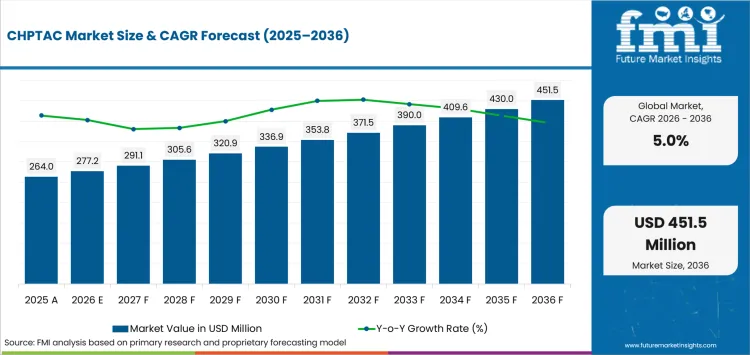
| Metric | Value |
|---|---|
| 2025 Market Size | USD 264.0 million |
| 2026 Market Size | USD 277.2 million |
| 2036 Market Size | USD 451.5 million |
| Forecast CAGR (2026 to 2036) | 5.0% |
| Application Focus | Flocculants |
| Flocculants Share (2026) | 39.7% |
| End-Use Focus | Water Treatment Industry |
| Water Treatment Industry Share (2026) | 45.3% |
| Key Countries | USA, Germany, France, UK |
Summary of the CHPTAC Market
| Market Signal | Commercial Impact |
|---|---|
| Demand and Growth Drivers | Demand comes from water treatment flocculants, cationic paper starch, and textile processing reagents.
|
| Product and Segment View | Flocculant applications and liquid CHPTAC lead the mix, with water treatment the largest end use.
|
| Geography and Competitive Outlook | South Korea leads growth on water treatment and chemical demand, while producers compete on reactivity and purity.
|
| Analyst Opinion | Consistent, high-reactivity liquid CHPTAC with reliable supply will win as water-treatment flocculant demand anchors the market.
|
Why is the CHPTAC Market growing?
Rising Flocculant and water-treatment demand in cationic reagent applications
- Sustained sourcing of CHPTAC is shaped by water treatment producers manufacturing cationic flocculants.
- South Korea is leading the way with growth of 5.3%, driven by water treatment demand, chemical production, and flocculant use.
- The application segment is led by flocculants at 39.7% share, supported by water treatment clarification.
Demand is rising because water treatment requires cationic flocculants for clarification and sludge management. Adoption is increasing due to CHPTAC use in flocculant and cationic starch production, with the epichlorohydrin route supporting liquid CHPTAC supply for water treatment, paper, and textile applications.
How is the CHPTAC Market segmented?
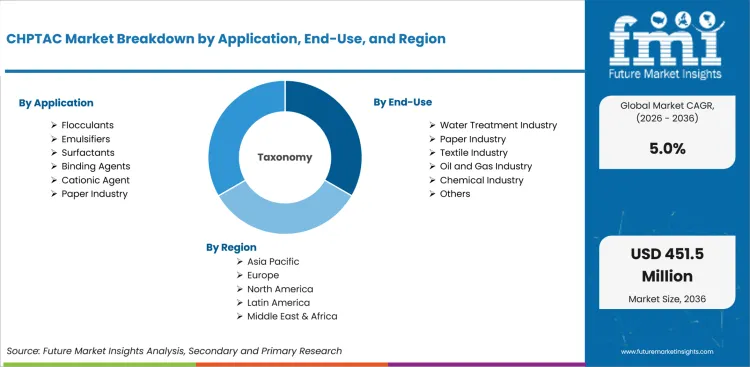
By Application, End-Use, Product and Manufacturing Process
- Flocculants are projected to lead Application demand with 39.7% share in 2026 due to water treatment clarification.
- Water treatment industry is expected to lead End-Use with 45.3% share in 2026 as flocculant demand drives use.
- Liquid CHPTAC is forecast to lead product as it suits direct reaction in production.
Why do flocculants lead the CHPTAC Market?
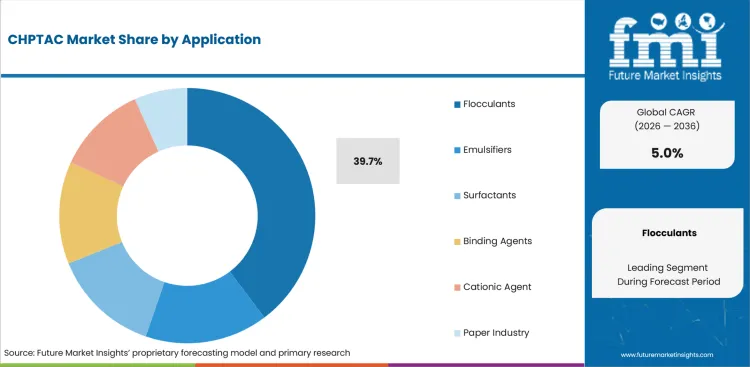
- Flocculants are expected to hold 39.7% share in 2026 because CHPTAC produces cationic flocculants for water clarification.
- Water treatment demand anchors flocculant production across municipal and industrial use.
How big is the end-use segment in the CHPTAC Market?
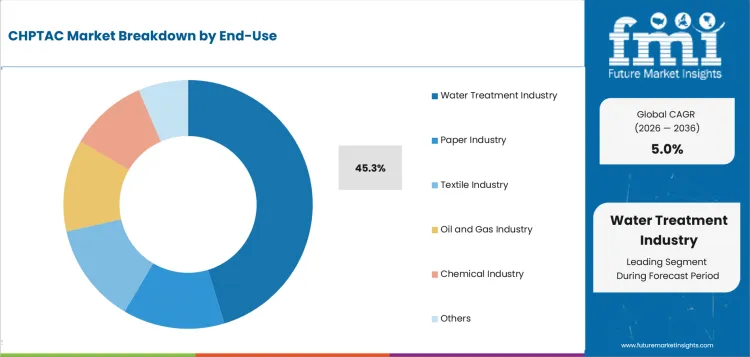
- Water Treatment Industry forms the leading end-use at 45.3% share, anchored by flocculant demand.
- Paper and textile industries follow as cationic starch and reagent use extends.
Which product leads the market?
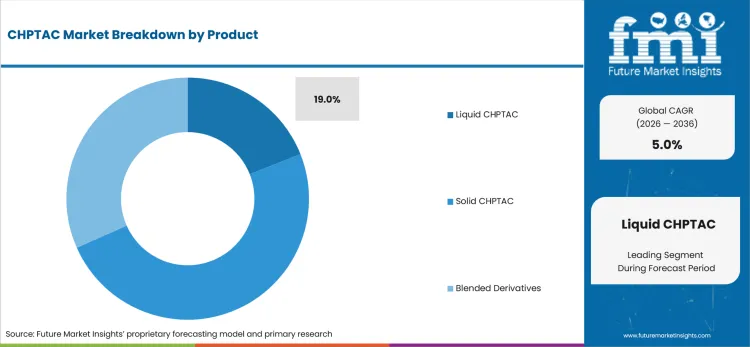
- Liquid CHPTAC leads as it suits direct reaction in flocculant and cationic starch production.
- Solid CHPTAC and blended derivatives follow where storage or transport favors solid form.
Which manufacturing process leads procurement?
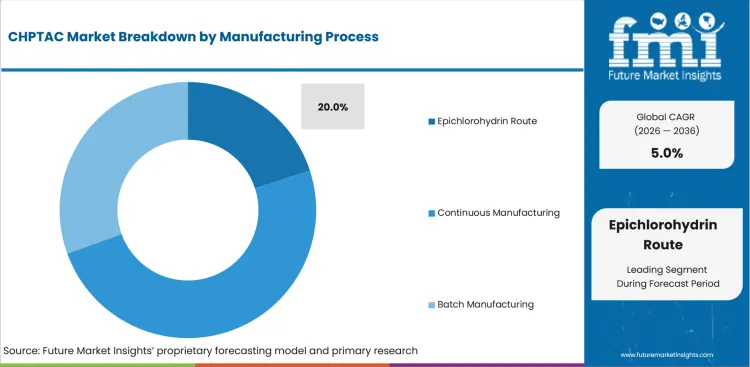
- Epichlorohydrin route leads as it delivers high-reactivity CHPTAC for reagent production.
- Continuous and batch manufacturing follow based on production scale.
What drives and restrains the CHPTAC Market?
Driven by water treatment and paper demand; restrained by epichlorohydrin feedstock cost and handling
Water treatment and paper demand support growth while epichlorohydrin feedstock cost and reagent handling requirements constrain production economics.
- Driver: Water treatment producers use CHPTAC to manufacture cationic flocculants for clarification, generating recurring demand tied to municipal and industrial water treatment.
- Restraint: Production economics are constrained by epichlorohydrin feedstock cost and the handling requirements of CHPTAC as a reactive reagent that limit lower-cost supply.
- Opportunity: Cationic starch demand in paper and specialty reagent applications can widen value beyond water treatment flocculants.
Water treatment demand is lifting CHPTAC consumption as producers manufacture cationic flocculants. Flocculant production anchors demand while liquid CHPTAC supports direct reaction.
The market is led by structural demand from water treatment. Flocculants remain the leading application, while cationic starch serves paper. Constraints include epichlorohydrin feedstock cost, reagent handling, and competition from alternative cationic reagents.
Which factors support expansion in the CHPTAC Market?
Flocculant procurement and water-treatment demand support market value across water and paper channels
- Market value is supported by water treatment flocculant demand before paper and textile uses add volume.
- Supplier pricing reflects reactivity and purity before feedstock cost affects realization.
- Water treatment producers compare reactivity and supply consistency before qualifying a CHPTAC source.
Which countries are growing fastest in the CHPTAC Market?
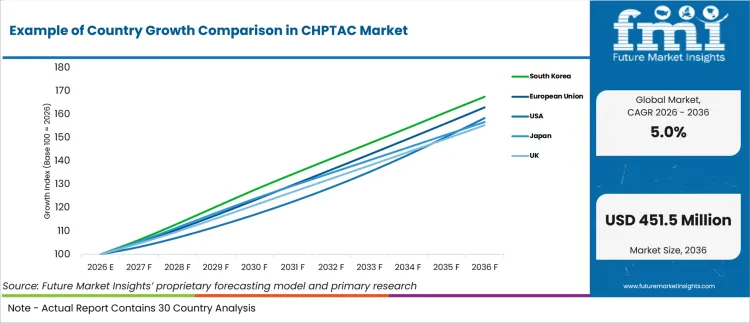
| Country | CAGR |
|---|---|
| South Korea | 5.3% |
| European Union | 5.0% |
| USA | 4.7% |
| Japan | 4.6% |
| UK | 4.5% |
Source: Future Market Insights analysis, 2026.
How do country-level CAGRs compare in the CHPTAC Market?
The global CHPTAC market is projected to expand at 5.0% from 2026 to 2036. The study covers more than 30 countries, and the primary markets are listed below.
- South Korea is forecast to record 5.3% CAGR by 2036 as water treatment and chemical demand expand.
- The European Union is expected to expand at 5.0% CAGR through 2036 as water treatment and paper demand grow.
- The USA is estimated to grow at 4.7% CAGR by 2036 as water treatment and paper demand continue.
- Japan is projected to rise at 4.6% CAGR through 2036 as water treatment and specialty chemical demand support volume.
- The UK is forecast to post 4.5% CAGR by 2036 as water treatment and paper demand support demand.
Who are the leading companies in the CHPTAC Market?
Dow Chemical, Kemira, SKW Quab Chemicals, Sachem, and Lotte Fine Chemical
Dow Chemical and Kemira compete through CHPTAC reagent supply and reactivity. Purity remains a further point of differentiation. SKW Quab Chemicals and Sachem compete on specialty CHPTAC grades, while Lotte Fine Chemical holds positions in cationic reagent supply. These overlap with broader water treatment chemical and cationic starch buying paths.
Buyers compare suppliers on reactivity, purity, and supply consistency. Water treatment and paper producers standardize on CHPTAC with consistent reactivity. Specialty applications favor high-purity grades for reagent production.
Who are the key players in the CHPTAC Market?
Key global companies leading the CHPTAC Market include:
- Dow Chemical, Kemira, and SKW Quab Chemicals maintain leading positions through CHPTAC reagent supply, reactivity, and production scale across global markets.
- Chemical specialists such as Sachem, Lotte Fine Chemical, and Daicel compete through cationic reagent supply.
- Regional and emerging producers such as Yanzhou Tiancheng Chemical and Dongying J&M Chemical target regional reagent supply to establish positions and scale.
How do top CHPTAC Market companies compare?
Dow and Kemira lead on scale; SKW Quab also has a global footprint, while Sachem and Lotte Fine Chemical are more grade-concentrated.
| Company | Reagent Breadth | Reactivity Quality | Production Scale | Geographic Footprint |
|---|---|---|---|---|
| Dow Chemical | High | High | Strong | Global |
| Kemira | High | High | Strong | Global |
| SKW Quab Chemicals | Moderate | High | Strong | Americas-led |
| Sachem | Moderate | High | Moderate | Global |
| Lotte Fine Chemical | Moderate | Moderate | Strong | Asia-led |
Source: Future Market Insights competitive analysis, 2026.
Key Developments in the CHPTAC Market
• In 2025, major Chinese producers including Shandong Tiancheng Chemical Co., Ltd. and Shandong Luyue Chemical expanded production capacity for liquid and solid CHPTAC to meet rising domestic demand from the paper industry and growing export volumes to Southeast Asia and other emerging markets. These expansions strengthen supply for cationic starch in high-speed paper machines and flocculants in water treatment applications.
• In early 2026, North American suppliers SKW Quab Chemicals Inc. and Sachem Inc. advanced domestic manufacturing and distribution capabilities, reducing reliance on imports for U.S. and Canadian paper mills. The moves support supply chain resilience and align with sustainability targets favoring CHPTAC-modified starches over synthetic alternatives in packaging and tissue grades.
• Throughout 2025–2026, manufacturers continued to introduce and optimize higher-purity and low-chloride CHPTAC formulations (typically 60–70% liquid concentrations), improving performance in paper wet-end chemistry, reducing byproducts, and enhancing compliance with stringent environmental regulations in water treatment and textile processing.
Key Players in the CHPTAC Market
Global Chemical Producers
- Dow Chemical Company
- Kemira Oyj
- SKW Quab Chemicals Inc.
Specialty Reagent Suppliers
- Sachem Inc.
- Lotte Fine Chemical Co., Ltd.
- Daicel Corporation
- PCC Group
Regional and Emerging Producers
- Yanzhou Tiancheng Chemical Co., Ltd.
- Dongying J&M Chemical Co., Ltd.
- Guangzhou Shuangjian Fine Chemical Co., Ltd.
- Jubilant Life Sciences Ltd.
CHPTAC Market - Scope & Definition
| Attribute | Detail |
|---|---|
| Market Definition | CHPTAC (3-chloro-2-hydroxypropyltrimethylammonium chloride) cationic reagent used to produce flocculants and cationic starch across water treatment, paper, and textile applications |
| Functions Covered | Cationic flocculant production, cationic starch synthesis, and reagent use across applications |
| Applications Covered | Flocculants, emulsifiers, surfactants, binding agents, cationic agents, and paper industry use |
| End-Use Industries | Water treatment, paper, textile, oil and gas, and chemical industries |
| Inclusions | Liquid, solid, and blended CHPTAC derivatives across manufacturing processes |
| Exclusions | Other cationic reagents outside CHPTAC, and non-cationic water treatment chemicals |
CHPTAC Market - Research Methodology
| Method | Description |
|---|---|
| Primary Research | FMI analysts gathered input from manufacturers, service providers, technology developers, distributors, end users, procurement teams, and subject-matter experts. Interviews examined purchasing decisions, product or service evaluation, adoption barriers, approval requirements, pricing considerations, and expectations for technical or commercial support. Respondents were also asked what evidence is required before a trial, pilot, or initial order develops into regular purchasing. |
| Desk Research | Desk research covered government statistics, regulatory publications, trade data, industry associations, technical literature, standards, company filings, product information, and official corporate announcements. Sources were reviewed for relevance, publication date, geographic coverage, and consistency with the defined market scope. Claims relating to performance, applications, approvals, capacity, investment, and commercial activity were retained only when supported by credible public evidence. |
| Market Sizing & Forecasting | The market model combined the baseline value with historical performance, segment structure, pricing and volume indicators, adoption levels, company participation, and country-level demand conditions. Forecast assumptions considered economic activity, investment trends, regulatory developments, technology adoption, purchasing cycles, supply availability, and barriers to wider market use. Segment and regional estimates were reconciled before the final market total was calculated. |
| Data Validation | Estimates were checked against multiple independent indicators, including public data, company activity, trade patterns, industry developments, and findings from primary interviews. Validation also tested whether products, services, applications, and company revenues fell within the defined market boundaries. Adjacent categories, unsupported claims, overlapping revenues, and activities without direct market relevance were excluded to reduce double counting and maintain consistency across segments and countries. |
What does the CHPTAC Market report cover?
2021 to 2025 history and 2026 to 2036 forecasts across all segments and 30+ countries
| Parameter | Details |
|---|---|
| Forecast period | 2026 to 2036 |
| Historical period | 2021 to 2025 |
| Quantitative unit | Value in USD million |
| By Application | Flocculants, Emulsifiers, Surfactants, Binding Agents, Cationic Agent, Paper Industry |
| By End-use | Water Treatment Industry, Paper Industry, Textile Industry, Oil and Gas Industry, Chemical Industry |
| By Product | Liquid CHPTAC, Solid CHPTAC, Blended Derivatives |
| By Manufacturing process | Epichlorohydrin Route, Continuous Manufacturing, Batch Manufacturing |
| Regions covered | North America, Latin America, Western Europe, Eastern Europe, East Asia, South Asia and Pacific, Middle East and Africa |
| Countries covered | USA, South Korea, European Union, Japan, UK, and other major markets |
| Key companies profiled | Dow Chemical, Kemira, SKW Quab Chemicals, Sachem, Lotte Fine Chemical, Daicel, Yanzhou Tiancheng Chemical, Dongying J&M Chemical |
| Approach | Bottom-up application-based approach using water treatment and paper demand, product mix, and supplier disclosures |
Market Segmentation Analysis
CHPTAC Market Segmented by Application:
- Flocculants
- Emulsifiers
- Surfactants
- Binding Agents
- Cationic Agent
- Municipal Water Clarification
- Industrial Effluent Treatment
- Paper Industry
- Wet End Additives
- Retention Aid Production
- Dry Strength Resin Use
- Surface Treatment Chemicals
- Paper Coating Modification
- Printability Enhancement
- Wet End Additives
CHPTAC Market Segmented by End-Use:
- Water Treatment Industry
- Paper Industry
- Packaging Paper Producers
- Writing Paper Manufacturers
- Textile Industry
- Apparel Textile Mills
- Garment Fabric Producers
- Color Processing Units
- Home Textile Producers
- Towel and Linen Makers
- Decor Fabric Units
- Apparel Textile Mills
- Oil and Gas Industry
- Onshore Operators
- Drilling Chemical Demand
- Production Site Use
- Offshore Operators
- Enhanced Recovery Applications
- High Performance Chemical Use
- Onshore Operators
- Chemical Industry
- Others
CHPTAC Market Segmented by Product:
- Liquid CHPTAC
- Standard Concentration Grades
- 60 Percent Active Solutions
- 65 Percent Active Solutions
- High Purity Liquid Grades
- Low Impurity Industrial Grades
- Premium Performance Grades
- Custom Formulated Solutions
- Viscosity Modified Grades
- Application Specific Blends
- Standard Concentration Grades
- Solid CHPTAC
- Powder Grades
- Free Flowing Powder Products
- Easy Handling Industrial Grades
- Granular Grades
- Dust Reduced Granules
- Bulk Processing Grades
- Powder Grades
- Blended Derivatives
- CHPTAC Formulations
- Polymer Modification Blends
- Textile Processing Blends
- Specialty Intermediate Products
- Customized Functional Derivatives
- High Value Niche Products
- CHPTAC Formulations
CHPTAC Market Segmented by Manufacturing Process:
- Epichlorohydrin Route
- Conventional Synthesis
- Large Scale Production
- Standard Industry Output
- Optimized Process Route
- Higher Yield Production
- Lower Waste Generation
- Conventional Synthesis
- Continuous Manufacturing
- Continuous Reactor Systems
- Stable Quality Production
- High Volume Output
- Automated Plants
- Reduced Labor Cost
- Improved Safety Standards
- Continuous Reactor Systems
- Batch Manufacturing
- Flexible Batch Production
- Custom Grade Output
- Small Volume Specialty Supply
- High Purity Batch Systems
- Controlled Parameter Production
- Premium Product Lines
- Flexible Batch Production
CHPTAC Market by Region:
- North America
- USA
- Canada
- Latin America
- Brazil
- Mexico
- Chile
- Rest of Latin America
- Western Europe
- Germany
- UK
- Italy
- Spain
- France
- Nordic
- BENELUX
- Rest of Western Europe
- Eastern Europe
- Russia
- Poland
- Hungary
- Balkan & Baltic
- Rest of Eastern Europe
- East Asia
- China
- Japan
- South Korea
- South Asia and Pacific
- India
- ASEAN
- Australia & New Zealand
- Rest of South Asia and Pacific
- Middle East & Africa
- Kingdom of Saudi Arabia
- Other GCC Countries
- Türkiye
- South Africa
- Other African Union
- Rest of Middle East & Africa
Research Sources and Bibliography
- International Organization for Standardization. (2025, October). Standards for water treatment chemicals.
- Organisation for Economic Co-operation and Development. (2025, November). Chemical industry and water treatment indicators.
- USA Environmental Protection Agency. (2026, January). Drinking water treatment chemical guidance.
- European Chemicals Agency. (2025, December 8). Cationic reagent assessment report.
- World Bank. (2025, September). Global water and sanitation infrastructure outlook.
- Dow Chemical Company. (2026, February 12). 2025 annual report and water solutions overview.
- Kemira Oyj. (2026, February 11). 2025 results and water treatment chemicals update.
This bibliography is provided for reader reference and is not exhaustive.
This Report Answers
- Market size estimates for 2026 and forecasts through 2036 for the CHPTAC Market.
- Analysis of application demand across flocculants and cationic starch reagents.
- Country-level growth analysis covering South Korea and the European Union with USA, Japan and UK outlooks.
- Evaluation of company positioning across Dow Chemical and Kemira with SKW Quab Chemicals, Sachem and Lotte Fine Chemical.
- Assessment of drivers and restraints with procurement patterns across water treatment and paper channels.
Frequently Asked Questions
What is the growth prospect for the CHPTAC Market?
Demand is projected to grow as water treatment producers utilize CHPTAC for cationic flocculants and clarification.
Which companies are expected to shape the CHPTAC Market?
Dow Chemical and Kemira are positioned to lead the competitive landscape, alongside SKW Quab Chemicals, Sachem, and Lotte Fine Chemical.
Why do Flocculants matter in this market?
Flocculants account for the largest share of Application demand, as CHPTAC produces cationic flocculants for water treatment clarification.
How does feedstock cost influence demand?
Epichlorohydrin feedstock costs and reagent handling influence CHPTAC production economics and pricing.
Which end-use is gaining attention?
Water treatment leads CHPTAC demand, while the paper segment is gaining prominence for cationic starch applications.
Preview the report firsthand - request a free sample
Get SampleGet the brochure for pricing and purchase details.
Get PDFTable of Content
- Key Takeaways
- Market Size and CAGR
- Top Growth Driver
- Fastest Growing Segment
- Leading Region
- Key Companies
- Emerging Opportunities
- Executive Summary
- Global Market Outlook
- Demand-side Trends
- Supply-side Trends
- Technology Roadmap Analysis
- Analysis and Recommendations
- Analyst Perspective (What is happening? Why now? What should investors know?)
- Key Questions Answered
- How large is the market?
- What is the CAGR?
- What are key trends?
- Which region dominates?
- Who are the leaders?
- Market Overview
- Market Coverage / Taxonomy
- Market Definition / Scope / Limitations
- Research Methodology
- Chapter Orientation
- Analytical Lens and Working Hypotheses
- Market Structure, Signals, and Trend Drivers
- Benchmarking and Cross-market Comparability
- Market Sizing, Forecasting, and Opportunity Mapping
- Research Design and Evidence Framework
- Desk Research Programme (Secondary Evidence)
- Expert Input and Fieldwork (Primary Evidence)
- Tooling, Models, and Reference Databases
- Data Engineering and Model Build
- Quality Assurance and Audit Trail
- Market Background
- Market Dynamics (Drivers, Restraints, Opportunity, Trends)
- Scenario Forecast (Optimistic, Likely, Conservative)
- Impact Analysis
- AI Impact
- Sustainability Impact
- Regulatory Impact
- Technology Impact
- Consumer / Buyer Analysis
- Purchase Drivers
- Adoption Barriers
- Buyer Journey
- Opportunity Map Analysis
- Product Life Cycle Analysis
- Supply Chain Analysis
- Investment Feasibility Matrix
- Value Chain Analysis
- PESTLE and Porter's Analysis
- Regulatory Landscape
- Regional Parent Market Outlook
- Production and Consumption Statistics
- Import and Export Statistics
- Global Market Analysis and Forecast, 2021 to 2036
- Historical Market Size Value (USD Million) Analysis, 2021 to 2025
- Current and Future Market Size Value (USD Million) Projections, 2026 to 2036
- Y-o-Y Growth Trend Analysis
- Absolute $ Opportunity Analysis
- Global Market Pricing Analysis, 2021 to 2036
- Global Market Analysis and Forecast, By Application, 2021 to 2036
- Introduction / Key Findings
- Historical Market Size Value (USD Million) Analysis By Application, 2021 to 2025
- Current and Future Market Size Value (USD Million) Analysis and Forecast By Application, 2026 to 2036
- Flocculants
- Emulsifiers
- Surfactants
- Binding Agents
- Cationic Agent
- Municipal Water Clarification
- Industrial Effluent Treatment
- Paper Industry
- Wet End Additives
- Surface Treatment Chemicals
- Flocculants
- Y-o-Y Growth Trend Analysis By Application, 2021 to 2025
- Absolute $ Opportunity Analysis By Application, 2026 to 2036
- Global Market Analysis and Forecast, By End-Use, 2021 to 2036
- Introduction / Key Findings
- Historical Market Size Value (USD Million) Analysis By End-Use, 2021 to 2025
- Current and Future Market Size Value (USD Million) Analysis and Forecast By End-Use, 2026 to 2036
- Water Treatment Industry
- Paper Industry
- Packaging Paper Producers
- Writing Paper Manufacturers
- Textile Industry
- Apparel Textile Mills
- Home Textile Producers
- Oil and Gas Industry
- Onshore Operators
- Offshore Operators
- Chemical Industry
- Others
- Water Treatment Industry
- Y-o-Y Growth Trend Analysis By End-Use, 2021 to 2025
- Absolute $ Opportunity Analysis By End-Use, 2026 to 2036
- Global Market Analysis and Forecast, By Product, 2021 to 2036
- Introduction / Key Findings
- Historical Market Size Value (USD Million) Analysis By Product, 2021 to 2025
- Current and Future Market Size Value (USD Million) Analysis and Forecast By Product, 2026 to 2036
- Liquid CHPTAC
- Standard Concentration Grades
- High Purity Liquid Grades
- Custom Formulated Solutions
- Solid CHPTAC
- Powder Grades
- Granular Grades
- Blended Derivatives
- CHPTAC Formulations
- Specialty Intermediate Products
- Liquid CHPTAC
- Y-o-Y Growth Trend Analysis By Product, 2021 to 2025
- Absolute $ Opportunity Analysis By Product, 2026 to 2036
- Global Market Analysis and Forecast, By Manufacturing Process, 2021 to 2036
- Introduction / Key Findings
- Historical Market Size Value (USD Million) Analysis By Manufacturing Process, 2021 to 2025
- Current and Future Market Size Value (USD Million) Analysis and Forecast By Manufacturing Process, 2026 to 2036
- Epichlorohydrin Route
- Conventional Synthesis
- Optimized Process Route
- Continuous Manufacturing
- Continuous Reactor Systems
- Automated Plants
- Batch Manufacturing
- Flexible Batch Production
- High Purity Batch Systems
- Epichlorohydrin Route
- Y-o-Y Growth Trend Analysis By Manufacturing Process, 2021 to 2025
- Absolute $ Opportunity Analysis By Manufacturing Process, 2026 to 2036
- Global Market Analysis and Forecast, By Region, 2021 to 2036
- Introduction
- Historical Market Size Value (USD Million) Analysis By Region, 2021 to 2025
- Current Market Size Value (USD Million) Analysis and Forecast By Region, 2026 to 2036
- North America
- Latin America
- Western Europe
- Eastern Europe
- East Asia
- South Asia and Pacific
- Middle East & Africa
- Market Attractiveness Analysis By Region
- North America Market Analysis and Forecast, By Country, 2021 to 2036
- Historical Market Size Value (USD Million) Trend Analysis By Market Taxonomy, 2021 to 2025
- Market Size Value (USD Million) Forecast By Market Taxonomy, 2026 to 2036
- By Country
- USA
- Canada
- By Application
- By End-Use
- By Product
- By Manufacturing Process
- By Country
- Market Attractiveness Analysis
- By Country
- By Application
- By End-Use
- By Product
- By Manufacturing Process
- Key Takeaways
- Latin America Market Analysis and Forecast, By Country
- Historical Market Size Value (USD Million) Trend Analysis By Market Taxonomy, 2021 to 2025
- Market Size Value (USD Million) Forecast By Market Taxonomy, 2026 to 2036
- By Country
- Brazil
- Mexico
- Chile
- Rest of Latin America
- By Application
- By End-Use
- By Product
- By Manufacturing Process
- By Country
- Market Attractiveness Analysis
- By Country
- By Application
- By End-Use
- By Product
- By Manufacturing Process
- Key Takeaways
- Western Europe Market Analysis and Forecast, By Country
- Historical Market Size Value (USD Million) Trend Analysis By Market Taxonomy, 2021 to 2025
- Market Size Value (USD Million) Forecast By Market Taxonomy, 2026 to 2036
- By Country
- Germany
- UK
- Italy
- Spain
- France
- Nordic
- BENELUX
- Rest of Western Europe
- By Application
- By End-Use
- By Product
- By Manufacturing Process
- By Country
- Market Attractiveness Analysis
- By Country
- By Application
- By End-Use
- By Product
- By Manufacturing Process
- Key Takeaways
- Eastern Europe Market Analysis and Forecast, By Country
- Historical Market Size Value (USD Million) Trend Analysis By Market Taxonomy, 2021 to 2025
- Market Size Value (USD Million) Forecast By Market Taxonomy, 2026 to 2036
- By Country
- Russia
- Poland
- Hungary
- Balkan & Baltic
- Rest of Eastern Europe
- By Application
- By End-Use
- By Product
- By Manufacturing Process
- By Country
- Market Attractiveness Analysis
- By Country
- By Application
- By End-Use
- By Product
- By Manufacturing Process
- Key Takeaways
- East Asia Market Analysis and Forecast, By Country
- Historical Market Size Value (USD Million) Trend Analysis By Market Taxonomy, 2021 to 2025
- Market Size Value (USD Million) Forecast By Market Taxonomy, 2026 to 2036
- By Country
- China
- Japan
- South Korea
- By Application
- By End-Use
- By Product
- By Manufacturing Process
- By Country
- Market Attractiveness Analysis
- By Country
- By Application
- By End-Use
- By Product
- By Manufacturing Process
- Key Takeaways
- South Asia and Pacific Market Analysis and Forecast, By Country
- Historical Market Size Value (USD Million) Trend Analysis By Market Taxonomy, 2021 to 2025
- Market Size Value (USD Million) Forecast By Market Taxonomy, 2026 to 2036
- By Country
- India
- ASEAN
- Australia & New Zealand
- Rest of South Asia and Pacific
- By Application
- By End-Use
- By Product
- By Manufacturing Process
- By Country
- Market Attractiveness Analysis
- By Country
- By Application
- By End-Use
- By Product
- By Manufacturing Process
- Key Takeaways
- Middle East & Africa Market Analysis and Forecast, By Country
- Historical Market Size Value (USD Million) Trend Analysis By Market Taxonomy, 2021 to 2025
- Market Size Value (USD Million) Forecast By Market Taxonomy, 2026 to 2036
- By Country
- Kingdom of Saudi Arabia
- Other GCC Countries
- Türkiye
- South Africa
- Other African Union
- Rest of Middle East & Africa
- By Application
- By End-Use
- By Product
- By Manufacturing Process
- By Country
- Market Attractiveness Analysis
- By Country
- By Application
- By End-Use
- By Product
- By Manufacturing Process
- Key Takeaways
- Key Countries Market Analysis
- USA
- Pricing Analysis
- Market Share Analysis, 2025
- By Application
- By End-Use
- By Product
- By Manufacturing Process
- Canada
- Pricing Analysis
- Market Share Analysis, 2025
- By Application
- By End-Use
- By Product
- By Manufacturing Process
- Mexico
- Pricing Analysis
- Market Share Analysis, 2025
- By Application
- By End-Use
- By Product
- By Manufacturing Process
- Brazil
- Pricing Analysis
- Market Share Analysis, 2025
- By Application
- By End-Use
- By Product
- By Manufacturing Process
- Chile
- Pricing Analysis
- Market Share Analysis, 2025
- By Application
- By End-Use
- By Product
- By Manufacturing Process
- Germany
- Pricing Analysis
- Market Share Analysis, 2025
- By Application
- By End-Use
- By Product
- By Manufacturing Process
- UK
- Pricing Analysis
- Market Share Analysis, 2025
- By Application
- By End-Use
- By Product
- By Manufacturing Process
- Italy
- Pricing Analysis
- Market Share Analysis, 2025
- By Application
- By End-Use
- By Product
- By Manufacturing Process
- Spain
- Pricing Analysis
- Market Share Analysis, 2025
- By Application
- By End-Use
- By Product
- By Manufacturing Process
- France
- Pricing Analysis
- Market Share Analysis, 2025
- By Application
- By End-Use
- By Product
- By Manufacturing Process
- India
- Pricing Analysis
- Market Share Analysis, 2025
- By Application
- By End-Use
- By Product
- By Manufacturing Process
- ASEAN
- Pricing Analysis
- Market Share Analysis, 2025
- By Application
- By End-Use
- By Product
- By Manufacturing Process
- Australia & New Zealand
- Pricing Analysis
- Market Share Analysis, 2025
- By Application
- By End-Use
- By Product
- By Manufacturing Process
- China
- Pricing Analysis
- Market Share Analysis, 2025
- By Application
- By End-Use
- By Product
- By Manufacturing Process
- Japan
- Pricing Analysis
- Market Share Analysis, 2025
- By Application
- By End-Use
- By Product
- By Manufacturing Process
- South Korea
- Pricing Analysis
- Market Share Analysis, 2025
- By Application
- By End-Use
- By Product
- By Manufacturing Process
- Russia
- Pricing Analysis
- Market Share Analysis, 2025
- By Application
- By End-Use
- By Product
- By Manufacturing Process
- Poland
- Pricing Analysis
- Market Share Analysis, 2025
- By Application
- By End-Use
- By Product
- By Manufacturing Process
- Hungary
- Pricing Analysis
- Market Share Analysis, 2025
- By Application
- By End-Use
- By Product
- By Manufacturing Process
- Kingdom of Saudi Arabia
- Pricing Analysis
- Market Share Analysis, 2025
- By Application
- By End-Use
- By Product
- By Manufacturing Process
- Türkiye
- Pricing Analysis
- Market Share Analysis, 2025
- By Application
- By End-Use
- By Product
- By Manufacturing Process
- South Africa
- Pricing Analysis
- Market Share Analysis, 2025
- By Application
- By End-Use
- By Product
- By Manufacturing Process
- USA
- Market Structure Analysis
- Competition Dashboard
- Competition Benchmarking
- Market Share Analysis of Top Players
- By Regional
- By Application
- By End-Use
- By Product
- By Manufacturing Process
- Emerging Startups
- Innovation Benchmarking
- Competition Analysis
- Competition Deep Dive
- Dow Chemical Company
- Overview
- Product Portfolio
- Profitability by Market Segments
- Sales Footprint
- Strategy Overview
- Marketing Strategy
- Product Strategy
- Channel Strategy
- Kemira Oyj
- SKW Quab Chemicals Inc.
- Sachem Inc.
- Yanzhou Tiancheng Chemical Co., Ltd.
- Dongying J&M Chemical Co., Ltd.
- Lotte Fine Chemical Co., Ltd.
- Shubham Starch ChemPvt. Ltd.
- Daicel Corporation
- Guangzhou Shuangjian Fine Chemical Co., Ltd.
- PCC Group
- Jubilant Life Sciences Ltd.
- Nantong Changhai Chemical Co., Ltd.
- Dow Chemical Company
- Case Studies
- Success Stories
- Recent Developments
- Competition Deep Dive
- Assumptions & Acronyms Used


