

- Market Size (2026)
- USD 67.4 Bn
- Forecast (2036)
- USD 94.2 Bn
- CAGR (2026 to 2036)
- 3.4%
How big is Glass Container Market in 2026?
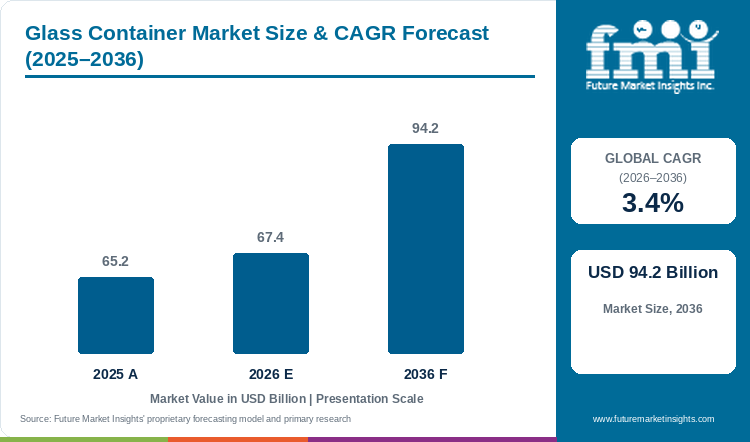
Sales in the glass container market are projected to grow at 3.4% CAGR, with the market size rising from USD 65.2 billion in 2025 to USD 67.4 billion in 2026 and reaching USD 94.2 billion by 2036.
Increasing demand for inert food contact materials, combined with the reduction of single-use plastic waste under global packaging mandates, led to sustained reliance on glass containers across beverage and pharmaceutical industries. Glass containers protect product flavor profile, tolerate thermal pasteurization cycles, and remain chemically non-reactive with complex pharmaceutical formulations. On the back of these performance requirements, the global glass container market stands at USD 65.2 billion in 2025 and rises to USD 67.4 billion in 2026. Industry valuation is projected to reach USD 94.2 billion by 2036, expanding at a 3.4% CAGR and generating USD 26.8 billion in added revenue across the forecast period. Soda lime glass commands the leading material position with a 68.0% share in 2026, as high-volume regenerative furnaces optimize batch melting and forming economics. In February 2025, the European Parliament and Council enacted Regulation (EU) 2025/40 mandating comprehensive packaging recyclability thresholds by 2030 [1]. This statutory framework reinforces brand commitments to closed-loop glass cullet recycling, although intensive furnace energy consumption and lengthy campaign rebuilds continue to restrain rapid capacity expansion.
Key Market Trends & Insights
- By product type: Bottles are forecast to hold 52.0% share in 2026, supported by standard closures and high-speed beverage filling.
- By material: Soda lime glass is estimated at 68.0% in 2026, owing to familiar forming behavior and controlled production cost.
- By end use: Beverages account for 45.0% in 2026 as beer, spirits, water, and soft drink brands retain glass for taste protection.
- By application: Pharmaceuticals represent 48.0% in 2026, underpinned by chemical stability and tighter dimensional controls.
- By technology: Light weighting technology holds 42.0% in 2026 as brands lower freight load without abandoning glass presentation.
- By neck type: Narrow neck containers lead with 58.0% in 2026 due to closure reliability and fast line compatibility.
Regional Highlights
- Fastest-growing evaluated country: India at 6.0% CAGR from 2026 to 2036.
- China follows at 5.3%, while Canada reaches 2.9%; the United Kingdom records the lowest evaluated CAGR at 1.6%.
Market Size & Forecast
Table 1: Market Size and Forecast for the Glass Container Market (USD billion and CAGR percentage), 2025 to 2036
| Metric | Value |
|---|---|
| 2025 Market Size | USD 65.2 billion |
| Estimated Market Size in 2026 | USD 67.4 billion |
| Projected Market Size by 2036 | USD 94.2 billion |
| CAGR, 2026 to 2036 | 3.4% |
| Added Revenue, 2026 to 2036 | USD 26.8 billion |
Commercial buying decisions are increasingly determined by furnace operating status, as switching container molds and specifications between different manufacturing sites incurs substantial line qualification costs and freight penalties. Brand owners prioritize verified carbon reduction metrics and recycled cullet availability before committing to multi-year supply agreements. In April 2026, Verallia inaugurated its first hybrid industrial furnace in Zaragoza, Spain, utilizing 70% renewable electrical energy alongside 30% natural gas to achieve a daily output capacity of 1.3 million containers [2]. This advanced melting architecture enables suppliers to demonstrate verifiable scope 1 emission reductions while preserving color clarity across commercial runs. However, the capital intensity of electric boost installations and unpredictable industrial power tariffs restrict rapid furnace conversions across smaller regional glassmakers.
Cullet, Furnace and Output Economics
Table 2: Production and Circularity Sizing for the Glass Container Market (USD billion, percentages, and indexed indicators), 2025 to 2036
| Metric | 2025 | 2026 | 2036 |
|---|---|---|---|
| Market size (USD billion) | 65.2 | 67.4 | 94.2 |
| Leading material share | 68.0% | 68.0% | 66.5% to 68.0% |
| Lightweighting share | 40.8% | 42.0% | 48.0% to 52.0% |
| Cullet intensity index (2026=100) | 97 | 100 | 122 to 132 |
The 2036 ranges show the direction in which current adoption could move as recyclability requirements become stricter and hybrid furnaces enter commercial production. These indicators represent a market outlook and not reported global production totals.
Value per Container and Furnace-Network Sizing
Glass container value is not decided by tonnage alone. A furnace earns differently when it runs one standard beer bottle for a longer campaign than when colours, molds and decorated formats are changed repeatedly. Premium bottles can carry higher value; food and beverage bottles need volume and steady forming speed. Freight distance also matters because a heavy empty bottle can lose its price advantage when it travels too far. This connects market growth with plant location, furnace use and the type of contracts a supplier is able to retain.
Table 3: Per Capita and Market-Intensity Indicators for the Glass Container Market (USD), 2025 to 2036
| Metric | 2025 | 2026 | 2036 |
|---|---|---|---|
| World population (billion) | 8.23 | 8.30 | 8.95 |
| Market spend per capita (USD) | 7.92 | 8.12 | 10.53 |
| Spend per 1,000 people (USD) | 7,922 | 8,120 | 10,525 |
| Incremental value versus 2026 | - | - | USD 26.8 billion |
Table 4: Segment Revenue and Producer Concentration Indicators for the Glass Container Market (USD billion and percentages), 2026
| Metric | Value | Basis |
|---|---|---|
| Market size, 2026 | USD 67.4 billion | Report value |
| Beverage end-use revenue | USD 30.3 billion | 45.0% share |
| Bottle product revenue | USD 35.0 billion | 52.0% share |
| O-I Glass company share | 24.0% | FMI company segment estimate |
Analyst Perspective
“Glass suppliers must balance furnace economics with packaging proof that brand owners can defend under new waste rules. Producers controlling clean cullet and lightweight design will secure the most durable beverage and pharmaceutical programs.”
- Nandini Roy Choudhury, Principal Consultant, Future Market Insights.
How is the glass container market segmented?
The glass container market is segmented by product type, material, end use, application, technology, and neck type. In 2026, bottles lead at 52.0%, soda lime glass at 68.0%, beverages at 45.0%, pharmaceuticals at 48.0%, light weighting at 42.0%, and narrow neck containers at 58.0%.
By product type: Bottles, jars, vials and ampoules, tableware and specialty containers, and others.
By material: Soda lime glass, borosilicate glass containers, tempered glass containers, and recycled glass containers.
By end use: Beverages, food manufacturers, pharmaceutical companies, cosmetic brands, retail and household consumers, and others.
By application: Food and beverages, pharmaceuticals, cosmetics and personal care, and others.
By technology: Light weighting, smart packaging, decorative technology, and sustainable manufacturing technology.
By neck type: Narrow neck and wide neck containers.
Why do Bottles account for a notable share of product type demand?
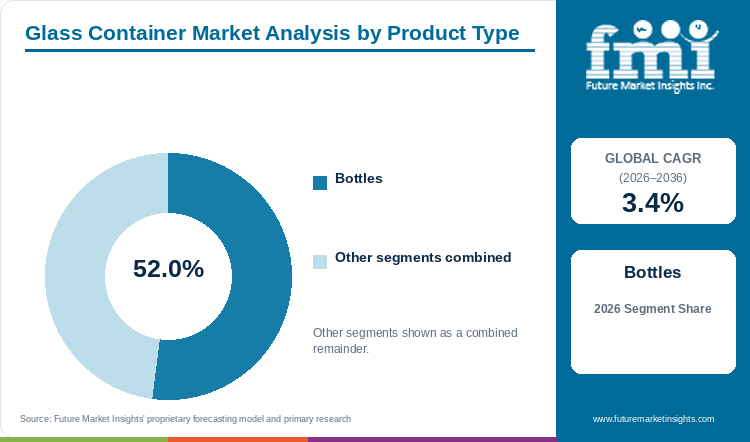
Bottles represents 52.0% of product type in 2026, supported by standard neck finishes protect line speed and closure repeatability.
Table 5: Product Type Share for the Glass Container Market (percentage share), 2026
| Product Type | Share (2026) |
|---|---|
| Bottles | 52.0% |
| Other Segments Combined | 48.0%* |
| Total | 100.0% |
*Calculated as the balance remaining after deducting the leading segment share from 100.0%.
Table 6: Product Type Leadership and Market Growth for the Glass Container Market (segment and CAGR percentage), 2026 to 2036
| Metric | Value |
|---|---|
| Global CAGR (2026 to 2036) | 3.4% |
| Leading Segment | Bottles |
Bottles account for 52.0% of product type demand in 2026 because automated beverage bottling lines and pharmaceutical filling suites are engineered around standardized crown, cork, and screw neck finishes. High-speed rotary fillers achieve maximum line efficiency when processing uniform glass containers, directly preventing costly line jams and seal failures. While lightweighting initiatives reduce tare weight, brand owners avoid switching away from standard glass bottles due to the prohibitive capital expense of retooling inspection and packing machinery. Demand remains concentrated near regional bottling hubs, as excessive empty freight distances can diminish the economic viability of returnable container fleets.
What supports Soda Lime Glass as the preferred material choice?
Soda lime glass represents 68.0% of material in 2026, supported by forming speed remains compatible with high-volume furnaces.
Soda lime glass commands 68.0% of material demand in 2026 because high-volume regenerative furnaces operate continuously on silica, soda ash, and limestone batch formulations. Incorporating post-consumer cullet lowers furnace melting temperatures, delivering direct fuel savings and reducing virgin raw material consumption across commercial runs. This metallurgical stability underpins growing investment in closed-loop recycled glass packaging across food and beverage sectors. However, contaminated cullet feedstock and inconsistent color separation can introduce optical defects, requiring glassmakers to deploy optical sorting systems before cullet enters the melting tank.
How are Beverages gaining share across end-use applications?
Beverages represents 45.0% of end use in 2026, supported by brand protection and established return systems sustain bottle demand.
Beverage brands represent 45.0% of end-use demand in 2026, as premium beer, spirits, mineral water, and wine producers depend on glass to prevent oxygen ingress and preserve delicate aroma profiles. Unlike permeable polymers, impermeable glass walls provide exceptional flavor protection and support closed-loop deposit return systems. Sourcing demand is expanding across single-serve ready to drink packaging, where premium brand positioning justifies higher container tare weights. Although canned packaging captures mass-market share in casual drinking segments, glass maintains commanding authority in high-end retail merchandising.
Why are buyers selecting Pharmaceuticals within application demand?
Pharmaceuticals represents 48.0% of application in 2026, supported by chemical resistance and inspection discipline shape procurement.
Pharmaceuticals represent 48.0% of application demand in 2026 because regulatory standards demand hydrolytic resistance and dimensional uniformity that non-glass alternatives cannot guarantee. Injectable biologics, liquid syrups, and ophthalmic solutions require Type I borosilicate or sulfur-treated Type II soda lime glass to prevent chemical leaching during storage. Qualifying a certified supplier within pharmaceutical glass packaging requires extensive stability documentation and regulatory audits, creating high switching costs for pharmaceutical procurement teams. Manufacturers maintaining tight cleanroom forming and automated camera inspection secure long-term commercial contracts.
Which market conditions keep Light Weighting Technology relevant?
Light weighting technology represents 42.0% of technology in 2026, supported by brands need lower freight weight without losing glass perception.
Lightweighting technology represents 42.0% of technology demand in 2026, allowing beverage and food brand owners to curb freight emissions without sacrificing premium container presentation. Narrow neck press and blow forming enables uniform wall thickness distributions, slashing container mass by up to thirty percent. Sourcing sustainable glass packaging formats enables brand owners to meet corporate sustainability goals. However, excessive wall thinning heightens fracture risk during high-speed capping and rough logistics, compelling glassmakers to apply surface coatings that protect mechanical impact resistance.
What gives Narrow Neck Containers the leading neck-type position?
Narrow neck containers represents 58.0% of neck type in 2026, supported by closure security supports beverage filling at scale.
Narrow neck containers account for 58.0% of neck type demand in 2026 because high-speed automated bottling lines utilize standardized crown, roll-on pilfer-proof, and cork closures. Narrow finishes maintain pressure resistance in carbonated beverages and provide precision pouring in spirits and pharmaceutical syrups. High-speed lines in alcohol packaging depend on tight dimensional tolerances at the finish to guarantee leak-proof sealing. Wide mouth jars serve specialty food spreads but cannot match the sheer production throughput of high-speed narrow neck bottle campaigns.
What are the drivers, restraints, and opportunities in the glass container market?
Recyclability rules strengthen specification demand, whereas furnace energy and rebuild costs restrain expansion, and hybrid melting creates lower-carbon procurement value.
- Driver: Recyclability mandates and brand protection requirements keep glass active in beverage, food, pharmaceutical, and cosmetic packaging.
- Restraint: Continuous high-temperature melting exposes producers to energy volatility and long furnace-rebuild cycles.
- Opportunity: Hybrid furnaces, higher cullet ratios, and lightweight containers reduce emissions and freight intensity.
Growth Analysis and Future Potential: Recyclability and Brand-Protection Catalysts
Statutory mandates for packaging circularity provide substantial momentum for glass container demand across commercial supply chains. Procurement executives actively transition toward verified sustainable packaging solutions to satisfy European Union packaging waste directives and state-level extended producer responsibility laws. Unlike multi-layer plastic pouches, glass melts infinitely without polymer degradation. However, realizing commercial circularity requires robust cullet collection networks and municipal deposit return systems that deliver clean, color-sorted cullet directly to regional furnaces.
Risk Assessment of the Glass Container Market: Furnace and Energy Friction
Glass furnaces cannot be stopped and restarted whenever orders soften. They run through planned campaigns, and a rebuild takes capital as well as lost production time. This exposes suppliers to energy changes before prices can be recovered through contracts. A furnace outage can also disturb several filling lines because molds and bottle specifications are not immediately transferable. Lightweighting can reduce freight, but tighter walls raise the need for impact checks. Smaller producers face the sharper hurdle when one furnace carries a large part of output. Buyers are therefore looking at remaining furnace life, spare mold position and alternate plant capacity before approving supply.
Commercial Opportunity Analysis: Hybrid Melting and Premium Formats
Deploying oxy-fuel and electric hybrid furnaces provides commercial glassmakers with a powerful competitive differentiator in international tenders. Major brand owners in beverage packaging contract dedicated furnace runs that combine lower scope 1 emissions with custom container embossing and decorated finishes. Verallia and Ardagh demonstrate that low-carbon glass lines secure premium pricing among sustainability-focused beverage brands. The primary challenge rests in managing furnace power transition costs during volatile regional energy pricing cycles.
Glass Container Market by Country (2026 to 2036)
Country growth will not move for the same reason in every market. India at 6.0% CAGR and China at 5.3% are supported by new filling and manufacturing scale, whereas Canada at 2.9% receives more support from collection systems. Germany, Spain and the United Kingdom remain useful glass markets, but mature consumption and furnace energy keep growth lower. The country outlook indicates that local plant distance, regulation, return routes and the end-use mix will decide whether the global 3.4% CAGR is exceeded or missed.
Table 7: Country CAGR and Primary Growth Levers for the Glass Container Market (CAGR percentage and operational drivers), 2026 to 2036
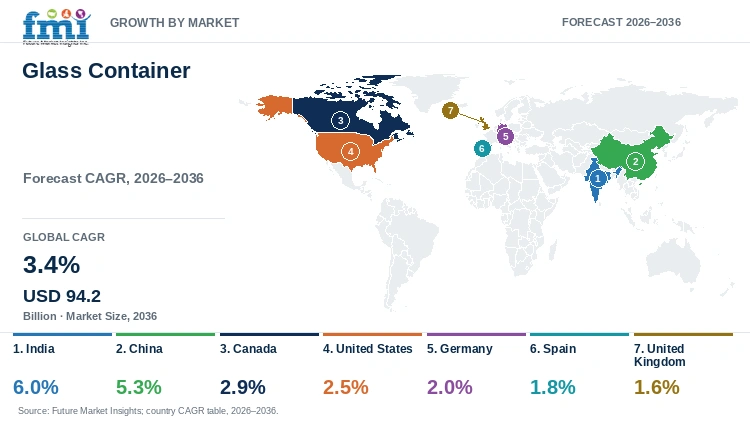
| Country | CAGR (2026 to 2036) | Primary Growth Lever |
|---|---|---|
| India | 6.0% | Pharmaceutical packaging and beverage filling expansion |
| China | 5.3% | Large beverage clusters and fast mold turnaround |
| Canada | 2.9% | Deposit-return systems and circular bottle programs |
| United States | 2.5% | Craft beverages and pharmaceutical replacement demand |
| Germany | 2.0% | Mature return systems and cullet availability |
| Spain | 1.8% | Wine packaging and hybrid furnace investment |
| United Kingdom | 1.6% | Premium drinks, food jars, and lightweighting |
Source: Future Market Insights analysis
India Glass Container Market Outlook (2026 to 2036)
India is expected to grow at 6.0% CAGR through 2036, which is above the global rate because pharmaceutical lines and beverage filling capacity are expanding at the same time. Western and southern clusters create demand for vials, syrup bottles, beauty packs and narrow neck beverage containers, giving furnaces more than one end-use route. The hurdle is not market interest but keeping defects, colour and dimensions stable over long campaigns while power and freight costs differ by location. Government schedules issued in September 2025 continue to place bottles, jars, phials and ampoules under HS 7010 [3]. Domestic mold support and dedicated inspection could therefore push adoption faster, whereas an uneven quality record can delay regulated approvals.
Key takeaway: In India, pharmaceutical packaging and beverage filling expansion shapes purchasing decisions and supplier qualification.
China Glass Container Market Outlook (2026 to 2036)
China is projected to advance at a 5.3% CAGR from 2026 to 2036, driven by massive domestic brewing capacity and dense manufacturing clusters for premium cosmetic packaging. Coastal manufacturing hubs benefit from rapid mold fabrication and localized chemical supply chains, enabling glassmakers to execute high-volume production campaigns at competitive price points. However, severe local price competition in standard amber beer bottles compresses producer operating margins, prompting leading suppliers to shift capacity toward high-value flint cosmetic flacons and specialty liquor bottles.
Key takeaway: In China, large beverage clusters and fast mold turnaround shapes purchasing decisions and supplier qualification.
Key takeaway: In China, large beverage clusters and fast mold turnaround shapes purchasing decisions and supplier qualification.
Canada Glass Container Market Outlook (2026 to 2036)
Canada is likely to expand at 2.9% CAGR through 2036, with deposit-return infrastructure carrying more weight than new consumption. Alberta recorded an 83.1% return rate in 2024 and 2.2 billion beverage containers were returned through the system [4]. This makes circular bottle programs easier to defend, although long distances between population centres can raise the landed cost of heavy glass. Ontario and Quebec provide dense food and beverage demand, while western provinces give brands a stronger collection proof. Regional inventory and lighter returnable bottles could work in favour of suppliers; imported specialty formats may remain exposed to freight and lead-time changes.
Key takeaway: In Canada, deposit-return systems and circular bottle programs shapes purchasing decisions and supplier qualification.
United States Glass Container Market Outlook (2026 to 2036)
The United States is projected to record 2.5% CAGR through 2036. Growth is unlikely to come from one national beverage format because orders are divided between craft drinks, food bottles and pharmaceutical replacement demand. Craft beer production was 21.9 million barrels in 2025, showing a sizeable bottle base even after volume correction [5]. Regional plants can benefit from short runs and decoration, while pharmaceutical buyers create demand for tighter inspection. The hurdle remains freight across a large geography and small order sizes that interrupt furnace efficiency. Producers able to serve nearby fillers with flexible molds may gain; plants depending on long-haul standard bottles could face weaker economics.
Key takeaway: In United States, craft beverages and pharmaceutical replacement demand shapes purchasing decisions and supplier qualification.
Germany Glass Container Market Outlook (2026 to 2036)
Germany is expected to grow at 2.0% CAGR through 2036. The country already has mature return habits and established cullet streams, so the opportunity is less about introducing glass and more about producing it with lower energy and higher recycled input. Beer and mineral water protect narrow neck demand, while pharma and specialty foods add higher-value work. Furnace energy can still restrict margins even when cullet is available. Packaging statistics published by Eurostat in 2025 keep recovery performance visible [6]. Efficient furnaces and long beverage agreements could support the market, whereas high melting cost may hold back fresh capacity.
Key takeaway: In Germany, mature return systems and cullet availability shapes purchasing decisions and supplier qualification.
Spain Glass Container Market Outlook (2026 to 2036)
Spain is forecast to rise at 1.8% CAGR through 2036. Wine, preserved foods and tourism-linked drinks keep bottles and jars moving, but the market remains exposed to seasonal energy demand and export freight. The April 2026 opening of Verallia’s Zaragoza hybrid furnace changes the local angle because the site can combine higher output with lower-emission melting. This may help Spanish plants win European beverage programs where production evidence is checked. Demand could improve around wine regions and food processors; margins may remain under pressure when heavy bottles travel long distances or colour campaigns are not planned efficiently.
Key takeaway: In Spain, wine packaging and hybrid furnace investment shapes purchasing decisions and supplier qualification.
United Kingdom Glass Container Market Outlook (2026 to 2036)
The United Kingdom is forecast to expand at a 1.6% CAGR through 2036, representing a mature packaging environment anchored by Scotch whisky exports and specialty food glass packaging. High domestic energy tariffs and heavy freight weights restrict volume growth for standard container lines, forcing local producers to focus on lightweight bottle designs and premium embossed spirits packaging. Local supply continuity and rapid mold turnaround protect domestic suppliers from imported European containers, although strict retailer cost targets continue to restrain wholesale packaging price increases.
Key takeaway: In United Kingdom, premium drinks, food jars, and lightweighting shapes purchasing decisions and supplier qualification.
Key takeaway: In United Kingdom, premium drinks, food jars, and lightweighting shapes purchasing decisions and supplier qualification.
Full report country CAGRs cover: North America; Latin America; Europe; East Asia; South Asia and Pacific; Middle East and Africa.
Who are the notable companies in the glass container market?
O-I Glass, Inc., Ardagh Glass Packaging, Verallia, Vitro Glass Containers, BA Glass, Vidrala, and PGP Glass Pvt. Ltd. are the significant market players in this market.
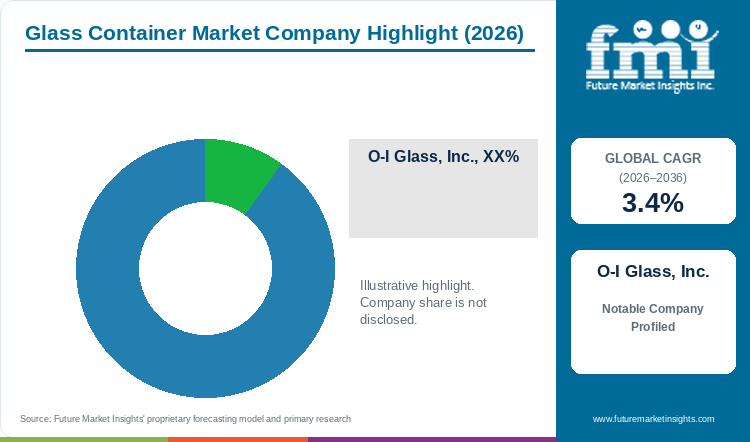
Competition in the glass container market is divided between large furnace networks, regional bottle producers and specialists serving pharma or premium beauty. Large groups can move accounts between plants when one furnace is rebuilt, which is important to beverage fillers that cannot wait for packaging. Regional suppliers compete through shorter freight and faster mold support. Specialists hold value through decoration and tighter quality limits. The competitive review suggests that price alone will not decide longer programs; cullet access, colour control, furnace age and backup output can change the final supplier decision.
- Global Container Producers: O-I Glass, Ardagh Glass Packaging, and Verallia operate broad plant networks for beverage and food accounts.
- European and Regional Producers: BA Glass and Vidrala compete through proximity, bottle catalogues, and efficient furnace assets.
- Specialty and Premium Producers: Vitro Glass Containers and PGP Glass support liquor, cosmetics, and pharmaceutical packaging.
Competitive Benchmarking: Glass Container Market
Table 8: Competitive Benchmarking for the Glass Container Market (qualitative capability ratings), 2026
| Company | Furnace Network | Circularity Position | Format Range | Reach |
|---|---|---|---|---|
| O-I Glass, Inc. | High | High | High | High |
| Ardagh Glass Packaging | High | High | High | High |
| Verallia | High | High | High | High |
| Vitro Glass Containers | Medium | Medium | High | Medium |
| BA Glass | Medium | Medium | Medium | Medium |
| Vidrala | Medium | High | Medium | Medium |
| PGP Glass Pvt. Ltd. | Medium | Medium | High | Medium |
The ratings compare publicly visible plant reach, circularity work and format capability. High represents evidence across several plants or markets, while Medium represents a stronger regional or specialist position.
Key Developments in the Glass Container Market
- In April 2026, Verallia inaugurated its first hybrid furnace in Zaragoza, Spain, creating lower-emission capacity for European glass containers.
- In July 2025, Ardagh Glass Packaging-Europe supplied emerald green Jägermeister bottles from its NextGen furnace, linking high cullet use with commercial color production. [7]
- In March 2025, Vitro Glass Containers started Furnace #4 at Toluca to increase liquor and cosmetics capacity for local and international customers. [8]
Key Players in the Glass Container Market
Major Global Players
- O-I Glass, Inc.
- Ardagh Glass Packaging
- Verallia
- Vitro Glass Containers
Specialist and Regional Players
- BA Glass
- Vidrala
- PGP Glass Pvt. Ltd.
Glass Container Market - Report Scope
Table 9: Report Scope for the Glass Container Market (coverage fields and definitions), 2026 to 2036
| Coverage field | Report scope |
|---|---|
| Market breakdown | Product Type; Material; End Use; Application; Technology; Neck Type |
| Quantitative units | USD Billion |
| Market definition | Supplier revenue from glass bottles, jars, vials, ampoules, and specialty containers included within the stated taxonomy. |
| Regions covered | North America; Latin America; Europe; East Asia; South Asia and Pacific; Middle East and Africa |
| Countries covered | India, China, Canada, United States, Germany, Spain, United Kingdom, and additional countries |
| Key companies covered | O-I Glass, Ardagh Glass Packaging, Verallia, Vitro, BA Glass, Vidrala, PGP Glass |
| Forecast period | 2026 to 2036 |
| Approach | Primary and secondary research with data triangulation. |
Glass Container Market - Research Methodology
Table 10: Research Methodology for the Glass Container Market (research methods and approach), 2026 edition
| Method | Approach |
|---|---|
| Primary Research | Interviews with glass producers, raw-material suppliers, mold specialists, fillers, distributors, packaging buyers, and industry experts validate commercial requirements. |
| Secondary Research | Annual reports, investor presentations, regulatory publications, industry associations, technical papers, trade journals, company websites, and product literature are reviewed. |
| Market Sizing and Forecasting | Top-down and bottom-up approaches assess container format mix, end-use demand, pricing, and country adoption from 2026 to 2036. |
| Data Triangulation and Validation | Values are checked against packaging demand, regulation, collection systems, company investments, and historical trends to prevent adjacent-market double counting. |
Glass Container Market by Segments
Glass Container Market segmented by Product Type:
- Bottles
- jars
- vials
- ampoules
- tableware
- specialty containers
- others
Glass Container Market segmented by Material:
- Soda lime glass
- borosilicate glass containers
- tempered glass containers
- recycled glass containers
Glass Container Market segmented by End Use:
- Beverages
- food manufacturers
- pharmaceutical companies
- cosmetic brands
- retail
- household consumers
- others
Glass Container Market segmented by Application:
- Food
- beverages
- pharmaceuticals
- cosmetics
- personal care
- others
Glass Container Market segmented by Technology:
- Light weighting
- smart packaging
- decorative technology
- sustainable manufacturing technology
Glass Container Market segmented by Neck Type:
- Narrow neck
- wide neck containers
Glass Container Market by Region
- North America
- United States
- Canada
- Latin America
- Brazil
- Mexico
- Argentina
- Chile
- Europe
- Germany
- Spain
- United Kingdom
- France
- Italy
- Benelux
- Nordics
- East Asia
- China
- Japan
- South Korea
- South Asia and Pacific
- India
- ASEAN
- Australia and New Zealand
- Middle East and Africa
- GCC Countries
- South Africa
- Türkiye
- Israel
Research Sources and Bibliography
- [1] European Parliament & Council of the European Union. (2025). Regulation (EU) 2025/40 on packaging and packaging waste. Official Journal of the European Union.
- [2] Verallia. (2026, April 16). Verallia inaugurates its first hybrid furnace in Zaragoza, Spain. Verallia Corporate News.
- [3] Central Board of Indirect Taxes and Customs. (2025, September 17). Notification No. 9/2025-Integrated Tax (Rate). Government of India.
- [4] Beverage Container Management Board. (2025, June 17). Annual report 2024. Alberta beverage container system. BCMB Publications.
- [5] Brewers Association. (2026, April 14). A year of correction for craft beer, with early signals of recovery. Brewers Association Industry Reports.
- [6] Eurostat. (2025, October 10). Packaging waste statistics. European Commission Statistical Data.
- [7] Ardagh Group. (2025, July 16). Ardagh and Jägermeister in NextGen first. Ardagh Group Corporate Releases.
- [8] Vitro Glass Containers. (2025, March 3). VGC starts Furnace #4. Vitro Investor Relations.
- [9] Reloop Platform. (2025, February 4). Maximising Canada’s beverage container recycling potential. Reloop Platform.
- [10] Future Market Insights. (2026, May 21). Glass Container Market Report, 2026-2036. FMI Industry Research.
- [11] Verescence. (2025, June 30). New hybrid furnace for luxury glass packaging. Verescence Newsroom.
- [12] Beverage Container Management Board. (2025). Collection and recycling performance data. Alberta BCMB.
This bibliography is provided for reader reference and is not exhaustive. The full report contains the complete reference list and detailed citations.
This Report Answers
- How large is the glass container market in 2026 and what is forecast for 2036?
- Which packaging and regulatory pressures support demand for glass containers?
- Why do bottles lead product type demand?
- Why does soda lime glass lead material demand?
- How do country growth rates differ across India, China, Canada, and the United States?
- Which companies supply beverage, food, pharma, and beauty containers?
- What limits capacity additions and supplier switching?
- What should buyers evaluate before approving a glass container supplier?
Frequently Asked Questions
How big is the Glass Container Market in 2026, and what is the forecast for 2036?
The Glass Container Market is estimated at USD 67.4 billion in 2026, up from USD 65.2 billion in 2025. Future Market Insights projects the market to reach USD 94.2 billion by 2036, reflecting continued demand from beverage, food, pharmaceutical, and personal care packaging applications.
What CAGR is expected for the Glass Container Market from 2026 to 2036?
The Glass Container Market is projected to expand at a CAGR of 3.4% between 2026 and 2036. Over the forecast period, the industry is expected to generate approximately USD 26.8 billion in additional revenue.
Which material leads demand in the Glass Container Market?
Soda lime glass leads material demand in the Glass Container Market, accounting for 68.0% of the market share in 2026. Its dominance is supported by cost-effective production, compatibility with high-volume furnace operations, strong recyclability, and widespread use across beverage and food packaging applications.
Which product type leads the Glass Container Market?
Bottles are projected to hold 52.0% share in 2026 within the Glass Container Market. Their leadership is driven by compatibility with standardized closures, high-speed filling operations, and extensive use in beverage and pharmaceutical packaging.
Which country is expected to grow the fastest in the Glass Container Market?
India is expected to be the fastest-growing country in the Glass Container Market, registering a 6.0% CAGR from 2026 to 2036, supported by expanding pharmaceutical packaging and beverage-filling capacity. China follows with an expected 5.3% CAGR over the same period.
Who are the key players in the Glass Container Market?
Key participants in the Glass Container Market include O-I Glass, Inc., Ardagh Glass Packaging, Verallia, Vitro Glass Containers, BA Glass, Vidrala, and PGP Glass Pvt. Ltd. These companies compete through furnace networks, recycling capabilities, product range, geographic reach, and specialized packaging expertise.
Preview the report firsthand - request a free sample
Get SampleGet the brochure for pricing and purchase details.
Get PDFTable of Content
- Key Takeaways
- Market Size and CAGR
- Top Growth Driver
- Fastest Growing Segment
- Leading Region
- Key Companies
- Emerging Opportunities
- Executive Summary
- Global Market Outlook
- Demand-side Trends
- Supply-side Trends
- Technology Roadmap Analysis
- Analysis and Recommendations
- Analyst Perspective (What is happening? Why now? What should investors know?)
- Key Questions Answered
- How large is the market?
- What is the CAGR?
- What are key trends?
- Which region dominates?
- Who are the leaders?
- Market Overview
- Market Coverage / Taxonomy
- Market Definition / Scope / Limitations
- Research Methodology
- Chapter Orientation
- Analytical Lens and Working Hypotheses
- Market Structure, Signals, and Trend Drivers
- Benchmarking and Cross-market Comparability
- Market Sizing, Forecasting, and Opportunity Mapping
- Research Design and Evidence Framework
- Desk Research Programme (Secondary Evidence)
- Expert Input and Fieldwork (Primary Evidence)
- Tooling, Models, and Reference Databases
- Data Engineering and Model Build
- Quality Assurance and Audit Trail
- Market Background
- Market Dynamics (Drivers, Restraints, Opportunity, Trends)
- Scenario Forecast (Optimistic, Likely, Conservative)
- Impact Analysis
- AI Impact
- Sustainability Impact
- Regulatory Impact
- Technology Impact
- Consumer / Buyer Analysis
- Purchase Drivers
- Adoption Barriers
- Buyer Journey
- Opportunity Map Analysis
- Product Life Cycle Analysis
- Supply Chain Analysis
- Investment Feasibility Matrix
- Value Chain Analysis
- PESTLE and Porter's Analysis
- Regulatory Landscape
- Regional Parent Market Outlook
- Production and Consumption Statistics
- Import and Export Statistics
- Global Market Analysis and Forecast, 2021 to 2036
- Historical Market Size Value (USD Billion) Analysis, 2021 to 2025
- Current and Future Market Size Value (USD Billion) Projections, 2026 to 2036
- Y-o-Y Growth Trend Analysis
- Absolute $ Opportunity Analysis
- Global Market Pricing Analysis, 2021 to 2036
- Global Market Analysis and Forecast, By Product Type, 2021 to 2036
- Introduction / Key Findings
- Historical Market Size Value (USD Billion) Analysis By Product Type, 2021 to 2025
- Current and Future Market Size Value (USD Billion) Analysis and Forecast By Product Type, 2026 to 2036
- Bottles
- jars
- vials
- ampoules
- tableware
- specialty containers
- others
- Y-o-Y Growth Trend Analysis By Product Type, 2021 to 2025
- Absolute $ Opportunity Analysis By Product Type, 2026 to 2036
- Global Market Analysis and Forecast, By Material, 2021 to 2036
- Introduction / Key Findings
- Historical Market Size Value (USD Billion) Analysis By Material, 2021 to 2025
- Current and Future Market Size Value (USD Billion) Analysis and Forecast By Material, 2026 to 2036
- Soda lime glass
- borosilicate glass containers
- tempered glass containers
- recycled glass containers
- Y-o-Y Growth Trend Analysis By Material, 2021 to 2025
- Absolute $ Opportunity Analysis By Material, 2026 to 2036
- Global Market Analysis and Forecast, By End Use, 2021 to 2036
- Introduction / Key Findings
- Historical Market Size Value (USD Billion) Analysis By End Use, 2021 to 2025
- Current and Future Market Size Value (USD Billion) Analysis and Forecast By End Use, 2026 to 2036
- Beverages
- food manufacturers
- pharmaceutical companies
- cosmetic brands
- retail
- household consumers
- others
- Y-o-Y Growth Trend Analysis By End Use, 2021 to 2025
- Absolute $ Opportunity Analysis By End Use, 2026 to 2036
- Global Market Analysis and Forecast, By Application, 2021 to 2036
- Introduction / Key Findings
- Historical Market Size Value (USD Billion) Analysis By Application, 2021 to 2025
- Current and Future Market Size Value (USD Billion) Analysis and Forecast By Application, 2026 to 2036
- Food
- beverages
- pharmaceuticals
- cosmetics
- personal care
- others
- Y-o-Y Growth Trend Analysis By Application, 2021 to 2025
- Absolute $ Opportunity Analysis By Application, 2026 to 2036
- Global Market Analysis and Forecast, By Technology, 2021 to 2036
- Introduction / Key Findings
- Historical Market Size Value (USD Billion) Analysis By Technology, 2021 to 2025
- Current and Future Market Size Value (USD Billion) Analysis and Forecast By Technology, 2026 to 2036
- Light weighting
- smart packaging
- decorative technology
- sustainable manufacturing technology
- Y-o-Y Growth Trend Analysis By Technology, 2021 to 2025
- Absolute $ Opportunity Analysis By Technology, 2026 to 2036
- Global Market Analysis and Forecast, By Neck Type, 2021 to 2036
- Introduction / Key Findings
- Historical Market Size Value (USD Billion) Analysis By Neck Type, 2021 to 2025
- Current and Future Market Size Value (USD Billion) Analysis and Forecast By Neck Type, 2026 to 2036
- Narrow neck
- wide neck containers
- Y-o-Y Growth Trend Analysis By Neck Type, 2021 to 2025
- Absolute $ Opportunity Analysis By Neck Type, 2026 to 2036
- Global Market Analysis and Forecast, By Region, 2021 to 2036
- Introduction
- Historical Market Size Value (USD Billion) Analysis By Region, 2021 to 2025
- Current Market Size Value (USD Billion) Analysis and Forecast By Region, 2026 to 2036
- North America
- Latin America
- Europe
- East Asia
- South Asia and Pacific
- Middle East and Africa
- Market Attractiveness Analysis By Region
- North America Market Analysis and Forecast, By Country, 2021 to 2036
- Historical Market Size Value (USD Billion) Trend Analysis By Market Taxonomy, 2021 to 2025
- Market Size Value (USD Billion) Forecast By Market Taxonomy, 2026 to 2036
- By Country
- United States
- Canada
- By Product Type
- By Material
- By End Use
- By Application
- By Technology
- By Neck Type
- By Country
- Market Attractiveness Analysis
- By Country
- By Product Type
- By Material
- By End Use
- By Application
- By Technology
- By Neck Type
- Key Takeaways
- Latin America Market Analysis and Forecast, By Country
- Historical Market Size Value (USD Billion) Trend Analysis By Market Taxonomy, 2021 to 2025
- Market Size Value (USD Billion) Forecast By Market Taxonomy, 2026 to 2036
- By Country
- Brazil
- Mexico
- Argentina
- Chile
- By Product Type
- By Material
- By End Use
- By Application
- By Technology
- By Neck Type
- By Country
- Market Attractiveness Analysis
- By Country
- By Product Type
- By Material
- By End Use
- By Application
- By Technology
- By Neck Type
- Key Takeaways
- Europe Market Analysis and Forecast, By Country
- Historical Market Size Value (USD Billion) Trend Analysis By Market Taxonomy, 2021 to 2025
- Market Size Value (USD Billion) Forecast By Market Taxonomy, 2026 to 2036
- By Country
- Germany
- Spain
- United Kingdom
- France
- Italy
- Benelux
- Nordics
- By Product Type
- By Material
- By End Use
- By Application
- By Technology
- By Neck Type
- By Country
- Market Attractiveness Analysis
- By Country
- By Product Type
- By Material
- By End Use
- By Application
- By Technology
- By Neck Type
- Key Takeaways
- East Asia Market Analysis and Forecast, By Country
- Historical Market Size Value (USD Billion) Trend Analysis By Market Taxonomy, 2021 to 2025
- Market Size Value (USD Billion) Forecast By Market Taxonomy, 2026 to 2036
- By Country
- China
- Japan
- South Korea
- By Product Type
- By Material
- By End Use
- By Application
- By Technology
- By Neck Type
- By Country
- Market Attractiveness Analysis
- By Country
- By Product Type
- By Material
- By End Use
- By Application
- By Technology
- By Neck Type
- Key Takeaways
- South Asia and Pacific Market Analysis and Forecast, By Country
- Historical Market Size Value (USD Billion) Trend Analysis By Market Taxonomy, 2021 to 2025
- Market Size Value (USD Billion) Forecast By Market Taxonomy, 2026 to 2036
- By Country
- India
- ASEAN
- Australia and New Zealand
- By Product Type
- By Material
- By End Use
- By Application
- By Technology
- By Neck Type
- By Country
- Market Attractiveness Analysis
- By Country
- By Product Type
- By Material
- By End Use
- By Application
- By Technology
- By Neck Type
- Key Takeaways
- Middle East and Africa Market Analysis and Forecast, By Country
- Historical Market Size Value (USD Billion) Trend Analysis By Market Taxonomy, 2021 to 2025
- Market Size Value (USD Billion) Forecast By Market Taxonomy, 2026 to 2036
- By Country
- GCC Countries
- South Africa
- Türkiye
- Israel
- By Product Type
- By Material
- By End Use
- By Application
- By Technology
- By Neck Type
- By Country
- Market Attractiveness Analysis
- By Country
- By Product Type
- By Material
- By End Use
- By Application
- By Technology
- By Neck Type
- Key Takeaways
- Key Countries Market Analysis
- United States
- Pricing Analysis
- Market Share Analysis, 2025
- By Product Type
- By Material
- By End Use
- By Application
- By Technology
- By Neck Type
- Canada
- Pricing Analysis
- Market Share Analysis, 2025
- By Product Type
- By Material
- By End Use
- By Application
- By Technology
- By Neck Type
- Mexico
- Pricing Analysis
- Market Share Analysis, 2025
- By Product Type
- By Material
- By End Use
- By Application
- By Technology
- By Neck Type
- Brazil
- Pricing Analysis
- Market Share Analysis, 2025
- By Product Type
- By Material
- By End Use
- By Application
- By Technology
- By Neck Type
- Chile
- Pricing Analysis
- Market Share Analysis, 2025
- By Product Type
- By Material
- By End Use
- By Application
- By Technology
- By Neck Type
- Germany
- Pricing Analysis
- Market Share Analysis, 2025
- By Product Type
- By Material
- By End Use
- By Application
- By Technology
- By Neck Type
- United Kingdom
- Pricing Analysis
- Market Share Analysis, 2025
- By Product Type
- By Material
- By End Use
- By Application
- By Technology
- By Neck Type
- Italy
- Pricing Analysis
- Market Share Analysis, 2025
- By Product Type
- By Material
- By End Use
- By Application
- By Technology
- By Neck Type
- Spain
- Pricing Analysis
- Market Share Analysis, 2025
- By Product Type
- By Material
- By End Use
- By Application
- By Technology
- By Neck Type
- France
- Pricing Analysis
- Market Share Analysis, 2025
- By Product Type
- By Material
- By End Use
- By Application
- By Technology
- By Neck Type
- India
- Pricing Analysis
- Market Share Analysis, 2025
- By Product Type
- By Material
- By End Use
- By Application
- By Technology
- By Neck Type
- ASEAN
- Pricing Analysis
- Market Share Analysis, 2025
- By Product Type
- By Material
- By End Use
- By Application
- By Technology
- By Neck Type
- Australia and New Zealand
- Pricing Analysis
- Market Share Analysis, 2025
- By Product Type
- By Material
- By End Use
- By Application
- By Technology
- By Neck Type
- China
- Pricing Analysis
- Market Share Analysis, 2025
- By Product Type
- By Material
- By End Use
- By Application
- By Technology
- By Neck Type
- Japan
- Pricing Analysis
- Market Share Analysis, 2025
- By Product Type
- By Material
- By End Use
- By Application
- By Technology
- By Neck Type
- South Korea
- Pricing Analysis
- Market Share Analysis, 2025
- By Product Type
- By Material
- By End Use
- By Application
- By Technology
- By Neck Type
- Türkiye
- Pricing Analysis
- Market Share Analysis, 2025
- By Product Type
- By Material
- By End Use
- By Application
- By Technology
- By Neck Type
- South Africa
- Pricing Analysis
- Market Share Analysis, 2025
- By Product Type
- By Material
- By End Use
- By Application
- By Technology
- By Neck Type
- United States
- Market Structure Analysis
- Competition Dashboard
- Competition Benchmarking
- Market Share Analysis of Top Players
- By Regional
- By Product Type
- By Material
- By End Use
- By Application
- By Technology
- By Neck Type
- Emerging Startups
- Innovation Benchmarking
- Competition Analysis
- Competition Deep Dive
- O-I Glass, Inc.
- Overview
- Product Portfolio
- Profitability by Market Segments
- Sales Footprint
- Strategy Overview
- Marketing Strategy
- Product Strategy
- Channel Strategy
- Ardagh Glass Packaging
- Verallia
- Vitro Glass Containers
- BA Glass
- Vidrala
- PGP Glass Pvt. Ltd.
- O-I Glass, Inc.
- Case Studies
- Success Stories
- Recent Developments
- Competition Deep Dive
- Assumptions & Acronyms Used


