

- Industry Size (2026)
- USD 1.3 Bn
- Forecast (2036)
- USD 1.7 Bn
- CAGR (2026 to 2036)
- 3.2%
Cyclomethicone Market Size, Market Forecast and Outlook by FMI
The cyclomethicone market crossed a valuation of USD 1.2 billion in 2025. Industry is expected to reach USD 1.3 billion in 2026 at a CAGR of 3.2% during the forecast period. Demand outlook carries the market valuation to USD 1.7 billion through 2036 as personal care manufacturers continue relying on volatile silicone carriers that improve spreadability, texture, and fast-drying performance in modern formulation systems.
Cyclomethicone has shifted from a conventional silicone input to a highly strategic formulation ingredient across beauty and personal care chemistry. Formulation teams developing skincare, deodorant, and haircare products increasingly reject heavier carrier systems that compromise sensory performance and product finish. This formulation shift compels silicone suppliers to provide materials that deliver lightweight application, rapid evaporation, and consistent compatibility with multifunctional ingredient systems. Suppliers entering future qualification cycles without strong documentation, stable tonnage availability, and formulation-grade technical support risk losing relevance as cosmetic manufacturers refine ingredient architectures around performance and compliance.
FMI analysts observe that the projected compound expansion depends on continued demand from personal care manufacturing rather than abrupt structural transformation in end-use markets. The mechanism sustaining the 3.2% growth trajectory is the ongoing need for volatile carriers that can distribute pigments, conditioning agents, and active ingredients evenly without increasing viscosity or oily residue. This transition is also shaped by regulatory reassessment of cyclic siloxanes, which is pushing buyers toward more carefully optimized ingredient portfolios rather than eliminating cyclomethicone outright. The geographic distribution of growth reflects different adoption rates tied directly to beauty manufacturing scale, export orientation, regulatory oversight, and the maturity of regional silicone supply chains.
Summary of Cyclomethicone Market
- Cyclomethicone Market Definition
- The cyclomethicone market covers the production and supply of cyclic silicone fluids used primarily as volatile carriers and conditioning agents in personal care, pharmaceutical, and specialty industrial formulations.
- Demand Drivers in the Market
- Expansion of global beauty and personal care manufacturing increases demand for volatile silicone carriers used in skincare, deodorant, and hair treatment formulations.
- Cosmetic formulators rely on cyclomethicone to improve spreadability and fast evaporation properties in products linked to personal care ingredients and cosmetic chemicals.
- Growth in contract manufacturing for beauty brands across Asia supports higher consumption of silicone-based formulation ingredients tied to specialty silicones.
- Key Segments Analyzed in the FMI Report
- Industry Grade Cyclomethicone: 58.1% share in 2026, reflecting its broad adoption across large-scale personal care and industrial formulation systems where consistent supply volumes and cost efficiency remain critical.
- Cosmetics and Personal Care: 25.2% share in 2026, as formulators continue to rely on cyclomethicone for lightweight texture, rapid evaporation, and smooth ingredient dispersion in skincare, haircare, and deodorant products.
- China: 4.8% compound growth driven by large domestic beauty manufacturing capacity, expanding cosmetics consumption, and stronger ingredient qualification requirements under evolving safety-assessment frameworks.
- Analyst Opinion at FMI
- Nikhil Kaitwade, Principal Consultant for Chemicals & Materials, opines, “In our updated Cyclomethicone Market analysis, my team and I have identified sensory performance as the core reason behind its widespread use in personal care formulations. Cyclomethicone provides a lightweight, silky texture and rapid evaporation profile that enhances product spreadability without leaving a heavy residue. However, increasing scrutiny around volatile silicone ingredients is pushing formulators to carefully balance performance benefits with evolving regulatory expectations.”
- Strategic Implications/Executive Takeaways
- Producers should invest in regulatory-compliant silicone chemistries as environmental scrutiny around cyclic siloxanes intensifies in developed markets.
- Partnerships with contract cosmetic manufacturers can secure long-term supply positions across high-growth markets in Asia.
- Portfolio diversification into adjacent materials connected to cosmetic formulation chemicals can stabilize revenue streams where regulatory shifts affect specific silicone compounds.
- Methodology
- Primary Research: FMI conducted detailed technical interviews with cosmetic ingredient suppliers, formulation chemists, specialty silicone manufacturers, distributors, and procurement managers across personal care, pharmaceutical, and specialty chemical sectors to validate cyclomethicone demand patterns and formulation-use trends across major regional markets.
- Desk Research: Analysts aggregated company filings, industry association publications, regulatory databases, trade literature, and technical references covering cyclic siloxanes, personal care ingredients, silicone chemistry, and formulation technologies.
- Market-Sizing and Forecasting: The model applies a hybrid methodology combining top-down analysis of global silicone production with bottom-up demand assessment across cosmetics and personal care, textiles, pharmaceutical applications, and other industrial end uses.
- Data Validation and Update Cycle: Segment forecasts undergo cross-validation against manufacturer disclosures, supply chain inputs, pricing benchmarks, and periodic regulatory and formulation updates affecting specialty chemical ingredients and cosmetic formulation additives.
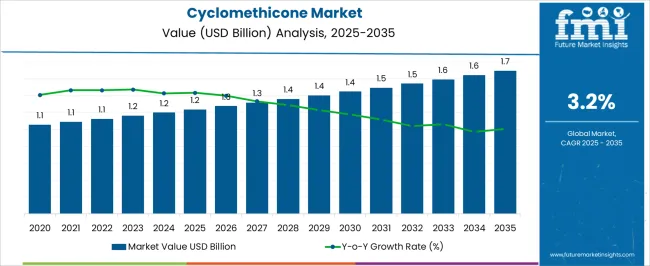
Cyclomethicone Market Key Takeaways
| Metric | Value |
|---|---|
| Expected Value (2026E) | USD 1.3 billion |
| Projected Value (2036F) | USD 1.7 billion |
| CAGR from 2026 to 2036 | 3.2% |
As major formulation hubs navigate this transition, China leads with a 4.8% CAGR, supported by large-scale cosmetics manufacturing and stronger ingredient qualification standards. India follows at 4.6% as specialty chemicals capacity and beauty product manufacturing continue to expand in parallel. South Korea advances at 4.0%, driven by rapid cosmetic innovation cycles and export-oriented product development. Japan records a 3.5% growth rate, reflecting stable demand across high-standard formulation systems. The United States expands at 2.9% as suppliers adapt to a more structured compliance environment under modernized cosmetics oversight. Germany posts a 2.6% CAGR as environmental scrutiny and formulation discipline continue to shape demand across Europe’s regulated personal care ingredient market.
Cyclomethicone Market Definition
Cyclomethicone refers to a class of cyclic silicone compounds, primarily composed of volatile methylsiloxanes such as D4, D5, and D6. These materials are widely used as lightweight carriers and conditioning agents in formulation chemistry. Their primary industrial function is to improve spreadability, texture, and quick-drying characteristics in cosmetic and personal care products. Cyclomethicone evaporates after application, leaving active ingredients or conditioning agents on the skin or hair surface.
Cyclomethicone Market Inclusions
This report covers the global cyclomethicone market, providing estimates of market size and demand across key regions and countries. The analysis includes the forecast period from 2026 to 2036 along with historical context for industry evolution. Segment-level analysis is presented by type and application, with detailed examination of demand across cosmetics, textiles, pharmaceuticals, and industrial uses. The study also evaluates pricing dynamics, supply structure, and formulation trends connected to adjacent industries such as beauty and personal care ingredients, silicone emulsifiers, and cosmetic formulation chemicals.
Cyclomethicone Market Exclusions
The scope excludes linear silicone fluids such as dimethicone unless incorporated in hybrid formulations that directly rely on cyclomethicone as a volatile carrier. The analysis also omits finished consumer goods including shampoos, deodorants, lotions, and skincare products, focusing strictly on the upstream chemical ingredient market. Downstream cosmetic brands and packaging formats are outside the scope. In addition, niche silicone elastomers and resins used in coatings or sealants are not included unless their production chain directly overlaps with silicone intermediates or personal care formulation ingredients.
Cyclomethicone Market Research Methodology
- Primary Research: FMI analysts engaged with cosmetic ingredient suppliers, formulation chemists, specialty silicone manufacturers, distributors, and procurement managers across personal care, pharmaceutical, and specialty chemical sectors to identify the specific factors sustaining cyclomethicone demand across formulation-intensive applications.
- Desk Research: The data collection phase aggregated company filings, industry association publications, regulatory databases, and trade literature covering cyclic siloxanes, personal care ingredients, silicone chemistry, and formulation technologies.
- Market-Sizing and Forecasting: The baseline value derives from a hybrid model combining top-down analysis of global silicone production with bottom-up demand assessment across application sectors such as cosmetics and personal care, textiles, pharmaceuticals, and industrial processing.
- Data Validation and Update Cycle: Projections are rigorously tested against manufacturer disclosures, supply chain inputs, pricing benchmarks, and periodic regulatory and formulation updates affecting specialty chemical ingredients and cosmetic formulation additives.
Segment Analysis
Cyclomethicone Market Analysis by Type
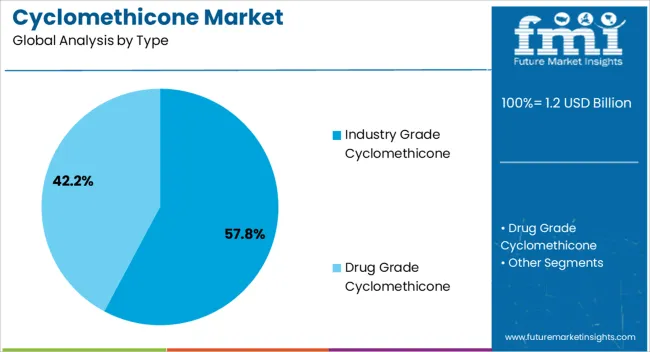
Industry grade cyclomethicone is projected to account for 58.1% of global market revenue in 2026. The segment leads because this grade is widely utilized across formulation-intensive industries where high supply volumes and cost efficiency take precedence over ultra-high purity standards. Personal care manufacturing, textile finishing, coatings additives, and processing fluids commonly rely on industry grade material due to its volatility and spreading performance, which support consistent product texture and surface treatment results at commercial scale.
- Large-scale formulation demand: Contract manufacturers supplying bulk personal care and industrial formulations increasingly prefer Industrial-grade cyclomethicone. High-volume cosmetic production lines require silicone carriers that can be sourced in consistent tonnage, and industry grade material meets these supply requirements while maintaining the functional properties required in formulation chemistry.
- Integration of silicone supply chains: The silicone industry is increasingly organized around vertically integrated production models where silicon metal processing, silicone intermediate synthesis, and finished fluid production occur within the same manufacturing ecosystem. This integration lowers production costs for industrial-grade cyclomethicone and stabilizes supply availability for large downstream buyers.
- Regional manufacturing proximity: Silicone producers have been aligning production capacity closer to major cosmetics and specialty chemical manufacturing clusters. Locating silicone processing facilities near high-consumption regions reduces shipping volatility and supports just-in-time delivery requirements for large formulation plants that depend on steady ingredient availability.
Cyclomethicone Market Analysis by Application
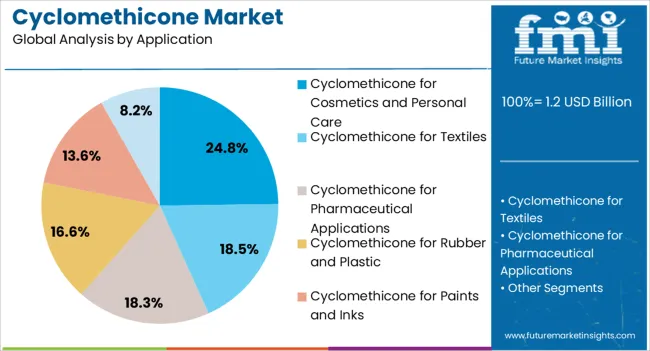
Cosmetics and personal care applications are expected to hold 25.2% of the cyclomethicone market in 2026, making them the leading demand segment. Cyclomethicone is widely incorporated into skincare creams, hair conditioners, deodorants, and color cosmetics because it improves product spreadability and creates a smooth, lightweight sensory feel during application. Its rapid evaporation allows active ingredients and conditioning agents to be evenly distributed while minimizing oily residue, which supports its continued use in premium formulation systems.
- Growth of sensory-focused formulation design: Cosmetic formulators increasingly prioritize product sensory attributes such as lightweight feel, fast absorption, and smooth glide. Volatile silicone carriers play a central role in achieving these performance characteristics, particularly in hair styling serums and skin products designed for humid or warm climates where heavy emollients are less desirable.
- Expansion of multifunctional cosmetic formulations: Personal care manufacturers are developing hybrid products that combine skincare, sun protection, and cosmetic benefits within a single formulation. Cyclomethicone functions as a dispersing carrier in these multifunctional systems, helping stabilize pigment particles, UV filters, and conditioning agents while preserving uniform application.
- Reformulation dynamics driven by regulatory compliance: Regulatory assessments of cyclic siloxanes in several markets have encouraged cosmetic companies to optimize silicone usage and refine formulation ratios. Rather than eliminating silicones entirely, many manufacturers are redesigning product architectures to balance compliance requirements with the performance advantages that volatile silicone carriers provide in modern cosmetic formulations.
Cyclomethicone Market Drivers, Restraints, and Opportunities
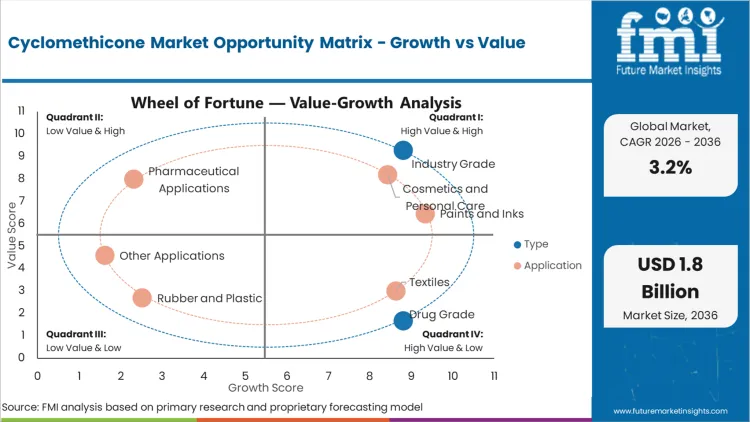
The evolution of cosmetic formulation systems continues to push manufacturers toward ingredients that improve sensory performance without disrupting product stability or processing efficiency. This formulation requirement makes cyclomethicone highly relevant in personal care products where spreadability, rapid evaporation, and lightweight after-feel must be delivered simultaneously. Ingredient buyers updating modern skincare, deodorant, and haircare systems face a direct choice between using heavier emollient structures or retaining volatile silicone carriers that improve application texture and ingredient dispersion. Transitioning to optimized cyclomethicone-based systems helps formulators support smooth glide, quick drying, and uniform distribution of active ingredients across skin and hair surfaces. Manufacturers that fail to modernize their ingredient architecture risk weaker sensory performance, less competitive product textures, and reduced formulation flexibility in high-turnover personal care categories.
The regulatory evaluation of cyclic volatile methylsiloxanes continues to restrain broader cyclomethicone adoption across several developed markets. Environmental authorities are increasing scrutiny of persistence, bioaccumulation potential, and long-term usage patterns, creating a more complex compliance burden for formulation teams and suppliers. Designing compliant product systems while preserving the sensory benefits of traditional cyclomethicone requires specialized reformulation expertise that many manufacturers do not fully possess in-house. To reduce this constraint, ingredient producers increasingly rely on application laboratories, technical service teams, and optimized silicone blends that help customers validate performance before large-scale manufacturing begins.
Opportunities in the Cyclomethicone Market
- Modified Silicone Carrier Systems: Next-generation volatility-controlled silicone systems enable formulators to preserve lightweight texture and spreadability while aligning more closely with evolving environmental and regulatory expectations.
- Multifunctional Cosmetic Formulations: Hybrid skincare, sun-care, and color cosmetic systems create new demand for cyclomethicone-based carriers that can evenly disperse pigments, UV filters, and conditioning agents without increasing residue.
- Application Lab Collaboration: Silicone suppliers expanding specialized formulation laboratories can strengthen customer relationships by helping cosmetic manufacturers test ingredient behavior in real-world haircare, skincare, and aerosol systems before commercial scale-up.
Regional Analysis
.webp "Top Country Growth Comparison Cyclomethicone Market Cagr (2026 2036)")
The cyclomethicone market is assessed across Asia Pacific, North America, Europe, and Latin America, with country-level analysis focused on the main production, formulation, regulatory, and consumption centers. The full report also offers market attractiveness analysis across regions and countries.
| Country | CAGR (2026 to 2036) |
|---|---|
| China | 4.8% |
| India | 4.6% |
| South Korea | 4.0% |
| Japan | 3.5% |
| United States | 2.9% |
| Germany | 2.6% |
Source: Future Market Insights (FMI) analysis, based on proprietary forecasting model and primary research
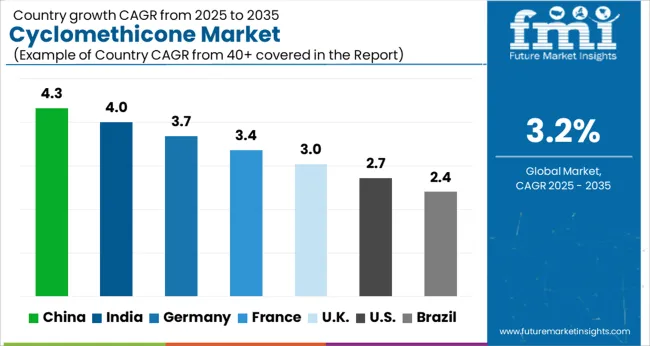
Asia Pacific Cyclomethicone Market Analysis
Asia Pacific represents the largest production and formulation ecosystem for cyclomethicone, supported by dense cosmetic manufacturing capacity, integrated silicone supply chains, and rapid product development cycles across personal care categories. Ingredient procurement teams across the region increasingly prioritize volatile silicone carriers that can improve spreadability, texture, and fast-drying performance without disrupting large-scale formulation economics. FMI analysts opine that this regional strength is reinforced by the combination of export-oriented beauty manufacturing, local specialty chemical production, and expanding regulatory frameworks that require more structured ingredient documentation. By aligning silicone fluid production close to downstream cosmetics and personal care clusters, regional manufacturers improve supply reliability and reduce fulfillment volatility for high-volume formulators. Growth conditions differ by country, with each market shaped by its own mix of domestic beauty demand, export capacity, regulatory modernization, and silicone materials investment.
- China: China’s beauty and personal care manufacturing base continues to absorb large volumes of cyclomethicone as domestic and export-oriented brands prioritize lightweight sensory performance in skincare, deodorant, and haircare formulations. The scale of the country’s cosmetics economy and the concentration of formulation manufacturing across major industrial provinces support consistent demand for volatile silicone carriers across multiple product categories. Regulatory modernization is also raising the threshold for ingredient qualification, requiring suppliers to provide more comprehensive safety-assessment data and technical support documentation. This combination of formulation scale, compliance tightening, and silicone supply depth sustains a 4.8% CAGR for cyclomethicone demand in China through 2036. Suppliers unable to combine reliable tonnage availability with stronger formulation and regulatory support risk weaker positioning in the region’s largest demand center.
- India: India’s specialty chemicals ecosystem and expanding personal care manufacturing base continue to strengthen the country’s role in cyclomethicone demand growth. Cosmetic manufacturers operating in the market are increasing the use of volatile silicone carriers in formulations designed to deliver smooth application, fast evaporation, and lighter after-feel for domestic and export consumption. The country’s growing status as a higher-value chemical input producer further supports ingredient availability across downstream beauty and personal care manufacturing networks. This production-backed and consumption-led environment supports a 4.6% CAGR for cyclomethicone demand in India through 2036. Ingredient suppliers that cannot align with evolving cosmetics registration requirements, formulation cost sensitivity, and export-driven manufacturing expectations risk weaker traction in one of Asia Pacific’s fastest-growing specialty ingredient markets.
- South Korea: South Korea’s global strength in beauty exports and rapid cosmetic formulation cycles sustain a strong role for cyclomethicone in advanced personal care product development. Local manufacturers continue to emphasize elegant texture, quick absorption, and premium sensory performance across skincare, makeup, and haircare applications, supporting demand for lightweight silicone carriers that enhance product finish without residue buildup. Government-backed efforts to strengthen overseas market access and regulatory coordination further reinforce the country’s export-oriented cosmetics infrastructure. This formulation-intense and export-driven market supports a 4.0% CAGR for cyclomethicone demand in South Korea through 2036. Suppliers unable to demonstrate consistent quality, technical collaboration, and fast-response formulation support may lose competitiveness in one of the world’s most innovation-driven beauty markets.
- Japan: Japan’s cyclomethicone market is shaped by stable cosmetics demand, strong formulation discipline, and continued emphasis on high-performance product refinement. Manufacturers in the country rely on volatile silicone systems to support premium application feel, controlled evaporation, and elegant finish characteristics in mature skincare and haircare categories. Long-standing strength in cosmetic production and ongoing investment in silicone materials research reinforce the role of cyclomethicone within sophisticated formulation systems. This technically steady environment supports a 3.5% CAGR for cyclomethicone demand in Japan through 2036. Suppliers that fail to match Japan’s high expectations for formulation precision, documentation quality, and advanced material performance risk weaker placement in one of Asia Pacific’s most quality-sensitive cosmetics markets.
FMI’s report includes extensive coverage of the Asia Pacific cyclomethicone landscape. It incorporates detailed analysis of ASEAN and Australia & New Zealand alongside the leading profiled markets. A major structural trend shaping the region is the continued expansion of contract beauty manufacturing and export-oriented formulation development, which sustains demand for silicone carriers that combine sensory performance with scalable ingredient supply.
North America Cyclomethicone Market Analysis
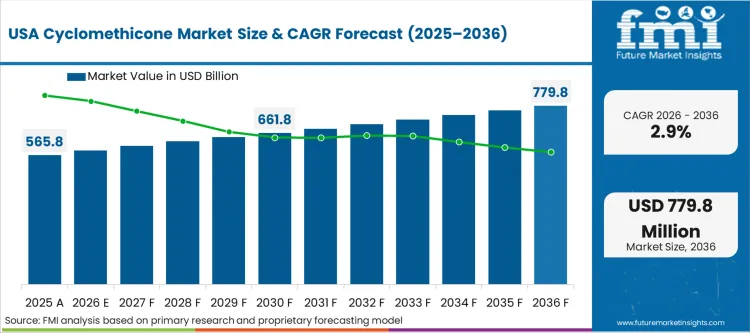
North America represents a mature but technically advanced market for cyclomethicone, where ingredient demand is shaped by large personal care manufacturing volumes, sophisticated formulation requirements, and strong regulatory scrutiny. Formulation teams across the region continue to use volatile silicone carriers in products where lightweight feel, rapid evaporation, and improved ingredient distribution remain commercially important. FMI estimates that demand is sustained less by abrupt volume growth and more by the need to preserve product performance while navigating evolving ingredient oversight and documentation standards. This environment places a premium on suppliers that can combine material consistency with technical support and regulatory readiness.
- United States: The United States remains the most commercially significant cyclomethicone market in North America due to its scale in beauty and personal care manufacturing and its increasingly structured compliance environment. Ingredient suppliers serving the market must support formulators that require consistent silicone quality, detailed documentation, and compatibility with evolving federal oversight of cosmetic manufacturing. The country’s large personal care industry continues to generate stable demand for volatile silicone carriers across skincare, haircare, and deodorant applications where spreadability and sensory finish remain central product attributes. This mature but substantial market supports a 2.9% CAGR for cyclomethicone demand in the United States through 2036. Suppliers that cannot deliver reliable regulatory support, supply-chain stability, and formulation-specific material performance risk weaker positioning in North America’s largest beauty ingredient market.
FMI’s report includes broader coverage of the North American cyclomethicone environment, with additional focus on Canada and Mexico. A defining structural condition across the region is the need to balance ingredient performance with rising compliance expectations, encouraging buyers to favor suppliers that can support both formulation functionality and documentation quality.
Europe Cyclomethicone Market Analysis
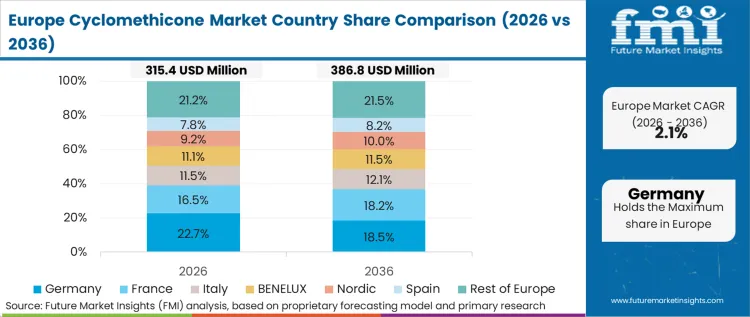
Europe functions as one of the most influential regulatory environments for cyclomethicone because regional demand is shaped not only by personal care manufacturing and consumer spending, but also by close scrutiny of ingredient safety and environmental performance. Cosmetic manufacturers operating in the region continue to evaluate volatile silicone carriers against evolving regulatory expectations while preserving the texture, glide, and evaporation characteristics required in high-quality formulations. FMI analysts observe that this creates a market environment where technical compliance and performance retention must advance together. Growth is therefore measured, with adoption shaped more by reformulation discipline and regulatory alignment than by broad expansion in ingredient usage.
- Germany: Germany serves as a key center for cyclomethicone demand within Europe due to its strong cosmetics manufacturing base, resilient consumer spending, and growing compliance expertise. Ingredient qualification in the country increasingly reflects both formulation-performance priorities and the need for stronger safety-assessment capability within the broader European regulatory framework. Manufacturers continue to require volatile silicone carriers that support elegant product feel while fitting into more carefully managed ingredient portfolios. This mature but strategically relevant environment supports a 2.6% CAGR for cyclomethicone demand in Germany through 2036. Suppliers unable to provide robust compliance documentation, consistent material quality, and application-focused technical support risk weaker placement in one of Europe’s most influential cosmetic ingredient markets.
FMI’s report includes detailed evaluation of the broader European cyclomethicone framework, extending beyond Germany into other regional beauty and personal care markets. A prevailing structural condition across Europe is the continued reassessment of cyclic siloxane usage under environmental and safety scrutiny, which is reshaping procurement behavior toward more technically supported and compliance-ready ingredient supply.
Competitive Aligners for Market Players
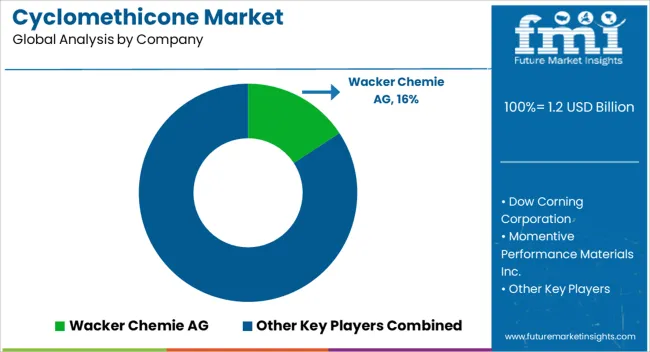
The cyclomethicone market is being reshaped by rising regulatory scrutiny, formulation-performance expectations, and the need for stronger technical support across personal care ingredient supply chains. Procurement teams no longer evaluate cyclomethicone suppliers only on price or bulk availability. Cosmetic manufacturers increasingly expect ingredient partners to provide formulation-grade documentation, stable material specifications, and support for compliance with evolving environmental and safety standards. This shift has raised the competitive threshold across the market, meaning producers that continue to rely on undifferentiated cyclic siloxane volumes without stronger technical and regulatory positioning risk losing relevance in future supplier qualification cycles.
Industry leaders have already adapted. Companies such as Dow Inc., Wacker Chemie AG, Shin-Etsu Chemical Co., Ltd., KCC Corporation, Siltech Corporation, BRB International B.V., and Innospec Inc. have aligned their portfolios with the needs of formulators seeking lightweight texture, rapid evaporation, and reliable ingredient performance across skincare, haircare, and deodorant systems. Their advantage comes from the ability to combine silicone manufacturing depth with application-focused support, helping customers preserve product texture and performance while adjusting to evolving environmental and formulation requirements. As a result, suppliers are increasingly expected to offer differentiated silicone blends, consistent global material specifications, and stronger compliance support rather than depending only on standard cyclomethicone volumes.
Vendors that combine manufacturing resilience with technical collaboration gain a significant competitive advantage. Suppliers that expand application laboratories, provide formulation testing support, and maintain geographically distributed production capabilities help cosmetic manufacturers reduce qualification risk and preserve product consistency during reformulation cycles. This support-led approach is especially valuable as beauty brands balance sensory performance with tighter regulatory expectations. In contrast, producers slow to improve documentation quality, compliance readiness, and formulation-specific innovation risk losing position during early-stage supplier shortlisting and long-term procurement reviews.
Key Players in Cyclomethicone Market
- Dow Inc.
- Wacker Chemie AG
- Shin-Etsu Chemical Co., Ltd.
- KCC Corporation / KCC Silicone
- Siltech Corporation
- BRB International B.V.
- Innospec Inc.
Scope of Report
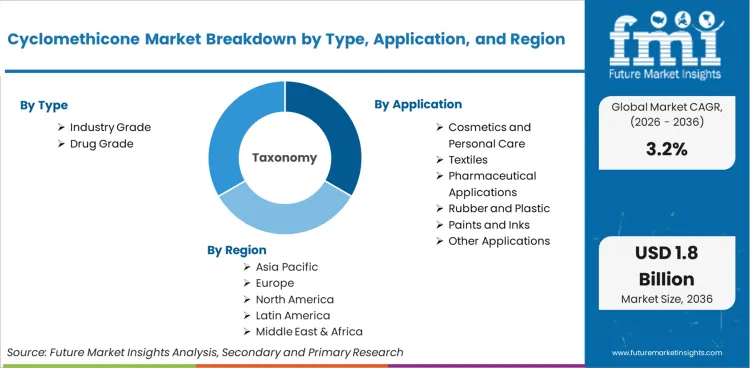
| Metric | Value |
|---|---|
| Quantitative Units | USD 1.3 billion in 2026 to USD 1.7 billion by 2036, at a CAGR of 3.2% |
| Market Definition | Cyclomethicone refers to cyclic silicone compounds, primarily volatile methylsiloxanes such as D4, D5, and D6, used as lightweight carriers and conditioning agents in personal care, pharmaceutical, and specialty industrial formulations. |
| Type Segmentation | Industry Grade Cyclomethicone, Drug Grade Cyclomethicone |
| Application Segmentation | Cosmetics and Personal Care, Textiles, Pharmaceutical Applications, Rubber and Plastic, Paints and Inks, Other Applications |
| Regions Covered | Asia Pacific, Europe, North America, Latin America, Middle East & Africa |
| Countries Covered | China, India, Japan, South Korea, United States, Germany, and 40+ countries |
| Key Companies Profiled | Dow Inc., Wacker Chemie AG, Shin-Etsu Chemical Co., Ltd., KCC Corporation / KCC Silicone, Siltech Corporation, BRB International B.V., Innospec Inc. |
| Forecast Period | 2026 to 2036 |
| Approach | The baseline value derives from a hybrid model combining top-down analysis of global silicone production with bottom-up demand assessment across cosmetics and personal care, textiles, pharmaceutical applications, and other industrial end uses. |
Cyclomethicone Market by Segments
By Type
- Industry Grade
- Drug Grade
By Application
- Cosmetics and Personal Care
- Textiles
- Pharmaceutical Applications
- Rubber and Plastic
- Paints and Inks
- Other Applications
Region:
- Asia Pacific
- India
- China
- Japan
- South Korea
- Indonesia
- Australia & New Zealand
- ASEAN
- Rest of Asia Pacific
- Europe
- Germany
- Italy
- France
- United Kingdom
- Spain
- Benelux
- Nordics
- Central & Eastern Europe
- Rest of Europe
- North America
- United States
- Canada
- Mexico
- Latin America
- Brazil
- Argentina
- Chile
- Rest of Latin America
- Middle East & Africa
- Kingdom of Saudi Arabia
- United Arab Emirates
- South Africa
- Turkey
- Rest of Middle East & Africa
Bibliography
- European Commission. (2024, May 16). Commission Regulation (EU) 2024/1328 of 16 May 2024 amending Annex XVII to Regulation (EC) No 1907/2006 of the European Parliament and of the Council concerning the Registration, Evaluation, Authorisation and Restriction of Chemicals (REACH) as regards octamethylcyclotetrasiloxane (D4), decamethylcyclopentasiloxane (D5) and dodecamethylcyclohexasiloxane (D6). Official Journal of the European Union.
- European Chemicals Agency. (2024, October 30). Hazardous chemicals found in cosmetic products.
- USA Food and Drug Administration. (2024, December 11). Guidance for Industry: Registration and Listing of Cosmetic Product Facilities and Products. USA Department of Health and Human Services.
- National Medical Products Administration. (2024, April 22). NMPA Announcement on Several Measures to Optimize the Management of Cosmetic Safety Assessment.
This bibliography is provided for reader reference. The full FMI report contains the complete reference list with primary source documentation.
This Report Addresses
- Market sizing and quantitative forecast metrics detailing cyclomethicone demand across key formulation-intensive industries through 2036.
- Segmentation analysis evaluating demand by type and application, with emphasis on industry grade usage and personal care formulation requirements.
- Regional demand intelligence comparing Asia Pacific’s high-volume beauty manufacturing base with the compliance-driven procurement environment across North America and Europe.
- Regulatory assessment analyzing how scrutiny of cyclic siloxanes is reshaping supplier qualification, formulation design, and documentation requirements.
- Competitive posture evaluation tracking how technical support, application-lab capability, and compliance readiness influence supplier selection across personal care ingredient supply chains.
- Strategic guidance for producers and ingredient partners on balancing sensory performance, formulation compatibility, and evolving environmental expectations.
- Supply chain analysis identifying the role of vertically integrated silicone production, regional manufacturing proximity, and stable tonnage availability in reducing procurement risk.
- Custom data delivery formats encompassing structured market tables, segment-level analysis, country outlooks, and comprehensive PDF narrative reports.
Frequently Asked Questions
How large is the demand for Cyclomethicone in the global market in 2026?
Demand for Cyclomethicone in the global market is estimated to be valued at USD 1.3 billion in 2026.
What will be the market size of Cyclomethicone in the global market by 2036?
Market size for Cyclomethicone is projected to reach USD 1.7 billion by 2036.
What is the expected demand growth for Cyclomethicone in the global market between 2026 and 2036?
Demand for Cyclomethicone is expected to grow at a CAGR of 3.2% between 2026 and 2036.
Which Type is poised to lead global sales by 2026?
Industry Grade Cyclomethicone accounts for 58.1% in 2026 as large-scale formulators prioritize consistent supply volumes, cost efficiency, and reliable spreading performance across commercial production systems.
How significant is the role of Cosmetics and Personal Care in driving Cyclomethicone adoption in 2026?
Cosmetics and Personal Care represents 25.2% of segment share as formulators continue relying on cyclomethicone for lightweight texture, rapid evaporation, and smooth ingredient dispersion.
What is driving demand in China?
China’s large beauty and personal care manufacturing base, export-oriented production, and stronger ingredient qualification requirements are driving sustained demand for cyclomethicone.
What compliance or regulatory theme is referenced for Germany?
Germany is shaped by stronger environmental scrutiny and formulation discipline, pushing suppliers to provide robust safety documentation and compliance-ready ingredient support.
What is the China growth outlook in this report?
China is projected to grow at a CAGR of 4.8% during 2026 to 2036.
Why is North America described as a strategically important region in this report?
North America remains important because formulators continue demanding high-performance volatile silicone carriers while navigating a more structured compliance and documentation environment.
What type of demand dominates in North America?
Demand in North America is centered on maintaining product performance in skincare, haircare, and deodorant formulations while meeting tighter regulatory and technical support expectations.
What is India's growth outlook in this report?
India is projected to expand at a CAGR of 4.6% during 2026 to 2036.
Does the report cover the United States in its regional analysis?
Yes, the United States is included within North America under the regional scope of analysis.
What are the sources referred to for analyzing the United States?
The analysis is based on FMI primary research, manufacturer disclosures, supply-chain inputs, pricing benchmarks, and evolving federal oversight affecting cosmetic ingredient supply.
What is the main demand theme linked to the United States in its region coverage?
The main demand theme in the United States is the need to preserve silicone-based formulation performance while aligning with a more structured compliance environment.
Does the report cover Germany in its regional analysis?
Yes, Germany is included within Europe under the regional coverage framework.
What is the main Germany-related demand theme in its region coverage?
Germany’s market is shaped by the need to retain elegant product feel and formulation performance while operating under stricter environmental and safety assessment expectations.
Which product formats or formulation roles are strategically important for Asia Pacific supply chains?
Volatile silicone carrier systems used in skincare, deodorant, haircare, and multifunctional cosmetic formulations are strategically important across Asia Pacific supply chains.
What is Cyclomethicone and what is it mainly used for?
Cyclomethicone is a class of cyclic silicone compounds used mainly as a lightweight carrier and conditioning agent in personal care, pharmaceutical, and specialty industrial formulations.
What does Cyclomethicone mean in this report?
The term refers to volatile methylsiloxanes such as D4, D5, and D6 that improve spreadability, texture, and quick-drying performance in formulation chemistry.
What is included in the scope of this Cyclomethicone report?
The report includes the global upstream market for cyclomethicone across type and application segments, covering demand in cosmetics and personal care, textiles, pharmaceutical applications, and other industrial uses.
What is excluded from the scope of this report?
The scope excludes linear silicone fluids such as dimethicone, finished consumer goods like shampoos and lotions, downstream cosmetic brands, packaging formats, and niche silicone elastomers or resins not directly tied to cyclomethicone use.
What does market forecast mean on this page?
The market forecast represents FMI’s model-based projection built on application demand, regional manufacturing trends, pricing benchmarks, and regulatory developments through 2036.
How does FMI build and validate the Cyclomethicone forecast?
FMI uses a hybrid model combining top-down analysis of global silicone production with bottom-up demand assessment across end-use applications, then validates the output against manufacturer disclosures, supply-chain inputs, pricing benchmarks, and regulatory updates.
What does reduced reliance on generic third-party market estimates mean here?
It means the forecast is grounded in FMI primary interviews, company disclosures, regulatory databases, trade literature, and application-specific validation rather than unsupported syndicated assumptions.
Preview the report firsthand - request a free sample
Get SampleGet the brochure for pricing and purchase details.
Get PDFTable of Content
- Executive Summary
- Global Market Outlook
- Demand-side Trends
- Supply-side Trends
- Technology Roadmap Analysis
- Analysis and Recommendations
- Market Overview
- Market Coverage / Taxonomy
- Market Definition / Scope / Limitations
- Research Methodology
- Chapter Orientation
- Analytical Lens and Working Hypotheses
- Market Structure, Signals, and Trend Drivers
- Benchmarking and Cross-market Comparability
- Market Sizing, Forecasting, and Opportunity Mapping
- Research Design and Evidence Framework
- Desk Research Programme (Secondary Evidence)
- Company Annual and Sustainability Reports
- Peer-reviewed Journals and Academic Literature
- Corporate Websites, Product Literature, and Technical Notes
- Earnings Decks and Investor Briefings
- Statutory Filings and Regulatory Disclosures
- Technical White Papers and Standards Notes
- Trade Journals, Industry Magazines, and Analyst Briefs
- Conference Proceedings, Webinars, and Seminar Materials
- Government Statistics Portals and Public Data Releases
- Press Releases and Reputable Media Coverage
- Specialist Newsletters and Curated Briefings
- Sector Databases and Reference Repositories
- FMI Internal Proprietary Databases and Historical Market Datasets
- Subscription Datasets and Paid Sources
- Social Channels, Communities, and Digital Listening Inputs
- Additional Desk Sources
- Expert Input and Fieldwork (Primary Evidence)
- Primary Modes
- Qualitative Interviews and Expert Elicitation
- Quantitative Surveys and Structured Data Capture
- Blended Approach
- Why Primary Evidence is Used
- Field Techniques
- Interviews
- Surveys
- Focus Groups
- Observational and In-context Research
- Social and Community Interactions
- Stakeholder Universe Engaged
- C-suite Leaders
- Board Members
- Presidents and Vice Presidents
- R&D and Innovation Heads
- Technical Specialists
- Domain Subject-matter Experts
- Scientists
- Physicians and Other Healthcare Professionals
- Governance, Ethics, and Data Stewardship
- Research Ethics
- Data Integrity and Handling
- Primary Modes
- Tooling, Models, and Reference Databases
- Desk Research Programme (Secondary Evidence)
- Data Engineering and Model Build
- Data Acquisition and Ingestion
- Cleaning, Normalisation, and Verification
- Synthesis, Triangulation, and Analysis
- Quality Assurance and Audit Trail
- Market Background
- Market Dynamics
- Drivers
- Restraints
- Opportunity
- Trends
- Scenario Forecast
- Demand in Optimistic Scenario
- Demand in Likely Scenario
- Demand in Conservative Scenario
- Opportunity Map Analysis
- Product Life Cycle Analysis
- Supply Chain Analysis
- Investment Feasibility Matrix
- Value Chain Analysis
- PESTLE and Porter’s Analysis
- Regulatory Landscape
- Regional Parent Market Outlook
- Production and Consumption Statistics
- Import and Export Statistics
- Market Dynamics
- Global Market Analysis 2021 to 2025 and Forecast, 2026 to 2036
- Historical Market Size Value (USD Million) Analysis, 2021 to 2025
- Current and Future Market Size Value (USD Million) Projections, 2026 to 2036
- Y-o-Y Growth Trend Analysis
- Absolute $ Opportunity Analysis
- Global Market Pricing Analysis 2021 to 2025 and Forecast 2026 to 2036
- Global Market Analysis 2021 to 2025 and Forecast 2026 to 2036, By Type
- Introduction / Key Findings
- Historical Market Size Value (USD Million) Analysis By Type , 2021 to 2025
- Current and Future Market Size Value (USD Million) Analysis and Forecast By Type , 2026 to 2036
- Industry Grade
- Drug Grade
- Industry Grade
- Y-o-Y Growth Trend Analysis By Type , 2021 to 2025
- Absolute $ Opportunity Analysis By Type , 2026 to 2036
- Global Market Analysis 2021 to 2025 and Forecast 2026 to 2036, By Application
- Introduction / Key Findings
- Historical Market Size Value (USD Million) Analysis By Application, 2021 to 2025
- Current and Future Market Size Value (USD Million) Analysis and Forecast By Application, 2026 to 2036
- Cosmetics and Personal Care
- Textiles
- Pharmaceutical Applications
- Rubber and Plastic
- Paints and Inks
- Other Applications
- Cosmetics and Personal Care
- Y-o-Y Growth Trend Analysis By Application, 2021 to 2025
- Absolute $ Opportunity Analysis By Application, 2026 to 2036
- Global Market Analysis 2021 to 2025 and Forecast 2026 to 2036, By Region
- Introduction
- Historical Market Size Value (USD Million) Analysis By Region, 2021 to 2025
- Current Market Size Value (USD Million) Analysis and Forecast By Region, 2026 to 2036
- North America
- Latin America
- Western Europe
- Eastern Europe
- East Asia
- South Asia and Pacific
- Middle East & Africa
- Market Attractiveness Analysis By Region
- North America Market Analysis 2021 to 2025 and Forecast 2026 to 2036, By Country
- Historical Market Size Value (USD Million) Trend Analysis By Market Taxonomy, 2021 to 2025
- Market Size Value (USD Million) Forecast By Market Taxonomy, 2026 to 2036
- By Country
- USA
- Canada
- Mexico
- By Type
- By Application
- By Country
- Market Attractiveness Analysis
- By Country
- By Type
- By Application
- Key Takeaways
- Latin America Market Analysis 2021 to 2025 and Forecast 2026 to 2036, By Country
- Historical Market Size Value (USD Million) Trend Analysis By Market Taxonomy, 2021 to 2025
- Market Size Value (USD Million) Forecast By Market Taxonomy, 2026 to 2036
- By Country
- Brazil
- Chile
- Rest of Latin America
- By Type
- By Application
- By Country
- Market Attractiveness Analysis
- By Country
- By Type
- By Application
- Key Takeaways
- Western Europe Market Analysis 2021 to 2025 and Forecast 2026 to 2036, By Country
- Historical Market Size Value (USD Million) Trend Analysis By Market Taxonomy, 2021 to 2025
- Market Size Value (USD Million) Forecast By Market Taxonomy, 2026 to 2036
- By Country
- Germany
- UK
- Italy
- Spain
- France
- Nordic
- BENELUX
- Rest of Western Europe
- By Type
- By Application
- By Country
- Market Attractiveness Analysis
- By Country
- By Type
- By Application
- Key Takeaways
- Eastern Europe Market Analysis 2021 to 2025 and Forecast 2026 to 2036, By Country
- Historical Market Size Value (USD Million) Trend Analysis By Market Taxonomy, 2021 to 2025
- Market Size Value (USD Million) Forecast By Market Taxonomy, 2026 to 2036
- By Country
- Russia
- Poland
- Hungary
- Balkan & Baltic
- Rest of Eastern Europe
- By Type
- By Application
- By Country
- Market Attractiveness Analysis
- By Country
- By Type
- By Application
- Key Takeaways
- East Asia Market Analysis 2021 to 2025 and Forecast 2026 to 2036, By Country
- Historical Market Size Value (USD Million) Trend Analysis By Market Taxonomy, 2021 to 2025
- Market Size Value (USD Million) Forecast By Market Taxonomy, 2026 to 2036
- By Country
- China
- Japan
- South Korea
- By Type
- By Application
- By Country
- Market Attractiveness Analysis
- By Country
- By Type
- By Application
- Key Takeaways
- South Asia and Pacific Market Analysis 2021 to 2025 and Forecast 2026 to 2036, By Country
- Historical Market Size Value (USD Million) Trend Analysis By Market Taxonomy, 2021 to 2025
- Market Size Value (USD Million) Forecast By Market Taxonomy, 2026 to 2036
- By Country
- India
- ASEAN
- Australia & New Zealand
- Rest of South Asia and Pacific
- By Type
- By Application
- By Country
- Market Attractiveness Analysis
- By Country
- By Type
- By Application
- Key Takeaways
- Middle East & Africa Market Analysis 2021 to 2025 and Forecast 2026 to 2036, By Country
- Historical Market Size Value (USD Million) Trend Analysis By Market Taxonomy, 2021 to 2025
- Market Size Value (USD Million) Forecast By Market Taxonomy, 2026 to 2036
- By Country
- Kingdom of Saudi Arabia
- Other GCC Countries
- Turkiye
- South Africa
- Other African Union
- Rest of Middle East & Africa
- By Type
- By Application
- By Country
- Market Attractiveness Analysis
- By Country
- By Type
- By Application
- Key Takeaways
- Key Countries Market Analysis
- USA
- Pricing Analysis
- Market Share Analysis, 2025
- By Type
- By Application
- Canada
- Pricing Analysis
- Market Share Analysis, 2025
- By Type
- By Application
- Mexico
- Pricing Analysis
- Market Share Analysis, 2025
- By Type
- By Application
- Brazil
- Pricing Analysis
- Market Share Analysis, 2025
- By Type
- By Application
- Chile
- Pricing Analysis
- Market Share Analysis, 2025
- By Type
- By Application
- Germany
- Pricing Analysis
- Market Share Analysis, 2025
- By Type
- By Application
- UK
- Pricing Analysis
- Market Share Analysis, 2025
- By Type
- By Application
- Italy
- Pricing Analysis
- Market Share Analysis, 2025
- By Type
- By Application
- Spain
- Pricing Analysis
- Market Share Analysis, 2025
- By Type
- By Application
- France
- Pricing Analysis
- Market Share Analysis, 2025
- By Type
- By Application
- India
- Pricing Analysis
- Market Share Analysis, 2025
- By Type
- By Application
- ASEAN
- Pricing Analysis
- Market Share Analysis, 2025
- By Type
- By Application
- Australia & New Zealand
- Pricing Analysis
- Market Share Analysis, 2025
- By Type
- By Application
- China
- Pricing Analysis
- Market Share Analysis, 2025
- By Type
- By Application
- Japan
- Pricing Analysis
- Market Share Analysis, 2025
- By Type
- By Application
- South Korea
- Pricing Analysis
- Market Share Analysis, 2025
- By Type
- By Application
- Russia
- Pricing Analysis
- Market Share Analysis, 2025
- By Type
- By Application
- Poland
- Pricing Analysis
- Market Share Analysis, 2025
- By Type
- By Application
- Hungary
- Pricing Analysis
- Market Share Analysis, 2025
- By Type
- By Application
- Kingdom of Saudi Arabia
- Pricing Analysis
- Market Share Analysis, 2025
- By Type
- By Application
- Turkiye
- Pricing Analysis
- Market Share Analysis, 2025
- By Type
- By Application
- South Africa
- Pricing Analysis
- Market Share Analysis, 2025
- By Type
- By Application
- USA
- Market Structure Analysis
- Competition Dashboard
- Competition Benchmarking
- Market Share Analysis of Top Players
- By Regional
- By Type
- By Application
- Competition Analysis
- Competition Deep Dive
- Dow Inc.
- Overview
- Product Portfolio
- Profitability by Market Segments (Product/Age /Sales Channel/Region)
- Sales Footprint
- Strategy Overview
- Marketing Strategy
- Product Strategy
- Channel Strategy
- Wacker Chemie AG
- Shin-Etsu Chemical Co., Ltd.
- KCC Corporation / KCC Silicone
- Siltech Corporation
- BRB International B.V.
- Innospec Inc.
- Dow Inc.
- Competition Deep Dive
- Assumptions & Acronyms Used


