

- Market Size (2026)
- USD 2.2 Bn
- Forecast (2036)
- USD 2.9 Bn
- CAGR (2026 to 2036)
- 3.1%
How big is Demi-Fine Jewellery Market in 2026?
Demand for demi-fine jewellery will grow at a CAGR of 3.1% from 2026 to 2036. Market size was USD 2.1 billion in 2025 and USD 2.2 billion in 2026, and is projected to reach USD 2.9 billion by 2036.
Demi-fine jewellery market size was USD 2.1 billion in 2025 and is USD 2.2 billion in 2026. The market is projected to reach USD 2.9 billion by 2036, with sales growing at a CAGR of 3.1% from 2026 to 2036, according to FMI.
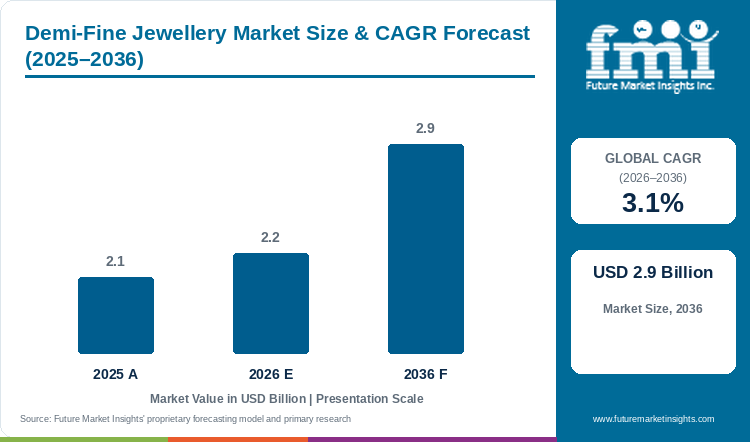
Gold prices shape the buying pattern. The World Gold Council reported on 30 July 2026 that global jewellery demand fell 17% to 278.2 tonnes in the second quarter, and demand measured in dollars rose 22% to US$86bn in the first half[1].
Fewer tonnes at higher prices push shoppers toward lighter pieces and gold-look designs. Demand for demi-fine pieces will hold up as buyers trade down from solid gold but still want a gold look at an everyday ticket. Key challenges faced by brands include price competition from fast-fashion jewellery and from solid gold at the top of the band.
Sales potential is expected to emerge from online brands and travel retail, with buyers who compare designs quickly. Growth of the market is moderate, and brands with clear metal quality claims and steady design launches will keep repeat buyers.
Key Market Trends & Insights
- By price range, the USD 151 to USD 300 band led the market with a share of 45% in 2026, as buyers pay for a gold look below fine jewellery prices.
- By application, women accounted for 72.1% of sales in 2026. Customers in India make more small-ticket jewellery purchases in a year, The Week reported in October 2025.[2]
- By distribution channel, offline stores held 82.5% of sales in 2026. Catbird was slated to open a first Seattle store on 2 April 2026.[3]
Regional Highlights
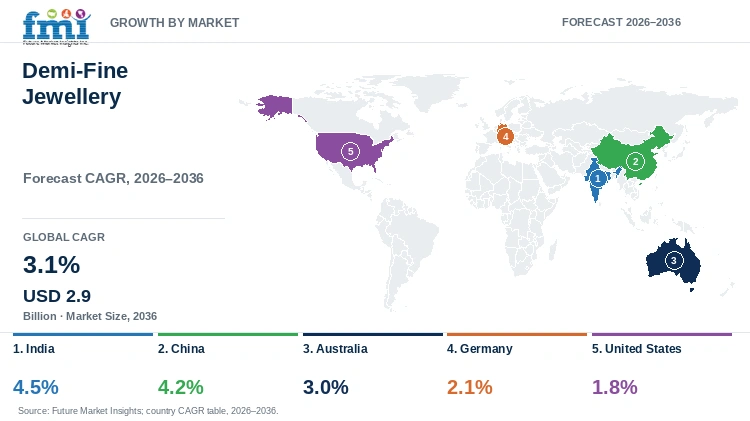
- Fastest-growing profiled country: India (4.5% CAGR, 2026 to 2036).
- By country: China (4.2%) and Australia (3%) follow, with Germany at 2.1% and the United States recording the lowest profiled CAGR at 1.8%.
- Indian jewellery demand measured in dollars rose 26% to US$21bn in the first half of 2026, although tonnes fell 17% to 141 tonnes, the World Gold Council reported in July 2026.[1]
Market Size & Forecast
Table 1: Market Size and Forecast for the Demi-Fine Jewellery Market (USD billion and percentage), 2025 to 2036
| Metric | Value |
|---|---|
| 2025 Market Size | USD 2.1 billion |
| Estimated Market Size in 2026 | USD 2.2 billion |
| Projected Market Size by 2036 | USD 2.9 billion |
| CAGR, 2026 to 2036 | 3.1% |
| Added Revenue, 2026 to 2036 | USD 0.7 billion |
| Market Expansion Multiple | 1.3x |
Pandora said in August 2026 that silver, gold and platinum prices have eased recently but remain materially above historical levels.[4] Higher metal costs raise the base price of every plated piece, and demi-fine prices in India already range from Rs 6,000 to Rs 1 lakh in most categories, The Week reported in October 2025.[2] Palmonas aims to open 100 new stores over the next year, and each opening adds demand for display and packaging, which links the category to the jewellery box market.[5] The FMI forecast of a 3.1% CAGR leaves the metal bill as the main constraint on plated ranges.
Price Ladder from Costume to Fine Jewellery
Lovisa marks the lowest step of the ladder, with sales of A$938.8 million in the year to 28 June 2026 and 1,136 stores at year end, and sales in Australia and New Zealand fell 5.7%.[6] Pandora holds the middle step with 2% organic growth in the first half of 2026, Moments down 3% like for like and lab-grown diamonds down 18%.[4] Lab-grown stones link the tier to the synthetic diamond market and natural stones to the gemstone market. Pandora plans to move around half of the relevant silver assortment to platinum plating in 2027.[4] At the top step, Signet reported average unit retail up about 5% in the first quarter of fiscal 2027.[7] Buyers priced out of heavy gold are shifting down the ladder, and the World Gold Council noted that lightweight products gained share across many markets.[1] India jewellery demand fell 17% in the first half of 2026, and China demand fell 30%.[1] FMI places the USD 151 to USD 300 band at 45% of price range sales in 2026, and this is the first step such buyers meet. The step below costs less and the step above costs more, so plating quality at USD 300 decides the point at which buyers stop.
Table 2: Price Ladder Indicators for the Demi-Fine Jewellery Market (tonnes, percentages, USD, AUD and rupee amounts), mixed reporting years from 2025 to 2026
| Indicator | Data Point | Relevance | Source |
|---|---|---|---|
| Global jewellery demand, Q2 2026 | 278.2 tonnes, down 17% | Heavy gold volumes weaken at high prices. | [1] |
| Global jewellery demand in dollars, H1 2026 | US$86bn, up 22% | Value rises as tonnes fall. | [1] |
| United States jewellery demand, Q2 2026 | 22.2 tonnes against 29.7 tonnes a year earlier; lighter-weight and lower-carat products favoured | Lighter gold draws US buyers. | [1] |
| India and China jewellery demand, H1 2026 | India 141 tonnes, down 17%; China 136 tonnes, down 30% | Buyers in both countries purchase less metal. | [1] |
| Pandora silver assortment | Around half moves to platinum plating in 2027 | Silver ranges are being reworked for cost. | [4] |
| Pandora, H1 2026 | Organic growth 2%; Moments down 3% like for like; lab-grown diamonds down 18% | Middle-step growth is modest. | [4] |
| Signet merchandise average unit retail, Q1 fiscal 2027 | Up about 5%, with growth in Bridal and Fashion | Average prices rise at the fine end. | [7] |
| Lovisa, FY26 | Sales A$938.8 million; 1,136 stores; Australia and New Zealand sales down 5.7% | Sales at the lowest step slow in one home region. | [6] |
| Demi-fine prices in India, October 2025 | Rs 6,000 to Rs 1 lakh in most categories | Price points define the demi-fine tier in India. | [2] |
| Chow Tai Fook Mainland, FY2026 | Same store sales up 6.9% | Gold-led stores in China keep sales rising. | [8] |
Analyst Perspective
“Buyers priced out of heavy gold will keep the USD 151 to USD 300 band busy as long as solid gold stays costly. Brands with clear price steps and steady plating quality are likely to hold these buyers through 2036.”
- Rahul Pandita, Principal Consultant, Future Market Insights.
How is the demi-fine jewellery market segmented?
The demi-fine jewellery market is segmented into price range, application and distribution channel, and region. In 2026, the USD 151 to USD 300 band holds 45% of price range sales, women hold 72.1% of application sales and offline stores hold 82.5% of distribution channel sales.
By price range: priced below USD 150, USD 151 to USD 300, and USD 301 to USD 500.
By application: women and men.
By distribution channel: offline and online.
By region: North America, Latin America, Western Europe, Eastern Europe, Balkan and Baltic Countries, Russia and Belarus, Central Asia, East Asia, South Asia and Pacific, and Middle East and Africa.
Why does the USD 151 to USD 300 band lead price range sales?
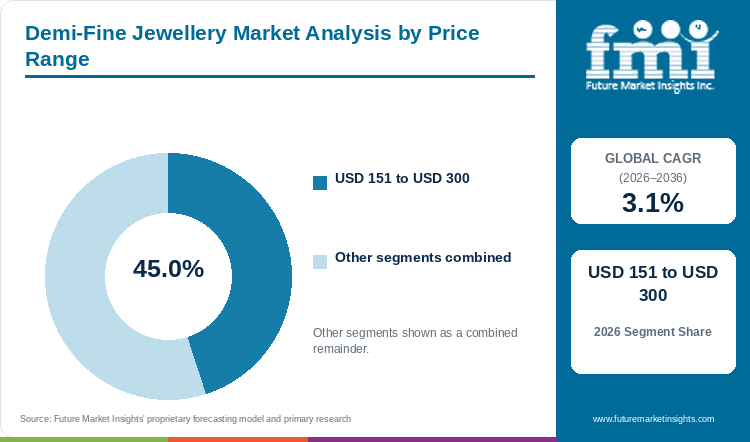
The USD 151 to USD 300 band accounts for 45% of price range sales in 2026, as buyers get a gold look at an everyday ticket.
Table 3: Price Range Share for the Demi-Fine Jewellery Market (percentage share), 2026
| Price Range | Estimated Share (2026) |
|---|---|
| Priced below USD 150 | 25% |
| USD 151 to USD 300 | 45% |
| USD 301 to USD 500 | 30% |
| Total | 100.0% |
Table 4: Price Range Leadership and Market Growth for the Demi-Fine Jewellery Market (segment and CAGR percentage), 2026 to 2036
| Metric | Value |
|---|---|
| Global CAGR (2026 to 2036) | 3.1% |
| Leading Segment | USD 151 to USD 300 |
Lovisa ran 1,136 stores at the end of the 2026 financial year, and chains of that size serve pieces below USD 150.[6] Pieces from USD 301 to USD 500 meet solid gold pricing, and buyers who want larger stones move on to the diamond jewelry market. Between the two, the USD 151 to USD 300 band gives a gold look at an everyday ticket, and FMI data reflects this in a 45% share. Pandora began a pilot of platinum-plated jewellery in the Netherlands in July 2026, a sign that silver ranges are being reworked for cost.[4] Plating quality at the middle price is the test for brands in this band.
- Plating quality decides repeat purchase in this band.
- Vermeil is gold plated over a base of sterling silver, brass or bronze, so the base metal matters near USD 300.[2]
Why do women account for most application sales?
Women account for 72.1% of application sales in 2026, led by repeat purchases of small pieces.
Customers in India make more small-ticket jewellery purchases in a year, and discerning clientele in metros and Tier-1 cities are making a beeline for demi-fine jewellery, The Week reported in October 2025.[2] That pattern of frequent small purchases suits women buyers, whom FMI sizes at 72.1% of application sales in 2026. Men form the smaller segment. The depth of men's ranges is the choice for brands that want a wider buyer base.
- Gifting and self-purchase both feed repeat orders.
- Palmonas, a D2C demi-fine startup, secured INR 55 crore in Series A funding in August 2025.[5]
What keeps offline stores ahead in distribution channel sales?
Offline stores take 82.5% of distribution channel sales in 2026, as buyers check plating and finish before paying.
Palmonas aims to open 100 new stores over the next year after an August 2025 funding round.[5] Catbird was slated to open a first Seattle store at University Village on 2 April 2026, selling pieces in 14k gold and sterling silver.[3] At the gold end, Chow Tai Fook reported Mainland same store sales up 6.9% in the year to 31 March 2026.[8] Buyers want to see colour, weight and finish before paying, so offline stores take 82.5% of distribution channel sales in 2026 against a smaller online share, as FMI data shows. Online-first brands face a choice between building stores and accepting a smaller share.
- Handling a plated piece answers questions that photos leave open.
- Lovisa reported 1,136 stores at the end of FY26.[6]
What are the drivers, restraints, and opportunities in the demi-fine jewellery market?
In the demi-fine jewellery market, costly gold pushes buyers toward lighter and plated pieces, high metal costs squeeze plated ranges, and mid-priced silver and studded gold ranges open the main opportunity.
- Driver: High gold prices push buyers toward lighter, plated and vermeil pieces.
- Restraint: High silver and gold costs raise the cost of plated ranges.
- Opportunity: Silver and studded gold ranges at mid prices open growth in price-aware markets.
High Gold Prices Push Buyers to Lighter Pieces
Lighter pieces gain ground as gold stays costly. The World Gold Council reported on 30 July 2026 that jewellery demand fell 17% in the second quarter, and that lightweight products gained share across many markets.[1] In the United States, consumers increasingly favoured lighter-weight and lower-carat products.[1] Brands selling gold-plated and vermeil pieces gain buyers who cannot pay for heavy gold. The open point is the size of the shift once prices ease.
Metal Costs Squeeze Plated Ranges
Silver and gold costs raise the base cost of every plated piece. German industry reporting in May 2026 showed silver up about 150% within a year, and gold reaching over US$4,400 an ounce for the first time.[9] Pandora plans to move around half of the relevant silver assortment to platinum plating in 2027, to reduce exposure to elevated silver prices.[4] Demi-fine brands that buy silver bases face the same cost pressure in the early forecast years.
Silver and Studded Gold Open Mid-Priced Ranges
Export data point to the ranges that grow at affordable prices. India's silver jewellery exports surged 52.21% to US$1.47 billion in FY26, driven by global demand and affordability, Indian Jeweller reported in April 2026.[10] Studded gold jewellery exports grew 6.27% to US$6.52 billion, and plain gold exports fell 7.42%.[10] Palmonas is strengthening a popular 9 karat gold demi-fine collection.[5] Mid-priced silver and studded ranges are positioned to add the most new sales through 2036.
Which country CAGRs are profiled in the demi-fine jewellery market?
Table 5: Country CAGR Comparison for the Demi-Fine Jewellery Market (CAGR percentage), 2026 to 2036
| Country | CAGR |
|---|---|
| India | 4.5% |
| China | 4.2% |
| Australia | 3% |
| Germany | 2.1% |
| United States | 1.8% |
How do country-level CAGRs compare in the demi-fine jewellery market?
Growth across the five profiled countries differs owing to gold buying habits, store networks and metal costs. FMI projects India at 4.5% CAGR from 2026 to 2036, followed by China at 4.2% and Australia at 3%. Germany is estimated at 2.1%, and the United States is projected at 1.8%. Gold prices and the trade between costume, plated and solid gold ranges shape the spread.
- India pairs store-led demi-fine brands with price-aware buyers after a duty rise on gold imports.
- China combines falling gold tonnes with rising spending.
- Australia shows softer sales at the lowest price step.
- Germany posts export figures moved mainly by metal prices.
- US growth draws on higher average unit prices and lighter-weight products.
Full report country CAGRs cover: North America; Latin America; Western Europe; Eastern Europe; Balkan and Baltic Countries; Russia and Belarus; Central Asia; East Asia; South Asia and Pacific; Middle East and Africa.
Country-wise Analysis
India Demi-Fine Jewellery Market Outlook (2026 to 2036)
A sharp rise in import duty on gold, from 6% to 15%, was one reason for a mid-quarter slump in Indian jewellery demand, the World Gold Council reported in July 2026.[1] First-half demand fell 17% to 141 tonnes, and demand measured in dollars rose 26% to US$21bn.[1] Palmonas, a D2C demi-fine startup, secured INR 55 crore in Series A funding in August 2025 and aims to open 100 new stores.[5] The Week reported that clientele in metros and Tier-1 cities are making a beeline for demi-fine jewellery.[2] India is projected at 4.5% CAGR from 2026 to 2036, the highest of the five profiled countries.
Key takeaway: India leads the profiled CAGRs at 4.5% as price-aware metro buyers move toward demi-fine pieces, and duty changes can shift that flow from quarter to quarter.
China Demi-Fine Jewellery Market Outlook (2026 to 2036)
Chow Tai Fook reported Mainland same store sales up 6.9% in the year to 31 March 2026.[8] China jewellery demand fell 30% to 136 tonnes in the first half of 2026, and spending rose 11% to US$21bn, the World Gold Council reported.[1] Second-quarter demand fell 28% to the lowest second-quarter level since 2004.[1] Falling tonnes with rising spending describe a market that buys less metal at higher prices. China is projected at 4.2% CAGR from 2026 to 2036, second among the profiled countries.
Key takeaway: China at 4.2% CAGR follows spending growth on a smaller volume of gold.
Australia Demi-Fine Jewellery Market Outlook (2026 to 2036)
Australia is projected at 3% CAGR from 2026 to 2036, the middle rate among the five profiled countries. Lovisa reported Australia and New Zealand sales down 5.7% to A$193.4 million in the year to 28 June 2026, in a year when group sales rose 17.6% to A$938.8 million.[6] The figure shows one chain softening at the lowest price step in the home region. Demi-fine brands in Australia compete for buyers between that step and fine jewellers.
Key takeaway: Australia's 3% CAGR reflects a middle-of-the-table outcome, with the lowest price step softer at Lovisa.
Germany Demi-Fine Jewellery Market Outlook (2026 to 2036)
Exports of finished jewellery from Germany rose to EUR 823.5 million in the first quarter of 2026, and the BVSU said the figures were primarily driven by the sharp rise in precious metal prices.[9] Silver rose about 150% within a year, and gold reached over US$4,400 an ounce for the first time.[9] Value gains driven by metal prices do not signal more pieces sold. Germany is projected at 2.1% CAGR from 2026 to 2036, the second lowest of the five profiled countries.
Key takeaway: Germany at 2.1% CAGR shows export gains moved by metal prices more than by new buyers.
United States Demi-Fine Jewellery Market Outlook (2026 to 2036)
Signet reported in June 2026 that average unit retail rose about 5% in the first quarter of fiscal 2027, with growth in both Bridal and Fashion.[7] US jewellery demand was 22.2 tonnes in the second quarter of 2026 against 29.7 tonnes a year earlier, with consumers favouring lighter-weight and lower-carat products.[1] Catbird was slated to open a first Seattle store on 2 April 2026.[3] The United States records the lowest profiled CAGR at 1.8% from 2026 to 2036.
Key takeaway: US growth of 1.8% comes from higher prices per unit and new stores, not from more tonnes of gold.
Who are the notable companies in the demi-fine jewellery market?
Missoma, Otiumberg, Edge of Ember, Catbird, Astley Clarke, WWAKE, Loren Stewart, Monica Vinader, Natasha Schweitzer, and Sarah & Sebastian are notable companies profiled in this market.
FMI profiles ten labels, and leadership among them follows positioning and store reach. Regional brands include Tanishq, Tira, Melorra, Voylla, Pipa Bella and Isharya in India, PD Paola, Vieri and Thomas Sabo in Germany, and Mejuri, AUrate and Catbird in the United States.
Documented activity separates the group. Catbird sells pieces in 14k gold and sterling silver and was slated to open a first Seattle store in April 2026.[3] Palmonas secured INR 55 crore in August 2025 and aims to open 100 new stores.[5] Around these labels, Pandora, Lovisa and Signet mark the middle, lowest and top steps of the price ladder.[4][6][7]
- Profiled labels: Missoma, Otiumberg, Edge of Ember, Catbird, Astley Clarke, WWAKE, Loren Stewart, Monica Vinader, Natasha Schweitzer, and Sarah & Sebastian.
- Indian brands: Tanishq, Tira, Melorra, Voylla, Pipa Bella, and Isharya, with Palmonas documented in 2025.
- German and US brands: PD Paola, Vieri, Thomas Sabo, Mejuri, AUrate, and Catbird.
- Price-step reference groups: Pandora, Lovisa, and Signet.
Competitive Benchmarking: Demi-Fine Jewellery Market
Table 6: Competitive Benchmarking for the Demi-Fine Jewellery Market (qualitative documentation ratings), 2026
| Company | Product Range | Store Network | Activity | Disclosure |
|---|---|---|---|---|
| Catbird | Medium | Medium | Medium | Medium |
| Palmonas | Medium | Medium | High | Medium |
| Pandora | High | Low | High | High |
| Signet | Medium | Low | Medium | High |
| Lovisa | Low | High | Medium | High |
High indicates wider documentation in company filings and releases, Medium indicates limited documentation, and Low indicates less direct documentation. Ratings do not indicate product quality, market share or company rank.
Key Developments in the Demi-Fine Jewellery Market
- On 26 August 2026, Lovisa reported FY26 sales revenue up 17.6% to A$938.8 million, with 1,136 stores at financial year end.[6]
- In August 2026, Pandora reported 3% organic growth in the second quarter and a Netherlands pilot of a limited platinum-plated range started in July.[4]
- In July 2026, the World Gold Council reported global jewellery demand down 17% in the second quarter to 278.2 tonnes.[1]
- On 2 June 2026, Signet reported merchandise average unit retail up about 5% in the first quarter of fiscal 2027.[7]
- On 31 March 2026, WhatNow reported that Catbird would open a first Seattle store at University Village on 2 April 2026.[3]
- In August 2025, Palmonas secured INR 55 crore in Series A funding from Vertex Ventures SEAI.[5]
Key Players in the Demi-Fine Jewellery Market
Profiled Labels
- Missoma
- Otiumberg
- Edge of Ember
- Catbird
- Astley Clarke
- WWAKE
- Loren Stewart
- Monica Vinader
- Natasha Schweitzer
- Sarah & Sebastian
Regional Brands
- Tanishq
- Tira
- Melorra
- Voylla
- Pipa Bella
- Isharya
- PD Paola
- Vieri
- Thomas Sabo
- Mejuri
- AUrate
Brands with Documented 2025 to 2026 Activity
- Palmonas
- Pandora
- Signet Jewelers
- Lovisa
Demi-Fine Jewellery Market - Report Scope
Table 7: Report Scope for the Demi-Fine Jewellery Market (coverage fields and definitions), 2026 to 2036
| Coverage field | Report scope |
|---|---|
| Market breakdown | Price range; application; distribution channel; region |
| Quantitative units | USD billion |
| Market definition | Pieces priced below USD 150, from USD 151 to USD 300 and from USD 301 to USD 500, sold to women and men through offline and online channels. |
| Regions covered | North America; Latin America; Western Europe; Eastern Europe; Balkan and Baltic Countries; Russia and Belarus; Central Asia; East Asia; South Asia and Pacific; Middle East and Africa |
| Countries covered | India; China; Australia; Germany; United States |
| Key companies profiled | Missoma, Otiumberg, Edge of Ember, Catbird, Astley Clarke, WWAKE, Loren Stewart, Monica Vinader, Natasha Schweitzer, Sarah & Sebastian |
| Forecast period | 2026 to 2036 |
Demi-Fine Jewellery Market - Research Methodology
Table 8: Research Methodology for the Demi-Fine Jewellery Market (research methods and approach), 2026 edition
| Method | Approach |
|---|---|
| Data Sources | Market and company facts come from company filings, press releases, the World Gold Council and trade press dated May 2025 or later. |
| Desk Research | Desk research covers company results, official announcements and trade press on jewellery demand, metal prices and demi-fine brands. |
| Market Sizing and Forecasting | Sizing starts from the 2025 base of USD 2.1 billion and the 3.1% CAGR. |
| Data Validation | Brand, metal price and store facts are cross-checked across company filings, press releases and trade press dated May 2025 or later. |
Demi-Fine Jewellery Market by Segments
Demi-Fine Jewellery Market segmented by Price Range:
- Priced below USD 150
- USD 151 to USD 300
- USD 301 to USD 500
Demi-Fine Jewellery Market segmented by Application:
- Women
- Men
Demi-Fine Jewellery Market segmented by Distribution Channel:
- Offline
- Online
Demi-Fine Jewellery Market by Region
- North America
- United States
- Latin America
- Western Europe
- Germany
- Eastern Europe
- Balkan and Baltic Countries
- Russia and Belarus
- Central Asia
- East Asia
- China
- South Asia and Pacific
- India
- Australia
- Middle East and Africa
Research Sources and Bibliography
- [1] World Gold Council. (2026, July 30). Gold Demand Trends: Q2 2026, Jewellery. https://www.gold.org/goldhub/research/gold-demand-trends/gold-demand-trends-q2-2026/jewellery
- [2] The Week (K. Sunil Thomas). (2025, October 31). Why are sky-high gold prices leading to a surprising boom in a certain category of jewellery? https://www.theweek.in/news/biz-tech/2025/10/31/why-are-sky-high-gold-prices-leading-to-a-surprising-boom-in-a-certain-category-of-jewellery.amp.html
- [3] WhatNow (Deepali Singla). (2026, March 31). Demi-Fine Jewelry Brand to Open First Seattle Location at University Village. https://whatnow.com/?p=386321
- [4] Pandora A/S (Nasdaq Copenhagen Company Announcement 1015). (2026, August 12). Interim Financial Report Q2 2026. https://attachment.news.eu.nasdaq.com/aada3dfb478410f5fc7fe5a9a60d0448c
- [5] Entrepreneur India. (2025, August 25). Jewellery Brand Palmonas Raises INR 55 Cr in Series A Funding. https://india.entrepreneur.com/news-and-trends/jewellery-brand-palmonas-raises-inr-55-cr-in-series-a/496301
- [6] Lovisa Holdings Limited (ASX announcement). (2026, August 26). FY26 Full Year Results. https://announcements.asx.com.au/asxpdf/20260826/pdf/07376qs6clgzpp.pdf
- [7] Signet Jewelers Limited (SEC Form 8-K, Exhibit 99.1). (2026, June 2). Signet Jewelers Reports First Quarter Fiscal 2027 Results. https://www.sec.gov/Archives/edgar/data/0000832988/000083298826000158/fy27ex99106x02x26pressrele.htm
- [8] Chow Tai Fook Jewellery Group (press release). (2026, June 11). Chow Tai Fook Jewellery Reports Record High Profit Brand Transformation Delivering High-quality Earnings Growth. https://www.accessnewswire.com/newsroom/en/metals-and-mining/chow-tai-fook-jewellery-reports-record-high-profit-brand-transformation-deliverin-1175989
- [9] Insight Luxury (Wolfram Bekker). (2026, May 28). German Jewelry and Watch Industry 1st Quarter 2026: Record Figures with a Question Mark. https://insight-luxury.com/en/2026/05/28/german-jewelry-and-watch-industry-1st-quarter-2026-record-figures-with-a-question-mark/
- [10] Indian Jeweller (IJ News Service). (2026, April 15). India gem and jewellery exports at $27.72 billion in FY26. https://www.indianjeweller.in/Indian-Jewellery-News/16151/index.html
This bibliography is provided for reader reference. The full report contains the complete reference list and detailed citations.
This Report Answers
- How big is the demi-fine jewellery market during 2026?
- What market size is projected by 2036?
- Which price range holds notable share?
- Which application and distribution channel hold notable share?
- Which countries have notable growth?
- Which companies are notable in the market?
Frequently Asked Questions
How large is the demi-fine jewellery market expected in 2026?
Future Market Insights estimates demi-fine jewellery sales at USD 2.2 billion in 2026. Sales are projected to reach USD 2.9 billion by 2036, reflecting steady growth over the forecast period.
What CAGR is projected for the demi-fine jewellery market through 2036?
As per FMI analysis, demi-fine jewellery sales are projected to grow at a 3.1% CAGR from 2026 to 2036. Costly gold and a wide price gap above costume pieces support the outlook.
Which price range holds a notable market share in 2026?
The USD 151 to USD 300 band accounts for 45% of price range sales in 2026. Buyers get a gold look in this band without paying solid gold prices.
Which application and distribution channel hold a notable market share in 2026?
Women account for 72.1% of application sales, and offline stores take 82.5% of distribution channel sales in 2026. Small-ticket pieces and the need to see plating support both shares.
Which country has a notable expansion outlook through 2036?
India is projected to record the fastest growth at 4.5% CAGR from 2026 to 2036, according to FMI. Store-led brands and price-aware buyers support the outlook.
Who are the key companies in the demi-fine jewellery market?
Notable companies include Missoma, Otiumberg, Edge of Ember, Catbird, Astley Clarke, WWAKE, Loren Stewart, Monica Vinader, Natasha Schweitzer, and Sarah & Sebastian.
Preview the report firsthand - request a free sample
Get SampleGet the brochure for pricing and purchase details.
Get PDFTable of Content
- Key Takeaways
- Market Size and CAGR
- Top Growth Driver
- Fastest Growing Segment
- Leading Region
- Key Companies
- Emerging Opportunities
- Executive Summary
- Global Market Outlook
- Demand-side Trends
- Supply-side Trends
- Technology Roadmap Analysis
- Analysis and Recommendations
- Analyst Perspective (What is happening? Why now? What should investors know?)
- Key Questions Answered
- How large is the market?
- What is the CAGR?
- What are key trends?
- Which region dominates?
- Who are the leaders?
- Market Overview
- Market Coverage / Taxonomy
- Market Definition / Scope / Limitations
- Research Methodology
- Chapter Orientation
- Analytical Lens and Working Hypotheses
- Market Structure, Signals, and Trend Drivers
- Benchmarking and Cross-market Comparability
- Market Sizing, Forecasting, and Opportunity Mapping
- Research Design and Evidence Framework
- Desk Research Programme (Secondary Evidence)
- Expert Input and Fieldwork (Primary Evidence)
- Tooling, Models, and Reference Databases
- Data Engineering and Model Build
- Quality Assurance and Audit Trail
- Market Background
- Market Dynamics (Drivers, Restraints, Opportunity, Trends)
- Scenario Forecast (Optimistic, Likely, Conservative)
- Impact Analysis
- AI Impact
- Sustainability Impact
- Regulatory Impact
- Technology Impact
- Consumer / Buyer Analysis
- Purchase Drivers
- Adoption Barriers
- Buyer Journey
- Opportunity Map Analysis
- Product Life Cycle Analysis
- Supply Chain Analysis
- Investment Feasibility Matrix
- Value Chain Analysis
- PESTLE and Porter's Analysis
- Regulatory Landscape
- Regional Parent Market Outlook
- Production and Consumption Statistics
- Import and Export Statistics
- Global Market Analysis and Forecast, 2021 to 2036
- Historical Market Size Value (USD Billion) Analysis, 2021 to 2025
- Current and Future Market Size Value (USD Billion) Projections, 2026 to 2036
- Y-o-Y Growth Trend Analysis
- Absolute $ Opportunity Analysis
- Global Market Pricing Analysis, 2021 to 2036
- Global Market Analysis and Forecast, By Price Range, 2021 to 2036
- Introduction / Key Findings
- Historical Market Size Value (USD Billion) Analysis By Price Range, 2021 to 2025
- Current and Future Market Size Value (USD Billion) Analysis and Forecast By Price Range, 2026 to 2036
- Priced below USD 150
- USD 151 to USD 300
- USD 301 to USD 500
- Y-o-Y Growth Trend Analysis By Price Range, 2021 to 2025
- Absolute $ Opportunity Analysis By Price Range, 2026 to 2036
- Global Market Analysis and Forecast, By Application, 2021 to 2036
- Introduction / Key Findings
- Historical Market Size Value (USD Billion) Analysis By Application, 2021 to 2025
- Current and Future Market Size Value (USD Billion) Analysis and Forecast By Application, 2026 to 2036
- Women
- Men
- Y-o-Y Growth Trend Analysis By Application, 2021 to 2025
- Absolute $ Opportunity Analysis By Application, 2026 to 2036
- Global Market Analysis and Forecast, By Distribution Channel, 2021 to 2036
- Introduction / Key Findings
- Historical Market Size Value (USD Billion) Analysis By Distribution Channel, 2021 to 2025
- Current and Future Market Size Value (USD Billion) Analysis and Forecast By Distribution Channel, 2026 to 2036
- Offline
- Online
- Y-o-Y Growth Trend Analysis By Distribution Channel, 2021 to 2025
- Absolute $ Opportunity Analysis By Distribution Channel, 2026 to 2036
- Global Market Analysis and Forecast, By Region, 2021 to 2036
- Introduction
- Historical Market Size Value (USD Billion) Analysis By Region, 2021 to 2025
- Current Market Size Value (USD Billion) Analysis and Forecast By Region, 2026 to 2036
- North America
- Latin America
- Western Europe
- Eastern Europe
- East Asia
- South Asia and Pacific
- Middle East and Africa
- Market Attractiveness Analysis By Region
- North America Market Analysis and Forecast, By Country, 2021 to 2036
- Historical Market Size Value (USD Billion) Trend Analysis By Market Taxonomy, 2021 to 2025
- Market Size Value (USD Billion) Forecast By Market Taxonomy, 2026 to 2036
- By Country
- United States
- By Price Range
- By Application
- By Distribution Channel
- By Country
- Market Attractiveness Analysis
- By Country
- By Price Range
- By Application
- By Distribution Channel
- Key Takeaways
- Latin America Market Analysis and Forecast, By Country
- Historical Market Size Value (USD Billion) Trend Analysis By Market Taxonomy, 2021 to 2025
- Market Size Value (USD Billion) Forecast By Market Taxonomy, 2026 to 2036
- By Country
- By Price Range
- By Application
- By Distribution Channel
- Market Attractiveness Analysis
- By Country
- By Price Range
- By Application
- By Distribution Channel
- Key Takeaways
- Western Europe Market Analysis and Forecast, By Country
- Historical Market Size Value (USD Billion) Trend Analysis By Market Taxonomy, 2021 to 2025
- Market Size Value (USD Billion) Forecast By Market Taxonomy, 2026 to 2036
- By Country
- Germany
- By Price Range
- By Application
- By Distribution Channel
- By Country
- Market Attractiveness Analysis
- By Country
- By Price Range
- By Application
- By Distribution Channel
- Key Takeaways
- Eastern Europe Market Analysis and Forecast, By Country
- Historical Market Size Value (USD Billion) Trend Analysis By Market Taxonomy, 2021 to 2025
- Market Size Value (USD Billion) Forecast By Market Taxonomy, 2026 to 2036
- By Country
- Balkan and Baltic Countries
- Russia and Belarus
- Central Asia
- By Price Range
- By Application
- By Distribution Channel
- By Country
- Market Attractiveness Analysis
- By Country
- By Price Range
- By Application
- By Distribution Channel
- Key Takeaways
- East Asia Market Analysis and Forecast, By Country
- Historical Market Size Value (USD Billion) Trend Analysis By Market Taxonomy, 2021 to 2025
- Market Size Value (USD Billion) Forecast By Market Taxonomy, 2026 to 2036
- By Country
- China
- By Price Range
- By Application
- By Distribution Channel
- By Country
- Market Attractiveness Analysis
- By Country
- By Price Range
- By Application
- By Distribution Channel
- Key Takeaways
- South Asia and Pacific Market Analysis and Forecast, By Country
- Historical Market Size Value (USD Billion) Trend Analysis By Market Taxonomy, 2021 to 2025
- Market Size Value (USD Billion) Forecast By Market Taxonomy, 2026 to 2036
- By Country
- India
- Australia
- By Price Range
- By Application
- By Distribution Channel
- By Country
- Market Attractiveness Analysis
- By Country
- By Price Range
- By Application
- By Distribution Channel
- Key Takeaways
- Middle East and Africa Market Analysis and Forecast, By Country
- Historical Market Size Value (USD Billion) Trend Analysis By Market Taxonomy, 2021 to 2025
- Market Size Value (USD Billion) Forecast By Market Taxonomy, 2026 to 2036
- By Country
- By Price Range
- By Application
- By Distribution Channel
- Market Attractiveness Analysis
- By Country
- By Price Range
- By Application
- By Distribution Channel
- Key Takeaways
- Key Countries Market Analysis
- United States
- Pricing Analysis
- Market Share Analysis, 2025
- By Price Range
- By Application
- By Distribution Channel
- Germany
- Pricing Analysis
- Market Share Analysis, 2025
- By Price Range
- By Application
- By Distribution Channel
- India
- Pricing Analysis
- Market Share Analysis, 2025
- By Price Range
- By Application
- By Distribution Channel
- China
- Pricing Analysis
- Market Share Analysis, 2025
- By Price Range
- By Application
- By Distribution Channel
- Australia
- Pricing Analysis
- Market Share Analysis, 2025
- By Price Range
- By Application
- By Distribution Channel
- United States
- Market Structure Analysis
- Competition Dashboard
- Competition Benchmarking
- Market Share Analysis of Top Players
- By Regional
- By Price Range
- By Application
- By Distribution Channel
- Emerging Startups
- Innovation Benchmarking
- Competition Analysis
- Competition Deep Dive
- Catbird
- Overview
- Product Portfolio
- Profitability by Market Segments
- Sales Footprint
- Strategy Overview
- Marketing Strategy
- Product Strategy
- Channel Strategy
- Palmonas
- Pandora
- Signet
- Lovisa
- Missoma
- Otiumberg
- Edge of Ember
- Astley Clarke
- WWAKE
- Loren Stewart
- Monica Vinader
- Natasha Schweitzer
- Sarah & Sebastian
- Tanishq
- Tira
- Melorra
- Voylla
- Pipa Bella
- Isharya
- PD Paola
- Vieri
- Thomas Sabo
- Mejuri
- AUrate
- Signet Jewelers
- Catbird
- Case Studies
- Success Stories
- Recent Developments
- Competition Deep Dive
- Assumptions & Acronyms Used


