
- Market Size (2026)
- USD 592.5 Mn
- Forecast (2036)
- USD 1122.7 Mn
- CAGR (2026 to 2036)
- 6.6%
How Big Is the Fixatives Market in 2026?
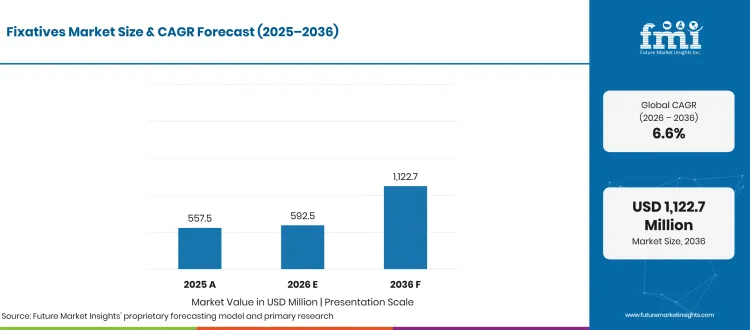
The global fixatives market reaches USD 592.5 million in 2026, up from USD 557.5 million in 2025, and is projected by Future Market Insights (FMI) to reach USD 1,122.7 million by 2036, expanding at a 6.6% CAGR from 2026 to 2036 and generating USD 530.2 million in incremental revenue over the 10-year forecast period.
| Market Metric | Valuation / Share / Forecast Benchmark |
|---|---|
| 2025 Market Size (Historical) | USD 557.5 million |
| 2026 Market Size (Estimated) | USD 592.5 million |
| 2036 Market Size (Projected) | USD 1,122.7 million |
| Compound Annual Growth Rate (2026 to 2036) | 6.6% CAGR |
| Incremental Dollar Opportunity (2026 to 2036) | USD 530.2 million (1.89-fold expansion) |
| Dominant Fixative Type (2026 Share) | Synthetic Fixatives (46.8% revenue share in 2026, rising to 48.2% by 2036) |
| Fastest-Growing Fixative Type (2026 to 2036) | Natural & Botanical Fixatives (7.5% CAGR from 2026 to 2036) |
| Leading & Fastest-Growing Applications | Fine Fragrances & Perfumery (38.4% share in 2026; 7.2% CAGR) | Histopathology & Clinical Diagnostics (6.8% CAGR) |
| Leading & Fastest-Growing Forms | Liquid & Solution Fixatives (62.5% share in 2026) | Microencapsulated & Controlled-Release Systems (7.9% CAGR) |
| Largest Country Markets (2026 Global Share) | United States (21.0%, USD 124.4 million), China (16.0%, USD 94.8 million), France (10.0%, USD 59.3 million), Germany (7.5%, USD 44.4 million) |
| Fastest-Growing Country Markets (2026 to 2036) | South Korea (8.4% CAGR), China (8.1% CAGR), United States (7.4% CAGR), France (7.1% CAGR) |
| Leading Tier-1 Companies | Givaudan SA, Symrise AG, dsm-firmenich AG, International Flavors & Fragrances Inc. (IFF), BASF SE, Archroma, Merck KGaA, Thermo Fisher Scientific Inc., Croda International Plc, Eastman Chemical Company |
Source: Future Market Insights analysis of the fixatives market, 2026.
Executive Market Overview
Procurement of fragrance and industrial fixatives is accelerating from four buyer groups, fine perfumery compounding houses, cosmetic spray fillers, textile dye houses and anatomical histology laboratories, and each group judges a fixative on a different axis. Cosmetics Europe (October 2026) reports that European cosmetics retail sales reached EUR 110 billion in 2025 with fragrances capturing 15.6% of retail value, which is why prestige perfume houses keep raising fragrance oil loadings and in turn keep raising fixative inclusion rates. North America and Western Europe account for 58.2% of global fixative revenue in 2026, driven by luxury fragrance demand and by hospital clinical pathology volumes that no consumer cycle touches. Asia-Pacific is the swing region, with expanding personal care manufacturing corridors and consumer premiumization lifting order growth through 2036. Commercial momentum reaches the compounding floor as raw material tenders.
Industrial textile dye houses and hospital pathology laboratories are phasing out legacy formaldehyde-based fixatives ahead of strict 2026 US EPA and European REACH exposure limits, and suppliers answer with cationic polyamine textile crosslinkers, closed-system formalin alternatives and biodegradable macrocyclic musks that deliver scent tenacity without hazardous emissions. Margins on a commodity musk depend on synthesis scale, so suppliers lift value per unit by moving into water-based microencapsulated systems and by selling botanical fixatives extracted in Grasse where supply is traceable. FMI projects water-based microencapsulated fixatives to advance at a 7.9% CAGR and natural botanical fixatives at a 7.5% CAGR through 2036. These chemistries protect supplier margins while meeting workplace safety standards. Sizing covers synthetic musks, botanical resinoids and polymeric crosslinkers for perfumes, personal care and textiles, excluding pure carrier ethanol, unformulated essential oils and packaging adhesives.
Analyst Perspective
"Fixative procurement is splitting along two high-margin tracks: fragrance compounders are investing in biodegradable macrocyclic musks, Grasse botanical resinoids, and water-based microcapsules to hold scent tenacity without alcohol, while textile mills and pathology labs are replacing free formaldehyde with cationic polyamine dye fixatives and closed specimen workflows ahead of strict 2026 US and EU exposure limits." The core procurement risk stems from raw material cost inflation across specialty musk intermediates and sudden regulatory bans on synthetic nitro-musks.
- Rahul Pandita, Principal Consultant, Future Market Insights (FMI)
Major Market Trends and Insights
- Alcohol-Free Fragrance Matrices Force Higher Fixative Loading: Prestige and masstige fragrance brands are reformulating eau de parfum lines into water-based, skin-hydration mists that need specialized matrix fixatives and core-shell microcapsules to prevent phase separation and rapid scent fade. International Flavors & Fragrances Inc. (September 2026) launched AQUASCENT, supporting 10% to 25% fragrance oil loading in crystal-clear water-based fragrances compared with a 15% ceiling for conventional solubilizers, while Givaudan SA (July 2026) took an equity stake in ETH Zurich spin-off Microcaps AG to scale precision alcohol-free perfume microencapsulation and to widen the fragrance oils it can solubilize in clear water.
- Grasse Extraction Capacity Anchors Traceable Natural Fixative Supply: Leading fragrance houses are building captive extraction and agronomy hubs in Southern France to secure traceable natural fixatives, resinoids and solvent-free floral extracts. Givaudan SA (February 2026) committed CHF 55 million in Grasse to construct Campus 52 for its House of Naturals organization, Symrise AG (September 2026) inaugurated its new Lautier 1795 natural fragrance site in Grasse and confirmed the planned acquisition of Floral Concept (Symrise AG, July 2026), and dsm-firmenich AG (September 2026) displayed Muguet Firgood 100% natural solvent-free extracts at Beautyworld Middle East 2026 for luxury attar and perfume oils.
- Cationic Polymers Replace Formalin in Textiles: Apparel and hospital textile finishers are adopting formaldehyde-free cationic fixing polymers that lock anionic dyes onto cotton and recycled polyamide fibers across repeated laundering cycles. Validation by Mota, Fernandes, and Silva (July 2026) in Coatings confirmed that treating cotton knits with Archroma's Optifix EC liq. C (1.25% pre-cationization and 15 g/L after-treatment) preserves water contact angles above 130 degrees and UPF above 50 after domestic washing, while Martínez-González et al. (August 2026) in ACS Applied Materials & Interfaces showed chitosan interlayers with a cyanoguanidine polymer achieving 87.4% dye exhaustion, zero leaching over 20 washes and 75% bacterial reduction.
- Biopsy Protocols Push Histology Fixatives Toward Safer Transport: Clinical gastroenterology and translational transplant laboratories are pairing standardized neutral-buffered formalin (NBF) primary fixation with safer post-fixation transport media and closed vials. Thermo Fisher Scientific Inc. (November 2025) highlighted updated 2025 ESsCD adult celiac diagnostic guidelines requiring at least 4 biopsies from the second duodenum plus 2 from the duodenal bulb fixed in 10% neutral-buffered formalin, while Yamamoto, Kinoshita, Kume, Kimura, Yokoo, and Kobayashi (March 2025) in Biomedicines proved that substituting formalin with 0.9% saline or 70% ethanol after 12 to 24 hours of fixation preserves antigenicity over 500 km / 24-hour freight transport, complementing prefilled formalin vials.
What Are the Main Drivers, Restraints, and Opportunities?
Fast growth in fine-fragrance concentration levels and multi-biopsy clinical diagnostic guidelines expands commercial fixative demand, whereas strict US EPA and EU REACH formaldehyde limits and biodegradable musk synthesis costs restrain legacy chemistries, opening rapid growth for bio-based macrocyclic musks, water-based microcapsules and zero-formaldehyde textile fixatives.
Driver: Fine Fragrance Premiumization and Biodegradable Macrocyclic Musk Expansion
Consumers in Europe, North America, the Middle East and East Asia are trading up to high-oil-concentration extrait and eau de parfum formats (20% to 35% fragrance oil) that require higher dosages of heavy base-note fixatives to sustain 8-to-12-hour skin projection. Givaudan SA (January 2026) posted 18.3% like-for-like Fine Fragrance growth in 2025 as its Fragrance & Beauty division reached CHF 3,830 million (+7.9% LFL), while Croda International Plc (October 2026) reported 10.8% organic growth in Consumer Care (GBP 266.3 million) in Q3 2026, led by 19% organic growth in Beauty Actives. To supply this volume, Symrise AG (October 2026) commissioned world-scale capacity expansion in India for Globalide, a readily biodegradable macrocyclic musk fixative used across perfumery and aromatherapy essential oils.
Restraint: Formaldehyde Occupational Exposure Limits and EU REACH Article Restrictions
Regulatory clampdowns on free formaldehyde in both textile finishing mills and pathology laboratories are forcing costly reformulation and ventilation upgrades. In December 2025, the U.S. Environmental Protection Agency (December 2025) released its Revised Draft Human Health Risk Assessment for Formaldehyde (CASRN 50-00-0), establishing an acute inhalation point of departure of 0.3 ppm (0.37 mg/m3) based on sensory irritation and identifying unreasonable occupational and consumer risks across textile and laboratory uses. Concurrently, the European Chemicals Agency (May 2025) issued standardized compliance test methods ahead of the August 2026 enforcement of EU REACH Appendix 14 limits (0.062 mg/m3 for furniture and wood/textile articles and 0.080 mg/m3 for road vehicle interiors), accelerating the phase-out of unbuffered formalin and dicyandiamide-formaldehyde condensates.
Opportunity: Phenolic-Free Polyamide Fixatives and AI-Guided Home & Personal Care Formats
Circular-fashion commitments and smart home-fragrance systems are creating high-margin demand for phenolic-free wet-fastness fixatives and controlled-release aroma matrices. In May 2026, BASF SE (May 2026) partnered with European fashion retailer Lindex to scale loopamid, a 100% textile-to-textile recycled polyamide 6 that tolerates PA6/elastane blends, while Archroma (April 2026) launched NYLOFIXAN PA LIQ C (a phenolic-free, bisphenol-free wet-fastness fixative for polyamide) and APPRETAN FFX formaldehyde-free binders at Techtextil 2026, a portfolio that included textile dye removal chemicals for mills running the same line. In consumer scent delivery, fragrance houses are pairing low-vapor-pressure fixative esters with AI-personalized home fragrance customization cartridges to maintain uniform diffusion curves from first use to depletion.
How Is the Fixatives Market Segmented?
The global fixatives market is segmented by fixative type, application, physical form, and region, with synthetic musks, botanical resinoids, and polymeric crosslinkers reconciled on a single producer revenue basis across perfume, textile, and clinical buyers.
| Segmentation Axis | Sub-Segments Covered | 2026 Leading Segment & Share | Main Growth Benchmark (2026 to 2036) |
|---|---|---|---|
| Fixative Type | Synthetic Fixatives (Macrocyclic/Polycyclic Musks, Ambroxide, Esters), Natural & Botanical Fixatives (Resinoids, Benzoin, Labdanum, Orris, Vetiver), Crosslinking & Polymeric Fixatives (Cationic Polyamines, Aldehyde/Non-Aldehyde Tissue Fixatives) | Synthetic Fixatives (46.8% revenue share) | Natural & Botanical Fixatives grow fastest at 7.5% CAGR; Synthetic share reaches 48.2% by 2036 |
| Application | Fine Fragrances & Perfumery, Personal Care & Cosmetics, Textile Dyeing & Finishing, Histopathology & Clinical Diagnostics, Household & Fabric Care | Fine Fragrances & Perfumery (38.4% revenue share) | Fine Fragrances & Perfumery leads application growth at 7.2% CAGR through 2036 |
| Physical Form | Liquid & Solution Fixatives, Solid, Crystalline & Resinoid Fixatives, Microencapsulated & Controlled-Release Systems | Liquid & Solution Fixatives (62.5% revenue share) | Microencapsulated & Controlled-Release Systems expand fastest at 7.9% CAGR |
| Region | North America, Europe, East Asia, Latin America, South Asia & Pacific, Middle East & Africa | Europe & North America (led by United States at 21.0% and France at 10.0% global share) | South Korea (8.4% CAGR) and China (8.1% CAGR) record fastest national growth |
Source: Future Market Insights analysis of the fixatives market, 2026.
Why Does the Synthetic Fixatives Segment Lead by Fixative Type?
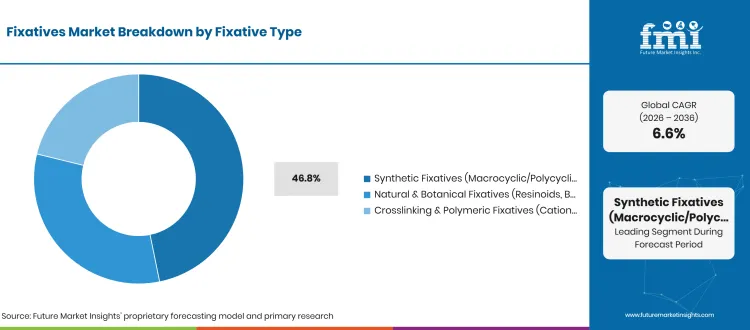
Fixative type: Synthetic Fixatives lead the market with 46.8% of global revenue in 2026 and are projected to reach 48.2% share by 2036, because biodegradable macrocyclic musks, ambroxide, benzyl salicylate, and dipropylene glycol esters offer batch-to-batch olfactory consistency, IFRA compliance, and scalable multi-ton synthesis that wild-harvested animalic and botanical exudates cannot match. Perfume compounders buy on reproducibility, since a fixative that varies between harvests forces a reformulation of the whole fragrance. Symrise AG (October 2026) reinforced synthetic macrocyclic supply by expanding Globalide production capacity in India, while in Q2 2026 its Aroma Molecules division achieved high-single-digit organic growth led by double-digit expansion in Specialty Fragrance Ingredients (Symrise AG, July 2026). Natural and botanical fixatives represent the fastest-growing fixative type at a 7.5% CAGR through 2036 as Givaudan SA (February 2026), Symrise AG (September 2026), and dsm-firmenich AG (September 2026) scale captive Grasse resinoid and solvent-free Firgood extraction.
Why Does the Fine Fragrances and Perfumery Segment Lead by Application?
Application: Fine Fragrances & Perfumery capture 38.4% of global revenue in 2026 and expand at a 7.2% CAGR through 2036, ahead of personal care and cosmetics, textile dyeing and finishing, and histopathology and clinical diagnostics. Extrait de parfum, Arabic oud and floral blends, and alcohol-free water-based fine fragrances require high fixative inclusion rates to anchor volatile citrus and floral top notes and sustain skin tenacity. Givaudan SA (January 2026) recorded 18.3% like-for-like Fine Fragrance growth in 2025, while luxury brands pairing high-tenacity base notes with bespoke perfume packaging such as dsm-firmenich's Beautyworld Middle East 2026 collection in Identiscents flacons (dsm-firmenich AG, September 2026) are driving sustained volume and value gains; meanwhile, histopathology fixatives benefit from specialized protocols for confocal fluorescence imaging (Mežaraupe et al., October 2026).
Why Does the Liquid and Solution Segment Lead by Physical Form?
Physical form: Liquid & Solution Fixatives hold 62.5% of global revenue in 2026 because pre-diluted fragrance bases, aqueous cationic textile fixing baths, and ready-to-use 10% neutral-buffered formalin solutions integrate directly into automated compounding and dyeing equipment without heating or melting steps. In textile wet processing, Archroma's liquid Optifix EC liq. C (Mota et al., July 2026) and NYLOFIXAN PA LIQ C (Archroma, April 2026) meter directly into pad-dry-cure and exhaust baths at 15 g/L, while in pathology labs, liquid NBF followed by 0.9% saline or 70% ethanol substitution enables safe specimen transit (Yamamoto et al., March 2025). Microencapsulated and controlled-release systems represent the fastest-growing physical form at a 7.9% CAGR from 2026 to 2036, supported by the Microcaps AG arrangement with Givaudan (Givaudan SA, July 2026) and IFF's AQUASCENT matrix (International Flavors & Fragrances Inc., September 2026).
Fixatives Market by Region and Country (2026 to 2036)
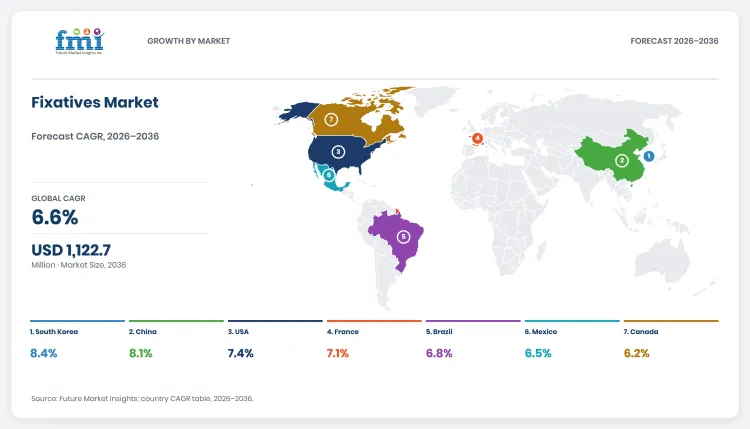
North America and Europe anchor global fixatives revenue through established fine-fragrance compounding hubs in the United States and France and high clinical biopsy volumes, while East Asia leads growth velocity as South Korean bioprocessing and K-beauty exports and Chinese fine-fragrance and textile mills expand. The tracked countries below carry the bulk of the USD 530.2 million ten-year dollar addition, with the United States alone adding USD 129.6 million as fine fragrance concentrations and hospital procurement of non-formaldehyde histology fixatives rise together. China contributes USD 111.8 million as export dye houses retrofit for zero-discharge apparel programs, and South Korea moves from USD 29.6 million to USD 66.3 million at an 8.4% CAGR. Regional divergence is a matter of what each cluster buys, perfume in Europe, textiles in China, and clinical chemistry in North America.
| Country | 2026 Revenue | 2036 Revenue | 10-Year Addition | 2026 to 2036 CAGR | Global Share (2026 → 2036) |
|---|---|---|---|---|---|
| South Korea | USD 29.6 million | USD 66.3 million | +USD 36.7 million | 8.4% | 5.0% → 5.9% |
| China | USD 94.8 million | USD 206.6 million | +USD 111.8 million | 8.1% | 16.0% → 18.4% |
| United States | USD 124.4 million | USD 254.0 million | +USD 129.6 million | 7.4% | 21.0% → 22.6% |
| France | USD 59.3 million | USD 117.7 million | +USD 58.4 million | 7.1% | 10.0% → 10.5% |
| Brazil | USD 26.7 million | USD 51.5 million | +USD 24.8 million | 6.8% | 4.5% → 4.6% |
| Mexico | USD 17.8 million | USD 33.4 million | +USD 15.6 million | 6.5% | 3.0% → 3.0% |
| Canada | USD 14.8 million | USD 27.0 million | +USD 12.2 million | 6.2% | 2.5% → 2.4% |
| Germany | USD 44.4 million | USD 78.8 million | +USD 34.4 million | 5.9% | 7.5% → 7.0% |
| United Kingdom | USD 32.6 million | USD 56.2 million | +USD 23.6 million | 5.6% | 5.5% → 5.0% |
Source: Future Market Insights analysis of the fixatives market, 2026.
South Korea
Korean fixatives demand grows 2.24-fold at an 8.4% CAGR from USD 29.6 million in 2026 (5.0% global share) to USD 66.3 million by 2036 (5.9% share), making South Korea the fastest-growing national fixatives market globally with USD 36.7 million of ten-year revenue added. Growth is supported by K-beauty prestige fragrance and functional skincare exports, plus major biopharmaceutical and pathology reagent investments. On October 29, 2026, Merck KGaA (October 2026) opened its EUR 300 million, 44,500-square-meter Asia-Pacific Bioprocessing Production Center in Daejeon, South Korea, expanding regional manufacturing of process liquids, cell culture media, and sterile sampling systems, while Cosmetics Europe (October 2026) ranked South Korea among the world's top personal-care markets at EUR 11 billion in retail value. Expanding domestic bioprocessing reagent production and water-based K-beauty fragrance exports are projected to sustain this position through 2036.
China
China ranks second globally in fixatives revenue and second in growth pace at an 8.1% CAGR, climbing from USD 94.8 million in 2026 to USD 206.6 million by 2036 (+USD 111.8 million) and expanding its global share to 18.4%. High chemical demand is driven by export textile dye houses in Zhejiang and Jiangsu upgrading dye-fixing agents ahead of international apparel brand zero-discharge requirements. Manufacturing statistics from the National Bureau of Statistics of China (October 2026) show chemical industry value-added output grew 7.2% year-over-year in September 2026, while Givaudan SA (February 2026) expanded compounding capacity. Rapid expansion of domestic high-end perfumery brands and industrial conversion toward formaldehyde-free textile fixatives will keep China growing rapidly through 2036.
United States
United States industrial and commercial end-users expand procurement at a 7.4% CAGR from USD 124.4 million in 2026 to USD 254.0 million by 2036, generating USD 129.6 million in incremental revenue to hold a 22.6% global share. American demand is anchored by fine perfumery compounding in New Jersey, plus high-throughput hospital clinical histology networks. Federal regulatory updates from the U.S. Environmental Protection Agency (December 2025) under TSCA established strict occupational inhalation limits for formaldehyde, accelerating hospital adoption of closed tissue-fixation workflows. Corporate reporting from Eastman Chemical Company (October 2026) confirms strong third-quarter 2026 revenue of USD 2,460 million, supported by specialty additive demand. Expanding fine fragrance concentrations and hospital adoption of non-formaldehyde histology fixatives will sustain strong U.S. growth through 2036.
France
France is Europe's premier fixatives market, expanding at a 7.1% CAGR from USD 59.3 million in 2026 to USD 117.7 million by 2036, adding USD 58.4 million and lifting its global share to 10.5%. Centered around the historic fragrance capital of Grasse and Paris perfumery houses, French compounders formulate prestige extrait de parfum using high-molecular-weight macrocyclic musks and solvent-free amber resinoids. Corporate statements from Givaudan SA (February 2026) highlight a CHF 55 million investment to expand its Grasse fragrance ingredients facility, while dsm-firmenich AG (September 2026) displayed biodegradable perfumery fixatives at the same trade events. Growing global export demand for luxury French perfumes and strict EU REACH compliant botanical fixatives will anchor French sales growth through 2036.
Brazil
Brazil leads Latin American fixatives demand, expanding at a 6.8% CAGR from USD 26.7 million in 2026 (4.5% global share) to USD 51.5 million by 2036 (4.6% share) and generating USD 24.8 million in 10-year incremental sales. High per-capita daily application of colognes, body splashes, and scented hair and skin care in warm, humid climates requires elevated dosages of substantive musk and amber fixatives. Cosmetics Europe (October 2026) identified Brazil as the world's fourth-largest national cosmetics retail market at EUR 27 billion, while Symrise AG (July 2026) and Givaudan SA (January 2026) both cited sustained Latin American consumer-fragrance and fine-fragrance project vitality across Sao Paulo compounding centers. Growing formulation of alcohol-reduced body mists and high-substantivity fabric softeners is expected to drive steady Brazilian fixative demand expansion through 2036.
Mexico
Revenue in Mexico is projected to grow 1.88-fold at a 6.5% CAGR from USD 17.8 million in 2026 (3.0% global share) to USD 33.4 million by 2036 (3.0% share), adding USD 15.6 million over the forecast decade. Mexican demand is supported by nearshored personal-care and home-care manufacturing, denim and apparel wet-finishing mills in Puebla and Guanajuato, and expanding private hospital pathology networks. Eastman Chemical Company (October 2026) reported 8% year-on-year Q3 2026 revenue growth to USD 2,385 million with 9% expansion in Additives & Functional Products serving North American coatings and personal-care formulators, while Archroma (April 2026) expanded technical support for formaldehyde-free cationic dye fixatives across global apparel supply chains. Continued nearshoring of beauty and personal-care finishing plants serving U.S. retail brands is projected to sustain Mexican fixative sales growth through 2036.
Canada
The Canadian fixatives market expands at a 6.2% CAGR from USD 14.8 million in 2026 (2.5% global share) to USD 27.0 million by 2036 (2.4% share), generating USD 12.2 million in 10-year incremental revenue. Consumption is concentrated in clinical histopathology and veterinary diagnostic laboratories, clean-beauty skincare and fragrance manufacturing in Ontario and Quebec, and specialty paper and textile finishing. According to Statistics Canada (September 2026), Canadian chemical product manufacturing sales rose 13.9% year-on-year in current dollars to CAD 5.9 billion in July 2026 as total manufacturing sales climbed 10.9% year-on-year to CAD 78.7 billion and unfilled manufacturing orders hit a record CAD 134.6 billion. Adoption of saline- and ethanol-substituted tissue transport protocols and natural botanical fixatives in Canadian personal care will support steady revenue expansion through 2036.
Germany
German demand is projected to climb at a 5.9% CAGR from USD 44.4 million in 2026 to USD 78.8 million by 2036, generating USD 34.4 million in 10-year added sales and retaining a 7.0% global share. German consumption is anchored by specialty textile finishing mills in Baden-Wurttemberg and university clinical pathology networks across North Rhine-Westphalia. Chemical production tracking from the German Chemical Industry Association (VCI, September 2025) confirms steady recovery in specialty chemicals output, while Merck KGaA (March 2026) delivered solid pharmaceutical and laboratory supply results. Stricter European REACH limits on formaldehyde-releasing resins and expanding hospital automation will drive steady replacement demand for certified textile and laboratory fixatives through 2036.
United Kingdom
British fixatives demand is projected to expand at a 5.6% CAGR from USD 32.6 million in 2026 (5.5% global share) to USD 56.2 million by 2036 (5.0% share), adding USD 23.6 million over the 10-year forecast period. British demand is led by artisanal and luxury fine-fragrance houses, prestige beauty-care formulations, and NHS cellular pathology laboratories standardizing gastrointestinal and oncology biopsy workflows. UK-headquartered Croda International Plc (October 2026) posted Q3 2026 group sales of GBP 449.9 million (+6.6% organic growth), driven by a 10.8% organic surge in Consumer Care (GBP 266.3 million), including 19% organic growth in Beauty Actives, 13% in Beauty Care, and 10% in Home Care. Continued innovation in high-substantivity beauty actives and microencapsulated home-care fragrances will underpin UK fixative market value through 2036.
Competitive Environment and Notable Companies
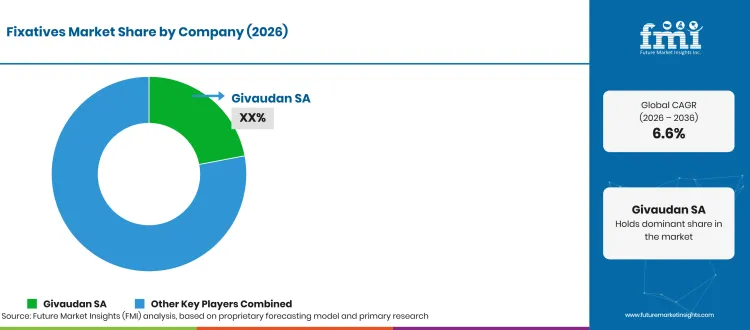
Notable companies operating in the global fixatives market include Givaudan SA, Symrise AG, dsm-firmenich AG, International Flavors & Fragrances Inc. (IFF), BASF SE, Archroma, Merck KGaA, Thermo Fisher Scientific Inc., Croda International Plc, and Eastman Chemical Company. The top four fragrance and aroma-chemical houses account for over 55% of global perfumery fixative sales, while Archroma and Merck/Thermo Fisher lead textile and histological fixation respectively. Value sits with the houses that control both molecule supply and extraction assets, since perfume compounding and textile wet processing buy on different specifications from the same chemical base.
How Are Companies Positioned in the Fixatives Market?
Suppliers compete across three specialized verticals: integrated fragrance and aroma-molecule leaders (Givaudan SA, Symrise AG, dsm-firmenich AG, IFF, BASF SE, Croda International Plc), textile wet-processing chemical specialists (Archroma), and clinical pathology and life-science reagent manufacturers (Merck KGaA, Thermo Fisher Scientific Inc.). Fragrance leaders are backward-integrating into Grasse botanical extraction and Indian macrocyclic musk synthesis (Givaudan SA, February 2026; Symrise AG, September & October 2026), while Archroma (March & April 2026) is expanding sustainable textile finishing across European and Vietnamese apparel hubs. Buyers compare a supplier by vertical, since a perfume qualification rarely travels to a dye house.
What Matters When a Buyer Selects a Fixative Supplier?
Perfumery and personal-care buyers evaluate suppliers on vapor-pressure curves, IFRA 51st Amendment compliance and biodegradability with water-based or high-electrolyte bases. In textile finishing, apparel brands and mills require zero free formaldehyde (complying with EU REACH Appendix 14 and Oeko-Tex standards), phenolic-free non-yellowing performance on polyamide, and wash durability across 20+ laundering cycles (Mota et al., July 2026; Martínez-González et al., August 2026). In clinical pathology, hospital labs prioritize lot-to-lot pH stability (pH 7.2 to 7.4) in neutral-buffered formalin and leak-proof specimen transport (Yamamoto et al., March 2025).
Which Capabilities Distinguish Product Offers?
Proprietary solubilization, microencapsulation, solvent-free botanical extraction and formaldehyde-free crosslinking chemistries are how leading suppliers differentiate. IFF's AQUASCENT (International Flavors & Fragrances Inc., September 2026) enables 10% to 25% fragrance loading in water-based perfumes, Givaudan SA (July 2026) uses Microcaps AG microfluidic encapsulation for alcohol-free fine fragrances, dsm-firmenich AG (September 2026) deploys Firgood solvent-free electromagnetic extraction, and Archroma (April 2026) offers NYLOFIXAN PA LIQ C phenolic-free polyamide fixatives.
How Does Geographic Reach Affect Competition?
Fragrance fixatives require dual proximity: natural extraction assets near botanical harvests in Grasse, France (Givaudan's Campus 52 and Symrise's Lautier 1795) and large-scale chemical synthesis in India and the United States (Symrise's Globalide expansion in India). Conversely, textile dye fixatives and histological formalin solutions are heavier liquid formulations that rely on regional manufacturing near Asian apparel mills, such as Archroma's SaigonTex 2026 expansion in Vietnam (Archroma, March 2026), and regional bioprocessing hubs such as Merck's EUR 300 million Daejeon center in South Korea (Merck KGaA, October 2026).
| Verified Company Evidence (2025 to 2026) | Commercial Effect | Buyer Action |
|---|---|---|
| 17 February 2026 & 7 July 2026: Givaudan SA invested CHF 55 million in Campus 52 in Grasse and partnered with Microcaps AG for alcohol-free fragrance microencapsulation (Givaudan SA, February & July 2026). | Expands captive supply of Grasse natural resinoids/absolutes and scales precision core-shell microcapsules for water-based fine fragrances. | Co-develop alcohol-free and high-naturality eau de parfum lines using microencapsulated and Grasse-sourced fixatives. |
| 22 September 2026 & 15 October 2026: Symrise AG opened its new Lautier 1795 natural site in Grasse and expanded world-scale Globalide biodegradable musk capacity in India (Symrise AG, September & October 2026). | Secures biodegradable macrocyclic musk fixative volume alongside traceable French botanical extracts. | Replace legacy polycyclic musks with biodegradable macrocyclic musks (Globalide) under multi-year supply agreements. |
| 30 September 2026: IFF launched AQUASCENT water-based fragrance technology supporting 10% to 25% oil loading, while dsm-firmenich debuted Muguet Firgood at Beautyworld Middle East (IFF, September 2026; dsm-firmenich AG, September 2026). | Eliminates ethanol cloudiness and rapid scent fade in water-based fine fragrances and introduces 100% natural solvent-free floral extracts. | Reformulate alcohol-free mists and Middle Eastern luxury blends using high-load water-based solubilizers and Firgood extracts. |
| 14 April 2026 & 29 October 2026: Archroma launched phenolic-free NYLOFIXAN PA LIQ C and formaldehyde-free APPRETAN FFX at Techtextil 2026, and Merck KGaA opened its EUR 300 million Daejeon center (Archroma, April 2026; Merck KGaA, October 2026). | Enables EU REACH Appendix 14 formaldehyde compliance in textiles and strengthens Asia-Pacific life-science reagent supply. | Transition polyamide and cotton wet-finishing baths to phenolic-free/formaldehyde-free cationic fixatives ahead of August 2026 EU limits. |
Source: Verified corporate disclosures and Future Market Insights analysis, 2026.
| Company | Core Positioning | Verified Activity & Source Attribution |
|---|---|---|
| Givaudan SA | Global leader in fine-fragrance captive fixatives, Grasse natural resinoids (House of Naturals), and microencapsulated scent systems | Reported 2025 sales of CHF 7,472 million (+5.1% LFL) with Fine Fragrance up 18.3% LFL (Givaudan SA, January 2026); invested CHF 55 million in Campus 52 in Grasse (February 2026) and partnered with Microcaps AG (July 2026). |
| Symrise AG | Biodegradable macrocyclic musk fixatives (Globalide, Ambroxid), aroma molecules, and Grasse natural extracts (Lautier 1795) | Reported H1 2026 sales of EUR 2,539 million (+4.5% Q2 organic growth) and binding offer for Floral Concept (Symrise AG, July 2026); opened new Lautier 1795 Grasse site (September 2026) and expanded Globalide in India (October 2026). |
| dsm-firmenich AG | Captive synthetic fixatives (Hedione, Clearwood, Ambrox) and solvent-free natural extracts (Firgood) | Showcased Muguet Firgood 100% natural solvent-free extract and 3D Skin-Mapping technology at Beautyworld Middle East 2026 in Dubai (dsm-firmenich AG, September 2026). |
| International Flavors & Fragrances Inc. (IFF) | Aroma molecules, amber and musk fixatives, and water-based fragrance delivery platforms (AQUASCENT) | Launched AQUASCENT water-based fragrance technology on September 30, 2026, enabling crystal-clear 10% to 25% fragrance oil loading without ethanol (IFF, September 2026). |
| Archroma | Global leader in cationic textile dye-fixing agents (Optifix, Nylofixan) and formaldehyde-free crosslinking binders (Appretan) | Debuted at SaigonTex 2026 in Vietnam (Archroma, March 2026); launched phenolic-free NYLOFIXAN PA LIQ C and formaldehyde-free APPRETAN FFX at Techtextil 2026 (Archroma, April 2026); Optifix EC liq. C validated by Mota et al. (July 2026). |
| Merck KGaA (MilliporeSigma) | Histopathology tissue fixatives (neutral-buffered formalin, Bouin's, non-aldehyde fixatives) and life-science process liquids | Generated EUR 21,102 million in 2025 group sales (+3.1% organic) and EUR 8,980 million in Life Science (Merck KGaA, March 2026); opened EUR 300 million Daejeon center in South Korea on October 29, 2026 (Merck KGaA, October 2026). |
| Croda International Plc | Specialty beauty actives, fragrance fixative emollients, and controlled-release personal-care and home-care ingredients | Reported Q3 2026 sales of GBP 449.9 million (+6.6% organic), with Consumer Care up 10.8% organically (Beauty Actives +19%, Beauty Care +13%, Home Care +10%, F&F +4%) (Croda International Plc, October 2026). |
| Thermo Fisher Scientific Inc. | Anatomical pathology prefilled formalin containers, alcohol-based fixatives, and biopsy diagnostic workflows | Published clinical guidance on 2025 ESsCD adult celiac diagnostic protocols requiring standardized multi-site duodenal biopsy fixation in November 2025 (Thermo Fisher Scientific Inc., November 2025). |
| BASF SE | Aroma ingredients, cosmetic polymers (Luviskol, Ultrahold), and circular polyamide textile chemistry (loopamid) | Partnered with Lindex in May 2026 to commercialize GRS-certified loopamid 100% textile-to-textile recycled polyamide 6 for lingerie (BASF SE, May 2026). |
| Eastman Chemical Company | High-purity fixative esters (Eastman Sustane, triethyl citrate, sucrose acetate isobutyrate) for fragrances and cosmetics | Delivered Q3 2026 sales of USD 2,385 million (+8% YoY), with Additives & Functional Products revenue rising 9% YoY on strong specialty ester and additive pricing (Eastman Chemical Company, October 2026). |
Source: Verified corporate disclosures and Future Market Insights analysis, 2026.
Fixatives Market Report Scope and Research Methodology
Future Market Insights sizes the global fixatives market by reconciling merchant sales of fragrance fixative molecules, botanical resinoids, textile dye-fixing agents, and histological tissue fixatives against downstream production in fine perfumery, personal care, apparel wet finishing, and clinical pathology laboratories. Bottom-up build starts with producer shipment records and formulation inclusion rates for each fixative chemistry, then cross-checks against downstream output of perfumes, textiles, and clinical reagent kits so that channel inventory does not double count. Top-down validation applies official retail and chemical production statistics for the countries where compounding activity is concentrated. Valuations are expressed in current U.S. dollars at manufacturer realization across 2025 historical, 2026 estimated, and 2026 to 2036 forecast periods, cross-validated against audited corporate segment filings, European and U.S. chemical agency publications, and peer-reviewed analytical studies.
| Coverage Field | Report Scope |
|---|---|
| Market definition | Chemical and botanical substances engineered to retard volatile evaporation in fragrances, immobilize dyes on textile fibers, or preserve cellular and antigenic structure in biological specimens. |
| Fixative types covered | Synthetic fixatives (macrocyclic and polycyclic musks, ambroxide, fixative esters), natural and botanical fixatives (resinoids, benzoin, labdanum, orris, vetiver), and crosslinking and polymeric fixatives (cationic polyamines, neutral-buffered formalin, and non-aldehyde tissue fixatives). |
| Applications covered | Fine fragrances and perfumery, personal care and cosmetics, textile dyeing and finishing, histopathology and clinical diagnostics, and household and fabric care. |
| Physical forms covered | Liquid and solution fixatives, solid, crystalline and resinoid fixatives, and microencapsulated and controlled-release systems. |
| Exclusions | Bulk denatured carrier ethanol, unformulated top-note essential oils lacking fixative function, unbuffered commodity bulk formaldehyde for wood-panel resins, and general packaging adhesives. |
| Quantitative units | USD million for value at manufacturer (ex-works) realization. |
| Base, estimated, and forecast years | 2025 (historical benchmark), 2026 (estimated base year), and 2026 to 2036 (10-year forecast period). |
| Regions covered | North America, Europe, East Asia, Latin America, South Asia and Pacific, and Middle East and Africa. |
| National coverage | United States, China, France, Germany, United Kingdom, South Korea, Brazil, Mexico, Canada, plus regional aggregations. |
| Companies covered | Givaudan SA, Symrise AG, dsm-firmenich AG, International Flavors & Fragrances Inc. (IFF), BASF SE, Archroma, Merck KGaA, Thermo Fisher Scientific Inc., Croda International Plc, and Eastman Chemical Company. |
Source: Future Market Insights analysis of the fixatives market, 2026.
Research Sources and Bibliography
- Archroma. (2026, March 31). Archroma to present sustainable textile innovations at SaigonTex 2026.
- Archroma. (2026, April 14). Archroma showcases innovations delivering performance without compromise at Techtextil 2026. https://www.archroma.com/press-releases/archroma-brings-its-no-compromise-philosophy-to-techtextil-2026
- BASF SE. (2026, May 20). Lindex and BASF partner to bring textile-to-textile recycled polyamide to lingerie sector.
- Cosmetics Europe. (2026, October). Socio-economic contribution of the European cosmetics industry and consumer perception study 2026. https://cosmeticseurope.eu/wp-content/uploads/2026/10/CE-Socio-Ec-Infographic-2026-4.pdf
- Croda International Plc. (2026, October). Third quarter 2026 sales update.
- dsm-firmenich AG. (2026, September 28). dsm-firmenich returns to Beautyworld Middle East 2026 with Flowers Are Watching Us. https://our-company.dsm-firmenich.com/en/our-company/news/trade-news/2026/dsm-firmenich-returns-to-beautyworld-middle-east-2026-with-flowers-are-watching-us.html
- Eastman Chemical Company. (2026, October 29). Eastman announces third-quarter 2026 financial results.
- European Chemicals Agency. (2025, May 14). ECHA Weekly - 14 May 2025: New guideline for measuring formaldehyde releases and concentrations. https://echa.europa.eu/view-article/-/journal_content/title/echa-weekly-14-may-2025
- Givaudan SA. (2026, January 29). 2025 full year results. https://www.givaudan.com/media/media-releases/2026/2025-full-year-results
- Givaudan SA. (2026, February 17). Givaudan to invest CHF 55 million in Grasse, France to build Campus 52, its new centre of excellence dedicated to House of Naturals organisation. https://www.givaudan.com/media/media-releases/2026/givaudan-to-invest-in-campus-52
- Givaudan SA. (2026, July 7). Givaudan announces strategic collaboration with Microcaps. https://www.givaudan.com/media/media-releases/2026/givaudan-announces-strategic-collaboration-with-microcaps
- International Flavors & Fragrances Inc. (2026, September 30). IFF introduces AQUASCENT: Advanced water-based fragrance technology. https://www.iff.com/media/news/iff-introduces-aquascent-advanced-water-based-fragrance-technology/
- Martínez-González, I., Gisbert-Payá, J., Marin, M. L., Delgado, S. G., García-Lainez, G., Bonet-Aracil, M., Bosca, F., Ayala, I., Mateos-Pujante, A., Moya, P., Blazquez-Moraleja, A., & Andreu, I. (2026, August 10). Light-driven antimicrobial cotton fabric: Multilayer dye-finishing design and hospital environment validation. ACS Applied Materials & Interfaces, 18(32), 43747-43759. https://pubs.acs.org/aamick/article/18/32/43747/5251680/Light-Driven-Antimicrobial-Cotton-Fabric
- Mežaraupe, L., Romanovska-Dzalbe, E., Kecko, S., Kirjušina, M., Pavlova, V., Kirilova, E., & Rubenina, I. (2026, October 8). Recent advances in the application of anthrone-based fluorescent sensors for helminth imaging. Chemosensors, 14(10), 224. https://www.mdpi.com/2227-9040/14/10/224
- Merck KGaA. (2026, March 5). Merck: Guidance for 2025 delivered, growth foundation in place. https://www.merckgroup.com/en/news/q4-2025-05-03-2026.html
- Merck KGaA. (2026, October 29). Merck opens EUR 300 million Asia-Pacific Bioprocessing Center in Daejeon, South Korea. https://www.merckgroup.com/en/news/daejeon-center-29-10-2026.html
- Mota, M., Fernandes, A. M., & Silva, C. J. (2026, July 4). Bio-based finishes for the development of functional cotton knitted fabrics. Coatings, 16(7), 800. https://www.mdpi.com/2079-6412/16/7/800
- Statistics Canada. (2026, September 14). The Daily: Monthly Survey of Manufacturing, July 2026. https://www150.statcan.gc.ca/n1/daily-quotidien/260914/dq260914b-eng.htm
- Symrise AG. (2026, July 30). Symrise reports solid H1 2026 performance with accelerating growth momentum in Q2. https://www.symrise.com/newsroom/article/symrise-reports-solid-h1-2026-performance-with-accelerating-growth-momentum-in-q2/
- Symrise AG. (2026, September 22). Symrise strengthens natural fragrance ecosystem with new Lautier 1795 site in Grasse. https://www.symrise.com/newsroom/article/symrise-strengthens-natural-fragrance-ecosystem-with-new-lautier-1795-site-in-grasse/
- Symrise AG. (2026, October 15). Symrise expands global production platform for sustainable musk fragrance ingredient. https://www.symrise.com/newsroom/article/symrise-expands-global-production-platform-for-sustainable-musk-fragrance-ingredient/
- Thermo Fisher Scientific Inc. (2025, November). 2025 ESsCD guidelines: Updates in adult celiac disease diagnosis. https://www.thermofisher.com/celiac/wo/en/resources/news/2025-esscd-guidelines-in-adult-celiac-diagnosis.html
- U.S. Census Bureau. (2026, March 5). Chemical manufacturers produce everything from medicine to fertilizer. https://www.census.gov/library/stories/2026/03/chemical-manufacturing.html
- U.S. Environmental Protection Agency. (2025, December). Revised draft human health risk assessment for formaldehyde CASRN 50-00-0. https://www.epa.gov/system/files/documents/2025-12/7-formaldehyde-revised-draft-human-health-risk-assessment-for-formaldehyde-public-release-december-2025.pdf
- Yamamoto, S., Kinoshita, Y., Kume, H., Kimura, T., Yokoo, T., & Kobayashi, E. (2025, March 31). Proposal of a safe transport protocol and its utility of antigen-preserving tissue for formalin-fixed porcine renal samples. Biomedicines, 13(4), 831. https://www.mdpi.com/2227-9059/13/4/831
Table of Content
- Key Takeaways
- Market Size and CAGR
- Top Growth Driver
- Fastest Growing Segment
- Leading Region
- Key Companies
- Emerging Opportunities
- Executive Summary
- Global Market Outlook
- Demand-side Trends
- Supply-side Trends
- Technology Roadmap Analysis
- Analysis and Recommendations
- Analyst Perspective (What is happening? Why now? What should investors know?)
- Key Questions Answered
- How large is the market?
- What is the CAGR?
- What are key trends?
- Which region dominates?
- Who are the leaders?
Read More...
- Market Overview
- Market Coverage / Taxonomy
- Market Definition / Scope / Limitations
- Research Methodology
- Chapter Orientation
- Analytical Lens and Working Hypotheses
- Market Structure, Signals, and Trend Drivers
- Benchmarking and Cross-market Comparability
- Market Sizing, Forecasting, and Opportunity Mapping
- Research Design and Evidence Framework
- Desk Research Programme (Secondary Evidence)
- Expert Input and Fieldwork (Primary Evidence)
- Tooling, Models, and Reference Databases
- Data Engineering and Model Build
- Quality Assurance and Audit Trail
- Market Background
- Market Dynamics (Drivers, Restraints, Opportunity, Trends)
- Scenario Forecast (Optimistic, Likely, Conservative)
- Impact Analysis
- AI Impact
- Sustainability Impact
- Regulatory Impact
- Technology Impact
- Consumer / Buyer Analysis
- Purchase Drivers
- Adoption Barriers
- Buyer Journey
- Opportunity Map Analysis
- Product Life Cycle Analysis
- Supply Chain Analysis
- Investment Feasibility Matrix
- Value Chain Analysis
- PESTLE and Porter's Analysis
- Regulatory Landscape
- Regional Parent Market Outlook
- Production and Consumption Statistics
- Import and Export Statistics
- Global Market Analysis and Forecast, 2021 to 2036
- Historical Market Size Value (USD Million) Analysis, 2021 to 2025
- Current and Future Market Size Value (USD Million) Projections, 2026 to 2036
- Y-o-Y Growth Trend Analysis
- Absolute $ Opportunity Analysis
- Global Market Pricing Analysis, 2021 to 2036
- Global Market Analysis and Forecast, By Fixative Type, 2021 to 2036
- Introduction / Key Findings
- Historical Market Size Value (USD Million) Analysis By Fixative Type, 2021 to 2025
- Current and Future Market Size Value (USD Million) Analysis and Forecast By Fixative Type, 2026 to 2036
- Synthetic Fixatives (Macrocyclic/Polycyclic Musks
- Ambroxide
- Esters)
- Natural & Botanical Fixatives (Resinoids
- Benzoin
- Labdanum
- Orris
- Vetiver)
- Crosslinking & Polymeric Fixatives (Cationic Polyamines
- Aldehyde/Non-Aldehyde Tissue Fixatives)
- Y-o-Y Growth Trend Analysis By Fixative Type, 2021 to 2025
- Absolute $ Opportunity Analysis By Fixative Type, 2026 to 2036
- Global Market Analysis and Forecast, By Application, 2021 to 2036
- Introduction / Key Findings
- Historical Market Size Value (USD Million) Analysis By Application, 2021 to 2025
- Current and Future Market Size Value (USD Million) Analysis and Forecast By Application, 2026 to 2036
- Fine Fragrances & Perfumery
- Personal Care & Cosmetics
- Textile Dyeing & Finishing
- Histopathology & Clinical Diagnostics
- Household & Fabric Care
- Y-o-Y Growth Trend Analysis By Application, 2021 to 2025
- Absolute $ Opportunity Analysis By Application, 2026 to 2036
- Global Market Analysis and Forecast, By Physical Form, 2021 to 2036
- Introduction / Key Findings
- Historical Market Size Value (USD Million) Analysis By Physical Form, 2021 to 2025
- Current and Future Market Size Value (USD Million) Analysis and Forecast By Physical Form, 2026 to 2036
- Liquid & Solution Fixatives
- Solid
- Crystalline & Resinoid Fixatives
- Microencapsulated & Controlled-Release Systems
- Y-o-Y Growth Trend Analysis By Physical Form, 2021 to 2025
- Absolute $ Opportunity Analysis By Physical Form, 2026 to 2036
- Global Market Analysis and Forecast, By Region, 2021 to 2036
- Introduction
- Historical Market Size Value (USD Million) Analysis By Region, 2021 to 2025
- Current Market Size Value (USD Million) Analysis and Forecast By Region, 2026 to 2036
- North America
- Western Europe
- East Asia
- South Asia and Pacific
- Market Attractiveness Analysis By Region
- North America Market Analysis and Forecast, By Country, 2021 to 2036
- Historical Market Size Value (USD Million) Trend Analysis By Market Taxonomy, 2021 to 2025
- Market Size Value (USD Million) Forecast By Market Taxonomy, 2026 to 2036
- By Country
- United States
- Canada
- By Fixative Type
- By Application
- By Physical Form
- By Country
- Market Attractiveness Analysis
- By Country
- By Fixative Type
- By Application
- By Physical Form
- Key Takeaways
- Western Europe Market Analysis and Forecast, By Country
- Historical Market Size Value (USD Million) Trend Analysis By Market Taxonomy, 2021 to 2025
- Market Size Value (USD Million) Forecast By Market Taxonomy, 2026 to 2036
- By Country
- United Kingdom
- Germany
- France
- By Fixative Type
- By Application
- By Physical Form
- By Country
- Market Attractiveness Analysis
- By Country
- By Fixative Type
- By Application
- By Physical Form
- Key Takeaways
- East Asia Market Analysis and Forecast, By Country
- Historical Market Size Value (USD Million) Trend Analysis By Market Taxonomy, 2021 to 2025
- Market Size Value (USD Million) Forecast By Market Taxonomy, 2026 to 2036
- By Country
- China
- Japan
- South Korea
- By Fixative Type
- By Application
- By Physical Form
- By Country
- Market Attractiveness Analysis
- By Country
- By Fixative Type
- By Application
- By Physical Form
- Key Takeaways
- South Asia and Pacific Market Analysis and Forecast, By Country
- Historical Market Size Value (USD Million) Trend Analysis By Market Taxonomy, 2021 to 2025
- Market Size Value (USD Million) Forecast By Market Taxonomy, 2026 to 2036
- By Country
- India
- Australia
- Rest of world aggregate
- By Fixative Type
- By Application
- By Physical Form
- By Country
- Market Attractiveness Analysis
- By Country
- By Fixative Type
- By Application
- By Physical Form
- Key Takeaways
- Key Countries Market Analysis
- United States
- Pricing Analysis
- Market Share Analysis, 2025
- By Fixative Type
- By Application
- By Physical Form
- Canada
- Pricing Analysis
- Market Share Analysis, 2025
- By Fixative Type
- By Application
- By Physical Form
- Germany
- Pricing Analysis
- Market Share Analysis, 2025
- By Fixative Type
- By Application
- By Physical Form
- United Kingdom
- Pricing Analysis
- Market Share Analysis, 2025
- By Fixative Type
- By Application
- By Physical Form
- France
- Pricing Analysis
- Market Share Analysis, 2025
- By Fixative Type
- By Application
- By Physical Form
- India
- Pricing Analysis
- Market Share Analysis, 2025
- By Fixative Type
- By Application
- By Physical Form
- China
- Pricing Analysis
- Market Share Analysis, 2025
- By Fixative Type
- By Application
- By Physical Form
- Japan
- Pricing Analysis
- Market Share Analysis, 2025
- By Fixative Type
- By Application
- By Physical Form
- South Korea
- Pricing Analysis
- Market Share Analysis, 2025
- By Fixative Type
- By Application
- By Physical Form
- Australia
- Pricing Analysis
- Market Share Analysis, 2025
- By Fixative Type
- By Application
- By Physical Form
- United States
- Market Structure Analysis
- Competition Dashboard
- Competition Benchmarking
- Market Share Analysis of Top Players
- By Regional
- By Fixative Type
- By Application
- By Physical Form
- Emerging Startups
- Innovation Benchmarking
- Competition Analysis
- Competition Deep Dive
- Givaudan SA
- Overview
- Product Portfolio
- Profitability by Market Segments
- Sales Footprint
- Strategy Overview
- Marketing Strategy
- Product Strategy
- Channel Strategy
- Symrise AG
- dsm-firmenich AG
- International Flavors & Fragrances Inc. (IFF)
- Archroma
- Merck KGaA (MilliporeSigma)
- Croda International Plc
- Thermo Fisher Scientific Inc.
- BASF SE
- Eastman Chemical Company
- Givaudan SA
- Case Studies
- Success Stories
- Recent Developments
- Competition Deep Dive
- Assumptions & Acronyms Used
List of Tables
- Table 1: Global Market Value (USD Million) Forecast by Region, 2021 to 2036
- Table 2: Global Market Value (USD Million) Forecast by Fixative Type, 2021 to 2036
- Table 3: Global Market Value (USD Million) Forecast by Application, 2021 to 2036
- Table 4: Global Market Value (USD Million) Forecast by Physical Form, 2021 to 2036
- Table 5: North America Market Value (USD Million) Forecast by Country, 2021 to 2036
- Table 6: North America Market Value (USD Million) Forecast by Fixative Type, 2021 to 2036
- Table 7: North America Market Value (USD Million) Forecast by Application, 2021 to 2036
- Table 8: North America Market Value (USD Million) Forecast by Physical Form, 2021 to 2036
- Table 9: Western Europe Market Value (USD Million) Forecast by Country, 2021 to 2036
- Table 10: Western Europe Market Value (USD Million) Forecast by Fixative Type, 2021 to 2036
- Table 11: Western Europe Market Value (USD Million) Forecast by Application, 2021 to 2036
- Table 12: Western Europe Market Value (USD Million) Forecast by Physical Form, 2021 to 2036
- Table 13: East Asia Market Value (USD Million) Forecast by Country, 2021 to 2036
- Table 14: East Asia Market Value (USD Million) Forecast by Fixative Type, 2021 to 2036
- Table 15: East Asia Market Value (USD Million) Forecast by Application, 2021 to 2036
- Table 16: East Asia Market Value (USD Million) Forecast by Physical Form, 2021 to 2036
- Table 17: South Asia and Pacific Market Value (USD Million) Forecast by Country, 2021 to 2036
- Table 18: South Asia and Pacific Market Value (USD Million) Forecast by Fixative Type, 2021 to 2036
- Table 19: South Asia and Pacific Market Value (USD Million) Forecast by Application, 2021 to 2036
- Table 20: South Asia and Pacific Market Value (USD Million) Forecast by Physical Form, 2021 to 2036
List of Figures
- Figure 1: Global Market Pricing Analysis
- Figure 2: Global Market Value (USD Million) Forecast 2021-2036
- Figure 3: Global Market Value Share and BPS Analysis by Fixative Type, 2026 and 2036
- Figure 4: Global Market Y-o-Y Growth Comparison by Fixative Type, 2026-2036
- Figure 5: Global Market Attractiveness Analysis by Fixative Type
- Figure 6: Global Market Value Share and BPS Analysis by Application, 2026 and 2036
- Figure 7: Global Market Y-o-Y Growth Comparison by Application, 2026-2036
- Figure 8: Global Market Attractiveness Analysis by Application
- Figure 9: Global Market Value Share and BPS Analysis by Physical Form, 2026 and 2036
- Figure 10: Global Market Y-o-Y Growth Comparison by Physical Form, 2026-2036
- Figure 11: Global Market Attractiveness Analysis by Physical Form
- Figure 12: Global Market Value (USD Million) Share and BPS Analysis by Region, 2026 and 2036
- Figure 13: Global Market Y-o-Y Growth Comparison by Region, 2026-2036
- Figure 14: Global Market Attractiveness Analysis by Region
- Figure 15: North America Market Incremental Dollar Opportunity, 2026-2036
- Figure 16: Western Europe Market Incremental Dollar Opportunity, 2026-2036
- Figure 17: East Asia Market Incremental Dollar Opportunity, 2026-2036
- Figure 18: South Asia and Pacific Market Incremental Dollar Opportunity, 2026-2036
- Figure 19: North America Market Value Share and BPS Analysis by Country, 2026 and 2036
- Figure 20: North America Market Value Share and BPS Analysis by Fixative Type, 2026 and 2036
- Figure 21: North America Market Y-o-Y Growth Comparison by Fixative Type, 2026-2036
- Figure 22: North America Market Attractiveness Analysis by Fixative Type
- Figure 23: North America Market Value Share and BPS Analysis by Application, 2026 and 2036
- Figure 24: North America Market Y-o-Y Growth Comparison by Application, 2026-2036
- Figure 25: North America Market Attractiveness Analysis by Application
- Figure 26: North America Market Value Share and BPS Analysis by Physical Form, 2026 and 2036
- Figure 27: North America Market Y-o-Y Growth Comparison by Physical Form, 2026-2036
- Figure 28: North America Market Attractiveness Analysis by Physical Form
- Figure 29: Western Europe Market Value Share and BPS Analysis by Country, 2026 and 2036
- Figure 30: Western Europe Market Value Share and BPS Analysis by Fixative Type, 2026 and 2036
- Figure 31: Western Europe Market Y-o-Y Growth Comparison by Fixative Type, 2026-2036
- Figure 32: Western Europe Market Attractiveness Analysis by Fixative Type
- Figure 33: Western Europe Market Value Share and BPS Analysis by Application, 2026 and 2036
- Figure 34: Western Europe Market Y-o-Y Growth Comparison by Application, 2026-2036
- Figure 35: Western Europe Market Attractiveness Analysis by Application
- Figure 36: Western Europe Market Value Share and BPS Analysis by Physical Form, 2026 and 2036
- Figure 37: Western Europe Market Y-o-Y Growth Comparison by Physical Form, 2026-2036
- Figure 38: Western Europe Market Attractiveness Analysis by Physical Form
- Figure 39: East Asia Market Value Share and BPS Analysis by Country, 2026 and 2036
- Figure 40: East Asia Market Value Share and BPS Analysis by Fixative Type, 2026 and 2036
- Figure 41: East Asia Market Y-o-Y Growth Comparison by Fixative Type, 2026-2036
- Figure 42: East Asia Market Attractiveness Analysis by Fixative Type
- Figure 43: East Asia Market Value Share and BPS Analysis by Application, 2026 and 2036
- Figure 44: East Asia Market Y-o-Y Growth Comparison by Application, 2026-2036
- Figure 45: East Asia Market Attractiveness Analysis by Application
- Figure 46: East Asia Market Value Share and BPS Analysis by Physical Form, 2026 and 2036
- Figure 47: East Asia Market Y-o-Y Growth Comparison by Physical Form, 2026-2036
- Figure 48: East Asia Market Attractiveness Analysis by Physical Form
- Figure 49: South Asia and Pacific Market Value Share and BPS Analysis by Country, 2026 and 2036
- Figure 50: South Asia and Pacific Market Value Share and BPS Analysis by Fixative Type, 2026 and 2036
- Figure 51: South Asia and Pacific Market Y-o-Y Growth Comparison by Fixative Type, 2026-2036
- Figure 52: South Asia and Pacific Market Attractiveness Analysis by Fixative Type
- Figure 53: South Asia and Pacific Market Value Share and BPS Analysis by Application, 2026 and 2036
- Figure 54: South Asia and Pacific Market Y-o-Y Growth Comparison by Application, 2026-2036
- Figure 55: South Asia and Pacific Market Attractiveness Analysis by Application
- Figure 56: South Asia and Pacific Market Value Share and BPS Analysis by Physical Form, 2026 and 2036
- Figure 57: South Asia and Pacific Market Y-o-Y Growth Comparison by Physical Form, 2026-2036
- Figure 58: South Asia and Pacific Market Attractiveness Analysis by Physical Form
- Figure 59: Global Market - Tier Structure Analysis
- Figure 60: Global Market - Company Share Analysis
Frequently Asked Questions
How big is the fixatives market in 2026?
Future Market Insights estimates the global fixatives market at USD 592.5 million in 2026, up from USD 557.5 million in 2025, supported by rising extrait de parfum demand, formaldehyde-free textile finishing, and standardized clinical biopsy protocols.
How fast is the fixatives market expected to grow through 2036?
FMI projects the global fixatives market to grow at a 6.6% CAGR from 2026 to 2036, reaching USD 1,122.7 million by 2036 and generating USD 530.2 million in incremental revenue (1.89-fold expansion).
Which fixative type holds the largest market share?
Synthetic fixatives lead the global market with 46.8% of revenue in 2026 (rising to 48.2% by 2036), while natural and botanical fixatives record the fastest growth rate by type at a 7.5% CAGR through 2036.
Which application leads the global fixatives market?
Fine fragrances and perfumery represent the largest and fastest-growing application, capturing 38.4% of global revenue in 2026 and expanding at a 7.2% CAGR through 2036 on strong demand for high-oil-concentration and alcohol-free perfumes.
Which physical form is growing fastest in the fixatives market?
Liquid and solution fixatives hold the largest share at 62.5% of 2026 revenue, whereas microencapsulated and controlled-release systems grow fastest at a 7.9% CAGR from 2026 to 2036 as brands adopt microfluidic perfume capsules and water-based solubilizers.
Which countries are the largest and fastest-growing fixatives markets?
The United States is the largest national market at 21.0% global share (USD 124.4 million in 2026, rising at a 7.4% CAGR to USD 254.0 million by 2036), while South Korea (8.4% CAGR), China (8.1% CAGR), and France (7.1% CAGR) lead global growth rates.
How are formaldehyde regulations affecting the fixatives market?
The U.S. EPA's December 2025 revised draft risk assessment (0.3 ppm acute inhalation point of departure) and EU REACH Appendix 14 restrictions taking effect in August 2026 are accelerating buyer migration toward formaldehyde-free cationic polyamine textile fixatives and closed or saline/ethanol-substituted pathology workflows.
Which companies lead the global fixatives market?
Key companies include Givaudan SA, Symrise AG, dsm-firmenich AG, International Flavors & Fragrances Inc. (IFF), BASF SE, Archroma, Merck KGaA, Thermo Fisher Scientific Inc., Croda International Plc, and Eastman Chemical Company.
Preview the report firsthand - request a free sample
Get SampleGet the brochure for pricing and purchase details.
Get PDF
