

- Industry Size (2025)
- USD 2.3 Bn
- Forecast (2035)
- USD 3.7 Bn
- CAGR (2025 to 2035)
- 4.8%
Fragrance Fixatives Market Size and Share Forecast Outlook 2025 to 2035
The Fragrance Fixatives Market is estimated to be valued at USD 2.3 billion in 2025 and is projected to reach USD 3.7 billion by 2035, registering a compound annual growth rate (CAGR) of 4.8% over the forecast period. During the early adoption phase from 2020 to 2024, the market progressed from USD 1.8 billion to USD 2.2 billion. This period was characterized by experimental use in premium perfumes, personal care, and niche applications, where formulators tested novel fixative blends for enhanced fragrance longevity. Key breakpoints included initial regulatory approvals, pilot launches, and the gradual recognition of fixatives’ value in extending scent profiles, helping build consumer and industry awareness.
From 2025 to 2030, the market entered a scaling phase, expanding from USD 2.3 billion to USD 2.9 billion. Adoption accelerated as leading brands integrated fixatives across multiple product lines and optimized formulations for cost and performance. Between 2030 and 2035, the market transitioned to consolidation, reaching USD 3.7 billion. Milestones in this phase included the dominance of established players, streamlined supply chains, and wider penetration into mass-market personal care and home fragrance products. Growth became more stable, reflecting mature distribution networks, standardized product formulations, and consistent demand, marking the market as a well-established segment in the fragrance industry.
Current market dynamics reflect the profound impact of International Fragrance Association standards and European Union cosmetic regulations that have systematically eliminated or restricted many historically important fixatives. Oakmoss, long considered the gold standard for chypre fragrances, faces complete prohibition of its key allergenic components atranol and chloroatranol in European markets, forcing manufacturers to invest heavily in synthetic alternatives and reformulation programs. This regulatory pressure creates market opportunities for companies developing compliant fixative technologies while simultaneously threatening traditional suppliers of natural materials.
Manufacturing strategies demonstrate significant adaptation to compliance requirements as companies establish parallel product lines for different regulatory environments. European operations require extensive documentation, allergen testing, and formulation modifications that increase development costs and extend product launch timelines. Markets outside European jurisdiction maintain broader ingredient access but face growing pressure to adopt similar restrictions as regulatory frameworks converge toward international standards. This bifurcation influences manufacturing location decisions and supply chain strategies.
Research and development investment patterns reflect regulatory constraints as companies channel resources toward synthetic fixative development and natural ingredient modification technologies. Traditional natural fixatives undergo extensive chemical processing to remove allergenic compounds, often compromising their original performance characteristics. Synthetic alternatives receive substantial investment but struggle to replicate the complex performance profiles of natural materials, particularly their ability to enhance fragrance longevity and provide depth to compositions.
Quick Stats for Fragrance Fixatives Market
- Fragrance Fixatives Market Value (2025): USD 2.3 billion
- Fragrance Fixatives Market Forecast Value (2035): USD 3.7 billion
- Fragrance Fixatives Market Forecast CAGR: 4.8%
- Leading Segment in Fragrance Fixatives Market in 2025: Synthetic (55.6%)
- Key Growth Regions in Fragrance Fixatives Market: North America, Asia-Pacific, Europe
- Top Players in Fragrance Fixatives Market: Eastman Chemical Company, Givaudan SA, Alpha Aromatics, BMV Fragrances Private Limited, Tokos BV, Landmark Perfumes & Aromatics, Dadia Chemical Industries, Lotioncrafter LLC
Fragrance Fixatives Market Key Takeaways
| Metric | Value |
|---|---|
| Fragrance Fixatives Market Estimated Value in (2025 E) | USD 2.3 billion |
| Fragrance Fixatives Market Forecast Value in (2035 F) | USD 3.7 billion |
| Forecast CAGR (2025 to 2035) | 4.8% |
Why is the Fragrance Fixatives Market Growing?
The fragrance fixatives market is experiencing sustained growth as the industry increasingly prioritizes scent longevity, formulation stability, and multisensory appeal in both personal care and home fragrance applications. Fixatives play a crucial role in enhancing the performance of perfumes by slowing down the evaporation of volatile components and stabilizing aroma compounds over time. This market momentum is supported by a surge in demand for high-end fine fragrances, grooming products, and specialty cosmetics where consistent scent profiles are essential.
Manufacturers are focusing on innovation in fixative chemistry to align with regulatory requirements and consumer expectations regarding ingredient safety and environmental impact. The shift toward synthetic molecules with controlled olfactory release and compatibility across complex formulations has opened new pathways for scalable and cost-effective production.
Additionally, consumer interest in layered and bespoke scents is encouraging R&D investments in functional fixative systems The integration of advanced encapsulation technologies and solvent-free solutions is anticipated to further propel the market's evolution across premium and mass-market product categories.
Segmental Analysis
The fragrance fixatives market is segmented by type, product, application, and geographic regions. By type, fragrance fixatives market is divided into Synthetic and Natural. In terms of product, fragrance fixatives market is classified into Galaxolide, Sclareolide, ISO E Super, Sucrose acetate isobutyrate, Ambergris, and Civet. Based on application, fragrance fixatives market is segmented into Fine Fragrances, Homecare Fragrance, Color Cosmetics, Skincare Products, and Haircare Products. Regionally, the fragrance fixatives industry is classified into North America, Latin America, Western Europe, Eastern Europe, Balkan & Baltic Countries, Russia & Belarus, Central Asia, East Asia, South Asia & Pacific, and the Middle East & Africa.
Insights into the Synthetic Type Segment
The synthetic type segment is projected to hold 55.6% of the total revenue share in the fragrance fixatives market in 2025, establishing itself as the dominant formulation approach. This leadership has been supported by the ability of synthetic fixatives to offer consistent quality, enhanced longevity, and stability across diverse fragrance profiles.
Unlike natural alternatives, synthetic variants are engineered for precision in volatility and fixative strength, which improves their performance in complex formulations. The segment’s growth has also been influenced by lower production costs and scalability, making it a preferred choice for mass-market and premium applications alike.
In addition, the adaptability of synthetic compounds to comply with evolving safety and allergen regulations has further enhanced their acceptance among formulators and global brands. Continuous advancements in olfactory chemistry and molecule engineering have enabled the creation of highly effective synthetic fixatives with minimal environmental footprint, which is expected to reinforce further their adoption across both personal care and industrial scenting solutions.
Insights into the Galaxolide Product Segment
The Galaxolide product segment is expected to account for 39.5% of the overall revenue share in the fragrance fixatives market in 2025. Its strong market presence is attributed to its established performance as a cost-effective and versatile synthetic musk with excellent fixative properties.
Galaxolide has been widely incorporated into various personal care products, home fragrances, and detergents due to its clean, musky odor and ability to enhance scent longevity. Its stability under diverse pH conditions and compatibility with a broad range of aromatic ingredients have positioned it as a workhorse fixative in large-scale formulations.
Despite ongoing scrutiny related to environmental persistence, reformulation efforts and usage level adjustments have enabled continued adoption in compliance with regional regulations The ability of Galaxolide to perform effectively in both oil- and water-based systems has also contributed to its widespread use, particularly in cost-sensitive segments where olfactory consistency and formulation efficiency are critical.
Insights into the Fine Fragrances Application Segment
The fine fragrances application segment is forecast to capture 47.3% of the fragrance fixatives market revenue share in 2025, making it the leading area of application. This dominance is being driven by the increasing global appetite for luxury perfumes and artisanal scent products that demand superior olfactory performance and wear time. Fixatives in fine fragrances play a pivotal role in anchoring volatile top and middle notes, thereby enhancing the overall composition and sensory experience.
The segment’s expansion has been supported by rising disposable income, urbanization, and the aspirational appeal of niche and premium fragrance lines. Brands are leveraging advanced fixative technologies to achieve differentiated scent structures and long-lasting impressions, aligning with consumer expectations for value and exclusivity.
The use of controlled-release and microencapsulation delivery systems in fine fragrance formulations has further elevated the role of fixatives as performance enablers. As the market continues to move toward personalization and gender-neutral scent profiles, the importance of tailored fixative solutions in this segment is expected to grow.
What are the Drivers, Restraints, and Key Trends of the Fragrance Fixatives Market?
The fragrance fixatives market is expanding due to rising demand for long-lasting, high-quality perfumes, personal care products, and home fragrances. Fixatives stabilize volatile compounds, enhancing scent longevity and intensity in perfumes, lotions, candles, and air fresheners. Growth is driven by increasing disposable income, premiumization in personal care, and emerging markets in Asia-Pacific. Manufacturers are focusing on natural, sustainable, and allergen-free fixatives. Technological innovations in macrocyclic musks, botanical extracts, and synthetic molecules enable high-performance, customized fragrance profiles across multiple applications.
Rising Demand for Long-Lasting Perfumes and Personal Care
Consumers increasingly prefer perfumes, body sprays, and personal care products that retain fragrance over extended periods. Fragrance fixatives enhance scent retention, prevent rapid evaporation, and stabilize complex aromatic compositions. Luxury and premium product segments especially rely on high-performance fixatives to deliver consistent olfactory experiences. Manufacturers invest in high-purity natural resins, synthetic fixatives, and microencapsulation technologies to achieve longer-lasting fragrances. Until universal standards for scent retention measurement are adopted, product differentiation and consumer satisfaction depend on innovation in fixative chemistry and formulation expertise.
Shift Toward Natural and Sustainable Fixatives
Growing environmental awareness and consumer demand for clean-label products are driving the use of natural, eco-friendly, and biodegradable fragrance fixatives. Botanical resins, essential oils, and plant-derived compounds are increasingly replacing petroleum-based fixatives. Sustainability initiatives, such as traceable sourcing and reduced chemical footprint, are important for brand perception and regulatory compliance. Companies developing high-performing natural fixatives that maintain scent longevity and intensity gain competitive advantage. Until scalable, cost-effective, and high-quality natural fixatives are widely available, manufacturers must balance performance, sustainability, and pricing to meet market demand.
Innovations in Microencapsulation and Controlled Release
Technological innovations in microencapsulation, nanoparticles, and polymer-based delivery systems are transforming the fragrance fixatives market. These technologies allow controlled release of aromatic molecules, improving longevity and intensity while reducing formulation volatility. Controlled-release fixatives are increasingly used in air fresheners, laundry products, and home care items. Integration of fixatives with encapsulation ensures stability during storage and application. Companies investing in R&D to optimize release kinetics and scent profiles can create unique consumer experiences. Until these advanced technologies become standardized, innovation remains a key differentiator for premium and functional fragrance products.
Expansion in Emerging Markets and Niche Applications
Emerging economies in Asia-Pacific, Latin America, and the Middle East present high growth potential due to increasing urbanization, disposable income, and demand for luxury personal care products. Niche applications, including scented candles, aromatherapy oils, and functional fragrances, are driving adoption of specialized fixatives. Cultural preferences and regional scent trends require customized formulations. Manufacturers investing in regional market insights, localized production, and application-specific solutions can capture new segments. Until global consumer trends converge, market growth will depend on the ability to combine performance, customization, and affordability for diverse fragrance applications.
Analysis of Fragrance Fixatives Market By Key Countries
| Country | CAGR |
|---|---|
| China | 6.5% |
| India | 6.0% |
| Germany | 5.5% |
| France | 5.0% |
| UK | 4.6% |
| USA | 4.1% |
| Brazil | 3.6% |
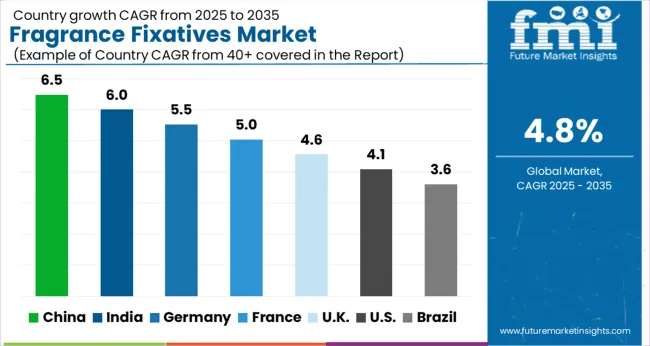
The global Fragrance Fixatives Market is projected to grow at a CAGR of 4.8% through 2035, supported by increasing demand across perfumes, personal care, and cosmetic applications. Among BRICS nations, China has been recorded with 6.5% growth, driven by large-scale production and deployment in fragrance and personal care products, while India has been observed at 6.0%, supported by rising utilization in cosmetics and perfumery. In the OECD region, Germany has been measured at 5.5%, where production and adoption for perfumes, personal care, and cosmetic applications have been steadily maintained. The United Kingdom has been noted at 4.6%, reflecting consistent use in cosmetic and fragrance products, while the USA has been recorded at 4.1%, with production and utilization across personal care, perfumes, and cosmetic sectors being steadily increased. This report includes insights on 40+ countries; the top five markets are shown here for reference.
Fragrance Fixatives Market Analysis in China
The fragrance fixatives market in China is expanding at a CAGR of 6.5%, driven by growth in the personal care, cosmetics, and household products sectors. Increasing demand for long-lasting perfumes, scented toiletries, and premium cosmetic formulations is fueling market adoption. Cosmetic and personal care brands are incorporating fragrance fixatives to enhance scent longevity and improve overall product performance. Rising disposable income and changing consumer preferences toward premium and long-lasting fragrances further support market growth. Industrial applications, including scented cleaning products and air fresheners, contribute to steady demand. Manufacturers are investing in research and development to produce environmentally friendly and sustainable fixatives. Additionally, government regulations on chemical safety and quality standards ensure high-quality production, reinforcing market stability. China’s expanding cosmetics industry and rapid urbanization create a favorable environment for fragrance fixative adoption, positioning the market for consistent growth over the forecast period.
- Demand driven by personal care and cosmetics sectors
- Fixatives enhance scent longevity in products
- R&D focuses on eco-friendly and sustainable options
Fragrance Fixatives Market Insights in India
The fragrance fixatives market in India is growing at a CAGR of 6.0%, supported by the rising personal care and cosmetics industry. Increasing awareness of long-lasting perfumes and scented toiletries is driving adoption of fragrance fixatives among consumers. Urbanization and growing disposable income encourage the purchase of premium and mid-range personal care products. Cosmetic and household product manufacturers are incorporating fixatives to improve fragrance stability, durability, and user experience. Growth in scented air fresheners, detergents, and cleaning products also contributes to market expansion. Government regulations on chemical safety and quality standards ensure consumer protection and product compliance. Indian manufacturers are investing in research to develop natural and synthetic fixatives with minimal environmental impact. Overall, the combination of rising consumer demand, industrial applications, and regulatory support creates a positive outlook for the fragrance fixatives market in India.
- Personal care industry drives fragrance fixative demand
- Urbanization increases preference for long-lasting perfumes
- Natural and synthetic fixatives gain market adoption
Fragrance Fixatives Market Review in Germany
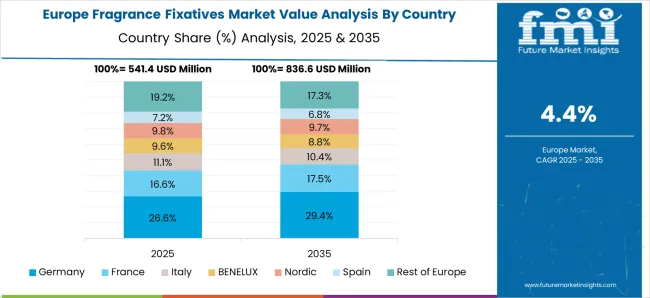
The fragrance fixatives market in Germany is expanding at a CAGR of 5.5%, driven by the personal care, cosmetic, and household product sectors. High consumer expectations for long-lasting, high-quality fragrances encourage the use of advanced fixatives. The cosmetics industry relies on fixatives to maintain scent stability and enhance overall product performance. Household cleaning products and scented air fresheners also utilize fragrance fixatives to improve consumer satisfaction. Germany’s strong focus on sustainability and environmental regulations ensures the adoption of eco-friendly fixative solutions. Manufacturers invest in research and development to create innovative products that comply with chemical safety standards and environmental requirements. Export opportunities within Europe further support market growth. The combination of technological innovation, regulatory compliance, and demand from cosmetics and household sectors ensures steady expansion of the fragrance fixatives market in Germany.
- High-quality fragrances drive fixative adoption
- Eco-friendly solutions comply with regulations
- Household and cosmetic sectors sustain market growth
Fragrance Fixatives Market Outlook in United Kingdom
The fragrance fixatives market in the United Kingdom is growing at a CAGR of 4.6%, with demand driven by personal care, cosmetics, and home fragrance products. Consumers increasingly seek long-lasting perfumes, scented toiletries, and high-performance cosmetic products. Manufacturers incorporate fixatives to improve scent stability, durability, and user experience. Household products such as air fresheners and cleaning agents also benefit from fragrance fixatives. Government regulations on chemical safety, product labeling, and environmental compliance promote high-quality production. Innovation in natural and synthetic fixatives supports the development of sustainable and eco-friendly solutions. The UK market also benefits from increasing urbanization, disposable income, and rising consumer awareness about premium fragrances. Combined with ongoing R&D investments and industry collaborations, these factors ensure continued growth and a positive outlook for the fragrance fixatives market in the United Kingdom.
- Personal care and cosmetics drive market demand
- Household products adopt fragrance fixatives widely
- Natural and eco-friendly options gain popularity
Fragrance Fixatives Market Trends in United States
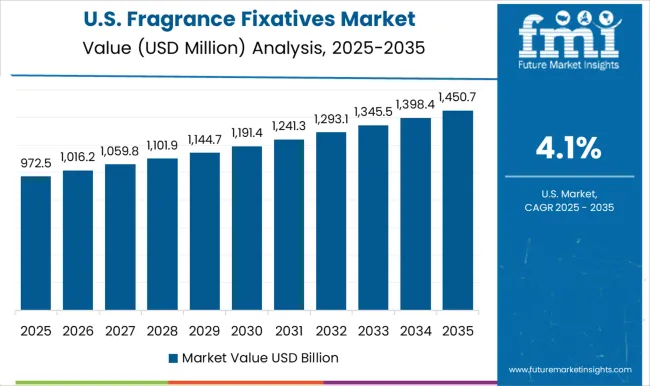
The fragrance fixatives market in the United States is expanding at a CAGR of 4.1%, driven by demand from personal care, cosmetics, and home fragrance industries. Consumers prefer long-lasting perfumes, scented toiletries, and high-quality cosmetic products, creating opportunities for fixative adoption. Household products such as air fresheners, detergents, and cleaning agents increasingly incorporate fragrance fixatives to enhance scent stability and performance. Manufacturers invest in research to develop natural, sustainable, and eco-friendly fixatives that comply with regulatory requirements. Government policies on chemical safety and environmental compliance ensure product quality and consumer protection. Technological innovation, industry collaborations, and growing consumer awareness about premium fragrances further support market growth. Overall, the combination of increasing product applications, urbanization, and regulatory support positions the fragrance fixatives market in the United States for steady expansion over the forecast period.
- Long-lasting perfumes drive consumer demand
- Household products use fixatives for scent stability
- Eco-friendly fixatives gain regulatory and consumer support
Competitive Landscape of Fragrance Fixatives Market
The Fragrance Fixatives Market is growing steadily, driven by the rising global demand for premium and long-lasting fragrances in personal care, home care, and fine perfume applications. Fragrance fixatives are essential ingredients that stabilize volatile aromatic compounds, prolonging the scent’s longevity and improving overall fragrance quality. The market’s growth is being fueled by the expanding luxury cosmetics sector, increased consumer preference for natural and sustainable ingredients, and ongoing innovation in bio-based and non-toxic fixative formulations.
Leading producers such as Eastman Chemical Company and Givaudan SA dominate the market through advanced chemical and natural fixative technologies tailored for both mass-market and high-end fragrance products. Eastman Chemical Company focuses on high-purity, sustainable fixatives derived from renewable feedstocks, ensuring enhanced scent retention and compatibility with diverse fragrance bases. Givaudan SA, a global fragrance leader, integrates proprietary fixative technologies within its fine fragrance and personal care lines, emphasizing natural ingredient sourcing and environmentally responsible chemistry.
Alpha Aromatics and BMV Fragrances Private Limited are expanding their portfolios of synthetic and natural fixatives, offering customizable solutions that balance cost-efficiency with olfactory performance. Tokos BV and Landmark Perfumes & Aromatics contribute to the European fragrance market with fixatives tailored for perfumery, incense, and body care applications, emphasizing biodegradability and compliance with IFRA and REACH standards.
Dadia Chemical Industries and Lotioncrafter LLC focus on supplying small-batch and specialty fixatives to the personal care, artisan perfume, and cosmetic formulation sectors, meeting growing demand from indie and boutique brands seeking unique scent profiles.
Market momentum is reinforced by the shift toward bio-based fixatives, such as ambroxan, sclareolide, and labdanum derivatives, driven by consumer demand for clean-label and cruelty-free fragrance products. Additionally, ongoing R&D in microencapsulation and controlled-release fragrance technologies is enabling longer-lasting scent delivery across skincare, haircare, and home fragrance categories.
Key Players in the Fragrance Fixatives Market
- Eastman Chemical Company
- Givaudan SA
- Alpha Aromatics
- BMV Fragrances Private Limited
- Tokos BV
- Landmark Perfumes & Aromatics
- Dadia Chemical Industries
- Lotioncrafter LLC
Scope of the Report
| Item | Value |
|---|---|
| Quantitative Units | USD 2.3 Billion |
| Type | Synthetic and Natural |
| Product | Galaxolide, Sclareolide, ISO E Super, Sucrose acetate isobutyrate, Ambergris, and Civet |
| Application | Fine Fragrances, Homecare Fragrance, Color Cosmetics, Skincare Products, and Haircare Products |
| Regions Covered | North America, Europe, Asia-Pacific, Latin America, Middle East & Africa |
| Country Covered | United States, Canada, Germany, France, United Kingdom, China, Japan, India, Brazil, South Africa |
| Key Companies Profiled |
Eastman Chemical Company, Givaudan SA, Alpha Aromatics, BMV Fragrances Private Limited, Tokos BV, Landmark Perfumes & Aromatics, Dadia Chemical Industries, Lotioncrafter LLC |
| Additional Attributes | Dollar sales vary by type, including natural fixatives, synthetic fixatives, and resin-based fixatives; by application, such as perfumes, personal care products, household products, and aromatherapy; by end-use industry, spanning cosmetics, toiletries, and home care; by region, led by North America, Europe, and Asia-Pacific. Growth is driven by rising demand for long-lasting fragrances, premium personal care products, and innovative scent formulations. |
Fragrance Fixatives Market by Segments
Type:
- Synthetic
- Natural
Product:
- Galaxolide
- Sclareolide
- ISO E Super
- Sucrose acetate isobutyrate
- Ambergris
- Civet
Application:
- Fine Fragrances
- Homecare Fragrance
- Color Cosmetics
- Skincare Products
- Haircare Products
Region:
- North America
- USA
- Canada
- Mexico
- Latin America
- Brazil
- Chile
- Rest of Latin America
- Western Europe
- Germany
- UK
- Italy
- Spain
- France
- Nordic
- BENELUX
- Rest of Western Europe
- Eastern Europe
- Russia
- Poland
- Hungary
- Balkan & Baltic
- Rest of Eastern Europe
- East Asia
- China
- Japan
- South Korea
- South Asia and Pacific
- India
- ASEAN
- Australia & New Zealand
- Rest of South Asia and Pacific
- Middle East & Africa
- Kingdom of Saudi Arabia
- Other GCC Countries
- Turkiye
- South Africa
- Other African Union
- Rest of Middle East & Africa
Frequently Asked Questions
How big is the fragrance fixatives market in 2025?
The global fragrance fixatives market is estimated to be valued at USD 2.3 billion in 2025.
What will be the size of fragrance fixatives market in 2035?
The market size for the fragrance fixatives market is projected to reach USD 3.7 billion by 2035.
How much will be the fragrance fixatives market growth between 2025 and 2035?
The fragrance fixatives market is expected to grow at a 4.8% CAGR between 2025 and 2035.
What are the key product types in the fragrance fixatives market?
The key product types in fragrance fixatives market are synthetic and natural.
Which product segment to contribute significant share in the fragrance fixatives market in 2025?
In terms of product, galaxolide segment to command 39.5% share in the fragrance fixatives market in 2025.
Preview the report firsthand - request a free sample
Get SampleGet the brochure for pricing and purchase details.
Get PDFTable of Content
- Executive Summary
- Global Market Outlook
- Demand-side Trends
- Supply-side Trends
- Technology Roadmap Analysis
- Analysis and Recommendations
- Market Overview
- Market Coverage / Taxonomy
- Market Definition / Scope / Limitations
- Market Background
- Market Dynamics
- Drivers
- Restraints
- Opportunity
- Trends
- Scenario Forecast
- Demand in Optimistic Scenario
- Demand in Likely Scenario
- Demand in Conservative Scenario
- Opportunity Map Analysis
- Product Life Cycle Analysis
- Supply Chain Analysis
- Investment Feasibility Matrix
- Value Chain Analysis
- PESTLE and Porter’s Analysis
- Regulatory Landscape
- Regional Parent Market Outlook
- Production and Consumption Statistics
- Import and Export Statistics
- Market Dynamics
- Global Fragrance Fixatives Market Analysis 2020-2024 and Forecast, 2025-2035
- Historical Market Size Value (USD Mn) Analysis, 2020-2024
- Current and Future Market Size Value (USD Mn) Projections, 2025-2035
- Y-o-Y Growth Trend Analysis
- Absolute $ Opportunity Analysis
- Global Fragrance Fixatives Market Pricing Analysis 2020-2024 and Forecast 2025-2035
- Global Fragrance Fixatives Market Analysis 2020-2024 and Forecast 2025-2035, By Type
- Introduction / Key Findings
- Historical Market Size Value (USD Mn) Analysis By Type , 2020-2024
- Current and Future Market Size Value (USD Mn) Analysis and Forecast By Type , 2025-2035
- Synthetic
- Natural
- Y-o-Y Growth Trend Analysis By Type , 2020-2024
- Absolute $ Opportunity Analysis By Type , 2025-2035
- Global Fragrance Fixatives Market Analysis 2020-2024 and Forecast 2025-2035, By Product
- Introduction / Key Findings
- Historical Market Size Value (USD Mn) Analysis By Product, 2020-2024
- Current and Future Market Size Value (USD Mn) Analysis and Forecast By Product, 2025-2035
- Galaxolide
- Sclareolide
- ISO E Super
- Sucrose acetate isobutyrate
- Ambergris
- Civet
- Y-o-Y Growth Trend Analysis By Product, 2020-2024
- Absolute $ Opportunity Analysis By Product, 2025-2035
- Global Fragrance Fixatives Market Analysis 2020-2024 and Forecast 2025-2035, By Application
- Introduction / Key Findings
- Historical Market Size Value (USD Mn) Analysis By Application, 2020-2024
- Current and Future Market Size Value (USD Mn) Analysis and Forecast By Application, 2025-2035
- Fine Fragrances
- Homecare Fragrance
- Color Cosmetics
- Skincare Products
- Haircare Products
- Y-o-Y Growth Trend Analysis By Application, 2020-2024
- Absolute $ Opportunity Analysis By Application, 2025-2035
- Global Fragrance Fixatives Market Analysis 2020-2024 and Forecast 2025-2035, By Region
- Introduction
- Historical Market Size Value (USD Mn) Analysis By Region, 2020-2024
- Current Market Size Value (USD Mn) Analysis and Forecast By Region, 2025-2035
- North America
- Latin America
- Western Europe
- Eastern Europe
- East Asia
- South Asia and Pacific
- Middle East & Africa
- Market Attractiveness Analysis By Region
- North America Fragrance Fixatives Market Analysis 2020-2024 and Forecast 2025-2035, By Country
- Historical Market Size Value (USD Mn) Trend Analysis By Market Taxonomy, 2020-2024
- Market Size Value (USD Mn) Forecast By Market Taxonomy, 2025-2035
- By Country
- USA
- Canada
- Mexico
- By Type
- By Product
- By Application
- By Country
- Market Attractiveness Analysis
- By Country
- By Type
- By Product
- By Application
- Key Takeaways
- Latin America Fragrance Fixatives Market Analysis 2020-2024 and Forecast 2025-2035, By Country
- Historical Market Size Value (USD Mn) Trend Analysis By Market Taxonomy, 2020-2024
- Market Size Value (USD Mn) Forecast By Market Taxonomy, 2025-2035
- By Country
- Brazil
- Chile
- Rest of Latin America
- By Type
- By Product
- By Application
- By Country
- Market Attractiveness Analysis
- By Country
- By Type
- By Product
- By Application
- Key Takeaways
- Western Europe Fragrance Fixatives Market Analysis 2020-2024 and Forecast 2025-2035, By Country
- Historical Market Size Value (USD Mn) Trend Analysis By Market Taxonomy, 2020-2024
- Market Size Value (USD Mn) Forecast By Market Taxonomy, 2025-2035
- By Country
- Germany
- UK
- Italy
- Spain
- France
- Nordic
- BENELUX
- Rest of Western Europe
- By Type
- By Product
- By Application
- By Country
- Market Attractiveness Analysis
- By Country
- By Type
- By Product
- By Application
- Key Takeaways
- Eastern Europe Fragrance Fixatives Market Analysis 2020-2024 and Forecast 2025-2035, By Country
- Historical Market Size Value (USD Mn) Trend Analysis By Market Taxonomy, 2020-2024
- Market Size Value (USD Mn) Forecast By Market Taxonomy, 2025-2035
- By Country
- Russia
- Poland
- Hungary
- Balkan & Baltic
- Rest of Eastern Europe
- By Type
- By Product
- By Application
- By Country
- Market Attractiveness Analysis
- By Country
- By Type
- By Product
- By Application
- Key Takeaways
- East Asia Fragrance Fixatives Market Analysis 2020-2024 and Forecast 2025-2035, By Country
- Historical Market Size Value (USD Mn) Trend Analysis By Market Taxonomy, 2020-2024
- Market Size Value (USD Mn) Forecast By Market Taxonomy, 2025-2035
- By Country
- China
- Japan
- South Korea
- By Type
- By Product
- By Application
- By Country
- Market Attractiveness Analysis
- By Country
- By Type
- By Product
- By Application
- Key Takeaways
- South Asia and Pacific Fragrance Fixatives Market Analysis 2020-2024 and Forecast 2025-2035, By Country
- Historical Market Size Value (USD Mn) Trend Analysis By Market Taxonomy, 2020-2024
- Market Size Value (USD Mn) Forecast By Market Taxonomy, 2025-2035
- By Country
- India
- ASEAN
- Australia & New Zealand
- Rest of South Asia and Pacific
- By Type
- By Product
- By Application
- By Country
- Market Attractiveness Analysis
- By Country
- By Type
- By Product
- By Application
- Key Takeaways
- Middle East & Africa Fragrance Fixatives Market Analysis 2020-2024 and Forecast 2025-2035, By Country
- Historical Market Size Value (USD Mn) Trend Analysis By Market Taxonomy, 2020-2024
- Market Size Value (USD Mn) Forecast By Market Taxonomy, 2025-2035
- By Country
- Kingdom of Saudi Arabia
- Other GCC Countries
- Turkiye
- South Africa
- Other African Union
- Rest of Middle East & Africa
- By Type
- By Product
- By Application
- By Country
- Market Attractiveness Analysis
- By Country
- By Type
- By Product
- By Application
- Key Takeaways
- Key Countries Fragrance Fixatives Market Analysis
- USA
- Pricing Analysis
- Market Share Analysis, 2024
- By Type
- By Product
- By Application
- Canada
- Pricing Analysis
- Market Share Analysis, 2024
- By Type
- By Product
- By Application
- Mexico
- Pricing Analysis
- Market Share Analysis, 2024
- By Type
- By Product
- By Application
- Brazil
- Pricing Analysis
- Market Share Analysis, 2024
- By Type
- By Product
- By Application
- Chile
- Pricing Analysis
- Market Share Analysis, 2024
- By Type
- By Product
- By Application
- Germany
- Pricing Analysis
- Market Share Analysis, 2024
- By Type
- By Product
- By Application
- UK
- Pricing Analysis
- Market Share Analysis, 2024
- By Type
- By Product
- By Application
- Italy
- Pricing Analysis
- Market Share Analysis, 2024
- By Type
- By Product
- By Application
- Spain
- Pricing Analysis
- Market Share Analysis, 2024
- By Type
- By Product
- By Application
- France
- Pricing Analysis
- Market Share Analysis, 2024
- By Type
- By Product
- By Application
- India
- Pricing Analysis
- Market Share Analysis, 2024
- By Type
- By Product
- By Application
- ASEAN
- Pricing Analysis
- Market Share Analysis, 2024
- By Type
- By Product
- By Application
- Australia & New Zealand
- Pricing Analysis
- Market Share Analysis, 2024
- By Type
- By Product
- By Application
- China
- Pricing Analysis
- Market Share Analysis, 2024
- By Type
- By Product
- By Application
- Japan
- Pricing Analysis
- Market Share Analysis, 2024
- By Type
- By Product
- By Application
- South Korea
- Pricing Analysis
- Market Share Analysis, 2024
- By Type
- By Product
- By Application
- Russia
- Pricing Analysis
- Market Share Analysis, 2024
- By Type
- By Product
- By Application
- Poland
- Pricing Analysis
- Market Share Analysis, 2024
- By Type
- By Product
- By Application
- Hungary
- Pricing Analysis
- Market Share Analysis, 2024
- By Type
- By Product
- By Application
- Kingdom of Saudi Arabia
- Pricing Analysis
- Market Share Analysis, 2024
- By Type
- By Product
- By Application
- Turkiye
- Pricing Analysis
- Market Share Analysis, 2024
- By Type
- By Product
- By Application
- South Africa
- Pricing Analysis
- Market Share Analysis, 2024
- By Type
- By Product
- By Application
- USA
- Market Structure Analysis
- Competition Dashboard
- Competition Benchmarking
- Market Share Analysis of Top Players
- By Regional
- By Type
- By Product
- By Application
- Competition Analysis
- Competition Deep Dive
- EastmanChemicalCompany
- Overview
- Product Portfolio
- Profitability by Market Segments (Product/Age /Sales Channel/Region)
- Sales Footprint
- Strategy Overview
- Marketing Strategy
- Product Strategy
- Channel Strategy
- Givaudan
- AlphaAromatics
- BMVFragrancesPrivateLimited
- Tokos
- LandmarkPerfumes&Aromatics
- DadiaChemicalsIndustries
- Lotioncarfter
- EastmanChemicalCompany
- Competition Deep Dive
- Assumptions & Acronyms Used
- Research Methodology


