

- Industry Size (2026)
- USD 2.033 Bn
- Forecast (2036)
- USD 4.0 Bn
- CAGR (2026 to 2036)
- 7.0%
Mango Puree Market Size, Market Forecast and Outlook By FMI
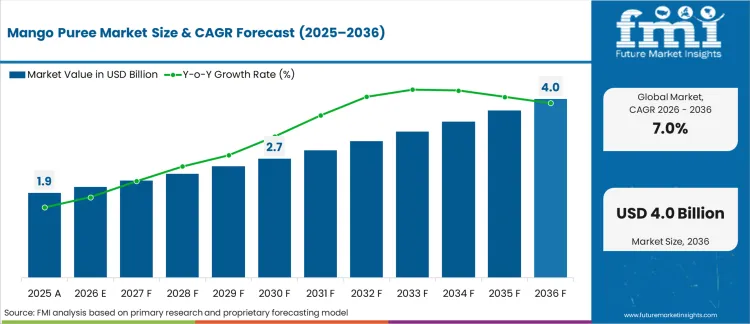
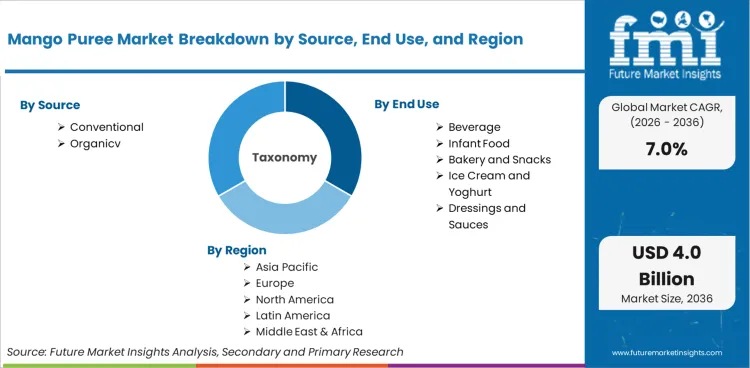
Mango puree market is expected to expand from USD 2.033 billion in 2026 to USD 4.0 billion by 2036. The market is anticipated to register a 7.0% CAGR during the forecast period. Conventional mango puree is likely to lead with a 63.4% share, while beverage applications are projected to account for 38.7% of end-use demand in 2026.
Summary of the Mango Puree Market
- Demand and Growth Drivers
- Clean-label reformulation is raising demand for fruit-based ingredients.
- Beverage brands use mango puree to replace synthetic mango flavors.
- Aseptic processing helps brands extend shelf life without preservatives.
- Infant food producers require stable purity and consistent texture.
- Product and Segment View
- Conventional puree leads due to cost efficiency and wider supply access.
- Organic variants gain traction in premium food and beverage ranges.
- Beverage use remains strongest across juices, nectars, and smoothies.
- Frozen and aseptic formats support export-oriented ingredient supply.
- Geography and Competitive Outlook
- India benefits from mango availability and rising processing capacity.
- Japan shows strong demand from dessert and foodservice applications.
- China gains from beverage manufacturing and summer drink consumption.
- Suppliers compete on aseptic capability, certifications, and fruit consistency.
- Analyst Opinion
- Nandini Roy Choudhury, Principal Consultant for Food & Beverage at Future Market Insights, opines, “Mango puree demand is moving toward traceable, preservative-free, and aseptic formats. Processors with reliable fruit sourcing and advanced packaging capacity will gain stronger access to premium beverage and infant food supply chains.”
- Mango Puree Market Value Analysis
- Mango puree demand is shifting from bulk concentrate toward premium fruit ingredients.
- Aseptic formats help suppliers serve export markets with lower cold-chain dependence.
- Beverage makers use puree to improve flavor authenticity and label clarity.
- Spending is linked to crop availability, processing capacity, and clean-label reformulation.
Key Takeaways, Market Size, and Forecast
- Mango puree market was valued at USD 1.9 billion in 2025.
- Demand is estimated to stand at USD 2.033 billion in 2026.
- By 2036, the market is forecast to attain USD 4.0 billion.
- Sales are anticipated to rise at a 7.0% CAGR during 2026 to 2036.
- Conventional mango puree is likely to hold 63.4% share by source in 2026.
- Beverage applications are projected to account for 38.7% share in 2026.
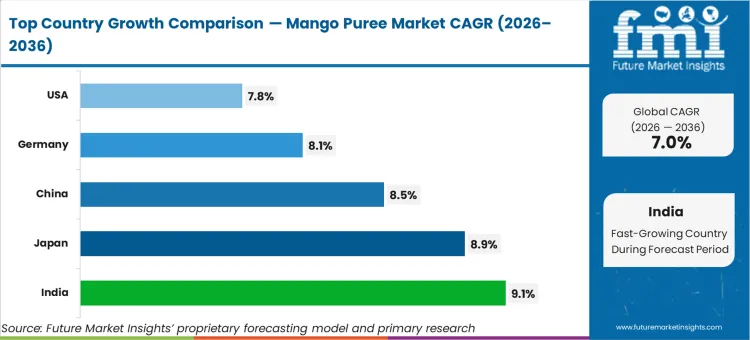
- India records the strongest country outlook with a 9.1% CAGR through 2036.
- Japan follows with an 8.9% CAGR, supported by premium foodservice demand.
India (9.1% CAGR) and Japan (8.9% CAGR) lead growth in this forecast period, with China (8.5%) and Germany (8.1%) contributing meaningfully through premium beverage and infant food applications. USA (7.8% CAGR) generates substantial replacement demand driven by clean-label reformulation across packaged food categories. Beverage end use holds the largest share at 38.7% in 2026, while conventional source format commands 63.4% of total volume. Organic formats are gaining ground as health-conscious sourcing requirements tighten in North American and European procurement channels.
Mango Puree Market Definition
The mango puree market comprises the global processing, trade, and industrial consumption of smooth, semi-liquid preparations derived from fresh ripe mangoes, produced in conventional and organic variants. These purees serve as primary flavoring and functional ingredients across beverages, infant nutrition, bakery, confectionery, dairy, and condiment applications. The market is defined by the degree of processing (fresh, aseptic, frozen, or concentrated) and source certification.
Mango Puree Market Inclusions
The report includes a comprehensive analysis of market dynamics, featuring Global and Regional Market Sizes (Volume and Value) and a 10-year Forecast (2026 to 2036). It covers segmental breakdowns by source (Conventional and Organic), end use (Beverage, Infant Food, Bakery and Snacks, Ice Cream and Yoghurt, Dressings and Sauces), processing form (aseptic, frozen, concentrated), and geography across 40-plus countries.
Mango Puree Market Exclusions
The scope excludes finished consumer-packaged mango beverages, mango-flavored confectionery, and retail fresh mango fruit unless directly incorporated as primary puree feedstock. Dehydrated mango powder and mango essence or extract products intended for fragrance or personal care applications are not covered. Agricultural-stage mango orchards, farming inputs, and upstream cultivation economics are excluded from the reportable market.
Mango Puree Market Research Methodology
- Primary Research: Interviews were conducted with mango puree processors, aseptic technology suppliers, food and beverage formulators, infant nutrition manufacturers, retail buyers, and cold chain logistics operators across key producing and consuming countries including India, Mexico, Brazil, and the United States.
- Desk Research: Production data from national food processing associations, FAOSTAT agricultural trade records, UN Comtrade HS codes for mango preparations, and industry association publications supported volume and trade benchmarking.
- Market-Sizing and Forecasting: A hybrid top-down and bottom-up model was applied. End-use consumption in beverages, infant food, and bakery was reconstructed from ingredient purchase data and manufacturer capacity disclosures, then validated against export-import trade flows.
- Data Validation and Update Cycle: Outputs undergo cross-validation against plant-level capacity announcements, retail price trend data, and structured peer review prior to release.
Key Factors Driving the Mango Puree Market
- Mango puree demand is driven by the growing preference of consumers for natural and healthful food products. Mango puree is becoming more popular due to the natural fruit-based ingredient present in a variety of food and beverage applications.
- The expansion of the market is facilitated by the globalization of food markets and the accessibility of mango puree as an adaptable component everywhere.
- Easy accessibility of mango puree has raised its demand and market presence to consumers and food makers worldwide, resulting growth in international trade and distribution channels.
- Ongoing innovation in mango puree product compositions, packaging designs, and processing methods constantly launches new goods designed to satisfy changing customer tastes and market trends.
Key Factors Hampering the Mango Puree Market
- Due to their seasonality, mango prices and availability might vary throughout the year. With a restricted supply of fresh mangoes, it becomes difficult to meet consumer demand and maintain steady production quantities during off-seasons.
- The market for mango puree is susceptible to price volatility due to variations in mango pricing brought on by variables like weather, crop production, and consumer demand. High price volatility discourages buyers and food makers from regular purchases, impeding stability and expansion of the market.
- Mango puree production presents a problem maintaining consistent quality standards, particularly regarding flavor, color, and texture.
- Variations in mango types, maturity, and processing techniques can impact the sensory qualities of the mango puree and overall acceptability on the market, which in turn can impact consumer satisfaction.
Category-wise Insights
The below section shows the leading segment. Based on the source, the organic mango puree segment is accounted to hold a market share of 65.2% in 2026. Based on end-use, the beverage segment is accounted to hold a market share of 35.3% in 2026.
As organic mango puree is produced without pesticides, uses sustainable agricultural practices, and is said to have health benefits, it is becoming increasingly popular among consumers concerned about the environment and their health.
The natural and tasty beverage market is driven by consumers growing desire for healthier substitutes for carbonated and sugary drinks.
| Category | Market Share in 2026 |
|---|---|
| Organic Mango Puree | 65.2% |
| Beverage | 38.7% |
Organic Mango Puree Segment to Hold a Significant Share in the Market
The organic mango puree market is expected to grow rapidly and reach a large market share of 65.2% by 2026. This domination results from a growing inclination toward organic food due to worries about sustainability, environmental impact, and health.
Due to natural and pesticide-free qualities, organic mango puree is in high demand among health-conscious consumers looking for healthy and environmentally responsible solutions.
Beverage Segment to Hold a Dominant Share in the Market
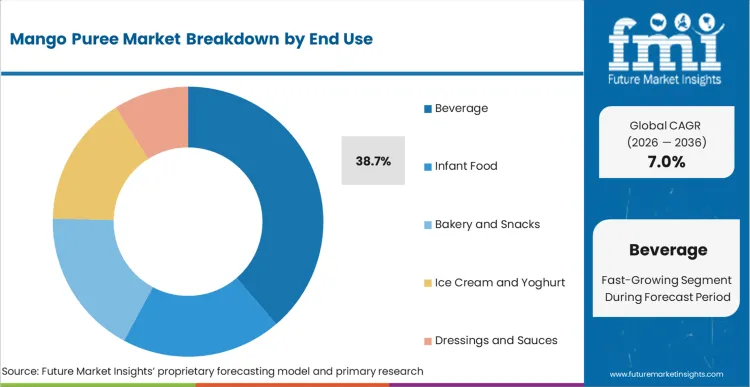
The beverage segment had a significant market share of 38.7% in terms of end-use in 2026. In the beverage business, mango puree is widely used to make juices, smoothies, nectars, and other fruit-based drinks.
With rich flavor, brilliant color, and nutritional qualities, mango puree is popular among beverage manufacturers, satisfying consumer demands for tasty and refreshing beverages. The market for mango puree is anticipated to continue growing as long as there is a growing demand for natural and healthful beverages.
Country-wise Insights
The table mentions the top five countries ranked by revenue, with India holding the top position.
India has a strong market share in the mango puree industry because of its large number of mango orchards and long agricultural history. The nation has a top mango grower with a huge range of tasty cultivars.
India is a major player in the mango puree sector, meeting a large portion of the global demand with its huge farming and processing facilities.
Forecast CAGRs from 2026 to 2036
.webp "Top Country Growth Comparison Mango Puree Market Cagr (2026 2036)")
| Countries | CAGR through 2036 |
|---|---|
| United States | 7.8% |
| Germany | 8.1% |
| China | 8.5% |
| Japan | 8.9% |
| India | 9.1% |
Diverse Culinary Applications Boost the Market in the United States
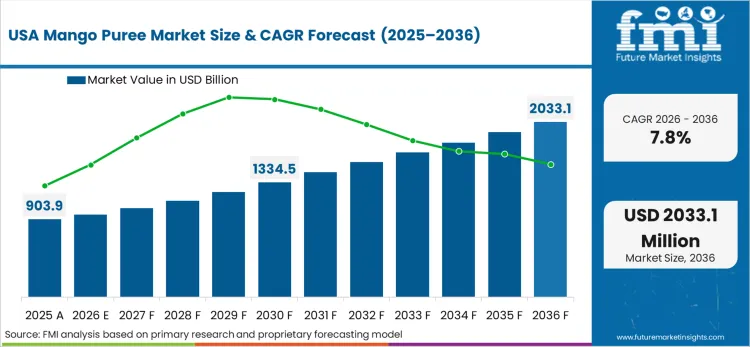
Mango puree is mostly utilized in various culinary applications in the food and beverage industry in the United States.
Mango puree caters to the wide tastes and culinary preferences of the consumers of America by adding a burst of tropical flavor to a variety of foods, including smoothies, drinks, desserts, and sauces.
Boom in the Bakery and Confectionery Industry of Germany
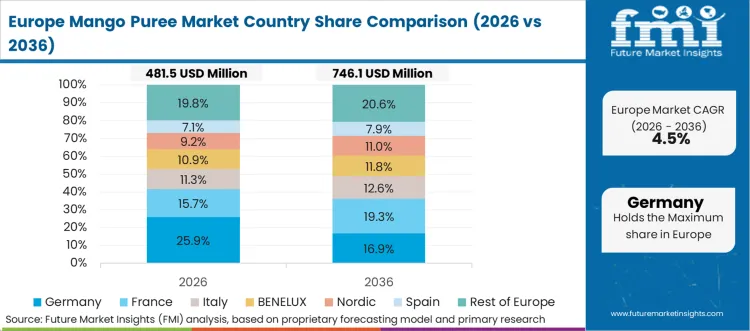
Incorporating mango puree into cakes, pastries, ice creams, and other sweet treats gives baked goods and confectionery products in the markets of Germany, a distinct flavor profile.
Mango puree is widely used in the bread and confectionery industries in Germany.
Beverage Manufacturing Sector Drives Market Growth in China
Mango puree is mostly used in the beverage production industry in China. To satisfy the consumer desire for cool, tasty beverages, particularly in the summer, mango puree is a crucial component in creating juices, nectars, and fruit-based drinks and is therefore used extensively.
Foodservice and Hospitality Sector Raises the Market in Japan
Mango puree is widely used in the food service and hospitality industries in Japan.
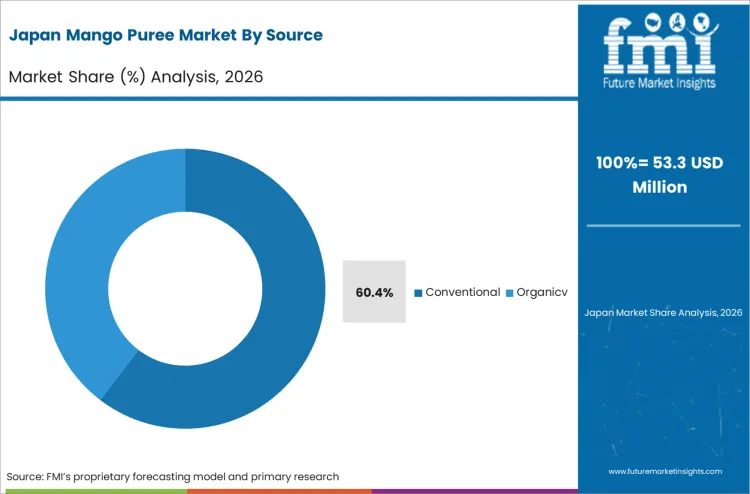
It elevates the eating experience and soothes the picky palates of the customers by being part of a wide range of dishes offered in cafes, restaurants, and hotels, from fruit salads and desserts to cocktails and mocktails.
Traditional and Modern Cuisine Holds a Pivotal Position in the Market Growth of India
Mango puree is widely used in both traditional and modern cuisines in India. Mango, being a basic component of the recipe, various condiments and drinks can be made, like mango lassi, mango pudding, and mango chutney.
Mango puree is also being used more frequently in contemporary recipes and fusion meals, reflecting diverse culinary traditions and changing dietary preferences in India.
Competitive Landscape
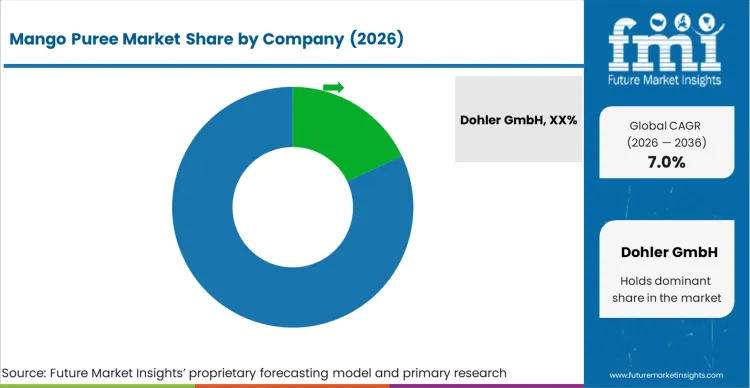
Important market players, like Kiril Mischeff, ITC Limited, Tree Top Inc., and AGRANA Beteiligungs-AG, occupy major positions in the highly competitive mango puree market. The market players provide many mango puree products for different food and drink needs.
Strong competition encourages innovation and raises quality standards that gives the access to consumers to premium mango puree options. Regional firms and niche producers also add value to the market by offering specialized goods and services.
Recent Developments
The report includes full coverage of key trends from competitive benchmarking. Some of the recent developments covered in the reports:
- In March 2025, Mother Dairy announced a strategic investment of approximately USD 70 million to expand its processing capabilities and distribution network, with a focus on scaling its Aamrus natural frozen mango pulp production to meet a 12% surge in domestic demand for preservative-free mango products. [1]
- In February 2026, Jain Irrigation unveiled a state-of-the-art Aseptic Beverages Bottling Plant with a capacity of 600 to 800 bottles per minute, enabling high-speed packaging of mango puree-based beverages without preservatives for global export markets. [2]
- In January 2026, Döhler introduced a new generation of fruit-based sweetening solutions at ISM Ingredients 2026, utilizing high-purity mango and other tropical purees in a Multi-Sensory Experience platform allowing food and beverage manufacturers to replace refined sugars while maintaining clean-label status. [3]
- In February 2026, ADM reported an 8% rise in operating profit for its Nutrition division driven by Flavor-forward investments in North America and Asia-Pacific, integrating mango-based specialty ingredients into its Nature Re-Mixed technology platform targeting multi-sensory and functional beverage sectors. [4]
Key Coverage in the Mango Puree Industry Report
- Adjacent Study on Mango Puree Market
- United States Fruit Puree Market
- Mango Purees Market Size, Current Insights, and Demographic Trends
- Global Mango Puree Sales Market
- Key Strategies in the Global Mango Puree Market
Report Scope
| Metric | Value |
|---|---|
| Quantitative Units | USD 2.033 billion (2026) to USD 4.0 billion (2036), at a CAGR of 7.0% |
| Market Definition | The mango puree market comprises the global processing, trade, and industrial consumption of smooth, semi-liquid preparations derived from fresh ripe mangoes, in conventional and organic variants, used as primary flavoring and functional ingredients in food and beverage applications. |
| Source Segmentation | Conventional, Organic |
| End Use Segmentation | Beverage, Infant Food, Bakery and Snacks, Ice Cream and Yoghurt, Dressings and Sauces |
| Application Coverage | Aseptic puree, frozen puree, concentrated puree, fresh puree |
| Regions Covered | North America, Latin America, Europe, East Asia, South Asia, Oceania, Middle East and Africa |
| Countries Covered | United States, Germany, China, Japan, India and 40 plus countries |
| Key Companies Profiled | Dohler GmbH, Kiril Mischeff, ITC Limited, Tree Top Inc, AGRANA Beteiligungs-AG |
| Forecast Period | 2026 to 2036 |
| Approach | Hybrid top-down and bottom-up market modeling validated through primary interviews with mango puree processors and food ingredient formulators, supported by FAOSTAT trade data benchmarking and plant-level capacity verification |
Key Segments
By Source:
- Organic
- Conventional
By End Use:
- Infant Food
- Beverage
- Bakery and Snacks
- Ice Cream and Yoghurt
- Dressings and Sauces
By Region:
- North America
- Latin America
- Western Europe
- Eastern Europe
- South Asia and Pacific
- East Asia
- Middle East and Africa
Bibliography
- [1] Mother Dairy Fruit and Vegetable Pvt Ltd. (2025). Strategic investment announced for expansion of Aamrus frozen mango pulp processing and distribution capabilities. Corporate Announcement, March 2025. https://www.motherdairy.com/
- [2] Jain Irrigation Systems Ltd. (2026). Aseptic Beverages Bottling Plant inauguration press release, 600 to 800 BPM capacity for preservative-free mango puree packaging. Corporate Press Release, February 2026.
- [3] Döhler GmbH. (2026). Multi-Sensory Experience platform launch featuring high-purity mango and tropical purees as clean-label sugar replacers. ISM Ingredients 2026 product announcement, January 2026.
- [4] Archer Daniels Midland Company. (2026). Full-Year 2025 Nutrition Division Results, 8% operating profit rise driven by mango-integrated Nature Re-Mixed technology platform. Investor Relations Release, February 2026.
- [5] Food and Agriculture Organization of the United Nations. FAOSTAT: Mango production and trade statistics. Rome: FAO. https://www.fao.org/faostat/
- [6] UN Comtrade. (2025). International trade statistics for mango preparations (HS 2008.99). United Nations Statistics Division. https://comtrade.un.org/
This bibliography is provided for reader reference and is not exhaustive. The full report contains the complete reference list and detailed citations.
This Report Addresses
- Market intelligence to enable structured strategic decision making across conventional and organic mango puree supply chains in mature and emerging economies
- Market size estimation and 10-year revenue forecasts from 2026 to 2036, supported by validated processing capacity and trade flow benchmarks
- Growth opportunity mapping across source formats and end-use applications with emphasis on aseptic and organic grade transitions
- Segment and regional revenue forecasts covering beverage, infant food, bakery and snacks, ice cream and yoghurt, and dressings and sauces applications
- Competition strategy assessment including processing technology positioning, cost structure analysis, and clean-label compliance benchmarking
- Product certification and compliance tracking including organic, aseptic, and clean-label specification alignment for major procurement channels
- Regulatory impact analysis covering food safety standards for mango preparations in North American, European, and Asian markets
- Market report delivery in PDF, Excel, PPT, and interactive dashboard formats for executive and operational use
Frequently Asked Questions
How large is the demand for mango puree in the global market in 2026?
Demand for mango puree in the global market is estimated to be valued at USD 2.033 billion in 2026.
What will be the market size of mango puree in the global market by 2036?
Market size for mango puree is projected to reach USD 4.0 billion by 2036.
What is the expected demand growth for mango puree in the global market between 2026 and 2036?
Demand for mango puree in the global market is expected to grow at a CAGR of 7.0% between 2026 and 2036.
Which source format leads global mango puree sales in 2026?
Conventional mango puree holds the dominant share at approximately 63.4% in 2026, driven by cost efficiency and established supply chains, though organic formats are gaining share.
Which end-use application drives the largest share of mango puree demand?
Beverage applications represent the highest-volume end use, accounting for approximately 38.7% of total mango puree consumption in 2026.
Which countries show the fastest mango puree demand growth?
India is projected to lead growth at a 9.1% CAGR through 2036, followed by Japan (8.9%) and China (8.5%), driven by expanding food processing capacity and rising health-focused consumption.
What is the role of aseptic processing in the mango puree market?
Aseptic processing enables preservative-free packaging at scale, extending shelf life for global export and making mango puree viable for premium beverage and infant food supply chains.
What does the United States market outlook look like?
The United States is projected to grow at a 7.8% CAGR through 2036, with demand driven by clean-label beverage reformulation and replacement of synthetic mango flavors in packaged food applications.
Is Japan covered in this report?
Yes, Japan is covered within the East Asia regional scope. Japan is projected to grow at an 8.9% CAGR through 2036, supported by premium food manufacturing demand for high-purity fruit ingredients.
What sourcing methodology does FMI use for this report?
The forecast uses a hybrid top-down and bottom-up model validated through primary interviews with processors and formulators, supplemented by FAOSTAT production data and UN Comtrade export records.
Preview the report firsthand - request a free sample
Get SampleGet the brochure for pricing and purchase details.
Get PDFTable of Content
- Executive Summary
- Global Market Outlook
- Demand-side Trends
- Supply-side Trends
- Technology Roadmap Analysis
- Analysis and Recommendations
- Market Overview
- Market Coverage / Taxonomy
- Market Definition / Scope / Limitations
- Research Methodology
- Chapter Orientation
- Analytical Lens and Working Hypotheses
- Market Structure, Signals, and Trend Drivers
- Benchmarking and Cross-market Comparability
- Market Sizing, Forecasting, and Opportunity Mapping
- Research Design and Evidence Framework
- Desk Research Programme (Secondary Evidence)
- Company Annual and Sustainability Reports
- Peer-reviewed Journals and Academic Literature
- Corporate Websites, Product Literature, and Technical Notes
- Earnings Decks and Investor Briefings
- Government Statistics Portals and Public Data Releases
- Press Releases and Reputable Media Coverage
- Specialist Newsletters and Curated Briefings
- Sector Databases and Reference Repositories
- FMI Internal Proprietary Databases and Historical Market Datasets
- Subscription Datasets and Paid Sources
- Social Channels, Communities, and Digital Listening Inputs
- Additional Desk Sources
- Expert Input and Fieldwork (Primary Evidence)
- Primary Modes
- Qualitative Interviews and Expert Elicitation
- Quantitative Surveys and Structured Data Capture
- Blended Approach
- Why Primary Evidence is Used
- Field Techniques
- Interviews
- Surveys
- Focus Groups
- Observational and In-context Research
- Social and Community Interactions
- Stakeholder Universe Engaged
- C-suite Leaders
- Board Members
- Presidents and Vice Presidents
- R&D and Innovation Heads
- Technical Specialists
- Domain Subject-matter Experts
- Scientists
- Physicians and Other Healthcare Professionals
- Governance, Ethics, and Data Stewardship
- Research Ethics
- Data Integrity and Handling
- Primary Modes
- Tooling, Models, and Reference Databases
- Desk Research Programme (Secondary Evidence)
- Data Engineering and Model Build
- Data Acquisition and Ingestion
- Cleaning, Normalisation, and Verification
- Synthesis, Triangulation, and Analysis
- Quality Assurance and Audit Trail
- Market Background
- Market Dynamics
- Drivers
- Restraints
- Opportunity
- Trends
- Scenario Forecast
- Demand in Optimistic Scenario
- Demand in Likely Scenario
- Demand in Conservative Scenario
- Opportunity Map Analysis
- Product Life Cycle Analysis
- Supply Chain Analysis
- Investment Feasibility Matrix
- Value Chain Analysis
- PESTLE and Porter’s Analysis
- Regulatory Landscape
- Regional Parent Market Outlook
- Production and Consumption Statistics
- Import and Export Statistics
- Market Dynamics
- Global Market Analysis 2021 to 2025 and Forecast, 2026 to 2036
- Historical Market Size Value (USD Billion) Analysis, 2021 to 2025
- Current and Future Market Size Value (USD Billion) Projections, 2026 to 2036
- Y-o-Y Growth Trend Analysis
- Absolute $ Opportunity Analysis
- Global Market Pricing Analysis 2021 to 2025 and Forecast 2026 to 2036
- Global Market Analysis 2021 to 2025 and Forecast 2026 to 2036, By Source
- Introduction / Key Findings
- Historical Market Size Value (USD Billion) Analysis By Source , 2021 to 2025
- Current and Future Market Size Value (USD Billion) Analysis and Forecast By Source , 2026 to 2036
- Conventional
- Organicv
- Conventional
- Y-o-Y Growth Trend Analysis By Source , 2021 to 2025
- Absolute $ Opportunity Analysis By Source , 2026 to 2036
- Global Market Analysis 2021 to 2025 and Forecast 2026 to 2036, By End Use
- Introduction / Key Findings
- Historical Market Size Value (USD Billion) Analysis By End Use, 2021 to 2025
- Current and Future Market Size Value (USD Billion) Analysis and Forecast By End Use, 2026 to 2036
- Beverage
- Infant Food
- Bakery and Snacks
- Ice Cream and Yoghurt
- Dressings and Sauces
- Beverage
- Y-o-Y Growth Trend Analysis By End Use, 2021 to 2025
- Absolute $ Opportunity Analysis By End Use, 2026 to 2036
- Global Market Analysis 2021 to 2025 and Forecast 2026 to 2036, By Region
- Introduction
- Historical Market Size Value (USD Billion) Analysis By Region, 2021 to 2025
- Current Market Size Value (USD Billion) Analysis and Forecast By Region, 2026 to 2036
- North America
- Latin America
- Western Europe
- Eastern Europe
- East Asia
- South Asia and Pacific
- Middle East & Africa
- Market Attractiveness Analysis By Region
- North America Market Analysis 2021 to 2025 and Forecast 2026 to 2036, By Country
- Historical Market Size Value (USD Billion) Trend Analysis By Market Taxonomy, 2021 to 2025
- Market Size Value (USD Billion) Forecast By Market Taxonomy, 2026 to 2036
- By Country
- USA
- Canada
- Mexico
- By Source
- By End Use
- By Country
- Market Attractiveness Analysis
- By Country
- By Source
- By End Use
- Key Takeaways
- Latin America Market Analysis 2021 to 2025 and Forecast 2026 to 2036, By Country
- Historical Market Size Value (USD Billion) Trend Analysis By Market Taxonomy, 2021 to 2025
- Market Size Value (USD Billion) Forecast By Market Taxonomy, 2026 to 2036
- By Country
- Brazil
- Chile
- Rest of Latin America
- By Source
- By End Use
- By Country
- Market Attractiveness Analysis
- By Country
- By Source
- By End Use
- Key Takeaways
- Western Europe Market Analysis 2021 to 2025 and Forecast 2026 to 2036, By Country
- Historical Market Size Value (USD Billion) Trend Analysis By Market Taxonomy, 2021 to 2025
- Market Size Value (USD Billion) Forecast By Market Taxonomy, 2026 to 2036
- By Country
- Germany
- UK
- Italy
- Spain
- France
- Nordic
- BENELUX
- Rest of Western Europe
- By Source
- By End Use
- By Country
- Market Attractiveness Analysis
- By Country
- By Source
- By End Use
- Key Takeaways
- Eastern Europe Market Analysis 2021 to 2025 and Forecast 2026 to 2036, By Country
- Historical Market Size Value (USD Billion) Trend Analysis By Market Taxonomy, 2021 to 2025
- Market Size Value (USD Billion) Forecast By Market Taxonomy, 2026 to 2036
- By Country
- Russia
- Poland
- Hungary
- Balkan & Baltic
- Rest of Eastern Europe
- By Source
- By End Use
- By Country
- Market Attractiveness Analysis
- By Country
- By Source
- By End Use
- Key Takeaways
- East Asia Market Analysis 2021 to 2025 and Forecast 2026 to 2036, By Country
- Historical Market Size Value (USD Billion) Trend Analysis By Market Taxonomy, 2021 to 2025
- Market Size Value (USD Billion) Forecast By Market Taxonomy, 2026 to 2036
- By Country
- China
- Japan
- South Korea
- By Source
- By End Use
- By Country
- Market Attractiveness Analysis
- By Country
- By Source
- By End Use
- Key Takeaways
- South Asia and Pacific Market Analysis 2021 to 2025 and Forecast 2026 to 2036, By Country
- Historical Market Size Value (USD Billion) Trend Analysis By Market Taxonomy, 2021 to 2025
- Market Size Value (USD Billion) Forecast By Market Taxonomy, 2026 to 2036
- By Country
- India
- ASEAN
- Australia & New Zealand
- Rest of South Asia and Pacific
- By Source
- By End Use
- By Country
- Market Attractiveness Analysis
- By Country
- By Source
- By End Use
- Key Takeaways
- Middle East & Africa Market Analysis 2021 to 2025 and Forecast 2026 to 2036, By Country
- Historical Market Size Value (USD Billion) Trend Analysis By Market Taxonomy, 2021 to 2025
- Market Size Value (USD Billion) Forecast By Market Taxonomy, 2026 to 2036
- By Country
- Kingdom of Saudi Arabia
- Other GCC Countries
- Turkiye
- South Africa
- Other African Union
- Rest of Middle East & Africa
- By Source
- By End Use
- By Country
- Market Attractiveness Analysis
- By Country
- By Source
- By End Use
- Key Takeaways
- Key Countries Market Analysis
- USA
- Pricing Analysis
- Market Share Analysis, 2025
- By Source
- By End Use
- Canada
- Pricing Analysis
- Market Share Analysis, 2025
- By Source
- By End Use
- Mexico
- Pricing Analysis
- Market Share Analysis, 2025
- By Source
- By End Use
- Brazil
- Pricing Analysis
- Market Share Analysis, 2025
- By Source
- By End Use
- Chile
- Pricing Analysis
- Market Share Analysis, 2025
- By Source
- By End Use
- Germany
- Pricing Analysis
- Market Share Analysis, 2025
- By Source
- By End Use
- UK
- Pricing Analysis
- Market Share Analysis, 2025
- By Source
- By End Use
- Italy
- Pricing Analysis
- Market Share Analysis, 2025
- By Source
- By End Use
- Spain
- Pricing Analysis
- Market Share Analysis, 2025
- By Source
- By End Use
- France
- Pricing Analysis
- Market Share Analysis, 2025
- By Source
- By End Use
- India
- Pricing Analysis
- Market Share Analysis, 2025
- By Source
- By End Use
- ASEAN
- Pricing Analysis
- Market Share Analysis, 2025
- By Source
- By End Use
- Australia & New Zealand
- Pricing Analysis
- Market Share Analysis, 2025
- By Source
- By End Use
- China
- Pricing Analysis
- Market Share Analysis, 2025
- By Source
- By End Use
- Japan
- Pricing Analysis
- Market Share Analysis, 2025
- By Source
- By End Use
- South Korea
- Pricing Analysis
- Market Share Analysis, 2025
- By Source
- By End Use
- Russia
- Pricing Analysis
- Market Share Analysis, 2025
- By Source
- By End Use
- Poland
- Pricing Analysis
- Market Share Analysis, 2025
- By Source
- By End Use
- Hungary
- Pricing Analysis
- Market Share Analysis, 2025
- By Source
- By End Use
- Kingdom of Saudi Arabia
- Pricing Analysis
- Market Share Analysis, 2025
- By Source
- By End Use
- Turkiye
- Pricing Analysis
- Market Share Analysis, 2025
- By Source
- By End Use
- South Africa
- Pricing Analysis
- Market Share Analysis, 2025
- By Source
- By End Use
- USA
- Market Structure Analysis
- Competition Dashboard
- Competition Benchmarking
- Market Share Analysis of Top Players
- By Regional
- By Source
- By End Use
- Competition Analysis
- Competition Deep Dive
- Dohler GmbH
- Overview
- Product Portfolio
- Profitability by Market Segments (Product/Age /Sales Channel/Region)
- Sales Footprint
- Strategy Overview
- Marketing Strategy
- Product Strategy
- Channel Strategy
- Kiril Mischeff
- ITC Limited
- Tree Top Inc
- AGRANA Beteiligungs-AG
- Dohler GmbH
- Competition Deep Dive
- Assumptions & Acronyms Used


