

- Industry Size (2026)
- USD 3.14 Bn
- Forecast (2036)
- USD 4.87 Bn
- CAGR (2026 to 2036)
- 4.5%
Pyruvate Market Size, Market Forecast and Outlook By FMI
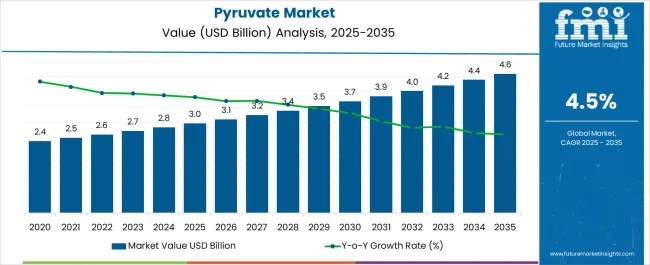
In 2025, the pyruvate market was valued at USD 3.00 billion. Based on Future Market Insights' analysis, demand for pyruvate is estimated to grow to USD 3.14 billion in 2026 and USD 4.87 billion by 2036. FMI projects a CAGR of 4.5% during the forecast period.
Absolute dollar growth of USD 1.73 billion over the decade reflects a market where established dietary supplement and food ingredient channels provide stable volume growth while pharmaceutical pyruvate kinase activator regulatory approvals are incrementally expanding the addressable pharmaceutical procurement channel. In March 2026, Agios Pharmaceuticals received approval from the Emirates Drug Establishment for PYRUKYND (mitapivat), an oral pyruvate kinase activator, to treat adults with transfusion-dependent and non-transfusion-dependent alpha- or beta-thalassemia in the United Arab Emirates, a regulatory clearance in a high-income Middle East market that extends the geographic footprint of pyruvate kinase activation therapy beyond its existing US, EU, and UK approvals. [1]
Summary of Pyruvate Market
- Pyruvate Market Definition
- The market covers globally traded sodium pyruvate, calcium pyruvate, and potassium pyruvate compounds used as dietary supplement actives for weight management and sports performance, food and beverage functional ingredients, and pharmaceutical-grade raw materials for pyruvate kinase activator and pyruvate dehydrogenase complex therapeutic manufacturing.
- Demand Drivers in the Market
- Agios Pharmaceuticals' March 2026 PYRUKYND approval by the UAE Emirates Drug Establishment for alpha- and beta-thalassemia treatment extends pyruvate kinase activator geographic coverage into the Middle East, confirming sequential international regulatory roll-out of this pyruvate-mechanism pharmaceutical class.
- FDA acceptance of Saol Therapeutics' NDA for SL1009 sodium dichloroacetate targeting pyruvate dehydrogenase complex deficiency in pediatric patients confirms that the rare disease pharmaceutical channel for pyruvate biochemistry compounds is accumulating regulatory momentum across multiple therapeutic targets.
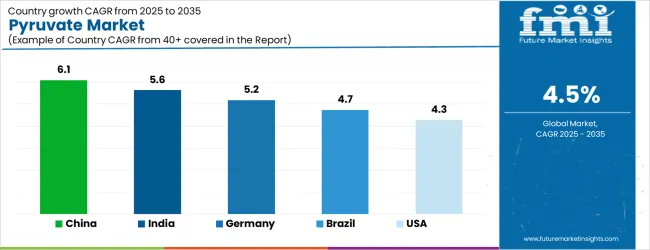
- China's 6.1% CAGR is driven by simultaneous expansion in dietary supplement manufacturing export capacity and growing domestic pharmaceutical raw material procurement, with Jinan Pengbo Biotechnology and QingDao ZhongZheng serving as key production infrastructure enablers.
- Key Segments Analyzed in the FMI Report
- End Use: Dietary Supplements capture 40.0% of demand as the leading segment, driven by weight management, sports performance recovery, and cellular energy support positioning across North American and Asia Pacific retail channels.
- Pharmaceutical Industry: Growing pharmaceutical end-use reflects sequential FDA, EMA, and regional regulatory approvals for pyruvate kinase activators and rare disease PDC deficiency therapies that are driving specialised pyruvate compound procurement.
- Geography: Japan holds USD 2.41 billion in 2026 value anchored by Musashino Chemical Laboratory's established production infrastructure and deep supplement and pharmaceutical channel integration.
- Analyst Opinion at FMI
- Nandini Roy Choudhury, Principal Consultant for Food & Beverage at Future Market Insights, opines, "In the updated version of the Pyruvate Market Report for 2026 to 2036, CXOs will find that the pharmaceutical channel's contribution to the market's 4.5% CAGR is currently underweighted relative to its strategic commercial importance. The PYRUKYND UAE approval is the fourth major market clearance for mitapivat and confirms a sequential international regulatory expansion pattern that will continue generating new pharmaceutical procurement demand in emerging markets over the forecast period. The Saol Therapeutics NDA acceptance for PDC deficiency treatment introduces a second independent pyruvate mechanism therapeutic pathway, meaning the pharmaceutical channel's demand growth is not dependent on a single drug or single indication."
- Strategic Implications / Executive Takeaways
- Qualify pharmaceutical-grade sodium pyruvate production lines to serve the growing procurement demand from PYRUKYND manufacturing and PDC deficiency therapy development as these regulatory approvals expand into additional international markets.
- Build China production partnerships with Jinan Pengbo Biotechnology and QingDao ZhongZheng to access the 6.1% CAGR growth trajectory in both export-oriented dietary supplement manufacturing and domestic pharmaceutical raw material channels.
- Monitor FDA and EMA rare disease pyruvate therapy pipeline approvals to anticipate pharmaceutical-grade pyruvate demand increases before new approvals create supply tightening.
- Methodology
- Validated through primary interviews with pyruvate manufacturers, pharmaceutical procurement specialists, and supplement formulators.
- Zero reliance on speculative third-party market research reports.
- Based on FDA, EMA, and UAE EDE regulatory approval databases, clinical trial registries, and major producer annual reports.
China leads regional growth at a 6.1% CAGR through 2036, driven by expanding dietary supplement manufacturing, pharmaceutical pyruvate raw material procurement, and growing sports nutrition ingredient demand in domestic supplement channels. Japan holds the largest individual country value at USD 2.41 billion in 2026, reflecting deep pyruvate integration across both dietary supplement and pharmaceutical channels supported by established Musashino Chemical Laboratory production infrastructure. The United States generates USD 1.08 billion in 2026 demand, anchored by dietary supplement retail, sports nutrition procurement, and pharmaceutical pyruvate kinase activator manufacturing. South Korea contributes USD 0.088 billion. Dietary Supplements capture 40.0% of end-use demand as the leading application.
Pyruvate Market Definition
The pyruvate market comprises the global production, synthesis, and distribution of pyruvate compounds including sodium pyruvate, calcium pyruvate, and potassium pyruvate used as dietary supplement active ingredients for weight management, sports performance, and antioxidant applications, as well as food and beverage functional ingredient applications and pharmaceutical-grade pyruvate raw materials used in pyruvate kinase activator drug manufacturing and pyruvate dehydrogenase complex therapy research. The market spans both biosynthetic fermentation-derived and chemical synthesis production methods distributed across supplement, food, and pharmaceutical channels.
Pyruvate Market Inclusions
The report includes global and regional market sizes by volume and value with a 10-year forecast from 2026 to 2036. Coverage spans segmental breakdowns by end use (Dietary Supplements, Food and Beverages Industry, Pharmaceutical Industry, Others). Country-level analysis covers all major pyruvate producing and consuming markets globally.
Pyruvate Market Exclusions
The scope excludes endogenous pyruvate produced within human cellular metabolism as a glycolysis intermediate, pyruvate enzyme preparations used as analytical reagents without commercial food or supplement application, and finished dietary supplement or pharmaceutical products where pyruvate is a minor formulation component below 100mg per serving. Agricultural and industrial chemical applications of pyruvate not related to food, supplement, or pharmaceutical end uses are outside scope.
Pyruvate Market Research Methodology
Primary Research
Interviews were conducted with pyruvate raw material manufacturers, dietary supplement formulators, pharmaceutical pyruvate kinase activator procurement specialists, sports nutrition brand managers, and food and beverage functional ingredient buyers across China, Japan, the United States, Germany, and the United Arab Emirates.
Desk Research
Production data from Chinese chemical manufacturer industry association reports, pharmaceutical regulatory approval databases from the FDA, EMA, and UAE EDE, clinical trial registries for pyruvate kinase activator and pyruvate dehydrogenase complex applications, dietary supplement market data, and major producer annual reports from Musashino Chemical Laboratory and Merck Life Science supported benchmarking.
Market-Sizing and Forecasting
A hybrid top-down and bottom-up model was applied. Demand was reconstructed from dietary supplement retail channel sales, food and beverage ingredient procurement volumes, and pharmaceutical pyruvate raw material import records, then validated against producer synthesis capacity and regulatory approval geographic coverage.
Data Validation and Update Cycle
Outputs undergo anomaly screening, cross-validation against pharmaceutical regulatory approval records and dietary supplement market association data, and structured peer review prior to release.
Why is the Pyruvate Market Growing?
The Pyruvate market is experiencing steady growth due to its increasing utilization in dietary supplements, functional foods, and nutraceutical formulations. In 2026, the market is being driven by the growing awareness among consumers regarding weight management, energy metabolism, and overall health benefits. Demand is being bolstered by the rising adoption of health-conscious diets and the expansion of fitness and wellness trends globally.
Technological advancements in production and purification processes have enhanced the bioavailability and stability of pyruvate in various formulations, enabling wider incorporation in functional beverages and capsules. Increasing investments in research focused on metabolic health and athletic performance have further stimulated market expansion. Additionally, regulatory approvals and evolving health standards are supporting the commercialization of pyruvate-based products across different regions.
The combination of rising disposable incomes, urbanization, and increased focus on preventive healthcare is creating substantial growth opportunities As consumer preference shifts toward scientifically supported dietary supplements, the Pyruvate market is expected to sustain a positive growth trajectory while attracting investments for innovative product development.
Segmental Analysis
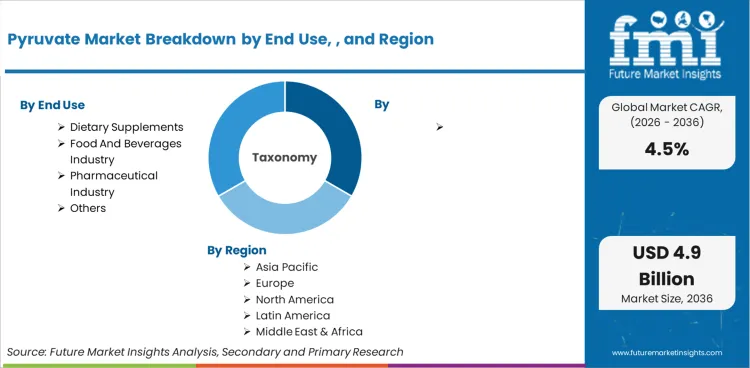
The pyruvate market is segmented by end use, and geographic regions. By end use, pyruvate market is divided into Dietary Supplements, Food And Beverages Industry, Pharmaceutical Industry, and Others. Regionally, the pyruvate industry is classified into North America, Latin America, Western Europe, Eastern Europe, Balkan & Baltic Countries, Russia & Belarus, Central Asia, East Asia, South Asia & Pacific, and the Middle East & Africa.
Insights into the Dietary Supplements Segment
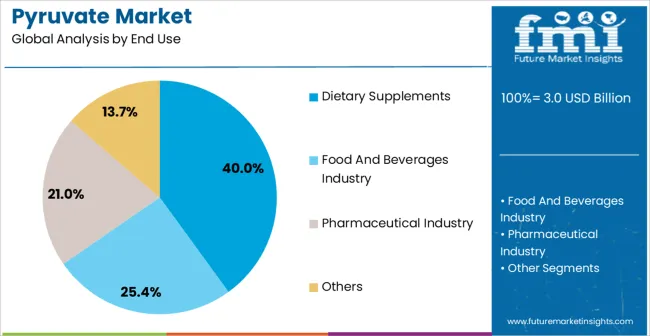
The Dietary Supplements end-use segment is projected to hold 40.00% of the Pyruvate market revenue share in 2025, making it the leading segment. This position is being attributed to the widespread incorporation of pyruvate in formulations aimed at supporting weight management, energy metabolism, and enhanced athletic performance. The segment’s growth is being reinforced by increased consumer interest in personalized nutrition and preventive health solutions.
Dietary supplements allow for precise dosing and convenient administration, which has encouraged consumer adoption. Manufacturers are leveraging advancements in formulation technologies to improve bioavailability and product stability, enabling pyruvate to deliver consistent efficacy in various supplement formats. The rising prevalence of lifestyle-related health concerns, coupled with expanding fitness and wellness initiatives, has strengthened demand for pyruvate-based supplements.
Additionally, retail expansion and e-commerce channels have improved product accessibility, further supporting segment growth The ability to integrate pyruvate into multifunctional supplements targeting energy, metabolism, and general wellness has solidified its leading position in the market, and ongoing innovation is expected to sustain its prominence over the coming years.
Market Overview
The global Pyruvate market is expected to reach a market valuation of USD 2,715 million by 2025, recording a CAGR of 4.5% from 2025 to 2035.
The first stage of cellular respiration, glycolysis, produces the three-carbon molecule pyruvate. In the process of glycolysis, glucose is split into two molecules of pyruvate, which can subsequently be utilized to produce ATP, the main energy source for cells. The Krebs cycle, also known as the citric acid cycle or the tricarboxylic acid cycle, and the process of gluconeogenesis, which is the creation of glucose from non-carbohydrate precursors, are two other metabolic pathways that employ pyruvate.
| Pyruvate Market Size (2026E) | USD 3.14 billion |
| Pyruvate Market Projected Size (2036F) | USD 4.87 billion |
| Value CAGR (2026 to 2036) | 4.5% |
| Top 3 Countries Marketing Share | 60.2% |
Pyruvate is frequently advertised as a dietary supplement for conditions like weight loss, enhancing exercise performance, and other issues. Pyruvate has been investigated for its potential health advantages. Typically, pyruvate is used as a supplement to aid with fat and weight loss. Pyruvate is utilized to improve athletic performance since studies have shown that it increases the endurance of some particular muscles. Applications for pyruvate can be found in food, pharmaceutical, cosmetic, dietary supplement, and other industries.
In our new study, ESOMAR-certified market research and consulting firm Future Market Insights (FMI) offers insights into key factors driving demand for Pyruvate.
Analysis of Pyruvate Market By Key Countries
.webp "Top Country Growth Comparison Pyruvate Market Cagr (2026 2036)")
| Country | CAGR |
|---|---|
| China | 6.1% |
| India | 5.6% |
| Germany | 5.2% |
| Brazil | 4.7% |
| USA | 4.3% |
| UK | 3.8% |
| Japan | 3.4% |
Country-wise Analysis
The Pyruvate Market is expected to register a CAGR of 4.5% during the forecast period, exhibiting varied country level momentum. China leads with the highest CAGR of 6.1%, followed by India at 5.6%. Developed markets such as Germany, France, and the UK continue to expand steadily, while the USA is likely to grow at consistent rates. Japan posts the lowest CAGR at 3.4%, yet still underscores a broadly positive trajectory for the global Pyruvate Market. In 2024, Germany held a dominant revenue in the Western Europe market and is expected to grow with a CAGR of 5.2%.
The USA Pyruvate Market is estimated to be valued at USD 1.0 billion in 2025 and is anticipated to reach a valuation of USD 1.0 billion by 2035. Sales are projected to rise at a CAGR of 0.0% over the forecast period between 2025 and 2035. While Japan and South Korea markets are estimated to be valued at USD 136.1 million and USD 80.4 million respectively in 2025.
Key Players in the Pyruvate Market
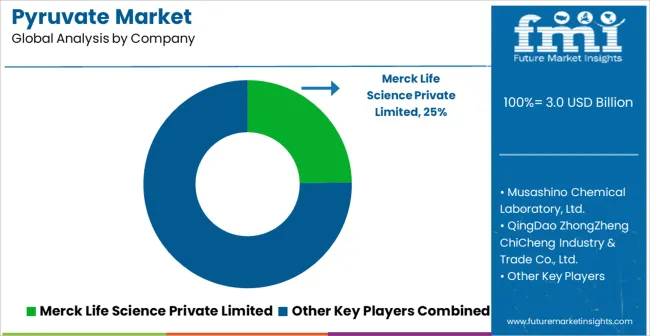
- Merck Life Science Private Limited
- Musashino Chemical Laboratory, Ltd.
- QingDao ZhongZheng ChiCheng Industry & Trade Co., Ltd.
- Bedoukian Research, Inc
- Karolinska Industries
- Jinan Pengbo Biotechnology Co., Ltd.
Recent Developments
The report includes full coverage of key trends from competitive benchmarking. Some of the recent developments covered in the reports:
- In March 2026, Agios Pharmaceuticals received approval from the Emirates Drug Establishment for PYRUKYND (mitapivat), an oral pyruvate kinase activator, to treat adults with alpha- or beta-thalassemia in the United Arab Emirates, extending the drug's geographic approval footprint beyond the US, EU, and UK. [1]
- In November 2025, Rocket Pharmaceuticals announced a strategic corporate reorganisation prioritising its cardiovascular portfolio, leading to a delay in regulatory timeline for RP-L301, its investigational gene therapy for Pyruvate Kinase Deficiency, with a filing now expected beyond 2026. [2]
- In January 2025, Saol Therapeutics announced that the FDA accepted the New Drug Application for SL1009 (Sodium Dichloroacetate), a targeted therapy designed to stimulate the Pyruvate Dehydrogenase Complex to treat pediatric patients with Pyruvate Dehydrogenase Complex Deficiency. [3]
Scope of the Report
| Metric | Value |
|---|---|
| Quantitative Units | USD 3.14 billion (2026) to USD 4.87 billion (2036), at a CAGR of 4.5% |
| Market Definition | The pyruvate market covers globally traded sodium pyruvate, calcium pyruvate, and potassium pyruvate compounds used as dietary supplement actives, food and beverage functional ingredients, and pharmaceutical-grade raw materials for pyruvate kinase activator and pyruvate dehydrogenase complex therapeutic manufacturing. |
| End Use Segmentation | Dietary Supplements, Food and Beverages Industry, Pharmaceutical Industry, Others |
| Application Coverage | Weight management supplements, sports performance recovery, cellular energy support, pyruvate kinase activator pharmaceutical manufacturing, PDC deficiency therapy development, food functional ingredient applications |
| Regions Covered | North America, Latin America, Europe, East Asia, South Asia, Oceania, Middle East and Africa |
| Countries Covered | United States, Germany, United Kingdom, China, Japan, South Korea, UAE, India, France, Australia and 40 plus countries |
| Key Companies Profiled | Musashino Chemical Laboratory Ltd., Merck Life Science Private Limited, QingDao ZhongZheng ChiCheng Industry and Trade Co. Ltd., Bedoukian Research Inc., Jinan Pengbo Biotechnology Co. Ltd., Karolinska Industries |
| Forecast Period | 2026 to 2036 |
| Approach | Hybrid top-down and bottom-up market modeling validated through primary interviews with pyruvate manufacturers, pharmaceutical buyers, and supplement formulators, supported by FDA, EMA, and EDE regulatory records and producer capacity data |
Pyruvate Market by Segments
End Use:
- Dietary Supplements
- Food And Beverages Industry
- Pharmaceutical Industry
- Others
Region:
- North America
- USA
- Canada
- Mexico
- Latin America
- Brazil
- Chile
- Rest of Latin America
- Western Europe
- Germany
- UK
- Italy
- Spain
- France
- Nordic
- BENELUX
- Rest of Western Europe
- Eastern Europe
- Russia
- Poland
- Hungary
- Balkan & Baltic
- Rest of Eastern Europe
- East Asia
- China
- Japan
- South Korea
- South Asia and Pacific
- India
- ASEAN
- Australia & New Zealand
- Rest of South Asia and Pacific
- Middle East & Africa
- Kingdom of Saudi Arabia
- Other GCC Countries
- Turkiye
- South Africa
- Other African Union
- Rest of Middle East & Africa
Bibliography
- [1] Agios Pharmaceuticals. (2026). Agios PYRUKYND (mitapivat) approved for adults with thalassemia in the United Arab Emirates. March 2026. https://investor.agios.com/news-releases/news-release-details/agios-pyrukyndr-mitapivat-approved-adults-thalassemia-united
- [2] Rocket Pharmaceuticals. (2025). Rocket Pharmaceuticals announces strategic corporate reorganisation affecting RP-L301 Pyruvate Kinase Deficiency gene therapy timeline. November 2025. https://ir.rocketpharma.com/news-releases/news-release-details/rocket-pharmaceuticals-announces-strategic-corporate/
- [3] Saol Therapeutics. (2025). Saol Therapeutics announces FDA acceptance of NDA for SL1009 for treatment of Pyruvate Dehydrogenase Complex Deficiency. January 2025. https://saolrx.com/saol-therapeutics-announces-fda-acceptance-of-new-drug-application-for-sl1009-for-treatment-of-pyruvate-dehydrogenase-complex-deficiency/
- [4] Musashino Chemical Laboratory Ltd. (2025). Annual Report on Pyruvate Product Portfolio and Production Capacity. Tokyo, 2025.
This Report Addresses
- Market intelligence to enable structured raw material sourcing, pharmaceutical qualification, and channel strategy decisions across dietary supplement, food and beverage, and pharmaceutical pyruvate end uses
- Market size estimation and 10-year revenue forecasts from 2026 to 2036, supported by validated producer capacity data and pharmaceutical regulatory approval benchmarks
- Growth opportunity mapping across dietary supplement, pharmaceutical, and food and beverage segments with emphasis on pharmaceutical-grade qualification and China production partnership development
- Segment and regional revenue forecasts covering dietary supplement, pharmaceutical, and food and beverage end uses across 40 plus countries
- Competition strategy assessment including pharmaceutical-grade sodium pyruvate qualification, China sourcing partnership development, and rare disease therapy pipeline monitoring
- Regulatory impact analysis covering FDA NDA acceptance timelines, EMA approval frameworks, UAE EDE pyruvate kinase activator approvals, and rare disease orphan drug designation status
- Pharmaceutical pipeline tracking covering PYRUKYND geographic expansion, RP-L301 gene therapy timeline, SL1009 NDA progress, and emerging pyruvate mechanism therapeutic candidates
- Market report delivery in PDF, Excel, PPT, and interactive dashboard formats for executive and operational use
Frequently Asked Questions
How large is the demand for Pyruvate in the global market in 2026?
Demand for Pyruvate in the global market is estimated to be valued at USD 3.14 billion in 2026.
What will the market size of Pyruvate be by 2036?
Market size for Pyruvate is projected to reach USD 4.87 billion by 2036.
What is the expected CAGR for the Pyruvate Market between 2026 and 2036?
Demand for Pyruvate is expected to grow at a CAGR of 4.5% between 2026 and 2036.
Which End Use segment leads the Pyruvate Market in 2026?
Dietary Supplements capture 40.0% of demand as the leading segment, driven by weight management, sports performance recovery, and cellular energy support positioning.
What is driving China's growth in the Pyruvate Market?
China leads regional growth at a 6.1% CAGR through 2036, driven by simultaneous expansion in dietary supplement manufacturing export capacity and growing domestic pharmaceutical raw material procurement.
What is the United States market value for Pyruvate in 2026?
The United States generates USD 1.08 billion in 2026 demand across dietary supplement retail, sports nutrition, and pharmaceutical pyruvate kinase activator manufacturing.
What does the PYRUKYND UAE approval mean for the Pyruvate Market?
The March 2026 Emirates Drug Establishment approval extends pyruvate kinase activator geographic coverage into the Middle East, confirming a sequential international regulatory expansion pattern that will continue generating pharmaceutical procurement demand in additional markets.
What rare disease applications are driving pharmaceutical pyruvate demand?
FDA acceptance of Saol Therapeutics' NDA for SL1009 targeting pyruvate dehydrogenase complex deficiency confirms a second independent therapeutic pathway for pyruvate biochemistry compounds, reducing pharmaceutical demand concentration on a single indication.
What is included in the scope of this report?
Scope covers sodium pyruvate, calcium pyruvate, and potassium pyruvate across dietary supplement, food and beverage functional ingredient, and pharmaceutical-grade raw material applications.
What is excluded from this report's scope?
Endogenous pyruvate in cellular metabolism, pyruvate analytical reagents, finished products below 100mg serving pyruvate content, and non-food industrial chemical applications are excluded.
How does FMI validate its Pyruvate Market forecast?
The forecast uses a hybrid model validated through primary interviews with producers and pharmaceutical buyers, cross-checked against FDA, EMA, and UAE EDE approval records, clinical trial registries, and major producer capacity data.
Preview the report firsthand - request a free sample
Get SampleGet the brochure for pricing and purchase details.
Get PDFTable of Content
- Executive Summary
- Global Market Outlook
- Demand-side Trends
- Supply-side Trends
- Technology Roadmap Analysis
- Analysis and Recommendations
- Market Overview
- Market Coverage / Taxonomy
- Market Definition / Scope / Limitations
- Research Methodology
- Chapter Orientation
- Analytical Lens and Working Hypotheses
- Market Structure, Signals, and Trend Drivers
- Benchmarking and Cross-market Comparability
- Market Sizing, Forecasting, and Opportunity Mapping
- Research Design and Evidence Framework
- Desk Research Programme (Secondary Evidence)
- Company Annual and Sustainability Reports
- Peer-reviewed Journals and Academic Literature
- Corporate Websites, Product Literature, and Technical Notes
- Earnings Decks and Investor Briefings
- Statutory Filings and Regulatory Disclosures
- Technical White Papers and Standards Notes
- Trade Journals, Industry Magazines, and Analyst Briefs
- Conference Proceedings, Webinars, and Seminar Materials
- Government Statistics Portals and Public Data Releases
- Press Releases and Reputable Media Coverage
- Specialist Newsletters and Curated Briefings
- Sector Databases and Reference Repositories
- FMI Internal Proprietary Databases and Historical Market Datasets
- Subscription Datasets and Paid Sources
- Social Channels, Communities, and Digital Listening Inputs
- Additional Desk Sources
- Expert Input and Fieldwork (Primary Evidence)
- Primary Modes
- Qualitative Interviews and Expert Elicitation
- Quantitative Surveys and Structured Data Capture
- Blended Approach
- Why Primary Evidence is Used
- Field Techniques
- Interviews
- Surveys
- Focus Groups
- Observational and In-context Research
- Social and Community Interactions
- Stakeholder Universe Engaged
- C-suite Leaders
- Board Members
- Presidents and Vice Presidents
- R&D and Innovation Heads
- Technical Specialists
- Domain Subject-matter Experts
- Scientists
- Physicians and Other Healthcare Professionals
- Governance, Ethics, and Data Stewardship
- Research Ethics
- Data Integrity and Handling
- Primary Modes
- Tooling, Models, and Reference Databases
- Desk Research Programme (Secondary Evidence)
- Data Engineering and Model Build
- Data Acquisition and Ingestion
- Cleaning, Normalisation, and Verification
- Synthesis, Triangulation, and Analysis
- Quality Assurance and Audit Trail
- Market Background
- Market Dynamics
- Drivers
- Restraints
- Opportunity
- Trends
- Scenario Forecast
- Demand in Optimistic Scenario
- Demand in Likely Scenario
- Demand in Conservative Scenario
- Opportunity Map Analysis
- Product Life Cycle Analysis
- Supply Chain Analysis
- Investment Feasibility Matrix
- Value Chain Analysis
- PESTLE and Porter’s Analysis
- Regulatory Landscape
- Regional Parent Market Outlook
- Production and Consumption Statistics
- Import and Export Statistics
- Market Dynamics
- Global Market Analysis 2021 to 2025 and Forecast, 2026 to 2036
- Historical Market Size Value (USD Million) Analysis, 2021 to 2025
- Current and Future Market Size Value (USD Million) Projections, 2026 to 2036
- Y-o-Y Growth Trend Analysis
- Absolute $ Opportunity Analysis
- Global Market Pricing Analysis 2021 to 2025 and Forecast 2026 to 2036
- Global Market Analysis 2021 to 2025 and Forecast 2026 to 2036, By End Use
- Introduction / Key Findings
- Historical Market Size Value (USD Million) Analysis By End Use , 2021 to 2025
- Current and Future Market Size Value (USD Million) Analysis and Forecast By End Use , 2026 to 2036
- Dietary Supplements
- Food And Beverages Industry
- Pharmaceutical Industry
- Others
- Dietary Supplements
- Y-o-Y Growth Trend Analysis By End Use , 2021 to 2025
- Absolute $ Opportunity Analysis By End Use , 2026 to 2036
- Global Market Analysis 2021 to 2025 and Forecast 2026 to 2036, By Region
- Introduction
- Historical Market Size Value (USD Million) Analysis By Region, 2021 to 2025
- Current Market Size Value (USD Million) Analysis and Forecast By Region, 2026 to 2036
- North America
- Latin America
- Western Europe
- Eastern Europe
- East Asia
- South Asia and Pacific
- Middle East & Africa
- Market Attractiveness Analysis By Region
- North America Market Analysis 2021 to 2025 and Forecast 2026 to 2036, By Country
- Historical Market Size Value (USD Million) Trend Analysis By Market Taxonomy, 2021 to 2025
- Market Size Value (USD Million) Forecast By Market Taxonomy, 2026 to 2036
- By Country
- USA
- Canada
- Mexico
- By End Use
- By Country
- Market Attractiveness Analysis
- By Country
- By End Use
- Key Takeaways
- Latin America Market Analysis 2021 to 2025 and Forecast 2026 to 2036, By Country
- Historical Market Size Value (USD Million) Trend Analysis By Market Taxonomy, 2021 to 2025
- Market Size Value (USD Million) Forecast By Market Taxonomy, 2026 to 2036
- By Country
- Brazil
- Chile
- Rest of Latin America
- By End Use
- By Country
- Market Attractiveness Analysis
- By Country
- By End Use
- Key Takeaways
- Western Europe Market Analysis 2021 to 2025 and Forecast 2026 to 2036, By Country
- Historical Market Size Value (USD Million) Trend Analysis By Market Taxonomy, 2021 to 2025
- Market Size Value (USD Million) Forecast By Market Taxonomy, 2026 to 2036
- By Country
- Germany
- UK
- Italy
- Spain
- France
- Nordic
- BENELUX
- Rest of Western Europe
- By End Use
- By Country
- Market Attractiveness Analysis
- By Country
- By End Use
- Key Takeaways
- Eastern Europe Market Analysis 2021 to 2025 and Forecast 2026 to 2036, By Country
- Historical Market Size Value (USD Million) Trend Analysis By Market Taxonomy, 2021 to 2025
- Market Size Value (USD Million) Forecast By Market Taxonomy, 2026 to 2036
- By Country
- Russia
- Poland
- Hungary
- Balkan & Baltic
- Rest of Eastern Europe
- By End Use
- By Country
- Market Attractiveness Analysis
- By Country
- By End Use
- Key Takeaways
- East Asia Market Analysis 2021 to 2025 and Forecast 2026 to 2036, By Country
- Historical Market Size Value (USD Million) Trend Analysis By Market Taxonomy, 2021 to 2025
- Market Size Value (USD Million) Forecast By Market Taxonomy, 2026 to 2036
- By Country
- China
- Japan
- South Korea
- By End Use
- By Country
- Market Attractiveness Analysis
- By Country
- By End Use
- Key Takeaways
- South Asia and Pacific Market Analysis 2021 to 2025 and Forecast 2026 to 2036, By Country
- Historical Market Size Value (USD Million) Trend Analysis By Market Taxonomy, 2021 to 2025
- Market Size Value (USD Million) Forecast By Market Taxonomy, 2026 to 2036
- By Country
- India
- ASEAN
- Australia & New Zealand
- Rest of South Asia and Pacific
- By End Use
- By Country
- Market Attractiveness Analysis
- By Country
- By End Use
- Key Takeaways
- Middle East & Africa Market Analysis 2021 to 2025 and Forecast 2026 to 2036, By Country
- Historical Market Size Value (USD Million) Trend Analysis By Market Taxonomy, 2021 to 2025
- Market Size Value (USD Million) Forecast By Market Taxonomy, 2026 to 2036
- By Country
- Kingdom of Saudi Arabia
- Other GCC Countries
- Turkiye
- South Africa
- Other African Union
- Rest of Middle East & Africa
- By End Use
- By Country
- Market Attractiveness Analysis
- By Country
- By End Use
- Key Takeaways
- Key Countries Market Analysis
- USA
- Pricing Analysis
- Market Share Analysis, 2025
- By End Use
- Canada
- Pricing Analysis
- Market Share Analysis, 2025
- By End Use
- Mexico
- Pricing Analysis
- Market Share Analysis, 2025
- By End Use
- Brazil
- Pricing Analysis
- Market Share Analysis, 2025
- By End Use
- Chile
- Pricing Analysis
- Market Share Analysis, 2025
- By End Use
- Germany
- Pricing Analysis
- Market Share Analysis, 2025
- By End Use
- UK
- Pricing Analysis
- Market Share Analysis, 2025
- By End Use
- Italy
- Pricing Analysis
- Market Share Analysis, 2025
- By End Use
- Spain
- Pricing Analysis
- Market Share Analysis, 2025
- By End Use
- France
- Pricing Analysis
- Market Share Analysis, 2025
- By End Use
- India
- Pricing Analysis
- Market Share Analysis, 2025
- By End Use
- ASEAN
- Pricing Analysis
- Market Share Analysis, 2025
- By End Use
- Australia & New Zealand
- Pricing Analysis
- Market Share Analysis, 2025
- By End Use
- China
- Pricing Analysis
- Market Share Analysis, 2025
- By End Use
- Japan
- Pricing Analysis
- Market Share Analysis, 2025
- By End Use
- South Korea
- Pricing Analysis
- Market Share Analysis, 2025
- By End Use
- Russia
- Pricing Analysis
- Market Share Analysis, 2025
- By End Use
- Poland
- Pricing Analysis
- Market Share Analysis, 2025
- By End Use
- Hungary
- Pricing Analysis
- Market Share Analysis, 2025
- By End Use
- Kingdom of Saudi Arabia
- Pricing Analysis
- Market Share Analysis, 2025
- By End Use
- Turkiye
- Pricing Analysis
- Market Share Analysis, 2025
- By End Use
- South Africa
- Pricing Analysis
- Market Share Analysis, 2025
- By End Use
- USA
- Market Structure Analysis
- Competition Dashboard
- Competition Benchmarking
- Market Share Analysis of Top Players
- By Regional
- By End Use
- Competition Analysis
- Competition Deep Dive
- Merck Life Science Private Limited
- Overview
- Product Portfolio
- Profitability by Market Segments (Product/Age /Sales Channel/Region)
- Sales Footprint
- Strategy Overview
- Marketing Strategy
- Product Strategy
- Channel Strategy
- Musashino Chemical Laboratory, Ltd.
- QingDao ZhongZheng ChiCheng Industry & Trade Co., Ltd.
- Bedoukian Research, Inc
- Karolinska Industries
- Jinan Pengbo Biotechnology Co., Ltd.
- Merck Life Science Private Limited
- Competition Deep Dive
- Assumptions & Acronyms Used


