

- Market Size (2026)
- USD 4.7 Bn
- Forecast (2036)
- USD 8.1 Bn
- CAGR (2026 to 2036)
- 5.5%
Trams Market Size, Market Forecast and Outlook By FMI
The trams market was valued at USD 4.5 billion in 2025. The market is set to reach USD 4.7 billion by 2026-end and grow at a CAGR of 5.5% between 2026-2036 to reach USD 8.1 billion by 2036.
Summary of the Trams Market
- Demand and Growth Drivers
- Infrastructure modernization programs and fleet replacement mandates are likely to support demand through the forecast period.
- Government budget allocations for transit and freight infrastructure are expected to remain a consistent growth driver from 2026 to 2036.
- Electrification and sustainability mandates are expected to create additional procurement opportunities during the forecast period.
- Product and Segment View
- Between 60 To 150 Passengers is likely to remain the leading passenger capacity segment, accounting for 38% of demand in 2026.
- Single Ended Trams is expected to lead the design category, supported by established adoption patterns.
- Growth across segments is expected to remain uneven, with modernization-driven and compliance-required categories outpacing legacy alternatives.
- Geography and Competitive Outlook
- China is likely to lead growth at 7.4% CAGR, reflecting infrastructure investment scale and transit expansion.
- India at 6.9% CAGR represents the second-fastest growth corridor, supported by urbanization and government transit investment.
- Companies that combine technology breadth with OEM access and aftermarket reach are likely to strengthen competitive positioning through the forecast period.
- Analyst Opinion
- The trams market is evolving from a component supply model toward integrated system solutions. Companies that invest in next-generation platform development and multi-regional manufacturing are better positioned to capture incremental demand. The market is expected to reward vendors with established OEM relationships and growing aftermarket distribution. Strategic capital allocation toward electrification readiness and regional production is likely to define competitive outcomes over the forecast period.
- Growth is concentrated in regions where infrastructure investment is expanding.
- Adoption is increasing due to infrastructure modernization programs, fleet replacement cycles, and urbanization-led transit expansion.
- The market is expected to create USD 3.36 billion in incremental opportunity between 2026 and 2036, with the strongest contribution from China and India.
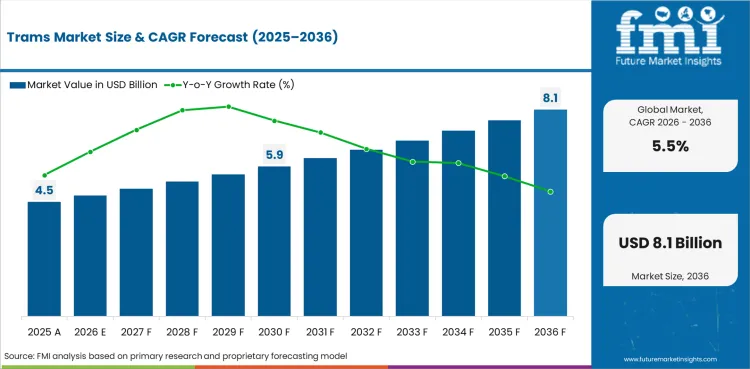
Key Takeaways, Market Size, and Forecast
- The trams market was valued at USD 4.50 billion in 2025.
- By 2036, the Trams Market is expected to be worth USD 8.11 billion.
- From 2026 to 2036, the market is projected to expand at a CAGR of 5.5%.
- The market is projected to create an incremental opportunity of USD 3.36 billion between 2026 and 2036.
- In 2026, Between 60 To 150 Passengers is expected to account for 38% of the passenger capacity, driven by infrastructure modernization programs, fleet replacement cycles, and urbanization-led transit expansion.
- China (7.4%) and India (6.9%) are two of the fastest growing markets in the world.
Trams Market Definition
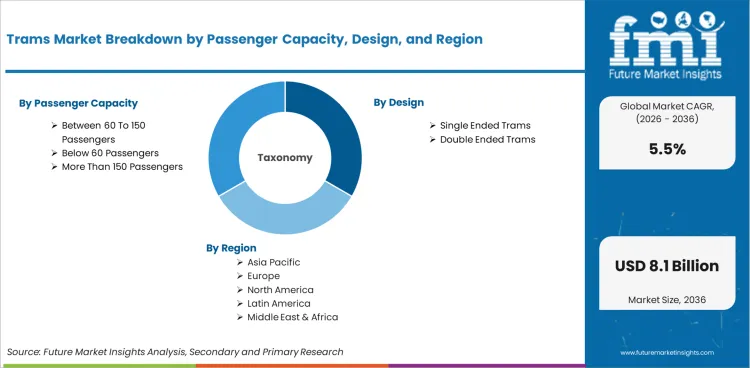
The trams market encompasses all commercially traded products, solutions, and services categorized by passenger capacity, design. The market covers revenue generated from sales across North America, Latin America, Europe, East Asia, South Asia and Pacific, Middle East and Africa during the forecast period from 2026 to 2036.
Trams Market Inclusions
Market scope includes all trams products and services sold through commercial channels, covering Between 60 To 150 Passengers, Below 60 Passengers, More Than 150 Passengers; Single Ended Trams, Double Ended Trams. Revenue is tracked from 2026 to 2036 across all identified regions and countries.
Trams Market Exclusions
The scope excludes non-commercial transactions, internal transfers, prototype or research-stage products, and custom-built one-off vehicles or systems developed for non-commercial applications. Government-funded research programs without commercial procurement are also excluded.
Trams Market Research Methodology
- Primary Research: Interviews with transit operators, vehicle manufacturers, component suppliers, and fleet procurement teams across key markets.
- Desk Research: Analysis of government infrastructure budgets, transit authority procurement records, and industry association reports.
- Market Sizing and Forecasting: Bottom-up aggregation of fleet deployment data, procurement contracts, and infrastructure investment tracking, with regional adoption curves and top-down validation.
- Data Validation: Cross-checked quarterly against fleet registration data and manufacturer production reports.
Why is the Trams Market Growing?
- Infrastructure investment programs and fleet modernization mandates are creating structured procurement demand, supporting a CAGR of 5.5% through 2036.
- China leads growth at 7.4% owing to transit expansion and infrastructure modernization scale.
- Between 60 To 150 Passengers accounts for 38% of the passenger capacity segment, reflecting established fleet composition and operator preferences.
Demand in the trams space is structured around fleet replacement cycles. Commercial operators and transit authorities plan procurement based on asset age, maintenance costs, and performance thresholds. The timing of replacement decisions is influenced by regulatory mandates, fuel efficiency requirements, and safety standards. Vendors that align product availability with replacement windows capture disproportionate share of procurement budgets.
Government infrastructure programs are the primary demand catalyst in several regions. Transit expansion, highway upgrades, and freight corridor development create structured procurement requirements. Budget allocation cycles vary by region, with multi-year funding commitments providing visibility for manufacturers. The link between infrastructure spending and equipment procurement is direct, making government budget tracking a leading indicator of demand.
The supply chain is characterized by concentrated OEM relationships. A small number of vehicle and rolling stock manufacturers account for the majority of component procurement. This concentration gives OEMs significant pricing leverage and influences product specification requirements. Suppliers that secure long-term OEM contracts benefit from volume predictability but accept margin constraints. Diversification across OEM relationships reduces concentration risk.
Market Segmentation Analysis
- The trams market is segmented by passenger capacity, design, covering all commercially relevant product and service categories.
- Between 60 To 150 Passengers maintains the largest share at 38% of the passenger capacity segment in 2026.
The trams market segmentation reflects the distribution of demand across product categories, application types, and end-user groups. Market structure is concentrated in the top segments, with Between 60 To 150 Passengers and Single Ended Trams accounting for the majority of revenue.
Insights into the Between 60 To 150 Passengers Segment
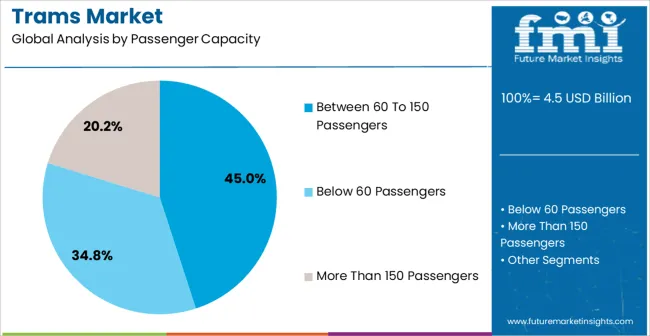
Between 60 To 150 Passengers maintains the largest share within the passenger capacity segment. Demand for this category reflects established fleet procurement patterns and operator preferences. Adoption is concentrated in regions with mature transit infrastructure and active fleet replacement programs. Growth in this segment is expected to remain consistent through the forecast period.
Insights into the Single Ended Trams Segment
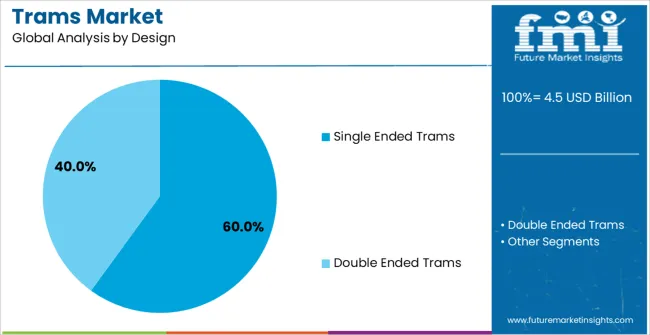
Single Ended Trams maintains the largest share within the design segment. Demand for this category reflects shifting infrastructure investment priorities and operational requirements. Adoption is concentrated in regions with mature transit infrastructure and active fleet replacement programs. Growth in this segment is expected to remain consistent through the forecast period.
Trams Market Drivers, Restraints, and Opportunities
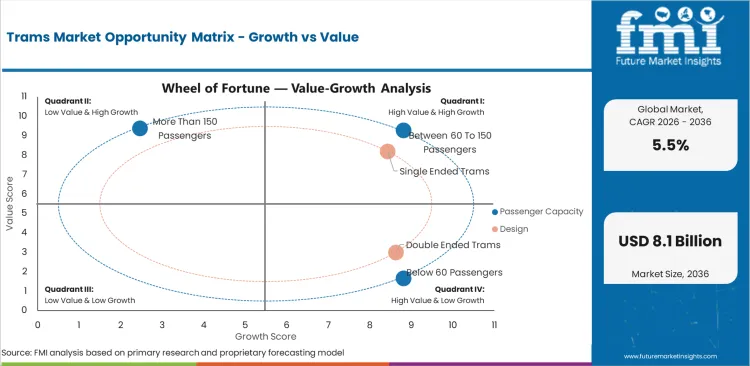
- Infrastructure modernization and fleet replacement mandates are creating structured demand.
- Budget constraints and project delays remain the primary restraints limiting faster adoption.
- Electrification transition and smart mobility integration represent the most significant growth opportunities through 2036.
The trams market continues to expand as infrastructure modernization programs, fleet replacement cycles, and urbanization-led transit expansion create sustained procurement demand. Growth is tempered by funding constraints and project execution challenges in certain segments and regions.
Fleet Replacement Cycles Define Procurement Timing
Demand in the trams space is structured around fleet replacement cycles. Commercial operators and transit authorities plan procurement based on asset age, maintenance costs, and performance thresholds. The timing of replacement decisions is influenced by regulatory mandates, fuel efficiency requirements, and safety standards. Vendors that align product availability with replacement windows capture disproportionate share of procurement budgets.
Infrastructure Investment Creates Demand Corridors
Government infrastructure programs are the primary demand catalyst in several regions. Transit expansion, highway upgrades, and freight corridor development create structured procurement requirements. Budget allocation cycles vary by region, with multi-year funding commitments providing visibility for manufacturers. The link between infrastructure spending and equipment procurement is direct, making government budget tracking a leading indicator of demand.
OEM Concentration Shapes Supplier Economics
The supply chain is characterized by concentrated OEM relationships. A small number of vehicle and rolling stock manufacturers account for the majority of component procurement. This concentration gives OEMs significant pricing leverage and influences product specification requirements. Suppliers that secure long-term OEM contracts benefit from volume predictability but accept margin constraints. Diversification across OEM relationships reduces concentration risk.
Aftermarket Revenue Provides Margin Stability
Aftermarket sales generate higher margins than OEM supply, providing financial stability for component manufacturers. The aftermarket channel serves fleet operators that require replacement parts, upgrades, and maintenance components. Customer relationships in this channel are built on parts availability, service speed, and technical support. Companies with strong aftermarket distribution networks maintain revenue quality across economic cycles.
Analysis of Trams Market By Key Countries
.webp "Top Country Growth Comparison Trams Market Cagr (2026 2036)")
| Country | CAGR |
|---|---|
| China | 7.4% |
| India | 6.9% |
| Germany | 6.3% |
| Brazil | 5.8% |
| USA | 5.2% |
| UK | 4.7% |
| Japan | 4.1% |
Source: FMI analysis based on primary research and proprietary forecasting model
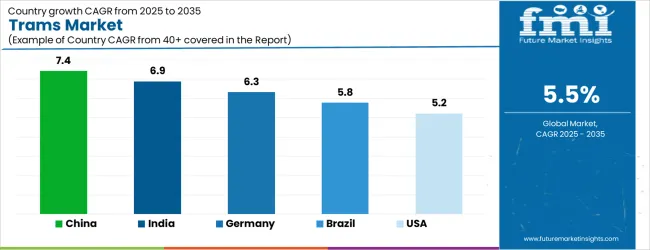
- China leads at 7.4% CAGR, reflecting infrastructure investment scale.
- India at 6.9% CAGR represents the second-fastest growth corridor.
- Germany (6.3%) and Brazil (5.8%) show sustained growth supported by regional policy frameworks.
The global trams market is expected to expand at a CAGR of 5.5% from 2026 to 2036. The analysis covers more than 30 countries, with the primary markets detailed below.
Demand Outlook for Trams Market in China
China is projected to register a CAGR of 7.4% through 2036. Growth reflects expanding urban transit networks, fleet modernization mandates, and increasing government investment in rail and road infrastructure.
- Government infrastructure spending is accelerating procurement of transit and commercial vehicle systems.
- Fleet replacement cycles are creating sustained demand for upgraded components and systems.
- Urbanization is expanding the addressable market for public transit solutions.
Future Outlook for Trams Market in India
India is projected to register a CAGR of 6.9% through 2036. Growth reflects expanding urban transit networks, fleet modernization mandates, and increasing government investment in rail and road infrastructure.
- Government infrastructure spending is accelerating procurement of transit and commercial vehicle systems.
- Fleet replacement cycles are creating sustained demand for upgraded components and systems.
- Urbanization is expanding the addressable market for public transit solutions.
Opportunity Analysis of Trams Market in Germany
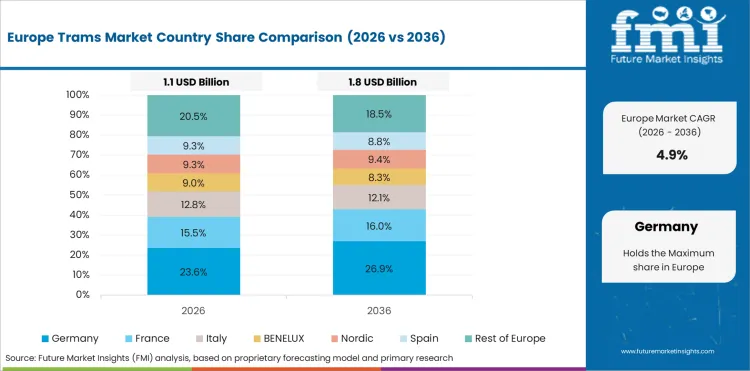
Germany is projected to register a CAGR of 6.3% through 2036. Growth reflects expanding urban transit networks, fleet modernization mandates, and increasing government investment in rail and road infrastructure.
- Government infrastructure spending is accelerating procurement of transit and commercial vehicle systems.
- Fleet replacement cycles are creating sustained demand for upgraded components and systems.
- Urbanization is expanding the addressable market for public transit solutions.
In-depth Analysis of Trams Market in Brazil
Brazil is projected to register a CAGR of 5.8% through 2036. Growth reflects expanding urban transit networks, fleet modernization mandates, and increasing government investment in rail and road infrastructure.
- Government infrastructure spending is accelerating procurement of transit and commercial vehicle systems.
- Fleet replacement cycles are creating sustained demand for upgraded components and systems.
- Urbanization is expanding the addressable market for public transit solutions.
Sales Analysis of Trams Market in USA
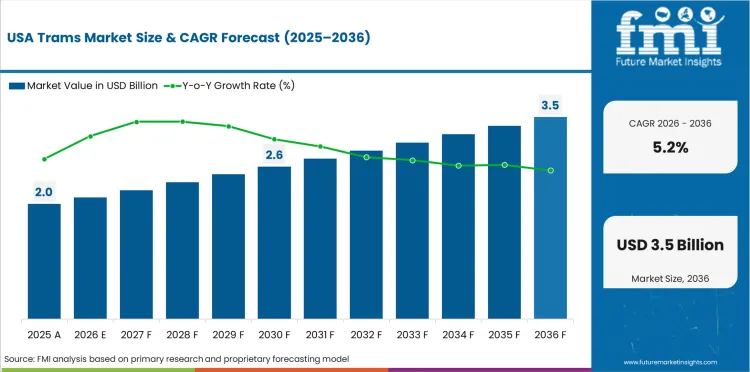
USA is projected to register a CAGR of 5.2% through 2036. Growth reflects expanding urban transit networks, fleet modernization mandates, and increasing government investment in rail and road infrastructure.
- Government infrastructure spending is accelerating procurement of transit and commercial vehicle systems.
- Fleet replacement cycles are creating sustained demand for upgraded components and systems.
- Urbanization is expanding the addressable market for public transit solutions.
Growth Analysis of Trams Market in UK
UK is projected to register a CAGR of 4.7% through 2036. Growth reflects expanding urban transit networks, fleet modernization mandates, and increasing government investment in rail and road infrastructure.
- Government infrastructure spending is accelerating procurement of transit and commercial vehicle systems.
- Fleet replacement cycles are creating sustained demand for upgraded components and systems.
- Urbanization is expanding the addressable market for public transit solutions.
Competitive Landscape and Strategic Positioning
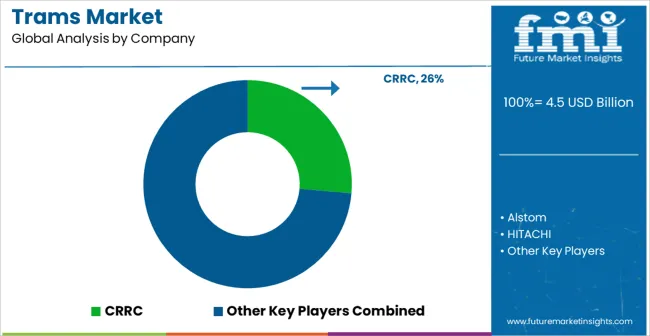
- CRRC maintains a strong position through OEM relationships and global manufacturing reach.
- Alstom and HITACHI compete through specialized capabilities and targeted market focus.
- New entrants are targeting electrification components and smart mobility applications.
The competitive landscape reflects a mix of global players with broad portfolios and regional specialists with deep application expertise. Market concentration is moderate, with the top 5 companies accounting for a significant share of revenue.
CRRC leads through integrated product platforms and established transit authority relationships. Alstom competes through engineering capabilities and regional manufacturing presence.
Barriers to entry include OEM qualification requirements, safety certification costs, and established procurement relationships.
Key Companies in the Trams Market
Key global companies in the trams market include:
- CRRC, Alstom, HITACHI, Bombardier maintain strong market positions through established infrastructure and multi-regional capabilities.
- Stadler, CAF, Siemens have established regional positions through specialized capabilities.
- LUCCHINI RS GROUP, GE, Kawasaki, Brookville Equipment, General Motor, Inekon Trams represent emerging participants with growth potential through innovation and niche positioning.
Competitive Benchmarking: Trams Market
| Company | Product Range | OEM Relationships | Aftermarket Reach | Geographic Presence |
|---|---|---|---|---|
| CRRC | High | High | Strong | Global |
| Alstom | High | High | Strong | Global |
| HITACHI | High | Medium | Strong | Global |
| Bombardier | Medium | Medium | Moderate | Global |
| Stadler | Medium | Medium | Moderate | Regional |
| CAF | Medium | Low | Moderate | Regional |
| Siemens | Low | Low | Moderate | Regional |
| LUCCHINI RS GROUP | Low | Low | Limited | Niche |
| GE | Low | Low | Limited | Niche |
| Kawasaki | Low | Low | Limited | Niche |
Source: Future Market Insights competitive analysis, 2026
Key Players in the Trams Market
Major Global Players
- CRRC
- Alstom
- HITACHI
- Bombardier
- Stadler
- CAF
- Siemens
Emerging Players/Startups
- LUCCHINI RS GROUP
- GE
- Kawasaki
- Brookville Equipment
- General Motor
- Inekon Trams
Report Scope and Coverage
| Parameter | Details |
|---|---|
| Quantitative Units | USD 4.75 Billion to USD 8.11 Billion, at a CAGR of 5.5% |
| Market Definition | The trams market encompasses trams products and services across passenger capacity, design. |
| Regions Covered | North America, Latin America, Europe, East Asia, South Asia and Pacific, Middle East and Africa |
| Countries Covered | China, India, Germany, Brazil, USA, UK, Japan, 30 plus countries |
| Key Companies Profiled | CRRC, Alstom, HITACHI, Bombardier, Stadler, CAF, Siemens, LUCCHINI RS GROUP, GE, Kawasaki, Brookville Equipment, General Motor, Inekon Trams |
| Forecast Period | 2026 to 2036 |
| Approach | Hybrid bottom-up and top-down methodology starting with verified transaction data, projecting adoption velocity across segments and regions. |
Segmentation
Trams Market Segmented by Passenger Capacity:
- Between 60 To 150 Passengers
- Below 60 Passengers
- More Than 150 Passengers
Trams Market Segmented by Design:
- Single Ended Trams
- Double Ended Trams
Trams Market by Region:
- North America
- USA
- Canada
- Mexico
- Latin America
- Brazil
- Chile
- Rest of Latin America
- Western Europe
- Germany
- UK
- Italy
- Spain
- France
- Nordic
- BENELUX
- Rest of Western Europe
- Eastern Europe
- Russia
- Poland
- Hungary
- Balkan & Baltic
- Rest of Eastern Europe
- East Asia
- China
- Japan
- South Korea
- South Asia and Pacific
- India
- ASEAN
- Australia & New Zealand
- Rest of South Asia and Pacific
- Middle East & Africa
- Kingdom of Saudi Arabia
- Other GCC Countries
- Turkiye
- South Africa
- Other African Union
- Rest of Middle East & Africa
Research Sources and Bibliography
- International Association of Public Transport. (2025). UITP Global Public Transport Statistics. UITP.
- World Bank. (2025). Transport Infrastructure Investment Database. World Bank Group.
- Organisation for Economic Co-operation and Development. (2025). OECD Transport Outlook. OECD.
- United Nations Economic Commission for Europe. (2025). UNECE Transport Statistics. UNECE.
- International Organization for Standardization. (2025). ISO Standards for Railway and Road Vehicles. ISO.
This bibliography is provided for reader reference. The full Future Market Insights report contains the complete reference list with publication dates, URLs, and supporting data for all cited works.
This Report Answers
- Estimating the size of the trams market and revenue potential from 2026 to 2036.
- Segmentation by passenger capacity, design.
- Regional insights across more than 30 markets.
- Analysis of fleet deployment patterns and infrastructure investment trends.
- Competitive landscape assessment and company benchmarking.
- Identification of investment opportunities across transit segments and infrastructure corridors.
- Supply chain and distribution channel tracking.
- Delivery of data in PDF and Excel formats.
Frequently Asked Questions
What is the global market demand for Trams Market in 2026?
In 2026, the global trams market is expected to be valued at USD 4.75 billion.
How big is the Trams Market expected to be in 2036?
By 2036, the trams market is projected to reach USD 8.11 billion.
What is the expected growth rate for the Trams Market between 2026 and 2036?
The trams market is projected to grow at a CAGR of 5.5% from 2026 to 2036.
Which passenger capacity segment is expected to lead in 2026?
Between 60 To 150 Passengers is expected to account for 38% of the passenger capacity segment in 2026, supported by infrastructure modernization programs, fleet replacement cycles, and urbanization-led transit expansion.
What is driving demand in China?
China is projected to grow at 7.4% CAGR through 2036, supported by infrastructure investment and fleet expansion programs.
What is driving demand in India?
India is projected to grow at 6.9% CAGR through 2036, driven by urbanization and transit modernization initiatives.
What does FMI mean by Trams Market definition?
The trams market includes all commercially traded products and solutions categorized by passenger capacity, design, across the forecast period from 2026 to 2036.
How does FMI build and validate the Trams Market forecast?
Forecasting uses a hybrid bottom-up and top-down methodology, starting with fleet deployment data, procurement contracts, and infrastructure investment tracking and cross-checking against industry production statistics and manufacturer disclosures.
Preview the report firsthand - request a free sample
Get SampleGet the brochure for pricing and purchase details.
Get PDFTable of Content
- Executive Summary
- Global Market Outlook
- Demand-side Trends
- Supply-side Trends
- Technology Roadmap Analysis
- Market Coverage / Taxonomy
- Market Definition / Scope / Limitations
- Research Methodology
- Chapter Orientation
- Analytical Lens and Working Hypotheses
- Market Structure, Signals, and Trend Drivers
- Benchmarking and Cross-market Comparability
- Market Sizing, Forecasting, and Opportunity Mapping
- Research Design and Evidence Framework
- Desk Research Programme (Secondary Evidence)
- Company Annual and Sustainability Reports
- Peer-reviewed Journals and Academic Literature
- Corporate Websites, Product Literature, and Technical Notes
- Earnings Decks and Investor Briefings
- Statutory Filings and Regulatory Disclosures
- Technical White Papers and Standards Notes
- Social Channels, Communities, and Digital Listening Inputs
- Additional Desk Sources
- Expert Input and Fieldwork (Primary Evidence)
- Primary Modes
- Qualitative Interviews and Expert Elicitation
- Quantitative Surveys and Structured Data Capture
- Blended Approach
- Why Primary Evidence is Used
- Field Techniques
- Interviews
- Surveys
- Focus Groups
- Observational and In-context Research
- Social and Community Interactions
- Stakeholder Universe Engaged
- C-suite Leaders
- Board Members
- Presidents and Vice Presidents
- R&D and Innovation Heads
- Technical Specialists
- Domain Subject-matter Experts
- Scientists
- Physicians and Other Healthcare Professionals
- Governance, Ethics, and Data Stewardship
- Research Ethics
- Data Integrity and Handling
- Primary Modes
- Tooling, Models, and Reference Databases
- Desk Research Programme (Secondary Evidence)
- Data Engineering and Model Build
- Data Acquisition and Ingestion
- Cleaning, Normalisation, and Verification
- Synthesis, Triangulation, and Analysis
- Quality Assurance and Audit Trail
- Market Background
- Market Dynamics
- Drivers
- Restraints
- Opportunity
- Trends
- Scenario Forecast
- Demand in Optimistic Scenario
- Demand in Likely Scenario
- Demand in Conservative Scenario
- Opportunity Map Analysis
- Product Life Cycle Analysis
- Supply Chain Analysis
- Investment Feasibility Matrix
- Value Chain Analysis
- PESTLE and Porter’s Analysis
- Regulatory Landscape
- Regional Parent Market Outlook
- Production and Consumption Statistics
- Import and Export Statistics
- Market Dynamics
- Global Market Analysis 2021 to 2025 and Forecast, 2026 to 2036
- Historical Market Size Value (USD Million) Analysis, 2021 to 2025
- Current and Future Market Size Value (USD Million) Projections, 2026 to 2036
- Y-o-Y Growth Trend Analysis
- Absolute $ Opportunity Analysis
- Global Market Pricing Analysis 2021 to 2025 and Forecast 2026 to 2036
- Global Market Analysis 2021 to 2025 and Forecast 2026 to 2036, By Passenger Capacity
- Introduction / Key Findings
- Historical Market Size Value (USD Million) Analysis By Passenger Capacity, 2021 to 2025
- Current and Future Market Size Value (USD Million) Analysis and Forecast By Passenger Capacity, 2026 to 2036
- Between 60 To 150 Passengers
- Below 60 Passengers
- More Than 150 Passengers
- Between 60 To 150 Passengers
- Y-o-Y Growth Trend Analysis By Passenger Capacity, 2021 to 2025
- Absolute $ Opportunity Analysis By Passenger Capacity, 2026 to 2036
- Global Market Analysis 2021 to 2025 and Forecast 2026 to 2036, By Design
- Introduction / Key Findings
- Historical Market Size Value (USD Million) Analysis By Design, 2021 to 2025
- Current and Future Market Size Value (USD Million) Analysis and Forecast By Design, 2026 to 2036
- Single Ended Trams
- Double Ended Trams
- Single Ended Trams
- Y-o-Y Growth Trend Analysis By Design, 2021 to 2025
- Absolute $ Opportunity Analysis By Design, 2026 to 2036
- Global Market Analysis 2021 to 2025 and Forecast 2026 to 2036, By Region
- Introduction
- Historical Market Size Value (USD Million) Analysis By Region, 2021 to 2025
- Current Market Size Value (USD Million) Analysis and Forecast By Region, 2026 to 2036
- North America
- Latin America
- Western Europe
- Eastern Europe
- East Asia
- South Asia and Pacific
- Middle East & Africa
- Market Attractiveness Analysis By Region
- North America Market Analysis 2021 to 2025 and Forecast 2026 to 2036, By Country
- Historical Market Size Value (USD Million) Trend Analysis By Market Taxonomy, 2021 to 2025
- Market Size Value (USD Million) Forecast By Market Taxonomy, 2026 to 2036
- By Country
- USA
- Canada
- Mexico
- By Passenger Capacity
- By Design
- By Country
- Market Attractiveness Analysis
- By Country
- By Passenger Capacity
- By Design
- Key Takeaways
- Latin America Market Analysis 2021 to 2025 and Forecast 2026 to 2036, By Country
- Historical Market Size Value (USD Million) Trend Analysis By Market Taxonomy, 2021 to 2025
- Market Size Value (USD Million) Forecast By Market Taxonomy, 2026 to 2036
- By Country
- Brazil
- Chile
- Rest of Latin America
- By Passenger Capacity
- By Design
- By Country
- Market Attractiveness Analysis
- By Country
- By Passenger Capacity
- By Design
- Key Takeaways
- Western Europe Market Analysis 2021 to 2025 and Forecast 2026 to 2036, By Country
- Historical Market Size Value (USD Million) Trend Analysis By Market Taxonomy, 2021 to 2025
- Market Size Value (USD Million) Forecast By Market Taxonomy, 2026 to 2036
- By Country
- Germany
- UK
- Italy
- Spain
- France
- Nordic
- BENELUX
- Rest of Western Europe
- By Passenger Capacity
- By Design
- By Country
- Market Attractiveness Analysis
- By Country
- By Passenger Capacity
- By Design
- Key Takeaways
- Eastern Europe Market Analysis 2021 to 2025 and Forecast 2026 to 2036, By Country
- Historical Market Size Value (USD Million) Trend Analysis By Market Taxonomy, 2021 to 2025
- Market Size Value (USD Million) Forecast By Market Taxonomy, 2026 to 2036
- By Country
- Russia
- Poland
- Hungary
- Balkan & Baltic
- Rest of Eastern Europe
- By Passenger Capacity
- By Design
- By Country
- Market Attractiveness Analysis
- By Country
- By Passenger Capacity
- By Design
- Key Takeaways
- East Asia Market Analysis 2021 to 2025 and Forecast 2026 to 2036, By Country
- Historical Market Size Value (USD Million) Trend Analysis By Market Taxonomy, 2021 to 2025
- Market Size Value (USD Million) Forecast By Market Taxonomy, 2026 to 2036
- By Country
- China
- Japan
- South Korea
- By Passenger Capacity
- By Design
- By Country
- Market Attractiveness Analysis
- By Country
- By Passenger Capacity
- By Design
- Key Takeaways
- South Asia and Pacific Market Analysis 2021 to 2025 and Forecast 2026 to 2036, By Country
- Historical Market Size Value (USD Million) Trend Analysis By Market Taxonomy, 2021 to 2025
- Market Size Value (USD Million) Forecast By Market Taxonomy, 2026 to 2036
- By Country
- India
- ASEAN
- Australia & New Zealand
- Rest of South Asia and Pacific
- By Passenger Capacity
- By Design
- By Country
- Market Attractiveness Analysis
- By Country
- By Passenger Capacity
- By Design
- Key Takeaways
- Middle East & Africa Market Analysis 2021 to 2025 and Forecast 2026 to 2036, By Country
- Historical Market Size Value (USD Million) Trend Analysis By Market Taxonomy, 2021 to 2025
- Market Size Value (USD Million) Forecast By Market Taxonomy, 2026 to 2036
- By Country
- Kingdom of Saudi Arabia
- Other GCC Countries
- Turkiye
- South Africa
- Other African Union
- Rest of Middle East & Africa
- By Passenger Capacity
- By Design
- By Country
- Market Attractiveness Analysis
- By Country
- By Passenger Capacity
- By Design
- Key Takeaways
- Key Countries Market Analysis
- USA
- Pricing Analysis
- Market Share Analysis, 2025
- By Passenger Capacity
- By Design
- Canada
- Pricing Analysis
- Market Share Analysis, 2025
- By Passenger Capacity
- By Design
- Mexico
- Pricing Analysis
- Market Share Analysis, 2025
- By Passenger Capacity
- By Design
- Brazil
- Pricing Analysis
- Market Share Analysis, 2025
- By Passenger Capacity
- By Design
- Chile
- Pricing Analysis
- Market Share Analysis, 2025
- By Passenger Capacity
- By Design
- Germany
- Pricing Analysis
- Market Share Analysis, 2025
- By Passenger Capacity
- By Design
- UK
- Pricing Analysis
- Market Share Analysis, 2025
- By Passenger Capacity
- By Design
- Italy
- Pricing Analysis
- Market Share Analysis, 2025
- By Passenger Capacity
- By Design
- Spain
- Pricing Analysis
- Market Share Analysis, 2025
- By Passenger Capacity
- By Design
- France
- Pricing Analysis
- Market Share Analysis, 2025
- By Passenger Capacity
- By Design
- India
- Pricing Analysis
- Market Share Analysis, 2025
- By Passenger Capacity
- By Design
- ASEAN
- Pricing Analysis
- Market Share Analysis, 2025
- By Passenger Capacity
- By Design
- Australia & New Zealand
- Pricing Analysis
- Market Share Analysis, 2025
- By Passenger Capacity
- By Design
- China
- Pricing Analysis
- Market Share Analysis, 2025
- By Passenger Capacity
- By Design
- Japan
- Pricing Analysis
- Market Share Analysis, 2025
- By Passenger Capacity
- By Design
- South Korea
- Pricing Analysis
- Market Share Analysis, 2025
- By Passenger Capacity
- By Design
- Russia
- Pricing Analysis
- Market Share Analysis, 2025
- By Passenger Capacity
- By Design
- Poland
- Pricing Analysis
- Market Share Analysis, 2025
- By Passenger Capacity
- By Design
- Hungary
- Pricing Analysis
- Market Share Analysis, 2025
- By Passenger Capacity
- By Design
- Kingdom of Saudi Arabia
- Pricing Analysis
- Market Share Analysis, 2025
- By Passenger Capacity
- By Design
- Turkiye
- Pricing Analysis
- Market Share Analysis, 2025
- By Passenger Capacity
- By Design
- South Africa
- Pricing Analysis
- Market Share Analysis, 2025
- By Passenger Capacity
- By Design
- USA
- Market Structure Analysis
- Competition Dashboard
- Competition Benchmarking
- Market Share Analysis of Top Players
- By Regional
- By Passenger Capacity
- By Design
- Competition Analysis
- Competition Deep Dive
- CRRC
- Overview
- Product Portfolio
- Profitability by Market Segments (Product/Age /Sales Channel/Region)
- Sales Footprint
- Strategy Overview
- Marketing Strategy
- Product Strategy
- Channel Strategy
- Alstom
- HITACHI
- Bombardier
- Stadler
- CAF
- Siemens
- LUCCHINI RS GROUP
- GE
- Kawasaki
- Brookville Equipment
- General Motor
- Inekon Trams
- CRRC
- Competition Deep Dive
- Assumptions & Acronyms Used


