

- Industry Size (2026)
- USD 185.6 Mn
- Forecast (2036)
- USD 280.0 Mn
- CAGR (2026 to 2036)
- 4.2%
Bacillus Coagulans Market Size, Market Forecast and Outlook By FMI
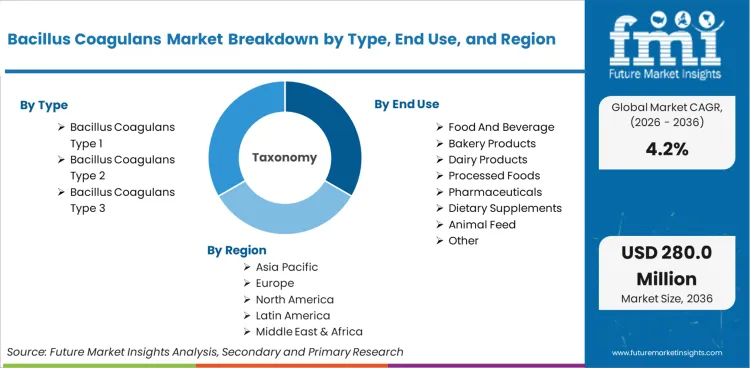
In 2025, the Bacillus coagulans market was valued at USD 178.1 million. Based on Future Market Insights' analysis, demand for Bacillus coagulans is estimated to grow to USD 185.6 million in 2026 and USD 280.0 million by 2036. FMI projects a CAGR of 4.2% during the forecast period.
Absolute dollar growth of USD 94.4 million over the decade reflects a market where the spore-forming stability advantage of Bacillus coagulans over conventional Lactobacillus strains is generating demand in technically demanding food and beverage formats, pharmaceutical applications, and animal feed channels that conventional probiotics cannot reliably serve. In February 2026, Kerry Group announced that its spore-forming probiotic BC30 received official regulatory approval from Indonesian authorities BPOM for a Live Culture health claim, facilitating new innovation in functional food and beverage categories across the Southeast Asian market, a regulatory clearance that opens access to a consumer market exceeding 270 million people for heat-stable probiotic food formulation. [1]
Summary of Bacillus Coagulans Market
- Bacillus Coagulans Market Definition:
- The market covers globally distributed spore-forming Bacillus coagulans probiotic strains used as active ingredients in food and beverage, dietary supplement, pharmaceutical, and animal feed applications across wholesale, retail, and direct-to-consumer channels.
- Demand Drivers in the Market:
- Kerry's BC30 Indonesian BPOM Live Culture health claim approval in February 2026 opens access to Southeast Asian functional food formulation markets where heat-stable probiotic ingredients are technically required and regulatory clearance was previously unavailable.
- Sami-Sabinsa Group's June 2025 published clinical evidence demonstrating LactoSpore improvement in IBS patient depression symptoms and sleep quality signals that Bacillus coagulans strains are accumulating clinical proof for psychiatric and neurological comorbidity applications beyond traditional gut health claims.
- Sanzyme Biologics' January 2026 pediatric clinical trial on Bacillus coagulans SNZ 1969 for immune health and respiratory symptom reduction confirms institutional investment in clinical evidence generation for new end-use categories with significant volume potential.
- Key Segments Analyzed in the FMI Report:
- Type: Bacillus coagulans Type 1 leads at 45.0% share, encompassing the best-documented commercial strains including BC30 and LactoSpore with the broadest regulatory approval coverage.
- End Use: Food and Beverage captures 35.0% of demand as the leading segment, driven by heat-stable probiotic formulation in bakery, dairy, and processed food applications where conventional strains cannot survive processing.
- Distribution: Wholesale channels account for 40.0% of distribution volume, reflecting B2B ingredient procurement patterns across food manufacturer and supplement contract manufacturer customer bases.
- Analyst Opinion at FMI:
- Nandini Roy Choudhury, Principal Consultant for Food and Beverage Industry at Future Market Insights, opines, "In the updated version of the Bacillus Coagulans Market Report for 2026 to 2036, CXOs will find that the market's 4.2% CAGR projection materially undervalues the commercial upside being generated by sequential regulatory approvals in Southeast Asia and accelerating clinical evidence across IBS comorbidity and pediatric immune applications. BC30's Indonesian BPOM approval is a template that BC strain manufacturers are actively replicating in the Philippines, Vietnam, and Thailand, each of which represents a step-function demand increase for heat-stable probiotic food ingredients. The clinical evidence accumulation in psychiatric comorbidities is particularly significant because it creates pharmaceutical-channel demand for strains that are currently priced as food supplement ingredients."
- Strategic Implications / Executive Takeaways:
- Pursue sequential Southeast Asian regulatory approvals for Live Culture health claims in the Philippines, Vietnam, and Thailand to replicate the commercial opportunity unlocked by BC30's Indonesian BPOM clearance.
- Invest in clinical trial sponsorship for IBS comorbidity and pediatric immune applications to build pharmaceutical-grade clinical dossiers that justify pricing and channel repositioning into prescription and clinical nutrition procurement.
- Develop heat-stable Bacillus coagulans formulations for baked goods, extruded snacks, and ambient-temperature beverages to capture the food and beverage channel segment that conventional probiotic suppliers cannot technically serve.
- Methodology:
- Validated through primary interviews with Bacillus coagulans strain manufacturers, supplement formulators, and functional food ingredient buyers.
- Zero reliance on speculative third-party market research reports.
- Based on regulatory approval databases, FDA GRAS notifications, EFSA QPS dossiers, and published clinical trial registry records.
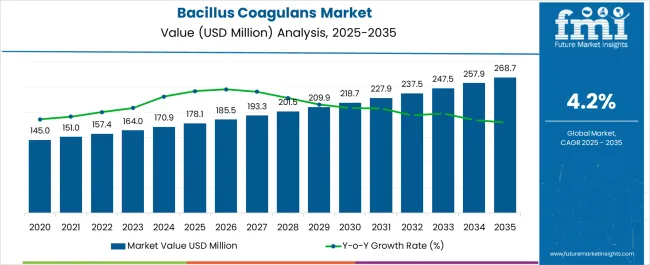
China leads regional growth at a 5.7% CAGR through 2036, driven by expanding functional food and beverage manufacturing and growing clinical nutrition procurement for digestive and metabolic health applications. Japan holds the largest individual country value at USD 145.0 million in 2026, reflecting deep probiotic ingredient integration across functional dairy, fermented food, and pharmaceutical supplement channels. The United States generates USD 68.0 million in 2026 demand, anchored by dietary supplement retail and functional food ingredient procurement. South Korea contributes USD 6.1 million. Bacillus coagulans Type 1 leads at 45.0% type share, Food and Beverage captures 35.0% of end-use demand, and Wholesale channels account for 40.0% of distribution volume.
Bacillus Coagulans Market Definition
The Bacillus coagulans market comprises the global production, cultivation, and distribution of spore-forming thermophilic lactic acid bacteria strains of the Bacillus coagulans species used as probiotic active ingredients in food and beverage formulations, dietary supplements, pharmaceutical preparations, and animal feed applications. The market spans multiple proprietary strain types including GBI-30 6086 (BC30), MTCC 5856 (LactoSpore), and SNZ 1969 variants, distributed across wholesale, retail, and direct-to-consumer channels. Both established strain types and novel clinical-grade strain variants are included.
Bacillus Coagulans Market Inclusions
The report includes global and regional market sizes by volume and value with a 10-year forecast from 2026 to 2036. Coverage spans segmental breakdowns by type (Type 1, Type 2, Type 3), end use (Food and Beverage, Bakery, Dairy, Processed Foods, Pharmaceuticals, Dietary Supplements, Animal Feed, Other), and distribution channel (Wholesale, Online Retailer, Supermarket, Specialty Stores). Country-level analysis covers all major producing and consuming markets globally.
Bacillus Coagulans Market Exclusions
The scope excludes non-spore-forming probiotic strains including Lactobacillus, Bifidobacterium, and Streptococcus thermophilus species even when used in comparable functional food and supplement applications. Finished probiotic consumer products where Bacillus coagulans is a minor component below 1 billion CFU per serving are excluded, as are postbiotic and paraprobiotics derived from heat-inactivated Bacillus coagulans cells. Agricultural soil amendment applications of Bacillus coagulans strains without probiotic functionality claims are outside scope.
Bacillus Coagulans Market Research Methodology
- Primary Research: Interviews were conducted with Bacillus coagulans strain manufacturers, dietary supplement formulators, functional food and beverage ingredient buyers, pharmaceutical probiotic procurement specialists, clinical nutrition researchers, and regulatory affairs consultants across the United States, Japan, South Korea, India, and China.
- Desk Research: Production data from probiotic ingredient industry association reports, regulatory approval databases from BPOM, FDA GRAS notifications, EFSA qualified presumption of safety dossiers, published clinical trial registries, and peer-reviewed probiotic research journals supported benchmarking.
- Market-Sizing and Forecasting: A hybrid top-down and bottom-up model was applied. Demand was reconstructed from dietary supplement retail channel sales data, functional food ingredient procurement volumes, animal feed probiotic additive records, and pharmaceutical probiotic formulation data, then validated against strain manufacturer production capacity and regulatory approval coverage.
- Data Validation and Update Cycle: Outputs undergo anomaly screening, cross-validation against clinical trial registration data and regulatory approval records, and structured peer review prior to release.
Why is the Bacillus Coagulans Market Growing?
The Bacillus Coagulans market is experiencing steady growth driven by increasing awareness of gut health and the rising demand for functional foods and dietary supplements. In 2025, the market is witnessing significant adoption in food and beverage formulations, nutraceuticals, and pharmaceutical applications due to the probiotic’s ability to survive harsh gastric conditions and confer health benefits. Expansion in health-conscious consumer segments, coupled with the growing trend of preventive healthcare, is shaping the current market scenario.
Increased incorporation of Bacillus Coagulans in fortified beverages, dairy alternatives, and snack products is further supporting growth, as manufacturers seek shelf-stable and effective probiotic solutions. Investment in R&D and the launch of novel formulations have enhanced product efficacy and consumer acceptance.
Additionally, the market outlook is strengthened by the proliferation of organized retail channels and the increasing penetration of modern distribution networks, which enable wider availability across urban and semi-urban regions Continued awareness campaigns and education on digestive health are anticipated to sustain demand, making Bacillus Coagulans a preferred choice among probiotics for both commercial and consumer applications.
Segmental Analysis
The bacillus coagulans market is segmented by type, end use, distribution channel, and geographic regions. By type, bacillus coagulans market is divided into Bacillus Coagulans Type 1, Bacillus Coagulans Type 2, and Bacillus Coagulans Type 3. In terms of end use, bacillus coagulans market is classified into Food And Beverage, Bakery Products, Dairy Products, Processed Foods, Pharmaceuticals, Dietary Supplements, Animal Feed, and Other. Based on distribution channel, bacillus coagulans market is segmented into Wholesale, Online Retailer, Supermarket, and Specialty Stores. Regionally, the bacillus coagulans industry is classified into North America, Latin America, Western Europe, Eastern Europe, Balkan & Baltic Countries, Russia & Belarus, Central Asia, East Asia, South Asia & Pacific, and the Middle East & Africa.
Insights into the Bacillus Coagulans Type 1 Segment
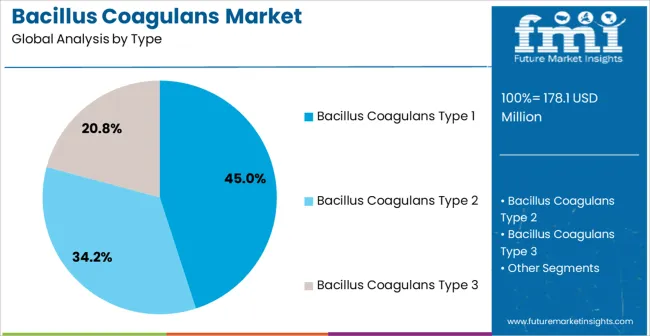
Bacillus Coagulans Type 1 is projected to hold 45.00% of the market revenue share in 2026, establishing it as the leading type in the market. Its dominance is being driven by superior viability under high-temperature processing, long shelf life, and strong resistance to acidic environments, which makes it suitable for inclusion in diverse functional foods and beverages.
The adoption of this type is further supported by research validating its efficacy in improving gut microbiota balance, enhancing digestion, and promoting overall wellness. Manufacturers prefer Bacillus Coagulans Type 1 due to its reliable performance in powdered, capsule, and liquid formulations, enabling cost-effective large-scale production without compromising probiotic functionality.
Growing demand for ready-to-consume functional products and dietary supplements has encouraged the development of Type 1-based formulations that are easily integrated into both established and novel products Its proven stability in commercial processing environments and the flexibility of incorporation into various delivery formats have reinforced its leading position in the market.
Insights into the Food and Beverage End Use Segment
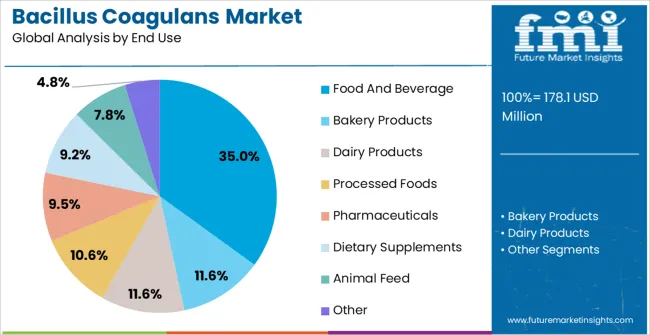
The Food and Beverage end-use segment is expected to account for 35.00% of the Bacillus Coagulans market revenue in 2026, making it the largest contributor among all applications. Growth in this segment is being driven by the rising incorporation of probiotics into functional beverages, dairy alternatives, fortified snacks, and nutritional supplements. Consumer preference for health-oriented products with digestive and immune health benefits has strongly influenced adoption.
Food and beverage manufacturers are increasingly leveraging Bacillus Coagulans for its heat resistance and shelf-stability, which allows it to retain viability during processing and storage. The segment has also benefited from reformulation trends in plant-based and low-sugar products where probiotics are being used to enhance functional value.
Additionally, the ability to integrate Bacillus Coagulans without altering taste or texture has further accelerated uptake As consumer awareness of gut health expands, the Food and Beverage segment is expected to maintain its leadership position, driven by innovations in functional products and increasing demand for convenient, probiotic-enriched consumables.
Insights into the Wholesale Distribution Channel Segment
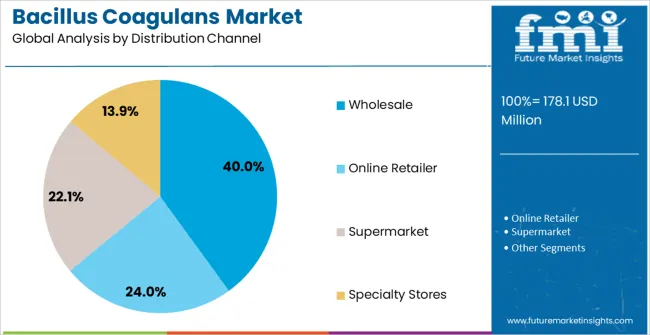
The Wholesale distribution channel segment is projected to hold 40.00% of the Bacillus Coagulans market revenue in 2026, establishing it as the leading channel for product movement. This prominence is being driven by the efficiency and scalability offered by wholesale networks, which enable manufacturers to reach a wide range of retailers, food service providers, and distributors. Adoption is facilitated by cost-effective bulk purchasing, simplified logistics, and the ability to supply diverse end-use segments without requiring direct manufacturer intervention.
Wholesale distribution is particularly advantageous in supplying functional food and dietary supplement markets, where demand volumes are substantial and consistent. The channel also supports rapid market penetration for new product launches and allows flexibility in inventory management.
With expanding retail networks and growing health-focused consumer bases, wholesale distribution continues to act as a critical conduit for Bacillus Coagulans products, ensuring timely availability and consistent supply across multiple geographies This channel’s reliability and broad reach reinforce its position as the dominant mode of distribution in the market.
Market Overview
Bacillus Coagulans Market Outlook from (2026 to 2036)
Bacillus coagulans is a type of bacteria that is utilized as a probiotic due to its ability to withstand harsh acidic environments. This makes it ideal for concentrating on the digestive system in humans, providing relief from various gastrointestinal issues such as stomach aches, constipation, and irritable bowel syndrome. Moreover, this resilient bacterium is also useful in animal feeding as it possesses beneficial properties such as improved immunity, prevention of respiratory ailments, and anti-cancer properties.
The global market for Bacillus coagulans has experienced significant growth opportunities due to an increase in demand for functional foods and growing health concerns. The market expansion is further supported by increased research and development expenditures. However, the lack of awareness about the effectiveness of Bacillus coagulans among consumers has hindered its growth. Nonetheless, the market is expected to expand in emerging economies as consumer demand for Bacillus coagulans products increases, creating new opportunities for growth.
In our new study, ESOMAR-certified market research and consulting firm Future Market Insights (FMI) offers insights into key factors driving demand for Bacillus Coagulans.
Analysis of Bacillus Coagulans Market By Key Countries
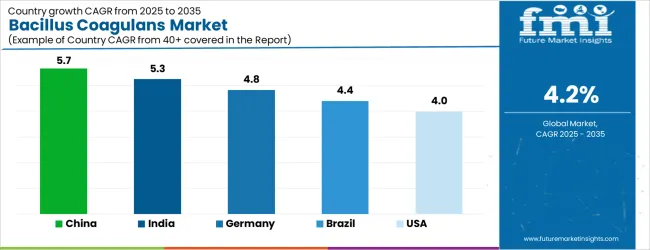
.webp "Top Country Growth Comparison Bacillus Coagulans Market Cagr (2026 2036)")
| Country | CAGR |
|---|---|
| China | 5.7% |
| India | 5.3% |
| Germany | 4.8% |
| Brazil | 4.4% |
| USA | 4.0% |
| UK | 3.6% |
| Japan | 3.2% |
Country-wise Analysis
The Bacillus Coagulans Market is expected to register a CAGR of 4.2% during the forecast period, exhibiting varied country level momentum. China leads with the highest CAGR of 5.7%, followed by India at 5.3%. Developed markets such as Germany, France, and the UK continue to expand steadily, while the USA is likely to grow at consistent rates. Japan posts the lowest CAGR at 3.2%, yet still underscores a broadly positive trajectory for the global Bacillus Coagulans Market. In 2024, Germany held a dominant revenue in the Western Europe market and is expected to grow with a CAGR of 4.8%. The USA Bacillus Coagulans Market is estimated to be valued at USD 66.1 million in 2025 and is anticipated to reach a valuation of USD 66.1 million by 2036. Sales are projected to rise at a CAGR of 0.0% over the forecast period between 2025 and 2036. While Japan and South Korea markets are estimated to be valued at USD 8.3 million and USD 6.1 million respectively in 2025.
Key Players in the Bacillus Coagulans Market
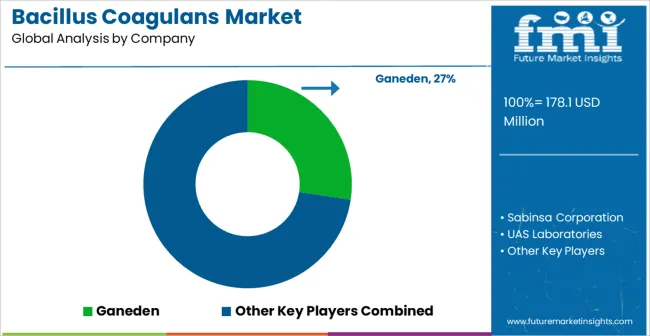
- Ganeden
- Sabinsa Corporation
- UAS Laboratories
- Sanzyme
- Mitsubishi Chemical Foods Corporation
- Mystical Biotech Pvt. Ltd.
- Aumgene Biosciences
- Unique Biotech Ltd.
- Nebraska Culture
- Syngem Biotech
Recent Developments
The report includes full coverage of key trends from competitive benchmarking. Some of the recent developments covered in the reports:
- In February 2026, Kerry Group announced that its BC30 probiotic received official regulatory approval from Indonesian authorities BPOM for a Live Culture health claim, facilitating new functional food and beverage innovation across the Southeast Asian market. [1]
- In January 2026, Sanzyme Biologics initiated a targeted clinical trial to evaluate the efficacy of Bacillus coagulans SNZ 1969 in improving immune health and reducing respiratory and gastrointestinal symptoms in school-aged children during the 2025 to 2026 cold and flu season. [2]
- In June 2025, Sami-Sabinsa Group highlighted new clinical evidence published in Food and Nutrition Research demonstrating that its LactoSpore Bacillus coagulans MTCC 5856 strain may improve symptoms of major depression and sleep quality in IBS patients. [3]
Scope of the Report
| Metric | Value |
|---|---|
| Quantitative Units | USD 185.6 million (2026) to USD 280.0 million (2036), at a CAGR of 4.2% |
| Market Definition | The Bacillus coagulans market covers globally distributed spore-forming probiotic strains used as active ingredients in food and beverage, dietary supplement, pharmaceutical, and animal feed applications across wholesale, retail, and direct-to-consumer channels. |
| Type Segmentation | Bacillus Coagulans Type 1, Bacillus Coagulans Type 2, Bacillus Coagulans Type 3 |
| End Use Segmentation | Food and Beverage, Bakery Products, Dairy Products, Processed Foods, Pharmaceuticals, Dietary Supplements, Animal Feed, Other |
| Distribution Channel | Wholesale, Online Retailer, Supermarket, Specialty Stores |
| Regions Covered | North America, Latin America, Europe, East Asia, South Asia, Oceania, Middle East and Africa |
| Countries Covered | United States, Germany, France, United Kingdom, Japan, China, South Korea, India, Indonesia, Australia and 40 plus countries |
| Key Companies Profiled | Kerry Group PLC (Ganeden BC30), Sabinsa Corporation (LactoSpore), UAS Laboratories, Sanzyme Biologics, Mitsubishi Chemical Foods Corporation, Mystical Biotech Pvt. Ltd., Aumgene Biosciences, Unique Biotech Ltd., Nebraska Culture, Syngem Biotech |
| Forecast Period | 2026 to 2036 |
| Approach | Hybrid top-down and bottom-up market modeling validated through primary interviews with strain manufacturers and functional food buyers, supported by regulatory approval databases, clinical trial registries, and industry association data |
Bacillus Coagulans Market by Segments
Type:
- Bacillus Coagulans Type 1
- Bacillus Coagulans Type 2
- Bacillus Coagulans Type 3
End Use:
- Food And Beverage
- Bakery Products
- Dairy Products
- Processed Foods
- Pharmaceuticals
- Dietary Supplements
- Animal Feed
- Other
Distribution Channel:
- Wholesale
- Online Retailer
- Supermarket
- Specialty Stores
Region:
- North America
- USA
- Canada
- Mexico
- Latin America
- Brazil
- Chile
- Rest of Latin America
- Western Europe
- Germany
- UK
- Italy
- Spain
- France
- Nordic
- BENELUX
- Rest of Western Europe
- Eastern Europe
- Russia
- Poland
- Hungary
- Balkan & Baltic
- Rest of Eastern Europe
- East Asia
- China
- Japan
- South Korea
- South Asia and Pacific
- India
- ASEAN
- Australia & New Zealand
- Rest of South Asia and Pacific
- Middle East & Africa
- Kingdom of Saudi Arabia
- Other GCC Countries
- Turkiye
- South Africa
- Other African Union
- Rest of Middle East & Africa
Bibliography
- [1] Kerry Group / PR Newswire APAC. (2026). BC30 approved for Live Culture claim in Indonesia, opening opportunities in food and beverage innovation. February 2026. https://www.prnewswire.com/apac/news-releases/bc30-approved-for-live-culture-claim-in-indonesia-opening-opportunities-in-fb-innovation-302697947.html
- [2] ClinicalTrials.gov. (2026). Sanzyme Biologics clinical trial NCT07341750: Bacillus coagulans SNZ 1969 for immune health in school-aged children. January 2026. https://clinicaltrials.gov/study/NCT07341750
- [3] Sami-Sabinsa Group. (2025). LactoSpore clinical evidence: Bacillus coagulans MTCC 5856 beneficial for IBS patients with major depression and sleep quality. June 2025. https://sami-sabinsagroup.com/97-media-coverage/155-sami-sabinsa-s-lactospore-beneficial-for-ibs-patients-news-featured-in-nuffoods-spectrum
- [4] ISAPP (International Scientific Association for Probiotics and Prebiotics). (2025). Annual Review of Probiotic Strain Regulatory Status. ISAPP Report.
This bibliography is provided for reader reference and is not exhaustive. The full report contains the complete reference list and detailed citations.
This Report Addresses
- Market intelligence to enable structured strain sourcing, regulatory strategy, and channel positioning decisions across food and beverage, supplement, pharmaceutical, and animal feed Bacillus coagulans applications
- Market size estimation and 10-year revenue forecasts from 2026 to 2036, supported by validated strain production data and regulatory approval coverage benchmarks
- Growth opportunity mapping across type, end use, and distribution channel segments with emphasis on Southeast Asian regulatory expansion and clinical comorbidity evidence development
- Segment and regional revenue forecasts covering Type 1, Type 2, and Type 3 strains across food, supplement, and pharmaceutical end-use channels in 40 plus countries
- Competition strategy assessment including heat-stable formulation investment, sequential regulatory approval strategies, and pharmaceutical-channel clinical dossier development
- Regulatory impact analysis covering BPOM, FDA GRAS, EFSA QPS, and country-specific probiotic health claim frameworks across key Asian and Western markets
- Clinical evidence tracking covering IBS, psychiatric comorbidity, pediatric immune, and metabolic health application trials across major registered Bacillus coagulans strains
- Market report delivery in PDF, Excel, PPT, and interactive dashboard formats for executive and operational use
Frequently Asked Questions
How large is the demand for Bacillus Coagulans in the global market in 2026?
Demand for Bacillus Coagulans in the global market is estimated to be valued at USD 185.6 million in 2026.
What will the market size of Bacillus Coagulans be by 2036?
Market size for Bacillus Coagulans is projected to reach USD 280.0 million by 2036.
What is the expected CAGR for the Bacillus Coagulans Market between 2026 and 2036?
Demand for Bacillus Coagulans is expected to grow at a CAGR of 4.2% between 2026 and 2036.
Which Type leads the Bacillus Coagulans Market in 2026?
Bacillus coagulans Type 1 leads at 45.0% type share, encompassing the best-documented commercial strains including BC30 and LactoSpore with the broadest regulatory approval coverage.
Which End Use segment dominates the Bacillus Coagulans Market?
Food and Beverage captures 35.0% of demand as the leading segment, driven by heat-stable probiotic formulation in bakery, dairy, and processed food applications.
What is driving China's growth in the Bacillus Coagulans Market?
China leads regional growth at a 5.7% CAGR through 2036, driven by expanding functional food and beverage manufacturing and growing clinical nutrition procurement for digestive and metabolic health.
What does Kerry's BC30 Indonesian BPOM approval mean for the market?
The February 2026 Live Culture health claim approval opens access to a consumer market exceeding 270 million people for heat-stable probiotic food formulation, serving as a template for sequential Southeast Asian regulatory filings.
What clinical applications are expanding for Bacillus Coagulans?
Published clinical evidence now covers IBS patient depression and sleep quality improvement by LactoSpore, pediatric immune health by SNZ 1969, and gut health applications, collectively expanding addressable pharmaceutical and clinical nutrition channels.
What is included in the scope of this report?
Scope covers spore-forming Bacillus coagulans probiotic strains across food and beverage, dietary supplement, pharmaceutical, and animal feed applications in Type 1, Type 2, and Type 3 strain categories.
What is excluded from this report's scope?
Non-spore-forming probiotic strains, heat-inactivated postbiotic and paraprobiotic products, finished products below 1 billion CFU per serving, and agricultural soil amendment applications are excluded.
How does FMI validate its Bacillus Coagulans Market forecast?
The forecast uses a hybrid model validated through primary interviews with strain manufacturers and food ingredient buyers, cross-checked against regulatory approval databases, FDA GRAS notifications, and clinical trial registry records.
Preview the report firsthand - request a free sample
Get SampleGet the brochure for pricing and purchase details.
Get PDFTable of Content
- Executive Summary
- Global Market Outlook
- Demand-side Trends
- Supply-side Trends
- Technology Roadmap Analysis
- Analysis and Recommendations
- Market Overview
- Market Coverage / Taxonomy
- Market Definition / Scope / Limitations
- Research Methodology
- Chapter Orientation
- Analytical Lens and Working Hypotheses
- Market Structure, Signals, and Trend Drivers
- Benchmarking and Cross-market Comparability
- Market Sizing, Forecasting, and Opportunity Mapping
- Research Design and Evidence Framework
- Desk Research Programme (Secondary Evidence)
- Company Annual and Sustainability Reports
- Peer-reviewed Journals and Academic Literature
- Corporate Websites, Product Literature, and Technical Notes
- Earnings Decks and Investor Briefings
- Statutory Filings and Regulatory Disclosures
- Technical White Papers and Standards Notes
- Trade Journals, Industry Magazines, and Analyst Briefs
- Conference Proceedings, Webinars, and Seminar Materials
- Government Statistics Portals and Public Data Releases
- Press Releases and Reputable Media Coverage
- Specialist Newsletters and Curated Briefings
- Sector Databases and Reference Repositories
- FMI Internal Proprietary Databases and Historical Market Datasets
- Subscription Datasets and Paid Sources
- Social Channels, Communities, and Digital Listening Inputs
- Additional Desk Sources
- Expert Input and Fieldwork (Primary Evidence)
- Primary Modes
- Qualitative Interviews and Expert Elicitation
- Quantitative Surveys and Structured Data Capture
- Blended Approach
- Why Primary Evidence is Used
- Field Techniques
- Interviews
- Surveys
- Focus Groups
- Observational and In-context Research
- Social and Community Interactions
- Stakeholder Universe Engaged
- C-suite Leaders
- Board Members
- Presidents and Vice Presidents
- R&D and Innovation Heads
- Technical Specialists
- Domain Subject-matter Experts
- Scientists
- Physicians and Other Healthcare Professionals
- Governance, Ethics, and Data Stewardship
- Research Ethics
- Data Integrity and Handling
- Primary Modes
- Tooling, Models, and Reference Databases
- Desk Research Programme (Secondary Evidence)
- Data Engineering and Model Build
- Data Acquisition and Ingestion
- Cleaning, Normalisation, and Verification
- Synthesis, Triangulation, and Analysis
- Quality Assurance and Audit Trail
- Market Background
- Market Dynamics
- Drivers
- Restraints
- Opportunity
- Trends
- Scenario Forecast
- Demand in Optimistic Scenario
- Demand in Likely Scenario
- Demand in Conservative Scenario
- Opportunity Map Analysis
- Product Life Cycle Analysis
- Supply Chain Analysis
- Investment Feasibility Matrix
- Value Chain Analysis
- PESTLE and Porter’s Analysis
- Regulatory Landscape
- Regional Parent Market Outlook
- Production and Consumption Statistics
- Import and Export Statistics
- Market Dynamics
- Global Market Analysis 2021 to 2025 and Forecast, 2026 to 2036
- Historical Market Size Value (USD Million) Analysis, 2021 to 2025
- Current and Future Market Size Value (USD Million) Projections, 2026 to 2036
- Y-o-Y Growth Trend Analysis
- Absolute $ Opportunity Analysis
- Global Market Pricing Analysis 2021 to 2025 and Forecast 2026 to 2036
- Global Market Analysis 2021 to 2025 and Forecast 2026 to 2036, By Type
- Introduction / Key Findings
- Historical Market Size Value (USD Million) Analysis By Type , 2021 to 2025
- Current and Future Market Size Value (USD Million) Analysis and Forecast By Type , 2026 to 2036
- Bacillus Coagulans Type 1
- Bacillus Coagulans Type 2
- Bacillus Coagulans Type 3
- Bacillus Coagulans Type 1
- Y-o-Y Growth Trend Analysis By Type , 2021 to 2025
- Absolute $ Opportunity Analysis By Type , 2026 to 2036
- Global Market Analysis 2021 to 2025 and Forecast 2026 to 2036, By End Use
- Introduction / Key Findings
- Historical Market Size Value (USD Million) Analysis By End Use, 2021 to 2025
- Current and Future Market Size Value (USD Million) Analysis and Forecast By End Use, 2026 to 2036
- Food And Beverage
- Bakery Products
- Dairy Products
- Processed Foods
- Pharmaceuticals
- Dietary Supplements
- Animal Feed
- Other
- Food And Beverage
- Y-o-Y Growth Trend Analysis By End Use, 2021 to 2025
- Absolute $ Opportunity Analysis By End Use, 2026 to 2036
- Global Market Analysis 2021 to 2025 and Forecast 2026 to 2036, By Distribution Channel
- Introduction / Key Findings
- Historical Market Size Value (USD Million) Analysis By Distribution Channel, 2021 to 2025
- Current and Future Market Size Value (USD Million) Analysis and Forecast By Distribution Channel, 2026 to 2036
- Wholesale
- Online Retailer
- Supermarket
- Specialty Stores
- Wholesale
- Y-o-Y Growth Trend Analysis By Distribution Channel, 2021 to 2025
- Absolute $ Opportunity Analysis By Distribution Channel, 2026 to 2036
- Global Market Analysis 2021 to 2025 and Forecast 2026 to 2036, By Region
- Introduction
- Historical Market Size Value (USD Million) Analysis By Region, 2021 to 2025
- Current Market Size Value (USD Million) Analysis and Forecast By Region, 2026 to 2036
- North America
- Latin America
- Western Europe
- Eastern Europe
- East Asia
- South Asia and Pacific
- Middle East & Africa
- Market Attractiveness Analysis By Region
- North America Market Analysis 2021 to 2025 and Forecast 2026 to 2036, By Country
- Historical Market Size Value (USD Million) Trend Analysis By Market Taxonomy, 2021 to 2025
- Market Size Value (USD Million) Forecast By Market Taxonomy, 2026 to 2036
- By Country
- USA
- Canada
- Mexico
- By Type
- By End Use
- By Distribution Channel
- By Country
- Market Attractiveness Analysis
- By Country
- By Type
- By End Use
- By Distribution Channel
- Key Takeaways
- Latin America Market Analysis 2021 to 2025 and Forecast 2026 to 2036, By Country
- Historical Market Size Value (USD Million) Trend Analysis By Market Taxonomy, 2021 to 2025
- Market Size Value (USD Million) Forecast By Market Taxonomy, 2026 to 2036
- By Country
- Brazil
- Chile
- Rest of Latin America
- By Type
- By End Use
- By Distribution Channel
- By Country
- Market Attractiveness Analysis
- By Country
- By Type
- By End Use
- By Distribution Channel
- Key Takeaways
- Western Europe Market Analysis 2021 to 2025 and Forecast 2026 to 2036, By Country
- Historical Market Size Value (USD Million) Trend Analysis By Market Taxonomy, 2021 to 2025
- Market Size Value (USD Million) Forecast By Market Taxonomy, 2026 to 2036
- By Country
- Germany
- UK
- Italy
- Spain
- France
- Nordic
- BENELUX
- Rest of Western Europe
- By Type
- By End Use
- By Distribution Channel
- By Country
- Market Attractiveness Analysis
- By Country
- By Type
- By End Use
- By Distribution Channel
- Key Takeaways
- Eastern Europe Market Analysis 2021 to 2025 and Forecast 2026 to 2036, By Country
- Historical Market Size Value (USD Million) Trend Analysis By Market Taxonomy, 2021 to 2025
- Market Size Value (USD Million) Forecast By Market Taxonomy, 2026 to 2036
- By Country
- Russia
- Poland
- Hungary
- Balkan & Baltic
- Rest of Eastern Europe
- By Type
- By End Use
- By Distribution Channel
- By Country
- Market Attractiveness Analysis
- By Country
- By Type
- By End Use
- By Distribution Channel
- Key Takeaways
- East Asia Market Analysis 2021 to 2025 and Forecast 2026 to 2036, By Country
- Historical Market Size Value (USD Million) Trend Analysis By Market Taxonomy, 2021 to 2025
- Market Size Value (USD Million) Forecast By Market Taxonomy, 2026 to 2036
- By Country
- China
- Japan
- South Korea
- By Type
- By End Use
- By Distribution Channel
- By Country
- Market Attractiveness Analysis
- By Country
- By Type
- By End Use
- By Distribution Channel
- Key Takeaways
- South Asia and Pacific Market Analysis 2021 to 2025 and Forecast 2026 to 2036, By Country
- Historical Market Size Value (USD Million) Trend Analysis By Market Taxonomy, 2021 to 2025
- Market Size Value (USD Million) Forecast By Market Taxonomy, 2026 to 2036
- By Country
- India
- ASEAN
- Australia & New Zealand
- Rest of South Asia and Pacific
- By Type
- By End Use
- By Distribution Channel
- By Country
- Market Attractiveness Analysis
- By Country
- By Type
- By End Use
- By Distribution Channel
- Key Takeaways
- Middle East & Africa Market Analysis 2021 to 2025 and Forecast 2026 to 2036, By Country
- Historical Market Size Value (USD Million) Trend Analysis By Market Taxonomy, 2021 to 2025
- Market Size Value (USD Million) Forecast By Market Taxonomy, 2026 to 2036
- By Country
- Kingdom of Saudi Arabia
- Other GCC Countries
- Turkiye
- South Africa
- Other African Union
- Rest of Middle East & Africa
- By Type
- By End Use
- By Distribution Channel
- By Country
- Market Attractiveness Analysis
- By Country
- By Type
- By End Use
- By Distribution Channel
- Key Takeaways
- Key Countries Market Analysis
- USA
- Pricing Analysis
- Market Share Analysis, 2025
- By Type
- By End Use
- By Distribution Channel
- Canada
- Pricing Analysis
- Market Share Analysis, 2025
- By Type
- By End Use
- By Distribution Channel
- Mexico
- Pricing Analysis
- Market Share Analysis, 2025
- By Type
- By End Use
- By Distribution Channel
- Brazil
- Pricing Analysis
- Market Share Analysis, 2025
- By Type
- By End Use
- By Distribution Channel
- Chile
- Pricing Analysis
- Market Share Analysis, 2025
- By Type
- By End Use
- By Distribution Channel
- Germany
- Pricing Analysis
- Market Share Analysis, 2025
- By Type
- By End Use
- By Distribution Channel
- UK
- Pricing Analysis
- Market Share Analysis, 2025
- By Type
- By End Use
- By Distribution Channel
- Italy
- Pricing Analysis
- Market Share Analysis, 2025
- By Type
- By End Use
- By Distribution Channel
- Spain
- Pricing Analysis
- Market Share Analysis, 2025
- By Type
- By End Use
- By Distribution Channel
- France
- Pricing Analysis
- Market Share Analysis, 2025
- By Type
- By End Use
- By Distribution Channel
- India
- Pricing Analysis
- Market Share Analysis, 2025
- By Type
- By End Use
- By Distribution Channel
- ASEAN
- Pricing Analysis
- Market Share Analysis, 2025
- By Type
- By End Use
- By Distribution Channel
- Australia & New Zealand
- Pricing Analysis
- Market Share Analysis, 2025
- By Type
- By End Use
- By Distribution Channel
- China
- Pricing Analysis
- Market Share Analysis, 2025
- By Type
- By End Use
- By Distribution Channel
- Japan
- Pricing Analysis
- Market Share Analysis, 2025
- By Type
- By End Use
- By Distribution Channel
- South Korea
- Pricing Analysis
- Market Share Analysis, 2025
- By Type
- By End Use
- By Distribution Channel
- Russia
- Pricing Analysis
- Market Share Analysis, 2025
- By Type
- By End Use
- By Distribution Channel
- Poland
- Pricing Analysis
- Market Share Analysis, 2025
- By Type
- By End Use
- By Distribution Channel
- Hungary
- Pricing Analysis
- Market Share Analysis, 2025
- By Type
- By End Use
- By Distribution Channel
- Kingdom of Saudi Arabia
- Pricing Analysis
- Market Share Analysis, 2025
- By Type
- By End Use
- By Distribution Channel
- Turkiye
- Pricing Analysis
- Market Share Analysis, 2025
- By Type
- By End Use
- By Distribution Channel
- South Africa
- Pricing Analysis
- Market Share Analysis, 2025
- By Type
- By End Use
- By Distribution Channel
- USA
- Market Structure Analysis
- Competition Dashboard
- Competition Benchmarking
- Market Share Analysis of Top Players
- By Regional
- By Type
- By End Use
- By Distribution Channel
- Competition Analysis
- Competition Deep Dive
- Ganeden
- Overview
- Product Portfolio
- Profitability by Market Segments (Product/Age /Sales Channel/Region)
- Sales Footprint
- Strategy Overview
- Marketing Strategy
- Product Strategy
- Channel Strategy
- Sabinsa Corporation
- UAS Laboratories
- Sanzyme
- Mitsubishi Chemical Foods Corporation
- Mystical Biotech Pvt. Ltd.
- Aumgene Biosciences
- Unique Biotech Ltd.
- Nebraska Culture
- Syngem Biotech
- Ganeden
- Competition Deep Dive
- Assumptions & Acronyms Used


