

- Market Size (2026)
- USD 414.5 Bn
- Forecast (2036)
- USD 928.6 Bn
- CAGR (2026 to 2036)
- 8.4%
Branded Generics Market Size, Market Forecast and Outlook By FMI
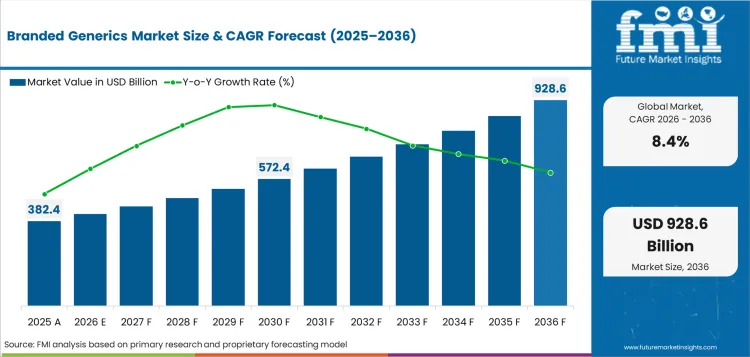
The branded generics market is valued at USD 382.4 billion in 2025. FMI projects the market to reach USD 414.5 billion in 2026 and USD 928.6 billion by 2036. Demand is expected to expand at 8.4% CAGR from 2026 to 2036. Oral formulations are likely to account for 65.0% of formulation type demand in 2026, and hospitals are forecast to represent 48.0% of end use revenue.
Branded generics succeed mainly because doctors and hospitals trust them, they are easy to access, and they are competitively priced. For example, Sandoz reported USD 11.1billion in sales in 2025, with biosimilars contributing 30%, which makes it an attractive supplier for distributors seeking both standard generics and higher‑value products. FDA’s October 2025 ANDA guidance continue to link generic approvals to the original branded medicines. Manufacturers must prove that a generic can serve as a safe and lower-cost alternative.
For example, Viatris added a portfolio signal because it combines generics, complex products and recognized brands across global markets. Teva’s January 2026 update shows the margin issue because innovative brands passed USD 3 billion while generic pricing remains competitive. Branded generic suppliers with regulatory discipline, broad molecule coverage and trusted names are better placed in pharmacy‑driven markets.
Summary of the Branded Generics Market
- Demand and Growth Drivers
- Chronic disease treatment is expected to support branded generic demand as physicians continue to prescribe trusted names for repeat therapy.
- Hospital formularies are likely to keep branded generics in active use as inpatient care depends on steady supply and known product quality.
- Cost pressure across public and private healthcare systems is expected to increase the role of branded generics in diabetes and cardiovascular treatment.
- Product and Segment View
- Oral formulations are likely to hold a leading position as tablets and capsules suit long-term prescriptions and routine refills.
- Cardiovascular diseases are forecast to form a major therapy base due to repeat use in hypertension and lipid management.
- Conventional generics are expected to retain a clear role as standard formulations remain widely accepted across hospital and retail pharmacy channels.
- Geography and Competitive Outlook
- China is expected to stay a key growth market as hospital purchasing reforms and chronic therapy access widen branded generic use.
- India is likely to sustain high demand as physician-led prescribing and retail pharmacy reach support branded medicine recall.
- Companies with strong regulatory filings and hospital channel access are likely to improve access during the forecast period.
- Analyst Opinion
- Anurag Sharma, Principal Consultant at FMI says, “I see branded generics as a trust-based pharmaceutical business, not a simple low-cost copy trade. Demand comes from physicians who want known brands for chronic therapy and hospitals that need dependable supply across high-volume medicines. Cost pressure is real, especially in public tenders and retail reimbursement systems.”
- Branded Generics Market Value Analysis
- Branded generics create value through trusted off-patent medicines that let physicians manage cost without losing product familiarity.
- Oral formulations support repeat spending as tablets and capsules suit daily therapy across diabetes and cardiovascular care.
- Hospitals generate high-value demand through inpatient supply and specialty treatment needs.
- Hospital pharmacies stay important as formulary control and steady stock availability shape product selection.
- Supplier pricing depends on regulatory filings and batch quality because branded generics compete against lower-cost unbranded alternatives.
Key Takeaways
| Metric | Value |
|---|---|
| Market Size (2025) | USD 382.4 Billion |
| Market Size (2036) | USD 928.6 Billion |
| Fastest-Growing Segment | Demand For Branded Generics |
| Demand For Branded Generics CAGR | 8.4% |
| Incremental Opportunity (2026–2036) | USD 514.1 Billion |
| Leading Formulation Type (2026) | Oral Formulations |
| Oral Formulations Share (2026) | 65.0% |
| Highlight | China (10.8%) and India (10.0%) are two steadily-growing branded generics markets globally |
Branded Generics Market Definition
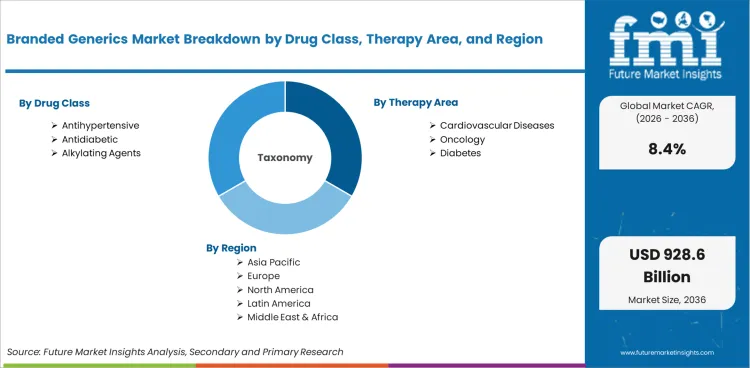
The branded generics market includes off-patent prescription medicines sold under a company-owned brand name. Scope covers antidiabetic drugs, antihypertensive drugs, oncology medicines, cardiovascular therapies, and other prescription drug classes.
Branded Generics Market Inclusions
Market scope includes branded off-patent prescription medicines by drug class, therapy area, formulation type, distribution channel, end use, technology, and region. Key stakeholders include branded generic manufacturers, API suppliers, contract manufacturing organizations, hospital pharmacies, retail pharmacies, drug distributors, prescribing physicians, specialty clinics, and healthcare institutions.
Branded Generics Market Exclusions
Scope excludes patented originator medicines, purely unbranded generics, consumer wellness products, nutraceuticals, medical devices, and biologics sold without generic substitution status.
Branded Generics Market Research Methodology
- Primary Research: FMI analysts reviewed prescribing behavior across hospital pharmacies, retail chains, specialty clinics, and chronic disease treatment centers. Inputs covered branded generic manufacturers, distributors, pharmacy managers, and therapy area specialists.
- Desk Research: Desk review used regulatory lists, generic approval databases, medicine access programs, and company product portfolios. FDA generic approval updates and national affordability programs were used to frame market access behavior.
- Market Sizing and Forecasting: The model combined provided FMI market values with country-level growth variation and segment demand shares. Forecasts were cross-checked against chronic disease therapy needs and distribution channel structure.
- Data Validation: Forecast assumptions were checked against company portfolios and generic medicine access signals.
Why is the Branded Generics Market Growing?
- Chronic therapy use supports repeat branded generic prescriptions across diabetes and cardiovascular care.
- Hospital formularies keep branded generics active when physicians prefer known names for high-volume medicines.
- Public affordability programs widen generic access in India and other cost-sensitive markets.
- Regulatory approval flow supports launch activity as off-patent therapies enter competitive branded channels.
Branded generics grow when physicians and hospitals need lower-cost medicines without losing brand familiarity. FDA lists first generic approvals each year and published its 2024 first generic approval list in October 2025. FDA approval flow keeps new off-patent therapies entering branded and unbranded supply channels. Each new approval creates a fresh product slot for companies with field force depth and pharmacy access. Manufacturers with recognized brands can protect physician trust in therapy areas such as diabetes and cardiovascular care.
Access programs strengthen the volume case for branded generics in price-sensitive countries. India’s PMBJP scheme had 16,912 Jan Aushadhi Kendras by June 30, 2025 and a target of 25,000 outlets by March 2027. PMBJP outlet growth shows the scale of public generic access, even when many prescriptions still move through branded private channels. Branded generic suppliers use that demand base differently by serving doctors and retail pharmacists with recognized product names. Branded generics grow through affordability and brand recall together.
Market Segmentation Analysis
- Oral formulations are projected to lead with 65.0% share in 2026 as tablets support long-term therapy adherence.
- Hospitals are projected to represent 48.0% of end use revenue as inpatient supply and specialty treatment needs shape spending in 2026.
- Structured institutional supply keeps hospital pharmacies on track to account for 42.0% of distribution channel revenue in 2026.
- Conventional generics are likely to hold 48.0% share during the forecast period as standard formulations retain broad use.
- Antihypertensive drugs are expected to represent 18.0% in 2026 due to repeat prescription intensity across chronic cardiovascular care.
The branded generics market is segmented by drug class, therapy area, formulation type, distribution channel, end use, and technology. Drug class includes antidiabetic, antihypertensive, alkylating agents, antimetabolites, hormones, lipid-lowering drugs, antidepressants, antipsychotics, antiepileptics, and others. Therapy area includes oncology, cardiovascular diseases, diabetes, neurology, gastrointestinal diseases, dermatology diseases, analgesics and anti-inflammatory, and others. Formulation type includes oral, parenteral, topical, and others. Distribution channel includes hospital pharmacies, retail pharmacies, online pharmacies, and drug stores. End use includes hospitals, clinics, and home care settings. Technology includes conventional generics, branded generics innovation, and enhanced delivery systems.
Insights into Branded Generics Market by Drug Class
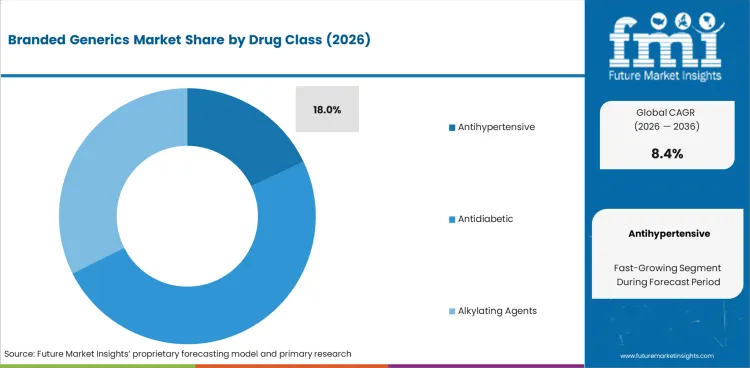
- Antihypertensive drugs are projected to represent 18.0% in 2026 as hypertension care depends on repeat prescriptions and stable brand recall.
- ACE inhibitors and calcium channel blockers support steady volume when physicians keep patients on familiar brands after blood pressure control improves.
Insights into Branded Generics Market by Therapy Area
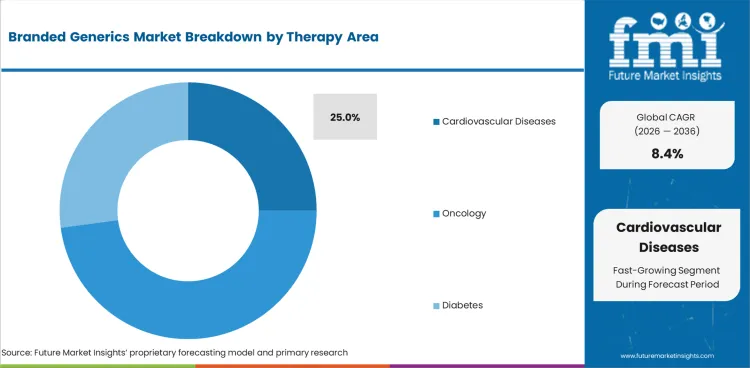
- A 25.0% share is expected for cardiovascular diseases in 2026 as hypertension and lipid management need long treatment cycles.
- Lipid-lowering drugs retain value in branded generic portfolios since statin therapy depends on refill continuity and physician comfort with product consistency.
Insights into Branded Generics Market by Formulation Type
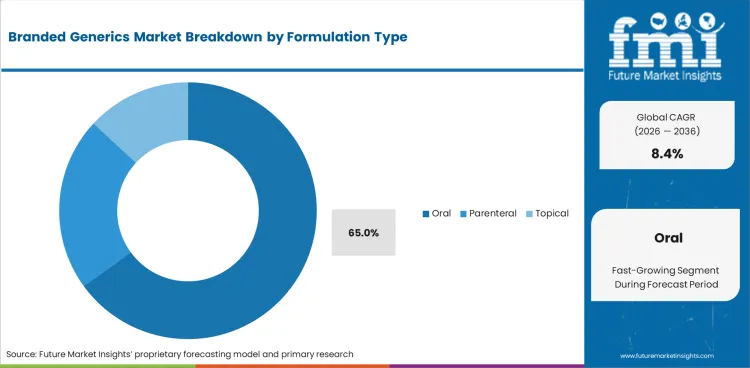
- Oral formulations are expected to lead with 65.0% share in 2026 as tablets and capsules suit daily chronic dosing.
- Immediate release and extended release formats create different pricing bands when modified dosing improves compliance in diabetes and cardiovascular therapy.
Insights into Branded Generics Market by Distribution Channel
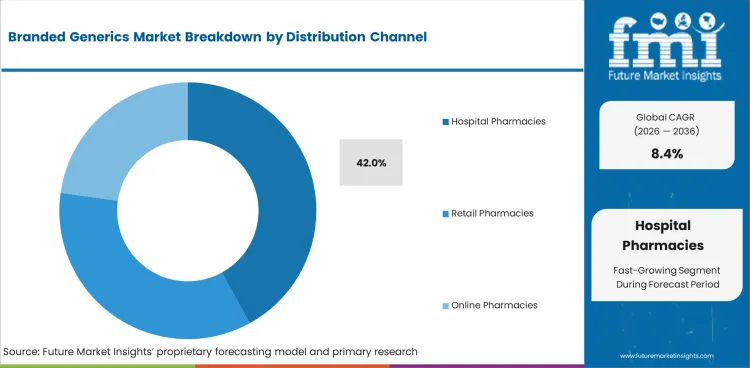
- During the forecast period, hospital pharmacies are forecast to account for 42.0% as institutional supply favors known products with consistent availability.
- Inpatient supply and critical care drugs give hospital pharmacies higher influence as substitution decisions often pass through formulary committees.
Insights into Branded Generics Market by End Use
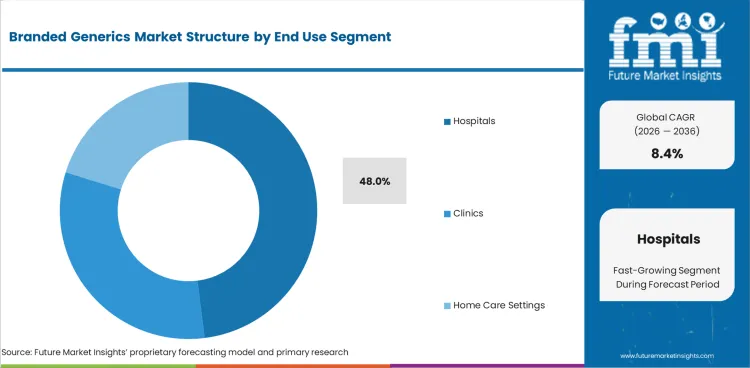
- Hospitals are estimated to represent 48.0% of end use revenue in 2026 through specialty treatment and high-value prescription use.
- Tertiary care hospitals use branded generics in oncology support and cardiovascular care when therapy risk makes product familiarity more important than the lowest price.
Insights into Branded Generics Market by Technology
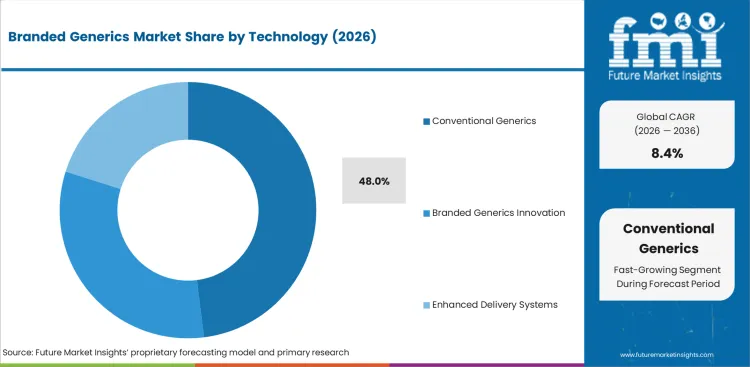
- Conventional generics are expected to lead with 48.0% share by 2026 as standard formulations cover most repeat prescriptions.
- Value-added generics gain attention when modified release or better absorption can support a clearer clinical benefit.
Branded Generics Market Drivers, Restraints, and Opportunities
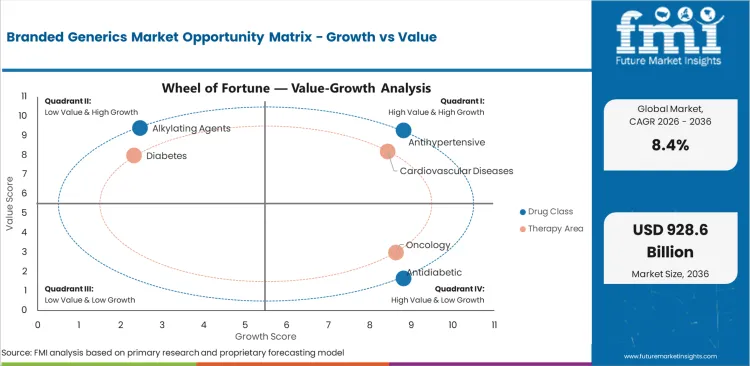
- Chronic prescription repetition supports branded generic volume across diabetes and cardiovascular treatment.
- Hospital formulary control creates demand for known suppliers with stable quality records.
- Price caps and tender rules limit margin upside in public supply channels.
- Value-added formulations create opportunity when companies prove dosing or adherence benefits.
Chronic Prescription Retention
Chronic therapy is the main reason branded generics keep a premium over plain unbranded alternatives. AAM's 2024 U.S. Generic & Biosimilar Medicines Savings Report found generic and biosimilar medicines represented 90% of prescriptions filled in 2023 and 13.1% of prescription drug spending. The prescription-spending gap shows why generic medicines carry large volume and face price discipline. Branded generics occupy a middle position by using brand familiarity to support repeat prescribing. Suppliers with diabetes and cardiovascular portfolios can protect refill behavior through physician confidence and retail availability.
Hospital Formulary Control
Hospital channels guide branded generic demand through formulary approval and inpatient stock choices. Hospital pharmacies are projected to represent 42.0% of distribution channel demand in 2026. The 42.0% share reflects medicine use inside oncology and critical care workflows. A hospital pharmacy often favors stable supply and documentation when several generics are available. Companies with quality records and institutional supply capacity gain better access to repeat orders. Hospital channel access keeps branded generics more resilient than products sold only through general trade stores.
Price Tender Pressure
Tender-based supply limits margin when public systems push lower prices across off-patent medicines. China’s volume-based purchasing system has made hospital supply more price-sensitive for many generic categories. Local and multinational companies must decide which molecules can still support brand investment after price cuts. Companies that rely on one tender channel face higher earnings risk than firms with mixed retail and hospital exposure.
Analysis of Branded Generics Market by Key Countries
.webp "Top Country Growth Comparison Branded Generics Market Cagr (2026 2036)")
| Country | CAGR |
|---|---|
| China | 10.8% |
| India | 10.0% |
| Germany | 9.2% |
| Brazil | 8.4% |
| USA | 7.6% |
| UK | 6.8% |
| Japan | 6.0% |
Source: FMI analysis based on primary research and proprietary forecasting model.
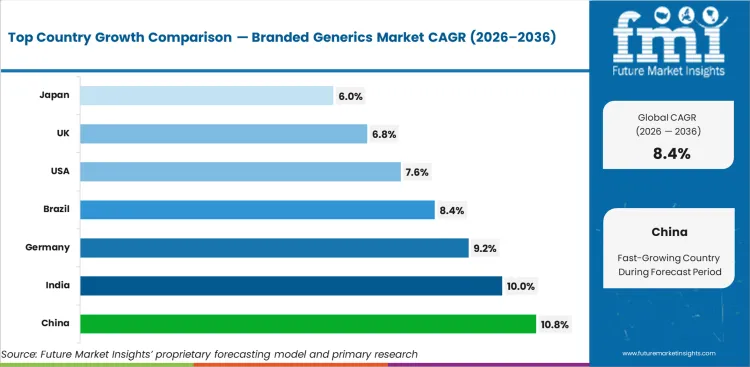
Branded Generics Market CAGR Analysis by Country
- China is projected to record a 10.8% CAGR by 2036 as hospital purchasing reforms keep generic access central to therapy supply.
- A 10.0% CAGR is expected for India between 2026 and 2036, with branded prescriptions and affordable medicine programs operating side by side.
- Germany is forecast to grow at 9.2% CAGR during the forecast period as substitution rules and reimbursement discipline support generic volume.
- Brazil is expected to advance through 2036 at 8.4% CAGR, supported by its branded similar medicine structure and retail pharmacy reliance.
- Generic approval flow supports wider off-patent competition in the U.S. Branded generics demand is projected to rise at 7.6% CAGR between 2026 and 2036.
- The UK is forecast at 6.8% CAGR by 2036 as NHS prescribing keeps generics central to cost control.
- Japan is expected to post 6.0% CAGR during the forecast period, with slower growth tied to mature reimbursement and quality substitution rules.
- The global branded generics market is projected to expand at 8.4% CAGR between 2026 and 2036.
Demand Outlook for Branded Generics Market in China
China is projected to record a 10.8% CAGR by 2036 as hospital purchasing reforms keep generic access central to therapy supply. Hospital tender systems and local quality approval shape branded generic selection. National healthcare authorities continue to support evaluated generics inside hospital channels. Suppliers need tender discipline and physician confidence to protect product movement.
- Beijing and Shanghai hospital systems shape early substitution behavior across large urban treatment centers.
- National Healthcare Security Administration tender practice keeps hospital prices under pressure across off-patent medicines.
- Provincial volume-based purchasing supports faster movement for suppliers with stable stock and compliant documentation.
Sales Analysis of Branded Generics Market in India
India's branded generics industry depends on physician brand recall and pharmacy-level substitution behavior. A 10.0% CAGR is expected for India between 2026 and 2036 as chronic therapy volume supports repeat prescriptions. Sun Pharmaceutical and Zydus Lifesciences gain from domestic reach and regulated-market experience. Private prescriptions continue to carry company brand names across many therapy areas.
- Maharashtra and Gujarat support large formulation capacity through established pharmaceutical manufacturing clusters.
- PMBJP expansion raises public awareness of generic medicines across district and rural retail points.
- Delhi NCR and Mumbai private hospitals keep branded generics active in specialty prescriptions and chronic therapy.
Demand Analysis of Branded Generics Market in Germany
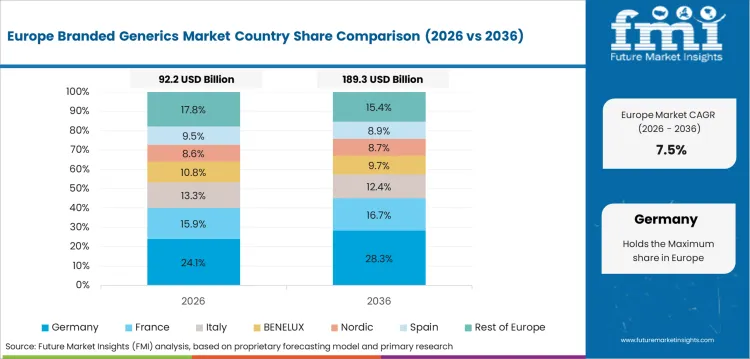
Germany branded generics demand is shaped by reimbursement contracts and pharmacy substitution rules. Sickness fund pricing keeps generics central to medicine access. Germany is forecast to grow at 9.2% CAGR during the forecast period as substitution discipline supports off-patent volume. Branded generics need proof of reliability when many products compete inside the same molecule group.
- North Rhine-Westphalia supports broad medicine access through dense pharmacy coverage across urban districts.
- Statutory health insurance contracts keep generic prices disciplined across high-volume prescription groups.
- Frankfurt and Baden-Württemberg support pharmaceutical logistics through central European distribution routes.
Opportunity Analysis of Branded Generics Market in Brazil
Brazil's branded generics demand depends on retail pharmacy reach and the official similar medicine structure. The country is expected to advance at 8.4% CAGR by 2036 as pharmacies use brand recognition to support substitution. Anvisa classification gives branded generics a clear regulatory identity. Cardiovascular and diabetes therapies remain important in retail pharmacy sales.
- São Paulo supports high pharmacy volume through dense private healthcare and retail medicine chains.
- Anvisa similar medicine classification gives branded generics a formal place in the national drug framework.
- SUS purchasing affects pricing discipline for medicines used in chronic public health programs.
Future Outlook for Branded Generics Market in the USA
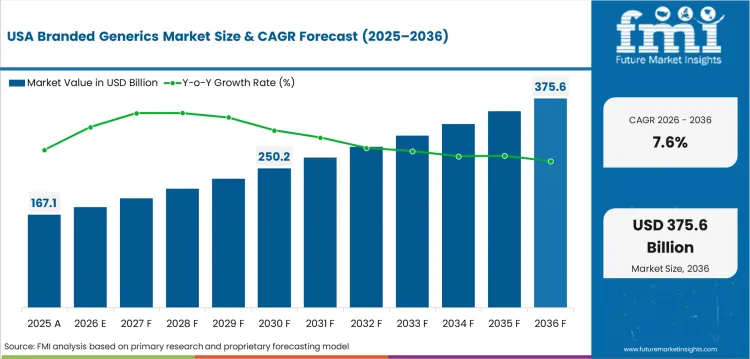
U.S. industry operates in a price-sensitive generic system with high prescription volume. Off-patent therapies continue to enter competitive channels and create launch opportunities for generic manufacturers. The U.S. is projected to rise at 7.6% CAGR between 2026 and 2036 as approval flow supports branded off-patent competition. Product identity matters most in complex or high-value therapies.
- FDA Orange Book listings guide generic launch timing across branded reference products.
- New Jersey and Pennsylvania support large generic company operations through established pharmaceutical corridors.
- Medicare and commercial pharmacy benefit designs influence substitution pressure across chronic therapies.
Demand Outlook for Branded Generics Market in the UK
UK demand is shaped by NHS prescribing discipline and branded generic price rules. Mature prescribing systems cap faster growth, with the UK forecast at 6.8% CAGR by 2036. Branded generics still appear when prescribing by brand protects treatment continuity. Hospital and community pharmacy supply issues can raise interest in suppliers with dependable stock.
- NHS England prescribing guidance keeps generic names central to routine primary care.
- Northern Ireland labeling changes affect pack planning and medicine supply routing across UK channels.
- London and Manchester hospital trusts influence formulary practice across specialist therapy groups.
In-depth Analysis of Branded Generics Market in Japan
Japan's branded generics demand grows more slowly as reimbursement and substitution practice are already mature. Price revisions and quality confidence shape product choice across off-patent medicines. Japan is expected to post 6.0% CAGR as brand familiarity holds value in chronic therapy. Supplier success depends on stable quality and physician comfort.
- Tokyo and Osaka support high pharmacy volume through dense outpatient care systems.
- MHLW price revisions keep off-patent medicines under recurring margin pressure.
- Aging care demand raises refill intensity across cardiovascular and diabetes prescriptions.
Competitive Landscape and Strategic Positioning
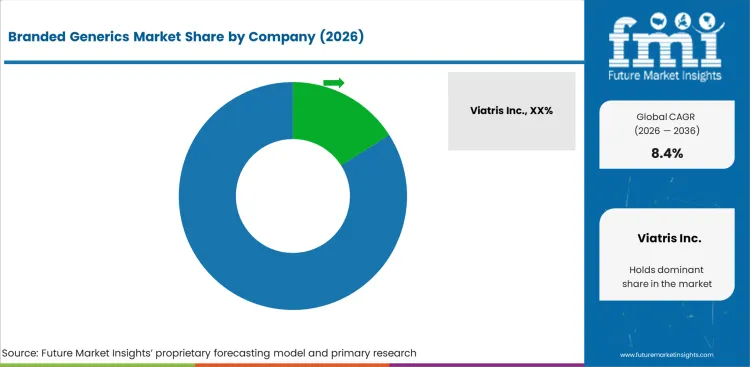
- Competition is broad with global generic firms and regional branded generic suppliers active across chronic therapy areas.
- Large firms compete through product breadth, regulatory filings and hospital channel access.
- Regional suppliers compete through physician relationships and localized brand recall.
- Entry barriers include bioequivalence work, quality audits and working capital needs.
Competition in branded generics depends on trust and speed after patent expiry. Higher-value products need deeper regulatory work and more controlled manufacturing. Injectable formats often carry greater entry barriers than basic oral tablets. Suppliers improve access when they can support quality records and fast launch timing after patent loss.
Established suppliers strengthen access when they can manage product registration and channel trust together. Sun Pharmaceutical has large domestic branded generic strength and global regulated-market filings. Zydus Lifesciences competes through chronic therapy brands and exportable generic dossiers. Pfizer and Abbott retain relevance in selected branded off-patent portfolios. Sterile formats create a higher barrier than plain oral solids.
Smaller companies often win when they focus on local physician coverage and narrow therapeutic portfolios. Aspen Pharmacare carries a large established medicines base and has used portfolio transactions to expand in selected geographies. Bausch Health retains branded medicine recognition across dermatology and eye care. Hospital channels favor suppliers that can document batch quality and provide consistent stock.
Key Companies in the Branded Generics Market
- Global Leaders: Viatris Inc., Teva Pharmaceutical Industries Ltd., Pfizer Inc., Abbott Laboratories, and Novartis AG operate across regulated markets with broad product portfolios.
- Regional Scale Players: Sun Pharmaceutical, Zydus Lifesciences Ltd., GlaxoSmithKline Pharmaceuticals Ltd., and Aspen Pharmacare Holdings Ltd. compete through country-level reach and branded generic recognition.
- Specialty Portfolio Players: Bausch Health Companies Inc. and selected regional manufacturers compete through therapy-specific brands and specialty portfolios.
Competitive Benchmarking: Branded Generics Market
| Company | Branded Portfolio Depth | Regulatory Filing Reach | Hospital Channel Access | Geographic Footprint |
|---|---|---|---|---|
| Viatris Inc. | High | High | Strong | Global |
| Teva Pharmaceutical Industries Ltd. | High | High | Strong | Global |
| Sun Pharmaceutical | High | High | Strong | Global |
| Zydus Lifesciences Ltd. | High | High | Moderate | Global |
| Abbott Laboratories | Medium | High | Strong | Global |
| Pfizer Inc. | Medium | High | Strong | Global |
| Aspen Pharmacare Holdings Ltd. | Medium | Medium | Moderate | Multi-region |
| Bausch Health Companies Inc. | Medium | Medium | Moderate | Multi-region |
| GlaxoSmithKline Pharmaceuticals Ltd. | Medium | Medium | Moderate | India-focused |
| Novartis AG | Medium | High | Strong | Global |
Source: Future Market Insights competitive analysis, 2026.
Key Developments in Branded Generics Market
- In August 2025, Viatris announced FDA approval of the first generic iron sucrose injection in the U.S. Viatris's approval supports complex injectable branded generic positioning.
- In August 2025, Teva announced FDA approval and launch of generic Saxenda. Teva's launch created the first generic GLP-1 indicated for weight loss in the U.S.
Key Players in the Branded Generics Market
Global Leaders
- Viatris Inc.
- Teva Pharmaceutical Industries Ltd.
- Pfizer Inc.
- Abbott Laboratories
- Novartis AG
Regional Scale Players
- Sun Pharmaceutical
- Zydus Lifesciences Ltd.
- GlaxoSmithKline Pharmaceuticals Ltd.
- Aspen Pharmacare Holdings Ltd.
Specialty Portfolio Players
- Bausch Health Companies Inc.
Report Scope and Coverage
| Parameter | Details |
|---|---|
| Quantitative Units | USD 414.5 billion to USD 928.6 billion, at a CAGR of 8.4% |
| Market Definition | Branded off-patent prescription medicines sold under company-owned brand names across chronic and specialty therapies. |
| Regions Covered | North America, Latin America, Europe, East Asia, South Asia and Pacific, Middle East and Africa |
| Countries Covered | China, India, Germany, Brazil, United States, UK, Japan, and 30+ countries |
| Key Companies Profiled | Viatris Inc., Novartis AG, Teva Pharmaceutical Industries Ltd., Pfizer Inc., Sun Pharmaceutical, Aspen Pharmacare Holdings Ltd., Abbott Laboratories, Bausch Health Companies Inc., GlaxoSmithKline Pharmaceuticals Ltd., Zydus Lifesciences Ltd. |
| Forecast Period | 2026 to 2036 |
| Approach | Hybrid bottom-up and top-down methodology starting with verified transaction data and segment adoption modeling. |
Branded Generics Market by Segments
Branded Generics Market Segmented by Drug Class
- Antidiabetic
- Antihypertensive
- Alkylating Agents
- Antimetabolites
- Hormones
- Lipid-lowering Drugs
- Antidepressants
- Antipsychotics
- Antiepileptics
- Others
Branded Generics Market Segmented by Therapy Area
- Oncology
- Cardiovascular Diseases
- Diabetes
- Neurology
- Gastrointestinal Diseases
- Dermatology Diseases
- Analgesics and Anti-inflammatory
- Others
Branded Generics Market Segmented by Formulation Type
- Oral
- Parenteral
- Topical
- Others
Branded Generics Market Segmented by Distribution Channel
- Hospital Pharmacies
- Retail Pharmacies
- Online Pharmacies
- Drug Stores
Branded Generics Market Segmented by End Use
- Hospitals
- Clinics
- Home Care Settings
Branded Generics Market Segmented by Technology
- Conventional Generics
- Branded Generics Innovation
- Enhanced Delivery Systems
Branded Generics Market by Region
- North America
- United States
- Canada
- Mexico
- Latin America
- Brazil
- Chile
- Rest of Latin America
- Western Europe
- Germany
- UK
- Italy
- Spain
- France
- Nordic
- BENELUX
- Rest of Western Europe
- Eastern Europe
- Russia
- Poland
- Hungary
- Balkan & Baltic
- Rest of Eastern Europe
- East Asia
- China
- Japan
- South Korea
- South Asia and Pacific
- India
- ASEAN
- Australia & New Zealand
- Rest of South Asia and Pacific
- Middle East & Africa
- Kingdom of Saudi Arabia
- Other GCC Countries
- Turkiye
- South Africa
- Rest of Africa
- Rest of Middle East & Africa
Research Sources and Bibliography
- USA Food and Drug Administration. (2025, October 23). 2024 first generic drug approvals. USA Food and Drug Administration.
- Press Information Bureau. (2025, July 29). Target is to open 25,000 Jan Aushadhi Kendras by March 2027. Government of India.
- Viatris Inc. (2025, August 11). Viatris announces approval of first generic iron sucrose injection in the USA Viatris Inc.
- Teva Pharmaceutical Industries Ltd. (2025, August 28). Teva announces FDA approval and launch of generic Saxenda. Teva Pharmaceutical Industries Ltd.
- Association for Accessible Medicines. (2024). 2024 U.S. Generic & Biosimilar Medicines Savings Report.
- Fryar, C. D., Ostchega, Y., Hales, C. M., Zhang, G., & Kruszon-Moran, D. (2024, October). Hypertension prevalence, awareness, treatment, and control among adults: United States, August 2021-August 2023. National Center for Health Statistics.
- American Society of Health-System Pharmacists. (2025). National drug shortages: January 2001-December 2024. American Society of Health-System Pharmacists.
- State Council of the People’s Republic of China. (2024, February 11). China expected to expand centralized bulk drug procurement in 2024. The State Council of the People’s Republic of China.
This Report Answers
- What is the current and future value of the branded generics market between 2026 and 2036?
- How fast is branded generics demand expected to grow during the forecast period?
- Which drug class is projected to lead branded generics demand in 2026?
- Which therapy area is expected to hold the clearest demand base in 2026?
- Why do oral formulations account for the significant formulation type share?
- How do hospital pharmacies shape branded generics distribution and supplier access?
- Which countries are forecast to grow faster in branded generics demand?
- Which companies hold the most relevant branded generics positions globally?
- What product types are included in the branded generics market definition?
- How does FMI estimate and validate branded generics market forecasts?
Frequently Asked Questions
What is the global market demand for branded generics in 2026?
In 2026, the global branded generics market is expected to be worth USD 414.5 billion with chronic therapy driving volume.
How big will the branded generics market be by 2036?
By 2036, the branded generics market is projected to reach USD 928.6 billion as off-patent therapy use widens.
How fast is branded generics demand expected to grow?
Demand for branded generics is expected to expand at 8.4% CAGR across the 2026 to 2036 assessment period.
Which formulation type is projected to lead in 2026?
Oral formulations are projected to account for 65.0% share in 2026 due to tablets and capsules in chronic therapy.
Which end use is expected to lead branded generics revenue?
Hospitals are expected to represent 48.0% of end use revenue in 2026 due to specialty and inpatient demand.
Why does China show a faster branded generics market outlook?
China is projected to record 10.8% CAGR through 2036 as hospital purchasing and chronic therapy access widen.
What does branded generics market definition include?
China is projected to record 10.8% CAGR through 2036 as hospital purchasing and chronic therapy access widen.
How does FMI estimate the branded generics forecast?
FMI uses provided market anchors, country growth checks, segment shares, and company portfolio validation to build the forecast.
Preview the report firsthand - request a free sample
Get SampleGet the brochure for pricing and purchase details.
Get PDFTable of Content
- Key Takeaways
- Market Size and CAGR
- Top Growth Driver
- Fastest Growing Segment
- Leading Region
- Key Companies
- Emerging Opportunities
- Executive Summary
- Global Market Outlook
- Demand-side Trends
- Supply-side Trends
- Technology Roadmap Analysis
- Analysis and Recommendations
- Analyst Perspective (What is happening? Why now? What should investors know?)
- Key Questions Answered
- How large is the market?
- What is the CAGR?
- What are key trends?
- Which region dominates?
- Who are the leaders?
- Market Overview
- Market Coverage / Taxonomy
- Market Definition / Scope / Limitations
- Research Methodology
- Chapter Orientation
- Analytical Lens and Working Hypotheses
- Market Structure, Signals, and Trend Drivers
- Benchmarking and Cross-market Comparability
- Market Sizing, Forecasting, and Opportunity Mapping
- Research Design and Evidence Framework
- Desk Research Programme (Secondary Evidence)
- Expert Input and Fieldwork (Primary Evidence)
- Tooling, Models, and Reference Databases
- Data Engineering and Model Build
- Quality Assurance and Audit Trail
- Market Background
- Market Dynamics (Drivers, Restraints, Opportunity, Trends)
- Scenario Forecast (Optimistic, Likely, Conservative)
- Impact Analysis
- AI Impact
- Sustainability Impact
- Regulatory Impact
- Technology Impact
- Consumer / Buyer Analysis
- Purchase Drivers
- Adoption Barriers
- Buyer Journey
- Opportunity Map Analysis
- Product Life Cycle Analysis
- Supply Chain Analysis
- Investment Feasibility Matrix
- Value Chain Analysis
- PESTLE and Porter's Analysis
- Regulatory Landscape
- Regional Parent Market Outlook
- Production and Consumption Statistics
- Import and Export Statistics
- Global Market Analysis and Forecast, 2021 to 2036
- Historical Market Size Value (USD Billion) Analysis, 2021 to 2025
- Current and Future Market Size Value (USD Billion) Projections, 2026 to 2036
- Y-o-Y Growth Trend Analysis
- Absolute $ Opportunity Analysis
- Global Market Pricing Analysis, 2021 to 2036
- Global Market Analysis and Forecast, By Drug Class, 2021 to 2036
- Introduction / Key Findings
- Historical Market Size Value (USD Billion) Analysis By Drug Class, 2021 to 2025
- Current and Future Market Size Value (USD Billion) Analysis and Forecast By Drug Class, 2026 to 2036
- Antihypertensive
- Antidiabetic
- Alkylating Agents
- Antimetabolites
- Hormones
- Lipid-lowering Drugs
- Antidepressants
- Antipsychotics
- Antiepileptics
- Others
- Antihypertensive
- Y-o-Y Growth Trend Analysis By Drug Class, 2021 to 2025
- Absolute $ Opportunity Analysis By Drug Class, 2026 to 2036
- Global Market Analysis and Forecast, By Therapy Area, 2021 to 2036
- Introduction / Key Findings
- Historical Market Size Value (USD Billion) Analysis By Therapy Area, 2021 to 2025
- Current and Future Market Size Value (USD Billion) Analysis and Forecast By Therapy Area, 2026 to 2036
- Cardiovascular Diseases
- Oncology
- Diabetes
- Neurology
- Gastrointestinal Diseases
- Dermatology Diseases
- Analgesics and Anti-inflammatory
- Others
- Cardiovascular Diseases
- Y-o-Y Growth Trend Analysis By Therapy Area, 2021 to 2025
- Absolute $ Opportunity Analysis By Therapy Area, 2026 to 2036
- Global Market Analysis and Forecast, By Formulation Type, 2021 to 2036
- Introduction / Key Findings
- Historical Market Size Value (USD Billion) Analysis By Formulation Type, 2021 to 2025
- Current and Future Market Size Value (USD Billion) Analysis and Forecast By Formulation Type, 2026 to 2036
- Oral
- Parenteral
- Topical
- Others
- Oral
- Y-o-Y Growth Trend Analysis By Formulation Type, 2021 to 2025
- Absolute $ Opportunity Analysis By Formulation Type, 2026 to 2036
- Global Market Analysis and Forecast, By Distribution Channel, 2021 to 2036
- Introduction / Key Findings
- Historical Market Size Value (USD Billion) Analysis By Distribution Channel, 2021 to 2025
- Current and Future Market Size Value (USD Billion) Analysis and Forecast By Distribution Channel, 2026 to 2036
- Hospital Pharmacies
- Retail Pharmacies
- Online Pharmacies
- Drug Stores
- Hospital Pharmacies
- Y-o-Y Growth Trend Analysis By Distribution Channel, 2021 to 2025
- Absolute $ Opportunity Analysis By Distribution Channel, 2026 to 2036
- Global Market Analysis and Forecast, By End Use, 2021 to 2036
- Introduction / Key Findings
- Historical Market Size Value (USD Billion) Analysis By End Use, 2021 to 2025
- Current and Future Market Size Value (USD Billion) Analysis and Forecast By End Use, 2026 to 2036
- Hospitals
- Clinics
- Home Care Settings
- Hospitals
- Y-o-Y Growth Trend Analysis By End Use, 2021 to 2025
- Absolute $ Opportunity Analysis By End Use, 2026 to 2036
- Global Market Analysis and Forecast, By Technology
- Introduction / Key Findings
- Historical Market Size Value (USD Billion) Analysis By Technology, 2021 to 2025
- Current and Future Market Size Value (USD Billion) Analysis and Forecast By Technology, 2026 to 2036
- Conventional Generics
- Branded Generics Innovation
- Enhanced Delivery Systems
- Conventional Generics
- Y-o-Y Growth Trend Analysis By Technology, 2021 to 2025
- Absolute $ Opportunity Analysis By Technology, 2026 to 2036
- Global Market Analysis and Forecast, By Region, 2021 to 2036
- Introduction
- Historical Market Size Value (USD Billion) Analysis By Region, 2021 to 2025
- Current Market Size Value (USD Billion) Analysis and Forecast By Region, 2026 to 2036
- North America
- Latin America
- Western Europe
- Eastern Europe
- East Asia
- South Asia and Pacific
- Middle East & Africa
- Market Attractiveness Analysis By Region
- North America Market Analysis and Forecast, By Country, 2021 to 2036
- Historical Market Size Value (USD Billion) Trend Analysis By Market Taxonomy, 2021 to 2025
- Market Size Value (USD Billion) Forecast By Market Taxonomy, 2026 to 2036
- By Country
- USA
- Canada
- By Drug Class
- By Therapy Area
- By Formulation Type
- By Distribution Channel
- By End Use
- By Technology
- By Country
- Market Attractiveness Analysis
- By Country
- By Drug Class
- By Therapy Area
- By Formulation Type
- By Distribution Channel
- By End Use
- By Technology
- Key Takeaways
- Latin America Market Analysis and Forecast, By Country
- Historical Market Size Value (USD Billion) Trend Analysis By Market Taxonomy, 2021 to 2025
- Market Size Value (USD Billion) Forecast By Market Taxonomy, 2026 to 2036
- By Country
- Brazil
- Mexico
- Chile
- Rest of Latin America
- By Drug Class
- By Therapy Area
- By Formulation Type
- By Distribution Channel
- By End Use
- By Technology
- By Country
- Market Attractiveness Analysis
- By Country
- By Drug Class
- By Therapy Area
- By Formulation Type
- By Distribution Channel
- By End Use
- By Technology
- Key Takeaways
- Western Europe Market Analysis and Forecast, By Country
- Historical Market Size Value (USD Billion) Trend Analysis By Market Taxonomy, 2021 to 2025
- Market Size Value (USD Billion) Forecast By Market Taxonomy, 2026 to 2036
- By Country
- Germany
- UK
- Italy
- Spain
- France
- Nordic
- BENELUX
- Rest of Western Europe
- By Drug Class
- By Therapy Area
- By Formulation Type
- By Distribution Channel
- By End Use
- By Technology
- By Country
- Market Attractiveness Analysis
- By Country
- By Drug Class
- By Therapy Area
- By Formulation Type
- By Distribution Channel
- By End Use
- By Technology
- Key Takeaways
- Eastern Europe Market Analysis and Forecast, By Country
- Historical Market Size Value (USD Billion) Trend Analysis By Market Taxonomy, 2021 to 2025
- Market Size Value (USD Billion) Forecast By Market Taxonomy, 2026 to 2036
- By Country
- Russia
- Poland
- Hungary
- Balkan & Baltic
- Rest of Eastern Europe
- By Drug Class
- By Therapy Area
- By Formulation Type
- By Distribution Channel
- By End Use
- By Technology
- By Country
- Market Attractiveness Analysis
- By Country
- By Drug Class
- By Therapy Area
- By Formulation Type
- By Distribution Channel
- By End Use
- By Technology
- Key Takeaways
- East Asia Market Analysis and Forecast, By Country
- Historical Market Size Value (USD Billion) Trend Analysis By Market Taxonomy, 2021 to 2025
- Market Size Value (USD Billion) Forecast By Market Taxonomy, 2026 to 2036
- By Country
- China
- Japan
- South Korea
- By Drug Class
- By Therapy Area
- By Formulation Type
- By Distribution Channel
- By End Use
- By Technology
- By Country
- Market Attractiveness Analysis
- By Country
- By Drug Class
- By Therapy Area
- By Formulation Type
- By Distribution Channel
- By End Use
- By Technology
- Key Takeaways
- South Asia and Pacific Market Analysis and Forecast, By Country
- Historical Market Size Value (USD Billion) Trend Analysis By Market Taxonomy, 2021 to 2025
- Market Size Value (USD Billion) Forecast By Market Taxonomy, 2026 to 2036
- By Country
- India
- ASEAN
- Australia & New Zealand
- Rest of South Asia and Pacific
- By Drug Class
- By Therapy Area
- By Formulation Type
- By Distribution Channel
- By End Use
- By Technology
- By Country
- Market Attractiveness Analysis
- By Country
- By Drug Class
- By Therapy Area
- By Formulation Type
- By Distribution Channel
- By End Use
- By Technology
- Key Takeaways
- Middle East & Africa Market Analysis and Forecast, By Country
- Historical Market Size Value (USD Billion) Trend Analysis By Market Taxonomy, 2021 to 2025
- Market Size Value (USD Billion) Forecast By Market Taxonomy, 2026 to 2036
- By Country
- Kingdom of Saudi Arabia
- Other GCC Countries
- Türkiye
- South Africa
- Other African Union
- Rest of Middle East & Africa
- By Drug Class
- By Therapy Area
- By Formulation Type
- By Distribution Channel
- By End Use
- By Technology
- By Country
- Market Attractiveness Analysis
- By Country
- By Drug Class
- By Therapy Area
- By Formulation Type
- By Distribution Channel
- By End Use
- By Technology
- Key Takeaways
- Key Countries Market Analysis
- USA
- Pricing Analysis
- Market Share Analysis, 2025
- By Drug Class
- By Therapy Area
- By Formulation Type
- By Distribution Channel
- By End Use
- By Technology
- Canada
- Pricing Analysis
- Market Share Analysis, 2025
- By Drug Class
- By Therapy Area
- By Formulation Type
- By Distribution Channel
- By End Use
- By Technology
- Mexico
- Pricing Analysis
- Market Share Analysis, 2025
- By Drug Class
- By Therapy Area
- By Formulation Type
- By Distribution Channel
- By End Use
- By Technology
- Brazil
- Pricing Analysis
- Market Share Analysis, 2025
- By Drug Class
- By Therapy Area
- By Formulation Type
- By Distribution Channel
- By End Use
- By Technology
- Chile
- Pricing Analysis
- Market Share Analysis, 2025
- By Drug Class
- By Therapy Area
- By Formulation Type
- By Distribution Channel
- By End Use
- By Technology
- Germany
- Pricing Analysis
- Market Share Analysis, 2025
- By Drug Class
- By Therapy Area
- By Formulation Type
- By Distribution Channel
- By End Use
- By Technology
- UK
- Pricing Analysis
- Market Share Analysis, 2025
- By Drug Class
- By Therapy Area
- By Formulation Type
- By Distribution Channel
- By End Use
- By Technology
- Italy
- Pricing Analysis
- Market Share Analysis, 2025
- By Drug Class
- By Therapy Area
- By Formulation Type
- By Distribution Channel
- By End Use
- By Technology
- Spain
- Pricing Analysis
- Market Share Analysis, 2025
- By Drug Class
- By Therapy Area
- By Formulation Type
- By Distribution Channel
- By End Use
- By Technology
- France
- Pricing Analysis
- Market Share Analysis, 2025
- By Drug Class
- By Therapy Area
- By Formulation Type
- By Distribution Channel
- By End Use
- By Technology
- India
- Pricing Analysis
- Market Share Analysis, 2025
- By Drug Class
- By Therapy Area
- By Formulation Type
- By Distribution Channel
- By End Use
- By Technology
- ASEAN
- Pricing Analysis
- Market Share Analysis, 2025
- By Drug Class
- By Therapy Area
- By Formulation Type
- By Distribution Channel
- By End Use
- By Technology
- Australia & New Zealand
- Pricing Analysis
- Market Share Analysis, 2025
- By Drug Class
- By Therapy Area
- By Formulation Type
- By Distribution Channel
- By End Use
- By Technology
- China
- Pricing Analysis
- Market Share Analysis, 2025
- By Drug Class
- By Therapy Area
- By Formulation Type
- By Distribution Channel
- By End Use
- By Technology
- Japan
- Pricing Analysis
- Market Share Analysis, 2025
- By Drug Class
- By Therapy Area
- By Formulation Type
- By Distribution Channel
- By End Use
- By Technology
- South Korea
- Pricing Analysis
- Market Share Analysis, 2025
- By Drug Class
- By Therapy Area
- By Formulation Type
- By Distribution Channel
- By End Use
- By Technology
- Russia
- Pricing Analysis
- Market Share Analysis, 2025
- By Drug Class
- By Therapy Area
- By Formulation Type
- By Distribution Channel
- By End Use
- By Technology
- Poland
- Pricing Analysis
- Market Share Analysis, 2025
- By Drug Class
- By Therapy Area
- By Formulation Type
- By Distribution Channel
- By End Use
- By Technology
- Hungary
- Pricing Analysis
- Market Share Analysis, 2025
- By Drug Class
- By Therapy Area
- By Formulation Type
- By Distribution Channel
- By End Use
- By Technology
- Kingdom of Saudi Arabia
- Pricing Analysis
- Market Share Analysis, 2025
- By Drug Class
- By Therapy Area
- By Formulation Type
- By Distribution Channel
- By End Use
- By Technology
- Türkiye
- Pricing Analysis
- Market Share Analysis, 2025
- By Drug Class
- By Therapy Area
- By Formulation Type
- By Distribution Channel
- By End Use
- By Technology
- South Africa
- Pricing Analysis
- Market Share Analysis, 2025
- By Drug Class
- By Therapy Area
- By Formulation Type
- By Distribution Channel
- By End Use
- By Technology
- USA
- Market Structure Analysis
- Competition Dashboard
- Competition Benchmarking
- Market Share Analysis of Top Players
- By Regional
- By Drug Class
- By Therapy Area
- By Formulation Type
- By Distribution Channel
- By End Use
- By Technology
- Emerging Startups
- Innovation Benchmarking
- Competition Analysis
- Competition Deep Dive
- Viatris Inc.
- Overview
- Product Portfolio
- Profitability by Market Segments
- Sales Footprint
- Strategy Overview
- Marketing Strategy
- Product Strategy
- Channel Strategy
- Teva Pharmaceutical Industries Ltd.
- Pfizer Inc.
- Abbott Laboratories
- Novartis AG
- Sun Pharmaceutical
- Zydus Lifesciences Ltd.
- GlaxoSmithKline Pharmaceuticals Ltd.
- Aspen Pharmacare Holdings Ltd.
- Viatris Inc.
- Case Studies
- Success Stories
- Recent Developments
- Competition Deep Dive
- Assumptions & Acronyms Used


