

- Industry Size (2025)
- USD 17.1 Bn
- Forecast (2035)
- USD 25.1 Bn
- CAGR (2025 to 2035)
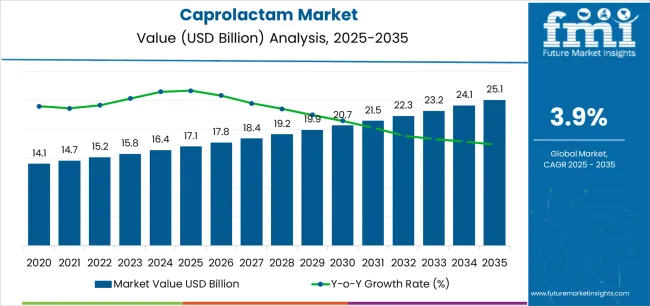
- 3.9%
Caprolactam Market Outlook from 2025 to 2035
The Caprolactam market is experiencing significant growth driven by its increasing utilization in the production of Nylon 6 and related derivatives. The market outlook remains positive, supported by growing demand from the automotive, textile, and industrial sectors. Rapid urbanization and rising consumer spending on durable goods are fueling the consumption of caprolactam-based materials due to their strength, elasticity, and resistance properties.
The shift toward lightweight and high-performance materials in vehicle manufacturing has also been influencing market expansion. Additionally, technological advancements in polymer production and recycling processes are fostering cost efficiency and sustainability across the value chain. The integration of circular economy principles and an increasing focus on eco-friendly manufacturing are shaping long-term market trends.
Moreover, expanding production capacities in Asia and Europe are expected to strengthen global supply chains As end-use industries continue to prioritize performance-driven materials, caprolactam is anticipated to remain a key raw material in both existing and emerging applications.
Quick Stats for Caprolactam Market
- Caprolactam Market Industry Value (2025): USD 17.1 billion
- Caprolactam Market Forecast Value (2035): USD 25.1 billion
- Caprolactam Market Forecast CAGR: 3.9%
- Leading Segment in Caprolactam Market in 2025: Nylon 6 Fibres (5560.0%)
- Key Growth Region in Caprolactam Market: North America, Asia-Pacific, Europe
- Top Key Players in Caprolactam Market: BASF SE, Advansix Inc., Alpek S.A.B. De C.V., The Aquafil Group, China Petrochemical Development Corporation, DOMO Chemicals, KANTO CHEMICAL CO.,INC., Junsei Chemical Co.,Ltd., Kishida Chemical Co.,Ltd., Merck, UBE Corporation, Otto Chemie Pvt. Ltd
| Metric | Value |
|---|---|
| Caprolactam Market Estimated Value in (2025 E) | USD 17.1 billion |
| Caprolactam Market Forecast Value in (2035 F) | USD 25.1 billion |
| Forecast CAGR (2025 to 2035) | 3.9% |
Segmental Analysis
The market is segmented by Application and region. By Application, the market is divided into Nylon 6 Fibres, Nylon 6 Engineering Plastics, Automotive, Films, and Others. Regionally, the market is classified into North America, Latin America, Western Europe, Eastern Europe, Balkan & Baltic Countries, Russia & Belarus, Central Asia, East Asia, South Asia & Pacific, and the Middle East & Africa.
Insights into the Nylon 6 Fibres Application Segment
The Nylon 6 Fibres application segment is projected to hold 55.6% of the Caprolactam market revenue share in 2025, making it the dominant application segment. This leadership is primarily attributed to the widespread use of Nylon 6 Fibres in textiles, carpets, industrial yarns, and tire cords due to their excellent mechanical properties and durability. The segment has benefited from increasing demand in the apparel and home furnishing industries, where flexibility, resilience, and aesthetic quality are highly valued.
The growing preference for synthetic fibers over natural alternatives has further reinforced this segment’s prominence. Expanding manufacturing capabilities in emerging economies have enhanced production efficiency and supply chain integration, contributing to segmental growth.
Moreover, the adoption of sustainable production technologies and the incorporation of recycled caprolactam in fiber manufacturing have supported environmental compliance and cost optimization As global textile consumption continues to rise, the Nylon 6 Fibres segment is expected to maintain its dominant position in the Caprolactam market, driving long-term growth and innovation.
Semi Annual Market Update
The table below provides a detailed comparison of the compound annual growth rate (CAGR) variations for the global caprolactum market, spanning from the base year (2025) to the current year (2025) over the first half of the year.
This analysis highlights significant shifts in market dynamics and identifies key trends in revenue generation, offering stakeholders crucial insights into the market's progression over the examined period. The first half (H1) includes January to June, while the second half (H2) comprises July to December.
The first half (H1) is the period from January to June, and the second half (H2) is July to December. In the first half (H1) of the decade from 2025 to 2035, the business is predicted to surge at a CAGR of 4.6%, followed by a slightly lower growth rate of 4.3% in the second half (H2) of the same decade.
| Particular | Value CAGR |
|---|---|
| H1 | 4.6% (2025 to 2035) |
| H2 | 4.3% (2025 to 2035) |
| H1 | 3.9% (2025 to 2035) |
| H2 | 3.6% (2025 to 2035) |
Moving into the subsequent period, from H1 2025 to H2 2035, the CAGR is projected to increase slightly to 3.9% in the first half and remain relatively moderate at 3.6% in the second half. In the first half (H1) the market witnessed a decrease of 70 BPS while in the second half (H2), the market witnessed a decrease of 70 BPS.
Key Industry Highlights
Growing Demand for Caprolactam in Pharmaceutical Industry is Augmenting the Market Growth
Caprolactam finds application in the pharmaceutical industry due to its diversified nature and advantageous properties. In pharmaceutical industry, these polymers are suitable for the manufacture of controlled-release formulations that provide adequate dosage of medicinal therapy. Its increased biocompatibility makes it suitable for the manufacturing of medical implants, sutures, or surgical devices.
Continuous innovation in the biomaterials is contributing to its wide spread application and footprint in pharmaceuticals. Moreover, ongoing research focused on advanced materials for tissue engineering and regenerative medicine applications propels its growing demand.
Caprolactum is also witnessing its growing demand in pharmaceutical packaging due to its reliability and durability in maintaining product integrity. Therefore, the constantly growing healthcare needs of the human population, and their constant focus towards development of new drugs and therapies contributes to an overall growth of pharmaceutical industry and ultimately demand for caprolactum.
With technological advancements and increased refinement in the manufacturing processes and material capabilities, caprolactam is poised to further drive innovation in drug delivery technologies and biomedical materials and hence will shape its growth trajectory within the pharmaceutical industry.
Increasing Application of Caprolactum is Various Industries Augments the Market Growth
Factors contributing to the growth of caprolactum market is its growing application in the production of nylon-6, a very strong, tough, and versatile polymer. Polyamide nylon-6 is used in a great number of material applications such as in car manufacture for engine parts, it is used in textiles for clothing, carpets, and industrial fabrics. Its growing applications, in the manufacturing of electrical components and consumer products is further driving the market growth. Its increased adoption in automotive sector is been observed owing to the need for lightweight materials.
In addition to nylon-6, some of the other applications of caprolactam are in films, coatings, and adhesives in industries such as packaging and construction. Hence, the expansion of these end-use industries has been boosting the market.
In addition, growth is further enhanced by regulatory frameworks that advocate for nylon-6 and caprolactam in applications that are environmentally friendly while providing high performances. Therefore, the added advantages provided by the caprolactum in the modern industrial application is enrooting the growth of the market growth.
Increased Adoption of Caprolactam in Sports Industry
Unique properties of caprolactam makes it very well suited to serve the performance, durability, and sustainability requirements of the sports industry. The Nylon-6 compound derived from caprolactum is been significantly used in manufacturing of sports apparel. Its increased use is owing to its light weight, and abrasion resistance properties. These properties allows sports athletes to move comfortably.
Its increased use in the manufacturing of sports equipment is due to its strength, impact resistance, and lightness which provides performance and safety. The ability of the material to absorb shock is of tantamount importance to numerous protective gears, like padding and body armor, which guarantees the athlete's safety during strenuous sporting activity.
Taken as a whole, the uses and performance characteristics of caprolactam personally brand it as favorite for the development of new and high-technology athletic, sports, and safety wear; that which meets the continuously evolving requirements of athletes while also ensuring that the consumers get the best innovation in manufacturing.
Growing Advancements in Caprolactum Production
Traditionally known for the production of nylon-6, recent developments are stretching these applications into new frontiers, mainly focusing on sustainable practices with efforts toward production efficiency and low environmental impact. Growing innovations in catalyst technologies and process optimization is significantly propelling the sustainability profile of caprolactam manufacturing.
Further, caprolactam emerges as the impetus for innovation in advanced materials. Other than nylon-6, it is used in making high-performance plastics, specialty films, and composite materials. This caters to a host of industries such as automotive industry players looking for light weigh manufacturing of products, electronic manufacturers, and aerospace applications. Such technological breakthroughs make caprolactam more resistant, cost-effective, and suited for demanding applications.
In addition, the growing interaction among institutions of academic institutes, industry players, and regulatory bodies keeps caprolactam at the forefront of innovative processes in order to achieve the varying requirements in the market with respect to sustainability and high performance in materials.
2020 to 2024 Global Caprolactam Sales Outlook Compared to Demand Forecast from 2025 to 2035
The global caprolactam cover industry recorded a CAGR of 3.9% during the historical period between 2020 and 2025. The growth of caprolactam cover industry was positive as it reached a value of USD 15,830.5 million in 2025 from 13,876.8 million in 2020.
The versatility and performance of caprolactam see its growing application across industries as its derivatives such as nylon-6, has good mechanical properties like tensile strength, abrasion resistance, and resistance to chemical agents. In addition it’s growing application in textiles for clothing and carpets, engineering plastics and electronic components, and packaging materials further surges its growing demand.
The important application of caprolactam in specialty films, coatings, adhesives, and advanced composites serve a variety of industrial requirements beyond nylon-6. Moreover, the material's resistance to harsh conditions and its ability to support structural integrity make it broadly applicable for rough uses.
The another major application is the synthesis of active pharmaceutical-grade polyamide material meant for drug encapsulation and delivery systems. The delivery materials provide improved stability, a controlled release, and enhanced bioavailability of APIs that make them one of the vital materials in modern drug formulation.
Besides that, derivatives of caprolactam have been studied for use in the synthesis of biocompatible and biodegradable polymers for medical implants, sutures, and wound dressings. The high demand for sophisticated systems of drug delivery and new biomedical devices has been boosting the demand of the pharmaceutical industry for caprolactam.
Also, its consumption for the manufacture of specialty chemicals and intermediates, which are further used in the formulation of anti-biotics, anti-inflammatory drugs, and other therapeutic agents, is also securing its demand.
Therefore, the growing global demand fueled by the growth of industries and technological development underlines the pivotal role in the growth of the market.
Market Concentration
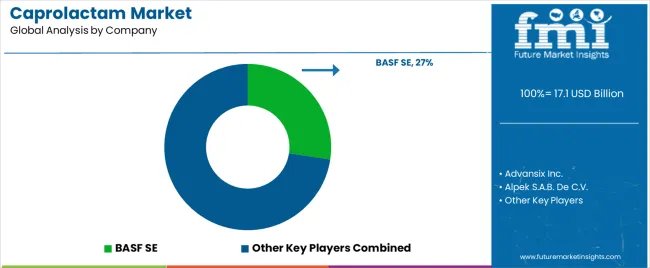
Tier 1 companies comprise market leaders with a market revenue of above USD 100 million capturing significant market share of 15% to 20% in global market. These market leaders have manufacturing capacity, and wide of product portfolio in the market. These market leaders differentiate themselves based on the technology, their extensive expertise in manufacturing and their geographical outreach reach in the market. These factors aid them in serving a wide range of consumer base. Prominent companies within tier 1 include Advansix Inc., Alpek S.A.B. De C.V., The Aquafil Group, and BASF SE
Tier 2 companies include mid-size players with revenue of USD 50 to 100 million having presence in specific regions with their high influence on the local market. These are characterized by a strong presence overseas and strong market knowledge. These market players have good technology but their presence is limited to certain markets. Prominent companies in tier 2 include China Petrochemical Development Corporation, Grupa Azoty, Lanxess AG and Sumitomo Chemical Co., Ltd.
Tier 3 includes the majority of companies that have limited geographical outreach or are operating at the local presence and serving niche markets having revenue below USD 50 million. These companies are focused towards fulfilling the demand from local market and are therefore classified as the tier 3 share segment. They are comparatively small-scale players which is generally recognized as an unorganized market. These players doesn’t have extensive infrastructure or higher production capabilities.
Country-wise Insights
The section below covers the industry analysis for the caprolactam cover market for different countries. Market demand analysis on key countries in several regions of the globe, including North America, Asia Pacific, Europe, and others, is provided. The United States is anticipated to remain at the forefront in North America, and is projected to grow at a CAGR of 1.0% through 2035. In Asia Pacific, India is projected to witness a CAGR of 3.7% by 2035.
Growing Focus of Manufacturers on Advancing Caprolactam Devices is Augmenting its Growth in Germany
Germany’s caprolactam cover market is poised to exhibit a CAGR of 1.0% between 2025 and 2035. The caprolactam market in Germany is driven by certain factors such as, its growing application in pharmaceutical and other industrial sectors, such as automobile and textiles.
Moreover, other factor such as sustainable innovations and stringent environmental regulations towards maintaining compliance further propels its market growth. Technological advancements in polymer science and the expanding use of caprolactum in the development of high-performance material and advanced drug delivery system surges its demand in the country.
The caprolactum market in Germany it witnessing a significant growth for caprolactum from its well established chemical and pharmaceutical industries as it is a crucial intermediate for the production of Nylon-6. Moreover, their growing focused towards export of chemical and pharmaceutical sector further stimulates caprolactum domestic market growth. Therefore, the geopolitical position of the Europe as an industrial hub, which is committed to innovation, further drives the caprolactam market in the Germany.
Developed Healthcare Infrastructure and Proactive Healthcare Policies is Fueling Demand in the USA
North America, spearheaded by the USA currently holds majority of the share of the global caprolactam cover industry. The market in the USA is anticipated to grow at a CAGR of 1.0% throughout the forecast period 2035.
Increasing use of caprolactam in the formulation of drug delivery systems for pharmaceutical industries, biocompatibility with the human body, strength, and durability have contributed to increasing adoption in the USA. Its increasing application in research and developmental areas in the development of new pharmaceutical products further supports its increased demand in the USA.
Hence, the contribution provided by caprolactam to the development of pharmaceutical technologies for meeting innovative needs of health industries anticipates the market growth in the USA. The increasing focus of the USA toward sustainability by following environmental regulations further creates expectation for the growth of the caprolactum market in the country. The development of biodegradable polymers from caprolactam aligns with these green initiatives, which further boosts its market growth.
Rising Population Undergoing Surgeries in China is pushing the Caprolactam Market
A number of factors create fertile ground for the growth of caprolactam in the pharmaceutical sector of China. Growing healthcare expenditure and infrastructure make huge demands for high-end pharmaceutical raw materials. Strong and efficient manufacturing capabilities are available within the country to produce products using caprolactam and meet the needs of the large and growing population of China.
| Countries | Value CAGR (2025 to 2035) |
|---|---|
| Canada | 1.8% |
| Spain | 1.9% |
| France | 1.7% |
| South Korea | 2.6% |
| China | 3.3% |
| India | 3.7% |
In addition to this, growing technology increases the applicability of caprolactam in the most modern and newest biomedical applications, such as controlled drug delivery systems and medical devices. Government support through friendly policies and incentives further contributes to the development and adoption of caprolactam in pharmaceutical applications.
Furthermore, growing application of caprolactum in the manufacturing of various surgical tools, implants and medical devices and its increasing use in the Chinese pharmaceutical industry for the manufacturing of advanced drug delivery systems, such as controlled-release capsules drives the growth of the market in the country.
Category-wise Insights
The section contains information about the leading segments in the industry. By application, the nylon-6 engineering plastics segment is estimated to account for 36.0% of the market share and is anticipated to witness significant growth during the forecast period.
By Application, Nylon 6 Engineering Plastics Dominate the Caprolactam Market in terms of Value
| Application | Nylon 6 Engineering Plastics |
|---|---|
| Value Share (2035) | 36.0% |
The nylon-6 engineering plastics segment dominates the market in terms of revenue, accounting for almost 36.0% of the market share in 2025. Caprolactam finds increasing use in nylon 6 engineering plastics due to their good mechanical properties, process ability, and thermal resistance. It is a versatile engineering plastic that has extensive industrial application.
It offers cost-effectiveness against other engineering plastics while meeting stringent performance requirements in the automotive, and other industrial applications. It has wide applications in consumer products, such as textiles, sporting goods, and electrical components.
Due to its economic efficiency, nylon-6 production has extended use in industries for various sectors, helping it gain a large market share. Besides, their superior performance characteristics, advances in material technologies along with their sustainable properties, continue to drive its growth in the manufacturing sector.
Competitive Landscape
Key players operating in the caprolactam cover market are investing in development of advanced and innovative products that are more reliable and efficient. Also, many of the key players are emphasizing on making strategic collaborations and acquisition for expansion of their geographical presence and strengthening their market share.
Recent Industry Developments in Caprolactam Market:
- In July 2025, Genomatica in collaboration with Aquafil completed the demonstration of their first scale production run of their plant-based nylon-6. The company is emphasizing on transformative evaluation of these material into applications such as yarns for textile and carpet and engineering plastics.
- In March 2025, DOMO Chemicals, a company engaged in producing engineered material solutions delivered 5 million tonnes of caprolactum at its Leuna site.
- In February 2025, Lanxess, a German chemical company who produces caprolactum as an intermediate inaugurated their nitrous oxide reduction plant in Belgium.
Key Players of Caprolactam Industry
- Advansix Inc.
- Alpek S.A.B. De C.V.
- The Aquafil Group
- BASF SE
- China Petrochemical Development Corporation
- DOMO Chemicals
- KANTO CHEMICAL CO.,INC.
- Junsei Chemical Co.,Ltd.
- Kishida Chemical Co.,Ltd.
- Merck
- UBE Corporation
- Otto Chemie Pvt. Ltd
Key Segments of Caprolactam Industry
By Application:
In terms of Application, the industry is divided into nylon 6 fibres (textile filament, industrial filament, carpet filament, and staple filament), nylon 6 engineering plastics (automotive, electrical & electronics, consumer goods, industrial/machinery, wire & cable and others), films (food packaging, pharmaceutical packaging and agricultural packaging) and others.
By Region:
Key countries of North America, Latin America, Europe, East Asia, South Asia, Middle East and Africa (MEA), and Oceania have been covered in the report.
Frequently Asked Questions
How big is the caprolactam market in 2025?
The global caprolactam market is estimated to be valued at USD 17.1 billion in 2025.
What will be the size of caprolactam market in 2035?
The market size for the caprolactam market is projected to reach USD 25.1 billion by 2035.
How much will be the caprolactam market growth between 2025 and 2035?
The caprolactam market is expected to grow at a 3.9% CAGR between 2025 and 2035.
What are the key product types in the caprolactam market?
The key product types in caprolactam market are nylon 6 fibres, textile filament, industrial filament, carpet filament, staple filament, nylon 6 engineering plastics, automotive, electrical & electronics, consumer goods, industrial/machinery, wire & cable, others, films, food packaging, pharmaceutical packaging, agricultural packaging and others.
Which segment to contribute significant share in the caprolactam market in 2025?
In terms of , segment to command 0.0% share in the caprolactam market in 2025.
Preview the report firsthand - request a free sample
Get SampleGet the brochure for pricing and purchase details.
Get PDFTable of Content
- Executive Summary
- Global Market Outlook
- Demand-side Trends
- Supply-side Trends
- Technology Roadmap Analysis
- Analysis and Recommendations
- Market Overview
- Market Coverage / Taxonomy
- Market Definition / Scope / Limitations
- Market Background
- Market Dynamics
- Drivers
- Restraints
- Opportunity
- Trends
- Scenario Forecast
- Demand in Optimistic Scenario
- Demand in Likely Scenario
- Demand in Conservative Scenario
- Opportunity Map Analysis
- Product Life Cycle Analysis
- Supply Chain Analysis
- Investment Feasibility Matrix
- Value Chain Analysis
- PESTLE and Porter’s Analysis
- Regulatory Landscape
- Regional Parent Market Outlook
- Production and Consumption Statistics
- Import and Export Statistics
- Market Dynamics
- Global Market Analysis 2020 to 2025 and Forecast, 2025 to 2035
- Historical Market Size Value (USD Million) Analysis, 2020 to 2025
- Current and Future Market Size Value (USD Million) Projections, 2025 to 2035
- Y-o-Y Growth Trend Analysis
- Absolute $ Opportunity Analysis
- Global Market Pricing Analysis 2020 to 2025 and Forecast 2025 to 2035
- Global Market Analysis 2020 to 2025 and Forecast 2025 to 2035, By Application
- Introduction / Key Findings
- Historical Market Size Value (USD Million) Analysis By Application , 2020 to 2025
- Current and Future Market Size Value (USD Million) Analysis and Forecast By Application , 2025 to 2035
- Nylon 6 Fibres
- Textile Filament
- Industrial Filament
- Carpet Filament
- Staple Filament
- Nylon 6 Engineering Plastics
- Automotive
- Electrical & Electronics
- Consumer Goods
- Industrial/Machinery
- Wire & Cable
- Others
- Films
- Food Packaging
- Pharmaceutical Packaging
- Agricultural Packaging
- Others
- Nylon 6 Fibres
- Y-o-Y Growth Trend Analysis By Application , 2020 to 2025
- Absolute $ Opportunity Analysis By Application , 2025 to 2035
- Global Market Analysis 2020 to 2025 and Forecast 2025 to 2035, By Region
- Introduction
- Historical Market Size Value (USD Million) Analysis By Region, 2020 to 2025
- Current Market Size Value (USD Million) Analysis and Forecast By Region, 2025 to 2035
- North America
- Latin America
- Western Europe
- Eastern Europe
- East Asia
- South Asia and Pacific
- Middle East & Africa
- Market Attractiveness Analysis By Region
- North America Market Analysis 2020 to 2025 and Forecast 2025 to 2035, By Country
- Historical Market Size Value (USD Million) Trend Analysis By Market Taxonomy, 2020 to 2025
- Market Size Value (USD Million) Forecast By Market Taxonomy, 2025 to 2035
- By Country
- USA
- Canada
- Mexico
- By Application
- By Country
- Market Attractiveness Analysis
- By Country
- By Application
- Key Takeaways
- Latin America Market Analysis 2020 to 2025 and Forecast 2025 to 2035, By Country
- Historical Market Size Value (USD Million) Trend Analysis By Market Taxonomy, 2020 to 2025
- Market Size Value (USD Million) Forecast By Market Taxonomy, 2025 to 2035
- By Country
- Brazil
- Chile
- Rest of Latin America
- By Application
- By Country
- Market Attractiveness Analysis
- By Country
- By Application
- Key Takeaways
- Western Europe Market Analysis 2020 to 2025 and Forecast 2025 to 2035, By Country
- Historical Market Size Value (USD Million) Trend Analysis By Market Taxonomy, 2020 to 2025
- Market Size Value (USD Million) Forecast By Market Taxonomy, 2025 to 2035
- By Country
- Germany
- UK
- Italy
- Spain
- France
- Nordic
- BENELUX
- Rest of Western Europe
- By Application
- By Country
- Market Attractiveness Analysis
- By Country
- By Application
- Key Takeaways
- Eastern Europe Market Analysis 2020 to 2025 and Forecast 2025 to 2035, By Country
- Historical Market Size Value (USD Million) Trend Analysis By Market Taxonomy, 2020 to 2025
- Market Size Value (USD Million) Forecast By Market Taxonomy, 2025 to 2035
- By Country
- Russia
- Poland
- Hungary
- Balkan & Baltic
- Rest of Eastern Europe
- By Application
- By Country
- Market Attractiveness Analysis
- By Country
- By Application
- Key Takeaways
- East Asia Market Analysis 2020 to 2025 and Forecast 2025 to 2035, By Country
- Historical Market Size Value (USD Million) Trend Analysis By Market Taxonomy, 2020 to 2025
- Market Size Value (USD Million) Forecast By Market Taxonomy, 2025 to 2035
- By Country
- China
- Japan
- South Korea
- By Application
- By Country
- Market Attractiveness Analysis
- By Country
- By Application
- Key Takeaways
- South Asia and Pacific Market Analysis 2020 to 2025 and Forecast 2025 to 2035, By Country
- Historical Market Size Value (USD Million) Trend Analysis By Market Taxonomy, 2020 to 2025
- Market Size Value (USD Million) Forecast By Market Taxonomy, 2025 to 2035
- By Country
- India
- ASEAN
- Australia & New Zealand
- Rest of South Asia and Pacific
- By Application
- By Country
- Market Attractiveness Analysis
- By Country
- By Application
- Key Takeaways
- Middle East & Africa Market Analysis 2020 to 2025 and Forecast 2025 to 2035, By Country
- Historical Market Size Value (USD Million) Trend Analysis By Market Taxonomy, 2020 to 2025
- Market Size Value (USD Million) Forecast By Market Taxonomy, 2025 to 2035
- By Country
- Kingdom of Saudi Arabia
- Other GCC Countries
- Turkiye
- South Africa
- Other African Union
- Rest of Middle East & Africa
- By Application
- By Country
- Market Attractiveness Analysis
- By Country
- By Application
- Key Takeaways
- Key Countries Market Analysis
- USA
- Pricing Analysis
- Market Share Analysis, 2025
- By Application
- Canada
- Pricing Analysis
- Market Share Analysis, 2025
- By Application
- Mexico
- Pricing Analysis
- Market Share Analysis, 2025
- By Application
- Brazil
- Pricing Analysis
- Market Share Analysis, 2025
- By Application
- Chile
- Pricing Analysis
- Market Share Analysis, 2025
- By Application
- Germany
- Pricing Analysis
- Market Share Analysis, 2025
- By Application
- UK
- Pricing Analysis
- Market Share Analysis, 2025
- By Application
- Italy
- Pricing Analysis
- Market Share Analysis, 2025
- By Application
- Spain
- Pricing Analysis
- Market Share Analysis, 2025
- By Application
- France
- Pricing Analysis
- Market Share Analysis, 2025
- By Application
- India
- Pricing Analysis
- Market Share Analysis, 2025
- By Application
- ASEAN
- Pricing Analysis
- Market Share Analysis, 2025
- By Application
- Australia & New Zealand
- Pricing Analysis
- Market Share Analysis, 2025
- By Application
- China
- Pricing Analysis
- Market Share Analysis, 2025
- By Application
- Japan
- Pricing Analysis
- Market Share Analysis, 2025
- By Application
- South Korea
- Pricing Analysis
- Market Share Analysis, 2025
- By Application
- Russia
- Pricing Analysis
- Market Share Analysis, 2025
- By Application
- Poland
- Pricing Analysis
- Market Share Analysis, 2025
- By Application
- Hungary
- Pricing Analysis
- Market Share Analysis, 2025
- By Application
- Kingdom of Saudi Arabia
- Pricing Analysis
- Market Share Analysis, 2025
- By Application
- Turkiye
- Pricing Analysis
- Market Share Analysis, 2025
- By Application
- South Africa
- Pricing Analysis
- Market Share Analysis, 2025
- By Application
- USA
- Market Structure Analysis
- Competition Dashboard
- Competition Benchmarking
- Market Share Analysis of Top Players
- By Regional
- By Application
- Competition Analysis
- Competition Deep Dive
- BASF SE
- Overview
- Product Portfolio
- Profitability by Market Segments (Product/Age /Sales Channel/Region)
- Sales Footprint
- Strategy Overview
- Marketing Strategy
- Product Strategy
- Channel Strategy
- Advansix Inc.
- Alpek S.A.B. De C.V.
- The Aquafil Group
- China Petrochemical Development Corporation
- DOMO Chemicals
- KANTO CHEMICAL CO.,INC.
- Junsei Chemical Co.,Ltd.
- Kishida Chemical Co.,Ltd.
- Merck
- UBE Corporation
- Otto Chemie Pvt. Ltd
- BASF SE
- Competition Deep Dive
- Assumptions & Acronyms Used
- Research Methodology


