

- Industry Size (2026)
- USD 44.7 Mn
- Forecast (2036)
- USD 64.3 Mn
- CAGR (2026 to 2036)
- 3.7%
Erythrosine Market Size, Market Forecast and Outlook By FMI
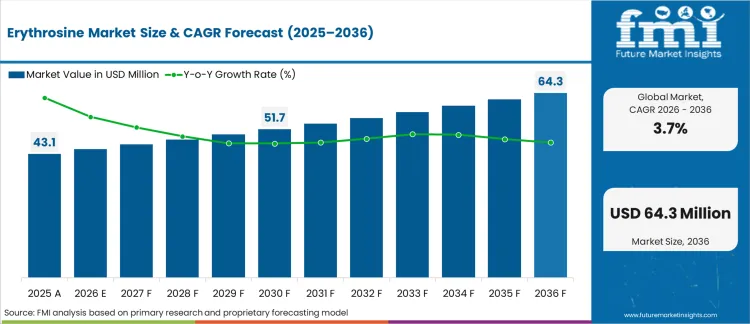
In 2025, the erythrosine market was valued at USD 43.1 million. Based on Future Market Insights' analysis, demand for erythrosine is estimated to grow to USD 44.7 million in 2026 and USD 64.3 million by 2036. FMI projects a CAGR of 3.7% during the forecast period
Absolute dollar growth of USD 19.6 million over the decade reflects a bifurcated market trajectory: modest nominal growth driven by continued pharmaceutical-grade and export-market demand in Asia and Latin America, offset by accelerating volume loss in the United States following the FDA's April 2025 formal initiation of Red No. 3 delisting from food, drug, and cosmetic use with final enforcement deadlines of January 15, 2027 for food products and January 18, 2028 for drugs and cosmetics. [1] Sensient's January 2026 expansion of its Certasure food safety program to manage the industry-wide transition away from synthetic dyes including erythrosine directly captures the reformulation demand from manufacturers seeking validated replacement pigments. [3]
As Paul Manning, Chairman and CEO of Sensient Technologies, noted regarding the company's 2025 strategic performance, 'Sensient delivered strong results in 2025 driven by exceptional new sales wins. We executed on our strategy, delivered meaningful value to our customers, and strengthened our position for the opportunities ahead.' [3]
Summary of Erythrosine Market
- Erythrosine Market Definition
- The market covers globally traded erythrosine in powder, liquid, and granule forms across dye and lake solubility grades, serving food confectionery coloring, pharmaceutical tablet coating, dental disclosing tablets, and specific cosmetic applications.
- Demand Drivers in the Market
- appetite for high-intensity red hues while signaling the natural alternative transition pathway. [2]
- Key Segments Analyzed in the FMI Report
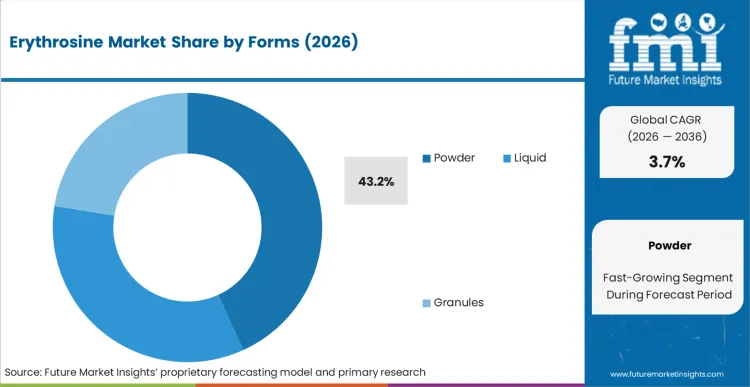
- Forms: Powder holds 43.2% of format share in 2026, reflecting the dominant handling preference for bulk industrial dye applications in pharmaceutical and confectionery manufacturing.
- Solubility: Dyes account for 63.4% of volume in 2026, with water-soluble dye grade serving the primary aqueous food and pharmaceutical coloring applications.
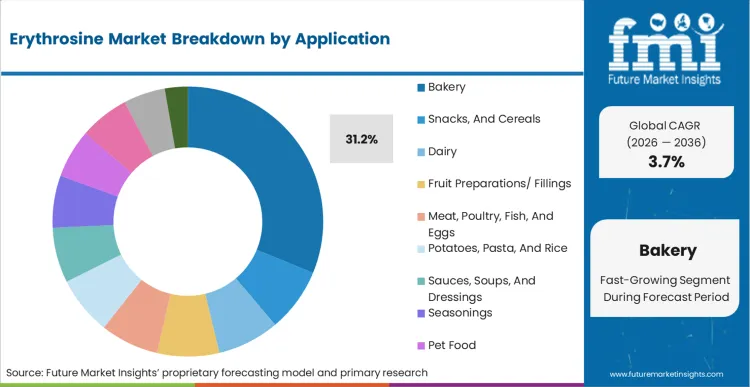
- Application: Bakery holds 31.2% of application value in 2026, encompassing maraschino cherry inclusion and confectionery decoration end uses.
- Analyst Opinion at FMI
- Nandini Roy Choudhury, Principal Consultant for Food & Beverage at Future Market Insights, opines, "In the updated version of the Erythrosine Market Report for 2026 to 2036, CXOs will find that the FDA Red No. 3 delisting, with food enforcement set for January 2027, represents the most commercially significant regulatory event in the synthetic food dye category in decades, and erythrosine producers face a two-track strategic challenge: accelerating exit from US food-grade exposure while simultaneously protecting pharmaceutical-grade revenue streams that face a separate enforcement clock extending to January 2028. My findings indicate that Asian and Latin American market growth at 4.5% and above will partially offset North American volume loss, but manufacturers with high US revenue concentration must execute reformulation support and alternative colorant sourcing strategies before the 2027 enforcement deadline to avoid customer attrition to competitors already positioned in the natural red transition."
- Strategic Implications / Executive Takeaways
- Prioritize commercial pivot to pharmaceutical-grade erythrosine supply for dental disclosing tablet and tablet coating markets in China and South Asia, where regulatory frameworks permit continued use and demand growth at 4.5% CAGR supports volume absorption of reallocated US-destined production.
- Develop natural red alternative partnerships or capabilities before January 2027 to retain food manufacturer relationships through the reformulation transition, preventing customer attrition to natural colorant specialists already holding Certasure or equivalent validation certifications.
- Establish pharmaceutical-grade inventory and supply commitment strategies for US drug and cosmetic customers operating under the January 2028 enforcement deadline, where a defined 24-month window supports structured transition planning without immediate volume loss.
- Methodology
- Validated through primary interviews with synthetic food dye producers and food and pharmaceutical formulation specialists managing Red No. 3 reformulation programs.
- Supported by FDA Federal Register delisting notices, EU Regulation EC No 1333/2008 E127 status documentation, and pharmaceutical pharmacopoeia monograph specifications.
- Zero reliance on speculative third-party market research; all forecasts grounded in verifiable regulatory enforcement timelines, pharmaceutical-grade consumption benchmarks, and confirmed producer developments.
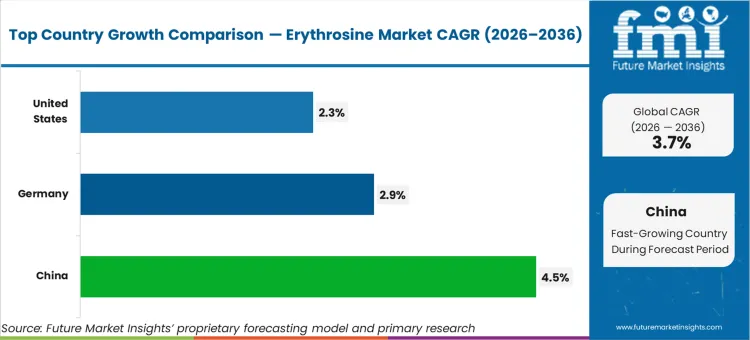
China leads erythrosine growth at 4.5% CAGR through 2036, where pharmaceutical-grade demand for dental disclosing tablets and regulated food coloring applications in confectionery categories continues to expand under existing CNCA approval frameworks. Germany grows at 2.9% as EU food-grade erythrosine applications in maraschino cherries and cocktail cherries maintain established usage, though pharmaceutical applications drive the marginal growth. The United States grows at 2.3% through 2026 before the January 2027 enforcement deadline compresses domestic food-grade volume; pharmaceutical and cosmetic timelines extend to January 2028. Powder form holds 43.2% of format share; Dyes solubility accounts for 63.4% of volume; Bakery application represents 31.2% of end-use value.
Key Industry Highlights
Consumers' visual appeal for food products elevating the sales
The increasing consumer trend of having visually appealing food items has prompted a demand for effective coloring agents, such as erythrosine. The market has also observed phenomenal uptake in erythrosine as a food coloring agent, with enhancing visual attractiveness on food and beverage products becoming a necessity for the changing consumer preferences.
Such trends have significantly favored the growth of the global erythrosine market, where there has been a race among manufacturers to satisfy enormous consumer demand for make-believe captivating food products.
Physical attributes of Erythrosine attracting the cosmetics industry
Apart from a popularized range of applications for food and beverage end uses, erythrosine has also been a subject of attraction to the cosmetics industry for its unique physical properties; hence, its use is becoming increasingly common in different personal care formulations.
From eye shadow to lipsticks, and skin care formulations, this unique color, stability, and versatility has made erythrosine appealing to cosmetics manufacturers in their use of these products. Further diversification of the erythrosine market is being realized as it extends beyond conventional food and beverage end uses, developing new paths to growth within the cosmetics industry.
Currently, there is an upward drift in the demand for erythrosine in cosmetic preparations since innovation and imagination are moving towards getting new formulations that look fabulous to the consumers.
Erythrosine: rising as antimicrobial agent
The increasing recognition of the microbial inhibition properties of erythrosine is leading to ever-greater application ranges; from food to medical applications, anything is under consideration.
In this regard, the erythrosine market has also generated increased interest in using it as a cheap and effective antimicrobial agent, because such an application can help prevent the development of various harmful microorganisms and extend product shelf life.
This unquestionably meant further room for the erythrosine market as players and researchers pursue new avenues where it could find use-from food products to the pharmaceutical and personal care segments. The number of applications for which this versatile compound can be used at some point might soon increase because of the ever-growing demand for it as an antimicrobial agent, which is indirectly contributing to the growth of the overall market.
Research and Innovation by key manufacturers enhancing the product quality
Investments by manufacturers in research and innovation developed higher-quality erythrosine products, which enhanced competitiveness and also helped grow the market. The introduction of most of such developments, improvements, and commercially interesting products has been made in new formulations of modified erythrosine with much better stability, purity, and performance characteristics.
Major players in the industry push these trends as they strive for being among the top players and therefore want to meet consumers' changing demands. Research and innovation improvements have enhanced erythrosine products' quality and broadened new application horizons, thereby impacting overall growth in the global erythrosine market.
Rising Awareness of about ingredients used in food products affecting the global revenue
Increased consumer awareness of the break ingredients in food products has thereby created a high level of penetration and demand for natural transparent color options for present products. To a large extent, these are dynamic trends impacting the global erythrosine market, as more and more consumers seek product choices that are consultative with their needs and demands for clean and sustainable ingredients.
Manufacturing firms have, therefore, adapted to this shift in consumer behaviour through reformulating their products with natural colorants, or by providing details on the use of erythrosine in their formulations. The erudition in food ingredients has spurred revenues of the erythrosine market, thus requiring the renewed classification of consumer inclination and their need for more transparent and natural alternatives.
Competition by colour options like carmine and Betacyanins affecting the business landscape
Some of the other competition in the arena of food coloration includes possibilities for replacement with alternatives, such as carmine and Betacyanins. These products could frost the growth of the erythrosine market. Highly popular among those consumers that are looking for more innovative and ecologically friendly substitutes for chemical dyes such as erythrosine, these natural-based colorants are going to impart competition in the market.
Currently, the market is witnessing a shift in consumer preference whereby some consumers will now prefer these natural colors over products whose source is erythrosine. Such a course of action is proving to be a threat to the erythrosine market since manufacturing firms must change their strategies to meet the high demand for natural as well as plant-derived coloring agents.
Competing with these alternative options opens up a chance for limiting the growth of the erythrosine market in the long run, as consumers put a premium on the choice of natural and sustainable ingredient use in their food as well as beverages.
2021 to 2026 Global Erythrosine Sales Analysis Compared to Demand Forecasts for 2026 to 2036
The erythrosine market globally has been oscillating over the last few years; with respect to sales indications and forecasts concerning demand, all of these have shown signs of the fluid nature of the industry. Many factors such as changing consumer preference, the regulatory landscape facilitating or controlling certain innovative technologies may have led to this trend in the market.
The industry analyst is watching performances of the market with expectation of shifts in demand and supply for strategic decision-making. From the year 2025 to 2035, the market will be going through several phases, so the stakeholders keep watching the trend and the prospects as they future-proof their offerings with the changing market scenario.
The industry will prove its resilience and adaptability to dance with these various challenges while taking advantage of emerging growth opportunities during this forecast period.
Market Concentration
The industry is characterized by a two-tier structure, which includes both organized and unorganized players. Leading companies such as Univar Colour Sigma-Aldrich Co. LLC Food Ingredient Solutions LLC BASF SE Sensient Colors LLC. Symrise AG Chr. Hansen Holding A/S and others some players dominate the organized segment that accounts for 40% of sales in the industry.
Multinational corporations (MNCs) that have target segment revenue greater than 1 million USD belong to these groupings and they maintain their arena presence in this way because they have large volumes of production capacities, high-tech infrastructure and various products.
These well-regulated players have strict distribution networks and can be found in every corner of the world thereby; resulting to huge penetration globally. Their modernized research labs on the other hand enhance innovations enabling them to introduce a range of Erythrosine with regard to changing trends among health aware consumers who are conscious about their diet.
On the contrary, local participants with target segment revenue below 1 million USD form the unorganized part that contributes up to 60% of total sales within this category. These smaller companies may lack global coverage but are vital for specific areas. Working in niche community allows them offer particular goods fitted for diverse domestic preferences or specialized dietary needs.
In many cases, these entities adjust quickly according to fads in consumer tastes which results into unique and exceptional product mix. This makes sure that there is dynamism as well as competitiveness within industry due to existence of both big and small firms.
This variety brings on board multiple developments along with a wide range of options being made available satisfying different customers across all regions worldwide. This means that the industry has good prospects given its innovative nature coupled with growing trend towards healthier alternatives.
Country wise Insights
The following table shows the estimated growth rates of the significant three geographies sales. USA, Germany and China are set to exhibit high consumption, recording CAGRs of 2.3%, 2.9%, and 4.5% respectively, through 2034.
.webp "Top Country Growth Comparison Erythrosine Market Cagr (2026 2036)")
| Countries | CAGR 2026 to 2036 |
|---|---|
| United States | 2.3% |
| Germany | 2.9% |
| China | 4.5% |
USA: Advanced Food Safety and Regulatory Compliance Driving Innovation
Stronger regulations on food safety and growing awareness among consumers about health in the USA have increased the demand for advanced food colorants. Manufacturers are directing their attention toward formulating colorant products with a high-purity grade so that they can meet FDA standards and address the concerns of the safe-food-consuming public.
In addition, there is an initiative geared toward goodness-in form of microencapsulation technologies for enhanced stability and shelf life. All these have been aligned with the growing demand for clean-label products with a transparent ingredient source.
Companies have also been investing in educating consumers about the safety and benefits of these formulations to ensure compliance is competitive in terms of locational advantage
Germany: Preference for Sustainable and Clean-Label Products
German consumers have turned out to be sustainability and clean-label consumers, making environmental aspects the driving trend in the colorant industry. Hence low-carbon methods form the focus of attention for companies: using renewable energy in their processes, eco-friendly packaging, and products.
Moreover, courses ethical sourcing of raw ingredients, transferring to sustainable modes of supply chains. These are some efforts made by producers that comply with Germany's regulations with a cleaner environment and a growing consumer mind-set on their eco-consciousness.
In this way, collaboration with local industries for promoting the sustainability initiative is developing. Thus these practices will be used to create better reputation for manufacturers among one of the most environmentally conscious markets in Europe.
China: High Demand for Processed Foods Boosting Consumption
The fast pace of urbanization and the changing pattern of eating in China have increased demands for processed and packaged food much more than ever before in the past, wherein colorants play important roles. The local manufacturers tend to concentrate their efforts on high-volume production to cater for the needs of the ever-increasing demand from food and beverage sectors.
The growing middle class is also driving these manufacturers to come up with attractive formulations, as demand grows for high-end products. It enjoys huge investments in automotive capacities boosting the manufacturing process as well as supply chain efficacies. Companies are considering localized production for efficient cost reduction and competitive gains through one of the best distribution networks in the world that China possesses.
Category-wise Insights
Vibrant Versatility: The Allure of Powdered Erythrosine
| Segment | Powder (Form) |
|---|---|
| Value Share (2026) | 43.2% |
Powdered erythrosine turned out to be such a potent drawing card for end-users that they left all other competing forms of this color behind. It has become the favored food dye as it practically matches a particular form that could be employed in a huge range of products-from candies to beverages or baked goods to drugs.
This incorporation besides affordability makes it very accessible for manufacturers to use it as the agent when designing end product with a striking red color. It also provides great stability and consistency to display a uniform look under various applications. This capability, along with adding nutritional color to the mix, has arguably placed powdered erythrosine as the industry premier at the advertisement.
Baking's Brilliant Hue: The Rise of Erythrosine in Confections
| Segment | Bakery Products (Application) |
|---|---|
| Value Share (2026) | 31.2% |
Erythrosine took no time in carving its niche and quickly has been treasured in baking, fascinating both the hearts of confectioners and eaters as it boasts an incomparable ability to dye sweet piles of candy colors. It finds itself compatible with batters and frostings to mister out an ordinary cake, a cookie, or a pastry into something visibly stunning.
Its hallmark is high stability at temperature rising and fading resistance. The rich red that will hold the attention would do so all along with baking through and through. It costs less. These advantages of erythrosine make it the punch in the mouth for a baker attempting to create a showpiece in a world clamouring for visually attractive delights to perk up the senses and, at the same time, tantalize the taste buds.
Competition Outlook
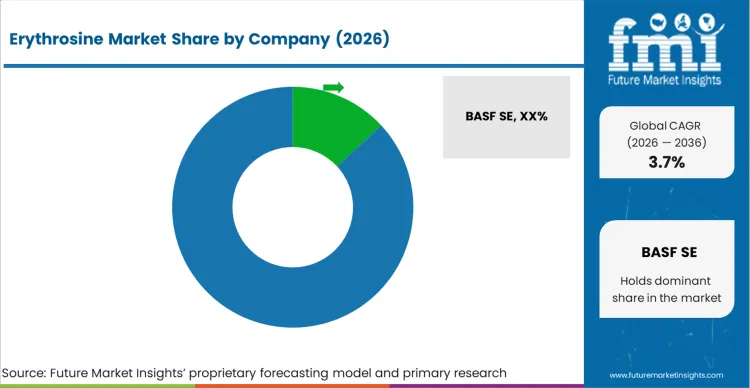
The erythrosine market is moderately fragmented with a mix of global chemical companies and regional specialty dye producers. BASF SE holds an estimated 13.1% share in 2026, with Univar Colour, Sigma-Aldrich (Merck), Dynamic Products Ltd., Food Ingredient Solutions LLC, Parshwanath Dyestuff Industries, Vidhi Specialty Food Ingredients Limited, and Kolor Jet Chemical as regional competitors. Indian producers including Parshwanath Dyestuff, Kolor Jet Chemical, Jagson Colorchem, and Vidhi Specialty hold competitively significant positions in the Asia Pacific export market, where pharmaceutical-grade and food-grade demand growth is expected to accelerate through 2036.
The FDA's April 2025 formal initiation of Red No. 3 delisting from food, drug, and cosmetic use is the single most disruptive commercial event for North American erythrosine demand in the market's history. [1] The January 2027 food enforcement deadline gives food manufacturers approximately 21 months from the April 2025 announcement to reformulate, a timeline that is driving immediate procurement decisions toward natural red alternatives. Sensient's January 2026 Certasure program expansion specifically addresses the validation and traceability needs of manufacturers seeking certified replacement pigments, positioning Sensient to capture the reformulation transition revenue that erythrosine producers cannot retain. [3]
ADM's October 2025 Flavor and Color Outlook launch of Newstalgia Dreamland, which targets vibrant reds and pinks using next-generation natural formulations, signals the organized commercial transition underway among major ingredient companies. [2] Erythrosine producers that do not develop parallel natural red colorant capabilities or transition support programs face structural customer attrition as the January 2027 enforcement date approaches and food manufacturers complete reformulation qualification processes.
Recent Developments
- April 2025: The FDA formally initiated the delisting of Red No. 3 (Erythrosine) from food, drug, and cosmetic use in the United States, setting final enforcement deadlines of January 15, 2027 for food products and January 18, 2028 for drugs and cosmetics. This development has triggered an industry-wide shift toward natural red alternatives including beetroot extract and anthocyanins among US food and pharmaceutical manufacturers. [1]
- October 2025: ADM released its 2026 Flavor and Color Outlook, introducing the Newstalgia Dreamland trend specifically targeting vibrant reds, pinks, and purples historically dominated by erythrosine. The initiative reimagines these high-intensity shades using next-generation natural formulations to meet new regulatory and clean-label demands while preserving the visual comfort associated with traditional synthetic dye hues. [2]
- January 2026: Sensient announced the expansion of its Certasure food safety program specifically to manage the industry-wide transition away from synthetic dyes including Red 3. The program provides testing, vendor certification, and traceability for replacement pigments, including new technology for ensuring the stability of natural red alternatives under varied processing conditions. [3]
Leading Manufacturers
- BASF SE
- Univar Colour
- Sigma-Aldrich Co. LLC
- Dynamic Products Ltd.
- Food Ingredient Solutions LLC
- Parshwanath Dyestuff Industries
- Sun Food Tech.
- Kolor Jet Chemical Pvt. Ltd.
- Jagson Colorchem Limited
- Matrix Pharma Chem
- Vidhi Specialty Food Ingredients Limited
- Rung International
Scope of the Report
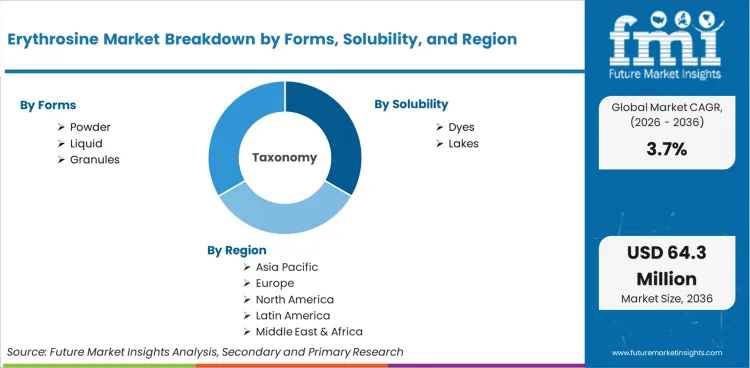
| Metric | Value |
|---|---|
| Quantitative Units | USD 44.7 million (2026) to USD 64.3 million (2036), at a CAGR of 3.7% |
| Market Definition | The erythrosine market covers global production and trade of FD&C Red No. 3 / E127 synthetic xanthene dye in powder, liquid, and granule forms across dye and lake solubility grades, serving food confectionery coloring, pharmaceutical tablet coating, dental disclosing tablets, and specific cosmetic applications. |
| Forms Segmentation | Powder, Liquid, Granules |
| Solubility Segmentation | Dyes, Lakes |
| Application Segmentation | Bakery, Snacks and Cereals, Dairy |
| Regions Covered | North America, Latin America, Europe, East Asia, South Asia, Oceania, Middle East and Africa |
| Countries Covered | United States, Germany, China, Japan, India, United Kingdom, France, Brazil, Australia, Canada and 40 plus countries |
| Key Companies Profiled | BASF SE, Univar Colour, Sigma-Aldrich Co. LLC, Dynamic Products Ltd., Food Ingredient Solutions LLC, Parshwanath Dyestuff Industries, Sun Food Tech., Kolor Jet Chemical Pvt. Ltd., Jagson Colorchem Limited, Vidhi Specialty Food Ingredients Limited |
| Forecast Period | 2026 to 2036 |
| Approach | Hybrid bottom-up and top-down market modeling validated through primary interviews with synthetic food dye producers and regulatory affairs specialists, supported by FDA Federal Register delisting notices and EU Regulation EC No 1333/2008 E127 status documentation |
Key Segments of the Report
Forms
- Powder (43.2% share, 2026)
- Liquid
- Granules
Solubility
- Dyes (63.4% share, 2026)
- Lakes
Application
- Bakery (31.2% share, 2026)
- Snacks and Cereals
- Dairy
Region
- North America: United States (USD 15.9M, 2026), Canada, Mexico
- Latin America: Brazil, Argentina, Chile, Rest of Latin America
- Europe: Germany, France, United Kingdom, Italy, Spain, Benelux, Nordics, Rest of Europe
- East Asia: China, Japan (USD 35.9M projected, 2036), South Korea
- South Asia: India, Indonesia, Malaysia, Thailand, Rest of South Asia
- Oceania: Australia, New Zealand
- Middle East & Africa: Saudi Arabia, UAE, South Africa, Rest of Middle East & Africa
Bibliography
- [1] U.S. Food and Drug Administration. (2025). FDA Initiates Delisting of Red No. 3 (Erythrosine) from Permitted Food, Drug, and Cosmetic Color Additives. Federal Register Notice, April 2025. https://www.fda.gov/food/color-additives/color-additive-status-list
- [2] ADM. (2025). ADM Releases 2026 Flavor and Color Outlook: Newstalgia Dreamland Trend. Corporate Press Release, October 2025. https://www.perfumerflavorist.com/flavor/trends/news/22952359/adm-adm-releases-2026-flavor-and-color-outlook
- [3] Sensient Technologies Corporation. (2026). Sensient Certasure Program Expansion to Support Synthetic Dye Transition Management. Corporate Press Release, January 2026. https://www.stocktitan.net/news/SXT/sensient-s-certasure-tm-program-delivers-critical-safeguard-during-gmnybtz07iup.html
- [4] Sensient Technologies Corporation. (2026). Sensient Technologies Corporation Reports Results for the Quarter Ended December 31, 2025. Investor Press Release, 2026. https://investor.sensient.com/news-and-events/press-releases/news-details/2026/Sensient-Technologies-Corporation-Reports-Results-for-the-Quarter-Ended-December-31-2025/default.aspx
- [5] New Food Magazine. (2025). How the Phase-Out of Synthetic Food Dyes is Reshaping the Colour Additives Industry. Industry Analysis, 2025. https://www.newfoodmagazine.com/article/255572/how-the-phase-out-of-synthetic-food-dyes-is-reshaping-the-colour-additives-industry/
This Report Addresses
- Market intelligence to enable erythrosine supply exposure assessment, reformulation transition planning, and natural red alternative qualification strategy decisions
- Market size estimation and 10-year revenue forecasts from 2026 to 2036, incorporating FDA Red No. 3 enforcement timeline volume attrition modeling for US food and pharmaceutical segments
- Growth opportunity mapping across pharmaceutical-grade dental and tablet coating applications in China and South Asia, where regulatory approval frameworks support continued erythrosine usage
- Segment and regional revenue forecasts covering form, solubility, and application dimensions with country-level analysis for the United States, Germany, and China
- Competition strategy assessment including Indian producer competitive positioning, natural colorant transition competitive dynamics, and Sensient Certasure program impact on reformulation contract capture
- Regulatory impact analysis covering FDA Red No. 3 delisting enforcement timeline, EU E127 approval status for maraschino cherry applications, and APAC regulatory framework stability
- Supply chain analysis covering pharmaceutical-grade erythrosine inventory strategy, US enforcement deadline-driven demand attrition curves, and Asian pharmaceutical market demand absorption capacity
- Market report delivery in PDF, Excel, PPT, and interactive dashboard formats for executive and operational use
Frequently Asked Questions
How large is the demand for Erythrosine in the global market in 2026?
Demand for Erythrosine in the global market is estimated to be valued at USD 44.7 million in 2026.
What will be the market size of Erythrosine by 2036?
Market size for Erythrosine is projected to reach USD 64.3 million by 2036.
What is the expected CAGR for the Erythrosine market between 2026 and 2036?
Demand for Erythrosine is expected to grow at a CAGR of 3.7% between 2026 and 2036.
Which form dominates the Erythrosine market in 2026?
Powder holds 43.2% of format share in 2026, reflecting the dominant handling preference for bulk industrial dye applications in pharmaceutical tablet coating and confectionery coloring manufacturing.
Which solubility type leads Erythrosine volume in 2026?
Dyes account for 63.4% of volume in 2026, with water-soluble dye grade serving the primary aqueous food and pharmaceutical coloring applications including cherry coloring and tablet coating.
What is the significance of the FDA Red No. 3 delisting for the Erythrosine market?
The FDA's April 2025 formal delisting sets food enforcement at January 15, 2027 and drug and cosmetic enforcement at January 18, 2028, effectively eliminating erythrosine from US food applications within 21 months and initiating a structural reformulation shift toward natural red alternatives across the North American market.
Which country is projected to lead Erythrosine growth?
China leads at 4.5% CAGR through 2036, driven by pharmaceutical-grade demand for dental disclosing tablet manufacturing and regulated food coloring applications in confectionery categories under existing CNCA approval frameworks.
What is driving Erythrosine demand in Germany?
Germany grows at 2.9% CAGR, supported by EU-maintained E127 approval for maraschino cherry and cocktail cherry applications under Regulation EC No 1333/2008, providing a stable food-grade demand base insulated from the North American regulatory attrition affecting USA volume.
How is Sensient positioning in the erythrosine transition market?
Sensient's January 2026 Certasure program expansion provides testing, vendor certification, and traceability for natural red replacement pigments, positioning the company to capture reformulation transition contracts from food and pharmaceutical manufacturers exiting erythrosine use ahead of FDA enforcement deadlines.
How does FMI validate its Erythrosine forecast?
Forecast is developed using hybrid bottom-up and top-down modeling validated through primary interviews with synthetic dye producers and regulatory affairs specialists, FDA Federal Register delisting notices, EU Regulation EC No 1333/2008 documentation, and pharmaceutical pharmacopoeia monograph specifications.
Preview the report firsthand - request a free sample
Get SampleGet the brochure for pricing and purchase details.
Get PDFTable of Content
- Executive Summary
- Global Market Outlook
- Demand-side Trends
- Supply-side Trends
- Technology Roadmap Analysis
- Analysis and Recommendations
- Market Overview
- Market Coverage / Taxonomy
- Market Definition / Scope / Limitations
- Research Methodology
- Chapter Orientation
- Analytical Lens and Working Hypotheses
- Market Structure, Signals, and Trend Drivers
- Benchmarking and Cross-market Comparability
- Market Sizing, Forecasting, and Opportunity Mapping
- Research Design and Evidence Framework
- Desk Research Programme (Secondary Evidence)
- Company Annual and Sustainability Reports
- Peer-reviewed Journals and Academic Literature
- Corporate Websites, Product Literature, and Technical Notes
- Earnings Decks and Investor Briefings
- Statutory Filings and Regulatory Disclosures
- Technical White Papers and Standards Notes
- Trade Journals, Industry Magazines, and Analyst Briefs
- Conference Proceedings, Webinars, and Seminar Materials
- Government Statistics Portals and Public Data Releases
- Press Releases and Reputable Media Coverage
- Specialist Newsletters and Curated Briefings
- Sector Databases and Reference Repositories
- FMI Internal Proprietary Databases and Historical Market Datasets
- Subscription Datasets and Paid Sources
- Social Channels, Communities, and Digital Listening Inputs
- Additional Desk Sources
- Expert Input and Fieldwork (Primary Evidence)
- Primary Modes
- Qualitative Interviews and Expert Elicitation
- Quantitative Surveys and Structured Data Capture
- Blended Approach
- Why Primary Evidence is Used
- Field Techniques
- Interviews
- Surveys
- Focus Groups
- Observational and In-context Research
- Social and Community Interactions
- Stakeholder Universe Engaged
- C-suite Leaders
- Board Members
- Presidents and Vice Presidents
- R&D and Innovation Heads
- Technical Specialists
- Domain Subject-matter Experts
- Scientists
- Physicians and Other Healthcare Professionals
- Governance, Ethics, and Data Stewardship
- Research Ethics
- Data Integrity and Handling
- Primary Modes
- Tooling, Models, and Reference Databases
- Desk Research Programme (Secondary Evidence)
- Data Engineering and Model Build
- Data Acquisition and Ingestion
- Cleaning, Normalisation, and Verification
- Synthesis, Triangulation, and Analysis
- Quality Assurance and Audit Trail
- Market Background
- Market Dynamics
- Drivers
- Restraints
- Opportunity
- Trends
- Scenario Forecast
- Demand in Optimistic Scenario
- Demand in Likely Scenario
- Demand in Conservative Scenario
- Opportunity Map Analysis
- Product Life Cycle Analysis
- Supply Chain Analysis
- Investment Feasibility Matrix
- Value Chain Analysis
- PESTLE and Porter’s Analysis
- Regulatory Landscape
- Regional Parent Market Outlook
- Production and Consumption Statistics
- Import and Export Statistics
- Market Dynamics
- Global Market Analysis 2021 to 2025 and Forecast, 2026 to 2036
- Historical Market Size Value (USD Million) Analysis, 2021 to 2025
- Current and Future Market Size Value (USD Million) Projections, 2026 to 2036
- Y-o-Y Growth Trend Analysis
- Absolute $ Opportunity Analysis
- Global Market Pricing Analysis 2021 to 2025 and Forecast 2026 to 2036
- Global Market Analysis 2021 to 2025 and Forecast 2026 to 2036, By Forms
- Introduction / Key Findings
- Historical Market Size Value (USD Million) Analysis By Forms , 2021 to 2025
- Current and Future Market Size Value (USD Million) Analysis and Forecast By Forms , 2026 to 2036
- Powder
- Liquid
- Granules
- Powder
- Y-o-Y Growth Trend Analysis By Forms , 2021 to 2025
- Absolute $ Opportunity Analysis By Forms , 2026 to 2036
- Global Market Analysis 2021 to 2025 and Forecast 2026 to 2036, By Solubility
- Introduction / Key Findings
- Historical Market Size Value (USD Million) Analysis By Solubility, 2021 to 2025
- Current and Future Market Size Value (USD Million) Analysis and Forecast By Solubility, 2026 to 2036
- Dyes
- Lakes
- Dyes
- Y-o-Y Growth Trend Analysis By Solubility, 2021 to 2025
- Absolute $ Opportunity Analysis By Solubility, 2026 to 2036
- Global Market Analysis 2021 to 2025 and Forecast 2026 to 2036, By Application
- Introduction / Key Findings
- Historical Market Size Value (USD Million) Analysis By Application, 2021 to 2025
- Current and Future Market Size Value (USD Million) Analysis and Forecast By Application, 2026 to 2036
- Bakery
- Snacks, And Cereals
- Dairy
- Fruit Preparations/ Fillings
- Meat, Poultry, Fish, And Eggs
- Potatoes, Pasta, And Rice
- Sauces, Soups, And Dressings
- Seasonings
- Pet Food
- Others
- Candy/ Confectionery
- Bakery
- Y-o-Y Growth Trend Analysis By Application, 2021 to 2025
- Absolute $ Opportunity Analysis By Application, 2026 to 2036
- Global Market Analysis 2021 to 2025 and Forecast 2026 to 2036, By Region
- Introduction
- Historical Market Size Value (USD Million) Analysis By Region, 2021 to 2025
- Current Market Size Value (USD Million) Analysis and Forecast By Region, 2026 to 2036
- North America
- Latin America
- Western Europe
- Eastern Europe
- East Asia
- South Asia and Pacific
- Middle East & Africa
- Market Attractiveness Analysis By Region
- North America Market Analysis 2021 to 2025 and Forecast 2026 to 2036, By Country
- Historical Market Size Value (USD Million) Trend Analysis By Market Taxonomy, 2021 to 2025
- Market Size Value (USD Million) Forecast By Market Taxonomy, 2026 to 2036
- By Country
- USA
- Canada
- Mexico
- By Forms
- By Solubility
- By Application
- By Country
- Market Attractiveness Analysis
- By Country
- By Forms
- By Solubility
- By Application
- Key Takeaways
- Latin America Market Analysis 2021 to 2025 and Forecast 2026 to 2036, By Country
- Historical Market Size Value (USD Million) Trend Analysis By Market Taxonomy, 2021 to 2025
- Market Size Value (USD Million) Forecast By Market Taxonomy, 2026 to 2036
- By Country
- Brazil
- Chile
- Rest of Latin America
- By Forms
- By Solubility
- By Application
- By Country
- Market Attractiveness Analysis
- By Country
- By Forms
- By Solubility
- By Application
- Key Takeaways
- Western Europe Market Analysis 2021 to 2025 and Forecast 2026 to 2036, By Country
- Historical Market Size Value (USD Million) Trend Analysis By Market Taxonomy, 2021 to 2025
- Market Size Value (USD Million) Forecast By Market Taxonomy, 2026 to 2036
- By Country
- Germany
- UK
- Italy
- Spain
- France
- Nordic
- BENELUX
- Rest of Western Europe
- By Forms
- By Solubility
- By Application
- By Country
- Market Attractiveness Analysis
- By Country
- By Forms
- By Solubility
- By Application
- Key Takeaways
- Eastern Europe Market Analysis 2021 to 2025 and Forecast 2026 to 2036, By Country
- Historical Market Size Value (USD Million) Trend Analysis By Market Taxonomy, 2021 to 2025
- Market Size Value (USD Million) Forecast By Market Taxonomy, 2026 to 2036
- By Country
- Russia
- Poland
- Hungary
- Balkan & Baltic
- Rest of Eastern Europe
- By Forms
- By Solubility
- By Application
- By Country
- Market Attractiveness Analysis
- By Country
- By Forms
- By Solubility
- By Application
- Key Takeaways
- East Asia Market Analysis 2021 to 2025 and Forecast 2026 to 2036, By Country
- Historical Market Size Value (USD Million) Trend Analysis By Market Taxonomy, 2021 to 2025
- Market Size Value (USD Million) Forecast By Market Taxonomy, 2026 to 2036
- By Country
- China
- Japan
- South Korea
- By Forms
- By Solubility
- By Application
- By Country
- Market Attractiveness Analysis
- By Country
- By Forms
- By Solubility
- By Application
- Key Takeaways
- South Asia and Pacific Market Analysis 2021 to 2025 and Forecast 2026 to 2036, By Country
- Historical Market Size Value (USD Million) Trend Analysis By Market Taxonomy, 2021 to 2025
- Market Size Value (USD Million) Forecast By Market Taxonomy, 2026 to 2036
- By Country
- India
- ASEAN
- Australia & New Zealand
- Rest of South Asia and Pacific
- By Forms
- By Solubility
- By Application
- By Country
- Market Attractiveness Analysis
- By Country
- By Forms
- By Solubility
- By Application
- Key Takeaways
- Middle East & Africa Market Analysis 2021 to 2025 and Forecast 2026 to 2036, By Country
- Historical Market Size Value (USD Million) Trend Analysis By Market Taxonomy, 2021 to 2025
- Market Size Value (USD Million) Forecast By Market Taxonomy, 2026 to 2036
- By Country
- Kingdom of Saudi Arabia
- Other GCC Countries
- Turkiye
- South Africa
- Other African Union
- Rest of Middle East & Africa
- By Forms
- By Solubility
- By Application
- By Country
- Market Attractiveness Analysis
- By Country
- By Forms
- By Solubility
- By Application
- Key Takeaways
- Key Countries Market Analysis
- USA
- Pricing Analysis
- Market Share Analysis, 2025
- By Forms
- By Solubility
- By Application
- Canada
- Pricing Analysis
- Market Share Analysis, 2025
- By Forms
- By Solubility
- By Application
- Mexico
- Pricing Analysis
- Market Share Analysis, 2025
- By Forms
- By Solubility
- By Application
- Brazil
- Pricing Analysis
- Market Share Analysis, 2025
- By Forms
- By Solubility
- By Application
- Chile
- Pricing Analysis
- Market Share Analysis, 2025
- By Forms
- By Solubility
- By Application
- Germany
- Pricing Analysis
- Market Share Analysis, 2025
- By Forms
- By Solubility
- By Application
- UK
- Pricing Analysis
- Market Share Analysis, 2025
- By Forms
- By Solubility
- By Application
- Italy
- Pricing Analysis
- Market Share Analysis, 2025
- By Forms
- By Solubility
- By Application
- Spain
- Pricing Analysis
- Market Share Analysis, 2025
- By Forms
- By Solubility
- By Application
- France
- Pricing Analysis
- Market Share Analysis, 2025
- By Forms
- By Solubility
- By Application
- India
- Pricing Analysis
- Market Share Analysis, 2025
- By Forms
- By Solubility
- By Application
- ASEAN
- Pricing Analysis
- Market Share Analysis, 2025
- By Forms
- By Solubility
- By Application
- Australia & New Zealand
- Pricing Analysis
- Market Share Analysis, 2025
- By Forms
- By Solubility
- By Application
- China
- Pricing Analysis
- Market Share Analysis, 2025
- By Forms
- By Solubility
- By Application
- Japan
- Pricing Analysis
- Market Share Analysis, 2025
- By Forms
- By Solubility
- By Application
- South Korea
- Pricing Analysis
- Market Share Analysis, 2025
- By Forms
- By Solubility
- By Application
- Russia
- Pricing Analysis
- Market Share Analysis, 2025
- By Forms
- By Solubility
- By Application
- Poland
- Pricing Analysis
- Market Share Analysis, 2025
- By Forms
- By Solubility
- By Application
- Hungary
- Pricing Analysis
- Market Share Analysis, 2025
- By Forms
- By Solubility
- By Application
- Kingdom of Saudi Arabia
- Pricing Analysis
- Market Share Analysis, 2025
- By Forms
- By Solubility
- By Application
- Turkiye
- Pricing Analysis
- Market Share Analysis, 2025
- By Forms
- By Solubility
- By Application
- South Africa
- Pricing Analysis
- Market Share Analysis, 2025
- By Forms
- By Solubility
- By Application
- USA
- Market Structure Analysis
- Competition Dashboard
- Competition Benchmarking
- Market Share Analysis of Top Players
- By Regional
- By Forms
- By Solubility
- By Application
- Competition Analysis
- Competition Deep Dive
- BASF SE
- Overview
- Product Portfolio
- Profitability by Market Segments (Product/Age /Sales Channel/Region)
- Sales Footprint
- Strategy Overview
- Marketing Strategy
- Product Strategy
- Channel Strategy
- Univar Colour
- Sigma-Aldrich Co. LLC
- Dynamic Products Ltd.
- Food Ingredient Solutions LLC
- Parshwanath Dyestuff Industries
- Sun Food Tech.
- Kolor Jet Chemical Pvt. Ltd.
- Jagson Colorchem Limited
- Matrix Pharma Chem
- Vidhi Specialty Food Ingredients Limited
- Rung International
- Vinayak Ingredients India Pvt. Ltd.
- Kanegrade Ltd.
- Sensient Colors LLC.
- Symrise AG
- Chr. Hansen Holding A/S
- Others
- BASF SE
- Competition Deep Dive
- Assumptions & Acronyms Used


