

- Market Size (2026)
- USD 4.5 Bn
- Forecast (2036)
- USD 30.7 Bn
- CAGR (2026 to 2036)
- 21.1%
How big is the esports market in 2026?
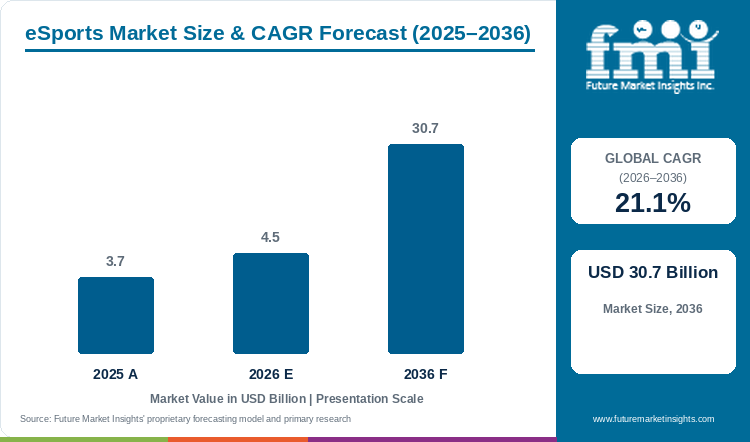
Demand is projected to expand at 21.1% CAGR from 2026 to 2036. Market value rises from USD 3.72 billion in 2025 to USD 4.5 billion in 2026 and USD 30.7 billion by 2036. [1]
FMI values the esports market at USD 4.5 billion in 2026 compared with an estimated USD 3.72 billion in 2025, with sales forecast to reach USD 30.7 billion by 2036, growing at a 21.1% CAGR. [1] MOBA games hold approximately 28.7% of genre demand in 2026, while mobile eSports is profiled at 27.6% CAGR, as game genres and platforms shape different parts of the competition offer. [1] WIPO’s 2026 tournament-organizer guidelines explain the intellectual-property rights involved in using video games for eSports events, with relevant permissions forming part of competition planning and commercial agreements. [2] The 2025 Esports World Cup announced a prize pool above USD 70 million, describing funding for tournament prize payments while event profitability remains dependent on the wider budget and commercial arrangements. [3] Organizers can sell sponsor and media exposure around a defined competition, although the promised benefit needs agreed placements, a reliable schedule and the rights covering the game and broadcast material. Professional teams develop audience and sponsorship partnerships within that event structure, while publishers retain a separate role through game ownership, permissions and sales associated with the underlying title. Mobile access creates another participation route, but the number of players does not establish sponsor revenue or the commercial return from a particular organized competition. Through 2036, FMI expects recurring agreements to depend on dependable event delivery and clearly specified exposure, with buyers assessing completed competitions and contractual rights alongside the audience offer presented by teams, organizers and platforms.
Key Market Trends and Insights
- MOBA games account for approximately 28.7% of genre demand in 2026, reflecting team-based competitions and recurring tournament formats within the eSports market and its commercial event structure. [1]
- Mobile eSports is profiled at 27.6% CAGR, with platform access supporting a growth outlook whose commercial value depends on the rights and dependable delivery of organized competitions. [1]
- Publisher permissions shape the use of games and broadcast material in organized competitions, with relevant rights forming part of the event and its commercial agreements before delivery. [2]
Regional Highlights
- Fastest-growing profiled market: India at 26.7% CAGR from 2026 to 2036. [1]
- Mobile applications provide another route for access to games and related audience services, while the commercial offer of an organized eSports event depends on its title permissions, schedule and agreed sponsor exposure.
Market Size and Forecast
Table 1: Market size and forecast for the esports market in USD billion and percentage
| Metric | Value |
|---|---|
| 2025 market size | USD 3.72 billion |
| Estimated market size in 2026 | USD 4.5 billion |
| Projected market size by 2036 | USD 30.7 billion |
| CAGR 2026 to 2036 | 21.1% |
| Added revenue 2026 to 2036 | USD 26.2 billion |
| Market expansion multiple | 6.8x |
Video game competitions bring publishers, organizers and teams into an event structure. Sponsorship and media agreements specify the exposure and rights delivered, while prize funding forms part of the event budget.
Tournament Rights and Event-Funding Evidence
Rights guidance addresses the permissions required for events, while prize-pool announcements describe funding for particular competitions. [2][3]
Table 2: Evidence and adoption indicators for the esports market
| Indicator | Data point or finding | Commercial relevance | Source |
|---|---|---|---|
| WIPO guidance | 2026 tournament-organizer guidelines | Defines necessary game-rights work | [2] |
| EWC 2025 funding | Announced prize pool above USD 70 million | Prize funding for organized competition | [3] |
| Commercial roles | Publishers, organizers, teams and platforms | Rights and delivery roles differ | [2] |
Analyst Perspective
"A competition needs the relevant game rights and a reliable operating schedule before its audience can become a dependable commercial offer. Sponsors and media buyers should be able to identify the exposure being purchased and how it will be delivered. Teams and organizers can build recurring agreements around that clarity, while prize funding and player access need to be understood within the wider event budget and the specific competition format."
- Sudip Saha, Principal Consultant, FMI
How is the esports market segmented?
The market covers 3 commercial axes and region: game genre; platform; revenue stream.
By game genre: MOBA; First-person shooter; Battle royale; Sports simulation; Fighting; Real-time strategy; Racing. By platform: PC; Console; Mobile. By revenue stream: Sponsorship and advertising; Media rights; Merchandise and tickets; Publisher fees; Streaming; Prize pools and wagering.
Why do MOBA games lead demand within the game genre category?
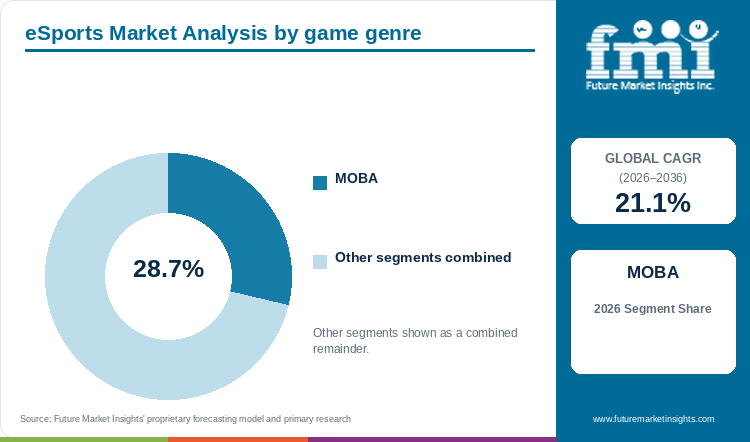
The moba games segment accounts for approximately 28.7% of game genre demand in 2026. [1]
MOBA games lead genre demand because team-based competition can support recurring leagues and tournaments in which organizers, publishers and participating teams develop a defined event offer. The commercial format depends on permissions for the title and broadcast material, with sponsor placements and operating schedules establishing what buyers receive. Web3 gaming follows another development path within the wider gaming industry, while organized MOBA events retain their own rights and competition requirements. The segment’s position therefore reflects a recurring tournament structure, with dependable delivery needed to connect its audience with commercial agreements. [2]
- MOBA games account for approximately 28.7% of genre demand in 2026, reflecting team-based competitions and recurring tournament formats within the eSports market and its commercial event structure. [1]
- Organizers should define the title permissions and sponsor exposure before commercializing a MOBA event, allowing partners to assess the competition format, operating schedule and agreed delivery of audience benefits. [2]
Table 3: Leading game genre share for the esports market
| Game genre | Share in 2026 |
|---|---|
| MOBA games | approximately 28.7% |
| Other segments combined | approximately 71.3% |
| Total | 100.0% |
Table 4: Segment leadership and market growth for the esports market
| Metric | Value |
|---|---|
| Global CAGR 2026 to 2036 | 21.1% |
| Leading segment | MOBA games |
How does mobile eSports shape the platform outlook?
Mobile eSports is profiled at 27.6% CAGR. [1]
Mobile eSports provides an additional participation route within the platform category, with access considered separately from the revenue produced by a defined competition. Organizers still need permissions for the game and its content, together with a reliable operating schedule and a clear commercial offer for sponsors or media partners. A player population can support an audience opportunity, although it does not by itself establish the benefit delivered through a particular event. Mobile’s growth outlook therefore connects broader access with the rights and reliable organization needed to turn participation into a defined competition offer. [1][2]
- Mobile eSports is profiled at 27.6% CAGR, with platform access supporting a growth outlook whose commercial value depends on the rights and dependable delivery of organized competitions. [1]
- Buyers should evaluate mobile participation through the rights, schedule and audience exposure of the actual event, keeping player access separate from the sponsor revenue and commercial outcome delivered. [2]
What are the drivers restraints and opportunities in the esports market?
- Defined competitions create sponsor and media inventory because organizers can offer scheduled audience exposure, provided the event has relevant publisher rights and agreed deliverables that establish the commercial benefit purchased by each partner. [2]
- Publisher rights constrain independent event planning because using a video game and its broadcast material requires relevant permissions, making the title and content agreements part of the organizer’s preparation before a competition is commercialized. [2]
- Reliable event delivery creates an opportunity to support recurring agreements through dependable schedules and clearly defined sponsor placements, with agreed game rights and measurable exposure giving commercial partners a practical basis for considering another season.
Defined competitions create sponsor and media inventory
A scheduled competition gives organizers sponsor exposure to sell when relevant publisher rights and agreed deliverables establish the benefit, with player access forming a separate measure from the commercial return of the event. [2]
Publisher rights constrain independent event planning
WIPO’s guidelines explain the game and content rights needed by tournament organizers, making the relevant permissions part of competition contracts before the event and its audience offer are commercialized. [2]
Reliable events can support recurring agreements
Defined sponsor placements, dependable schedules and agreed game rights provide a basis for another season. Fan engagement develops around the game, team and competition, with the event’s operating schedule and promised audience exposure helping sponsors assess the interaction purchased.
Which country CAGRs are profiled in the esports market?
Table 5: Country CAGR comparison for the esports market
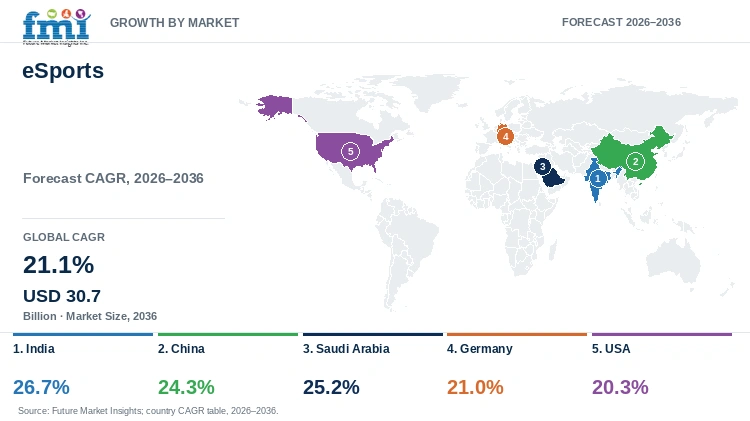
| Country | CAGR 2026 to 2036 |
|---|---|
| India | 26.7% |
| China | 24.3% |
| Saudi Arabia | 25.2% |
| Germany | 21.0% |
| USA | 20.3% |
Country-wise Analysis
India
A mobile tournament gives Indian organizers a way to reach players through the device on which the selected game is available, while registration and match operations determine whether participation becomes a dependable competition. Scheduling, connection checks and a clear result process all affect the experience of a player joining remotely. The country market is projected to expand at a 26.7% CAGR from 2026 to 2036, with organized events connecting that access to audiences and commercial partners. [1] Game permissions remain part of the event's foundation, as WIPO's organizer guidance describes the rights required to build tournament business models. [2] A supplier can therefore develop its offer around a defined game and competition format, giving sponsors a clearer understanding of the audience, broadcast opportunities and services included in the event agreement.
China
The selected game roster gives a Chinese tournament its competitive identity and also determines which publisher relationships the organizer needs to establish. WIPO's tournament guidance connects the use of games in eSports with the necessary intellectual-property rights, providing a reference for organizing the commercial offer around those permissions. [2] Event teams can then plan participation and audience coverage for the actual titles being played, rather than offering sponsor exposure independently of the competition schedule. Those game permissions and competition delivery requirements accompany a country market forecast to expand at a 24.3% CAGR from 2026 to 2036. [1] For a competition serving a Chinese-language audience, presentation and commentary also need to fit the participants and viewers, while a clear timetable helps commercial partners understand when and where their agreed presence will appear during the event.
Saudi Arabia
Riyadh's 2025 Esports World Cup announced total prize money above USD 70 million, illustrating the scale of an organized multi-game competition in Saudi Arabia. [3] Delivering an event at that scale brings tournament scheduling, team arrangements and audience presentation into the same operating budget, with commercial partners needing an understandable description of the exposure they are purchasing. The country market is forecast to expand at a 25.2% CAGR from 2026 to 2036, supported by an event offer whose value depends on dependable competition delivery. [1] An organizer can connect sponsorship and broadcast agreements with the actual game schedule and participation format, allowing each partner to assess its role. Careful coordination also gives players and viewers a coherent experience across matches, while the event team manages the staffing and technical capacity required for each competition.
Germany
A German event organizer selling sponsor exposure needs to describe the competition in which that exposure will appear, including the game, schedule and planned audience presentation. WIPO's guidance explains the rights associated with using games in tournaments, making permissions part of the commercial structure before the event's broadcast and on-site offer are finalized. [2] The market is projected to expand at a 21.0% CAGR from 2026 to 2036, with event delivery connecting those rights to the service promised to commercial partners. [1] A venue-based competition also requires usable space and technical support, while an online event needs a clear participation and result process. Distinguishing those requirements helps the organizer assign responsibilities within the budget and gives sponsors a more concrete basis for reviewing the exposure delivered during the competition.
USA
US teams can build commercial relationships around their players and audiences, while publishers manage the games used in the competition and the rights connected with them. These participants therefore bring different assets to an event, making agreement on the actual title, roster and audience offer important when a sponsor is considering a partnership. WIPO's organizer guidance describes the rights needed for tournament business models. [2] Within that commercial structure, the USA market is forecast to expand at a 20.3% CAGR from 2026 to 2036 as teams and event organizers develop their audience relationships. [1] A team can support renewal by explaining the appearances and content included in its agreement, while the event organizer coordinates competition delivery. Clear responsibilities help those relationships develop around services each participant can provide across the agreed schedule.
Who are the notable companies in the esports market?
Team Liquid; G2 Esports; Gen.G; Fnatic; Cloud9
Competitive Benchmarking
Table 6: Competitive positioning for the esports market
| Company or institution | Positioning | Evidence or purchasing distinction |
|---|---|---|
| Team Liquid | Professional team organization | Team sponsorship and competition partnerships [1] |
| G2 Esports | Professional team organization | Sponsor and audience-delivery role [1] |
| Gen.G | Professional team organization | Competitive team operations [1] |
| Fnatic | Professional eSports team organization | Documents professional teams across several game titles. [4] |
| Cloud9 | Professional eSports team organization | Documents competitive teams, creators and commercial partners. [5] |
Key Developments in the eSports Market
- WIPO published tournament-organizer guidelines in 2026 explaining the intellectual-property rights involved in eSports events, providing a public reference for organizers establishing game and content permissions before preparing competition schedules and associated commercial agreements. [2]
- The 2025 Esports World Cup announced a prize pool above USD 70 million, describing funding available for tournament prizes while the wider operating budget and sponsorship or media agreements determine the event’s commercial performance. [3]
Key Players in the eSports Market
Team Liquid; G2 Esports; Fnatic; Cloud9; 100 Thieves; Gen.G; NRG.
eSports Market Report Scope
Table 7: Report coverage for the esports market
| Coverage field | Report scope |
|---|---|
| Market breakdown | Game genre; Platform; Revenue stream; region |
| Quantitative units | USD billion |
| Market definition | Commercial competitive-gaming activities by genre and revenue stream. Ordinary consumer game sales are separated from esports receipts. |
| Regions covered | North America; Latin America; Western Europe; Eastern Europe; East Asia; South Asia and Pacific; Middle East and Africa |
| Countries profiled | India; China; Saudi Arabia; Germany; USA |
| Key companies profiled | Team Liquid; G2 Esports; Fnatic; Cloud9; 100 Thieves; Gen.G; NRG |
| Forecast period | 2026 to 2036 |
eSports Market Research Methodology
Table 8: Research methods for the esports market
| Method | Approach |
|---|---|
| Market coverage | Organized eSports competitions across game genres, platforms and revenue streams, connecting publishers, organizers and professional teams with the commercial event offer. |
| Public industry evidence | WIPO tournament-organizer guidelines, the Esports World Cup funding announcement and team disclosures. |
| Operating and technical context | Game permissions, content rights and the scope of prize funding. |
| Product and service assessment | Competition schedules, sponsor placements, broadcast exposure, title rosters and recurring commercial agreements. |
| Supplier research | Official company disclosures establish documented products, services and participation roles. |
| Country and segment analysis | Examine local operating conditions and the purchasing requirements of each market category. |
| Interpretation of industry indicators | Player access and prize payments from event revenue and profitability, with mobile growth interpreted as a platform outlook and game-genre demand analyzed within its separate segment category. |
eSports Market by Segments
By game genre
- MOBA
- First-person shooter
- Battle royale
- Sports simulation
- Fighting
- Real-time strategy
- Racing
By platform
- PC
- Console
- Mobile
By revenue stream
- Sponsorship and advertising
- Media rights
- Merchandise and tickets
- Publisher fees
- Streaming
- Prize pools and wagering
eSports Market by Region
- North America
- USA
- Canada
- Latin America
- Brazil
- Mexico
- Argentina
- Chile
- Western Europe
- Germany
- France
- UK
- Italy
- Spain
- Benelux
- Nordics
- Eastern Europe
- Poland
- Czech Republic
- Romania
- Hungary
- East Asia
- China
- Japan
- South Korea
- South Asia and Pacific
- India
- ASEAN
- Australia and New Zealand
- Middle East and Africa
- GCC countries
- South Africa
- Türkiye
- Israel
Research Sources and Bibliography
- [1] Future Market Insights. Published outlook accessed 12 October 2026. eSports Market.
- [2] World Intellectual Property Organization. 2026. Guidelines for Esports Tournament Organizers.
- [3] Saudi Press Agency. 13 June 2025. Esports World Cup 2025 tournament and prize-pool announcement.
- [4] Fnatic. Esports. Accessed 13 October 2026.
- [5] Cloud9. Cloud9 Esports. Accessed 13 October 2026.
This Report Answers
- How big is the esports market in 2026?
- What market value is projected by 2036?
- Which game genre segment leads demand?
- Which other commercial categories shape the market?
- Which countries have the fastest profiled growth?
- Which companies and institutions participate in the market?
Frequently Asked Questions
How large is the esports market in 2026?
FMI estimates market value at USD 4.5 billion in 2026, compared with an estimated USD 3.72 billion in 2025. [1]
What value and CAGR are projected through 2036?
Market value is projected to reach USD 30.7 billion by 2036 at a 21.1% CAGR from 2026 to 2036. [1]
Which game genre segment leads in 2026?
MOBA games account for approximately 28.7% of this category. [1]
What is the report segmentation?
Game genre; Platform; Revenue stream, and region.
Which profiled market records the highest CAGR?
India has the highest profiled rate at 26.7% from 2026 to 2036. [1]
Who are the key participants?
Team Liquid; G2 Esports; Fnatic; Cloud9; 100 Thieves; Gen.G; NRG.
Preview the report firsthand - request a free sample
Get SampleGet the brochure for pricing and purchase details.
Get PDFTable of Content
- Key Takeaways
- Market Size and CAGR
- Top Growth Driver
- Fastest Growing Segment
- Leading Region
- Key Companies
- Emerging Opportunities
- Executive Summary
- Global Market Outlook
- Demand-side Trends
- Supply-side Trends
- Technology Roadmap Analysis
- Analysis and Recommendations
- Analyst Perspective (What is happening? Why now? What should investors know?)
- Key Questions Answered
- How large is the market?
- What is the CAGR?
- What are key trends?
- Which region dominates?
- Who are the leaders?
- Market Overview
- Market Coverage / Taxonomy
- Market Definition / Scope / Limitations
- Research Methodology
- Chapter Orientation
- Analytical Lens and Working Hypotheses
- Market Structure, Signals, and Trend Drivers
- Benchmarking and Cross-market Comparability
- Market Sizing, Forecasting, and Opportunity Mapping
- Research Design and Evidence Framework
- Desk Research Programme (Secondary Evidence)
- Expert Input and Fieldwork (Primary Evidence)
- Tooling, Models, and Reference Databases
- Data Engineering and Model Build
- Quality Assurance and Audit Trail
- Market Background
- Market Dynamics (Drivers, Restraints, Opportunity, Trends)
- Scenario Forecast (Optimistic, Likely, Conservative)
- Impact Analysis
- AI Impact
- Sustainability Impact
- Regulatory Impact
- Technology Impact
- Consumer / Buyer Analysis
- Purchase Drivers
- Adoption Barriers
- Buyer Journey
- Opportunity Map Analysis
- Product Life Cycle Analysis
- Supply Chain Analysis
- Investment Feasibility Matrix
- Value Chain Analysis
- PESTLE and Porter's Analysis
- Regulatory Landscape
- Regional Parent Market Outlook
- Production and Consumption Statistics
- Import and Export Statistics
- Global Market Analysis and Forecast, 2021 to 2036
- Historical Market Size Value (USD Billion) Analysis, 2021 to 2025
- Current and Future Market Size Value (USD Billion) Projections, 2026 to 2036
- Y-o-Y Growth Trend Analysis
- Absolute $ Opportunity Analysis
- Global Market Pricing Analysis, 2021 to 2036
- Global Market Analysis and Forecast, By game genre, 2021 to 2036
- Introduction / Key Findings
- Historical Market Size Value (USD Billion) Analysis By game genre, 2021 to 2025
- Current and Future Market Size Value (USD Billion) Analysis and Forecast By game genre, 2026 to 2036
- MOBA
- First-person shooter
- Battle royale
- Sports simulation
- Fighting
- Real-time strategy
- Racing
- Y-o-Y Growth Trend Analysis By game genre, 2021 to 2025
- Absolute $ Opportunity Analysis By game genre, 2026 to 2036
- Global Market Analysis and Forecast, By platform, 2021 to 2036
- Introduction / Key Findings
- Historical Market Size Value (USD Billion) Analysis By platform, 2021 to 2025
- Current and Future Market Size Value (USD Billion) Analysis and Forecast By platform, 2026 to 2036
- PC
- Console
- Mobile
- Y-o-Y Growth Trend Analysis By platform, 2021 to 2025
- Absolute $ Opportunity Analysis By platform, 2026 to 2036
- Global Market Analysis and Forecast, By revenue stream, 2021 to 2036
- Introduction / Key Findings
- Historical Market Size Value (USD Billion) Analysis By revenue stream, 2021 to 2025
- Current and Future Market Size Value (USD Billion) Analysis and Forecast By revenue stream, 2026 to 2036
- Sponsorship and advertising
- Media rights
- Merchandise and tickets
- Publisher fees
- Streaming
- Prize pools and wagering
- Y-o-Y Growth Trend Analysis By revenue stream, 2021 to 2025
- Absolute $ Opportunity Analysis By revenue stream, 2026 to 2036
- Global Market Analysis and Forecast, By Region, 2021 to 2036
- Introduction
- Historical Market Size Value (USD Billion) Analysis By Region, 2021 to 2025
- Current Market Size Value (USD Billion) Analysis and Forecast By Region, 2026 to 2036
- North America
- Latin America
- Western Europe
- Eastern Europe
- East Asia
- South Asia and Pacific
- Middle East and Africa
- Market Attractiveness Analysis By Region
- North America Market Analysis and Forecast, By Country, 2021 to 2036
- Historical Market Size Value (USD Billion) Trend Analysis By Market Taxonomy, 2021 to 2025
- Market Size Value (USD Billion) Forecast By Market Taxonomy, 2026 to 2036
- By Country
- USA
- Canada
- By game genre
- By platform
- By revenue stream
- By Country
- Market Attractiveness Analysis
- By Country
- By game genre
- By platform
- By revenue stream
- Key Takeaways
- Latin America Market Analysis and Forecast, By Country
- Historical Market Size Value (USD Billion) Trend Analysis By Market Taxonomy, 2021 to 2025
- Market Size Value (USD Billion) Forecast By Market Taxonomy, 2026 to 2036
- By Country
- Brazil
- Mexico
- Argentina
- Chile
- By game genre
- By platform
- By revenue stream
- By Country
- Market Attractiveness Analysis
- By Country
- By game genre
- By platform
- By revenue stream
- Key Takeaways
- Western Europe Market Analysis and Forecast, By Country
- Historical Market Size Value (USD Billion) Trend Analysis By Market Taxonomy, 2021 to 2025
- Market Size Value (USD Billion) Forecast By Market Taxonomy, 2026 to 2036
- By Country
- Germany
- France
- UK
- Italy
- Spain
- Benelux
- Nordics
- By game genre
- By platform
- By revenue stream
- By Country
- Market Attractiveness Analysis
- By Country
- By game genre
- By platform
- By revenue stream
- Key Takeaways
- Eastern Europe Market Analysis and Forecast, By Country
- Historical Market Size Value (USD Billion) Trend Analysis By Market Taxonomy, 2021 to 2025
- Market Size Value (USD Billion) Forecast By Market Taxonomy, 2026 to 2036
- By Country
- Poland
- Czech Republic
- Romania
- Hungary
- By game genre
- By platform
- By revenue stream
- By Country
- Market Attractiveness Analysis
- By Country
- By game genre
- By platform
- By revenue stream
- Key Takeaways
- East Asia Market Analysis and Forecast, By Country
- Historical Market Size Value (USD Billion) Trend Analysis By Market Taxonomy, 2021 to 2025
- Market Size Value (USD Billion) Forecast By Market Taxonomy, 2026 to 2036
- By Country
- China
- Japan
- South Korea
- By game genre
- By platform
- By revenue stream
- By Country
- Market Attractiveness Analysis
- By Country
- By game genre
- By platform
- By revenue stream
- Key Takeaways
- South Asia and Pacific Market Analysis and Forecast, By Country
- Historical Market Size Value (USD Billion) Trend Analysis By Market Taxonomy, 2021 to 2025
- Market Size Value (USD Billion) Forecast By Market Taxonomy, 2026 to 2036
- By Country
- India
- ASEAN
- Australia and New Zealand
- By game genre
- By platform
- By revenue stream
- By Country
- Market Attractiveness Analysis
- By Country
- By game genre
- By platform
- By revenue stream
- Key Takeaways
- Middle East and Africa Market Analysis and Forecast, By Country
- Historical Market Size Value (USD Billion) Trend Analysis By Market Taxonomy, 2021 to 2025
- Market Size Value (USD Billion) Forecast By Market Taxonomy, 2026 to 2036
- By Country
- GCC countries
- South Africa
- Türkiye
- Israel
- By game genre
- By platform
- By revenue stream
- By Country
- Market Attractiveness Analysis
- By Country
- By game genre
- By platform
- By revenue stream
- Key Takeaways
- Key Countries Market Analysis
- USA
- Pricing Analysis
- Market Share Analysis, 2025
- By game genre
- By platform
- By revenue stream
- Canada
- Pricing Analysis
- Market Share Analysis, 2025
- By game genre
- By platform
- By revenue stream
- Mexico
- Pricing Analysis
- Market Share Analysis, 2025
- By game genre
- By platform
- By revenue stream
- Brazil
- Pricing Analysis
- Market Share Analysis, 2025
- By game genre
- By platform
- By revenue stream
- Chile
- Pricing Analysis
- Market Share Analysis, 2025
- By game genre
- By platform
- By revenue stream
- Germany
- Pricing Analysis
- Market Share Analysis, 2025
- By game genre
- By platform
- By revenue stream
- UK
- Pricing Analysis
- Market Share Analysis, 2025
- By game genre
- By platform
- By revenue stream
- Italy
- Pricing Analysis
- Market Share Analysis, 2025
- By game genre
- By platform
- By revenue stream
- Spain
- Pricing Analysis
- Market Share Analysis, 2025
- By game genre
- By platform
- By revenue stream
- France
- Pricing Analysis
- Market Share Analysis, 2025
- By game genre
- By platform
- By revenue stream
- India
- Pricing Analysis
- Market Share Analysis, 2025
- By game genre
- By platform
- By revenue stream
- ASEAN
- Pricing Analysis
- Market Share Analysis, 2025
- By game genre
- By platform
- By revenue stream
- Australia and New Zealand
- Pricing Analysis
- Market Share Analysis, 2025
- By game genre
- By platform
- By revenue stream
- China
- Pricing Analysis
- Market Share Analysis, 2025
- By game genre
- By platform
- By revenue stream
- Japan
- Pricing Analysis
- Market Share Analysis, 2025
- By game genre
- By platform
- By revenue stream
- South Korea
- Pricing Analysis
- Market Share Analysis, 2025
- By game genre
- By platform
- By revenue stream
- Poland
- Pricing Analysis
- Market Share Analysis, 2025
- By game genre
- By platform
- By revenue stream
- Hungary
- Pricing Analysis
- Market Share Analysis, 2025
- By game genre
- By platform
- By revenue stream
- Türkiye
- Pricing Analysis
- Market Share Analysis, 2025
- By game genre
- By platform
- By revenue stream
- South Africa
- Pricing Analysis
- Market Share Analysis, 2025
- By game genre
- By platform
- By revenue stream
- Saudi Arabia
- Pricing Analysis
- Market Share Analysis, 2025
- By game genre
- By platform
- By revenue stream
- USA
- Market Structure Analysis
- Competition Dashboard
- Competition Benchmarking
- Market Share Analysis of Top Players
- By Regional
- By game genre
- By platform
- By revenue stream
- Emerging Startups
- Innovation Benchmarking
- Competition Analysis
- Competition Deep Dive
- Team Liquid
- Overview
- Product Portfolio
- Profitability by Market Segments
- Sales Footprint
- Strategy Overview
- Marketing Strategy
- Product Strategy
- Channel Strategy
- G2 Esports
- Gen.G
- Fnatic
- Cloud9
- Team Liquid
- Case Studies
- Success Stories
- Recent Developments
- Competition Deep Dive
- Assumptions & Acronyms Used


