

- Industry Size (2026)
- USD 24.7 Bn
- Forecast (2036)
- USD 39.9 Bn
- CAGR (2026 to 2036)
- 4.9%
eBook Market Forecast and Outlook 2026 to 2036
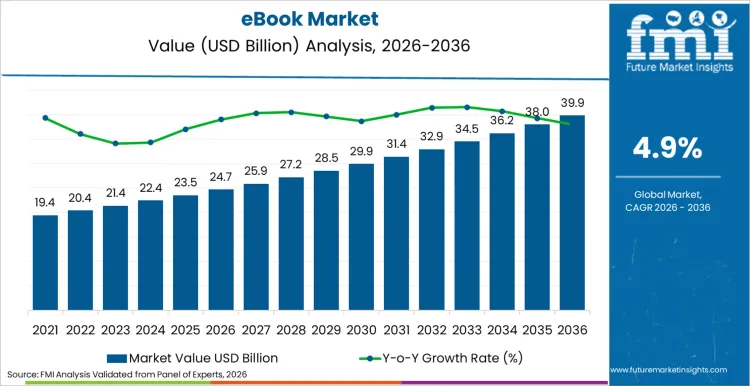
The eBook market is projected to be valued at USD 24.7 Billion in 2026 and is forecast to reach USD 39.9 Billion by 2036, expanding at a 4.9% CAGR during 2026 to 2036. The market’s operating structure is defined by platform concentration in retail and recurring monetisation in education, where digital access is sold as a service rather than a unit.
Large distributors are still investing in device and format innovation to keep digital reading engagement durable. Amazon disclosed it launched a series of new Kindle devices in 2024, including a new colour version and updated Paperwhites, and linked this cycle to its highest Kindle unit sales for a single quarter in over a decade. This matters commercially because hardware refresh cycles stabilise reading time and storefront traffic, which supports the paid eBook mix.
On the education side, publishers are scaling digital courseware and subscription access as the default delivery model. McGraw Hill reported digital billings as 60% of total billings over the last 12-month period and positioned its roadmap around digital solutions and AI-enabled personalisation.
It stated: We are excited as we continue to make advancements with our digital solutions and explore how to leverage powerful tools like generative AI to advance personalised learning, enhance learning experiences and improve operational efficiency. Publishers are also defending the long-run reader pipeline through literacy interventions that expand addressable demand. Hachette Book Group committed fresh capital to reading-for-pleasure activation and said: In 2026, we aim to take Raising Readers to the next level.
Summary of eBook Market
- The eBook market covers the creation, distribution, sale, and licensing of digital books delivered through eReaders, mobile apps, and web platforms across consumer and institutional channels.
- The defined scope follows FMI taxonomy across free and paid eBooks and key verticals such as educational institutes and media, excluding print books, audiobooks, and unlicensed digital distribution.
- The market is projected to grow at a 4.9% CAGR from 2026 to 2036, expanding from USD 24.7 billion in 2026 to USD 39.9 billion by 2036, based on platform-led paid conversion, device and app retention, and education-driven licensing throughput.
- Paid eBooks (61.0% share) anchor monetisation, while educational institutes (41.0% share) anchor volume through contract-based, recurring digital access models.
- Competition is split between platform distributors such as Amazon, Apple, and Google, and major publishers including Penguin Random House, HarperCollins, Hachette, McGraw-Hill, Wiley, and Cengage, with advantage concentrated in ecosystem control and rights management.
- China grows fastest at 6.2% CAGR through regulated digital distribution platforms, while the United States grows at 4.9% supported by device ecosystems; Germany (1.4%) and Japan (2.1%) expand more gradually under pricing and piracy constraints.
eBook Market Key Takeaways
| Metric | Value (USD Billion) |
|---|---|
| Market Size 2026 | USD 24.7 Billion |
| Forecast Value 2036 | USD 39.9 Billion |
| CAGR 2026 to 2036 | 4.9% |
Driving factors shaping the eBook market
Scale is being driven by platform-led product upgrades and education-led subscription conversion. Amazon’s 2024 annual report confirms an active Kindle device refresh cycle, including a new colour Kindle and performance upgrades, and links it to the strongest quarterly Kindle unit sales in more than a decade, tightening the retention loop that converts reading time into paid digital purchases. Education publishers are hard-wiring digital access into coursework economics. McGraw Hill reports digitalcurriculum-linked adoption billings dominance across its business and frames growth around digital solutions and AI-enabled personalisation, which raises switching costs for institutions and embeds recurring access models. In parallel, publishers are funding literacy activation to protect the future reader base. Hachette’s Raising Readers capital deployment for 2026 ties demand creation to measurable access programs, expanding long-run consumption capacity rather than relying on price-led promotion.
How is the eBook Market Segmented?
The eBook market is segmented by category, vertical, and region to reflect the diverse pathways of digital publishing and monetisation. By category, the market includes free eBooks and paid eBooks, with paid formats serving as the primary revenue engine through platform storefronts and subscription access models. By vertical, demand spans educational institutes, media and entertainment, and manufacturing, reflecting both curriculum-linked institutional procurement and general consumer reading across genres. Educational institutes anchor recurring volume through licensed digital access, while media and entertainment sustain retail-led unit purchases.
FMI analysis suggests that while subscription innovation and device upgrades are expanding engagement, the market structure remains heavily dependent on platform governance and rights-controlled distribution frameworks. This segmentation highlights a dual-track market where retail ecosystems drive monetisation depth while institutional licensing models provide scale and revenue stability.
Why do paid eBooks hold the largest share despite free availability?
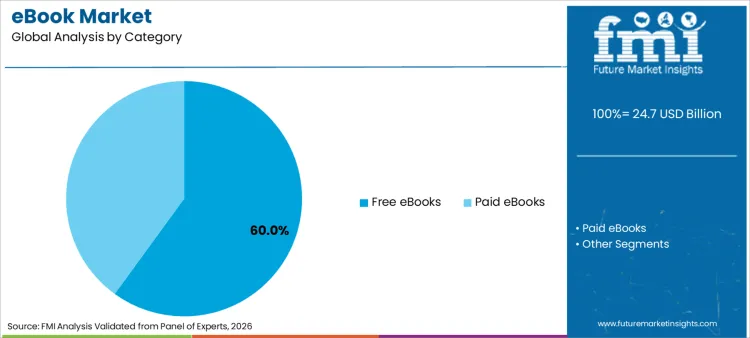
Paid eBooks lead with a 60% share by category because platforms and publishers continue to reinforce monetisation features that free formats cannot replicate at scale, particularly storefront discovery, device-led retention, and rights-controlled distribution. Publishers are strengthening premium positioning by aligning paid access with broader social and institutional initiatives that keep reading behaviour active and defensible. Hachette’s Raising Readers program commits funds and distribution actions across 2026, treating reading participation as an outcome that can be activated through targeted access, which supports the downstream economics of paid digital formats. The paid mix therefore holds because leading players control rights, distribution, and conversion infrastructure in ways that free-only ecosystems cannot structurally match.
Why do educational institutes dominate demand formation?
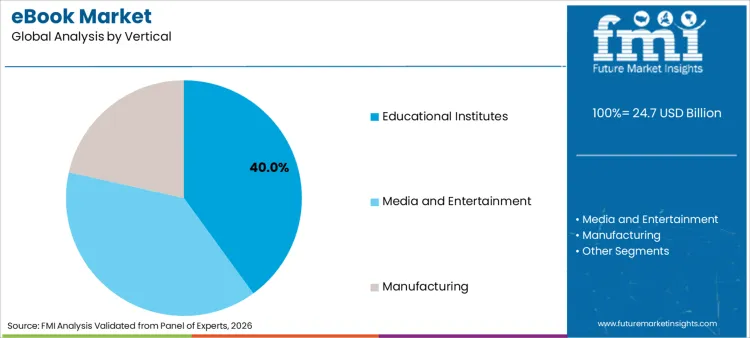
Educational institutes account for 40% share by vertical, ahead of media & entertainment and manufacturing, because procurement is increasingly tied to digital delivery models that create recurring billing, measurable usage, and institutional switching costs. McGraw Hill reported digital billings as the majority of its billings base and tied performance to platform activations and subscription-linked access models, indicating that institutions purchase integrated digital systems rather than discrete titles. This concentrates volume where curriculum alignment, campus-wide distribution, and first-day access programs operate at scale, making education a repeatable, contract-driven demand engine.
What are the key Trends and Restraints in eBook Market?
Accessibility compliance is becoming a product and workflow requirement for publishers, tightening the definition of what a commercially viable eBook must include. Hachette Livre stated it is offering natively accessible eBooks as the European Accessibility Act comes into effect on 28 June 2025, signalling that accessibility features are shifting from optional enhancements to baseline deliverables that shape production pipelines and catalogue remediation priorities. This pushes investment into EPUB workflows, metadata quality, and standardised accessibility checks, which favours scaled publishers that can amortise compliance across large catalogues and forces smaller publishers to rely more heavily on distribution partners and tooling.
Library and platform licensing frictions constrain availability and monetisation in specific markets because digital lending access is not purely a demand question. In Australia, the government’s Lending Right schemes were expanded to include ebook and audiobook title claims, and official programme settings make digital eligibility a formal part of the compensation and access framework. Trade bodies have also documented how platform decisions can restrict whether libraries can license ebooks, which directly affects public access and downstream discovery. These constraints make demand more sensitive to licensing terms and platform participation, limiting conversion even when reader interest is present.
What is eBook Market Regional Outlook?
Sales in regulated and platform-concentrated markets are diverging from the global average, shaped by rights frameworks, device ecosystems, and institutional digitisation cycles. While the global market expands at 4.9%, digitally regulated and mobile-first economies are converting reading time into paid formats more efficiently. China leads with a 6.2% CAGR, supported by licensed online distribution platforms and large-scale digital consumption. The United States follows at 4.9%, sustained by device refresh cycles and education-led licensing throughput. Australia grows at 4.6% as lending-right modernisation stabilises digital access economics. In contrast, structurally regulated markets such as Germany (1.4%) and Japan (2.1%) expand more gradually under fixed pricing rules and piracy-related monetisation leakage. FMI analysis indicates that future growth will concentrate in markets where platform control, institutional procurement, and rights governance align to support scalable digital conversion.
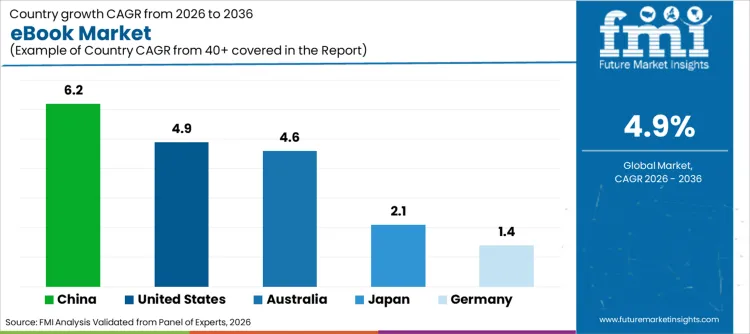
| Country | CAGR (2026 to 2036) |
|---|---|
| United States | 4.9% |
| Germany | 1.4% |
| Australia | 4.6% |
| China | 6.2% |
| Japan | 2.1% |
Source: Future Market Insights (FMI) analysis, based on proprietary forecasting model and primary research.
Why does the United States sustain a steady eBook growth curve through 2036?
The United States grows at 4.9% because commercial scale is reinforced by platform investment and education digitisation that keep paid consumption resilient. In education, federal positioning continues to push technology-enabled learning as a structural priority. The US Department of Education’s National Educational Technology Plan 2024 frames technology use around closing access, design, and use divides, which sustains institutional attention on digital learning infrastructure where eBooks and digital course materials remain core inputs. The combined effect is a market where consumer purchasing is stabilised by ecosystem control while institutional demand remains anchored in district and campus digitisation agendas.
Why is Germany structurally slower despite high reading intensity?
Germany grows at 1.4% because price and distribution rules reduce the speed at which aggressive platform discounting can expand penetration, keeping growth more dependent on format preference shifts than price-led conversion. The Börsenverein’s fixed price system documentation states that fixed book price rules cover eBooks, extending binding retail price logic into digital formats. This limits the promotional levers that typically accelerate paid eBook adoption in other markets, especially deep discounting and subscription-driven price anchoring. As a result, platform competition shifts toward catalogue breadth, compliance, and service quality rather than price disruption, which slows volume expansion even when digital access improves. The market therefore grows, but it grows through gradual substitution and institutional uptake rather than rapid retail price-driven conversion. That structural pricing environment is the binding mechanism behind Germany’s comparatively modest CAGR.
Why does Australia remain a mid-growth market instead of accelerating?
Australia grows at 4.6% because digital lending and rights modernisation are expanding the formal pathways through which ebooks are distributed and compensated, supporting both access and publisher participation. The Australian Government’s Lending Right schemes explicitly note important changes that allow ebook and audiobook title claims, embedding digital formats into the national compensation framework for creators and publishers. This aligns incentives to keep more titles available in digital lending ecosystems and reduces friction for publisher participation over time. Trade and library bodies have also highlighted how platform licensing choices can shape whether libraries can license ebooks, making policy settings and rights frameworks commercially material to availability. Australia’s growth is therefore governed by the pace at which licensing access, library distribution, and rights-based compensation mechanisms stabilise the supply side, not just by consumer willingness to read digitally.
Why does China post the fastest CAGR among the listed countries?
China grows at 6.2% because digital publishing is scaled through regulated online distribution frameworks that formalise platform participation and define what qualifies as online publication services. China’s online publication administration provisions apply to online publishing services within the territory and define the regulated scope of network publication activity, which anchors the market inside licensed digital channels rather than fragmented informal distribution. This regulatory structure concentrates growth into large domestic platforms that can comply, distribute at scale, and monetise through managed ecosystems, accelerating adoption where mobile-first content consumption is already structurally embedded. The result is faster conversion of digital reading time into paid formats, with growth supported by platform scale and regulatory formalisation of distribution rather than purely by price or device cycles.
Why is Japan moderate growth rather than high growth?
Japan grows at 2.1% because demand is supported by strong digital content consumption, but monetisation is constrained by structural leakage from piracy and persistent competition for attention across formats. Japan’s Intellectual Property Strategic Program 2025 explicitly calls for continuously grasping piracy damage and strengthening countermeasures across responsible agencies, signalling that piracy is treated as a national economic issue for content industries rather than a marginal enforcement problem. This matters for eBooks because piracy weakens paid conversion even when readership is strong, particularly in high-consumption categories such as serialized digital reading. Growth therefore remains positive but moderated, with industry players needing to allocate resources to enforcement, distribution control, and platform integrity rather than purely to demand expansion. Japan’s CAGR reflects that balance: strong underlying consumption, slower paid capture.
How is competition structured in the global eBook market?
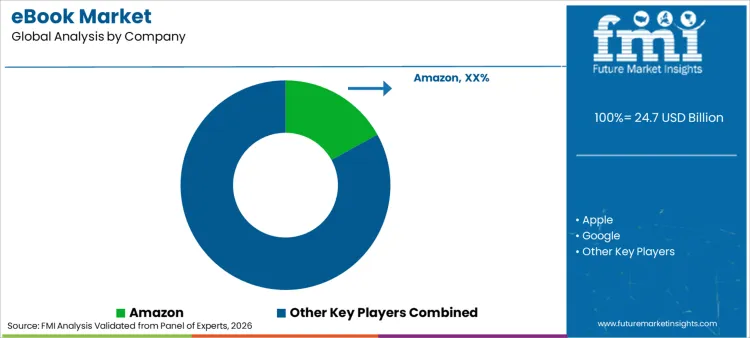
Competition is split between platform distributors that control discovery and payments and publishers that control rights and catalogue depth. Global leadership in consumer eBooks is shaped by ecosystem scale and device or app retention, where Amazon’s annual report signals continued capital allocation into Kindle hardware refresh and customer experience improvements that keep its reading ecosystem commercially defensible. In education, leadership is more publisher-led, with companies such as McGraw Hill emphasising digital billings, platform activations, and subscription-linked access models that increase institutional switching costs.
In North America, platform dominance tends to translate more directly into retail leadership because device and storefront ecosystems are deeply embedded. In Europe, structural rules such as Germany’s fixed price coverage for eBooks constrain price-led platform tactics, shifting competition toward service quality and catalogue alignment. In Asia, leadership is shaped by local platform compliance and distribution governance, with China’s online publication rules formalising the role of licensed online publishing services and favouring scaled domestic platforms. Japan remains distinct, where piracy countermeasures appear as a national priority, affecting paid capture dynamics.
Recent Developments:
- In December 2025, Hachette Book Group announced a USD 200,000 fund to support its Raising Readers program, providing books, classroom libraries, and author visits to 200 underserved schools to help more children develop a love for reading.
- In October 2024, Amazon introduced an all-new Kindle lineup, including its first color Kindle Colorsoft, a redesigned Kindle Scribe with AI features, the fastest Kindle Paperwhite, and a refreshed entry-level Kindle with enhanced performance and design.
Key players in eBook Market
- Amazon
- Apple
- Penguin Random House
- HarperCollins
- Hachette
- Macmillan Publishers
- Simon & Schuster
- McGraw-Hill
- Wiley
- Cengage Learning
- Kensington Publishing Corp.
Market Definition
The eBook market covers the creation, distribution, sale, licensing, and consumption of digital books delivered in electronic formats through dedicated eReaders, mobile applications, and web-based reading platforms. It includes consumer retail eBooks and institutional eBook access models where titles or course-linked books are delivered digitally under purchase, subscription, or license. Market activity includes platform-led storefront distribution, publisher-led catalogue monetisation, and institutional procurement pathways. Competitive advantage concentrates in ecosystem control and rights-based supply, where device refresh, discovery, payments, and licensing terms shape conversion and retention.
Market Inclusion
Included are free eBooks and paid eBooks delivered via commercial platforms and publisher channels, including education and professional eBook distribution where institutions procure digital titles or access bundles. Included offerings cover format production and compliance features that make eBooks commercially usable, including accessibility-aligned digital publishing practices where publishers treat accessibility as a baseline requirement. Included demand pools cover educational institutes, media and entertainment use cases, and enterprise consumption where eBooks are procured or distributed through formal channels.
Market Exclusion
Excluded are audiobooks and podcast-style spoken word products, print books, and physical distribution revenue. Also excluded are informal or pirated distribution channels and unlicensed online publication activity, even where readership exists, because it does not represent monetised market value within regulated and licensed systems. Excluded are digital learning products that are not books, such as standalone assessments, tutoring software, or LMS licenses without eBook or book-like digital content components. Where companies bundle multiple digital services, only the eBook-related portion is considered within scope.
Scope of Report
| Items | Values |
|---|---|
| Quantitative Units | USD 24.7 Billion |
| Category Segments | Free eBooks; Paid eBooks |
| Vertical Segments | Educational Institutes; Media and Entertainment; Manufacturing |
| Regions Covered | North America; Latin America; Asia Pacific; Japan; Western Europe; Eastern Europe; Middle East and Africa |
| Countries Covered | United States; Germany; Australia; China; Japan |
| Key Companies Profiled | McGraw-Hill; Wiley; Kensington Publishing Corp.; Hachette; Cengage Learning; HarperCollins; Simon & Schuster; Macmillan Publishers; Penguin Random House; Self-published eBooks |
| Additional Attributes | Revenue analysis by category and vertical; assessment of platform storefront control and device-led retention effects on paid conversion; evaluation of institutional licensing throughput and renewal cadence shaping education-led demand; review of accessibility compliance and format standards affecting catalogue readiness; analysis of library and rights-led availability constraints impacting distribution; competitive positioning based on catalogue scale, geographic expansion signals, and repeated executive emphasis on digital monetisation. |
eBook Market by Key segments
By Category:
- Free eBooks
- Paid eBooks
By Vertical:
- Educational Institutes
- Media and Entertainment
- Manufacturing
By Region:
- North America
- Latin America
- Asia Pacific
- Japan
- Western Europe
- Eastern Europe
- Middle East and Africa
Bibliography
- Australian Government Office for the Arts. (2024). Modernising the lending rights schemes: Expansion to digital formats. Department of Infrastructure, Transport, Regional Development, Communications and the Arts.
- Intellectual Property Strategy Headquarters. (2025). Intellectual property strategic program 2025. Cabinet Office, Government of Japan.
- USA Department of Education, Office of Educational Technology. (2024). National educational technology plan 2024: A call to action for closing the digital access, design, and use divides.
Frequently Asked Questions
How big is the eBook market in 2026 and what is the projected value by 2036?
The eBook market is valued at USD 24.7 billion in 2026 and is projected to reach USD 39.9 billion by 2036.
What is the growth outlook for the eBook market over the next 10 years?
The market is expected to grow at a 4.9% CAGR from 2026 to 2036, supported by paid platform conversion and education-led digital licensing.
Which segments drive demand in this market?
Demand is driven by paid eBooks holding a 61.0% share and educational institutes accounting for 41.0% of usage, reflecting storefront monetisation and institutional procurement cycles.
How does growth intensity differ across key countries?
China leads with a 6.2% CAGR, followed by the United States at 4.9%, Australia at 4.6%, Japan at 2.1%, and Germany at 1.4% due to structural pricing and rights dynamics.
What are the main risks and constraints affecting this market?
Key risks include rights and licensing frictions, accessibility compliance costs, and piracy-related monetisation leakage in markets with weaker enforcement.
Preview the report firsthand - request a free sample
Get SampleGet the brochure for pricing and purchase details.
Get PDFTable of Content
- Executive Summary
- Global Market Outlook
- Demand-side Trends
- Supply-side Trends
- Technology Roadmap Analysis
- Analysis and Recommendations
- Market Overview
- Market Coverage / Taxonomy
- Market Definition / Scope / Limitations
- Market Background
- Market Dynamics
- Drivers
- Restraints
- Opportunity
- Trends
- Scenario Forecast
- Demand in Optimistic Scenario
- Demand in Likely Scenario
- Demand in Conservative Scenario
- Opportunity Map Analysis
- Product Life Cycle Analysis
- Supply Chain Analysis
- Investment Feasibility Matrix
- Value Chain Analysis
- PESTLE and Porter’s Analysis
- Regulatory Landscape
- Regional Parent Market Outlook
- Production and Consumption Statistics
- Import and Export Statistics
- Market Dynamics
- Global Market Analysis 2021 to 2025 and Forecast, 2026 to 2036
- Historical Market Size Value (USD Million) Analysis, 2021 to 2025
- Current and Future Market Size Value (USD Million) Projections, 2026 to 2036
- Y-o-Y Growth Trend Analysis
- Absolute $ Opportunity Analysis
- Global Market Pricing Analysis 2021 to 2025 and Forecast 2026 to 2036
- Global Market Analysis 2021 to 2025 and Forecast 2026 to 2036, By Category
- Introduction / Key Findings
- Historical Market Size Value (USD Million) Analysis By Category , 2021 to 2025
- Current and Future Market Size Value (USD Million) Analysis and Forecast By Category , 2026 to 2036
- Free eBooks
- Paid eBooks
- Free eBooks
- Y-o-Y Growth Trend Analysis By Category , 2021 to 2025
- Absolute $ Opportunity Analysis By Category , 2026 to 2036
- Global Market Analysis 2021 to 2025 and Forecast 2026 to 2036, By Vertical
- Introduction / Key Findings
- Historical Market Size Value (USD Million) Analysis By Vertical, 2021 to 2025
- Current and Future Market Size Value (USD Million) Analysis and Forecast By Vertical, 2026 to 2036
- Educational Institutes
- Media and Entertainment
- Manufacturing
- Educational Institutes
- Y-o-Y Growth Trend Analysis By Vertical, 2021 to 2025
- Absolute $ Opportunity Analysis By Vertical, 2026 to 2036
- Global Market Analysis 2021 to 2025 and Forecast 2026 to 2036, By Region
- Introduction
- Historical Market Size Value (USD Million) Analysis By Region, 2021 to 2025
- Current Market Size Value (USD Million) Analysis and Forecast By Region, 2026 to 2036
- North America
- Latin America
- Western Europe
- Eastern Europe
- East Asia
- South Asia and Pacific
- Middle East & Africa
- Market Attractiveness Analysis By Region
- North America Market Analysis 2021 to 2025 and Forecast 2026 to 2036, By Country
- Historical Market Size Value (USD Million) Trend Analysis By Market Taxonomy, 2021 to 2025
- Market Size Value (USD Million) Forecast By Market Taxonomy, 2026 to 2036
- By Country
- USA
- Canada
- Mexico
- By Category
- By Vertical
- By Country
- Market Attractiveness Analysis
- By Country
- By Category
- By Vertical
- Key Takeaways
- Latin America Market Analysis 2021 to 2025 and Forecast 2026 to 2036, By Country
- Historical Market Size Value (USD Million) Trend Analysis By Market Taxonomy, 2021 to 2025
- Market Size Value (USD Million) Forecast By Market Taxonomy, 2026 to 2036
- By Country
- Brazil
- Chile
- Rest of Latin America
- By Category
- By Vertical
- By Country
- Market Attractiveness Analysis
- By Country
- By Category
- By Vertical
- Key Takeaways
- Western Europe Market Analysis 2021 to 2025 and Forecast 2026 to 2036, By Country
- Historical Market Size Value (USD Million) Trend Analysis By Market Taxonomy, 2021 to 2025
- Market Size Value (USD Million) Forecast By Market Taxonomy, 2026 to 2036
- By Country
- Germany
- UK
- Italy
- Spain
- France
- Nordic
- BENELUX
- Rest of Western Europe
- By Category
- By Vertical
- By Country
- Market Attractiveness Analysis
- By Country
- By Category
- By Vertical
- Key Takeaways
- Eastern Europe Market Analysis 2021 to 2025 and Forecast 2026 to 2036, By Country
- Historical Market Size Value (USD Million) Trend Analysis By Market Taxonomy, 2021 to 2025
- Market Size Value (USD Million) Forecast By Market Taxonomy, 2026 to 2036
- By Country
- Russia
- Poland
- Hungary
- Balkan & Baltic
- Rest of Eastern Europe
- By Category
- By Vertical
- By Country
- Market Attractiveness Analysis
- By Country
- By Category
- By Vertical
- Key Takeaways
- East Asia Market Analysis 2021 to 2025 and Forecast 2026 to 2036, By Country
- Historical Market Size Value (USD Million) Trend Analysis By Market Taxonomy, 2021 to 2025
- Market Size Value (USD Million) Forecast By Market Taxonomy, 2026 to 2036
- By Country
- China
- Japan
- South Korea
- By Category
- By Vertical
- By Country
- Market Attractiveness Analysis
- By Country
- By Category
- By Vertical
- Key Takeaways
- South Asia and Pacific Market Analysis 2021 to 2025 and Forecast 2026 to 2036, By Country
- Historical Market Size Value (USD Million) Trend Analysis By Market Taxonomy, 2021 to 2025
- Market Size Value (USD Million) Forecast By Market Taxonomy, 2026 to 2036
- By Country
- India
- ASEAN
- Australia & New Zealand
- Rest of South Asia and Pacific
- By Category
- By Vertical
- By Country
- Market Attractiveness Analysis
- By Country
- By Category
- By Vertical
- Key Takeaways
- Middle East & Africa Market Analysis 2021 to 2025 and Forecast 2026 to 2036, By Country
- Historical Market Size Value (USD Million) Trend Analysis By Market Taxonomy, 2021 to 2025
- Market Size Value (USD Million) Forecast By Market Taxonomy, 2026 to 2036
- By Country
- Kingdom of Saudi Arabia
- Other GCC Countries
- Turkiye
- South Africa
- Other African Union
- Rest of Middle East & Africa
- By Category
- By Vertical
- By Country
- Market Attractiveness Analysis
- By Country
- By Category
- By Vertical
- Key Takeaways
- Key Countries Market Analysis
- USA
- Pricing Analysis
- Market Share Analysis, 2025
- By Category
- By Vertical
- Canada
- Pricing Analysis
- Market Share Analysis, 2025
- By Category
- By Vertical
- Mexico
- Pricing Analysis
- Market Share Analysis, 2025
- By Category
- By Vertical
- Brazil
- Pricing Analysis
- Market Share Analysis, 2025
- By Category
- By Vertical
- Chile
- Pricing Analysis
- Market Share Analysis, 2025
- By Category
- By Vertical
- Germany
- Pricing Analysis
- Market Share Analysis, 2025
- By Category
- By Vertical
- UK
- Pricing Analysis
- Market Share Analysis, 2025
- By Category
- By Vertical
- Italy
- Pricing Analysis
- Market Share Analysis, 2025
- By Category
- By Vertical
- Spain
- Pricing Analysis
- Market Share Analysis, 2025
- By Category
- By Vertical
- France
- Pricing Analysis
- Market Share Analysis, 2025
- By Category
- By Vertical
- India
- Pricing Analysis
- Market Share Analysis, 2025
- By Category
- By Vertical
- ASEAN
- Pricing Analysis
- Market Share Analysis, 2025
- By Category
- By Vertical
- Australia & New Zealand
- Pricing Analysis
- Market Share Analysis, 2025
- By Category
- By Vertical
- China
- Pricing Analysis
- Market Share Analysis, 2025
- By Category
- By Vertical
- Japan
- Pricing Analysis
- Market Share Analysis, 2025
- By Category
- By Vertical
- South Korea
- Pricing Analysis
- Market Share Analysis, 2025
- By Category
- By Vertical
- Russia
- Pricing Analysis
- Market Share Analysis, 2025
- By Category
- By Vertical
- Poland
- Pricing Analysis
- Market Share Analysis, 2025
- By Category
- By Vertical
- Hungary
- Pricing Analysis
- Market Share Analysis, 2025
- By Category
- By Vertical
- Kingdom of Saudi Arabia
- Pricing Analysis
- Market Share Analysis, 2025
- By Category
- By Vertical
- Turkiye
- Pricing Analysis
- Market Share Analysis, 2025
- By Category
- By Vertical
- South Africa
- Pricing Analysis
- Market Share Analysis, 2025
- By Category
- By Vertical
- USA
- Market Structure Analysis
- Competition Dashboard
- Competition Benchmarking
- Market Share Analysis of Top Players
- By Regional
- By Category
- By Vertical
- Competition Analysis
- Competition Deep Dive
- Amazon
- Overview
- Product Portfolio
- Profitability by Market Segments (Product/Age /Sales Channel/Region)
- Sales Footprint
- Strategy Overview
- Marketing Strategy
- Product Strategy
- Channel Strategy
- Apple
- Penguin Random House
- HarperCollins
- Hachette
- Macmillan Publishers
- Simon & Schuster
- McGraw-Hill
- Wiley
- Cengage Learning
- Kensington Publishing Corp
- Amazon
- Competition Deep Dive
- Assumptions & Acronyms Used
- Research Methodology


