

- Market Size (2026)
- USD 117.1 Mn
- Forecast (2036)
- USD 268.4 Mn
- CAGR (2026 to 2036)
- 8.6%
Oxytocin Market Size, Market Forecast and Outlook By FMI
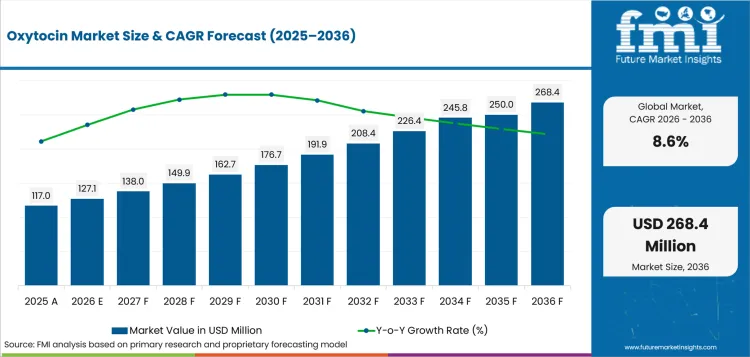
The oxytocin market is expected to rise from USD 117.1 million in 2026 to USD 268.4 million by 2036, at 8.6% CAGR, with demand driven by postpartum bleeding prevention and controlled maternity drug supply, while postpartum applications account for 86.8% share and hospital pharmacies hold 63.7% share as health systems prioritize safer delivery care.
Key Takeaways, Market Size, and Forecast
| Metric | Value |
|---|---|
| Market Size (2026) | USD 117.1 Million |
| Market Size (2036) | USD 268.4 Million |
| Forecast CAGR | 8.6% from 2026 to 2036 |
| Postpartum Applications Share In 2026 | 86.8% |
| Hospital Pharmacies Share In 2026 | 63.7% |
| Injectable Products Share In 2026 | 94.2% |
| Hospitals Share In 2026 | 69.0% |
| Intravenous Route Share In 2026 | 57.0% |
| Fastest-Growing Country | India |
| India CAGR | 10.1% through 2036 |
Summary of the Oxytocin Market
- Demand and Growth Drivers
- Oxytocin demand is closely connected with childbirth care. Hospitals need it for labor support and postpartum bleeding control.
- Maternal safety programs keep oxytocin in regular hospital purchasing. Delivery rooms need quick access to uterotonic medicines.
- Better access to skilled birth care supports market growth. More facility-based deliveries increase demand for quality-assured obstetric medicines.
- Clinical and Segment View
- Postpartum applications lead the market. The use case is strong because bleeding after childbirth can become urgent very quickly.
- Injectable products hold a strong position. Care teams prefer injections because they work fast and allow controlled dosing.
- Hospital pharmacies lead distribution. They manage storage and make sure the medicine is available in delivery rooms.
- Geography and Competitive Outlook
- India and China show stronger demand. Large childbirth volumes and hospital care expansion support medicine use.
- The United States and Europe have mature demand. Hospital protocols and drug quality standards guide supplier selection.
- Competition in the industry is influenced by supply reliability. Buyers prefer companies with stable injectable production and strong hospital access.
- Analyst Opinion
- Anurag Sharma, Principal Consultant for Healthcare at FMI, notes, “Oxytocin demand is closely linked with safer childbirth systems. Hospitals need dependable products because the medicine is used during time-sensitive obstetric care. Suppliers that maintain stable supply, strong quality control and clear hospital distribution will be better placed in this market.”
- Oxytocin Market Value Analysis
- The oxytocin market is moving from basic uterotonic supply into a more defined maternal safety medicine segment.
- Demand is being driven by postpartum bleeding prevention and hospital-based childbirth care.
- The market benefits from standardized obstetric protocols because hospitals need reliable medicines at the point of delivery.
- Spending is further supported by quality-assured injectable supply and maternal health programs focused on safer birth outcomes.
Postpartum hemorrhage prevention keeps oxytocin important in maternity care. Hospitals need steady access to trusted uterotonic medicines and clear dosing practices. The World Health Organization recommends 10 IU of oxytocin by intravenous or intramuscular route for postpartum hemorrhage prevention during all births. This supports regular hospital purchasing because the treatment pathway is clearly defined. Supply reliability is also important for providers. In June 2024, Fresenius Kabi said its Oxytocin Injection, USP Synthetic 10 USP units/mL multidose vial would return to unrestricted availability across Canadian distribution centers after a supply interruption. The update shows why hospitals need stronger inventory planning and dependable sourcing agreements for essential childbirth medicines.
Oxytocin Market Definition
The oxytocin market covers pharmaceutical oxytocin products used in childbirth and postpartum care. Oxytocin is a uterotonic medicine used to stimulate uterine contractions during selected labor situations and to help control bleeding after delivery. The market includes injectable oxytocin, oral products, nasal spray products, and related hospital-use formulations. It serves hospitals, birth centers, pharmacies, public health systems, maternity care providers, and pharmaceutical distributors involved in obstetric medicine supply.
Oxytocin Market Inclusions
Market scope covers oxytocin products categorized by clinical indication, including antepartum use and postpartum use; distribution channel, including hospital pharmacies, retail pharmacies, drug stores, and online pharmacies; dosage form, including injectable, oral, and nasal spray products; healthcare setting, including hospitals, birth centers, and home healthcare; and route of administration, including intravenous, intramuscular, and nasal routes. The scope includes prescription oxytocin used in labor management and postpartum bleeding control where dosing, monitoring, and medicine availability operate as part of one maternal care pathway. Revenue scope covers 2026 to 2036. The key stakeholders include oxytocin manufacturers, injectable drug suppliers, hospital pharmacies, maternity hospitals, birth centers, drug distributors, public health agencies, obstetric care teams, regulators, and cold-chain service providers.
Oxytocin Market Exclusions
Scope excludes non-pharmaceutical oxytocin supplements and wellness products. Animal-use oxytocin is excluded unless clearly sold for human obstetric medicine. Research-only oxytocin products are excluded unless sold through approved clinical or hospital supply channels. Oxytocin receptor antagonists are excluded because they are used for different therapeutic pathways. General maternal care devices are excluded unless they directly support oxytocin dosing or monitoring.
Oxytocin Market Research Methodology
- Primary Research: FMI analysts reviewed oxytocin suppliers and hospital purchasing needs. Maternal care specialists and distributor inputs were used to understand product availability.
- Desk Research: Official clinical guidance and company product information were reviewed. Public health data helped validate maternal care demand.
- Market Sizing and Forecasting: Market size was estimated through childbirth care volumes and product use across hospitals. Distribution channel mix and dosage form use were applied to refine values.
- Data Validation: Forecast checks compared postpartum care protocols and hospital pharmacy demand. Supplier activity and country-level maternal health programs were reviewed.
Why is the Oxytocin Market Growing?
Oxytocin use is propelled by maternal safety because postpartum bleeding can turn serious within a short time. WHO reported in April 2025 that about 260,000 women died during and after pregnancy and childbirth in 2023. Hospitals keep oxytocin ready because fast uterine contraction support can reduce bleeding risk after delivery. This makes the medicine part of basic delivery-room readiness.
Demand in hospitals is also supported by skilled childbirth care. UNICEF reported in November 2024 that skilled health professionals assisted 86.0% of births globally in 2023. More skilled delivery care increases the need for controlled obstetric drug supply. Oxytocin benefits from this shift because it is mainly used by trained care teams in monitored settings.
Market Segmentation Analysis
- Postpartum applications are expected to account for 86.8% share in 2026.
- Hospital pharmacies are forecast to hold 63.7% share in 2026.
- Injectable products are expected to account for 94.2% share in 2026.
- Hospitals are anticipated to hold 69.0% share in 2026.
- Intravenous administration is forecast to hold 57.0% share in 2026.
The market is divided into five primary segment groups based on clinical indication and distribution channel. Dosage form, healthcare setting and route of administration complete the structure. Clinical indication covers antepartum and postpartum use. Postpartum use completes the main demand scope. Distribution channel covers hospital pharmacies and retail pharmacies. Drug stores and online pharmacies complete the channel scope. Dosage form covers injectable and oral products. Nasal spray products complete the dosage scope. Healthcare setting covers hospitals and birth centers. Home healthcare completes the setting scope. Route of administration covers intravenous and intramuscular routes. Nasal route completes the administration scope.
Insights into Oxytocin Market by Clinical Indication
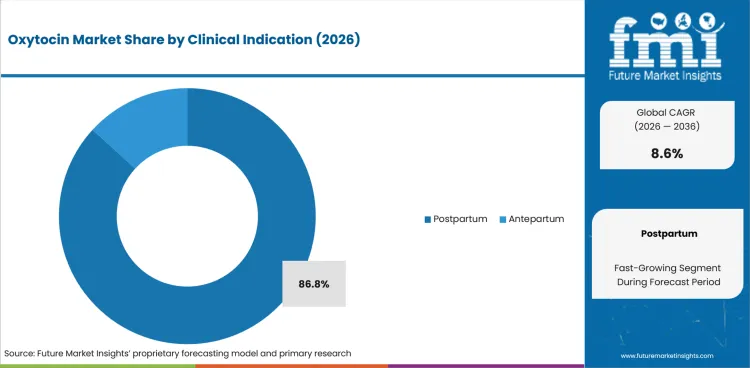
- Postpartum applications are expected to account for 86.8% share in 2026 since oxytocin is closely used after delivery. Hospitals keep it ready as postpartum bleeding can need quick clinical action.
- Antepartum use supports selected labor induction and labor reinforcement. This segment needs careful dosing under trained supervision.
Insights into Oxytocin Market by Distribution Channel
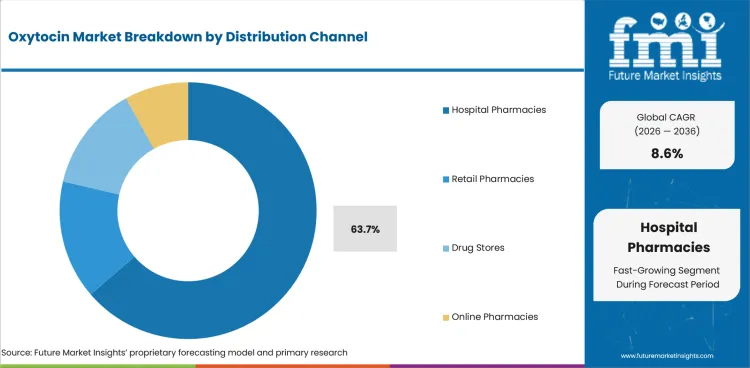
- Hospital pharmacies are forecast to hold 63.7% share in 2026 as maternity wards need controlled access to injectable oxytocin. Hospital supply teams also manage storage and emergency stock.
- Retail pharmacies serve limited demand in this market. Oxytocin use is mostly supervised by maternity care teams inside clinical settings.
Insights into Oxytocin Market by Dosage Form
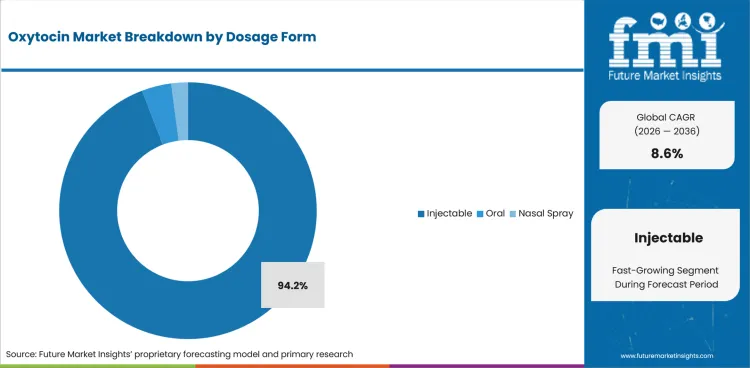
- Injectable products are expected to account for 94.2% share in 2026 due to rapid effect and dose control. Delivery teams need fast access during labor and after birth.
- Oral and nasal spray products serve a narrow use area. They do not replace hospital injectable use in urgent obstetric care.
Insights into Oxytocin Market by Healthcare Setting
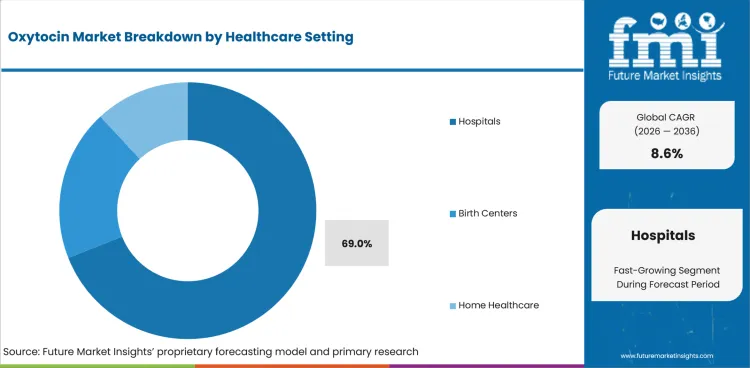
- Hospitals are anticipated to hold 69.0% share in 2026 since most oxytocin use happens during monitored childbirth care. Delivery rooms need medicine access with trained staff nearby.
- Birth centers use oxytocin under approved protocols. Home healthcare has a small role because administration needs professional supervision.
Insights into Oxytocin Market by Route of Administration
- Intravenous administration is forecast to hold 57.0% share in 2026 as it allows controlled dosing in monitored settings. This route fits labor support and postpartum care in hospitals.
- Intramuscular administration is used when rapid uterotonic support is needed and infusion setup is less practical. Nasal route demand stays limited due to narrower clinical use.
Oxytocin Market Drivers, Restraints, and Opportunities
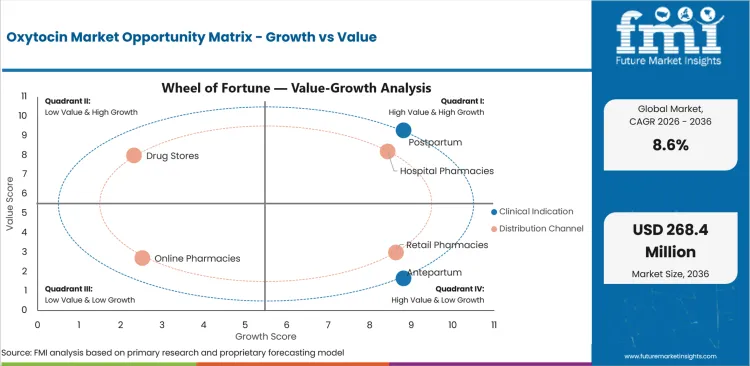
- Postpartum hemorrhage prevention keeps hospital demand active as guidelines keep oxytocin in delivery-room protocols.
- Storage sensitivity restrains supply planning because hospital pharmacies must protect injectable quality through handling controls.
- Protocol-led stock planning creates an opportunity for suppliers with reliable availability and clear product documentation.
Postpartum Hemorrhage Prevention Supports Hospital Demand
Postpartum bleeding prevention remains the main driver for oxytocin demand. WHO’s 2025 postpartum haemorrhage guideline recommends oxytocin 10 IU by intramuscular or intravenous route for prevention of postpartum haemorrhage for all births. This supports steady hospital purchasing because delivery teams need a reliable uterotonic medicine ready before complications begin. The main opportunity is safer use through protocol-based dosing and better pharmacy stock planning.
Handling Needs Constrain Channel Expansion
Storage and handling remain key restraints because oxytocin quality can weaken if supply systems are poor. Fresenius Kabi Canada’s official product information lists Oxytocin Injection, USP at 10 USP units/1 mL with a single-use vial presentation. Such product details show why hospitals need careful stock control and clear handling processes. Suppliers that can protect quality across distribution have a stronger position in public and private maternity channels.
Analysis of Oxytocin Market by Key Countries
.webp "Top Country Growth Comparison Oxytocin Market Cagr (2026 2036)")
| Country | CAGR |
|---|---|
| India | 10.1% |
| China | 9.4% |
| United Kingdom | 6.5% |
| United States | 3.2% |
| Germany | 2.8% |
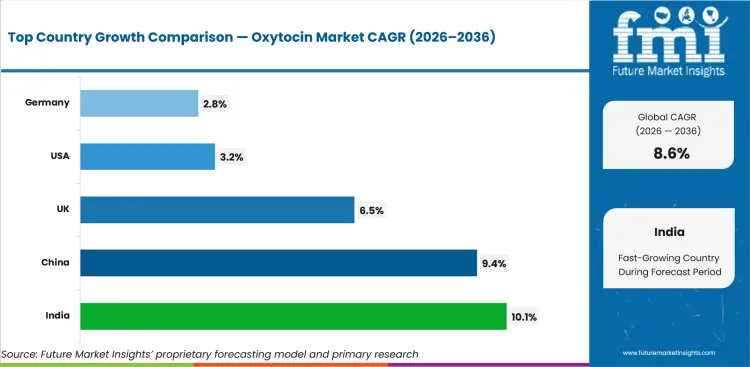
Source: Future Market Insights, 2026.
Demand Outlook for Oxytocin Market in India
Institutional childbirth access · 2026 to 2036
Country Market Snapshot Table
| Parameter | Value |
|---|---|
| Market Size in 2025 Value | USD 15.8 million |
| Market Forecast in 2036 Value | USD 45.2 million |
| CAGR 2026 to 2036 | 10.1% |
| Years Considered | 2021 to 2036 |
| Base Year | 2025 |
| Forecast Period | 2026 to 2036 |
| Units Considered | Value USD Million |
| Leading Sub-Region | High-birth-volume public hospital states |
India Oxytocin Market Outlook
India’s oxytocin demand is linked with hospital delivery and public maternal care programs. Institutional births create a clear need for uterotonic medicines in delivery rooms.
Public hospitals and district facilities need reliable supply for postpartum care. Suppliers must support quality and cold-chain handling to win hospital channels.
Key Growth Drivers
- Hospital delivery coverage supports oxytocin use in maternity wards. India reported institutional births at 89.0% nationally in the 2019 to 2021 survey period.
- Rural delivery access creates demand beyond large cities. India reported about 87.0% institutional delivery in rural areas.
- Urban maternity care strengthens hospital pharmacy demand. India reported 94.0% institutional delivery in urban areas.
- Domestic pharmaceutical manufacturing helps supply high-volume hospital demand. Local production can reduce dependence on imported uterotonic products.
Key Restraints
- Access is not equal across all states. India reported institutional delivery above 90.0% in 18.0 states and union territories.
- Cold-chain handling can be difficult outside major cities. Oxytocin supply can weaken where storage monitoring is poor.
- Misuse risk can create stricter control. Oxytocin requires careful medical supervision in childbirth care.
Key Companies
- Sun Pharmaceutical Industries Ltd.
- Pfizer Limited
- Zydus Lifesciences Ltd.
- Gland Pharma Ltd.
- Bharat Serums and Vaccines Ltd.
Sales and Marketing Channels
- Public hospital tenders
- Private maternity hospital procurement
- Injectable drug distributors
- Institutional pharmacy supply networks
Country Segment Breakdown Table
| Segment | Sub-Segments |
|---|---|
| By Clinical Indication | Postpartum · Antepartum |
| By Distribution Channel | Hospital Pharmacies · Retail Pharmacies · Drug Stores · Online Pharmacies |
| By Dosage Form | Injectable · Oral · Nasal Spray |
| By Healthcare Setting | Hospitals · Birth Centers · Home Healthcare |
| By Route of Administration | Intravenous · Intramuscular · Nasal |
| Key Sub-Regions Covered, States and Union Territories | Uttar Pradesh · Maharashtra · Bihar · West Bengal · Madhya Pradesh · Rajasthan · Tamil Nadu · Gujarat USA |
Market Taxonomy and Sub-Regions Covered
Frequently Asked Questions
How fast is India oxytocin market growing?
India is projected to record 10.1% CAGR from 2026 to 2036. Institutional delivery and maternal health access support the pace.
Who leads India oxytocin market?
Sun Pharmaceutical Industries Ltd. and Pfizer Limited are active suppliers. Zydus Lifesciences Ltd. and Gland Pharma Ltd. add injectable supply strength.
What is driving oxytocin use in India?
Hospital delivery coverage and postpartum bleeding care are the main drivers. Public maternity programs also support stable demand.
Demand Outlook for Oxytocin Market in China
Standardized maternity care expansion · 2026 to 2036
Country Market Snapshot Table
| Parameter | Value |
|---|---|
| Market Size in 2025 Value | USD 18.6 million |
| Market Forecast in 2036 Value | USD 50.0 million |
| CAGR 2026 to 2036 | 9.4% |
| Years Considered | 2021 to 2036 |
| Base Year | 2025 |
| Forecast Period | 2026 to 2036 |
| Units Considered | Value USD Million |
| Leading Sub-Region | Eastern hospital network |
China Oxytocin Market Outlook
China’s oxytocin demand is tied to hospital delivery systems and medicine quality control. Large maternity hospitals need steady access to injectable oxytocin.
Domestic pharmaceutical supply plays a strong role in public and private channels. Hospital buyers still require proven product quality and controlled distribution.
Key Growth Drivers
- Large birth volume supports maternity medicine demand. China recorded 9.54 million newborns in 2024.
- Birth recovery improves hospital planning for obstetric medicines. China recorded 520,000 more newborns in 2024 compared with 2023.
- Maternity care demand is supported by a wider birth-rate base. China reported a birth rate of 6.77 per 1,000 people in 2024.
- Public hospital purchasing creates structured buying channels. Approved suppliers can build repeat demand through stable supply.
Key Restraints
- Demographic pressure can limit long-term childbirth volume. China reported 10.93 million deaths in 2024.
- Regional quality differences can affect buyer trust. Hospitals may prefer suppliers with stronger quality records.
- Tender pricing can pressure margins. Lower prices may limit investment in packaging and distribution upgrades.
Key Companies
- China Resources Double-Crane Pharmaceutical Co. Ltd.
- Shanghai Hefeng Pharmaceutical Co. Ltd.
- Nanjing Xinbai Pharmaceutical Co. Ltd.
- Anhui Fengyuan Pharmaceutical Co. Ltd.
- Chengdu Tiantai Mount Pharmaceutical Co. Ltd.
Sales and Marketing Channels
- Public hospital procurement
- Provincial medicine tenders
- Obstetric drug distributors
- Private hospital supply networks
Country Segment Breakdown Table
| Segment | Sub-Segments |
|---|---|
| By Clinical Indication | Postpartum · Antepartum |
| By Distribution Channel | Hospital Pharmacies · Drug Stores · Retail Pharmacies · Online Pharmacies |
| By Dosage Form | Injectable · Oral · Nasal Spray |
| By Healthcare Setting | Hospitals · Birth Centers · Home Healthcare |
| By Route of Administration | Intravenous · Intramuscular · Nasal |
| Key Sub-Regions Covered, Provinces and Municipalities | Guangdong · Shandong · Henan · Sichuan · Jiangsu · Zhejiang · Shanghai · Beijing USA |
Market Taxonomy and Sub-Regions Covered
Frequently Asked Questions
How fast is China oxytocin market growing?
China is expected to expand at 9.4% CAGR from 2026 to 2036. Hospital procurement and maternal care protocols support demand.
Who leads China oxytocin market?
China Resources Double-Crane Pharmaceutical Co. Ltd. and Shanghai Hefeng Pharmaceutical Co. Ltd. are relevant domestic names. Other provincial suppliers serve hospital channels.
What is driving oxytocin use in China?
Hospital-based childbirth care and public procurement support oxytocin use. Quality-assured supply remains important for buyers.
Demand Outlook for Oxytocin Market in the United Kingdom
NHS maternity medicine access · 2026 to 2036
Country Market Snapshot Table
| Parameter | Value |
|---|---|
| Market Size in 2025 Value | USD 9.4 million |
| Market Forecast in 2036 Value | USD 19.3 million |
| CAGR 2026 to 2036 | 6.5% |
| Years Considered | 2021 to 2036 |
| Base Year | 2025 |
| Forecast Period | 2026 to 2036 |
| Units Considered | Value USD Million |
| Leading Sub-Region | England maternity hospital network |
United Kingdom Oxytocin Market Outlook
United Kingdom demand is mainly connected with NHS maternity care. Hospital pharmacies manage oxytocin stock for labor wards and postpartum care.
Clinical guidance and procurement discipline guide supplier selection. Buyers need products that fit controlled hospital use and clear documentation needs.
Key Growth Drivers
- Birth volume supports maternity medicine purchasing. England and Wales recorded 594,677 live births in 2024.
- Birth count improvement supports hospital supply planning. Live births increased by 3,605 in 2024 compared with 2023.
- Diverse maternity demand keeps hospital systems active. The proportion of live births to non-UK-born women increased to 33.9% in 2024.
- NHS procurement creates clear demand routes. Approved suppliers benefit when hospitals standardize maternity medicine supply.
Key Restraints
- Stillbirth monitoring keeps pressure on maternity care quality. England and Wales recorded a stillbirth rate of 3.9 per 1,000 births in 2024.
- Budget pressure can slow supplier switches. Hospitals may keep approved medicines unless supply risk appears.
- Strict clinical governance limits casual channel expansion. Oxytocin use stays centered on trained clinical teams.
Key Companies
- Pfizer Limited
- Fresenius Kabi Limited
- Hikma Pharmaceuticals PLC
- hameln pharma ltd
- ADVANZ PHARMA Corp. Limited
Sales and Marketing Channels
- NHS hospital pharmacy purchasing
- Private maternity hospital procurement
- Injectable medicine wholesalers
- Clinical supply frameworks
Country Segment Breakdown Table
| Segment | Sub-Segments |
|---|---|
| By Clinical Indication | Postpartum · Antepartum |
| By Distribution Channel | Hospital Pharmacies · Retail Pharmacies · Drug Stores · Online Pharmacies |
| By Dosage Form | Injectable · Oral · Nasal Spray |
| By Healthcare Setting | Hospitals · Birth Centers · Home Healthcare |
| By Route of Administration | Intravenous · Intramuscular · Nasal |
| Key Sub-Regions Covered, Nations and Regions | England · Wales · Scotland · Northern Ireland · London · West Midlands · North West · South East USA |
Market Taxonomy and Sub-Regions Covered
Frequently Asked Questions
How fast is the United Kingdom oxytocin market growing?
The United Kingdom is forecast to post 6.5% CAGR from 2026 to 2036. NHS maternity services keep demand structured.
Who leads the United Kingdom oxytocin market?
Pfizer Limited and Fresenius Kabi Limited are relevant hospital medicine suppliers. Hikma Pharmaceuticals PLC also has strong injectable medicine depth.
What is driving oxytocin use in the United Kingdom?
Hospital childbirth care and NHS maternity protocols guide oxytocin use. Pharmacy-led supply control keeps demand centered on hospitals.
Demand Outlook for Oxytocin Market in the United States
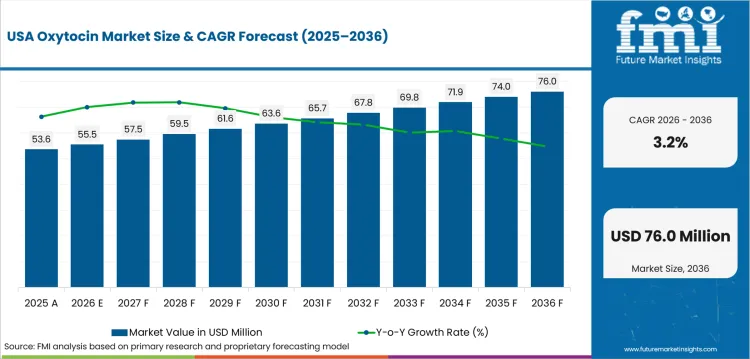
Hospital protocol-based childbirth care · 2026 to 2036
Country Market Snapshot Table
| Parameter | Value |
|---|---|
| Market Size in 2025 Value | USD 24.0 million |
| Market Forecast in 2036 Value | USD 33.9 million |
| CAGR 2026 to 2036 | 3.2% |
| Years Considered | 2021 to 2036 |
| Base Year | 2025 |
| Forecast Period | 2026 to 2036 |
| Units Considered | Value USD Million |
| Leading Sub-Region | Large hospital delivery networks |
United States Oxytocin Market Outlook
USA demand is centered on hospitals and labor delivery units. Oxytocin is purchased through controlled pharmacy channels because it is used under clinical supervision.
Hospital teams need reliable injectable supply and clear product labeling. Drug availability planning is important because maternity wards cannot risk shortages during delivery care.
Key Growth Drivers
- Hospital birth volume keeps oxytocin in regular purchasing. The United States registered 3,628,934 births in 2024.
- Surgical deliveries increase monitored maternity drug needs. The USA cesarean delivery rate was 32.4% in 2024.
- Public payer involvement supports structured delivery care.
- Electronic medication systems improve dosing documentation. Better tracking supports safer use in labor care.
Key Restraints
- Maternal risk rises sharply with older age. The USA maternal mortality rate for women aged 40 and older was 62.3 deaths per 100,000 live births in 2024.
- Drug shortages can disrupt hospital planning. Supply allocation can push pharmacies to manage inventory carefully.
- Strict labeling and handling rules raise compliance needs. Hospital pharmacies need staff training and storage checks.
Key Companies
- Fresenius Kabi USA LLC
- Pfizer Inc.
- Hikma Pharmaceuticals PLC
- Par Pharmaceutical
- Teva Pharmaceuticals USA, Inc.
Sales and Marketing Channels
- Hospital pharmacy contracts
- Group purchasing organizations
- Injectable medicine distributors
- Health system supply teams
Country Segment Breakdown Table
| Segment | Sub-Segments |
|---|---|
| By Clinical Indication | Postpartum · Antepartum |
| By Distribution Channel | Hospital Pharmacies · Retail Pharmacies · Online Pharmacies · Drug Stores |
| By Dosage Form | Injectable · Oral · Nasal Spray |
| By Healthcare Setting | Hospitals · Birth Centers · Home Healthcare |
| By Route of Administration | Intravenous · Intramuscular · Nasal |
| Key Sub-Regions Covered, States and Regions | California · Texas · Florida · New York · Illinois · Pennsylvania · Ohio · Southeast hospital corridor USA |
Market Taxonomy and Sub-Regions Covered
Frequently Asked Questions
How fast is the United States oxytocin market growing?
The United States market is forecast to expand at 3.2% CAGR from 2026 to 2036. Hospital protocol use supports steady demand.
Who leads the United States oxytocin market?
Fresenius Kabi USA LLC and Pfizer Inc. are important names. Hikma Pharmaceuticals PLC and Par Pharmaceutical also serve injectable channels.
What is driving oxytocin use in the United States?
Hospital childbirth protocols and postpartum bleeding prevention drive demand. Reliable injectable supply is a key buyer need.
Demand Outlook for Oxytocin Market in Germany
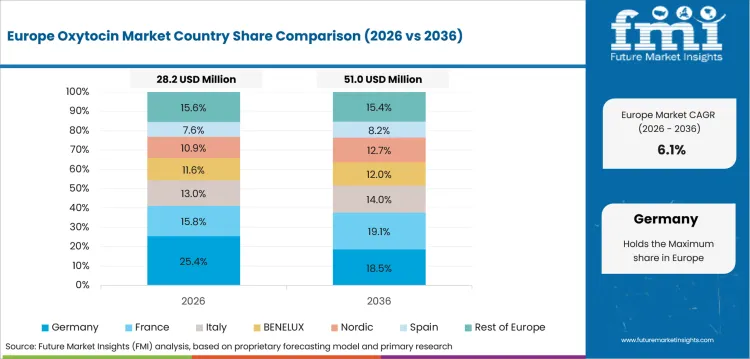
Controlled hospital maternity supply · 2026 to 2036
Country Market Snapshot Table
| Parameter | Value |
|---|---|
| Market Size in 2025 Value | USD 8.0 million |
| Market Forecast in 2036 Value | USD 10.9 million |
| CAGR 2026 to 2036 | 2.8% |
| Years Considered | 2021 to 2036 |
| Base Year | 2025 |
| Forecast Period | 2026 to 2036 |
| Units Considered | Value USD Million |
| Leading Sub-Region | Hospital networks in western and southern Germany |
Germany Oxytocin Market Outlook
Germany’s demand comes from mature hospital maternity care. Oxytocin use is steady because hospitals follow controlled obstetric medicine practices.
Suppliers must meet strong quality and documentation standards. Hospital pharmacies need dependable supply and clear product handling information.
Key Growth Drivers
- Hospital demand is supported by national childbirth volume. Germany recorded 677,117 live births in 2024.
- Maternity care planning follows a clear population base. Germany reported 8.1 live births per 1,000 residents in 2024.
- Fertility trends keep obstetric care under policy attention. Germany’s total fertility rate was 1.35 children per woman in 2024.
- Hospital pharmacies prefer known injectable suppliers. Product continuity helps reduce switching risk in labor wards.
Key Restraints
- Aging population pressure can limit long-term birth volume. Germany recorded 1,007,758 deaths in 2024.
- Strict documentation can slow supplier changes. Hospitals need product evidence before switching injectable medicines.
- Established maternity systems limit fast expansion. Most demand is replacement-style hospital purchasing.
Key Companies
- Fresenius Kabi Deutschland GmbH
- Pfizer Pharma GmbH
- Hikma Pharma GmbH
- hameln pharma gmbh
- Ferring Arzneimittel GmbH
Sales and Marketing Channels
- Hospital pharmacy procurement
- Injectable medicine wholesalers
- Public hospital purchasing groups
- Private maternity clinic supply
Country Segment Breakdown Table
| Segment | Sub-Segments |
|---|---|
| By Clinical Indication | Postpartum · Antepartum |
| By Distribution Channel | Hospital Pharmacies · Retail Pharmacies · Drug Stores · Online Pharmacies |
| By Dosage Form | Injectable · Oral · Nasal Spray |
| By Healthcare Setting | Hospitals · Birth Centers · Home Healthcare |
| By Route of Administration | Intravenous · Intramuscular · Nasal |
| Key Sub-Regions Covered, Federal States | North Rhine-Westphalia · Bavaria · Baden-Württemberg · Lower Saxony · Hesse · Saxony · Berlin · Hamburg |
Market Taxonomy and Sub-Regions Covered
Frequently Asked Questions
How fast is Germany oxytocin market growing?
Germany is forecast at 2.8% CAGR from 2026 to 2036. Mature hospital systems maintain controlled demand.
Who leads Germany oxytocin market?
Fresenius Kabi Deutschland GmbH and Pfizer Pharma GmbH are relevant suppliers. Hikma Pharma GmbH and hameln pharma gmbh also support injectable medicine channels.
What is driving oxytocin use in Germany?
Hospital-based maternity care and strict pharmacy control guide demand. Buyers value reliable supply and clear quality documentation.
Competitive Landscape and Strategic Positioning
- Injectable quality decides supplier preference because oxytocin is used in time-sensitive childbirth care.
- Hospital pharmacies prefer suppliers that can keep products available without supply gaps.
- Clear labels and storage instructions help care teams handle oxytocin safely before use.
- New entrants face strict approval needs because sterile injectable manufacturing requires controlled production and strong quality checks.
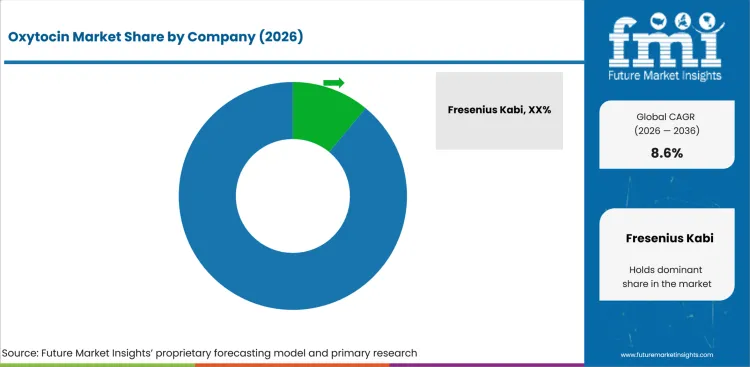
Oxytocin competition is based on hospital access and reliable injectable supply. Fresenius Kabi and Pfizer have strong roles through hospital medicine portfolios. Hikma Pharmaceuticals PLC and Par Pharmaceutical support USA injectable channels. Ferring B.V. is relevant in uterotonic care through maternal health products. Buyers choose suppliers that can deliver consistent quality and protect stock availability.
Supply reliability is important because oxytocin is used in time-sensitive childbirth care. Hospital pharmacies need products that arrive on schedule and meet storage rules. Manufacturers with sterile injectable capacity can serve large institutional orders. Companies with maternity health portfolios can support wider obstetric care pathways. Price matters, but product availability often decides repeat buying.
Key Companies in the Oxytocin Market
- Injectable Medicine Suppliers: Fresenius Kabi and Pfizer hold strong positions through hospital injectable portfolios and oxytocin product availability.
- Generic Pharmaceutical Suppliers: Hikma Pharmaceuticals PLC and Par Pharmaceutical support demand through sterile and generic medicine channels.
- Maternal Health Specialists: Ferring B.V. supports uterotonic care through maternal health products and hospital relationships.
- Regional Suppliers: Sun Pharmaceutical Industries Ltd. and Yuhan Corporation support country-level demand through broad pharmaceutical supply networks.
Competitive Benchmarking: Oxytocin Market
| Company | Injectable Supply Depth | Hospital Channel Access | Maternal Care Fit | Geographic Footprint |
|---|---|---|---|---|
| Fresenius Kabi | High | High | High | Global with North America and Europe strength |
| Pfizer Inc. | High | High | High | Global |
| Hikma Pharmaceuticals PLC | High | Medium | Medium | United States, Europe and MENA strength |
| Ferring B.V. | Medium | High | High | Global with maternal health depth |
| Par Pharmaceutical | Medium | Medium | Medium | United States hospital channel |
| Sun Pharmaceutical Industries Ltd. | Medium | Medium | Medium | India-centered with global reach |
| Yuhan Corporation | Medium | Medium | Medium | South Korea-centered with export reach |
Source: Future Market Insights competitive analysis, 2026.
Key Developments in Oxytocin Market
- In October 2025, WHO published consolidated guidelines for prevention, diagnosis and treatment of postpartum haemorrhage. The guideline keeps oxytocin central in postpartum haemorrhage prevention and gives health systems a clearer care pathway.
- In June 2024, Fresenius Kabi Canada issued an availability notice for Oxytocin Injection, USP Synthetic 10 USP units/mL MD Vial 10 mL. The company said the product would be available at all distribution centres by June 19, 2024.
Key Players in the Oxytocin Market
Major Global Players
- Fresenius Kabi
- Pfizer Inc.
- Hikma Pharmaceuticals PLC
- Ferring B.V.
- Par Pharmaceutical
Specialist and Regional Players
- Sun Pharmaceutical Industries Ltd.
- Yuhan Corporation
- Gland Pharma Ltd.
- Bharat Serums and Vaccines Ltd.
Oxytocin Market - Report Scope
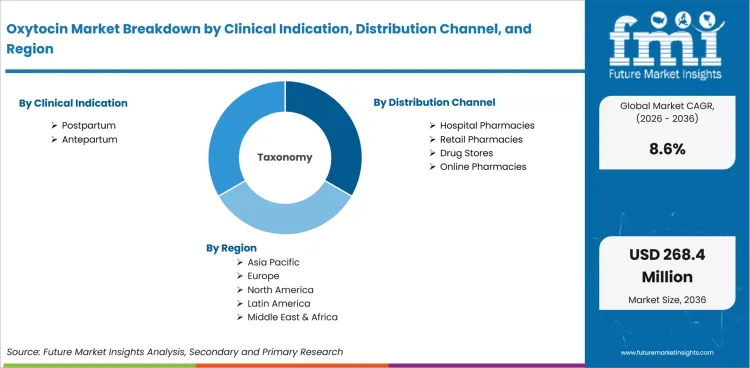
| Parameter | Details |
|---|---|
| Market size by 2036 | USD 268.4 million |
| Growth rate | 8.6% CAGR from 2026 to 2036 |
| Forecast period | 2026 to 2036 |
| Base year value | USD 117.1 million in 2026 |
| By clinical indication | Antepartum, Postpartum |
| By distribution channel | Hospital Pharmacies, Retail Pharmacies, Drug Stores, Online Pharmacies |
| By dosage form | Injectable, Oral, Nasal Spray |
| By healthcare setting | Hospitals, Birth Centers, Home Healthcare |
| By route of administration | Intravenous, Intramuscular, Nasal |
| Regions covered | North America, Latin America, Western Europe, Eastern Europe, East Asia, South Asia and Pacific, Middle East and Africa |
| Countries covered | India, China, United Kingdom, United States, Germany, Brazil, Japan, South Africa, 30 plus countries |
| Key companies profiled | Fresenius Kabi, Pfizer Inc., Hikma Pharmaceuticals PLC, Ferring B.V., Par Pharmaceutical, Sun Pharmaceutical Industries Ltd., Yuhan Corporation |
| Approach | Hybrid bottom-up and top-down methodology starting with childbirth care demand, hospital pharmacy use, dosage form mix, and country-level maternal health access trends. |
Source: Future Market Insights, 2026.
Oxytocin Market Breakdown by Clinical Indication, Distribution Channel, Dosage Form, Healthcare Setting, Route of Administration and Region
Oxytocin Market Segmented by Clinical Indication
- Antepartum
- Postpartum
Oxytocin Market Segmented by Distribution Channel
- Hospital Pharmacies
- Retail Pharmacies
- Drug Stores
- Online Pharmacies
Oxytocin Market Segmented by Dosage Form
- Injectable
- Oral
- Nasal Spray
Oxytocin Market Segmented by Healthcare Setting
- Hospitals
- Birth Centers
- Home Healthcare
Oxytocin Market Segmented by Route of Administration
- Intravenous
- Intramuscular
- Nasal
Oxytocin Market by Region
- North America
- Latin America
- Western Europe
- Eastern Europe
- East Asia
- South Asia and Pacific
- Middle East and Africa
Research Sources and Bibliography
- National Center for Health Statistics. (2026). NVSS birth data: Data for United States in 2024. Centers for Disease Control and Prevention.
- Centers for Disease Control and Prevention. (2026, March 4). Maternal mortality rates in the United States, 2024. National Center for Health Statistics.
- Federal Statistical Office of Germany. (2025, July 17). Births. Destatis.
- Federal Statistical Office of Germany. (2025). Live births and deaths: Germany.
- Fresenius Kabi Canada. (2024, June 13). Oxytocin Injection, USP Synthetic 10 USP units/mL MD Vial 10 mL availability notice.
- Government of China. (2025, January 17). China’s newborns rise in 2024, first time in years. The State Council of the People’s Republic of China.
- Government of India. (2025, March 21). India’s success in reducing maternal mortality. Press Information Bureau.
- Office for National Statistics. (2025, July 1). Births in England and Wales: 2024.
- United Nations Children’s Fund. (2024, November). Delivery care. UNICEF Data.
- World Health Organization. (2025). Consolidated guidelines for the prevention, diagnosis and treatment of postpartum haemorrhage. World Health Organization.
This Report Answers
- What is the current and future value of the oxytocin market from 2026 to 2036?
- What CAGR is expected for oxytocin demand during the forecast period?
- Which clinical indication is expected to hold the leading share in 2026?
- Which distribution channel is expected to hold a strong share in 2026?
- Which dosage form is expected to hold the leading share in 2026?
- What factors drive oxytocin use in postpartum care?
- How do storage needs affect oxytocin supply?
- Which countries are expected to advance faster in the oxytocin market?
- Which companies are active in oxytocin and uterotonic medicine supply?
- What forecasting approach was used to estimate oxytocin demand from 2026 to 2036?
Frequently Asked Questions
What is the value of the oxytocin market in 2026?
The oxytocin market is expected to reach USD 117.1 million in 2026.
What is the forecast value of the market by 2036?
The market is forecast to reach USD 268.4 million by 2036.
What CAGR is expected during the forecast period?
Demand is expected to expand at 8.6% CAGR from 2026 to 2036.
Which clinical indication is expected to hold the leading share?
Postpartum applications are expected to account for 86.8% share in 2026.
Which distribution channel is expected to lead?
Hospital pharmacies are expected to hold 63.7% share in 2026.
Which dosage form leads the market?
Injectable products are expected to account for 94.2% share in 2026.
Which country is expected to grow fastest?
India is projected to record 10.1% CAGR through 2036.
Which companies are active in the oxytocin market?
Fresenius Kabi, Pfizer Inc., Hikma Pharmaceuticals PLC, Ferring B.V. and Par Pharmaceutical are active names in the oxytocin and uterotonic supply space.
What does the oxytocin market include?
The market includes prescription oxytocin products used in antepartum and postpartum care across hospitals, birth centers and pharmacy channels.
Why do hospital pharmacies lead distribution?
Hospital pharmacies lead because oxytocin is mainly used under medical supervision during childbirth care.
Preview the report firsthand - request a free sample
Get SampleGet the brochure for pricing and purchase details.
Get PDFTable of Content
- Key Takeaways
- Market Size and CAGR
- Top Growth Driver
- Fastest Growing Segment
- Leading Region
- Key Companies
- Emerging Opportunities
- Executive Summary
- Global Market Outlook
- Demand-side Trends
- Supply-side Trends
- Technology Roadmap Analysis
- Analysis and Recommendations
- Analyst Perspective (What is happening? Why now? What should investors know?)
- Key Questions Answered
- How large is the market?
- What is the CAGR?
- What are key trends?
- Which region dominates?
- Who are the leaders?
- Market Overview
- Market Coverage / Taxonomy
- Market Definition / Scope / Limitations
- Research Methodology
- Chapter Orientation
- Analytical Lens and Working Hypotheses
- Market Structure, Signals, and Trend Drivers
- Benchmarking and Cross-market Comparability
- Market Sizing, Forecasting, and Opportunity Mapping
- Research Design and Evidence Framework
- Desk Research Programme (Secondary Evidence)
- Expert Input and Fieldwork (Primary Evidence)
- Tooling, Models, and Reference Databases
- Data Engineering and Model Build
- Quality Assurance and Audit Trail
- Market Background
- Market Dynamics (Drivers, Restraints, Opportunity, Trends)
- Scenario Forecast (Optimistic, Likely, Conservative)
- Impact Analysis
- AI Impact
- Sustainability Impact
- Regulatory Impact
- Technology Impact
- Consumer / Buyer Analysis
- Purchase Drivers
- Adoption Barriers
- Buyer Journey
- Opportunity Map Analysis
- Product Life Cycle Analysis
- Supply Chain Analysis
- Investment Feasibility Matrix
- Value Chain Analysis
- PESTLE and Porter's Analysis
- Regulatory Landscape
- Regional Parent Market Outlook
- Production and Consumption Statistics
- Import and Export Statistics
- Global Market Analysis and Forecast, 2021 to 2036
- Historical Market Size Value (USD Million) Analysis, 2021 to 2025
- Current and Future Market Size Value (USD Million) Projections, 2026 to 2036
- Y-o-Y Growth Trend Analysis
- Absolute $ Opportunity Analysis
- Global Market Pricing Analysis, 2021 to 2036
- Global Market Analysis and Forecast, By Clinical Indication, 2021 to 2036
- Introduction / Key Findings
- Historical Market Size Value (USD Million) Analysis By Clinical Indication, 2021 to 2025
- Current and Future Market Size Value (USD Million) Analysis and Forecast By Clinical Indication, 2026 to 2036
- Postpartum
- Antepartum
- Postpartum
- Y-o-Y Growth Trend Analysis By Clinical Indication, 2021 to 2025
- Absolute $ Opportunity Analysis By Clinical Indication, 2026 to 2036
- Global Market Analysis and Forecast, By Distribution Channel, 2021 to 2036
- Introduction / Key Findings
- Historical Market Size Value (USD Million) Analysis By Distribution Channel, 2021 to 2025
- Current and Future Market Size Value (USD Million) Analysis and Forecast By Distribution Channel, 2026 to 2036
- Hospital Pharmacies
- Retail Pharmacies
- Drug Stores
- Online Pharmacies
- Hospital Pharmacies
- Y-o-Y Growth Trend Analysis By Distribution Channel, 2021 to 2025
- Absolute $ Opportunity Analysis By Distribution Channel, 2026 to 2036
- Global Market Analysis and Forecast, By Dosage Form, 2021 to 2036
- Introduction / Key Findings
- Historical Market Size Value (USD Million) Analysis By Dosage Form, 2021 to 2025
- Current and Future Market Size Value (USD Million) Analysis and Forecast By Dosage Form, 2026 to 2036
- Injectable
- Oral
- Nasal Spray
- Injectable
- Y-o-Y Growth Trend Analysis By Dosage Form, 2021 to 2025
- Absolute $ Opportunity Analysis By Dosage Form, 2026 to 2036
- Global Market Analysis and Forecast, By Healthcare Setting, 2021 to 2036
- Introduction / Key Findings
- Historical Market Size Value (USD Million) Analysis By Healthcare Setting, 2021 to 2025
- Current and Future Market Size Value (USD Million) Analysis and Forecast By Healthcare Setting, 2026 to 2036
- Hospitals
- Birth Centers
- Home Healthcare
- Hospitals
- Y-o-Y Growth Trend Analysis By Healthcare Setting, 2021 to 2025
- Absolute $ Opportunity Analysis By Healthcare Setting, 2026 to 2036
- Global Market Analysis and Forecast, By Route of Administration, 2021 to 2036
- Introduction / Key Findings
- Historical Market Size Value (USD Million) Analysis By Route of Administration, 2021 to 2025
- Current and Future Market Size Value (USD Million) Analysis and Forecast By Route of Administration, 2026 to 2036
- Intravenous
- Intramuscular
- Nasal
- Intravenous
- Y-o-Y Growth Trend Analysis By Route of Administration, 2021 to 2025
- Absolute $ Opportunity Analysis By Route of Administration, 2026 to 2036
- Global Market Analysis and Forecast, By Region, 2021 to 2036
- Introduction
- Historical Market Size Value (USD Million) Analysis By Region, 2021 to 2025
- Current Market Size Value (USD Million) Analysis and Forecast By Region, 2026 to 2036
- North America
- Latin America
- Western Europe
- Eastern Europe
- East Asia
- South Asia and Pacific
- Middle East & Africa
- Market Attractiveness Analysis By Region
- North America Market Analysis and Forecast, By Country, 2021 to 2036
- Historical Market Size Value (USD Million) Trend Analysis By Market Taxonomy, 2021 to 2025
- Market Size Value (USD Million) Forecast By Market Taxonomy, 2026 to 2036
- By Country
- USA
- Canada
- By Clinical Indication
- By Distribution Channel
- By Dosage Form
- By Healthcare Setting
- By Route of Administration
- By Country
- Market Attractiveness Analysis
- By Country
- By Clinical Indication
- By Distribution Channel
- By Dosage Form
- By Healthcare Setting
- By Route of Administration
- Key Takeaways
- Latin America Market Analysis and Forecast, By Country
- Historical Market Size Value (USD Million) Trend Analysis By Market Taxonomy, 2021 to 2025
- Market Size Value (USD Million) Forecast By Market Taxonomy, 2026 to 2036
- By Country
- Brazil
- Mexico
- Chile
- Rest of Latin America
- By Clinical Indication
- By Distribution Channel
- By Dosage Form
- By Healthcare Setting
- By Route of Administration
- By Country
- Market Attractiveness Analysis
- By Country
- By Clinical Indication
- By Distribution Channel
- By Dosage Form
- By Healthcare Setting
- By Route of Administration
- Key Takeaways
- Western Europe Market Analysis and Forecast, By Country
- Historical Market Size Value (USD Million) Trend Analysis By Market Taxonomy, 2021 to 2025
- Market Size Value (USD Million) Forecast By Market Taxonomy, 2026 to 2036
- By Country
- Germany
- UK
- Italy
- Spain
- France
- Nordic
- BENELUX
- Rest of Western Europe
- By Clinical Indication
- By Distribution Channel
- By Dosage Form
- By Healthcare Setting
- By Route of Administration
- By Country
- Market Attractiveness Analysis
- By Country
- By Clinical Indication
- By Distribution Channel
- By Dosage Form
- By Healthcare Setting
- By Route of Administration
- Key Takeaways
- Eastern Europe Market Analysis and Forecast, By Country
- Historical Market Size Value (USD Million) Trend Analysis By Market Taxonomy, 2021 to 2025
- Market Size Value (USD Million) Forecast By Market Taxonomy, 2026 to 2036
- By Country
- Russia
- Poland
- Hungary
- Balkan & Baltic
- Rest of Eastern Europe
- By Clinical Indication
- By Distribution Channel
- By Dosage Form
- By Healthcare Setting
- By Route of Administration
- By Country
- Market Attractiveness Analysis
- By Country
- By Clinical Indication
- By Distribution Channel
- By Dosage Form
- By Healthcare Setting
- By Route of Administration
- Key Takeaways
- East Asia Market Analysis and Forecast, By Country
- Historical Market Size Value (USD Million) Trend Analysis By Market Taxonomy, 2021 to 2025
- Market Size Value (USD Million) Forecast By Market Taxonomy, 2026 to 2036
- By Country
- China
- Japan
- South Korea
- By Clinical Indication
- By Distribution Channel
- By Dosage Form
- By Healthcare Setting
- By Route of Administration
- By Country
- Market Attractiveness Analysis
- By Country
- By Clinical Indication
- By Distribution Channel
- By Dosage Form
- By Healthcare Setting
- By Route of Administration
- Key Takeaways
- South Asia and Pacific Market Analysis and Forecast, By Country
- Historical Market Size Value (USD Million) Trend Analysis By Market Taxonomy, 2021 to 2025
- Market Size Value (USD Million) Forecast By Market Taxonomy, 2026 to 2036
- By Country
- India
- ASEAN
- Australia & New Zealand
- Rest of South Asia and Pacific
- By Clinical Indication
- By Distribution Channel
- By Dosage Form
- By Healthcare Setting
- By Route of Administration
- By Country
- Market Attractiveness Analysis
- By Country
- By Clinical Indication
- By Distribution Channel
- By Dosage Form
- By Healthcare Setting
- By Route of Administration
- Key Takeaways
- Middle East & Africa Market Analysis and Forecast, By Country
- Historical Market Size Value (USD Million) Trend Analysis By Market Taxonomy, 2021 to 2025
- Market Size Value (USD Million) Forecast By Market Taxonomy, 2026 to 2036
- By Country
- Kingdom of Saudi Arabia
- Other GCC Countries
- Türkiye
- South Africa
- Other African Union
- Rest of Middle East & Africa
- By Clinical Indication
- By Distribution Channel
- By Dosage Form
- By Healthcare Setting
- By Route of Administration
- By Country
- Market Attractiveness Analysis
- By Country
- By Clinical Indication
- By Distribution Channel
- By Dosage Form
- By Healthcare Setting
- By Route of Administration
- Key Takeaways
- Key Countries Market Analysis
- USA
- Pricing Analysis
- Market Share Analysis, 2025
- By Clinical Indication
- By Distribution Channel
- By Dosage Form
- By Healthcare Setting
- By Route of Administration
- Canada
- Pricing Analysis
- Market Share Analysis, 2025
- By Clinical Indication
- By Distribution Channel
- By Dosage Form
- By Healthcare Setting
- By Route of Administration
- Mexico
- Pricing Analysis
- Market Share Analysis, 2025
- By Clinical Indication
- By Distribution Channel
- By Dosage Form
- By Healthcare Setting
- By Route of Administration
- Brazil
- Pricing Analysis
- Market Share Analysis, 2025
- By Clinical Indication
- By Distribution Channel
- By Dosage Form
- By Healthcare Setting
- By Route of Administration
- Chile
- Pricing Analysis
- Market Share Analysis, 2025
- By Clinical Indication
- By Distribution Channel
- By Dosage Form
- By Healthcare Setting
- By Route of Administration
- Germany
- Pricing Analysis
- Market Share Analysis, 2025
- By Clinical Indication
- By Distribution Channel
- By Dosage Form
- By Healthcare Setting
- By Route of Administration
- UK
- Pricing Analysis
- Market Share Analysis, 2025
- By Clinical Indication
- By Distribution Channel
- By Dosage Form
- By Healthcare Setting
- By Route of Administration
- Italy
- Pricing Analysis
- Market Share Analysis, 2025
- By Clinical Indication
- By Distribution Channel
- By Dosage Form
- By Healthcare Setting
- By Route of Administration
- Spain
- Pricing Analysis
- Market Share Analysis, 2025
- By Clinical Indication
- By Distribution Channel
- By Dosage Form
- By Healthcare Setting
- By Route of Administration
- France
- Pricing Analysis
- Market Share Analysis, 2025
- By Clinical Indication
- By Distribution Channel
- By Dosage Form
- By Healthcare Setting
- By Route of Administration
- India
- Pricing Analysis
- Market Share Analysis, 2025
- By Clinical Indication
- By Distribution Channel
- By Dosage Form
- By Healthcare Setting
- By Route of Administration
- ASEAN
- Pricing Analysis
- Market Share Analysis, 2025
- By Clinical Indication
- By Distribution Channel
- By Dosage Form
- By Healthcare Setting
- By Route of Administration
- Australia & New Zealand
- Pricing Analysis
- Market Share Analysis, 2025
- By Clinical Indication
- By Distribution Channel
- By Dosage Form
- By Healthcare Setting
- By Route of Administration
- China
- Pricing Analysis
- Market Share Analysis, 2025
- By Clinical Indication
- By Distribution Channel
- By Dosage Form
- By Healthcare Setting
- By Route of Administration
- Japan
- Pricing Analysis
- Market Share Analysis, 2025
- By Clinical Indication
- By Distribution Channel
- By Dosage Form
- By Healthcare Setting
- By Route of Administration
- South Korea
- Pricing Analysis
- Market Share Analysis, 2025
- By Clinical Indication
- By Distribution Channel
- By Dosage Form
- By Healthcare Setting
- By Route of Administration
- Russia
- Pricing Analysis
- Market Share Analysis, 2025
- By Clinical Indication
- By Distribution Channel
- By Dosage Form
- By Healthcare Setting
- By Route of Administration
- Poland
- Pricing Analysis
- Market Share Analysis, 2025
- By Clinical Indication
- By Distribution Channel
- By Dosage Form
- By Healthcare Setting
- By Route of Administration
- Hungary
- Pricing Analysis
- Market Share Analysis, 2025
- By Clinical Indication
- By Distribution Channel
- By Dosage Form
- By Healthcare Setting
- By Route of Administration
- Kingdom of Saudi Arabia
- Pricing Analysis
- Market Share Analysis, 2025
- By Clinical Indication
- By Distribution Channel
- By Dosage Form
- By Healthcare Setting
- By Route of Administration
- Türkiye
- Pricing Analysis
- Market Share Analysis, 2025
- By Clinical Indication
- By Distribution Channel
- By Dosage Form
- By Healthcare Setting
- By Route of Administration
- South Africa
- Pricing Analysis
- Market Share Analysis, 2025
- By Clinical Indication
- By Distribution Channel
- By Dosage Form
- By Healthcare Setting
- By Route of Administration
- USA
- Market Structure Analysis
- Competition Dashboard
- Competition Benchmarking
- Market Share Analysis of Top Players
- By Regional
- By Clinical Indication
- By Distribution Channel
- By Dosage Form
- By Healthcare Setting
- By Route of Administration
- Emerging Startups
- Innovation Benchmarking
- Competition Analysis
- Competition Deep Dive
- Fresenius Kabi
- Overview
- Product Portfolio
- Profitability by Market Segments
- Sales Footprint
- Strategy Overview
- Marketing Strategy
- Product Strategy
- Channel Strategy
- Pfizer Inc.
- Hikma Pharmaceuticals PLC
- Ferring B.V.
- Par Pharmaceutical
- Sun Pharmaceutical Industries Ltd.
- Yuhan Corporation
- Gland Pharma Ltd.
- Bharat Serums and Vaccines Ltd.
- Fresenius Kabi
- Case Studies
- Success Stories
- Recent Developments
- Competition Deep Dive
- Assumptions & Acronyms Used


