

- Industry Size (2026)
- USD 1.3 Bn
- Forecast (2036)
- USD 2.2 Bn
- CAGR (2026 to 2036)
- 5.2%
Perforating Guns Market Forecast and Outlook By FMI
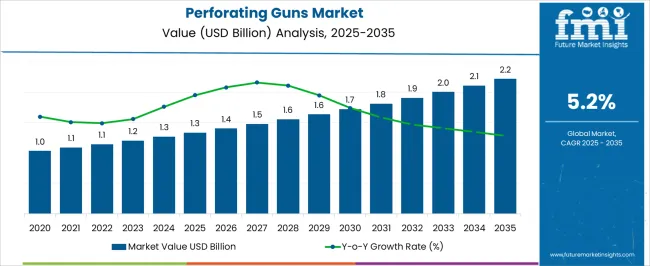
In 2025, the global perforating guns market was valued at USD 1.3 billion. Based on Future Market Insights' analysis, demand for perforating guns is estimated to grow to USD 1.4 billion in 2026 and is projected to reach between USD 2.3 billion by 2036. FMI projects a CAGR of 5.1% during the forecast period.
Absolute dollar growth of over USD 1.0 billion over the decade signals steady expansion driven by complex well completion requirements and mature field re-perforation rather than transformational growth. Despite oil price volatility and supply chain challenges, major perforating gun manufacturers sustain profitability through technology differentiation in high-pressure, high-temperature (HPHT) systems and integrated service offerings.
As Jeff Miller, Chairman, President, and CEO of Halliburton, noted regarding the company’s leadership in autonomous operations, “I am excited by the strong adoption of our groundbreaking technologies. We achieved the world's first closed-loop, autonomous fracturing operation. I believe this unlocks the next big step in unconventionals.” [1]
Summary of Perforating Guns Market
- Perforating Guns Market Definition:
- The industry covers downhole explosive tools used to create reservoir-to-wellbore flow paths through shaped charge detonation, critical for well completion and production optimization.
- Demand Drivers in the Market:
- Horizontal and multi-stage completions require multiple precisely placed perforating intervals.
- Mature field re-perforation optimizes production from existing wells.
- Deepwater and HPHT developments demand robust, high-performance systems.
- Key Segments Analyzed in the FMI Report:
- Gun Type: Tubing conveyed perforating leads with 42.3% share.
- Depth: 3,000–8,000 ft dominates at 42.5% share.
- Well Type: Horizontal wells command 57.1% share.
- Analyst Opinion at FMI:
- Nikhil Kaitwade, Principal Consultant for Industrial Automation at Future Market Insights, opines, "In the updated version of the Perforating Guns Market Report for 2026 to 2036, completion strategists and procurement directors will find insights into how instrumented guns with real-time telemetry are reducing uncertainty in multi-stage fracturing and how tariff-driven supply chain shifts are reshaping sourcing strategies. Besides this, my findings point at safety risks associated with explosive handling driving adoption of preloaded logistics and the emergence of geothermal applications as a new addressable market."
- Strategic Implications/Executive Takeaways:
- Shift focus from standalone tool sales to integrated perforating-fracturing systems.
- Treat digital integration and real-time diagnostics as competitive differentiators.
- Prioritize modular, retrievable systems for operational flexibility and cost efficiency.
- Methodology:
- Validated through rig count data and well completion statistics.
- Zero reliance on speculative third-party market research reports.
- Based on verifiable upstream investment data and operator procurement records.
China (6.8% projected) and India (6.5% projected) drive new opportunities through expanding upstream investments and favorable government policies. The United States maintains market leadership with extensive unconventional activity, while Middle East and Africa regions contribute through deepwater and HPHT developments.
Perforating Guns Market Definition
Perforating guns are critical downhole completion tools designed to create flow paths between the reservoir and production tubing through mechanically and energetically generated entry points. These tools utilize shaped explosive charges that, upon detonation, create holes or tunnels through casing, cement, and formation rock, allowing reservoir fluids to flow into the wellbore.
Their design, metallurgy, and deployment method determine run reliability, hole size and depth, and ultimately the efficiency of stimulation operations. Perforating systems have evolved from single-use explosive carriers toward modular, retrievable, and precision-positioned systems that integrate with various conveyance methods including wireline, coiled tubing, and tubing-conveyed perforating (TCP).
Perforating Guns Market Inclusions
The report includes a comprehensive analysis of market dynamics, featuring Global and Regional Market Sizes (Volume and Value) and a 10-year Forecast (2026-2036). It covers segmental breakdowns by gun type (Tubing Conveyed Perforating, Through Tubing Hollow Carrier, Through Tubing Exposed, Wireline Conveyed Casing), depth (Below 3,000 ft, 3,000-8,000 ft, Above 8,000 ft), well type (Horizontal, Vertical), well pressure (High Pressure, Low Pressure), and geographic regions.
Perforating Guns Market Exclusions
The scope excludes standard completion equipment not related to perforating operations, non-explosive perforating technologies, and general oilfield drilling equipment. It also omits post-perforating well stimulation services and production logging tools, focusing strictly on perforating gun systems and their immediate deployment components.
Perforating Guns Market Research Methodology
- Primary Research: Interviews were conducted with completion engineers, perforating gun manufacturers, oilfield service company procurement managers, and well intervention specialists across major regions. Explosives experts clarified shaped charge design and safety protocols.
- Desk Research: Drilling activity reports, offshore project databases, and corporate financial filings supported volume benchmarking.
- Market-Sizing and Forecasting: A hybrid top-down and bottom-up model was developed. Demand was reconstructed from rig count data, well completion statistics, and perforating gun consumption patterns per well stage, then validated against manufacturer shipment records and service company procurement data.
- Data Validation and Update Cycle: Outputs undergo anomaly screening, variance checks across production and trade datasets, and structured peer review prior to release.
Segmental Analysis
Perforating Guns Market Analysis by Gun Type
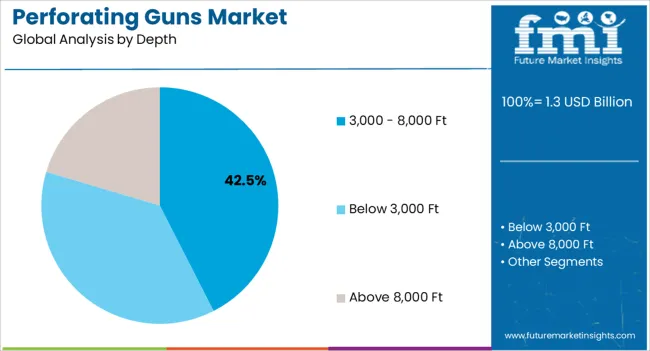
Based on FMI’s perforating guns market report, consumption of tubing conveyed perforating (TCP) systems is estimated to hold 42.3% share in 2026. Growth in demand for TCP is driven by its ability to perforate extended intervals in a single trip and its operational superiority in high-angle and horizontal wellbores where conventional wireline-conveyed systems face deployment constraints.
- System Integration Innovation: Hunting PLC introduced the H-3 Perforating System as a plug-and-play gun integrating ControlFire® Recon switch technology directly into the charge tube assembly, stating that it assures “all components are in place and in working order when running in hole.” [2]
- Real-Time Measurement Advancement: SLB highlighted digital integration in perforating, noting that the Tempo instrumented docking perforating gun system is “the industry's first perforating gun system to fully integrate a plug-in gun with real-time advanced downhole measurements obtained throughout the operation.” [3]
- Operational Efficiency in Horizontal Wells: TCP deployment enables pressure-balanced perforating under managed well conditions, reducing operational trips and mitigating non-productive time in shale and tight formations where multi-stage fracturing dominates development programs.
Perforating Guns Market Analysis by Depth
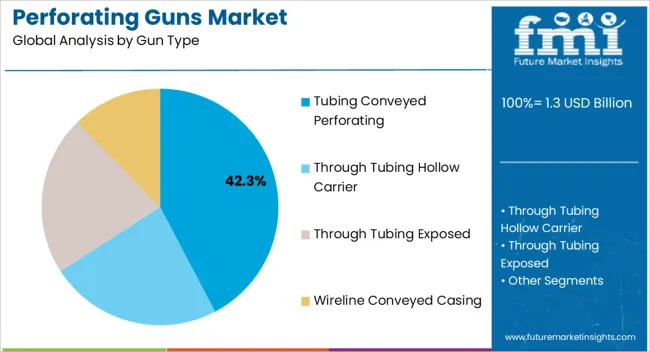
The 3,000-8,000 ft depth segment’s 42.5% market share in 2026 stems from its alignment with the concentration of onshore shale drilling and mature field recompletion programs. The segment benefits from optimized gun carrier designs suited for moderate pressure regimes, balancing cost control with perforation efficiency across large pad developments.
- Mid-Depth Optimization: DynaEnergetics emphasized performance gains with DS Gravity 2.0, describing it as “a length-optimized, self-orienting gun system that saves time, increases perforation efficiency and maximizes well profitability… the internal self-orientating design ensures perfect phasing alignment of perforations in the casing.” [4]
- Underbalanced Perforating Execution: Halliburton documented shallow and mid-depth TCP applications, noting operators perforated formation intervals at “1,500-psi underbalanced pressure with tubing-conveyed perforation (TCP)” to decrease resistance to flow. [5]
- Mature Field Workover Alignment: Mid-depth intervals dominate recompletion activity in aging onshore basins where standardized, high-reliability gun systems support refracturing campaigns and infill drilling strategies.
Perforating Guns Market Drivers, Restraints, and Opportunities
Future Market Insights analysis indicates that historical patterns point to a technically intensive, cycle-sensitive global market where perforating guns remain mission-critical to well completion economics across unconventional shale, tight oil, and mature field recompletions. Estimated valuation in 2026 reflects a continuation of efficiency-driven capital deployment, where operators prioritize technologies that maximize stage productivity, reduce non-productive time, and improve perforation consistency under complex downhole conditions. The market is shaped less by rig count volatility alone and more by the intensity of completion activity per well, including longer laterals and higher cluster density designs.
While demand fundamentals remain tied to upstream capital expenditure cycles (volume exposure), pricing resilience is supported by the shift toward digitally integrated, high-reliability gun systems (value protection). Premium systems incorporating real-time diagnostics, selective firing, and autonomous stage sequencing command higher margins, partially offsetting pressure during periods of reduced drilling activity. The forecast assumes a structural move toward automation, safety enhancement, and performance optimization in unconventional completions, even as operators maintain strict cost discipline.
- Automation-Driven Performance Gains: Growth is shifting from conventional expendable gun assemblies toward digitally enabled and closed-loop integrated perforating systems that improve cluster efficiency, reduce misfires, and support autonomous fracturing programs.
- Regulatory and Safety Compliance Pressure: Increasing scrutiny over explosives handling, transportation safety, and wellsite risk management is pushing service providers to adopt safer switch technologies, redundant firing systems, and standardized quality controls across global operations.
- Unconventional and Recompletion Intensity: Longer horizontal laterals and refracturing of mature wells are expanding demand for high-shot-density guns, modular carrier systems, and depth-optimized designs that enhance reservoir contact while controlling perforation phasing and debris management.
Regional Analysis
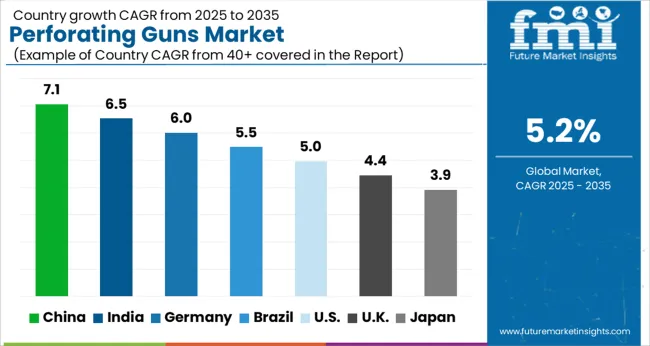
Based on the regional analysis, the perforating guns market is segmented into North America, Latin America, Europe, East Asia, South Asia, Oceania and Middle East & Africa across 40+ countries. The full report also offers market attractiveness analysis based on upstream capital expenditure cycles, unconventional drilling intensity, and offshore licensing momentum.
| Country | CAGR (2026 to 2036) |
|---|---|
| China | 7.9% |
| India | 7.2% |
| United States | 6.5% |
| United Kingdom | 5.8% |
| Brazil | 5.1% |
Source: Future Market Insights (FMI) analysis, based on proprietary forecasting model and primary research
North America Perforating Guns Market Analysis
North America remains the global benchmark for perforating gun deployment, defined by high-intensity unconventional shale development, multi-stage hydraulic fracturing programs, and continued productivity optimization in the Permian Basin and other tight formations. Service providers are transitioning toward advanced plug-and-perf systems integrated with autonomous fracturing technologies to maximize cluster efficiency and reduce non-productive time. [10]
- United States: Demand for perforating guns in the United States is projected to rise at a 6.5% CAGR through 2036. Growth is supported by technically recoverable shale resources such as the Woodford and Barnett formations, where the USA Geological Survey assessed 28.3 trillion cubic feet of gas, enabled by advances in hydraulic fracturing and horizontal drilling technologies.
The United States also recorded crude oil production of 13.6 million barrels per day in 2025, reinforcing sustained completion intensity across unconventional basins [6].
FMI’s report includes a detailed assessment of North American completion intensity, shale basin activity, and service company technology deployment trends across the United States and Canada.
Asia Pacific Perforating Guns Market Analysis
Asia Pacific is emerging as a key growth corridor, driven by offshore discoveries, enhanced recovery programs, and government-backed exploration licensing reforms that are expanding technically challenging drilling environments.
- China: Leading with a 7.9% CAGR, the market benefits from offshore and shallow slope discoveries such as recent CNOOC operations, where a well completed at 1,688 meters encountered 66.7 meters of oil pay zones and tested at approximately 2,560 barrels per day [7].
- India: Domestic demand is accelerating at a 7.2% CAGR, supported by structural policy reforms including the Hydrocarbon Exploration and Licensing Policy (HELP) and Open Acreage Licensing Programme (OALP), which unlocked deepwater and frontier exploration basins such as the Andaman-Nicobar offshore region [8].
The full report analyzes perforating gun demand across China, India, Southeast Asia, and Oceania, evaluating offshore capital allocation, completion complexity, and technology adoption patterns.
Europe Perforating Guns Market Analysis
Europe remains a technically resilient basin, particularly in the UK Continental Shelf, where high-impact discoveries and redevelopment projects sustain demand for specialized perforating solutions despite broader energy transition pressures.
- United Kingdom: Demand in the United Kingdom is projected to expand at a 5.8% CAGR through 2036, supported by discoveries such as the Glengorm gas condensate field, reported at approximately 250 mmboe of recoverable resources, demonstrating continued viability of North Sea exploration [11].
FMI’s analysis of the European perforating guns market includes country-wise assessment covering the United Kingdom, Norway, Germany, and Rest of Europe, focusing on offshore redevelopment, mature field optimization, and high-pressure completion technologies.
Competitive Aligners for Market Players
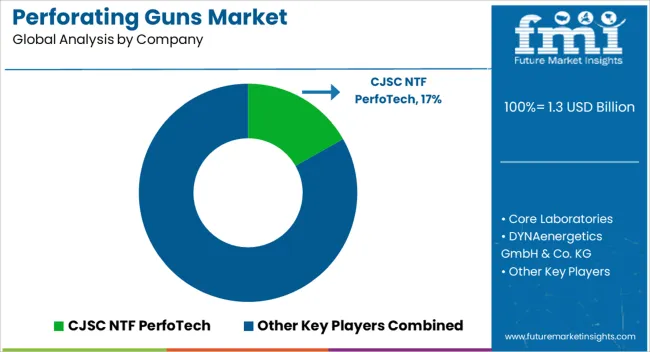
Market structure in the perforating guns market remains fragmented at the surface level, yet effective competition is concentrated among a limited group of global oilfield service companies and specialized explosive manufacturers capable of meeting volume, safety, and performance requirements of major E&P operators. A meaningful share of global deployment is controlled by vertically integrated service providers that combine perforating hardware, downhole telemetry, and hydraulic fracturing execution under bundled completion contracts. The primary competitive variable is operational reliability and stage efficiency in multi-well pad developments, not short-term pricing leverage during peak drilling cycles.
Suppliers with in-house shaped charge manufacturing, explosive loading facilities, and field service crews can control quality consistency and reduce failure risk during high-pressure, high-temperature completions. Companies lacking vertical integration often rely on third-party charge suppliers or contract assembly, increasing exposure to supply chain disruptions, margin compression, and service reliability risks during periods of elevated completion intensity. Regulatory compliance further narrows the competitive field. Handling, transportation, and deployment of explosive perforating systems require strict adherence to ATF, DOT, and international hazardous materials regulations, creating structural entry barriers and natural consolidation toward established players.
Customer concentration reinforces buyer leverage. Large shale operators and national oil companies typically dual-source perforating systems to mitigate operational dependency, limiting price pass-through and favoring vendors that demonstrate consistent gun performance, reduced misfire rates, and integration with plug-and-perf and autonomous fracturing platforms.
Recent Developments
- In February 2026, Expro launched Solus™, a single shear-and-seal ball valve for subsea well access. It replaces two valves with one, reducing risk and complexity while improving safety, flexibility, and operational efficiency [12].
- In January 2026, SLB completed its acquisition of RESMAN Energy Technology, adding wireless tracer and reservoir surveillance capabilities to its portfolio, helping operators gain faster insights, improve well performance monitoring, and enhance overall recovery [13].
Key Players in Perforating Guns Market
- SLB (Schlumberger Limited)
- Halliburton Company
- Baker Hughes Company
- National Oilwell Varco, Inc.
- Weatherford International plc
- Hunting PLC
- Core Laboratories N.V.
- DynaEnergetics GmbH & Co. KG (DMC Global)
- FHE USA LLC
- Expro Group
- G&H Diversified Manufacturing, L.P.
- GEODynamics, Inc.
- Oso Perforating
- Repeat Precision
- Shaanxi FYPE Rigid Machinery Co., Ltd.
- China National Petroleum Corporation (CNPC)
- Sinopec Corporation
- Oiltech Services Pte Ltd
- Tassaroli S.A.
- Wellmatics
Scope of the Report
| Metric | Value |
|---|---|
| Quantitative Units | USD 1.4 billion (2026) to USD 2.3 billion (2036), at a CAGR of 5.1% |
| Market Definition | The perforating guns market comprises the global production, integration, and commercialization of explosive-based downhole completion tools used to create reservoir-to-wellbore flow paths in oil and gas wells. These systems deploy shaped charges through casing and cement to enable hydrocarbon flow and are increasingly integrated with digital firing systems, telemetry, and modular conveyance platforms for high-efficiency completions. |
| Gun Type Segmentation | Tubing Conveyed Perforating (TCP), Through Tubing Hollow Carrier, Through Tubing Exposed, Wireline Conveyed Casing |
| Depth Segmentation | Below 3,000 ft; 3,000-8,000 ft; Above 8,000 ft |
| Well Type Segmentation | Horizontal, Vertical |
| Well Pressure Segmentation | High Pressure, Low Pressure |
| Regions Covered | North America, Latin America, Europe, Asia Pacific, Middle East & Africa |
| Countries Covered | United States, Canada, Mexico, Brazil, Argentina, United Kingdom, Norway, Russia, China, India, Japan, South Korea, Indonesia, Australia, Saudi Arabia, UAE, South Africa and 40+ countries |
| Key Companies Profiled | SLB (Schlumberger Limited), Halliburton Company, Baker Hughes Company, National Oilwell Varco, Weatherford International plc, Hunting PLC, DynaEnergetics (DMC Global), Core Laboratories N.V., Expro Group, GEODynamics, Inc. |
| Forecast Period | 2026 to 2036 |
| Approach | Hybrid top-down and bottom-up market modeling validated through primary interviews with completion engineers and oilfield service providers, supported by rig count benchmarking, well completion statistics, offshore project databases, explosives compliance analysis, and manufacturer shipment verification. |
Key Segments
Gun Type
- Tubing Conveyed Perforating (TCP)
- Through Tubing Hollow Carrier
- Through Tubing Exposed
- Wireline Conveyed Casing
Depth
- Below 3,000 ft
- 3,000 – 8,000 ft
- Above 8,000 ft
Well Type
- Horizontal
- Vertical
Well Pressure
- High Pressure
- Low Pressure
Region
- North America
- United States
- Canada
- Latin America
- Brazil
- Mexico
- Argentina
- Rest of Latin America
- Europe
- United Kingdom
- Russia
- Norway
- Rest of Europe
- Asia Pacific
- China
- India
- Japan
- South Korea
- Indonesia
- Australia & New Zealand
- Rest of Asia Pacific
- Middle East & Africa
- Saudi Arabia
- UAE
- South Africa
- Rest of Middle East & Africa
Bibliography
- [1] Halliburton Company. (2025). Halliburton announces first quarter 2025 results. Halliburton Press Release.
- [2] Hunting PLC. (2025). H-3 perforating system. Hunting PLC.
- [3] SLB. (2025). Tempo instrumented docking perforating gun system. SLB.
- [4] DynaEnergetics. (2025). DS Gravity® 2.0. DynaEnergetics.
- [5] Offshore Energy. (2025). New perforating technology saves operator time and money. Offshore Energy.
- [6] USA Energy Information Administration (EIA). (2025). Permian production forecast growth driven by well productivity, pipeline capacity. EIA.
- [7] Offshore Energy. (2025). Another 100-million-ton oilfield discovery sees light of day in Asian waters. Offshore Energy.
- [8] Press Information Bureau, Government of India. (2025). Press release. PIB.
- [9] USA Geological Survey (USGS). (2025). USGS releases assessment of undiscovered oil and gas resources in Woodford and Barnett shales. USGS.
- [10] USA Geological Survey (USGS). (2025). USGS releases assessment of undiscovered oil and gas resources in Woodford and Barnett shales. USGS.
- [11] Westwood Global Energy Group. (2025). Significant Glengorm discovery shows that high-impact discoveries are still possible in the UK North Sea. Westwood.
- [12] Expro Group Holdings N.V. (2025). Expro launches Solus™ – The single valve solution for subsea well access. Expro Press Release.
- [13] SLB. (2025). SLB completes acquisition of RESMAN Energy Technology. SLB Press Release.
This Report Addresses
- Market intelligence to enable structured strategic decision-making across mature and emerging perforating guns markets
- Market size estimation and 10-year revenue forecasts from 2026 to 2036, supported by validated rig count data and well completion statistics
- Growth opportunity mapping across gun types, depths, well types, and regions with emphasis on TCP and horizontal well applications
- Segment and regional revenue forecasts covering all major gun types and deployment environments
- Competition strategy assessment including technology differentiation, supply chain integration, and service delivery models benchmarking
- Technology roadmap tracking including instrumented guns, addressable firing systems, and HPHT-rated materials
- Regulatory impact analysis covering explosives handling safety, international trade policies, and regional content requirements
- Market report delivery in PDF, Excel, PPT, and interactive dashboard formats for executive and operational use
Frequently Asked Questions
How large is the demand for perforating guns in the global market in 2026?
Demand for perforating guns in the global market is estimated to be valued at approximately USD 1.4 billion in 2026.
What will be the market size of perforating guns in the global market by 2036?
Demand for perforating guns in the global market is estimated to be valued at approximately USD 1.4 billion in 2026.
What is the expected demand growth for perforating guns in the global market between 2026 and 2036?
Demand for perforating guns in the global market is expected to grow at a CAGR of 5.1% between 2026 and 2036.
Which gun type is poised to lead global sales by 2026?
Tubing conveyed perforating (TCP) is expected to be the dominant gun type, capturing approximately 42.3% of global market share in 2026 due to its ability to perforate long horizontal intervals in a single trip.
Which depth segment is projected to contribute significant share in the perforating guns market in 2026?
The 3,000–8,000 ft depth segment is projected to command 42.5% share in 2026, supported by the concentration of onshore shale drilling and mature field recompletion activity.
How significant is the role of horizontal wells in driving perforating gun demand in 2026?
Horizontal wells represent a critical segment, accounting for 57.1% of market share in 2026 as multi-stage fracturing requires multiple precisely spaced perforation clusters.
What is driving perforating gun demand in the United States?
Rising unconventional shale activity, sustained Permian Basin production, and re-perforation of mature wells are driving demand in the United States.
What compliance standards are referenced for the United States?
USA Bureau of Alcohol, Tobacco, Firearms and Explosives (ATF) explosives regulations, Department of Transportation (DOT) hazardous materials rules, and API recommended practices for perforating equipment are referenced as key compliance benchmarks.
What is the United States growth outlook in this report?
The United States is projected to grow at a CAGR of 6.5% during 2026 to 2036.
Why is Asia Pacific described as a high-growth region in this report?
Growth is supported by offshore discoveries, government-backed licensing reforms, and expansion of upstream investment programs in China and India.
What type of demand dominates in mature markets?
Re-perforation and refracturing of mature fields dominate demand in mature markets, as operators optimize recovery from existing wellbores.
What is China’s growth outlook in this report?
China is projected to expand at a CAGR of 7.9% during 2026 to 2036, supported by offshore discoveries and continued shale gas development.
Does the report cover India in its regional analysis?
India is included within Asia Pacific under the regional coverage framework.
Press Information Bureau (PIB) releases, upstream licensing disclosures under HELP and OALP, and national oil company announcements are cited as primary reference sources.
Press Information Bureau (PIB) releases, upstream licensing disclosures under HELP and OALP, and national oil company announcements are cited as primary reference sources.
What is the main demand theme linked to Middle East coverage?
Middle East demand centers on deepwater projects, high-pressure developments, and sustained investment in large-scale oilfield infrastructure.
Which gun type is strategically important for high-pressure wells?
Tubing conveyed perforating (TCP) systems are strategically important for high-pressure and high-deviation wells where controlled underbalanced perforating enhances flow efficiency.
What are perforating guns and what are they mainly used for?
Perforating guns are downhole explosive tools used to create flow paths between the reservoir and wellbore by detonating shaped charges through casing and cement to enable hydrocarbon production.
What does the perforating guns market mean in this report?
The perforating guns market refers to global production, integration, and deployment of explosive-based well completion tools and associated firing systems.
What is included in the scope of this perforating guns market report?
Scope covers perforating guns by gun type, depth, well type, pressure rating, and geographic regions, along with 10-year revenue forecasts.
What is excluded from the scope of this report?
Non-explosive perforating technologies, general drilling equipment, post-perforation stimulation services, and unrelated completion tools are excluded.
What does market forecast mean on this page?
Market forecast represents a model-based projection built on defined assumptions for strategic planning purposes.
How does FMI build and validate the perforating guns market forecast?
The forecast is developed using hybrid top-down and bottom-up modeling validated through rig count data, well completion statistics, offshore project announcements, and manufacturer shipment benchmarks.
What does zero reliance on speculative third-party market research mean here?
Primary interviews and verifiable public datasets, including government energy statistics and corporate financial filings, are used instead of unverified syndicated market estimates.
Preview the report firsthand - request a free sample
Get SampleGet the brochure for pricing and purchase details.
Get PDFTable of Content
- Executive Summary
- Global Market Outlook
- Demand-side Trends
- Supply-side Trends
- Technology Roadmap Analysis
- Analysis and Recommendations
- Market Overview
- Market Coverage / Taxonomy
- Market Definition / Scope / Limitations
- Research Methodology
- Chapter Orientation
- Analytical Lens and Working Hypotheses
- Market Structure, Signals, and Trend Drivers
- Benchmarking and Cross-market Comparability
- Market Sizing, Forecasting, and Opportunity Mapping
- Research Design and Evidence Framework
- Desk Research Programme (Secondary Evidence)
- Company Annual and Sustainability Reports
- Peer-reviewed Journals and Academic Literature
- Corporate Websites, Product Literature, and Technical Notes
- Earnings Decks and Investor Briefings
- Statutory Filings and Regulatory Disclosures
- Technical White Papers and Standards Notes
- Trade Journals, Industry Magazines, and Analyst Briefs
- Conference Proceedings, Webinars, and Seminar Materials
- Government Statistics Portals and Public Data Releases
- Press Releases and Reputable Media Coverage
- Specialist Newsletters and Curated Briefings
- Sector Databases and Reference Repositories
- FMI Internal Proprietary Databases and Historical Market Datasets
- Subscription Datasets and Paid Sources
- Social Channels, Communities, and Digital Listening Inputs
- Additional Desk Sources
- Expert Input and Fieldwork (Primary Evidence)
- Primary Modes
- Qualitative Interviews and Expert Elicitation
- Quantitative Surveys and Structured Data Capture
- Blended Approach
- Why Primary Evidence is Used
- Field Techniques
- Interviews
- Surveys
- Focus Groups
- Observational and In-context Research
- Social and Community Interactions
- Stakeholder Universe Engaged
- C-suite Leaders
- Board Members
- Presidents and Vice Presidents
- R&D and Innovation Heads
- Technical Specialists
- Domain Subject-matter Experts
- Scientists
- Physicians and Other Healthcare Professionals
- Governance, Ethics, and Data Stewardship
- Research Ethics
- Data Integrity and Handling
- Primary Modes
- Tooling, Models, and Reference Databases
- Desk Research Programme (Secondary Evidence)
- Data Engineering and Model Build
- Data Acquisition and Ingestion
- Cleaning, Normalisation, and Verification
- Synthesis, Triangulation, and Analysis
- Quality Assurance and Audit Trail
- Market Background
- Market Dynamics
- Drivers
- Restraints
- Opportunity
- Trends
- Scenario Forecast
- Demand in Optimistic Scenario
- Demand in Likely Scenario
- Demand in Conservative Scenario
- Opportunity Map Analysis
- Product Life Cycle Analysis
- Supply Chain Analysis
- Investment Feasibility Matrix
- Value Chain Analysis
- PESTLE and Porter’s Analysis
- Regulatory Landscape
- Regional Parent Market Outlook
- Production and Consumption Statistics
- Import and Export Statistics
- Market Dynamics
- Global Market Analysis 2021 to 2025 and Forecast, 2026 to 2036
- Historical Market Size Value (USD Million) Analysis, 2021 to 2025
- Current and Future Market Size Value (USD Million) Projections, 2026 to 2036
- Y-o-Y Growth Trend Analysis
- Absolute $ Opportunity Analysis
- Global Market Pricing Analysis 2021 to 2025 and Forecast 2026 to 2036
- Global Market Analysis 2021 to 2025 and Forecast 2026 to 2036, By Gun Type
- Introduction / Key Findings
- Historical Market Size Value (USD Million) Analysis By Gun Type , 2021 to 2025
- Current and Future Market Size Value (USD Million) Analysis and Forecast By Gun Type , 2026 to 2036
- Tubing Conveyed Perforating (TCP)
- Through Tubing Hollow Carrier
- Through Tubing Exposed
- Wireline Conveyed Casing
- Tubing Conveyed Perforating (TCP)
- Y-o-Y Growth Trend Analysis By Gun Type , 2021 to 2025
- Absolute $ Opportunity Analysis By Gun Type , 2026 to 2036
- Global Market Analysis 2021 to 2025 and Forecast 2026 to 2036, By Depth
- Introduction / Key Findings
- Historical Market Size Value (USD Million) Analysis By Depth, 2021 to 2025
- Current and Future Market Size Value (USD Million) Analysis and Forecast By Depth, 2026 to 2036
- 3,000–8,000 ft
- Below 3,000 ft
- Above 8,000 ft
- 3,000–8,000 ft
- Y-o-Y Growth Trend Analysis By Depth, 2021 to 2025
- Absolute $ Opportunity Analysis By Depth, 2026 to 2036
- Global Market Analysis 2021 to 2025 and Forecast 2026 to 2036, By Region
- Introduction
- Historical Market Size Value (USD Million) Analysis By Region, 2021 to 2025
- Current Market Size Value (USD Million) Analysis and Forecast By Region, 2026 to 2036
- North America
- Latin America
- Western Europe
- Eastern Europe
- East Asia
- South Asia and Pacific
- Middle East & Africa
- Market Attractiveness Analysis By Region
- North America Market Analysis 2021 to 2025 and Forecast 2026 to 2036, By Country
- Historical Market Size Value (USD Million) Trend Analysis By Market Taxonomy, 2021 to 2025
- Market Size Value (USD Million) Forecast By Market Taxonomy, 2026 to 2036
- By Country
- USA
- Canada
- Mexico
- By Gun Type
- By Depth
- By Country
- Market Attractiveness Analysis
- By Country
- By Gun Type
- By Depth
- Key Takeaways
- Latin America Market Analysis 2021 to 2025 and Forecast 2026 to 2036, By Country
- Historical Market Size Value (USD Million) Trend Analysis By Market Taxonomy, 2021 to 2025
- Market Size Value (USD Million) Forecast By Market Taxonomy, 2026 to 2036
- By Country
- Brazil
- Chile
- Rest of Latin America
- By Gun Type
- By Depth
- By Country
- Market Attractiveness Analysis
- By Country
- By Gun Type
- By Depth
- Key Takeaways
- Western Europe Market Analysis 2021 to 2025 and Forecast 2026 to 2036, By Country
- Historical Market Size Value (USD Million) Trend Analysis By Market Taxonomy, 2021 to 2025
- Market Size Value (USD Million) Forecast By Market Taxonomy, 2026 to 2036
- By Country
- Germany
- UK
- Italy
- Spain
- France
- Nordic
- BENELUX
- Rest of Western Europe
- By Gun Type
- By Depth
- By Country
- Market Attractiveness Analysis
- By Country
- By Gun Type
- By Depth
- Key Takeaways
- Eastern Europe Market Analysis 2021 to 2025 and Forecast 2026 to 2036, By Country
- Historical Market Size Value (USD Million) Trend Analysis By Market Taxonomy, 2021 to 2025
- Market Size Value (USD Million) Forecast By Market Taxonomy, 2026 to 2036
- By Country
- Russia
- Poland
- Hungary
- Balkan & Baltic
- Rest of Eastern Europe
- By Gun Type
- By Depth
- By Country
- Market Attractiveness Analysis
- By Country
- By Gun Type
- By Depth
- Key Takeaways
- East Asia Market Analysis 2021 to 2025 and Forecast 2026 to 2036, By Country
- Historical Market Size Value (USD Million) Trend Analysis By Market Taxonomy, 2021 to 2025
- Market Size Value (USD Million) Forecast By Market Taxonomy, 2026 to 2036
- By Country
- China
- Japan
- South Korea
- By Gun Type
- By Depth
- By Country
- Market Attractiveness Analysis
- By Country
- By Gun Type
- By Depth
- Key Takeaways
- South Asia and Pacific Market Analysis 2021 to 2025 and Forecast 2026 to 2036, By Country
- Historical Market Size Value (USD Million) Trend Analysis By Market Taxonomy, 2021 to 2025
- Market Size Value (USD Million) Forecast By Market Taxonomy, 2026 to 2036
- By Country
- India
- ASEAN
- Australia & New Zealand
- Rest of South Asia and Pacific
- By Gun Type
- By Depth
- By Country
- Market Attractiveness Analysis
- By Country
- By Gun Type
- By Depth
- Key Takeaways
- Middle East & Africa Market Analysis 2021 to 2025 and Forecast 2026 to 2036, By Country
- Historical Market Size Value (USD Million) Trend Analysis By Market Taxonomy, 2021 to 2025
- Market Size Value (USD Million) Forecast By Market Taxonomy, 2026 to 2036
- By Country
- Kingdom of Saudi Arabia
- Other GCC Countries
- Turkiye
- South Africa
- Other African Union
- Rest of Middle East & Africa
- By Gun Type
- By Depth
- By Country
- Market Attractiveness Analysis
- By Country
- By Gun Type
- By Depth
- Key Takeaways
- Key Countries Market Analysis
- USA
- Pricing Analysis
- Market Share Analysis, 2025
- By Gun Type
- By Depth
- Canada
- Pricing Analysis
- Market Share Analysis, 2025
- By Gun Type
- By Depth
- Mexico
- Pricing Analysis
- Market Share Analysis, 2025
- By Gun Type
- By Depth
- Brazil
- Pricing Analysis
- Market Share Analysis, 2025
- By Gun Type
- By Depth
- Chile
- Pricing Analysis
- Market Share Analysis, 2025
- By Gun Type
- By Depth
- Germany
- Pricing Analysis
- Market Share Analysis, 2025
- By Gun Type
- By Depth
- UK
- Pricing Analysis
- Market Share Analysis, 2025
- By Gun Type
- By Depth
- Italy
- Pricing Analysis
- Market Share Analysis, 2025
- By Gun Type
- By Depth
- Spain
- Pricing Analysis
- Market Share Analysis, 2025
- By Gun Type
- By Depth
- France
- Pricing Analysis
- Market Share Analysis, 2025
- By Gun Type
- By Depth
- India
- Pricing Analysis
- Market Share Analysis, 2025
- By Gun Type
- By Depth
- ASEAN
- Pricing Analysis
- Market Share Analysis, 2025
- By Gun Type
- By Depth
- Australia & New Zealand
- Pricing Analysis
- Market Share Analysis, 2025
- By Gun Type
- By Depth
- China
- Pricing Analysis
- Market Share Analysis, 2025
- By Gun Type
- By Depth
- Japan
- Pricing Analysis
- Market Share Analysis, 2025
- By Gun Type
- By Depth
- South Korea
- Pricing Analysis
- Market Share Analysis, 2025
- By Gun Type
- By Depth
- Russia
- Pricing Analysis
- Market Share Analysis, 2025
- By Gun Type
- By Depth
- Poland
- Pricing Analysis
- Market Share Analysis, 2025
- By Gun Type
- By Depth
- Hungary
- Pricing Analysis
- Market Share Analysis, 2025
- By Gun Type
- By Depth
- Kingdom of Saudi Arabia
- Pricing Analysis
- Market Share Analysis, 2025
- By Gun Type
- By Depth
- Turkiye
- Pricing Analysis
- Market Share Analysis, 2025
- By Gun Type
- By Depth
- South Africa
- Pricing Analysis
- Market Share Analysis, 2025
- By Gun Type
- By Depth
- USA
- Market Structure Analysis
- Competition Dashboard
- Competition Benchmarking
- Market Share Analysis of Top Players
- By Regional
- By Gun Type
- By Depth
- Competition Analysis
- Competition Deep Dive
- SLB (Schlumberger Limited)
- Overview
- Product Portfolio
- Profitability by Market Segments (Product/Age /Sales Channel/Region)
- Sales Footprint
- Strategy Overview
- Marketing Strategy
- Product Strategy
- Channel Strategy
- Halliburton Company
- Baker Hughes Company
- National Oilwell Varco, Inc.
- Weatherford International plc
- Hunting PLC
- Core Laboratories N.V.
- SLB (Schlumberger Limited)
- Competition Deep Dive
- Assumptions & Acronyms Used


