

- Industry Size (2026)
- USD 73796.5 Mn
- Forecast (2036)
- USD 325548.6 Mn
- CAGR (2026 to 2036)
- 16.0%
X-by-Wire Market Forecast and Outlook By FMI
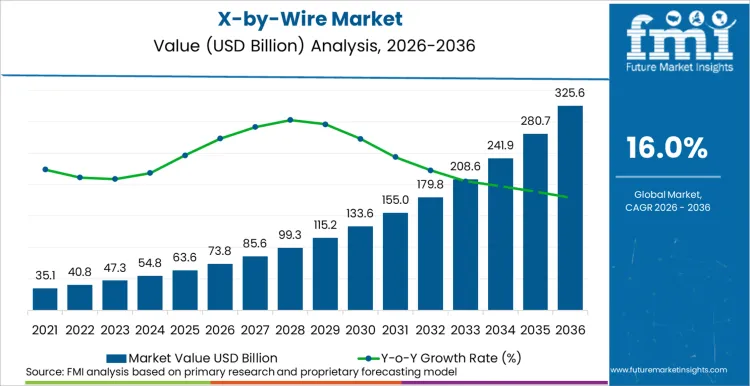
In 2025, the X-by-Wire market was valued at USD 63,617.7 million. Based on Future Market Insights' analysis, demand is estimated to grow to USD 73,796.5 million in 2026 and USD 325,548.6 million by 2036. FMI projects a CAGR of 16.0% during the forecast period.
Absolute dollar growth of USD 251,752.1 million over the decade reflects a generational shift in vehicle architecture as mechanical steering columns, hydraulic brake lines, and cable-actuated throttles are replaced by electronic control systems. Autonomous driving requirements at Level 3 and above make X-by-Wire mandatory, since software-controlled steering and braking are prerequisites for vehicle self-driving capability. Brake-by-wire holds the largest system share, but steer-by-wire is the fastest-growing segment following Mercedes-Benz's 2026 series production announcement.
As Philippe Gasnier, Head of R&D at ZF Chassis Solutions, stated regarding steer-by-wire production, 'With our steering system expertise, we enable automotive manufacturers around the world to unlock the full dynamic potential of their vehicles.' [1]
China (18.5% CAGR) leads through rapid EV adoption and domestic autonomous driving programmes. Germany (16.0% CAGR) grows as Mercedes-Benz, BMW, and VW Group accelerate X-by-Wire integration. The United States (15.5% CAGR) benefits from autonomous vehicle testing and NHTSA regulatory framework development. Japan (14.0% CAGR) contributes through Toyota and Honda by-wire system development. South Korea (15.0% CAGR) benefits from Hyundai's steer-by-wire deployment on its E-GMP platform.
X-by-Wire Market Definition
The X-by-Wire market covers the manufacture, sale, and integration of electronic control systems that replace mechanical, hydraulic, or cable-actuated vehicle control linkages. Systems include steer-by-wire, brake-by-wire (including electro-mechanical and electro-hydraulic braking), throttle-by-wire, shift-by-wire, and park-by-wire across passenger, commercial, and off-highway vehicle platforms.
X-by-Wire Market Inclusions
The report covers global and regional market sizes by revenue for the 2026 to 2036 forecast period. It includes segmental breakdowns by system type, vehicle type, and autonomy level. OEM platform tracking, supplier tier mapping, and functional safety certification analysis are included.
X-by-Wire Market Exclusions
The scope excludes conventional hydraulic braking systems, mechanical steering columns, and cable-actuated throttle linkages. ADAS sensors and computing platforms are outside scope unless sold as integrated X-by-Wire control packages.
X-by-Wire Market Research Methodology
- Primary Research: Interviews were conducted with automotive OEMs, Tier-1 by-wire system suppliers, functional safety engineers, autonomous vehicle programme managers, and component manufacturers across Germany, Japan, China, and the United States.
- Desk Research: OEM product roadmaps, NHTSA and UNECE regulatory filings, functional safety (ISO 26262) certification databases, and autonomous vehicle testing permit data supported demand benchmarking.
- Market-Sizing and Forecasting: A hybrid model combined top-down vehicle production forecasts by autonomy level with bottom-up by-wire system content-per-vehicle and average selling price data, validated against Tier-1 supplier revenue and OEM procurement disclosures.
- Data Validation and Update Cycle: Outputs undergo anomaly screening, variance checks across vehicle production and by-wire system shipment datasets, and structured peer review prior to release.
Summary of X-by-Wire Market
- Power concentration is observed among Tier 1 suppliers with functional safety certifications and long term OEM platform contracts. ZF Friedrichshafen AG, Robert Bosch GmbH, Continental AG, and Nexteer Automotive dominate series production by wire systems. ZF holds the steer by wire contract for Mercedes-Benz 2026 production vehicle. OEMs avoid dual sourcing mid programme, ensuring multi year revenue visibility for first mover suppliers.
- Pricing asymmetry is driven by safety certification premiums. Conventional hydraulic power steering costs USD 150 to 250 per vehicle, while steer by wire with redundant actuators and ASIL D compliance ranges from USD 600 to 1,200. Brake by wire carries a comparable premium. Total by wire system content in Level 3 plus autonomy can reach USD 2,000 to 4,000 per vehicle, significantly increasing supplier revenue per unit.
- Supply chain fragility is concentrated in redundant actuator production and safety qualified semiconductor sourcing. Dual or triple redundant motors and ECUs are required to meet ASIL D standards, effectively doubling component requirements. Automotive grade motor controllers and safety processors are sourced from limited semiconductor vendors such as Infineon Technologies and NXP Semiconductors, whose capacity allocation influences production schedules.
- Brand exposure and compliance risk are closely linked to functional safety validation and liability frameworks. A by wire system malfunction carries high legal exposure. UNECE Regulation 79 governs steer by wire type approval, and International Organization for Standardization ISO 26262 ASIL D compliance remains mandatory. Regulatory barriers create a natural oligopoly among certified Tier 1 suppliers.
- Geographic leverage is shaped by OEM headquarters and autonomous driving regulations. Germany leads through premium OEM early adoption including BMW and Mercedes Benz. China drives volume growth through domestic EV platforms and L3 plus pilot programmes. United States influences regulatory direction through NHTSA framework development. Japan and South Korea support innovation through OEM R and D and component manufacturing.
- Strategic priority for automotive and mobility executives through 2036 is focused on ASIL D certified redundant system investment, early OEM platform awards before production lock, and semiconductor supply chain resilience. First mover certification advantage in by wire platforms functions as the primary competitive moat.
X-by-Wire Industry Analysis by Top Investment Segments
The section explains the market share analysis of the leading segments in the industry. In terms of type, the throttle by wire type will likely dominate and generate a share of around 30.1% in 2025.
Based on the application, the passenger vehicle segment is projected to hold a major share of 35.6% in 2025. The analysis would enable potential clients to make effective business decisions for investment purposes.
Throttle by wire is being widely used as automotive technology in the vehicles
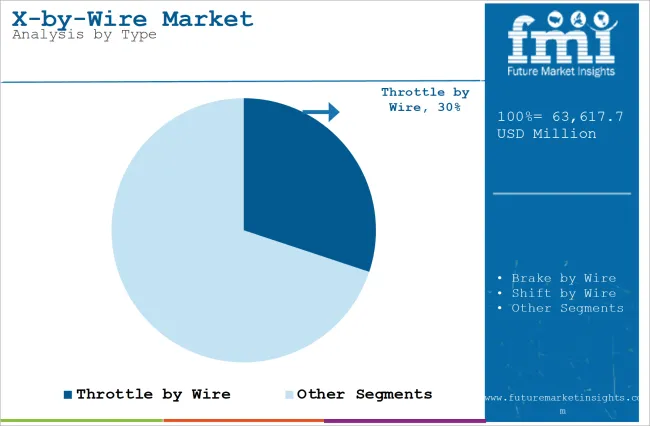
| Segment | Value Share (2026) |
|---|---|
| Throttle by Wire (Type) | 30.1% |
Throttle by wire is being widely used as automotive technology in the vehicles nowadays, where it replaces the clutches throttle linkage with the pedal position sensor and throttle operated electronically.
Advantages of Throttle by Wire
It eradicates binding problems in mechanical linkages for forbidding the accelerator from sticking.
Emission can be reduced; efficiency and fuel economy can be improved by provides automatic throttle control arrangement.
Advanced modulated system can be formed using modeling and installation of throttle by wire
It also allows the ECM to integrate the features such as torque management with cruise control, traction control and stability control. The accelerator pad detects the position of accelerator pedal, retrieve the information and convey it to the ECM as a variation in the electric resistance. The ECM operates a servo-motor, which controls the movement of butterfly valve, the feedback circuit with the help of the ECM, collects the feedback and continuously monitors the position of the throttle.
X-by-wire technology improves safety, efficiency, and driving comfort in passenger vehicles
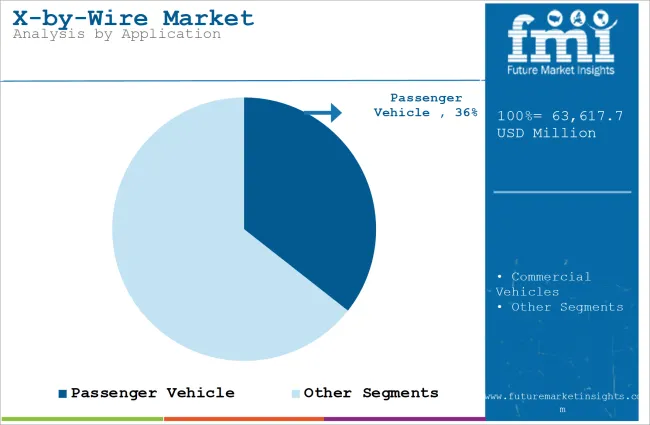
| Segment | Value Share (2026) |
|---|---|
| Passenger Vehicle (Application) | 35.6% |
X-by-Wire technology is widely used in passenger cars due to its ability to enhance safety, efficiency, and driving comfort. By replacing traditional mechanical and hydraulic linkages with electronic systems, X-by-Wire technologies offer precise control and faster response times.
This improves the performance of critical systems like steering, braking, and throttle, ensuring a safer and more comfortable driving experience, which is a priority for passenger car manufacturers and consumers.
The integration of X-by-Wire systems supports modern automotive trends like electric vehicles (EVs) and autonomous driving. These systems reduce the overall weight of vehicles, increasing energy efficiency and contributing to extended battery range for EVs.
For autonomous vehicles, X-by-Wire systems enable seamless communication between sensors and actuators, ensuring precise operation without manual intervention. The growing demand for technologically advanced, safe, and sustainable passenger cars makes X-by-Wire a preferred choice in the automotive industry.
Future Trends and Innovations in Throttle-By-Wire Technology
As technology advances, throttle-by-wire systems are expected to evolve with new features and integrations.
Integration with Autonomous Driving Systems
Throttle-by-wire technology plays a key role in autonomous driving by facilitating seamless vehicle control.
Sustainability and Environmental Impact
Efforts to improve fuel efficiency and reduce emissions are driving innovations in throttle-by-wire technology.
Potential for Customization and Performance Tuning
Enthusiasts can explore tuning options to modify throttle-by-wire systems for enhanced performance, always considering safety implications.
| Attributes | Key Insights |
|---|---|
| Estimated Value (2026) | USD 63,617.7 million |
| Projected Size (2036) | USD 281,240.5 million |
| Value-based CAGR (2026 to 2036) | 16.0% |
The growth trajectory of steer by wire type is anticipated to grow at fastest CAGR in the forecast period and is expected to account for CAGR of 18.1% in 2026 to 2036.
With steer-by-wire (SbW), vehicle technology enters a new phase. Redesigning the vehicle's interior and implementing new features and functions are made possible by the removal of the mechanical link between the steering wheel actuator and the steering rack actuator. Both automated and manual driving systems can incorporate this technology.
Steer-by-wire significantly lowers complexity and costs by allowing the cockpit module and chassis to be standardized across complete platforms. A variety of technical features that were not achievable with traditional steering systems are also made possible by the system, increasing safety, comfort, and agility.
Advantages and Benefits of Steer-By-Wire Technology
OEM benefits:
- Increases extensive component reuse & standardization
- Eliminates intermediate shafts
- Reduces rack bar variants Reduces component inventory, space and management costs
- Reduces assembly time, simplifies roadwheel-handwheel alignment
- Opens valuable underhood space
- Enables BOLD cockpit designs, NEW safety and performance features only achievable with SbW
Safety & Performance:
- Enhanced Safety, Stability Control & Compensation for weather and road conditions, plus shorter braking distance
- Dynamic Steering Ratio - at low speeds (parking lot or tight corner,) steering is more responsive and reduces the number of steering wheel turns; at high speeds (highway) is less sensitive for smoother control
- SbW immerses drivers into a "branded" driving experience - with highly tuned steering feel (luxury, sporty, truck-feel, and other) Steering assist could also potentially be tailored for drivers with limited range of motion such as in aging populations, and other
- Keeps steering wheel still during autonomous driving, enhances cabin comfort. It can also be coupled with Stowable Column wherein the steering wheel retracts into the dashboard. SbW + Stow Col can be used across all driving scenarios
- Prevents collisions by automatically adjusting steering to avoid an obstacle if the driver does not respond quickly enough. Because the steering wheel is not mechanically linked, the steering adjustment is seamless to the driver.
Comparison of Historical vs Future Outlook on X-by-Wire Industry Trends
Between 2020 and 2024, the target market registered growth rate of 14.6% by reaching a value of USD 55,320.2 million in 2024 from USD 32,118.9 million in 2020.
The automotive industry has already implemented many advanced computer systems in an attempt to increase safety and comfort of drivers. In parallel with these advancements the industry has witnessed big shift from mechanical systems to electrical systems and X-by-wire is another implementation that is promising in terms of safety and functionality.
In connection with the further advancing vehicle automation, Steer-by-Wire (SbW) systems are increasingly in the focus of development, as they enable the steering-wheel to be held stationary during automated driving.
At the same time, these systems also have considerable potential for improving vehicle handling, which is an important aspect of the chassis development process. With Steer-by-Wire the road wheels are not mechanically linked to the steering-wheel.
The steering ratio can therefore be modified in a variety of ways. With a velocity-dependent steering ratio, the agility of the vehicle can be increased at low and medium velocities, whereas at high velocities a smooth and more stable handling of the vehicle is achieved.
Over the last couple of years, steer-by-wire (SbW) has become one of the trending topics in the automotive environment. More recently, the progress in the field of automated driving puts focus on the structural setup of steering systems and especially the SbW technology.
The steering system in a vehicle is the central system to influence the lateral dynamics by manipulating the direction of travel. New requirements have been established with regard to performance, comfort and vehicle concepts in general.
Even though the introduction of electric power steering systems (EPS) already contributed to the performance and the comfort of steering on a large scale, the limits of a steering system with a rigid connection between steering wheel and front wheels on the road are still strongly constrained by its system properties. For the development and the design of new vehicle cabin concepts and differently shaped steering control units, the physical connection is the restricting factor again.
Thereby the optimal layout and ergonomics of a vehicle cabin as well as the introduction of new control units are countered by the need to position the steering unit in a way, that it is possible to physically connect the steering wheel to the steering gear by a steering column.
All these factors have played pivotal role in expanding the demand for X-by-wire industry in 2020 to 2024.
Looking ahead to 2026 to 2036, the market is anticipated to grow faster. Electronic throttle control (ETC) has become standard in modern vehicles, replacing traditional mechanical throttle linkages with advanced electronic systems.
However, ETC has faced challenges, such as potential unintended acceleration due to software glitches, sensor malfunctions, and electromagnetic interference. Additionally, some drivers reported a lack of tactile feedback compared to mechanical systems in the early days of the technology.
Brake-by-wire and steer-by-wire technologies have begun revolutionizing vehicle control by replacing the traditional mechanical and hydraulic systems with electronic controls. Brake-by-wire systems offer faster response times, improved braking efficiency, and the ability to integrate with advanced driver assistance systems such as automatic emergency braking.
Likewise, steer-by-wire systems aim to eliminate the mechanical connection between the steering wheel and the front wheels, relying instead on electronic signals to direct the vehicle's steering mechanisms.
Brake-by-wire replaces conventional hydraulic brake systems with electronic controls that offer numerous benefits. This system improves braking response time and consistency, as electronic signals can transmit instructions faster than hydraulic fluids. Brake-by-wire systems reduce the overall weight of the vehicle by eliminating bulky hydraulic components. The technology also allows for more seamless integration with ADAS features like adaptive cruise control and collision avoidance systems, enhancing overall vehicle safety.
Toyota has been at the forefront of developing steer-by-wire technology, exemplified by its innovation in the Lexus cars.
Steer-by-wire systems are overly safe due to the incorporation of redundancy and fail-safe mechanisms to ensure continuous operation in case of a component failure. Toyota's innovation in steer-by-wire technology marks a significant milestone in automotive engineering.
Drive-by-wire technology has been a catalyst for the development and implementation of ADAS. By replacing traditional mechanical controls with electronic ones, drive-by-wire systems enable more precise and reliable vehicle control, which is essential for the functioning of ADAS features.
These systems use sensors, cameras, and radar to monitor the vehicle's surroundings and assist the driver in various ways, enhancing safety, comfort, and overall driving experience.
From automatic emergency braking to intelligent parking assist, drive-by-wire technology has paved the way for numerous innovations that make driving safer and more convenient. Two prominent ADAS features made possible by drive-by-wire technology are lane-keep assist and adaptive cruise control.
Future of Drive-By-Wire Systems and Autonomous Driving
The future of drive-by-wire technology is intrinsically linked to the advancement of autonomous driving. As vehicles move towards higher levels of automation, the precision and reliability of drive-by-wire systems have become even more critical.
Autonomous vehicles require seamless integration of steering, braking, and throttle control to navigate complex driving environments safely. Drive-by-wire technology provides the foundation for this technology, enabling vehicles to operate with minimal human intervention.
Looking ahead, we can expect continued innovation in drive-by-wire systems, with advancements in sensor technology, artificial intelligence, and machine learning further enhancing their capabilities.
These developments will lead to more sophisticated autonomous driving features, ultimately paving the way for fully self-driving cars, much like what Tesla is moving towards already. As drive-by-wire technology evolves, it will not only improve the safety and convenience of today's vehicles but also shape the future of transportation, making autonomous driving a practical and reliable reality.
Key Industry Highlights in the X-by-Wire Market
The automotive X-by-wire revolution: balancing performance with value
For the automotive sector, the X-by-wire revolution is on the verge. Replacing mechanical linkages with electronic control has distinct demands on the motor system, essential for the actuation of acceleration, steering, braking, and in the future, 360-degree LiDAR vision systems.
Precise control is required for performance and safety, and low weight to optimize fuel or battery efficiency is vital too. But as ever with the automotive sector, development must be balanced with value for the global market.
Recently, regulators in California ruled that Cruise, the operator and manufacturer of the San Francisco driverless taxi firm, had to suspend its service. Officials blamed an accident for the decision.
In one sense, this story shows that driverless technology isn’t sufficiently mature for day-to-day use in the real world. But this case is also an example of how far driverless technology has already progressed.
California may be pausing its driverless taxi initiative, but this is a temporary measure. And while California has always had a reputation as a place of pioneers, the state is not alone in its openness to driverless technology. Scotland, for example, is already running an autonomous bus service.
Technology essential to achieve the driverless car revolution is X-by-wire, where x represents the required aspects of vehicle control, including drive (acceleration), braking, and steering. This technology replaces traditional mechanical systems with electronic and computer-control.
Electronic control is already responsible for numerous functions of a car, from engine management through to the control of passenger windows, and X-by-wire control of the throttle has already been on the market for a number of years. X-by-wire technology will soon be implemented in every part of a car, including the vital safety and driving systems that are essential to autonomous vehicle management.
X-by-wire is set to see widespread use a lot sooner. In the next 3 to 10 years, there will be increasing numbers of standard, human driver vehicles, equipped with X-by-wire systems that will actuate the primary means of driver input, including steering, gear shifting, and braking.
Advantages include enhancements in safety, energy efficiency, as well as improving the ease of the driving experience. While the opportunity to increase customer value is driving X-by-wire innovation, accelerated by market competition among the global vehicle manufacturers, the culmination of technology progress is pushing it further.
Advances in the power of microchips is one such enabler, alongside the increasing reliance on electronic control systems. This direction of travel has been further accelerated by the transition to EVs that has encouraged a spike in electronic management capabilities.
Enhanced User Experience with Drive-By-Wire Technology
Automobile drive-by-wire technology offer drivers completely new experiences. Drive-by-wire technology is a type of technology that can be used to replace all mechanical wires with electrical wires. Sensors in this type of technology record signals, or information, and send it to a computer or series of computers that convert electrical energy into mechanical motion.
Research and development in the automotive industry has been experimenting throughout the years by adding computers to cars and making them smarter. Drive by wire powered systems have had a significant influence on the automotive industry as a whole. As with the use of this system, several factors from safety to comfort, functionality and vehicle operative system increases efficiently.
Electric wires are replacing mechanical cables and hydraulics in the automotive industry, which is a new trend. A car's weight can be easily decreased by replacing some of its essential parts, such as the brakes, hoses, fluids, coolers, and hydraulics. Vehicle safety can be significantly improved with the addition of the stability control feature.
Electronic cables tend to give motor vehicles more flexibility, which makes it simpler to replace or modify them. Electronic controls have several advantages, such as increased fuel efficiency, better handling, and quicker reaction times in an emergency.
One of the more recent innovations in the automobile sector is drive-by-wire. "X by Wire" or just "By Wire" are other names for drive by wire technology. This type of technology essentially uses electronic controls to operate a variety of functions, such as brakes, throttle, steering, and acceleration.
The same functions are mostly performed by mechanical and hydraulic technologies in conventionally operating autos. Although conventional systems are powerful, they are ultimately too complicated and inefficient to withstand wear and tear over time. In contrast, drive-by-wire technology allows the designer more freedom because it eliminates the need for mechanical connection.
Manufacturers and innovators have employed the integrated approach of computers and electronics into modern cars' working as a result of the automotive industry's industrialization and advancements. Computers and sensors provide the instructions that allow the vehicles to operate. It has also been shown to benefit the environment by improving engine emissions and becoming fuel-efficient.
Advanced X-by-Wire Technologies for Electrified Vehicle Chassis
Advanced X-by-wire technologies for vehicular electrified chassis play an essential role in developing new energy-intelligent vehicles, which is the inevitable choice for intelligent vehicles in the future. This technology is involved in mechanical engineering, electronic and electrical engineering, computer technology, control engineering, signal processing, and artificial intelligence.
Advanced electrified chassis control technology transmits control signals through cables and acts directly on the actuator to implement its corresponding actions. The application of X-by-wire technologies for vehicular electrified chassis has changed complex mechanical connections among actuators and hydraulic and pneumatic equipment in the past, significantly promoting energy efficiency, integration, and intelligence.
The use of such electronic controls helps in reducing the number of moving components in the vehicle, and also contributes towards decreasing the total weight of the system, which is an integral step in increasing vehicular efficiency.
Additionally, electronic sensors can easily communicate with other active and passive safety features to ensure that special safety features such as electronic lane assistance, electronicstability control and adaptive cruise control can be easily integrated.
These systems also allow better control than mechanical systems, while also giving a faster response. Finally, X-by-wire technology allows automotive manufacturers to get a significant amount of flexibility in designing the systems, as electronic controls don’t demand the same space and positioning constraints as mechanical controls.
Rising Demand and Applications for Shift-By-Wire Technology
In recent times, potential energy, environment, and economic interests have stimulated motorized industry to develop and enhance efficient, clean, and sustainable vehicle, particularly, for city transportation.
The automotive industry has seen significant change throughout the years due to a persistent focus on efficiency and innovation. One of the most encouraging recent developments is the introduction of shift-by-wire technology, a novel approach to transmission control. SBW introduces electronic connections in place of traditional mechanical linkages, ushering in a new era of superior car design.
In automobile transmissions, the gear changer and transmission were usually physically attached. These mechanical connections have well, however technological advancements in gear systems such as intelligent manual transmission, dual clutch transmission, and automatic have put forward problems in the mechanical gear systems.
In many cases, they are unable to fulfill the demands of modern driving and might be cumbersome and prone to damage. SBW has made it possible to replace mechanical connections with electronic impulses. Instead of manually engaging the transmission by pushing a lever or adjusting a gear selector, drivers now engage the transmission through electronic interfaces. The transition to digital control has generated a multitude of options.
Smoothness and Accuracy: SBW technology enables smooth gear selection. Electronic signals allow for quicker, smoother, and more accurate shifts. Drivers can enjoy a smooth and comfortable driving experience.
Intelligent Adaptability: SBW systems offer a high level of flexibility. They can be used in conjunction with advanced driver assistance systems (ADAS) and artificial intelligence (AI) algorithms to provide autonomous gear selection based on load, traffic conditions, and even driver behavior. This adaptive intelligence also enhances fuel efficiency and performance.
Decreased Mechanical Complexity: By eliminating mechanical linkages, SBW streamlines the transmission system. This lowers the need for maintenance and creates more space within the vehicle, which allows for more imaginative interior design options.
Eco-Friendly Driving: By optimizing gear selection and reducing emissions, shift-by-wire technology promotes fuel efficiency. Even more benefits are in store for electric and hybrid vehicles thanks to SBW’s enhanced capacity to combine electric motors with conventional transmissions.
Enhanced Safety: SBW technology can stop inadvertent gear changes and alert drivers in hazardous situations, among other safety features. This results in safer driving for all users of the road
Reliability Challenges, Cost Factors, and Signal Interference in X-by-Wire Systems
There are several drawbacks associated with adoption of X-by-wire technology. For instance, shift-by-wire technology has several setbacks including dependability difficulties, cost of implementation, adaptability, risk to cyber security, and intricacy.
Dependability Difficulties: There are dependability difficulties with electronic systems since they are prone to malfunctions or breakdowns. Failure of the shift-by-wire technology could result in issues in choosing a gear and could put the vehicle in danger.
Cost: Shift-by-wire systems are usually more complex and costly to build and repair than standard mechanical connections. This may result in increased upfront costs for both automakers and customers.
Upkeep and Fixtures: Qualified specialists and advanced diagnostic equipment are often needed when shift-by-wire systems require maintenance or repairs. Vehicle owners may experience higher maintenance expenses and longer downtime as a result.
Difficulties with Adaptation: Some drivers may prefer the old-fashioned mechanical shifters’ quickness and control. Shift-by-wire systems may require some time for drivers to get used to, and this change may not be well received.
Risks to Cyber Security: As shift-by-wire systems become more interconnected and integrated into automotive networks, they may become vulnerable to hackers. Securing these systems is crucial to preventing unwanted access or modification.
Intricacy: The intricacy of shift-by-wire technology can make it more challenging to identify and fix issues with it, increasing maintenance costs and delaying problem-solving times.
Market Concentration and Competitive Analysis in X-by-Wire
Tier 1 companies comprise players with a revenue of above USD 2,000 million capturing a significant share of 40-45% in the global market. These players are characterized by high production capacity and a wide product portfolio.
These leaders are distinguished by their extensive expertise in manufacturing and reconditioning across multiple X-by-wire applications and a broad geographical reach, underpinned by a robust consumer base. Prominent companies within Tier 1 include ZF Friedrichshafen AG, Robert Bosch GmbH, thyssenkrupp AG, Infineon Technologies AG, Schaeffler AG and other players.
Tier 2 companies include mid-size players with revenue of below USD 2,000 million having a presence in specific regions and highly influencing the local industry. These are characterized by a strong presence overseas and strong industry knowledge.
These players have good technology and ensure regulatory compliance but may not have advanced technology and wide global reach. Prominent companies in tier 2 include DORLECO, Nexteer Automotive, Forvia, WELLYSUN, and other player.
Analysis of Top Countries Adopting X-by-Wire Technology
The section below covers the industry analysis for X-by-wire demand in different countries. The demand analysis on key countries in several regions of the globe, including North America, Latin America, East Asia, South Asia Pacific, Western Europe, Eastern Europe, Middle East, and Africa is provided.
China will hold 68.1% in East Asia due to due to its strong presence in the automotive industry, which is the world's largest by production and sales volume.
The USA will capture 75.6% in North America owing to its advanced automotive industry, which emphasizes innovation and adoption of cutting-edge technologies.
Germany will lead Western Europe with 34.8% due to due to its position as a global leader in automotive engineering and innovation. Renowned for its premium automobile brands like BMW, Mercedes-Benz, Audi, and Volkswagen, Germany consistently pushes the boundaries of advanced vehicle technologies.
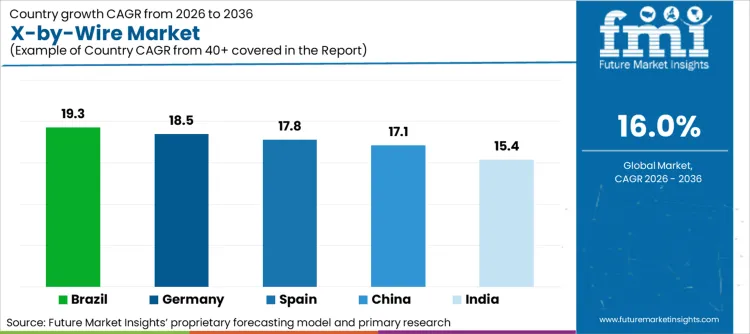
| Countries | Value CAGR (2026 to 2036) |
|---|---|
| Spain | 17.8% |
| India | 15.4% |
| Brazil | 19.3% |
| Germany | 18.5% |
| China | 17.1% |
Strong presence in the automotive industry, which is the world's largest by production and sales volume.
The sale of X-by-wire in China is projected to reach USD 58,032.0 million and is estimated to grow at an 17.1% CAGR by 2036.
The country is a hub for both domestic automakers and international brands, fostering high demand for advanced vehicle technologies such as X-by-Wire systems. These technologies are increasingly adopted to improve vehicle performance, safety, and fuel efficiency, aligning with China's push toward smart and connected mobility.
Another key factor is the rapid growth of electric vehicles (EVs) in China, driven by government policies, subsidies, and a growing consumer base. X-by-Wire systems, such as steer-by-wire and brake-by-wire, are integral to EVs due to their compatibility with electric powertrains and ability to reduce vehicle weight and energy consumption.
Advanced automotive industry, which emphasizes innovation and adoption of cutting-edge technologies
The sales of X-by-wire in the USA is projected to reach USD 54,430.2 million by 2036.
The country is home to leading automakers and Tier-1 suppliers who invest heavily in research and development to enhance vehicle safety, efficiency, and performance. These investments have accelerated the deployment of X-by-Wire systems, such as throttle-by-wire, steer-by-wire, and brake-by-wire, in both passenger and commercial vehicles.
Moreover, the USA government and regulatory bodies have implemented stringent safety and emission standards, driving automakers to incorporate advanced control systems like X-by-Wire to comply with these regulations. The growing demand for electric and autonomous vehicles in the USA also plays a crucial role, as these technologies rely on X-by-Wire systems for their lightweight design and precision control.
Germany’s focus on electric and autonomous vehicles aligns with the adoption of X-by-Wire technologies,
The sale of X-by-wire in Germany is projected to reach USD 10,374.4 million and grow at a CAGR of 18.5% by 2036.
Germany dominates the X-by-Wire market in Western Europe due to its position as a global leader in automotive engineering and innovation. Renowned for its premium automobile brands like BMW, Mercedes-Benz, Audi, and Volkswagen, Germany consistently pushes the boundaries of advanced vehicle technologies. These manufacturers heavily invest in R&D to enhance safety, performance, and sustainability, making X-by-Wire systems an integral part of their vehicle offerings.
Germany’s focus on electric and autonomous vehicles aligns with the adoption of X-by-Wire technologies, which are crucial for precise control and weight reduction in these vehicles. The country’s robust regulatory framework, emphasizing stringent safety and emission standards, further drives the integration of advanced control systems.
With a well-established supply chain, advanced manufacturing capabilities, and a culture of technological excellence, Germany remains the epicenter of innovation in Western Europe's X-by-Wire market.
Leading Suppliers and Competitive Landscape in X-by-Wire
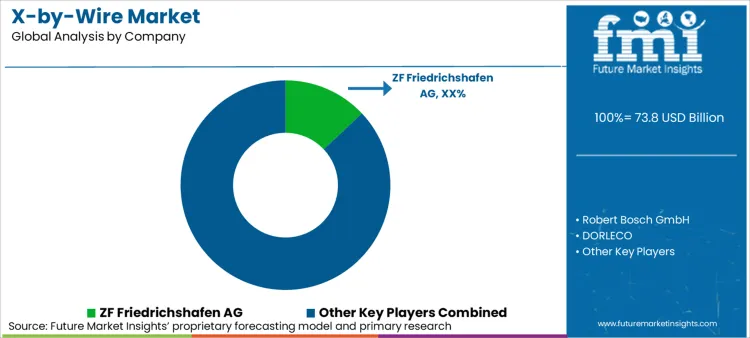
Key companies engaged in the X-by-wire are slightly consolidate the market with about 50-55% share that are prioritizing technological advancements, integrating sustainable practices, and expanding their footprints in the region.
Customer satisfaction remains paramount, with a keen focus on advanced X-by-wire to meet diverse applications. These industry leaders actively foster collaborations to stay at the forefront of innovation, ensuring their X-by-wire align with the evolving demands and maintain the highest standards of quality and adaptability.
Recent Developments
- The report includes full coverage of key trends from competitive benchmarking. Some of the recent developments covered in the report:
- In February 2026, Mercedes-Benz announced it will become the first German manufacturer to offer a production vehicle with steer-by-wire, removing the mechanical steering column entirely. [1]
- In April 2025, Nexteer Automotive launched its electro-mechanical brake (EMB) system, a full brake-by-wire solution replacing hydraulic fluid and traditional linkage. [2]
- In 2025, ZF secured the steer-by-wire production contract for Mercedes-Benz, leveraging its chassis solutions expertise and ASIL-D certified redundant actuator platform. [3]
- In 2025, Continental expanded its MK C2 brake-by-wire platform production to meet growing demand from European and Chinese EV OEMs. [4]
- In 2025, Hyundai deployed steer-by-wire on its E-GMP electric vehicle platform for advanced driver assistance and autonomous driving readiness. [5]
Major Companies in the X-by-Wire Market
- ZF Friedrichshafen AG
- Robert Bosch GmbH
- DORLECO
- Nexteer Automotive
- Forvia
- thyssenkrupp AG
- Danfoss
- Infineon Technologies AG
- Schaeffler AG
- WELLYSUN
- Other Key Players
Scope of the Report
| Metric | Value |
|---|---|
| Quantitative Units | USD 73,796.5 million (2026) to USD 325,548.6 million (2036), at a CAGR of 16.0% |
| Market Definition | Covers electronic control systems replacing mechanical, hydraulic, or cable-actuated vehicle control linkages across passenger, commercial, and off-highway platforms. |
| System Type Segmentation | Steer-by-Wire, Brake-by-Wire, Throttle-by-Wire, Shift-by-Wire, Park-by-Wire |
| Vehicle Type Segmentation | Passenger Vehicles, Commercial Vehicles, Off-highway Vehicles |
| Regions Covered | North America, Latin America, Europe, East Asia, South Asia, Oceania, Middle East and Africa |
| Countries Covered | Germany, China, United States, Japan, South Korea, France, United Kingdom, India, Brazil, Mexico and 30 plus countries |
| Key Companies Profiled | ZF Friedrichshafen, Robert Bosch, Continental AG, Nexteer Automotive, Infineon Technologies, NXP Semiconductors, Schaeffler, Mando Corporation, Jtekt Corporation, Kayaba |
| Forecast Period | 2026 to 2036 |
| Approach | Hybrid top-down and bottom-up modeling validated through primary interviews with automotive OEMs, Tier-1 by-wire suppliers, and functional safety engineers |
X-by-Wire Industry Analysis by Top Investment Segments
By Type:
The Type segment is further categorized into Throttle by Wire, Brake by Wire, Shift by Wire, Steer by Wire, and Other by Wire.
By Application:
The Application segment is classified into Passenger Vehicles and Commercial Vehicles.
By Region:
Regions considered in the study include North America, Latin America, Western Europe, Eastern Europe, East Asia, South Asia & Pacific, and the Middle East and Africa.
This Report Addresses
- Market intelligence for automotive OEM platform planning and Tier-1 by-wire system procurement
- Market size estimation and 10-year revenue forecasts from 2026 to 2036
- Growth opportunity mapping across steer-by-wire, brake-by-wire, and throttle-by-wire systems
- Segment and regional revenue forecasts covering passenger, commercial, and off-highway vehicles by autonomy level
- Competition strategy assessment including functional safety certification and OEM platform award dynamics
- Semiconductor and actuator supply chain tracking for safety-critical by-wire components
- Regulatory impact analysis covering UNECE R79, NHTSA FMVSS, and ISO 26262 ASIL-D requirements
- Market report delivery in PDF, Excel, PPT, and interactive dashboard formats
Bibliography
- [1] ZF Friedrichshafen. (2025). Steer-by-Wire Production Contract for Mercedes-Benz.
- [2] Nexteer Automotive. (2025). Electro-Mechanical Brake System Launch. April 2025.
- [3] Mercedes-Benz. (2026). Steer-by-Wire Production Vehicle Announcement. February 2026.
- [4] Continental AG. (2025). MK C2 Brake-by-Wire Platform Expansion.
- [5] Hyundai Motor Group. (2025). E-GMP Platform Steer-by-Wire Deployment.
- [6] NHTSA. (2025). Federal Motor Vehicle Safety Standards: Electronic Steering.
- [7] UNECE. (2025). Regulation 79: Steering Equipment.
- [8] ISO. (2025). ISO 26262: Functional Safety for Road Vehicles.
- [9] IHS Markit / S&P Global Mobility. (2025). Global Vehicle Production Forecast by Autonomy Level.
- [10] Infineon Technologies. (2025). Automotive Safety Processor Portfolio.
- [11] Future Market Insights. (2026). X-by-Wire Market Report.
- [12] Future Market Insights. (2025). Steer-by-Wire Market.
Frequently Asked Questions
How large is the X-by-Wire market in 2026?
The global market is estimated at USD 73,796.5 million in 2026.
What will the market size be by 2036?
The market is projected to reach USD 325,548.6 million by 2036.
What is the expected CAGR?
Demand is expected to grow at a CAGR of 16.0% between 2026 and 2036.
Which system type is growing fastest?
Steer-by-wire is the fastest-growing segment following Mercedes-Benz's 2026 series production announcement.
Which country is growing fastest?
China at 18.5% CAGR through rapid EV adoption and domestic autonomous driving programmes.
What drives X-by-Wire adoption?
Autonomous driving requirements at Level 3 and above make by-wire systems mandatory for software-controlled steering and braking.
Preview the report firsthand - request a free sample
Get SampleGet the brochure for pricing and purchase details.
Get PDFTable of Content
- Executive Summary
- Global Market Outlook
- Demand-side Trends
- Supply-side Trends
- Technology Roadmap Analysis
- Analysis and Recommendations
- Market Overview
- Market Coverage / Taxonomy
- Market Definition / Scope / Limitations
- Research Methodology
- Chapter Orientation
- Analytical Lens and Working Hypotheses
- Market Structure, Signals, and Trend Drivers
- Benchmarking and Cross-market Comparability
- Market Sizing, Forecasting, and Opportunity Mapping
- Research Design and Evidence Framework
- Desk Research Programme (Secondary Evidence)
- Company Annual and Sustainability Reports
- Peer-reviewed Journals and Academic Literature
- Corporate Websites, Product Literature, and Technical Notes
- Earnings Decks and Investor Briefings
- Statutory Filings and Regulatory Disclosures
- Technical White Papers and Standards Notes
- Trade Journals, Industry Magazines, and Analyst Briefs
- Conference Proceedings, Webinars, and Seminar Materials
- Government Statistics Portals and Public Data Releases
- Press Releases and Reputable Media Coverage
- Specialist Newsletters and Curated Briefings
- Sector Databases and Reference Repositories
- FMI Internal Proprietary Databases and Historical Market Datasets
- Subscription Datasets and Paid Sources
- Social Channels, Communities, and Digital Listening Inputs
- Additional Desk Sources
- Expert Input and Fieldwork (Primary Evidence)
- Primary Modes
- Qualitative Interviews and Expert Elicitation
- Quantitative Surveys and Structured Data Capture
- Blended Approach
- Why Primary Evidence is Used
- Field Techniques
- Interviews
- Surveys
- Focus Groups
- Observational and In-context Research
- Social and Community Interactions
- Stakeholder Universe Engaged
- C-suite Leaders
- Board Members
- Presidents and Vice Presidents
- R&D and Innovation Heads
- Technical Specialists
- Domain Subject-matter Experts
- Scientists
- Physicians and Other Healthcare Professionals
- Governance, Ethics, and Data Stewardship
- Research Ethics
- Data Integrity and Handling
- Primary Modes
- Tooling, Models, and Reference Databases
- Desk Research Programme (Secondary Evidence)
- Data Engineering and Model Build
- Data Acquisition and Ingestion
- Cleaning, Normalisation, and Verification
- Synthesis, Triangulation, and Analysis
- Quality Assurance and Audit Trail
- Market Background
- Market Dynamics
- Drivers
- Restraints
- Opportunity
- Trends
- Scenario Forecast
- Demand in Optimistic Scenario
- Demand in Likely Scenario
- Demand in Conservative Scenario
- Opportunity Map Analysis
- Product Life Cycle Analysis
- Supply Chain Analysis
- Investment Feasibility Matrix
- Value Chain Analysis
- PESTLE and Porter’s Analysis
- Regulatory Landscape
- Regional Parent Market Outlook
- Production and Consumption Statistics
- Import and Export Statistics
- Market Dynamics
- Global Market Analysis 2021 to 2025 and Forecast, 2026 to 2036
- Historical Market Size Value (USD Million) Analysis, 2021 to 2025
- Current and Future Market Size Value (USD Million) Projections, 2026 to 2036
- Y-o-Y Growth Trend Analysis
- Absolute $ Opportunity Analysis
- Global Market Pricing Analysis 2021 to 2025 and Forecast 2026 to 2036
- Global Market Analysis 2021 to 2025 and Forecast 2026 to 2036, By Type
- Introduction / Key Findings
- Historical Market Size Value (USD Million) Analysis By Type , 2021 to 2025
- Current and Future Market Size Value (USD Million) Analysis and Forecast By Type , 2026 to 2036
- Throttle
- Brake
- Shift
- Steer
- Throttle
- Y-o-Y Growth Trend Analysis By Type , 2021 to 2025
- Absolute $ Opportunity Analysis By Type , 2026 to 2036
- Global Market Analysis 2021 to 2025 and Forecast 2026 to 2036, By Application
- Introduction / Key Findings
- Historical Market Size Value (USD Million) Analysis By Application, 2021 to 2025
- Current and Future Market Size Value (USD Million) Analysis and Forecast By Application, 2026 to 2036
- Passenger Vehicle
- Commercial Vehicles
- Passenger Vehicle
- Y-o-Y Growth Trend Analysis By Application, 2021 to 2025
- Absolute $ Opportunity Analysis By Application, 2026 to 2036
- Global Market Analysis 2021 to 2025 and Forecast 2026 to 2036, By Region
- Introduction
- Historical Market Size Value (USD Million) Analysis By Region, 2021 to 2025
- Current Market Size Value (USD Million) Analysis and Forecast By Region, 2026 to 2036
- North America
- Latin America
- Western Europe
- Eastern Europe
- East Asia
- South Asia and Pacific
- Middle East & Africa
- Market Attractiveness Analysis By Region
- North America Market Analysis 2021 to 2025 and Forecast 2026 to 2036, By Country
- Historical Market Size Value (USD Million) Trend Analysis By Market Taxonomy, 2021 to 2025
- Market Size Value (USD Million) Forecast By Market Taxonomy, 2026 to 2036
- By Country
- USA
- Canada
- Mexico
- By Type
- By Application
- By Country
- Market Attractiveness Analysis
- By Country
- By Type
- By Application
- Key Takeaways
- Latin America Market Analysis 2021 to 2025 and Forecast 2026 to 2036, By Country
- Historical Market Size Value (USD Million) Trend Analysis By Market Taxonomy, 2021 to 2025
- Market Size Value (USD Million) Forecast By Market Taxonomy, 2026 to 2036
- By Country
- Brazil
- Chile
- Rest of Latin America
- By Type
- By Application
- By Country
- Market Attractiveness Analysis
- By Country
- By Type
- By Application
- Key Takeaways
- Western Europe Market Analysis 2021 to 2025 and Forecast 2026 to 2036, By Country
- Historical Market Size Value (USD Million) Trend Analysis By Market Taxonomy, 2021 to 2025
- Market Size Value (USD Million) Forecast By Market Taxonomy, 2026 to 2036
- By Country
- Germany
- UK
- Italy
- Spain
- France
- Nordic
- BENELUX
- Rest of Western Europe
- By Type
- By Application
- By Country
- Market Attractiveness Analysis
- By Country
- By Type
- By Application
- Key Takeaways
- Eastern Europe Market Analysis 2021 to 2025 and Forecast 2026 to 2036, By Country
- Historical Market Size Value (USD Million) Trend Analysis By Market Taxonomy, 2021 to 2025
- Market Size Value (USD Million) Forecast By Market Taxonomy, 2026 to 2036
- By Country
- Russia
- Poland
- Hungary
- Balkan & Baltic
- Rest of Eastern Europe
- By Type
- By Application
- By Country
- Market Attractiveness Analysis
- By Country
- By Type
- By Application
- Key Takeaways
- East Asia Market Analysis 2021 to 2025 and Forecast 2026 to 2036, By Country
- Historical Market Size Value (USD Million) Trend Analysis By Market Taxonomy, 2021 to 2025
- Market Size Value (USD Million) Forecast By Market Taxonomy, 2026 to 2036
- By Country
- China
- Japan
- South Korea
- By Type
- By Application
- By Country
- Market Attractiveness Analysis
- By Country
- By Type
- By Application
- Key Takeaways
- South Asia and Pacific Market Analysis 2021 to 2025 and Forecast 2026 to 2036, By Country
- Historical Market Size Value (USD Million) Trend Analysis By Market Taxonomy, 2021 to 2025
- Market Size Value (USD Million) Forecast By Market Taxonomy, 2026 to 2036
- By Country
- India
- ASEAN
- Australia & New Zealand
- Rest of South Asia and Pacific
- By Type
- By Application
- By Country
- Market Attractiveness Analysis
- By Country
- By Type
- By Application
- Key Takeaways
- Middle East & Africa Market Analysis 2021 to 2025 and Forecast 2026 to 2036, By Country
- Historical Market Size Value (USD Million) Trend Analysis By Market Taxonomy, 2021 to 2025
- Market Size Value (USD Million) Forecast By Market Taxonomy, 2026 to 2036
- By Country
- Kingdom of Saudi Arabia
- Other GCC Countries
- Turkiye
- South Africa
- Other African Union
- Rest of Middle East & Africa
- By Type
- By Application
- By Country
- Market Attractiveness Analysis
- By Country
- By Type
- By Application
- Key Takeaways
- Key Countries Market Analysis
- USA
- Pricing Analysis
- Market Share Analysis, 2025
- By Type
- By Application
- Canada
- Pricing Analysis
- Market Share Analysis, 2025
- By Type
- By Application
- Mexico
- Pricing Analysis
- Market Share Analysis, 2025
- By Type
- By Application
- Brazil
- Pricing Analysis
- Market Share Analysis, 2025
- By Type
- By Application
- Chile
- Pricing Analysis
- Market Share Analysis, 2025
- By Type
- By Application
- Germany
- Pricing Analysis
- Market Share Analysis, 2025
- By Type
- By Application
- UK
- Pricing Analysis
- Market Share Analysis, 2025
- By Type
- By Application
- Italy
- Pricing Analysis
- Market Share Analysis, 2025
- By Type
- By Application
- Spain
- Pricing Analysis
- Market Share Analysis, 2025
- By Type
- By Application
- France
- Pricing Analysis
- Market Share Analysis, 2025
- By Type
- By Application
- India
- Pricing Analysis
- Market Share Analysis, 2025
- By Type
- By Application
- ASEAN
- Pricing Analysis
- Market Share Analysis, 2025
- By Type
- By Application
- Australia & New Zealand
- Pricing Analysis
- Market Share Analysis, 2025
- By Type
- By Application
- China
- Pricing Analysis
- Market Share Analysis, 2025
- By Type
- By Application
- Japan
- Pricing Analysis
- Market Share Analysis, 2025
- By Type
- By Application
- South Korea
- Pricing Analysis
- Market Share Analysis, 2025
- By Type
- By Application
- Russia
- Pricing Analysis
- Market Share Analysis, 2025
- By Type
- By Application
- Poland
- Pricing Analysis
- Market Share Analysis, 2025
- By Type
- By Application
- Hungary
- Pricing Analysis
- Market Share Analysis, 2025
- By Type
- By Application
- Kingdom of Saudi Arabia
- Pricing Analysis
- Market Share Analysis, 2025
- By Type
- By Application
- Turkiye
- Pricing Analysis
- Market Share Analysis, 2025
- By Type
- By Application
- South Africa
- Pricing Analysis
- Market Share Analysis, 2025
- By Type
- By Application
- USA
- Market Structure Analysis
- Competition Dashboard
- Competition Benchmarking
- Market Share Analysis of Top Players
- By Regional
- By Type
- By Application
- Competition Analysis
- Competition Deep Dive
- ZF Friedrichshafen AG
- Overview
- Product Portfolio
- Profitability by Market Segments (Product/Age /Sales Channel/Region)
- Sales Footprint
- Strategy Overview
- Marketing Strategy
- Product Strategy
- Channel Strategy
- Robert Bosch GmbH
- DORLECO
- Nexteer Automotive
- Forvia
- thyssenkrupp AG
- Danfoss
- ZF Friedrichshafen AG
- Competition Deep Dive
- Assumptions & Acronyms Used


