

- Industry Size (2026)
- USD 7.0 Bn
- Forecast (2036)
- USD 33.4 Bn
- CAGR (2026 to 2036)
- 16.8%
Demand for X-by-Wire in the UK 2026-2036
The UK industry for X-by-Wire technologies is forecasted to grow from USD 7.0 billion in 2026 to USD 33.4 billion by 2036, with a CAGR of 16.8%. This growth is driven by the increasing adoption of electronic control systems in the automotive sector, where traditional mechanical linkages are being replaced with electronic systems for steering, braking, and throttle. As vehicles become more complex and the demand for safety, efficiency, and performance increases, the role of X-by-Wire systems becomes more critical.
The shift to electric vehicles (EVs) and autonomous driving technologies also accelerates the demand for X-by-Wire, as these systems optimize vehicle design by reducing weight and enhancing control. UK manufacturers and Tier 1 suppliers are increasingly investing in X-by-Wire systems to meet regulatory standards and offer innovative safety features like advanced driver-assistance systems (ADAS).
Quick Stats for X-by-Wire Industry in the UK
- X-by-Wire Industry Value (2026): USD 7.0 billion
- X-by-Wire Industry Forecast Value (2036): USD 33.4 billion
- X-by-Wire Industry Forecast CAGR (2026 to 2036): 16.8%
- Leading Type by Demand Share: Throttle by Wire
- Fastest-Growing Regions: England, Scotland, Wales, Northern Ireland
- Key Industry Participants: ZF Friedrichshafen AG, Robert Bosch GmbH, DORLECO, Nexteer Automotive, Forvia, thyssenkrupp AG
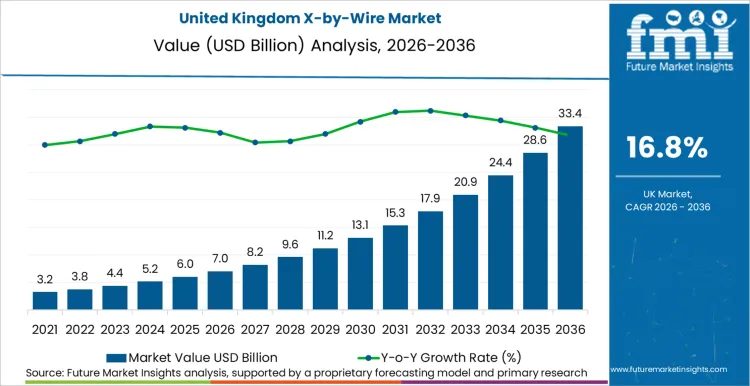
X-by-Wire Industry in the UK Key Takeaways
| Metric | Value |
|---|---|
| Industry Value (2026) | USD 7.0 billion |
| Industry Forecast Value (2036) | USD 33.4 billion |
| Forecast CAGR (2026 to 2036) | 16.8% |
Why is the UK Building Steady Demand for X by Wire?
Automotive and specialist vehicle makers in the UK are transitioning toward electronic control systems that replace mechanical linkages, which increases interest in X by Wire technologies. Drivers and fleet operators value the precision and responsiveness that electronic steering, braking and throttle systems deliver, especially as vehicle complexity grows. This trend reflects a broader shift toward systems that support enhanced control and safety in modern vehicles.
Regulatory and safety frameworks influence uptake because electronic control enables advanced driver assistance and automated features that are becoming commonplace. UK manufacturers integrate X‑by‑Wire modules to support lane keeping, stability control and assisted parking systems that rely on precise actuation. This electronic architecture simplifies communication between sensors and actuators, which aligns with engineering priorities for reliability and performance verification.
Innovation in electrified and autonomous platforms also strengthens demand. Electric vehicles and advanced mobility solutions deploy X‑by‑Wire systems to optimize packaging, reduce weight and enhance energy efficiency. UK suppliers and OEMs work with Tier‑1 partners to source and calibrate these systems so they integrate with broader vehicle software stacks. This integration demand stems from practical performance and validation needs rather than novelty, shaping procurement and development across the automotive ecosystem.
How is X-by-Wire Demand Segmented by Type and Application in the UK?
Demand for X-by-wire technologies in the UK reflects how automakers and OEMs embrace electronic control systems to replace traditional mechanical and hydraulic components, enhancing performance, efficiency, and design flexibility. Segmentation follows application-specific needs and the drive towards more precise, responsive, and scalable control systems.
Why does throttle by wire lead type-level adoption?
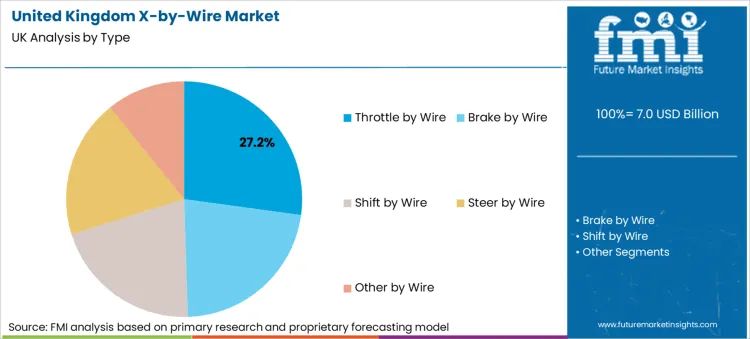
Throttle by wire accounts for 27.2% of the demand, reflecting its role as a critical system in enhancing engine responsiveness and efficiency. This technology replaces traditional mechanical linkages with electronic sensors, providing more precise control over throttle inputs, enabling smoother acceleration, and improving fuel efficiency. Throttle by wire systems also support the integration of advanced features such as adaptive cruise control and automated driving systems, which are becoming increasingly common in modern vehicles.
Automakers prefer throttle by wire for its ability to reduce mechanical complexity, eliminate physical components like cables and linkages, and offer more flexible design options, contributing to vehicle weight reduction and overall performance improvements.
What positions commercial vehicles as the dominant application?
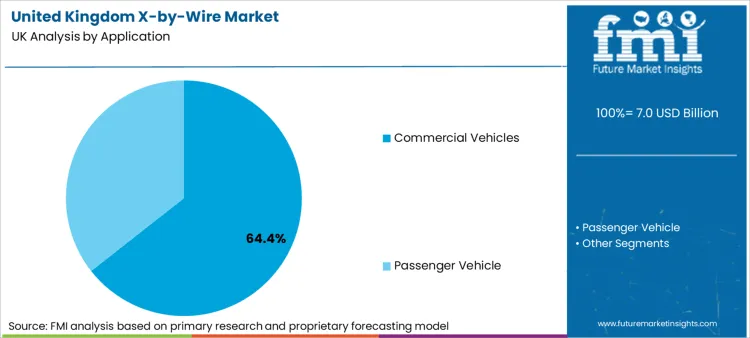
Commercial vehicles represent 64.4% of the demand, driven by the significant advantages that X-by-wire systems offer in large, heavy-duty vehicles. These systems enhance control precision, reduce maintenance costs, and improve safety features in trucks and buses, where mechanical linkages are more prone to wear and tear under demanding conditions.
In commercial vehicles, the shift to electronic systems also supports the integration of advanced driver assistance systems (ADAS) and autonomous driving capabilities, which are becoming essential in modern logistics and public transport. The growing demand for more reliable, fuel-efficient, and safer commercial vehicles further accelerates the adoption of X-by-wire technologies in this segment.
What are the Key Dynamics in Demand for X by Wire Systems in the UK?
Demand for x‑by‑wire systems in the UK is driven by the proliferation of electrified vehicle architectures, advanced driver assistance systems (ADAS), and future autonomous driving roadmaps. Automotive OEMs and tier suppliers prioritize electronic control of steering, braking, and throttle functions to reduce mechanical complexity, improve system integration, and enable over‑the‑air calibration of control logic. Growth correlates with the increasing share of hybrid and battery electric vehicles (BEVs) in UK new registrations, where traditional linkages give way to redundant, software‑defined interfaces that support modular vehicle platforms and weight reduction.
How do vehicle electrification trends and regulatory safety standards shape adoption?
Adoption of x‑by‑wire technologies in the UK automotive sector reflects electrification strategies that replace hydraulic and mechanical systems with electrically controlled actuators and sensors. Steering‑by‑wire and brake‑by‑wire systems decouple physical linkages, allowing directional control and deceleration to be managed through electronic commands, which supports greater packaging flexibility and efficiency gains. Regulations that emphasise vehicle safety, crash avoidance and system redundancy incentivise designs with multiple fail‑safe layers and real‑time diagnostics. OEMs calibrate x‑by‑wire control units to meet UNECE R79 or equivalent UK homologation criteria for steering performance and stability, while brake‑by‑wire systems integrate with ADAS functions such as automatic emergency braking and adaptive cruise control.
What do technical complexities and cost considerations imply for industry growth?
Uptake of x‑by‑wire systems in the UK is influenced by technical complexity and cost implications that accompany electronic control system integration. Development of high‑reliability sensors, actuators, and communication networks that meet automotive functional safety standards (ISO 26262) requires significant engineering investment. Redundant pathways and sophisticated fault detection protocols are necessary to ensure safe operation under varied environmental and load conditions, which drives up system cost relative to conventional mechanical architectures. Calibration and validation for diverse vehicle platforms lengthen development cycles, particularly where OEMs seek seamless interaction with existing vehicle dynamics control systems. Total cost of ownership considerations affect adoption in mainstream vehicle segments, with uptake occurring first in higher margin models where performance benefit and differentiation justify premium pricing.
How is X-by-Wire Demand Evolving across Key Regions in the UK?
Demand for X-by-Wire systems across the UK accelerates as automotive and industrial sectors seek enhanced control systems, reduced weight, and increased flexibility. Regional variation reflects vehicle manufacturing intensity, technological integration, and how sectors adopt electronic control systems to improve performance, safety, and energy efficiency.
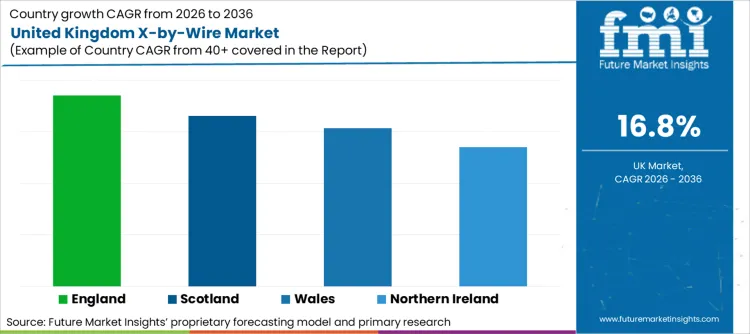
| Region | CAGR (2026 to 2036) |
|---|---|
| England | 18.5% |
| Scotland | 16.5% |
| Wales | 15.3% |
| Northern Ireland | 13.5% |
Why is England leading expansion through advanced automotive integration and manufacturing scale?
England grows at 18.5%, supported by a strong automotive manufacturing base and early adoption of X-by-Wire technology in high-performance and electric vehicles. Demand rises where manufacturers prioritize electronic control systems that replace mechanical linkages, enhancing vehicle design flexibility and reducing weight. OEMs invest in X-by-Wire to improve safety, performance, and powertrain integration across diverse vehicle models.
How is Scotland progressing through adoption in specific vehicle and industrial applications?
Scotland expands at 16.5%, shaped by increasing adoption in specialized vehicle production and industrial machinery. Demand builds where X-by-Wire systems enhance operational precision, reduce mechanical failure risks, and improve system integration. Manufacturers seek solutions that enable cleaner, more efficient designs while supporting the growing push for automation in transportation and heavy-duty applications.
What is shaping Wales as manufacturers balance system reliability with production scalability?
Wales advances at 15.3%, driven by selective integration within smaller-scale automotive and machinery production. Demand strengthens when X-by-Wire systems deliver high reliability and reduced component complexity without compromising production cost control. Manufacturers focus on system robustness and scalability to meet demand for both premium and standard vehicle lines, aligning with industry-specific operational needs.
Why is Northern Ireland showing measured growth linked to niche adoption and targeted sectors?
Northern Ireland records 13.5% growth, reflecting targeted adoption in niche automotive and industrial sectors. Adoption progresses where manufacturers integrate X-by-Wire to improve performance in limited production runs and specialized vehicle types. Demand improves when systems deliver clear cost and design benefits while maintaining flexibility for low-volume, high-specification production schedules.
What Defines the Competitive Landscape for X-by-Wire in the UK?
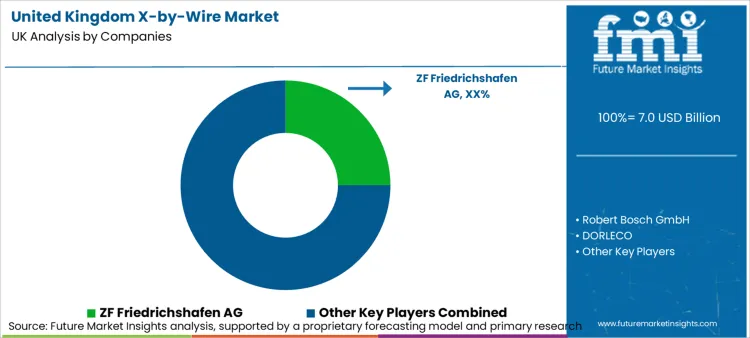
Demand for X-by-wire systems in the UK is driven by automotive innovation, particularly in electric vehicles (EVs) and autonomous driving technologies. Manufacturers focus on reducing weight, enhancing system reliability, and providing precise control for advanced steering, braking, and transmission systems. Buyers assess the robustness of the electronic connections, system responsiveness, safety redundancy, and compatibility with existing vehicle platforms. Procurement behavior tends to favor suppliers with extensive testing capabilities, proven performance in high-stress environments, and the ability to integrate seamlessly with electric and hybrid vehicles. The trend in the UK industry reflects the transition from mechanical linkages toward fully integrated electronic control systems to support next-generation vehicle designs.
ZF Friedrichshafen AG leads competitive positioning through its advanced steering and braking X-by-wire solutions, which integrate seamlessly with electric and autonomous vehicles. Robert Bosch GmbH competes by offering scalable X-by-wire solutions, leveraging its extensive experience in automotive electronics and drive systems. Nexteer Automotive maintains relevance by providing electronic steering systems with high precision and reliability, supporting both passenger and commercial vehicle applications. Forvia (formerly Faurecia) supports demand with X-by-wire components focusing on reducing weight and improving interior space in vehicle cabins. thyssenkrupp AG participates through steering and braking systems that emphasize safety and adaptability to various vehicle architectures. DORLECO remains a specialized player, offering niche solutions with a focus on customization and integration flexibility. Competitive differentiation centers on safety certifications, system integration capabilities, and performance under diverse driving conditions.
Scope of Report
| Items | Values |
|---|---|
| Quantitative Units | USD billion |
| Type | Throttle by Wire; Brake by Wire; Shift by Wire; Steer by Wire; Other by Wire |
| Application | Commercial Vehicles; Passenger Vehicle |
| Regions Covered | England; Scotland; Wales; Northern Ireland |
| Key Companies Profiled | ZF Friedrichshafen AG; Robert Bosch GmbH; DORLECO; Nexteer Automotive; Forvia; thyssenkrupp AG |
Key Industry Participants
- ZF Friedrichshafen AG
- Robert Bosch GmbH
- DORLECO
- Nexteer Automotive
- Forvia
- thyssenkrupp AG
X-by-Wire Demand in the UK by Segments
Type:
- Throttle by Wire
- Brake by Wire
- Shift by Wire
- Steer by Wire
- Other by Wire
Application:
- Commercial Vehicles
- Passenger Vehicle
By Region
- England
- Scotland
- Wales
- Northern Ireland
Bibliography
- Department for Transport. (2024). Vehicle type approval, automated vehicle technologies, and electronic control system requirements. UK Government.
- United Nations Economic Commission for Europe. (2023). UN Regulation No. 79: Steering equipment requirements for electronically controlled systems. UNECE.
- United Nations Economic Commission for Europe. (2023). UN Regulation No. 13-H: Braking systems and electronic brake control integration. UNECE.
- International Organization for Standardization. (2023). ISO 26262: Road vehicles - Functional safety (2nd ed., confirmed updates). ISO.
- International Organization for Standardization. (2024). ISO 21448: Safety of the intended functionality (SOTIF) for electronically controlled vehicle systems. ISO.
- European Commission. (2023). General Safety Regulation (EU) 2019/2144: Application to electronically controlled steering and braking systems. European Union.
Frequently Asked Questions
How big is the X-by-Wire industry in the UK in 2026?
The X-by-Wire industry in the UK is projected to be valued at USD 7.0 billion in 2026.
What will be the size of the X-by-Wire industry in the UK in 2036?
The industry size for X-by-Wire in the UK is projected to reach USD 33.4 billion by 2036.
How much will the demand for X-by-Wire in the UK grow between 2026 and 2036?
Demand for X-by-Wire in the UK is projected to grow at a 16.8% CAGR between 2026 and 2036.
Which product type holds a significant share in the X-by-Wire industry in the UK in 2026?
In terms of product type, throttle by wire is expected to account for a 27.2% share in 2026.
Which application contributes a major share in the X-by-Wire industry in the UK in 2026?
The commercial vehicles segment is expected to account for 64.4% of the X-by-Wire industry in the UK in 2026.
Preview the report firsthand - request a free sample
Get SampleGet the brochure for pricing and purchase details.
Get PDFTable of Content
- Executive Summary
- UK Market Outlook
- Demand-side Trends
- Supply-side Trends
- Technology Roadmap Analysis
- Analysis and Recommendations
- Market Overview
- Market Coverage / Taxonomy
- Market Definition / Scope / Limitations
- Research Methodology
- Chapter Orientation
- Analytical Lens and Working Hypotheses
- Market Structure, Signals, and Trend Drivers
- Benchmarking and Cross-market Comparability
- Market Sizing, Forecasting, and Opportunity Mapping
- Research Design and Evidence Framework
- Desk Research Programme (Secondary Evidence)
- Company Annual and Sustainability Reports
- Peer-reviewed Journals and Academic Literature
- Corporate Websites, Product Literature, and Technical Notes
- Earnings Decks and Investor Briefings
- Statutory Filings and Regulatory Disclosures
- Technical White Papers and Standards Notes
- Trade Journals, Industry Magazines, and Analyst Briefs
- Conference Proceedings, Webinars, and Seminar Materials
- Government Statistics Portals and Public Data Releases
- Press Releases and Reputable Media Coverage
- Specialist Newsletters and Curated Briefings
- Sector Databases and Reference Repositories
- Roots Internal Knowledge Base and Historical Datasets
- Subscription Datasets and Paid Sources
- Social Channels, Communities, and Digital Listening Inputs
- Additional Desk Sources
- Expert Input and Fieldwork (Primary Evidence)
- Primary Modes
- Qualitative Interviews and Expert Elicitation
- Quantitative Surveys and Structured Data Capture
- Blended A7oach
- Why Primary Evidence is Used
- Field Techniques
- Interviews
- Surveys
- Focus Groups
- Observational and In-context Research
- Social and Community Interactions
- Stakeholder Universe Engaged
- C-suite Leaders
- Board Members
- Presidents and Vice Presidents
- R&D and Innovation Heads
- Technical Specialists
- Domain Subject-matter Experts
- Scientists
- Physicians and Other Healthcare Professionals
- Governance, Ethics, and Data Stewardship
- Research Ethics
- Data Integrity and Handling
- Primary Modes
- Tooling, Models, and Reference Databases
- Desk Research Programme (Secondary Evidence)
- Data Engineering and Model Build
- Data Acquisition and Ingestion
- Cleaning, Normalisation, and Verification
- Synthesis, Triangulation, and Analysis
- Quality Assurance and Audit Trail
- Market Background
- Market Dynamics
- Drivers
- Restraints
- Opportunity
- Trends
- Scenario Forecast
- Demand in Optimistic Scenario
- Demand in Likely Scenario
- Demand in Conservative Scenario
- Opportunity Map Analysis
- Product Life Cycle Analysis
- Supply Chain Analysis
- Investment Feasibility Matrix
- Value Chain Analysis
- PESTLE and Porter’s Analysis
- Regulatory Landscape
- Regional Parent Market Outlook
- Production and Consumption Statistics
- Import and Export Statistics
- Market Dynamics
- UK Market Analysis 2021 to 2025 and Forecast, 2026 to 2036
- Historical Market Size Value (USD Million) Analysis, 2021 to 2025
- Current and Future Market Size Value (USD Million) Projections, 2026 to 2036
- Y-o-Y Growth Trend Analysis
- Absolute $ Opportunity Analysis
- UK Market Pricing Analysis 2021 to 2025 and Forecast 2026 to 2036
- UK Market Analysis 2021 to 2025 and Forecast 2026 to 2036, By Type
- Introduction / Key Findings
- Historical Market Size Value (USD Million) Analysis By Type , 2021 to 2025
- Current and Future Market Size Value (USD Million) Analysis and Forecast By Type , 2026 to 2036
- Throttle by Wire
- Brake by Wire
- Shift by Wire
- Steer by Wire
- Other by Wire
- Throttle by Wire
- Y-o-Y Growth Trend Analysis By Type , 2021 to 2025
- Absolute $ Opportunity Analysis By Type , 2026 to 2036
- UK Market Analysis 2021 to 2025 and Forecast 2026 to 2036, By Application
- Introduction / Key Findings
- Historical Market Size Value (USD Million) Analysis By Application, 2021 to 2025
- Current and Future Market Size Value (USD Million) Analysis and Forecast By Application, 2026 to 2036
- Commercial Vehicles
- Passenger Vehicle
- Commercial Vehicles
- Y-o-Y Growth Trend Analysis By Application, 2021 to 2025
- Absolute $ Opportunity Analysis By Application, 2026 to 2036
- Market Structure Analysis
- Competition Dashboard
- Competition Benchmarking
- Market Share Analysis of Top Players
- By Regional
- By Type
- By Application
- Competition Analysis
- Competition Deep Dive
- ZF Friedrichshafen AG
- Overview
- Product Portfolio
- Profitability by Market Segments (Product/Age /Sales Channel/Region)
- Sales Footprint
- Strategy Overview
- Marketing Strategy
- Product Strategy
- Channel Strategy
- Robert Bosch GmbH
- DORLECO
- Nexteer Automotive
- Forvia
- thyssenkrupp AG
- ZF Friedrichshafen AG
- Competition Deep Dive
- Assumptions & Acronyms Used


