

- Industry Size (2025)
- USD 5.4 Bn
- Forecast (2035)
- USD 10.3 Bn
- CAGR (2025 to 2035)
- 6.6%
Chronic Lymphocytic Leukemia Therapeutics Market Size and Share Forecast Outlook 2025 to 2035
The Chronic Lymphocytic Leukemia Therapeutics Market is estimated to be valued at USD 5.4 billion in 2025 and is projected to reach USD 10.3 billion by 2035, registering a compound annual growth rate (CAGR) of 6.6% over the forecast period.
Quick Stats for Chronic Lymphocytic Leukemia Therapeutics Market
- Chronic Lymphocytic Leukemia Therapeutics Market Value (2025): USD 5.4 billion
- Chronic Lymphocytic Leukemia Therapeutics Market Forecast Value (2035): USD 10.3 billion
- Chronic Lymphocytic Leukemia Therapeutics Market Forecast CAGR: 6.6%
- Leading Segment in Chronic Lymphocytic Leukemia Therapeutics Market in 2025: Targeted Therapy (55.2%)
- Key Growth Regions in Chronic Lymphocytic Leukemia Therapeutics Market: North America, Asia-Pacific, Europe
- Top Key Players in Chronic Lymphocytic Leukemia Therapeutics Market: AbbVie, AstraZeneca, F. Hoffmann-La Roche, Gilead Sciences, Novartis, BeiGene, Eli Lilly, Sanofi, Teva Pharmaceutical, Ono Pharmaceutical, Incyte, Astellas Pharma, Secura Bio
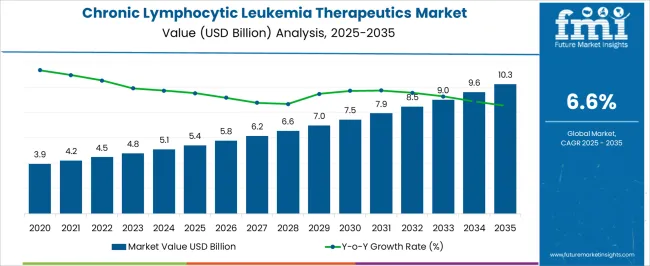
Chronic Lymphocytic Leukemia Therapeutics Market Key Takeaways
| Metric | Value |
|---|---|
| Chronic Lymphocytic Leukemia Therapeutics Market Estimated Value in (2025 E) | USD 5.4 billion |
| Chronic Lymphocytic Leukemia Therapeutics Market Forecast Value in (2035 F) | USD 10.3 billion |
| Forecast CAGR (2025 to 2035) | 6.6% |
Why is the Chronic Lymphocytic Leukemia Therapeutics Market Growing?
The chronic lymphocytic leukemia therapeutics market is experiencing significant growth, driven by the increasing prevalence of CLL, particularly among aging populations in developed and emerging economies. Rising awareness, early diagnosis, and advanced treatment options are supporting expanded adoption of targeted therapies and personalized medicine approaches. Continuous innovations in drug development, including molecularly targeted inhibitors and immunotherapies, are improving patient survival rates and treatment tolerability, thereby encouraging higher market uptake.
Oral formulations and less invasive treatment regimens are further contributing to patient compliance and preference. Additionally, the market is being shaped by substantial investments in clinical trials, R&D initiatives, and strategic collaborations among pharmaceutical companies aiming to introduce next-generation therapies.
Health care infrastructure improvements and growing reimbursement coverage for advanced CLL treatments are enhancing accessibility and affordability With an increasing focus on precision medicine, reduced treatment-related toxicity, and extended patient lifespans, the market is expected to witness sustained expansion in the coming years, offering multiple growth opportunities for manufacturers and healthcare providers.
Segmental Analysis
The chronic lymphocytic leukemia therapeutics market is segmented by treatment type, route of administration, end-users, distribution channel, and geographic regions. By treatment type, chronic lymphocytic leukemia therapeutics market is divided into Targeted Therapy and Chemotherapy. In terms of route of administration, chronic lymphocytic leukemia therapeutics market is classified into Oral and Parenteral. Based on end-users, chronic lymphocytic leukemia therapeutics market is segmented into Hospitals, Homecare, and Specialty Clinics. By distribution channel, chronic lymphocytic leukemia therapeutics market is segmented into Hospital Pharmacy, Online Pharmacy, and Retail Pharmacy. Regionally, the chronic lymphocytic leukemia therapeutics industry is classified into North America, Latin America, Western Europe, Eastern Europe, Balkan & Baltic Countries, Russia & Belarus, Central Asia, East Asia, South Asia & Pacific, and the Middle East & Africa.
Insights into the Targeted Therapy Treatment Type Segment
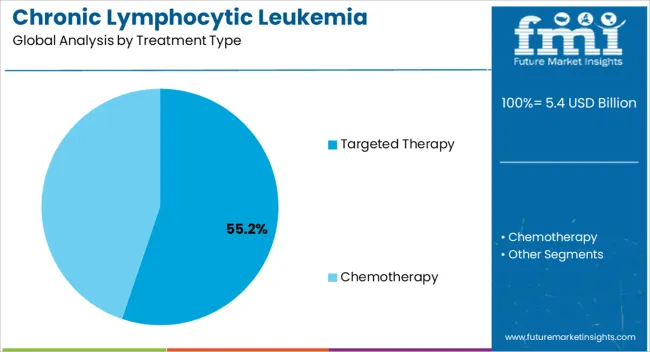
The targeted therapy segment is projected to hold 55.2% of the chronic lymphocytic leukemia therapeutics market revenue share in 2025, establishing it as the leading treatment type. This dominance is being driven by the therapies’ ability to selectively inhibit cancer cell growth while minimizing damage to healthy cells, resulting in improved safety and efficacy profiles.
Continuous advancements in molecular biology and genomic research have enabled the development of highly specific inhibitors and monoclonal antibodies, which are increasingly preferred over conventional chemotherapies. The rising adoption is also supported by their demonstrated effectiveness in treating relapsed or refractory cases and their ability to be combined with other treatment regimens to enhance outcomes.
Improved tolerability and reduced hospitalization requirements make targeted therapies particularly attractive to both patients and healthcare providers As regulatory approvals expand and more therapies enter the market pipeline, the segment is expected to maintain leadership, reflecting the ongoing shift toward personalized and precision oncology treatments for chronic lymphocytic leukemia.
Insights into the Oral Route of Administration Segment
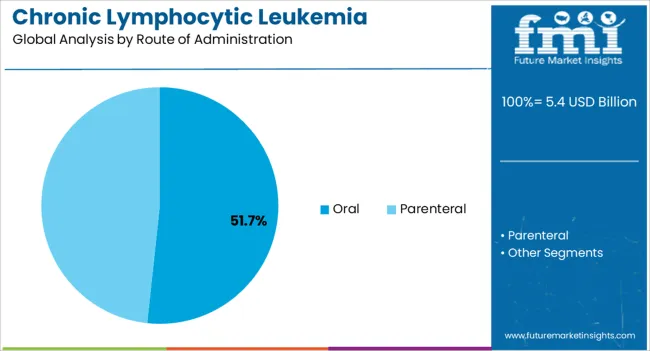
The oral route of administration segment is anticipated to account for 51.7% of the chronic lymphocytic leukemia therapeutics market revenue share in 2025, making it the leading administration method. This dominance is being supported by the convenience, flexibility, and improved patient adherence associated with oral therapies compared to intravenous or injectable options.
Oral treatments allow patients to maintain therapy regimens at home, reducing hospital visits and overall treatment costs while minimizing disruption to daily life. The segment’s growth is further reinforced by the increasing availability of oral targeted inhibitors and combination therapies that demonstrate comparable or superior efficacy to parenteral formulations.
Physicians and healthcare providers are increasingly recommending oral options for eligible patients due to their ease of use, reduced procedural complications, and enhanced quality of life outcomes As patient-centered care and home-based treatment models gain prominence, oral therapeutics are expected to sustain their leading market position, supported by ongoing research, regulatory approvals, and patient preference trends.
Insights into the Hospitals End-User Segment
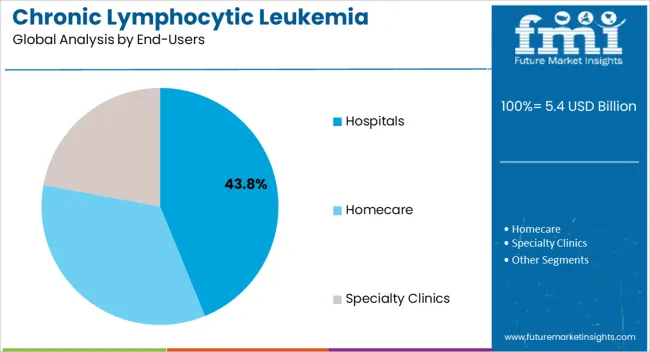
The hospitals end-user segment is expected to hold 43.8% of the chronic lymphocytic leukemia therapeutics market revenue share in 2025, establishing it as the dominant end-user category. This leadership is being driven by hospitals’ capacity to provide comprehensive treatment, monitoring, and supportive care for CLL patients, including access to specialized oncology departments and advanced therapeutic protocols. Hospitals are increasingly serving as primary points of administration for both inpatient and outpatient therapies, facilitating early diagnosis, continuous monitoring, and personalized treatment plans.
The segment’s growth is further reinforced by increasing investment in hospital infrastructure, specialized staff training, and integration of modern treatment technologies. Collaboration with pharmaceutical companies for clinical trials and patient access programs is also supporting hospitals as preferred treatment venues.
Rising patient volumes, especially in urban centers, coupled with the availability of targeted and oral therapies within hospital settings, are sustaining demand As healthcare systems continue to focus on efficient delivery of advanced CLL treatments, hospitals are expected to maintain their leading role as primary end-users in the market.
Market Overview
Chronic Lymphocytic Leukemia Therapeutics Market Overview
When cells in the body grow out of control it leads to cancer. Chronic Lymphocytic Leukemia is also one such type of cancer which begins from white blood cells also called as Lymphocytes formed in the bone marrow. These cells can spread to other parts of the body including liver and lymph node.
This type of cancer is very common in aging population as it is diagnosed at a very later stage. The increasing number of chronic disease amongst aging population is expected to boost the demand of chronic lymphocytic leukemia therapeutics market in near future.
Analysis of Chronic Lymphocytic Leukemia Therapeutics Market By Key Countries
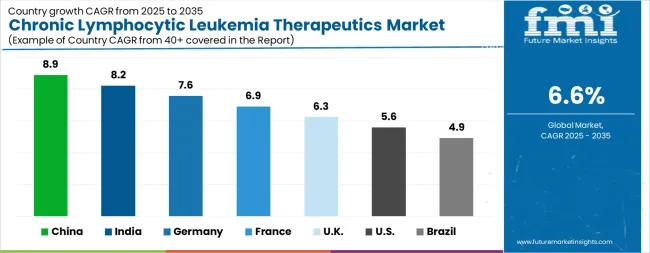
| Country | CAGR |
|---|---|
| China | 8.9% |
| India | 8.2% |
| Germany | 7.6% |
| France | 6.9% |
| UK | 6.3% |
| USA | 5.6% |
| Brazil | 4.9% |
Country-wise Analysis
The Chronic Lymphocytic Leukemia Therapeutics Market is expected to register a CAGR of 6.6% during the forecast period, exhibiting varied country level momentum. China leads with the highest CAGR of 8.9%, followed by India at 8.2%. Developed markets such as Germany, France, and the UK continue to expand steadily, while the USA is likely to grow at consistent rates. Brazil posts the lowest CAGR at 4.9%, yet still underscores a broadly positive trajectory for the global Chronic Lymphocytic Leukemia Therapeutics Market. In 2024, Germany held a dominant revenue in the Western Europe market and is expected to grow with a CAGR of 7.6%. The USA Chronic Lymphocytic Leukemia Therapeutics Market is estimated to be valued at USD 1.9 billion in 2025 and is anticipated to reach a valuation of USD 3.3 billion by 2035. Sales are projected to rise at a CAGR of 5.6% over the forecast period between 2025 and 2035. While Japan and South Korea markets are estimated to be valued at USD 288.6 million and USD 151.0 million respectively in 2025.
Key Players in the Chronic Lymphocytic Leukemia Therapeutics Market
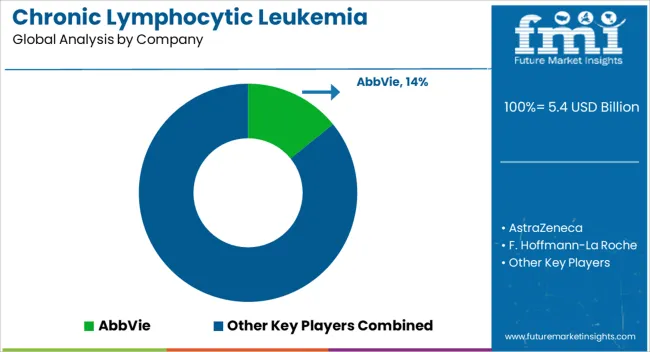
- AbbVie
- AstraZeneca
- F. Hoffmann-La Roche
- Gilead Sciences
- Novartis
- BeiGene
- Eli Lilly
- Sanofi
- Teva Pharmaceutical
- Ono Pharmaceutical
- Incyte
- Astellas Pharma
- Secura Bio
Scope of the Report
| Item | Value |
|---|---|
| Quantitative Units | USD 5.4 Billion |
| Treatment Type | Targeted Therapy and Chemotherapy |
| Route of Administration | Oral and Parenteral |
| End-Users | Hospitals, Homecare, and Specialty Clinics |
| Distribution Channel | Hospital Pharmacy, Online Pharmacy, and Retail Pharmacy |
| Regions Covered | North America, Europe, Asia-Pacific, Latin America, Middle East & Africa |
| Country Covered | United States, Canada, Germany, France, United Kingdom, China, Japan, India, Brazil, South Africa |
| Key Companies Profiled | AbbVie, AstraZeneca, F. Hoffmann-La Roche, Gilead Sciences, Novartis, BeiGene, Eli Lilly, Sanofi, Teva Pharmaceutical, Ono Pharmaceutical, Incyte, Astellas Pharma, and Secura Bio |
Chronic Lymphocytic Leukemia Therapeutics Market by Segments
Treatment Type:
- Targeted Therapy
- Chemotherapy
Route of Administration:
- Oral
- Parenteral
End-Users:
- Hospitals
- Homecare
- Specialty Clinics
Distribution Channel:
- Hospital Pharmacy
- Online Pharmacy
- Retail Pharmacy
Region:
- North America
- USA
- Canada
- Mexico
- Latin America
- Brazil
- Chile
- Rest of Latin America
- Western Europe
- Germany
- UK
- Italy
- Spain
- France
- Nordic
- BENELUX
- Rest of Western Europe
- Eastern Europe
- Russia
- Poland
- Hungary
- Balkan & Baltic
- Rest of Eastern Europe
- East Asia
- China
- Japan
- South Korea
- South Asia and Pacific
- India
- ASEAN
- Australia & New Zealand
- Rest of South Asia and Pacific
- Middle East & Africa
- Kingdom of Saudi Arabia
- Other GCC Countries
- Turkiye
- South Africa
- Other African Union
- Rest of Middle East & Africa
Frequently Asked Questions
How big is the chronic lymphocytic leukemia therapeutics market in 2025?
The global chronic lymphocytic leukemia therapeutics market is estimated to be valued at USD 5.4 billion in 2025.
What will be the size of chronic lymphocytic leukemia therapeutics market in 2035?
The market size for the chronic lymphocytic leukemia therapeutics market is projected to reach USD 10.3 billion by 2035.
How much will be the chronic lymphocytic leukemia therapeutics market growth between 2025 and 2035?
The chronic lymphocytic leukemia therapeutics market is expected to grow at a 6.6% CAGR between 2025 and 2035.
What are the key product types in the chronic lymphocytic leukemia therapeutics market?
The key product types in chronic lymphocytic leukemia therapeutics market are targeted therapy and chemotherapy.
Which route of administration segment to contribute significant share in the chronic lymphocytic leukemia therapeutics market in 2025?
In terms of route of administration, oral segment to command 51.7% share in the chronic lymphocytic leukemia therapeutics market in 2025.
Preview the report firsthand - request a free sample
Get SampleGet the brochure for pricing and purchase details.
Get PDFTable of Content
- Executive Summary
- Global Market Outlook
- Demand-side Trends
- Supply-side Trends
- Technology Roadmap Analysis
- Analysis and Recommendations
- Market Overview
- Market Coverage / Taxonomy
- Market Definition / Scope / Limitations
- Market Background
- Market Dynamics
- Drivers
- Restraints
- Opportunity
- Trends
- Scenario Forecast
- Demand in Optimistic Scenario
- Demand in Likely Scenario
- Demand in Conservative Scenario
- Opportunity Map Analysis
- Product Life Cycle Analysis
- Supply Chain Analysis
- Investment Feasibility Matrix
- Value Chain Analysis
- PESTLE and Porter’s Analysis
- Regulatory Landscape
- Regional Parent Market Outlook
- Production and Consumption Statistics
- Import and Export Statistics
- Market Dynamics
- Global Market Analysis 2020 to 2024 and Forecast, 2025 to 2035
- Historical Market Size Value (USD Million) Analysis, 2020 to 2024
- Current and Future Market Size Value (USD Million) Projections, 2025 to 2035
- Y-o-Y Growth Trend Analysis
- Absolute $ Opportunity Analysis
- Global Market Pricing Analysis 2020 to 2024 and Forecast 2025 to 2035
- Global Market Analysis 2020 to 2024 and Forecast 2025 to 2035, By Treatment Type
- Introduction / Key Findings
- Historical Market Size Value (USD Million) Analysis By Treatment Type , 2020 to 2024
- Current and Future Market Size Value (USD Million) Analysis and Forecast By Treatment Type , 2025 to 2035
- Targeted Therapy
- Chemotherapy
- Y-o-Y Growth Trend Analysis By Treatment Type , 2020 to 2024
- Absolute $ Opportunity Analysis By Treatment Type , 2025 to 2035
- Global Market Analysis 2020 to 2024 and Forecast 2025 to 2035, By Route of Administration
- Introduction / Key Findings
- Historical Market Size Value (USD Million) Analysis By Route of Administration, 2020 to 2024
- Current and Future Market Size Value (USD Million) Analysis and Forecast By Route of Administration, 2025 to 2035
- Oral
- Parenteral
- Y-o-Y Growth Trend Analysis By Route of Administration, 2020 to 2024
- Absolute $ Opportunity Analysis By Route of Administration, 2025 to 2035
- Global Market Analysis 2020 to 2024 and Forecast 2025 to 2035, By End-Users
- Introduction / Key Findings
- Historical Market Size Value (USD Million) Analysis By End-Users, 2020 to 2024
- Current and Future Market Size Value (USD Million) Analysis and Forecast By End-Users, 2025 to 2035
- Hospitals
- Homecare
- Specialty Clinics
- Y-o-Y Growth Trend Analysis By End-Users, 2020 to 2024
- Absolute $ Opportunity Analysis By End-Users, 2025 to 2035
- Global Market Analysis 2020 to 2024 and Forecast 2025 to 2035, By Distribution Channel
- Introduction / Key Findings
- Historical Market Size Value (USD Million) Analysis By Distribution Channel, 2020 to 2024
- Current and Future Market Size Value (USD Million) Analysis and Forecast By Distribution Channel, 2025 to 2035
- Hospital Pharmacy
- Online Pharmacy
- Retail Pharmacy
- Y-o-Y Growth Trend Analysis By Distribution Channel, 2020 to 2024
- Absolute $ Opportunity Analysis By Distribution Channel, 2025 to 2035
- Global Market Analysis 2020 to 2024 and Forecast 2025 to 2035, By Region
- Introduction
- Historical Market Size Value (USD Million) Analysis By Region, 2020 to 2024
- Current Market Size Value (USD Million) Analysis and Forecast By Region, 2025 to 2035
- North America
- Latin America
- Western Europe
- Eastern Europe
- East Asia
- South Asia and Pacific
- Middle East & Africa
- Market Attractiveness Analysis By Region
- North America Market Analysis 2020 to 2024 and Forecast 2025 to 2035, By Country
- Historical Market Size Value (USD Million) Trend Analysis By Market Taxonomy, 2020 to 2024
- Market Size Value (USD Million) Forecast By Market Taxonomy, 2025 to 2035
- By Country
- USA
- Canada
- Mexico
- By Treatment Type
- By Route of Administration
- By End-Users
- By Distribution Channel
- By Country
- Market Attractiveness Analysis
- By Country
- By Treatment Type
- By Route of Administration
- By End-Users
- By Distribution Channel
- Key Takeaways
- Latin America Market Analysis 2020 to 2024 and Forecast 2025 to 2035, By Country
- Historical Market Size Value (USD Million) Trend Analysis By Market Taxonomy, 2020 to 2024
- Market Size Value (USD Million) Forecast By Market Taxonomy, 2025 to 2035
- By Country
- Brazil
- Chile
- Rest of Latin America
- By Treatment Type
- By Route of Administration
- By End-Users
- By Distribution Channel
- By Country
- Market Attractiveness Analysis
- By Country
- By Treatment Type
- By Route of Administration
- By End-Users
- By Distribution Channel
- Key Takeaways
- Western Europe Market Analysis 2020 to 2024 and Forecast 2025 to 2035, By Country
- Historical Market Size Value (USD Million) Trend Analysis By Market Taxonomy, 2020 to 2024
- Market Size Value (USD Million) Forecast By Market Taxonomy, 2025 to 2035
- By Country
- Germany
- UK
- Italy
- Spain
- France
- Nordic
- BENELUX
- Rest of Western Europe
- By Treatment Type
- By Route of Administration
- By End-Users
- By Distribution Channel
- By Country
- Market Attractiveness Analysis
- By Country
- By Treatment Type
- By Route of Administration
- By End-Users
- By Distribution Channel
- Key Takeaways
- Eastern Europe Market Analysis 2020 to 2024 and Forecast 2025 to 2035, By Country
- Historical Market Size Value (USD Million) Trend Analysis By Market Taxonomy, 2020 to 2024
- Market Size Value (USD Million) Forecast By Market Taxonomy, 2025 to 2035
- By Country
- Russia
- Poland
- Hungary
- Balkan & Baltic
- Rest of Eastern Europe
- By Treatment Type
- By Route of Administration
- By End-Users
- By Distribution Channel
- By Country
- Market Attractiveness Analysis
- By Country
- By Treatment Type
- By Route of Administration
- By End-Users
- By Distribution Channel
- Key Takeaways
- East Asia Market Analysis 2020 to 2024 and Forecast 2025 to 2035, By Country
- Historical Market Size Value (USD Million) Trend Analysis By Market Taxonomy, 2020 to 2024
- Market Size Value (USD Million) Forecast By Market Taxonomy, 2025 to 2035
- By Country
- China
- Japan
- South Korea
- By Treatment Type
- By Route of Administration
- By End-Users
- By Distribution Channel
- By Country
- Market Attractiveness Analysis
- By Country
- By Treatment Type
- By Route of Administration
- By End-Users
- By Distribution Channel
- Key Takeaways
- South Asia and Pacific Market Analysis 2020 to 2024 and Forecast 2025 to 2035, By Country
- Historical Market Size Value (USD Million) Trend Analysis By Market Taxonomy, 2020 to 2024
- Market Size Value (USD Million) Forecast By Market Taxonomy, 2025 to 2035
- By Country
- India
- ASEAN
- Australia & New Zealand
- Rest of South Asia and Pacific
- By Treatment Type
- By Route of Administration
- By End-Users
- By Distribution Channel
- By Country
- Market Attractiveness Analysis
- By Country
- By Treatment Type
- By Route of Administration
- By End-Users
- By Distribution Channel
- Key Takeaways
- Middle East & Africa Market Analysis 2020 to 2024 and Forecast 2025 to 2035, By Country
- Historical Market Size Value (USD Million) Trend Analysis By Market Taxonomy, 2020 to 2024
- Market Size Value (USD Million) Forecast By Market Taxonomy, 2025 to 2035
- By Country
- Kingdom of Saudi Arabia
- Other GCC Countries
- Turkiye
- South Africa
- Other African Union
- Rest of Middle East & Africa
- By Treatment Type
- By Route of Administration
- By End-Users
- By Distribution Channel
- By Country
- Market Attractiveness Analysis
- By Country
- By Treatment Type
- By Route of Administration
- By End-Users
- By Distribution Channel
- Key Takeaways
- Key Countries Market Analysis
- USA
- Pricing Analysis
- Market Share Analysis, 2024
- By Treatment Type
- By Route of Administration
- By End-Users
- By Distribution Channel
- Canada
- Pricing Analysis
- Market Share Analysis, 2024
- By Treatment Type
- By Route of Administration
- By End-Users
- By Distribution Channel
- Mexico
- Pricing Analysis
- Market Share Analysis, 2024
- By Treatment Type
- By Route of Administration
- By End-Users
- By Distribution Channel
- Brazil
- Pricing Analysis
- Market Share Analysis, 2024
- By Treatment Type
- By Route of Administration
- By End-Users
- By Distribution Channel
- Chile
- Pricing Analysis
- Market Share Analysis, 2024
- By Treatment Type
- By Route of Administration
- By End-Users
- By Distribution Channel
- Germany
- Pricing Analysis
- Market Share Analysis, 2024
- By Treatment Type
- By Route of Administration
- By End-Users
- By Distribution Channel
- UK
- Pricing Analysis
- Market Share Analysis, 2024
- By Treatment Type
- By Route of Administration
- By End-Users
- By Distribution Channel
- Italy
- Pricing Analysis
- Market Share Analysis, 2024
- By Treatment Type
- By Route of Administration
- By End-Users
- By Distribution Channel
- Spain
- Pricing Analysis
- Market Share Analysis, 2024
- By Treatment Type
- By Route of Administration
- By End-Users
- By Distribution Channel
- France
- Pricing Analysis
- Market Share Analysis, 2024
- By Treatment Type
- By Route of Administration
- By End-Users
- By Distribution Channel
- India
- Pricing Analysis
- Market Share Analysis, 2024
- By Treatment Type
- By Route of Administration
- By End-Users
- By Distribution Channel
- ASEAN
- Pricing Analysis
- Market Share Analysis, 2024
- By Treatment Type
- By Route of Administration
- By End-Users
- By Distribution Channel
- Australia & New Zealand
- Pricing Analysis
- Market Share Analysis, 2024
- By Treatment Type
- By Route of Administration
- By End-Users
- By Distribution Channel
- China
- Pricing Analysis
- Market Share Analysis, 2024
- By Treatment Type
- By Route of Administration
- By End-Users
- By Distribution Channel
- Japan
- Pricing Analysis
- Market Share Analysis, 2024
- By Treatment Type
- By Route of Administration
- By End-Users
- By Distribution Channel
- South Korea
- Pricing Analysis
- Market Share Analysis, 2024
- By Treatment Type
- By Route of Administration
- By End-Users
- By Distribution Channel
- Russia
- Pricing Analysis
- Market Share Analysis, 2024
- By Treatment Type
- By Route of Administration
- By End-Users
- By Distribution Channel
- Poland
- Pricing Analysis
- Market Share Analysis, 2024
- By Treatment Type
- By Route of Administration
- By End-Users
- By Distribution Channel
- Hungary
- Pricing Analysis
- Market Share Analysis, 2024
- By Treatment Type
- By Route of Administration
- By End-Users
- By Distribution Channel
- Kingdom of Saudi Arabia
- Pricing Analysis
- Market Share Analysis, 2024
- By Treatment Type
- By Route of Administration
- By End-Users
- By Distribution Channel
- Turkiye
- Pricing Analysis
- Market Share Analysis, 2024
- By Treatment Type
- By Route of Administration
- By End-Users
- By Distribution Channel
- South Africa
- Pricing Analysis
- Market Share Analysis, 2024
- By Treatment Type
- By Route of Administration
- By End-Users
- By Distribution Channel
- USA
- Market Structure Analysis
- Competition Dashboard
- Competition Benchmarking
- Market Share Analysis of Top Players
- By Regional
- By Treatment Type
- By Route of Administration
- By End-Users
- By Distribution Channel
- Competition Analysis
- Competition Deep Dive
- AbbVie
- Overview
- Product Portfolio
- Profitability by Market Segments (Product/Age /Sales Channel/Region)
- Sales Footprint
- Strategy Overview
- Marketing Strategy
- Product Strategy
- Channel Strategy
- AstraZeneca
- F. Hoffmann-La Roche
- Gilead Sciences
- Novartis
- BeiGene
- Eli Lilly
- Sanofi
- Teva Pharmaceutical
- Ono Pharmaceutical
- Incyte
- Astellas Pharma
- Secura Bio
- AbbVie
- Competition Deep Dive
- Assumptions & Acronyms Used
- Research Methodology


