

- Market Size (2026)
- USD 1.5 Bn
- Forecast (2036)
- USD 4.4 Bn
- CAGR (2026 to 2036)
- 11.4%
How big is the Chronic Myelomonocytic Leukemia Market in 2026?
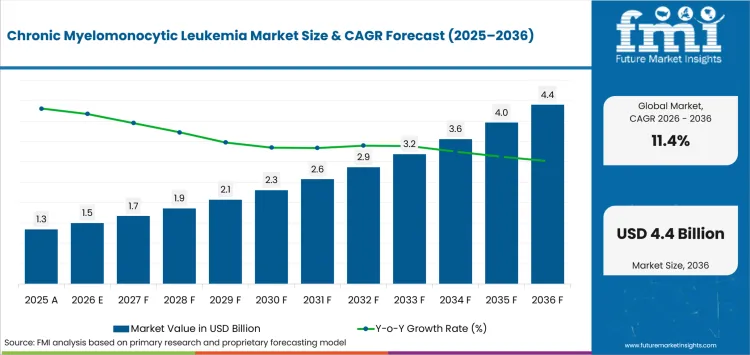
USD 1.5 billion in 2026 and USD 4.4 billion by 2036 at an 11.4% CAGR.
Sales in the chronic myelomonocytic leukemia market are projected to increase from USD 1.5 billion in 2026 to USD 4.4 billion by 2036 at an 11.4% CAGR. Specialist pathways connect repeated treatment with leukemia therapeutics and continuing laboratory monitoring across tertiary hospitals.
CMML rarity concentrates diagnosis and treatment within experienced hematology centers that coordinate marrow assessment with supportive care. The American Cancer Society reported in March 2025 that one or two people per 100,000 develop CMML annually. Limited case volume raises referral and recruitment costs across hematology diagnostics networks and trial programs.
Key Takeaways of Chronic Myelomonocytic Leukemia Market
- Repeated treatment cycles and serial blood monitoring sustain demand across chronic-phase and higher-risk CMML care.
- Hypomethylating agents are projected to represent 42.0% of treatment type demand in 2026 due to established dosing routines.
- CMML-1 is estimated to account for 39.0% of application demand in 2026 as lower-blast disease requires continuing surveillance and repeated treatment review.
- Hospitals are forecast to capture 41.0% of end user demand in 2026 through integrated hematology and supportive-care services.
- Rare patient populations and varied disease biology restrict comparative trials across molecular subgroups and slow evidence generation.
- Taiho Oncology, Inc., Bristol Myers Squibb, AbbVie Inc., F. Hoffmann-La Roche Ltd., Incyte Corporation, Kura Oncology, Inc., Jazz Pharmaceuticals plc and Syndax Pharmaceuticals, Inc. cover labeled therapy, exact-CMML studies and transformation-stage treatment.
Analyst Perspective
“Commercial success in CMML depends on the treatment line a therapy can own and the monitoring burden specialist centers must absorb. Strong programs connect molecular selection with practical dosing and a credible route for patients whose disease stops responding to hypomethylating agents.”
- Anurag Sharma, Principal Consultant, Future Market Insights
How is the Chronic Myelomonocytic Leukemia Market segmented?
The chronic myelomonocytic leukemia industry is segmented by treatment type, application, end user, distribution channel, drug class and region.
The chronic myelomonocytic leukemia market is segmented by treatment type, application, end user, distribution channel, drug class and region. Treatment type covers hypomethylating agents, targeted therapy, chemotherapy and stem cell transplantation, while application separates CMML-1, CMML-2, relapsed-refractory disease and acute leukemia transformation. End users include hospitals, cancer centers, specialty clinics and research institutes, while distribution channels span hospital, retail, specialty and online pharmacies and drug classes cover hypomethylating, targeted, cytotoxic and immunomodulatory agents.
Why do hypomethylating agents remain central within the treatment type category?
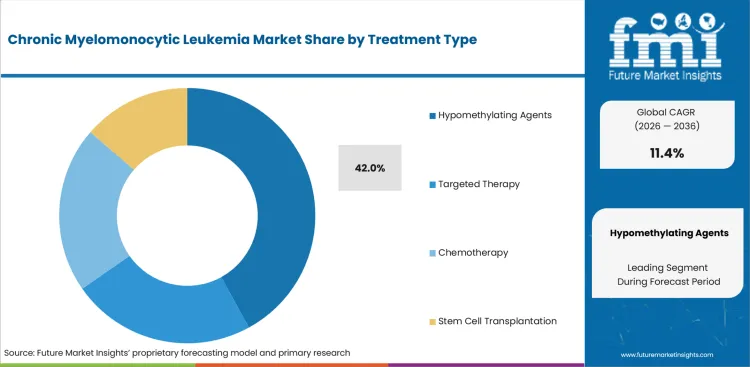
Hypomethylating agents provide the clearest non-transplant route for CMML patients who need repeated specialist treatment. FDA labels include CMML within defined azacitidine and oral decitabine-cedazuridine indications for eligible adult patients. Hospital systems manage comparable generic oncology medicines through recurring cycles and laboratory review, limiting workflow changes for established hypomethylating treatment.
- Hypomethylating agents are set to lead the treatment type category with 42.0% share in 2026 due to established cycle-based treatment routines.
- Oral decitabine-cedazuridine reduces clinic administration for eligible patients without removing laboratory surveillance or specialist dose review. Injectable azacitidine suits care teams needing direct administration and immediate supportive services during each treatment cycle.
Why does CMML-1 account for the largest application share?
CMML-1 covers lower-blast disease that remains under active hematology management through repeated marrow assessment and cancer diagnostics. Extended observation sustains specialist review and recurring pharmacy demand despite lower immediate treatment intensity across care settings.
- Based on application, CMML-1 is projected to account for 39.0% in 2026 due to extended surveillance in lower-blast disease.
- Blast-based classification helps clinicians time treatment changes without shifting stable patients into intensive pathways prematurely. The National Cancer Institute updated its CMML treatment review in May 2025 and retained separate dysplastic or proliferative disease considerations. Those distinctions support different monitoring schedules and treatment decisions across lower-blast CMML populations in practice.
What sustains hospital demand within the end user category?
Hospitals combine marrow assessment with transfusion support and urgent cytopenia management during repeated treatment cycles within blood cancer treatment pathways. The March 2026 AVENHIR registry update records multicenter hospital participation in a higher-risk CMML combination study. Participating sites require frequent laboratory surveillance and coordinated adverse-event management throughout repeated combination treatment cycles.
- The end user category is forecast to be led by hospitals at 41.0% share in 2026 due to integrated specialist services.
- Cancer centers concentrate trial-eligible and transplant-ready patients through dedicated protocol teams and molecular testing resources. Specialty clinics manage stable follow-up but refer acute complications and complex treatment changes to hospital hematology units.
Why do hospital pharmacies lead the distribution channel category?
Hospital pharmacies work beside prescribing teams that adjust doses through blood counts and toxicity reviews within specialist systems. Their controlled supply routes support injectable administration and rapid access to supportive medicines across wide service areas between cycles.
- By distribution channel, hospital pharmacies are forecast to represent 43.0% in 2026 driven by repeated dosing and laboratory-led adjustments.
- Specialty pharmacies support oral regimens through adherence programs and regulated e-pharmacy services that coordinate delivery between scheduled hospital visits across regions. Retail and online channels remain secondary since urgent dose changes require current laboratory results and direct hematology coordination.
What are the drivers, restraints and opportunities in the Chronic Myelomonocytic Leukemia Market?
Established hypomethylating pathways sustain repeated treatment, rare disease biology limits comparative evidence and molecularly defined failure settings support targeted development.
- Driver: Labeled hypomethylating therapies support recurring treatment cycles through established dosing and specialist monitoring routines.
- Restraint: Small patient populations and biological variation slow recruitment and weaken comparisons across treatment studies.
- Opportunity: Post-hypomethylating failure and mutation-defined disease provide focused settings for combination or targeted development programs.
Labeled oral and injectable regimens give hematology teams predictable cycle schedules and familiar monitoring requirements. Hospital pharmacies can plan orphan drug inventory around scheduled treatment dates and current laboratory results.
CMML combines dysplastic and proliferative biology that produces different treatment goals across a small patient population. FDA draft guidance from July 2025 classifies CMML separately from MDS development, requiring sponsors to generate disease-specific evidence instead of relying on broader myelodysplastic syndrome treatment results.
Post-hypomethylating failure defines a recognizable population for targeted combinations and transplant-linked treatment decisions within specialist care. ClinicalTrials.gov updated NCT04550442 in June 2026 for venetoclax plus azacitidine in relapsed or refractory high-risk MDS or CMML. Programs that pair a defined prior-treatment setting with measurable response criteria can support clearer recruitment and hematopoietic stem cell transplantation decisions.
Which country CAGRs are profiled in the Chronic Myelomonocytic Leukemia Market?
| Country | CAGR |
|---|---|
| United States | 11.9% |
| Japan | 11.7% |
| Germany | 11.6% |
| United Kingdom | 11.4% |
| Canada | 11.2% |
How do country-level CAGRs compare in the Chronic Myelomonocytic Leukemia Market?
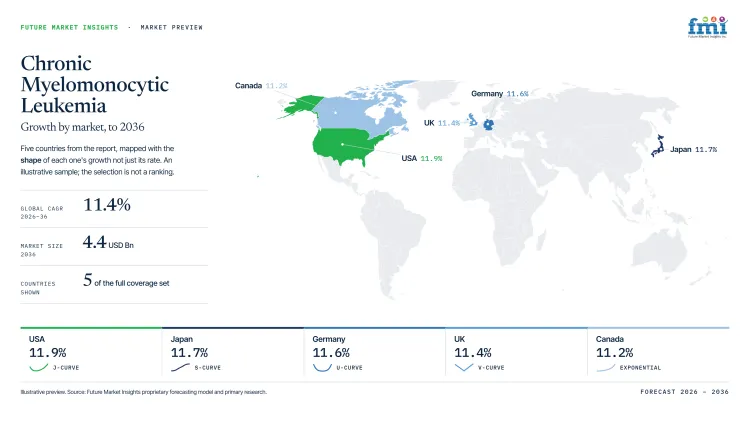
The country CAGRs span 0.7 percentage points and describe forecast pace instead of current market size. Small gaps commercially conceal different reimbursement routes and specialist access requirements across national healthcare systems.
- The United States and Japan differ by 0.2 percentage point as American networks support broader specialist referrals.
- Japan and Germany differ by 0.1 percentage point despite distinct regulatory review and hospital concentration.
- Germany and the United Kingdom differ by 0.2 percentage point as formal benefit assessment shapes access.
- The United Kingdom matches the global CAGR through coordinated hematology pathways and centralized reimbursement decisions.
- Canada records the lower displayed pace as provincial funding determines access following federal authorization decisions.
Comparable CAGRs can produce materially different market entry conditions across reimbursement systems and specialist treatment networks. The full report provides country-level CAGR analysis across North America, Latin America, Europe, East Asia, South Asia and Pacific, and the Middle East and Africa.
Country-wise Analysis
- United States CMML care centers on major leukemia programs that combine marrow assessment with molecular testing, transfusion support and transplant referral for patients needing repeated therapy and recurring treatment review across broad referral territories. The United States is estimated to post 11.9% CAGR over the forecast period, supported by established specialist networks and active rare-disease research across several regions for mutation-defined patients with dedicated molecular testing. ClinicalTrials.gov updated the Phase 2 ruxolitinib CMML expansion in July 2026 with five participating centers, yet patients outside metropolitan areas face longer travel and fewer trial options for frequent monitoring and dose adjustment.
- Japan relies on metropolitan hematology hospitals that coordinate marrow testing, scheduled azacitidine cycles and clinical research through specialist networks serving patients who need continuing follow-up and supportive care throughout each repeated treatment cycle. The national research registry maintained a multicenter azacitidine combination study involving CMML-2 in April 2026, confirming an established hospital route for protocol-based treatment and coordinated safety monitoring across participating tertiary hospital sites nationwide. Japan's chronic myelomonocytic leukemia outlook is anticipated to advance at 11.7% CAGR over the assessment period, influenced by tertiary expertise and reimbursement despite detailed local dossiers and limited specialist capacity outside major cities.
- Germany combines university leukemia units with regional oncology practices that deliver repeated therapy through statutory insurance and refer complex cases to academic centers for transplant assessment or investigational treatment within formal national referral networks. The 2026 German procedure classification includes oral and parenteral azacitidine administration codes, giving hospitals defined billing routes for established treatment and specialist monitoring across inpatient and outpatient settings during recurring treatment cycles. The German chronic myelomonocytic leukemia sector is projected to record 11.6% CAGR during the assessment period, reinforced by specialist capacity despite formal benefit reviews and negotiated reimbursement for therapies lacking comparative CMML evidence.
- United Kingdom CMML pathways use NHS hematology centers that coordinate diagnosis, repeated treatment and transplant referral across regional cancer networks for patients requiring regular monitoring and transfusion support during recurring hospital-based treatment cycles. Adoption of chronic myelomonocytic leukemia treatment in the United Kingdom is estimated to expand at 11.4% CAGR through 2036, shaped by centralized specialist care and nationally defined access routes across regional NHS networks. NICE recommends azacitidine for defined CMML patients who cannot receive transplantation, although hospital capacity and travel distance can restrict investigational treatment outside academic centers that manage complex protocols and long-term follow-up in practice.
- Canada combines federal authorization with provincial formularies and specialist cancer centers that coordinate oral treatment, laboratory monitoring and supportive care across wide service areas with long travel routes between scheduled visits and remote communities. Health Canada listed INQOVI as marketed in June 2025, confirming an authorized oral route for eligible CMML patients who require repeated specialist supervision and dose review across provincial cancer systems in practice. Chronic myelomonocytic leukemia sales in Canada are forecast to expand at 11.2% CAGR by 2036, aided by established cancer systems despite provincial funding timelines and distance barriers that can delay frequent laboratory review.
Who are the notable companies in the Chronic Myelomonocytic Leukemia Market?
Taiho Oncology, Inc., Bristol Myers Squibb, AbbVie Inc., F. Hoffmann-La Roche Ltd., Incyte Corporation, Kura Oncology, Inc., Jazz Pharmaceuticals plc and Syndax Pharmaceuticals, Inc.
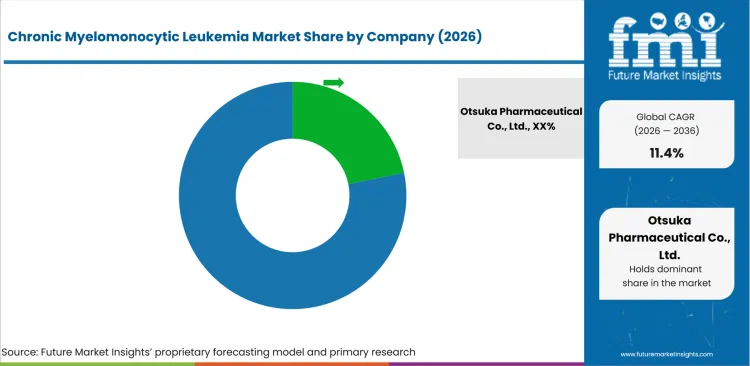
Competition concentrates around labeled hypomethylating platforms that fit hospital treatment pathways and recurring pharmacy supply. Development programs remain fragmented across post-treatment settings and the wider myelodysplastic syndrome treatment field globally. Entry requires rare-disease recruitment, specialist-site access and molecular biomarkers that separate CMML outcomes from broader myeloid disease.
- Taiho Oncology and Bristol Myers Squibb hold direct CMML positions through labeled oral or injectable hypomethylating therapies.
- AbbVie and Roche join Incyte and Syndax in exact-CMML studies using combination or pathway-directed approaches.
- Kura Oncology and Jazz Pharmaceuticals serve transformation-stage pathways through mutation-directed or myelodysplasia-related acute leukemia therapies.
Competitive Benchmarking: Chronic Myelomonocytic Leukemia Market
| Company | CMML Pathway Position | Molecular Selection | Administration Flexibility | Geographic Reach |
|---|---|---|---|---|
| Taiho Oncology, Inc. | High | Low | High | United States and Canada |
| Bristol Myers Squibb | High | Low | Low | United States and Europe |
| AbbVie Inc. | Medium | Medium | Medium | France and United States |
| F. Hoffmann-La Roche Ltd. | Medium | High | High | United States |
| Incyte Corporation | Medium | Medium | High | United States |
| Kura Oncology, Inc. | Low | High | High | United States and Japan |
| Jazz Pharmaceuticals plc | Medium | Low | Low | United States and Europe |
| Syndax Pharmaceuticals, Inc. | Medium | High | Medium | United States |
Key Developments in the Chronic Myelomonocytic Leukemia Market
- In May 2026, Taiho Oncology and Taiho Pharmaceutical announced FDA approval of INQOVI plus venetoclax for newly diagnosed AML among older or intensive-chemotherapy-ineligible adults. The oral combination extends the same hypomethylating platform used within labeled CMML care into a transformation-stage pathway.
- In November 2025, Kura Oncology and Kyowa Kirin announced FDA approval of once-daily oral KOMZIFTI for adults with relapsed or refractory NPM1-mutated AML. The mutation-defined therapy is relevant to CMML patients whose disease transforms into acute leukemia with the same target.
- In October 2025, Syndax Pharmaceuticals announced FDA approval of oral REVUFORJ for relapsed or refractory NPM1-mutated AML in adults and pediatric patients. The approval adds a molecularly selected option within transformation-stage treatment rather than chronic-phase CMML care.
Key Players in the Chronic Myelomonocytic Leukemia Market
CMML Treatment and Combination Developers
- Taiho Oncology, Inc.
- Bristol Myers Squibb
- AbbVie Inc.
- F. Hoffmann-La Roche Ltd.
Exact-CMML Molecular Programs
- Incyte Corporation
- Syndax Pharmaceuticals, Inc.
Transformation-Stage Acute Leukemia Specialists
- Kura Oncology, Inc.
- Jazz Pharmaceuticals plc
Chronic Myelomonocytic Leukemia Market - Report Scope
| Coverage field | Report scope |
|---|---|
| Market breakdown | By treatment type, application, end user, distribution channel, drug class and region. |
| Quantitative Units | Revenue in USD billion and CAGR in %. |
| Market Definition | Medicines and treatment pathways supporting commercial demand for chronic myelomonocytic leukemia across approved and investigational settings. |
| Regions Covered | North America, Latin America, Europe, East Asia, South Asia and Pacific, and Middle East and Africa. |
| Countries Covered | United States, Japan, Germany, United Kingdom, Canada, and 20+ countries included in the full report. |
| Key Companies Profiled | Taiho Oncology, Inc., Bristol Myers Squibb, AbbVie Inc., F. Hoffmann-La Roche Ltd., Incyte Corporation, Kura Oncology, Inc., Jazz Pharmaceuticals plc and Syndax Pharmaceuticals, Inc. |
| Forecast Period | 2026 to 2036. |
| Approach | Primary and secondary research with market triangulation. |
Chronic Myelomonocytic Leukemia Market - Research Methodology
| Method | Approach |
|---|---|
| Primary Research | FMI analysts gathered input from manufacturers, service providers, technology developers, distributors, end users, procurement teams, and subject-matter experts. Interviews examined purchasing decisions, product or service evaluation, adoption barriers, approval requirements, pricing considerations, and expectations for technical or commercial support. Respondents were also asked what evidence is required before a trial, pilot, or initial order develops into regular purchasing. |
| Desk Research | Desk research covered government statistics, regulatory publications, trade data, industry associations, technical literature, standards, company filings, product information, and official corporate announcements. Sources were reviewed for relevance, publication date, geographic coverage, and consistency with the defined market scope. Claims relating to performance, applications, approvals, capacity, investment, and commercial activity were retained only when supported by credible public evidence. |
| Market Sizing and Forecasting | The market model combined the baseline value with historical performance, segment structure, pricing and volume indicators, adoption levels, company participation, and country-level demand conditions. Forecast assumptions considered economic activity, investment trends, regulatory developments, technology adoption, purchasing cycles, supply availability, and barriers to wider market use. Segment and regional estimates were reconciled before the final market total was calculated. |
| Data Validation | Estimates were checked against multiple independent indicators, including public data, company activity, trade patterns, industry developments, and findings from primary interviews. Validation also tested whether products, services, applications, and company revenues fell within the defined market boundaries. Adjacent categories, unsupported claims, overlapping revenues, and activities without direct market relevance were excluded to reduce double counting and maintain consistency across segments and countries. |
Chronic Myelomonocytic Leukemia Market by Segments
Chronic Myelomonocytic Leukemia Market segmented by Treatment Type:
- Hypomethylating Agents
- Azacitidine
- Decitabine
- Targeted Therapy
- IDH Inhibitors
- FLT3 & Other Kinase Inhibitors
- Chemotherapy
- Low-Dose Cytarabine
- Intensive Chemotherapy
- Stem Cell Transplantation
- Allogeneic Stem Cell Transplant
- Reduced-Intensity Conditioning Transplant
Chronic Myelomonocytic Leukemia Market segmented by Application:
- CMML-1
- Low Blast Count CMML
- Chronic Phase CMML
- CMML-2
- High Blast Count CMML
- Advanced CMML
- Relapsed-Refractory CMML
- Post-Hypomethylating Agent Failure
- Progressive Disease
- Transformation to Acute Myeloid Leukemia
- Secondary AML
- High-Risk Disease
Chronic Myelomonocytic Leukemia Market segmented by End User:
- Hospitals
- Tertiary Care Hospitals
- Cancer Specialty Hospitals
- Cancer Centers
- Comprehensive Cancer Centers
- Hematology Centers
- Specialty Clinics
- Hematology Clinics
- Oncology Clinics
- Academic & Research Institutes
- University Hospitals
- Clinical Research Centers
Chronic Myelomonocytic Leukemia Market segmented by Distribution Channel:
- Hospital Pharmacies
- Inpatient Pharmacies
- Outpatient Hospital Pharmacies
- Retail Pharmacies
- Chain Pharmacies
- Independent Pharmacies
- Specialty Pharmacies
- Oncology Specialty Pharmacies
- Hematology Pharmacies
- Online Pharmacies
- E-Pharmacy Platforms
- Home Delivery Services
Chronic Myelomonocytic Leukemia Market segmented by Drug Class:
- Hypomethylating Agents
- Azacitidine
- Decitabine
- Targeted Therapies
- IDH Inhibitors
- BCL-2 Inhibitors
- Cytotoxic Agents
- Cytarabine
- Hydroxyurea
- Immunomodulatory Agents
- Interferons
- Immunostimulatory Therapies
Chronic Myelomonocytic Leukemia Market by Region:
- North America
- United States
- Canada
- Mexico
- Latin America
- Brazil
- Chile
- Rest of Latin America
- Western Europe
- Germany
- United Kingdom
- Italy
- Spain
- France
- Nordics
- Benelux
- Rest of Western Europe
- Eastern Europe
- Russia
- Poland
- Hungary
- Balkan and Baltic States
- Rest of Eastern Europe
- East Asia
- China
- Japan
- South Korea
- South Asia and Pacific
- India
- ASEAN
- Australia and New Zealand
- Rest of South Asia and Pacific
- Middle East and Africa
- Kingdom of Saudi Arabia
- Other GCC Countries
- Türkiye
- South Africa
- Other African Union Countries
- Rest of Middle East and Africa
Research Sources and Bibliography
- American Cancer Society. (2025, March 7). Key Statistics About Chronic Myelomonocytic Leukemia (CMML).
- Taiho Oncology, Inc. (2026, May 13). USA FDA Approves INQOVI® in Combination with Venetoclax, the First All-Oral Combination Treatment for Patients with Acute Myeloid Leukemia Who Are Ineligible for Intensive Induction Chemotherapy.
- USA Food and Drug Administration. (2024). VIDAZA (azacitidine for injection), for subcutaneous or intravenous use.
- USA Food and Drug Administration. (2020, July 7). Search Orphan Drug Designations and Approvals [INQOVI].
- National Cancer Institute. (2025, May 14). Myelodysplastic/Myeloproliferative Neoplasms Treatment (PDQ®)-Health Professional Version.
- ClinicalTrials.gov. (2026, March 5). Azacitidine Combined With Venetoclax in Patients With Higher-risk Chronic Myelomonocytic Leukemia (AVENHIR).
- USA Food and Drug Administration. (2025, July). Myelodysplastic Syndromes: Developing Drug and Biological Products for Treatment Draft Guidance for Industry July 2025.
- ClinicalTrials.gov. (2026, June 5). Venetoclax and Azacitidine for the Treatment of Relapsed or Refractory High-Risk Myelodysplastic Syndrome or Chronic Myelomonocytic Leukemia.
- USA Food and Drug Administration. (2025, February 25). Search Orphan Drug Designations and Approvals [Co-packaged combination of azacitidine and cedazuridine for chronic myelomonocytic leukemia].
- Japan Ministry of Health, Labour and Welfare. (2026, April 1). Study of efficacy and safety of MBG453 in combination with azacitidine in subjects with intermediate, high or very high risk myelodysplastic syndrome or CMML-2.
- Federal Institute for Drugs and Medical Devices. (2026). OPS Version 2026.
- National Institute for Health and Care Excellence. (2011, March 23). Azacitidine for the treatment of myelodysplastic syndromes, chronic myelomonocytic leukaemia and acute myeloid leukaemia.
- Health Canada. (2025, June 4). Product information [INQOVI].
- ClinicalTrials.gov. (2026, April 24). Cobimetinib in Newly Diagnosed or HMA-treated CMML Patients With RAS Pathway Mutations.
- ClinicalTrials.gov. (2026, July 1). Ruxolitinib for the Treatment of Chronic Myelomonocytic Leukemia: A Phase 2 Expansion.
- ClinicalTrials.gov. (2026, January 5). Phase I/II Clinical Trial of Axatilimab in Combination With Ruxolitinib for Patients With Myelofibrosis and Chronic Myelomonocytic Leukemia.
- ClinicalTrials.gov. (2026, May 20). CPX-351 in Treating Patients With Relapsed or Refractory High Risk Myelodysplastic Syndrome or Chronic Myelomonocytic Leukemia.
- Jazz Pharmaceuticals plc. (2026, February 24). 2025 Annual Report on Form 10-K.
- Kura Oncology, Inc. (2025, November 13). Kura Oncology and Kyowa Kirin Announce FDA Approval of KOMZIFTI™ (ziftomenib), the First and Only Once-Daily Targeted Therapy for Adults with Relapsed or Refractory NPM1-Mutated Acute Myeloid Leukemia.
- Syndax Pharmaceuticals, Inc. (2025, October 24). Syndax Announces FDA Approval of Revuforj® (revumenib) in Adult and Pediatric Patients with Relapsed or Refractory NPM1 Mutated Acute Myeloid Leukemia.
- Solu Therapeutics, Inc. (2026, May 27). Solu Therapeutics Granted FDA Fast Track Designation for STX-0712 for Treatment of Chronic Myelomonocytic Leukemia.
- Solu Therapeutics, Inc. (2025, April 9). Solu Therapeutics Closes $41M Series A Financing and Announces First Patient Dosed in Phase 1 Clinical Trial of STX-0712 in Patients with CMML and Other Advanced Hematologic Malignancies.
- ImmuneOnco Biopharmaceuticals (Shanghai) Inc. (2026, July 16). ImmuneOnco Completes planned Enrollment of 173 Patients in Phase III Registrational Trial of Timdarpacept (IMM01) for CMML.
This bibliography is provided for reader reference and is not exhaustive. The full report contains the complete reference list and detailed citations.
This Report Answers
- How large is the chronic myelomonocytic leukemia market in 2026 and 2036?
- Which operating conditions support repeated CMML treatment across specialist care pathways?
- Which treatment type accounts for the 42.0% share in 2026?
- How does application severity change monitoring and treatment intensity?
- Why do hospitals and hospital pharmacies retain substantial category shares?
- How do country growth rates differ across the five profiled healthcare systems?
- Which companies hold labeled therapy or exact-CMML development positions?
- What limits evidence generation and defines post-hypomethylating development routes?
Frequently Asked Questions
How big is the chronic myelomonocytic leukemia market in 2026?
The chronic myelomonocytic leukemia market is valued at USD 1.5 billion in 2026 across established and investigational treatment pathways. Repeated therapy and specialist monitoring support commercial demand despite the disease’s limited patient population worldwide.
What is the CAGR of the chronic myelomonocytic leukemia market from 2026 to 2036?
Chronic myelomonocytic leukemia sales are projected to expand at an 11.4% CAGR between 2026 and 2036. Recurring hypomethylating treatment and higher-risk development programs support the forecast across specialist healthcare systems worldwide.
Which treatment type is projected to account for 42.0% of the chronic myelomonocytic leukemia market?
Hypomethylating agents are projected to represent 42.0% of treatment type demand in 2026 across CMML care. Established azacitidine and decitabine pathways support repeated treatment for patients who are not immediate transplant candidates.
How much will the chronic myelomonocytic leukemia market add between 2026 and 2036?
The market is expected to add USD 2.9 billion between its 2026 value and the 2036 forecast endpoint. Continuing hypomethylating demand combines with molecularly selected programs that address higher-risk or relapsed disease across specialist centers.
Which companies are active in the chronic myelomonocytic leukemia market?
The profiled company set spans labeled hypomethylating platforms and exact-CMML development programs across targeted or transformation-stage pathways. Taiho Oncology and Bristol Myers Squibb hold labeled positions while other companies compete through clinical programs.
Which application is projected to hold 39.0% of the chronic myelomonocytic leukemia market?
CMML-1 is estimated to account for 39.0% of application demand in 2026 as lower-blast disease remains under active surveillance. Continued observation and treatment reassessment support recurring specialist activity until progression requires greater treatment intensity.
Which end user is forecast to hold 41.0% of the chronic myelomonocytic leukemia market?
Hospitals are forecast to capture 41.0% of end user demand in 2026 through integrated hematology and supportive-care services. Their clinical teams combine marrow assessment with transfusion support and management of treatment-related cytopenias during repeated cycles.
Which distribution channel is projected to hold 43.0% of the chronic myelomonocytic leukemia market?
Hospital pharmacies are projected to hold 43.0% of distribution demand in 2026 through controlled dispensing near prescribing teams. Pharmacists coordinate dose changes with laboratory results and maintain access to supportive medicines during repeated cycles.
Preview the report firsthand - request a free sample
Get SampleGet the brochure for pricing and purchase details.
Get PDFTable of Content
- Key Takeaways
- Market Size and CAGR
- Top Growth Driver
- Fastest Growing Segment
- Leading Region
- Key Companies
- Emerging Opportunities
- Executive Summary
- Global Market Outlook
- Demand-side Trends
- Supply-side Trends
- Technology Roadmap Analysis
- Analysis and Recommendations
- Analyst Perspective (What is happening? Why now? What should investors know?)
- Key Questions Answered
- How large is the market?
- What is the CAGR?
- What are key trends?
- Which region dominates?
- Who are the leaders?
- Market Overview
- Market Coverage / Taxonomy
- Market Definition / Scope / Limitations
- Research Methodology
- Chapter Orientation
- Analytical Lens and Working Hypotheses
- Market Structure, Signals, and Trend Drivers
- Benchmarking and Cross-market Comparability
- Market Sizing, Forecasting, and Opportunity Mapping
- Research Design and Evidence Framework
- Desk Research Programme (Secondary Evidence)
- Expert Input and Fieldwork (Primary Evidence)
- Tooling, Models, and Reference Databases
- Data Engineering and Model Build
- Quality Assurance and Audit Trail
- Market Background
- Market Dynamics (Drivers, Restraints, Opportunity, Trends)
- Scenario Forecast (Optimistic, Likely, Conservative)
- Impact Analysis
- AI Impact
- Sustainability Impact
- Regulatory Impact
- Technology Impact
- Consumer / Buyer Analysis
- Purchase Drivers
- Adoption Barriers
- Buyer Journey
- Opportunity Map Analysis
- Product Life Cycle Analysis
- Supply Chain Analysis
- Investment Feasibility Matrix
- Value Chain Analysis
- PESTLE and Porter's Analysis
- Regulatory Landscape
- Regional Parent Market Outlook
- Production and Consumption Statistics
- Import and Export Statistics
- Global Market Analysis and Forecast, 2021 to 2036
- Historical Market Size Value (USD Billion) Analysis, 2021 to 2025
- Current and Future Market Size Value (USD Billion) Projections, 2026 to 2036
- Y-o-Y Growth Trend Analysis
- Absolute $ Opportunity Analysis
- Global Market Pricing Analysis, 2021 to 2036
- Global Market Analysis and Forecast, By Treatment Type, 2021 to 2036
- Introduction / Key Findings
- Historical Market Size Value (USD Billion) Analysis By Treatment Type, 2021 to 2025
- Current and Future Market Size Value (USD Billion) Analysis and Forecast By Treatment Type, 2026 to 2036
- Hypomethylating Agents
- Azacitidine
- Decitabine
- Targeted Therapy
- IDH Inhibitors
- FLT3 & Other Kinase Inhibitors
- Chemotherapy
- Low-Dose Cytarabine
- Intensive Chemotherapy
- Stem Cell Transplantation
- Allogeneic Stem Cell Transplant
- Reduced-Intensity Conditioning Transplant
- Hypomethylating Agents
- Y-o-Y Growth Trend Analysis By Treatment Type, 2021 to 2025
- Absolute $ Opportunity Analysis By Treatment Type, 2026 to 2036
- Global Market Analysis and Forecast, By Application, 2021 to 2036
- Introduction / Key Findings
- Historical Market Size Value (USD Billion) Analysis By Application, 2021 to 2025
- Current and Future Market Size Value (USD Billion) Analysis and Forecast By Application, 2026 to 2036
- CMML-1
- Low Blast Count CMML
- Chronic Phase CMML
- CMML-2
- High Blast Count CMML
- Advanced CMML
- Relapsed-Refractory CMML
- Post-Hypomethylating Agent Failure
- Progressive Disease
- Transformation to Acute Myeloid Leukemia
- Secondary AML
- High-Risk Disease
- CMML-1
- Y-o-Y Growth Trend Analysis By Application, 2021 to 2025
- Absolute $ Opportunity Analysis By Application, 2026 to 2036
- Global Market Analysis and Forecast, By End User, 2021 to 2036
- Introduction / Key Findings
- Historical Market Size Value (USD Billion) Analysis By End User, 2021 to 2025
- Current and Future Market Size Value (USD Billion) Analysis and Forecast By End User, 2026 to 2036
- Hospitals
- Tertiary Care Hospitals
- Cancer Specialty Hospitals
- Cancer Centers
- Comprehensive Cancer Centers
- Hematology Centers
- Specialty Clinics
- Hematology Clinics
- Oncology Clinics
- Academic & Research Institutes
- University Hospitals
- Clinical Research Centers
- Hospitals
- Y-o-Y Growth Trend Analysis By End User, 2021 to 2025
- Absolute $ Opportunity Analysis By End User, 2026 to 2036
- Global Market Analysis and Forecast, By Distribution Channel, 2021 to 2036
- Introduction / Key Findings
- Historical Market Size Value (USD Billion) Analysis By Distribution Channel, 2021 to 2025
- Current and Future Market Size Value (USD Billion) Analysis and Forecast By Distribution Channel, 2026 to 2036
- Hospital Pharmacies
- Inpatient Pharmacies
- Outpatient Hospital Pharmacies
- Retail Pharmacies
- Chain Pharmacies
- Independent Pharmacies
- Specialty Pharmacies
- Oncology Specialty Pharmacies
- Hematology Pharmacies
- Online Pharmacies
- E-Pharmacy Platforms
- Home Delivery Services
- Hospital Pharmacies
- Y-o-Y Growth Trend Analysis By Distribution Channel, 2021 to 2025
- Absolute $ Opportunity Analysis By Distribution Channel, 2026 to 2036
- Global Market Analysis and Forecast, By Drug Class, 2021 to 2036
- Introduction / Key Findings
- Historical Market Size Value (USD Billion) Analysis By Drug Class, 2021 to 2025
- Current and Future Market Size Value (USD Billion) Analysis and Forecast By Drug Class, 2026 to 2036
- Hypomethylating Agents
- Azacitidine
- Decitabine
- Targeted Therapies
- IDH Inhibitors
- BCL-2 Inhibitors
- Cytotoxic Agents
- Cytarabine
- Hydroxyurea
- Immunomodulatory Agents
- Interferons
- Immunostimulatory Therapies
- Hypomethylating Agents
- Y-o-Y Growth Trend Analysis By Drug Class, 2021 to 2025
- Absolute $ Opportunity Analysis By Drug Class, 2026 to 2036
- Global Market Analysis and Forecast, By Region, 2021 to 2036
- Introduction
- Historical Market Size Value (USD Billion) Analysis By Region, 2021 to 2025
- Current Market Size Value (USD Billion) Analysis and Forecast By Region, 2026 to 2036
- North America
- Latin America
- Western Europe
- Eastern Europe
- East Asia
- South Asia and Pacific
- Middle East & Africa
- Market Attractiveness Analysis By Region
- North America Market Analysis and Forecast, By Country, 2021 to 2036
- Historical Market Size Value (USD Billion) Trend Analysis By Market Taxonomy, 2021 to 2025
- Market Size Value (USD Billion) Forecast By Market Taxonomy, 2026 to 2036
- By Country
- USA
- Canada
- By Treatment Type
- By Application
- By End User
- By Distribution Channel
- By Drug Class
- By Country
- Market Attractiveness Analysis
- By Country
- By Treatment Type
- By Application
- By End User
- By Distribution Channel
- By Drug Class
- Key Takeaways
- Latin America Market Analysis and Forecast, By Country
- Historical Market Size Value (USD Billion) Trend Analysis By Market Taxonomy, 2021 to 2025
- Market Size Value (USD Billion) Forecast By Market Taxonomy, 2026 to 2036
- By Country
- Brazil
- Mexico
- Chile
- Rest of Latin America
- By Treatment Type
- By Application
- By End User
- By Distribution Channel
- By Drug Class
- By Country
- Market Attractiveness Analysis
- By Country
- By Treatment Type
- By Application
- By End User
- By Distribution Channel
- By Drug Class
- Key Takeaways
- Western Europe Market Analysis and Forecast, By Country
- Historical Market Size Value (USD Billion) Trend Analysis By Market Taxonomy, 2021 to 2025
- Market Size Value (USD Billion) Forecast By Market Taxonomy, 2026 to 2036
- By Country
- Germany
- UK
- Italy
- Spain
- France
- Nordic
- BENELUX
- Rest of Western Europe
- By Treatment Type
- By Application
- By End User
- By Distribution Channel
- By Drug Class
- By Country
- Market Attractiveness Analysis
- By Country
- By Treatment Type
- By Application
- By End User
- By Distribution Channel
- By Drug Class
- Key Takeaways
- Eastern Europe Market Analysis and Forecast, By Country
- Historical Market Size Value (USD Billion) Trend Analysis By Market Taxonomy, 2021 to 2025
- Market Size Value (USD Billion) Forecast By Market Taxonomy, 2026 to 2036
- By Country
- Russia
- Poland
- Hungary
- Balkan & Baltic
- Rest of Eastern Europe
- By Treatment Type
- By Application
- By End User
- By Distribution Channel
- By Drug Class
- By Country
- Market Attractiveness Analysis
- By Country
- By Treatment Type
- By Application
- By End User
- By Distribution Channel
- By Drug Class
- Key Takeaways
- East Asia Market Analysis and Forecast, By Country
- Historical Market Size Value (USD Billion) Trend Analysis By Market Taxonomy, 2021 to 2025
- Market Size Value (USD Billion) Forecast By Market Taxonomy, 2026 to 2036
- By Country
- China
- Japan
- South Korea
- By Treatment Type
- By Application
- By End User
- By Distribution Channel
- By Drug Class
- By Country
- Market Attractiveness Analysis
- By Country
- By Treatment Type
- By Application
- By End User
- By Distribution Channel
- By Drug Class
- Key Takeaways
- South Asia and Pacific Market Analysis and Forecast, By Country
- Historical Market Size Value (USD Billion) Trend Analysis By Market Taxonomy, 2021 to 2025
- Market Size Value (USD Billion) Forecast By Market Taxonomy, 2026 to 2036
- By Country
- India
- ASEAN
- Australia & New Zealand
- Rest of South Asia and Pacific
- By Treatment Type
- By Application
- By End User
- By Distribution Channel
- By Drug Class
- By Country
- Market Attractiveness Analysis
- By Country
- By Treatment Type
- By Application
- By End User
- By Distribution Channel
- By Drug Class
- Key Takeaways
- Middle East & Africa Market Analysis and Forecast, By Country
- Historical Market Size Value (USD Billion) Trend Analysis By Market Taxonomy, 2021 to 2025
- Market Size Value (USD Billion) Forecast By Market Taxonomy, 2026 to 2036
- By Country
- Kingdom of Saudi Arabia
- Other GCC Countries
- Türkiye
- South Africa
- Other African Union
- Rest of Middle East & Africa
- By Treatment Type
- By Application
- By End User
- By Distribution Channel
- By Drug Class
- By Country
- Market Attractiveness Analysis
- By Country
- By Treatment Type
- By Application
- By End User
- By Distribution Channel
- By Drug Class
- Key Takeaways
- Key Countries Market Analysis
- USA
- Pricing Analysis
- Market Share Analysis, 2025
- By Treatment Type
- By Application
- By End User
- By Distribution Channel
- By Drug Class
- Canada
- Pricing Analysis
- Market Share Analysis, 2025
- By Treatment Type
- By Application
- By End User
- By Distribution Channel
- By Drug Class
- Mexico
- Pricing Analysis
- Market Share Analysis, 2025
- By Treatment Type
- By Application
- By End User
- By Distribution Channel
- By Drug Class
- Brazil
- Pricing Analysis
- Market Share Analysis, 2025
- By Treatment Type
- By Application
- By End User
- By Distribution Channel
- By Drug Class
- Chile
- Pricing Analysis
- Market Share Analysis, 2025
- By Treatment Type
- By Application
- By End User
- By Distribution Channel
- By Drug Class
- Germany
- Pricing Analysis
- Market Share Analysis, 2025
- By Treatment Type
- By Application
- By End User
- By Distribution Channel
- By Drug Class
- UK
- Pricing Analysis
- Market Share Analysis, 2025
- By Treatment Type
- By Application
- By End User
- By Distribution Channel
- By Drug Class
- Italy
- Pricing Analysis
- Market Share Analysis, 2025
- By Treatment Type
- By Application
- By End User
- By Distribution Channel
- By Drug Class
- Spain
- Pricing Analysis
- Market Share Analysis, 2025
- By Treatment Type
- By Application
- By End User
- By Distribution Channel
- By Drug Class
- France
- Pricing Analysis
- Market Share Analysis, 2025
- By Treatment Type
- By Application
- By End User
- By Distribution Channel
- By Drug Class
- India
- Pricing Analysis
- Market Share Analysis, 2025
- By Treatment Type
- By Application
- By End User
- By Distribution Channel
- By Drug Class
- ASEAN
- Pricing Analysis
- Market Share Analysis, 2025
- By Treatment Type
- By Application
- By End User
- By Distribution Channel
- By Drug Class
- Australia & New Zealand
- Pricing Analysis
- Market Share Analysis, 2025
- By Treatment Type
- By Application
- By End User
- By Distribution Channel
- By Drug Class
- China
- Pricing Analysis
- Market Share Analysis, 2025
- By Treatment Type
- By Application
- By End User
- By Distribution Channel
- By Drug Class
- Japan
- Pricing Analysis
- Market Share Analysis, 2025
- By Treatment Type
- By Application
- By End User
- By Distribution Channel
- By Drug Class
- South Korea
- Pricing Analysis
- Market Share Analysis, 2025
- By Treatment Type
- By Application
- By End User
- By Distribution Channel
- By Drug Class
- Russia
- Pricing Analysis
- Market Share Analysis, 2025
- By Treatment Type
- By Application
- By End User
- By Distribution Channel
- By Drug Class
- Poland
- Pricing Analysis
- Market Share Analysis, 2025
- By Treatment Type
- By Application
- By End User
- By Distribution Channel
- By Drug Class
- Hungary
- Pricing Analysis
- Market Share Analysis, 2025
- By Treatment Type
- By Application
- By End User
- By Distribution Channel
- By Drug Class
- Kingdom of Saudi Arabia
- Pricing Analysis
- Market Share Analysis, 2025
- By Treatment Type
- By Application
- By End User
- By Distribution Channel
- By Drug Class
- Türkiye
- Pricing Analysis
- Market Share Analysis, 2025
- By Treatment Type
- By Application
- By End User
- By Distribution Channel
- By Drug Class
- South Africa
- Pricing Analysis
- Market Share Analysis, 2025
- By Treatment Type
- By Application
- By End User
- By Distribution Channel
- By Drug Class
- USA
- Market Structure Analysis
- Competition Dashboard
- Competition Benchmarking
- Market Share Analysis of Top Players
- By Regional
- By Treatment Type
- By Application
- By End User
- By Distribution Channel
- By Drug Class
- Emerging Startups
- Innovation Benchmarking
- Competition Analysis
- Competition Deep Dive
- Otsuka Pharmaceutical Co., Ltd.
- Overview
- Product Portfolio
- Profitability by Market Segments
- Sales Footprint
- Strategy Overview
- Marketing Strategy
- Product Strategy
- Channel Strategy
- Bristol Myers Squibb
- AbbVie Inc.
- Novartis AG
- F. Hoffmann-La Roche Ltd.
- Johnson & Johnson
- Pfizer Inc.
- Kura Oncology, Inc.
- Jazz Pharmaceuticals plc
- Syndax Pharmaceuticals, Inc.
- Otsuka Pharmaceutical Co., Ltd.
- Case Studies
- Success Stories
- Recent Developments
- Competition Deep Dive
- Assumptions & Acronyms Used


