

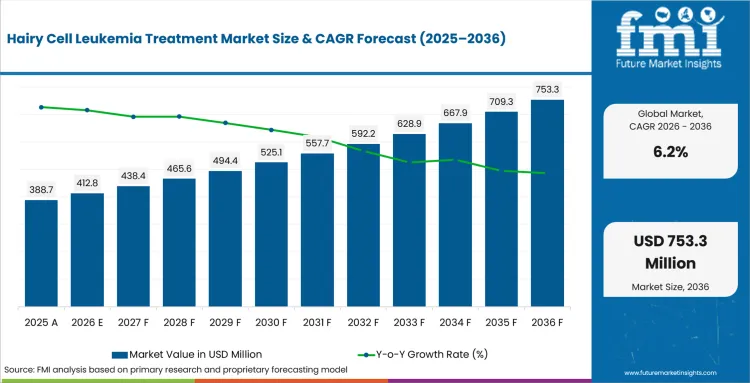
- Market Size (2026)
- USD 412.8 Mn
- Forecast (2036)
- USD 753.3 Mn
- CAGR (2026 to 2036)
- 6.2%
How big is Hairy Cell Leukemia Treatment Market in 2026?
USD 412.8 million in 2026 and USD 753.3 million by 2036 at a 6.2% CAGR.
Demand in the hairy cell leukemia treatment market is anticipated to push valuation from USD 412.8 million in 2026 to USD 753.3 million by 2036, expanding at a 6.2% CAGR over the forecast period. Established treatment guidelines and clearly defined intervention criteria continue to support demand for effective therapies in patients with active diseases. The National Cancer Institute updated its professional summary in February 2025 and retained cladribine with or without rituximab as standard care. Symptomatic cytopenias, progressive splenomegaly, or recurrent infections establish the clinical need for treatment rather than diagnosis alone. The treatment threshold concentrates leukemia therapeutics revenue within experienced hematology centers that can manage infection risk and blood-count recovery.
The rare patient pool limits annual treatment volume and makes response durability more valuable than frequent prescription activity across national markets. The Hairy Cell Leukemia Foundation published updated international consensus guidance in April 2026 for classic disease and the variant form. The guidance separates molecularly distinct patient groups and gives measurable residual disease a clearer role in response assessment. Molecular separation strengthens blood cancer treatment planning for relapse and reduces reliance on one pathway across biologically different cases. Purine analog providers gain value through dependable supply and evidence that supports longer treatment-free intervals within concentrated referral networks. Commercial expansion remains tied to centers that can confirm disease subtype and manage complications throughout infrequent treatment episodes.
Key Takeaways of Hairy Cell Leukemia Treatment Market
- Symptomatic cytopenias and progressive splenomegaly create treatment demand that requires specialist confirmation and coordinated infection management across concentrated referral centers.
- Chemotherapy is expected to account for 49.0% in 2026 due to established purine-based courses and familiar specialist monitoring pathways.
- Purine analogs are projected to represent 52.0% by drug class in 2026 owing durable response evidence and established administration practice.
- First-line treatment is anticipated to capture 61.0% in 2026 supported by the larger flow of newly treated patients.
- A small eligible population restricts treatment volume and trial recruitment across pathways affected by infection exposure and temporary marrow suppression.
- Competition combines labeled purine analog providers with antibody and targeted developers that require direct hairy cell leukemia evidence for commercial relevance.
Analyst Perspective
"Hairy cell leukemia creates value through long treatment-free intervals rather than repeated prescription volume across a broad patient base. Purine analogs retain first-line relevance because experienced centers understand their response profile and monitoring burden. Targeted combinations need disease-specific evidence in relapsed or molecularly selected patients, while commercial teams must preserve dependable medicine access across referral networks that treat very few cases each year."
- Anurag Sharma, Principal Analyst, Future Market Insights
How is the Hairy Cell Leukemia Treatment Market segmented?
The hairy cell leukemia treatment industry is segmented by treatment, drug class, disease stage, end user, distribution channel, and region.
By treatment, the market is segment by chemotherapy from targeted therapy and immunotherapy alongside selected stem cell transplantation according to therapeutic approach. Drug class distinguishes purine analogs, monoclonal antibodies, targeted small molecules, and supportive medicines according to mechanism. Disease stage covers first-line treatment, relapsed disease, and refractory settings across specialist hematology care pathways. End user categories include hospitals, specialty cancer centers, and ambulatory infusion centers according to care setting. Distribution channel separates hospital pharmacies, retail pharmacies, and online pharmacies according to medicine handling and patient access. Regional analysis compares adoption through specialist availability, medicine access, reimbursement rules, and the concentration of referral services. Each dimension measures a distinct commercial decision within the same specialist treatment and access pathway.
What keeps chemotherapy ahead within the treatment category?
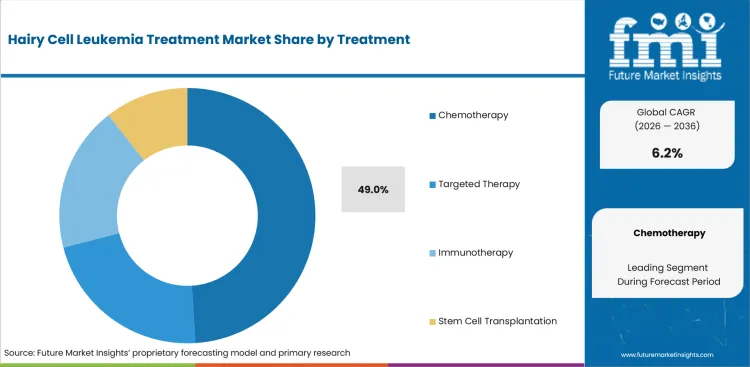
Chemotherapy remains central because purine analog courses can produce deep responses during a limited treatment period under specialist supervision. Referral centers already maintain the infusion capacity and detailed blood-count monitoring needed for these medicines. Treatment teams compare response depth with infection exposure and time without another therapy through disease-specific clinical trials. Established workflows let hospital teams coordinate dosing and supportive care within one planned treatment sequence.
- Chemotherapy is set to lead the treatment category with 49.0% share in 2026 due to established purine-based courses that fit specialist monitoring. ClinicalTrials.gov posted results in August 2025 from a 175-participant National Cancer Institute study of cladribine with immediate or delayed rituximab. The record gives hematologists current response evidence across established treatment sequences and measurable residual disease assessments.
- Hematology teams adopt chemotherapy through planned courses that connect dosing with blood-count surveillance and infection support. Use becomes less suitable for patients with uncontrolled infection or limited marrow reserve during the treatment period. Centers therefore balance remission durability against temporary immunosuppression and the practical burden of supportive care across each planned course.
Which treatment mechanism supports purine analogs within the drug class category?
Purine analogs retain a defined treatment role through familiar schedules and response expectations across experienced hematology services. The European Medicines Agency updated Litak information in April 2025 and retained cladribine for adult hairy cell leukemia. The active authorization provides a regulated route for injectable drugs through hospital treatment and pharmacy pathways across Europe. Cladribine and pentostatin remain commercially relevant through dependable availability and clearly defined specialist administration and monitoring requirements.
- The drug class category is forecast to be led by purine analogs at 52.0% share in 2026 due to established response performance. Their position depends on dependable access through specialist channels that serve uncommon treatment episodes across regional networks. Purine analog providers preserve use through reliable supply and clear administration guidance rather than frequent portfolio changes.
- Hospitals use purine analogs through controlled infusion or injection pathways that combine dosing with blood-count surveillance. Familiar protocols reduce additional training needs across experienced hematology teams that manage uncommon treatment episodes and complications. Adoption can slow if infection control or marrow recovery requires additional support beyond the planned treatment course and follow-up period.
What supports first-line treatment within the disease stage category?
Most eligible patients enter an established purine-based pathway following diagnostic confirmation and make first-line treatment the largest treated group. New options must compete against durable standards with known outcome expectations rather than enter an empty therapeutic category. Monoclonal antibodies gain relevance through combinations designed to improve response depth for carefully selected newly treated patients. Specialists compare safety and durability to determine whether initial treatment practice should change across low-volume referral networks.
- First-line treatment is projected to hold 61.0% share in 2026 owing to the larger flow of newly treated patients. The segment remains anchored to regimens that specialists understand across diagnostic confirmation and early treatment monitoring. Alternative approaches must deliver comparable disease control without creating greater operational burden across referral centers.
- ClinicalTrials.gov updated a recruiting phase 2 study in May 2026 that compares vemurafenib plus obinutuzumab with cladribine plus rituximab. The trial gives specialists a direct first-line comparison between a non-chemotherapy approach and an established purine-based combination. Adoption depends on evidence that the targeted pathway reduces treatment burden while preserving durable disease control across specialist services.
Why do hospitals retain the largest end user position?
Hospitals concentrate marrow assessment and infusion capacity with infection management and specialist review inside one coordinated care setting. Purine analog treatment requires close blood-count surveillance and rapid clinical support for infection or marrow-related complications. ClinicalTrials.gov updated an NCI sample-collection protocol in June 2026 for hairy cell and related leukemias. The protocol centralizes biospecimen collection and specialist evaluation at the NIH Clinical Center, reinforcing the hospital role in hematology diagnostics and long-term follow-up.
- The hospitals segment is likely to capture 46.0% share in 2026 attributable to integrated diagnosis and complication management. The position reflects treatment complexity and coordinated specialist care rather than routine inpatient admission for every eligible patient. Concentrated expertise lets hospital teams connect diagnostic confirmation with therapy and supportive care through one documented pathway.
- Hospital use is reinforced by onsite pharmacy preparation and immediate access to specialist infection support. Lower-volume facilities can face scheduling delays through limited hematology capacity and fewer trained treatment staff. Regional cancer centers and ambulatory units gain selected administrations through clear escalation routes that preserve specialist oversight and complication support.
How do hospital pharmacies shape the distribution channel category?
Key medicines require controlled ordering and preparation through specialist schedules and make hospital pharmacies central to the distribution pathway. Pharmacy teams can match limited stock with uncommon treatment episodes and manage supportive medicines through the same hospital system. Connections with clinical diagnostics support medicine release and patient monitoring across coordinated hospital oncology and hematology services. Retail and online channels mainly serve supportive prescriptions or medicines that do not require complex hospital preparation and monitoring.
- By distribution channel, hospital pharmacies are forecast to represent 55.0% share in 2026 driven by controlled handling and scheduled specialist administration. The channel fits medicines that require coordinated dosing and blood-count monitoring across specialist hospital hematology services. Its position depends on reliable special-order processes that prevent uncommon treatment courses from facing local stock delays.
- The Clatterbridge Cancer Centre updated its subcutaneous Litak protocol in February 2025 for hairy cell leukemia. The protocol shows how pharmacy preparation connects with scheduled administration and documented monitoring inside a specialist service. Adoption remains harder for smaller hospitals that lack dependable stock and rapid access to specialist complication management and monitoring.
What are the drivers, restraints, and opportunities in the Hairy Cell Leukemia Treatment Market?
Established purine analog response supports treatment revenue while patient scarcity and infection risk constrain volume. Relapsed disease creates focused openings for molecularly selected combinations and measurable response strategies within specialist hematology networks.
- Driver: Durable responses from established purine analog regimens sustain first-line treatment through specialist hematology pathways and long follow-up intervals.
- Restraint: A very small eligible population limits trial recruitment and commercial scale outside concentrated referral networks with disease-specific experience.
- Opportunity: Targeted combinations can serve relapsed disease and treatment intolerance through molecular selection and measurable response assessment.
Durable remission remains one of the significant drivers for established purine-based treatment across specialist hematology centers. ClinicalTrials.gov updated a recruiting cladribine and rituximab study in June 2026 and retained measurable residual disease among its response measures. The trial provides generic oncology drugs with a defined hairy cell leukemia pathway and clear response criteria. Revenue depends on diagnosed treatment need and consistent medicine access across referral systems that manage uncommon cases.
Patient scarcity creates the central restraint for development programs that depend on a limited eligible pool. NHS England published a January 2026 policy that did not support routine commissioning of vemurafenib plus rituximab for defined relapsed or refractory classic disease. The decision shows that limited comparative and cost-effectiveness evidence can restrict funded access through national treatment pathways. Small cohorts therefore slow evidence development and reduce commercial scale outside expert centers with disease-specific trial infrastructure.
Relapsed disease creates a focused opportunity for combinations that use a different mechanism from earlier purine therapy. ClinicalTrials.gov updated a phase 2 study record in April 2026 for low-dose vemurafenib with rituximab in hairy cell leukemia. The study provides targeted oncology biologics with a direct evaluation route for patients who need a non-purine option. Commercial value depends on durable response and manageable toxicity rather than novelty across broader oncology portfolios.
Which country CAGRs are profiled in the Hairy Cell Leukemia Treatment Market?
| Country | CAGR |
|---|---|
| Japan | 7.8% |
| Canada | 7.4% |
| Germany | 7.0% |
| Italy | 6.3% |
| UK | 5.9% |
| France | 5.5% |
| USA | 4.4% |
How do country-level CAGRs compare in the Hairy Cell Leukemia Treatment Market?
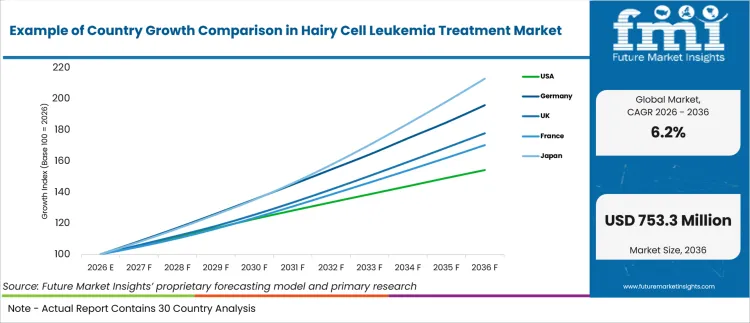
The 3.4-percentage-point spread separates a closely grouped upper tier from mature treatment systems with slower incremental expansion. Japan and Canada sit near the upper edge through concentrated specialist pathways and active rare-disease documentation. Germany and Italy form the central transition through hospital hematology networks that support adoption despite limited case numbers. The UK and France remain closely spaced through structured evidence review and regional referral systems. The USA remains 1.1 percentage points below France within this set and combines established therapy with incremental pipeline expansion. The forecast measures market pace rather than treatment quality or the underlying disease burden across the profiled countries.
- Japan combines formal hematology guidance with concentrated expertise across major specialist centers serving uncommon leukemia cases.
- Canada benefits from provincial cancer programs and international registry participation despite long travel distances for some patients.
- Germany uses organized hematology networks and long-term registry infrastructure although lower-volume sites retain limited disease-specific experience.
- Italy gains from public hospital research networks although regional differences can restrict equal access to specialist follow-up.
- The UK applies defined treatment protocols through specialist centers but national funding thresholds can delay newer combinations.
- France supports molecular confirmation through regional laboratories although disease-specific expertise remains concentrated within selected referral centers.
- The USA combines mature purine analog use with broad trial capacity and uneven travel access outside academic centers.
The full report provides country-level CAGR analysis across North America, Latin America, Europe, East Asia, South Asia, Oceania and the Middle East and Africa.
Country-wise Analysis
- Japan routes uncommon leukemia care through hematology centers that require detailed diagnostic classification ahead of treatment selection. Hairy cell leukemia treatment demand in Japan is forecast to rise at 7.8% CAGR over the forecast period supported by concentrated expertise and formal clinical guidance. The Japanese Society of Hematology updated its online hematologic malignancy guideline portal in November 2025 for national clinical reference. Major urban centers enable adoption through established injectable oncology pathways, although limited regional case volume weakens disease-specific experience elsewhere. National referral concentration improves treatment consistency but increases travel and scheduling burdens for patients outside major metropolitan areas. Commercial programs should prioritize specialist education and dependable distribution that supports treatment continuity across lower-volume regional hospitals.
- Canada combines provincial cancer programs with long travel distances between specialist centers and dispersed patient communities. Adoption of hairy cell leukemia treatment in Canada is estimated to expand at 7.4% CAGR through 2036 reinforced by coordinated cancer services and registry participation. ClinicalTrials.gov updated the international patient registry in April 2025 and listed CancerCare Manitoba as a recruiting location. Registry participation and provincial coverage enable shared outcome documentation through established cancer pathways for a disease with limited local volume. Geographic distance creates the principal friction and can require lengthy travel for repeated assessment and treatment monitoring. Companies need reliable special-order supply and patient support that fit provincial treatment routes across dispersed communities.
- Germany uses organized hematology networks and formal specialist review for uncommon blood cancers across hospital and outpatient settings. ClinicalTrials.gov updated the German CLL Study Group registry in December 2025 and retained hairy cell leukemia within its long-term documentation program. The German hairy cell leukemia treatment sector is projected to record 7.0% CAGR during the assessment period shaped by registry-supported follow-up and specialist access. Registry infrastructure enables referral coordination and longitudinal outcome recording across participating hematology centers and regional treatment services. Small patient numbers weaken disease-specific experience at lower-volume sites and reduce opportunities for consistent local case management. Commercial access requires German-language evidence support and dependable medicine distribution through hematology networks across federal states.
- Italy relies on public hospital hematology units and academic collaboration for rare leukemia diagnosis and follow-up. By 2036, Italy's hairy cell leukemia treatment market is projected to grow at 6.3% CAGR reinforced by specialist research networks and public hospital expertise. ClinicalTrials.gov posted a Bologna observational study in January 2025 that includes patients at diagnosis and relapse. The program enables disease-specific biomarker research and structured follow-up within a public academic hospital network. Regional differences in specialist access restrict consistent diagnosis and long-term monitoring outside established referral centers. Commercial programs should work through recognized hematology networks rather than assume uniform treatment access across the country.
- The UK combines national funding review with specialist cancer centers that operate defined systemic therapy protocols for rare blood malignancies. The UK's hairy cell leukemia treatment outlook is anticipated to advance at 5.9% CAGR over the assessment period influenced by protocol access and strict evidence review. A North East and North Cumbria NHS formulary update in July 2025 retained injectable cladribine for hairy cell leukemia. The formulary enables medicine access through a defined route within specialist hematology services and hospital pharmacy systems. National funding thresholds restrict newer combinations that lack direct comparative evidence and credible economic support. Companies need detailed implementation plans that align medicine access with NHS commissioning decisions and specialist treatment pathways.
- France combines regional university hospitals with molecular laboratories that support diagnosis across uncommon hematologic cancer pathways. In France, hairy cell leukemia treatment demand is predicted to advance at 5.5% CAGR through 2036 supported by specialist testing and concentrated referral services. Orphanet updated an IUCT Oncopole laboratory listing in December 2025 and included classic hairy cell leukemia within flow-cytometry testing. The listed route enables disease-specific immunophenotyping through a regional cancer center and established laboratory network. Concentrated expertise restricts convenient access for patients living far from selected university hospitals and molecular laboratories. Commercial programs need dependable medicine access and referral support across regions without local disease-specific testing.
- The USA combines mature purine analog use with a broad academic trial network for molecularly selected relapse. Hairy cell leukemia treatment sales in the USA are forecast to expand at 4.4% CAGR by 2036 reflecting an established treatment base and incremental pipeline expansion. ClinicalTrials.gov updated an encorafenib plus binimetinib study in June 2026 for relapsed or refractory BRAF V600-mutated disease. Academic trial capacity enables molecularly defined research routes and specialist follow-up for previously treated patients. Insurance authorization and travel to expert centers restrict access across large geographic areas and community oncology networks. Companies need payer evidence and investigator support rather than volume-based promotion across general oncology services.
Who are the notable companies in the Hairy Cell Leukemia Treatment Market?
Hospira, Inc., Lipomed GmbH, Fresenius Kabi USA, LLC, Hisun Pharmaceuticals USA, Inc., Genentech USA, Inc., AbbVie Inc., MacroGenics, Inc., and Servier are notable participants.
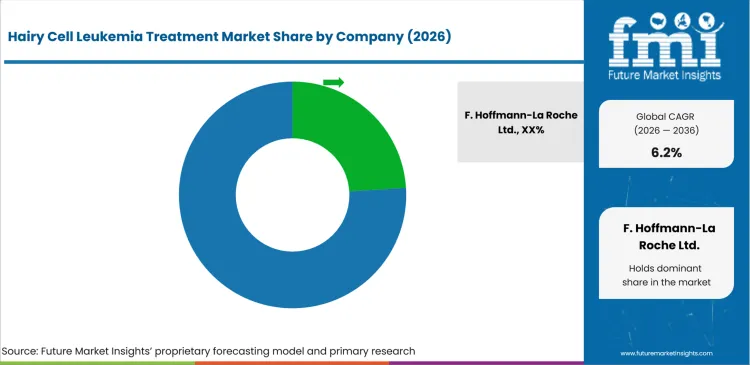
The competitive outlook combines labeled purine analog providers with companies supporting targeted programs in relapsed disease. DailyMed retains an active hairy cell leukemia indication for Fresenius Kabi cladribine in the United States. Genentech confirmed in February 2026 that Venclexta is jointly developed with AbbVie and jointly commercialized by both companies in the United States. Hospira and Hisun compete through established specialist medicine access, while MacroGenics and Servier contribute direct trial-stage programs. The practical comparison separates current labeled supply from targeted development and next-generation immunotherapies activity rather than relying on general oncology portfolio size.
- Hospira and Lipomed join Fresenius Kabi and Hisun across established purine analog supply within specialist treatment channels. Their practical advantage rests on active hairy cell leukemia labels and dependable access through concentrated hematology networks. Selection depends on medicine availability and clear administration support across low-volume referral centers rather than portfolio breadth.
- Genentech USA and AbbVie provide venetoclax through a current United States development and commercialization collaboration. ClinicalTrials.gov updated a recruiting venetoclax study in May 2026 for patients with relapsed hairy cell leukemia. Their commercial opening depends on disease-specific response and safety evidence that establishes a defined role beside established purine regimens across specialist pathways.
- MacroGenics and Servier represent development-stage participants with hairy cell leukemia programs rather than labeled hairy cell leukemia therapies. Each company must convert small-cohort clinical evidence into a defensible role across specialist referral centers. Commercial relevance depends on durable response and manageable safety across carefully selected patients rather than broad oncology activity.
Competitive Benchmarking: Hairy Cell Leukemia Treatment Market
| Company | Established HCL Therapy | Targeted or Relapse Pipeline | Recent HCL Evidence | Geographic Reach |
|---|---|---|---|---|
| Hospira, Inc. | High | Low | High | North America |
| Lipomed GmbH | High | Low | Medium | Europe |
| Fresenius Kabi USA, LLC | High | Low | Low | North America |
| Hisun Pharmaceuticals USA, Inc. | High | Low | Medium | North America |
| Genentech USA, Inc. | Medium | High | High | United States |
| AbbVie Inc. | Medium | High | High | United States |
| MacroGenics, Inc. | Low | Medium | High | United States |
| Servier | Low | High | High | United States |
Key Developments in the Hairy Cell Leukemia Treatment Market
- In July 2026, Hospira retained NIPENT's active hairy cell leukemia indication in an updated federal drug label. The regulator record confirms a current pentostatin route for patients with active disease and preserves specialist monitoring requirements for renal and hematologic toxicity. The update supports disease-specific availability without implying that the medicine expanded into a new patient group or wider treatment setting.
- In January 2025, Hisun Pharmaceuticals USA retained cladribine's active hairy cell leukemia indication in an updated federal drug label. The record confirms a current intravenous purine analog route and preserves warnings for marrow suppression and infection. The update supports disease-specific availability through specialist hospital channels without suggesting a broader indication or new patient population. Dependable special-order supply and treatment-center familiarity remain necessary for commercial continuity across low-volume specialist channels.
- In May 2026, MacroGenics updated its recruiting phase 1 study of MGD024 and retained hairy cell leukemia among eligible relapsed blood cancers. The study evaluates a CD123 x CD3 bispecific DART molecule across selected relapsed or refractory hematologic malignancies. The hairy cell leukemia cohort confirms a current development role without establishing a dedicated commercial position for this disease. Commercial relevance depends on direct cohort results rather than broader hematologic study activity across other blood cancers.
- In April 2026, Servier completed its acquisition of Day One Biopharmaceuticals and gained control of the tovorafenib development portfolio. ClinicalTrials.gov then updated a direct hairy cell leukemia study in June 2026 that combines tovorafenib with rituximab across untreated and relapsed disease. The completed ownership change gives Servier a verified targeted-development route without implying current commercial availability for this indication in routine specialist care.
Hairy Cell Leukemia Treatment Market - Report Scope
| Coverage field | Report scope |
|---|---|
| Market breakdown | Treatment, drug class, disease stage, end user, distribution channel, and region. |
| Quantitative Units | Revenue in USD Million and CAGR in %. |
| Market Definition | First-line and relapsed treatment of classic and variant hairy cell leukemia using purine analogs, anti-CD20 therapy, targeted agents, immunotherapy, supportive care, and selected transplant procedures. |
| Regions Covered | North America, Latin America, Europe, East Asia, South Asia, Oceania, and Middle East and Africa. |
| Countries Covered | Japan, Canada, Germany, Italy, UK, France, and USA. |
| Key Companies Profiled | Hospira, Inc., Lipomed GmbH, Fresenius Kabi USA, LLC, Hisun Pharmaceuticals USA, Inc., Genentech USA, Inc., AbbVie Inc., MacroGenics, Inc., Servier. |
| Forecast Period | 2026 to 2036. |
| Approach | Hybrid bottom-up and top-down market sizing supported by primary interviews and official desk research. |
Hairy Cell Leukemia Treatment Market - Research Methodology
| Method | Approach |
|---|---|
| Primary Research | FMI analysts gathered input from manufacturers, service providers, technology developers, distributors, end users, procurement teams, and subject-matter experts. Interviews examined purchasing decisions, product or service evaluation, adoption barriers, approval requirements, pricing considerations, and expectations for technical or commercial support. Respondents were also asked what evidence is required before a trial, pilot, or initial order develops into regular purchasing. |
| Desk Research | Desk research covered government statistics, regulatory publications, trade data, industry associations, technical literature, standards, company filings, product information, and official corporate announcements. Sources were reviewed for relevance, publication date, geographic coverage, and consistency with the defined market scope. Claims relating to performance, applications, approvals, capacity, investment, and commercial activity were retained only when supported by credible public evidence. |
| Market Sizing and Forecasting | The market model combined the baseline value with historical performance, segment structure, pricing and volume indicators, adoption levels, company participation, and country-level demand conditions. Forecast assumptions considered economic activity, investment trends, regulatory developments, technology adoption, purchasing cycles, supply availability, and barriers to wider market use. Segment and regional estimates were reconciled before the final market total was calculated. |
| Data Validation | Estimates were checked against multiple independent indicators, including public data, company activity, trade patterns, industry developments, and findings from primary interviews. Validation also tested whether products, services, applications, and company revenues fell within the defined market boundaries. Adjacent categories, unsupported claims, overlapping revenues, and activities without direct market relevance were excluded to reduce double counting and maintain consistency across segments and countries. |
Hairy Cell Leukemia Treatment Market by Segments
Hairy Cell Leukemia Treatment Market, by Treatment
- Chemotherapy
- Purine Analog Therapy
- Combination Chemotherapy
- Single-agent Chemotherapy
- Targeted Therapy
- BRAF Inhibitors
- BTK Inhibitors
- MEK Inhibitors
- Immunotherapy
- Monoclonal Antibodies
- Interferon Therapy
- Immune Checkpoint Therapy
- Stem Cell Transplantation
- Autologous Transplantation
- Allogeneic Transplantation
- Salvage Transplantation
Hairy Cell Leukemia Treatment Market, by Drug Class
- Purine Analogs
- Cladribine
- Pentostatin
- Combination Purine Therapy
- Monoclonal Antibodies
- Rituximab
- Moxetumomab Pasudotox
- Biosimilar Antibodies
- Targeted Small Molecules
- Vemurafenib
- Ibrutinib
- Dabrafenib
- Supportive Care Drugs
- Growth Factors
- Anti-infective Agents
- Blood Transfusion Products
Hairy Cell Leukemia Treatment Market, by Disease Stage
- First-line Treatment
- Newly Diagnosed Patients
- Standard-risk Patients
- Symptomatic Patients
- Relapsed Disease
- First Relapse
- Multiple Relapse
- Early Relapse
- Refractory Disease
- Drug-resistant Disease
- High-risk Patients
- Advanced Disease
Hairy Cell Leukemia Treatment Market, by End User
- Hospitals
- Cancer Hospitals
- Tertiary Care Hospitals
- Academic Hospitals
- Specialty Cancer Centers
- Hematology Clinics
- Oncology Centers
- Comprehensive Cancer Centers
- Ambulatory Infusion Centers
- Outpatient Infusion Clinics
- Day Care Centers
- Private Oncology Clinics
Hairy Cell Leukemia Treatment Market, by Distribution Channel
- Hospital Pharmacies
- Inpatient Pharmacies
- Oncology Pharmacies
- Specialty Hospital Pharmacies
- Retail Pharmacies
- Chain Pharmacies
- Independent Pharmacies
- Specialty Retail Pharmacies
- Online Pharmacies
- E-commerce Pharmacies
- Mail-order Pharmacies
- Digital Specialty Pharmacies
Hairy Cell Leukemia Treatment Market by Region:
- North America
- United States
- Canada
- Latin America
- Brazil
- Mexico
- Argentina
- Chile
- Western Europe
- Germany
- France
- United Kingdom
- Italy
- Spain
- Benelux
- Nordics
- Eastern Europe
- Poland
- Czech Republic
- Romania
- Hungary
- East Asia
- China
- Japan
- South Korea
- South Asia and Pacific
- India
- ASEAN
- Australia and New Zealand
- Middle East and Africa
- GCC Countries
- South Africa
- Türkiye
- Israel
Research Sources and Bibliography
- PDQ® Adult Treatment Editorial Board. (2025, February 21). Hairy Cell Leukemia Treatment (PDQ®)-Health Professional Version.
- Hairy Cell Leukemia Foundation. (2026, April 14). Updated Consensus Guidelines for the Diagnosis and Management of Patients with Hairy Cell Leukemia (HCL) and HCL-Variant.
- ClinicalTrials.gov. (2025, August 8). Cladribine With Simultaneous or Delayed Rituximab to Treat Hairy Cell Leukemia (NCT00923013).
- European Medicines Agency. (2025, April 3). Litak.
- ClinicalTrials.gov. (2026, May 26). A Study of Vemurafenib and Obinutuzumab Compared to Cladribine and Rituximab in People With Hairy Cell Leukemia (HCL) (NCT06561360).
- ClinicalTrials.gov. (2026, June 5). Collection of Human Samples to Study Hairy Cell and Other Leukemias, and to Develop Recombinant Immunotoxins for Cancer Treatment (NCT01087333).
- The Clatterbridge Cancer Centre. (2025, February 28). Cladribine SC (LITAK) Subcutaneous Hairy Cell Leukaemia.
- ClinicalTrials.gov. (2026, June 11). Cladribine and Rituximab in Treating Patients With Hairy Cell Leukemia (NCT00412594).
- NHS England. (2026, January 19). Vemurafenib plus rituximab for patients with relapsed or refractory classic hairy cell leukaemia (HCL) (Adults).
- ClinicalTrials.gov. (2026, May 13). Venetoclax for the Treatment of Patients With Relapsed Hairy Cell Leukemia (NCT06311227).
- Japanese Society of Hematology. (2025, November 10).
- ClinicalTrials.gov. (2025, April 16). Hairy Cell Leukemia Patient Data Registry (HCL-PDR) (NCT02560883).
- ClinicalTrials.gov. (2025, December 8). Registry of the German CLL Study Group (CLL-Registry) (NCT02863692).
- ClinicalTrials.gov. (2025, January 8). Hairy Cell Leukemia: Harnessing the Full Power of Extracellular Vesicles to Improve Patient Care Management (NCT06764524).
- North East and North Cumbria Formulary. (2025, July 21). North East and North Cumbria ICS Formulary.
- Orphanet. (2025, December). Diagnosis of acute leukemias (immunophenotyping by flow cytometry).
- ClinicalTrials.gov. (2026, June 12). Encorafenib Plus Binimetinib for People With BRAF V600 Mutated Relapsed/Refractory HCL (NCT04324112).
- DailyMed. (2024, October 10). CLADRIBINE- cladribine injection.
- DailyMed. (2025, January 23). CLADRIBINE injection, solution.
- ClinicalTrials.gov. (2026, April 24). Low Dose Vemurafenib and Rituximab in Hairy Cell Leukemia (NCT05388123).
- Genentech. (2026, February 19). FDA Approves Genentech’s Venclexta® Plus Acalabrutinib Combination Regimen for Previously Untreated Chronic Lymphocytic Leukemia.
- DailyMed. (2026, July 1). NIPENT- pentostatin injection, powder, lyophilized, for solution.
- ClinicalTrials.gov. (2026, May 22). A Study of MGD024 in Patients With Relapsed or Refractory Hematologic Malignancies (NCT05362773).
- Servier. (2026, April 23). Servier completes the acquisition of Day One Biopharmaceuticals.
- ClinicalTrials.gov. (2026, June 3). Testing the Combination of Anti-cancer Drugs, Tovorafenib Plus Rituximab, in Patients With Hairy Cell Leukemia (NCT06965114).
This bibliography is provided for reader reference and is not exhaustive. The full report contains the complete reference list and detailed citations
This Report Answers
- How large is the hairy cell leukemia treatment market in 2026 and 2036?
- Which clinical conditions convert diagnosed hairy cell leukemia into active treatment demand?
- Why do chemotherapy and purine analogs retain the largest segment shares in 2026?
- How do first-line and relapsed treatment pathways differ commercially?
- Which country growth rates are profiled across Japan, Canada, Europe, and the USA?
- Which companies provide established therapies or active targeted programs?
- What limits treatment-market growth across a very small patient population?
- How do hospital and pharmacy pathways influence therapy access?
- Which recent studies or ownership changes could affect competitive positioning?
Frequently Asked Questions
How big is the Hairy Cell Leukemia Treatment Market in 2026?
The hairy cell leukemia treatment market is valued at USD 412.8 million in 2026 and is forecast to reach USD 753.3 million by 2036. Growth is supported by established treatment guidelines and clearly defined intervention criteria that sustain demand for effective therapies among patients with symptomatic cytopenias, progressive splenomegaly, or recurrent infections.
What is the CAGR of the Hairy Cell Leukemia Treatment Market from 2026 to 2036?
The hairy cell leukemia treatment market grows at a CAGR of 6.2% between 2026 and 2036, supported by durable responses from established purine analog regimens that sustain first-line treatment through specialist hematology pathways and long follow-up intervals across concentrated referral networks.
Which treatment type leads the Hairy Cell Leukemia Treatment Market?
Chemotherapy accounts for 49.0% of the hairy cell leukemia treatment market by treatment type in 2026, driven by established purine-based courses that fit specialist monitoring and referral centers already equipped with the infusion capacity and blood-count surveillance these regimens require.
How much will the Hairy Cell Leukemia Treatment Market add between 2026 and 2036
The hairy cell leukemia treatment market is set to add USD 340.5 million between 2026 and 2036, growing from USD 412.8 million to USD 753.3 million as molecularly selected combinations and measurable residual disease assessment expand treatment options across relapsed and first-line pathways.
Who are the leading companies in the Hairy Cell Leukemia Treatment Market?
Eight companies lead the hairy cell leukemia treatment market, including Hospira, Lipomed, Fresenius Kabi USA, Hisun Pharmaceuticals USA, Genentech USA, AbbVie, MacroGenics, and Servier, competing through labeled purine analog supply, venetoclax collaboration, and targeted relapse-stage pipeline programs across specialist hematology networks worldwide.
Preview the report firsthand - request a free sample
Get SampleGet the brochure for pricing and purchase details.
Get PDFTable of Content
- Key Takeaways
- Market Size and CAGR
- Top Growth Driver
- Fastest Growing Segment
- Leading Region
- Key Companies
- Emerging Opportunities
- Executive Summary
- Global Market Outlook
- Demand-side Trends
- Supply-side Trends
- Technology Roadmap Analysis
- Analysis and Recommendations
- Analyst Perspective (What is happening? Why now? What should investors know?)
- Key Questions Answered
- How large is the market?
- What is the CAGR?
- What are key trends?
- Which region dominates?
- Who are the leaders?
- Market Overview
- Market Coverage / Taxonomy
- Market Definition / Scope / Limitations
- Research Methodology
- Chapter Orientation
- Analytical Lens and Working Hypotheses
- Market Structure, Signals, and Trend Drivers
- Benchmarking and Cross-market Comparability
- Market Sizing, Forecasting, and Opportunity Mapping
- Research Design and Evidence Framework
- Desk Research Programme (Secondary Evidence)
- Expert Input and Fieldwork (Primary Evidence)
- Tooling, Models, and Reference Databases
- Data Engineering and Model Build
- Quality Assurance and Audit Trail
- Market Background
- Market Dynamics (Drivers, Restraints, Opportunity, Trends)
- Scenario Forecast (Optimistic, Likely, Conservative)
- Impact Analysis
- AI Impact
- Sustainability Impact
- Regulatory Impact
- Technology Impact
- Consumer / Buyer Analysis
- Purchase Drivers
- Adoption Barriers
- Buyer Journey
- Opportunity Map Analysis
- Product Life Cycle Analysis
- Supply Chain Analysis
- Investment Feasibility Matrix
- Value Chain Analysis
- PESTLE and Porter's Analysis
- Regulatory Landscape
- Regional Parent Market Outlook
- Production and Consumption Statistics
- Import and Export Statistics
- Global Market Analysis and Forecast, 2021 to 2036
- Historical Market Size Value (USD Million) Analysis, 2021 to 2025
- Current and Future Market Size Value (USD Million) Projections, 2026 to 2036
- Y-o-Y Growth Trend Analysis
- Absolute $ Opportunity Analysis
- Global Market Pricing Analysis, 2021 to 2036
- Global Market Analysis and Forecast, By Treatment, 2021 to 2036
- Introduction / Key Findings
- Historical Market Size Value (USD Million) Analysis By Treatment, 2021 to 2025
- Current and Future Market Size Value (USD Million) Analysis and Forecast By Treatment, 2026 to 2036
- Chemotherapy
- Purine Analog Therapy
- Combination Chemotherapy
- Single-agent Chemotherapy
- Targeted Therapy
- BRAF Inhibitors
- BTK Inhibitors
- MEK Inhibitors
- Immunotherapy
- Monoclonal Antibodies
- Interferon Therapy
- Immune Checkpoint Therapy
- Stem Cell Transplantation
- Autologous Stem Cell Transplant
- Allogeneic Stem Cell Transplant
- Salvage Transplant Therapy
- Chemotherapy
- Y-o-Y Growth Trend Analysis By Treatment, 2021 to 2025
- Absolute $ Opportunity Analysis By Treatment, 2026 to 2036
- Global Market Analysis and Forecast, By Drug Class, 2021 to 2036
- Introduction / Key Findings
- Historical Market Size Value (USD Million) Analysis By Drug Class, 2021 to 2025
- Current and Future Market Size Value (USD Million) Analysis and Forecast By Drug Class, 2026 to 2036
- Purine Analogs
- Cladribine
- Pentostatin
- Combination Purine Therapy
- Monoclonal Antibodies
- Rituximab
- Moxetumomab Pasudotox
- Biosimilar Antibodies
- Targeted Small Molecules
- Vemurafenib
- Ibrutinib
- Dabrafenib
- Supportive Care Drugs
- Growth Factors
- Anti-infective Agents
- Blood Transfusion Products
- Purine Analogs
- Y-o-Y Growth Trend Analysis By Drug Class, 2021 to 2025
- Absolute $ Opportunity Analysis By Drug Class, 2026 to 2036
- Global Market Analysis and Forecast, By Disease Stage, 2021 to 2036
- Introduction / Key Findings
- Historical Market Size Value (USD Million) Analysis By Disease Stage, 2021 to 2025
- Current and Future Market Size Value (USD Million) Analysis and Forecast By Disease Stage, 2026 to 2036
- First-line Treatment
- Newly Diagnosed Patients
- Standard-risk Patients
- Symptomatic Patients
- Relapsed Disease
- First Relapse
- Multiple Relapse
- Early Relapse
- Refractory Disease
- Drug-resistant Disease
- High-risk Patients
- Advanced Disease
- First-line Treatment
- Y-o-Y Growth Trend Analysis By Disease Stage, 2021 to 2025
- Absolute $ Opportunity Analysis By Disease Stage, 2026 to 2036
- Global Market Analysis and Forecast, By End User, 2021 to 2036
- Introduction / Key Findings
- Historical Market Size Value (USD Million) Analysis By End User, 2021 to 2025
- Current and Future Market Size Value (USD Million) Analysis and Forecast By End User, 2026 to 2036
- Hospitals
- Cancer Hospitals
- Tertiary Care Hospitals
- Academic Hospitals
- Specialty Cancer Centers
- Hematology Clinics
- Oncology Centers
- Comprehensive Cancer Centers
- Ambulatory Infusion Centers
- Outpatient Infusion Clinics
- Day Care Centers
- Private Oncology Clinics
- Hospitals
- Y-o-Y Growth Trend Analysis By End User, 2021 to 2025
- Absolute $ Opportunity Analysis By End User, 2026 to 2036
- Global Market Analysis and Forecast, By Distribution Channel, 2021 to 2036
- Introduction / Key Findings
- Historical Market Size Value (USD Million) Analysis By Distribution Channel, 2021 to 2025
- Current and Future Market Size Value (USD Million) Analysis and Forecast By Distribution Channel, 2026 to 2036
- Hospital Pharmacies
- Inpatient Pharmacies
- Oncology Pharmacies
- Specialty Hospital Pharmacies
- Retail Pharmacies
- Chain Pharmacies
- Independent Pharmacies
- Specialty Retail Pharmacies
- Online Pharmacies
- E-commerce Pharmacies
- Mail-order Pharmacies
- Digital Specialty Pharmacies
- Hospital Pharmacies
- Y-o-Y Growth Trend Analysis By Distribution Channel, 2021 to 2025
- Absolute $ Opportunity Analysis By Distribution Channel, 2026 to 2036
- Global Market Analysis and Forecast, By Region, 2021 to 2036
- Introduction
- Historical Market Size Value (USD Million) Analysis By Region, 2021 to 2025
- Current Market Size Value (USD Million) Analysis and Forecast By Region, 2026 to 2036
- North America
- Latin America
- Western Europe
- Eastern Europe
- East Asia
- South Asia and Pacific
- Middle East & Africa
- Market Attractiveness Analysis By Region
- North America Market Analysis and Forecast, By Country, 2021 to 2036
- Historical Market Size Value (USD Million) Trend Analysis By Market Taxonomy, 2021 to 2025
- Market Size Value (USD Million) Forecast By Market Taxonomy, 2026 to 2036
- By Country
- USA
- Canada
- By Treatment
- By Drug Class
- By Disease Stage
- By End User
- By Distribution Channel
- By Country
- Market Attractiveness Analysis
- By Country
- By Treatment
- By Drug Class
- By Disease Stage
- By End User
- By Distribution Channel
- Key Takeaways
- Latin America Market Analysis and Forecast, By Country
- Historical Market Size Value (USD Million) Trend Analysis By Market Taxonomy, 2021 to 2025
- Market Size Value (USD Million) Forecast By Market Taxonomy, 2026 to 2036
- By Country
- Brazil
- Mexico
- Chile
- Rest of Latin America
- By Treatment
- By Drug Class
- By Disease Stage
- By End User
- By Distribution Channel
- By Country
- Market Attractiveness Analysis
- By Country
- By Treatment
- By Drug Class
- By Disease Stage
- By End User
- By Distribution Channel
- Key Takeaways
- Western Europe Market Analysis and Forecast, By Country
- Historical Market Size Value (USD Million) Trend Analysis By Market Taxonomy, 2021 to 2025
- Market Size Value (USD Million) Forecast By Market Taxonomy, 2026 to 2036
- By Country
- Germany
- UK
- Italy
- Spain
- France
- Nordic
- BENELUX
- Rest of Western Europe
- By Treatment
- By Drug Class
- By Disease Stage
- By End User
- By Distribution Channel
- By Country
- Market Attractiveness Analysis
- By Country
- By Treatment
- By Drug Class
- By Disease Stage
- By End User
- By Distribution Channel
- Key Takeaways
- Eastern Europe Market Analysis and Forecast, By Country
- Historical Market Size Value (USD Million) Trend Analysis By Market Taxonomy, 2021 to 2025
- Market Size Value (USD Million) Forecast By Market Taxonomy, 2026 to 2036
- By Country
- Russia
- Poland
- Hungary
- Balkan & Baltic
- Rest of Eastern Europe
- By Treatment
- By Drug Class
- By Disease Stage
- By End User
- By Distribution Channel
- By Country
- Market Attractiveness Analysis
- By Country
- By Treatment
- By Drug Class
- By Disease Stage
- By End User
- By Distribution Channel
- Key Takeaways
- East Asia Market Analysis and Forecast, By Country
- Historical Market Size Value (USD Million) Trend Analysis By Market Taxonomy, 2021 to 2025
- Market Size Value (USD Million) Forecast By Market Taxonomy, 2026 to 2036
- By Country
- China
- Japan
- South Korea
- By Treatment
- By Drug Class
- By Disease Stage
- By End User
- By Distribution Channel
- By Country
- Market Attractiveness Analysis
- By Country
- By Treatment
- By Drug Class
- By Disease Stage
- By End User
- By Distribution Channel
- Key Takeaways
- South Asia and Pacific Market Analysis and Forecast, By Country
- Historical Market Size Value (USD Million) Trend Analysis By Market Taxonomy, 2021 to 2025
- Market Size Value (USD Million) Forecast By Market Taxonomy, 2026 to 2036
- By Country
- India
- ASEAN
- Australia & New Zealand
- Rest of South Asia and Pacific
- By Treatment
- By Drug Class
- By Disease Stage
- By End User
- By Distribution Channel
- By Country
- Market Attractiveness Analysis
- By Country
- By Treatment
- By Drug Class
- By Disease Stage
- By End User
- By Distribution Channel
- Key Takeaways
- Middle East & Africa Market Analysis and Forecast, By Country
- Historical Market Size Value (USD Million) Trend Analysis By Market Taxonomy, 2021 to 2025
- Market Size Value (USD Million) Forecast By Market Taxonomy, 2026 to 2036
- By Country
- Kingdom of Saudi Arabia
- Other GCC Countries
- Türkiye
- South Africa
- Other African Union
- Rest of Middle East & Africa
- By Treatment
- By Drug Class
- By Disease Stage
- By End User
- By Distribution Channel
- By Country
- Market Attractiveness Analysis
- By Country
- By Treatment
- By Drug Class
- By Disease Stage
- By End User
- By Distribution Channel
- Key Takeaways
- Key Countries Market Analysis
- USA
- Pricing Analysis
- Market Share Analysis, 2025
- By Treatment
- By Drug Class
- By Disease Stage
- By End User
- By Distribution Channel
- Canada
- Pricing Analysis
- Market Share Analysis, 2025
- By Treatment
- By Drug Class
- By Disease Stage
- By End User
- By Distribution Channel
- Mexico
- Pricing Analysis
- Market Share Analysis, 2025
- By Treatment
- By Drug Class
- By Disease Stage
- By End User
- By Distribution Channel
- Brazil
- Pricing Analysis
- Market Share Analysis, 2025
- By Treatment
- By Drug Class
- By Disease Stage
- By End User
- By Distribution Channel
- Chile
- Pricing Analysis
- Market Share Analysis, 2025
- By Treatment
- By Drug Class
- By Disease Stage
- By End User
- By Distribution Channel
- Germany
- Pricing Analysis
- Market Share Analysis, 2025
- By Treatment
- By Drug Class
- By Disease Stage
- By End User
- By Distribution Channel
- UK
- Pricing Analysis
- Market Share Analysis, 2025
- By Treatment
- By Drug Class
- By Disease Stage
- By End User
- By Distribution Channel
- Italy
- Pricing Analysis
- Market Share Analysis, 2025
- By Treatment
- By Drug Class
- By Disease Stage
- By End User
- By Distribution Channel
- Spain
- Pricing Analysis
- Market Share Analysis, 2025
- By Treatment
- By Drug Class
- By Disease Stage
- By End User
- By Distribution Channel
- France
- Pricing Analysis
- Market Share Analysis, 2025
- By Treatment
- By Drug Class
- By Disease Stage
- By End User
- By Distribution Channel
- India
- Pricing Analysis
- Market Share Analysis, 2025
- By Treatment
- By Drug Class
- By Disease Stage
- By End User
- By Distribution Channel
- ASEAN
- Pricing Analysis
- Market Share Analysis, 2025
- By Treatment
- By Drug Class
- By Disease Stage
- By End User
- By Distribution Channel
- Australia & New Zealand
- Pricing Analysis
- Market Share Analysis, 2025
- By Treatment
- By Drug Class
- By Disease Stage
- By End User
- By Distribution Channel
- China
- Pricing Analysis
- Market Share Analysis, 2025
- By Treatment
- By Drug Class
- By Disease Stage
- By End User
- By Distribution Channel
- Japan
- Pricing Analysis
- Market Share Analysis, 2025
- By Treatment
- By Drug Class
- By Disease Stage
- By End User
- By Distribution Channel
- South Korea
- Pricing Analysis
- Market Share Analysis, 2025
- By Treatment
- By Drug Class
- By Disease Stage
- By End User
- By Distribution Channel
- Russia
- Pricing Analysis
- Market Share Analysis, 2025
- By Treatment
- By Drug Class
- By Disease Stage
- By End User
- By Distribution Channel
- Poland
- Pricing Analysis
- Market Share Analysis, 2025
- By Treatment
- By Drug Class
- By Disease Stage
- By End User
- By Distribution Channel
- Hungary
- Pricing Analysis
- Market Share Analysis, 2025
- By Treatment
- By Drug Class
- By Disease Stage
- By End User
- By Distribution Channel
- Kingdom of Saudi Arabia
- Pricing Analysis
- Market Share Analysis, 2025
- By Treatment
- By Drug Class
- By Disease Stage
- By End User
- By Distribution Channel
- Türkiye
- Pricing Analysis
- Market Share Analysis, 2025
- By Treatment
- By Drug Class
- By Disease Stage
- By End User
- By Distribution Channel
- South Africa
- Pricing Analysis
- Market Share Analysis, 2025
- By Treatment
- By Drug Class
- By Disease Stage
- By End User
- By Distribution Channel
- USA
- Market Structure Analysis
- Competition Dashboard
- Competition Benchmarking
- Market Share Analysis of Top Players
- By Regional
- By Treatment
- By Drug Class
- By Disease Stage
- By End User
- By Distribution Channel
- Emerging Startups
- Innovation Benchmarking
- Competition Analysis
- Competition Deep Dive
- F. Hoffmann-La Roche Ltd.
- Overview
- Product Portfolio
- Profitability by Market Segments
- Sales Footprint
- Strategy Overview
- Marketing Strategy
- Product Strategy
- Channel Strategy
- AstraZeneca plc
- Amgen Inc.
- Pfizer Inc.
- Novartis AG
- AbbVie Inc.
- Bristol Myers Squibb
- Sanofi
- Johnson & Johnson
- Merck & Co., Inc.
- F. Hoffmann-La Roche Ltd.
- Case Studies
- Success Stories
- Recent Developments
- Competition Deep Dive
- Assumptions & Acronyms Used


