

- Market Size (2026)
- USD 145.6 Mn
- Forecast (2036)
- USD 5,316.5 Mn
- CAGR (2026 to 2036)
- 43.3%
How big is Cell-Cultured Cocoa Butter & Cacao Market in 2026?
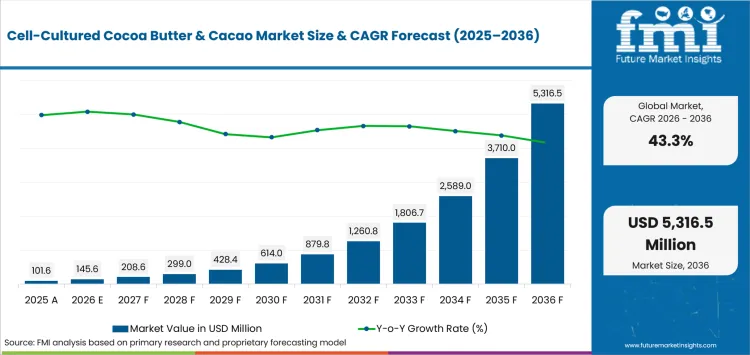
USD 145.6 million in 2026 and USD 5,316.5 million by 2036 at a 43.3% CAGR.
Sales of cell-cultured cocoa butter and cacao are projected to rise at 43.3% CAGR over the forecast period, supported by larger controlled-production programs. The valuation is expected to increase from USD 145.6 million in 2026 to USD 5,316.5 million by 2036. Investment centers on controlled cell-culture systems that can produce cocoa ingredients with consistent composition across separate production campaigns. The International Cocoa Organization revised the 2023/24 global cocoa deficit to 492,000 tonnes in May 2026. The same May 2026 bulletin estimated a 48,000-tonne surplus for 2024/25 as improved output reversed the global supply balance. The rapid swing strengthens interest in cultured cocoa derivatives that reduce harvest exposure and preserve established chocolate specifications.
Regulatory routes create different launch timetables for cultured cocoa ingredients in the United States and Great Britain. FDA rules require the ingredient sponsor to prove safety for each intended use through the food-additive or GRAS framework. In April 2025, the Food Standards Agency changed the British process so ministerial authorizations take effect through an official public register. British developers therefore need formal authorization for every novel-food use prior to any commercial ingredient sale. Launch plans must connect food biotechnology records with production methods and intended-use specifications in each jurisdiction. Chocolate manufacturers also need application evidence that covers flavor and texture under routine industrial processing conditions. Commercial contracts become clearer through defined responsibility for safety documentation and recipe validation across each launch program.
Key Takeaways of Cell-Cultured Cocoa Butter & Cacao Market
- Demand for cell-cultured cocoa butter and cacao is driven by cocoa harvest volatility, which changes the cost and availability of conventional inputs and pushes manufacturers toward controlled production with repeatable specifications.
- By technology, cell culture holds the leading share at 67.3% in 2026, supported by direct control over cacao biomass development.
- Confectionery is the dominant application segment, holding 53.8% share in 2026, reflecting clear sensory and processing tests in chocolate applications.
- Cultured cocoa butter accounts for 50.4% product share in 2026, due to its direct role in texture and tempering performance.
- Production scale-up economics and cost competitiveness remain key constraints, as commercial orders depend on output economics and regulatory evidence that stay credible beyond an early pilot campaign.
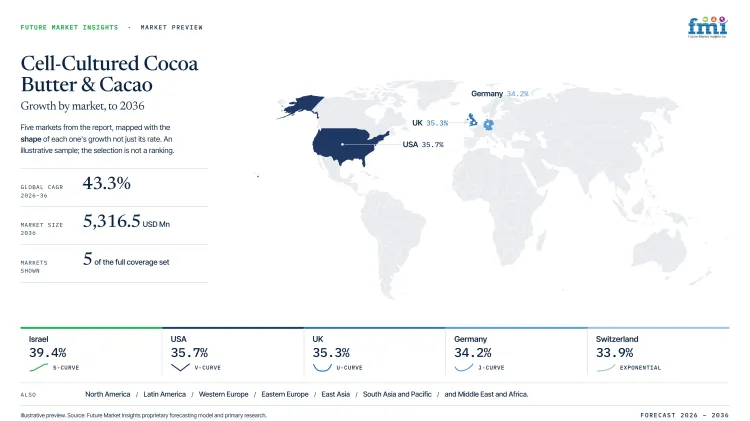
- Israel, the USA, and the UK record CAGRs of 39.4%, 35.7%, and 35.3% respectively through 2036, while Germany and Switzerland combine application expertise with different dossier timelines and production-scale economics.
- Competition centers on Celleste Bio, California Cultured, Kokomodo, Pluri, The Cultured Hub, Puratos, Mondelēz International, and Meiji Holdings, with vendors differentiating through cultured ingredient development, cell-expansion capability, scale-up process support, and finished-product validation.
Analyst Perspective
Commercial confidence in cell-cultured cocoa depends on whether these ingredients reproduce cocoa performance at costs that survive regulatory and application qualification, not on biomass yield claims alone. Developers and chocolate manufacturers should test cultured butter through existing tempering and storage routines rather than accept laboratory composition data, and scale-up plans need to connect biomass productivity with downstream yield since higher cell output doesn't guarantee lower ingredient cost. Development contracts should assign safety documentation and recipe validation responsibilities before any production-capacity commitment.
- Nandini Roy Choudhury, Principal Analyst at Future Market Insights
Source: FMI's proprietary forecasting model and primary research
How is the Cell-Cultured Cocoa Butter & Cacao Market segmented?
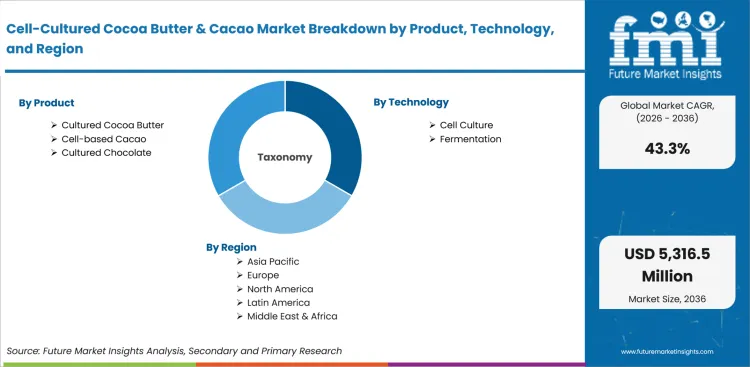
The cell-cultured cocoa butter and cacao industry is segmented by product, technology, application, and region.
The product taxonomy separates cultured cocoa butter from cell-based cacao and cultured chocolate so ingredient revenue remains distinct from finished formulations. Technology analysis distinguishes direct cell culture from fermentation routes used to develop cocoa biomass or process cultured material. Application analysis covers confectionery and bakery uses that require different melting behavior and flavor performance. Regional analysis follows authorization routes and manufacturing capacity across the seven geographic groups used in the report. The structure excludes conventional cocoa ingredients and unrelated fermentation services without a direct cultured-cacao role. It also separates ingredient development from integrated food ingredients used in completed recipes so category boundaries remain clear.
What supports demand for cultured cocoa butter within the product category?
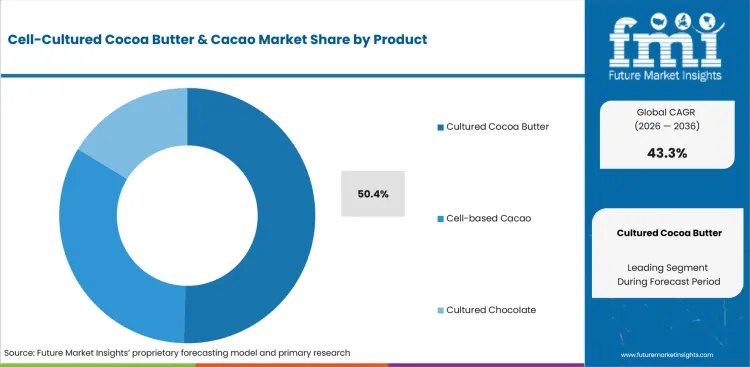
Cultured cocoa butter controls the fat behavior that shapes tempering performance and finished chocolate texture across established recipes. In October 2025, Celleste Bio reported chocolate-grade butter with the same fatty-acid profile and key sensory properties as conventional cocoa butter. The result gives chocolate manufacturers a direct comparison point for melting behavior and snap during recipe trials. Commercial qualification requires consistent performance across separate batches and production economics that remain credible at pilot and later commercial volumes. The same tests align with established cocoa butter specifications used across conventional chocolate production and storage systems.
- Cultured cocoa butter is projected to hold 50.4% share in 2026 owing to direct control over fat crystallization and finished chocolate texture. The category controls a defined recipe input without requiring manufacturers to adopt a finished cultured chocolate format. Commercial strength depends on matching crystallization and melting behavior inside existing tempering systems across successive production batches.
- Chocolate manufacturers are expected to evaluate cultured cocoa butter through recipe trials that compare texture and processing tolerance. Formulation teams need consistent fat composition between production lots and storage periods for commercial sourcing. Bakery developers can apply similar tests as cultured cocoa enters coatings and filled bakery ingredients with defined melting requirements.
How is cell culture positioned within the technology category?
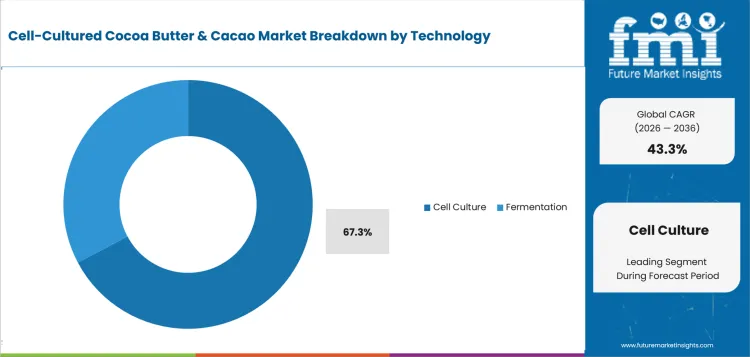
Cell culture determines how cacao biomass develops prior to downstream extraction and later flavor processing across successive production campaigns. Stable productivity and contamination control determine whether cell growth remains economical beyond controlled laboratory trials. In June 2026, the USA National Science Foundation announced a UC Davis-BioMADE project focused on reducing cultured-chocolate production costs. The project combines cacao plant cell cultures with novel bioreactors and improved vessel and media sterilization methods. In-line biomass sensors will compare food-grade cell-culture conditions across separate campaigns and support more consistent process optimization. The documented work places food technology decisions directly inside the ingredient cost model and commercial scale-up plan.
- Based on technology, cell culture is projected to account for 67.3% share in 2026 due to direct control over cacao biomass growth and consistent production conditions. Direct control over growth conditions gives developers a measurable route for managing biomass quality and targeted cocoa components. Capital requirements concentrate in sterile vessels and downstream recovery systems that must sustain food-grade operation across successive campaigns.
- Ingredient developers are anticipated to expand cell culture through modular pilot campaigns that test media use and harvest intervals. Process engineers need data connecting cell productivity with downstream yield and cleaning time across separate pilot runs. The investment case weakens if higher biomass output creates disproportionate separation costs or purification requirements.
What makes confectionery central to the application category?
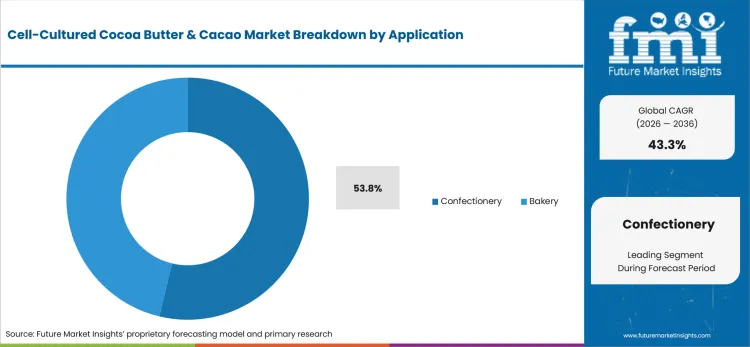
Confectionery provides an early commercial setting for testing cultured cacao against familiar sensory and processing expectations. In February 2026, Puratos announced a professional chocolate product containing cultured cocoa for United States customers later that year. The development connects confectionery ingredients with a defined commercial channel rather than a laboratory demonstration. Manufacturers can compare flavor and handling through established chocolate routines that already define product acceptance.
- The application category is forecast to be led by confectionery at 53.8% share in 2026 due to established product tests for flavor and texture under standard chocolate processing conditions. Chocolate bars and professional coatings provide clear measures for snap and melting behavior under routine production conditions. The category gives developers visible customer feedback without requiring immediate expansion into every food application or finished format.
- Professional chocolatiers are expected to adopt confectionery applications through limited launches that protect product quality during early supply. Formulation teams must align cultured ingredients with recipe fat balance and flavor release across each format. Wider use depends on repeat supply that supports seasonal production plans and consistent product labeling across commercial releases.
What are the drivers, restraints, and opportunities in the Cell-Cultured Cocoa Butter & Cacao Market?
Cocoa input volatility supports investment as authorization and scale costs slow market entry; shared pilot infrastructure creates a practical route toward qualified supply.
- Driver: Cocoa input volatility encourages chocolate manufacturers to examine controlled production routes that can supplement farm-based butter and cacao supply.
- Restraint: Novel-food authorization and scale economics require extensive safety data and consistent production prior to routine commercial sale.
- Opportunity: Shared pilot infrastructure can reduce early capital exposure and help cultured-cacao developers produce application-ready batches at meaningful scale.
Rapid cocoa price reversals increase the value of production routes that can deliver stable ingredient specifications across purchasing cycles. In July 2026, the World Bank reported that cocoa averaged USD 4.35 per kilogram during June 2026. The June 2026 price remained more than 50% below its year-earlier level despite a recent increase. The reversal shows why chocolate manufacturers cannot treat one season of lower prices as durable supply security. Manufacturers should compare cultured output with conventional cocoa through supply continuity and specification stability rather than one monthly price point.
Authorization requirements create an extended evidence path for cultured ingredients entering European recipes intended for commercial sale. The November 2015 novel-food regulation allows nine months for an EFSA opinion and up to seven months for the later Commission process. Developers must prepare identity and composition records that match every proposed use and final specification. The regulatory route increases financing needs as pilot production can continue for extended periods without commercial revenue. Contract schedules should separate technical milestones from regulatory clearance and customer qualification across every planned launch.
Shared pilot infrastructure creates a practical opening for cultured-cacao developers that cannot fund dedicated scale-up assets. Bühler described The Cultured Hub as a joint venture with cell-culture and fermentation equipment supporting pilot operations up to 1,000 liters in June 2025. The official account documents shared scale-up capacity but does not prove cultured-cocoa commercialization at the facility. Its scale range nevertheless shows how external infrastructure can reduce capital exposure during qualified specialty food ingredients campaigns. Revenue potential depends on customer samples and consistent cost data rather than another isolated technical demonstration.
Which country CAGRs are profiled in the Cell-Cultured Cocoa Butter & Cacao Market?
| Country | CAGR |
|---|---|
| USA | 35.7% |
| Israel | 39.4% |
| Germany | 34.2% |
| Switzerland | 33.9% |
| UK | 35.3% |
How do country-level CAGRs compare in the Cell-Cultured Cocoa Butter & Cacao Market?
Israel forms the upper boundary of the country forecast range and Switzerland defines the lower boundary. The five listed country rates span 5.5 percentage points across their complete ten-year forecast range. The USA and UK form the closest middle pair with 0.4 percentage points between them. Germany and Switzerland differ by 0.3 percentage points and occupy a comparable commercial planning band. The ordering describes projected commercialization pace rather than absolute revenue or guaranteed launch timing across individual programs.
- Israel exceeds the USA by 3.7 percentage points within the forecast range for cultured cocoa demand. Its smaller confectionery base means export partnerships remain central to scale decisions and sustained production planning.
- The USA follows Israel and provides a broad commercial application base for controlled cultured-ingredient trials. Its 0.4-point advantage over the UK leaves regulatory execution and customer access as practical market-entry differentiators.
- The UK follows the USA within the same middle growth band despite different local operating conditions. Regulatory guidance can improve dossier planning, yet authorization timing and development finance remain separate commercial constraints.
- Germany trails the UK by 1.1 percentage points and offers substantial chocolate manufacturing capacity for application trials. Entry decisions should balance factory access and technical support against the cost of European novel-food authorization.
- Switzerland closes the listed range at 33.9% and remains 0.3 percentage points behind neighboring Germany. Shared pilot infrastructure supports development, although the smaller domestic customer base favors programs designed for wider European sales.
The forecast pattern supports a portfolio approach that separates local qualification from later production scale. The full report provides country-level CAGR analysis across North America, Latin America, Europe, East Asia, South Asia, Oceania and the Middle East and Africa.
Country-wise Analysis
- United States ingredient developers operate within a federal safety framework and a domestic biomanufacturing network that supports cacao cell-culture scale-up. Adoption of cell-cultured cocoa ingredients in the United States is estimated to expand at 35.7% CAGR through 2036, supported by a large confectionery base and domestic development programs. UC Davis reported in May 2026 that California Cultured had demonstrated cacao cell growth inside novel 1,600-liter bioreactors. The same program anticipated commercial cocoa powder production during early 2027 to fulfill the company’s first chocolate-manufacturer purchase order. The documented project gives American chocolate manufacturers a nearby route for pilot samples and process data ahead of larger sourcing commitments. FDA rules require every food-additive or GRAS use to meet the same safety standard under its proposed conditions. Developers therefore need complete media records and stable ingredient batches across each recipe qualification program. The central friction is financing regulatory work and application testing without allowing early costs to exceed realistic order value.
- Israel combines a concentrated food-technology cluster with public manufacturing programs and several active cacao cell-culture developers. In Israel, cell-cultured cocoa butter and cacao demand is predicted to advance at 39.4% CAGR through 2036 with growth attributable to concentrated plant-cell expertise and public manufacturing support. Celleste Bio and Kokomodo provide nearby technical capability for cacao strains and production process development. In June 2025, the Israel Innovation Authority reported rising applications for plant-cell bioreactors that produce ingredients such as cocoa. The authority recorded greater participation in advanced manufacturing tracks supporting a shift from development toward local production. The same review measured an approximately 60% decline in Israeli food-tech fundraising during the 2024 calendar year. Limited domestic capital makes export partnerships necessary for scale-up programs that exceed Israel’s confectionery demand.
- Germany offers a large chocolate manufacturing base that can test cultured ingredients within established industrial recipes and process controls. Cell-cultured cocoa ingredient demand in Germany is forecast to rise at 34.2% CAGR over the forecast period, influenced by established chocolate production and European authorization requirements. Established factories give development teams clear settings for tempering trials and storage tests across several product formats. Application programs can measure ingredient behavior without redesigning the complete chocolate production line or changing familiar quality controls. In December 2025, Destatis reported that German factories produced nearly 1.07 million tonnes of cocoa-containing chocolate goods during 2024. The national production volume confirms a substantial application base for pilot supply and controlled recipe qualification. European novel-food authorization remains the material barrier despite successful factory trials that demonstrate acceptable process performance under industrial conditions. Cultured-cocoa developers must document composition and intended use alongside stable performance through tempering and storage. Initial programs should focus on factories that can fund qualification without disrupting high-volume seasonal production.
- Switzerland combines specialized food research with shared pilot infrastructure designed for cell-culture development and controlled scale-up. Switzerland’s cultured-cacao sector is projected to record 33.9% CAGR during the assessment period, enabled by shared pilot infrastructure and specialized process-development support. In February 2026, the Federal Food Safety and Veterinary Office published updated information sheets for novel foods produced through new technologies. The guidance classifies foods made from cultured cells as novel and requires technical documentation for every intended ingredient use. A complete application must explain ingredient composition and production methods alongside safety evidence for the proposed conditions of use. European Union authorizations remain valid in Switzerland and can simplify coordinated launch planning across nearby chocolate manufacturing markets. Shared facilities provide a direct enabler for process development and customer sampling through controlled pilot campaigns. An approximately twelve-month dossier process creates the material constraint for companies submitting a complete application. Swiss programs therefore need transferable process evidence and partnerships with larger established European chocolate manufacturers.
- Great Britain requires novel-food authorization for cultured cocoa ingredients intended for commercial chocolate recipes or retail sale. The United Kingdom’s cell-cultured cocoa ingredient outlook is anticipated to advance at 35.3% CAGR over the assessment period, shaped by established confectionery capacity and the novel-food authorization route. The local route separates lawful research tasting from authorization for commercial sale across England, Scotland and Wales. In July 2026, the Food Standards Agency published guidance for cell-cultivated products and novel-food taste trials. The sandbox covers animal cells, so plant-cell cocoa developers must rely on the wider novel-food route for authorization. Taste-trial guidance supports lawful research testing but does not grant permission for commercial distribution of cultured cocoa ingredients. Established confectionery manufacturers provide a direct application enabler through controlled recipe trials and formulation expertise. Financing dossier preparation and recipe qualification creates the principal local constraint during periods without commercial ingredient revenue. Launch plans should pair regulatory preparation with partners that can test recipes under lawful research conditions.
Who are the notable companies in the Cell-Cultured Cocoa Butter & Cacao Market?
Celleste Bio, California Cultured, Kokomodo, Pluri Inc., The Cultured Hub, Puratos, Mondelēz International, and Meiji Holdings are the notable companies shaping this market.
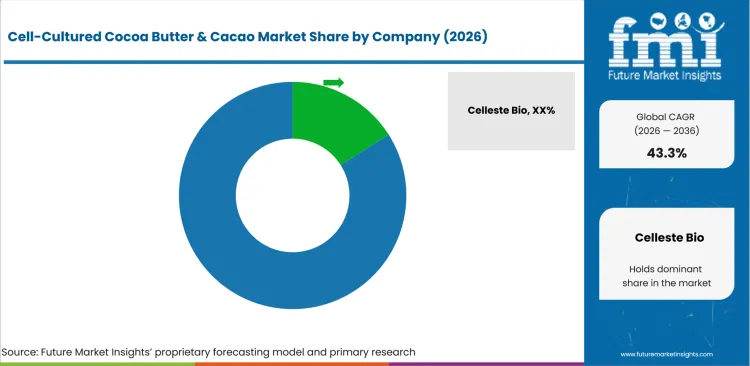
The competitive landscape combines cultured-ingredient developers with scale-up facilities and confectionery groups that validate finished recipes. A Meiji Holdings biodiversity page updated in June 2026 listed the company’s investment in California Cultured for cocoa cell-culture development. The disclosure confirms strategic participation but does not prove independent scale-up capacity or finished-product validation. Celleste Bio and Kokomodo focus on cultured cocoa output, and Pluri controls Kokomodo as a majority-owned subsidiary with cell-expansion capability. The Cultured Hub supports pilot scale-up through shared cell-culture assets and chocolate processing equipment in Switzerland. Puratos connects cultured cocoa with professional product development and established customer channels across its global chocolate business. Company relevance therefore depends on the verified stage each organization controls rather than corporate size alone.
- Celleste Bio and California Cultured develop cultured cocoa ingredients alongside Kokomodo through separate plant-cell production platforms. Their position rests on consistent biomass quality and downstream recovery that yields food-grade cocoa butter or cacao material. Each developer must also show that process economics remain credible across larger campaigns and customer specifications.
- Pluri supports cell-expansion work through its Kokomodo subsidiary and a cultivated-cacao platform designed for larger production campaigns. The Cultured Hub provides shared process infrastructure that lowers capital exposure during larger pilot campaigns and customer sample production. Puratos connects cultured cocoa with professional chocolate formulation and application development across established customer-facing confectionery channels.
- Mondelēz International provides finished-product validation through strategic work with cultured-cocoa developers and established chocolate quality standards across commercial recipes. Meiji Holdings contributes chocolate-category access through strategic investment in a cultured-cocoa developer and retains a verified investor role rather than direct production control.
Competitive Benchmarking: Cell-Cultured Cocoa Butter & Cacao Market
| Company | Cultured Ingredient Development | Scale-up Infrastructure | Chocolate Application Validation | Geographic Reach |
|---|---|---|---|---|
| Celleste Bio | High | Medium | High | Israel and international partnerships |
| California Cultured | High | Medium | Medium | United States with European and Japanese partnerships |
| Kokomodo | High | Medium | Medium | Israel with European and North American agreements |
| Pluri Inc. | Medium | High | Medium | Israel with European and North American partnerships |
| The Cultured Hub | Medium | High | Low | Switzerland with international collaboration programs |
| Puratos | Medium | Medium | Medium | United States launch within global operations |
| Mondelēz International | Low | Low | High | Global |
| Meiji Holdings | Low | Low | Low | Japan with a United States investment relationship |
Key Developments in the Cell-Cultured Cocoa Butter & Cacao Market
- In April 2026, Celleste Bio unveiled milk chocolate bars made with its cultured cocoa butter through development work with Mondelēz International. The finished bars met Mondelēz product standards and advanced the ingredient beyond a single laboratory sample. The development gives chocolate manufacturers a stronger application reference, although regulatory clearance and consistent commercial supply remain separate requirements across larger bioreactor campaigns and planned customer programs.
- In April 2025, Pluri completed the acquisition of approximately 71% of Kokomodo for USD 4.5 million. Kokomodo retained its brand and management team as an independent Pluri subsidiary under its existing leadership and identity. The transaction gives the cacao developer access to Pluri cell-expansion capabilities without erasing its specialist identity. Commercial value depends on translating platform scale into reliable food-grade output and consistent customer-ready ingredient batches.
- In December 2025, The Cultured Hub added plant cell culturing for cocoa and other high-value ingredients to its service offering. The expanded service gives cultured-cacao developers access to shared bioprocess equipment and specialized process-development expertise at pilot scale. Repeated campaigns must produce yield and cost evidence that supports external financing or a manufacturer qualification program across several production runs.
- In November 2025, Kokomodo signed two strategic agreements with a European confectionery innovation company and a United States multinational. Each agreement includes a collaborator-funded proof of concept supporting research and manufacturing development alongside co-development work. The programs expand Kokomodo’s testing base across Europe and North America through two externally funded commercial collaborations. Each partner must confirm application performance through controlled trials prior to committing resources for larger commercial supply.
Key Players in the Cell-Cultured Cocoa Butter & Cacao Market
Cultured Cocoa Ingredient Developers
- Celleste Bio
- California Cultured
- Kokomodo
Scale-up and Commercialization Partners
- Pluri Inc.
- The Cultured Hub
- Puratos
Confectionery Application Partners
- Mondelēz International
- Meiji Holdings
Cell-Cultured Cocoa Butter & Cacao Market - Report Scope
| Coverage field | Report scope |
|---|---|
| Market breakdown | Product, technology, application, and region. |
| Quantitative Units | Revenue in USD Million, CAGR in %. |
| Market Definition | Revenue from cultured cocoa butter, cell-based cacao ingredients, and cultured chocolate formulations produced through cell culture or fermentation for confectionery and bakery applications. The scope excludes conventional cocoa ingredients, unrelated biotechnology services, and finished foods without verified cultured-cacao content. |
| Regions Covered | North America, Latin America, Western Europe, Eastern Europe, East Asia, South Asia and Pacific, and Middle East and Africa. |
| Countries Covered | USA, Israel, Germany, Switzerland, and UK, with more than twenty-five additional countries across the regions covered. |
| Key Companies Profiled | Celleste Bio, California Cultured, Kokomodo, Pluri Inc., The Cultured Hub, Puratos, Mondelēz International, Meiji Holdings |
| Forecast Period | 2026 to 2036. |
| Approach | Hybrid bottom-up and top-down market sizing supported by completed primary research and official desk research. |
Cell-Cultured Cocoa Butter & Cacao Market - Research Methodology
| Method | Approach |
|---|---|
| Primary Research | FMI analysts gathered input from manufacturers, service providers, technology developers, distributors, end users, procurement teams, and subject-matter experts. Interviews examined purchasing decisions, product or service evaluation, adoption barriers, approval requirements, pricing considerations, and expectations for technical or commercial support. Respondents were also asked what evidence is required before a trial, pilot, or initial order develops into regular purchasing. |
| Desk Research | Desk research covered government statistics, regulatory publications, trade data, industry associations, technical literature, standards, company filings, product information, and official corporate announcements. Sources were reviewed for relevance, publication date, geographic coverage, and consistency with the defined market scope. Claims relating to performance, applications, approvals, capacity, investment, and commercial activity were retained only when supported by credible public evidence. |
| Market Sizing and Forecasting | The market model combined the baseline value with historical performance, segment structure, pricing and volume indicators, adoption levels, company participation, and country-level demand conditions. Forecast assumptions considered economic activity, investment trends, regulatory developments, technology adoption, purchasing cycles, supply availability, and barriers to wider market use. Segment and regional estimates were reconciled before the final market total was calculated. |
| Data Validation | Estimates were checked against multiple independent indicators, including public data, company activity, trade patterns, industry developments, and findings from primary interviews. Validation also tested whether products, services, applications, and company revenues fell within the defined market boundaries. Adjacent categories, unsupported claims, overlapping revenues, and activities without direct market relevance were excluded to reduce double counting and maintain consistency across segments and countries. |
Cell-Cultured Cocoa Butter & Cacao Market by Segments
Cell-Cultured Cocoa Butter & Cacao Market segmented by Product:
- Cultured Cocoa Butter
- Cell-based Cacao
- Cultured Chocolate
Cell-Cultured Cocoa Butter & Cacao Market segmented by Technology:
- Cell Culture
- Fermentation
Cell-Cultured Cocoa Butter & Cacao Market segmented by Application:
- Confectionery
- Bakery
Cell-Cultured Cocoa Butter & Cacao Market by Region:
- North America
- United States
- Canada
- Latin America
- Brazil
- Mexico
- Argentina
- Chile
- Western Europe
- Germany
- France
- United Kingdom
- Italy
- Spain
- Benelux
- Nordics
- Eastern Europe
- Poland
- Czech Republic
- Romania
- Hungary
- East Asia
- China
- Japan
- South Korea
- South Asia and Pacific
- India
- ASEAN
- Australia and New Zealand
- Middle East and Africa
- GCC Countries
- South Africa
- Türkiye
- Israel
Research Sources and Bibliography
- International Cocoa Organization. (2026, May 29). May 2026 Quarterly Bulletin of Cocoa Statistics.
- USA Food and Drug Administration. (2024, June 6). Understanding How the FDA Regulates Food Additives and GRAS Ingredients.
- Food Standards Agency. (2025, April 1). Reforms to the market authorisation process for regulated products come into force.
- The Trendlines Group. (2025, October 15). Celleste Bio™ Announces Major Milestone for Cocoa Industry: Production of First Chocolate Grade Cocoa Butter Using Cell Cultured Technology.
- USA National Science Foundation. (2026, June 1). NSF and BioMADE partner to support bioindustrial manufacturing.
- Puratos. (2026, February 24). Puratos to Launch First Professional Chocolate Product with Cultured Cocoa.
- Baffes, J., & Temaj, K. (2026, July 7). Beverage prices retreat as supplies recover.
- European Parliament and Council of the European Union. (2015, November 25). Regulation (EU) 2015/2283 of the European Parliament and of the Council of 25 November 2015 on novel foods, amending Regulation (EU) No 1169/2011 of the European Parliament and of the Council and repealing Regulation (EC) No 258/97 of the European Parliament and of the Council and Commission Regulation (EC) No 1852/2001 (Text with EEA relevance).
- Jacomino, D. (2025, June). Cultivating tomorrow’s food.
- Gautam, N. (2026, May 11). Could Cultured Chocolate Unlock the Next Food Revolution?
- Israel Innovation Authority. (2025, June 30). FoodTech 2024 - Overview.
- Federal Statistical Office (Destatis). (2025, December 2). 12,8 Kilo Schokolade pro Kopf wurden 2024 produziert.
- Federal Food Safety and Veterinary Office. (2026, February 17). Authorisation of novel foods.
- Food Standards Agency. (2026, July 10). New guidance for cell-cultivated and novel food businesses.
- Meiji Holdings Co., Ltd. (2026, June 25). Biodiversity.
- The Trendlines Group. (2026, April 15). Celleste Bio™ Unveils World’s First Milk Chocolate Bars Made with Cell Cultured Cocoa Butter.
- Pluri Inc. (2025, April 28). Pluri Completes Strategic Acquisition of Leading Cultivated Cacao AgFoodTech Company, Kokomodo Ltd.
- Bühler Group. (2025, December 17). The Cultured Hub unveils plant cell culturing for cocoa, coffee, and other ingredients.
- Pluri Inc. (2025, November 10). Leading Global Players Back and Fund Pluri’s Cell-Based Food and Agriculture Collaborations.
This bibliography is provided for reader reference and is not exhaustive. The full report contains the complete reference list and detailed citations.
This Report Answers
- How large is the cell-cultured cocoa butter and cacao market in 2026 and 2036?
- Which cocoa supply and qualification pressures support investment in cultured ingredient production?
- Why is cultured cocoa butter projected to account for the largest product share in 2026?
- How does cell culture influence production economics within the technology category?
- Why is confectionery forecast to capture the largest application share in 2026?
- How do country growth rates compare across the USA, Israel, Germany, Switzerland, and the UK?
- Which companies develop cultured cacao or provide scale-up and confectionery application support?
- What regulatory and process barriers slow commercial qualification across major countries?
- Which operating evidence should manufacturers review prior to approving larger cultured-cacao orders?
Frequently Asked Questions
How big is the Cell-Cultured Cocoa Butter & Cacao Market in 2026?
The cell-cultured cocoa butter and cacao market is valued at USD 145.6 million in 2026 and is forecast to reach USD 5316.5 million by 2036. Growth reflects controlled cell-culture systems producing cocoa ingredients with consistent composition that reduce harvest exposure across established chocolate production specifications.
What is the CAGR of the Cell-Cultured Cocoa Butter & Cacao Market from 2026 to 2036?
The cell-cultured cocoa butter and cacao market grows at a CAGR of 43.3% between 2026 and 2036, supported by cocoa input volatility that encourages chocolate manufacturers to examine controlled production routes supplementing farm-based butter and cacao supply.
Which technology leads the Cell-Cultured Cocoa Butter & Cacao Market?
Cell culture accounts for 67.3% of the cell-cultured cocoa butter and cacao market by technology in 2026, driven by direct control over cacao biomass growth that gives developers a measurable route for managing biomass quality and targeted cocoa components.
How much will the Cell-Cultured Cocoa Butter & Cacao Market add between 2026 and 2036?
The cell-cultured cocoa butter and cacao market is set to add USD 5170.9 million between 2026 and 2036, growing from USD 145.6 million to USD 5316.5 million as controlled production systems extend across a widening base of chocolate and confectionery manufacturing programs.
Who are the leading companies in the Cell-Cultured Cocoa Butter & Cacao Market?
Five companies lead the cell-cultured cocoa butter and cacao market, including Celleste Bio, California Cultured, Kokomodo, Pluri, and The Cultured Hub, competing through cultured ingredient development, cell-expansion capability, scale-up process support, and finished-product validation across global confectionery channels.
Preview the report firsthand - request a free sample
Get SampleGet the brochure for pricing and purchase details.
Get PDFTable of Content
- Key Takeaways
- Market Size and CAGR
- Top Growth Driver
- Fastest Growing Segment
- Leading Region
- Key Companies
- Emerging Opportunities
- Executive Summary
- Global Market Outlook
- Demand-side Trends
- Supply-side Trends
- Technology Roadmap Analysis
- Analysis and Recommendations
- Analyst Perspective (What is happening? Why now? What should investors know?)
- Key Questions Answered
- How large is the market?
- What is the CAGR?
- What are key trends?
- Which region dominates?
- Who are the leaders?
- Market Overview
- Market Coverage / Taxonomy
- Market Definition / Scope / Limitations
- Research Methodology
- Chapter Orientation
- Analytical Lens and Working Hypotheses
- Market Structure, Signals, and Trend Drivers
- Benchmarking and Cross-market Comparability
- Market Sizing, Forecasting, and Opportunity Mapping
- Research Design and Evidence Framework
- Desk Research Programme (Secondary Evidence)
- Expert Input and Fieldwork (Primary Evidence)
- Tooling, Models, and Reference Databases
- Data Engineering and Model Build
- Quality Assurance and Audit Trail
- Market Background
- Market Dynamics (Drivers, Restraints, Opportunity, Trends)
- Scenario Forecast (Optimistic, Likely, Conservative)
- Impact Analysis
- AI Impact
- Sustainability Impact
- Regulatory Impact
- Technology Impact
- Consumer / Buyer Analysis
- Purchase Drivers
- Adoption Barriers
- Buyer Journey
- Opportunity Map Analysis
- Product Life Cycle Analysis
- Supply Chain Analysis
- Investment Feasibility Matrix
- Value Chain Analysis
- PESTLE and Porter's Analysis
- Regulatory Landscape
- Regional Parent Market Outlook
- Production and Consumption Statistics
- Import and Export Statistics
- Global Market Analysis and Forecast, 2021 to 2036
- Historical Market Size Value (USD Million) Analysis, 2021 to 2025
- Current and Future Market Size Value (USD Million) Projections, 2026 to 2036
- Y-o-Y Growth Trend Analysis
- Absolute $ Opportunity Analysis
- Global Market Pricing Analysis, 2021 to 2036
- Global Market Analysis and Forecast, By Product, 2021 to 2036
- Introduction / Key Findings
- Historical Market Size Value (USD Million) Analysis By Product, 2021 to 2025
- Current and Future Market Size Value (USD Million) Analysis and Forecast By Product, 2026 to 2036
- Cultured Cocoa Butter
- Cell-based Cacao
- Cultured Chocolate
- Cultured Cocoa Butter
- Y-o-Y Growth Trend Analysis By Product, 2021 to 2025
- Absolute $ Opportunity Analysis By Product, 2026 to 2036
- Global Market Analysis and Forecast, By Technology, 2021 to 2036
- Introduction / Key Findings
- Historical Market Size Value (USD Million) Analysis By Technology, 2021 to 2025
- Current and Future Market Size Value (USD Million) Analysis and Forecast By Technology, 2026 to 2036
- Cell Culture
- Fermentation
- Cell Culture
- Y-o-Y Growth Trend Analysis By Technology, 2021 to 2025
- Absolute $ Opportunity Analysis By Technology, 2026 to 2036
- Global Market Analysis and Forecast, By Application, 2021 to 2036
- Introduction / Key Findings
- Historical Market Size Value (USD Million) Analysis By Application, 2021 to 2025
- Current and Future Market Size Value (USD Million) Analysis and Forecast By Application, 2026 to 2036
- Confectionery
- Bakery
- Confectionery
- Y-o-Y Growth Trend Analysis By Application, 2021 to 2025
- Absolute $ Opportunity Analysis By Application, 2026 to 2036
- Global Market Analysis and Forecast, By Region, 2021 to 2036
- Introduction
- Historical Market Size Value (USD Million) Analysis By Region, 2021 to 2025
- Current Market Size Value (USD Million) Analysis and Forecast By Region, 2026 to 2036
- North America
- Latin America
- Western Europe
- Eastern Europe
- East Asia
- South Asia and Pacific
- Middle East & Africa
- Market Attractiveness Analysis By Region
- North America Market Analysis and Forecast, By Country, 2021 to 2036
- Historical Market Size Value (USD Million) Trend Analysis By Market Taxonomy, 2021 to 2025
- Market Size Value (USD Million) Forecast By Market Taxonomy, 2026 to 2036
- By Country
- USA
- Canada
- By Product
- By Technology
- By Application
- By Country
- Market Attractiveness Analysis
- By Country
- By Product
- By Technology
- By Application
- Key Takeaways
- Latin America Market Analysis and Forecast, By Country
- Historical Market Size Value (USD Million) Trend Analysis By Market Taxonomy, 2021 to 2025
- Market Size Value (USD Million) Forecast By Market Taxonomy, 2026 to 2036
- By Country
- Brazil
- Mexico
- Chile
- Rest of Latin America
- By Product
- By Technology
- By Application
- By Country
- Market Attractiveness Analysis
- By Country
- By Product
- By Technology
- By Application
- Key Takeaways
- Western Europe Market Analysis and Forecast, By Country
- Historical Market Size Value (USD Million) Trend Analysis By Market Taxonomy, 2021 to 2025
- Market Size Value (USD Million) Forecast By Market Taxonomy, 2026 to 2036
- By Country
- Germany
- UK
- Italy
- Spain
- France
- Nordic
- BENELUX
- Rest of Western Europe
- By Product
- By Technology
- By Application
- By Country
- Market Attractiveness Analysis
- By Country
- By Product
- By Technology
- By Application
- Key Takeaways
- Eastern Europe Market Analysis and Forecast, By Country
- Historical Market Size Value (USD Million) Trend Analysis By Market Taxonomy, 2021 to 2025
- Market Size Value (USD Million) Forecast By Market Taxonomy, 2026 to 2036
- By Country
- Russia
- Poland
- Hungary
- Balkan & Baltic
- Rest of Eastern Europe
- By Product
- By Technology
- By Application
- By Country
- Market Attractiveness Analysis
- By Country
- By Product
- By Technology
- By Application
- Key Takeaways
- East Asia Market Analysis and Forecast, By Country
- Historical Market Size Value (USD Million) Trend Analysis By Market Taxonomy, 2021 to 2025
- Market Size Value (USD Million) Forecast By Market Taxonomy, 2026 to 2036
- By Country
- China
- Japan
- South Korea
- By Product
- By Technology
- By Application
- By Country
- Market Attractiveness Analysis
- By Country
- By Product
- By Technology
- By Application
- Key Takeaways
- South Asia and Pacific Market Analysis and Forecast, By Country
- Historical Market Size Value (USD Million) Trend Analysis By Market Taxonomy, 2021 to 2025
- Market Size Value (USD Million) Forecast By Market Taxonomy, 2026 to 2036
- By Country
- India
- ASEAN
- Australia & New Zealand
- Rest of South Asia and Pacific
- By Product
- By Technology
- By Application
- By Country
- Market Attractiveness Analysis
- By Country
- By Product
- By Technology
- By Application
- Key Takeaways
- Middle East & Africa Market Analysis and Forecast, By Country
- Historical Market Size Value (USD Million) Trend Analysis By Market Taxonomy, 2021 to 2025
- Market Size Value (USD Million) Forecast By Market Taxonomy, 2026 to 2036
- By Country
- Kingdom of Saudi Arabia
- Other GCC Countries
- Türkiye
- South Africa
- Other African Union
- Rest of Middle East & Africa
- By Product
- By Technology
- By Application
- By Country
- Market Attractiveness Analysis
- By Country
- By Product
- By Technology
- By Application
- Key Takeaways
- Key Countries Market Analysis
- USA
- Pricing Analysis
- Market Share Analysis, 2025
- By Product
- By Technology
- By Application
- Canada
- Pricing Analysis
- Market Share Analysis, 2025
- By Product
- By Technology
- By Application
- Mexico
- Pricing Analysis
- Market Share Analysis, 2025
- By Product
- By Technology
- By Application
- Brazil
- Pricing Analysis
- Market Share Analysis, 2025
- By Product
- By Technology
- By Application
- Chile
- Pricing Analysis
- Market Share Analysis, 2025
- By Product
- By Technology
- By Application
- Germany
- Pricing Analysis
- Market Share Analysis, 2025
- By Product
- By Technology
- By Application
- UK
- Pricing Analysis
- Market Share Analysis, 2025
- By Product
- By Technology
- By Application
- Italy
- Pricing Analysis
- Market Share Analysis, 2025
- By Product
- By Technology
- By Application
- Spain
- Pricing Analysis
- Market Share Analysis, 2025
- By Product
- By Technology
- By Application
- France
- Pricing Analysis
- Market Share Analysis, 2025
- By Product
- By Technology
- By Application
- India
- Pricing Analysis
- Market Share Analysis, 2025
- By Product
- By Technology
- By Application
- ASEAN
- Pricing Analysis
- Market Share Analysis, 2025
- By Product
- By Technology
- By Application
- Australia & New Zealand
- Pricing Analysis
- Market Share Analysis, 2025
- By Product
- By Technology
- By Application
- China
- Pricing Analysis
- Market Share Analysis, 2025
- By Product
- By Technology
- By Application
- Japan
- Pricing Analysis
- Market Share Analysis, 2025
- By Product
- By Technology
- By Application
- South Korea
- Pricing Analysis
- Market Share Analysis, 2025
- By Product
- By Technology
- By Application
- Russia
- Pricing Analysis
- Market Share Analysis, 2025
- By Product
- By Technology
- By Application
- Poland
- Pricing Analysis
- Market Share Analysis, 2025
- By Product
- By Technology
- By Application
- Hungary
- Pricing Analysis
- Market Share Analysis, 2025
- By Product
- By Technology
- By Application
- Kingdom of Saudi Arabia
- Pricing Analysis
- Market Share Analysis, 2025
- By Product
- By Technology
- By Application
- Türkiye
- Pricing Analysis
- Market Share Analysis, 2025
- By Product
- By Technology
- By Application
- South Africa
- Pricing Analysis
- Market Share Analysis, 2025
- By Product
- By Technology
- By Application
- USA
- Market Structure Analysis
- Competition Dashboard
- Competition Benchmarking
- Market Share Analysis of Top Players
- By Regional
- By Product
- By Technology
- By Application
- Emerging Startups
- Innovation Benchmarking
- Competition Analysis
- Competition Deep Dive
- Celleste Bio
- Overview
- Product Portfolio
- Profitability by Market Segments
- Sales Footprint
- Strategy Overview
- Marketing Strategy
- Product Strategy
- Channel Strategy
- Cargill (Kokomodo)
- Mondelēz
- California Cultured
- Puratos
- Fermtech
- Kokomodo
- Celleste Bio
- Case Studies
- Success Stories
- Recent Developments
- Competition Deep Dive
- Assumptions & Acronyms Used


