

- Market Size (2026)
- USD 4.59 Bn
- Forecast (2036)
- USD 8.18 Bn
- CAGR (2026 to 2036)
- 8.6%
Chocolate Processing Equipment Market Size, Market Forecast and Outlook By FMI
Summary of the Chocolate Processing Equipment Market
- Demand and Growth Drivers
- Global chocolate and confectionery production expansion is creating sustained demand for processing equipment across tempering, molding, enrobing, depositing, and cooling stages.
- Growth in premium, artisanal, and single origin chocolate manufacturing is driving investment in versatile processing equipment that supports small batch production alongside industrial scale operations.
- Functional confectionery categories including vitamin gummies, protein bars, and medicated confections are creating new equipment requirements for hybrid food and pharmaceutical processing.
- Product and Segment View
- Gummies and jellies hold 35.6% of product type, reflecting the growing confectionery segment that requires specialized depositing and molding equipment.
- Depositors account for 31.6% of machine type, confirming precision depositing as a critical processing function across confectionery categories.
- Chocolate manufacturing plants lead at 46.8% of applications, confirming industrial chocolate production as the primary equipment consumption driver.
- Geography and Competitive Outlook
- China leads at 11.1% through 2036, supported by rapid confectionery industry expansion and investment in automated food manufacturing infrastructure.
- Europe sustains demand through established chocolate manufacturing traditions and ongoing equipment modernization across premium and industrial production facilities.
- Companies combining processing precision with hygienic design and flexible production changeover capabilities hold competitive advantage across confectionery manufacturing segments.
- Analyst Opinion
- The chocolate processing equipment market is experiencing strong growth as confectionery production industrializes globally and functional confectionery categories create new equipment requirements.
- Adoption reflects the shift toward automated processing lines that deliver consistent product quality across tempering, depositing, enrobing, and cooling stages with reduced manual intervention.
- The gummies and jellies segment's leading share indicates the growing importance of functional confectionery manufacturing as a demand driver alongside traditional chocolate production.
- Companies that deliver versatile, hygienic, and precision controlled processing equipment with strong technical support are expected to capture share as the global confectionery industry expands.
Key Takeaways
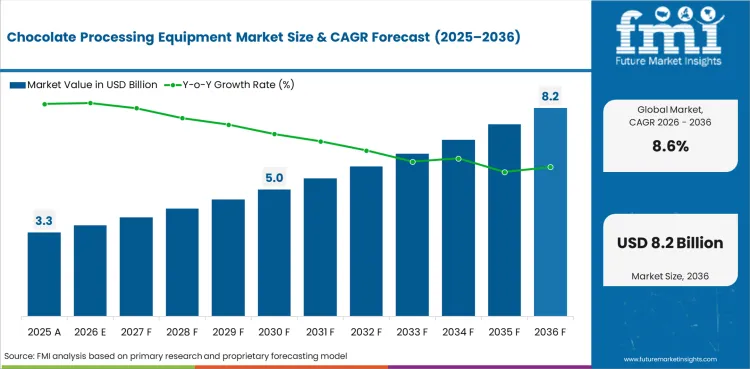
- The chocolate processing equipment market was valued at USD 3.30 billion in 2025.
- By 2036, the Chocolate Processing Equipment Market is expected to be worth USD 8.18 billion.
- From 2026 to 2036, the market is projected to expand at a CAGR of 8.6%.
- The market is projected to create an incremental opportunity of USD 4.59 billion between 2026 and 2036.
- In 2026, gummies and jellies are expected to account for 35.6% of the product type segment, driven by demand for precision depositing and molding equipment used in confectionery and functional food manufacturing.
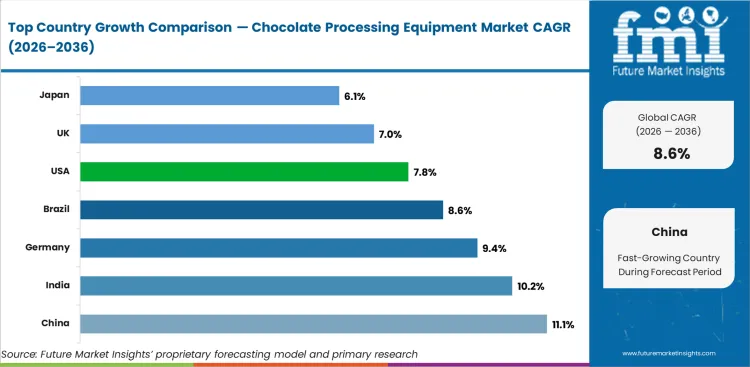
- China (11.1%) and India (10.2%) are two of the fastest growing markets in the world.
Chocolate Processing Equipment Market Definition
The chocolate processing equipment market encompasses machinery used in the production of chocolate, confections, gummies, and related products. Products include tempering machines, depositors, enrobers, molding systems, cooling tunnels, conching equipment, and integrated processing lines for chocolate manufacturing plants, confectionery factories, and artisanal producers.
Chocolate Processing Equipment Market Inclusions
Market scope covers all commercially traded chocolate and confectionery processing equipment categorized by product type (gummies and jellies equipment, chocolate bars, pralines, truffles, enrobed products, others), machine type (depositors, tempering machines, enrobers, molding systems, cooling tunnels, conching machines), application (chocolate manufacturing plants, confectionery factories, artisanal producers), and distribution channel (direct sales, equipment dealers, online platforms). Revenue sizing spans 2026 to 2036.
Chocolate Processing Equipment Market Exclusions
The scope does not include cocoa bean processing and grinding equipment used before chocolate liquor production, retail chocolate display equipment, or packaging machinery used after processing completion.
Chocolate Processing Equipment Market Research Methodology
- Primary Research: Interviews with confectionery equipment manufacturers, chocolate producers, functional confectionery companies, and equipment distributors across key markets.
- Desk Research: Aggregated data from confectionery equipment publications, chocolate industry reports, trade association data, and manufacturer disclosures.
- Market Sizing and Forecasting: Bottom up methodology starting with verified processing equipment sales data across machine type and application segments, with regional production capacity modeling.
- Data Validation: Cross referenced quarterly against global confectionery production data, equipment output statistics, and manufacturer reported revenues.
Why is the Chocolate Processing Equipment Market Growing?
- Confectionery production expansion and the industrialization of chocolate manufacturing create consistent demand for processing equipment across established and emerging production markets.
- China leads growth at 11.1%, shaped by rapid confectionery industry expansion, growing chocolate consumption, and investment in automated food manufacturing infrastructure.
- Functional confectionery growth, particularly vitamin gummies and nutraceutical confections, creates demand for processing equipment that bridges confectionery and pharmaceutical manufacturing requirements.
The chocolate processing equipment market reflects strong growth driven by the expansion of global confectionery production and the emergence of functional confectionery as a high growth category. As chocolate, gummy, and confectionery consumption increases globally, manufacturers invest in processing equipment to expand capacity and improve product consistency.
Growth is accelerated by the functional confectionery segment, where vitamin gummies, CBD confections, and protein bars require processing equipment capable of handling active ingredient incorporation, precise dosing, and pharmaceutical grade manufacturing standards alongside traditional confectionery production capabilities.
The competitive landscape is dominated by European confectionery equipment manufacturers with decades of chocolate processing expertise. German, Swiss, and Italian companies hold particular strength through engineering excellence and established relationships with global chocolate and confectionery producers.
Market Segmentation Analysis
- Gummies and jellies hold 35.6% of product type, reflecting functional confectionery's growing equipment demand.
- Depositors account for 31.6% of machine type, confirming precision depositing as a critical confectionery processing function.
- Direct sales lead at 44.0% of distribution, reflecting the capital equipment procurement model.
The chocolate processing equipment market is segmented by product type, machine type, application, and distribution channel.
Insights into the Gummies and Jellies Product Type Segment
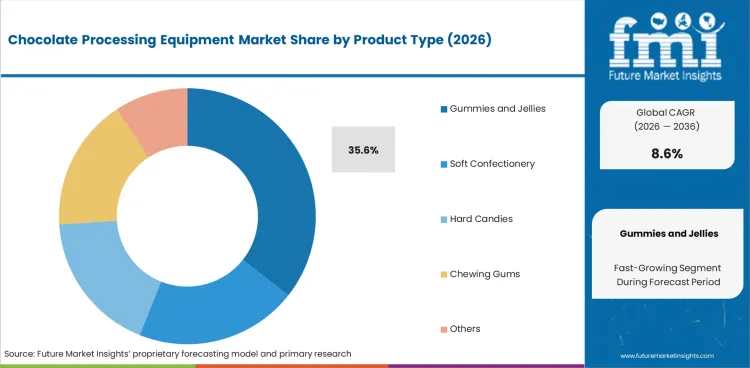
In 2026, gummies and jellies equipment is expected to hold 35.6% of the product type segment. This leading position reflects the rapid growth of gummy confectionery production, driven by both traditional gummy candy and the functional gummy supplement category. Starch and starchless mogul systems, precision depositors, and gelatin and pectin processing equipment are the primary machine categories serving this segment.
Insights into the Depositors Machine Type Segment
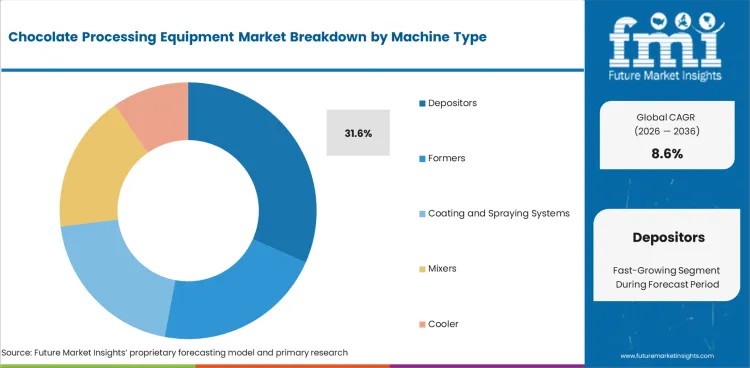
Depositors account for 31.6% of the machine type segment in 2026. Precision depositing technology is essential for consistent portion control, accurate ingredient placement, and multi component product creation across chocolate, gummy, and praline manufacturing. Servo driven depositors with multi nozzle configurations enable high speed production with minimal waste and product variation.
Chocolate Processing Equipment Market Drivers, Restraints, and Opportunities
- Confectionery production expansion and functional food manufacturing growth create dual demand drivers for processing equipment.
- High equipment capital costs and long replacement cycles create investment cycle dynamics that affect manufacturer revenue predictability.
- Industry 4.0 integration with IoT monitoring, predictive maintenance, and recipe management represents premium technology opportunities.
The market is shaped by production expansion, capital investment dynamics, and smart manufacturing opportunities.
Confectionery Production and Functional Food Growth
Demand is shaped by the expansion of global confectionery production and the rapid growth of functional confectionery categories. Equipment must serve both traditional chocolate and candy production and the emerging requirements of vitamin gummy, nutraceutical, and functional confection manufacturing.
Capital Investment and Equipment Lifecycle
Revenue dynamics are influenced by equipment capital costs and replacement cycles of 15 to 20 years. Investment concentrates during periods of production capacity expansion and technology upgrade, creating cyclical demand patterns.
Smart Manufacturing and IoT Integration
Growth reflects the integration of confectionery processing equipment with Industry 4.0 technologies including IoT sensors for temperature and viscosity monitoring, predictive maintenance systems, and centralized production management platforms.
Analysis of Chocolate Processing Equipment Market by Key Countries
.webp "Top Country Growth Comparison Chocolate Processing Equipment Market Cagr (2026 2036)")
| Country | CAGR |
|---|---|
| China | 11.1% |
| India | 10.2% |
| Germany | 9.4% |
| Brazil | 8.6% |
| USA | 7.8% |
| UK | 7.0% |
| Japan | 6.1% |
- China leads with 11.1% CAGR through 2036, reflecting confectionery industry expansion and automation investment.
- India at 10.2% shows growth shaped by growing confectionery manufacturing and chocolate consumption.
- Germany at 9.4% sustains demand through established chocolate manufacturing and equipment expertise.
The global chocolate processing equipment market is projected to expand at 8.6% from 2026 to 2036.
Demand Outlook for Chocolate Processing Equipment Market in the United States
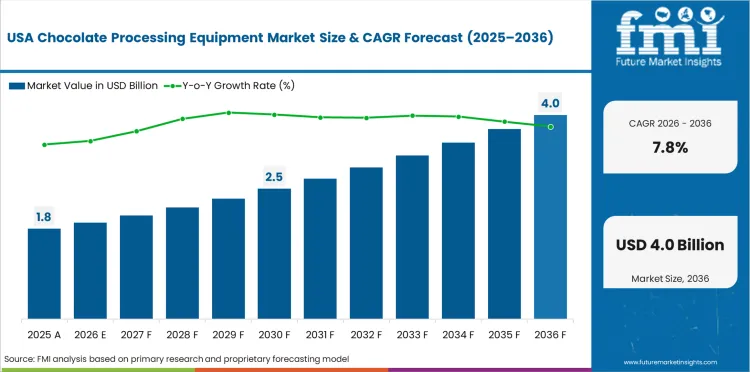
The USA is expected to grow at 7.8% through 2036, supported by large confectionery production and functional gummy manufacturing expansion.
- Large confectionery industry creates consistent processing equipment demand.
- Functional gummy supplement manufacturing drives specialized equipment procurement.
- Equipment modernization supports technology upgrade investment.
Future Outlook for Chocolate Processing Equipment Market in Germany
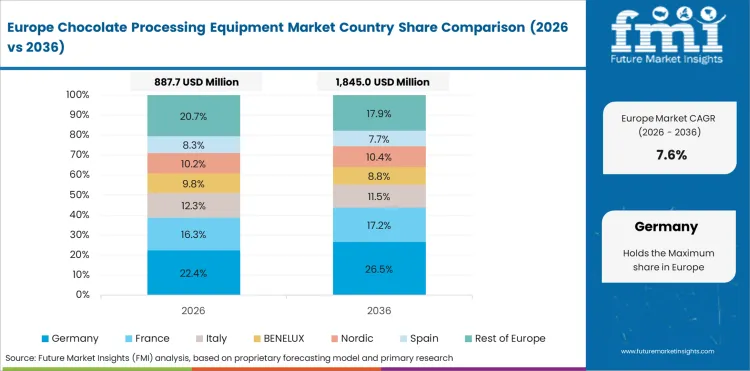
Germany is expected to grow at 9.4% through 2036, reflecting European chocolate manufacturing traditions and equipment innovation.
- German confectionery equipment manufacturers serve global markets.
- Premium chocolate manufacturing drives investment in precision processing equipment.
- Strict food processing standards support hygienic equipment adoption.
Opportunity Analysis of Chocolate Processing Equipment Market in China
China leads at 11.1% through 2036, driven by rapid confectionery manufacturing expansion.
- Growing chocolate and confectionery consumption creates production capacity demand.
- Functional gummy manufacturing growth drives equipment procurement.
- Domestic equipment manufacturing reduces import dependency.
In-depth Analysis of Chocolate Processing Equipment Market in India
India is expected to grow at 10.2% through 2036, shaped by confectionery industry development.
- Growing confectionery consumption supports manufacturing capacity investment.
- Functional food manufacturing creates specialized equipment demand.
- Food processing modernization drives equipment quality upgrades.
Sales Analysis of Chocolate Processing Equipment Market in Brazil
Brazil is expected to grow at 8.6% through 2036, supported by confectionery production expansion.
- Large domestic confectionery market supports processing equipment demand.
- Chocolate manufacturing growth drives tempering and molding equipment procurement.
- Equipment modernization supports productivity improvement investment.
Competitive Landscape and Strategic Positioning
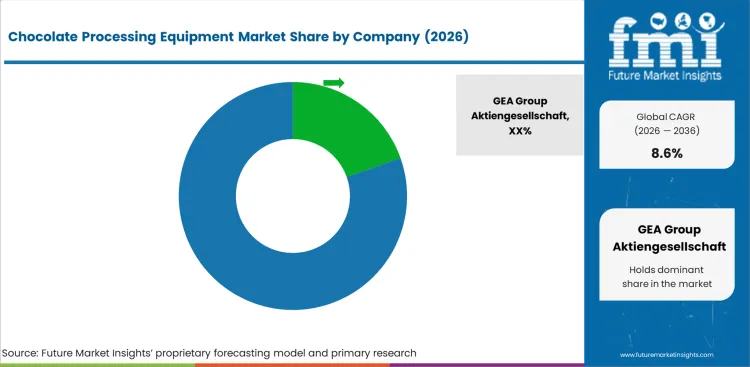
- GEA Group holds a dominant position through comprehensive food processing equipment portfolios, global manufacturing scale, and established confectionery industry relationships.
- John Bean Technologies Corporation and Heat and Control Inc. compete with specialized food processing solutions and strong distribution across the Americas.
- Alfa Laval and Robert Bosch Packaging Technology provide integrated processing and packaging solutions for confectionery manufacturers.
GEA Group leads through diversified food processing capabilities and global confectionery industry distribution. JBT and Heat and Control compete with focused processing solutions and Americas distribution strength.
Alfa Laval and Bosch bring integrated processing and packaging expertise. Buhler Group, Sollich, and Aasted provide specialized chocolate processing technology with European engineering excellence.
Entry barriers include food processing engineering expertise, hygienic design certification, precision manufacturing capability, and the after sales service infrastructure required for complex confectionery processing systems.
Key Companies in the Chocolate Processing Equipment Market
Key global companies leading the chocolate processing equipment market include:
- GEA Group Aktiengesellschaft (Germany), John Bean Technologies Corporation (USA), and Heat and Control Inc. (USA) maintain strong positions through comprehensive equipment portfolios and global food processing industry distribution.
- Alfa Laval AB (Sweden) and Robert Bosch Packaging Technology GmbH (Germany) compete with integrated processing and packaging solutions for confectionery manufacturers.
- Buhler Group (Switzerland), Sollich KG (Germany), Aasted ApS (Denmark), Hacos (Belgium), and Prefamac (Belgium) represent specialized chocolate and confectionery processing equipment manufacturers.
Competitive Benchmarking: Chocolate Processing Equipment Market
| Company | Product Range | Technology Level | Distribution Reach | Geographic Footprint |
|---|---|---|---|---|
| GEA Group | High | High | Strong | Global |
| JBT Corporation | High | High | Strong | Global |
| Heat and Control | Medium | High | Strong | Americas |
| Alfa Laval | High | High | Strong | Global |
| Bosch Packaging | High | High | Strong | Global |
| Buhler Group | High | High | Strong | Global |
| Sollich KG | Medium | High | Moderate | Global |
| Aasted ApS | Medium | High | Moderate | Europe |
| Hacos | Medium | Medium | Moderate | Europe |
| Prefamac | Medium | Medium | Moderate | Europe |
Source: Future Market Insights competitive analysis, 2026.
Key Developments in Chocolate Processing Equipment Market
- In 2025, GEA Group introduced a new IoT enabled depositing system with real time viscosity monitoring for gummy and chocolate confectionery production lines.
- In 2025, Buhler Group launched a modular chocolate tempering and molding line designed for flexible production switching between multiple confectionery product formats.
Key Players in the Chocolate Processing Equipment Market
Major Global Players
- GEA Group Aktiengesellschaft
- John Bean Technologies Corporation
- Heat and Control Inc.
- Alfa Laval AB
- Robert Bosch Packaging Technology GmbH
Emerging Players/Startups
- Buhler Group
- Sollich KG
- Aasted ApS
- Hacos
- Prefamac
Report Scope and Coverage
| Parameter | Details |
|---|---|
| Quantitative Units | USD 3.58 billion to USD 8.18 billion, at a CAGR of 8.6% |
| Market Definition | The chocolate processing equipment market includes machinery for chocolate, confection, and gummy product manufacturing across tempering, depositing, enrobing, molding, and cooling stages. |
| Regions Covered | North America, Latin America, Europe, East Asia, South Asia and Pacific, Middle East and Africa |
| Countries Covered | China, India, Germany, Brazil, USA, UK, Japan, and 25 plus countries |
| Key Companies Profiled | GEA Group Aktiengesellschaft, John Bean Technologies Corporation, Heat and Control Inc., Alfa Laval AB, Robert Bosch Packaging Technology GmbH, Aasted APS, Baker Perkins Limited, Tomric Systems, Inc, Caotech B.V., Sollich KG, Apex Machinery & Equipment Co., Ltd., Royal Duyvis Wiener B.V., Others (on demand) |
| Forecast Period | 2026 to 2036 |
| Approach | Hybrid bottom up and top down methodology starting with verified transaction data, projecting adoption velocity across segments and regions. |
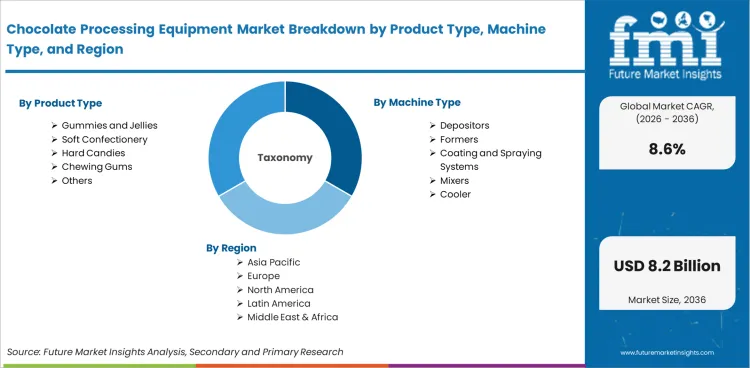
Segmentation
Chocolate Processing Equipment Market Segmented by Product Type:
- Gummies and Jellies
- Soft Confectionery
- Hard Candies
- Chewing Gums
- Others
Chocolate Processing Equipment Market Segmented by Machine Type:
- Depositors
- Formers
- Coating and Spraying Systems
- Mixers
- Cooler
Chocolate Processing Equipment Market Segmented by Application:
- Chocolate Manufacturing Plants
- Confectionery Manufacturing
- Bakery and Desserts Production
Chocolate Processing Equipment Market Segmented by Distribution Channel:
- Direct Sales
- Distributors
- Online Retailers
Chocolate Processing Equipment Market by Region:
- North America
- USA
- Canada
- Mexico
- Latin America
- Brazil
- Chile
- Rest of Latin America
- Western Europe
- Germany
- UK
- Italy
- Spain
- France
- Nordic
- BENELUX
- Rest of Western Europe
- Eastern Europe
- Russia
- Poland
- Hungary
- Balkan & Baltic
- Rest of Eastern Europe
- East Asia
- China
- Japan
- South Korea
- South Asia and Pacific
- India
- ASEAN
- Australia & New Zealand
- Rest of South Asia and Pacific
- Middle East & Africa
- Kingdom of Saudi Arabia
- Other GCC Countries
- Turkiye
- South Africa
- Other African Union
- Rest of Middle East & Africa
Research Sources and Bibliography
- 1. International Confectionery Association. (2024). ICA World Confectionery Industry Report. ICA.
- 2. World Cocoa Foundation. (2025). WCF Cocoa Processing and Chocolate Manufacturing Report. WCF.
- 3. Packaging Machinery Manufacturers Institute. (2024). PMMI Confectionery Equipment Technology Report. PMMI.
- 4. Food and Agriculture Organization. (2025). FAO Global Confectionery Production Statistics. FAO.
- 5. International Organization for Standardization. (2024). ISO Food Processing Equipment Safety Standards. ISO.
- 6. European Confectionery Association. (2025). ECA Annual Report on Confectionery Industry Trends. ECA.
This bibliography is provided for reader reference.
This Report Answers
- Estimating the market size and revenue potential from 2026 to 2036.
- Segmentation by product type, machine type, application, and distribution channel.
- Regional insights across more than 30 markets.
- Analysis of processing technology, automation, and functional confectionery equipment trends.
- Assessment of the competitive landscape and strategic positioning.
- Identification of growth opportunities in functional gummies, smart manufacturing, and emerging market expansion.
- Supply chain and manufacturing evaluation.
- Data delivery in PDF and Excel formats.
Frequently Asked Questions
What is the global market demand for chocolate processing equipment in 2026?
In 2026, the global chocolate processing equipment market is expected to be worth USD 3.58 billion.
How big will the market be in 2036?
By 2036, the chocolate processing equipment market is expected to be worth USD 8.18 billion.
How much is demand expected to grow?
Between 2026 and 2036, demand is expected to grow at a CAGR of 8.6%.
Which product type is expected to lead?
Gummies and jellies equipment is expected to hold 35.6% of the product type segment in 2026.
What is causing demand to rise in China?
China leads at 11.1% through 2036, driven by confectionery industry expansion and automation investment.
What is causing demand to rise in India?
India is expected to grow at 10.2% through 2036, shaped by growing confectionery manufacturing.
What does this report mean by chocolate processing equipment market definition?
The market includes machinery for chocolate, confection, and gummy manufacturing across processing stages.
How does FMI make the forecast?
Forecasting uses a hybrid bottom up and top down approach with verified equipment sales data cross referenced against confectionery production statistics.
Preview the report firsthand - request a free sample
Get SampleGet the brochure for pricing and purchase details.
Get PDFTable of Content
- Executive Summary
- Global Market Outlook
- Demand-side Trends
- Supply-side Trends
- Technology Roadmap Analysis
- Analysis and Recommendations
- Market Overview
- Market Coverage / Taxonomy
- Market Definition / Scope / Limitations
- Research Methodology
- Chapter Orientation
- Analytical Lens and Working Hypotheses
- Market Structure, Signals, and Trend Drivers
- Benchmarking and Cross-market Comparability
- Market Sizing, Forecasting, and Opportunity Mapping
- Research Design and Evidence Framework
- Desk Research Programme (Secondary Evidence)
- Company Annual and Sustainability Reports
- Peer-reviewed Journals and Academic Literature
- Corporate Websites, Product Literature, and Technical Notes
- Earnings Decks and Investor Briefings
- Statutory Filings and Regulatory Disclosures
- Technical White Papers and Standards Notes
- Trade Journals, Industry Magazines, and Analyst Briefs
- Conference Proceedings, Webinars, and Seminar Materials
- Government Statistics Portals and Public Data Releases
- Press Releases and Reputable Media Coverage
- Specialist Newsletters and Curated Briefings
- Sector Databases and Reference Repositories
- FMI Internal Proprietary Databases and Historical Market Datasets
- Subscription Datasets and Paid Sources
- Social Channels, Communities, and Digital Listening Inputs
- Additional Desk Sources
- Expert Input and Fieldwork (Primary Evidence)
- Primary Modes
- Qualitative Interviews and Expert Elicitation
- Quantitative Surveys and Structured Data Capture
- Blended Approach
- Why Primary Evidence is Used
- Field Techniques
- Interviews
- C-suite Leaders
- Board Members
- Presidents and Vice Presidents
- R&D and Innovation Heads
- Technical Specialists
- Domain Subject-matter Experts
- Scientists
- Physicians and Other Healthcare Professionals
- Governance, Ethics, and Data Stewardship
- Research Ethics
- Data Integrity and Handling
- Primary Modes
- Tooling, Models, and Reference Databases
- Desk Research Programme (Secondary Evidence)
- Data Engineering and Model Build
- Data Acquisition and Ingestion
- Cleaning, Normalisation, and Verification
- Synthesis, Triangulation, and Analysis
- Quality Assurance and Audit Trail
- Market Background
- Market Dynamics
- Drivers
- Restraints
- Opportunity
- Trends
- Scenario Forecast
- Demand in Optimistic Scenario
- Demand in Likely Scenario
- Demand in Conservative Scenario
- Opportunity Map Analysis
- Product Life Cycle Analysis
- Supply Chain Analysis
- Investment Feasibility Matrix
- Value Chain Analysis
- PESTLE and Porter’s Analysis
- Regulatory Landscape
- Regional Parent Market Outlook
- Production and Consumption Statistics
- Import and Export Statistics
- Market Dynamics
- Global Market Analysis 2021 to 2025 and Forecast, 2026 to 2036
- Historical Market Size Value (USD Million) Analysis, 2021 to 2025
- Current and Future Market Size Value (USD Million) Projections, 2026 to 2036
- Y-o-Y Growth Trend Analysis
- Absolute $ Opportunity Analysis
- Global Market Pricing Analysis 2021 to 2025 and Forecast 2026 to 2036
- Global Market Analysis 2021 to 2025 and Forecast 2026 to 2036, By Product Type
- Introduction / Key Findings
- Historical Market Size Value (USD Million) Analysis By Product Type , 2021 to 2025
- Current and Future Market Size Value (USD Million) Analysis and Forecast By Product Type , 2026 to 2036
- Gummies and Jellies
- Soft Confectionery
- Hard Candies
- Chewing Gums
- Others
- Gummies and Jellies
- Y-o-Y Growth Trend Analysis By Product Type , 2021 to 2025
- Absolute $ Opportunity Analysis By Product Type , 2026 to 2036
- Global Market Analysis 2021 to 2025 and Forecast 2026 to 2036, By Machine Type
- Introduction / Key Findings
- Historical Market Size Value (USD Million) Analysis By Machine Type, 2021 to 2025
- Current and Future Market Size Value (USD Million) Analysis and Forecast By Machine Type, 2026 to 2036
- Depositors
- Formers
- Coating and Spraying Systems
- Mixers
- Cooler
- Depositors
- Y-o-Y Growth Trend Analysis By Machine Type, 2021 to 2025
- Absolute $ Opportunity Analysis By Machine Type, 2026 to 2036
- Global Market Analysis 2021 to 2025 and Forecast 2026 to 2036, By Application
- Introduction / Key Findings
- Historical Market Size Value (USD Million) Analysis By Application, 2021 to 2025
- Current and Future Market Size Value (USD Million) Analysis and Forecast By Application, 2026 to 2036
- Chocolate Manufacturing Plants
- Confectionery Manufacturing
- Bakery and Desserts Production
- Chocolate Manufacturing Plants
- Y-o-Y Growth Trend Analysis By Application, 2021 to 2025
- Absolute $ Opportunity Analysis By Application, 2026 to 2036
- Global Market Analysis 2021 to 2025 and Forecast 2026 to 2036, By Distribution Channel
- Introduction / Key Findings
- Historical Market Size Value (USD Million) Analysis By Distribution Channel, 2021 to 2025
- Current and Future Market Size Value (USD Million) Analysis and Forecast By Distribution Channel, 2026 to 2036
- Direct Sales
- Distributors
- Online Retailers
- Direct Sales
- Y-o-Y Growth Trend Analysis By Distribution Channel, 2021 to 2025
- Absolute $ Opportunity Analysis By Distribution Channel, 2026 to 2036
- Global Market Analysis 2021 to 2025 and Forecast 2026 to 2036, By Region
- Introduction
- Historical Market Size Value (USD Million) Analysis By Region, 2021 to 2025
- Current Market Size Value (USD Million) Analysis and Forecast By Region, 2026 to 2036
- North America
- Latin America
- Western Europe
- Eastern Europe
- East Asia
- South Asia and Pacific
- Middle East & Africa
- Market Attractiveness Analysis By Region
- North America Market Analysis 2021 to 2025 and Forecast 2026 to 2036, By Country
- Historical Market Size Value (USD Million) Trend Analysis By Market Taxonomy, 2021 to 2025
- Market Size Value (USD Million) Forecast By Market Taxonomy, 2026 to 2036
- By Country
- USA
- Canada
- Mexico
- By Product Type
- By Machine Type
- By Application
- By Distribution Channel
- By Country
- Market Attractiveness Analysis
- By Country
- By Product Type
- By Machine Type
- By Application
- By Distribution Channel
- Key Takeaways
- Latin America Market Analysis 2021 to 2025 and Forecast 2026 to 2036, By Country
- Historical Market Size Value (USD Million) Trend Analysis By Market Taxonomy, 2021 to 2025
- Market Size Value (USD Million) Forecast By Market Taxonomy, 2026 to 2036
- By Country
- Brazil
- Chile
- Rest of Latin America
- By Product Type
- By Machine Type
- By Application
- By Distribution Channel
- By Country
- Market Attractiveness Analysis
- By Country
- By Product Type
- By Machine Type
- By Application
- By Distribution Channel
- Key Takeaways
- Western Europe Market Analysis 2021 to 2025 and Forecast 2026 to 2036, By Country
- Historical Market Size Value (USD Million) Trend Analysis By Market Taxonomy, 2021 to 2025
- Market Size Value (USD Million) Forecast By Market Taxonomy, 2026 to 2036
- By Country
- Germany
- UK
- Italy
- Spain
- France
- Nordic
- BENELUX
- Rest of Western Europe
- By Product Type
- By Machine Type
- By Application
- By Distribution Channel
- By Country
- Market Attractiveness Analysis
- By Country
- By Product Type
- By Machine Type
- By Application
- By Distribution Channel
- Key Takeaways
- Eastern Europe Market Analysis 2021 to 2025 and Forecast 2026 to 2036, By Country
- Historical Market Size Value (USD Million) Trend Analysis By Market Taxonomy, 2021 to 2025
- Market Size Value (USD Million) Forecast By Market Taxonomy, 2026 to 2036
- By Country
- Russia
- Poland
- Hungary
- Balkan & Baltic
- Rest of Eastern Europe
- By Product Type
- By Machine Type
- By Application
- By Distribution Channel
- By Country
- Market Attractiveness Analysis
- By Country
- By Product Type
- By Machine Type
- By Application
- By Distribution Channel
- Key Takeaways
- East Asia Market Analysis 2021 to 2025 and Forecast 2026 to 2036, By Country
- Historical Market Size Value (USD Million) Trend Analysis By Market Taxonomy, 2021 to 2025
- Market Size Value (USD Million) Forecast By Market Taxonomy, 2026 to 2036
- By Country
- China
- Japan
- South Korea
- By Product Type
- By Machine Type
- By Application
- By Distribution Channel
- By Country
- Market Attractiveness Analysis
- By Country
- By Product Type
- By Machine Type
- By Application
- By Distribution Channel
- Key Takeaways
- South Asia and Pacific Market Analysis 2021 to 2025 and Forecast 2026 to 2036, By Country
- Historical Market Size Value (USD Million) Trend Analysis By Market Taxonomy, 2021 to 2025
- Market Size Value (USD Million) Forecast By Market Taxonomy, 2026 to 2036
- By Country
- India
- ASEAN
- Australia & New Zealand
- Rest of South Asia and Pacific
- By Product Type
- By Machine Type
- By Application
- By Distribution Channel
- By Country
- Market Attractiveness Analysis
- By Country
- By Product Type
- By Machine Type
- By Application
- By Distribution Channel
- Key Takeaways
- Middle East & Africa Market Analysis 2021 to 2025 and Forecast 2026 to 2036, By Country
- Historical Market Size Value (USD Million) Trend Analysis By Market Taxonomy, 2021 to 2025
- Market Size Value (USD Million) Forecast By Market Taxonomy, 2026 to 2036
- By Country
- Kingdom of Saudi Arabia
- Other GCC Countries
- Turkiye
- South Africa
- Other African Union
- Rest of Middle East & Africa
- By Product Type
- By Machine Type
- By Application
- By Distribution Channel
- By Country
- Market Attractiveness Analysis
- By Country
- By Product Type
- By Machine Type
- By Application
- By Distribution Channel
- Key Takeaways
- Key Countries Market Analysis
- USA
- Pricing Analysis
- Market Share Analysis, 2025
- By Product Type
- By Machine Type
- By Application
- By Distribution Channel
- Canada
- Pricing Analysis
- Market Share Analysis, 2025
- By Product Type
- By Machine Type
- By Application
- By Distribution Channel
- Mexico
- Pricing Analysis
- Market Share Analysis, 2025
- By Product Type
- By Machine Type
- By Application
- By Distribution Channel
- Brazil
- Pricing Analysis
- Market Share Analysis, 2025
- By Product Type
- By Machine Type
- By Application
- By Distribution Channel
- Chile
- Pricing Analysis
- Market Share Analysis, 2025
- By Product Type
- By Machine Type
- By Application
- By Distribution Channel
- Germany
- Pricing Analysis
- Market Share Analysis, 2025
- By Product Type
- By Machine Type
- By Application
- By Distribution Channel
- UK
- Pricing Analysis
- Market Share Analysis, 2025
- By Product Type
- By Machine Type
- By Application
- By Distribution Channel
- Italy
- Pricing Analysis
- Market Share Analysis, 2025
- By Product Type
- By Machine Type
- By Application
- By Distribution Channel
- Spain
- Pricing Analysis
- Market Share Analysis, 2025
- By Product Type
- By Machine Type
- By Application
- By Distribution Channel
- France
- Pricing Analysis
- Market Share Analysis, 2025
- By Product Type
- By Machine Type
- By Application
- By Distribution Channel
- India
- Pricing Analysis
- Market Share Analysis, 2025
- By Product Type
- By Machine Type
- By Application
- By Distribution Channel
- ASEAN
- Pricing Analysis
- Market Share Analysis, 2025
- By Product Type
- By Machine Type
- By Application
- By Distribution Channel
- Australia & New Zealand
- Pricing Analysis
- Market Share Analysis, 2025
- By Product Type
- By Machine Type
- By Application
- By Distribution Channel
- China
- Pricing Analysis
- Market Share Analysis, 2025
- By Product Type
- By Machine Type
- By Application
- By Distribution Channel
- Japan
- Pricing Analysis
- Market Share Analysis, 2025
- By Product Type
- By Machine Type
- By Application
- By Distribution Channel
- South Korea
- Pricing Analysis
- Market Share Analysis, 2025
- By Product Type
- By Machine Type
- By Application
- By Distribution Channel
- Russia
- Pricing Analysis
- Market Share Analysis, 2025
- By Product Type
- By Machine Type
- By Application
- By Distribution Channel
- Poland
- Pricing Analysis
- Market Share Analysis, 2025
- By Product Type
- By Machine Type
- By Application
- By Distribution Channel
- Hungary
- Pricing Analysis
- Market Share Analysis, 2025
- By Product Type
- By Machine Type
- By Application
- By Distribution Channel
- Kingdom of Saudi Arabia
- Pricing Analysis
- Market Share Analysis, 2025
- By Product Type
- By Machine Type
- By Application
- By Distribution Channel
- Turkiye
- Pricing Analysis
- Market Share Analysis, 2025
- By Product Type
- By Machine Type
- By Application
- By Distribution Channel
- South Africa
- Pricing Analysis
- Market Share Analysis, 2025
- By Product Type
- By Machine Type
- By Application
- By Distribution Channel
- USA
- Market Structure Analysis
- Competition Dashboard
- Competition Benchmarking
- Market Share Analysis of Top Players
- By Regional
- By Product Type
- By Machine Type
- By Application
- By Distribution Channel
- Competition Analysis
- Competition Deep Dive
- GEA Group Aktiengesellschaft
- Overview
- Product Portfolio
- Profitability by Market Segments (Product/Age /Sales Channel/Region)
- Sales Footprint
- Strategy Overview
- Marketing Strategy
- Product Strategy
- Channel Strategy
- John Bean Technologies Corporation
- Heat and Control Inc.
- Alfa Laval AB
- Robert Bosch Packaging Technology GmbH
- Aasted APS
- Baker Perkins Limited
- Tomric Systems, Inc
- Caotech B.V.
- Sollich KG
- Apex Machinery & Equipment Co., Ltd.
- Royal Duyvis Wiener B.V.
- Others (on demand)
- GEA Group Aktiengesellschaft
- Competition Deep Dive
- Assumptions & Acronyms Used


