

- Market Size (2026)
- USD 9.0 Bn
- Forecast (2036)
- USD 10.8 Bn
- CAGR (2026 to 2036)
- 1.8%
Cocoa Butter Market Size, Market Forecast and Outlook By FMI
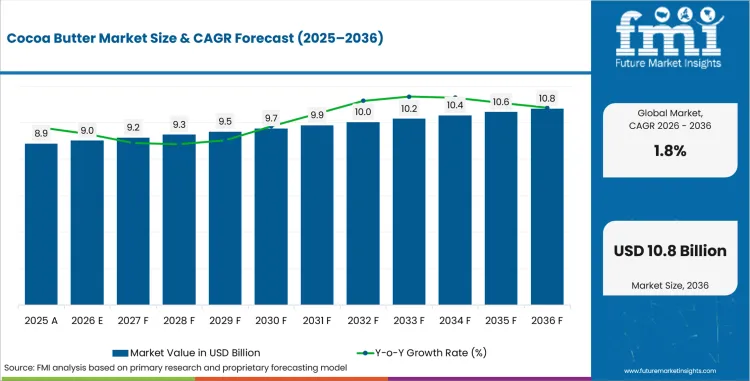
The cocoa butter market was valued at USD 8.9 billion in 2025. The market is set to reach USD 9.0 billion by 2026-end and grow at a CAGR of 1.8% between 2026-2036 to reach USD 10.8 billion by 2036. Natural Cocoa Butter will dominate with a 54.3% share, while Food And Beverage will lead with a 62.1% share.
Key Takeaways, Market Size, and Forecast
- 2026 Market Size: USD 9.0 billion
- 2036 Market Size: USD 10.8 billion
- Forecast CAGR: 1.8% from 2026 to 2036
- Absolute $ Opportunity: USD 1.76 billion between 2026 and 2036
- Leading Product: Natural Cocoa Butter
- Natural Cocoa Butter Share in 2026: 54.3%
- Fastest-growing Country: Japan
- Japan CAGR: 6.8% through 2036
| Parameter | Details |
|---|---|
| Market Size in 2026 (Value) | USD 9.0 billion |
| Market Forecast in 2036 (Value) | USD 10.8 billion |
| CAGR (2026 to 2036) | 1.8% |
| Years Considered | 2021 to 2036 |
| Base Year | 2026 |
| Forecast Period | 2026 to 2036 |
| Units Considered | Value (USD Bn) |
| Leading Sub-Region | Japan |
Summary of the Cocoa Butter Market
- Demand and Growth Drivers
- Chocolate confectionery production growth driven by premiumization trends and emerging market consumption expansion is expected to sustain cocoa butter demand through the forecast period.
- Adoption of certified sustainable and organic cocoa butter is increasing due to brand sustainability commitments, EU deforestation regulation compliance, and consumer preference for ethically sourced ingredients.
- Expansion of cosmetic and pharmaceutical applications for cocoa butter in skin care, lip care, and excipient formulations is broadening demand beyond traditional confectionery dominance.
- Product and Segment View
- Natural cocoa butter accounts for 54.3% of the product segment, reflecting chocolate manufacturer preference for unmodified press butter that provides the crystallization properties essential for chocolate tempering and snap.
- Food and beverage holds 62.1% of the end-use segment, driven by chocolate confectionery manufacturing as the primary consumption application for cocoa butter.
- Blocks represent 37.8% of the product form segment, serving chocolate manufacturers through standardized block formats compatible with automated melting and dosing systems.
- Geography and Competitive Outlook
- Japan is expected to lead growth at 6.8% CAGR through 2036, driven by premium chocolate consumption growth, high-quality confectionery manufacturing, and Japanese consumer preference for premium cocoa butter chocolate formulations.
- Europe accounts for the largest market share, sustained by chocolate manufacturing concentration in Belgium, Switzerland, Germany, and the Netherlands with established cocoa processing infrastructure.
- Barry Callebaut AG holds an estimated 24.0% market share, supported by the largest cocoa processing capacity globally, integrated bean-to-butter supply chains, and established chocolate manufacturer customer relationships.
- Analyst Opinion
- Nandini Roy Choudhury, Principal Consultant at FMI says, 'Processors that can deliver certified deforestation-free cocoa butter with documented traceability to origin while maintaining supply consistency and competitive pricing are positioned to capture specification share as EU deforestation regulation compliance and brand sustainability commitments reshape procurement criteria from price-first to sustainability-qualified sourcing.'
- Growth reflects chocolate premiumization, sustainability-qualified sourcing, and emerging market confectionery consumption expansion.
- Demand is supported by chocolate manufacturing output growth, cosmetic ingredient applications, and pharmaceutical excipient requirements for cocoa butter-based formulations.
- Adoption of certified sustainable cocoa butter is constrained by supply availability, premium pricing over conventional butter, and traceability infrastructure development timelines in origin countries.
Cocoa Butter Market Definition
The cocoa butter market includes natural, deodorized, and organic cocoa butter produced through hydraulic pressing of cocoa liquor, used as the primary fat ingredient in chocolate manufacturing, and as a functional ingredient in cosmetics, pharmaceuticals, and personal care products.
Cocoa Butter Market Inclusions
Market scope covers products segmented by product (natural, deodorized, organic), end use (food and beverage, cosmetics, pharmaceuticals), nature (organic, conventional), product form (blocks, liquid, powder), processing method (cold pressed, expeller pressed, solvent extracted), distribution (B2B, retail), and grade (food grade, cosmetic grade, pharmaceutical grade). Revenue estimates span 2026 to 2036.
Cocoa Butter Market Exclusions
The scope excludes cocoa butter equivalents and substitutes made from non-cocoa fats, cocoa powder, and chocolate finished products.
Cocoa Butter Market Research Methodology
- Primary Research: FMI analysts conducted interviews with chocolate manufacturers, cocoa processors, and cosmetic ingredient buyers across key cocoa consuming markets.
- Desk Research: Combined data from cocoa bean grinding statistics, chocolate production databases, and cocoa processor revenue disclosures.
- Market Sizing and Forecasting: Bottom-up aggregation of chocolate production data, per-tonne cocoa butter consumption rates, and cosmetic/pharmaceutical application volumes across regions.
- Data Validation: Cross-checked quarterly against ICCO cocoa grinding statistics, chocolate production indices, and processor financial disclosures.
Why is the Cocoa Butter Market Growing?
- Chocolate confectionery production growth, particularly in premium and single-origin segments, is sustaining cocoa butter demand as manufacturers increase cocoa butter content in high-quality formulations.
- EU Deforestation Regulation compliance mandates traceability documentation for cocoa products entering EU markets, reshaping procurement toward supply chains with documented origin and deforestation-free status.
- Japanese premium chocolate market growth is driving demand for high-quality natural cocoa butter with specific crystallization properties required for Japanese confectionery manufacturing standards.
The cocoa butter market grows at a moderate pace reflecting the mature chocolate confectionery industry in Europe and North America alongside emerging market consumption growth. Cocoa butter is the essential fat component of chocolate, providing the crystallization properties that create chocolate's characteristic snap, gloss, and melt-in-mouth texture. Natural cocoa butter at 54.3% maintains preference among chocolate manufacturers for its unmodified triglyceride profile.
Sustainability transformation is reshaping cocoa butter procurement. EU Deforestation Regulation requires documented evidence that cocoa products are not linked to post-2020 deforestation, creating traceability requirements that affect sourcing from Cote d'Ivoire, Ghana, and other West African origin countries. Chocolate brands including Lindt, Mondelez, and Nestle are committing to fully traceable cocoa supply chains, creating procurement preference for processors with documented traceability capability.
Cosmetic and pharmaceutical applications represent a growing non-food demand channel. Cocoa butter provides emollient properties valued in skin moisturizers, lip care products, and body care formulations. Pharmaceutical-grade cocoa butter serves as a suppository base and excipient. These applications command premium pricing above food-grade butter and create diversification opportunities for cocoa processors.
Market Segmentation Analysis
- Natural cocoa butter holds 54.3%, reflecting chocolate manufacturer preference for unmodified press butter with specific crystallization and tempering properties.
- Food and beverage at 62.1% generates the dominant demand through chocolate confectionery manufacturing.
- Block form at 37.8% serves chocolate manufacturers through standardized formats for automated processing.
The market is segmented by product, end use, nature, product form, processing method, distribution, and grade. Products include natural, deodorized, and organic. End uses span food/beverage, cosmetics, and pharmaceuticals.
Insights into the Natural Cocoa Butter Segment
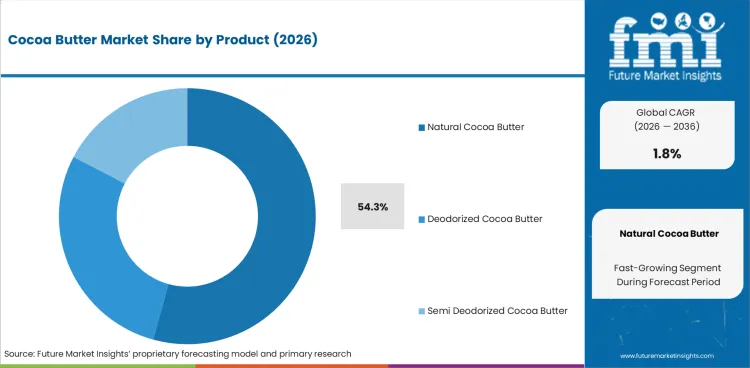
Natural cocoa butter at 54.3% is produced by hydraulic pressing of cocoa liquor, yielding butter with unmodified fatty acid and triglyceride composition. Chocolate manufacturers value natural butter for consistent crystallization behavior during tempering.
Procurement follows annual and multi-year contracts between chocolate manufacturers and cocoa processors, with pricing linked to London and New York cocoa futures plus processing margins.
Insights into the Organic Cocoa Butter Segment
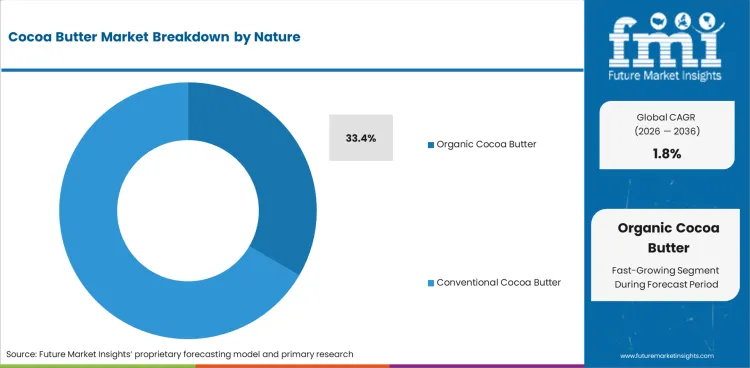
Organic cocoa butter at 33.4% of the nature segment serves premium and organic-certified chocolate manufacturing. Organic certification requires documented supply chain from certified organic cocoa farms through dedicated processing lines. Premium pricing of 15 to 30% above conventional butter reflects certification costs and supply constraints.
Cocoa Butter Market Drivers, Restraints, and Opportunities
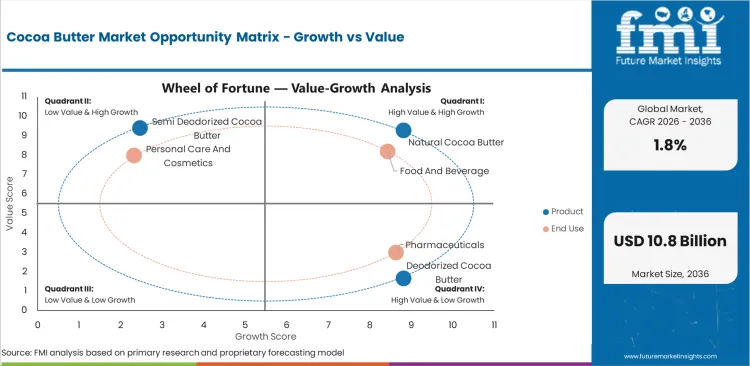
- Chocolate production growth creates baseline cocoa butter demand proportional to confectionery manufacturing output.
- EU Deforestation Regulation compliance reshapes procurement toward traceable, deforestation-free supply chains.
- Cosmetic and pharmaceutical applications create non-food demand diversification with premium pricing.
The market benefits from chocolate production, premiumization, and sustainability-qualified sourcing. Restraints include cocoa price volatility and deforestation regulation compliance cost. Opportunities exist in certified sustainable supply, cosmetic ingredients, and emerging market chocolate consumption.
Chocolate Production Demand
Demand is shaped by global chocolate manufacturing output, with cocoa butter consumption proportional to production volumes across dark, milk, and white chocolate formulations.
Sustainability Transformation
Growth reflects the transition toward sustainability-certified and deforestation-free cocoa butter procurement driven by EU regulation and brand sustainability commitments.
Non-Food Diversification
Adoption in cosmetic and pharmaceutical applications creates premium pricing demand channels that diversify cocoa butter revenue beyond confectionery dependence.
Analysis of Cocoa Butter Market By Key Countries
.webp "Top Country Growth Comparison Cocoa Butter Market Cagr (2026 2036)")
| Country | CAGR |
|---|---|
| Japan | 6.8% |
| China | 5.6% |
| USA | 3.7% |
| Germany | 2.7% |
| UK | 2.7% |
Source: FMI analysis based on primary research and proprietary forecasting model
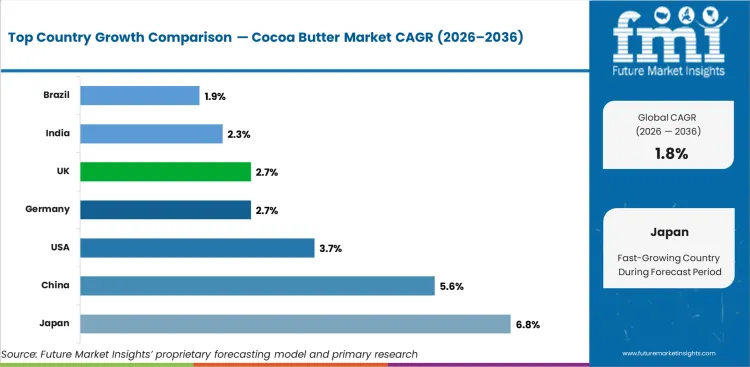
- Japan leads growth at 6.8% CAGR, driven by premium chocolate consumption, Japanese confectionery quality standards, and specialty cocoa butter specification for artisan chocolate production.
- China at 5.6% reflects growing chocolate consumption, premiumization trends, and domestic confectionery manufacturing expansion.
- The USA (3.7%) and Germany (2.7%) sustain demand through established chocolate manufacturing, cosmetic ingredient applications, and organic cocoa butter procurement.
The global cocoa butter market is projected to grow at 1.8% CAGR from 2026 to 2036. The analysis covers more than 30 countries, with key markets discussed below.
Demand Outlook for Cocoa Butter Market in Japan
Premium chocolate consumption and confectionery quality standards drive cocoa butter demand. Growth at 6.8% through 2036 reflects artisan chocolate growth, Meiji and Morinaga manufacturing, and Japanese consumer premium preference.
- Japanese consumer preference for premium single-origin and craft chocolate creates demand for high-quality natural cocoa butter with specific flavor and crystallization profiles.
- Meiji Holdings and Morinaga domestic chocolate manufacturing sustains structured cocoa butter procurement through established processor supply relationships.
- Japanese confectionery quality standards including strict tempering and texture specifications drive specification of premium-grade natural cocoa butter from qualified processors.
Sales Analysis of Cocoa Butter Market in China
Growing chocolate consumption and domestic manufacturing expansion define the Chinese market. Growth at 5.6% through 2036 reflects premiumization, confectionery production scaling, and cosmetic ingredient demand.
- Chinese chocolate consumption growth driven by gifting culture, premium brand expansion, and Western confectionery format adoption creates incremental cocoa butter demand.
- Domestic confectionery manufacturing expansion by companies including Ferrero China and domestic brands generates localized cocoa butter procurement requirements.
- Cosmetic industry growth in China creates demand for cosmetic-grade cocoa butter in skin care and personal care formulations.
In-depth Analysis of Cocoa Butter Market in the United States
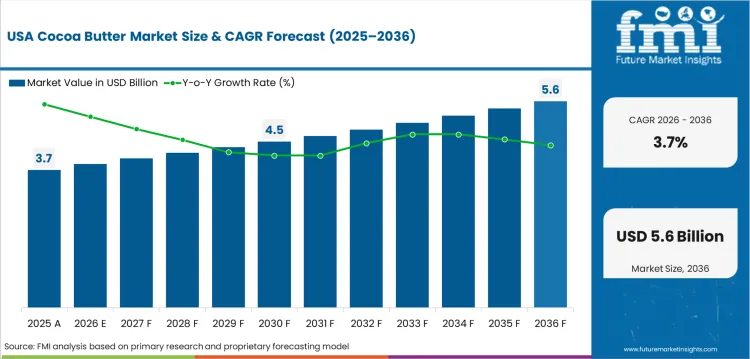
Established chocolate manufacturing and cosmetic ingredient demand define the US market. Growth at 3.7% through 2036 reflects premiumization, organic demand, and cosmetic-grade cocoa butter procurement.
- Premium and organic chocolate growth by Lindt, Ghirardelli, and craft chocolate makers sustains demand for certified organic and single-origin cocoa butter.
- Cosmetic and personal care formulation using cocoa butter generates premium-grade procurement through specialty ingredient distributors.
- USDA organic certification requirements for organic cocoa butter create structured supply chains serving certified chocolate and cosmetic manufacturers.
Opportunity Analysis of Cocoa Butter Market in Germany
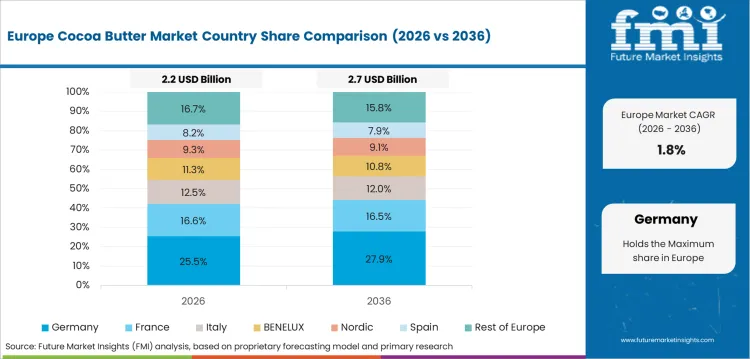
Chocolate manufacturing concentration and EU deforestation regulation shape the German market. Growth at 2.7% through 2036 reflects sustainability compliance, premium production, and processor proximity.
- EU Deforestation Regulation compliance requires documented traceability for cocoa butter entering German chocolate manufacturing, reshaping procurement specifications.
- German chocolate manufacturing concentration including Ritter Sport, Stollwerck, and contract manufacturers generates structured cocoa butter procurement from European processors.
- Hamburg and Amsterdam cocoa processing proximity provides German chocolate manufacturers with competitive logistics for cocoa butter supply.
Future Outlook for Cocoa Butter Market in the United Kingdom
Post-Brexit regulatory framework and confectionery industry define the UK market. Growth at 2.7% through 2036 reflects UK deforestation due diligence, premium chocolate, and cosmetic ingredient demand.
- UK Environment Act deforestation due diligence requirements create compliance obligations for cocoa product importers that parallel EU regulatory requirements.
- Premium chocolate brands including Hotel Chocolat and Cadbury (Mondelez) generate UK-based cocoa butter procurement through confectionery manufacturing operations.
- Cosmetic ingredient demand from UK personal care manufacturers creates premium-grade cocoa butter procurement through specialty ingredient supply channels.
Competitive Landscape and Strategic Positioning
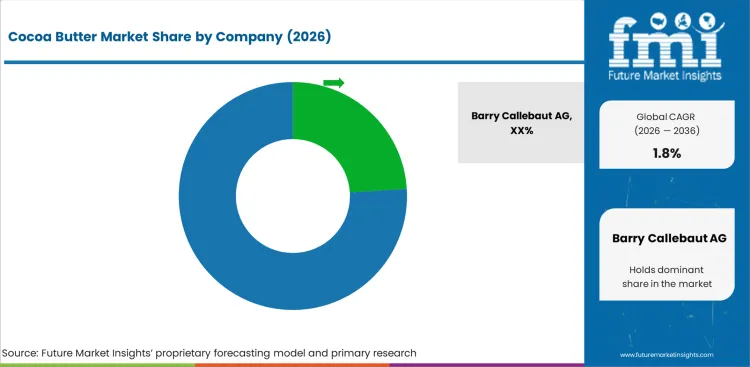
- Barry Callebaut AG holds an estimated 24.0% market share, supported by the largest global cocoa processing capacity, integrated bean-to-butter supply chains, and established relationships with major chocolate manufacturers.
- Cargill Incorporated and Olam International maintain strong positions through cocoa processing operations in origin and consuming countries, with documented traceability capability for sustainability-qualified supply.
- Nestlé and The Hershey Company represent vertically integrated chocolate manufacturers with captive cocoa processing operations serving internal cocoa butter requirements.
Barry Callebaut leads with an estimated 24.0% share through the largest cocoa grinding and butter pressing capacity, serving chocolate manufacturers from processing facilities in Europe, Asia, and the Americas.
Cargill provides cocoa processing through origin and consuming country facilities, with traceability programs addressing EU deforestation regulation compliance. Olam (ofi) operates cocoa processing with integrated origin country sourcing.
Nestlé and Hershey operate captive cocoa processing for internal chocolate manufacturing requirements. Puratos and Cémoi Group serve European chocolate manufacturing with cocoa butter and chocolate ingredient supply.
Barriers include cocoa bean sourcing relationships in origin countries, processing infrastructure capital, EU deforestation regulation traceability compliance, and the quality control capability required for consistent cocoa butter crystallization properties.
Key Companies in the Cocoa Butter Market
Key global companies leading the cocoa butter market include:
- Barry Callebaut AG (Switzerland), Cargill Incorporated (USA), and Olam International/ofi (Singapore) lead with large-scale cocoa processing, integrated origin sourcing, and sustainability-certified supply serving global chocolate manufacturers.
- The Hershey Company (USA), Nestlé S.A. (Switzerland), and Mars Incorporated (USA) maintain positions through vertically integrated cocoa processing serving internal chocolate manufacturing requirements.
- Puratos Group (Belgium), Cémoi Group (France), and Touton SA (France) serve European chocolate manufacturing with cocoa butter, chocolate couverture, and ingredient supply.
Competitive Benchmarking: Cocoa Butter Market
| Company | Processing Capacity | Traceability | Customer Base | Geographic Footprint |
|---|---|---|---|---|
| Barry Callebaut | High | Strong | Strong | Global |
| Cargill | High | Strong | Strong | Global |
| Olam/ofi | High | Strong | Strong | Global |
| Hershey | Medium | Strong | Internal | N. America |
| Nestlé | Medium | Strong | Internal | Global |
| Puratos | Medium | Moderate | Moderate | Europe |
| Cémoi | Medium | Moderate | Moderate | Europe |
Source: Future Market Insights competitive analysis, 2026.
Key Developments in Cocoa Butter Market
- In 2025, Barry Callebaut launched a fully traceable cocoa butter product line with documented deforestation-free origin verification meeting EU Deforestation Regulation compliance requirements.
- In 2025, Cargill expanded its cocoa processing facility in Cote d'Ivoire with enhanced traceability infrastructure for sustainable cocoa butter production serving European chocolate manufacturers.
Key Players in the Cocoa Butter Market
Major Global Players
- Barry Callebaut AG
- Cargill Incorporated
- Olam International Limited
- The Hershey Company
- Nestlé S.A.
- Mars, Incorporated
Emerging Players/Startups
- Puratos Group
- Cémoi Group
- Touton SA
- Natra (Baronie Group)
- Guan Chong Berhad
Report Scope and Coverage
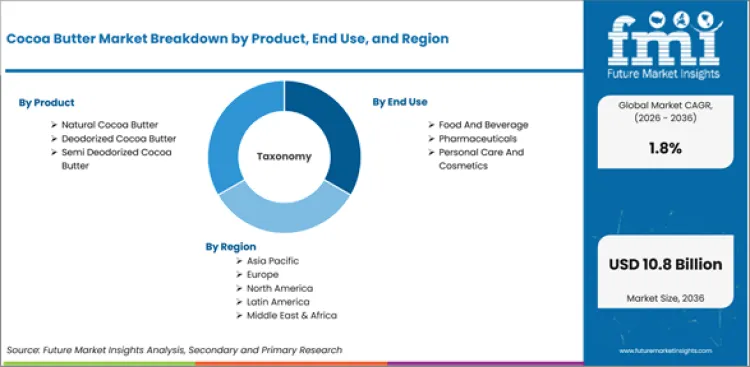
| Parameter | Details |
|---|---|
| Market size by 2036 | USD 10.78 billion |
| Growth rate | 1.8% CAGR (2026 to 2036) |
| Forecast period | 2026 to 2036 |
| Base year value (2026) | USD 9.02 billion |
| By Product | Natural Cocoa Butter, Deodorized Cocoa Butter, Semi Deodorized Cocoa Butter |
| By End Use | Food and Beverage, Personal Care And Cosmetics, Pharmaceuticals |
| By Nature | Organic Cocoa Butter, Conventional Cocoa Butter |
| By Product Form | Blocks, Liquid, Powder |
| By Processing Method | Cold Pressed, Expeller Pressed, Solvent Extracted |
| By Grade | Food Grade, Cosmetic Grade, Pharmaceutical Grade |
| Regions covered | North America, Latin America, Europe, East Asia, South Asia and Pacific, Middle East and Africa |
| Countries covered | USA, UK, Germany, France, Japan, China, India, Brazil, 30 plus countries |
| Key companies profiled | Barry Callebaut, Cargill, Olam, Hershey, Nestlé, Mars, Puratos, Cémoi |
| Approach | Hybrid bottom-up and top-down methodology starting with cocoa grinding data and chocolate production volumes, projecting cocoa butter demand across applications and regions. |
Segmentation
Cocoa Butter Market Segmented by Product:
- Natural Cocoa Butter
- Raw Cocoa Butter
- Unrefined Cocoa Butter
- Cold Pressed Cocoa Butter
- Premium Grade Cocoa Butter
- Raw Cocoa Butter
- Deodorized Cocoa Butter
- Refined Cocoa Butter
- Odorless Cocoa Butter
- Food Grade Refined Butter
- Cosmetic Grade Cocoa Butter
- Refined Cocoa Butter
- Semi Deodorized Cocoa Butter
- Partially Processed Cocoa Butter
- Mild Aroma Cocoa Butter
- Balanced Flavor Butter
- Partially Processed Cocoa Butter
Cocoa Butter Market Segmented by End Use:
- Food And Beverage
- Chocolate Manufacturing
- Dark Chocolate
- Milk Chocolate
- Confectionery Products
- Chocolate Manufacturing
- Pharmaceuticals
- Medical Formulations
- Capsule Coating
- Drug Delivery Systems
- Medical Formulations
- Personal Care And Cosmetics
- Skincare Products
- Moisturizers
- Lip Care Products
- Hair Care Products
- Skincare Products
Cocoa Butter Market Segmented by Nature:
- Organic Cocoa Butter
- Certified Organic Products
- Non GMO Cocoa Butter
- Sustainably Sourced Butter
- Certified Organic Products
- Conventional Cocoa Butter
- Standard Cocoa Butter
- Mass Production Cocoa Butter
- Commercial Grade Butter
- Standard Cocoa Butter
Cocoa Butter Market Segmented by Product Form:
- Blocks
- Solid Form Cocoa Butter
- Industrial Blocks
- Bulk Supply Blocks
- Solid Form Cocoa Butter
- Powder
- Dry Cocoa Butter
- Spray Dried Powder
- Fine Cocoa Powder Butter
- Dry Cocoa Butter
- Liquid
- Melted Cocoa Butter
- Liquid Bulk Supply
- Ready To Use Liquid
- Melted Cocoa Butter
Cocoa Butter Market Segmented by Processing Method:
- Cold Pressed Cocoa Butter
- Minimal Processing
- High Nutrient Retention
- Premium Quality Butter
- Minimal Processing
- Solvent Extracted Cocoa Butter
- Chemical Extraction Process
- High Yield Extraction
- Industrial Production
- Chemical Extraction Process
- Expeller Pressed Cocoa Butter
- Mechanical Extraction
- Standard Processing Method
- Commercial Grade Butter
- Mechanical Extraction
Cocoa Butter Market Segmented by Distribution Channel:
- B2B Distribution
- Industrial Supply
- Chocolate Manufacturers
- Cosmetic Manufacturers
- Industrial Supply
- B2C Distribution
- Retail Sales
- Supermarkets And Hypermarkets
- Online Retail Stores
- Retail Sales
- Specialty Distribution
- Niche Markets
- Organic Stores
- Health And Wellness Stores
- Niche Markets
Cocoa Butter Market Segmented by Grade:
- Food Grade Cocoa Butter
- Edible Applications
- Chocolate Production Grade
- Confectionery Grade
- Edible Applications
- Pharmaceutical Grade Cocoa Butter
- Medical Use
- USP Grade Butter
- High Purity Butter
- Medical Use
- Cosmetic Grade Cocoa Butter
- Personal Care Use
- Skin Care Grade
- Hair Care Grade
- Personal Care Use
Cocoa Butter Market by Region:
- North America
- USA
- Canada
- Mexico
- Latin America
- Brazil
- Chile
- Rest of Latin America
- Western Europe
- Germany
- UK
- Italy
- Spain
- France
- Nordic
- BENELUX
- Rest of Western Europe
- Eastern Europe
- Russia
- Poland
- Hungary
- Balkan & Baltic
- Rest of Eastern Europe
- East Asia
- China
- Japan
- South Korea
- South Asia and Pacific
- India
- ASEAN
- Australia & New Zealand
- Rest of South Asia and Pacific
- Middle East & Africa
- Kingdom of Saudi Arabia
- Other GCC Countries
- Turkiye
- South Africa
- Other African Union
- Rest of Middle East & Africa
Research Sources and Bibliography
- 1. International Cocoa Organization. (2025). ICCO Quarterly Bulletin of Cocoa Statistics. ICCO.
- 2. European Commission. (2024). EC Regulation on Deforestation-Free Products. EC.
- 3. Food and Agriculture Organization. (2025). FAO Cocoa Production and Trade Statistics. FAO.
- 4. World Cocoa Foundation. (2024). WCF Cocoa Sustainability Report. WCF.
- 5. Codex Alimentarius Commission. (2025). Codex Standards for Cocoa Products. Codex.
This bibliography is provided for reader reference. The full Future Market Insights report contains the complete reference list with publication dates, URLs, and supporting data for all cited works.
This Report Answers
- Estimating market size and revenue from 2026 to 2036.
- Segmentation by product, end use, nature, form, processing, distribution, and grade.
- Regional insights across more than 30 markets.
- Technology analysis covering pressing, refining, and sustainability certification.
- Competitive landscape assessment.
- Investment opportunities in sustainable sourcing and cosmetic-grade production.
- Supply chain and origin country sourcing analysis.
- Data delivery in PDF and Excel formats.
Frequently Asked Questions
How big is the cocoa butter market in 2026?
The global cocoa butter market is estimated to be valued at USD 9.0 billion in 2026.
What will be the size of cocoa butter market in 2036?
The market size for the cocoa butter market is projected to reach USD 10.8 billion by 2036.
How much will be the cocoa butter market growth between 2026 and 2036?
The cocoa butter market is expected to grow at a 1.8% CAGR between 2026 and 2036.
What are the key product types in the cocoa butter market?
The key product types in cocoa butter market are Natural Cocoa Butter, Deodorized Cocoa Butter and Semi Deodorized Cocoa Butter.
Which end use segment is expected to contribute significant share in the cocoa butter market in 2026?
In terms of end use, food and beverage segment is expected to command 62.1% share in the cocoa butter market in 2026.
Preview the report firsthand - request a free sample
Get SampleGet the brochure for pricing and purchase details.
Get PDFTable of Content
- Executive Summary
- Global Market Outlook
- Demand-side Trends
- Supply-side Trends
- Technology Roadmap Analysis
- Analysis and Recommendations
- Market Overview
- Market Coverage / Taxonomy
- Market Definition / Scope / Limitations
- Research Methodology
- Chapter Orientation
- Analytical Lens and Working Hypotheses
- Market Structure, Signals, and Trend Drivers
- Benchmarking and Cross-market Comparability
- Market Sizing, Forecasting, and Opportunity Mapping
- Research Design and Evidence Framework
- Desk Research Programme (Secondary Evidence)
- Company Annual and Sustainability Reports
- Peer-reviewed Journals and Academic Literature
- Corporate Websites, Product Literature, and Technical Notes
- Earnings Decks and Investor Briefings
- Statutory Filings and Regulatory Disclosures
- Technical White Papers and Standards Notes
- Trade Journals, Industry Magazines, and Analyst Briefs
- Conference Proceedings, Webinars, and Seminar Materials
- Government Statistics Portals and Public Data Releases
- Press Releases and Reputable Media Coverage
- Specialist Newsletters and Curated Briefings
- Sector Databases and Reference Repositories
- FMI Internal Proprietary Databases and Historical Market Datasets
- Subscription Datasets and Paid Sources
- Social Channels, Communities, and Digital Listening Inputs
- Additional Desk Sources
- Expert Input and Fieldwork (Primary Evidence)
- Primary Modes
- Qualitative Interviews and Expert Elicitation
- Quantitative Surveys and Structured Data Capture
- Blended Approach
- Why Primary Evidence is Used
- Field Techniques
- Interviews
- Surveys
- Focus Groups
- Observational and In-context Research
- Social and Community Interactions
- Stakeholder Universe Engaged
- C-suite Leaders
- Board Members
- Presidents and Vice Presidents
- R&D and Innovation Heads
- Technical Specialists
- Domain Subject-matter Experts
- Scientists
- Physicians and Other Healthcare Professionals
- Governance, Ethics, and Data Stewardship
- Research Ethics
- Data Integrity and Handling
- Primary Modes
- Tooling, Models, and Reference Databases
- Desk Research Programme (Secondary Evidence)
- Data Engineering and Model Build
- Data Acquisition and Ingestion
- Cleaning, Normalisation, and Verification
- Synthesis, Triangulation, and Analysis
- Quality Assurance and Audit Trail
- Market Background
- Market Dynamics
- Drivers
- Restraints
- Opportunity
- Trends
- Scenario Forecast
- Demand in Optimistic Scenario
- Demand in Likely Scenario
- Demand in Conservative Scenario
- Opportunity Map Analysis
- Product Life Cycle Analysis
- Supply Chain Analysis
- Investment Feasibility Matrix
- Value Chain Analysis
- PESTLE and Porter’s Analysis
- Regulatory Landscape
- Regional Parent Market Outlook
- Production and Consumption Statistics
- Import and Export Statistics
- Market Dynamics
- Global Market Analysis 2021 to 2025 and Forecast, 2026 to 2036
- Historical Market Size Value (USD Million) Analysis, 2021 to 2025
- Current and Future Market Size Value (USD Million) Projections, 2026 to 2036
- Y to o to Y Growth Trend Analysis
- Absolute $ Opportunity Analysis
- Global Market Pricing Analysis 2021 to 2025 and Forecast 2026 to 2036
- Global Market Analysis 2021 to 2025 and Forecast 2026 to 2036, By Product
- Introduction / Key Findings
- Historical Market Size Value (USD Million) Analysis By Product , 2021 to 2025
- Current and Future Market Size Value (USD Million) Analysis and Forecast By Product , 2026 to 2036
- Natural Cocoa Butter
- Raw Cocoa Butter
- Unrefined Cocoa Butter
- Cold Pressed Cocoa Butter
- Premium Grade Cocoa Butter
- Raw Cocoa Butter
- Deodorized Cocoa Butter
- Refined Cocoa Butter
- Odorless Cocoa Butter
- Food Grade Refined Butter
- Cosmetic Grade Cocoa Butter
- Refined Cocoa Butter
- Semi Deodorized Cocoa Butter
- Partially Processed Cocoa Butter
- Mild Aroma Cocoa Butter
- Balanced Flavor Butter
- Partially Processed Cocoa Butter
- Natural Cocoa Butter
- Y to o to Y Growth Trend Analysis By Product , 2021 to 2025
- Absolute $ Opportunity Analysis By Product , 2026 to 2036
- Global Market Analysis 2021 to 2025 and Forecast 2026 to 2036, By End Use
- Introduction / Key Findings
- Historical Market Size Value (USD Million) Analysis By End Use, 2021 to 2025
- Current and Future Market Size Value (USD Million) Analysis and Forecast By End Use, 2026 to 2036
- Food And Beverage
- Chocolate Manufacturing
- Dark Chocolate
- Milk Chocolate
- Confectionery Products
- Chocolate Manufacturing
- Pharmaceuticals
- Medical Formulations
- Capsule Coating
- Drug Delivery Systems
- Medical Formulations
- Personal Care And Cosmetics
- Skincare Products
- Moisturizers
- Lip Care Products
- Hair Care Products
- Skincare Products
- Food And Beverage
- Y to o to Y Growth Trend Analysis By End Use, 2021 to 2025
- Absolute $ Opportunity Analysis By End Use, 2026 to 2036
- Global Market Analysis 2021 to 2025 and Forecast 2026 to 2036, By Nature
- Introduction / Key Findings
- Historical Market Size Value (USD Million) Analysis By Nature, 2021 to 2025
- Current and Future Market Size Value (USD Million) Analysis and Forecast By Nature, 2026 to 2036
- Organic Cocoa Butter
- Certified Organic Products
- Non GMO Cocoa Butter
- Sustainably Sourced Butter
- Certified Organic Products
- Conventional Cocoa Butter
- Standard Cocoa Butter
- Mass Production Cocoa Butter
- Commercial Grade Butter
- Standard Cocoa Butter
- Organic Cocoa Butter
- Y to o to Y Growth Trend Analysis By Nature, 2021 to 2025
- Absolute $ Opportunity Analysis By Nature, 2026 to 2036
- Global Market Analysis 2021 to 2025 and Forecast 2026 to 2036, By Product Form
- Introduction / Key Findings
- Historical Market Size Value (USD Million) Analysis By Product Form, 2021 to 2025
- Current and Future Market Size Value (USD Million) Analysis and Forecast By Product Form, 2026 to 2036
- Blocks
- Solid Form Cocoa Butter
- Industrial Blocks
- Bulk Supply Blocks
- Solid Form Cocoa Butter
- Powder
- Dry Cocoa Butter
- Spray Dried Powder
- Fine Cocoa Powder Butter
- Dry Cocoa Butter
- Liquid
- Melted Cocoa Butter
- Liquid Bulk Supply
- Ready To Use Liquid
- Melted Cocoa Butter
- Blocks
- Y to o to Y Growth Trend Analysis By Product Form, 2021 to 2025
- Absolute $ Opportunity Analysis By Product Form, 2026 to 2036
- Global Market Analysis 2021 to 2025 and Forecast 2026 to 2036, By Processing Method
- Introduction / Key Findings
- Historical Market Size Value (USD Million) Analysis By Processing Method, 2021 to 2025
- Current and Future Market Size Value (USD Million) Analysis and Forecast By Processing Method, 2026 to 2036
- Cold Pressed Cocoa Butter
- Minimal Processing
- High Nutrient Retention
- Premium Quality Butter
- Minimal Processing
- Solvent Extracted Cocoa Butter
- Chemical Extraction Process
- High Yield Extraction
- Industrial Production
- Chemical Extraction Process
- Expeller Pressed Cocoa Butter
- Mechanical Extraction
- Standard Processing Method
- Commercial Grade Butter
- Mechanical Extraction
- Cold Pressed Cocoa Butter
- Y to o to Y Growth Trend Analysis By Processing Method, 2021 to 2025
- Absolute $ Opportunity Analysis By Processing Method, 2026 to 2036
- Global Market Analysis 2021 to 2025 and Forecast 2026 to 2036, By Distribution Channel
- Introduction / Key Findings
- Historical Market Size Value (USD Million) Analysis By Distribution Channel, 2021 to 2025
- Current and Future Market Size Value (USD Million) Analysis and Forecast By Distribution Channel, 2026 to 2036
- B2B Distribution
- Industrial Supply
- Chocolate Manufacturers
- Cosmetic Manufacturers
- Industrial Supply
- B2C Distribution
- Retail Sales
- Supermarkets And Hypermarkets
- Online Retail Stores
- Retail Sales
- Specialty Distribution
- Niche Markets
- Organic Stores
- Health And Wellness Stores
- Niche Markets
- B2B Distribution
- Y to o to Y Growth Trend Analysis By Distribution Channel, 2021 to 2025
- Absolute $ Opportunity Analysis By Distribution Channel, 2026 to 2036
- Global Market Analysis 2021 to 2025 and Forecast 2026 to 2036, By Grade
- Introduction / Key Findings
- Historical Market Size Value (USD Million) Analysis By Grade, 2021 to 2025
- Current and Future Market Size Value (USD Million) Analysis and Forecast By Grade, 2026 to 2036
- Food Grade Cocoa Butter
- Edible Applications
- Chocolate Production Grade
- Confectionery Grade
- Edible Applications
- Pharmaceutical Grade Cocoa Butter
- Medical Use
- USP Grade Butter
- High Purity Butter
- Medical Use
- Cosmetic Grade Cocoa Butter
- Personal Care Use
- Skin Care Grade
- Hair Care Grade
- Personal Care Use
- Food Grade Cocoa Butter
- Y to o to Y Growth Trend Analysis By Grade, 2021 to 2025
- Absolute $ Opportunity Analysis By Grade, 2026 to 2036
- Global Market Analysis 2021 to 2025 and Forecast 2026 to 2036, By Region
- Introduction
- Historical Market Size Value (USD Million) Analysis By Region, 2021 to 2025
- Current Market Size Value (USD Million) Analysis and Forecast By Region, 2026 to 2036
- North America
- Latin America
- Western Europe
- Eastern Europe
- East Asia
- South Asia and Pacific
- Middle East & Africa
- Market Attractiveness Analysis By Region
- North America Market Analysis 2021 to 2025 and Forecast 2026 to 2036, By Country
- Historical Market Size Value (USD Million) Trend Analysis By Market Taxonomy, 2021 to 2025
- Market Size Value (USD Million) Forecast By Market Taxonomy, 2026 to 2036
- By Country
- USA
- Canada
- Mexico
- By Product
- By End Use
- By Nature
- By Product Form
- By Processing Method
- By Distribution Channel
- By Grade
- By Country
- Market Attractiveness Analysis
- By Country
- By Product
- By End Use
- By Nature
- By Product Form
- By Processing Method
- By Distribution Channel
- By Grade
- Key Takeaways
- Latin America Market Analysis 2021 to 2025 and Forecast 2026 to 2036, By Country
- Historical Market Size Value (USD Million) Trend Analysis By Market Taxonomy, 2021 to 2025
- Market Size Value (USD Million) Forecast By Market Taxonomy, 2026 to 2036
- By Country
- Brazil
- Chile
- Rest of Latin America
- By Product
- By End Use
- By Nature
- By Product Form
- By Processing Method
- By Distribution Channel
- By Grade
- By Country
- Market Attractiveness Analysis
- By Country
- By Product
- By End Use
- By Nature
- By Product Form
- By Processing Method
- By Distribution Channel
- By Grade
- Key Takeaways
- Western Europe Market Analysis 2021 to 2025 and Forecast 2026 to 2036, By Country
- Historical Market Size Value (USD Million) Trend Analysis By Market Taxonomy, 2021 to 2025
- Market Size Value (USD Million) Forecast By Market Taxonomy, 2026 to 2036
- By Country
- Germany
- UK
- Italy
- Spain
- France
- Nordic
- BENELUX
- Rest of Western Europe
- By Product
- By End Use
- By Nature
- By Product Form
- By Processing Method
- By Distribution Channel
- By Grade
- By Country
- Market Attractiveness Analysis
- By Country
- By Product
- By End Use
- By Nature
- By Product Form
- By Processing Method
- By Distribution Channel
- By Grade
- Key Takeaways
- Eastern Europe Market Analysis 2021 to 2025 and Forecast 2026 to 2036, By Country
- Historical Market Size Value (USD Million) Trend Analysis By Market Taxonomy, 2021 to 2025
- Market Size Value (USD Million) Forecast By Market Taxonomy, 2026 to 2036
- By Country
- Russia
- Poland
- Hungary
- Balkan & Baltic
- Rest of Eastern Europe
- By Product
- By End Use
- By Nature
- By Product Form
- By Processing Method
- By Distribution Channel
- By Grade
- By Country
- Market Attractiveness Analysis
- By Country
- By Product
- By End Use
- By Nature
- By Product Form
- By Processing Method
- By Distribution Channel
- By Grade
- Key Takeaways
- East Asia Market Analysis 2021 to 2025 and Forecast 2026 to 2036, By Country
- Historical Market Size Value (USD Million) Trend Analysis By Market Taxonomy, 2021 to 2025
- Market Size Value (USD Million) Forecast By Market Taxonomy, 2026 to 2036
- By Country
- China
- Japan
- South Korea
- By Product
- By End Use
- By Nature
- By Product Form
- By Processing Method
- By Distribution Channel
- By Grade
- By Country
- Market Attractiveness Analysis
- By Country
- By Product
- By End Use
- By Nature
- By Product Form
- By Processing Method
- By Distribution Channel
- By Grade
- Key Takeaways
- South Asia and Pacific Market Analysis 2021 to 2025 and Forecast 2026 to 2036, By Country
- Historical Market Size Value (USD Million) Trend Analysis By Market Taxonomy, 2021 to 2025
- Market Size Value (USD Million) Forecast By Market Taxonomy, 2026 to 2036
- By Country
- India
- ASEAN
- Australia & New Zealand
- Rest of South Asia and Pacific
- By Product
- By End Use
- By Nature
- By Product Form
- By Processing Method
- By Distribution Channel
- By Grade
- By Country
- Market Attractiveness Analysis
- By Country
- By Product
- By End Use
- By Nature
- By Product Form
- By Processing Method
- By Distribution Channel
- By Grade
- Key Takeaways
- Middle East & Africa Market Analysis 2021 to 2025 and Forecast 2026 to 2036, By Country
- Historical Market Size Value (USD Million) Trend Analysis By Market Taxonomy, 2021 to 2025
- Market Size Value (USD Million) Forecast By Market Taxonomy, 2026 to 2036
- By Country
- Kingdom of Saudi Arabia
- Other GCC Countries
- Turkiye
- South Africa
- Other African Union
- Rest of Middle East & Africa
- By Product
- By End Use
- By Nature
- By Product Form
- By Processing Method
- By Distribution Channel
- By Grade
- By Country
- Market Attractiveness Analysis
- By Country
- By Product
- By End Use
- By Nature
- By Product Form
- By Processing Method
- By Distribution Channel
- By Grade
- Key Takeaways
- Key Countries Market Analysis
- USA
- Pricing Analysis
- Market Share Analysis, 2025
- By Product
- By End Use
- By Nature
- By Product Form
- By Processing Method
- By Distribution Channel
- By Grade
- Canada
- Pricing Analysis
- Market Share Analysis, 2025
- By Product
- By End Use
- By Nature
- By Product Form
- By Processing Method
- By Distribution Channel
- By Grade
- Mexico
- Pricing Analysis
- Market Share Analysis, 2025
- By Product
- By End Use
- By Nature
- By Product Form
- By Processing Method
- By Distribution Channel
- By Grade
- Brazil
- Pricing Analysis
- Market Share Analysis, 2025
- By Product
- By End Use
- By Nature
- By Product Form
- By Processing Method
- By Distribution Channel
- By Grade
- Chile
- Pricing Analysis
- Market Share Analysis, 2025
- By Product
- By End Use
- By Nature
- By Product Form
- By Processing Method
- By Distribution Channel
- By Grade
- Germany
- Pricing Analysis
- Market Share Analysis, 2025
- By Product
- By End Use
- By Nature
- By Product Form
- By Processing Method
- By Distribution Channel
- By Grade
- UK
- Pricing Analysis
- Market Share Analysis, 2025
- By Product
- By End Use
- By Nature
- By Product Form
- By Processing Method
- By Distribution Channel
- By Grade
- Italy
- Pricing Analysis
- Market Share Analysis, 2025
- By Product
- By End Use
- By Nature
- By Product Form
- By Processing Method
- By Distribution Channel
- By Grade
- Spain
- Pricing Analysis
- Market Share Analysis, 2025
- By Product
- By End Use
- By Nature
- By Product Form
- By Processing Method
- By Distribution Channel
- By Grade
- France
- Pricing Analysis
- Market Share Analysis, 2025
- By Product
- By End Use
- By Nature
- By Product Form
- By Processing Method
- By Distribution Channel
- By Grade
- India
- Pricing Analysis
- Market Share Analysis, 2025
- By Product
- By End Use
- By Nature
- By Product Form
- By Processing Method
- By Distribution Channel
- By Grade
- ASEAN
- Pricing Analysis
- Market Share Analysis, 2025
- By Product
- By End Use
- By Nature
- By Product Form
- By Processing Method
- By Distribution Channel
- By Grade
- Australia & New Zealand
- Pricing Analysis
- Market Share Analysis, 2025
- By Product
- By End Use
- By Nature
- By Product Form
- By Processing Method
- By Distribution Channel
- By Grade
- China
- Pricing Analysis
- Market Share Analysis, 2025
- By Product
- By End Use
- By Nature
- By Product Form
- By Processing Method
- By Distribution Channel
- By Grade
- Japan
- Pricing Analysis
- Market Share Analysis, 2025
- By Product
- By End Use
- By Nature
- By Product Form
- By Processing Method
- By Distribution Channel
- By Grade
- South Korea
- Pricing Analysis
- Market Share Analysis, 2025
- By Product
- By End Use
- By Nature
- By Product Form
- By Processing Method
- By Distribution Channel
- By Grade
- Russia
- Pricing Analysis
- Market Share Analysis, 2025
- By Product
- By End Use
- By Nature
- By Product Form
- By Processing Method
- By Distribution Channel
- By Grade
- Poland
- Pricing Analysis
- Market Share Analysis, 2025
- By Product
- By End Use
- By Nature
- By Product Form
- By Processing Method
- By Distribution Channel
- By Grade
- Hungary
- Pricing Analysis
- Market Share Analysis, 2025
- By Product
- By End Use
- By Nature
- By Product Form
- By Processing Method
- By Distribution Channel
- By Grade
- Kingdom of Saudi Arabia
- Pricing Analysis
- Market Share Analysis, 2025
- By Product
- By End Use
- By Nature
- By Product Form
- By Processing Method
- By Distribution Channel
- By Grade
- Turkiye
- Pricing Analysis
- Market Share Analysis, 2025
- By Product
- By End Use
- By Nature
- By Product Form
- By Processing Method
- By Distribution Channel
- By Grade
- South Africa
- Pricing Analysis
- Market Share Analysis, 2025
- By Product
- By End Use
- By Nature
- By Product Form
- By Processing Method
- By Distribution Channel
- By Grade
- USA
- Market Structure Analysis
- Competition Dashboard
- Competition Benchmarking
- Market Share Analysis of Top Players
- By Regional
- By Product
- By End Use
- By Nature
- By Product Form
- By Processing Method
- By Distribution Channel
- By Grade
- Competition Analysis
- Competition Deep Dive
- Barry Callebaut AG
- Overview
- Product Portfolio
- Profitability by Market Segments (Product/Age /Sales Channel/Region)
- Sales Footprint
- Strategy Overview
- Marketing Strategy
- Product Strategy
- Channel Strategy
- Cargill Incorporated
- Olam International Limited
- The Hershey Company
- Nestlé S.A.
- Mars, Incorporated
- Puratos Group
- Cémoi Group
- Blommer Chocolate Company
- Meiji Holdings Company, Ltd.
- Barry Callebaut AG
- Competition Deep Dive
- Assumptions & Acronyms Used


