

- Industry Size (2026)
- USD 10.7 Bn
- Forecast (2036)
- USD 16 Bn
- CAGR (2026 to 2036)
- 4.1%
Organic Cocoa Market Forecast and Outlook 2026 to 2036
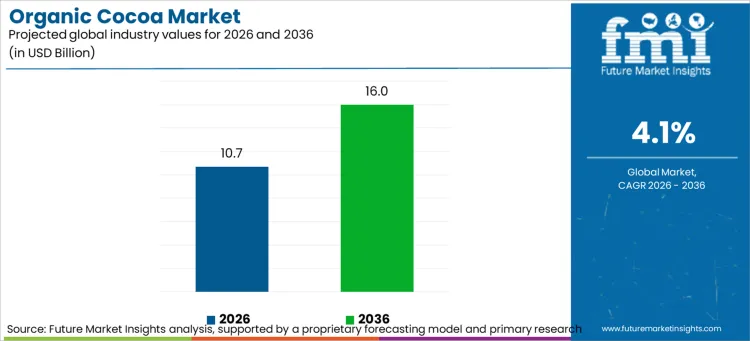
The global organic cocoa market is on track to achieve a valuation of USD 16 Billion by 2036, accelerating from USD 10.7 Billion in 2026 at a CAGR of 4.1%. As per Future Market Insights, expansion is structurally underpinned by tightening West African supply conditions and intensifying EU deforestation compliance requirements that are channeling demand toward certified organic and traceable sourcing pathways. The International Cocoa Organization reported in 2025 that global cocoa production declined for a third consecutive season, confirming the supply tightness that is channeling procurement toward certified and traceable origins.
This compels manufacturers to invest in scalable production and distribution infrastructure that can meet accelerating demand. Simultaneously the regulatory and competitive landscape is shifting from voluntary sustainability pledges to binding deforestation compliance and farmgate price regulation, which forces traders and processors to invest in traceability infrastructure and direct farmer relationships.
Peter Vanneste, CFO, Barry Callebaut, stated: 'As anticipated, the first quarter of our fiscal year began softly. Volumes in the global chocolate confectionery market deteriorated sequentially, as customers adjusted their behaviors.' This statement was made in the context of explaining market softening due to high prices in the q1 2025/26 results.. FMI opines that this reflects a broader structural shift in the industry where established players are accelerating investment to secure competitive positioning in a market defined by rapid evolution.
The operational reality for organic cocoa processors is defined by persistent supply tightness in West Africa that is accelerating the shift toward traceable sourcing and specialty processing capabilities. Cargill transformed its Rouen facility in 2025 into a leading specialty hub capable of producing organic, sustainable segregated, and tailored cocoa liquors, a capital commitment that locks in European processing capacity for premium-grade supply chains. Barry Callebaut unveiled its 'Top Chocolate Confectionery Trends 2026 and Beyond' report in February 2026, prioritizing purpose-driven creation and cleaner, organic-aligned profiles as the direction for product development across its global customer base.
Olam Food Ingredients introduced the 'Cocoa Compass Tracker' in 2025, an AI-driven platform providing real-time visibility into its cocoa supply chain that supports sustainability goals and enables consumers to verify ethical sourcing claims. As per FMI, these investments confirm that the organic cocoa sector is building a parallel infrastructure of traceable, certified supply that commands meaningful premiums over conventional volumes. The Ghana government increased the farmgate price for cocoa to 51,660 cedis per tonne for the 2025/26 season, a policy intervention aimed at stabilizing farmer livelihoods that simultaneously raises the cost floor for all downstream processors and increases the relative value of organic certification.
Summary of Organic Cocoa Market
What Is Growth Outlook for Organic Cocoa Market as per Future Market Insights Projection?
Future Market Insights projects the organic cocoa market to expand at a CAGR of 4.1% from 2026 to 2036, increasing from USD 10.7 Billion in 2026 to USD 16 Billion by 2036.
FMI Research Approach: FMI proprietary forecasting model based on demand-supply correlation and end-use consumption analysis.
How Do FMI Analysts Perceive Organic Cocoa Market to Evolve?
FMI analysts perceive the market evolving toward a compliance-driven structure where EU deforestation regulation and farmgate price interventions channel procurement toward certified organic and traceable origins with verifiable sustainability credentials.
FMI Research Approach: Regulatory convergence analysis and competitive landscape mapping.
Which Country Holds Largest Share in Global Organic Cocoa Market?
The United States holds a significant share of the global organic cocoa market by value, supported by the largest chocolate confectionery consumption market globally and a concentration of processing and manufacturing capacity.
FMI Research Approach: FMI country-level revenue modelling by end-use consumption and trade data.
How Large Will Organic Cocoa Market Be by 2036?
The global organic cocoa market is projected to reach USD 16 Billion by 2036.
FMI Research Approach: FMI long-term revenue forecast derived from end-use demand projections and macroeconomic indicators.
What Is Definition of Organic Cocoa Market?
The organic cocoa market includes revenue generated from the production, processing, and trade of cocoa beans, butter, powder, and liquor derived from certified organic farming practices that exclude synthetic pesticides and fertilizers.
FMI Research Approach: FMI market taxonomy and inclusion-exclusion framework.
What Are Globally Unique Trends Shaping Organic Cocoa Market?
Globally unique trends include the transformation of European processing facilities into specialty organic hubs, the deployment of AI-driven supply chain traceability tools, and government intervention in farmgate pricing to stabilize farmer incomes in key producing nations.
FMI Research Approach: Competitive intelligence and regulatory directive tracking.
Organic Cocoa Market Key Takeaways
| Metric | Details |
|---|---|
| Industry Size (2026) | USD 10.7 Billion |
| Industry Value (2036) | USD 16 Billion |
| CAGR (2026 to 2036) | 4.1% |
Source: Future Market Insights (FMI) analysis, based on proprietary forecasting model and primary research
Certification Standards, Ethical Production, and Fair Trade Practices to Drive Market Growth
The term ‘organic’ these days plays a crucial role in the product's overall success. This is why, there is an influx of regulatory bodies such as USDA Organic, EU Organic, and India Organic, etc. Certification by these bodies not only validates the authenticity of these products but also builds consumer trust.
This is the main reason why, a significant number of businesses in the organic cocoa market are focusing on the certification of their products to meet these stringent organic standards.
Organic cocoa is a very niche segment, only 0.5% of the global cocoa production. This number is also indicative of the fact that the total number of certified farms around the world must be in thousands.
In such scenarios, certification by these bodies means a lot to the consumers. It means that cocoa is grown, harvested, and processed according to strict organic farming guidelines.
Hence, the organic cocoa industry analysis highlights the importance of certification in fostering growth and consumer confidence.
Key Markets for Organic Cocoa: Organic Cocoa Industry Analysis
| Region | Key Characteristics |
|---|---|
| European Union | Largest importer of organic cocoa; high consumer demand for organic and fair-trade products. Significant entry points: Germany and the Netherlands, where much processing occurs. |
| United States | Major consumer of organic cocoa, particularly in high-end chocolate and confectionery products. |
| Japan | Smaller volume market, but growing demand for premium and organic cocoa products; reflects a preference for high-quality and sustainable goods. |
Organic Cocoa Industry Outlook: Drivers
Organic cocoa has a lot of benefits. It is rich in antioxidants, which lowers oxidative stress in the body. It also does not have any harmful pesticides and chemicals. This further expands its safety net, making it a secure choice for health-conscious consumers. This trend is seen in developed markets like North America and Europe.
To promote sustainability in supply chains, Deforestation-Free Regulation has been curated by the European Union (EUDR). This is also intended to help address deforestation linked to certain commodities like cocoa with a strong environmental footprint. This is why, a majority of market players are avoiding deforestation methods.
Environmental and ethical issues, as well, play big role here. Consumers concerned about climate change and ethical sourcing prefer sustainably farmed products. Certification schemes such as Fairtrade and EU Organic often overlap with organic cocoa production. This assurance makes organic cocoa products more appealing, especially to the younger generations.
Corporate and regulatory initiatives are also a major driver here. They are creating favorable conditions for organic cocoa. This is why, it has become easy for chocolate manufacturers to embrace sustainable sourcing strategies. These measures are, thus, strengthening the organic cocoa value chain by ensuring consistent quality and availability.
Organic Cocoa Sector Outlook: Challenges
Supply Constraints and Certification Issues
There is also only about 0.5% of the world’s cocoa being grown organically, making it a rare product. The strict standards to be certified as organic, which forbid synthetic pesticides and fertilizers, require labor- and time-intensive ways of growing.
This presents hurdles for small land-holders who want to switch from conventional farming, leading to a supply-demand mismatch. This creates upward pressure on commodity prices and limits the scalability of the market.
High Production and Certification Costs
The costs of organic farming are quite expensive. Farmers need to make substantial investments in sustainable practices, training, and infrastructure. Also, the costs of organic certification itself, as well as the auditing, documentation, and annual renewal processes, are simply too expensive for many small farmers. Financial challenges are also compounded by price volatility on cocoa markets, which discourages long-term investment in organic production.
Logistical and Supply Chain Problems
It is logistically difficult to keep the integrity of organic cocoa through the supply chain. It requires specialized storage, transportation, and processing facilities to avoid contamination with non-organic products. This increases complexity and operational costs.
Due to a lack of infrastructure, inefficiencies arise in many producing regions specifically handling this organic cocoa. Additionally, strict traceability regulations to demonstrate compliance with organic standards create complexity in the supply chain and present a challenge in meeting increasing global demand while preserving certification consistency.
Market Segmentation
By Form
| Attributes | Details |
|---|---|
| Top Form | Cocoa Powder |
| Market Share in 2026 | 35% |
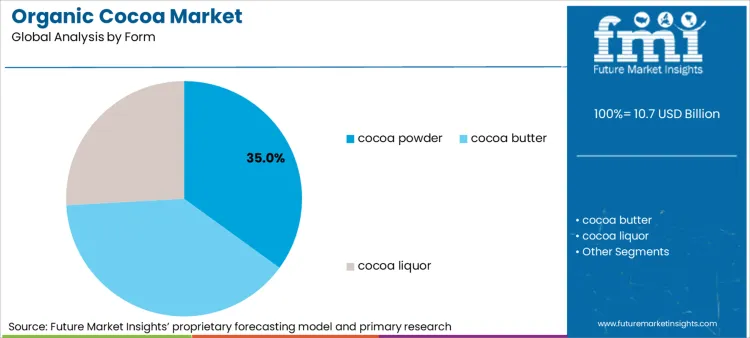
Cocoa powder is the leading form for organic cocoa industry and is poised to hold a market share of 35% in 2026.
While there are multitude of products available in the market which are made from organic cocoa, its powder form is in excellent demand. This is because it is naturally low in sugar, making it a healthier option for consumers. It can also be used in a variety of recipes, including baked goods, smoothies, hot drinks, and desserts, appealing to both home cooks and professional chefs.
By End Use Application
| Attributes | Details |
|---|---|
| Top End Use Application | Bakery and Confectionery |
| Market Share in 2026 | 36% |
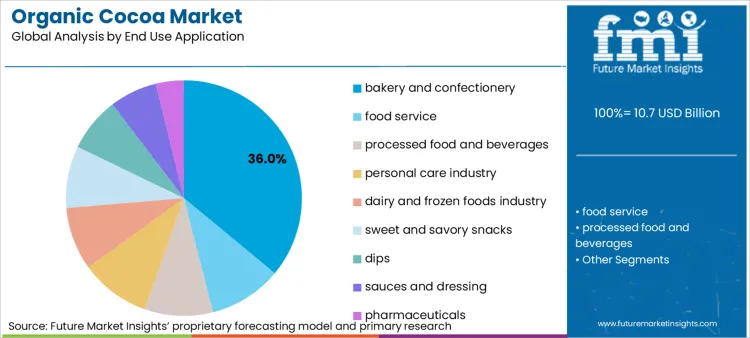
Bakery and confectionery are the leading consumers with an expected market share of 36% in 2026.
Due to its versatility, organic cocoa powder finds its application in a wide spectrum of industries. However, bakery and confectionery owners generate excellent demand for them as it adds a deep, rich chocolate flavor to baked goods. It can be used in a variety of recipes, from cakes and cookies to chocolates and pastries, making it a staple in many kitchens.
Unique Market Trends by Form
Cocoa butter’s application in chocolate and skin care will win it the race to being a value-added application. On the other hand, cocoa liquor has been able to ride the wave of premiumization with the demand for dark chocolate products. Cocoa powder's adaptability is leading it to be a staple component in health-driven developments, drifting away from its conventional arenas.
Segment-wise Application Based Study
Organic cocoa has a wide range of application scope across various industries which is contributing toward the robust growth of the organic cocoa market. Bakery and confectionery hold the highest market share in terms of volume and revenue due to increasing demand for premium and health-conscious products, such as dark chocolate and organic pastries.
The food service industry is also a major factor using organic cocoa to provide clean label and sustainable dining options in high-end cafes and restaurants.
Country-wise Insights
The following section talks about the region-wise analysis of the organic cocoa market with a focus on prominent countries.
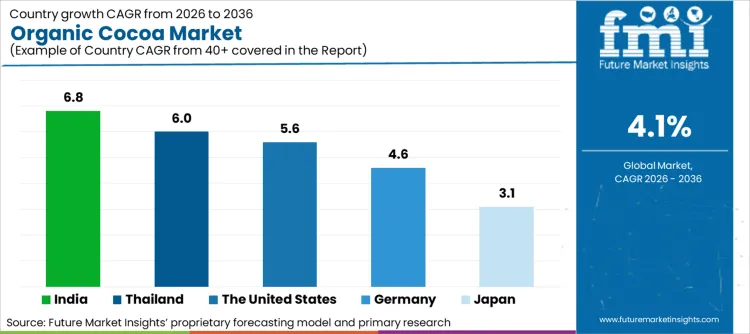
| Countries | CAGR |
|---|---|
| India | 6.8% |
| Germany | 4.6% |
| The United States | 5.6% |
| Japan | 3.1% |
| Thailand | 6% |
United States Market to Grow at a decent rate in the Coming Future
The United States leads as an organic cocoa importer, fueled by consumer demand for sustainable, health-conscious products. As organic chocolate and functional food coffee market is thriving, the cocoa butter and cocoa powder drives up imports. Its main applications are organic chocolate, drinks like hot chocolate and protein shakes, and natural cosmetics.
The United States market is driven by key factors such as a sizeable base of health-conscious consumers, rising demand for clean-label products, and innovations in plant-based and functional foods. Outlook for the future also remains good, with organic lines expanding and interest in fair-trade certifications growing.
German Market to Benefit from its Name as the Largest Chocolate Producer
Germany is Europe’s biggest buyer of organic cocoa and a centre for chocolate production. This is a country that not only sells to its own but also exports into the other EU countries. Important applications include premium chocolate, bakery, and confectionery.
Strong sustainability regulations, including the EU Deforestation-Free Regulation, drive growth, as do organic sourcing. Moreover, ethical and environmentally friendly consumption plays a major role to German consumer which increases the demand even more.
Germany's processing skills, compliance and regulatory framework will ensure that it remains on the shortlist for organic cocoa for the foreseeable future.
Premiumization of Chocolate Benefits the Market in Japan
The Japanese market is small yet it has shown significant signs of growth in the past few years. Premiumization of chocolate and increasing interest in health and wellness have played a major role in this.
With the popularity of artisanal chocolate and sophisticated confectionery, the demand for organic cocoa has skyrocketed.
Besides this, the rise of plant-based diets and innovative uses of cocoa powder in functional beverages also contribute to market expansion.
Switzerland’s Dominance in the Chocolate Industry Makes it a Lucrative Market
Switzerland has been a dominant player when it comes to the production of chocolate. This is why, it generates an excellent demand for organic cocoa every year. Country’s strong emphasis on sustainability and ethical sourcing also prompts consumers to pay a little bit extra.
As the country retains its name for producing top-class organic cocoa butter and liquor, the future outlook for Swiss market looks very bright.
Competition Outlook: Key Focus of Companies
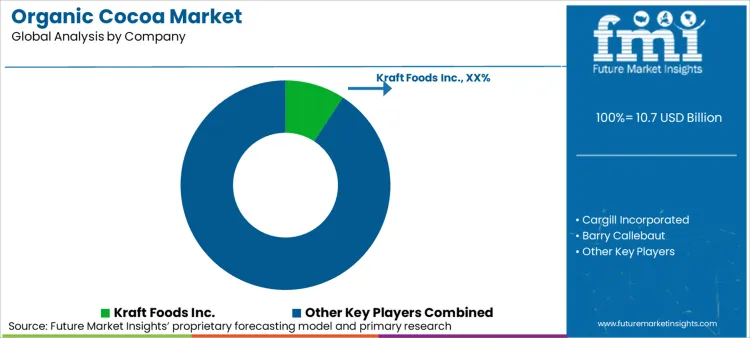
Here's a table summarizing the competitive landscape of the organic cocoa market:
| Company | Key Initiatives |
|---|---|
| Kraft Foods Inc. | Strategic acquisitions to enhance market share and global presence. |
| Cargill Incorporated | Acquired ADM's cocoa business; emphasizes traceable sourcing. |
| Barry Callebaut | Expanded footprint in Asia through acquisitions; launched Ruby chocolate. |
| Tradin Organic Agriculture | Focuses on cooperative partnerships with smallholder farmers for ethically sourced cocoa. |
| Olam Cocoa | Integrates programs like Rainforest Alliance and Cocoa Horizons for environmentally responsible practices. |
| Ciranda | Collaborated with Blommer Chocolate Company to strengthen organic cocoa offerings. |
| PASCHA Company | Focuses on allergen-free and premium chocolate lines. |
| InterNatural Foods | Introduces cocoa powders and butters tailored to plant-based and functional foods. |
Recent Developments:
- In January 2026, Barry Callebaut confirmed its fiscal outlook for the year with a strategic focus on its 'BC Next Level' program. The company is managing a transition back to volume growth after a 22% decline in its Global Cocoa segment during late 2025, primarily by scaling ChoViva, a sustainable, non-cocoa chocolate alternative, to insulate the brand from the extreme price fluctuations and supply shortages of organic beans.
- In July 2025, Cargill announced a massive overhaul of its global cocoa supply chain, launching the world's first fully electric barge network in the Netherlands to transport cocoa beans. The initiative includes the installation of biomass boilers in Côte d'Ivoire and Ghana that repurpose organic cocoa shells into energy, aiming to reduce the company's operational CO2 emissions by 90% at its primary processing sites by the end of 2025.
- In February 2025, Olam Group finalized a USD 1.78 billion deal to sell a majority stake in its Olam Agri unit to Saudi Arabia's SALIC. This 'transformative' divestment allows Olam to focus exclusively on ofi (Olam Food Ingredients), its specialized cocoa and coffee business, as it prepares for an IPO and accelerates its 'AtSource' program, which
Here are some of the most prominent companies in the market, as per the organic cocoa sector outlook
- Kraft Foods Inc.
- Cargill Incorporated
- Barry Callebaut
- Tradin Organic Agriculture
- Olam Cocoa
- Ciranda
- PASCHA Company
- InterNatural Foods
- Blommer Chocolate Company
- Ecom Agroindustrial Corp.
- Theo Chocolate
- Divine Chocolate
- TCHO Chocolate
- Guittard Chocolate Company
- Schokinag Chocolate Factory
- Chocolove
- Alter Eco
- Green & Black's
- Sjaak's Organic Chocolates
- Cacao Barry
Market Definition
The organic cocoa market represents revenue generated from the production, processing, and trade of cocoa beans, butter, powder, and liquor derived from certified organic farming practices that exclude synthetic pesticides, fertilizers, and genetically modified organisms. The market measures the value of organic-certified cocoa products sold to confectionery manufacturers, food processors, and specialty retailers.
Inclusions cover organic-certified cocoa beans, cocoa butter, cocoa powder, cocoa liquor, and semi-finished organic chocolate products. It includes products certified by USDA Organic, EU Organic, Rainforest Alliance (organic tier), and equivalent national organic standards. Organic cocoa sourced through fair trade and direct trade programs is also included.
Exclusions include conventional (non-organic) cocoa products, finished chocolate confectionery retail sales, cocoa-flavoured products that do not contain real cocoa, and cocoa by-products used in cosmetics or pharmaceuticals. Sustainable but non-organic certifications (UTZ, Rainforest Alliance standard tier) are outside the scope unless combined with organic certification.
Organic Cocoa Market Segmentation
By Form:
The global market is segmented, according to the organic cocoa sector analysis, into three : cocoa butter, cocoa liquor, and cocoa powder.
By End Use Application:
The global organic cocoa market is segmented by end-use applications into food service, processed food and beverages, personal care industry, bakery and confectionery, dairy and frozen foods industry, sweet and savory snacks, dips, sauces and dressing, and pharmaceuticals.
By Region:
The market can be segmented by region, encompassing North America, Europe, Asia Pacific, Middle East and Africa, and Latin America.
Bibliography
- Cargill. (2025). Transformed the Rouen facility into a leading specialty hub capable of producing. Cargill corporate disclosure.
- Barry Callebaut. (2026, February). Unveiled the 'Top Chocolate Confectionery Trends 2026 & Beyond' report, prioriti. Barry Callebaut corporate disclosure.
- Olam Food Ingredients (ofi). (2025). Introduced the 'Cocoa Compass Tracker,' an AI-driven tool providing real-time vi. Olam Food Ingredients (ofi) corporate disclosure.
- Ghana Government. (2025). Increased the farmgate price for cocoa to 51,660 cedis per tonne for the 2025/26. Ghana Government corporate disclosure.
- International Cocoa Organization. (2025). Quarterly bulletin of cocoa statistics. ICCO.
- European Parliament. (2024). EU Deforestation Regulation implementation guidance. Official Journal of the European Union.
Frequently Asked Questions
What is the current global market size for the Organic Cocoa Market?
The market is valued at USD 10.7 Billion in 2026, driven by tightening certified organic supply from West Africa and rising demand for traceable sourcing.
What is the projected Compound Annual Growth Rate (CAGR) for the market over the next 10 years?
The market is projected to grow at a CAGR of 4.1% from 2026 to 2036.
Which regions are experiencing the fastest expansion?
Asia Pacific and Latin America lead with the highest growth rates, driven by rising tourism and agricultural development, followed by Europe with its sustainability-driven demand.
What are the primary market drivers?
Strategic investment from players such as Cargill and Barry Callebaut, combined with regulatory mandates and evolving end-user demand, are the primary drivers of adoption.
Who are the leading companies in the industry?
Cargill, Barry Callebaut, Olam Food Ingredients (ofi), Ghana Government are key players, differentiating through strategic investment, product innovation, and regional expansion.
Preview the report firsthand - request a free sample
Get SampleGet the brochure for pricing and purchase details.
Get PDFTable of Content
- Executive Summary
- Global Market Outlook
- Demand-side Trends
- Supply-side Trends
- Technology Roadmap Analysis
- Analysis and Recommendations
- Market Overview
- Market Coverage / Taxonomy
- Market Definition / Scope / Limitations
- Research Methodology
- Chapter Orientation
- Analytical Lens and Working Hypotheses
- Market Structure, Signals, and Trend Drivers
- Benchmarking and Cross-market Comparability
- Market Sizing, Forecasting, and Opportunity Mapping
- Research Design and Evidence Framework
- Desk Research Programme (Secondary Evidence)
- Company Annual and Sustainability Reports
- Peer-reviewed Journals and Academic Literature
- Corporate Websites, Product Literature, and Technical Notes
- Earnings Decks and Investor Briefings
- Statutory Filings and Regulatory Disclosures
- Technical White Papers and Standards Notes
- Trade Journals, Industry Magazines, and Analyst Briefs
- Conference Proceedings, Webinars, and Seminar Materials
- Government Statistics Portals and Public Data Releases
- Press Releases and Reputable Media Coverage
- Specialist Newsletters and Curated Briefings
- Sector Databases and Reference Repositories
- FMI Internal Proprietary Databases and Historical Market Datasets
- Subscription Datasets and Paid Sources
- Social Channels, Communities, and Digital Listening Inputs
- Additional Desk Sources
- Expert Input and Fieldwork (Primary Evidence)
- Primary Modes
- Qualitative Interviews and Expert Elicitation
- Quantitative Surveys and Structured Data Capture
- Blended Approach
- Why Primary Evidence is Used
- Field Techniques
- Interviews
- Surveys
- Focus Groups
- Observational and In-context Research
- Social and Community Interactions
- Stakeholder Universe Engaged
- C-suite Leaders
- Board Members
- Presidents and Vice Presidents
- R&D and Innovation Heads
- Technical Specialists
- Domain Subject-matter Experts
- Scientists
- Physicians and Other Healthcare Professionals
- Governance, Ethics, and Data Stewardship
- Research Ethics
- Data Integrity and Handling
- Primary Modes
- Tooling, Models, and Reference Databases
- Desk Research Programme (Secondary Evidence)
- Data Engineering and Model Build
- Data Acquisition and Ingestion
- Cleaning, Normalisation, and Verification
- Synthesis, Triangulation, and Analysis
- Quality Assurance and Audit Trail
- Market Background
- Market Dynamics
- Drivers
- Restraints
- Opportunity
- Trends
- Scenario Forecast
- Demand in Optimistic Scenario
- Demand in Likely Scenario
- Demand in Conservative Scenario
- Opportunity Map Analysis
- Product Life Cycle Analysis
- Supply Chain Analysis
- Investment Feasibility Matrix
- Value Chain Analysis
- PESTLE and Porter’s Analysis
- Regulatory Landscape
- Regional Parent Market Outlook
- Production and Consumption Statistics
- Import and Export Statistics
- Market Dynamics
- Global Market Analysis 2021 to 2025 and Forecast, 2026 to 2036
- Historical Market Size Value (USD Million) Analysis, 2021 to 2025
- Current and Future Market Size Value (USD Million) Projections, 2026 to 2036
- Y-o-Y Growth Trend Analysis
- Absolute $ Opportunity Analysis
- Global Market Pricing Analysis 2021 to 2025 and Forecast 2026 to 2036
- Introduction / Key Findings
- Global Market Analysis 2021 to 2025 and Forecast 2026 to 2036, By Region
- Introduction
- Historical Market Size Value (USD Million) Analysis By Region, 2021 to 2025
- Current Market Size Value (USD Million) Analysis and Forecast By Region, 2026 to 2036
- North America
- Latin America
- Western Europe
- Eastern Europe
- East Asia
- South Asia and Pacific
- Middle East & Africa
- Market Attractiveness Analysis By Region
- North America Market Analysis 2021 to 2025 and Forecast 2026 to 2036, By Country
- Historical Market Size Value (USD Million) Trend Analysis By Market Taxonomy, 2021 to 2025
- Market Size Value (USD Million) Forecast By Market Taxonomy, 2026 to 2036
- By Country
- USA
- Canada
- Mexico
- Market Attractiveness Analysis
- By Country
- Key Takeaways
- By Country
- Latin America Market Analysis 2021 to 2025 and Forecast 2026 to 2036, By Country
- Historical Market Size Value (USD Million) Trend Analysis By Market Taxonomy, 2021 to 2025
- Market Size Value (USD Million) Forecast By Market Taxonomy, 2026 to 2036
- By Country
- Brazil
- Chile
- Rest of Latin America
- Market Attractiveness Analysis
- By Country
- Key Takeaways
- By Country
- Western Europe Market Analysis 2021 to 2025 and Forecast 2026 to 2036, By Country
- Historical Market Size Value (USD Million) Trend Analysis By Market Taxonomy, 2021 to 2025
- Market Size Value (USD Million) Forecast By Market Taxonomy, 2026 to 2036
- By Country
- Germany
- UK
- Italy
- Spain
- France
- Nordic
- BENELUX
- Rest of Western Europe
- Market Attractiveness Analysis
- By Country
- Key Takeaways
- By Country
- Eastern Europe Market Analysis 2021 to 2025 and Forecast 2026 to 2036, By Country
- Historical Market Size Value (USD Million) Trend Analysis By Market Taxonomy, 2021 to 2025
- Market Size Value (USD Million) Forecast By Market Taxonomy, 2026 to 2036
- By Country
- Russia
- Poland
- Hungary
- Balkan & Baltic
- Rest of Eastern Europe
- Market Attractiveness Analysis
- By Country
- Key Takeaways
- By Country
- East Asia Market Analysis 2021 to 2025 and Forecast 2026 to 2036, By Country
- Historical Market Size Value (USD Million) Trend Analysis By Market Taxonomy, 2021 to 2025
- Market Size Value (USD Million) Forecast By Market Taxonomy, 2026 to 2036
- By Country
- China
- Japan
- South Korea
- Market Attractiveness Analysis
- By Country
- Key Takeaways
- By Country
- South Asia and Pacific Market Analysis 2021 to 2025 and Forecast 2026 to 2036, By Country
- Historical Market Size Value (USD Million) Trend Analysis By Market Taxonomy, 2021 to 2025
- Market Size Value (USD Million) Forecast By Market Taxonomy, 2026 to 2036
- By Country
- India
- ASEAN
- Australia & New Zealand
- Rest of South Asia and Pacific
- Market Attractiveness Analysis
- By Country
- Key Takeaways
- By Country
- Middle East & Africa Market Analysis 2021 to 2025 and Forecast 2026 to 2036, By Country
- Historical Market Size Value (USD Million) Trend Analysis By Market Taxonomy, 2021 to 2025
- Market Size Value (USD Million) Forecast By Market Taxonomy, 2026 to 2036
- By Country
- Kingdom of Saudi Arabia
- Other GCC Countries
- Turkiye
- South Africa
- Other African Union
- Rest of Middle East & Africa
- Market Attractiveness Analysis
- By Country
- Key Takeaways
- By Country
- Key Countries Market Analysis
- USA
- Pricing Analysis
- Market Share Analysis, 2025
- Canada
- Pricing Analysis
- Market Share Analysis, 2025
- Mexico
- Pricing Analysis
- Market Share Analysis, 2025
- Brazil
- Pricing Analysis
- Market Share Analysis, 2025
- Chile
- Pricing Analysis
- Market Share Analysis, 2025
- Germany
- Pricing Analysis
- Market Share Analysis, 2025
- UK
- Pricing Analysis
- Market Share Analysis, 2025
- Italy
- Pricing Analysis
- Market Share Analysis, 2025
- Spain
- Pricing Analysis
- Market Share Analysis, 2025
- France
- Pricing Analysis
- Market Share Analysis, 2025
- India
- Pricing Analysis
- Market Share Analysis, 2025
- ASEAN
- Pricing Analysis
- Market Share Analysis, 2025
- Australia & New Zealand
- Pricing Analysis
- Market Share Analysis, 2025
- China
- Pricing Analysis
- Market Share Analysis, 2025
- Japan
- Pricing Analysis
- Market Share Analysis, 2025
- South Korea
- Pricing Analysis
- Market Share Analysis, 2025
- Russia
- Pricing Analysis
- Market Share Analysis, 2025
- Poland
- Pricing Analysis
- Market Share Analysis, 2025
- Hungary
- Pricing Analysis
- Market Share Analysis, 2025
- Kingdom of Saudi Arabia
- Pricing Analysis
- Market Share Analysis, 2025
- Turkiye
- Pricing Analysis
- Market Share Analysis, 2025
- South Africa
- Pricing Analysis
- Market Share Analysis, 2025
- USA
- Market Structure Analysis
- Competition Dashboard
- Competition Benchmarking
- Market Share Analysis of Top Players
- By Regional
- Competition Analysis
- Competition Deep Dive
- Kraft Foods Inc.
- Overview
- Product Portfolio
- Profitability by Market Segments (Product/Age /Sales Channel/Region)
- Sales Footprint
- Strategy Overview
- Marketing Strategy
- Product Strategy
- Channel Strategy
- Cargill Incorporated
- Barry Callebaut
- Tradin Organic Agriculture
- Olam Cocoa
- Ciranda
- PASCHA Company
- InterNatural Foods
- Blommer Chocolate Company
- Ecom Agroindustrial Corp.
- Theo Chocolate
- Divine Chocolate
- TCHO Chocolate
- Guittard Chocolate Company
- Schokinag Chocolate Factory
- Chocolove
- Kraft Foods Inc.
- Competition Deep Dive
- Assumptions & Acronyms Used


