

- Market Size (2026)
- USD 8.4 Bn
- Forecast (2036)
- USD 15.3 Bn
- CAGR (2026 to 2036)
- 6.2%
Cocoa Liquor Market Size, Market Forecast and Outlook By FMI
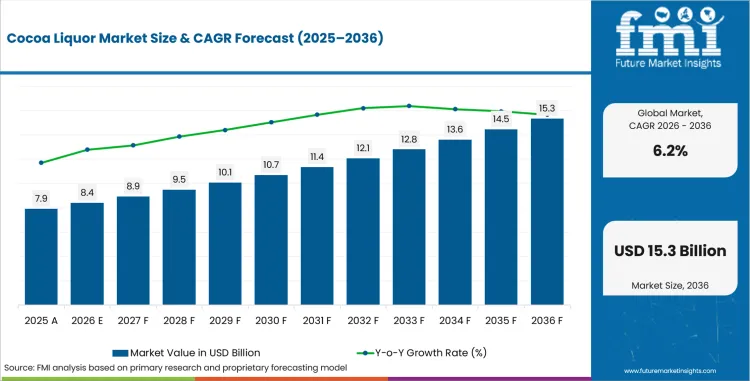
The cocoa liquor market was valued at USD 7.9 billion in 2025. The market is set to reach USD 8.4 billion by 2026-end and grow at a CAGR of 6.2% between 2026-2036 to reach USD 15.3 billion by 2036. Dutch Process Cocoa Liquor will dominate with a 21.0% share, while Chocolate And Confectionery will lead with a 21.0% share.
Key Takeaways, Market Size, and Forecast
- 2026 Market Size: USD 8.4 billion
- 2036 Market Size: USD 15.3 billion
- Forecast CAGR: 6.2% from 2026 to 2036
- Absolute $ Opportunity: USD 6.94 billion between 2026 and 2036
- Leading Product: Dutch Process Cocoa Liquor
- Dutch Process Cocoa Liquor Share in 2026: 21.0%
- Fastest-growing Country: India
- India CAGR: 7.75% through 2036
| Parameter | Details |
|---|---|
| Market Size in 2026 (Value) | USD 8.4 billion |
| Market Forecast in 2036 (Value) | USD 15.3 billion |
| CAGR (2026 to 2036) | 6.2% |
| Years Considered | 2021 to 2036 |
| Base Year | 2026 |
| Forecast Period | 2026 to 2036 |
| Units Considered | Value (USD Bn) |
| Leading Sub-Region | India |
Summary of the Cocoa Liquor Market
- Demand and Growth Drivers
- Growing chocolate confectionery production and premiumization trends are expected to sustain demand for cocoa liquor as the foundational ingredient in chocolate manufacturing.
- Adoption of single-origin and specialty cocoa liquor is increasing as craft chocolate makers and premium confectioners seek differentiated flavor profiles linked to specific cocoa bean varieties and origins.
- Expansion of chocolate consumption in India, China, and Southeast Asia is broadening the addressable market for cocoa liquor beyond traditional concentration in Europe and North America.
- Product and Segment View
- Dutch process cocoa liquor accounts for 21.0% of the product segment, reflecting demand for alkalized cocoa mass with modified color, flavor, and pH characteristics for specific confectionery and bakery applications.
- Chocolate and confectionery holds 21.0% of the application segment, with cocoa liquor serving as the base ingredient that provides chocolate flavor, color, and composition.
- Forastero cocoa variety at 38.6% represents the dominant bean source, reflecting global production concentration in West African Forastero cultivars that provide the bulk cocoa supply for industrial chocolate manufacturing.
- Geography and Competitive Outlook
- India is expected to lead growth at 7.75% CAGR through 2036, driven by growing chocolate consumption, domestic confectionery manufacturing expansion, and premium chocolate segment development.
- Europe accounts for the largest market share, sustained by chocolate manufacturing concentration in Belgium, Switzerland, and Germany with established cocoa liquor processing infrastructure.
- Barry Callebaut AG holds an estimated 18.5% market share, supported by the largest cocoa processing capacity globally and integrated supply from bean sourcing through liquor and butter production.
- Analyst Opinion
- Nandini Roy Choudhury, Principal Consultant at FMI says, 'Processors that can deliver traceable, single-origin cocoa liquor with documented flavor profiles and EU deforestation compliance are positioned to capture premium specification from craft and premium chocolate manufacturers willing to pay origin premiums for differentiated cocoa mass.'
- Growth reflects chocolate consumption expansion, premiumization, and emerging market confectionery development.
- Demand is supported by chocolate production scaling, craft chocolate segment growth, and bakery and ice cream applications using cocoa liquor as a flavor ingredient.
- Adoption of single-origin liquor is constrained by supply variability, premium pricing, and flavor consistency challenges inherent in single-source cocoa bean procurement.
Cocoa Liquor Market Definition
The cocoa liquor market includes natural, Dutch-processed, and organic cocoa liquor (cocoa mass) produced by grinding cocoa nibs, used as the primary ingredient in chocolate manufacturing and as a flavoring ingredient in bakery, ice cream, and confectionery applications.
Cocoa Liquor Market Inclusions
Market scope covers products segmented by product (Dutch process, natural, organic), application (chocolate and confectionery, bakery, ice cream, beverages), cocoa variety (Forastero, Criollo, Trinitario), form (wafers, blocks, liquid), processing method (Dutch processed, natural processed), and end-use industry (food and beverage, cosmetics). Revenue estimates span 2026 to 2036.
Cocoa Liquor Market Exclusions
The scope excludes cocoa powder, cocoa butter, and finished chocolate products downstream of cocoa liquor processing.
Cocoa Liquor Market Research Methodology
- Primary Research: FMI analysts conducted interviews with chocolate manufacturers, cocoa processors, and confectionery ingredient buyers across key consuming markets.
- Desk Research: Combined data from ICCO grinding statistics, chocolate production databases, and cocoa processor disclosures.
- Market Sizing and Forecasting: Bottom-up aggregation of chocolate production data and per-tonne cocoa liquor consumption, with bakery and ice cream application volumes.
- Data Validation: Cross-checked quarterly against ICCO statistics, processor financial disclosures, and chocolate production indices.
Why is the Cocoa Liquor Market Growing?
- Chocolate production growth across premium, mainstream, and emerging market segments generates proportional cocoa liquor demand as the base ingredient providing chocolate flavor and composition.
- Craft chocolate movement growth creates demand for single-origin and specialty cocoa liquor with documented bean variety, origin, and flavor profile differentiation.
- India leads growth at 7.75%, driven by rapidly expanding chocolate consumption, domestic confectionery manufacturing, and growing consumer appetite for premium chocolate products.
The cocoa liquor market is expanding as global chocolate production grows and premiumization trends create demand for differentiated cocoa ingredients. Cocoa liquor, produced by grinding roasted cocoa nibs, is the fundamental ingredient from which all chocolate products derive their cocoa flavor and composition. Each tonne of chocolate production requires cocoa liquor in proportion to the cocoa solids content of the formulation.
Dutch-processed cocoa liquor at 21.0% serves applications requiring modified color, reduced acidity, and milder flavor compared to natural process liquor. Alkalization treatment adjusts pH and develops darker color suitable for dark chocolate, bakery applications, and cocoa-flavored products. Natural process liquor preserves the inherent flavor characteristics of the cocoa bean origin.
Forastero variety at 38.6% dominates global cocoa supply from West African production in Cote d'Ivoire, Ghana, and Nigeria. Criollo and Trinitario varieties serve the premium and craft chocolate segment with flavor complexity that commands pricing premiums. Origin differentiation is creating new product tiers in the cocoa liquor market as craft chocolate makers seek specific bean genetics and processing profiles.
Market Segmentation Analysis
- Dutch process at 21.0% serves applications requiring alkalized flavor and color modification.
- Chocolate and confectionery at 21.0% generates the primary demand through manufacturing.
- Forastero at 38.6% reflects the dominant bean variety sourcing from West African production.
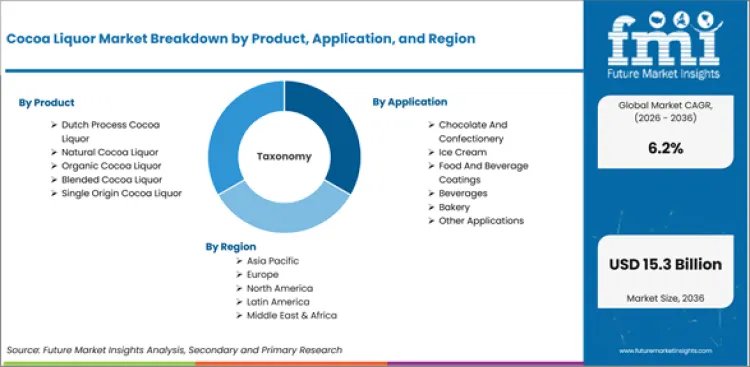
The market is segmented by product, application, cocoa variety, form, processing method, and end-use industry.
Insights into the Dutch Process Segment
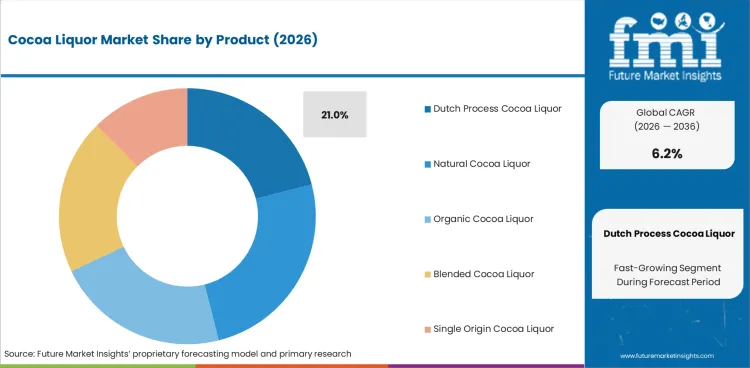
Dutch-processed cocoa liquor provides modified pH, color, and flavor through alkalization. Applications in dark chocolate, bakery, and flavored products drive procurement from chocolate and food manufacturers seeking consistent color and mild acidity.
Insights into the Single-Origin Segment
Single-origin cocoa liquor from specific geographic sources commands premium pricing for documented flavor profiles. Craft chocolate makers procure directly from origin processors or specialty importers, creating a differentiated supply chain parallel to commodity cocoa liquor trade.
Cocoa Liquor Market Drivers, Restraints, and Opportunities
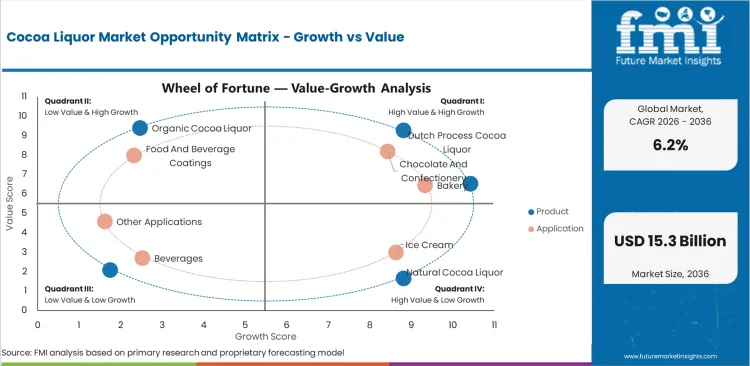
- Chocolate production growth creates proportional cocoa liquor demand as the base manufacturing ingredient.
- Origin and bean variety differentiation create premium tiers with pricing premiums over commodity Forastero liquor.
- EU deforestation regulation reshapes procurement toward documented traceable supply chains.
The market benefits from chocolate production, premiumization, and emerging market consumption. Restraints include cocoa price volatility and deforestation compliance cost. Opportunities exist in single-origin premiums, emerging market consumption, and craft chocolate growth.
Chocolate Production
Demand tracks global chocolate manufacturing output proportionally.
Premiumization
Growth reflects craft and premium chocolate segment expansion creating single-origin and specialty cocoa liquor demand.
Emerging Market Expansion
Adoption increases as chocolate consumption grows in India, China, and Southeast Asia.
Analysis of Cocoa Liquor Market By Key Countries
.webp "Top Country Growth Comparison Cocoa Liquor Market Cagr (2026 2036)")
| Country | CAGR |
|---|---|
| India | 7.75% |
| Japan | 6.8% |
| Brazil | 6.51% |
| China | 5.6% |
| USA | 3.7% |
Source: FMI analysis based on primary research and proprietary forecasting model
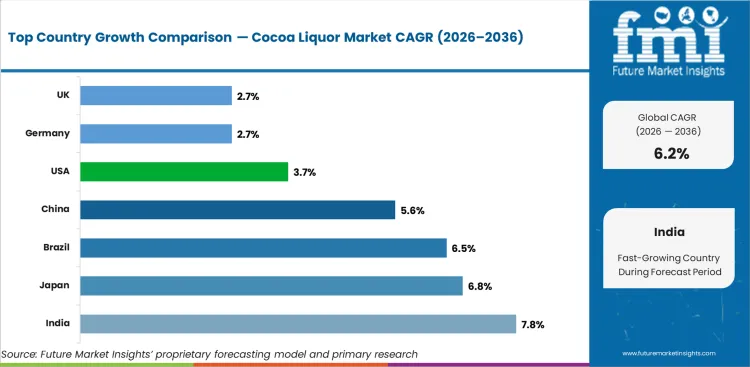
- India leads at 7.75% CAGR, driven by chocolate consumption growth, domestic manufacturing, and premium segment development.
- Japan at 6.8% reflects premium confectionery, artisan chocolate, and high-quality manufacturing standards.
- Brazil (6.51%) and China (5.6%) sustain demand through domestic production and consumption expansion.
The global cocoa liquor market is projected to grow at 6.2% CAGR from 2026 to 2036.
Demand Outlook for Cocoa Liquor Market in India
Rapidly growing chocolate consumption and domestic manufacturing expansion position India as the fastest-growing market. Growth at 7.75% through 2036 reflects Mondelez India, Amul chocolate expansion, and premium segment development.
- Mondelez (Cadbury) India and domestic confectioners drive cocoa liquor procurement through expanding chocolate manufacturing capacity.
- Premium and artisan chocolate brands entering the Indian market create demand for specialty cocoa liquor grades.
- Domestic cocoa bean processing in Kerala and Karnataka provides local liquor supply supplementing imports from global processors.
In-depth Analysis of Cocoa Liquor Market in Japan
Premium confectionery standards and artisan chocolate growth define the Japanese market. Growth at 6.8% through 2036 reflects quality specifications, Meiji-Morinaga manufacturing, and craft chocolate expansion.
- Japanese confectionery quality standards drive specification of premium-grade cocoa liquor with consistent flavor and crystallization properties.
- Bean-to-bar craft chocolate makers source single-origin cocoa liquor for artisan production targeting premium Japanese consumers.
- Meiji and Morinaga manufacturing operations sustain structured cocoa liquor procurement from major global processors.
Future Outlook for Cocoa Liquor Market in Brazil
Domestic cocoa production and confectionery manufacturing define the Brazilian market. Growth at 6.51% through 2036 reflects origin-country processing advantage, domestic consumption, and export chocolate production.
- Bahian cocoa production provides domestic bean supply for local liquor processing, creating origin-country cost and logistics advantages.
- Domestic chocolate consumption growth driven by premiumization and gifting culture sustains confectionery manufacturing and liquor demand.
- Brazilian single-origin cocoa from Bahia and Para creates specialty liquor products for craft chocolate markets.
Sales Analysis of Cocoa Liquor Market in China
Growing chocolate consumption and domestic manufacturing expansion define the Chinese market. Growth at 5.6% through 2036 reflects Western confectionery adoption, premium chocolate, and cosmetic applications.
- Chocolate consumption growth driven by gifting culture and premium brand expansion generates incremental cocoa liquor demand for Chinese manufacturing.
- International chocolate brands manufacturing in China create localized cocoa liquor procurement requirements.
- Domestic cocoa processing development provides Chinese-manufactured liquor for domestic confectionery supply chains.
Opportunity Analysis of Cocoa Liquor Market in the United States
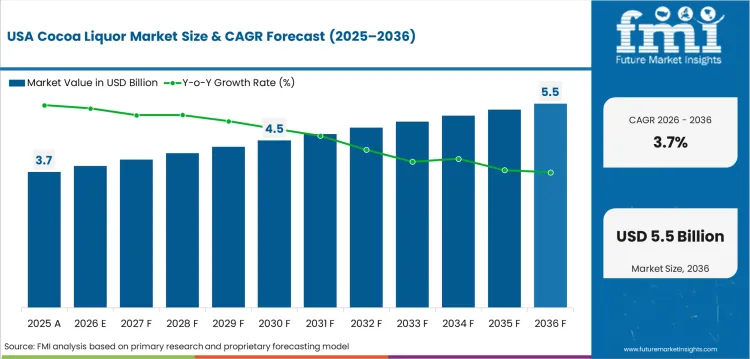
Established chocolate manufacturing and craft segment growth define the US market. Growth at 3.7% through 2036 reflects premiumization, single-origin demand, and bakery application expansion.
- Craft chocolate movement growth in the US creates demand for single-origin and specialty cocoa liquor from specific growing regions.
- Bakery and ice cream applications using cocoa liquor as flavor ingredient generate non-confectionery demand.
- USDA organic certification requirements for organic cocoa liquor create structured supply for certified chocolate manufacturing.
Competitive Landscape and Strategic Positioning
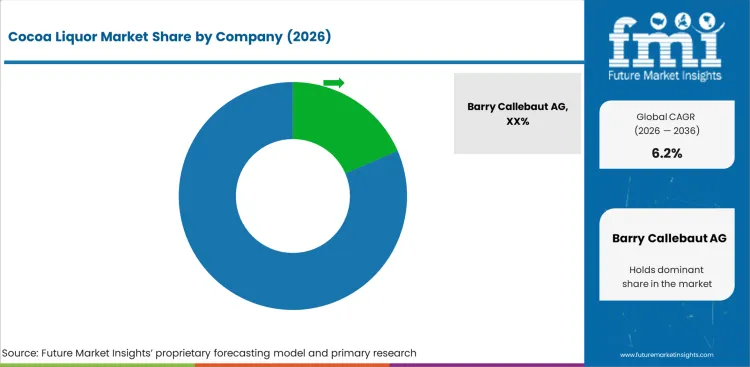
- Barry Callebaut AG holds an estimated 18.5% market share through the largest global cocoa grinding capacity and integrated supply chains.
- Cargill and Olam International maintain positions through origin-country and consuming-market processing facilities.
- Blommer Chocolate Company serves the North American cocoa liquor market with domestic processing serving US confectionery manufacturers.
Barry Callebaut leads through the broadest processing network. Cargill and Olam compete with integrated origin sourcing. Blommer serves North American demand from domestic facilities. Nestlé and Hershey operate captive processing.
Barriers include origin country sourcing relationships, processing capital, deforestation traceability, and quality consistency for chocolate manufacturing specifications.
Key Companies in the Cocoa Liquor Market
Key global companies leading the cocoa liquor market include:
- Barry Callebaut (Switzerland), Cargill (USA), and Olam/ofi (Singapore) lead with global processing.
- Blommer (USA), Nestlé (Switzerland), and Hershey (USA) maintain positions through domestic and captive processing.
- Puratos (Belgium), Cémoi (France), and Guan Chong Berhad (Malaysia) serve regional segments.
Competitive Benchmarking: Cocoa Liquor Market
| Company | Processing | Traceability | Customer Base | Geographic Footprint |
|---|---|---|---|---|
| Barry Callebaut | High | Strong | Strong | Global |
| Cargill | High | Strong | Strong | Global |
| Olam/ofi | High | Strong | Strong | Global |
| Blommer | Medium | Moderate | Strong | N. America |
| Nestlé | Medium | Strong | Internal | Global |
| Hershey | Medium | Strong | Internal | N. America |
Source: Future Market Insights competitive analysis, 2026.
Key Developments in Cocoa Liquor Market
- In 2025, Barry Callebaut introduced a traceable single-origin cocoa liquor range with documented bean variety and flavor profile for premium chocolate manufacturers.
- In 2025, Olam launched an expanded deforestation-free cocoa liquor program with satellite-verified origin traceability for EU regulation compliance.
Key Players in the Cocoa Liquor Market
Major Global Players
- Barry Callebaut AG
- Cargill, Incorporated
- Olam International Limited
- Blommer Chocolate Company
- Nestlé S.A.
Emerging Players/Startups
- The Hershey Company
- Puratos Group
- Cémoi Group
- Guan Chong Berhad
- JB Cocoa
Report Scope and Coverage
| Parameter | Details |
|---|---|
| Market size by 2036 | USD 15.35 billion |
| Growth rate | 6.2% CAGR (2026 to 2036) |
| Base year value (2026) | USD 8.41 billion |
| By Product | Dutch Process, Natural, Organic, Blended, Single |
| By Application | Chocolate, Bakery, Ice Cream, Beverages |
| By Cocoa Variety | Forastero, Criollo, Trinitario |
| By Form | Wafers, Blocks, Liquid, Chips |
| Regions covered | North America, Latin America, Europe, East Asia, South Asia and Pacific, Middle East and Africa |
| Countries covered | USA, UK, Germany, Japan, China, India, Brazil, 30 plus countries |
| Key companies profiled | Barry Callebaut, Cargill, Olam, Blommer, Nestlé, Hershey, Puratos |
| Approach | Hybrid bottom-up and top-down methodology starting with cocoa grinding and chocolate production data. |
Segmentation
Cocoa Liquor Market Segmented by Product:
- Dutch Process Cocoa Liquor
- Alkalized Cocoa Liquor
- Low Acidity Cocoa Liquor
- Dark Color Cocoa Liquor
- Smooth Flavor Cocoa Liquor
- Alkalized Cocoa Liquor
- Natural Cocoa Liquor
- Non Alkalized Cocoa Liquor
- High Acidity Cocoa Liquor
- Strong Cocoa Flavor Liquor
- Light Brown Cocoa Liquor
- Non Alkalized Cocoa Liquor
- Organic Cocoa Liquor
- Certified Organic Cocoa Liquor
- Non GMO Cocoa Liquor
- Sustainably Sourced Cocoa Liquor
- Premium Organic Liquor
- Certified Organic Cocoa Liquor
- Blended Cocoa Liquor
- Mixed Origin Cocoa Liquor
- Flavor Balanced Liquor
- Custom Formulation Liquor
- Industrial Blend Liquor
- Mixed Origin Cocoa Liquor
- Single Origin Cocoa Liquor
- Specific Region Cocoa Liquor
- Premium Traceable Liquor
- Specialty Cocoa Liquor
- Artisanal Cocoa Liquor
- Specific Region Cocoa Liquor
Cocoa Liquor Market Segmented by Application:
- Chocolate And Confectionery
- Chocolate Manufacturing
- Dark Chocolate Production
- Milk Chocolate Production
- Filled Confectionery
- Chocolate Manufacturing
- Ice Cream
- Frozen Dessert Production
- Premium Ice Cream
- Chocolate Flavored Ice Cream
- Frozen Dessert Production
- Food And Beverage Coatings
- Enrobing Applications
- Bakery Coatings
- Snack Coatings
- Enrobing Applications
- Beverages
- Cocoa Based Drinks
- Hot Chocolate Drinks
- Ready To Drink Beverages
- Cocoa Based Drinks
- Bakery
- Baked Goods Applications
- Cakes And Pastries
- Biscuits And Cookies
- Baked Goods Applications
- Other Applications
- Food Processing Uses
- Desserts
- Spreads And Fillings
- Food Processing Uses
Cocoa Liquor Market Segmented by Cocoa Variety:
- Forastero
- Bulk Cocoa Variety
- High Yield Beans
- Standard Flavor Profile
- Bulk Cocoa Variety
- Criollo
- Fine Flavor Cocoa
- Low Yield Beans
- Premium Taste Profile
- Fine Flavor Cocoa
- Trinitario
- Hybrid Cocoa Variety
- Balanced Flavor Beans
- Medium Yield Production
- Hybrid Cocoa Variety
- Other Cocoa Varieties
- Specialty Cocoa Beans
- Regional Cocoa Types
- Experimental Varieties
- Specialty Cocoa Beans
Cocoa Liquor Market Segmented by Form:
- Wafers
- Solid Cocoa Pieces
- Easy Melt Wafers
- Industrial Use Wafers
- Solid Cocoa Pieces
- Blocks
- Bulk Cocoa Liquor Blocks
- Large Format Blocks
- Processing Blocks
- Bulk Cocoa Liquor Blocks
- Chips
- Small Cocoa Pieces
- Quick Melt Chips
- Uniform Size Chips
- Small Cocoa Pieces
- Liquid
- Molten Cocoa Liquor
- Pumpable Liquid Form
- Continuous Processing Form
- Molten Cocoa Liquor
Cocoa Liquor Market Segmented by Processing Method:
- Dutch Processed
- Alkalization Process
- pH Controlled Processing
- Color Modified Cocoa
- Alkalization Process
- Natural Processing
- Non Alkalized Method
- Raw Cocoa Processing
- Minimal Treatment Cocoa
- Non Alkalized Method
Cocoa Liquor Market Segmented by End Use Industry:
- Food And Beverage Industry
- Industrial Food Processing
- Chocolate Manufacturers
- Beverage Producers
- Industrial Food Processing
- Cosmetics And Personal Care
- Cocoa Butter Extraction Use
- Skincare Products
- Beauty Formulations
- Cocoa Butter Extraction Use
- Pharmaceutical Industry
- Functional Ingredient Use
- Nutraceutical Applications
- Health Supplements
- Functional Ingredient Use
Cocoa Liquor Market by Region:
- North America
- USA
- Canada
- Mexico
- Latin America
- Brazil
- Chile
- Rest of Latin America
- Western Europe
- Germany
- UK
- Italy
- Spain
- France
- Nordic
- BENELUX
- Rest of Western Europe
- Eastern Europe
- Russia
- Poland
- Hungary
- Balkan & Baltic
- Rest of Eastern Europe
- East Asia
- China
- Japan
- South Korea
- South Asia and Pacific
- India
- ASEAN
- Australia & New Zealand
- Rest of South Asia and Pacific
- Middle East & Africa
- Kingdom of Saudi Arabia
- Other GCC Countries
- Turkiye
- South Africa
- Other African Union
- Rest of Middle East & Africa
Research Sources and Bibliography
- 1. International Cocoa Organization. (2025). ICCO Cocoa Statistics. ICCO.
- 2. European Commission. (2024). EC Deforestation Regulation. EC.
- 3. Food and Agriculture Organization. (2025). FAO Cocoa Trade Data. FAO.
- 4. World Cocoa Foundation. (2024). WCF Sustainability Report. WCF.
- 5. Codex Alimentarius. (2025). Codex Cocoa Product Standards. Codex.
This bibliography is provided for reader reference. The full Future Market Insights report contains the complete reference list with publication dates, URLs, and supporting data for all cited works.
This Report Answers
- Estimating market size and revenue from 2026 to 2036.
- Segmentation by product, application, variety, form, and processing.
- Regional insights across more than 30 markets.
- Technology analysis covering Dutch process, natural, and single-origin.
- Competitive landscape assessment.
- Investment in single-origin and sustainable sourcing.
- Supply chain analysis.
- Data delivery in PDF and Excel formats.
Frequently Asked Questions
How big is the cocoa liquor market in 2026?
The global cocoa liquor market is estimated to be valued at USD 8.4 billion in 2026.
What will be the size of cocoa liquor market in 2036?
The market size for the cocoa liquor market is projected to reach USD 15.3 billion by 2036.
How much will be the cocoa liquor market growth between 2026 and 2036?
The cocoa liquor market is expected to grow at a 6.2% CAGR between 2026 and 2036.
What are the key product types in the cocoa liquor market?
The key product types in cocoa liquor market are Dutch Process Cocoa Liquor, Natural Cocoa Liquor, Organic Cocoa Liquor, Blended Cocoa Liquor and Single Origin Cocoa Liquor.
Which application segment is expected to contribute significant share in the cocoa liquor market in 2026?
In terms of application, chocolate and confectionery segment is expected to command 21.0% share in the cocoa liquor market in 2026.
Preview the report firsthand - request a free sample
Get SampleGet the brochure for pricing and purchase details.
Get PDFTable of Content
- Executive Summary
- Global Market Outlook
- Demand-side Trends
- Supply-side Trends
- Technology Roadmap Analysis
- Analysis and Recommendations
- Market Overview
- Market Coverage / Taxonomy
- Market Definition / Scope / Limitations
- Research Methodology
- Chapter Orientation
- Analytical Lens and Working Hypotheses
- Market Structure, Signals, and Trend Drivers
- Benchmarking and Cross-market Comparability
- Market Sizing, Forecasting, and Opportunity Mapping
- Research Design and Evidence Framework
- Desk Research Programme (Secondary Evidence)
- Company Annual and Sustainability Reports
- Peer-reviewed Journals and Academic Literature
- Corporate Websites, Product Literature, and Technical Notes
- Earnings Decks and Investor Briefings
- Statutory Filings and Regulatory Disclosures
- Technical White Papers and Standards Notes
- Trade Journals, Industry Magazines, and Analyst Briefs
- Press Releases and Reputable Media Coverage
- Specialist Newsletters and Curated Briefings
- Sector Databases and Reference Repositories
- FMI Internal Proprietary Databases and Historical Market Datasets
- Subscription Datasets and Paid Sources
- Social Channels, Communities, and Digital Listening Inputs
- Additional Desk Sources
- Expert Input and Fieldwork (Primary Evidence)
- Primary Modes
- Qualitative Interviews and Expert Elicitation
- Quantitative Surveys and Structured Data Capture
- Blended Approach
- Why Primary Evidence is Used
- Field Techniques
- Interviews
- Surveys
- Focus Groups
- Observational and In-context Research
- Social and Community Interactions
- Stakeholder Universe Engaged
- C-suite Leaders
- Board Members
- Presidents and Vice Presidents
- R&D and Innovation Heads
- Domain Subject-matter Experts
- Scientists
- Physicians and Other Healthcare Professionals
- Governance, Ethics, and Data Stewardship
- Research Ethics
- Data Integrity and Handling
- Primary Modes
- Tooling, Models, and Reference Databases
- Desk Research Programme (Secondary Evidence)
- Data Engineering and Model Build
- Data Acquisition and Ingestion
- Cleaning, Normalisation, and Verification
- Synthesis, Triangulation, and Analysis
- Quality Assurance and Audit Trail
- Market Background
- Market Dynamics
- Drivers
- Restraints
- Opportunity
- Trends
- Scenario Forecast
- Demand in Optimistic Scenario
- Demand in Likely Scenario
- Demand in Conservative Scenario
- Opportunity Map Analysis
- Product Life Cycle Analysis
- Supply Chain Analysis
- Investment Feasibility Matrix
- Value Chain Analysis
- PESTLE and Porter’s Analysis
- Regulatory Landscape
- Regional Parent Market Outlook
- Production and Consumption Statistics
- Import and Export Statistics
- Market Dynamics
- Global Market Analysis 2021 to 2025 and Forecast, 2026 to 2036
- Historical Market Size Value (USD Million) Analysis, 2021 to 2025
- Current and Future Market Size Value (USD Million) Projections, 2026 to 2036
- Y to o to Y Growth Trend Analysis
- Absolute $ Opportunity Analysis
- Global Market Pricing Analysis 2021 to 2025 and Forecast 2026 to 2036
- Global Market Analysis 2021 to 2025 and Forecast 2026 to 2036, By Product
- Introduction / Key Findings
- Historical Market Size Value (USD Million) Analysis By Product , 2021 to 2025
- Current and Future Market Size Value (USD Million) Analysis and Forecast By Product , 2026 to 2036
- Dutch Process Cocoa Liquor
- Alkalized Cocoa Liquor
- Low Acidity Cocoa Liquor
- Dark Color Cocoa Liquor
- Smooth Flavor Cocoa Liquor
- Alkalized Cocoa Liquor
- Natural Cocoa Liquor
- Non Alkalized Cocoa Liquor
- High Acidity Cocoa Liquor
- Strong Cocoa Flavor Liquor
- Light Brown Cocoa Liquor
- Non Alkalized Cocoa Liquor
- Organic Cocoa Liquor
- Certified Organic Cocoa Liquor
- Non GMO Cocoa Liquor
- Sustainably Sourced Cocoa Liquor
- Premium Organic Liquor
- Certified Organic Cocoa Liquor
- Blended Cocoa Liquor
- Mixed Origin Cocoa Liquor
- Dutch Process Cocoa Liquor
- Y to o to Y Growth Trend Analysis By Product , 2021 to 2025
- Absolute $ Opportunity Analysis By Product , 2026 to 2036
- Global Market Analysis 2021 to 2025 and Forecast 2026 to 2036, By Application
- Introduction / Key Findings
- Historical Market Size Value (USD Million) Analysis By Application, 2021 to 2025
- Current and Future Market Size Value (USD Million) Analysis and Forecast By Application, 2026 to 2036
- Chocolate And Confectionery
- Chocolate Manufacturing
- Dark Chocolate Production
- Milk Chocolate Production
- Filled Confectionery
- Chocolate Manufacturing
- Ice Cream
- Frozen Dessert Production
- Premium Ice Cream
- Chocolate Flavored Ice Cream
- Frozen Dessert Production
- Food And Beverage Coatings
- Enrobing Applications
- Bakery Coatings
- Snack Coatings
- Enrobing Applications
- Beverages
- Cocoa Based Drinks
- Hot Chocolate Drinks
- Ready To Drink Beverages
- Cocoa Based Drinks
- Bakery
- Baked Goods Applications
- Cakes And Pastries
- Biscuits And Cookies
- Baked Goods Applications
- Other Applications
- Food Processing Uses
- Desserts
- Spreads And Fillings
- Food Processing Uses
- Chocolate And Confectionery
- Y to o to Y Growth Trend Analysis By Application, 2021 to 2025
- Absolute $ Opportunity Analysis By Application, 2026 to 2036
- Global Market Analysis 2021 to 2025 and Forecast 2026 to 2036, By Cocoa Variety
- Introduction / Key Findings
- Historical Market Size Value (USD Million) Analysis By Cocoa Variety, 2021 to 2025
- Current and Future Market Size Value (USD Million) Analysis and Forecast By Cocoa Variety, 2026 to 2036
- Forastero
- Bulk Cocoa Variety
- High Yield Beans
- Standard Flavor Profile
- Bulk Cocoa Variety
- Criollo
- Fine Flavor Cocoa
- Low Yield Beans
- Premium Taste Profile
- Fine Flavor Cocoa
- Trinitario
- Hybrid Cocoa Variety
- Balanced Flavor Beans
- Medium Yield Production
- Hybrid Cocoa Variety
- Other Cocoa Varieties
- Specialty Cocoa Beans
- Regional Cocoa Types
- Experimental Varieties
- Specialty Cocoa Beans
- Forastero
- Y to o to Y Growth Trend Analysis By Cocoa Variety, 2021 to 2025
- Absolute $ Opportunity Analysis By Cocoa Variety, 2026 to 2036
- Global Market Analysis 2021 to 2025 and Forecast 2026 to 2036, By Form
- Introduction / Key Findings
- Historical Market Size Value (USD Million) Analysis By Form, 2021 to 2025
- Current and Future Market Size Value (USD Million) Analysis and Forecast By Form, 2026 to 2036
- Wafers
- Solid Cocoa Pieces
- Easy Melt Wafers
- Industrial Use Wafers
- Solid Cocoa Pieces
- Blocks
- Bulk Cocoa Liquor Blocks
- Large Format Blocks
- Processing Blocks
- Bulk Cocoa Liquor Blocks
- Chips
- Small Cocoa Pieces
- Quick Melt Chips
- Uniform Size Chips
- Small Cocoa Pieces
- Liquid
- Molten Cocoa Liquor
- Pumpable Liquid Form
- Continuous Processing Form
- Molten Cocoa Liquor
- Wafers
- Y to o to Y Growth Trend Analysis By Form, 2021 to 2025
- Absolute $ Opportunity Analysis By Form, 2026 to 2036
- Global Market Analysis 2021 to 2025 and Forecast 2026 to 2036, By Processing Method
- Introduction / Key Findings
- Historical Market Size Value (USD Million) Analysis By Processing Method, 2021 to 2025
- Current and Future Market Size Value (USD Million) Analysis and Forecast By Processing Method, 2026 to 2036
- Dutch Processed
- Alkalization Process
- pH Controlled Processing
- Color Modified Cocoa
- Alkalization Process
- Natural Processing
- Non Alkalized Method
- Raw Cocoa Processing
- Minimal Treatment Cocoa
- Non Alkalized Method
- Dutch Processed
- Y to o to Y Growth Trend Analysis By Processing Method, 2021 to 2025
- Absolute $ Opportunity Analysis By Processing Method, 2026 to 2036
- Global Market Analysis 2021 to 2025 and Forecast 2026 to 2036, By End Use Industry
- Introduction / Key Findings
- Historical Market Size Value (USD Million) Analysis By End Use Industry, 2021 to 2025
- Current and Future Market Size Value (USD Million) Analysis and Forecast By End Use Industry, 2026 to 2036
- Food And Beverage Industry
- Industrial Food Processing
- Chocolate Manufacturers
- Beverage Producers
- Industrial Food Processing
- Cosmetics And Personal Care
- Cocoa Butter Extraction Use
- Skincare Products
- Beauty Formulations
- Cocoa Butter Extraction Use
- Pharmaceutical Industry
- Functional Ingredient Use
- Nutraceutical Applications
- Health Supplements
- Functional Ingredient Use
- Food And Beverage Industry
- Y to o to Y Growth Trend Analysis By End Use Industry, 2021 to 2025
- Absolute $ Opportunity Analysis By End Use Industry, 2026 to 2036
- Global Market Analysis 2021 to 2025 and Forecast 2026 to 2036, By Region
- Introduction
- Historical Market Size Value (USD Million) Analysis By Region, 2021 to 2025
- Current Market Size Value (USD Million) Analysis and Forecast By Region, 2026 to 2036
- North America
- Latin America
- Western Europe
- Eastern Europe
- East Asia
- South Asia and Pacific
- Middle East & Africa
- Market Attractiveness Analysis By Region
- North America Market Analysis 2021 to 2025 and Forecast 2026 to 2036, By Country
- Historical Market Size Value (USD Million) Trend Analysis By Market Taxonomy, 2021 to 2025
- Market Size Value (USD Million) Forecast By Market Taxonomy, 2026 to 2036
- By Country
- USA
- Canada
- Mexico
- By Product
- By Application
- By Cocoa Variety
- By Form
- By Processing Method
- By End Use Industry
- By Country
- Market Attractiveness Analysis
- By Country
- By Product
- By Application
- By Cocoa Variety
- By Form
- By Processing Method
- By End Use Industry
- Key Takeaways
- Latin America Market Analysis 2021 to 2025 and Forecast 2026 to 2036, By Country
- Historical Market Size Value (USD Million) Trend Analysis By Market Taxonomy, 2021 to 2025
- Market Size Value (USD Million) Forecast By Market Taxonomy, 2026 to 2036
- By Country
- Brazil
- Chile
- Rest of Latin America
- By Product
- By Application
- By Cocoa Variety
- By Form
- By Processing Method
- By End Use Industry
- By Country
- Market Attractiveness Analysis
- By Country
- By Product
- By Application
- By Cocoa Variety
- By Form
- By Processing Method
- By End Use Industry
- Key Takeaways
- Western Europe Market Analysis 2021 to 2025 and Forecast 2026 to 2036, By Country
- Historical Market Size Value (USD Million) Trend Analysis By Market Taxonomy, 2021 to 2025
- Market Size Value (USD Million) Forecast By Market Taxonomy, 2026 to 2036
- By Country
- Germany
- UK
- Italy
- Spain
- France
- Nordic
- BENELUX
- Rest of Western Europe
- By Product
- By Application
- By Cocoa Variety
- By Form
- By Processing Method
- By End Use Industry
- By Country
- Market Attractiveness Analysis
- By Country
- By Product
- By Application
- By Cocoa Variety
- By Form
- By Processing Method
- By End Use Industry
- Key Takeaways
- Eastern Europe Market Analysis 2021 to 2025 and Forecast 2026 to 2036, By Country
- Historical Market Size Value (USD Million) Trend Analysis By Market Taxonomy, 2021 to 2025
- Market Size Value (USD Million) Forecast By Market Taxonomy, 2026 to 2036
- By Country
- Russia
- Poland
- Hungary
- Balkan & Baltic
- Rest of Eastern Europe
- By Product
- By Application
- By Cocoa Variety
- By Form
- By Processing Method
- By End Use Industry
- By Country
- Market Attractiveness Analysis
- By Country
- By Product
- By Application
- By Cocoa Variety
- By Form
- By Processing Method
- By End Use Industry
- Key Takeaways
- East Asia Market Analysis 2021 to 2025 and Forecast 2026 to 2036, By Country
- Historical Market Size Value (USD Million) Trend Analysis By Market Taxonomy, 2021 to 2025
- Market Size Value (USD Million) Forecast By Market Taxonomy, 2026 to 2036
- By Country
- China
- Japan
- South Korea
- By Product
- By Application
- By Cocoa Variety
- By Form
- By Processing Method
- By End Use Industry
- By Country
- Market Attractiveness Analysis
- By Country
- By Product
- By Application
- By Cocoa Variety
- By Form
- By Processing Method
- By End Use Industry
- Key Takeaways
- South Asia and Pacific Market Analysis 2021 to 2025 and Forecast 2026 to 2036, By Country
- Historical Market Size Value (USD Million) Trend Analysis By Market Taxonomy, 2021 to 2025
- Market Size Value (USD Million) Forecast By Market Taxonomy, 2026 to 2036
- By Country
- India
- ASEAN
- Australia & New Zealand
- Rest of South Asia and Pacific
- By Product
- By Application
- By Cocoa Variety
- By Form
- By Processing Method
- By End Use Industry
- By Country
- Market Attractiveness Analysis
- By Country
- By Product
- By Application
- By Cocoa Variety
- By Form
- By Processing Method
- By End Use Industry
- Key Takeaways
- Middle East & Africa Market Analysis 2021 to 2025 and Forecast 2026 to 2036, By Country
- Historical Market Size Value (USD Million) Trend Analysis By Market Taxonomy, 2021 to 2025
- Market Size Value (USD Million) Forecast By Market Taxonomy, 2026 to 2036
- By Country
- Kingdom of Saudi Arabia
- Other GCC Countries
- Turkiye
- South Africa
- Other African Union
- Rest of Middle East & Africa
- By Product
- By Application
- By Cocoa Variety
- By Form
- By Processing Method
- By End Use Industry
- By Country
- Market Attractiveness Analysis
- By Country
- By Product
- By Application
- By Cocoa Variety
- By Form
- By Processing Method
- By End Use Industry
- Key Takeaways
- Key Countries Market Analysis
- USA
- Pricing Analysis
- Market Share Analysis, 2025
- By Product
- By Application
- By Cocoa Variety
- By Form
- By Processing Method
- By End Use Industry
- Canada
- Pricing Analysis
- Market Share Analysis, 2025
- By Product
- By Application
- By Cocoa Variety
- By Form
- By Processing Method
- By End Use Industry
- Mexico
- Pricing Analysis
- Market Share Analysis, 2025
- By Product
- By Application
- By Cocoa Variety
- By Form
- By Processing Method
- By End Use Industry
- Brazil
- Pricing Analysis
- Market Share Analysis, 2025
- By Product
- By Application
- By Cocoa Variety
- By Form
- By Processing Method
- By End Use Industry
- Chile
- Pricing Analysis
- Market Share Analysis, 2025
- By Product
- By Application
- By Cocoa Variety
- By Form
- By Processing Method
- By End Use Industry
- Germany
- Pricing Analysis
- Market Share Analysis, 2025
- By Product
- By Application
- By Cocoa Variety
- By Form
- By Processing Method
- By End Use Industry
- UK
- Pricing Analysis
- Market Share Analysis, 2025
- By Product
- By Application
- By Cocoa Variety
- By Form
- By Processing Method
- By End Use Industry
- Italy
- Pricing Analysis
- Market Share Analysis, 2025
- By Product
- By Application
- By Cocoa Variety
- By Form
- By Processing Method
- By End Use Industry
- Spain
- Pricing Analysis
- Market Share Analysis, 2025
- By Product
- By Application
- By Cocoa Variety
- By Form
- By Processing Method
- By End Use Industry
- France
- Pricing Analysis
- Market Share Analysis, 2025
- By Product
- By Application
- By Cocoa Variety
- By Form
- By Processing Method
- By End Use Industry
- India
- Pricing Analysis
- Market Share Analysis, 2025
- By Product
- By Application
- By Cocoa Variety
- By Form
- By Processing Method
- By End Use Industry
- ASEAN
- Pricing Analysis
- Market Share Analysis, 2025
- By Product
- By Application
- By Cocoa Variety
- By Form
- By Processing Method
- By End Use Industry
- Australia & New Zealand
- Pricing Analysis
- Market Share Analysis, 2025
- By Product
- By Application
- By Cocoa Variety
- By Form
- By Processing Method
- By End Use Industry
- China
- Pricing Analysis
- Market Share Analysis, 2025
- By Product
- By Application
- By Cocoa Variety
- By Form
- By Processing Method
- By End Use Industry
- Japan
- Pricing Analysis
- Market Share Analysis, 2025
- By Product
- By Application
- By Cocoa Variety
- By Form
- By Processing Method
- By End Use Industry
- South Korea
- Pricing Analysis
- Market Share Analysis, 2025
- By Product
- By Application
- By Cocoa Variety
- By Form
- By Processing Method
- By End Use Industry
- Russia
- Pricing Analysis
- Market Share Analysis, 2025
- By Product
- By Application
- By Cocoa Variety
- By Form
- By Processing Method
- By End Use Industry
- Poland
- Pricing Analysis
- Market Share Analysis, 2025
- By Product
- By Application
- By Cocoa Variety
- By Form
- By Processing Method
- By End Use Industry
- Hungary
- Pricing Analysis
- Market Share Analysis, 2025
- By Product
- By Application
- By Cocoa Variety
- By Form
- By Processing Method
- By End Use Industry
- Kingdom of Saudi Arabia
- Pricing Analysis
- Market Share Analysis, 2025
- By Product
- By Application
- By Cocoa Variety
- By Form
- By Processing Method
- By End Use Industry
- Turkiye
- Pricing Analysis
- Market Share Analysis, 2025
- By Product
- By Application
- By Cocoa Variety
- By Form
- By Processing Method
- By End Use Industry
- South Africa
- Pricing Analysis
- Market Share Analysis, 2025
- By Product
- By Application
- By Cocoa Variety
- By Form
- By Processing Method
- By End Use Industry
- USA
- Market Structure Analysis
- Competition Dashboard
- Competition Benchmarking
- Market Share Analysis of Top Players
- By Regional
- By Product
- By Application
- By Cocoa Variety
- By Form
- By Processing Method
- By End Use Industry
- Competition Analysis
- Competition Deep Dive
- Barry Callebaut AG
- Overview
- Product Portfolio
- Profitability by Market Segments (Product/Age /Sales Channel/Region)
- Sales Footprint
- Strategy Overview
- Marketing Strategy
- Product Strategy
- Channel Strategy
- Cargill, Incorporated
- Olam International Limited
- Blommer Chocolate Company
- Nestlé S.A.
- The Hershey Company
- Mars, Incorporated
- Puratos Group
- Cémoi Group
- ECOM Agroindustrial Corporation Ltd.
- Barry Callebaut AG
- Competition Deep Dive
- Assumptions & Acronyms Used


