

- Market Size (2026)
- USD 1.8 Bn
- Forecast (2036)
- USD 3.7 Bn
- CAGR (2026 to 2036)
- 7.2%
Liquor Flavored Ice Cream Market Size, Market Forecast and Outlook By FMI
Sales revenue in the liquor flavored ice cream market is expected to grow from USD 1.8 billion in 2026 to USD 3.7 billion by 2036, expanding at a 7.2% CAGR. Demand is being driven by rising interest in premium adult desserts, indulgent at-home consumption, and innovative liquor-infused flavors. Dairy based liquor ice cream is expected to remain the leading product segment with 60.0% share in 2026, while China records the fastest growth at 9.7% CAGR. However, alcohol regulations, cold chain requirements, and formulation challenges may limit wider market adoption.
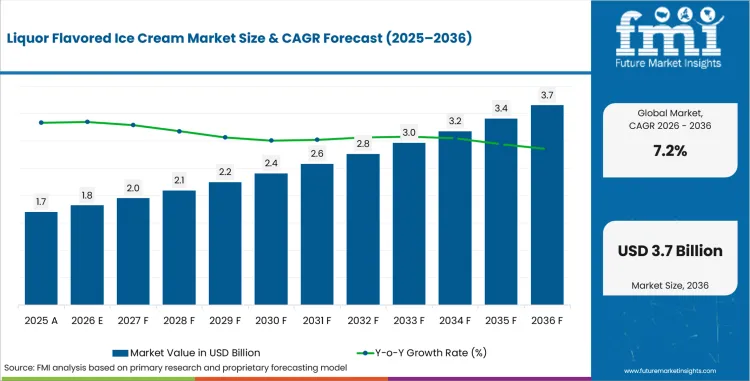
The liquor ice cream market is valued at USD 1.8 billion in 2026 and is projected to reach USD 3.7 billion by 2036, growing at a 7.2% CAGR. The market will create USD 1.9 billion in absolute opportunity. Dairy based liquor ice cream leads with 60.0% share in 2026, while China is the fastest-growing country at 9.7% CAGR through 2036.
| Parameter | Details |
|---|---|
| Market Size in 2026 (Value) | USD 1.8 billion |
| Market Forecast in 2036 (Value) | USD 3.7 billion |
| CAGR (2026 to 2036) | 7.2% from 2026 to 2036 |
| Years Considered | 2021 to 2036 |
| Base Year | 2025 |
| Forecast Period | 2026 to 2036 |
| Units Considered | Value (USD Billion) |
| Leading Sub-Region | China |
Summary of the Liquor Flavored Ice Cream Market
Key Takeaways, Market Size, and Forecast
- 2026 Market Size: USD 1.8 billion
- 2036 Market Size: USD 3.7 billion
- Compound Annual Growth Rate (CAGR): 7.2% from 2026 to 2036
- Absolute $ Opportunity: USD 1.9 billion between 2026 and 2036
- Leading Product Segment: Dairy Based Liquor Ice Cream
- Dairy Based Liquor Ice Cream Share in 2026: 60.0%
- Fastest-growing Country: China
- China CAGR: 9.7% through 2036
Demand and Growth Drivers
- Adult indulgence trends and premiumization of frozen dessert categories are expected to sustain demand for liquor-flavored ice cream, with dairy-based variants serving as the primary product format.
- Expansion of craft and artisan ice cream brands incorporating premium spirits is likely to generate incremental demand in specialty retail and food service channels.
- Growth of at-home premium dessert consumption is expected to support retail procurement of spirit-flavored ice cream in pint and tub formats.
Product and Segment View
- Dairy based liquor ice cream is estimated to account for 60.0% of product demand in 2026, driven by consumer preference for rich, cream-based ice cream formats combined with spirit flavoring.
- Cup and tub formats are likely to lead at 65.0%, with single-serve and take-home packaging serving both retail and food service consumption.
- Retail consumption is expected to account for 70.0% of application demand, with at-home indulgence and gifting as primary purchase occasions.
Geography and Competitive Outlook
- China is likely to lead country level growth at 9.7% through 2036, driven by expanding premium ice cream consumption and growing interest in adult-oriented frozen dessert categories.
- North America and Western Europe are expected to sustain demand through established premium ice cream retail channels and consumer familiarity with spirit-flavored products.
- Companies that can combine premium ice cream manufacturing with recognized spirit brand partnerships are likely to capture growing adult frozen dessert demand.
Analyst Opinion
- Nandini Roy Choudhury, Principal Consultant at FMI says, 'Manufacturers that can deliver consistent spirit flavour profiles in frozen formats while managing cold chain distribution and regulatory compliance across markets are positioned for sustained category growth through 2036.'
- The liquor flavored ice cream market is evolving from a novelty product category into a defined adult premium dessert segment with growing mainstream retail distribution.
- Adoption is increasing due to premiumization of at-home dessert consumption, with consumers willing to pay premium pricing for spirit-branded frozen treats.
- The market is also benefiting from food service adoption, with restaurants and bars incorporating liquor ice cream into dessert menus and cocktail pairings.
- Demand is further supported by social media driven product visibility that generates consumer trial for visually distinctive spirit-flavored ice cream products.
Why is the Liquor Flavored Ice Cream Market Growing?
- Premiumization of frozen dessert consumption and adult indulgence positioning are generating demand for spirit-flavored ice cream products across retail and food service channels.
- Craft ice cream brands incorporating local and premium spirits are creating a niche product category with strong social media visibility and consumer trial rates.
- China leads country level growth at 9.7% CAGR, driven by rapidly expanding premium ice cream consumption and growing urban consumer interest in adult-oriented dessert categories.
The liquor flavored ice cream market is expanding as premium frozen dessert categories attract adult consumers seeking sophisticated indulgence products. Spirit-branded ice cream combines the emotional appeal of ice cream consumption with the prestige positioning of recognized alcohol brands, creating a hybrid product that commands premium pricing.
Cold chain distribution requirements and alcohol content regulatory compliance create operational complexity that limits market participation to manufacturers with established frozen dessert infrastructure. The need to maintain consistent spirit flavour profiles at frozen temperatures adds formulation complexity beyond standard ice cream production.
Social media and visual marketing play a significant role in consumer trial generation for liquor ice cream products. Distinctive packaging, recognizable spirit brand names, and visually appealing product formats generate organic social sharing that drives awareness and retail demand, particularly among younger adult consumer demographics.
Market Segmentation Analysis
- Dairy based products lead at 60.0%, with rich cream-based ice cream providing the texture and fat content needed to carry and deliver spirit flavour profiles effectively.
- Individual consumers dominate end use at 65.0%, with self-purchase for at-home indulgence as the primary consumption occasion.
- Retail stores lead distribution at 45.0%, with premium supermarket freezer sections and specialty ice cream retailers as primary consumer access points.
The liquor flavored ice cream market is segmented by product, alcohol type, form, application, end use, flavor profile, and distribution channel. Dairy based products dominate while retail consumption leads application demand.
Insights into the Dairy Based Liquor Ice Cream Product Segment
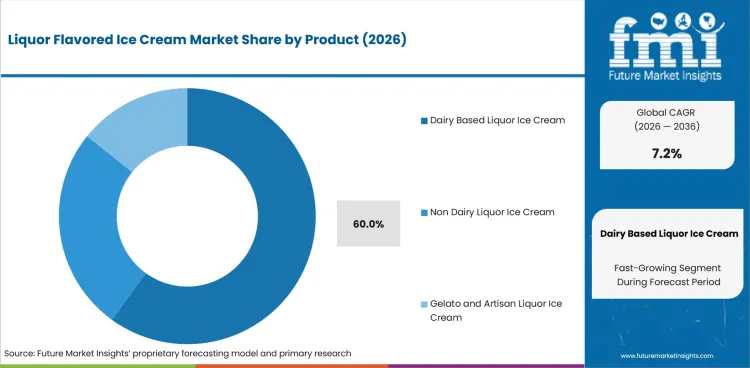
In 2026, dairy based liquor ice cream is estimated to account for 60.0% of total product demand. Cream-based formulations provide the fat content needed for smooth texture and effective spirit flavour delivery. Premium milk fat percentages and real cream ingredients support the indulgence positioning that defines this category.
Spirit integration in dairy ice cream requires balancing alcohol content with freezing point depression, as alcohol lowers the freezing point and affects texture consistency. Manufacturers that have developed proprietary formulation techniques for alcohol integration maintain product quality advantages.
Insights into the Cup And Tub Form Segment
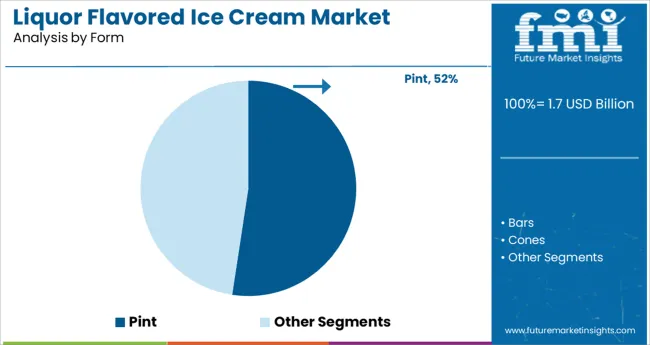
Cup and tub formats are expected to account for 65.0% of form demand in 2026, with pint-sized tubs serving the primary take-home retail format and single-serve cups providing food service and impulse purchase options. Premium packaging design with spirit brand co-branding supports shelf differentiation in retail freezer sections.
Take-home pint formats enable at-home consumption occasions where consumers pair liquor ice cream with evening dessert and entertainment. Single-serve cups serve food service channels including restaurants, bars, and event catering where portion control and presentation are procurement criteria.
Liquor Flavored Ice Cream Market Drivers, Restraints, and Opportunities
- Adult indulgence trends and premiumization of frozen dessert categories sustain demand for spirit-flavored ice cream at premium pricing levels.
- Cold chain distribution requirements and alcohol content formulation complexity create operational barriers limiting market participation to established frozen dessert manufacturers.
- Spirit brand licensing partnerships create co-branded products that benefit from dual brand equity and consumer recognition.
- Food service adoption in restaurants and bars creates incremental demand for liquor ice cream as a premium dessert and cocktail pairing option.
The liquor flavored ice cream market continues to grow based on premiumization, spirit partnerships, and food service expansion. Cold chain complexity and regulatory requirements shape the competitive environment.
Premium At-Home Dessert Consumption
Demand is shaped by the premiumization of at-home dessert occasions, where consumers invest in higher-quality products for evening indulgence. Liquor ice cream pricing typically commands 40% to 80% premiums over standard ice cream, supported by spirit brand positioning and adult-only product appeal.
Cold Chain and Formulation Barriers
Growth is constrained by the technical requirements of integrating alcohol into frozen dessert formulations. Alcohol depresses freezing points, affecting texture consistency and storage stability. Cold chain distribution from manufacturing to retail requires unbroken temperature control that adds logistics cost.
Spirit Brand Licensing Value
Adoption of co-branded products is increasing as spirit companies and ice cream manufacturers develop partnership models. Products featuring Bailey's, Kahlua, or bourbon brand names generate stronger consumer purchase intent than generic spirit-flavored alternatives.
Food Service and Experience Economy
Restaurant and bar adoption of liquor ice cream creates premium dessert positioning that enhances menu value and customer experience. Event catering and experiential dining occasions provide seasonal demand from hospitality operators seeking distinctive dessert offerings.
Analysis of Liquor Flavored Ice Cream Market By Key Countries
.webp "Top Country Growth Comparison Liquor Flavored Ice Cream Market Cagr (2026 2036)")
| Country | CAGR |
|---|---|
| China | 9.7% |
| India | 9.0% |
| Germany | 8.3% |
| France | 7.6% |
| UK | 6.8% |
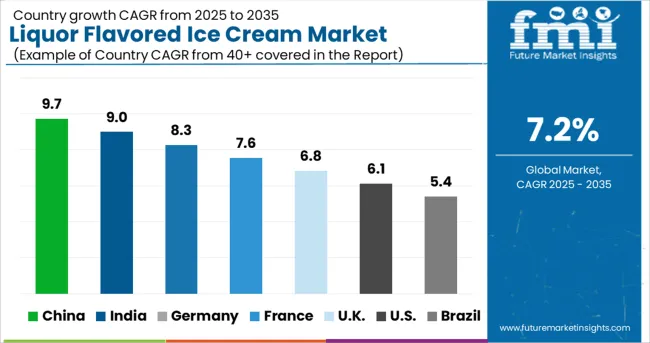
- China at 9.7% leads growth, driven by expanding premium ice cream consumption and growing urban consumer interest in adult-oriented frozen dessert products.
- India at 9.0% reflects rising premium dessert demand among urban consumers and expanding cold chain retail infrastructure.
- Germany at 8.3% sustains growth through premium ice cream retail channels and strong consumer preference for quality frozen dessert products.
- France at 7.6% reflects established culinary culture and consumer appreciation for spirit-paired dessert products.
The global liquor flavored ice cream market is projected to expand at 7.2% CAGR from 2026 to 2036. The study covers more than 30 countries, and the main markets are listed below.
Demand Outlook for Liquor Flavored Ice Cream Market in China
China is projected to record a 9.7% CAGR through 2036. Rapidly expanding premium ice cream consumption among urban consumers and growing interest in imported and craft frozen dessert products sustain demand. E-commerce cold chain delivery platforms enable nationwide distribution of premium frozen products.
- E-commerce cold chain platforms enable direct-to-consumer distribution of premium liquor ice cream brands reaching tier-1 and tier-2 city consumers.
- Food delivery integration with premium dessert and restaurant channels creates food service demand for spirit-flavored ice cream products.
- Growing urban consumer interest in imported and craft frozen dessert products supports premium pricing for spirit-branded ice cream.
Future Outlook for Liquor Flavored Ice Cream Market in India
India is expected to grow at 9.0% through 2036. Rising premium dessert demand among urban consumers and expanding cold chain retail infrastructure support market development. Private investment in premium food service and dessert retail channels creates distribution access for liquor ice cream products.
- Private healthcare and hospitality investment in premium food service channels creates distribution points for adult-oriented frozen dessert products.
- Expanding cold chain infrastructure in urban areas improves logistics viability for frozen premium ice cream distribution.
- Urban consumer interest in premium and international dessert products supports trial and adoption of spirit-flavored ice cream brands.
Opportunity Analysis of Liquor Flavored Ice Cream Market in Germany
Germany is projected to record a 8.3% CAGR through 2036. Premium ice cream retail distribution and strong consumer preference for quality frozen desserts sustain demand. EU food labeling requirements govern alcohol content disclosure for ice cream products.
- Premium supermarket and specialty retail freezer sections provide established distribution for imported and domestic liquor ice cream brands.
- EU food labeling requirements establish alcohol content disclosure standards that influence product formulation and packaging design.
- Strong consumer preference for quality artisan food products supports premium pricing for craft spirit-flavored ice cream variants.
Sales Analysis of Liquor Flavored Ice Cream Market in France
France is estimated to grow at 7.6% through 2036. Established culinary culture and consumer appreciation for spirit-paired desserts sustain demand for premium liquor ice cream. Artisan ice cream producers incorporating local spirits create a distinctive craft product segment.
- Established culinary culture supports consumer acceptance of spirit-flavored frozen desserts as a premium dining and entertainment option.
- Artisan ice cream producers incorporating cognac, armagnac, and regional liqueurs create locally distinctive liquor ice cream products.
- Tourism and hospitality channels in major French cities provide food service distribution for premium spirit-flavored dessert products.
In-depth Analysis of Liquor Flavored Ice Cream Market in UK
The UK is expected to grow at 6.8% through 2036. Premium ice cream retail distribution and growing consumer interest in adult indulgence products sustain demand. Post-Brexit food labeling requirements create distinct compliance considerations for alcohol content in frozen dessert products.
- Premium ice cream retail channels including specialty stores and supermarket premium sections provide established distribution for liquor ice cream brands.
- Post-Brexit food labeling regulations establish UK-specific requirements for alcohol content disclosure in frozen dessert products.
- Growing at-home premium dessert consumption supports retail demand for spirit-branded ice cream in take-home pint and tub formats.
Competitive Landscape and Strategic Positioning
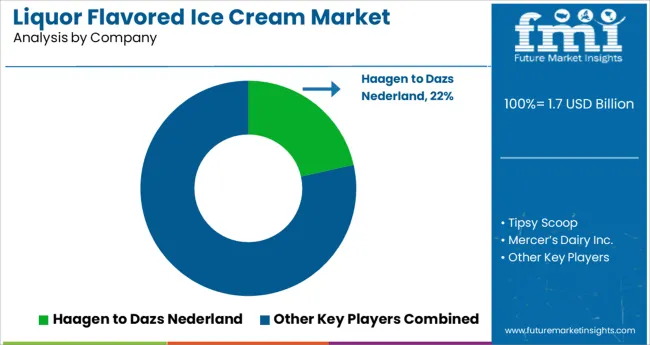
- Ben and Jerry's leads with established premium ice cream brand positioning, global distribution infrastructure, and spirit-flavored product line innovation.
- Haagen-Dazs competes on ultra-premium positioning with spirit-infused ice cream products distributed through retail and food service channels globally.
- Specialty brands including Tipsy Scoop and Mercer's Dairy serve niche segments with higher alcohol content products targeting adult indulgence occasions.
Ben and Jerry's holds a leading position through its established premium ice cream brand and global retail distribution. The company has developed spirit-flavored variants that leverage its brand identity and distribution infrastructure to reach mainstream retail consumers.
Haagen-Dazs competes on ultra-premium positioning with spirit-infused ice cream targeting sophisticated adult consumers through retail and food service channels. Bailey's branded ice cream products benefit from the spirit brand's established consumer recognition in the dessert and indulgence category.
Barriers to entry include premium ice cream manufacturing capability, cold chain distribution infrastructure, and spirit brand licensing relationships. Strategic priorities include expanding retail distribution, developing food service formats, and securing spirit brand partnerships that create co-branded product differentiation.
Key Companies in the Liquor Flavored Ice Cream Market
Key global companies leading the liquor flavored ice cream market include:
- Ben and Jerry's (USA/Unilever), Haagen-Dazs Nederland N.V. (Netherlands), and Bailey's (Ireland/Diageo) maintain established premium ice cream brands with global distribution and spirit brand integration or licensing capabilities.
- Mercer's Dairy Inc (USA) and Viennetta (Unilever) serve regional markets with liquor-flavored frozen dessert products targeting retail and food service channels.
- Tipsy Scoop (USA) competes as a specialty brand with higher alcohol content ice cream targeting urban adult consumers through retail and experiential food service channels.
Competitive Benchmarking: Liquor Flavored Ice Cream Market
| Company | Brand Strength | Spirit Partners | Cold Chain | Geo. Reach |
|---|---|---|---|---|
| Ben and Jerry's | Very High | In-house | Global | Global |
| Haagen-Dazs | Very High | Licensed | Global | Global |
| Tipsy Scoop | Medium | Multiple | Regional | N. America |
| Mercer's Dairy | Medium | Multiple | Regional | N. America |
| Bailey's Ice Cream | High | Owned | Global | Global |
| Viennetta | Medium | Limited | Regional | Europe |
Source: Future Market Insights competitive analysis, 2026.
Key Developments in Liquor Flavored Ice Cream Market
- In 2025, Ben and Jerry's launched two new spirit-flavored ice cream variants featuring bourbon and Irish cream profiles for the North American and European retail markets.
- In 2025, Tipsy Scoop expanded its direct-to-consumer distribution with cold chain shipping capability to serve online orders across additional US metropolitan areas.
Key Players in the Liquor Flavored Ice Cream Market
Major Global Players
- Ben and Jerry's
- Haagen-Dazs Nederland N.V.
- Tipsy Scoop
- Mercer's Dairy Inc
Emerging Players/Startups
- Aubi & Ramsa
- Tipsy Scoop
- Momenti Spirited Ice Creams
Report Scope and Coverage
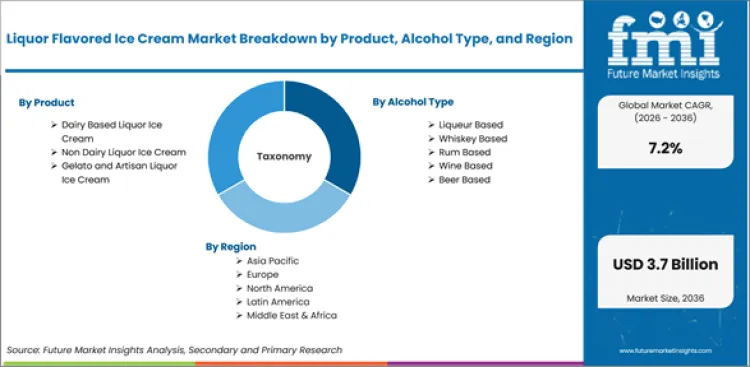
| Parameter | Details |
|---|---|
| Market size by 2036 | USD 3.7 billion |
| Growth rate | 7.2% CAGR (2026 to 2036) |
| Forecast period | 2026 to 2036 |
| Base year value (2025) | USD 1.7 billion |
| Key Segment Covered | Product, Alcohol Type, Form, Application, End Use, Flavor Profile, Distribution Channel |
| Regions covered | North America, Latin America, Western Europe, Eastern Europe, East Asia, South Asia and Pacific, Middle East and Africa |
| Countries covered | USA, South Korea, UK, Japan, China, India, Germany, 30 plus countries |
| Key companies profiled | Ben and Jerry's, Haagen-Dazs Nederland N.V., Tipsy Scoop, Mercer's Dairy Inc, Bailey's, Viennetta |
| Approach | Hybrid bottom-up and top-down methodology starting with verified transaction data, projecting adoption velocity across segments and regions. |
Market Segmentation Analysis
Liquor Flavored Ice Cream Market Segmented by Product:
- Dairy Based Liquor Ice Cream
- Cream Based Ice Cream
- Full Fat Ice Cream
- Premium Ice Cream
- Milk Based Ice Cream
- Reduced Fat Ice Cream
- Standard Ice Cream
- Cream Based Ice Cream
- Non Dairy Liquor Ice Cream
- Plant Based Ice Cream
- Almond Based
- Coconut Based
- Lactose Free Ice Cream
- Dairy Free Formulations
- Vegan Products
- Plant Based Ice Cream
- Gelato and Artisan Liquor Ice Cream
- Italian Style Gelato
- Low Fat Gelato
- Dense Texture
- Artisan Ice Cream
- Handcrafted
- Small Batch Production
- Italian Style Gelato
Liquor Flavored Ice Cream Market Segmented by Alcohol Type:
- Liqueur Based
- Cream Liqueur
- Fruit Liqueur
- Whiskey Based
- Bourbon Flavors
- Scotch Flavors
- Rum Based
- Dark Rum
- Spiced Rum
- Wine Based
- Red Wine
- Sparkling Wine
- Beer Based
- Stout
- Craft Beer
Liquor Flavored Ice Cream Market Segmented by Form:
- Cup and Tub
- Single Serve Cups
- Family Size Tubs
- Bars and Sticks
- Ice Cream Bars
- Chocolate Coated Sticks
- Cones
- Wafer Cones
- Chocolate Coated Cones
Liquor Flavored Ice Cream Market Segmented by Application:
- Retail Consumption
- Supermarket Sales
- Packaged Products
- Impulse Buying
- Supermarket Sales
- Food Service
- Restaurants
- Dessert Menus
- Premium Dining
- Bars and Lounges
- Alcohol Paired Desserts
- Nightlife Consumption
- Restaurants
Liquor Flavored Ice Cream Market Segmented by End Use:
- Individual Consumers
- Personal Consumption
- At Home Dessert
- Occasional Indulgence
- Personal Consumption
- Hospitality Industry
- Restaurants and Cafes
- Dessert Offerings
- Specialty Menus
- Bars and Lounges
- Alcohol Based Desserts
- Nightlife Demand
- Restaurants and Cafes
Liquor Flavored Ice Cream Market Segmented by Flavor Profile:
- Sweet
- Chocolate Based
- Caramel Based
- Fruity
- Berry Flavors
- Citrus Flavors
- Bitter
- Dark Chocolate
- Coffee Based
- Spiced
- Cinnamon
- Nutmeg
Liquor Flavored Ice Cream Market Segmented by Distribution Channel:
- Retail Stores
- Supermarkets and Hypermarkets
- Modern Trade
- Convenience Stores
- Local Retail
- Supermarkets and Hypermarkets
- Specialty Stores
- Premium Ice Cream Stores
- Artisan Brands
- Boutique Outlets
- Premium Ice Cream Stores
- Online Channel
- E-commerce Platforms
- Direct to Consumer
- E-commerce Platforms
- Food Service Distribution
- HoReCa Supply
- Bulk Supply
- HoReCa Supply
Liquor Flavored Ice Cream Market by Region:
- North America
- USA
- Canada
- Mexico
- Latin America
- Brazil
- Chile
- Rest of Latin America
- Western Europe
- Germany
- UK
- Italy
- Spain
- France
- Nordic
- BENELUX
- Rest of Western Europe
- Eastern Europe
- Russia
- Poland
- Hungary
- Balkan & Baltic
- Rest of Eastern Europe
- East Asia
- China
- Japan
- South Korea
- South Asia and Pacific
- India
- ASEAN
- Australia & New Zealand
- Rest of South Asia and Pacific
- Middle East & Africa
- Kingdom of Saudi Arabia
- Other GCC Countries
- Türkiye
- South Africa
- Other African Union
- Rest of Middle East & Africa
Liquor Flavored Ice Cream Market Definition
The liquor flavored ice cream market includes ice cream and frozen dessert products flavored with or containing alcoholic beverages including liqueurs, whiskey, rum, wine, and beer. Products encompass dairy and non-dairy based formats in cups, tubs, bars, and novelty configurations for retail, food service, and direct-to-consumer distribution.
Liquor Flavored Ice Cream Market Inclusions
Market scope encompasses all commercially traded liquor flavored ice cream products categorized by product (dairy based liquor ice cream, non-dairy liquor ice cream), alcohol type (liqueur based, whiskey based, rum based, wine based, beer based), form (cup and tub, bar and stick, novelty formats), application (retail consumption, food service, gifting), end use (individual consumers, hospitality, events and catering), flavor profile (sweet, bitter, mixed), and distribution channel (retail stores, online, food service direct). Revenue scope covers 2026 to 2036.
Liquor Flavored Ice Cream Market Exclusions
The scope does not include non-alcoholic ice cream with artificial spirit flavoring containing zero alcohol, frozen cocktail mixes without ice cream base, or ice cream cakes not sold in individual portion formats.
Liquor Flavored Ice Cream Market Research Methodology
- Primary Research: FMI analysts conducted interviews with premium ice cream manufacturers, spirit brand licensing teams, and frozen dessert retail category managers across key markets.
- Desk Research: Combined data from frozen dessert retail sales tracking, premium ice cream distribution reports, and manufacturer production disclosures.
- Market Sizing and Forecasting: Bottom-up aggregation across retail, food service, and direct-to-consumer channels with adoption curves based on premium ice cream penetration and adult indulgence trends.
- Data Validation: Cross-checked quarterly against retail scanner data, cold chain distribution reports, and manufacturer shipment data.
Research Sources and Bibliography
- 1. International Dairy Foods Association. (2025). IDFA Ice Cream Production and Sales Statistics. IDFA.
- 2. European Commission. (2025). EU Regulation on Frozen Dessert Labeling and Composition Standards. EC.
- 3. USA Food and Drug Administration. (2025). FDA Standards for Frozen Desserts and Ice Cream. FDA.
- 4. International Ice Cream Association. (2025). IICA Global Frozen Dessert Market Overview. IICA.
- 5. Codex Alimentarius Commission. (2025). Codex Standard for Edible Ices and Ice Mixes. FAO/WHO.
This bibliography is provided for reader reference.
This Report Answers
- Estimating the size of the liquor flavored ice cream market and projected revenue from 2026 to 2036.
- Segmentation by product, alcohol type, form, application, end use, flavor profile, and distribution channel.
- Insights about more than 30 markets in the region.
- Analysis of alcohol types including liqueur, whiskey, rum, wine, and beer based ice cream.
- Assessment of the competitive landscape.
- Identifying investment opportunities in retail, food service, and direct-to-consumer segments.
- Tracking the supply chain from dairy and spirit sourcing to cold chain retail distribution.
- Delivery of data in PDF and Excel formats.
Frequently Asked Questions
How big is the liquor flavored ice cream market in 2026?
The global liquor flavored ice cream market is estimated to be valued at USD 1.8 billion in 2026.
What will be the size of the liquor flavored ice cream market in 2036?
The market size for the liquor flavored ice cream market is projected to reach USD 3.7 billion by 2036.
How much will the liquor flavored ice cream market growth be between 2026 and 2036?
The liquor flavored ice cream market is expected to grow at a 7.2% CAGR between 2026 and 2036.
What are the key products in the liquor flavored ice cream market?
The key products in the liquor flavored ice cream market are Dairy Based Liquor Ice Cream, Non Dairy Liquor Ice Cream and Gelato and Artisan Liquor Ice Cream.
Which alcohol type segment is expected to contribute a significant share in the liquor flavored ice cream market in 2026?
In terms of alcohol type, the liqueur based segment is expected to command 35.0% share in the liquor flavored ice cream market in 2026.
Preview the report firsthand - request a free sample
Get SampleGet the brochure for pricing and purchase details.
Get PDFTable of Content
- Key Takeaways
- Market Size and CAGR
- Top Growth Driver
- Fastest Growing Segment
- Leading Region
- Key Companies
- Emerging Opportunities
- Executive Summary
- Global Market Outlook
- Demand-side Trends
- Supply-side Trends
- Technology Roadmap Analysis
- Analysis and Recommendations
- Analyst Perspective (What is happening? Why now? What should investors know?)
- Key Questions Answered
- How large is the market?
- What is the CAGR?
- What are key trends?
- Which region dominates?
- Who are the leaders?
- Market Overview
- Market Coverage / Taxonomy
- Market Definition / Scope / Limitations
- Research Methodology
- Chapter Orientation
- Analytical Lens and Working Hypotheses
- Market Structure, Signals, and Trend Drivers
- Benchmarking and Cross-market Comparability
- Market Sizing, Forecasting, and Opportunity Mapping
- Research Design and Evidence Framework
- Desk Research Programme (Secondary Evidence)
- Expert Input and Fieldwork (Primary Evidence)
- Tooling, Models, and Reference Databases
- Data Engineering and Model Build
- Quality Assurance and Audit Trail
- Market Background
- Market Dynamics (Drivers, Restraints, Opportunity, Trends)
- Scenario Forecast (Optimistic, Likely, Conservative)
- Impact Analysis
- AI Impact
- Sustainability Impact
- Regulatory Impact
- Technology Impact
- Consumer / Buyer Analysis
- Purchase Drivers
- Adoption Barriers
- Buyer Journey
- Opportunity Map Analysis
- Product Life Cycle Analysis
- Supply Chain Analysis
- Investment Feasibility Matrix
- Value Chain Analysis
- PESTLE and Porter's Analysis
- Regulatory Landscape
- Regional Parent Market Outlook
- Production and Consumption Statistics
- Import and Export Statistics
- Global Market Analysis and Forecast, 2021 to 2036
- Historical Market Size Value (USD Million) Analysis, 2021 to 2025
- Current and Future Market Size Value (USD Million) Projections, 2026 to 2036
- Y-o-Y Growth Trend Analysis
- Absolute $ Opportunity Analysis
- Global Market Pricing Analysis, 2021 to 2036
- Global Market Analysis and Forecast, By Product, 2021 to 2036
- Introduction / Key Findings
- Historical Market Size Value (USD Million) Analysis By Product, 2021 to 2025
- Current and Future Market Size Value (USD Million) Analysis and Forecast By Product, 2026 to 2036
- Dairy Based Liquor Ice Cream
- Cream Based Ice Cream
- Milk Based Ice Cream
- Non Dairy Liquor Ice Cream
- Plant Based Ice Cream
- Lactose Free Ice Cream
- Gelato and Artisan Liquor Ice Cream
- Italian Style Gelato
- Artisan Ice Cream
- Dairy Based Liquor Ice Cream
- Y-o-Y Growth Trend Analysis By Product, 2021 to 2025
- Absolute $ Opportunity Analysis By Product, 2026 to 2036
- Global Market Analysis and Forecast, By Alcohol Type, 2021 to 2036
- Introduction / Key Findings
- Historical Market Size Value (USD Million) Analysis By Alcohol Type, 2021 to 2025
- Current and Future Market Size Value (USD Million) Analysis and Forecast By Alcohol Type, 2026 to 2036
- Liqueur Based
- Cream Liqueur
- Fruit Liqueur
- Whiskey Based
- Bourbon Flavors
- Scotch Flavors
- Rum Based
- Dark Rum
- Spiced Rum
- Wine Based
- Red Wine
- Sparkling Wine
- Beer Based
- Stout
- Craft Beer
- Liqueur Based
- Y-o-Y Growth Trend Analysis By Alcohol Type, 2021 to 2025
- Absolute $ Opportunity Analysis By Alcohol Type, 2026 to 2036
- Global Market Analysis and Forecast, By Form, 2021 to 2036
- Introduction / Key Findings
- Historical Market Size Value (USD Million) Analysis By Form, 2021 to 2025
- Current and Future Market Size Value (USD Million) Analysis and Forecast By Form, 2026 to 2036
- Cup and Tub
- Single Serve Cups
- Family Size Tubs
- Bars and Sticks
- Ice Cream Bars
- Chocolate Coated Sticks
- Cones
- Wafer Cones
- Chocolate Coated Cones
- Cup and Tub
- Y-o-Y Growth Trend Analysis By Form, 2021 to 2025
- Absolute $ Opportunity Analysis By Form, 2026 to 2036
- Global Market Analysis and Forecast, By Application, 2021 to 2036
- Introduction / Key Findings
- Historical Market Size Value (USD Million) Analysis By Application, 2021 to 2025
- Current and Future Market Size Value (USD Million) Analysis and Forecast By Application, 2026 to 2036
- Retail Consumption
- Supermarket Sales
- Food Service
- Restaurants
- Bars and Lounges
- Retail Consumption
- Y-o-Y Growth Trend Analysis By Application, 2021 to 2025
- Absolute $ Opportunity Analysis By Application, 2026 to 2036
- Global Market Analysis and Forecast, By End Use, 2021 to 2036
- Introduction / Key Findings
- Historical Market Size Value (USD Million) Analysis By End Use, 2021 to 2025
- Current and Future Market Size Value (USD Million) Analysis and Forecast By End Use, 2026 to 2036
- Individual Consumers
- Personal Consumption
- Hospitality Industry
- Restaurants and Cafes
- Bars and Lounges
- Individual Consumers
- Y-o-Y Growth Trend Analysis By End Use, 2021 to 2025
- Absolute $ Opportunity Analysis By End Use, 2026 to 2036
- Global Market Analysis and Forecast, By Flavor Profile
- Introduction / Key Findings
- Historical Market Size Value (USD Million) Analysis By Flavor Profile, 2021 to 2025
- Current and Future Market Size Value (USD Million) Analysis and Forecast By Flavor Profile, 2026 to 2036
- Sweet
- Chocolate Based
- Caramel Based
- Fruity
- Berry Flavors
- Citrus Flavors
- Bitter
- Dark Chocolate
- Coffee Based
- Spiced
- Cinnamon
- Nutmeg
- Sweet
- Y-o-Y Growth Trend Analysis By Flavor Profile, 2021 to 2025
- Absolute $ Opportunity Analysis By Flavor Profile, 2026 to 2036
- Global Market Analysis and Forecast, By Distribution Channel
- Introduction / Key Findings
- Historical Market Size Value (USD Million) Analysis By Distribution Channel, 2021 to 2025
- Current and Future Market Size Value (USD Million) Analysis and Forecast By Distribution Channel, 2026 to 2036
- Retail Stores
- Supermarkets and Hypermarkets
- Convenience Stores
- Specialty Stores
- Premium Ice Cream Stores
- Online Channel
- E-commerce Platforms
- Food Service Distribution
- HoReCa Supply
- Retail Stores
- Y-o-Y Growth Trend Analysis By Distribution Channel, 2021 to 2025
- Absolute $ Opportunity Analysis By Distribution Channel, 2026 to 2036
- Global Market Analysis and Forecast, By Region, 2021 to 2036
- Introduction
- Historical Market Size Value (USD Million) Analysis By Region, 2021 to 2025
- Current Market Size Value (USD Million) Analysis and Forecast By Region, 2026 to 2036
- North America
- Latin America
- Western Europe
- Eastern Europe
- East Asia
- South Asia and Pacific
- Middle East & Africa
- Market Attractiveness Analysis By Region
- North America Market Analysis and Forecast, By Country, 2021 to 2036
- Historical Market Size Value (USD Million) Trend Analysis By Market Taxonomy, 2021 to 2025
- Market Size Value (USD Million) Forecast By Market Taxonomy, 2026 to 2036
- By Country
- USA
- Canada
- Mexico
- By Product
- By Alcohol Type
- By Form
- By Application
- By End Use
- By Flavor Profile
- By Distribution Channel
- By Country
- Market Attractiveness Analysis
- By Country
- By Product
- By Alcohol Type
- By Form
- By Application
- By End Use
- By Flavor Profile
- By Distribution Channel
- Key Takeaways
- Latin America Market Analysis and Forecast, By Country
- Historical Market Size Value (USD Million) Trend Analysis By Market Taxonomy, 2021 to 2025
- Market Size Value (USD Million) Forecast By Market Taxonomy, 2026 to 2036
- By Country
- Brazil
- Chile
- Rest of Latin America
- By Product
- By Alcohol Type
- By Form
- By Application
- By End Use
- By Flavor Profile
- By Distribution Channel
- By Country
- Market Attractiveness Analysis
- By Country
- By Product
- By Alcohol Type
- By Form
- By Application
- By End Use
- By Flavor Profile
- By Distribution Channel
- Key Takeaways
- Western Europe Market Analysis and Forecast, By Country
- Historical Market Size Value (USD Million) Trend Analysis By Market Taxonomy, 2021 to 2025
- Market Size Value (USD Million) Forecast By Market Taxonomy, 2026 to 2036
- By Country
- Germany
- UK
- Italy
- Spain
- France
- Nordic
- BENELUX
- Rest of Western Europe
- By Product
- By Alcohol Type
- By Form
- By Application
- By End Use
- By Flavor Profile
- By Distribution Channel
- By Country
- Market Attractiveness Analysis
- By Country
- By Product
- By Alcohol Type
- By Form
- By Application
- By End Use
- By Flavor Profile
- By Distribution Channel
- Key Takeaways
- Eastern Europe Market Analysis and Forecast, By Country
- Historical Market Size Value (USD Million) Trend Analysis By Market Taxonomy, 2021 to 2025
- Market Size Value (USD Million) Forecast By Market Taxonomy, 2026 to 2036
- By Country
- Russia
- Poland
- Hungary
- Balkan & Baltic
- Rest of Eastern Europe
- By Product
- By Alcohol Type
- By Form
- By Application
- By End Use
- By Flavor Profile
- By Distribution Channel
- By Country
- Market Attractiveness Analysis
- By Country
- By Product
- By Alcohol Type
- By Form
- By Application
- By End Use
- By Flavor Profile
- By Distribution Channel
- Key Takeaways
- East Asia Market Analysis and Forecast, By Country
- Historical Market Size Value (USD Million) Trend Analysis By Market Taxonomy, 2021 to 2025
- Market Size Value (USD Million) Forecast By Market Taxonomy, 2026 to 2036
- By Country
- China
- Japan
- South Korea
- By Product
- By Alcohol Type
- By Form
- By Application
- By End Use
- By Flavor Profile
- By Distribution Channel
- By Country
- Market Attractiveness Analysis
- By Country
- By Product
- By Alcohol Type
- By Form
- By Application
- By End Use
- By Flavor Profile
- By Distribution Channel
- Key Takeaways
- South Asia and Pacific Market Analysis and Forecast, By Country
- Historical Market Size Value (USD Million) Trend Analysis By Market Taxonomy, 2021 to 2025
- Market Size Value (USD Million) Forecast By Market Taxonomy, 2026 to 2036
- By Country
- India
- ASEAN
- Australia & New Zealand
- Rest of South Asia and Pacific
- By Product
- By Alcohol Type
- By Form
- By Application
- By End Use
- By Flavor Profile
- By Distribution Channel
- By Country
- Market Attractiveness Analysis
- By Country
- By Product
- By Alcohol Type
- By Form
- By Application
- By End Use
- By Flavor Profile
- By Distribution Channel
- Key Takeaways
- Middle East & Africa Market Analysis and Forecast, By Country
- Historical Market Size Value (USD Million) Trend Analysis By Market Taxonomy, 2021 to 2025
- Market Size Value (USD Million) Forecast By Market Taxonomy, 2026 to 2036
- By Country
- Kingdom of Saudi Arabia
- Other GCC Countries
- Türkiye
- South Africa
- Other African Union
- Rest of Middle East & Africa
- By Product
- By Alcohol Type
- By Form
- By Application
- By End Use
- By Flavor Profile
- By Distribution Channel
- By Country
- Market Attractiveness Analysis
- By Country
- By Product
- By Alcohol Type
- By Form
- By Application
- By End Use
- By Flavor Profile
- By Distribution Channel
- Key Takeaways
- Key Countries Market Analysis
- USA
- Pricing Analysis
- Market Share Analysis, 2025
- By Product
- By Alcohol Type
- By Form
- By Application
- By End Use
- By Flavor Profile
- By Distribution Channel
- Canada
- Pricing Analysis
- Market Share Analysis, 2025
- By Product
- By Alcohol Type
- By Form
- By Application
- By End Use
- By Flavor Profile
- By Distribution Channel
- Mexico
- Pricing Analysis
- Market Share Analysis, 2025
- By Product
- By Alcohol Type
- By Form
- By Application
- By End Use
- By Flavor Profile
- By Distribution Channel
- Brazil
- Pricing Analysis
- Market Share Analysis, 2025
- By Product
- By Alcohol Type
- By Form
- By Application
- By End Use
- By Flavor Profile
- By Distribution Channel
- Chile
- Pricing Analysis
- Market Share Analysis, 2025
- By Product
- By Alcohol Type
- By Form
- By Application
- By End Use
- By Flavor Profile
- By Distribution Channel
- Germany
- Pricing Analysis
- Market Share Analysis, 2025
- By Product
- By Alcohol Type
- By Form
- By Application
- By End Use
- By Flavor Profile
- By Distribution Channel
- UK
- Pricing Analysis
- Market Share Analysis, 2025
- By Product
- By Alcohol Type
- By Form
- By Application
- By End Use
- By Flavor Profile
- By Distribution Channel
- Italy
- Pricing Analysis
- Market Share Analysis, 2025
- By Product
- By Alcohol Type
- By Form
- By Application
- By End Use
- By Flavor Profile
- By Distribution Channel
- Spain
- Pricing Analysis
- Market Share Analysis, 2025
- By Product
- By Alcohol Type
- By Form
- By Application
- By End Use
- By Flavor Profile
- By Distribution Channel
- France
- Pricing Analysis
- Market Share Analysis, 2025
- By Product
- By Alcohol Type
- By Form
- By Application
- By End Use
- By Flavor Profile
- By Distribution Channel
- India
- Pricing Analysis
- Market Share Analysis, 2025
- By Product
- By Alcohol Type
- By Form
- By Application
- By End Use
- By Flavor Profile
- By Distribution Channel
- ASEAN
- Pricing Analysis
- Market Share Analysis, 2025
- By Product
- By Alcohol Type
- By Form
- By Application
- By End Use
- By Flavor Profile
- By Distribution Channel
- Australia & New Zealand
- Pricing Analysis
- Market Share Analysis, 2025
- By Product
- By Alcohol Type
- By Form
- By Application
- By End Use
- By Flavor Profile
- By Distribution Channel
- China
- Pricing Analysis
- Market Share Analysis, 2025
- By Product
- By Alcohol Type
- By Form
- By Application
- By End Use
- By Flavor Profile
- By Distribution Channel
- Japan
- Pricing Analysis
- Market Share Analysis, 2025
- By Product
- By Alcohol Type
- By Form
- By Application
- By End Use
- By Flavor Profile
- By Distribution Channel
- South Korea
- Pricing Analysis
- Market Share Analysis, 2025
- By Product
- By Alcohol Type
- By Form
- By Application
- By End Use
- By Flavor Profile
- By Distribution Channel
- Russia
- Pricing Analysis
- Market Share Analysis, 2025
- By Product
- By Alcohol Type
- By Form
- By Application
- By End Use
- By Flavor Profile
- By Distribution Channel
- Poland
- Pricing Analysis
- Market Share Analysis, 2025
- By Product
- By Alcohol Type
- By Form
- By Application
- By End Use
- By Flavor Profile
- By Distribution Channel
- Hungary
- Pricing Analysis
- Market Share Analysis, 2025
- By Product
- By Alcohol Type
- By Form
- By Application
- By End Use
- By Flavor Profile
- By Distribution Channel
- Kingdom of Saudi Arabia
- Pricing Analysis
- Market Share Analysis, 2025
- By Product
- By Alcohol Type
- By Form
- By Application
- By End Use
- By Flavor Profile
- By Distribution Channel
- Türkiye
- Pricing Analysis
- Market Share Analysis, 2025
- By Product
- By Alcohol Type
- By Form
- By Application
- By End Use
- By Flavor Profile
- By Distribution Channel
- South Africa
- Pricing Analysis
- Market Share Analysis, 2025
- By Product
- By Alcohol Type
- By Form
- By Application
- By End Use
- By Flavor Profile
- By Distribution Channel
- USA
- Market Structure Analysis
- Competition Dashboard
- Competition Benchmarking
- Market Share Analysis of Top Players
- By Regional
- By Product
- By Alcohol Type
- By Form
- By Application
- By End Use
- By Flavor Profile
- By Distribution Channel
- Emerging Startups
- Innovation Benchmarking
- Competition Analysis
- Competition Deep Dive
- Ben & Jerry’s
- Overview
- Product Portfolio
- Profitability by Market Segments (Product/Region/Sales Channel)
- Sales Footprint
- Strategy Overview
- Marketing Strategy
- Product Strategy
- Channel Strategy
- Haagen-Dazs Nederland N.V.
- Tipsy Scoop
- Mercer’s Dairy Inc
- Bailey’s
- Viennetta
- Ben & Jerry’s
- Case Studies
- Success Stories
- Recent Developments
- Competition Deep Dive
- Assumptions & Acronyms Used


