

- Industry Size (2026)
- USD 9.12 Bn
- Forecast (2036)
- USD 13.0 Bn
- CAGR (2026 to 2036)
- 3.6%
Cocoa Bean Extract Market Size, Market Forecast and Outlook By FMI
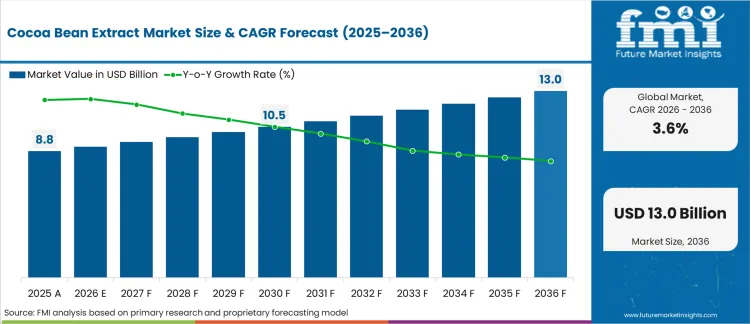
In 2025, the cocoa bean extract market was valued at USD 8.80 billion. Based on Future Market Insights' analysis, demand for cocoa bean extract is estimated to grow to USD 9.12 billion in 2026 and USD 13.0 billion by 2036. FMI projects a CAGR of 3.6% during the forecast period.
Absolute dollar growth of USD 3.88 billion over the decade reflects steady demand expansion underpinned by chocolate confectionery consumption growth in Asia Pacific and functional food applications of cocoa polyphenols in premium health and nutrition segments. In May 2025, Cargill reinforced its forest conservation efforts in Cote d'Ivoire by signing a partnership with SODEFOR to implement high-tech surveillance and polygon mapping across cocoa-growing regions, ensuring compliance with the EU Deforestation Regulation ahead of its 2026 enforcement deadlines, a supply chain investment that signals the high compliance cost burden that major processors are absorbing to maintain EU market access. [1]
Summary of Cocoa Bean Extract Market
- Cocoa Bean Extract Market Definition
- The market covers globally traded primary cocoa bean derived fractions including cocoa powder, cocoa liquor/mass, and cocoa butter from organic and conventional Theobroma cacao supply chains for chocolate, food, pharmaceutical, and cosmetic applications.
- Demand Drivers in the Market
- EU Deforestation Regulation 2026 enforcement deadline is compelling major processors including Cargill to invest in polygon mapping and forest surveillance infrastructure, concentrating compliant supply chain access among operators with documented deforestation-free sourcing.
- Barry Callebaut's November 2025 partnership with Planet A Foods to distribute ChoViva cocoa-free chocolate alternative signals that supply chain sovereignty risk from West African origin concentration is prompting the industry's largest processors to hedge with alternative ingredient strategies.
- EU Regulation 2018/848 organic production unit certification requirements are restructuring organic cocoa smallholder supply chains, concentrating certified organic volume among larger certified farm networks.
- Key Segments Analyzed in the FMI Report
- Product Type: Cocoa Powder leads at 36.1% share, driven by its versatile application in beverages, bakery, confectionery, and functional nutrition formulations.
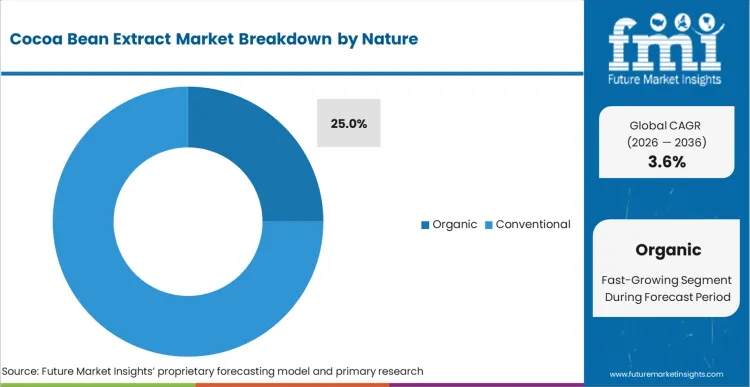
- Nature: Organic accounts for 25.0% of market volume, reflecting premium segment demand from health-focused food and nutrition brands requiring certified origin and traceability documentation.
- Geography: Japan holds the largest individual country value at USD 7.37 billion in 2026, reflecting deep chocolate confectionery consumption and well-established premium cocoa ingredient procurement.
- Analyst Opinion at FMI
- Nandini Roy Choudhury, Principal Consultant for Food & Beverage and Materials Industry at Future Market Insights, opines, "In the updated version of the Cocoa Bean Extract Market Report for 2026 to 2036, CXOs will find that the market's 3.6% CAGR understates the structural risk embedded in the supply base. The EU Deforestation Regulation's 2026 enforcement deadline is not a compliance exercise but a supply chain redesign requirement that will disqualify non-polygon-mapped West African origins from EU market access, effectively concentrating purchasing power among the three to four major processors who have already invested in high-tech forest surveillance. Barry Callebaut's cocoa-free ChoViva distribution partnership is not a niche innovation but an early hedge against a supply sovereignty scenario that the industry's largest operator is clearly pricing into its portfolio strategy."
- Strategic Implications / Executive Takeaways
- Invest in polygon mapping and deforestation-free sourcing documentation infrastructure ahead of EU Deforestation Regulation 2026 enforcement to maintain access to the European market and avoid the supply disruption that non-compliant origins will face.
- Develop cocoa-free or reduced-cocoa formulation capabilities as a portfolio hedge against West African origin supply sovereignty risk, replicating the strategic logic behind Barry Callebaut's ChoViva distribution partnership.
- Engage directly with ICCO-certified and organic-certified smallholder cooperatives in Ecuador and Peru to diversify origin exposure and capture the premium organic market segment that EU Regulation 2018/848 is restructuring.
- Methodology
- Validated through primary interviews with cocoa processors, chocolate manufacturers, and sustainability compliance specialists across primary producing and consuming markets.
- Zero reliance on speculative third-party market research reports.
- Based on ICCO production data, EU import statistics, organic certification records, and major processor annual reports.
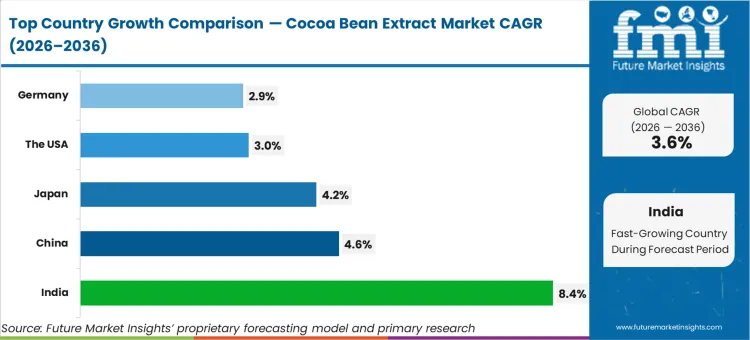
The United States leads with a 3.0% CAGR through 2036, generating USD 3.40 billion in 2026 demand, reflecting stable premium chocolate, food ingredient, and functional nutrition procurement. Japan holds the largest individual country value at USD 7.37 billion in 2026, anchored by deep chocolate confectionery consumption and well-established cocoa ingredient procurement networks. South Korea contributes USD 0.29 billion through premium confectionery and functional food channels. Cocoa Powder leads product type at 36.1% share, Organic nature accounts for 25.0% of market volume reflecting the growing premium segment, while the remaining 75.0% is served by conventional supply chains.
Cocoa Bean Extract Market Definition
The cocoa bean extract market comprises the global production, processing, and trade of primary cocoa bean derived ingredient fractions including cocoa powder (natural and alkalized), cocoa liquor (mass), and cocoa butter, derived from Theobroma cacao bean fermentation, drying, roasting, and pressing operations. The market covers both organic and conventional supply chains originating primarily in West Africa (Cote d'Ivoire, Ghana), Ecuador, Peru, and Southeast Asia, encompassing primary processing through to commercial ingredient distribution for chocolate manufacturing, food and beverage formulation, pharmaceutical, and cosmetic applications.
Cocoa Bean Extract Market Inclusions
The report includes global and regional market sizes by volume and value with a 10-year forecast from 2026 to 2036. Coverage spans segmental breakdowns by product type (Cocoa Powder, Cocoa Liquor/Mass, Cocoa Butter) and nature (Organic, Conventional). Country-level analysis covers all major cocoa producing and consuming markets globally, including primary origin countries in West Africa and Latin America.
Cocoa Bean Extract Market Exclusions
The scope excludes finished chocolate confectionery products and consumer packaged chocolate goods where cocoa extract is a processed component in a finished retail SKU. Cocoa-free chocolate alternatives such as carob and sunflower seed chocolate substitutes are excluded, as are synthetic cocoa flavour compounds and non-Theobroma cacao botanical extracts marketed under similar sensory descriptors. Speculative cocoa land investment vehicles and agricultural financing instruments are outside scope.
Cocoa Bean Extract Market Research Methodology
- Primary Research: Interviews were conducted with cocoa bean processors, cocoa ingredient exporters, chocolate manufacturers, food and beverage ingredient buyers, organic certification bodies, and sustainability compliance specialists across Cote d'Ivoire, Ghana, Ecuador, the Netherlands, Germany, the United States, and Japan.
- Desk Research: Production data from the International Cocoa Organization (ICCO), USDA cocoa production and trade reports, EU customs import statistics, organic certification body records, and major cocoa processor annual reports supported volume benchmarking.
- Market-Sizing and Forecasting: A hybrid top-down and bottom-up model was applied. Demand was reconstructed from chocolate manufacturing ingredient procurement volumes, food and beverage cocoa ingredient import data, and functional nutrition channel sales records, then validated against cocoa production yield and processing capacity data.
- Data Validation and Update Cycle: Outputs undergo anomaly screening, cross-validation against ICCO production data and EU import statistics, and structured peer review prior to release.
Key Industry Highlights
Increasing Demand from Chocolate and Confectionery Industry Boosting the Cocoa Bean Extract Sales
As chocolate is one of the most favorite flavors in desserts, it is among the most preferred ingredients for preparing many traditional and holiday dessert recipes. Especially in the chocolate and confectionery industry, the majority of manufacturers are making use of cocoa liquor to prepare cocoa-flavored food products to meet the ever-growing consumer demand for chocolate confectionery products.
Cocoa liquor acts as one of the primary ingredients for numerous foods such as cakes, ice creams, cookies, brownies, biscuits, candies, and other types of desserts, which is expected to spur the growth of the global cocoa market in the chocolate and confectionery industry in the upcoming years.
The extensive use of cocoa liquor in the confectionery industry has resulted in making chocolate confections a separate category in the global confectionery industry, becoming one of the leading end-user industries in the global cocoa market throughout the forecast period. Manufacturers can grasp the opportunity to include cocoa liquor in their portfolio for diversification and greater revenue generation.
Customization of offerings based on Consumer needs and Preference
Manufacturers today want to design their food products by utilizing various food ingredient solutions. They are strategically differentiating themselves from competitors by offering customized products as per emerging consumer trends, needs and requirements. Manufacturers have formed partnerships with many of their customers to provide them tailored-made stable solutions for food products according to varying needs.
The key market players are targeting consumers ranging from artisan bakers and foodservice providers to processing industries. Traditionally, there were only a few options made available in cocoa for customization. Customers now demand ingredients that can be customized according to their needs.
High Price of Cocoa Beans and Problems with Cocoa Production Endanger Market Growth
The rising price of cocoa beans significantly limits the industry's expansion potential and also increases the cost of raw materials for cocoa extract manufacturers. According to the International Cocoa Organization (ICCO), bean prices have risen four times more than the previous year. This makes production levels unsustainable for quite a few of producers, and the sector suffers as a result.
This frequently results in increased pricing for end - products, which may reduce demand in price-sensitive markets. High raw material prices constrain profit margins and limit pricing flexibility for firms in competitive industries such as chocolate and personal care.
One important cause for the high price of the beans is a decrease in production. In 2023, production in major cocoa-producing countries such as Ivory Coast and Ghana decreased considerably. Low rainfall and old trees were cited as the causes. As a result, companies must deal with an unpredictable supply of raw materials in their company.
2021 to 2026 Global Cocoa Bean Extract Sales Analysis Compared to Demand Forecasts for 2026 to 2036
Global sales increased at a CAGR of 3.2% from 2021 to 2026. For the next ten years (2026 to 2036), projections are that expenditure on such products will rise at 3.6% CAGR.
Between 2021 to 2026 consumers become aware about beer and there is a growing demand for high-quality and unique brews which amylase enzyme can produce. Barry Callebaut, Cargill, Inc., and PROVA have given the lead in doing so by producing cocoa bean that promote cocoa powder, cocoa butter, cocoa liquor production.
Major players in the cocoa and its derivatives production sector have established dedicated research facilities and employed specialized personnel to ensure access to the finest quality raw materials. Their research and development (R&D) teams are actively engaged in creating novel products in line with current market trends and evolving customer preferences.
From the year 2026 to 2036, they are employed in wine preparation to ensure that wine filtration is hassle-free and smooth, while also preserving the color and fragrance of the product. Thus, Cocoa Bean Extract have steered the industry away from traditional, time-consuming procedures and toward faster, more efficient, and healthier alternatives.
Market Concentration
Tier 1 Companies are referred to as the major players of the industry as they are fully established worldwide with majority shares of the business ecosystem. Industry leaders always lead the level of creativity, research, and development and most of the time are the trendsetters.
Through iterative and incremental processes, companies are striving to introduce new fillings that cater to the increasing demand for chemical-free, kosher, non-GMO verified, and vegan products. Additionally, existing products are continuously undergoing innovation to offer the highest quality cocoa, resulting in a rich flavor and aromatic profile for baking and confectionery production.
Tier 2 Companies are the regional players with adequate market coverage and are known for offering niche products. They are typically more localized and address specific issues of more general ones.
Tier 3 Companies are smaller players who are usually limited to the local or regional areas. They tend to service localized areas and do not possess the same level of research & development as bigger companies but are nonetheless helpful in satisfying local needs. These companies are smaller in size but still remain strong in their target industries due to their deep-rooted innovations and customer service.
Country-wise Insights
The following table shows the estimated growth rates of the top three territories. China and Japan are set to exhibit high consumption, recording CAGRs of 4.6% and 4.2%, respectively, through 2034.
.webp "Top Country Growth Comparison Cocoa Bean Extract Market Cagr (2026 2036)")
| Countries | CAGR 2026 to 2036 |
|---|---|
| The USA | 3.0% |
| Germany | 2.9% |
| India | 8.4% |
| Japan | 4.2% |
| China | 4.6% |
Increasing Demand for Premium and Artisanal Chocolate Products is Surging in the USA
Consumers now have an increasing appetite for artisan-style baked products such as bread, cakes, and confectioneries. Manufacturers are focusing on aesthetics, creating products that resemble traditional hand-crafted baking.
To enhance the attractiveness of their final products, artisanal bakers utilize specialty ingredients such as toppings, glazes, and frostings, with tastes like chocolate adding richness. Premium and handmade chocolates usually have clear labelling with limited ingredients, emphasizing the utilization of pure cocoa powder, butter, or extracts free of artificial additives.
Major participants in the USA bakery industry promote mass production and innovation, using product decorating equipment to produce designs on baked products of varying forms and weight. Technological improvements have greatly boosted the baking sector. As a result, artisanal bakeries provide a promising application opportunity, addressing consumers' need for visually appealing and delicious baked products.
Sales of Cocoa Bean Extract is Enhancing in India.
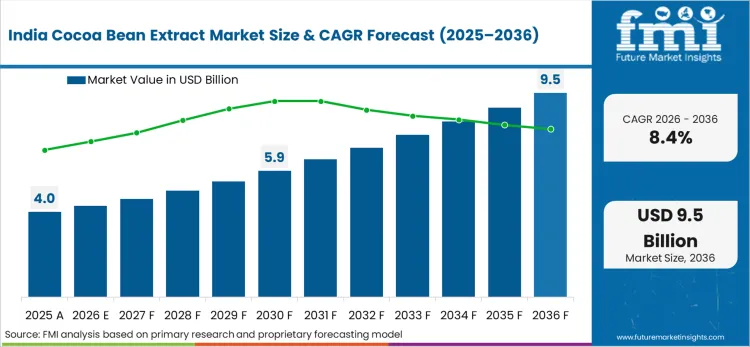
The India Cocoa Bean Extract market is anticipated to surge at a rate of around 8.4% from 2026 to 2036, owing to increasing demand among urban consumers for artisanal and premium confectionery products, as well as items from the personal care and cosmetics sectors that frequently include natural and premium cocoa extracts.
India's personal care and cosmetics industry is another important driver of the cocoa bean extract market. Cocoa butter, a key by-product of cocoa beans, is widely utilized in haircare and skincare products for its anti-aging, moisturizing, and nourishing properties. As Indian consumers prefer natural and organic personal care products, the demand for cocoa-based formulations has increased substantially.
Furthermore, the growing importance of beauty trends around worldwide, as well as the growth of e-commerce platforms, have enhanced Indian consumers’ access to high-quality cocoa products. Domestic and multinational enterprises are also capturing on this potential to develop unique personal care products infused with cocoa extracts, hence driving market growth.
Category-Wise Insights
Increasing Demand of Cocoa Powder in Food & beverage Industry Pushing the Product Type Segment for Higher Sales

| Segment | Cocoa Powder (By Product Type) |
|---|---|
| Value Share (2026) | 36.1% |
The global food and beverage sector depends on cocoa powder, which dominates the market for cocoa bean extract in 2026. Known for its rich flavor, affordability, and versatility, cocoa powder is used in chocolates, baked products, beverages, desserts, and even health-conscious foods. The food and beverage sector relies heavily on it owing to its many uses and the increasing demand from consumers for functional, and plant-based products.
Increase Preference for Organic Cocoa Products is Augmenting the Market Growth
| Segment | Organic (By Nature) |
|---|---|
| Value CAGR (2026) | 25.0% |
Organic cocoa segment is expected to dominate the cocoa bean extract market during the forecast period owing to the absence of synthetic pesticides, fertilizers, and other chemical additives involved in its cultivation. The product has high antioxidant properties, such as flavonoids, which are in line with consumer interest in functional foods and wellness products.
Consumers are reading more labels to ensure that products meet organic and non-GMO standards. Organic cocoa products are positioned as clean-label products, making them more attractive to health-conscious consumers. Organic cocoa does not lose its nutritional profile, including flavonoids, which are antioxidants that protect the cardiovascular system, and reduce inflammation. Consumers are attracted to these science-backed benefits, especially as they look for functional foods that promote general well-being.
Competition Outlook
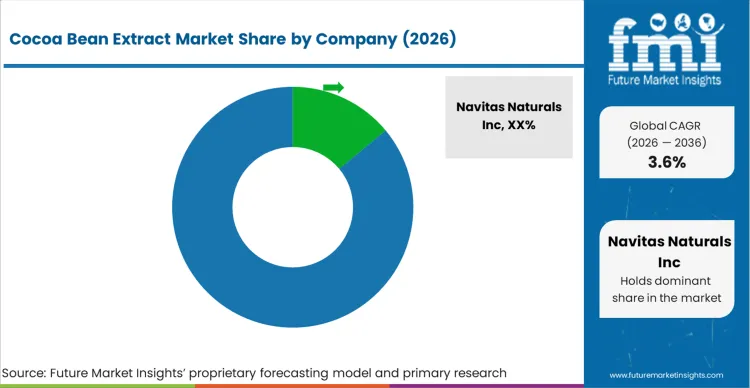
The competition landscape of the Cocoa Bean Extract market is intense. Barry Callebaut, Bloomer Chocolate Company, and Cargill, Incorporated are some of the major market players and contribute significantly in terms of research & development investment as well as further towards the creation of innovative sustainable feed concepts to tackle the market.
Such companies also seek to increase the investment that they can dedicate to the efficient manufacturing of developing enzymes solutions to enhance product quality, growth rates, as well as its efficiency.
To expand their sales, manufacturers are embracing different strategies including vertical and strategic acquisitions. For instance, Flavorchem Corporation offers wide range of customizable cocoa extracts and natural flavorings based on end user consumer needs. The company offer natural cocoa enhancers to meet regulatory requirements and thereby capture the market.
Recent Developments
The report includes full coverage of key trends from competitive benchmarking. Some of the recent developments covered in the reports:
- In May 2025, Cargill signed a partnership with SODEFOR in Cote d'Ivoire to implement high-tech surveillance and polygon mapping across cocoa-growing regions, ensuring compliance with the EU Deforestation Regulation ahead of 2026 enforcement deadlines. [1]
- In November 2025, Barry Callebaut entered a long-term commercial partnership with Planet A Foods to distribute ChoViva, a sustainable chocolate alternative made from locally sourced sunflower seeds, providing manufacturers with a cocoa-free option to hedge against supply chain volatility. [2]
- In October 2025, the European Union enforced Regulation (EU) 2018/848 mandating that all organic cocoa extracts entering the EU comply with stricter production unit rules requiring entire farms to be certified organic, significantly impacting smallholder supply chains. [3]
Leading Brands
- Navitas Naturals Inc
- Moner Cocoa, S.A
- Barry Callebaut
- Cargill, Inc.
- Ciranda, Inc.
- Ephoka Europe S.L
- Blommer Chocolate Company
- Mars, Inc.
- Keliff's
- PROVA
- Pruthvi Foods Pvt Ltd.
- Cargill
- Aakriti Trading Company
- Olam International Limited
- Briofeed Private Limited
- Clia Naturals
- Avi Naturals
- Grasse International
- GustavHeess
- Sapphire Flavors & Fragrances
- Avanschem
- Skyline Food Products LLP.
- Others
Scope of the Report

| Metric | Value |
|---|---|
| Quantitative Units | USD 9.12 billion (2026) to USD 13.0 billion (2036), at a CAGR of 3.6% |
| Market Definition | The cocoa bean extract market comprises globally traded primary Theobroma cacao derived fractions including cocoa powder, cocoa liquor/mass, and cocoa butter from organic and conventional supply chains for chocolate, food, pharmaceutical, and cosmetic applications. |
| Product Type Segmentation | Cocoa Powder, Cocoa Liquor/Mass, Cocoa Butter |
| Nature Segmentation | Organic, Conventional |
| Application Coverage | Chocolate manufacturing, food and beverage formulation, pharmaceutical actives, cosmetic ingredients, functional nutrition |
| Regions Covered | North America, Latin America, Europe, East Asia, South Asia, Oceania, Middle East and Africa |
| Countries Covered | United States, Germany, Netherlands, Belgium, France, United Kingdom, Japan, South Korea, China, Brazil, Cote d'Ivoire, Ghana, Ecuador, Peru and 40 plus countries |
| Key Companies Profiled | Barry Callebaut, Cargill Inc., Blommer Chocolate Company, Mars Inc., Navitas Naturals Inc, Moner Cocoa S.A., Ciranda Inc., Ephoka Europe S.L., PROVA, Pruthvi Foods Pvt Ltd., Keliff's |
| Forecast Period | 2026 to 2036 |
| Approach | Hybrid top-down and bottom-up market modeling validated through primary interviews with cocoa processors, chocolate manufacturers, and sustainability specialists, supported by ICCO data and EU import statistics |
Key Segments of the Report
By Nature:
As per Type, the industry has been categorized into Organic and Conventional.
By Product Type:
As per Source, the industry has been categorized into Cocoa Powder, Cocoa Liquor/Mass, and Cocoa Butter.
By Cocoa Type:
As per Form, the industry has been categorized into Forastero, Criollo, and Trinitario.
By Processing Type:
As per Process, the industry has been categorized into Dutch, and Natural.
By Distribution Channel:
This segment is further categorized into Business to Business, Business to Consumers (Hypermarkets/Supermarkets, Specialty Stores, Convenience Stores, Online Retailers).
By Region:
Industry analysis has been carried out in key countries of North America, Latin America, Western Europe, Eastern Europe, East Asia, South Asia & Pacific, Central Asia, Russia and Belarus, Balkan & Baltics, and the Middle East & Africa.
Bibliography
- [1] Cargill. (2025). Cargill 2025 Impact Report: Cocoa. Partnership with SODEFOR for polygon mapping in Cote d'Ivoire. May 2025.
- [2] Barry Callebaut. (2025). Barry Callebaut and Planet A Foods partner to pioneer sustainable chocolate alternative ChoViva. November 2025.
- [3] Chocolaterie Brussels. (2025). From farm to chocolate bar: how new EU organic rules are reshaping cacao. October 2025.
- [4] International Cocoa Organization (ICCO). (2025). Quarterly Bulletin of Cocoa Statistics. ICCO, 2025.
This Report Addresses
- Market intelligence to enable structured procurement, compliance, and supply chain strategy decisions across cocoa powder, cocoa liquor, and cocoa butter ingredient segments
- Market size estimation and 10-year revenue forecasts from 2026 to 2036, supported by validated ICCO production data and EU and USDA trade benchmarks
- Growth opportunity mapping across product type and nature segments with emphasis on EU Deforestation Regulation compliance, organic certification transitions, and Asia Pacific demand expansion
- Segment and regional revenue forecasts covering cocoa powder, cocoa liquor/mass, and cocoa butter across organic and conventional supply chains in 40 plus countries
- Competition strategy assessment including polygon mapping investment models, cocoa-free alternative hedging strategies, and smallholder certification partnership structures
- Regulatory impact analysis covering EU Deforestation Regulation 2026, EU Organic Regulation 2018/848, and EUDR traceability documentation requirements
- Supply chain risk assessment covering West African origin concentration, climate-driven yield volatility, and compliance cost burden distribution across the cocoa value chain
- Market report delivery in PDF, Excel, PPT, and interactive dashboard formats for executive and operational use
Frequently Asked Questions
How large is the demand for Cocoa Bean Extract in the global market in 2026?
Demand for Cocoa Bean Extract in the global market is estimated to be valued at USD 9.12 billion in 2026.
What will the market size of Cocoa Bean Extract be by 2036?
Market size for Cocoa Bean Extract is projected to reach USD 13.0 billion by 2036.
What is the expected CAGR for the Cocoa Bean Extract Market between 2026 and 2036?
Demand for Cocoa Bean Extract is expected to grow at a CAGR of 3.6% between 2026 and 2036.
Which Product Type leads the Cocoa Bean Extract Market in 2026?
Cocoa Powder leads at 36.1% product type share, driven by its versatile application across beverages, bakery, confectionery, and functional nutrition formulations.
What share does Organic Cocoa Bean Extract hold in 2026?
Organic nature accounts for 25.0% of market volume, reflecting premium segment demand from health-focused brands requiring certified origin and traceability documentation.
What is the United States CAGR for Cocoa Bean Extract?
The United States leads with a 3.0% CAGR through 2036, generating USD 3.40 billion in 2026 demand from stable premium chocolate, food ingredient, and functional nutrition procurement.
Why does Japan hold the largest individual country value in this market?
Japan holds USD 7.37 billion in 2026 market value, anchored by deep chocolate confectionery consumption, well-established cocoa ingredient procurement networks, and premium functional food channels.
What does the EU Deforestation Regulation mean for cocoa supply chains?
The EUDR's 2026 enforcement deadline requires polygon mapping and deforestation-free sourcing documentation, concentrating EU market access among processors who have invested in forest surveillance infrastructure.
What is included in the scope of this report?
Scope covers primary Theobroma cacao derived fractions including cocoa powder, cocoa liquor/mass, and cocoa butter from organic and conventional supply chains for chocolate, food, pharmaceutical, and cosmetic applications.
What is excluded from this report's scope?
Finished chocolate confectionery products, cocoa-free alternatives, synthetic cocoa flavour compounds, and speculative cocoa land investment vehicles are excluded.
How does FMI validate its Cocoa Bean Extract Market forecast?
The forecast uses a hybrid model validated through primary interviews with processors and chocolate manufacturers, cross-checked against ICCO production data, EU import statistics, and organic certification records.
Preview the report firsthand - request a free sample
Get SampleGet the brochure for pricing and purchase details.
Get PDFTable of Content
- Executive Summary
- Global Market Outlook
- Demand-side Trends
- Supply-side Trends
- Technology Roadmap Analysis
- Analysis and Recommendations
- Market Overview
- Market Coverage / Taxonomy
- Market Definition / Scope / Limitations
- Research Methodology
- Chapter Orientation
- Analytical Lens and Working Hypotheses
- Market Structure, Signals, and Trend Drivers
- Company Annual and Sustainability Reports
- Peer-reviewed Journals and Academic Literature
- Corporate Websites, Product Literature, and Technical Notes
- Earnings Decks and Investor Briefings
- Statutory Filings and Regulatory Disclosures
- Technical White Papers and Standards Notes
- Trade Journals, Industry Magazines, and Analyst Briefs
- Conference Proceedings, Webinars, and Seminar Materials
- Government Statistics Portals and Public Data Releases
- Press Releases and Reputable Media Coverage
- Specialist Newsletters and Curated Briefings
- Sector Databases and Reference Repositories
- FMI Internal Proprietary Databases and Historical Market Datasets
- Subscription Datasets and Paid Sources
- Social Channels, Communities, and Digital Listening Inputs
- Additional Desk Sources
- Expert Input and Fieldwork (Primary Evidence)
- Primary Modes
- Qualitative Interviews and Expert Elicitation
- Quantitative Surveys and Structured Data Capture
- Blended Approach
- Why Primary Evidence is Used
- Field Techniques
- Interviews
- Surveys
- Focus Groups
- Observational and In-context Research
- Social and Community Interactions
- Stakeholder Universe Engaged
- C-suite Leaders
- Board Members
- Presidents and Vice Presidents
- R&D and Innovation Heads
- Technical Specialists
- Domain Subject-matter Experts
- Scientists
- Physicians and Other Healthcare Professionals
- Governance, Ethics, and Data Stewardship
- Research Ethics
- Data Integrity and Handling
- Primary Modes
- Tooling, Models, and Reference Databases
- Data Engineering and Model Build
- Data Acquisition and Ingestion
- Cleaning, Normalisation, and Verification
- Synthesis, Triangulation, and Analysis
- Quality Assurance and Audit Trail
- Market Background
- Market Dynamics
- Drivers
- Restraints
- Opportunity
- Trends
- Scenario Forecast
- Demand in Optimistic Scenario
- Demand in Likely Scenario
- Demand in Conservative Scenario
- Opportunity Map Analysis
- Product Life Cycle Analysis
- Supply Chain Analysis
- Investment Feasibility Matrix
- Value Chain Analysis
- PESTLE and Porter’s Analysis
- Regulatory Landscape
- Regional Parent Market Outlook
- Production and Consumption Statistics
- Import and Export Statistics
- Market Dynamics
- Global Market Analysis 2021 to 2025 and Forecast, 2026 to 2036
- Historical Market Size Value (USD Million) Analysis, 2021 to 2025
- Current and Future Market Size Value (USD Million) Projections, 2026 to 2036
- Y-o-Y Growth Trend Analysis
- Absolute $ Opportunity Analysis
- Global Market Pricing Analysis 2021 to 2025 and Forecast 2026 to 2036
- Global Market Analysis 2021 to 2025 and Forecast 2026 to 2036, By Product Type
- Introduction / Key Findings
- Historical Market Size Value (USD Million) Analysis By Product Type , 2021 to 2025
- Current and Future Market Size Value (USD Million) Analysis and Forecast By Product Type , 2026 to 2036
- Cocoa Powder
- Cocoa Liquor/Mass
- Cocoa Butter
- Cocoa Powder
- Y-o-Y Growth Trend Analysis By Product Type , 2021 to 2025
- Absolute $ Opportunity Analysis By Product Type , 2026 to 2036
- Global Market Analysis 2021 to 2025 and Forecast 2026 to 2036, By Nature
- Introduction / Key Findings
- Historical Market Size Value (USD Million) Analysis By Nature, 2021 to 2025
- Current and Future Market Size Value (USD Million) Analysis and Forecast By Nature, 2026 to 2036
- Organic
- Conventional
- Organic
- Y-o-Y Growth Trend Analysis By Nature, 2021 to 2025
- Absolute $ Opportunity Analysis By Nature, 2026 to 2036
- Global Market Analysis 2021 to 2025 and Forecast 2026 to 2036, By Region
- Introduction
- Historical Market Size Value (USD Million) Analysis By Region, 2021 to 2025
- Current Market Size Value (USD Million) Analysis and Forecast By Region, 2026 to 2036
- North America
- Latin America
- Western Europe
- Eastern Europe
- East Asia
- South Asia and Pacific
- Middle East & Africa
- Market Attractiveness Analysis By Region
- North America Market Analysis 2021 to 2025 and Forecast 2026 to 2036, By Country
- Historical Market Size Value (USD Million) Trend Analysis By Market Taxonomy, 2021 to 2025
- Market Size Value (USD Million) Forecast By Market Taxonomy, 2026 to 2036
- By Country
- USA
- Canada
- Mexico
- By Product Type
- By Nature
- By Country
- Market Attractiveness Analysis
- By Country
- By Product Type
- By Nature
- Key Takeaways
- Latin America Market Analysis 2021 to 2025 and Forecast 2026 to 2036, By Country
- Historical Market Size Value (USD Million) Trend Analysis By Market Taxonomy, 2021 to 2025
- Market Size Value (USD Million) Forecast By Market Taxonomy, 2026 to 2036
- By Country
- Brazil
- Chile
- Rest of Latin America
- By Product Type
- By Nature
- By Country
- Market Attractiveness Analysis
- By Country
- By Product Type
- By Nature
- Key Takeaways
- Western Europe Market Analysis 2021 to 2025 and Forecast 2026 to 2036, By Country
- Historical Market Size Value (USD Million) Trend Analysis By Market Taxonomy, 2021 to 2025
- Market Size Value (USD Million) Forecast By Market Taxonomy, 2026 to 2036
- By Country
- Germany
- UK
- Italy
- Spain
- France
- Nordic
- BENELUX
- Rest of Western Europe
- By Product Type
- By Nature
- By Country
- Market Attractiveness Analysis
- By Country
- By Product Type
- By Nature
- Key Takeaways
- Eastern Europe Market Analysis 2021 to 2025 and Forecast 2026 to 2036, By Country
- Historical Market Size Value (USD Million) Trend Analysis By Market Taxonomy, 2021 to 2025
- Market Size Value (USD Million) Forecast By Market Taxonomy, 2026 to 2036
- By Country
- Russia
- Poland
- Hungary
- Balkan & Baltic
- Rest of Eastern Europe
- By Product Type
- By Nature
- By Country
- Market Attractiveness Analysis
- By Country
- By Product Type
- By Nature
- Key Takeaways
- East Asia Market Analysis 2021 to 2025 and Forecast 2026 to 2036, By Country
- Historical Market Size Value (USD Million) Trend Analysis By Market Taxonomy, 2021 to 2025
- Market Size Value (USD Million) Forecast By Market Taxonomy, 2026 to 2036
- By Country
- China
- Japan
- South Korea
- By Product Type
- By Nature
- By Country
- Market Attractiveness Analysis
- By Country
- By Product Type
- By Nature
- Key Takeaways
- South Asia and Pacific Market Analysis 2021 to 2025 and Forecast 2026 to 2036, By Country
- Historical Market Size Value (USD Million) Trend Analysis By Market Taxonomy, 2021 to 2025
- Market Size Value (USD Million) Forecast By Market Taxonomy, 2026 to 2036
- By Country
- India
- ASEAN
- Australia & New Zealand
- Rest of South Asia and Pacific
- By Product Type
- By Nature
- By Country
- Market Attractiveness Analysis
- By Country
- By Product Type
- By Nature
- Key Takeaways
- Middle East & Africa Market Analysis 2021 to 2025 and Forecast 2026 to 2036, By Country
- Historical Market Size Value (USD Million) Trend Analysis By Market Taxonomy, 2021 to 2025
- Market Size Value (USD Million) Forecast By Market Taxonomy, 2026 to 2036
- By Country
- Kingdom of Saudi Arabia
- Other GCC Countries
- Turkiye
- South Africa
- Other African Union
- Rest of Middle East & Africa
- By Product Type
- By Nature
- By Country
- Market Attractiveness Analysis
- By Country
- By Product Type
- By Nature
- Key Takeaways
- Key Countries Market Analysis
- USA
- Pricing Analysis
- Market Share Analysis, 2025
- By Product Type
- By Nature
- Canada
- Pricing Analysis
- Market Share Analysis, 2025
- By Product Type
- By Nature
- Mexico
- Pricing Analysis
- Market Share Analysis, 2025
- By Product Type
- By Nature
- Brazil
- Pricing Analysis
- Market Share Analysis, 2025
- By Product Type
- By Nature
- Chile
- Pricing Analysis
- Market Share Analysis, 2025
- By Product Type
- By Nature
- Germany
- Pricing Analysis
- Market Share Analysis, 2025
- By Product Type
- By Nature
- UK
- Pricing Analysis
- Market Share Analysis, 2025
- By Product Type
- By Nature
- Italy
- Pricing Analysis
- Market Share Analysis, 2025
- By Product Type
- By Nature
- Spain
- Pricing Analysis
- Market Share Analysis, 2025
- By Product Type
- By Nature
- France
- Pricing Analysis
- Market Share Analysis, 2025
- By Product Type
- By Nature
- India
- Pricing Analysis
- Market Share Analysis, 2025
- By Product Type
- By Nature
- ASEAN
- Pricing Analysis
- Market Share Analysis, 2025
- By Product Type
- By Nature
- Australia & New Zealand
- Pricing Analysis
- Market Share Analysis, 2025
- By Product Type
- By Nature
- China
- Pricing Analysis
- Market Share Analysis, 2025
- By Product Type
- By Nature
- Japan
- Pricing Analysis
- Market Share Analysis, 2025
- By Product Type
- By Nature
- South Korea
- Pricing Analysis
- Market Share Analysis, 2025
- By Product Type
- By Nature
- Russia
- Pricing Analysis
- Market Share Analysis, 2025
- By Product Type
- By Nature
- Poland
- Pricing Analysis
- Market Share Analysis, 2025
- By Product Type
- By Nature
- Hungary
- Pricing Analysis
- Market Share Analysis, 2025
- By Product Type
- By Nature
- Kingdom of Saudi Arabia
- Pricing Analysis
- Market Share Analysis, 2025
- By Product Type
- By Nature
- Turkiye
- Pricing Analysis
- Market Share Analysis, 2025
- By Product Type
- By Nature
- South Africa
- Pricing Analysis
- Market Share Analysis, 2025
- By Product Type
- By Nature
- USA
- Market Structure Analysis
- Competition Dashboard
- Competition Benchmarking
- Market Share Analysis of Top Players
- By Regional
- By Product Type
- By Nature
- Competition Analysis
- Competition Deep Dive
- Navitas Naturals Inc
- Overview
- Product Portfolio
- Profitability by Market Segments (Product/Age /Sales Channel/Region)
- Sales Footprint
- Strategy Overview
- Marketing Strategy
- Product Strategy
- Channel Strategy
- Moner Cocoa, S.A
- Barry Callebaut
- Cargill, Inc.
- Ciranda, Inc.
- Ephoka Europe S.L
- Blommer Chocolate Company
- Mars, Inc.
- Keliff's
- PROVA
- Pruthvi Foods Pvt Ltd.
- Cargill
- Aakriti Trading Company
- Olam International Limited
- Briofeed Private Limited
- Clia Naturals
- Avi Naturals
- Grasse International
- GustavHeess
- Sapphire Flavors & Fragrances
- Navitas Naturals Inc
- Competition Deep Dive
- Assumptions & Acronyms Used


