

- Market Size (2026)
- USD 21.2 Bn
- Forecast (2036)
- USD 39.4 Bn
- CAGR (2026 to 2036)
- 6.4%
How big is Cocoa & Cocoa Ingredients Market in 2026?
USD 21.2 billion in 2026 and USD 39.4 billion by 2036 at a 6.4% CAGR.
Sales of cocoa and cocoa ingredients are projected to expand at a 6.4% CAGR from 2026 to 2036, increasing valuation from USD 21.2 billion in 2026 to USD 39.4 billion by 2036. Expansion is supported by improving cocoa bean supplies, although downstream processing activity has not increased at the same pace. The International Cocoa Organization reported in May 2026 that 2024/25 world production rose 8.3% to 4.723 million tonnes. The May 2026 bulletin estimated grindings at 4.628 million tonnes following a 3.8% year-on-year decline. The opposing movements show that improved bean availability did not produce equivalent processing growth during the same cocoa year. Processors within the cocoa derivatives market should separate bean availability from customer demand and processing margins during capacity planning.
European cocoa processors face a defined compliance timetable for origin records and due diligence declarations across products. A European Commission update in July 2026 confirmed that the EUDR applies from 30 December 2026 to large and medium operators. The same application date covers micro and small operators already subject to the EU Timber Regulation. Other micro and small operators receive a later application date of 30 June 2027 under the amended timetable. Covered cocoa operators must align geolocation data with declarations submitted through the Union information system. Manufacturers serving several regions must separate European origin compliance from product-specific formulation rules in other jurisdictions. Commercial conditions also differ between processing hubs and manufacturing markets facing stronger pricing or labeling pressures. Plans within the chocolate formulations market should separate EUDR documentation costs from product-performance qualification and local labeling requirements.
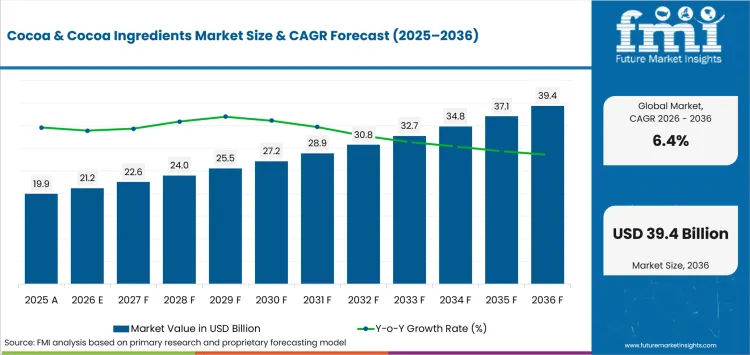
Key Takeaways of Cocoa & Cocoa Ingredients Market
- Demand for cocoa and cocoa ingredients is driven by supply security and repeatable processing performance, as improved bean supply alone does not remove qualification risk across major manufacturing regions.
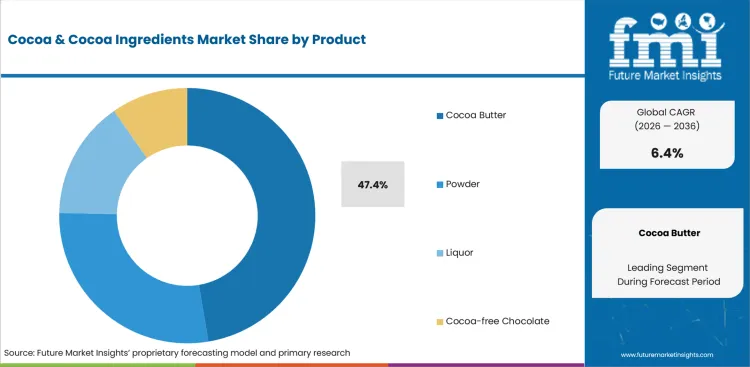
- By product, cocoa butter holds the leading share at 47.4% in 2026, due to its commercial role in texture and controlled melting behavior.
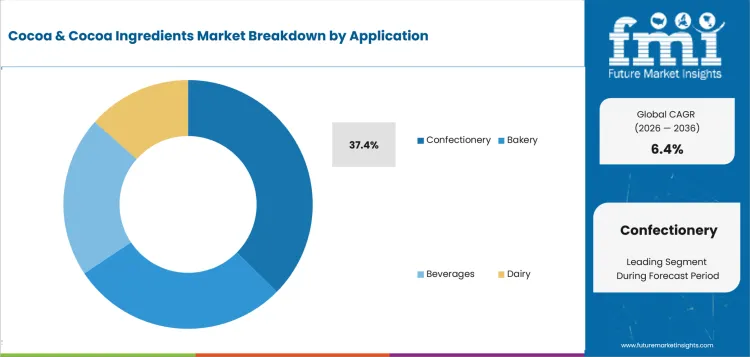
- Confectionery is the dominant application segment, holding 37.4% share in 2026, owing to repeated cocoa butter and liquor use across high-volume recipes.
- Cocoa powder and liquor support color and flavor development across bakery formulations and prepared beverage applications, while cocoa-free chocolate remains smaller but offers manufacturers an alternative route during supply disruption.
- Traceable origin records increasingly influence qualification across European supply chains, with manufacturers needing stable flavor and fat behavior across commercial batches rather than relying on favorable laboratory results alone.
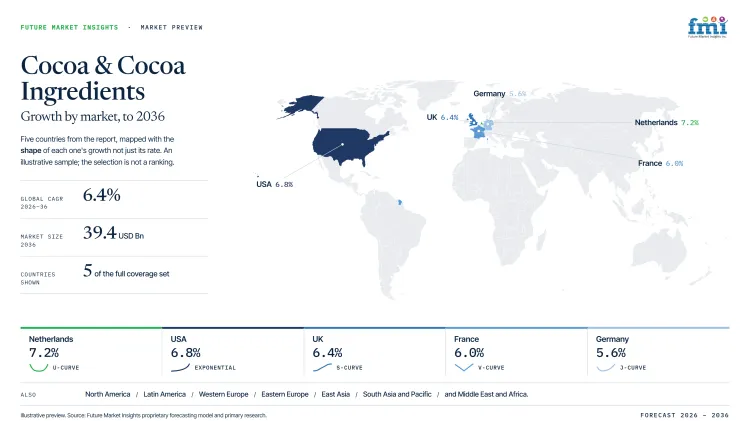
- The Netherlands, the USA, the UK, France, and Germany record CAGRs of 7.2%, 6.8%, 6.4%, 6.0%, and 5.6% respectively through 2036, shaped by port-centered processing, import-dependent supply structures, and distinct labeling conditions.
- Competition centers on Cargill, Barry Callebaut, ofi, Mondelēz International, Nestlé, Döhler (Nukoko), and Planet A Foods, with vendors differentiating through broad ingredient portfolios, documented sourcing initiatives, and cocoa-free formulation development.
Analyst Perspective
The commercial risk in cocoa ingredients sits less in bean availability than in whether tempering and flavor performance hold steady once a formulation moves from pilot batch to full production speed. A cocoa butter that reproduces gloss and snap in a lab trial can still fail premium confectionery programs if crystallization control loosens under real line speeds and storage variation. Buyers weighing cocoa-free alternatives should treat sensory validation and equipment compatibility as separate tests from cost savings, since a formulation that saves on commodity price but requires line changes rarely proves cheaper once qualification work is counted.
Nandini Roy Choudhury, Principal Consultant at Future Market Insights
Source: FMI's proprietary forecasting model and primary research
How is the Cocoa & Cocoa Ingredients Market segmented?
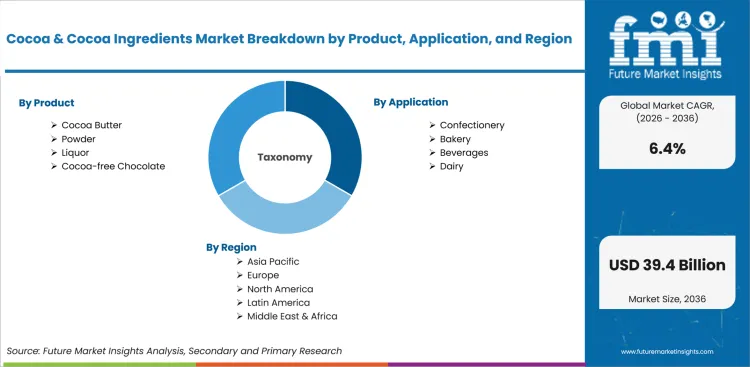
The cocoa & cocoa ingredients market is segmented by product, application, and region.
The segmentation framework separates ingredient forms from manufacturing applications so each category reflects a different purchasing decision. Product analysis covers cocoa butter and cocoa powder applications together with liquor plus cocoa-free chocolate alternatives used within food production. Cocoa butter supports texture and melting behavior while powder contributes flavor and color across dry or liquid formulations. Liquor provides combined cocoa solids and fat for recipes that require a fuller chocolate base.
Application analysis distinguishes confectionery from bakery and beverage uses together with dairy formulations that impose different processing limits. Regional analysis compares sourcing routes and compliance requirements across more than thirty covered national markets. The structure prevents finished retail chocolate revenue from being counted as ingredient sales unless the transaction falls inside the defined production chain.
What supports demand for cocoa butter within the product category?
Chocolate manufacturers evaluate cocoa butter through tempering stability and melt behavior under the intended production recipe. FDA guidance states that white chocolate must contain at least 20% cocoa butter under 21 CFR 163.124. The federal threshold gives United States manufacturers a fixed formulation boundary for an established commercial chocolate application. Processors therefore test cocoa butter supply under commercial cooling and storage conditions before approving routine production volumes.
- Cocoa butter leads the product category with 47.4% share in 2026 due to its commercial role in texture and controlled melting. Processors can measure performance through tempering curves and finished-product stability across representative commercial batches under normal factory conditions. The share position reflects a testable formulation function that affects finished quality throughout bars and coated products.
- Manufacturers expand Cocoa Butter approvals once pilot batches reproduce gloss and snap across representative commercial line speeds. Qualification must cover fat compatibility plus storage temperature without changing the approved recipe or weakening finished-product stability. Bakery applications may accept broader performance ranges while premium confectionery programs require tighter crystallization control and faster technical support.
How does confectionery shape demand within the application category?
Confectionery converts cocoa ingredients into high-volume finished products with measurable sensory performance and formal labeling requirements. Manufacturers evaluate confectionery ingredients against texture and flavor targets across seasonal production schedules and changing retail pack formats. The National Confectioners Association reported in March 2026 that United States confectionery sales reached USD 55 billion during 2025. The release placed chocolate at 51.7% of category sales and confirms a substantial commercial outlet for cocoa ingredients within confectionery.
- Confectionery holds 37.4% share in 2026 owing to repeated cocoa butter and liquor use across high-volume recipes. Bars and filled products concentrate ingredient volume while visible texture and flavor requirements make batch consistency commercially decisive across seasonal production cycles and diverse retail handling conditions across multiple selling channels.
- Confectionery producers expand approved ingredient use after recipes maintain viscosity and flavor through complete commercial runs across seasonal schedules and changing retail formats. Processors gain repeat orders by controlling origin and batch variation while supporting rapid troubleshooting across several factories without disrupting packaging plans or scheduled retail launch dates in key accounts.
What are the drivers, restraints, and opportunities in the Cocoa & Cocoa Ingredients Market?
Demand depends on dependable cocoa processing while regulation and supply volatility increase the commercial value of traceable ingredients plus validated alternatives.
- Driver: Global processing requirements remain substantial even as cocoa grindings respond to margin pressure and volatile raw material costs.
- Restraint: Traceability obligations and origin documentation increase qualification work throughout regulated European cocoa supply chains.
- Opportunity: Cocoa-free technologies and fuller cocoa-fruit utilization can diversify formulation choices during conventional cocoa supply stress.
Reliable cocoa bean derivatives support demand through consistent butter and powder availability across planned production cycles. Cargill announced in July 2025 that supply-chain investments connected West African origin operations with European processing hubs. The July 2025 program added solar power and reusable ISO tanks that could eliminate up to 100 metric tons of packaging waste each month. Integrated logistics improve scheduling visibility and reduce avoidable handling losses across the origin-to-processing commercial route. Improved shipment control strengthens contract execution through more predictable transport and scheduled delivery across recurring ingredient movements.
Cocoa importers face a considerable restraint through origin records and due diligence statements required for covered European supply chains. Smaller processors may experience longer qualification schedules without mapped farm data or repeatable declaration workflows. Regulation (EU) 2023/1115 requires production-country and plot-geolocation data while operators must retain due diligence records for five years. Data gaps create repeated shipment reviews that increase administrative cost across processors and importers serving several regulated customers. Ingredient approvals can stall until contracts assign data responsibilities and corrective actions across every covered shipment.
Cocoa-free formulations create a practical opportunity for manufacturers seeking resilience without abandoning familiar chocolate-like experiences. Food manufacturers need sensory acceptance and accurate product naming before alternatives progress across finished-product categories. Established processing compatibility can reduce conversion work across factories that already handle conventional chocolate ingredients. Cargill and Voyage Foods announced in May 2026 that NextCoa would enter the United States through familiar chocolate-making processes. The launch gives manufacturers a defined route to evaluate reduced cocoa exposure without requiring major equipment changes.
Which country CAGRs are profiled in the Cocoa & Cocoa Ingredients Market?
| Country | CAGR |
|---|---|
| USA | 6.8% |
| Germany | 5.6% |
| UK | 6.4% |
| France | 6.0% |
| Netherlands | 7.2% |
How do country-level CAGRs compare in the Cocoa & Cocoa Ingredients Market?
The country comparison shows a relatively narrow spread in projected growth rates across the cocoa & cocoa ingredients market. The Netherlands and the USA form a closely aligned upper group with only a limited difference between their forecasts. The UK and France create a middle cluster and remain separated from the upper group by a moderate gap. Germany occupies a distinct lower position but remains within a concentrated growth range overall. The total difference between the first and last country is 1.6 percentage points which indicates a stable growth pattern across the major cocoa processing and consumption markets. These differences reflect variations in cocoa processing activity, ingredient innovation and demand from food and beverage manufacturers.
- The Netherlands shows a notable position within the comparison as its extensive cocoa processing infrastructure supports the development and supply of cocoa ingredients for international markets.
- The USA remains close to the Netherlands in CAGR terms but follows a different market path through strong demand for cocoa ingredients across confectionery, bakery and beverage applications.
- The UK occupies a middle position within the comparison as manufacturers continue to incorporate cocoa-based ingredients into premium and value-added food products.
- France remains closely aligned with the UK yet market expansion is supported by established chocolate consumption patterns and continued product innovation.
- Germany holds a lower position within the group while maintaining steady development through a mature confectionery sector and consistent demand for cocoa-derived ingredients.
Comparable CAGRs do not create identical market conditions across countries. Differences in processing capacity, sourcing strategies, product mix and consumer preferences can influence how cocoa ingredients are adopted and commercialized. As a result, market participants may encounter different competitive and operational conditions despite relatively similar growth forecasts. The full report provides country-level CAGR analysis across North America, Latin America, Europe, East Asia, South Asia, Oceania and the Middle East and Africa.
Country-wise Analysis
- United States manufacturers rely on imported cocoa because domestic cultivation cannot satisfy commercial ingredient requirements at national production scale. Cocoa and cocoa ingredients demand in the United States is estimated to expand at 6.8% CAGR through 2036, reinforced by established processing and distribution routes. The USDA Economic Research Service reported in February 2025 that cocoa bean imports fell 26% during 2024 to 198,000 metric tons. Domestic grinders and ingredient distributors provide technical support for confectionery trials across several manufacturing regions. Import dependence remains a material friction as origin shortages and price shocks reach manufacturing budgets quickly. Supply agreements should separate commodity pricing from processor margins and technical service obligations during annual contract negotiations.
- German chocolate manufacturers operate within a dense European processing network that supports regional exports and nearby technical service. German cocoa and cocoa ingredients demand is predicted to advance at 5.6% CAGR through 2036, underpinned by substantial chocolate output and established logistics. Regional processors provide shorter technical routes for factory trials and approved ingredient adjustments across major manufacturing regions. Official December 2025 data from Destatis placed German production at nearly 1.07 million tonnes during 2024. The same release recorded output 5.8% below the previous year across covered domestic chocolate manufacturers. EUDR preparation remains a material friction as farm mapping must align with each processor's due diligence system. Manufacturers should confirm documentation fields and preserve alternate approved origins before signing annual volume commitments.
- United Kingdom manufacturers operate under reserved chocolate descriptions together with composition and labeling requirements for prepacked products. The cocoa and cocoa ingredients market in the United Kingdom is estimated to post 6.4% CAGR over the forecast period, shaped by established confectionery production and specialist distribution. A July 2026 Food Standards Agency report classified 22 of 40 prepacked milk and dark chocolate samples as unsatisfactory. The July 2026 survey found seven products with lower cocoa solids and seventeen products with labeling issues that required commercial follow-up. Specialist domestic distributors provide smaller trial lots and local technical support without requiring dedicated cocoa-processing assets. Manufacturers should verify cocoa-solid declarations and reserved product names before larger ingredient volumes enter seasonal production schedules.
- French manufacturers combine domestic chocolate production with regional cocoa processors serving bakery and retail confectionery accounts. Rising factory-gate prices create a direct local friction for annual formulation work and contract renewal decisions. Cocoa and cocoa ingredients sales in France are forecast to expand at 6.0% CAGR by 2036, supported by domestic manufacturing and broad retail applications. Insee published a provisional producer-price index of 170.9 in May 2026 for April French-market cocoa and confectionery output on a 2021 base. The level keeps formulation budgets exposed to substantial input-cost pressure during annual contract renewal decisions. Regional processors and chocolate flavor specialists provide staged trials that let manufacturers compare alternate cocoa profiles before larger commercial volumes receive approval.
- Dutch cocoa operations combine major port access with extensive processing and re-export flows across European customers. Statistics Netherlands data published in April 2026 showed that semi-finished products represented three-quarters of Dutch cocoa-product exports during 2025. The export mix creates recurring demand for butter and liquor that receive further processing in neighboring manufacturing markets. Cocoa and cocoa ingredients sales in the Netherlands are projected to grow at 7.2% CAGR through 2036, reflecting established processing and trade routes. Segregated lots and nearby technical services provide a direct enabler across several European production accounts. Dependence on imported beans remains a material friction as origin disruption reaches processing schedules despite strong logistics capacity. Customers should verify lot traceability and backup storage before committing substantial seasonal volumes across multiple facilities.
Who are the notable companies in the Cocoa & Cocoa Ingredients Market?
Cargill; Barry Callebaut; ofi; Mondelēz International; Nestlé; Döhler; Nukoko (a Döhler company); and Planet A Foods are the notable companies profiled in this market.
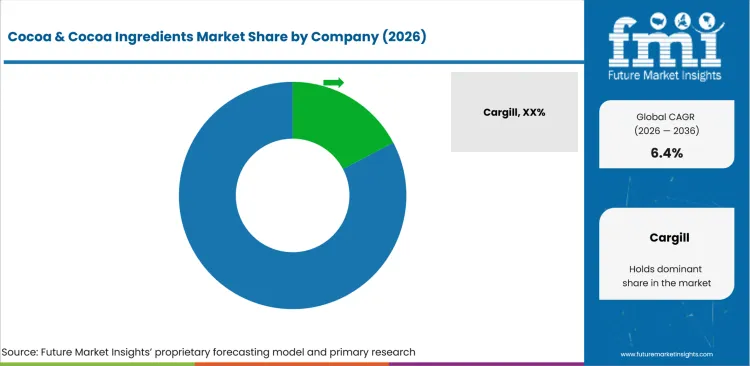
The competitive field combines global processors and branded confectionery groups with specialists developing cocoa-free ingredients. Cargill and Barry Callebaut compete with ofi through broad portfolios that combine origin sourcing with application support. Mondelēz International and Nestlé shape chocolate confectionery demand through large brand portfolios and documented cocoa programs. Nukoko operates as a Döhler company within an international ingredients organization serving several food categories. Planet A Foods reported ChoViva availability across eight countries during September 2025 through more than seventy partner products. Competitive strength depends on ingredient performance and traceability systems with responsive technical support near customer production sites.
- Cargill and Barry Callebaut compete with ofi across several origin and customer regions through broad ingredient portfolios. Their operating models combine core derivatives with application support and traceability systems that sustain multinational contracts through consistent batches and responsive technical service.
- Mondelēz International and Nestlé form the branded confectionery group through extensive product portfolios and visible cocoa sourcing programs. Their influence comes from formulation scale plus sourcing standards applied across many manufacturing countries and product categories. Their scale lets sourcing expectations influence processor documentation and quality programs beyond each company’s own finished-product factories.
- Döhler and its Nukoko subsidiary compete with Planet A Foods through cocoa-free ingredient platforms designed for existing food factories. Their position depends on sensory equivalence and scalable production while accurate labeling supports recipes that transfer without major equipment changes.
Competitive Benchmarking: Cocoa & Cocoa Ingredients Market
| Company | Ingredient Portfolio Breadth | Application Development Support | Commercial Ingredient Availability | Geographic Reach |
|---|---|---|---|---|
| Cargill | High | High | High | Global |
| Barry Callebaut | High | High | High | Global |
| ofi | High | High | High | Global |
| Mondelēz International | Low | Medium | Low | Global |
| Nestlé | Low | Medium | Low | Global |
| Döhler | Medium | High | Low | Global |
| Nukoko (a Döhler company) | Medium | Medium | Low | United Kingdom and Europe |
| Planet A Foods | Medium | Medium | Medium | Europe and Asia |
Key Developments in the Cocoa & Cocoa Ingredients Market
- In November 2025, Barry Callebaut entered a long-term commercial partnership with Planet A Foods to add scalable cocoa-free chocolate alternatives to its customer portfolio. The arrangement combines Barry Callebaut’s global manufacturing and application capabilities with the established ChoViva fermentation platform for commercial customer development. Customers can assess cocoa-free recipes through an established chocolate processor and compare taste and processing performance against conventional ingredients. The partnership expands customer availability across Europe and supports a broader international commercial route for cocoa-free formulations.
- In April 2026, Mondelēz International reported that approximately 100% of the cocoa volume used in its chocolate business during 2025 was covered through the Cocoa Life program. The initiative involved more than 257,000 registered farmers and connected sourcing activity with documented resilience measures across origin communities. The milestone demonstrates traceability expectations within a major confectionery account and requires ingredient partners to align origin records with sourcing standards across recurring programs.
- In August 2025, Nestlé announced a patented technique that uses up to 30% more of the cocoa fruit by combining cocoa pulp with beans. The process produces chocolate flakes through a simplified route that utilizes a greater share of harvested cocoa material. The announcement described a pilot-stage development rather than established commercial deployment across large manufacturing facilities worldwide. Commercial value depends on repeatable scale economics and consistent taste across industrial recipes and production lines. The technique expands utilization options without proving broad adoption across current commercial chocolate production facilities.
- In June 2026, Döhler completed the acquisition of Nukoko, bringing the United Kingdom-based cocoa-free developer into its ingredients organization. The transaction combines a fava-bean fermentation platform with international application support and commercial scaling resources. Planned sample availability from August 2026 gives manufacturers a defined route for bakery and confectionery trials. Commercial progress depends on sensory performance and stable production across customer recipes under routine factory conditions.
Key Players in the Cocoa & Cocoa Ingredients Market
Global Cocoa Processors
- Cargill
- Barry Callebaut
- ofi
Branded Confectionery Groups
- Mondelēz International
- Nestlé
Alternative Formulation Specialists
- Döhler
- Nukoko (a Döhler company)
- Planet A Foods
Cocoa & Cocoa Ingredients Market - Report Scope
| Coverage field | Report scope |
|---|---|
| Market breakdown | Product, application, and region. |
| Quantitative Units | USD Billion and CAGR in %. |
| Market Definition | Revenue covers cocoa butter and powder together with liquor plus commercial cocoa-free chocolate alternatives sold for food manufacturing. Finished retail product revenue is excluded unless it directly represents ingredient sales within the defined production chain. |
| Regions Covered | North America; Latin America; Western Europe; Eastern Europe; East Asia; South Asia and Pacific; and Middle East and Africa. |
| Countries Covered | USA; Germany; UK; France; Netherlands; plus more than twenty-five additional countries across the regions covered. |
| Key Companies Profiled | Cargill; Barry Callebaut; ofi; Mondelēz International; Nestlé; Döhler; Nukoko (a Döhler company); and Planet A Foods. |
| Forecast Period | 2026 to 2036. |
| Approach | Hybrid bottom-up and top-down market sizing supported by primary interviews and official desk research. |
Cocoa & Cocoa Ingredients Market - Research Methodology
| Method | Approach |
|---|---|
| Primary Research | FMI analysts gathered input from manufacturers, service providers, technology developers, distributors, end users, sourcing teams, and subject-matter experts. Interviews examined purchasing decisions, product or service evaluation, adoption barriers, approval requirements, pricing considerations, and expectations for technical or commercial support. Respondents were also asked what evidence is required before a trial, pilot, or initial order develops into regular purchasing. |
| Desk Research | Desk research covered government statistics, regulatory publications, trade data, industry associations, technical literature, standards, company filings, product information, and official corporate announcements. Sources were reviewed for relevance, publication date, geographic coverage, and consistency with the defined market scope. Claims relating to performance, applications, approvals, capacity, investment, and commercial activity were retained only when supported by credible public evidence. |
| Market Sizing and Forecasting | The market model combined the baseline value with historical performance, segment structure, pricing and volume indicators, adoption levels, company participation, and country-level demand conditions. Forecast assumptions considered economic activity, investment trends, regulatory developments, technology adoption, purchasing cycles, supply availability, and barriers to wider market use. Segment and regional estimates were reconciled before the final market total was calculated. |
| Data Validation | Estimates were checked against multiple independent indicators, including public data, company activity, trade patterns, industry developments, and findings from primary interviews. Validation also tested whether products, services, applications, and company revenues fell within the defined market boundaries. Adjacent categories, unsupported claims, overlapping revenues, and activities without direct market relevance were excluded to reduce double counting and maintain consistency across segments and countries. |
Cocoa & Cocoa Ingredients Market by Segments
Cocoa & Cocoa Ingredients Market segmented by Product:
- Cocoa Butter
- Powder
- Liquor
- Cocoa-free Chocolate
Cocoa & Cocoa Ingredients Market segmented by Application:
- Confectionery
- Bakery
- Beverages
- Dairy
Cocoa & Cocoa Ingredients Market by Region:
- North America
- United States
- Canada
- Latin America
- Brazil
- Mexico
- Argentina
- Chile
- Western Europe
- Germany
- France
- United Kingdom
- Italy
- Spain
- Benelux
- Nordics
- Eastern Europe
- Poland
- Czech Republic
- Romania
- Hungary
- East Asia
- China
- Japan
- South Korea
- South Asia and Pacific
- India
- ASEAN
- Australia and New Zealand
- Middle East and Africa
- GCC Countries
- South Africa
- Türkiye
- Israel
Research Sources and Bibliography
- Barry Callebaut. (n.d.-a). Looking for technical support?
- Barry Callebaut. (n.d.-b). Sustainable Ingredients.
- Barry Callebaut. (2025, November 5). Barry Callebaut and Planet A Foods Partner to Pioneer Sustainable Chocolate Alternatives Without Cocoa.
- Cargill. (2025, July 1). Cargill Sets a New Global Benchmark for more Sustainable Cocoa Supply Chains.
- Cargill. (2026, May 12). Cargill and Voyage Foods to bring NextCoa™ cocoa-free confectionery alternatives to North America.
- Döhler. (2026, June 18). Döhler Acquires Nukoko and Accelerates Cocoa-Free Chocolate Alternative Innovation.
- European Commission. (2026, July 13). Commission updates product scope and digital tools to support implementation of EU Deforestation Regulation.
- European Parliament and Council of the European Union. (2023, May 31). Regulation (EU) 2023/1115 of the European Parliament and of the Council of 31 May 2023 on the making available on the Union market and the export from the Union of certain commodities and products associated with deforestation and forest degradation and repealing Regulation (EU) No 995/2010 (Text with EEA relevance).
- USA Food and Drug Administration. (2008, July). Small Entity Compliance Guide: Standard of Identity for White Chocolate.
- Food Standards Agency, Scarrett, A., Cooke, S., & Bachelor, J. (2026, July 2). Retail Surveillance Survey Sampling Programme 2025/26.
- Institut national de la statistique et des études économiques. (2026, May 28). Indice de prix de production de l'industrie française pour le marché français − CPF 10.82 − Cacao, chocolat et produits de confiserie.
- International Cocoa Organization. (2026, May 29). May 2026 Quarterly Bulletin of Cocoa Statistics.
- Mondelēz International. (2026, April 15). Mondelēz International Announces 2025 Sustainability Milestones.
- National Confectioners Association. (2026, March 9). Confectionery Sales Climb to $55 Billion in 2025.
- Nestlé. (2025, August 20). Revolutionizing cocoa production: Nestlé develops novel technique to get more yield from cocoa fruit.
- ofi. (n.d.-a). Cocoa innovation for positive change.
- ofi. (n.d.-b). Cocoa powder that you can count on.
- ofi. (n.d.-c). Putting integrated supply chains first.
- ofi. (2025, December 10). ofi reaches cocoa greenhouse gas reduction milestone to help secure the future supply of cocoa ingredients.
- Planet A Foods. (2025, September 17). ChoViva in Asia.
- Statistics Netherlands. (2026, April 3). The Netherlands is the world’s leading exporter of cocoa products.
- Statistisches Bundesamt. (2025, December 2). Zahl der Woche 12,8 Kilo Schokolade pro Kopf wurden 2024 produziert.
- Gerval, A. (2025, February 13). High cocoa prices on smaller global crops lead to decreased USA imports in 2023 and 2024.
This bibliography is provided for reader reference and is not exhaustive. The full report contains the complete reference list and detailed citations.
This Report Answers
- How large is the Cocoa & Cocoa Ingredients Market in 2026 and 2036?
- Which supply and processing conditions support cocoa ingredient demand through 2036?
- Why does Cocoa Butter lead the Product category during 2026?
- Why does Confectionery lead the Application category during 2026?
- How do country growth rates compare across the USA, Germany, UK, France, and Netherlands?
- Which companies provide cocoa processing, branded manufacturing, or cocoa-free formulation capabilities?
- How do traceability rules and input costs affect commercial qualification?
- What should manufacturers test before approving larger ingredient volumes or alternative formulations?
Frequently Asked Questions
What is driving growth in the cocoa & cocoa ingredients market?
Food manufacturers require dependable cocoa functionality across established confectionery and bakery applications under routine commercial production conditions. Traceable sourcing and resilient supply routes support recurring purchasing across regulated manufacturing networks and multinational programs.
Who are the key players in the cocoa & cocoa ingredients market?
Cargill and Barry Callebaut compete with ofi through global cocoa processing and application support networks. Mondelēz International and Nestlé influence sourcing standards while Döhler and Planet A Foods advance cocoa-free alternatives.
What is a notable restraint in the cocoa & cocoa ingredients market?
Origin documentation and EUDR duties increase qualification work for cocoa entering covered European supply chains. Raw material volatility can delay recipe changes and weaken margins during annual volume commitment negotiations.
Why should executives track the cocoa & cocoa ingredients market?
Cocoa costs and traceability rules affect product margins across several high-volume food categories and manufacturing regions. Executives can use market signals to plan sourcing alternatives and technical qualification budgets across major production programs.
What business problem does the cocoa & cocoa ingredients market address?
The market supplies ingredients that create chocolate flavor and controlled texture across commercial food products. Processors help manufacturers reproduce those functions across routine batches and normal storage conditions at scale.
What should manufacturers evaluate before purchasing cocoa & cocoa ingredients?
Manufacturers should test flavor and processing behavior under intended line speeds and normal storage conditions. Approval work should verify origin records and technical support responsibilities for recurring commercial purchase volumes.
What limits return on investment in the cocoa & cocoa ingredients market?
Raw material volatility can compress manufacturer margins before reformulated products recover initial testing and qualification expenses. Weak documentation or inconsistent batches can prolong factory trials and delay recurring orders across several production sites.
What supports long-term confidence in the cocoa & cocoa ingredients market?
Long-term confidence depends on repeatable ingredient performance and traceable supply across routine commercial production programs. Responsive technical service helps manufacturers resolve batch variation without disrupting approved formulations across multiple plants.
Preview the report firsthand - request a free sample
Get SampleGet the brochure for pricing and purchase details.
Get PDFTable of Content
- Key Takeaways
- Market Size and CAGR
- Top Growth Driver
- Fastest Growing Segment
- Leading Region
- Key Companies
- Emerging Opportunities
- Executive Summary
- Global Market Outlook
- Demand-side Trends
- Supply-side Trends
- Technology Roadmap Analysis
- Analysis and Recommendations
- Analyst Perspective (What is happening? Why now? What should investors know?)
- Key Questions Answered
- How large is the market?
- What is the CAGR?
- What are key trends?
- Which region dominates?
- Who are the leaders?
- Market Overview
- Market Coverage / Taxonomy
- Market Definition / Scope / Limitations
- Research Methodology
- Chapter Orientation
- Analytical Lens and Working Hypotheses
- Market Structure, Signals, and Trend Drivers
- Benchmarking and Cross-market Comparability
- Market Sizing, Forecasting, and Opportunity Mapping
- Research Design and Evidence Framework
- Desk Research Programme (Secondary Evidence)
- Expert Input and Fieldwork (Primary Evidence)
- Tooling, Models, and Reference Databases
- Data Engineering and Model Build
- Quality Assurance and Audit Trail
- Market Background
- Market Dynamics (Drivers, Restraints, Opportunity, Trends)
- Scenario Forecast (Optimistic, Likely, Conservative)
- Impact Analysis
- AI Impact
- Sustainability Impact
- Regulatory Impact
- Technology Impact
- Consumer / Buyer Analysis
- Purchase Drivers
- Adoption Barriers
- Buyer Journey
- Opportunity Map Analysis
- Product Life Cycle Analysis
- Supply Chain Analysis
- Investment Feasibility Matrix
- Value Chain Analysis
- PESTLE and Porter's Analysis
- Regulatory Landscape
- Regional Parent Market Outlook
- Production and Consumption Statistics
- Import and Export Statistics
- Global Market Analysis and Forecast, 2021 to 2036
- Historical Market Size Value (USD Billion) Analysis, 2021 to 2025
- Current and Future Market Size Value (USD Billion) Projections, 2026 to 2036
- Y-o-Y Growth Trend Analysis
- Absolute $ Opportunity Analysis
- Global Market Pricing Analysis, 2021 to 2036
- Global Market Analysis and Forecast, By Product, 2021 to 2036
- Introduction / Key Findings
- Historical Market Size Value (USD Billion) Analysis By Product, 2021 to 2025
- Current and Future Market Size Value (USD Billion) Analysis and Forecast By Product, 2026 to 2036
- Cocoa Butter
- Powder
- Liquor
- Cocoa-free Chocolate
- Cocoa Butter
- Y-o-Y Growth Trend Analysis By Product, 2021 to 2025
- Absolute $ Opportunity Analysis By Product, 2026 to 2036
- Global Market Analysis and Forecast, By Application, 2021 to 2036
- Introduction / Key Findings
- Historical Market Size Value (USD Billion) Analysis By Application, 2021 to 2025
- Current and Future Market Size Value (USD Billion) Analysis and Forecast By Application, 2026 to 2036
- Confectionery
- Bakery
- Beverages
- Dairy
- Confectionery
- Y-o-Y Growth Trend Analysis By Application, 2021 to 2025
- Absolute $ Opportunity Analysis By Application, 2026 to 2036
- Global Market Analysis and Forecast, By Region, 2021 to 2036
- Introduction
- Historical Market Size Value (USD Billion) Analysis By Region, 2021 to 2025
- Current Market Size Value (USD Billion) Analysis and Forecast By Region, 2026 to 2036
- North America
- Latin America
- Western Europe
- Eastern Europe
- East Asia
- South Asia and Pacific
- Middle East & Africa
- Market Attractiveness Analysis By Region
- North America Market Analysis and Forecast, By Country, 2021 to 2036
- Historical Market Size Value (USD Billion) Trend Analysis By Market Taxonomy, 2021 to 2025
- Market Size Value (USD Billion) Forecast By Market Taxonomy, 2026 to 2036
- By Country
- USA
- Canada
- By Product
- By Application
- By Country
- Market Attractiveness Analysis
- By Country
- By Product
- By Application
- Key Takeaways
- Latin America Market Analysis and Forecast, By Country
- Historical Market Size Value (USD Billion) Trend Analysis By Market Taxonomy, 2021 to 2025
- Market Size Value (USD Billion) Forecast By Market Taxonomy, 2026 to 2036
- By Country
- Brazil
- Mexico
- Chile
- Rest of Latin America
- By Product
- By Application
- By Country
- Market Attractiveness Analysis
- By Country
- By Product
- By Application
- Key Takeaways
- Western Europe Market Analysis and Forecast, By Country
- Historical Market Size Value (USD Billion) Trend Analysis By Market Taxonomy, 2021 to 2025
- Market Size Value (USD Billion) Forecast By Market Taxonomy, 2026 to 2036
- By Country
- Germany
- UK
- Italy
- Spain
- France
- Nordic
- BENELUX
- Rest of Western Europe
- By Product
- By Application
- By Country
- Market Attractiveness Analysis
- By Country
- By Product
- By Application
- Key Takeaways
- Eastern Europe Market Analysis and Forecast, By Country
- Historical Market Size Value (USD Billion) Trend Analysis By Market Taxonomy, 2021 to 2025
- Market Size Value (USD Billion) Forecast By Market Taxonomy, 2026 to 2036
- By Country
- Russia
- Poland
- Hungary
- Balkan & Baltic
- Rest of Eastern Europe
- By Product
- By Application
- By Country
- Market Attractiveness Analysis
- By Country
- By Product
- By Application
- Key Takeaways
- East Asia Market Analysis and Forecast, By Country
- Historical Market Size Value (USD Billion) Trend Analysis By Market Taxonomy, 2021 to 2025
- Market Size Value (USD Billion) Forecast By Market Taxonomy, 2026 to 2036
- By Country
- China
- Japan
- South Korea
- By Product
- By Application
- By Country
- Market Attractiveness Analysis
- By Country
- By Product
- By Application
- Key Takeaways
- South Asia and Pacific Market Analysis and Forecast, By Country
- Historical Market Size Value (USD Billion) Trend Analysis By Market Taxonomy, 2021 to 2025
- Market Size Value (USD Billion) Forecast By Market Taxonomy, 2026 to 2036
- By Country
- India
- ASEAN
- Australia & New Zealand
- Rest of South Asia and Pacific
- By Product
- By Application
- By Country
- Market Attractiveness Analysis
- By Country
- By Product
- By Application
- Key Takeaways
- Middle East & Africa Market Analysis and Forecast, By Country
- Historical Market Size Value (USD Billion) Trend Analysis By Market Taxonomy, 2021 to 2025
- Market Size Value (USD Billion) Forecast By Market Taxonomy, 2026 to 2036
- By Country
- Kingdom of Saudi Arabia
- Other GCC Countries
- Türkiye
- South Africa
- Other African Union
- Rest of Middle East & Africa
- By Product
- By Application
- By Country
- Market Attractiveness Analysis
- By Country
- By Product
- By Application
- Key Takeaways
- Key Countries Market Analysis
- USA
- Pricing Analysis
- Market Share Analysis, 2025
- By Product
- By Application
- Canada
- Pricing Analysis
- Market Share Analysis, 2025
- By Product
- By Application
- Mexico
- Pricing Analysis
- Market Share Analysis, 2025
- By Product
- By Application
- Brazil
- Pricing Analysis
- Market Share Analysis, 2025
- By Product
- By Application
- Chile
- Pricing Analysis
- Market Share Analysis, 2025
- By Product
- By Application
- Germany
- Pricing Analysis
- Market Share Analysis, 2025
- By Product
- By Application
- UK
- Pricing Analysis
- Market Share Analysis, 2025
- By Product
- By Application
- Italy
- Pricing Analysis
- Market Share Analysis, 2025
- By Product
- By Application
- Spain
- Pricing Analysis
- Market Share Analysis, 2025
- By Product
- By Application
- France
- Pricing Analysis
- Market Share Analysis, 2025
- By Product
- By Application
- India
- Pricing Analysis
- Market Share Analysis, 2025
- By Product
- By Application
- ASEAN
- Pricing Analysis
- Market Share Analysis, 2025
- By Product
- By Application
- Australia & New Zealand
- Pricing Analysis
- Market Share Analysis, 2025
- By Product
- By Application
- China
- Pricing Analysis
- Market Share Analysis, 2025
- By Product
- By Application
- Japan
- Pricing Analysis
- Market Share Analysis, 2025
- By Product
- By Application
- South Korea
- Pricing Analysis
- Market Share Analysis, 2025
- By Product
- By Application
- Russia
- Pricing Analysis
- Market Share Analysis, 2025
- By Product
- By Application
- Poland
- Pricing Analysis
- Market Share Analysis, 2025
- By Product
- By Application
- Hungary
- Pricing Analysis
- Market Share Analysis, 2025
- By Product
- By Application
- Kingdom of Saudi Arabia
- Pricing Analysis
- Market Share Analysis, 2025
- By Product
- By Application
- Türkiye
- Pricing Analysis
- Market Share Analysis, 2025
- By Product
- By Application
- South Africa
- Pricing Analysis
- Market Share Analysis, 2025
- By Product
- By Application
- USA
- Market Structure Analysis
- Competition Dashboard
- Competition Benchmarking
- Market Share Analysis of Top Players
- By Regional
- By Product
- By Application
- Emerging Startups
- Innovation Benchmarking
- Competition Analysis
- Competition Deep Dive
- Cargill
- Overview
- Product Portfolio
- Profitability by Market Segments
- Sales Footprint
- Strategy Overview
- Marketing Strategy
- Product Strategy
- Channel Strategy
- Barry Callebaut
- Olam (ofi)
- Mondelēz
- Nestlé
- Döhler
- Nukoko
- Planet A Foods (cocoa-free)
- Cargill
- Case Studies
- Success Stories
- Recent Developments
- Competition Deep Dive
- Assumptions & Acronyms Used


