

- Industry Size (2026)
- USD 687.9 Mn
- Forecast (2036)
- USD 1294.6 Mn
- CAGR (2026 to 2036)
- 6.5%
Demand for Heat Stabilizers in the UK 2026 to 2036
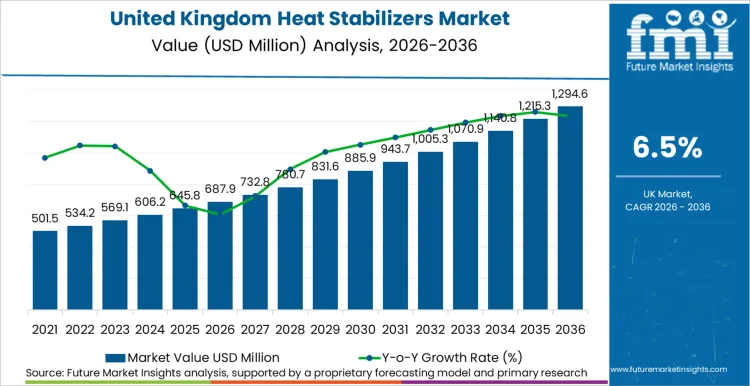
Demand for heat stabilizers in the UK is forecasted at USD 687.9 million in 2026 and is expected to grow to USD 1,294.6 million by 2036, at a CAGR of 6.5%. This growth is driven by the rising need for additives that maintain the integrity of materials under thermal stress across various sectors, including construction, automotive, and electrical industries. Heat stabilizers help preserve the physical properties of polymers, preventing degradation and ensuring durability, particularly in high-temperature applications.
As regulatory requirements intensify, UK manufacturers seek stabilizers that meet compliance standards and reduce lifecycle costs. Materials like PVC, commonly used in pipes, window profiles, and cables, require stabilizers that ensure long-term reliability and prevent material degradation under heat. As new polymers and resins emerge, particularly those with increased recyclate content or bio-based components, the demand for compatible heat stabilizer systems grows. These stabilizers help maintain consistent performance, reducing variability in thermal behavior and supporting the sustainability goals of manufacturers.
Quick Stats for Heat Stabilizers Industry in the UK
- Heat Stabilizers Industry Value (2026): USD 687.9 million
- Heat Stabilizers Industry Forecast Value (2036): USD 1,294.6 million
- Heat Stabilizers Industry Forecast CAGR 2026 to 2036: 6.5%
- Leading Heat Stabilizer Type by Demand Share: Metallic heat stabilizers
- Fastest-Growing Regions: England, Scotland, Wales, Northern Ireland
- Key Industry Participants: BASF SE, Clariant AG, AkzoNobel N.V., Arkema S.A., Baerlocher GmbH, Galata Chemicals
Heat Stabilizers Industry in the UK Key Takeaways
| Metric | Value |
|---|---|
| Industry Value (2026) | USD 687.9 million |
| Industry Forecast Value (2036) | USD 1,294.6 million |
| Forecast CAGR (2026 to 2036) | 6.5% |
Why is the UK Building Steady Demand for Heat Stabilizers?
Demand for heat stabilizers in the UK grows as manufacturers across plastics processing see quality and compliance pressures rise. Producers of PVC pipes, window profiles and automotive components require additives that maintain physical properties under thermal stress. Heat stabilizers help prevent degradation, preserve colour integrity, and ensure product longevity, which buyers treat as necessary performance criteria rather than optional enhancements.
Regulatory standards and customer expectations shape procurement behaviour. UK firms supplying construction and consumer goods must meet durability benchmarks that are verified in third-party testing and certification. Materials that lose structural integrity under heat can undermine warranty commitments and elevate lifecycle costs. This drives formulators to select stabilizers that deliver dependable thermal resistance in extrusion, injection moulding and compounding processes.
Shifts toward advanced polymer blends and engineering plastics also influence uptake. As usage of high-performance resins increases to satisfy lightweighting and sustainability goals, processors look for compatible heat stabilizer systems that integrate with novel formulations. This is especially true where recyclate content or bio-based components introduce variability in thermal behaviour. Buyers seek solutions that bring consistency to final products, sustaining demand rooted in performance assurance and regulatory conformity.
How is Heat Stabilizers Demand Segmented by Type, Application, and End-Use Industry in the UK?
Demand for heat stabilizers in the UK reflects how industries balance thermal stability, material longevity, and processing efficiency across various polymers and composites. Segmentation follows specific performance criteria, such as temperature tolerance and material compatibility, under demanding operational conditions.
Why do metallic heat stabilizers lead type-level demand?
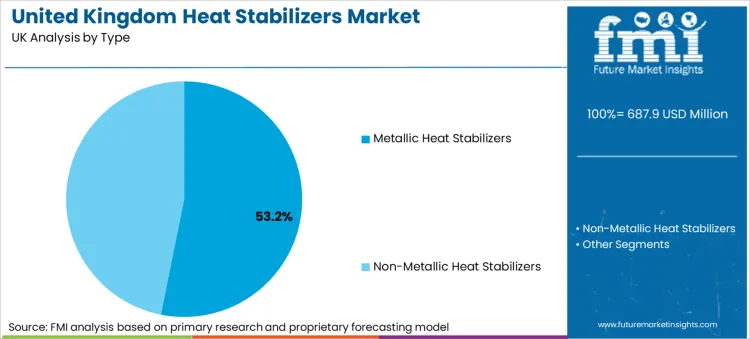
Metallic heat stabilizers account for 53.2% of the industry share, reflecting their dominant use in applications requiring high temperature tolerance and enhanced processing stability. These stabilizers are preferred for their ability to prevent degradation of polymers during manufacturing and use, especially in high-heat environments. Manufacturers favour metallic stabilizers for their cost-effectiveness, reliability, and long-term effectiveness in extending material life.
Their use is critical in maintaining the integrity of materials such as polyvinyl chloride (PVC) and other thermoplastic polymers, where overheating could lead to discoloration, loss of mechanical properties, or early degradation. Their role is especially crucial in industries where consistent product performance and regulatory compliance are mandatory.
What keeps engineering plastics as the most common application?
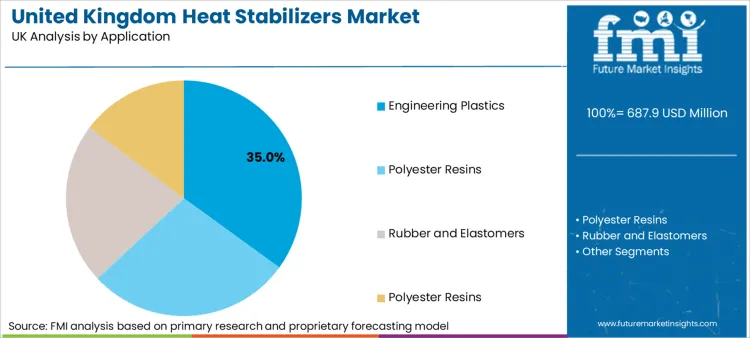
Engineering plastics hold a 35.0% share, making them the largest application for heat stabilizers. These materials are used in demanding applications requiring superior mechanical properties, chemical resistance, and high-temperature performance. Engineering plastics are critical in sectors like automotive and electrical industries, where components are exposed to high operational temperatures.
Heat stabilizers are essential to maintain the structural integrity of engineering plastics during both processing and end-use applications. The demand for stabilizers in this sector is driven by the need to ensure long-term durability and reliability of critical components.
Why does the construction industry dominate the end-use industry?
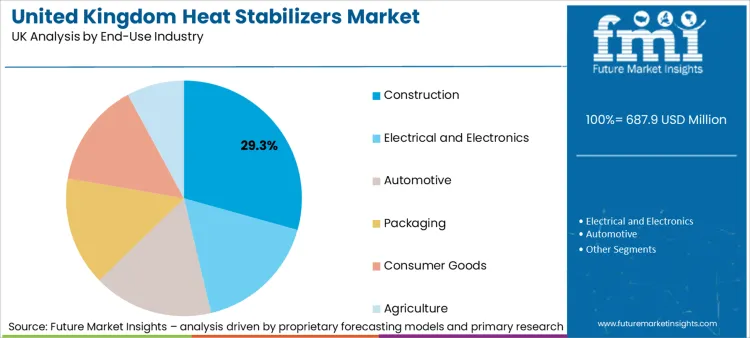
The construction industry accounts for 29.3% of the demand, reflecting the need for heat stability in materials such as pipes, cables, and window profiles, where exposure to varying temperatures and environmental conditions is common. Heat stabilizers are integral in maintaining the durability and performance of construction materials like PVC used in pipes and profiles that undergo significant thermal stress during installation and use.
These stabilizers help to maintain material strength, prevent brittleness, and improve the longevity of construction products exposed to both internal and external heat sources. The steady demand from this industry supports the widespread use of metallic stabilizers in building materials.
What are the Key Dynamics in Demand for Heat Stabilizers in the UK?
Demand for heat stabilizers in the UK is driven by the need to enhance polymer performance in applications exposed to elevated processing and service temperatures. Manufacturers in automotive, building and construction, electrical and electronics, and industrial goods specify heat stabilizers to protect polymers such as PVC, polyolefins, and engineering plastics from thermal degradation during extrusion, injection molding, and long-term use. The UK industry places emphasis on stabilizer systems that deliver colour retention, mechanical integrity, and extended lifecycle performance in end products subject to thermal stress.
How do application-specific thermal performance requirements shape uptake?
Uptake of heat stabilizers in the UK is closely tied to sectors where thermal exposure dictates material selection and long-term reliability. In PVC window profiles and cladding, stabilizers mitigate dehydrochlorination and colour change under heat during processing and extended outdoor exposure. Automotive under-the-hood components and cable jacketing require stabilizers that preserve tensile strength and flexibility despite repeated thermal cycling, meeting safety and durability standards. Electrical insulation and appliance housings depend on heat-stable formulations capable of resisting embrittlement when subjected to continuous operation at elevated temperatures. Manufacturers evaluate stabilizer packages for compatibility with fillers, flame retardants, and UV absorbers to ensure holistic performance without compromising processability on high-speed lines common in UK plastics converting.
How do regulatory compliance and feedstock variability influence industry patterns?
Demand for heat stabilizers in the UK is influenced by regulatory requirements and variability in polymer feedstock quality. Regulations restricting certain heavy metal stabilizers have shifted formulation strategies toward metal-free and environmentally acceptable alternatives, prompting investment in calcium-zinc, organotin, and organic stabilizer systems that balance performance with compliance. Quality variability in recycled polymer streams, increasingly used to meet sustainability targets, raises challenges for stabilizer efficiency because inconsistent impurity levels can accelerate degradation. Stabilizer suppliers work with converters to tailor packages that compensate for feedstock heterogeneity, reducing scrap and rework rates. Cost sensitivity affects uptake where high-performance systems command premiums, especially in value-oriented segments, reinforcing the need to align stabilizer selection with targeted thermal performance and lifecycle expectations of specific applications.
How is Heat Stabilizers Demand Evolving across Key Regions in the UK?
Demand for heat stabilizers across the UK progresses as industries seek enhanced thermal performance and material longevity in processing environments. Regional variation reflects production intensity, material compatibility, regulatory alignment, and how operators prioritise heat resistance and cost efficiency in sectors like plastics, automotive, and manufacturing.
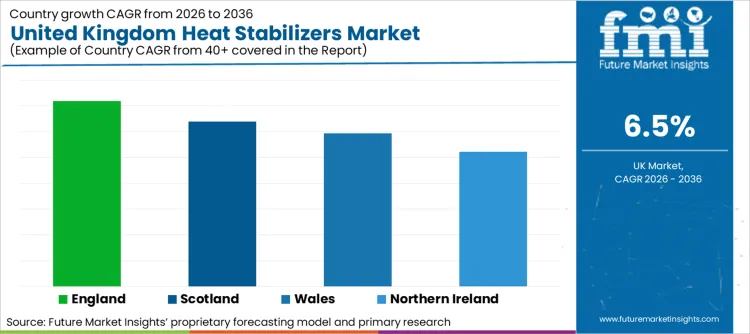
| Region | CAGR 2026 to 2036 |
|---|---|
| England | 7.2% |
| Scotland | 6.4% |
| Wales | 5.9% |
| Northern Ireland | 5.2% |
Source: FMI analysis based on primary research and proprietary forecasting model
Why is England leading expansion through high-volume industrial applications and regulatory alignment?
England grows at 7.2%, supported by large-scale industrial applications requiring consistent material performance under high temperatures. Demand rises where producers in automotive, construction, and packaging sectors prioritise long-term material stability. Buyers focus on stabilizers that ensure compliance with evolving regulatory standards while maintaining cost-effectiveness and performance integrity across diverse product lines.
How is Scotland progressing through selective adoption in specialised industries and smaller-scale production?
Scotland expands at 6.4%, shaped by adoption within industries like electronics, renewable energy, and niche manufacturing. Demand builds where heat stabilizers are crucial for maintaining material integrity under specific operating conditions. Producers favour solutions that enhance durability without compromising product cost or quality, with particular attention to smaller but high-value production lines.
What is shaping Wales as manufacturers optimise material performance within controlled production environments?
Wales advances at 5.9%, driven by manufacturers focusing on material optimisation and process efficiency in controlled environments. Demand strengthens when heat stabilizers extend product lifespan, prevent degradation, and maintain mechanical properties. Decision-makers prioritise products that balance performance with ease of integration into existing manufacturing processes while ensuring consistent results across varying product batches.
Why is Northern Ireland showing measured growth tied to targeted sectoral needs and production disciplines?
Northern Ireland records 5.2% growth, reflecting targeted demand within sectors like construction and automotive that require selective heat resistance solutions. Adoption progresses where stabilizers effectively maintain material quality during processing and enhance durability in finished products. Demand improves when suppliers offer tailored solutions that meet specific sectoral requirements and reduce production complexity.
What Defines the Competitive Landscape for Heat Stabilizers in the UK?
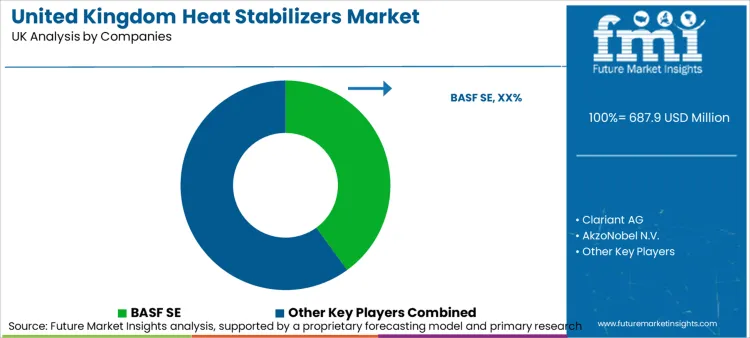
Demand for heat stabilizers in the UK is driven by the need for enhanced performance in PVC, automotive applications, and wire & cable industries, where thermal degradation protection is critical. Buyers assess stabilizer efficiency, compatibility with polymers, long-term heat resistance, and regulatory compliance with REACH and other industry-specific standards. Evaluation also includes processability, color stability, and non-toxicity, particularly in food-grade packaging and building materials. Procurement behavior favors suppliers with a strong track record of supply chain reliability, consistent quality control, and the ability to meet stringent environmental and safety standards. The trend in the UK industry reflects a growing shift toward environmentally friendly and non-toxic stabilizer solutions in line with sustainability goals.
BASF SE leads the industry through a comprehensive range of heat stabilizers, offering solutions with high efficiency and environmental compliance tailored to diverse industries. Clariant AG competes by providing stabilizer systems that balance performance with regulatory adherence, particularly in building and construction applications. AkzoNobel N.V. participates by offering high-performance heat stabilizers with a focus on PVC and thermoplastic applications, while Arkema S.A. supports demand through advanced stabilizer technologies designed for both traditional and renewable polymer systems.
Baerlocher GmbH remains active through a broad portfolio of stabilizers, focusing on cost-efficient solutions for industrial applications. Galata Chemicals competes by offering stabilizers that provide long-lasting protection and are used widely in the automotive and electrical sectors. Competitive differentiation is centered around thermal stability, environmental impact, cost-efficiency, and the ability to meet both performance and regulatory requirements.
Key Industry Participants
- BASF SE
- Clariant AG
- AkzoNobel N.V.
- Arkema S.A.
- Baerlocher GmbH
- Galata Chemicals
Scope of Report
| Items | Values |
|---|---|
| Quantitative Units | USD million |
| Type | Metallic Heat Stabilizers; Non-Metallic Heat Stabilizers |
| Application | Engineering Plastics; Polyester Resins; Rubber and Elastomers; Polyester Resins |
| End-Use Industry | Construction; Electrical and Electronics; Automotive; Packaging; Consumer Goods; Agriculture |
| Regions Covered | England; Scotland; Wales; Northern Ireland |
| Key Companies Profiled | BASF SE; Clariant AG; AkzoNobel N.V.; Arkema S.A.; Baerlocher GmbH; Galata Chemicals |
Heat Stabilizers Demand in the UK by Segments
Type:
- Metallic Heat Stabilizers
- Non-Metallic Heat Stabilizers
Application:
- Engineering Plastics
- Polyester Resins
- Rubber and Elastomers
- Polyester Resins
End-Use Industry:
- Construction
- Electrical and Electronics
- Automotive
- Packaging
- Consumer Goods
- Agriculture
By Region
- England
- Scotland
- Wales
- Northern Ireland
Bibliography
- European Chemicals Agency. (2023). Restrictions and regulatory status of stabilising additives under REACH. ECHA.
- British Plastics Federation. (2024). Additives in plastics: Performance, compliance, and sustainability considerations. BPF.
- International Organization for Standardization. (2023). ISO 18263-1: Plastics - Effect of heat exposure on polymer degradation. ISO.
- PlasticsEurope. (2023). Polymer additives and thermal stabilisation in circular plastics systems. PlasticsEurope Association.
- Müller, K., & Wypych, G. (2023). Thermal degradation and stabilisation mechanisms in PVC and engineering polymers. Polymer Degradation and Stability, 214, 110391.
- Organisation for Economic Co-operation and Development. (2024). Environmental and health considerations of polymer additives. OECD Publishing.
Frequently Asked Questions
How big is the heat stabilizers industry in the UK in 2026?
The heat stabilizers industry in the UK is projected to be valued at USD 687.9 million in 2026.
What will be the size of the heat stabilizers industry in the UK in 2036?
The industry size for heat stabilizers in the UK is projected to reach USD 1,294.6 million by 2036.
How much will the demand for heat stabilizers in the UK grow between 2026 and 2036?
Demand for heat stabilizers in the UK is projected to grow at a 6.5% CAGR between 2026 and 2036.
Which type of heat stabilizer holds a significant share in the heat stabilizers industry in the UK in 2026?
In terms of type, metallic heat stabilizers are expected to account for a 53.2% share in 2026.
Which end-user industry contributes a major share in the heat stabilizers industry in the UK in 2026?
The construction industry is expected to account for a 29.3% share in the heat stabilizers industry in the UK in 2026.
Preview the report firsthand - request a free sample
Get SampleGet the brochure for pricing and purchase details.
Get PDFTable of Content
- Executive Summary
- UK Market Outlook
- Demand-side Trends
- Supply-side Trends
- Technology Roadmap Analysis
- Analysis and Recommendations
- Market Overview
- Market Coverage / Taxonomy
- Market Definition / Scope / Limitations
- Market Background
- Market Dynamics
- Drivers
- Restraints
- Opportunity
- Trends
- Scenario Forecast
- Demand in Optimistic Scenario
- Demand in Likely Scenario
- Demand in Conservative Scenario
- Opportunity Map Analysis
- Product Life Cycle Analysis
- Supply Chain Analysis
- Investment Feasibility Matrix
- Value Chain Analysis
- PESTLE and Porter’s Analysis
- Regulatory Landscape
- Regional Parent Market Outlook
- Production and Consumption Statistics
- Import and Export Statistics
- Market Dynamics
- UK Market Analysis 2021 to 2025 and Forecast, 2026 to 2036
- Historical Market Size Value (USD Million) Analysis, 2021 to 2025
- Current and Future Market Size Value (USD Million) Projections, 2026 to 2036
- Y-o-Y Growth Trend Analysis
- Absolute $ Opportunity Analysis
- UK Market Pricing Analysis 2021 to 2025 and Forecast 2026 to 2036
- UK Market Analysis 2021 to 2025 and Forecast 2026 to 2036, By Type
- Introduction / Key Findings
- Historical Market Size Value (USD Million) Analysis By Type , 2021 to 2025
- Current and Future Market Size Value (USD Million) Analysis and Forecast By Type , 2026 to 2036
- Metallic Heat Stabilizers
- Non-Metallic Heat Stabilizers
- Metallic Heat Stabilizers
- Y-o-Y Growth Trend Analysis By Type , 2021 to 2025
- Absolute $ Opportunity Analysis By Type , 2026 to 2036
- UK Market Analysis 2021 to 2025 and Forecast 2026 to 2036, By Application
- Introduction / Key Findings
- Historical Market Size Value (USD Million) Analysis By Application, 2021 to 2025
- Current and Future Market Size Value (USD Million) Analysis and Forecast By Application, 2026 to 2036
- Engineering Plastics
- Polyester Resins
- Rubber and Elastomers
- Polyester Resins
- Engineering Plastics
- Y-o-Y Growth Trend Analysis By Application, 2021 to 2025
- Absolute $ Opportunity Analysis By Application, 2026 to 2036
- UK Market Analysis 2021 to 2025 and Forecast 2026 to 2036, By End-Use Industry
- Introduction / Key Findings
- Historical Market Size Value (USD Million) Analysis By End-Use Industry, 2021 to 2025
- Current and Future Market Size Value (USD Million) Analysis and Forecast By End-Use Industry, 2026 to 2036
- Construction
- Electrical and Electronics
- Automotive
- Packaging
- Consumer Goods
- Agriculture
- Construction
- Y-o-Y Growth Trend Analysis By End-Use Industry, 2021 to 2025
- Absolute $ Opportunity Analysis By End-Use Industry, 2026 to 2036
- Market Structure Analysis
- Competition Dashboard
- Competition Benchmarking
- Market Share Analysis of Top Players
- By Regional
- By Type
- By Application
- By End-Use Industry
- Competition Analysis
- Competition Deep Dive
- BASF SE
- Overview
- Product Portfolio
- Profitability by Market Segments (Product/Age /Sales Channel/Region)
- Sales Footprint
- Strategy Overview
- Marketing Strategy
- Product Strategy
- Channel Strategy
- Clariant AG
- AkzoNobel N.V.
- Arkema S.A.
- Baerlocher GmbH
- Galata Chemicals
- BASF SE
- Competition Deep Dive
- Assumptions & Acronyms Used
- Research Methodology


