

- Industry Size (2026)
- USD 5437.4 Mn
- Forecast (2036)
- USD 9876.3 Mn
- CAGR (2026 to 2036)
- 6.2%
Heat Stabilizers Market Forecast and Outlook By FMI
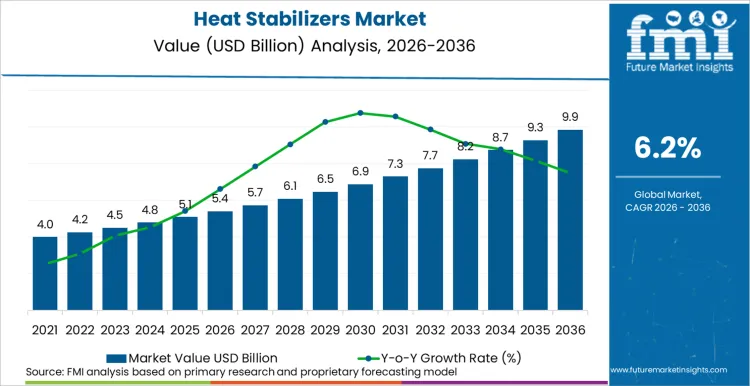
In 2025, the heat stabilizers market was valued at USD 5,120.0 million. Based on Future Market Insights' analysis, demand for heat stabilizers is estimated to grow to USD 5,437.4 million in 2026 and USD 9,876.3 million by 2036. FMI projects a CAGR of 6.2% during the forecast period.
Absolute dollar growth of USD 4,438.8 million over the decade reflects a market expanding on two fronts: the ongoing replacement of legacy lead-based stabilizers with calcium-zinc and organotin alternatives in compliance-driven markets, and the newer demand for stabilizer masterbatches tailored for recycled PVC (https://www.futuremarketinsights.com/reports/pvc-stabilizers-market). Construction sector PVC consumption, particularly pipes, profiles, and window frames, remains the dominant volume driver globally.
Summary of Heat Stabilizers Market
- Heat Stabilizers Market Definition
- The market covers chemical additives that prevent thermal degradation of PVC during processing and end-use, including calcium-zinc, lead-based, tin-based, organic-based, and mixed-metal stabilizer systems used in pipes, profiles, cables, flooring, and packaging.
- Demand Drivers in the Market
- Lead stabilizer phase-out regulations (EU REACH, India BIS) are forcing mandatory migration to Ca-Zn and organic alternatives.
- PVC pipe demand for water infrastructure in Asia Pacific and Middle East is driving base stabilizer volume growth.
- Recycled PVC processing requires higher stabilizer loadings, creating additional demand per tonne of resin processed.
- Key Segments Analyzed in the FMI Report
- Type: Calcium-zinc stabilizers are the fastest-growing segment, lead-based systems are declining under regulatory pressure.
- Application: Pipes and fittings account for the largest share of stabilizer consumption globally.
- Geography: Asia Pacific leads by volume, Europe leads by Ca-Zn adoption rate and regulatory compliance standards.
- Analyst Opinion at FMI
- Principal Consultant at Future Market Insights opines, 'In the updated Heat Stabilizers Market Report for 2026 to 2036, CXOs will find that stabilizer selection is becoming a regulatory compliance and market-access decision. My findings point at the lead-to-Ca-Zn transition and recycled PVC stabilization requirements as the two forces reshaping supplier qualification criteria across the value chain.'
- Strategic Implications/Executive Takeaways
- Accelerate Ca-Zn formulation development to meet EU and India lead phase-out compliance deadlines.
- Build recycled PVC stabilization expertise as circular economy mandates increase recycled content requirements.
- Secure zinc and calcium stearate supply chains to support Ca-Zn volume scale-up.
- Methodology
- Validated through PVC resin production statistics and regulatory compliance timeline databases.
- Zero reliance on speculative third-party market research reports.
- Based on stabilizer consumption ratios, pipe production benchmarks, and chemical industry trade data.
At Plastindia 2026 in February, BASF showcased its Tinuvin light and heat stabilizer portfolio, targeting the durability of agricultural films and marine floats [1]. The exhibition demonstrated how stabilizer formulation is shifting from simple thermal protection to multi-function additive packages that combine UV resistance, thermal stability, and processing aid properties in a single masterbatch. This consolidation of additive functions is reducing converter complexity while increasing per-kilogram stabilizer value.
India (7.8% CAGR) and China (7.2% CAGR) lead growth, underpinned by massive PVC pipe demand for water and sanitation infrastructure (https://www.futuremarketinsights.com/reports/pvc-pipes-market). Brazil (6.5% CAGR) gains from construction sector recovery. The United States (5.8% CAGR) sustains demand through Ca-Zn conversion mandates and recycled PVC processing growth. Germany (5.5% CAGR) and France (5.2% CAGR) contribute through regulatory-driven reformulation toward non-toxic alternatives. Japan (5.0% CAGR) adds through automotive PVC applications.
Heat Stabilizers Market Definition
The heat stabilizers market covers chemical additives used to prevent thermal degradation of polymers, principally PVC, during processing and end-use exposure. Stabilizer types include calcium-zinc (Ca-Zn), organotin, lead-based, mixed metal, and organic-based systems. These additives are formulated as powders, liquids, or masterbatches and are incorporated during compounding to maintain colour stability, mechanical properties, and weathering resistance throughout the product lifecycle.
Heat Stabilizers Market Inclusions
Global and regional sizes by value for 2026 to 2036. Breakdowns by stabilizer type, application, end use, and region. Pricing analysis across Ca-Zn, organotin, and lead-based grades. Regulatory compliance tracking for REACH, RoHS, and national lead-ban timelines.
Heat Stabilizers Market Exclusions
UV stabilizers and antioxidants marketed separately from heat stabilizer packages are excluded unless sold as combined masterbatches. Non-PVC polymer stabilizers (PP, PE thermal stabilizers) are outside scope unless cross-applicable.
Heat Stabilizers Market Research Methodology
Primary Research: Interviews with PVC compounders, stabilizer formulators, pipe and profile extruders, and regulatory compliance specialists.
Desk Research: REACH registered substance data, national lead-ban legislation, plastics industry association production statistics, and trade data from Eurostat and UN Comtrade.
Market-Sizing and Forecasting: Top-down model based on regional PVC consumption volumes and stabilizer loading rates by application, validated against producer shipment data and compounder purchasing records.
Data Validation and Update Cycle: Cross-referenced against ECVM sustainability reports, VinylPlus recycling statistics, and quarterly chemical company earnings.
Key Industry Highlights
Growing Demand for Heat Stabilizers in PVC Applications Across Multiple Industries
The growing demand for PVC products in several sectors is, therefore, considered to have driven the demand for heat stabilizers significantly in construction, automotive, electrical, and healthcare sectors. In most of the versatile polymers, especially PVC, the effectiveness of the heat stabilizer during processing will determine most of the heat stability and thermal resistance during long-term service.
Heat stabilizers are some of the most critical additives that impart durability and good weather ability in PVC products such as pipes, cables, flooring, and medical devices. Infrastructure development and increasing consumption of PVC-based advanced materials across emerging economies drive the heat stabilizers market. Also, some innovation in environmental friendly and high-performance stabilizer formulation has helped boost this demand.
Rising Regulations Promoting Sustainable and Non-Toxic Heat Stabilizers
Stringent regulations regarding environmental protection and the usage of non-toxic additives in polymers drive the demand for sustainable heat stabilizers. The banning or restriction of hazardous substances, such as lead-based stabilizers, by governments and international bodies is one of the major factors that have been forcing the industry toward eco-friendly alternatives like calcium-zinc and organic-based stabilizers.
These sustainable options meet regulatory compliance and also align with growing consumer preferences for safer and greener materials, particularly in sensitive applications like food packaging, medical devices, and toys. This has, in turn, driven the demand for investments in research and development toward developing nontoxic heat stabilizers that meet regulatory compliances.
Technological Innovations and Customizable Heat Stabilizer Solutions Driving Market Growth
Advanced technologies in polymer stabilization have empowered manufacturers to produce highly efficient, application-specific heat stabilizers. These innovations have translated into a wide range of heat stabilizers with superior thermal resistance, flexibility in processing, and compatibility with diverse polymer grades.
Additionally, the growth has been further propelled by an increased trend for the adoption of custom formulation for specific end-use applications. The materials have benefited greatly from this improvement in thermal stability and long-term performance in the automotive and electronics industries. This has driven product differentiation and, at the same time, opens up opportunities for niche players to establish their lead in the marketplace.
Volatility in Raw Material Prices Posing Challenges to Market Growth
Some of the key restraints being witnessed in the growth of the heat stabilizers market include volatility in raw material pricing that immediately influences the production cost and profitability of the stabilizer manufacturers. The essential raw materials involved in their making, such as metals like calcium, zinc, and tin, besides other chemical precursors, also face unstable price dynamics owing to broken supply chains, geopolitical turmoil, and altering market dynamics.
The unpredictable nature of raw material availability and pricing often poses challenges for manufacturers, particularly small and medium enterprises, to maintain competitive pricing while ensuring consistent quality. This price instability can hinder the market's growth trajectory, especially in price-sensitive regions and industries.
2021 to 2025 Global Heat Stabilizers Sales Outlook Compared to Demand Forecast from 2026 to 2035
The demand from construction, automotive, and electronic industries, especially from developing nations where urbanization and industrialization are going at a rapid pace, contributed to a steady growth rate in the heat stabilizers market during 2021 to 2025.
Infrastructural development concentration along with cost-effective alternatives has, in turn, contributed to an unprecedented increase in the consumption of PVC products. The COVID-19 pandemic disrupted supply chains and, on several occasions, stalled industrial production in various areas, acting to put a damper on the growth trajectory of the market.
Moving into 2026 from the period of 2036, the market is likely to enter a period of accelerated growth driven by increased environmental regulations promoting the use of eco-friendly stabilizers, technological advancement allowing superior performance of products, and growing adoption of sustainable polymer solutions.
The demand for heat stabilizers, especially those with a calcium-zinc and organic formulation base, is likely to increase with investment growth in green construction, electric vehicles, and renewable energy installations. Other factors include growth in the expansion of advanced manufacturing sectors and smart infrastructure initiatives all over the globe, adding to market demand, thereby making 2025 to 2035 the period of high growth compared to the steady pace witnessed during 2021 to 2025.
Market Concentration
Tier 1 companies are global majors with comprehensive product portfolios and strong market outreach. Companies included in the Tier 1 category are BASF SE, Clariant AG, and AkzoNobel N.V., attributed to their comprehensive product portfolios, global reach, and decent financial strength to invest in state-of-the-art technologies.
These players make significant investments in R&D to develop state-of-the-art, sustainable heat stabilizers for construction, automobiles, and other packaging applications. Their vast distribution networks and strong customer base afford them a wide lead in maintaining leading positions in key regions.
Tier 2: Well-Established Regional Players with Focused Expertise. Baerlocher GmbH, Arkema S.A., and Adeka Corporation make up the Tier 2 category, which is typified by their focus on regional dominance and their specialized product offerings.
In general, these companies hold prominence in various specific stabilizer technologies, including calcium-zinc and organotin stabilizers, catering to some of the most exacting regulatory requirements of their local markets. While their market reach is not as wide as that of Tier 1 players, they use their technological know-how and strong regional partnerships to sustain growth and expand their market presence.
Tier 3: Niche and Emerging Players with Innovation-Driven Strategies. Galata Chemicals, Songwon Industrial Co., Ltd., Chemson Polymer-Additive AG, and Valtris Specialty Chemicals are part of Tier 3, focusing on niche markets and emerging applications. These companies generally emphasize eco-friendly and customized solutions for customers, hence making them indispensable suppliers for certain industries.
Although they lack the scale of Tier 1 and Tier 2 players, their ability to be more agile in responding to market trends and changing customer demands enables them to establish competitive positions in the market for heat stabilizers.
Country-wise Insights
The section below covers the industry analysis for the Heat Stabilizers market for different countries. The market demand analysis on key countries in several countries of the globe, including USA, Germany, France, China and Japan are provided.
The united states are expected to remains at the forefront in North America, with a value share of 65.5% in 2026. In South Asia & Pacific, India is projected to witness a CAGR of 6.9% during the forecasted period.
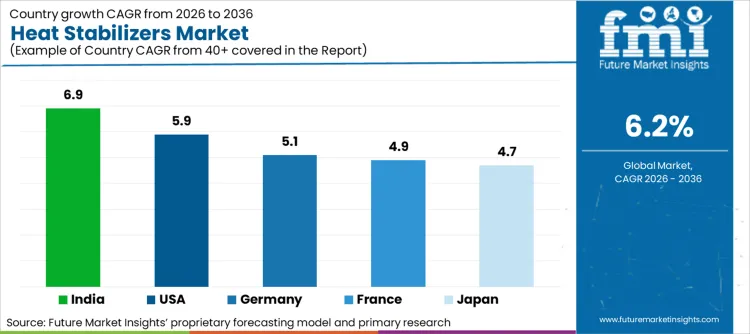
| Countries | Value CAGR (2026 to 2036) |
|---|---|
| USA | 5.9% |
| Germany | 5.1% |
| France | 4.9% |
| India | 6.9% |
| Japan | 4.7% |
The United States Has Established Industrial Base and Regulatory Trends Driving Growth in the Heat Stabilizers Market
The mature industrial landscape of the United States propels the demand for the heat stabilizers market, along with evolving regulatory frameworks that favor sustainability. Owing to its strong manufacturing base for industries such as construction, automotive, packaging, and consumer goods, the demand for PVC products stabilized with heat stabilizers is also high. This factor creates a demand for heat stabilizers.
Agencies such as the EPA regulate product formulations that now call for greener and non-toxic variants of stabilizers, such as calcium-zinc stabilizers. Apart from this, with the advancement in infrastructure projects under federal funding and ever-growing renewable energy sector, heat stabilizers also find applications in manufacturing energy-efficient and weather-resistant materials, thereby continuing the growth in the market without interruptions.
Italy is Flourishing Plastics Sector and Sustainability Priorities Supporting Heat Stabilizers Market Expansion
The heat stabilizers market in Italy benefits from its leading position in European plastics and PVC processing industries, primarily for building materials, automotive components, and consumer goods. The commitment of the country to stay within the tight EU regulations on environmental sustainability governs the movement toward the application of lead-free and sustainable stabilizers, such as organotin and calcium-based products.
Innovation in Italy is fostered with its industrial machinery capabilities, which further support the production and application of advanced stabilizers. Additionally, the country's export-oriented economy, built on high-quality manufacturing, demands the utilization of dependable stabilizers that comply with the international standards necessary for the rapid development of such markets.
Rapid Urbanization, Infrastructure Development, and Regulatory Shifts in India Fueling Growth in the Heat Stabilizers Market
Due to rapid urbanization, a booming construction industry, and an increased demand for long-lasting plastic goods, the Indian heat stabilizers market is emerging as one of the important players in the global market. The ambitious infrastructure plans of the government, such as Smart Cities Mission and the housing development programs, boost demand for PVC pipes, cables, and profiles, which depend largely on the consumption of heat stabilizers.
In addition, the rapid pace of the middle-class population of India is attracting demand for consumer goods, packaging, and automotive. The regulatory measures to reduce consumption of lead-based stabilizers and emergence of local manufacturing under "Make in India" initiative compels producers for innovation and usage of sustainable stabilizers, which ensures the long-term growth for the market.
Category-wise Insights
The section contains information about the leading segments in the Heat Stabilizers industry. By Application, the Polyester Resins segment is estimated to grow at a CAGR of 7.1% during the forecasted period. moreover, by Type, the Metallic Heat Stabilizers segment has holding the share of 58.9% in 2024.
Metallic Heat Stabilizers is Dominating the Type Segment in the Heat Stabilizers Market
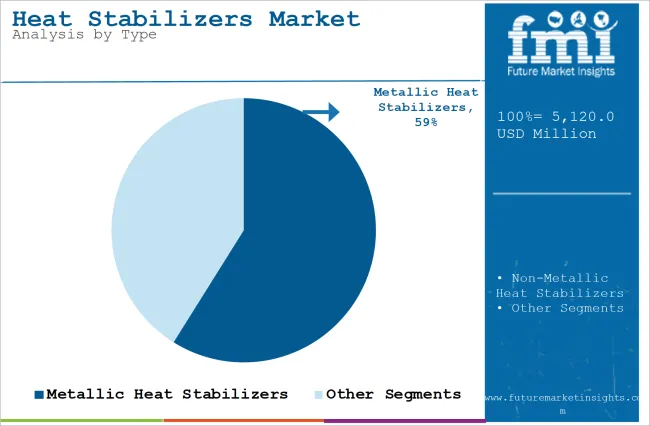
| By Type | Share (2025) |
|---|---|
| Metallic Heat Stabilizers | 58.9% |
In the Heat Stabilizers market, DLP is leading due to its quality images, reliability, and flexibility. DLP technology uses microscopic mirrors reflecting crisp, vibrant images to be used highly and frequently in education and corporate applications. It is a technology that has made sure high contrast ratios and minimum pixilation deliver an immersive viewing experience, hence ideal for interactive installations.
DLP projectors are also dust- and debris-resistant due to their lightweight and compact design, which adds to durability and reduces maintenance costs, thus encouraging wider usage.
Polyester Resins is Growing at the Highest CAGR in the Application Segment
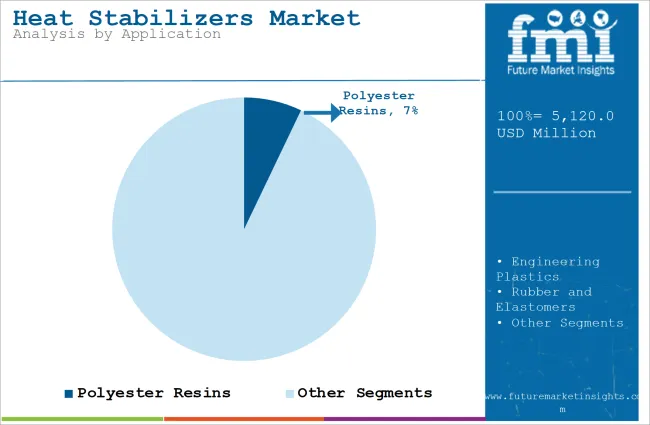
| By Application | CAGR (2026 to 2036) |
|---|---|
| Polyester Resins | 7.1% |
The polyester resins segment holds the highest CAGR in the heat stabilizers market because of its increasing demand from construction, automotive, and electronics industries. Polyester resins find wide application in areas that require high heat resistance, durability, and chemical stability; hence, heat stabilizers become vital in maintaining performance under extreme conditions.
The increased use of reinforced composites and coatings in various automotive and construction projects, especially in developing economies, has spurred the demand for heat stabilizers in polyester resins. Also, the movement of industries towards lightweight and durable materials is further driving this segment during the forecast period.
Competitive Landscape
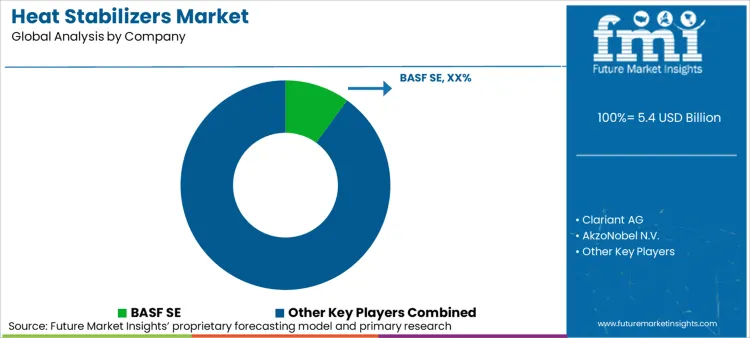
The competitive landscape of the heat stabilizers market is a blend of well-established global players and regional manufacturers attempting to meet the diversified demand for various industries.
The key companies operating in the market include Baerlocher GmbH, Clariant AG, BASF SE, PMC Group, and Songwon Industrial Co., Ltd.; most of these companies have extensive product portfolios and are focused on lead-free and sustainable stabilizer solutions as per the demand for fulfilling strict environmental regulations. These companies are investing heavily in R&D to develop high-performance stabilizers for PVC and engineering plastics.
Regional players, especially in the Asia-Pacific region, are finding a niche by offering cost-effective and customized solutions for emerging markets. Competition Strategies: The competitors in the segment adopt strategic partnerships, acquisitions, and geographic expansions with the intent of strengthening their presence in the market and hold growth opportunities in construction, automotive, and packaging applications.
Recent Developments:
- In February 2026, BASF showcased Tinuvin light and heat stabilizer portfolio at Plastindia 2026, targeting agricultural films and marine floats [1].
- In February 2026, BASF introduced Irgastab Cable KV 10, a thermal stabilizer for medium and high-voltage cable insulation providing scorch protection [2].
- In August 2025, Clariant commissioned a second production line for Nylostab S-EED stabilizer at its Cangzhou, China facility to meet surging Asian demand [3].
- In February 2025, the Indian Government allocated USD 157.7 million to enhance production of specialized materials including those for heat-treated EV components [4].
- In January 2025, organotin stabilizer costs spiked due to tin ore disruptions in Myanmar and Indonesia, prompting PVC converters to accelerate Ca-Zn transition [5].
Key Players of Heat Stabilizers Industry
- BASF SE
- Clariant AG
- AkzoNobel N.V.
- Arkema S.A.
- Baerlocher GmbH
- Galata Chemicals
- Adeka Corporation
- Songwon Industrial Co., Ltd.
- Chemson Polymer-Additive AG
- Valtris Specialty Chemicals
Scope of the Report
| Metric | Value |
|---|---|
| Quantitative Units | USD 5,437.4 million (2026) to USD 9,876.3 million (2036), at a CAGR of 6.2% |
| Type Segmentation | Calcium-Zinc, Organotin, Lead-Based, Mixed Metal, Organic-Based, Others |
| Application Segmentation | Pipes and Fittings, Profiles and Cables, Films, Coatings, Others |
| End Use Segmentation | Building and Construction, Automotive, Packaging, Electrical and Electronics, Agriculture, Others |
| Key Companies | Clariant, BASF SE, Baerlocher, Galata Chemicals, Reagens, Songwon Industrial, Adeka Corporation, PMC Group, Valtris Specialty Chemicals, Akcros Chemicals |
| Forecast Period | 2026 to 2036 |
Key Segments of Heat Stabilizers Industry
By Type:
In terms of Type is segregated Metallic Heat Stabilizers and Non-Metallic Heat Stabilizers.
By Application:
In terms of Application, is distributed into Polyvinyl Chloride (PVC) Products, Engineering, Plastics Rubber and Elastomers and Polyester Resins.
By End-Use Industry:
In terms of End-Use Industry, is segregated Construction, Electrical and Electronics, Automotive, Packaging, Consumer Goods and Agriculture.
By Region:
Key countries of North America, Latin America, Western Europe, Eastern Europe, East Asia, South Asia & pacific, Middle East and Africa (MEA) have been covered in the report.
Bibliography
- [1] BASF SE. Tinuvin Portfolio at Plastindia 2026. February 2026. https://www.global-agriculture.com/global-agriculture/at-plastindia-2026-basf-showcases-how-light-stabilizers-extend-the-durability-of-plastics-across-industries/
- [2] BASF SE. Irgastab Cable KV 10 Launch. February 2026. https://www.basf.com
- [3] Clariant. Nylostab S-EED Cangzhou Expansion. August 2025. https://www.indianchemicalnews.com/chemical/clariant-expands-stabilizer-production-and-applications-for-plastics-industry-27046
- [4] Government of India. Specialized Materials Production Allocation. February 2025.
- [5] Industry Reports. Organotin Price Spike Analysis. January 2025.
- [6] ECHA. REACH Registered Substances: PVC Stabilizers. 2025. https://echa.europa.eu
- [7] VinylPlus. Progress Report on PVC Recycling. 2025. https://www.vinylplus.eu
- [8] Future Market Insights. PVC Stabilizers Market. https://www.futuremarketinsights.com/reports/pvc-stabilizers-market
- [9] Future Market Insights. PVC Pipes Market. https://www.futuremarketinsights.com/reports/pvc-pipes-market
- [10] Future Market Insights. Plastic Additives Market. https://www.futuremarketinsights.com/reports/plastic-additives-market
- [11] European Council of Vinyl Manufacturers. PVC Production Statistics. 2025. https://www.pvc.org
- [12] Songwon Industrial. Annual Report 2025. https://www.songwon.com
This Report Addresses
- Market intelligence across Ca-Zn, organotin, lead-based, and organic stabilizer segments
- 10-year forecasts from 2026 to 2036
- Regulatory transition tracking: lead phase-out timelines, REACH, RoHS compliance
- Competition assessment including formulation IP, compounder lock-in, and raw material sourcing
- Recycled PVC stabilizer demand analysis aligned with VinylPlus and circular economy mandates
- Regional forecasts across construction, automotive, and packaging PVC applications
- Raw material price tracking: tin ore, zinc, calcium stearate supply chains
- Report delivery in PDF, Excel, PPT, and interactive dashboard formats
Frequently Asked Questions
Market size in 2026?
USD 5,437.4 million.
Market size by 2036?
USD 9,876.3 million.
CAGR?
6.2%.
Leading Type?
Calcium-zinc stabilizers are the fastest-growing segment.
Largest end use?
Building and construction, driven by PVC pipe and profile demand.
Preview the report firsthand - request a free sample
Get SampleGet the brochure for pricing and purchase details.
Get PDFTable of Content
- Executive Summary
- Global Market Outlook
- Demand-side Trends
- Supply-side Trends
- Technology Roadmap Analysis
- Analysis and Recommendations
- Market Overview
- Market Coverage / Taxonomy
- Market Definition / Scope / Limitations
- Research Methodology
- Chapter Orientation
- Analytical Lens and Working Hypotheses
- Market Structure, Signals, and Trend Drivers
- Benchmarking and Cross-market Comparability
- Market Sizing, Forecasting, and Opportunity Mapping
- Research Design and Evidence Framework
- Desk Research Programme (Secondary Evidence)
- Company Annual and Sustainability Reports
- Peer-reviewed Journals and Academic Literature
- Corporate Websites, Product Literature, and Technical Notes
- Earnings Decks and Investor Briefings
- Statutory Filings and Regulatory Disclosures
- Technical White Papers and Standards Notes
- Trade Journals, Industry Magazines, and Analyst Briefs
- Conference Proceedings, Webinars, and Seminar Materials
- Government Statistics Portals and Public Data Releases
- Press Releases and Reputable Media Coverage
- Specialist Newsletters and Curated Briefings
- Sector Databases and Reference Repositories
- FMI Internal Proprietary Databases and Historical Market Datasets
- Subscription Datasets and Paid Sources
- Social Channels, Communities, and Digital Listening Inputs
- Additional Desk Sources
- Expert Input and Fieldwork (Primary Evidence)
- Primary Modes
- Qualitative Interviews and Expert Elicitation
- Quantitative Surveys and Structured Data Capture
- Blended Approach
- Why Primary Evidence is Used
- Field Techniques
- Interviews
- Surveys
- Focus Groups
- Observational and In-context Research
- Social and Community Interactions
- Stakeholder Universe Engaged
- C-suite Leaders
- Board Members
- Presidents and Vice Presidents
- R&D and Innovation Heads
- Technical Specialists
- Domain Subject-matter Experts
- Scientists
- Physicians and Other Healthcare Professionals
- Governance, Ethics, and Data Stewardship
- Research Ethics
- Data Integrity and Handling
- Primary Modes
- Tooling, Models, and Reference Databases
- Desk Research Programme (Secondary Evidence)
- Data Engineering and Model Build
- Data Acquisition and Ingestion
- Cleaning, Normalisation, and Verification
- Synthesis, Triangulation, and Analysis
- Quality Assurance and Audit Trail
- Market Background
- Market Dynamics
- Drivers
- Restraints
- Opportunity
- Trends
- Scenario Forecast
- Demand in Optimistic Scenario
- Demand in Likely Scenario
- Demand in Conservative Scenario
- Opportunity Map Analysis
- Product Life Cycle Analysis
- Supply Chain Analysis
- Investment Feasibility Matrix
- Value Chain Analysis
- PESTLE and Porter’s Analysis
- Regulatory Landscape
- Regional Parent Market Outlook
- Production and Consumption Statistics
- Import and Export Statistics
- Market Dynamics
- Global Market Analysis 2021 to 2025 and Forecast, 2026 to 2036
- Historical Market Size Value (USD Million) Analysis, 2021 to 2025
- Current and Future Market Size Value (USD Million) Projections, 2026 to 2036
- Y-o-Y Growth Trend Analysis
- Absolute $ Opportunity Analysis
- Global Market Pricing Analysis 2021 to 2025 and Forecast 2026 to 2036
- Global Market Analysis 2021 to 2025 and Forecast 2026 to 2036, By Type
- Introduction / Key Findings
- Historical Market Size Value (USD Million) Analysis By Type , 2021 to 2025
- Current and Future Market Size Value (USD Million) Analysis and Forecast By Type , 2026 to 2036
- Metallic Heat Stabilizers
- Non-Metallic Heat Stabilizers
- Metallic Heat Stabilizers
- Y-o-Y Growth Trend Analysis By Type , 2021 to 2025
- Absolute $ Opportunity Analysis By Type , 2026 to 2036
- Global Market Analysis 2021 to 2025 and Forecast 2026 to 2036, By Application
- Introduction / Key Findings
- Historical Market Size Value (USD Million) Analysis By Application, 2021 to 2025
- Current and Future Market Size Value (USD Million) Analysis and Forecast By Application, 2026 to 2036
- Polyvinyl Chloride (PVC) Products
- Engineering Plastics
- Rubber and Elastomers
- Polyester Resins
- Polyvinyl Chloride (PVC) Products
- Y-o-Y Growth Trend Analysis By Application, 2021 to 2025
- Absolute $ Opportunity Analysis By Application, 2026 to 2036
- Global Market Analysis 2021 to 2025 and Forecast 2026 to 2036, By Region
- Introduction
- Historical Market Size Value (USD Million) Analysis By Region, 2021 to 2025
- Current Market Size Value (USD Million) Analysis and Forecast By Region, 2026 to 2036
- North America
- Latin America
- Western Europe
- Eastern Europe
- East Asia
- South Asia and Pacific
- Middle East & Africa
- Market Attractiveness Analysis By Region
- North America Market Analysis 2021 to 2025 and Forecast 2026 to 2036, By Country
- Historical Market Size Value (USD Million) Trend Analysis By Market Taxonomy, 2021 to 2025
- Market Size Value (USD Million) Forecast By Market Taxonomy, 2026 to 2036
- By Country
- USA
- Canada
- Mexico
- By Type
- By Application
- By Country
- Market Attractiveness Analysis
- By Country
- By Type
- By Application
- Key Takeaways
- Latin America Market Analysis 2021 to 2025 and Forecast 2026 to 2036, By Country
- Historical Market Size Value (USD Million) Trend Analysis By Market Taxonomy, 2021 to 2025
- Market Size Value (USD Million) Forecast By Market Taxonomy, 2026 to 2036
- By Country
- Brazil
- Chile
- Rest of Latin America
- By Type
- By Application
- By Country
- Market Attractiveness Analysis
- By Country
- By Type
- By Application
- Key Takeaways
- Western Europe Market Analysis 2021 to 2025 and Forecast 2026 to 2036, By Country
- Historical Market Size Value (USD Million) Trend Analysis By Market Taxonomy, 2021 to 2025
- Market Size Value (USD Million) Forecast By Market Taxonomy, 2026 to 2036
- By Country
- Germany
- UK
- Italy
- Spain
- France
- Nordic
- BENELUX
- Rest of Western Europe
- By Type
- By Application
- By Country
- Market Attractiveness Analysis
- By Country
- By Type
- By Application
- Key Takeaways
- Eastern Europe Market Analysis 2021 to 2025 and Forecast 2026 to 2036, By Country
- Historical Market Size Value (USD Million) Trend Analysis By Market Taxonomy, 2021 to 2025
- Market Size Value (USD Million) Forecast By Market Taxonomy, 2026 to 2036
- By Country
- Russia
- Poland
- Hungary
- Balkan & Baltic
- Rest of Eastern Europe
- By Type
- By Application
- By Country
- Market Attractiveness Analysis
- By Country
- By Type
- By Application
- Key Takeaways
- East Asia Market Analysis 2021 to 2025 and Forecast 2026 to 2036, By Country
- Historical Market Size Value (USD Million) Trend Analysis By Market Taxonomy, 2021 to 2025
- Market Size Value (USD Million) Forecast By Market Taxonomy, 2026 to 2036
- By Country
- China
- Japan
- South Korea
- By Type
- By Application
- By Country
- Market Attractiveness Analysis
- By Country
- By Type
- By Application
- Key Takeaways
- South Asia and Pacific Market Analysis 2021 to 2025 and Forecast 2026 to 2036, By Country
- Historical Market Size Value (USD Million) Trend Analysis By Market Taxonomy, 2021 to 2025
- Market Size Value (USD Million) Forecast By Market Taxonomy, 2026 to 2036
- By Country
- India
- ASEAN
- Australia & New Zealand
- Rest of South Asia and Pacific
- By Type
- By Application
- By Country
- Market Attractiveness Analysis
- By Country
- By Type
- By Application
- Key Takeaways
- Middle East & Africa Market Analysis 2021 to 2025 and Forecast 2026 to 2036, By Country
- Historical Market Size Value (USD Million) Trend Analysis By Market Taxonomy, 2021 to 2025
- Market Size Value (USD Million) Forecast By Market Taxonomy, 2026 to 2036
- By Country
- Kingdom of Saudi Arabia
- Other GCC Countries
- Turkiye
- South Africa
- Other African Union
- Rest of Middle East & Africa
- By Type
- By Application
- By Country
- Market Attractiveness Analysis
- By Country
- By Type
- By Application
- Key Takeaways
- Key Countries Market Analysis
- USA
- Pricing Analysis
- Market Share Analysis, 2025
- By Type
- By Application
- Canada
- Pricing Analysis
- Market Share Analysis, 2025
- By Type
- By Application
- Mexico
- Pricing Analysis
- Market Share Analysis, 2025
- By Type
- By Application
- Brazil
- Pricing Analysis
- Market Share Analysis, 2025
- By Type
- By Application
- Chile
- Pricing Analysis
- Market Share Analysis, 2025
- By Type
- By Application
- Germany
- Pricing Analysis
- Market Share Analysis, 2025
- By Type
- By Application
- UK
- Pricing Analysis
- Market Share Analysis, 2025
- By Type
- By Application
- Italy
- Pricing Analysis
- Market Share Analysis, 2025
- By Type
- By Application
- Spain
- Pricing Analysis
- Market Share Analysis, 2025
- By Type
- By Application
- France
- Pricing Analysis
- Market Share Analysis, 2025
- By Type
- By Application
- India
- Pricing Analysis
- Market Share Analysis, 2025
- By Type
- By Application
- ASEAN
- Pricing Analysis
- Market Share Analysis, 2025
- By Type
- By Application
- Australia & New Zealand
- Pricing Analysis
- Market Share Analysis, 2025
- By Type
- By Application
- China
- Pricing Analysis
- Market Share Analysis, 2025
- By Type
- By Application
- Japan
- Pricing Analysis
- Market Share Analysis, 2025
- By Type
- By Application
- South Korea
- Pricing Analysis
- Market Share Analysis, 2025
- By Type
- By Application
- Russia
- Pricing Analysis
- Market Share Analysis, 2025
- By Type
- By Application
- Poland
- Pricing Analysis
- Market Share Analysis, 2025
- By Type
- By Application
- Hungary
- Pricing Analysis
- Market Share Analysis, 2025
- By Type
- By Application
- Kingdom of Saudi Arabia
- Pricing Analysis
- Market Share Analysis, 2025
- By Type
- By Application
- Turkiye
- Pricing Analysis
- Market Share Analysis, 2025
- By Type
- By Application
- South Africa
- Pricing Analysis
- Market Share Analysis, 2025
- By Type
- By Application
- USA
- Market Structure Analysis
- Competition Dashboard
- Competition Benchmarking
- Market Share Analysis of Top Players
- By Regional
- By Type
- By Application
- Competition Analysis
- Competition Deep Dive
- BASF SE
- Overview
- Product Portfolio
- Profitability by Market Segments (Product/Age /Sales Channel/Region)
- Sales Footprint
- Strategy Overview
- Marketing Strategy
- Product Strategy
- Channel Strategy
- Clariant AG
- AkzoNobel N.V.
- Arkema S.A.
- Baerlocher GmbH
- Galata Chemicals
- Adeka Corporation
- BASF SE
- Competition Deep Dive
- Assumptions & Acronyms Used


