

- Industry Size (2026)
- USD 75.3 Bn
- Forecast (2036)
- USD 107.8 Bn
- CAGR (2026 to 2036)
- 3.6%
Polyvinyl Chloride Market Size, Market Forecast and Outlook By FMI
In 2025, the polyvinyl chloride market was valued at USD 70.2 billion. Based on Future Market Insights' analysis, demand for PVC is estimated to reach USD 75.3 billion in 2026 and USD 100.1 billion by 2034, before rising further to approximately USD 107.8 billion by 2036. This trajectory reflects a CAGR of 3.6% during the forecast period [1].
Absolute dollar growth of more than USD 32.5 billion between 2026 and 2036 signals a market expanding at a steady pace, underpinned by sustained demand from global construction activity and infrastructure development. This value uplift reflects volume growth in established applications rather than significant price appreciation, as PVC remains a cost-competitive material versus alternatives including metals, wood, and other polymers.
Summary of Polyvinyl Chloride Market
- Demand Drivers in the Market:
- Global construction activity, where PVC pipes, fittings, profiles, and flooring are specified for durability, cost-effectiveness, and ease of installation in residential, commercial, and infrastructure projects [2].
- Infrastructure investment in water management, including potable water distribution, sewage systems, and irrigation networks, which consume substantial volumes of PVC pipe for its corrosion resistance and long service life [3].
- Manufacturing sector demand for PVC in automotive components, wire and cable insulation, medical devices, and packaging films, leveraging the material's versatility and processing advantages [4].
- Key Segments Analyzed in the FMI Report:
- Product Type: Rigid PVC, which accounts for the majority of consumption driven by pipe and profile applications, with flexible PVC serving cable, flooring, and medical applications through plasticizer incorporation.
- Application: Pipes & Fittings, representing the largest application segment due to PVC's dominance in water and drainage systems globally.
- End-use Industry: Construction, capturing the highest share as the primary consumer across multiple PVC applications including pipes, profiles, flooring, and cables.
- Analyst Opinion at FMI:
- Nikhil Kaitwade, principal consultant for Chemicals & Materials at Future Market Insights states, "In the updated PVC Market Report, procurement specialists and product developers will observe how regional construction cycles and infrastructure spending patterns determine demand trajectories more than material substitution dynamics. PVC's cost position relative to alternatives remains the primary specification driver in volume applications, with sustainability considerations increasingly influencing formulation choices in regulated markets."
- Strategic Implications/Executive Takeaways:
- Prioritize production locations with access to ethylene and chlorine feedstock at competitive costs, as feedstock position determines profitability in commodity PVC markets where pricing is largely set by supply-demand balances.
- Align product portfolios with construction sector requirements by developing PVC formulations optimized for specific applications, pressure pipe grades, window profile compounds, and flooring formulations, that meet regional performance standards.
- Build recycling capabilities and sustainable PVC offerings to address regulatory pressure and customer sustainability commitments, particularly in Europe and North America where circular economy initiatives are advancing.
- Methodology:
- The market view is grounded in primary input from construction material buyers, pipe manufacturers, and PVC producers, and in technical and policy sources focused on construction materials, polymer science, and chemical industry economics, avoiding reliance on secondary market research reports from competing providers.
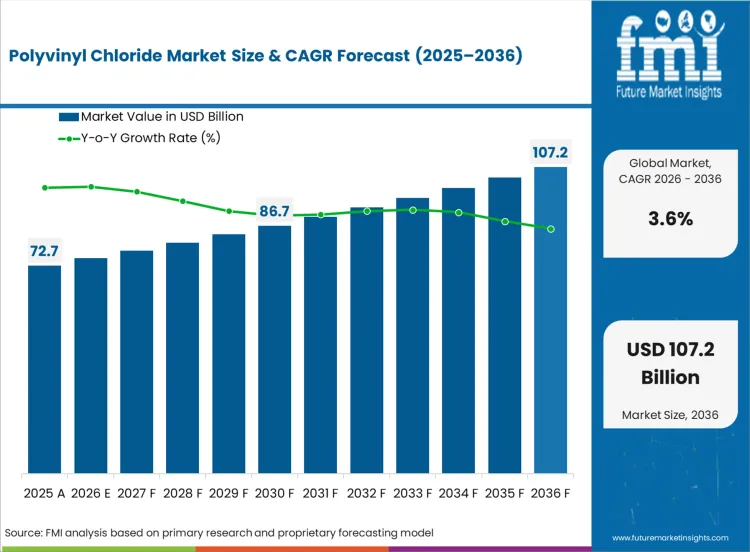
North America, Europe, and Asia-Pacific account for the bulk of incremental revenues through 2036, but the underlying demand logic is distinct in each region. In North America, infrastructure renewal and residential construction drive PVC consumption in pipes, fittings, and profiles. In Europe, building renovation and automotive applications maintain steady demand, with increasing focus on sustainable PVC formulations. Across Asia-Pacific, rapid urbanization, industrial expansion, and manufacturing growth generate the highest volume increases, with China and India as primary demand centers.
Polyvinyl Chloride Market Definition
Polyvinyl chloride is a synthetic thermoplastic polymer produced by polymerization of vinyl chloride monomer, available in rigid and flexible formulations through incorporation of plasticizers and additives. For this report, the market covers PVC resins and compounds used in pipes and fittings, window profiles, flooring, cables, films, sheets, and medical devices across construction, automotive, electrical, healthcare, and packaging applications.
Polyvinyl Chloride Market Inclusions
The report provides a comprehensive analysis of the PVC market, covering global and regional market sizes in value terms and a 10-year forecast from 2026 to 2036. It includes segmental breakdowns by product type, application, and end-use industry, across core regions including North America, Latin America, Western Europe, Eastern Europe, East Asia, South Asia & Pacific, and the Middle East & Africa.
Polyvinyl Chloride Market Exclusions
The scope excludes vinyl chloride monomer sold in isolation, as well as PVC recyclate traded as scrap material rather than finished resin. It also omits chlorinated polyvinyl chloride (CPVC) where the differentiated properties and applications warrant separate market analysis. Very low-volume, custom-formulated PVC compounds for specialized applications that do not contribute meaningfully to global revenue pools are likewise outside the quantified scope.
Polyvinyl Chloride Market Research Methodology
- Primary research: Structured interviews were conducted with procurement managers in construction companies, pipe manufacturers, automotive suppliers, and medical device producers, alongside PVC resin producers and compounders on capacity utilization, pricing dynamics, and regional supply-demand balances.
- Desk research: Technical documentation and application guides from major PVC manufacturers, together with industry publications on polymer science and end-use sector trends, were assessed to benchmark performance characteristics and to align market modeling with the latest data on construction activity and industrial production.
- Market-sizing and forecasting: A hybrid top-down and bottom-up modeling framework was applied, reconstructing PVC demand from construction spending, pipe and profile production volumes, automotive manufacturing data, and per-capita consumption patterns, then validating outputs against publicly available commentary from leading manufacturers on sales trends and regional market dynamics.
- Data validation and update cycle: Model outputs undergo consistency checks across regions, product types, and applications, with iterative calibration using new construction data, infrastructure project pipelines, and emerging regulatory developments to ensure that the forecast reflects the latest structural drivers.
Segment Analysis
Polyvinyl Chloride Market Analysis by Product Type
Based on FMI's PVC market assessment, Rigid PVC constitutes the majority of global consumption, driven by its dominance in pipe and profile applications where stiffness and structural integrity are required. Unplasticized PVC formulations provide chemical resistance, weatherability, and mechanical strength for pressure pipes, window frames, and siding [5].
Flexible PVC maintains significant volume through incorporation of plasticizers that impart flexibility for cables, flooring, medical tubing, and films. The flexibility range can be tuned through plasticizer type and concentration, enabling applications from semi-rigid profiles to highly flexible sheets. Plasticizer selection increasingly reflects regulatory pressure on phthalate-based formulations, driving development of alternative plasticizer systems [6].
Polyvinyl Chloride Market Analysis by Application
Pipes & Fittings represent the largest application segment for PVC, reflecting the material's near-ubiquitous use in water supply, drainage, sewerage, irrigation, and industrial piping systems. PVC pipe's corrosion resistance, smooth interior surfaces reducing friction losses, and long service life provide compelling value versus metal, concrete, and other alternatives [7].
Profiles & Tubing applications include window frames, door profiles, siding, and conduit, consuming significant volumes in construction. Films & Sheets serve packaging, stationery, and protective covering applications. Cables consume PVC for insulation and sheathing in power distribution, communications, and automotive wiring. Flooring applications include residential and commercial vinyl flooring, benefiting from durability and ease of maintenance. Medical applications include tubing, blood bags, and masks, requiring specialized grades meeting biocompatibility standards.
Polyvinyl Chloride Market Analysis by End-use Industry
Construction represents the largest end-use industry for PVC, consuming the material across multiple applications including pipes, profiles, flooring, cables, and membranes. The sector's dominance reflects both the volume of construction activity globally and PVC's extensive specification within buildings and infrastructure [8].
Automotive applications include interior trim, underbody coatings, wire harnesses, and seals, benefiting from PVC's durability and cost position. Electrical & Electronics consume PVC in wire and cable insulation, conduit, and equipment housings. Healthcare applications include medical devices, tubing, and packaging, requiring grades meeting regulatory standards. Packaging includes films, blister packs, and closures, competing with other polymers in this applications.
Polyvinyl Chloride Market Drivers, Restraints, Opportunities and Trends
Drivers
Urbanization and infrastructure investment
Global urbanization trends drive construction of housing, commercial buildings, and municipal infrastructure, all intensive consumers of PVC pipe, profiles, and related products. Developing economies' investments in water and sanitation systems create particular demand for PVC pipe as a cost-effective solution for expanding service coverage [9].
Replacement and renovation demand
In mature markets, aging water infrastructure requires replacement, with PVC specified for its corrosion resistance and long service life. Building renovation activity generates demand for PVC window profiles, flooring, and piping systems. These replacement cycles provide stable demand independent of new construction volatility [10].
Cost advantage versus alternatives
PVC's position as a low-cost material relative to metals, wood, and competing polymers drives specification in price-sensitive applications. In pipe applications, PVC provides installed cost advantages through lighter weight, easier joining, and longer service life. In profiles, PVC offers weatherability and low maintenance versus painted wood or aluminum.
Restraints
Feedstock price volatility
PVC production depends on ethylene and chlorine, with ethylene derived from oil or natural gas feedstocks. Fluctuations in energy and feedstock prices directly affect PVC production costs and profitability. Periods of high feedstock costs can compress margins when PVC selling prices cannot fully pass through increases [11].
Environmental and regulatory pressure
PVC faces regulatory scrutiny regarding chlorine chemistry, plasticizer migration, and end-of-life disposal. Concerns about phthalate plasticizers have driven restrictions in sensitive applications including toys and medical devices. Dioxin formation during improper combustion creates disposal challenges. These factors can lead to specification avoidance in environmentally sensitive projects [12].
Opportunities
Sustainable PVC formulations
Development of bio-based plasticizers, lead-free stabilizers, and recycled content PVC addresses regulatory pressure and customer sustainability requirements. PVC recycling technologies, including mechanical recycling of post-consumer pipe and profile waste, enable circular economy positioning. Manufacturers investing in certified recycled content gain preference in green building projects [13].
PVC in renewable energy infrastructure
Emerging applications in solar panel frames, wind turbine components, and energy storage systems create new demand vectors. PVC's weatherability and cost position make it suitable for certain renewable energy balance-of-system components, potentially offsetting slower growth in traditional applications.
Regional Analysis
.webp "Top Country Growth Comparison Polyvinyl Chloride Market Cagr (2026 2036)")
| Countries | Value CAGR (2026 to 2036) |
|---|---|
| United States | 4.2% |
| Germany | 3.8% |
| Russia | 3.1% |
| Italy | 2.8% |
| Canada | 2.7% |
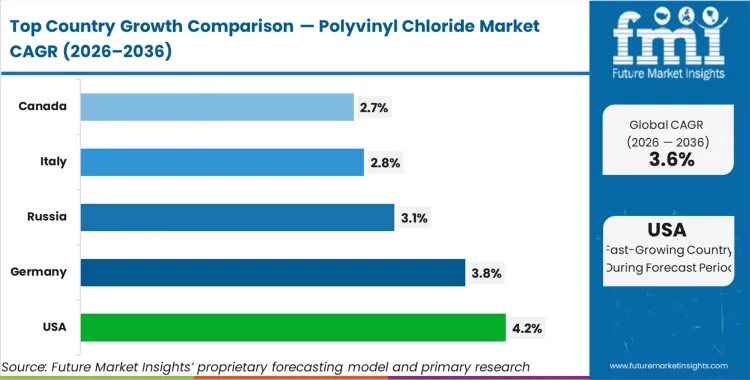
Source: Future Market Insights analysis, supported by a proprietary forecasting model and primary research
United States
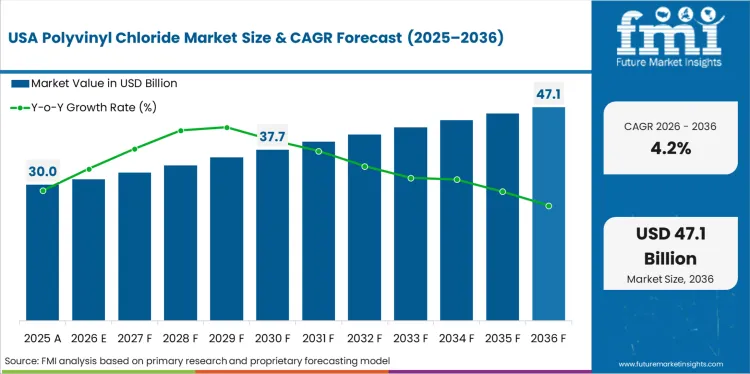
The United States PVC market is projected to grow at a 4.2% CAGR from 2026 to 2036, the highest among key countries. Growth is driven by infrastructure investment under the Bipartisan Infrastructure Law, including water system upgrades and transportation projects. Residential construction activity, though cyclical, supports pipe and profile demand. Access to low-cost natural gas feedstock for ethylene production provides competitive advantage for domestic producers [14].
Germany
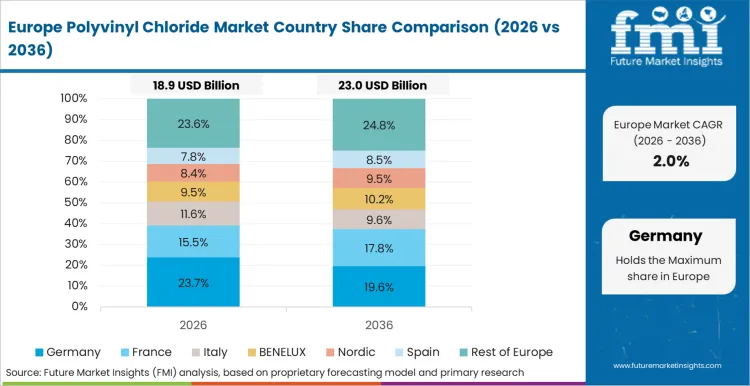
Germany's PVC market is expected to grow at a 3.8% CAGR from 2026 to 2036. The country's robust manufacturing sector, particularly automotive and industrial equipment, generates steady demand. Building renovation activity under energy efficiency programs drives window profile consumption.
Strong emphasis on recycling and circular economy positions German producers for sustainable PVC development. Research and development focus on innovative formulations and processing technologies maintains technical leadership [15].
Russia
Russia's PVC market is forecast to grow at a 3.1% CAGR from 2026 to 2036. Construction activity in major urban centers, particularly Moscow and St. Petersburg, drives pipe and profile demand. Infrastructure development including water systems and transportation projects adds consumption.
Domestic production capacity expansions aim to reduce import dependence, though technology access may be constrained by sanctions. Economic cycles affecting construction investment influence growth patterns.
Italy
Italy's PVC market is projected to grow at a 2.8% CAGR from 2026 to 2036. Construction sector activity, including residential building and renovation, supports pipe and profile consumption. Manufacturing industries including automotive and consumer goods consume PVC in components and packaging. The country's position in European building product markets provides export opportunities for Italian PVC processors.
Canada
Canada's PVC market is expected to grow at a 2.7% CAGR from 2026 to 2036. Resource sector activity, including oil and gas development, generates industrial pipe demand. Residential construction in major urban centers supports profile and flooring consumption. Infrastructure investment, particularly in water and wastewater systems, adds pipe demand. Access to domestic ethylene production from Alberta's petrochemical industry provides feedstock cost advantages.
Competitive Aligners for Market Players
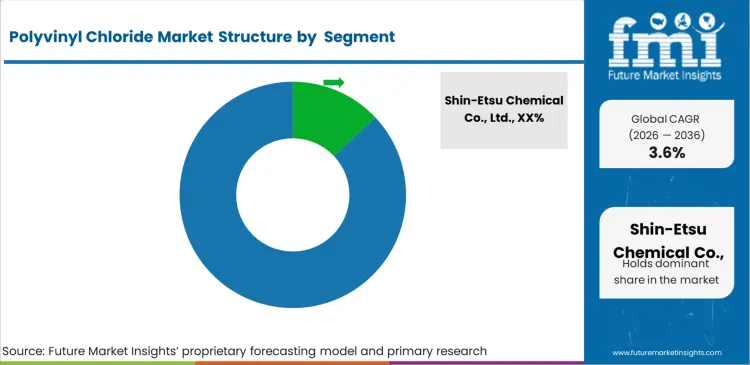
The PVC market features a mix of global integrated chemical manufacturers and regional producers with access to feedstock and downstream markets. Competitive positioning hinges on vinyl chloride monomer integration, production scale, feedstock cost position, and relationships with large-volume pipe and profile fabricators.
Leading players such as Shin-Etsu Chemical, Formosa Plastics, Westlake Chemical, and INEOS leverage their integrated production from ethylene and chlorine through to PVC resin, providing cost advantages and supply security. Their global manufacturing footprints enable serving multinational customers and balancing regional supply-demand.
Regional producers including Vinnolit, Orbia, and Hanwha maintain strong positions through relationships with local fabricators and understanding of regional specification requirements. Tier 3 players including Reliance Industries and Shandong Xinfa serve domestic markets with cost-competitive production.
From a strategic perspective, differentiation is moving beyond basic resin production toward demonstrable capability in three areas. These include feedstock cost management through integration and favorable energy positions; application-specific compound development for pipe, profile, and film customers; and sustainability initiatives including recycled content and alternative plasticizers addressing regulatory pressure.
Important Developments:
- Shin-Etsu Chemical has maintained its position as the world's largest PVC producer through continuous investment in production capacity and process efficiency. The company's integrated operations from vinyl chloride monomer through PVC resin provide cost leadership in global markets.
- Westlake Chemical has expanded its PVC capacity through organic investment and acquisitions, strengthening its position in North American construction markets. The company's integration with ethylene production from natural gas feedstock provides cost advantage in US markets.
- Orbia (formerly Mexichem) has focused on vertical integration from PVC resin through to pipe and profile systems, capturing value across the value chain. The company's building and infrastructure business combines resin production with fabricated products for construction applications.
Key Players Profiled
- Shin-Etsu Chemical Co., Ltd.
- Formosa Plastics Corporation
- Westlake Chemical Corporation
- INEOS Group Holdings S.A.
- LG Chem Ltd.
- Orbia Advance Corporation S.A.B. de C.V. (Mexichem)
- Vinnolit GmbH & Co. KG
- Braskem S.A.
- Hanwha Solutions Corporation
- Reliance Industries Limited
Scope of the Report
| Metric | Value |
|---|---|
| Quantitative Units | USD 75.3 billion (2026) to approximately USD 107.8 billion (2036), at a CAGR of 3.6%, with 2024 historic value of USD 70.2 billion |
| Market Definition | The PVC market comprises synthetic thermoplastic polymer produced from vinyl chloride monomer, available in rigid and flexible formulations used in pipes and fittings, window profiles, flooring, cables, films, sheets, and medical devices across construction, automotive, electrical, healthcare, and packaging applications. |
| Product Type Segmentation | Rigid PVC; Flexible PVC |
| Application Coverage | Pipes & Fittings; Profiles & Tubing; Films & Sheets; Cables; Flooring; Others |
| End-use Industry Coverage | Construction; Automotive; Electrical & Electronics; Healthcare; Packaging; Others |
| Regions Covered | North America, Latin America, Western Europe, Eastern Europe, East Asia, South Asia & Pacific, Middle East & Africa |
| Countries Covered | United States, Germany, Russia, Italy, Canada |
| Key Companies Profiled | Shin-Etsu Chemical Co., Ltd.; Formosa Plastics Corporation; Westlake Chemical Corporation; INEOS Group Holdings S.A.; LG Chem Ltd.; Orbia Advance Corporation S.A.B. de C.V.; Vinnolit GmbH & Co. KG; Braskem S.A.; Hanwha Solutions Corporation; Reliance Industries Limited |
| Forecast Period | 2026 to 2036 |
| Approach | Hybrid top-down and bottom-up market modeling validated through primary interviews with construction material buyers, pipe manufacturers, and PVC producers, supported by benchmarking against construction spending data, infrastructure project pipelines, and chemical industry production statistics. |
Polyvinyl Chloride Market Analysis by Segments
Product Type:
- Rigid PVC
- Flexible PVC
Application:
- Pipes & Fittings
- Profiles & Tubing
- Films & Sheets
- Cables
- Flooring
- Others
End-use Industry:
- Construction
- Automotive
- Electrical & Electronics
- Healthcare
- Packaging
- Others
Region:
- North America
- Latin America
- Western Europe
- Eastern Europe
- East Asia
- South Asia & Pacific
- Middle East & Africa
Bibliography
- United Nations Statistics Division. (2025). Industrial commodity production statistics: Plastics in primary forms. UNdata.
- Global Construction Perspectives. (2024). Global construction 2030: A forecast for the construction industry to 2030. GCP.
- World Health Organization. (2024). Progress on drinking water, sanitation and hygiene. WHO/UNICEF Joint Monitoring Programme.
- Plastics Europe. (2025). Plastics - the facts 2024. Plastics Europe Market Research Group.
- American Water Works Association. (2023). PVC pipe design and installation. AWWA Manual M23.
- European Chemicals Agency. (2024). Assessment of alternative plasticizers to phthalates. ECHA.
- Uni-Bell PVC Pipe Association. (2025). Handbook of PVC pipe design and construction. Uni-Bell.
- European Construction Industry Federation. (2024). Construction activity in Europe. FIEC.
- World Bank. (2025). Infrastructure investment and urbanization trends. World Bank Group.
- USA Environmental Protection Agency. (2024). Drinking water infrastructure needs survey and assessment. EPA.
- USA Energy Information Administration. (2025). Natural gas liquids and petrochemical feedstocks. EIA.
- European Commission. (2024). REACH restriction roadmap for substances of concern. ECHA.
- VinylPlus. (2025). Progress report: PVC recycling in Europe. VinylPlus.
- American Chemistry Council. (2025). USA chemical industry production and trade statistics. ACC.
- German Federal Statistical Office. (2025). Construction and housing statistics. Destatis.
This Report Addresses
- Market intelligence to enable structured strategic decision-making across PVC producers, fabricators, and industry investors.
- Market size estimation and 10-year revenue forecasts from 2026 to 2036, including validated CAGR and absolute dollar opportunity sizing.
- Growth opportunity mapping across Product Type, Application, End-use Industry, and regional demand pockets, with emphasis on rigid PVC consumption and construction-driven demand patterns.
- Segment and regional forecasting covering pipes & fittings and profiles, alongside end-use-specific demand trajectories across construction and infrastructure applications.
- Competition strategy assessment, including feedstock integration, production scale economics, and buyer leverage dynamics shaping sourcing decisions.
- Product and technology tracking focused on sustainable formulations, recycling technologies, and application-specific compound development.
- Regional construction activity analysis covering infrastructure investment, housing starts, and renovation trends influencing PVC procurement.
- Report delivery in PDF, Excel, and presentation-ready formats to support executive planning, capacity investment decisions, and competitive benchmarking.
Frequently Asked Questions
What is the size of the global PVC market in 2025 and how fast is it expected to grow through 2036?
The global PVC market is valued at USD 70.2 billion in 2025 and is projected to grow at a 3.6% CAGR, reaching about USD 75.3 billion in 2026 and approximately USD 107.8 billion by 2036.
What drives Rigid PVC as the dominant product type?
Rigid PVC dominates due to its extensive use in pipe and profile applications where stiffness and structural integrity are required, including pressure pipes, window frames, and siding, which represent the largest volume PVC applications globally.
Why are Pipes & Fittings the largest application segment?
Pipes & Fittings represent the largest application due to PVC's near-ubiquitous use in water supply, drainage, sewerage, irrigation, and industrial piping systems, where corrosion resistance, smooth interiors, and long service life provide value versus alternatives.
How does construction activity affect PVC demand?
Construction is the largest end-use industry, consuming PVC across pipes, profiles, flooring, cables, and membranes. Urbanization in developing economies and infrastructure investment in mature markets both drive construction-related PVC consumption.
What role does infrastructure investment play in PVC consumption?
Water and sanitation infrastructure projects consume substantial PVC pipe volumes. Aging water systems in developed countries require replacement, while developing economies invest in expanding service coverage, both creating sustained pipe demand.
Why is the United States PVC market projected to grow at a 4.2% CAGR?
The United States' 4.2% CAGR reflects infrastructure investment under the Bipartisan Infrastructure Law, residential construction activity, and access to low-cost natural gas feedstock providing competitive advantage for domestic producers.
What drives Germany's 3.8% CAGR between 2026 and 2036?
Germany's 3.8% CAGR is driven by robust manufacturing sector demand, building renovation activity under energy efficiency programs, and strong emphasis on recycling and circular economy positioning producers for sustainable PVC development.
How does Russia achieve 3.1% growth?
Russia's 3.1% CAGR reflects construction activity in major urban centers, infrastructure development including water systems, and domestic production capacity expansions reducing import dependence, though economic cycles influence growth patterns.
What factors contribute to Italy's 2.8% growth forecast?
Italy's 2.8% CAGR reflects construction sector activity supporting pipe and profile consumption, manufacturing industries including automotive consuming PVC components, and export opportunities for Italian processors in European building product markets.
Why does Canada's market grow at a 2.7% CAGR?
Canada's 2.7% CAGR reflects resource sector activity generating industrial pipe demand, residential construction in urban centers supporting profile consumption, infrastructure investment in water systems, and access to domestic ethylene production providing feedstock advantages.
How are leading manufacturers like Shin-Etsu Chemical positioning?
Shin-Etsu Chemical maintains position as largest PVC producer through continuous investment in capacity and process efficiency, with integrated operations from vinyl chloride monomer through PVC resin providing cost leadership in global markets.
What is Westlake Chemical's strategic focus?
Westlake Chemical expands PVC capacity through organic investment and acquisitions, strengthening position in North American construction markets, with integration to ethylene production from natural gas feedstock providing cost advantage.
How does Orbia differentiate in the PVC market?
Orbia focuses on vertical integration from PVC resin through pipe and profile systems, capturing value across the value chain, with building and infrastructure business combining resin production with fabricated products for construction applications.
What are the main technical barriers in PVC production?
PVC production requires integration with ethylene and chlorine feedstocks, sophisticated polymerization process control, and management of vinyl chloride monomer handling and safety. Environmental controls for emissions add complexity and cost.
How do feedstock prices affect the PVC market?
Ethylene price fluctuations directly impact PVC production costs and profitability. Periods of high feedstock costs can compress margins when PVC selling prices cannot fully pass through increases, challenging producer profitability.
What opportunities exist in sustainable PVC formulations?
Development of bio-based plasticizers, lead-free stabilizers, and recycled content PVC addresses regulatory pressure and sustainability requirements. PVC recycling technologies enable circular economy positioning and green building project specification.
How does PVC's cost position affect market dynamics?
PVC's position as low-cost material relative to metals, wood, and competing polymers drives specification in price-sensitive applications. Cost advantages in installed systems through lighter weight and longer service life reinforce market position.
What risks does the regulatory environment create?
Regulatory scrutiny regarding plasticizer migration, dioxin formation during combustion, and end-of-life disposal can lead to specification avoidance in sensitive applications. Compliance with evolving regulations requires ongoing formulation investment.
Preview the report firsthand - request a free sample
Get SampleGet the brochure for pricing and purchase details.
Get PDFTable of Content
- Executive Summary
- Global Market Outlook
- Demand-side Trends
- Supply-side Trends
- Technology Roadmap Analysis
- Analysis and Recommendations
- Market Overview
- Market Coverage / Taxonomy
- Market Definition / Scope / Limitations
- Research Methodology
- Chapter Orientation
- Analytical Lens and Working Hypotheses
- Market Structure, Signals, and Trend Drivers
- Benchmarking and Cross-market Comparability
- Market Sizing, Forecasting, and Opportunity Mapping
- Research Design and Evidence Framework
- Desk Research Programme (Secondary Evidence)
- Company Annual and Sustainability Reports
- Peer-reviewed Journals and Academic Literature
- Corporate Websites, Product Literature, and Technical Notes
- Earnings Decks and Investor Briefings
- Statutory Filings and Regulatory Disclosures
- Technical White Papers and Standards Notes
- Trade Journals, Industry Magazines, and Analyst Briefs
- Conference Proceedings, Webinars, and Seminar Materials
- Government Statistics Portals and Public Data Releases
- Press Releases and Reputable Media Coverage
- Specialist Newsletters and Curated Briefings
- Sector Databases and Reference Repositories
- FMI Internal Proprietary Databases and Historical Market Datasets
- Subscription Datasets and Paid Sources
- Social Channels, Communities, and Digital Listening Inputs
- Additional Desk Sources
- Expert Input and Fieldwork (Primary Evidence)
- Primary Modes
- Qualitative Interviews and Expert Elicitation
- Quantitative Surveys and Structured Data Capture
- Blended Approach
- Why Primary Evidence is Used
- Field Techniques
- Interviews
- Surveys
- Focus Groups
- Observational and In-context Research
- Social and Community Interactions
- Stakeholder Universe Engaged
- C-suite Leaders
- Board Members
- Presidents and Vice Presidents
- R&D and Innovation Heads
- Technical Specialists
- Domain Subject-matter Experts
- Scientists
- Physicians and Other Healthcare Professionals
- Governance, Ethics, and Data Stewardship
- Research Ethics
- Data Integrity and Handling
- Primary Modes
- Tooling, Models, and Reference Databases
- Desk Research Programme (Secondary Evidence)
- Data Engineering and Model Build
- Data Acquisition and Ingestion
- Cleaning, Normalisation, and Verification
- Synthesis, Triangulation, and Analysis
- Quality Assurance and Audit Trail
- Market Background
- Market Dynamics
- Drivers
- Restraints
- Opportunity
- Trends
- Scenario Forecast
- Demand in Optimistic Scenario
- Demand in Likely Scenario
- Demand in Conservative Scenario
- Opportunity Map Analysis
- Product Life Cycle Analysis
- Supply Chain Analysis
- Investment Feasibility Matrix
- Value Chain Analysis
- PESTLE and Porter’s Analysis
- Regulatory Landscape
- Regional Parent Market Outlook
- Production and Consumption Statistics
- Import and Export Statistics
- Market Dynamics
- Global Market Analysis 2021 to 2025 and Forecast, 2026 to 2036
- Historical Market Size Value (USD Million) Analysis, 2021 to 2025
- Current and Future Market Size Value (USD Million) Projections, 2026 to 2036
- Y-o-Y Growth Trend Analysis
- Absolute $ Opportunity Analysis
- Global Market Pricing Analysis 2021 to 2025 and Forecast 2026 to 2036
- Introduction / Key Findings
- Global Market Analysis 2021 to 2025 and Forecast 2026 to 2036, By Region
- Introduction
- Historical Market Size Value (USD Million) Analysis By Region, 2021 to 2025
- Current Market Size Value (USD Million) Analysis and Forecast By Region, 2026 to 2036
- North America
- Latin America
- Western Europe
- Eastern Europe
- East Asia
- South Asia and Pacific
- Middle East & Africa
- Market Attractiveness Analysis By Region
- North America Market Analysis 2021 to 2025 and Forecast 2026 to 2036, By Country
- Historical Market Size Value (USD Million) Trend Analysis By Market Taxonomy, 2021 to 2025
- Market Size Value (USD Million) Forecast By Market Taxonomy, 2026 to 2036
- By Country
- USA
- Canada
- Mexico
- Market Attractiveness Analysis
- By Country
- Key Takeaways
- By Country
- Latin America Market Analysis 2021 to 2025 and Forecast 2026 to 2036, By Country
- Historical Market Size Value (USD Million) Trend Analysis By Market Taxonomy, 2021 to 2025
- Market Size Value (USD Million) Forecast By Market Taxonomy, 2026 to 2036
- By Country
- Brazil
- Chile
- Rest of Latin America
- Market Attractiveness Analysis
- By Country
- Key Takeaways
- By Country
- Western Europe Market Analysis 2021 to 2025 and Forecast 2026 to 2036, By Country
- Historical Market Size Value (USD Million) Trend Analysis By Market Taxonomy, 2021 to 2025
- Market Size Value (USD Million) Forecast By Market Taxonomy, 2026 to 2036
- By Country
- Germany
- UK
- Italy
- Spain
- France
- Nordic
- BENELUX
- Rest of Western Europe
- Market Attractiveness Analysis
- By Country
- Key Takeaways
- By Country
- Eastern Europe Market Analysis 2021 to 2025 and Forecast 2026 to 2036, By Country
- Historical Market Size Value (USD Million) Trend Analysis By Market Taxonomy, 2021 to 2025
- Market Size Value (USD Million) Forecast By Market Taxonomy, 2026 to 2036
- By Country
- Russia
- Poland
- Hungary
- Balkan & Baltic
- Rest of Eastern Europe
- Market Attractiveness Analysis
- By Country
- Key Takeaways
- By Country
- East Asia Market Analysis 2021 to 2025 and Forecast 2026 to 2036, By Country
- Historical Market Size Value (USD Million) Trend Analysis By Market Taxonomy, 2021 to 2025
- Market Size Value (USD Million) Forecast By Market Taxonomy, 2026 to 2036
- By Country
- China
- Japan
- South Korea
- Market Attractiveness Analysis
- By Country
- Key Takeaways
- By Country
- South Asia and Pacific Market Analysis 2021 to 2025 and Forecast 2026 to 2036, By Country
- Historical Market Size Value (USD Million) Trend Analysis By Market Taxonomy, 2021 to 2025
- Market Size Value (USD Million) Forecast By Market Taxonomy, 2026 to 2036
- By Country
- India
- ASEAN
- Australia & New Zealand
- Rest of South Asia and Pacific
- Market Attractiveness Analysis
- By Country
- Key Takeaways
- By Country
- Middle East & Africa Market Analysis 2021 to 2025 and Forecast 2026 to 2036, By Country
- Historical Market Size Value (USD Million) Trend Analysis By Market Taxonomy, 2021 to 2025
- Market Size Value (USD Million) Forecast By Market Taxonomy, 2026 to 2036
- By Country
- Kingdom of Saudi Arabia
- Other GCC Countries
- Turkiye
- South Africa
- Other African Union
- Rest of Middle East & Africa
- Market Attractiveness Analysis
- By Country
- Key Takeaways
- By Country
- Key Countries Market Analysis
- USA
- Pricing Analysis
- Market Share Analysis, 2025
- Canada
- Pricing Analysis
- Market Share Analysis, 2025
- Mexico
- Pricing Analysis
- Market Share Analysis, 2025
- Brazil
- Pricing Analysis
- Market Share Analysis, 2025
- Chile
- Pricing Analysis
- Market Share Analysis, 2025
- Germany
- Pricing Analysis
- Market Share Analysis, 2025
- UK
- Pricing Analysis
- Market Share Analysis, 2025
- Italy
- Pricing Analysis
- Market Share Analysis, 2025
- Spain
- Pricing Analysis
- Market Share Analysis, 2025
- France
- Pricing Analysis
- Market Share Analysis, 2025
- India
- Pricing Analysis
- Market Share Analysis, 2025
- ASEAN
- Pricing Analysis
- Market Share Analysis, 2025
- Australia & New Zealand
- Pricing Analysis
- Market Share Analysis, 2025
- China
- Pricing Analysis
- Market Share Analysis, 2025
- Japan
- Pricing Analysis
- Market Share Analysis, 2025
- South Korea
- Pricing Analysis
- Market Share Analysis, 2025
- Russia
- Pricing Analysis
- Market Share Analysis, 2025
- Poland
- Pricing Analysis
- Market Share Analysis, 2025
- Hungary
- Pricing Analysis
- Market Share Analysis, 2025
- Kingdom of Saudi Arabia
- Pricing Analysis
- Market Share Analysis, 2025
- Turkiye
- Pricing Analysis
- Market Share Analysis, 2025
- South Africa
- Pricing Analysis
- Market Share Analysis, 2025
- USA
- Market Structure Analysis
- Competition Dashboard
- Competition Benchmarking
- Market Share Analysis of Top Players
- By Regional
- Competition Analysis
- Competition Deep Dive
- Shin-Etsu Chemical Co., Ltd.
- Overview
- Product Portfolio
- Profitability by Market Segments (Product/Age /Sales Channel/Region)
- Sales Footprint
- Strategy Overview
- Marketing Strategy
- Product Strategy
- Channel Strategy
- Formosa Plastics Corporation
- Westlake Chemical Corporation
- INEOS Group Holdings S.A.
- LG Chem Ltd.
- Orbia Advance Corporation S.A.B. de C.V. (Mexichem)
- Vinnolit GmbH & Co. KG
- Braskem S.A.
- Hanwha Solutions Corporation
- Shin-Etsu Chemical Co., Ltd.
- Competition Deep Dive
- Assumptions & Acronyms Used


