

- Industry Size (2026)
- USD 1.9 Bn
- Forecast (2036)
- USD 2.8 Bn
- CAGR (2026 to 2036)
- 4.2%
Calcium Chloride Market Size, Market Forecast and Outlook By FMI
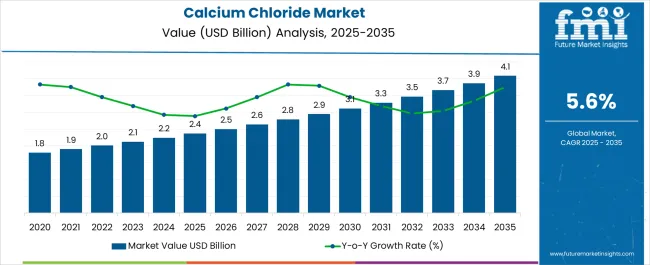
In 2025, the calcium chloride market value crossed USD 2.4 billion. Based on Future Market Insights' analysis, demand for calcium chloride is estimated to grow to USD 1.9 billion in 2026 and USD 2.8 billion by 2036. FMI projects a CAGR of 4.2% during the forecast period.
Absolute dollar growth of USD 0.9 billion over the decade signals steady expansion driven by infrastructure development and industrial processing requirements. Despite seasonal demand fluctuations and raw material cost volatility, major calcium chloride producers maintain consistent growth trajectories through diversified application portfolios and regional distribution optimization.
Summary of Calcium Chloride Market
- Calcium Chloride Market Definition
- The industry covers inorganic chemical products utilized for de-icing, construction, food processing, and industrial applications including dust control, concrete acceleration, and brine solutions.
- Demand Drivers in the Market
- Infrastructure maintenance requirements fuel winter de-icing demand.
- Construction sector growth increases concrete admixture consumption.
- Food industry expansion drives food-grade calcium chloride applications.
- Key Segments Analyzed in the FMI Report
- Grade: Industrial grade (55%) versus food and pharmaceutical grades.
- Application: De-icing and dust control (40-45% of total value).
- Geography: North America winter maintenance versus Asia-Pacific industrial growth markets.
- Analyst Opinion at FMI
- Nikhil Kaitwade, Principal Consultant for Chemicals & Materials at Future Market Insights, opines, "In the updated version of the Calcium Chloride Market Report for 2026 to 2036, executives will find insights into grade differentiation strategies that optimize product positioning. My findings point at production cost management directly impacting competitive positioning and transportation logistics could create regional pricing disparities."
- Strategic Implications/Executive Takeaways
- Diversify across seasonal and year-round applications to reduce demand volatility.
- Invest in production capacity near major consumption centers to minimize logistics costs.
- Develop food-grade capabilities to capture higher-margin applications.
- Methodology
- Validated through production facility data and consumption pattern analysis.
- Zero reliance on speculative commodity price projections.
- Based on verifiable trade statistics and confirmed industrial usage.
In October 2025, Berkshire Hathaway and Occidental announced a definitive agreement for Berkshire Hathaway to acquire Occidental’s chemical business, OxyChem. “This transaction strengthens our financial position and catalyzes a significant resource opportunity we’ve been building in our oil and gas business for the last decade. I’m incredibly proud of the impressive work the team has done to create this strategic opportunity that will unlock 20+ years of low-cost resource runway and deliver meaningful near and long-term value,” said Vicki Hollub, President and Chief Executive Officer. “OxyChem has grown under Occidental into a well-run, safely operated business with best-in-class employees, and we are confident the business and those employees will continue to thrive under Berkshire Hathaway’s ownership.”
United States (4.8% CAGR) and Canada (4.5% CAGR) drive market expansion through extensive winter road maintenance programs and oil extraction activities. China (5.1% CAGR) contributes significantly via rapid urbanization and construction sector growth. Emerging calcium chloride markets such as India (4.9%), Brazil (4.3%), and Russia (4.0%) generate growth through industrial development and agricultural modernization, while volume expansion accelerates through mining operations and concrete admixture applications.
Calcium Chloride Market Definition
Calcium chloride serves as a versatile inorganic compound utilized across de-icing operations, construction materials, food preservation, and industrial processing due to its hygroscopic properties and chemical reactivity. The calcium chloride market comprises the global production, processing, and distribution of calcium chloride in various grades and forms for commercial and industrial applications.
Calcium Chloride Market Inclusions
The report includes a comprehensive analysis of market dynamics, featuring Global and Regional Market Sizes (Volume and Value) and a 10-year Forecast (2026-2036). It covers segmental breakdowns by grade (Food, Industrial, Pharmaceutical), form (Anhydrous, Dihydrate, Hexahydrate), applications (De-icing, Construction, Food Processing, Oil and Gas), and end-users (Municipalities, Construction Companies, Food Manufacturers, Chemical Processors).
Calcium Chloride Market Exclusions
The scope excludes calcium-based compounds other than calcium chloride such as calcium carbonate or calcium sulfate unless used in combination products. It also omits application equipment like spreaders or mixing systems, focusing strictly on calcium chloride chemical products and their immediate commercial uses. Report does not account for laboratory-grade research chemicals or experimental formulations with minimal commercial volume.
Calcium Chloride Market Research Methodology
- Primary Research: Interviews were conducted with chemical manufacturers, municipal procurement managers, construction material suppliers, food processing executives, and industrial users across major regions. Mining companies clarified brine extraction processes and production cost dynamics.
- Desk Research: Industry databases from chemical trade associations, municipal winter maintenance reports, construction industry publications, and food safety regulatory documents supported application development benchmarking.
- Market-Sizing and Forecasting: A hybrid top-down and bottom-up model was developed. Demand was reconstructed from production facility outputs, municipal purchasing contracts, and industrial consumption patterns, then validated against import-export trade data.
- Data Validation and Update Cycle: Outputs undergo quality screening, variance checks across production and consumption datasets, and structured expert review prior to release.
Segmental Analysis
Calcium Chloride Market Analysis by Grade
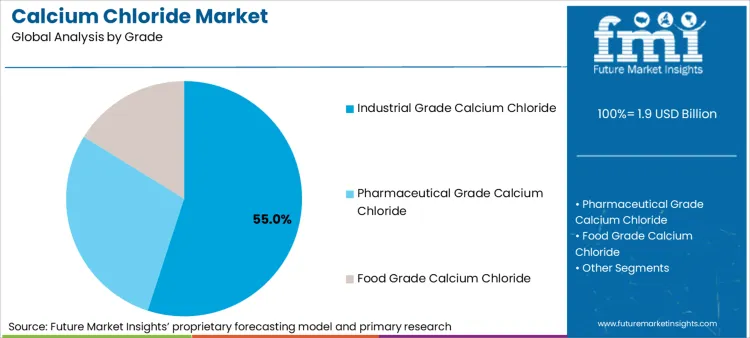
Based on FMI's calcium chloride market report, demand for industrial grade calcium chloride is estimated to hold 55% share in 2026. Growth in demand for industrial grade products comes from manufacturers leveraging cost-effective production processes to address bulk applications through standardized quality specifications. The surge in industry 4.0 practices in developing countries such as India is also fostering segment growth.
- Production Scale: Manufacturing companies continue to expand production facilities to meet growing demand from various industrial sectors. The expansion initiatives focus on increasing annual capacity to serve high-volume applications across multiple market segments.
- Quality Standardization: Companies are implementing quality control systems that ensure consistent purity levels across production batches, enabling applications in sensitive industrial processes while maintaining cost competitiveness for bulk users.
- Distribution Networks: The industry shift toward regional distribution centers enables optimized transportation costs for high-volume applications, decoupling production facilities from end-users to achieve economies of scale typically constrained by product density and shipping costs.
Calcium Chloride Market Analysis by Application

De-icing and dust control applications hold a 42% market share in 2026, driven by their role as the primary volume consumer for municipal winter maintenance and industrial site management. This concentration creates seasonal demand patterns that fluctuate during weather transition periods. The segment's integration with infrastructure maintenance and construction activities transforms municipal procurement into comprehensive material management platforms, while regulatory compliance offers structured purchasing frameworks for budget optimization.
- Municipal Integration: Government agencies and municipal authorities continue to establish long-term supply agreements with calcium chloride producers to ensure reliable access to de-icing materials for winter road maintenance programs across regional transportation networks.
- Application Development: Chemical manufacturers conduct ongoing field trials and product development initiatives to enhance calcium chloride formulations for specialized applications, focusing on improved performance characteristics and reduced application frequency requirements compared to standard products.
Calcium Chloride Market Drivers, Restraints, and Opportunities
Future Market Insights analysis indicates historical patterns point to a mature, stable industry where calcium chloride applications remain essential for infrastructure maintenance and industrial processing. Estimated valuation in 2026 represents the continued expansion phase as producers optimize manufacturing efficiency and application development to meet diverse market requirements.
While demand for specialized calcium chloride grades faces production complexity challenges (cost pressures), the essential nature of basic applications commands consistent volume demand (revenue stability), resulting in moderate but steady growth rates. The forecast accounts for market maturation where production processes are established and distribution networks support reliable supply chains.
- Application Diversification: Growth shifts from single-use products toward multi-application formulations, using enhanced purity standards and customized packaging to maintain competitive advantages against substitute chemicals.
- Production Optimization: Standards like ASTM D98 and food-grade specifications establish baseline requirements rather than experimental protocols, forcing transition from commodity products to specialized applications.
- Distribution Efficiency: To maintain cost competitiveness with alternative chemicals, producers aggressively optimize logistics networks to achieve delivered pricing that supports widespread adoption and long-term contracts.
Regional Analysis
Based on regional analysis, the calcium chloride market is segmented into North America, Latin America, Europe, East Asia, South Asia, Oceania and Middle East & Africa across 40+ countries. The full report also offers market attractiveness analysis based on regional trends.
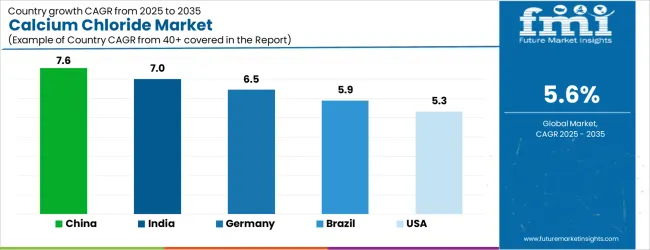
| Country | CAGR (2026 to 2036) |
|---|---|
| United States | 4.8% |
| China | 5.1% |
| Canada | 4.5% |
| India | 4.9% |
| Germany | 3.8% |
Source: Future Market Insights (FMI) analysis, based on proprietary forecasting model and primary research
North America Calcium Chloride Market Analysis
North America is characterized by "seasonal demand leadership," where established winter maintenance programs combine with extensive oil and gas operations to drive consistent consumption of calcium chloride products. Key players in North America include Tetra Technologies, which leads in oil field applications, Compass Minerals and Cargill specialize in de-icing and industrial salt solutions.
- United States: Demand for calcium chloride in the United States is projected to rise at 4.8% CAGR through 2036. Growth is driven by infrastructure maintenance requirements under federal highway funding programs and expanded shale gas extraction activities requiring completion fluids.
FMI's report includes detailed analysis of growth in the North American region, along with country-wise assessment that includes the USA and Canada. Readers can find consumption patterns, municipal procurement trends, and market development based on different application segments and seasonal variations.
Asia Pacific Calcium Chloride Market Analysis
Asia Pacific represents the industrial growth engine, leveraging expanding construction activities and industrial automation to achieve consumption levels that support regional production capacity expansion. Solvay and Qingdao Huadong Calcium lead regional production, while local manufacturers drive cost-competitive supply chains.
- China: Leading with a 5.1% CAGR, the market benefits from urbanization projects requiring concrete admixtures and industrial expansion driving chemical processing applications.
- India: Domestic demand accelerates at 4.9% CAGR, supported by infrastructure development programs and expanding food processing industries requiring preservation solutions. The government is also providing incentives for setting up new manufacturing plants. [2] Initiatives such as the National Manufacturing Mission are presenting growth pathways to the market. [3]
The full report analyzes the calcium chloride market across East and South Asia from 2021-2036, covering production trends, application development, and consumption patterns in China, India, Japan, South Korea, Australia, and Southeast Asian markets. The assessment highlights industrial segments that drive regional demand growth.
Europe Calcium Chloride Market Analysis
Europe functions as the "application innovation center," where market development is driven by stringent environmental regulations and advanced food safety standards that require specialized calcium chloride grades. Leading players include Zirax and TETRA Technologies driving pharmaceutical and food-grade product development.
- Germany: Demand for calcium chloride in Germany rises at 3.8% CAGR through 2036, driven by automotive industry requirements and chemical processing applications that support both domestic consumption and export manufacturing.
FMI's analysis of the European calcium chloride market includes country-specific assessment covering Germany, France, United Kingdom, Netherlands, and Nordic countries. Readers can access detailed regulatory framework analysis and application trends across the European region.
Competitive Landscape for Market Players
Market structure remains moderately concentrated among established chemical producers with integrated production capabilities and distribution networks. Primary competitive variables include production cost optimization, product quality consistency, and logistics efficiency rather than technology innovation.
Companies with vertically integrated operations from brine extraction to finished products demonstrate superior ability to control costs while maintaining supply reliability. Regional production strategies provide market access for bulk applications while specialized grades compete on quality specifications and technical service support.
Production capacity utilization creates distinct competitive advantages. Companies with efficient facilities command better margins and market positioning, while smaller producers compete primarily on regional proximity and specialized applications.
Recent Developments:
- The report includes comprehensive coverage of key industry developments and competitive positioning:
- In November 2025, Solvay and Noveon Magnetics announced the execution of a supply agreement for light and heavy rare earth materials. Under the said agreement, Solvay will supply Noveon with rare earth oxides starting in 2026.
- In September 2024, Cargill unveiled to acquire two US feed mills to boost its production and distribution capabilities.
- In April 2023, Solvay, a leading science and materials company whose technologies bring benefits to many aspects of daily life, announced a strategic collaboration with Ginkgo Bioworks, which is building the leading platform for cell programming and biosecurity.
Key Players in Calcium Chloride Market
- Tetra Technologies Inc.
- Compass Minerals International
- Occidental Petroleum Corporation (OxyChem)
- Solvay S.A.
- Cargill Incorporated
- Ward Chemical Limited
- Zirax Limited
- Qingdao Huadong Calcium Producing Co.
- Tangshan Sanyou Chemical Industries Co.
- Weifang Haibin Chemical Co.
Scope of the Report
| Metric | Value |
|---|---|
| Quantitative Units | USD 1.9 billion (2026) to USD 2.8 billion (2036), at a CAGR of 4.2% |
| Market Definition | The calcium chloride market comprises the global production, processing, and distribution of calcium chloride in various grades and forms for commercial, industrial, and municipal applications including de-icing, construction, food processing, and chemical manufacturing. |
| Grade Segmentation | Food Grade, Industrial Grade, Pharmaceutical Grade |
| Form Coverage | Anhydrous, Dihydrate, Hexahydrate |
| Application Coverage | De-icing and Dust Control, Construction, Food and Beverages, Oil and Gas, Water Treatment |
| End Use Segmentation | Municipalities, Construction Companies, Food Manufacturers, Chemical Processors, Oil and Gas Companies |
| Regions Covered | North America, Latin America, Europe, East Asia, South Asia, Oceania, Middle East and Africa |
| Countries Covered | United States, Canada, China, India, Germany, United Kingdom, Brazil, Mexico, Australia and 40 plus countries |
| Key Companies Profiled | Tetra Technologies Inc., Compass Minerals International, Occidental Petroleum Corporation (OxyChem), Solvay S.A., Cargill Incorporated, Ward Chemical Limited, Zirax Limited, Qingdao Huadong Calcium, Tangshan Sanyou Chemical, Weifang Haibin Chemical |
| Forecast Period | 2026 to 2036 |
| Approach | Hybrid top down and bottom up market modeling validated through production capacity tracking and consumption pattern analysis, supported by trade data verification and industrial usage benchmarking |
Calcium Chloride Market Analysis by Segments
Grade
- Food Grade Calcium Chloride
- Industrial Grade Calcium Chloride
- Pharmaceutical Grade Calcium Chloride
Form
- Anhydrous Calcium Chloride
- Dihydrate Calcium Chloride
- Hexahydrate Calcium Chloride
Application
- De-icing and Dust Control
- Construction (concrete acceleration, stabilization)
- Food and Beverages (preservation, coagulation)
- Oil and Gas (completion fluids, drilling)
- Water Treatment
- Others (chemical processing, refrigeration)
End Use
- Municipalities and Government Agencies
- Construction Companies
- Food and Beverage Manufacturers
- Oil and Gas Companies
- Chemical Processing Companies
- Others
Region
- Asia Pacific
- China
- India
- Japan
- South Korea
- Australia
- Thailand
- Indonesia
- Rest of Asia Pacific
- Europe
- Germany
- France
- United Kingdom
- Italy
- Netherlands
- Spain
- Nordic Countries
- Switzerland
- Rest of Europe
- North America
- United States
- Canada
- Latin America
- Brazil
- Mexico
- Argentina
- Chile
- Rest of Latin America
- Middle East & Africa
- Saudi Arabia
- United Arab Emirates
- South Africa
- Turkey
- Rest of Middle East & Africa
Bibliography
- Oxy (2026). Berkshire Hathaway Inc. to acquire OxyChem. News release.
- EOILAPAZ & Nexdigm (n.d.). Incentives for new manufacturing set-ups in India [Government/industry incentives document].
- Press Information Bureau, Government of India (2026). Incentives for new manufacturing set-ups in India [Factsheet].
- Solvay (2025). Noveon and Solvay forge partnership on light, heavy, rare earth materials supply. Press release.
- Cargill (2024). Cargill acquires two US feed mills, strengthens production. Corporate news release.
- Solvay (2023). Solvay announces strategic collaboration with Ginkgo Bioworks and expands its R&I footprint. Press release.
This Report Addresses
- Market intelligence to enable strategic decision making across established and emerging calcium chloride applications
- Market size estimation and 10-year revenue forecasts from 2026 to 2036, supported by validated production data and consumption pattern analysis
- Growth opportunity mapping across grades and applications with emphasis on cost optimization and quality differentiation
- Segment and regional revenue forecasts covering de-icing, construction, food processing, and industrial applications
- Competition strategy assessment including production scale requirements, distribution capabilities, and quality control systems
- Application development tracking including municipal procurement, industrial standards, and food safety regulations
- Market access analysis covering seasonal demand patterns, regional distribution networks, and customer relationship management
- Market report delivery in PDF, Excel, PPT, and interactive dashboard formats for executive and operational use
Frequently Asked Questions
How large is the demand for Calcium Chloride in the global market in 2026?
Demand for Calcium Chloride in the global market is estimated to be valued at USD 1.9 billion in 2026.
What will be the market size of Calcium Chloride in the global market by 2036?
Market size for Calcium Chloride is projected to reach USD 2.8 billion by 2036.
What is the expected demand growth for Calcium Chloride in the global market between 2026 and 2036?
Demand for Calcium Chloride in the global market is expected to grow at a CAGR of 4.2% between 2026 and 2036.
Which Grade is poised to lead global sales by 2026?
Industrial Grade Calcium Chloride is expected to be the dominant segment, capturing approximately 55.0% of global market share in 2026 due to cost competitiveness and broad application versatility.
How significant is the role of Municipalities in driving Calcium Chloride adoption in 2026?
Municipalities represent a major end-user segment, projected to hold approximately 35% share of the total market in 2026 as winter maintenance programs expand through infrastructure investment.
What is Driving Calcium Chloride Demand in the United States?
Infrastructure maintenance requirements under federal highway programs and expanded oil and gas extraction activities requiring completion fluids are driving growth.
What Applications are Referenced for the United States?
De-icing operations, concrete acceleration, and oil field completion fluids are referenced as key application areas.
What is the United States Growth Outlook in this Report?
The United States is projected to grow at a CAGR of 4.8% during 2026 to 2036.
Why is Asia Pacific described as Important for Production Growth in this Report?
Growth is driven by expanding construction activities and manufacturing development that require diverse calcium chloride applications.
What Type of Development Dominates in Asia Pacific?
Industrial expansion and urbanization projects requiring construction materials and chemical processing applications dominate regional activity.
What is China Growth Outlook in this Report?
China is projected to expand at a CAGR of 5.1% during 2026 to 2036.
Does the Report Cover Canada in its Regional Analysis?
Canada is included within North America under the regional scope of analysis.
What are the Sources referred to for analyzing the Market in Canada?
Municipal procurement databases, winter maintenance statistics, and chemical industry associations covering production capacity, consumption patterns, and seasonal demand variations are cited as primary reference sources.
What is the Main Development Theme Linked to Canada in North America Coverage?
North American development is associated with seasonal demand management and oil extraction activities requiring specialized calcium chloride products.
Does the Report Cover India in its Regional Analysis?
India is included within South Asia under the regional coverage framework.
What is the Main India Related Development Theme in Asia Coverage?
Infrastructure development programs and expanding food processing industries requiring preservation solutions are emphasized.
Which Production Approaches are Strategically Important for Asia Pacific Supply Chains?
Cost-competitive manufacturing facilities and regional distribution networks are prioritized for expanding industrial demand across regional markets.
What is Calcium Chloride and What is It Mainly Used For?
Calcium chloride is an inorganic salt primarily used for de-icing operations, construction applications, food processing, and industrial chemical processes.
What does Calcium Chloride Market Mean in this Report?
Calcium chloride market refers to global production, processing, and distribution of calcium chloride products across various commercial and industrial applications.
What is Included in the Scope of this Calcium Chloride Market Report?
Scope covers calcium chloride products by grade, key applications such as de-icing and construction, and end-use sectors including municipalities and manufacturing companies.
What is Excluded from the Scope of this Report?
Other calcium compounds, application equipment, and laboratory chemicals are excluded unless part of integrated calcium chloride product platforms.
What does Market Forecast Mean on this Page?
Market forecast represents model-based projections built on production capacity and consumption pattern assumptions for strategic planning purposes.
How does FMI Build and Validate the Calcium Chloride Market Forecast?
Forecast is developed using hybrid modeling validated through production facility data, consumption pattern analysis, and trade statistics verification.
What does Zero Reliance on Speculative Commodity Price Projections Mean Here?
Market analysis is based on verifiable production data, consumption statistics, and trade information rather than speculative commodity valuations.
Preview the report firsthand - request a free sample
Get SampleGet the brochure for pricing and purchase details.
Get PDFTable of Content
- Executive Summary
- Global Market Outlook
- Demand-side Trends
- Supply-side Trends
- Technology Roadmap Analysis
- Analysis and Recommendations
- Market Overview
- Market Coverage / Taxonomy
- Market Definition / Scope / Limitations
- Research Methodology
- Chapter Orientation
- Analytical Lens and Working Hypotheses
- Market Structure, Signals, and Trend Drivers
- Benchmarking and Cross-market Comparability
- Market Sizing, Forecasting, and Opportunity Mapping
- Research Design and Evidence Framework
- Desk Research Programme (Secondary Evidence)
- Company Annual and Sustainability Reports
- Peer-reviewed Journals and Academic Literature
- Corporate Websites, Product Literature, and Technical Notes
- Earnings Decks and Investor Briefings
- Statutory Filings and Regulatory Disclosures
- Technical White Papers and Standards Notes
- Trade Journals, Industry Magazines, and Analyst Briefs
- Conference Proceedings, Webinars, and Seminar Materials
- Government Statistics Portals and Public Data Releases
- Press Releases and Reputable Media Coverage
- Specialist Newsletters and Curated Briefings
- Sector Databases and Reference Repositories
- FMI Internal Proprietary Databases and Historical Market Datasets
- Subscription Datasets and Paid Sources
- Social Channels, Communities, and Digital Listening Inputs
- Additional Desk Sources
- Expert Input and Fieldwork (Primary Evidence)
- Primary Modes
- Qualitative Interviews and Expert Elicitation
- Quantitative Surveys and Structured Data Capture
- Blended Approach
- Why Primary Evidence is Used
- Field Techniques
- Interviews
- Surveys
- Focus Groups
- Observational and In-context Research
- Social and Community Interactions
- Stakeholder Universe Engaged
- C-suite Leaders
- Board Members
- Presidents and Vice Presidents
- R&D and Innovation Heads
- Technical Specialists
- Domain Subject-matter Experts
- Scientists
- Physicians and Other Healthcare Professionals
- Governance, Ethics, and Data Stewardship
- Research Ethics
- Data Integrity and Handling
- Primary Modes
- Tooling, Models, and Reference Databases
- Desk Research Programme (Secondary Evidence)
- Data Engineering and Model Build
- Data Acquisition and Ingestion
- Cleaning, Normalisation, and Verification
- Synthesis, Triangulation, and Analysis
- Quality Assurance and Audit Trail
- Market Background
- Market Dynamics
- Drivers
- Restraints
- Opportunity
- Trends
- Scenario Forecast
- Demand in Optimistic Scenario
- Demand in Likely Scenario
- Demand in Conservative Scenario
- Opportunity Map Analysis
- Product Life Cycle Analysis
- Supply Chain Analysis
- Investment Feasibility Matrix
- Value Chain Analysis
- PESTLE and Porter’s Analysis
- Regulatory Landscape
- Regional Parent Market Outlook
- Production and Consumption Statistics
- Import and Export Statistics
- Market Dynamics
- Global Market Analysis 2021 to 2025 and Forecast, 2026 to 2036
- Historical Market Size Value (USD Million) Analysis, 2021 to 2025
- Current and Future Market Size Value (USD Million) Projections, 2026 to 2036
- Y-o-Y Growth Trend Analysis
- Absolute $ Opportunity Analysis
- Global Market Pricing Analysis 2021 to 2025 and Forecast 2026 to 2036
- Global Market Analysis 2021 to 2025 and Forecast 2026 to 2036, By Grade
- Introduction / Key Findings
- Historical Market Size Value (USD Million) Analysis By Grade , 2021 to 2025
- Current and Future Market Size Value (USD Million) Analysis and Forecast By Grade , 2026 to 2036
- Industrial Grade Calcium Chloride
- Pharmaceutical Grade Calcium Chloride
- Food Grade Calcium Chloride
- Industrial Grade Calcium Chloride
- Y-o-Y Growth Trend Analysis By Grade , 2021 to 2025
- Absolute $ Opportunity Analysis By Grade , 2026 to 2036
- Global Market Analysis 2021 to 2025 and Forecast 2026 to 2036, By Application
- Introduction / Key Findings
- Historical Market Size Value (USD Million) Analysis By Application, 2021 to 2025
- Current and Future Market Size Value (USD Million) Analysis and Forecast By Application, 2026 to 2036
- De-Icing and Dust Control
- Construction
- Food and Beverages
- Water Treatment
- De-Icing and Dust Control
- Y-o-Y Growth Trend Analysis By Application, 2021 to 2025
- Absolute $ Opportunity Analysis By Application, 2026 to 2036
- Global Market Analysis 2021 to 2025 and Forecast 2026 to 2036, By Region
- Introduction
- Historical Market Size Value (USD Million) Analysis By Region, 2021 to 2025
- Current Market Size Value (USD Million) Analysis and Forecast By Region, 2026 to 2036
- North America
- Latin America
- Western Europe
- Eastern Europe
- East Asia
- South Asia and Pacific
- Middle East & Africa
- Market Attractiveness Analysis By Region
- North America Market Analysis 2021 to 2025 and Forecast 2026 to 2036, By Country
- Historical Market Size Value (USD Million) Trend Analysis By Market Taxonomy, 2021 to 2025
- Market Size Value (USD Million) Forecast By Market Taxonomy, 2026 to 2036
- By Country
- USA
- Canada
- Mexico
- By Grade
- By Application
- By Country
- Market Attractiveness Analysis
- By Country
- By Grade
- By Application
- Key Takeaways
- Latin America Market Analysis 2021 to 2025 and Forecast 2026 to 2036, By Country
- Historical Market Size Value (USD Million) Trend Analysis By Market Taxonomy, 2021 to 2025
- Market Size Value (USD Million) Forecast By Market Taxonomy, 2026 to 2036
- By Country
- Brazil
- Chile
- Rest of Latin America
- By Grade
- By Application
- By Country
- Market Attractiveness Analysis
- By Country
- By Grade
- By Application
- Key Takeaways
- Western Europe Market Analysis 2021 to 2025 and Forecast 2026 to 2036, By Country
- Historical Market Size Value (USD Million) Trend Analysis By Market Taxonomy, 2021 to 2025
- Market Size Value (USD Million) Forecast By Market Taxonomy, 2026 to 2036
- By Country
- Germany
- UK
- Italy
- Spain
- France
- Nordic
- BENELUX
- Rest of Western Europe
- By Grade
- By Application
- By Country
- Market Attractiveness Analysis
- By Country
- By Grade
- By Application
- Key Takeaways
- Eastern Europe Market Analysis 2021 to 2025 and Forecast 2026 to 2036, By Country
- Historical Market Size Value (USD Million) Trend Analysis By Market Taxonomy, 2021 to 2025
- Market Size Value (USD Million) Forecast By Market Taxonomy, 2026 to 2036
- By Country
- Russia
- Poland
- Hungary
- Balkan & Baltic
- Rest of Eastern Europe
- By Grade
- By Application
- By Country
- Market Attractiveness Analysis
- By Country
- By Grade
- By Application
- Key Takeaways
- East Asia Market Analysis 2021 to 2025 and Forecast 2026 to 2036, By Country
- Historical Market Size Value (USD Million) Trend Analysis By Market Taxonomy, 2021 to 2025
- Market Size Value (USD Million) Forecast By Market Taxonomy, 2026 to 2036
- By Country
- China
- Japan
- South Korea
- By Grade
- By Application
- By Country
- Market Attractiveness Analysis
- By Country
- By Grade
- By Application
- Key Takeaways
- South Asia and Pacific Market Analysis 2021 to 2025 and Forecast 2026 to 2036, By Country
- Historical Market Size Value (USD Million) Trend Analysis By Market Taxonomy, 2021 to 2025
- Market Size Value (USD Million) Forecast By Market Taxonomy, 2026 to 2036
- By Country
- India
- ASEAN
- Australia & New Zealand
- Rest of South Asia and Pacific
- By Grade
- By Application
- By Country
- Market Attractiveness Analysis
- By Country
- By Grade
- By Application
- Key Takeaways
- Middle East & Africa Market Analysis 2021 to 2025 and Forecast 2026 to 2036, By Country
- Historical Market Size Value (USD Million) Trend Analysis By Market Taxonomy, 2021 to 2025
- Market Size Value (USD Million) Forecast By Market Taxonomy, 2026 to 2036
- By Country
- Kingdom of Saudi Arabia
- Other GCC Countries
- Turkiye
- South Africa
- Other African Union
- Rest of Middle East & Africa
- By Grade
- By Application
- By Country
- Market Attractiveness Analysis
- By Country
- By Grade
- By Application
- Key Takeaways
- Key Countries Market Analysis
- USA
- Pricing Analysis
- Market Share Analysis, 2025
- By Grade
- By Application
- Canada
- Pricing Analysis
- Market Share Analysis, 2025
- By Grade
- By Application
- Mexico
- Pricing Analysis
- Market Share Analysis, 2025
- By Grade
- By Application
- Brazil
- Pricing Analysis
- Market Share Analysis, 2025
- By Grade
- By Application
- Chile
- Pricing Analysis
- Market Share Analysis, 2025
- By Grade
- By Application
- Germany
- Pricing Analysis
- Market Share Analysis, 2025
- By Grade
- By Application
- UK
- Pricing Analysis
- Market Share Analysis, 2025
- By Grade
- By Application
- Italy
- Pricing Analysis
- Market Share Analysis, 2025
- By Grade
- By Application
- Spain
- Pricing Analysis
- Market Share Analysis, 2025
- By Grade
- By Application
- France
- Pricing Analysis
- Market Share Analysis, 2025
- By Grade
- By Application
- India
- Pricing Analysis
- Market Share Analysis, 2025
- By Grade
- By Application
- ASEAN
- Pricing Analysis
- Market Share Analysis, 2025
- By Grade
- By Application
- Australia & New Zealand
- Pricing Analysis
- Market Share Analysis, 2025
- By Grade
- By Application
- China
- Pricing Analysis
- Market Share Analysis, 2025
- By Grade
- By Application
- Japan
- Pricing Analysis
- Market Share Analysis, 2025
- By Grade
- By Application
- South Korea
- Pricing Analysis
- Market Share Analysis, 2025
- By Grade
- By Application
- Russia
- Pricing Analysis
- Market Share Analysis, 2025
- By Grade
- By Application
- Poland
- Pricing Analysis
- Market Share Analysis, 2025
- By Grade
- By Application
- Hungary
- Pricing Analysis
- Market Share Analysis, 2025
- By Grade
- By Application
- Kingdom of Saudi Arabia
- Pricing Analysis
- Market Share Analysis, 2025
- By Grade
- By Application
- Turkiye
- Pricing Analysis
- Market Share Analysis, 2025
- By Grade
- By Application
- South Africa
- Pricing Analysis
- Market Share Analysis, 2025
- By Grade
- By Application
- USA
- Market Structure Analysis
- Competition Dashboard
- Competition Benchmarking
- Market Share Analysis of Top Players
- By Regional
- By Grade
- By Application
- Competition Analysis
- Competition Deep Dive
- Tetra Technologies Inc.
- Overview
- Product Portfolio
- Profitability by Market Segments (Product/Age /Sales Channel/Region)
- Sales Footprint
- Strategy Overview
- Marketing Strategy
- Product Strategy
- Channel Strategy
- Compass Minerals International
- Occidental Petroleum Corporation (OxyChem)
- Solvay S.A.
- Cargill Incorporated
- Ward Chemical Limited
- Zirax Limited
- Tetra Technologies Inc.
- Competition Deep Dive
- Assumptions & Acronyms Used


