

- Industry Size (2026)
- USD 3.72 Bn
- Forecast (2036)
- USD 6.78 Bn
- CAGR (2026 to 2036)
- 6.2%
Value-based Healthcare Service Market Size, Market Forecast and Outlook By FMI
In 2025, value-based healthcare service market valuation stood at USD 3.5 billion. Industry is projected to hit USD 3.72 billion in 2026 before ascending to USD 6.78 billion by 2036. Such progression implies a CAGR of 6.2%, driven by the systemic shift from volume-based billing to outcome-dependent reimbursement models. As per FMI's projection, this structural pivot forces providers to replace legacy fee-for-service (FFS) workflows with integrated care platforms capable of managing downside risk.
Procurement specification is shifting aggressively as payers and government bodies now mandate risk-sharing capabilities in vendor contracts to curb inflationary medical spending. Buyers are no longer purchasing simple administrative support; capital is flowing toward predictive adjudication engines and population health tools that guarantee margin preservation under capitated arrangements.
Summary of Value-based Healthcare Service Market
- Value-based Healthcare Service Market Definition
- Industry covers services enabling providers to transition from fee-for-service to outcome-based payment models.
- Demand Drivers in the Market
- Unsustainable rise in chronic disease costs necessitates preventive care models.
- Government mandates for shared savings force provider compliance.
- Integration of AI facilitates real-time risk stratification and adjudication.
- Key Segments Analyzed in the FMI Report
- Care Model: ACOs dominate institutional adoption with 28.8% market share.
- Deployment: Cloud-based solutions lead with 64.5% share due to scalability needs.
- Geography: North America leads in maturity; APAC offers highest growth velocity.
- Analyst Opinion at FMI
- Sabyasachi Ghosh, Principal Consultant for Healthcare, opines, "Providers clinging to fee-for-service models face an existential threat as payers aggressively steer volume toward risk-bearing entities. Our analysis confirms that clinics integrating patient engagement platforms into value-based workflows will capture disproportionate market share."
- Strategic Implications/Executive Takeaways
- Prioritize investments in actuarial capabilities to manage downside risk effectively.
- Shift focus from volume expansion to patient panel optimization.
- Leverage cloud architecture to enable seamless interoperability across care settings.
- Methodology
- Validated through first-hand corporate production and capacity data.
- Zero reliance on speculative third-party market research reports.
- Based on verifiable industrial benchmarks and verified sources.
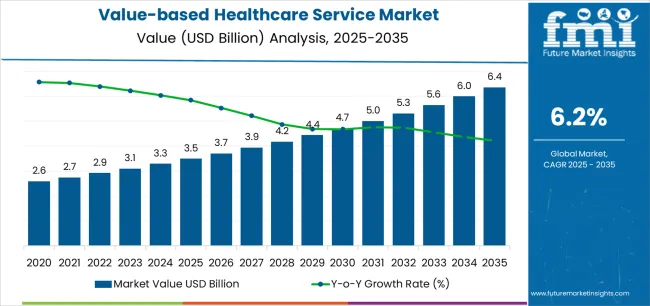
Accountability in spending remains central to this transition, as evidenced by industry leaders prioritizing synchronized execution between payers and providers. Jay Ackerman, CEO of Reveleer, highlights a critical inflection point: "To realize the full potential of value-based care, payers and providers must collaborate at scale. The good news is payers and providers are finally rowing in the same direction." [8]
While strategic alignment is at an all-time high, the market's focus is shifting to the operational "messy middle" of data integration. For buyers, this implies that future vendor selection will hinge on interoperability, platforms that can seamlessly bridge the gap between payer incentives and provider workflows to execute risk contracts at scale.
Global adoption varies, with high-growth trajectories observed in India (7.5% CAGR) and China (7.2% CAGR), while mature markets like the United States (5.6% CAGR) focus on refining existing Accountable Care Organization (ACO) structures. European nations such as the UK (6.1% CAGR) and Germany (6.0% CAGR) are leveraging value-based reforms to address public health budget deficits, whereas Japan (5.4% CAGR) targets specific high-cost disease burdens.
Value-based Healthcare Service Market Definition
Value-based healthcare (VBHC) service refers to the ecosystem of administrative, clinical, and technological solutions designed to support care delivery models where provider payment is tied to patient health outcomes rather than the volume of services rendered. It encompasses management services for Accountable Care Organizations (ACOs), bundled payment administration, capitation management, and quality reporting frameworks. These services enable providers to assume financial risk, optimize chronic disease management services, and improve population health metrics while reducing per capita costs.
Value-based Healthcare Service Market Inclusions
This market includes strategic advisory, technology platforms, and operational services specifically tailored for value-based contracts. Key components involve population health management (PHM) software, risk adjustment coding, quality performance tracking, and contract adjudication engines. Services supporting diverse risk arrangements, such as Medicare Shared Savings Program (MSSP) tracks, commercial shared risk, and episode-based bundled payments, are central to this scope. Technology enabling real-time data exchange, such as healthcare API integrations, is also covered.
Value-based Healthcare Service Market Exclusions
Excluded from this report are traditional fee-for-service (FFS) revenue cycle management (RCM) solutions that do not incorporate outcome-based adjudication logic. Pure-play clinical hardware, such as diagnostic imaging equipment or standard intensive care consumables, is omitted unless bundled as part of a risk-sharing service package. Pharmaceutical manufacturing and direct patient care delivery (hospital operations) are also outside the scope, focusing instead on the enabling service layer.
Value-based Healthcare Service Market Research Methodology
- Primary Research: Interviews were conducted with ACO executives, payer strategy directors, and healthcare IT vendors to validate contract adoption rates.
- Desk Research: Analysis of CMS fact sheets, NHS annual reports, and Ministry of Health filings in France and India provided regulatory baselines.
- Market-Sizing and Forecasting: A bottom-up model reconstructed market value based on covered lives under value-based arrangements and average service fees per beneficiary.
- Data Validation and Update Cycle: Financial results from publicly listed health-tech firms were cross-referenced with government savings reports to ensure accuracy.
Segmental Analysis
Value-based Healthcare Service Market Analysis by Care Model
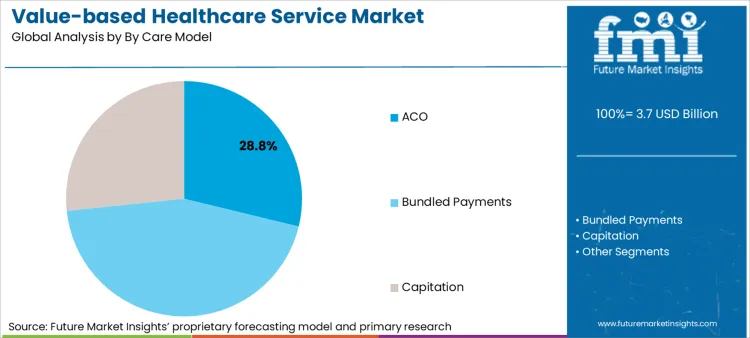
Accountable Care Organizations (ACOs) currently command the largest share of the value-based landscape, holding 28.8% of the total market value. This dominance is reinforced by proven financial results and established regulatory frameworks like the Medicare Shared Savings Program (MSSP). According to FMI's estimates, the ACO segment acts as the primary vehicle for risk adoption because it allows diverse provider groups to pool resources and manage population health at scale without immediately taking on full capitation. The 75% success rate in earning performance payments for PY 2024 further validates the ACO model as the most viable entry point for institutions transitioning away from fee-for-service [1].
- Financial incentives: Adoption of ACO models accelerates because high-performing organizations can capture significant shared savings revenue. In Performance Year 2024, 75% of ACOs earned performance payments totaling USD 4.1 billion, incentivizing continued participation and structural investment [1].
- Specialization efficiency: Growth in bundled payments is anchored in the need to control costs for specific high-volume procedures like joint replacements or cardiac care. NHS Scotland utilizing integrated value-based reform to manage a £20.6 billion budget reflects this shift toward condition-specific funding envelopes [2].
- Risk maturity: Deployment of capitation models expands as provider organizations develop the actuarial sophistication to manage full population risk. Advanced primary care groups are leveraging healthcare analytics to monitor utilization, enabling them to accept fixed per-member-per-month payments profitably.
Value-based Healthcare Service Market Analysis by Deployment
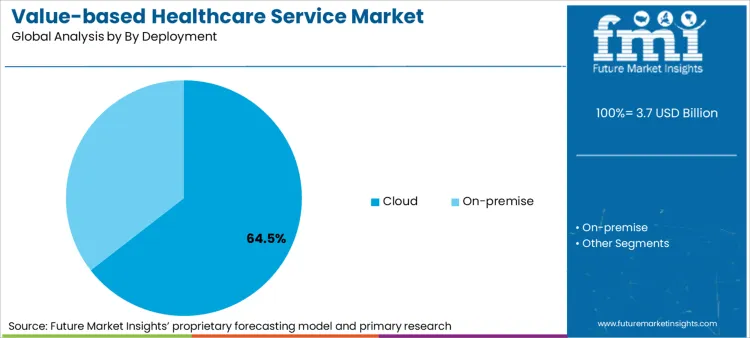
Cloud-based deployment has emerged as the unequivocal standard for value-based care infrastructure, capturing 64.5% of the market share. FMI analysts opine that on-premise solutions are rapidly becoming obsolete due to their inability to support real-time collaboration across fragmented care networks. The shift to cloud is driven by the necessity to aggregate disparate data streams, EMR feeds, claims data, and social determinants, into a single source of truth for risk adjustment. This architecture is the only viable path for organizations that need to scale computing resources dynamically during heavy reporting periods without incurring prohibitive capital expenditures.
- Interoperability necessity: Demand for cloud platforms is reinforced by the requirement to share patient data seamlessly between payers, hospitals, and community clinics. Modern architectures facilitate the integration of home healthcare software feeds, ensuring care teams have a holistic view of patient health status.
- Scalability requirements: Procurement shifts toward SaaS models because they allow health systems to scale computing resources dynamically during reporting periods. This flexibility is crucial for processing massive datasets required for risk adjustment and quality reporting without heavy upfront capital expenditure.
- Cost optimization: Adoption accelerates where cloud solutions reduce the total cost of ownership compared to maintaining physical servers. Lower maintenance burdens allow organizations to redirect IT budgets toward clinical innovation and healthcare digital experience platform enhancements.
Value-based Healthcare Service Market Analysis by End User
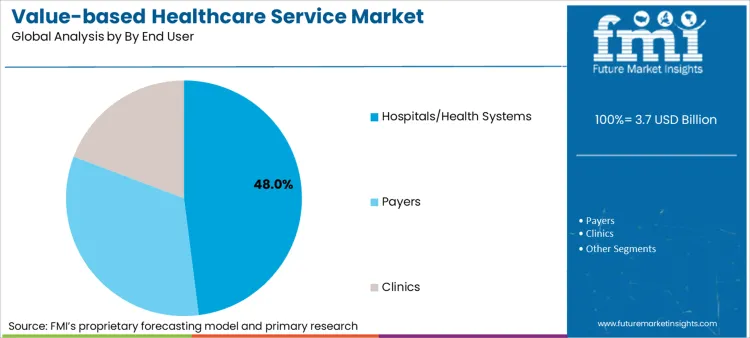
Hospitals and Health Systems represent the foundational volume for value-based services, accounting for 48% of the market share. While these large institutions provide the critical mass for population health initiatives, data indicates that smaller, physician-led entities are often more efficient at generating savings. Low-revenue, physician-led ACOs generated USD 319 in net per capita savings compared to USD 180 for high-revenue hospital-led counterparts, suggesting a nuance in performance versus market presence [1]. Despite this, hospitals remain the dominant buyer segment due to their sheer operational scale and the capital required to underwrite significant downside risk contracts.
- Margin pressure: Hospitals adopt value-based contracts because fee-for-service margins are compressing under inflationary pressures. Improving control over medical equipment reimbursement cycles through bundled payments helps large systems stabilize revenue streams against volume fluctuations.
- Ambulatory shift: Procurement shifts because independent clinics and physician groups are proving more agile in managing chronic conditions. Primary care-focused ACOs achieving USD 403 in net per capita savings underscores how smaller, focused entities drive superior economic value compared to specialists [1].
- Payer collaboration: Growth is anchored in Payers partnering directly with provider networks to offload financial risk. Collaboration is intensifying, with 2025 industry reports showing that 92% of payers and 81% of providers saw their value-based care contracts grow over the last 12 months, driving joint investment in data interoperability [8].
Value-based Healthcare Service Market Drivers, Restraints, and Opportunities
Mandatory regulatory transitions toward shared savings programs act as the primary catalyst for market expansion, effectively removing the option for providers to remain in pure fee-for-service models. Governments and commercial payers are systematically dismantling volume-based incentives to ensure long-term fund solvency. Adoption of these mandates forces healthcare organizations to overhaul their operational infrastructures, implementing robust data reporting and care coordination layers to avoid financial penalties. This regulatory push is substantiated by the CMS Shared Savings Program, which saw 480 ACOs serving 10.8 million beneficiaries in 2024, confirming that participation is becoming an industry standard rather than a niche experiment [1].
Integration complexity across fragmented IT systems remains a formidable restraint, stalling the ability of providers to assume downside risk confidently. Most healthcare entities operate with siloed data repositories that struggle to communicate, creating blind spots in patient history that are fatal to value-based contracts. Buyers often hesitate to commit to full capitation because their existing electronic health records (EHRs) cannot ingest real-time claims data or social determinants of health. This friction is highlighted by the fact that despite broad participation, 16 ACOs still owed shared losses totaling USD 20 million, illustrating the financial danger of entering risk arrangements without adequate data visibility [1].
- AI-driven adjudication: Payers and providers benefit from automated contract adjudication platforms that eliminate trust deficits and administrative waste. Arbital Health launched a neutral third-party platform and performed 58 contract adjudications within three months, validating the urgent market need for objective performance measurement [7].
- Network Scaling: Expansion of value-based care networks offers a pathway to massive scalability for tech-enabled providers. Aledade announced the addition of 700 new primary care organizations to its network for the 2026 performance year, demonstrating the high demand for platforms that enable independent practices to succeed in risk models [10].
- Global policy replication: Emerging markets can leapfrog legacy infrastructure by adopting successful regulatory frameworks piloted in mature regions. France is testing the PEPS 2 capitation model across 22 structures covering 107,453 patients, creating a template for other nations to implement bundled payments for chronic conditions [3].
Regional Analysis
Based on the regional analysis, the Value-based Healthcare Service market is segmented into North America, Latin America, Europe, East Asia, South Asia, Oceania and Middle East & Africa across 40+ countries. The full report also offers market attractiveness analysis based on regional trends.
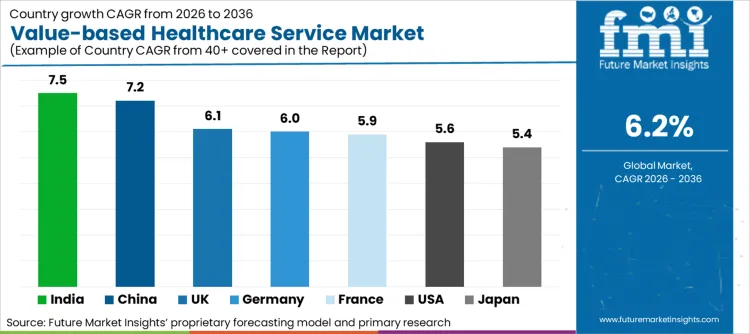
| Country | CAGR (2026 to 2036) |
|---|---|
| India | 7.5% |
| China | 7.2% |
| United Kingdom | 6.1% |
| Germany | 6.0% |
| France | 5.9% |
| United States | 5.6% |
| Japan | 5.4% |
Source: Future Market Insights (FMI) analysis, based on proprietary forecasting model and primary research
North America Value-based Healthcare Service Market Analysis
North America remains the global epicenter of value-based care innovation, characterized by a mature regulatory environment and high provider participation in risk-bearing models. FMI analysts opine that the region is shifting from simple upside-only arrangements to complex two-sided risk structures, driven by federal initiatives to curb Medicare spending.
- United States: Demand for value-based services in the United States is set to grow at 5.6% CAGR through 2036, supported by the continued success of the Medicare Shared Savings Program before procurement cycles fully transition to capitation. This trajectory is supported by evidence showing 75% of ACOs earned performance payments in 2024, incentivizing further investment in population health tools [1].
FMI’s report includes a comprehensive assessment of the North American landscape. Beyond the US, Canada represents a significant opportunity where provincial health authorities are exploring canada home care services reforms to alleviate hospital congestion. Buyers in these markets should monitor the emergence of provincial bundled payment initiatives aimed at reducing surgical wait times, similar to models observed in the US.
Europe Value-based Healthcare Service Market Analysis
Europe is defining the next generation of value-based standards through centralized national health services that are aggressively implementing outcome-based budgeting. As per FMI's projection, the focus here is on reducing structural deficits through integrated care pathways and bundled payments for chronic conditions.
- United Kingdom: The United Kingdom is likely to see value-based service revenues increase at 6.1% CAGR during 2026 to 2036, given the NHS's mandate to close efficiency gaps and the resulting push for digital care coordination. This demand shift is reflected in the NHS Scotland budget of £20.6 billion, which prioritizes integrated value-based reform to optimize spending [2].
- Germany: Growth in value-based services across Germany is estimated at 6.0% CAGR through 2036, driven by statutory health insurance reforms that increase the value of quality-centric reimbursement. This outlook is anchored in the shift toward integrated care contracts that reward providers for long-term patient outcomes rather than procedural volume.
- France: France is expected to record 5.9% CAGR in value-based service demand over 2026 to 2036 as the government scales successful Article 51 experiments, tightening the link between funding and care quality. This expansion is evidenced by the 22 structures currently testing the PEPS 2 capitation model, covering over 107,000 patients [3].
FMI’s report includes detailed insights into the European market transition. Countries like Sweden and the Netherlands are also prospective markets, known for their early adoption of outpatient clinics efficiency models. Suppliers should watch for tenders related to national diabetes and cardiovascular management programs in these nations, which are increasingly incorporating value-based vendor requirements.
Asia Pacific Value-based Healthcare Service Market Analysis
Asia Pacific is rapidly emerging as a high-growth frontier, with governments leveraging value-based principles to manage the dual challenge of aging populations and expanding healthcare access. According to FMI's estimates, the region is leapfrogging legacy systems to adopt tech-enabled, outcome-based financing models directly.
- China: China's value-based service landscape is forecast to expand at 7.2% CAGR through 2036, as rising chronic disease burdens and market participants respond with scaled deployment of diagnostic-related group (DRG) payments. This growth is supported by WHO flexible funding of USD 277 million deployed globally, aiding health program sustainability in major economies [9].
- India: In India, the value-based service market is forecast to advance at 7.5% CAGR through 2036, with growth anchored in the Ayushman Bharat scheme that converts into measurable quality standards for hospitals. This trajectory is underpinned by the National Health Authority's implementation of 5 performance indicators for empanelled hospitals, linking reimbursement to quality of care [4].
- Japan: The outlook for value-based services in Japan indicates a 5.4% CAGR from 2026 to 2036 as the burden of heart failure costs drives demand for preventive care models, strengthening demand from public insurers. This is critical given that heart failure hospitalizations cost approximately USD 1,187 million annually, necessitating cost-effective interventions [5].
FMI’s report includes a robust analysis of the Asia Pacific dynamic. South Korea and Singapore are identified as key opportunistic markets, leveraging advanced digital infrastructure to pilot healthcare chatbot solutions for patient monitoring. Stakeholders should observe policy shifts in these nations regarding reimbursement for digital therapeutics, which is expected to open new revenue streams for value-based platforms.
Competitive Aligners for Market Players
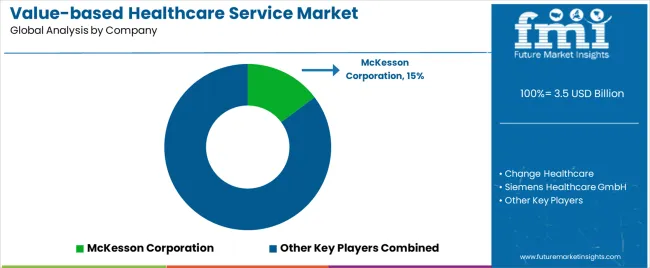
Competition in the value-based healthcare service market is bifurcated between incumbent payers vertically integrating with providers and agile health-tech firms offering specialized enablement platforms. Large entities like UnitedHealth Group are aggressively scaling their footprint, as seen with Optum Health's target to manage 5 million patients under fully accountable arrangements by 2025. This scale allows them to absorb actuarial risk that smaller, fragmented players cannot, creating a high barrier to entry for new competitors attempting to offer comprehensive risk management.
Partnership ecosystems are becoming the primary survival strategy for mid-sized technology vendors who lack the breadth to serve entire health systems alone. The strategic alliance between P3 Health Partners and Innovaccer exemplifies this trend, where unifying clinical and claims data creates a defensible moat against disjointed point solutions. By combining proprietary analytics with care delivery networks, these partnerships offer a complete "operating system" for value-based care that creates high switching costs for provider clients.
Technological differentiation is shifting from simple data visualization to predictive contract adjudication and automated risk adjustment. Arbital Health's acquisition of a specialized actuarial team to enhance its adjudication platform signals a move toward neutral, third-party validation services. As contracts become more complex, the ability to mathematically prove savings and accurately adjudicate payments becomes a critical competitive differentiator, favoring players with deep actuarial and healthcare contract research organization capabilities over generalist IT vendors [7].
Recent Developments
The report includes full coverage of key trends from competitive benchmarking. Some of the recent developments covered in the reports:
- In February 2026, Aledade announced the addition of 700 new primary care organizations to its network, now serving nearly 20% of all Medicare Shared Savings Program participants [10].
- In August 2025, a Reveleer report highlighted that 92% of payers saw their value-based care contracts grow over the last 12 months, validating the sector's expansion [8].
Key Players in Value-based Healthcare Service Market
- McKesson Corporation
- Change Healthcare (Optum)
- Siemens Healthineers
- Boston Consulting Group
- NextGen Healthcare
- Genpact
- athenahealth
- HarmonyCares
- Arbital Health
- Pearl Health
- Guidehealth
- Interwell Health
- UnitedHealth Group
Scope of the Report
| Metric | Value |
|---|---|
| Quantitative Units | USD 3.72 billion (2026) to USD 6.78 billion (2036), at a CAGR of 6.2% |
| Market Definition | Services enabling outcome-based provider payment models including ACO management, bundled payments, and capitation administration. |
| Care Model Segmentation | ACO, Bundled Payments, Capitation, Other |
| Deployment Segmentation | Cloud, On-premise |
| Application Coverage | Population Health Management, Risk Adjustment, Contract Adjudication, Quality Reporting |
| Regions Covered | North America, Latin America, Europe, East Asia, South Asia, Oceania, Middle East and Africa |
| Countries Covered | United States, Canada, Mexico, Brazil, Argentina, Germany, France, United Kingdom, Italy, Spain, China, India, Japan, South Korea, Indonesia, Australia and 40 plus countries |
| Key Companies Profiled | McKesson, Optum, Siemens Healthineers, BCG, NextGen Healthcare, Genpact, athenahealth, HarmonyCares, Arbital Health |
| Forecast Period | 2026 to 2036 |
| Approach | Hybrid top down and bottom up market modeling validated through primary interviews with ACOs and payers, supported by CMS/NHS data benchmarking |
Value-based Healthcare Service Market Analysis by Segments
Care Model:
- ACO
- Bundled Payments
- Capitation
- Other
Deployment:
- Cloud
- On-premise
End User:
- Hospitals/Health Systems
- Payers
- Clinics
Region:
- Asia Pacific
- India
- China
- Japan
- South Korea
- Indonesia
- Australia & New Zealand
- ASEAN
- Rest of Asia Pacific
- Europe
- Germany
- Italy
- France
- United Kingdom
- Spain
- Benelux
- Nordics
- Central & Eastern Europe
- Rest of Europe
- North America
- United States
- Canada
- Mexico
- Latin America
- Brazil
- Argentina
- Chile
- Rest of Latin America
- Middle East & Africa
- Kingdom of Saudi Arabia
- United Arab Emirates
- South Africa
- Turkey
- Rest of Middle East & Africa
Bibliography
- [1] CMS. (2025). Shared Savings Program Performance Year 2024 Results Fact Sheet. Centers for Medicare & Medicaid Services.
- [2] Audit Scotland. (2025). NHS in Scotland 2025: Budget and Reform Analysis. Audit Scotland.
- [3] Ministère de la Santé. (2024). Expérimentation d'un paiement en équipe de professionnels de santé en ville (PEPS). French Ministry of Health.
- [4] PIB India. (2023). NHA transitions Ayushman Bharat PM-JAY to value-based care model. Press Information Bureau, Government of India.
- [5] J-Stage. (2024). Economic burden of heart failure hospitalizations in Japan. Japanese Circulation Journal.
- [6] Audit Wales. (2024). Cardiff and Vale University Health Board Annual Plan 2024-25. Audit Wales.
- [7] Arbital Health. (2024). Launch of Value-Based Care Adjudication Platform and Acquisition of Actuarial Team. PR Newswire.
- [8] Reveleer. (2025). State of Technology in Value-Based Care 2025 Report. Reveleer News.
- [9] WHO. (2025). Corporate Flexible Funding Report 2024-2025. World Health Organization.
- [10] Business Wire. (2026). Aledade Adds a Record 700 New Primary Care Organizations to its Value-Based Care Network for 2026. Business Wire.
This Report Addresses
- Market intelligence to enable structured strategic decision making across mature and emerging value-based economies
- Market size estimation and 10 year revenue forecasts from 2026 to 2036, supported by validated CMS and NHS benchmarks
- Growth opportunity mapping across ACOs, bundled payments, and capitation models with emphasis on risk-sharing transitions
- Segment and regional revenue forecasts covering hospitals, payers, and clinics across North America, Europe, and Asia Pacific
- Competition strategy assessment including vertical integration models, actuarial capability positioning, and partnership ecosystems
- Product innovation tracking including AI-driven adjudication, population health management, and home-based care platforms
- Regulatory impact analysis covering Medicare Shared Savings Program, Article 51 (France), and PM-JAY (India) mandates
- Market report delivery in PDF, Excel, PPT, and interactive dashboard formats for executive and operational use
Frequently Asked Questions
How large is the demand for Value-based Healthcare Service in the global market in 2026?
Demand for Value-based Healthcare Service in the global market is estimated to be valued at USD 3.72 billion in 2026.
What will be the market size of Value-based Healthcare Service in the global market by 2036?
Market size for Value-based Healthcare Service is projected to reach USD 6.78 billion by 2036.
What is the expected demand growth for Value-based Healthcare Service in the global market between 2026 and 2036?
Demand for Value-based Healthcare Service in the global market is expected to grow at a CAGR of 6.2% between 2026 and 2036.
Which Care Model is poised to lead global sales by 2026?
Accountable Care Organizations (ACOs) are expected to lead with 28.8% share, driven by established regulatory frameworks like the Medicare Shared Savings Program.
How significant is the role of Hospitals/Health Systems in driving Value-based Healthcare Service adoption in 2026?
Hospitals represent a critical segment holding 48% market share as they seek to stabilize revenue through bundled payments and reduce readmission penalties.
What is driving demand in India?
Growth is driven by the government's Ayushman Bharat PM-JAY scheme which is implementing quality-based performance indicators for hospital reimbursement.
What compliance standards or regulations are referenced for India?
The National Health Authority's 5 performance indicators for empanelled hospitals are a key referenced benchmark.
What is the India growth outlook in this report?
India is projected to grow at a CAGR of 7.5% during 2026 to 2036.
Why is Europe described as a priority region in this report?
Europe is prioritizing value-based care to address structural budget deficits in national health systems through integrated care pathways.
What type of demand dominates in Europe?
Demand is dominated by government-led reforms implementing capitation and bundled payment models to control chronic disease costs.
What is the China growth outlook in this report?
China is projected to expand at a CAGR of 7.2% during 2026 to 2036.
Does the report cover Japan in its regional analysis?
Yes, Japan is included within Asia Pacific under the regional scope of analysis.
What are the sources referred to for analyzing Japan?
Data on heart failure hospitalization costs and burden from the Japanese Circulation Journal is utilized.
What is the main demand theme linked to Japan in its region coverage?
Demand is linked to managing the high economic burden of cardiovascular diseases in an aging population through preventive models.
Does the report cover France in its regional analysis?
Yes, France is included within Europe under the regional coverage framework.
What is the main France related demand theme in its region coverage?
The transition of experimental payment models like PEPS 2 into common law is a central theme.
Which product formats or configurations are strategically important for North America supply chains?
Cloud-based platforms capable of two-sided risk adjudication are strategically critical for managing complex contracts.
What is Value-based Healthcare Service and what is it mainly used for?
It refers to services supporting care models where payment is tied to patient outcomes, used for ACO management and risk adjustment.
What does Value-based Healthcare Service mean in this report?
The scope covers administrative and technological solutions enabling providers to assume financial risk for patient populations.
What is included in the scope of this Value-based Healthcare Service report?
It includes ACO management, bundled payment administration, capitation services, and population health technology.
What is excluded from the scope of this report?
Traditional fee-for-service revenue cycle management and pure clinical hardware are excluded.
What does market forecast mean on this page?
Market forecast represents a model-based projection built on defined regulatory and adoption assumptions for strategic planning.
How does FMI build and validate the Value-based Healthcare Service forecast?
Forecasts are developed using bottom-up modeling of covered lives validated against CMS and NHS financial reports.
What does zero reliance on speculative third party market research mean here?
It means the analysis relies on primary interviews and verified government data rather than unverified syndicated estimates.
Preview the report firsthand - request a free sample
Get SampleGet the brochure for pricing and purchase details.
Get PDFTable of Content
- Executive Summary
- Global Market Outlook
- Demand-side Trends
- Supply-side Trends
- Technology Roadmap Analysis
- Analysis and Recommendations
- Market Overview
- Market Coverage / Taxonomy
- Market Definition / Scope / Limitations
- Research Methodology
- Chapter Orientation
- Analytical Lens and Working Hypotheses
- Market Structure, Signals, and Trend Drivers
- Benchmarking and Cross-market Comparability
- Market Sizing, Forecasting, and Opportunity Mapping
- Research Design and Evidence Framework
- Desk Research Programme (Secondary Evidence)
- Company Annual and Sustainability Reports
- Peer-reviewed Journals and Academic Literature
- Corporate Websites, Product Literature, and Technical Notes
- Earnings Decks and Investor Briefings
- Statutory Filings and Regulatory Disclosures
- Technical White Papers and Standards Notes
- Trade Journals, Industry Magazines, and Analyst Briefs
- Conference Proceedings, Webinars, and Seminar Materials
- Sector Databases and Reference Repositories
- FMI Internal Proprietary Databases and Historical Market Datasets
- Subscription Datasets and Paid Sources
- Social Channels, Communities, and Digital Listening Inputs
- Additional Desk Sources
- Expert Input and Fieldwork (Primary Evidence)
- Primary Modes
- Qualitative Interviews and Expert Elicitation
- Quantitative Surveys and Structured Data Capture
- Blended Approach
- Why Primary Evidence is Used
- Field Techniques
- Interviews
- Surveys
- Focus Groups
- Observational and In-context Research
- Social and Community Interactions
- Stakeholder Universe Engaged
- C-suite Leaders
- Board Members
- Presidents and Vice Presidents
- R&D and Innovation Heads
- Technical Specialists
- Domain Subject-matter Experts
- Scientists
- Physicians and Other Healthcare Professionals
- Governance, Ethics, and Data Stewardship
- Research Ethics
- Data Integrity and Handling
- Primary Modes
- Tooling, Models, and Reference Databases
- Desk Research Programme (Secondary Evidence)
- Data Engineering and Model Build
- Data Acquisition and Ingestion
- Cleaning, Normalisation, and Verification
- Synthesis, Triangulation, and Analysis
- Quality Assurance and Audit Trail
- Market Background
- Market Dynamics
- Drivers
- Restraints
- Opportunity
- Trends
- Scenario Forecast
- Demand in Optimistic Scenario
- Demand in Likely Scenario
- Demand in Conservative Scenario
- Opportunity Map Analysis
- Product Life Cycle Analysis
- Supply Chain Analysis
- Investment Feasibility Matrix
- Value Chain Analysis
- PESTLE and Porter’s Analysis
- Regulatory Landscape
- Regional Parent Market Outlook
- Production and Consumption Statistics
- Import and Export Statistics
- Market Dynamics
- Global Market Analysis 2021 to 2025 and Forecast, 2026 to 2036
- Historical Market Size Value (USD Million) Analysis, 2021 to 2025
- Current and Future Market Size Value (USD Million) Projections, 2026 to 2036
- Y-o-Y Growth Trend Analysis
- Absolute $ Opportunity Analysis
- Global Market Pricing Analysis 2021 to 2025 and Forecast 2026 to 2036
- Global Market Analysis 2021 to 2025 and Forecast 2026 to 2036, By By Care Model
- Introduction / Key Findings
- Historical Market Size Value (USD Million) Analysis By By Care Model , 2021 to 2025
- Current and Future Market Size Value (USD Million) Analysis and Forecast By By Care Model , 2026 to 2036
- ACO
- Bundled Payments
- Capitation
- ACO
- Y-o-Y Growth Trend Analysis By By Care Model , 2021 to 2025
- Absolute $ Opportunity Analysis By By Care Model , 2026 to 2036
- Global Market Analysis 2021 to 2025 and Forecast 2026 to 2036, By By Deployment
- Introduction / Key Findings
- Historical Market Size Value (USD Million) Analysis By By Deployment, 2021 to 2025
- Current and Future Market Size Value (USD Million) Analysis and Forecast By By Deployment, 2026 to 2036
- Cloud
- On-premise
- Cloud
- Y-o-Y Growth Trend Analysis By By Deployment, 2021 to 2025
- Absolute $ Opportunity Analysis By By Deployment, 2026 to 2036
- Global Market Analysis 2021 to 2025 and Forecast 2026 to 2036, By By End User
- Introduction / Key Findings
- Historical Market Size Value (USD Million) Analysis By By End User, 2021 to 2025
- Current and Future Market Size Value (USD Million) Analysis and Forecast By By End User, 2026 to 2036
- Hospitals/Health Systems
- Payers
- Clinics
- Hospitals/Health Systems
- Y-o-Y Growth Trend Analysis By By End User, 2021 to 2025
- Absolute $ Opportunity Analysis By By End User, 2026 to 2036
- Global Market Analysis 2021 to 2025 and Forecast 2026 to 2036, By Region
- Introduction
- Historical Market Size Value (USD Million) Analysis By Region, 2021 to 2025
- Current Market Size Value (USD Million) Analysis and Forecast By Region, 2026 to 2036
- North America
- Latin America
- Western Europe
- Eastern Europe
- East Asia
- South Asia and Pacific
- Middle East & Africa
- Market Attractiveness Analysis By Region
- North America Market Analysis 2021 to 2025 and Forecast 2026 to 2036, By Country
- Historical Market Size Value (USD Million) Trend Analysis By Market Taxonomy, 2021 to 2025
- Market Size Value (USD Million) Forecast By Market Taxonomy, 2026 to 2036
- By Country
- USA
- Canada
- Mexico
- By By Care Model
- By By Deployment
- By By End User
- By Country
- Market Attractiveness Analysis
- By Country
- By By Care Model
- By By Deployment
- By By End User
- Key Takeaways
- Latin America Market Analysis 2021 to 2025 and Forecast 2026 to 2036, By Country
- Historical Market Size Value (USD Million) Trend Analysis By Market Taxonomy, 2021 to 2025
- Market Size Value (USD Million) Forecast By Market Taxonomy, 2026 to 2036
- By Country
- Brazil
- Chile
- Rest of Latin America
- By By Care Model
- By By Deployment
- By By End User
- By Country
- Market Attractiveness Analysis
- By Country
- By By Care Model
- By By Deployment
- By By End User
- Key Takeaways
- Western Europe Market Analysis 2021 to 2025 and Forecast 2026 to 2036, By Country
- Historical Market Size Value (USD Million) Trend Analysis By Market Taxonomy, 2021 to 2025
- Market Size Value (USD Million) Forecast By Market Taxonomy, 2026 to 2036
- By Country
- Germany
- UK
- Italy
- Spain
- France
- Nordic
- BENELUX
- Rest of Western Europe
- By By Care Model
- By By Deployment
- By By End User
- By Country
- Market Attractiveness Analysis
- By Country
- By By Care Model
- By By Deployment
- By By End User
- Key Takeaways
- Eastern Europe Market Analysis 2021 to 2025 and Forecast 2026 to 2036, By Country
- Historical Market Size Value (USD Million) Trend Analysis By Market Taxonomy, 2021 to 2025
- Market Size Value (USD Million) Forecast By Market Taxonomy, 2026 to 2036
- By Country
- Russia
- Poland
- Hungary
- Balkan & Baltic
- Rest of Eastern Europe
- By By Care Model
- By By Deployment
- By By End User
- By Country
- Market Attractiveness Analysis
- By Country
- By By Care Model
- By By Deployment
- By By End User
- Key Takeaways
- East Asia Market Analysis 2021 to 2025 and Forecast 2026 to 2036, By Country
- Historical Market Size Value (USD Million) Trend Analysis By Market Taxonomy, 2021 to 2025
- Market Size Value (USD Million) Forecast By Market Taxonomy, 2026 to 2036
- By Country
- China
- Japan
- South Korea
- By By Care Model
- By By Deployment
- By By End User
- By Country
- Market Attractiveness Analysis
- By Country
- By By Care Model
- By By Deployment
- By By End User
- Key Takeaways
- South Asia and Pacific Market Analysis 2021 to 2025 and Forecast 2026 to 2036, By Country
- Historical Market Size Value (USD Million) Trend Analysis By Market Taxonomy, 2021 to 2025
- Market Size Value (USD Million) Forecast By Market Taxonomy, 2026 to 2036
- By Country
- India
- ASEAN
- Australia & New Zealand
- Rest of South Asia and Pacific
- By By Care Model
- By By Deployment
- By By End User
- By Country
- Market Attractiveness Analysis
- By Country
- By By Care Model
- By By Deployment
- By By End User
- Key Takeaways
- Middle East & Africa Market Analysis 2021 to 2025 and Forecast 2026 to 2036, By Country
- Historical Market Size Value (USD Million) Trend Analysis By Market Taxonomy, 2021 to 2025
- Market Size Value (USD Million) Forecast By Market Taxonomy, 2026 to 2036
- By Country
- Kingdom of Saudi Arabia
- Other GCC Countries
- Turkiye
- South Africa
- Other African Union
- Rest of Middle East & Africa
- By By Care Model
- By By Deployment
- By By End User
- By Country
- Market Attractiveness Analysis
- By Country
- By By Care Model
- By By Deployment
- By By End User
- Key Takeaways
- Key Countries Market Analysis
- USA
- Pricing Analysis
- Market Share Analysis, 2025
- By By Care Model
- By By Deployment
- By By End User
- Canada
- Pricing Analysis
- Market Share Analysis, 2025
- By By Care Model
- By By Deployment
- By By End User
- Mexico
- Pricing Analysis
- Market Share Analysis, 2025
- By By Care Model
- By By Deployment
- By By End User
- Brazil
- Pricing Analysis
- Market Share Analysis, 2025
- By By Care Model
- By By Deployment
- By By End User
- Chile
- Pricing Analysis
- Market Share Analysis, 2025
- By By Care Model
- By By Deployment
- By By End User
- Germany
- Pricing Analysis
- Market Share Analysis, 2025
- By By Care Model
- By By Deployment
- By By End User
- UK
- Pricing Analysis
- Market Share Analysis, 2025
- By By Care Model
- By By Deployment
- By By End User
- Italy
- Pricing Analysis
- Market Share Analysis, 2025
- By By Care Model
- By By Deployment
- By By End User
- Spain
- Pricing Analysis
- Market Share Analysis, 2025
- By By Care Model
- By By Deployment
- By By End User
- France
- Pricing Analysis
- Market Share Analysis, 2025
- By By Care Model
- By By Deployment
- By By End User
- India
- Pricing Analysis
- Market Share Analysis, 2025
- By By Care Model
- By By Deployment
- By By End User
- ASEAN
- Pricing Analysis
- Market Share Analysis, 2025
- By By Care Model
- By By Deployment
- By By End User
- Australia & New Zealand
- Pricing Analysis
- Market Share Analysis, 2025
- By By Care Model
- By By Deployment
- By By End User
- China
- Pricing Analysis
- Market Share Analysis, 2025
- By By Care Model
- By By Deployment
- By By End User
- Japan
- Pricing Analysis
- Market Share Analysis, 2025
- By By Care Model
- By By Deployment
- By By End User
- South Korea
- Pricing Analysis
- Market Share Analysis, 2025
- By By Care Model
- By By Deployment
- By By End User
- Russia
- Pricing Analysis
- Market Share Analysis, 2025
- By By Care Model
- By By Deployment
- By By End User
- Poland
- Pricing Analysis
- Market Share Analysis, 2025
- By By Care Model
- By By Deployment
- By By End User
- Hungary
- Pricing Analysis
- Market Share Analysis, 2025
- By By Care Model
- By By Deployment
- By By End User
- Kingdom of Saudi Arabia
- Pricing Analysis
- Market Share Analysis, 2025
- By By Care Model
- By By Deployment
- By By End User
- Turkiye
- Pricing Analysis
- Market Share Analysis, 2025
- By By Care Model
- By By Deployment
- By By End User
- South Africa
- Pricing Analysis
- Market Share Analysis, 2025
- By By Care Model
- By By Deployment
- By By End User
- USA
- Market Structure Analysis
- Competition Dashboard
- Competition Benchmarking
- Market Share Analysis of Top Players
- By Regional
- By By Care Model
- By By Deployment
- By By End User
- Competition Analysis
- Competition Deep Dive
- McKesson Corporation
- Overview
- Product Portfolio
- Profitability by Market Segments (Product/Age /Sales Channel/Region)
- Sales Footprint
- Strategy Overview
- Marketing Strategy
- Product Strategy
- Channel Strategy
- Change Healthcare (Optum)
- Siemens Healthineers
- Boston Consulting Group
- NextGen Healthcare
- Genpact
- athenahealth
- McKesson Corporation
- Competition Deep Dive
- Assumptions & Acronyms Used


