

- Market Size (2026)
- USD 148.0 Bn
- Forecast (2036)
- USD 250.4 Bn
- CAGR (2026 to 2036)
- 5.4%
How big is Animal Healthcare Market in 2026?
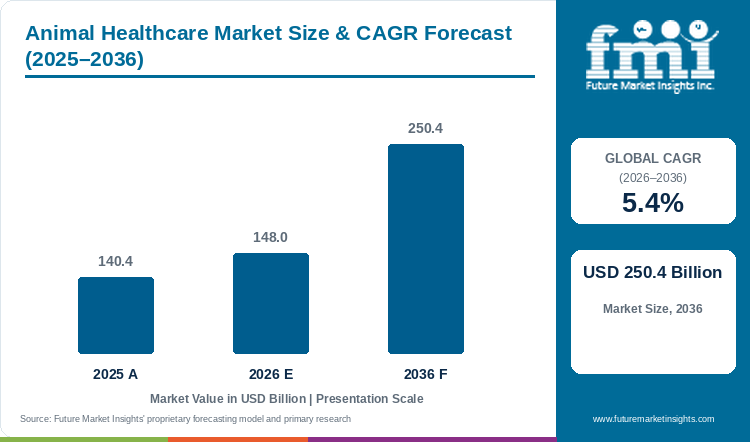
Demand is projected to expand at 5.4% CAGR from 2026 to 2036. Market value rises from USD 140.4 billion in 2025 to USD 148 billion in 2026 and USD 250.4 billion by 2036.
Animal healthcare expenditure follows two different patterns, because livestock operators evaluate herd health alongside production continuity while companion-animal owners make decisions around the needs of individual pets. The market is estimated at USD 148.0 billion in 2026 and projected to reach USD 250.4 billion by 2036, with feed additives and production animals retaining substantial positions within their respective classifications. Preventive products, diagnostic services and veterinary treatment therefore compete for budgets that respond to disease risk, animal age and the practical availability of professional care. Covered medicated feeds also require veterinary oversight in the United States, which gives prescribing relationships a direct commercial role within the covered medicated-feed category. [1] For livestock businesses, timely identification of illness can change the sequence of testing, treatment and subsequent monitoring, whereas companion-animal practices can combine recurring preventive visits with more specialized interventions. Veterinary point-of-care diagnostics can bring selected test results closer to that initial care decision. Suppliers that provide reliable product availability and clear species-specific instructions are positioned to support these established care pathways as spending expands. [4]
Key Market Trends & Insights
- Veterinary diagnostics are becoming more closely connected with treatment decisions, because identifying the organism or underlying condition changes the appropriate product and follow-up pathway.
- Antimicrobial surveillance increasingly distinguishes sales from actual use, helping veterinary authorities examine species-level patterns without treating all animal-health expenditure as antibiotic consumption. [2]
- Companion-animal portfolios extend from routine prevention to chronic care, while production-animal businesses continue to depend on practical delivery across large herds and flocks. [4]
Regional Highlights
- North American demand combines large companion-animal practices with commercial livestock operations, giving distribution reliability and veterinary prescribing relationships considerable practical importance. [1]
- European purchasing takes place alongside structured veterinary antimicrobial surveillance, while vaccines, diagnostics and other non-antimicrobial products retain distinct clinical and commercial functions. [2]
- Japan combines established veterinary product oversight with care for an aging pet population, making product suitability and continuity of treatment relevant purchasing considerations. [3]
Market Size & Forecast
Table 1: Market Size and Forecast for Animal Healthcare Market (USD billion and percentage), 2025 to 2036
| Metric | Value |
|---|---|
| 2025 market value | USD 140.4 billion |
| 2026 market value | USD 148 billion |
| 2036 market value | USD 250.4 billion |
| CAGR 2026 to 2036 | 5.4% |
| Revenue increase 2026 to 2036 | USD 102.4 billion |
| Market expansion 2026 to 2036 | 1.69 times |
Growth through 2036 is expected to reflect a broader mix of preventive products, diagnostic work and ongoing treatment across several species and care settings. At a projected 5.4% CAGR, the market expands from USD 148.0 billion in 2026 to USD 250.4 billion in 2036. The useful connection with poultry diagnostics is earlier recognition of flock health problems, which can influence subsequent care decisions without replacing vaccination, nutrition or veterinary judgment. [2]
How do animal type and veterinary oversight shape purchasing?
A feed additive, a diagnostic test and a veterinary medicine enter different purchasing pathways even when they support the same production system. Product classification determines the relevant professional oversight, while animal species and management setting influence the delivery route. US veterinary feed directive requirements and European antimicrobial surveillance illustrate these distinctions without defining the entire animal healthcare market. [1][2]
Table 2: Industry evidence relevant to the animal healthcare market
| Indicator | Data point or observation | Market relevance | Source |
|---|---|---|---|
| Covered medicated feed | US VFD products require veterinary supervision | Prescribing relationships matter for the covered feed category | [1] |
| Antimicrobial surveillance | EMA publishes veterinary sales and use reports | Species and product scope need separate interpretation | [2] |
| Veterinary product oversight | Japan NVAL addresses quality, efficacy and safety | Registration and product suitability support reliable supply | [3] |
Analyst Perspective
"The animal healthcare market is evolving structurally, with companies
that can combine cost efficiency and application-specific performance gaining share."- Anurag Sharma, Principal Consultant, FMI
How is the Animal Healthcare Market segmented?
The market is segmented by Product Type, Animal Type, Healthcare Setting, Healthcare Need, and Region.
The market is organized by product type, animal type, healthcare setting and healthcare need, encompassing animal health products, diagnostics, medical devices, veterinary services and digital solutions. Companion animals, livestock and production animals, equine, aquatic and other managed animals create different requirements across veterinary practices, production premises, private premises and specialist settings, while preventive, therapeutic, diagnostic and procedural needs describe the purpose of expenditure.
Why do feed additives hold a substantial product position?
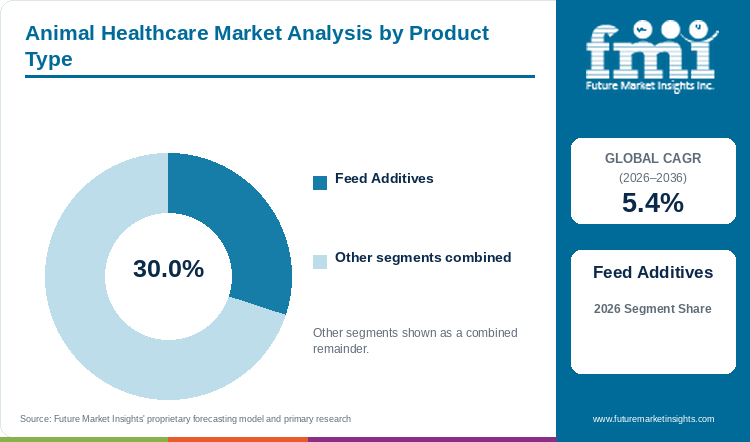
The Feed Additives segment is projected to account for 30.0% of product type demand in 2026.
Table 3: Product Type Share for Animal Healthcare Market (percentage share), 2026
| Product Type | Estimated share (2026) |
|---|---|
| Feed Additives | 30.0% |
| Other product types | 70.0% |
| Total | 100.0% |
Table 4: Segment Position and Market Growth for Animal Healthcare Market, 2026 to 2036
| Metric | Value |
|---|---|
| Global CAGR (2026 to 2036) | 5.4% |
| Profiled product type segment | Feed Additives |
Animal feed additives are purchased through the repeated feeding cycle, which gives their demand a regular relationship with herd and flock size. Their commercial importance rests on species-specific formulations, consistent mixing and suitability for the production system, with the intended nutritional function determining how the product enters the ration. Covered medicated feed remains subject to its own veterinary requirements in the United States, so nutritional products and VFD drugs retain distinct purchasing conditions. [1] At farm level, the comparison involves the amount used across a flock or herd and dependable delivery through the feed supply chain. These repeated requirements explain how additives can hold a substantial expenditure position across production systems with different feeding and animal-health priorities.
- Feed Additives are projected to account for 30.0% of product-type demand in 2026, as each feeding cycle creates repeat requirements for suitable formulations and dependable feed-chain delivery.
- Veterinary oversight applies to covered medicated feeds, while formulation and species suitability remain relevant considerations across the wider additive category. [1]
Why do livestock and production animals account for the larger animal-type share?
The Livestock & Production Animals segment is projected to account for 70.0% of animal type demand in 2026.
Table 5: Animal Type Share for Animal Healthcare Market (percentage share), 2026
| Animal Type | Estimated share (2026) |
|---|---|
| Livestock & Production Animals | 70.0% |
| Other animal type segments | 30.0% |
| Total | 100.0% |
Production animals concentrate expenditure across large numbers of cattle, pigs, poultry and other livestock, where health decisions affect the operation of an entire group. A vaccination schedule, diagnostic investigation or feed-related intervention can therefore involve substantial repeated purchasing even when spending per individual animal is limited. The production setting also changes how care is delivered, because veterinarians and farm staff must work within feeding, housing and handling routines. Group administration requires a product to fit those routines and the species being managed, with health observations influencing when a diagnostic investigation or treatment is needed. [4] Population scale and recurring management needs give this segment a substantial expenditure base across preventive products, professional care and authorized treatments.
- Livestock & Production Animals are projected to represent 70.0% of animal-type demand in 2026, with vaccination, testing and treatment programs involving repeated purchases across commercial herds and flocks.
- Companion-animal care remains commercially distinct because household treatment decisions, pet longevity and access to veterinary practices influence the pattern of spending. [4]
What are the drivers, restraints, and opportunities in the Animal Healthcare Market?
Animal-health purchasing combines recurring prevention with the less predictable cost of disease investigations and treatment. Large farms need products that fit group handling and feed routines, while household budgets influence the care available to individual pets. Linking timely diagnostic findings with a practical veterinary response offers suppliers a useful route to continuing demand, particularly when affordability and species-specific administration determine whether the proposed care can be sustained. [1][2][3][4]
Driver
Recurring animal care supports demand because vaccination, parasite management, diagnostic investigation and treatment address different points in the health cycle. Commercial farms need products that can be delivered consistently across groups of animals, while pet owners seek appropriate care as animals age or develop persistent conditions. Wider access to veterinary practices can bring these needs into a professional treatment pathway, with diagnostic findings helping practitioners select subsequent interventions alongside the clinical observations made during the visit. [4]
Restraint
Veterinary expenditure competes with farm operating costs and household budgets, creating different affordability pressures across animal categories. A product also needs an appropriate species indication, practical administration route and dependable availability before it can become a routine purchase. For antimicrobial medicines, professional oversight and surveillance add further conditions to use, so growth in the wider market does not imply unrestricted expansion of every drug class or a uniform treatment pathway across jurisdictions. [1][2]
Opportunity
Diagnostic services and more convenient follow-up offer an opportunity to connect an initial veterinary visit with continuing care, particularly where animals require repeated monitoring. Animal health software can help practices retain treatment histories and arrange subsequent visits, giving practitioners access to the observations behind an ongoing care plan. For production animals, the opportunity also involves linking herd observations with timely testing and suitable preventive products, so operators can respond to emerging health problems within the routines of the farm. [4]
Which country CAGRs are profiled in the Animal Healthcare Market?
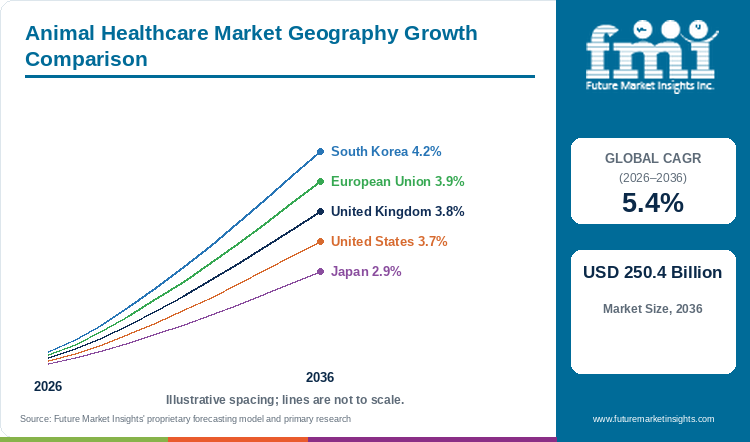
Table 6: Country CAGR Comparison for Animal Healthcare Market (CAGR percentage), 2026 to 2036
| Country | CAGR | Forecast period |
|---|---|---|
| South Korea | 4.2% | 2026 to 2036 |
| European Union | 3.9% | 2026 to 2036 |
| United Kingdom | 3.8% | 2026 to 2036 |
| United States | 3.7% | 2026 to 2036 |
| Japan | 2.9% | 2026 to 2036 |
Country-wise Analysis
South Korea Animal Healthcare Market Outlook (2026 to 2036)
Companion-animal care and modern livestock operations create different sources of South Korean demand, with the former shaped by household expectations and the latter by the practical needs of commercial herds and flocks. The market is projected to expand at a CAGR of 4.2% from 2026 to 2036. Veterinary infrastructure can widen access to testing and treatment, but adoption still depends on whether services are convenient for owners and usable within farm routines. Feed products, vaccines and diagnostics consequently reach customers through different purchasing relationships, while a specialist companion-animal intervention may require a referral. These differences favor suppliers that can match the species and care setting with suitable products and reliable local distribution.
European Union Animal Healthcare Market Outlook (2026 to 2036)
Veterinary antimicrobial reporting gives the European Union a particularly detailed framework for examining how selected medicines are sold and used, while the larger healthcare market also includes diagnostics, vaccines, nutrition and professional services. EMA's annual surveillance program separates these measures and is progressively expanding species-level information. [2] A projected 3.9% CAGR from 2026 to 2036 therefore reflects a diverse care market rather than a forecast of antibiotic consumption alone. Companion-animal practices can build recurring preventive and chronic-care relationships, whereas livestock customers evaluate health interventions within production systems. Product portfolios that address these distinct settings can serve demand without assuming that an approach appropriate for a household pet will transfer directly to a commercial farm.
United Kingdom Animal Healthcare Market Outlook (2026 to 2036)
The United Kingdom combines companion-animal spending with established cattle, sheep and other livestock systems, giving veterinary suppliers several routes to demand. A pet clinic may purchase diagnostic equipment and preventive medicines alongside services for older animals, while farm customers place greater emphasis on group management and dependable seasonal supply. Market growth is projected at a CAGR of 3.8% from 2026 to 2036, with practice organization and access to professional care influencing the mix of expenditure. Consolidation among veterinary groups can change procurement arrangements, but a local clinic still needs products suited to the animals it actually treats. This relationship between purchasing scale and day-to-day clinical requirements is more commercially relevant than treating every practice as an identical outlet.
United States Animal Healthcare Market Outlook (2026 to 2036)
Professional supervision has a direct place in US purchasing for covered veterinary feed directive products, because these medicated feeds require a licensed veterinarian's involvement. The requirement does not extend to every nutritional additive, making product classification important for suppliers serving livestock customers. [1] Alongside this production-animal business, companion-animal practices purchase medicines, diagnostics and other tools for routine prevention and continuing care. The US market is projected to expand at a CAGR of 3.7% from 2026 to 2036. Its broad customer base creates opportunities for specialized portfolios, but demand depends on the fit between the species, treatment setting and distribution channel, with farm operators and individual pet owners responding to different practical and financial considerations.
Japan Animal Healthcare Market Outlook (2026 to 2036)
Older pets can require repeated veterinary attention even when the overall companion-animal population does not increase rapidly, making the intensity and continuity of care relevant to Japan's market. Product suitability also operates within an established oversight system, with the National Veterinary Assay Laboratory addressing the quality, efficacy and safety of veterinary medicinal products. [3] Japan's animal healthcare market is projected to grow at a CAGR of 2.9% from 2026 to 2036. Suppliers therefore face a combination of mature pet-care demand and production-animal requirements, rather than a simple expansion in animal numbers. Convenient administration, consistent availability and appropriate diagnostic support can influence purchasing when owners and veterinarians manage conditions that persist over an animal's later life.
Who are the notable companies in the Animal Healthcare Market?
Zoetis; Boehringer Ingelheim Animal Health; MSD Animal Health; Elanco Animal Health; Ceva Santé Animale
Competition involves the breadth of species coverage, dependable product supply and the ability to serve veterinarians through established channels. A company with a substantial livestock portfolio needs to address group administration and farm routines, whereas a companion-animal portfolio can depend more on individual treatment plans and clinic relationships. [4] Vaccines, diagnostics and medicines also require different technical capabilities, making product category and customer setting useful distinctions when comparing suppliers across the different preventive, diagnostic and therapeutic portfolios available.
Competitive Benchmarking: Animal Healthcare Market
Table 7: Competitive positioning for the animal healthcare market
| Company | Positioning | Commercial distinction |
|---|---|---|
| Zoetis | Companion-animal and livestock medicines, vaccines and diagnostics | Reports distinct companion-animal and livestock businesses. [4] |
| Boehringer Ingelheim Animal Health | Veterinary pharmaceuticals and preventive animal-health products | Participates across companion-animal and production-animal care categories. |
| MSD Animal Health | Animal medicines, vaccines and connected animal-health solutions | Provides products used in veterinary and livestock management settings. |
| Elanco Animal Health | Companion-animal and livestock health products | Serves species-specific preventive and therapeutic product needs. |
| Ceva Santé Animale | Veterinary pharmaceuticals and vaccines | Supplies preventive and therapeutic animal-health portfolios. |
Key Developments in the Animal Healthcare Market
- EMA published its second ESUAvet annual surveillance report in December 2025, extending the public evidence available on veterinary antimicrobial sales and use across the participating European reporting system. [2]
- Zoetis reported companion-animal and livestock operations separately in its 2025 annual report, illustrating how different customer groups contribute to an established animal-health business. [4]
- Japan's National Veterinary Assay Laboratory continues to describe product quality, efficacy and safety as core responsibilities, providing a concrete institutional context for veterinary medicinal product oversight. [3]
Key Players in the Animal Healthcare Market
Companion-animal and livestock medicines, vaccines and diagnostics
- Zoetis
Veterinary pharmaceuticals and preventive animal-health products
- Boehringer Ingelheim Animal Health
Animal medicines, vaccines and connected animal-health solutions
- MSD Animal Health
Companion-animal and livestock health products
- Elanco Animal Health
Veterinary pharmaceuticals and vaccines
- Ceva Santé Animale
Animal Healthcare Market - Report Scope
Table 8: Report Scope for Animal Healthcare Market, 2026 to 2036
| Coverage field | Report scope |
|---|---|
| Market | Animal Healthcare Market |
| Historical reference | 2025 |
| Base year | 2026 |
| Forecast period | 2026 to 2036 |
| Currency and units | USD billion |
| Segmentation | Product Type, Animal Type, Healthcare Setting, Healthcare Need |
| Geographic coverage | North America, Latin America, Western Europe, Eastern Europe, East Asia, South Asia and Pacific, Middle East & Africa |
| Country and market profiles | South Korea, European Union, United Kingdom, United States, Japan |
| Representative companies | Zoetis; Boehringer Ingelheim Animal Health; MSD Animal Health; Elanco Animal Health; Ceva Santé Animale |
Animal Healthcare Market - Research Methodology
Table 9: Research Methodology for Animal Healthcare Market, 2026 edition
| Method | Approach |
|---|---|
| Market definition | Animal products, diagnostics, devices, veterinary services and digital care are considered with their species and use setting. |
| Demand assessment | Production-animal routines and individual companion-animal treatment pathways are examined separately. |
| Segmentation | Product type, animal type, setting and care need preserve the distinctions in the market coverage. |
| Geographic assessment | Five market profiles relate the forecast to local veterinary access, animal populations and product oversight. |
| Competitive assessment | Participant roles are compared through relevant product portfolios and disclosed business activities. |
| Evidence review | Institutional veterinary publications and company disclosures support specific claims alongside the market outlook. |
Animal Healthcare Market by Segments
Animal Healthcare Market segmented by Product Type:
- Animal Health Products
- Veterinary Pharmaceuticals
- Vaccines
- Biologics
- Parasiticides
- Feed Additives
- Medicated Feed Additives
- Therapeutic Nutrition
- Diagnostics
- Laboratory Diagnostics
- Point-of-Care Diagnostics
- Molecular Diagnostics
- Immunodiagnostics
- Imaging & Diagnostic Systems
- Medical Devices & Equipment
- Surgical Devices
- Monitoring Equipment
- Imaging Equipment
- Anesthesia & Critical-Care Equipment
- Dental Equipment
- Other Veterinary Devices
- Veterinary Healthcare Services
- Veterinary Consultation
- Preventive Healthcare
- Surgery
- Emergency Care
- Dental Care
- Hospitalization
- Diagnostic Services
- Rehabilitation & Physiotherapy
- Specialty Veterinary Care
- Digital & Technology-Enabled Healthcare
- Tele-veterinary Services
- Digital Health Platforms
- Remote Monitoring
- Connected Animal Health Technologies
- AI-enabled Diagnostics and Decision Support
- Veterinary Pharmaceuticals
Animal Healthcare Market segmented by Animal Type:
- Companion Animals
- Dogs
- Cats
- Other Companion Animals
- Livestock & Production Animals
- Cattle
- Swine
- Poultry
- Sheep & Goats
- Other Production Animals
- Equine
- Aquatic Animals
- Specialty & Managed Animals
- Dogs
Animal Healthcare Market segmented by Healthcare Setting:
- Veterinary Practice
- Veterinary Clinics
- Veterinary Hospitals
- Specialty Veterinary Centers
- Emergency & Critical-Care Practices
- Production Animal Premises
- Private Animal Premises
- Shelter & Welfare Facilities
- Research & Experimental Facilities
- Zoological & Conservation Facilities
- Veterinary Clinics
Animal Healthcare Market segmented by Healthcare Need:
- Preventive Healthcare
- Therapeutic Healthcare
- Diagnostic Healthcare
- Surgical & Procedural Care
- Critical & Emergency Care
- Specialty & Long-Term Care
- Reproductive & Production Health
Animal Healthcare Market by Region
- North America
- United States
- Canada
- Latin America
- Brazil
- Mexico
- Argentina
- Chile
- Western Europe
- Germany
- France
- United Kingdom
- Italy
- Spain
- Benelux
- Nordics
- Eastern Europe
- Poland
- Czech Republic
- Romania
- Hungary
- East Asia
- China
- Japan
- South Korea
- South Asia and Pacific
- India
- ASEAN
- Australia and New Zealand
- Middle East and Africa
- GCC Countries
- South Africa
- Türkiye
- Israel
Research Sources and Bibliography
- [1] US Food and Drug Administration. Accessed 15 October 2026. Veterinary Feed Directive Producer Requirements
- [2] European Medicines Agency. Accessed 15 October 2026. ESUAvet annual surveillance reports
- [3] Japan Ministry of Agriculture, Forestry and Fisheries. Accessed 15 October 2026. Summary of the National Veterinary Assay Laboratory
- [4] Zoetis. Accessed 15 October 2026. 2025 Annual Report
This Report Answers
- How large is the animal healthcare market in 2026?
- What is the animal healthcare market outlook through 2036?
- Which product category has a substantial share?
- Which animal type accounts for the larger share?
- Does veterinary feed oversight cover every additive?
Frequently Asked Questions
How large is the animal healthcare market in 2026?
The market is estimated at USD 148.0 billion in 2026, compared with USD 140.4 billion in 2025.
What is the animal healthcare market outlook through 2036?
The market is projected to reach USD 250.4 billion by 2036, expanding at a CAGR of 5.4% during 2026 to 2036.
Which product category has a substantial share?
Feed additives represent a projected 30.0% of product-type demand in 2026, supported by recurring use within animal feeding systems.
Which animal type accounts for the larger share?
Production animals account for a projected 70.0% share in 2026, reflecting the scale and recurring health requirements of commercial livestock operations.
Does veterinary feed oversight cover every additive?
US veterinary feed directive requirements apply to covered medicated feeds, while other feed additives retain their own classification and use conditions. [1]
Preview the report firsthand - request a free sample
Get SampleGet the brochure for pricing and purchase details.
Get PDFTable of Content
- Key Takeaways
- Market Size and CAGR
- Top Growth Driver
- Fastest Growing Segment
- Leading Region
- Key Companies
- Emerging Opportunities
- Executive Summary
- Global Market Outlook
- Demand-side Trends
- Supply-side Trends
- Technology Roadmap Analysis
- Analysis and Recommendations
- Analyst Perspective (What is happening? Why now? What should investors know?)
- Key Questions Answered
- How large is the market?
- What is the CAGR?
- What are key trends?
- Which region dominates?
- Who are the leaders?
- Market Overview
- Market Coverage / Taxonomy
- Market Definition / Scope / Limitations
- Research Methodology
- Chapter Orientation
- Analytical Lens and Working Hypotheses
- Market Structure, Signals, and Trend Drivers
- Benchmarking and Cross-market Comparability
- Market Sizing, Forecasting, and Opportunity Mapping
- Research Design and Evidence Framework
- Desk Research Programme (Secondary Evidence)
- Expert Input and Fieldwork (Primary Evidence)
- Tooling, Models, and Reference Databases
- Data Engineering and Model Build
- Quality Assurance and Audit Trail
- Market Background
- Market Dynamics (Drivers, Restraints, Opportunity, Trends)
- Scenario Forecast (Optimistic, Likely, Conservative)
- Impact Analysis
- AI Impact
- Sustainability Impact
- Regulatory Impact
- Technology Impact
- Consumer / Buyer Analysis
- Purchase Drivers
- Adoption Barriers
- Buyer Journey
- Opportunity Map Analysis
- Product Life Cycle Analysis
- Supply Chain Analysis
- Investment Feasibility Matrix
- Value Chain Analysis
- PESTLE and Porter's Analysis
- Regulatory Landscape
- Regional Parent Market Outlook
- Production and Consumption Statistics
- Import and Export Statistics
- Global Market Analysis and Forecast, 2021 to 2036
- Historical Market Size Value (USD Billion) Analysis, 2021 to 2025
- Current and Future Market Size Value (USD Billion) Projections, 2026 to 2036
- Y-o-Y Growth Trend Analysis
- Absolute $ Opportunity Analysis
- Global Market Pricing Analysis, 2021 to 2036
- Global Market Analysis and Forecast, By Product Type, 2021 to 2036
- Introduction / Key Findings
- Historical Market Size Value (USD Billion) Analysis By Product Type, 2021 to 2025
- Current and Future Market Size Value (USD Billion) Analysis and Forecast By Product Type, 2026 to 2036
- Animal Health Products
- Veterinary Pharmaceuticals
- Vaccines
- Biologics
- Parasiticides
- Feed Additives
- Medicated Feed Additives
- Therapeutic Nutrition
- Diagnostics
- Laboratory Diagnostics
- Point-of-Care Diagnostics
- Molecular Diagnostics
- Immunodiagnostics
- Imaging & Diagnostic Systems
- Medical Devices & Equipment
- Surgical Devices
- Monitoring Equipment
- Imaging Equipment
- Anesthesia & Critical-Care Equipment
- Dental Equipment
- Other Veterinary Devices
- Veterinary Healthcare Services
- Veterinary Consultation
- Preventive Healthcare
- Surgery
- Emergency Care
- Dental Care
- Hospitalization
- Diagnostic Services
- Rehabilitation & Physiotherapy
- Specialty Veterinary Care
- Digital & Technology-Enabled Healthcare
- Tele-veterinary Services
- Digital Health Platforms
- Remote Monitoring
- Connected Animal Health Technologies
- AI-enabled Diagnostics and Decision Support
- Y-o-Y Growth Trend Analysis By Product Type, 2021 to 2025
- Absolute $ Opportunity Analysis By Product Type, 2026 to 2036
- Global Market Analysis and Forecast, By Animal Type, 2021 to 2036
- Introduction / Key Findings
- Historical Market Size Value (USD Billion) Analysis By Animal Type, 2021 to 2025
- Current and Future Market Size Value (USD Billion) Analysis and Forecast By Animal Type, 2026 to 2036
- Companion Animals
- Dogs
- Cats
- Other Companion Animals
- Livestock & Production Animals
- Cattle
- Swine
- Poultry
- Sheep & Goats
- Other Production Animals
- Equine
- Aquatic Animals
- Specialty & Managed Animals
- Y-o-Y Growth Trend Analysis By Animal Type, 2021 to 2025
- Absolute $ Opportunity Analysis By Animal Type, 2026 to 2036
- Global Market Analysis and Forecast, By Healthcare Setting, 2021 to 2036
- Introduction / Key Findings
- Historical Market Size Value (USD Billion) Analysis By Healthcare Setting, 2021 to 2025
- Current and Future Market Size Value (USD Billion) Analysis and Forecast By Healthcare Setting, 2026 to 2036
- Veterinary Practice
- Veterinary Clinics
- Veterinary Hospitals
- Specialty Veterinary Centers
- Emergency & Critical-Care Practices
- Production Animal Premises
- Private Animal Premises
- Shelter & Welfare Facilities
- Research & Experimental Facilities
- Zoological & Conservation Facilities
- Y-o-Y Growth Trend Analysis By Healthcare Setting, 2021 to 2025
- Absolute $ Opportunity Analysis By Healthcare Setting, 2026 to 2036
- Global Market Analysis and Forecast, By Healthcare Need, 2021 to 2036
- Introduction / Key Findings
- Historical Market Size Value (USD Billion) Analysis By Healthcare Need, 2021 to 2025
- Current and Future Market Size Value (USD Billion) Analysis and Forecast By Healthcare Need, 2026 to 2036
- Preventive Healthcare
- Therapeutic Healthcare
- Diagnostic Healthcare
- Surgical & Procedural Care
- Critical & Emergency Care
- Specialty & Long-Term Care
- Reproductive & Production Health
- Y-o-Y Growth Trend Analysis By Healthcare Need, 2021 to 2025
- Absolute $ Opportunity Analysis By Healthcare Need, 2026 to 2036
- Global Market Analysis and Forecast, By Region, 2021 to 2036
- Introduction
- Historical Market Size Value (USD Billion) Analysis By Region, 2021 to 2025
- Current Market Size Value (USD Billion) Analysis and Forecast By Region, 2026 to 2036
- North America
- Latin America
- Western Europe
- Eastern Europe
- East Asia
- South Asia and Pacific
- Middle East & Africa
- Market Attractiveness Analysis By Region
- North America Market Analysis and Forecast, By Country, 2021 to 2036
- Historical Market Size Value (USD Billion) Trend Analysis By Market Taxonomy, 2021 to 2025
- Market Size Value (USD Billion) Forecast By Market Taxonomy, 2026 to 2036
- By Country
- USA
- Canada
- Mexico
- By Product Type
- By Animal Type
- By Healthcare Setting
- By Healthcare Need
- By Country
- Market Attractiveness Analysis
- By Country
- By Product Type
- By Animal Type
- By Healthcare Setting
- By Healthcare Need
- Key Takeaways
- Latin America Market Analysis and Forecast, By Country
- Historical Market Size Value (USD Billion) Trend Analysis By Market Taxonomy, 2021 to 2025
- Market Size Value (USD Billion) Forecast By Market Taxonomy, 2026 to 2036
- By Country
- Brazil
- Chile
- Rest of Latin America
- By Product Type
- By Animal Type
- By Healthcare Setting
- By Healthcare Need
- By Country
- Market Attractiveness Analysis
- By Country
- By Product Type
- By Animal Type
- By Healthcare Setting
- By Healthcare Need
- Key Takeaways
- Western Europe Market Analysis and Forecast, By Country
- Historical Market Size Value (USD Billion) Trend Analysis By Market Taxonomy, 2021 to 2025
- Market Size Value (USD Billion) Forecast By Market Taxonomy, 2026 to 2036
- By Country
- Germany
- UK
- Italy
- Spain
- France
- Nordic
- BENELUX
- Rest of Western Europe
- By Product Type
- By Animal Type
- By Healthcare Setting
- By Healthcare Need
- By Country
- Market Attractiveness Analysis
- By Country
- By Product Type
- By Animal Type
- By Healthcare Setting
- By Healthcare Need
- Key Takeaways
- Eastern Europe Market Analysis and Forecast, By Country
- Historical Market Size Value (USD Billion) Trend Analysis By Market Taxonomy, 2021 to 2025
- Market Size Value (USD Billion) Forecast By Market Taxonomy, 2026 to 2036
- By Country
- Russia
- Poland
- Hungary
- Balkan & Baltic
- Rest of Eastern Europe
- By Product Type
- By Animal Type
- By Healthcare Setting
- By Healthcare Need
- By Country
- Market Attractiveness Analysis
- By Country
- By Product Type
- By Animal Type
- By Healthcare Setting
- By Healthcare Need
- Key Takeaways
- East Asia Market Analysis and Forecast, By Country
- Historical Market Size Value (USD Billion) Trend Analysis By Market Taxonomy, 2021 to 2025
- Market Size Value (USD Billion) Forecast By Market Taxonomy, 2026 to 2036
- By Country
- China
- Japan
- South Korea
- By Product Type
- By Animal Type
- By Healthcare Setting
- By Healthcare Need
- By Country
- Market Attractiveness Analysis
- By Country
- By Product Type
- By Animal Type
- By Healthcare Setting
- By Healthcare Need
- Key Takeaways
- South Asia and Pacific Market Analysis and Forecast, By Country
- Historical Market Size Value (USD Billion) Trend Analysis By Market Taxonomy, 2021 to 2025
- Market Size Value (USD Billion) Forecast By Market Taxonomy, 2026 to 2036
- By Country
- India
- ASEAN
- Australia & New Zealand
- Rest of South Asia and Pacific
- By Product Type
- By Animal Type
- By Healthcare Setting
- By Healthcare Need
- By Country
- Market Attractiveness Analysis
- By Country
- By Product Type
- By Animal Type
- By Healthcare Setting
- By Healthcare Need
- Key Takeaways
- Middle East & Africa Market Analysis and Forecast, By Country
- Historical Market Size Value (USD Billion) Trend Analysis By Market Taxonomy, 2021 to 2025
- Market Size Value (USD Billion) Forecast By Market Taxonomy, 2026 to 2036
- By Country
- Kingdom of Saudi Arabia
- Other GCC Countries
- Turkiye
- South Africa
- Other African Union
- Rest of Middle East & Africa
- By Product Type
- By Animal Type
- By Healthcare Setting
- By Healthcare Need
- By Country
- Market Attractiveness Analysis
- By Country
- By Product Type
- By Animal Type
- By Healthcare Setting
- By Healthcare Need
- Key Takeaways
- Key Countries Market Analysis
- USA
- Pricing Analysis
- Market Share Analysis, 2025
- By Product Type
- By Animal Type
- By Healthcare Setting
- By Healthcare Need
- Canada
- Pricing Analysis
- Market Share Analysis, 2025
- By Product Type
- By Animal Type
- By Healthcare Setting
- By Healthcare Need
- Mexico
- Pricing Analysis
- Market Share Analysis, 2025
- By Product Type
- By Animal Type
- By Healthcare Setting
- By Healthcare Need
- Brazil
- Pricing Analysis
- Market Share Analysis, 2025
- By Product Type
- By Animal Type
- By Healthcare Setting
- By Healthcare Need
- Chile
- Pricing Analysis
- Market Share Analysis, 2025
- By Product Type
- By Animal Type
- By Healthcare Setting
- By Healthcare Need
- Germany
- Pricing Analysis
- Market Share Analysis, 2025
- By Product Type
- By Animal Type
- By Healthcare Setting
- By Healthcare Need
- UK
- Pricing Analysis
- Market Share Analysis, 2025
- By Product Type
- By Animal Type
- By Healthcare Setting
- By Healthcare Need
- Italy
- Pricing Analysis
- Market Share Analysis, 2025
- By Product Type
- By Animal Type
- By Healthcare Setting
- By Healthcare Need
- Spain
- Pricing Analysis
- Market Share Analysis, 2025
- By Product Type
- By Animal Type
- By Healthcare Setting
- By Healthcare Need
- France
- Pricing Analysis
- Market Share Analysis, 2025
- By Product Type
- By Animal Type
- By Healthcare Setting
- By Healthcare Need
- India
- Pricing Analysis
- Market Share Analysis, 2025
- By Product Type
- By Animal Type
- By Healthcare Setting
- By Healthcare Need
- ASEAN
- Pricing Analysis
- Market Share Analysis, 2025
- By Product Type
- By Animal Type
- By Healthcare Setting
- By Healthcare Need
- Australia & New Zealand
- Pricing Analysis
- Market Share Analysis, 2025
- By Product Type
- By Animal Type
- By Healthcare Setting
- By Healthcare Need
- China
- Pricing Analysis
- Market Share Analysis, 2025
- By Product Type
- By Animal Type
- By Healthcare Setting
- By Healthcare Need
- Japan
- Pricing Analysis
- Market Share Analysis, 2025
- By Product Type
- By Animal Type
- By Healthcare Setting
- By Healthcare Need
- South Korea
- Pricing Analysis
- Market Share Analysis, 2025
- By Product Type
- By Animal Type
- By Healthcare Setting
- By Healthcare Need
- Russia
- Pricing Analysis
- Market Share Analysis, 2025
- By Product Type
- By Animal Type
- By Healthcare Setting
- By Healthcare Need
- Poland
- Pricing Analysis
- Market Share Analysis, 2025
- By Product Type
- By Animal Type
- By Healthcare Setting
- By Healthcare Need
- Hungary
- Pricing Analysis
- Market Share Analysis, 2025
- By Product Type
- By Animal Type
- By Healthcare Setting
- By Healthcare Need
- Kingdom of Saudi Arabia
- Pricing Analysis
- Market Share Analysis, 2025
- By Product Type
- By Animal Type
- By Healthcare Setting
- By Healthcare Need
- South Africa
- Pricing Analysis
- Market Share Analysis, 2025
- By Product Type
- By Animal Type
- By Healthcare Setting
- By Healthcare Need
- European Union
- Pricing Analysis
- Market Share Analysis, 2025
- By Product Type
- By Animal Type
- By Healthcare Setting
- By Healthcare Need
- USA
- Market Structure Analysis
- Competition Dashboard
- Competition Benchmarking
- Market Share Analysis of Top Players
- By Regional
- By Product Type
- By Animal Type
- By Healthcare Setting
- By Healthcare Need
- Emerging Startups
- Innovation Benchmarking
- Competition Analysis
- Competition Deep Dive
- Zoetis
- Overview
- Product Portfolio
- Profitability by Market Segments
- Sales Footprint
- Strategy Overview
- Marketing Strategy
- Product Strategy
- Channel Strategy
- Boehringer Ingelheim Animal Health
- MSD Animal Health
- Elanco Animal Health
- Ceva Santé Animale
- Zoetis
- Case Studies
- Success Stories
- Recent Developments
- Competition Deep Dive
- Assumptions & Acronyms Used


