

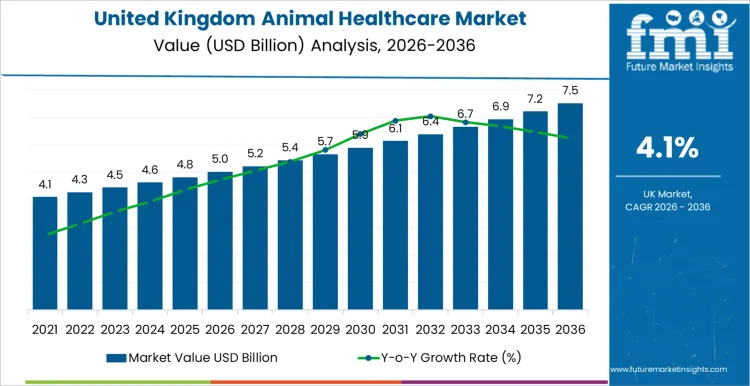
- Industry Size (2026)
- USD 5.02 Bn
- Forecast (2036)
- USD 7.51 Bn
- CAGR (2026 to 2036)
- 4.1%
Animal Healthcare Outlook in the UK 2026 to 2036
In the UK, the animal healthcare sector is projected to reach USD 5.02 billion in 2026, and further to USD 7.51 billion by 2036, at a 4.1% forecast CAGR. This expansion reflects a practical shift in how veterinary care is funded, delivered, and measured. Prevention-first routines, stronger diagnostic use, and more proactive disease management increasingly shape treatment decisions across both production animals and companion animals.
For executive teams in veterinary groups and animal health suppliers, the UK is a structured environment where product performance, clinical governance, and supply reliability matter as much as pricing. Demand is also influenced by how quickly veterinary service providers can respond to case load intensity. Pet owners expect faster treatment access, clear pricing, and confident clinical guidance.
Farm operators prioritise herd health continuity, biosecurity readiness, and output protection. These expectations create steady requirements across pharmaceuticals, vaccines, and feed additive programmes that support resilience against disease shocks and productivity loss.
Quick Stats for Animal Healthcare Industry in the UK
- Animal Healthcare Valuation in the UK (2026): USD 5.02 billion
- Animal Healthcare Forecast Valuation in the UK (2036): USD 7.51 billion
- Animal Healthcare Forecast CAGR (2026 to 2036): 4.1%
- Leading Regional Growth: England (4.5%)
- Leading Product Type: Feed Additives (44.0% share)
- Leading Animal Type: Production Animals (44.0% share)
- Key Companies Profiled: Zoetis Inc.; Boehringer Ingelheim Animal Health; Merck Animal Health (MSD Animal Health); Elanco Animal Health Incorporated; Ceva Santé Animale
Why is the UK a High-Value Hub for Animal Healthcare Adoption?
The UK remains a high-value adoption hub because veterinary care is shaped by strong regulation, high pet ownership, and a mature professional ecosystem. On the companion animal side, the scale is substantial. UK Pet Food reports that the UK pet population reached 36 million in 2024, with 60% of households, or 17.2 million, owning a pet. This reinforces recurring demand for preventive care, chronic condition management, parasite control, and routine vaccination support.
On the production side, healthcare spend is tied to herd productivity, welfare requirements, and infection risk management. The UK government publishes livestock population statistics that support sector planning and disease-control readiness. When livestock numbers shift, veterinary protocols and treatment programmes often adjust quickly to match biosecurity expectations and output protection targets.
Regulatory stability is another major driver. The Veterinary Medicines Directorate (VMD) annual report outlines how veterinary medicines oversight is maintained, including updates tied to legislative amendments that came into force in May 2024 to support continued availability of safe and effective veterinary medicines in Great Britain. This type of governance improves buyer confidence across veterinary clinics, farm supply networks, and animal health distributors.
A third driver is the UK’s disciplined approach to antimicrobial stewardship. The UK-VARSS reporting framework tracks veterinary antibiotic sales, usage, and resistance trends, supporting responsible treatment protocols and long-term efficacy protection. This supports a steady pivot toward prevention strategies, vaccination protocols, targeted treatment plans, and feed-based health support solutions.
Stakeholders shaping long-range portfolios often align product and service planning with broader developments in the animal healthcare industry worldwide to benchmark demand momentum across companion and production care pathways.
How is Animal Healthcare Demand Segmented by Product Type and Animal Type?
Two forces that influence every major purchasing decision shape UK demand: prevention intensity and outcome accountability. Buyers evaluate solutions based on how reliably they reduce disease risk, support performance, and minimise disruption across veterinary workflow.
Why do feed additives remain the strongest product-type anchor for preventive health programmes?
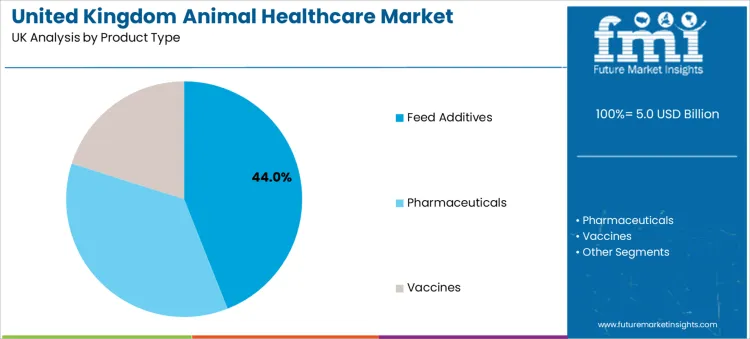
Feed additives hold a 44.0% share, making them the leading product type. This position is driven by the role additives play in day-to-day health maintenance rather than one-time interventions. In production environments, additives support gut health, nutrient uptake, stress tolerance, and immune readiness. These outcomes directly affect productivity and reduce the likelihood of costly disease outbreaks.
For commercial stakeholders, feed additives also offer a scalable route to standardised health programmes across multiple farms or sites. These solutions are often integrated into feed operations with clear dosing control and repeatable performance tracking. This fits well with supply partnerships linked to the animal feed additives outlook, especially where manufacturers want consistency across formulation, supply continuity, and measurable on-farm impact.
Pharmaceuticals remain essential for targeted treatment, pain management, infection response, and long-term condition support. Their role becomes critical when prevention is not enough or when treatment escalation is required. Vaccines also play a strategic role in disease prevention and outbreak control, with strong relevance across production animals and companion animals. Vaccine portfolio development and adoption decisions often align with the veterinary vaccines outlook, particularly where public health linkages and biosecurity requirements influence long-term demand.
How do Production Animals shape Structured Veterinary Spending and Protocol Discipline?
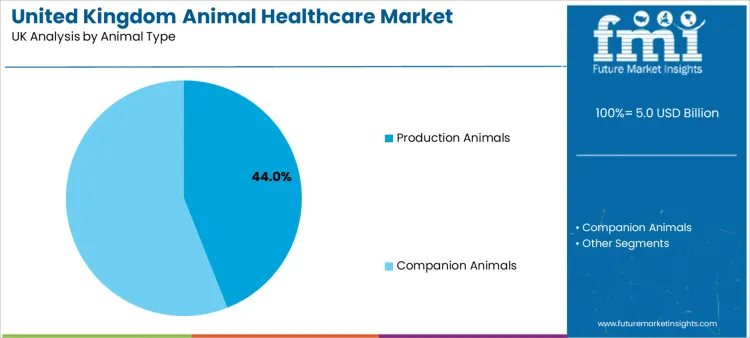
Production animals account for a 44.0% share, reflecting the operational reality that herd health is an economic lever. Farm operators and integrated meat and dairy supply chains rely on predictable veterinary protocols to protect yield, ensure welfare compliance, and support trade confidence. Health interventions for production animals are planned, audited, and measured against productivity indicators such as growth rate, feed conversion outcomes, and disease incidence reduction.
This segment supports consistent demand for preventive support, including feed additives, scheduled vaccination, parasite management, and selective pharmaceutical use. It also increases demand for surveillance and diagnostics that enable faster response when health conditions change.
Companion animals remain a powerful demand driver, supported by rising expectations around quality-of-life care. Pet owners increasingly seek advanced diagnostics, specialist treatment, and preventive routines that extend lifespan and improve daily wellbeing. This supports adoption of services and tools captured in companion animal imaging, where diagnostics improve clinical confidence and reduce delays in treatment decisions.
What are the Dynamics, Restraints, Opportunities, and Threats Shaping this Sector?
How is prevention-first care creating steady demand across products and services?
The UK is shifting toward prevention-first routines that protect animal wellbeing and reduce downstream treatment costs. For production animals, this means more structured feed health programmes, scheduled vaccinations, and proactive monitoring. For companion animals, it translates into routine check-ups, parasite control, early screening, and long-term condition management.
This behaviour supports recurring demand across feed additives and vaccines, while pharmaceuticals remain essential for acute care and ongoing condition treatment. Growth in clinical monitoring also increases demand for equipment and service capabilities tied to diagnostics, supported by technology pathways within animal health devices.
What limits Expansion even when Veterinary Needs are Rising?
Workforce capacity remains a pressure point. The Royal College of Veterinary Surgeons workforce modelling report highlights the importance of long-range workforce planning for veterinary surgeons and veterinary nurses in the UK. When clinics face staffing constraints, appointment availability tightens and service throughput becomes harder to scale. This can delay non-urgent care visits, reduce preventive uptake, and create backlogs for elective treatment.
Pricing sensitivity is another restraint. Pet owners may manage spending through prioritisation, focusing first on urgent treatment, essential medications, and core preventive care. Farm operators may delay upgrades unless the productivity benefit is clear and measurable.
Where do the Strongest Opportunities sit for Solution Providers and Veterinary Groups?
Opportunities are strongest in three areas:
Feed-based health programmes that reduce disease incidence and improve productivity outcomes. Additive manufacturers that can show consistent results and supply stability are well positioned for multi-site contracts.
Vaccine and preventive bundles that simplify owner compliance and strengthen herd protection. Portfolio design often benefits from clearer delivery models aligned with the veterinary vaccines outlook, especially where clinic networks want repeatable patient pathways.
Diagnostics-led care models that improve treatment speed and confidence. Veterinary groups investing in imaging, screening, and structured triage can improve outcomes and reduce costly escalation. Companion animal diagnostics adoption connects naturally with the expansion seen in companion animal imaging.
What Threats can Reshape Demand Patterns and Supplier Strategy?
Disease outbreaks remain a structural threat, capable of reshaping purchasing priorities overnight. Supply volatility is another threat, particularly for products with global sourcing exposure. A third threat is antimicrobial resistance risk.
The UK-VARSS programme tracks antibiotic sales, usage, and resistance patterns, reinforcing careful stewardship expectations across veterinary prescribing and farm protocols. This pushes suppliers to strengthen prevention options, improve vaccination coverage, and support evidence-based decision frameworks that preserve treatment effectiveness.
How is Animal Healthcare Demand Evolving across Key Regions in the UK?
Demand varies by veterinary clinic density, production activity, and regional healthcare infrastructure. Forecast growth rates from 2026 to 2036 are as follows:
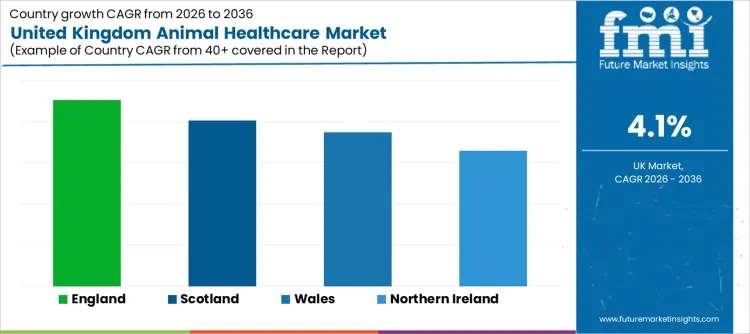
| Region | CAGR (2026 to 2036) |
|---|---|
| England | 4.5% |
| Scotland | 4.0% |
| Wales | 3.7% |
| Northern Ireland | 3.3% |
Why is England scaling faster through clinic concentration and higher service intensity?
England leads growth at 4.5%, supported by a dense network of veterinary providers, higher companion animal care intensity, and strong production supply chain presence. Clinic groups in England are also more likely to expand diagnostics capability and specialist care pathways, supporting higher-value treatment journeys. Demand for structured preventive programmes remains strong across both farm operations and companion care.
How is Scotland strengthening demand through planned livestock programmes and stable care routines?
Scotland expands at 4.0%, supported by consistent livestock health management and steady companion care routines. Buyers in the region often focus on reliable prevention frameworks that reduce outbreak risk and support welfare compliance. Demand for feed-based programmes remains relevant, especially where productivity continuity and animal wellbeing targets are prioritised.
What is driving Wales through practical adoption and value-focused veterinary planning?
Wales grows at 3.7%, with demand anchored in practical veterinary planning and outcome-focused purchasing. Farm operators often prioritise solutions that reduce health volatility and protect yield stability. Companion care demand is steady, shaped by routine visits, vaccinations, and management of chronic conditions.
Why is Northern Ireland progressing through focused care pathways and disciplined procurement?
Northern Ireland expands at 3.3%, reflecting steady demand where procurement discipline and value assurance are central. Buyers often scale adoption through essential preventive measures first, then broaden into higher-value diagnostic and treatment pathways as service capacity and budget flexibility allow.
What defines the Competitive Landscape for Animal Healthcare in the UK?
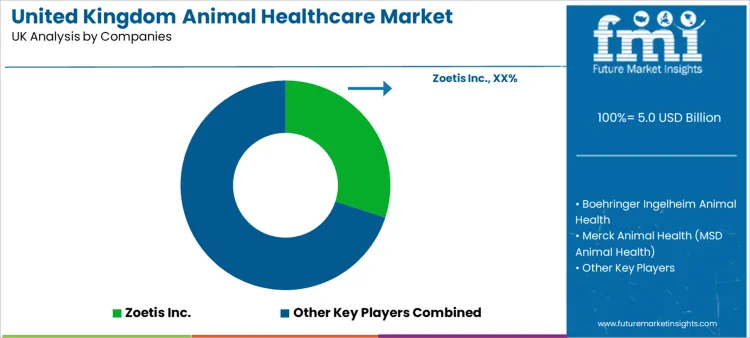
Competition is shaped by portfolio breadth, clinical trust, supply reliability, and technical support. Buyers evaluate providers on how well they can cover prevention, treatment, and long-term condition management across both production animals and companion animals. This rewards companies that can support full care pathways, not only individual products.
Zoetis Inc. maintains strong positioning through broad companion and production animal portfolios. Boehringer Ingelheim Animal Health competes through veterinary pharmaceuticals and preventive solutions across multiple species. Merck Animal Health (MSD Animal Health) remains influential through strong vaccine and disease-control capabilities. Elanco Animal Health Incorporated supports wide product access and veterinary partnerships across key categories. Ceva Santé Animale competes through targeted species solutions and focused healthcare innovation.
Winning strategies in the UK depend on practical execution. That includes consistent distribution, strong clinic engagement, clear dosing and compliance guidance, and proof-backed outcomes that stakeholders can trust.
Key Industry Participants
- Zoetis Inc.
- Boehringer Ingelheim Animal Health
- Merck Animal Health (MSD Animal Health)
- Elanco Animal Health Incorporated
- Ceva Santé Animale
Scope of Report
| Items | Values |
|---|---|
| Quantitative Units | USD Billion |
| Product Type | Feed Additives; Pharmaceuticals; Vaccines |
| Animal Type | Production Animals; Companion Animals |
| Regions Covered | England; Scotland; Wales; Northern Ireland |
| Key Companies Profiled | Zoetis Inc.; Boehringer Ingelheim Animal Health; Merck Animal Health (MSD Animal Health); Elanco Animal Health Incorporated; Ceva Santé Animale |
Animal Healthcare Demand in the UK by Segment
By Product Type:
- Feed Additives
- Pharmaceuticals
- Vaccines
By Animal Type:
- Production Animals
- Companion Animals
By Region:
- England
- Scotland
- Wales
- Northern Ireland
Bibliography
- Department for Environment, Food & Rural Affairs. (2024). Livestock populations in the United Kingdom at 1 December 2024.
- Royal College of Veterinary Surgeons. (2024). 2024 RCVS workforce modelling report. - UK Pet Food. (2024). UK Pet Food’s Pet Data Report 2024 is now available.
- Veterinary Medicines Directorate. (2025). Veterinary Medicines Directorate annual report and accounts 2024 to 2025.
- Veterinary Medicines Directorate. (2025). UK-VARSS 2024: Veterinary antimicrobial resistance and sales surveillance.
Frequently Asked Questions
How big is the demand for animal healthcare in uk in 2026?
The demand for animal healthcare in uk is estimated to be valued at USD 5.0 billion in 2026.
What will be the size of animal healthcare in uk in 2036?
The market size for the animal healthcare in uk is projected to reach USD 7.5 billion by 2036.
How much will be the demand for animal healthcare in uk growth between 2026 and 2036?
The demand for animal healthcare in uk is expected to grow at a 4.1% CAGR between 2026 and 2036.
What are the key product types in the animal healthcare in uk?
The key product types in animal healthcare in uk are feed additives, pharmaceuticals and vaccines.
Which animal type segment is expected to contribute significant share in the animal healthcare in uk in 2026?
In terms of animal type, production animals segment is expected to command 44.0% share in the animal healthcare in uk in 2026.
Preview the report firsthand - request a free sample
Get SampleGet the brochure for pricing and purchase details.
Get PDFTable of Content
- Executive Summary
- UK Market Outlook
- Demand-side Trends
- Supply-side Trends
- Technology Roadmap Analysis
- Analysis and Recommendations
- Market Overview
- Market Coverage / Taxonomy
- Market Definition / Scope / Limitations
- Market Background
- Market Dynamics
- Drivers
- Restraints
- Opportunity
- Trends
- Scenario Forecast
- Demand in Optimistic Scenario
- Demand in Likely Scenario
- Demand in Conservative Scenario
- Opportunity Map Analysis
- Product Life Cycle Analysis
- Supply Chain Analysis
- Investment Feasibility Matrix
- Value Chain Analysis
- PESTLE and Porter’s Analysis
- Regulatory Landscape
- Regional Parent Market Outlook
- Production and Consumption Statistics
- Import and Export Statistics
- Market Dynamics
- UK Market Analysis 2021 to 2025 and Forecast, 2026 to 2036
- Historical Market Size Value (USD Million) Analysis, 2021 to 2025
- Current and Future Market Size Value (USD Million) Projections, 2026 to 2036
- Y-o-Y Growth Trend Analysis
- Absolute $ Opportunity Analysis
- UK Market Pricing Analysis 2021 to 2025 and Forecast 2026 to 2036
- UK Market Analysis 2021 to 2025 and Forecast 2026 to 2036, By Product Type
- Introduction / Key Findings
- Historical Market Size Value (USD Million) Analysis By Product Type , 2021 to 2025
- Current and Future Market Size Value (USD Million) Analysis and Forecast By Product Type , 2026 to 2036
- Feed Additives
- Pharmaceuticals
- Vaccines
- Feed Additives
- Y-o-Y Growth Trend Analysis By Product Type , 2021 to 2025
- Absolute $ Opportunity Analysis By Product Type , 2026 to 2036
- UK Market Analysis 2021 to 2025 and Forecast 2026 to 2036, By Animal Type
- Introduction / Key Findings
- Historical Market Size Value (USD Million) Analysis By Animal Type, 2021 to 2025
- Current and Future Market Size Value (USD Million) Analysis and Forecast By Animal Type, 2026 to 2036
- Production Animals
- Companion Animals
- Production Animals
- Y-o-Y Growth Trend Analysis By Animal Type, 2021 to 2025
- Absolute $ Opportunity Analysis By Animal Type, 2026 to 2036
- Market Structure Analysis
- Competition Dashboard
- Competition Benchmarking
- Market Share Analysis of Top Players
- By Regional
- By Product Type
- By Animal Type
- Competition Analysis
- Competition Deep Dive
- Zoetis Inc.
- Overview
- Product Portfolio
- Profitability by Market Segments (Product/Age /Sales Channel/Region)
- Sales Footprint
- Strategy Overview
- Marketing Strategy
- Product Strategy
- Channel Strategy
- Boehringer Ingelheim Animal Health
- Merck Animal Health (MSD Animal Health)
- Elanco Animal Health Incorporated
- Ceva Santé Animale
- Zoetis Inc.
- Competition Deep Dive
- Assumptions & Acronyms Used
- Research Methodology


