

- Industry Size (2026)
- USD 3.1 Bn
- Forecast (2036)
- USD 7.4 Bn
- CAGR (2026 to 2036)
- 9.1%
Companion Animal Imaging Market Forecast and Outlook 2026 to 2036
The companion animal imaging market is projected to reach USD 7.4 billion by 2036 from an expected USD 3.1 billion in 2026, implying a CAGR of 9.10%. Spending is concentrated in North America, Western Europe, and parts of East Asia, where pet ownership rates, clinic density, and willingness to pay for advanced diagnostics are highest. Adoption remains uneven because many regions still rely on referral centers or basic radiography. Cost advantages cluster around countries with established medical imaging manufacturing bases and service networks, which shapes where equipment is produced, refurbished, and supported.
Over time, regional growth paths diverge based on clinic investment capacity rather than on pet population growth alone. Large urban markets continue to add in house imaging, while smaller practices in developing regions rely on shared or mobile units. Financing access, import duties, and technician availability influence purchase timing and modality choice. Distribution remains tied to veterinary equipment dealers with service reach. The market expands through gradual geographic spread of diagnostic standards, not through uniform upgrades across all veterinary practices.
Quick Stats of the Companion Animal Imaging Market
- Companion Animal Imaging Market Value (2026): USD 3.1 billion
- Companion Animal Imaging Forecast Value (2036): USD 7.4 billion
- Companion Animal Imaging Forecast CAGR 2026 to 2036: 9.1%
- Leading Modality in Companion Animal Imaging Market: X-ray Systems (40 % share)
- Leading End-User in Companion Animal Imaging Market: Veterinary Hospitals (45 % share)
- Key Growth Regions in Companion Animal Imaging Market: India, China, Brazil, USA, UK
- Top Players in Companion Animal Imaging Market: IDEXX Laboratories, Sound Technologies, FUJIFILM SonoSite, Canon Medical Systems, GE Healthcare, Samsung Medison, Siemens Healthineers
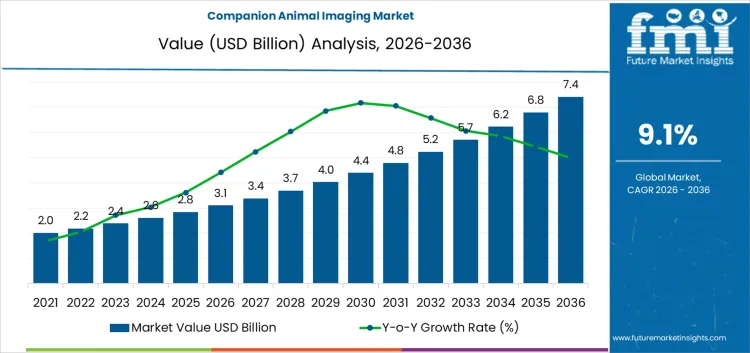
What is the Growth Forecast for Companion Animal Imaging Market through 2036?
Between 2026 and 2031, the companion animal imaging market is projected to expand from USD 3.1 billion along a path consistent with a 9.1% CAGR, shaped by the changing role of veterinary clinics rather than by equipment replacement cycles alone. Pet healthcare increasingly mirrors human care expectations, with diagnostics becoming a first-line decision tool instead of a last resort. X-ray and ultrasound systems remain the workhorses because they fit general practice economics, but referral patterns toward specialty clinics raise utilization intensity across installed bases. Spending in this phase is driven by case complexity and owner willingness to pursue definitive diagnosis, not only by clinic expansion. Investment decisions prioritize throughput, image quality, and workflow integration over acquiring the most advanced modality available.
From 2031 to 2036, the market is expected to reach USD 7.4 billion, with growth increasingly influenced by the spread of advanced imaging into non-academic veterinary settings. CT and MRI move from being referral-only tools toward becoming part of regional diagnostic hubs and large hospital networks. This changes the economics from occasional high-value scans to steady, protocol-driven utilization. Imaging becomes central to oncology, neurology, and orthopedic care pathways, raising both procedure volumes and equipment sophistication. Competitive positioning depends on service support, training, and software ecosystems as much as on hardware performance. This environment favors established suppliers such as IDEXX Laboratories, Sound Technologies, FUJIFILM SonoSite, Canon Medical Systems, GE Healthcare, Samsung Medison, and Siemens Healthineers.
Companion Animal Imaging Market Key Takeaways
| Metric | Value |
|---|---|
| Market Value (2026) | USD 3.1 billion |
| Forecast Value (2036) | USD 7.4 billion |
| Forecast CAGR 2026 to 2036 | 9.1% |
How Is the Companion Animal Imaging Market Advancing Veterinary Diagnostics?
Companion animal imaging technologies are increasingly adopted to enhance diagnosis, treatment planning, and monitoring in veterinary care. Historically, diagnostic imaging for pets relied on basic X-rays, limiting the ability to detect soft tissue conditions, early-stage diseases, or complex injuries. Modern imaging systems, including CT, MRI, and digital radiography, provide high-resolution, three-dimensional, and real-time visualization to support accurate diagnosis and treatment decisions. Veterinary clinics, specialty hospitals, and diagnostic centers prioritize image clarity, system reliability, and workflow integration. Early adoption focused on specialty and referral practices, while current demand spans general veterinary clinics, emergency care, and diagnostic laboratories, driven by increased pet healthcare spending, awareness of advanced treatments, and preventive care adoption.
Rising pet ownership, demand for advanced veterinary care, and regulatory standards for animal health are shaping market growth. Compared with conventional imaging methods, modern systems emphasize higher resolution, faster processing, and integration with digital record-keeping for improved clinical decision-making. Cost structures depend on equipment quality, software integration, and service support, concentrating margins among suppliers capable of delivering reliable, high-performance imaging systems. Veterinary practitioners adopt these technologies to improve diagnostic accuracy, reduce invasive procedures, and enhance treatment outcomes. By 2036, advanced companion animal imaging systems are expected to become standard in veterinary care, supporting precise diagnostics, preventive interventions, and improved animal health outcomes.
What Factors Are Shaping the Demand for Companion Animal Imaging by Modality Choice and Care Setting in 2026?
The companion animal imaging market in 2026 is segmented by imaging modality and by end user setting. By modality, demand is divided into X ray, ultrasound, CT, and MRI systems, each offering different balances of resolution, speed, cost, and diagnostic scope. By end user, demand is organized around veterinary hospitals, specialty animal clinics, diagnostic imaging centers, and research or academic institutions, which differ in case mix, capital budgets, and staffing depth. These segments reflect how clinical workflows, referral patterns, and economic constraints shape equipment selection in a field where diagnostic accuracy must be weighed against throughput, space, and ownership cost across diverse practice models.
Why Do X Ray Systems Remain the Most Widely Installed Modality?
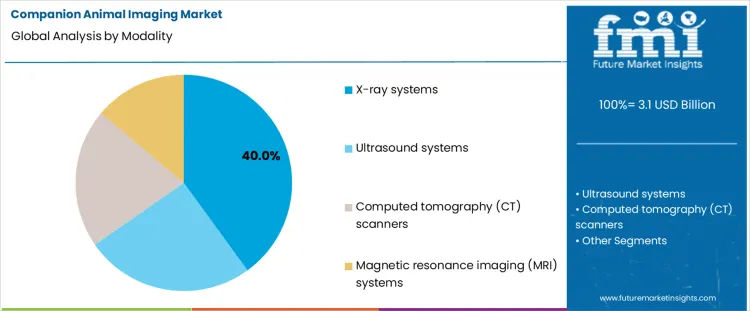
X ray systems account for about 40% of demand in 2026, reflecting their role as the first line imaging tool in most veterinary practices. They support rapid assessment of fractures, thoracic conditions, abdominal issues, and dental problems at a cost level that fits general practice economics. Workflow integration is simple, and image acquisition times are short, which suits high patient turnover environments. Digital radiography has further reduced handling and processing delays, improving daily utilization. Training requirements are modest compared with advanced modalities, which broadens the pool of usable staff. This combination of clinical versatility, speed, and manageable ownership cost keeps X ray as the default imaging investment for many companion animal clinics.
Ultrasound, CT, and MRI systems serve more targeted diagnostic roles. Ultrasound excels in soft tissue evaluation and guided procedures, yet it depends heavily on operator skill and does not replace radiography for many skeletal assessments. CT and MRI deliver high resolution cross sectional imaging, though they require dedicated rooms, anesthesia protocols, and higher capital outlay. Their use is often concentrated in referral centers and specialty practices. Case volumes for these systems are lower and more episodic, which limits their presence in general clinics. They expand with specialization and referral networks rather than through broad replacement of basic radiography.
Why Do Veterinary Hospitals Account for the Largest Share of Imaging Demand?
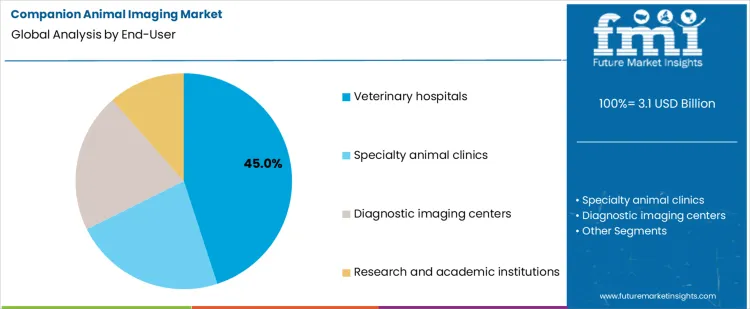
Veterinary hospitals represent about 45% of demand in 2026 because they combine primary care, surgery, and emergency services under one roof. This case mix generates steady imaging volume across trauma, internal medicine, and pre-operative assessment. Hospitals also operate longer hours and handle more walk in or urgent cases, which increases the need for on-site diagnostic capability. Investment decisions in these settings favor equipment that can be used across many departments rather than niche tools. Centralized management and higher patient throughput make it easier to justify imaging purchases and upgrades. This operational profile concentrates a large share of total imaging utilization and spending within hospital based practices.
Specialty clinics, imaging centers, and academic institutions follow different demand patterns. Specialty clinics focus on cardiology, neurology, or oncology cases, which drives selective investment in advanced modalities rather than broad based equipment sets. Imaging centers act as referral hubs, yet their numbers are limited and their business depends on regional referral density. Academic institutions purchase systems for training and research as well as care, which adds complexity to procurement but does not create large unit volumes. These settings are important for advanced diagnostics and skill development, yet routine imaging demand remains anchored in general veterinary hospitals that serve as the first contact point for most companion animal care.
Why Are Referral Patterns and Clinical Confidence, Not Pet Ownership Growth, Driving the Companion Animal Imaging Market through 2036?
Demand follows how cases move through veterinary networks. As primary clinics refer more complex workups, imaging becomes the gatekeeper for surgery, oncology, and chronic disease management. Clinicians rely on objective findings to justify invasive treatment and to communicate options to owners, which raises the threshold for decision making without scans. Insurance coverage and financing plans also reduce hesitation around diagnostics. Once a practice positions itself as a regional referral center, utilization rises through case mix rather than footfall. The result is that equipment adoption and upgrade cycles track specialization and referral density more closely than overall pet population trends.
What Capital Cost, Utilization Risk, and Skills Availability Are Limiting Wider Imaging Deployment?
Constraints are practical and financial. Advanced modalities require significant upfront investment, room modifications, shielding, and ongoing service contracts. Many clinics lack sufficient case volume to keep such assets fully utilized, which makes payback uncertain. Interpretation requires trained staff or teleradiology fees, adding recurring cost. Downtime risk is also material because a failed system can halt diagnostics entirely. Smaller practices therefore rely on external imaging centers or mobile services instead of owning equipment. These factors concentrate ownership in larger hospitals and chains and slow diffusion into general practices despite clear clinical benefits.
How Are Practice Consolidation, Workflow Integration, and Service Models Reshaping This Category?
Structure is changing with how veterinary care is organized. Corporate groups and hospital networks centralize high end imaging in hub locations while feeding cases from satellite clinics. Workflow integration is tightening, with imaging tied directly to electronic records, anesthesia protocols, and surgical planning. Mobile and shared use models are expanding to raise utilization without duplicating assets. At the same time, buyers prefer platforms that support multiple modalities over time to protect capital. The category is moving toward network based capacity planning and service driven access rather than one machine per clinic ownership.
What is the Demand for Companion Animal Imaging by Country?
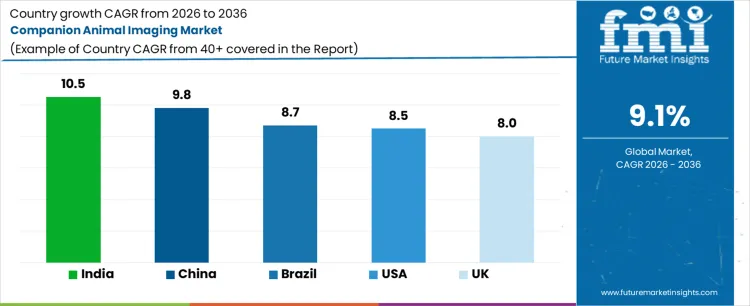
| Country | CAGR (%) |
|---|---|
| USA | 8.5 |
| UK | 8.0 |
| China | 9.8 |
| India | 10.5 |
| Brazil | 8.7 |
Demand for companion animal imaging is rising as veterinary clinics and animal hospitals adopt advanced diagnostic technologies for pet healthcare, disease detection, and treatment planning. India leads with a 10.5% CAGR, driven by rising pet ownership, growing veterinary infrastructure, and increased awareness of preventive healthcare. China follows at 9.8%, supported by expanding veterinary services, urbanization, and rising disposable income for pet care. Brazil records 8.7% growth, shaped by increasing pet population and adoption of modern imaging equipment. The USA grows at 8.5%, influenced by advanced veterinary practices and technological integration. The UK shows 8.0% CAGR, reflecting steady demand for imaging solutions in companion animal healthcare.
How is the United States experiencing growth in the companion animal imaging market?
United States is experiencing growth at a CAGR of 8.5%, driven by increasing pet ownership, rising awareness of veterinary diagnostics, and adoption of advanced imaging technologies. Veterinary hospitals and specialty clinics are deploying companion animal imaging systems optimized for X-ray, ultrasound, and MRI applications, ensuring rapid diagnosis and improved animal care. Demand is concentrated in metropolitan areas such as New York, Los Angeles, and Chicago, where pet healthcare spending is high. Investments focus on equipment reliability, diagnostic accuracy, and compliance with veterinary medical standards. Growth reflects expanding veterinary services, increasing pet health awareness, and integration of digital imaging in routine care.
- Veterinary diagnostics drive adoption.
- Imaging systems optimize speed, accuracy, and animal safety.
- Metropolitan veterinary hubs concentrate demand.
- Equipment reliability and regulatory compliance guide investment.
How is the United Kingdom witnessing growth in the companion animal imaging market?
United Kingdom is witnessing growth at a CAGR of 8%, supported by the expansion of small animal clinics, rising pet ownership, and integration of advanced diagnostic imaging technologies. Companion animal imaging solutions include digital radiography, CT, and ultrasound systems optimized for small animal applications and veterinary workflow efficiency. Demand is concentrated in London, Birmingham, and Manchester, where pet ownership and veterinary spending are highest. Investments prioritize equipment durability, imaging accuracy, and adherence to UK veterinary regulations. Growth reflects increasing use of advanced imaging for preventive care, specialized diagnostics, and clinical research in companion animals.
- Pet healthcare expansion drives adoption.
- Systems enhance diagnostic accuracy and workflow efficiency.
- Major cities concentrate demand.
- Equipment durability and veterinary compliance guide investment.
How is China experiencing growth in the companion animal imaging market?
China is experiencing growth at a CAGR of 9.8%, fueled by rising urban pet ownership, increasing disposable income, and rapid expansion of veterinary clinics in cities such as Beijing, Shanghai, and Guangzhou. Companion animal imaging solutions are optimized for digital radiography, ultrasound, and CT applications, supporting fast diagnosis and treatment planning. Demand is concentrated in urban veterinary hospitals and specialty animal clinics. Investments focus on system reliability, image resolution, and compliance with national veterinary guidelines. Growth reflects increasing awareness of animal health, urbanization-driven pet adoption, and integration of modern imaging technologies in veterinary practice.
- Urban pet ownership drives adoption.
- Systems optimize image resolution and diagnostic speed.
- Veterinary hospitals and specialty clinics concentrate demand.
- System reliability and regulatory compliance guide investment.
How is India witnessing growth in the companion animal imaging market?
India is witnessing growth at a CAGR of 10.5%, driven by rising pet ownership in metropolitan areas, growing awareness of veterinary diagnostics, and increasing availability of advanced imaging technologies. Companion animal imaging systems include X-ray, ultrasound, and CT devices optimized for small animal care and workflow efficiency. Demand is concentrated in urban centers such as Mumbai, Bengaluru, and Delhi, where veterinary infrastructure and pet healthcare spending are expanding. Investments prioritize imaging accuracy, equipment durability, and adherence to national veterinary standards. Growth reflects the modernization of veterinary clinics, rising demand for preventive diagnostics, and increasing adoption of digital imaging solutions.
- Pet healthcare growth drives adoption.
- Imaging systems enhance diagnostic accuracy and efficiency.
- Metro cities concentrate demand.
- Equipment durability and regulatory compliance guide investment.
How is Brazil experiencing growth in the companion animal imaging market?
Brazil is experiencing growth at a CAGR of 8.7%, supported by rising pet ownership, expansion of veterinary services, and increasing adoption of modern diagnostic technologies. Companion animal imaging solutions include X-ray, ultrasound, and CT devices optimized for small animal health monitoring and treatment. Demand is concentrated in urban areas such as São Paulo, Rio de Janeiro, and Brasília, where pet care spending and veterinary infrastructure are strong. Investments focus on equipment reliability, image quality, and compliance with national veterinary standards. Growth reflects increasing awareness of animal health, modernization of veterinary practices, and integration of advanced imaging into routine diagnostics.
- Pet ownership drives adoption.
- Systems optimize image quality and diagnostic reliability.
- Urban veterinary centers concentrate demand.
- Equipment reliability and regulatory compliance guide investment.
Who Competes in the Companion Animal Imaging Market and What Defines Their Capabilities?
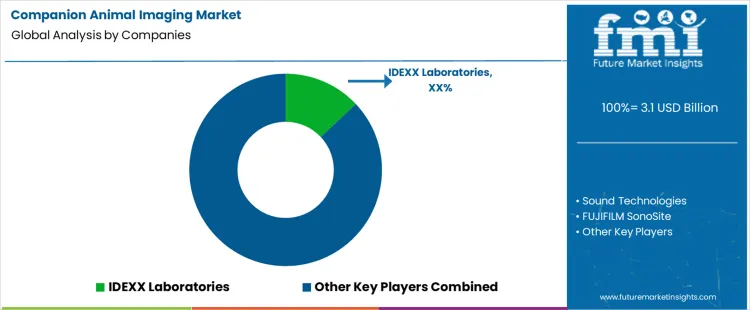
Competition in the companion animal imaging market centers on diagnostic performance, ease of use in veterinary settings, and support infrastructure for imaging modalities. IDEXX Laboratories provides imaging solutions tailored to veterinary clinics, pairing digital radiography and ultrasound with practice management tools for clinical workflows. Sound Technologies supplies veterinary specific imaging equipment and support services optimized for small animal diagnostics. FUJIFILM SonoSite delivers portable ultrasound systems with veterinary presets and rugged design for in clinic use. Canon Medical Systems offers a portfolio including digital radiography and CT systems adapted for animal imaging. GE Healthcare supplies ultrasound and advanced imaging modalities with veterinary applications supported by training and service networks. Samsung Medison provides ultrasound systems with veterinary software and probes designed for small and large animal anatomy. Siemens Healthineers delivers high resolution imaging systems and service support tailored to veterinary diagnostic needs.
Market participants differentiate through modality focus, veterinary workflow integration, and service support. IDEXX Laboratories emphasizes combined imaging and practice software to streamline patient records and diagnostics. Sound Technologies focuses on veterinary oriented sales, installation, and field support across clinic settings. FUJIFILM SonoSite’s portable ultrasound systems appeal where mobility and rapid diagnostics are priorities. Canon Medical Systems integrates veterinary imaging into broader clinical toolsets with advanced image processing. GE Healthcare’s offerings span ultrasound and CT with service agreements and training. Samsung Medison emphasizes image quality and veterinary application software. Siemens Healthineers supplies high end imaging options with integration into clinic IT systems. Other regional and specialty vendors contribute niche solutions such as digital radiography plates and dedicated animal probes. Competitive differences arise from image resolution, modality range, software features, service coverage, and alignment with veterinary practice workflows.
Key Players in the Companion Animal Imaging Market
- IDEXX Laboratories
- Sound Technologies
- FUJIFILM SonoSite
- Canon Medical Systems
- GE Healthcare
- Samsung Medison
- Siemens Healthineers
Scope of the Report
| Items | Values |
|---|---|
| Quantitative Units (2026) | USD billion |
| Modality | X-ray Systems, Ultrasound Systems, Computed Tomography (CT) Scanners, Magnetic Resonance Imaging (MRI) Systems |
| End User | Veterinary Hospitals, Specialty Animal Clinics, Diagnostic Imaging Centers, Research and Academic Institutions |
| Regions Covered | Asia Pacific, Europe, North America, Latin America, Middle East & Africa |
| Countries Covered | China, Japan, South Korea, India, Australia & New Zealand, ASEAN, Germany, United Kingdom, France, Italy, Spain, Nordic, BENELUX, United States, Canada, Mexico, Brazil, Chile, Saudi Arabia, Turkey, South Africa, and other regional markets |
| Key Companies Profiled | IDEXX Laboratories, Sound Technologies, FUJIFILM SonoSite, Canon Medical Systems, GE Healthcare, Samsung Medison, Siemens Healthineers |
| Additional Attributes | Dollar sales by modality and end user, X-ray systems forming the largest installed base due to general practice economics and high throughput needs, veterinary hospitals representing the largest share of demand because of mixed case load and emergency care volumes, increasing role of CT and MRI in referral hubs and large hospital networks, market expansion driven by referral patterns and clinical confidence rather than pet population growth, procurement influenced by financing access, technician availability, and service coverage, growing use of hub-and-spoke and mobile imaging models, and competitive positioning shaped by service support, training, software integration, and workflow compatibility as much as by hardware performance. |
Companion Animal Imaging Market Segmentation
Modality:
- X-ray systems
- Ultrasound systems
- Computed tomography (CT) scanners
- Magnetic resonance imaging (MRI) systems
End-User:
- Veterinary hospitals
- Specialty animal clinics
- Diagnostic imaging centers
- Research and academic institutions
Region:
- Asia Pacific
- China
- Japan
- South Korea
- India
- Australia & New Zealand
- ASEAN
- Rest of Asia Pacific
- Europe
- Germany
- United Kingdom
- France
- Italy
- Spain
- Nordic
- BENELUX
- Rest of Europe
- North America
- United States
- Canada
- Mexico
- Latin America
- Brazil
- Chile
- Rest of Latin America
- Middle East & Africa
- Kingdom of Saudi Arabia
- Other GCC Countries
- Turkey
- South Africa
- Other African Union
- Rest of Middle East & Africa
Bibliography
- World Organisation for Animal Health (WOAH). (2024). Global trends in companion animal health and veterinary services.
- Food and Agriculture Organization of the United Nations. (2023). Companion animals and veterinary services in urbanizing societies.
- American Veterinary Medical Association. (2024). USA pet ownership and veterinary care utilization statistics.
- Royal College of Veterinary Surgeons. (2023). Advanced veterinary practice standards and referral care frameworks.
- National Institutes of Health. (2025). Magnetic resonance imaging and computed tomography: Clinical principles and applications.
Frequently Asked Questions
How big is the companion animal imaging market in 2026?
The global companion animal imaging market is estimated to be valued at USD 3.1 billion in 2026.
What will be the size of companion animal imaging market in 2036?
The market size for the companion animal imaging market is projected to reach USD 7.4 billion by 2036.
How much will be the companion animal imaging market growth between 2026 and 2036?
The companion animal imaging market is expected to grow at a 9.1% CAGR between 2026 and 2036.
What are the key product types in the companion animal imaging market?
The key product types in companion animal imaging market are x-ray systems, ultrasound systems, computed tomography (ct) scanners and magnetic resonance imaging (mri) systems.
Which end-user segment to contribute significant share in the companion animal imaging market in 2026?
In terms of end-user, veterinary hospitals segment to command 45.0% share in the companion animal imaging market in 2026.
Preview the report firsthand - request a free sample
Get SampleGet the brochure for pricing and purchase details.
Get PDFTable of Content
- Executive Summary
- Global Market Outlook
- Demand-side Trends
- Supply-side Trends
- Technology Roadmap Analysis
- Analysis and Recommendations
- Market Overview
- Market Coverage / Taxonomy
- Market Definition / Scope / Limitations
- Market Background
- Market Dynamics
- Drivers
- Restraints
- Opportunity
- Trends
- Scenario Forecast
- Demand in Optimistic Scenario
- Demand in Likely Scenario
- Demand in Conservative Scenario
- Opportunity Map Analysis
- Product Life Cycle Analysis
- Supply Chain Analysis
- Investment Feasibility Matrix
- Value Chain Analysis
- PESTLE and Porter’s Analysis
- Regulatory Landscape
- Regional Parent Market Outlook
- Production and Consumption Statistics
- Import and Export Statistics
- Market Dynamics
- Global Market Analysis 2021 to 2025 and Forecast, 2026 to 2036
- Historical Market Size Value (USD Million) Analysis, 2021 to 2025
- Current and Future Market Size Value (USD Million) Projections, 2026 to 2036
- Y-o-Y Growth Trend Analysis
- Absolute $ Opportunity Analysis
- Global Market Pricing Analysis 2021 to 2025 and Forecast 2026 to 2036
- Global Market Analysis 2021 to 2025 and Forecast 2026 to 2036, By Modality
- Introduction / Key Findings
- Historical Market Size Value (USD Million) Analysis By Modality, 2021 to 2025
- Current and Future Market Size Value (USD Million) Analysis and Forecast By Modality, 2026 to 2036
- X-ray systems
- Ultrasound systems
- Computed tomography (CT) scanners
- Magnetic resonance imaging (MRI) systems
- X-ray systems
- Y-o-Y Growth Trend Analysis By Modality, 2021 to 2025
- Absolute $ Opportunity Analysis By Modality, 2026 to 2036
- Global Market Analysis 2021 to 2025 and Forecast 2026 to 2036, By End-User
- Introduction / Key Findings
- Historical Market Size Value (USD Million) Analysis By End-User, 2021 to 2025
- Current and Future Market Size Value (USD Million) Analysis and Forecast By End-User, 2026 to 2036
- Veterinary hospitals
- Specialty animal clinics
- Diagnostic imaging centers
- Research and academic institutions
- Veterinary hospitals
- Y-o-Y Growth Trend Analysis By End-User, 2021 to 2025
- Absolute $ Opportunity Analysis By End-User, 2026 to 2036
- Global Market Analysis 2021 to 2025 and Forecast 2026 to 2036, By Region
- Introduction
- Historical Market Size Value (USD Million) Analysis By Region, 2021 to 2025
- Current Market Size Value (USD Million) Analysis and Forecast By Region, 2026 to 2036
- North America
- Latin America
- Western Europe
- Eastern Europe
- East Asia
- South Asia and Pacific
- Middle East & Africa
- Market Attractiveness Analysis By Region
- North America Market Analysis 2021 to 2025 and Forecast 2026 to 2036, By Country
- Historical Market Size Value (USD Million) Trend Analysis By Market Taxonomy, 2021 to 2025
- Market Size Value (USD Million) Forecast By Market Taxonomy, 2026 to 2036
- By Country
- USA
- Canada
- Mexico
- By Modality
- By End-User
- By Country
- Market Attractiveness Analysis
- By Country
- By Modality
- By End-User
- Key Takeaways
- Latin America Market Analysis 2021 to 2025 and Forecast 2026 to 2036, By Country
- Historical Market Size Value (USD Million) Trend Analysis By Market Taxonomy, 2021 to 2025
- Market Size Value (USD Million) Forecast By Market Taxonomy, 2026 to 2036
- By Country
- Brazil
- Chile
- Rest of Latin America
- By Modality
- By End-User
- By Country
- Market Attractiveness Analysis
- By Country
- By Modality
- By End-User
- Key Takeaways
- Western Europe Market Analysis 2021 to 2025 and Forecast 2026 to 2036, By Country
- Historical Market Size Value (USD Million) Trend Analysis By Market Taxonomy, 2021 to 2025
- Market Size Value (USD Million) Forecast By Market Taxonomy, 2026 to 2036
- By Country
- Germany
- UK
- Italy
- Spain
- France
- Nordic
- BENELUX
- Rest of Western Europe
- By Modality
- By End-User
- By Country
- Market Attractiveness Analysis
- By Country
- By Modality
- By End-User
- Key Takeaways
- Eastern Europe Market Analysis 2021 to 2025 and Forecast 2026 to 2036, By Country
- Historical Market Size Value (USD Million) Trend Analysis By Market Taxonomy, 2021 to 2025
- Market Size Value (USD Million) Forecast By Market Taxonomy, 2026 to 2036
- By Country
- Russia
- Poland
- Hungary
- Balkan & Baltic
- Rest of Eastern Europe
- By Modality
- By End-User
- By Country
- Market Attractiveness Analysis
- By Country
- By Modality
- By End-User
- Key Takeaways
- East Asia Market Analysis 2021 to 2025 and Forecast 2026 to 2036, By Country
- Historical Market Size Value (USD Million) Trend Analysis By Market Taxonomy, 2021 to 2025
- Market Size Value (USD Million) Forecast By Market Taxonomy, 2026 to 2036
- By Country
- China
- Japan
- South Korea
- By Modality
- By End-User
- By Country
- Market Attractiveness Analysis
- By Country
- By Modality
- By End-User
- Key Takeaways
- South Asia and Pacific Market Analysis 2021 to 2025 and Forecast 2026 to 2036, By Country
- Historical Market Size Value (USD Million) Trend Analysis By Market Taxonomy, 2021 to 2025
- Market Size Value (USD Million) Forecast By Market Taxonomy, 2026 to 2036
- By Country
- India
- ASEAN
- Australia & New Zealand
- Rest of South Asia and Pacific
- By Modality
- By End-User
- By Country
- Market Attractiveness Analysis
- By Country
- By Modality
- By End-User
- Key Takeaways
- Middle East & Africa Market Analysis 2021 to 2025 and Forecast 2026 to 2036, By Country
- Historical Market Size Value (USD Million) Trend Analysis By Market Taxonomy, 2021 to 2025
- Market Size Value (USD Million) Forecast By Market Taxonomy, 2026 to 2036
- By Country
- Kingdom of Saudi Arabia
- Other GCC Countries
- Turkiye
- South Africa
- Other African Union
- Rest of Middle East & Africa
- By Modality
- By End-User
- By Country
- Market Attractiveness Analysis
- By Country
- By Modality
- By End-User
- Key Takeaways
- Key Countries Market Analysis
- USA
- Pricing Analysis
- Market Share Analysis, 2025
- By Modality
- By End-User
- Canada
- Pricing Analysis
- Market Share Analysis, 2025
- By Modality
- By End-User
- Mexico
- Pricing Analysis
- Market Share Analysis, 2025
- By Modality
- By End-User
- Brazil
- Pricing Analysis
- Market Share Analysis, 2025
- By Modality
- By End-User
- Chile
- Pricing Analysis
- Market Share Analysis, 2025
- By Modality
- By End-User
- Germany
- Pricing Analysis
- Market Share Analysis, 2025
- By Modality
- By End-User
- UK
- Pricing Analysis
- Market Share Analysis, 2025
- By Modality
- By End-User
- Italy
- Pricing Analysis
- Market Share Analysis, 2025
- By Modality
- By End-User
- Spain
- Pricing Analysis
- Market Share Analysis, 2025
- By Modality
- By End-User
- France
- Pricing Analysis
- Market Share Analysis, 2025
- By Modality
- By End-User
- India
- Pricing Analysis
- Market Share Analysis, 2025
- By Modality
- By End-User
- ASEAN
- Pricing Analysis
- Market Share Analysis, 2025
- By Modality
- By End-User
- Australia & New Zealand
- Pricing Analysis
- Market Share Analysis, 2025
- By Modality
- By End-User
- China
- Pricing Analysis
- Market Share Analysis, 2025
- By Modality
- By End-User
- Japan
- Pricing Analysis
- Market Share Analysis, 2025
- By Modality
- By End-User
- South Korea
- Pricing Analysis
- Market Share Analysis, 2025
- By Modality
- By End-User
- Russia
- Pricing Analysis
- Market Share Analysis, 2025
- By Modality
- By End-User
- Poland
- Pricing Analysis
- Market Share Analysis, 2025
- By Modality
- By End-User
- Hungary
- Pricing Analysis
- Market Share Analysis, 2025
- By Modality
- By End-User
- Kingdom of Saudi Arabia
- Pricing Analysis
- Market Share Analysis, 2025
- By Modality
- By End-User
- Turkiye
- Pricing Analysis
- Market Share Analysis, 2025
- By Modality
- By End-User
- South Africa
- Pricing Analysis
- Market Share Analysis, 2025
- By Modality
- By End-User
- USA
- Market Structure Analysis
- Competition Dashboard
- Competition Benchmarking
- Market Share Analysis of Top Players
- By Regional
- By Modality
- By End-User
- Competition Analysis
- Competition Deep Dive
- IDEXX Laboratories
- Overview
- Product Portfolio
- Profitability by Market Segments (Product/Age /Sales Channel/Region)
- Sales Footprint
- Strategy Overview
- Marketing Strategy
- Product Strategy
- Channel Strategy
- Sound Technologies
- FUJIFILM SonoSite
- Canon Medical Systems
- GE Healthcare
- Samsung Medison
- Siemens Healthineers
- IDEXX Laboratories
- Competition Deep Dive
- Assumptions & Acronyms Used
- Research Methodology


