

- Industry Size (2026)
- USD 92.4 Bn
- Forecast (2036)
- USD 163.9 Bn
- CAGR (2026 to 2036)
- 5.9%
Animal Behavior Research Instruments Market Forecast and Outlook 2026 to 2036
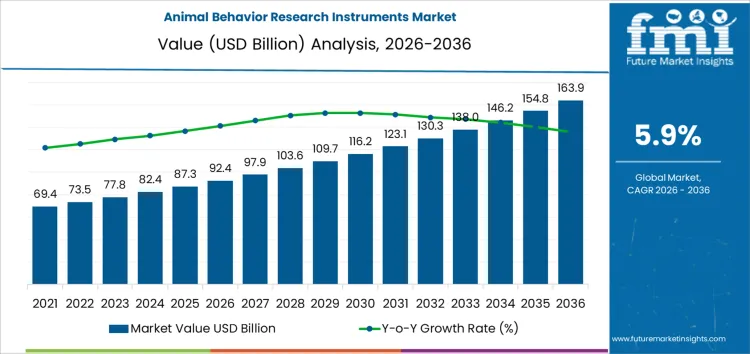
The animal behavior research instruments market is projected to grow from USD 92.4 billion in 2026 to USD 163.9 billion by 2036, expanding at a CAGR of 5.9%. Growth prospects remain steady, yet execution quality plays a decisive role in value realization. Adoption is supported by rising demand for reproducible and automated behavioral data, though procurement cycles remain slow and institution-driven. Budget approvals, grant dependency, and validation timelines introduce friction, particularly for advanced digital systems.
Suppliers face pressure to balance innovation speed with methodological reliability, as premature technology shifts can disrupt established research protocols. Economic sensitivity is moderate, with demand linked more closely to public research funding stability than discretionary spending. Upside potential exists in software-driven upgrades and modular expansions, while downside risk stems from cost escalation, training requirements, and uneven global research investment. Market expansion therefore favors suppliers capable of managing adoption complexity, supporting long lifecycle products, and aligning innovation with conservative research execution realities.
Quick Stats for Animal Behavior Research Instruments Market
- Animal Behavior Research Instruments Market Value (2026): USD 92.4 Billion
- Animal Behavior Research Instruments Market Forecast Value (2036): USD 163.9 Billion
- Animal Behavior Research Instruments Market Forecast CAGR 2026 to 2036: 5.9%
- Leading Product Type in Animal Behavior Research Instruments Market: Observational Tools (35% share)
- Key Growth Regions in Animal Behavior Research Instruments Market: North America, Asia Pacific, Europe, Latin America, Middle East & Africa
- Top Key Players in Animal Behavior Research Instruments Market: Bioseb, TSE Systems, Columbus Instruments, Ugo Basile, San Diego Instruments, Panlab (Harvard Apparatus), Orchid Scientific, Amuza Inc., Tecniplast
Animal Behavior Research Instruments Market Key Takeaways
| Metric | Value |
|---|---|
| Animal Behavior Research Instruments Market Value (2026) | USD 92.4 Billion |
| Animal Behavior Research Instruments Market Forecast Value (2036) | USD 163.9 Billion |
| Animal Behavior Research Instruments Market Forecast CAGR 2026 to 2036 | 5.9% |
How Are Research Practices and Technology Needs Creating Opportunities in the Animal Behavior Research Instruments Market?
The animal behavior research instruments market is evolving as research institutions and pharmaceutical companies increasingly adopt data-driven and automation-enabled study methodologies. Demand is shifting toward instruments that enable precise, repeatable, and longitudinal behavioral measurement across laboratory and semi-natural environments. For manufacturers, this trend is expanding opportunities beyond basic observation tools toward integrated systems that combine tracking, monitoring, and data acquisition capabilities. Suppliers offering scalable platforms that support multiple species and study designs are better positioned to secure long-term institutional contracts.
Technology expectations among buyers are also rising. Research organizations are prioritizing instruments that integrate seamlessly with software analytics, video processing, and AI-based behavioral interpretation tools. This is pushing equipment manufacturers to focus on modular designs, sensor accuracy, and compatibility with third-party data systems. Instruments that reduce manual scoring, improve throughput, and support regulatory documentation are gaining preference, particularly in preclinical drug development and neuroscience research settings.
Procurement decisions are increasingly influenced by compliance, reproducibility, and lifecycle support rather than upfront equipment cost alone. Ethical research standards and regulatory oversight are encouraging adoption of non-invasive monitoring instruments and enriched behavioral assessment tools. At the same time, expansion of biomedical research infrastructure in Asia Pacific and Latin America is creating new demand from emerging research hubs. For suppliers, success in this market depends on offering validated performance, training support, and upgrade pathways, positioning the animal behavior research instruments market as a steady, and institution-driven growth opportunity over the forecast period.
What Is The Segment Overview Of The Animal Behavior Research Instruments Market?
The animal behavior research instruments market is organized by product type and application, reflecting how data collection methods align with research, clinical, and welfare objectives. By product type, observational tools lead with 35% share, as they form the foundation of behavioral data capture across laboratory and field settings. Measurement tools, tracking devices, and behavioral analysis software complement observational systems by adding quantification, movement analytics, and data interpretation capabilities. By application, academic and research institutions account for about 40% share, driven by sustained funding for neuroscience, ethology, and behavioral science programs.
Why Do Observational Tools Lead The Animal Behavior Research Instruments Market By Product Type?

Observational tools lead the animal behavior research instruments market with 35% share because they provide direct, non-invasive methods to study animal responses, interactions, and behavioral patterns in both controlled and natural environments. Universities, contract research organizations, and animal welfare institutions rely on video-based observation systems, recording chambers, and monitoring enclosures to capture unbiased and repeatable behavioral data. These tools integrate effectively with behavioral analysis software for annotation, scoring, and long-term data storage. Manufacturers benefit from consistent replacement demand and customization requirements based on species, enclosure design, and study protocols. Observational tools also function as entry-level investments for new research facilities, supporting broad and sustained adoption.
Why Does Academic And Research Usage Dominate The Animal Behavior Research Instruments Market By Application?
Academic and research institutions dominate the animal behavior research instruments market with 40% share because behavioral analysis is central to neuroscience, psychology, toxicology, and translational medicine studies. Universities and public research labs conduct long-duration experiments requiring reliable, repeatable instrumentation. Funding from government agencies and international research programs supports continuous procurement of upgraded tools. Academic settings also drive early adoption of novel tracking and analytics technologies, influencing broader market standards. For suppliers, this segment offers opportunities for long-term partnerships, service contracts, and collaborative development. The scale, consistency, and innovation focus of academic research explain its position as the largest application segment.
What Are The Key Dynamics Of The Animal Behavior Research Instruments Market?
The animal behavior research instruments market is influenced by growing demand for precise, reproducible behavioral data across neuroscience, pharmacology, and veterinary studies. Instruments such as automated tracking systems, operant conditioning rigs, mazes, and sensor-integrated enclosures are being adopted to reduce manual observation bias and improve throughput. Standardization of protocols and compatibility with digital data platforms are critical for cross-lab comparability. For manufacturers and suppliers, responsiveness to evolving research models (rodents, zebrafish, and non-human primates) and support for integrated analytics are key differentiators. Cost, modularity, and ease of calibration significantly influence buying decisions by academic, CRO, and biopharma research facilities.
How Are Innovation And Digital Integration Shaping The Animal Behavior Research Instruments Market?
Innovation and digital integration are driving the animal behavior research instruments market toward higher automation and data richness. Advanced video tracking combined with AI-based pattern recognition enables nuanced behavioral phenotyping with minimal human intervention. Integration with telemetry, physiological sensors, and environmental control systems allows multimodal data capture in real time. Cloud-compatible data management, software analytics suites, and open APIs facilitate deeper insights and cross-study standardization. For suppliers, offering scalable platforms that integrate with existing laboratory information management systems (LIMS) enhances value. Modular hardware that supports software upgrades extends instrument lifecycle and increases recurring revenue potential.
Why Do Regulatory, Validation, And Cost Considerations Restrain The Animal Behavior Research Instruments Market?
Regulatory expectations for reproducibility, validation documentation, and ethical compliance are restraining aspects of the animal behavior research instruments market. Equipment must support standardized protocols to meet publishable research criteria and animal welfare regulations, which increases development and testing costs. Validation requirements for new instrument releases delay speed-to-market. Smaller research institutions and CROs face budget constraints that limit adoption of high-end automated systems. Maintenance, calibration services, and software licensing further add to total cost of ownership, requiring suppliers to offer flexible pricing, leasing, or service-inclusive models to broaden market reach.
How Are Research Funding Patterns Shaping Demand in the Animal Behavior Research Instruments Market?
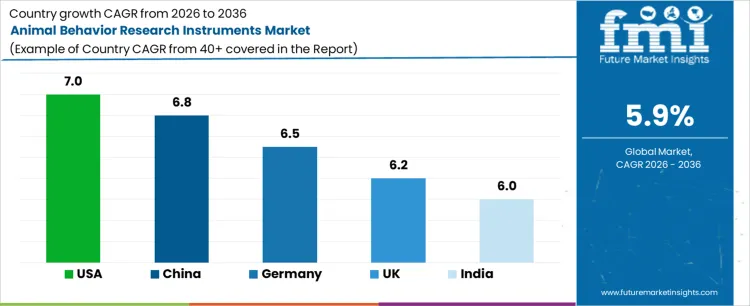
Demand for animal behavior research instruments is increasingly shaped by neuroscience funding intensity, regulatory scrutiny, and the shift toward data-rich behavioral phenotyping. Academic laboratories, pharmaceutical R&D centers, and contract research organizations are the primary buyers, with procurement decisions influenced by experiment reproducibility, automation capability, and data integration features. Growth is moving beyond basic observation tools toward video-based tracking systems, operant conditioning chambers, and sensor-enabled behavioral analysis platforms. Suppliers that offer modular hardware, software compatibility, and long-term technical support are better positioned to capture institutional buyers. Country-level opportunities differ significantly based on funding stability, research focus areas, and laboratory modernization cycles.
| Country | CAGR (%) |
|---|---|
| USA | 7.0% |
| China | 6.8% |
| Germany | 6.5% |
| UK | 6.2% |
| India | 6.0% |
Why Does the United States Remain the Most Attractive Market for Advanced Instrument Suppliers?
Demand for animal behavior research instruments in United States, expanding at a CAGR of 7.0% during 2026 to 2036, is supported by strong federal research funding and a mature preclinical research ecosystem. Universities, pharmaceutical R&D centers, and contract research organizations form the core buyer base. Procurement decisions emphasize data accuracy, experiment automation, and compatibility with imaging, electrophysiology, and digital analytics platforms. Laboratories increasingly replace manual or maze-based tools with video tracking, operant conditioning chambers, and software-driven behavior analysis systems. Compliance with animal welfare protocols and data reproducibility standards strongly influences purchasing behavior. Suppliers benefit from predictable replacement cycles linked to grant renewals and long-term research programs. The market favors vendors offering validated systems, software upgrades, and responsive technical support. This environment rewards innovation-led manufacturers capable of supporting complex, multi-parameter behavioral studies across neuroscience and pharmacology applications.
How Is China Building Scale-Oriented Demand for Standardized Research Instruments?
Sales of animal behavior research instruments in China, growing at a CAGR of 6.8% from 2026 to 2036, are driven by expansion of national research infrastructure and domestic pharmaceutical development. Demand is concentrated in universities, government-funded laboratories, and biotechnology parks. Buyers prioritize standardized, replicable instrument platforms that can be deployed across multiple institutions with minimal customization. Cost efficiency, durability, and ease of training influence supplier selection. Local manufacturing presence and regional service support improve supplier competitiveness. While demand for highly customized systems remains limited, volume potential is significant for modular video tracking systems and automated behavioral chambers. Procurement cycles are often centralized, favoring suppliers capable of meeting bulk requirements. China presents a scale-driven opportunity for manufacturers offering reliable, standardized solutions aligned with institutional research programs.
What Drives Precision-Led Procurement in Germany’s Research Instrument Market?
Demand for animal behavior research instruments in Germany, expanding at a CAGR of 6.5% during 2026 to 2036, is shaped by strong emphasis on experimental rigor and data reproducibility. Buyers include academic research institutes, pharmaceutical laboratories, and publicly funded neuroscience centers. Procurement decisions focus on measurement accuracy, controlled environments, and advanced analytical software. Demand is largely replacement-driven, with laboratories upgrading existing setups to meet evolving methodological standards. Qualification processes are structured and documentation-intensive, favoring suppliers with strong calibration, validation, and technical support capabilities. Volume growth is moderate, but unit values are high due to specification requirements. Germany rewards suppliers positioned around precision engineering, long lifecycle performance, and integration with advanced research workflows rather than cost-driven offerings.
Why Does the UK Offer Stable but Selective Opportunities for Instrument Suppliers?
Sales of animal behavior research instruments in United Kingdom, growing at a CAGR of 6.2% from 2026 to 2036, reflect steady investment in academic neuroscience and behavioral science programs. Demand is primarily grant-driven, with procurement linked to specific research projects rather than large institutional rollouts. Buyers emphasize reliability, software usability, and long-term service availability. Replacement and incremental upgrades dominate purchasing activity as laboratories modernize legacy equipment. Collaboration with academic researchers and training support influence supplier preference. While overall volumes remain limited, repeat purchases and long-term relationships sustain consistent demand. The UK market favors suppliers with strong academic engagement, application expertise, and responsive aftersales support.
How Is India Emerging as a Cost-Sensitive Growth Market for Research Instruments?
Demand for animal behavior research instruments in India, expanding at a CAGR of 6.0% during 2026 to 2036, is driven by growth in academic research capacity and preclinical outsourcing activity. Universities and publicly funded research institutes represent the largest buyer segments. Procurement decisions are highly cost-sensitive, prioritizing durability, multi-application usability, and ease of maintenance. Import substitution initiatives encourage local assembly and service partnerships. Demand is expanding gradually as laboratories transition from basic observation tools to automated tracking and analysis systems. Suppliers offering affordable, modular platforms with training support gain competitive advantage. India represents a long-term volume opportunity for manufacturers aligned with budget-conscious procurement and education-driven adoption models.
What Differentiates Competitors in the Animal Behavior Research Instruments Market?

Competition in the animal behavior research instruments market is structured around validated methodologies, modular system design, and data interoperability tailored for behavioral phenotyping. Bioseb leverages its portfolio of digital and analog behavioral measurement devices with technical materials that detail precision force and activity tracking. Its literature highlights flexibility across rodent and small mammal studies with open data export formats favored by academic labs. TSE Systems positions itself on integrated platforms combining sensory cages, operant conditioning units, and real-time analytics. Product documentation emphasizes scalable architectures and validated software modules for reproducible experimental control.
High-throughput and specialized modality providers define another competitive tier. Columbus Instruments holds a strong position with modular open-field, maze, and metabolic monitoring systems validated for longitudinal studies. Its brochures describe synchronized video tracking and automated scoring solutions. Ugo Basile competes through classical behavioral assay instruments with documentation stressing durability, calibration traceability, and ergonomic design. San Diego Instruments focuses on validated startle response and fear conditioning platforms, with product materials detailing stimulus control precision and safety compliance.
Integration of hardware and analytics drives differentiation for several suppliers. Panlab (Harvard Apparatus) offers comprehensive behavior suites with brochures detailing unified data capture and advanced analysis toolchains. Orchid Scientific positions its systems with emphasis on customizable sensor arrays and local support responsiveness. Amuza Inc. focuses on arena-based tracking and ethology analytics, with product guides that highlight machine learning-assisted behavior classification. Tecniplast integrates behavior monitoring into caging and husbandry solutions, with documentation that underscores compliance with welfare standards and facility integration.
Key Players in Animal Behavior Research Instruments Market
- Bioseb
- TSE Systems
- Columbus Instruments
- Ugo Basile
- San Diego Instruments
- Panlab (Harvard Apparatus)
- Orchid Scientific
- Amuza Inc.
- Tecniplast
- Other Players
Scope of Report
| Attribute | Description |
|---|---|
| Quantitative Unit | USD Billion |
| Product Type | Observational Tools, Measurement Tools, Tracking Devices, Behavioral Analysis Software |
| Application | Academic & Research, Pharmaceutical & Drug Discovery, Veterinary Clinics, Animal Welfare & Zoos, Other End Uses |
| Countries Covered | China, Japan, South Korea, India, Australia & New Zealand, ASEAN, Rest of Asia Pacific, Germany, United Kingdom, France, Italy, Spain, Nordic, BENELUX, Rest of Europe, United States, Canada, Mexico, Brazil, Chile, Rest of Latin America, Kingdom of Saudi Arabia, Other GCC Countries, Turkey, South Africa, Other African Union, Rest of Middle East & Africa |
| Regions Covered | Asia Pacific, Europe, North America, Latin America, Middle East & Africa |
| Key Companies Profiled | Bioseb, TSE Systems, Columbus Instruments, Ugo Basile, San Diego Instruments, Panlab (Harvard Apparatus), Orchid Scientific, Amuza Inc., Tecniplast, Other Players |
| Additional Attributes | Dollar sales by product type and application are analyzed across laboratory, preclinical, and applied research environments. The report includes country-level demand assessment, growth projections for 2026 to 2036, evaluation of data acquisition accuracy and automation trends, assessment of software-driven behavioral analytics, competitive benchmarking of instrument suppliers, and analysis of procurement patterns across academic and pharmaceutical research institutions. |
Animal Behavior Research Instruments Market by Key Segments
Product Type:
- Observational Tools
- Measurement Tools
- Tracking Devices
- Behavioral Analysis Software
Application:
- Academic & Research
- Pharmaceutical & Drug Discovery
- Veterinary Clinics
- Animal Welfare & Zoos
- Other End Uses
Region:
- Asia Pacific
- China
- Japan
- South Korea
- India
- Australia & New Zealand
- ASEAN
- Rest of Asia Pacific
- Europe
- Germany
- United Kingdom
- France
- Italy
- Spain
- Nordic
- BENELUX
- Rest of Europe
- North America
- United States
- Canada
- Mexico
- Latin America
- Brazil
- Chile
- Rest of Latin America
- Middle East & Africa
- Kingdom of Saudi Arabia
- Other GCC Countries
- Turkey
- South Africa
- Other African Union
- Rest of Middle East & Africa
Bibliography
- Association of Medical Research Charities. (2024, July 4). Guidance on implementing the 3Rs when funding research.
- National Academies of Sciences, Engineering, and Medicine. (2024). Future topical updates to the Guide for the Care and Use of Laboratory Animals: Proceedings of a workshop—in brief. The National Academies Press.
- National Centre for the Replacement, Refinement and Reduction of Animals in Research. (2024, June 24). Inclusion and exclusion.
Frequently Asked Questions
How big is the animal behavior research instruments market in 2026?
The global animal behavior research instruments market is estimated to be valued at USD 92.4 billion in 2026.
What will be the size of animal behavior research instruments market in 2036?
The market size for the animal behavior research instruments market is projected to reach USD 163.9 billion by 2036.
How much will be the animal behavior research instruments market growth between 2026 and 2036?
The animal behavior research instruments market is expected to grow at a 5.9% CAGR between 2026 and 2036.
What are the key product types in the animal behavior research instruments market?
The key product types in animal behavior research instruments market are observational tools, measurement tools, tracking devices and behavioral analysis software.
Which academic & research segment to contribute significant share in the animal behavior research instruments market in 2026?
In terms of application, academic & research segment to command 40.0% share in the animal behavior research instruments market in 2026.
Preview the report firsthand - request a free sample
Get SampleGet the brochure for pricing and purchase details.
Get PDFTable of Content
- Executive Summary
- Global Market Outlook
- Demand-side Trends
- Supply-side Trends
- Technology Roadmap Analysis
- Analysis and Recommendations
- Market Overview
- Market Coverage / Taxonomy
- Market Definition / Scope / Limitations
- Market Background
- Market Dynamics
- Drivers
- Restraints
- Opportunity
- Trends
- Scenario Forecast
- Demand in Optimistic Scenario
- Demand in Likely Scenario
- Demand in Conservative Scenario
- Opportunity Map Analysis
- Product Life Cycle Analysis
- Supply Chain Analysis
- Investment Feasibility Matrix
- Value Chain Analysis
- PESTLE and Porter’s Analysis
- Regulatory Landscape
- Regional Parent Market Outlook
- Production and Consumption Statistics
- Import and Export Statistics
- Market Dynamics
- Global Market Analysis 2021 to 2025 and Forecast, 2026 to 2036
- Historical Market Size Value (USD Million) Analysis, 2021 to 2025
- Current and Future Market Size Value (USD Million) Projections, 2026 to 2036
- Y-o-Y Growth Trend Analysis
- Absolute $ Opportunity Analysis
- Global Market Pricing Analysis 2021 to 2025 and Forecast 2026 to 2036
- Global Market Analysis 2021 to 2025 and Forecast 2026 to 2036, By Product Type
- Introduction / Key Findings
- Historical Market Size Value (USD Million) Analysis By Product Type , 2021 to 2025
- Current and Future Market Size Value (USD Million) Analysis and Forecast By Product Type , 2026 to 2036
- Observational Tools
- Measurement Tools
- Tracking Devices
- Behavioral Analysis Software
- Observational Tools
- Y-o-Y Growth Trend Analysis By Product Type , 2021 to 2025
- Absolute $ Opportunity Analysis By Product Type , 2026 to 2036
- Global Market Analysis 2021 to 2025 and Forecast 2026 to 2036, By Academic & Research
- Introduction / Key Findings
- Historical Market Size Value (USD Million) Analysis By Academic & Research, 2021 to 2025
- Current and Future Market Size Value (USD Million) Analysis and Forecast By Academic & Research, 2026 to 2036
- Pharmaceutical & Drug Discovery
- Veterinary Clinics
- Animal Welfare & Zoos
- Other End Uses
- Pharmaceutical & Drug Discovery
- Y-o-Y Growth Trend Analysis By Academic & Research, 2021 to 2025
- Absolute $ Opportunity Analysis By Academic & Research, 2026 to 2036
- Global Market Analysis 2021 to 2025 and Forecast 2026 to 2036, By Region
- Introduction
- Historical Market Size Value (USD Million) Analysis By Region, 2021 to 2025
- Current Market Size Value (USD Million) Analysis and Forecast By Region, 2026 to 2036
- North America
- Latin America
- Western Europe
- Eastern Europe
- East Asia
- South Asia and Pacific
- Middle East & Africa
- Market Attractiveness Analysis By Region
- North America Market Analysis 2021 to 2025 and Forecast 2026 to 2036, By Country
- Historical Market Size Value (USD Million) Trend Analysis By Market Taxonomy, 2021 to 2025
- Market Size Value (USD Million) Forecast By Market Taxonomy, 2026 to 2036
- By Country
- USA
- Canada
- Mexico
- By Product Type
- By Academic & Research
- By Country
- Market Attractiveness Analysis
- By Country
- By Product Type
- By Academic & Research
- Key Takeaways
- Latin America Market Analysis 2021 to 2025 and Forecast 2026 to 2036, By Country
- Historical Market Size Value (USD Million) Trend Analysis By Market Taxonomy, 2021 to 2025
- Market Size Value (USD Million) Forecast By Market Taxonomy, 2026 to 2036
- By Country
- Brazil
- Chile
- Rest of Latin America
- By Product Type
- By Academic & Research
- By Country
- Market Attractiveness Analysis
- By Country
- By Product Type
- By Academic & Research
- Key Takeaways
- Western Europe Market Analysis 2021 to 2025 and Forecast 2026 to 2036, By Country
- Historical Market Size Value (USD Million) Trend Analysis By Market Taxonomy, 2021 to 2025
- Market Size Value (USD Million) Forecast By Market Taxonomy, 2026 to 2036
- By Country
- Germany
- UK
- Italy
- Spain
- France
- Nordic
- BENELUX
- Rest of Western Europe
- By Product Type
- By Academic & Research
- By Country
- Market Attractiveness Analysis
- By Country
- By Product Type
- By Academic & Research
- Key Takeaways
- Eastern Europe Market Analysis 2021 to 2025 and Forecast 2026 to 2036, By Country
- Historical Market Size Value (USD Million) Trend Analysis By Market Taxonomy, 2021 to 2025
- Market Size Value (USD Million) Forecast By Market Taxonomy, 2026 to 2036
- By Country
- Russia
- Poland
- Hungary
- Balkan & Baltic
- Rest of Eastern Europe
- By Product Type
- By Academic & Research
- By Country
- Market Attractiveness Analysis
- By Country
- By Product Type
- By Academic & Research
- Key Takeaways
- East Asia Market Analysis 2021 to 2025 and Forecast 2026 to 2036, By Country
- Historical Market Size Value (USD Million) Trend Analysis By Market Taxonomy, 2021 to 2025
- Market Size Value (USD Million) Forecast By Market Taxonomy, 2026 to 2036
- By Country
- China
- Japan
- South Korea
- By Product Type
- By Academic & Research
- By Country
- Market Attractiveness Analysis
- By Country
- By Product Type
- By Academic & Research
- Key Takeaways
- South Asia and Pacific Market Analysis 2021 to 2025 and Forecast 2026 to 2036, By Country
- Historical Market Size Value (USD Million) Trend Analysis By Market Taxonomy, 2021 to 2025
- Market Size Value (USD Million) Forecast By Market Taxonomy, 2026 to 2036
- By Country
- India
- ASEAN
- Australia & New Zealand
- Rest of South Asia and Pacific
- By Product Type
- By Academic & Research
- By Country
- Market Attractiveness Analysis
- By Country
- By Product Type
- By Academic & Research
- Key Takeaways
- Middle East & Africa Market Analysis 2021 to 2025 and Forecast 2026 to 2036, By Country
- Historical Market Size Value (USD Million) Trend Analysis By Market Taxonomy, 2021 to 2025
- Market Size Value (USD Million) Forecast By Market Taxonomy, 2026 to 2036
- By Country
- Kingdom of Saudi Arabia
- Other GCC Countries
- Turkiye
- South Africa
- Other African Union
- Rest of Middle East & Africa
- By Product Type
- By Academic & Research
- By Country
- Market Attractiveness Analysis
- By Country
- By Product Type
- By Academic & Research
- Key Takeaways
- Key Countries Market Analysis
- USA
- Pricing Analysis
- Market Share Analysis, 2025
- By Product Type
- By Academic & Research
- Canada
- Pricing Analysis
- Market Share Analysis, 2025
- By Product Type
- By Academic & Research
- Mexico
- Pricing Analysis
- Market Share Analysis, 2025
- By Product Type
- By Academic & Research
- Brazil
- Pricing Analysis
- Market Share Analysis, 2025
- By Product Type
- By Academic & Research
- Chile
- Pricing Analysis
- Market Share Analysis, 2025
- By Product Type
- By Academic & Research
- Germany
- Pricing Analysis
- Market Share Analysis, 2025
- By Product Type
- By Academic & Research
- UK
- Pricing Analysis
- Market Share Analysis, 2025
- By Product Type
- By Academic & Research
- Italy
- Pricing Analysis
- Market Share Analysis, 2025
- By Product Type
- By Academic & Research
- Spain
- Pricing Analysis
- Market Share Analysis, 2025
- By Product Type
- By Academic & Research
- France
- Pricing Analysis
- Market Share Analysis, 2025
- By Product Type
- By Academic & Research
- India
- Pricing Analysis
- Market Share Analysis, 2025
- By Product Type
- By Academic & Research
- ASEAN
- Pricing Analysis
- Market Share Analysis, 2025
- By Product Type
- By Academic & Research
- Australia & New Zealand
- Pricing Analysis
- Market Share Analysis, 2025
- By Product Type
- By Academic & Research
- China
- Pricing Analysis
- Market Share Analysis, 2025
- By Product Type
- By Academic & Research
- Japan
- Pricing Analysis
- Market Share Analysis, 2025
- By Product Type
- By Academic & Research
- South Korea
- Pricing Analysis
- Market Share Analysis, 2025
- By Product Type
- By Academic & Research
- Russia
- Pricing Analysis
- Market Share Analysis, 2025
- By Product Type
- By Academic & Research
- Poland
- Pricing Analysis
- Market Share Analysis, 2025
- By Product Type
- By Academic & Research
- Hungary
- Pricing Analysis
- Market Share Analysis, 2025
- By Product Type
- By Academic & Research
- Kingdom of Saudi Arabia
- Pricing Analysis
- Market Share Analysis, 2025
- By Product Type
- By Academic & Research
- Turkiye
- Pricing Analysis
- Market Share Analysis, 2025
- By Product Type
- By Academic & Research
- South Africa
- Pricing Analysis
- Market Share Analysis, 2025
- By Product Type
- By Academic & Research
- USA
- Market Structure Analysis
- Competition Dashboard
- Competition Benchmarking
- Market Share Analysis of Top Players
- By Regional
- By Product Type
- By Academic & Research
- Competition Analysis
- Competition Deep Dive
- Bioseb
- Overview
- Product Portfolio
- Profitability by Market Segments (Product/Age /Sales Channel/Region)
- Sales Footprint
- Strategy Overview
- Marketing Strategy
- Product Strategy
- Channel Strategy
- TSE Systems
- Columbus Instruments
- Ugo Basile
- San Diego Instruments
- Panlab (Harvard Apparatus)
- Orchid Scientific
- Amuza Inc.
- Tecniplast
- Other Players
- Bioseb
- Competition Deep Dive
- Assumptions & Acronyms Used
- Research Methodology


