

- Market Size (2026)
- USD 231 Mn
- Forecast (2036)
- USD 578 Mn
- CAGR (2026 to 2036)
- 9.6%
Viral Vector Integrity and Potency Analytics Test Instruments Market Size, Market Forecast and Outlook by FMI
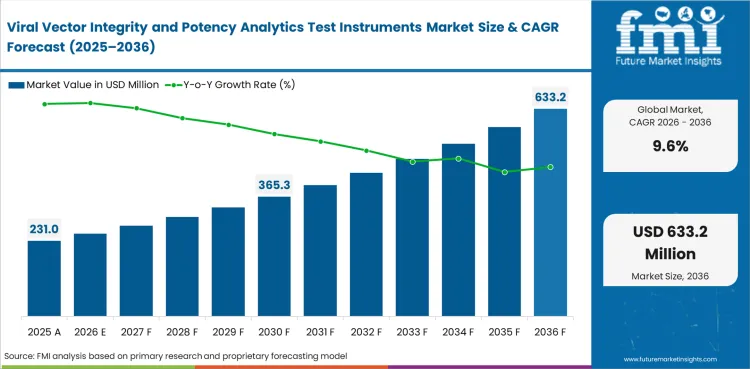
The viral vector integrity and potency analytics test instruments market was valued at USD 211 million in 2025, is projected to reach USD 231 million in 2026, and is forecast to expand to USD 578 million by 2036 at a 9.6% CAGR. Based on Future Market Insights analysis, industry outlook remains positive as later-stage vector programs place more importance on reproducibility, orthogonal confirmation, and assay transfer discipline across development and release-facing work.
Summary of Viral Vector Integrity and Potency Analytics Test Instruments Market
- The viral vector integrity and potency analytics test instruments market is forecast to reach USD 578 million by 2036.
- The market is expected to grow at a 9.6% CAGR from 2026 to 2036.
- The market was estimated at USD 211 million in 2025.
- Digital PCR systems are expected to account for 28.6% share in 2026 because precise genome quantification remains central to vector quality assessment.
- Genome quantification holds 24.8% of the assay priority segment, supported by its routine role in early analytical confirmation.
- AAV is projected to hold 49% share in 2026 under vector class, reflecting its central role across gene therapy development pipelines.
- Release testing is expected to represent 31.4% share in 2026 by workflow stage, as later-stage programs require stronger confirmation of vector integrity and potency.
- Biopharma developers hold 36.7% of the end-user segment, supported by continued sponsor control over core analytical workflows.
- Mid throughput accounts for 34.5% of the throughput segment, reflecting preference for balanced capacity across routine laboratory settings.
- Nucleic acid analytics represents 33.2% of the assay mode segment in 2026, indicating concentration in genome-linked analytical evaluation needs.
Key Takeaways, Market Size, and Forecast
- Viral Vector Integrity and Potency Analytics Test Instruments Market is projected to grow from USD 231 million in 2026 to USD 578 million by 2036, at a CAGR of 9.6%.
- The viral vector integrity and potency analytics test instruments market was valued at USD 211 million in 2025.
- By 2036, the Viral Vector Integrity and Potency Analytics Test Instruments Market is expected to be worth USD 578 million.
- From 2026 to 2036, the market is likely to expand at a CAGR of 9.6%.
- The market is projected to create an incremental opportunity of USD 347 million between 2026 and 2036.
- In 2026, Digital PCR systems are expected to account for 28.6% of the instrument technology segment.
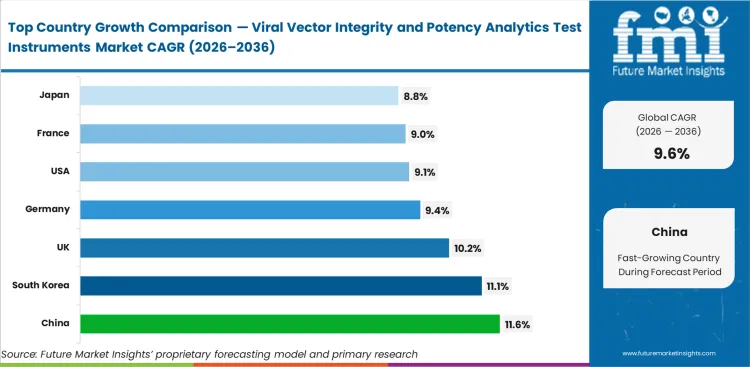
- China (11.6%) and South Korea (11.1%) are two of the fastest growing markets.
Viral Vector Integrity and Potency Analytics Test Instruments Market Key Takeaways
| Parameter | Details |
|---|---|
| Market value (2026) | USD 231 million |
| Forecast value (2036) | USD 578 million |
| CAGR (2026 to 2036) | 9.6% |
| Estimated market value (2025) | USD 211 million |
| Leading instrument technology | Digital PCR systems (28.6% of instrument technology segment) |
| Leading assay priority | Genome quantification (24.8% of assay priority segment) |
| Leading vector class | AAV (49% of vector class segment) |
| Leading workflow stage | Release testing (31.4% of workflow stage segment) |
| Leading end user | Biopharma developers (36.7% of end-user segment) |
| Leading throughput | Mid throughput (34.5% of throughput segment) |
| Leading assay mode | Nucleic acid analytics (33.2% of assay mode segment) |
| Leading region | North America (40% regional share) |
| Fastest-growing country | China (11.6% CAGR) |
| Key players | Thermo Fisher Scientific, Bio-Rad Laboratories, Sartorius AG, Agilent Technologies, Waters Corporation, Danaher Corporation, Bruker Corporation |
Source: Future Market Insights, 2026.
Lot readiness depends more on whether one result can be verified by another without long debates on assay reliability or interpretation gaps. Growing activity in adjacent cell and gene therapy clinical trial capabilities is pushing laboratories to build stronger analytical capability instead of relying on a limited set of methods.
China is projected to post 11.6% CAGR through 2036 in this market, followed by South Korea is anticipated to rise at a CAGR of 11.1%, the United Kingdom is poised to expand at a CAGR of 10.2%, Germany is projected to witness a CAGR of 9.4%, the United States is forecast to register at a CAGR of 9.1%, France is projected to grow at a CAGR of 9%, and Japan is expected to reach at a CAGR of 8.8%.
Viral Vector Integrity and Potency Analytics Test Instruments Market Definition
Viral vector integrity and potency analytics test instruments market includes analytical systems used to assess whether viral vectors meet potency, identity, and integrity requirements during development, release, comparability, and stability assessment. Market scope covers instruments used directly for vector characterization and excludes general laboratory equipment that does not serve a defined viral vector analytics purpose.
Viral Vector Integrity and Potency Analytics Test Instruments Market Inclusions
Scope includes digital PCR, qPCR, chromatography systems, capillary electrophoresis, flow cytometers, bio-layer interferometry systems, analytical ultracentrifuges, and advanced particle readout platforms used in viral vector testing. Configurations used for genome titer and capsid identity are part of the scope. Full-empty evaluation, potency interpretation, and replication competence review are included.
Viral Vector Integrity and Potency Analytics Test Instruments Market Exclusions
The market excludes upstream bioreactors, vector manufacturing consumables, fill-finish equipment, storage hardware, and routine clinical diagnostics unless they serve a direct viral vector integrity or potency testing role. General laboratory automation is excluded when it has no defined vector analytics function.
Viral Vector Integrity and Potency Analytics Test Instruments Market Methodology
- Primary Research: FMI discussions included analytical development heads and assay scientists along with quality managers and technical specialists working in viral vector testing environments.
- Desk Research: Review covered public guidance material and official association publications. It also included peer-reviewed work on AAV and viral vector analytics along with company technical pages linked to active instrument categories.
- Market-Sizing and Forecasting: Model inputs reflected site-level instrument demand tied to release testing and comparability studies. Process support and stability work were also included in the sizing model.
- Data Validation and Update Cycle: Forecasts were reconciled against method intensity and pipeline direction along with installed-base maturity. Vendor participation in cell and gene therapy analytics was also reviewed.
Why is the Viral Vector Integrity and Potency Analytics Test Instruments Market Growing?
- Genome quantification remains a central assay priority and is expected to contribute 24.8% share in 2026 because early molecular confirmation shapes downstream interpretation.
- Digital PCR systems are projected to account for 28.6% share in 2026 as absolute genome measurement becomes more important in decision-grade analytical work.
- East Asia is reshaping market momentum, with China and South Korea expanding analytical capacity and accelerating demand for viral vector integrity and potency test instruments.
Industry outlook is improving as viral vector programs move from exploratory characterization toward tighter control environments. High confidence depends on how well genome, particle, and potency readouts align across the same batch. Instruments that improve repeatability and reduce interpretation gaps are gaining relevance across analytical development and quality workflows. Similar discipline is becoming more visible in cell and gene therapy bioreactor PAT and analytics test platforms, where closer monitoring and decision-grade analytics are becoming more important in platform selection.
AAV-centered programs are adding further momentum because they often require deeper visibility into capsid composition, full-empty evaluation, and payload packaging consistency. Later-stage programs place more value on platforms that support method transfer and internal review discipline without forcing extensive assay rebuilding. Readout complexity in this market also close to analytical expectations seen in chromatography instrumentation, where system relevance rises when separation quality and reproducibility affect decision confidence.
Segmental Analysis
- Digital PCR systems account for 28.6% share in 2026 due to accurate genome measurement.
- Genome quantification holds 24.8% share in 2026 because it remains a routine starting point in viral vector assay workflows.
- AAV leads vector class demand with 49% share in 2026 because active programs require broader analytical depth.
- Release testing contributes 31.4% share in 2026 as final lot decisions depend on repeatable results.
- Biopharma developers hold 36.7% share in 2026 as core assay control remains close to sponsors.
- Mid throughput systems capture 34.5% share in 2026 by balancing capacity and real laboratory use.
- Nucleic acid analytics represents 33.2% share in 2026 as genome-linked questions come first in many evaluation sequences.
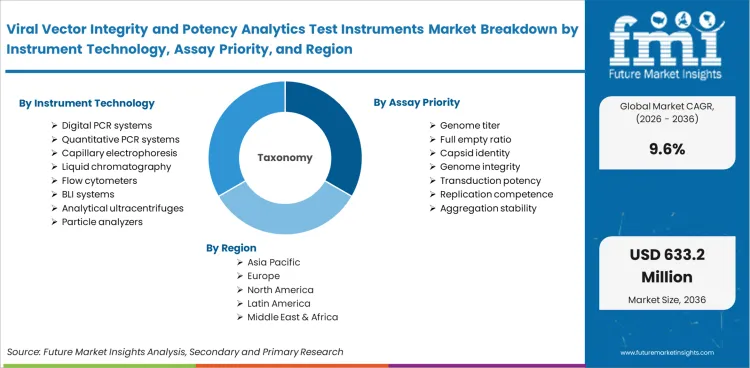
The viral vector integrity and potency analytics test instruments market is segmented by instrument technology, assay priority, vector class, workflow stage, end user, throughput, assay mode, and region. By instrument technology, the market is divided into Digital PCR Systems, Quantitative PCR Systems, Capillary Electrophoresis, Liquid Chromatography, Flow Cytometers, BLI Systems, Analytical Ultracentrifuges, and Particle Analyzers. By assay priority, the market is classified into Genome Titer, Full Empty Ratio, Capsid Identity, Genome Integrity, Transduction Potency, Replication Competence, and Aggregation Stability. Platform relevance across these groups is easier to understand when viewed alongside enabling tool families such as flow cytometry and liquid chromatography systems, both of which support controlled analytical interpretation in adjacent lab environments.
Insights into the Digital PCR Systems Segment
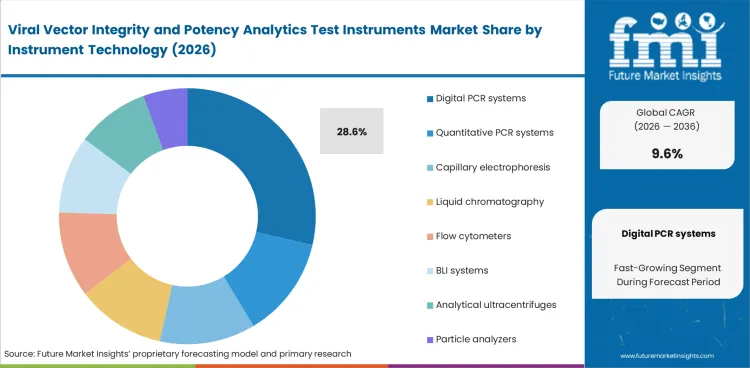
Absolute genome measurement becomes more important as viral vector testing moves into decision-grade analytical work. Digital PCR systems lead this segment because they reduce standard-curve variation and improve repeatability across analytical development and quality workflows. Digital PCR systems are expected to hold 28.6% share in 2026 within instrument technology. Laboratories use them for vector titer, copy number, and residual signal review with more consistent interpretation. Analytical logic in this segment is also close to the operating priorities seen in real-time PCR systems, though viral vector work places stronger emphasis on transfer discipline and orthogonal confirmation.
Insights into the Genome Quantification Segment
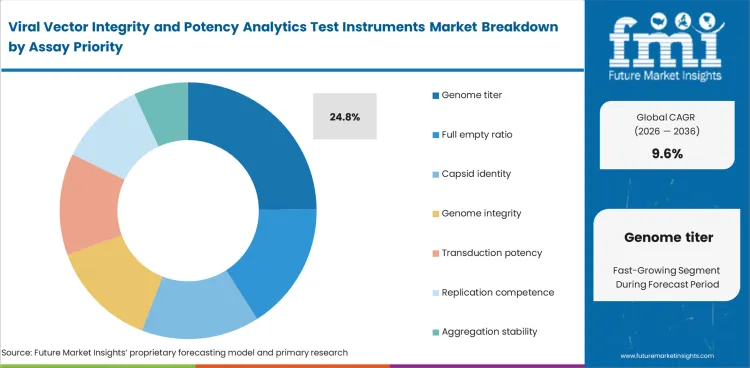
Genome quantification is likely to contribute 24.8% share in 2026 within assay priority because laboratories prefer stable and repeatable setups when early measurement confidence affects downstream interpretation. Testing often starts with measuring genome presence before broader analytical review. This early role also helps explain why molecular tool classes remain commercially relevant in adjacent testing environments such as large molecule bioanalytical testing services.
Insights into the AAV Segment
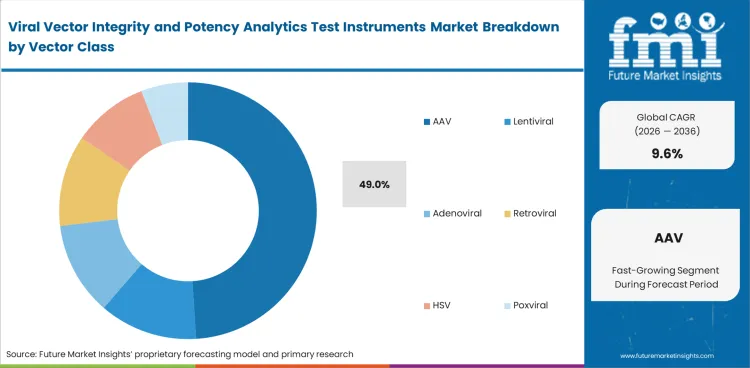
AAV leads vector class demand because active programs often require deeper testing across capsid composition, full-empty analysis, and payload packaging consistency. The segment is projected to hold 49% share in 2026 within vector class. Many laboratories use more than one method before accepting a result, which keeps instrument demand strong in AAV-related work.
Insights into the Release Testing Segment
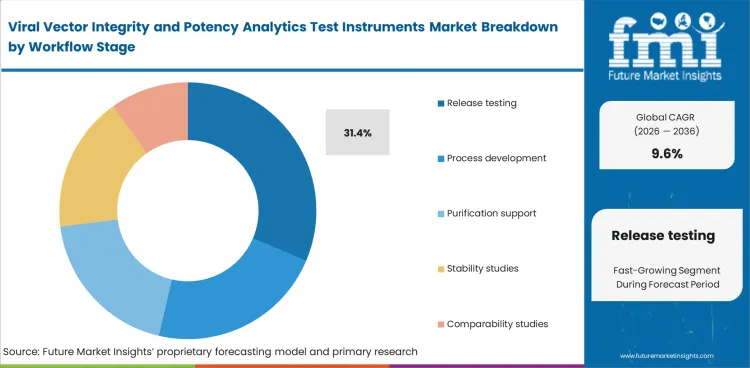
Release testing is expected to account for 31.4% share in 2026 within workflow stage because final lot decisions depend on reliable and repeatable results. Instruments used at this stage become more valuable when they help teams review data clearly and reduce uncertainty during product assessment.
Insights into the Biopharma Developers Segment
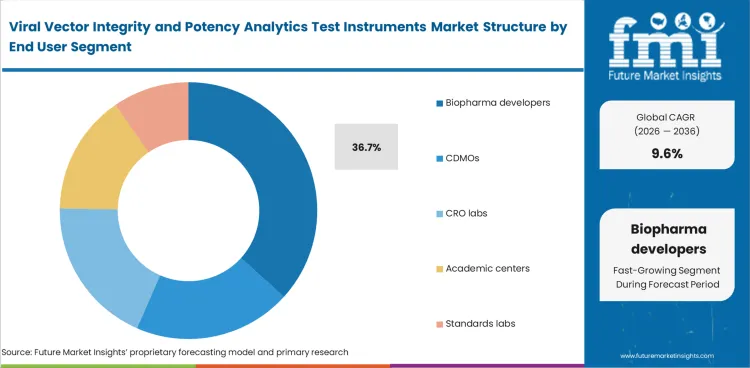
Biopharma developers are expected to represent 36.7% share in 2026 within end-user demand because key analytical work usually stays with sponsors as programs move closer to pivotal and commercial stages. Method selection, data review, and result interpretation often remain under direct sponsor control because product understanding is strongest at that level.
Insights into the Mid Throughput Segment
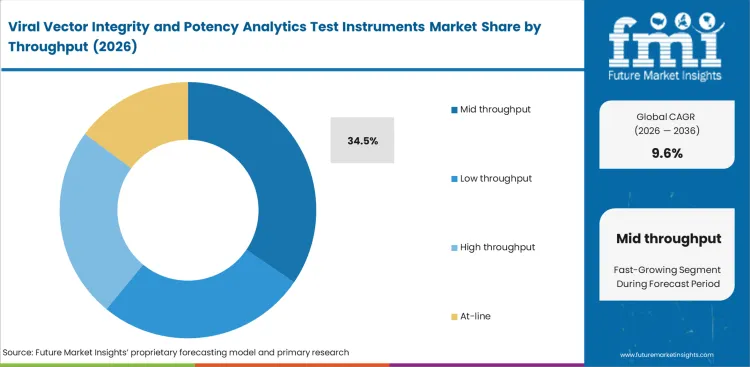
Mid throughput is projected to hold 34.5% share in 2026 because many laboratories need enough capacity to support study work and release-related testing without carrying the utilization risk of oversized systems. This leads comes from balanced bench use rather than maximum installed capacity.
Insights into the Nucleic Acid Analytics Segment
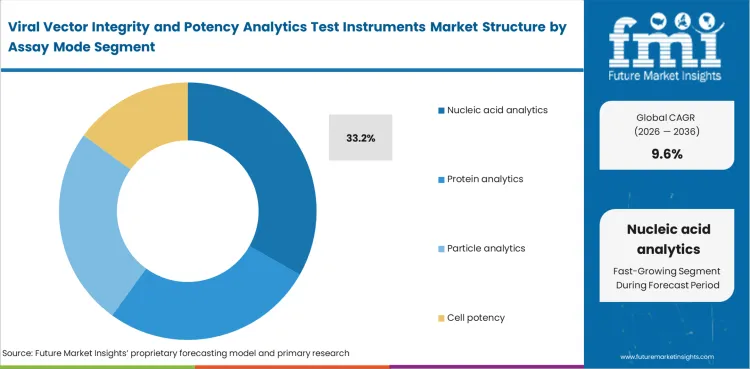
Nucleic acid analytics is expected to account 33.2% share in 2026 within assay mode because genome-linked questions usually come first before laboratories move into particle-focused or cell-based review. Titer and payload interpretation continue to shape assay flow across many viral vector evaluation settings.
What are the Drivers, Restraints, and Key Trends of the Viral Vector Integrity and Potency Analytics Test Instruments Market?
- Orthogonal assay packages are gaining importance where laboratories want tighter alignment across molecular, particle, and potency views.
- Transfer-friendly platforms carry stronger commercial value because development methods increasingly need clean movement into controlled quality use.
- Comparability work is bringing instrument investment forward during scale-up, site transfer, and process change.
The market is expanding steadily as viral vector programs require stronger analytical discipline across release testing, comparability studies, and stability work. Laboratories place more value on platforms that generate results they can defend during internal review. Opportunity continues to widen where instruments support reproducibility, method transfer, and orthogonal confirmation. A similar pattern is visible in cell and gene therapy clinical trial activity, where program advancement increases the need for stronger control logic around data and development decisions.
Comparability Burden Is Expanding Instrument Demand
Process changes often bring instrument purchases forward. Comparability work requires methods strong enough to support a definitive conclusion, which raises the value of platforms that remain dependable through scale-up, site transfer, automation changes, and raw-material adjustments. This level of analytical scrutiny also supports growing interest in advanced characterization tools such as next generation mass spectrometer where large and complex biomolecular analysis is becoming more useful in specialized settings.
Analysis of Viral Vector Integrity and Potency Analytics Test Instruments Market by Key Countries
- China records 11.6% CAGR through 2036, supported by continued capacity expansion and rising investment in viral vector analytical capability.
- South Korea grows at 11.1% CAGR through 2036, helped by a strong manufacturing base and expanding focus on analytical readiness.
- United Kingdom delivers 10.2% CAGR through 2036, reflecting a well-developed gene therapy research environment.
- Germany shows 9.4% CAGR through 2036, helped by stable laboratory practice and disciplined workflow adoption.
- United States posts 9.1% CAGR through 2036, backed by steady demand from an established development and manufacturing base.
- France records 9% CAGR through 2036, supported by continued research activity and broader use of vector characterization systems.
- Japan reaches 8.8% CAGR through 2036, reflecting gradual adoption as analytical requirements become more defined across advanced therapy programs.
.webp "Top Country Growth Comparison Viral Vector Integrity And Potency Analytics Test Instruments Market Cagr (2026 2036)")
| Country | CAGR |
|---|---|
| China | 11.6% |
| South Korea | 11.1% |
| United Kingdom | 10.2% |
| Germany | 9.4% |
| United States | 9.1% |
| France | 9% |
| Japan | 8.8% |
Source: Future Market Insights analysis, based on proprietary forecasting model and primary research.
Demand Outlook for Viral Vector Integrity and Potency Analytics Test Instruments Market in the United States
The United States is projected to grow at a 9.1% CAGR through 2036. An established development and manufacturing base, later-stage program activity, and continuing bench refinement support demand in this market. Platform choice often depends on repeatability, method transfer, and how well one readout supports another during product review.
- Strong sponsor activity keeps analytical instrument use steady across development and release programs.
- Most laboratories expand existing benches instead of building entirely new analytical setups.
- Platforms that improve agreement across methods gain more attention during lot review.
Future Outlook for Viral Vector Integrity and Potency Analytics Test Instruments Market in the United Kingdom
The United Kingdom is expected to rise at a 10.2% CAGR through 2036. Dense gene therapy research activity and a capable analytical services base keep the country ahead of much of Europe. Laboratories often favor platforms that can support development flexibility without forcing a major assay rebuild later.
- Active gene therapy research keeps analytical demand firm across development environments.
- Laboratories value platforms that remain useful from development through release-stage testing.
- Confidence improves when instruments support more than one critical analytical requirement.
Opportunity Analysis of Viral Vector Integrity and Potency Analytics Test Instruments Market in Germany
Germany is projected to rise at a 9.4% CAGR from 2026 to 2036. Reproducibility, operational fit, and controlled workflow compatibility carry strong importance in platform evaluation. Adoption tends to be deliberate, though long-run bench use remains strong once methods are accepted internally.
- Reproducibility remains a leading factor in instrument evaluation across controlled laboratory settings.
- Laboratories prefer platforms that fit disciplined workflows without adding operational complexity.
- Long-term bench usefulness often matters more than frequent technology replacement.
In-depth Analysis of Viral Vector Integrity and Potency Analytics Test Instruments Market in France
France is anticipated to record 9% CAGR through 2036. Translational research capability and continued interest in advanced therapy development support the country’s position in this market. Laboratories often favor instruments that help explain why payload, capsid, and potency signals do not align smoothly across batches.
- Translational research activity supports continued use of advanced vector characterization instruments.
- Laboratories value tools that clarify mismatches across payload, capsid, and potency results.
- Later-stage analytical review continues to support steady instrument adoption.
Sales Analysis of Viral Vector Integrity and Potency Analytics Test Instruments Market in China
China is anticipated to rise at a CAGR of 11.6% by 2036. Fresh analytical capacity and a broader local advanced therapy base are helping laboratories install wider assay capability from the outset. Current practices can be embedded earlier before legacy bench constraints become harder to manage.
- New laboratory capacity is expanding demand for advanced viral vector analytical instruments.
- Teams can install broader assay capabilities earlier in newer facilities.
- Modern analytical practices are being adopted before legacy workflows take hold.
In-depth Analysis of Viral Vector Integrity and Potency Analytics Test Instruments Market in South Korea
South Korea is projected to grow at 11.1% CAGR through 2036. Manufacturing ambition and disciplined quality practice support a strong position near the top of the country ranking. Laboratories often prefer platforms that deliver dependable results in controlled environments without adding unnecessary assay burden.
- Manufacturing expansion supports stronger demand for dependable analytical platforms.
- Controlled laboratory environments favor instruments with stable and repeatable performance.
- Broader assay combinations are gaining traction where deployment remains operationally manageable.
Future Outlook for Viral Vector Integrity and Potency Analytics Test Instruments Market in Japan
Japan is expected to grow at an 8.8% CAGR through 2036. Instrument selection emphasizes repeatable laboratory performance, long-use suitability, and compatibility with controlled workflows. The lower pace than China or South Korea reflects deliberate adoption rather than weak market conditions.
- Repeatable laboratory performance remains central to instrument selection across the country.
- Long-use suitability supports stable investment in analytical bench infrastructure.
- Controlled workflows keep adoption measured and technically selective.
Competitive Landscape of Viral Vector Integrity and Potency Analytics Test Instruments Market
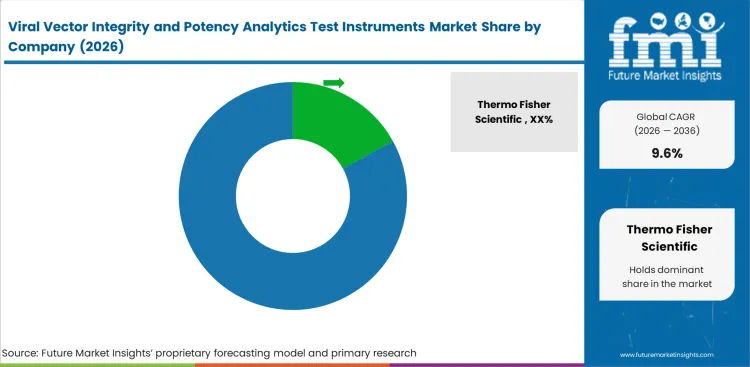
- Vendors compete on whether their instruments can generate results laboratories can defend when genome signals, particle data, and potency evidence point in different directions.
- Moderate concentration persists because many laboratories prefer mixed benches that allow at least two independent ways to assess a difficult batch.
- Dependable data behavior, application support, and fit within a wider assay package continue to shape competitive advantage.
The viral vector integrity and potency analytics test instruments market includes suppliers active across molecular analysis, chromatography, particle characterization, and label-free interaction workflows used in viral vector testing. Thermo Fisher Scientific and Bio-Rad Laboratories hold strong positions because genome quantification remains a central analytical priority, and both companies have broad relevance in decision-grade molecular workflows.
Agilent Technologies, Waters Corporation, and Danaher Corporation compete through established analytical platforms that fit characterization, separation, and control needs across vector development and quality workflows. Sartorius AG remains relevant where assay packages require broader analytical support, while Bruker Corporation serves more specialized environments where method quality and interpretation depth matter more.
Barriers to entry are moderate at the instrument level, though they rise in later-stage analytical use, where laboratories need repeatable performance, transfer-friendly workflows, application support, and confidence across orthogonal readouts before a platform gains routine acceptance.
Major Industry Players
Key global companies leading the viral vector integrity and potency analytics test instruments market include:
- Thermo Fisher Scientific, Bio-Rad Laboratories, and Sartorius AG are among the leading participants due to broad relevance across viral vector analytical workflows and established technical depth.
- Agilent Technologies, Waters Corporation, and Danaher Corporation maintain competitive relevance through continued presence in analytical platforms aligned with characterization and control activities.
- Bruker Corporation remains relevant in specialized analytical environments where method quality and data interpretation carry greater weight.
Competitive Benchmarking: Viral Vector Integrity and Potency Analytics Test Instruments Market
| Company | Molecular Analytics Relevance | Characterization Breadth | Application Support | Method Transfer Fit |
|---|---|---|---|---|
| Thermo Fisher Scientific | High | High | Strong | High |
| Bio-Rad Laboratories | High | Medium | Strong | High |
| Sartorius AG | Medium | Medium | Moderate | Medium |
| Agilent Technologies | Medium | High | Moderate | Medium |
| Waters Corporation | Medium | High | Moderate | Medium |
| Danaher Corporation | Medium | High | Strong | Medium |
| Bruker Corporation | Medium | Medium | Moderate | Medium |
Source: Future Market Insights competitive analysis, 2026.
Key Developments in Viral Vector Integrity and Potency Analytics Test Instruments Market
- In February 2026, Bruker launched iNTApharma, a label-free nanoparticle characterization platform that supports rapid native-state size and concentration analysis for gene therapy and mRNA workflows.
- In January 2025, Bio-Rad expanded its Vericheck ddPCR Empty-Full Capsid Kit range with AAV2 and AAV8 launches, strengthening AAV vector characterization across purified and crude lysate samples.
Key Players in the Viral Vector Integrity and Potency Analytics Test Instruments Market
Major Global Players
- Thermo Fisher Scientific
- Bio-Rad Laboratories
- Sartorius AG
- Agilent Technologies
- Waters Corporation
- Danaher Corporation
Emerging / Specialized Participants
- Bruker Corporation
Scope of the Report
| Metric | Value |
|---|---|
| Quantitative Units | USD 231 million to USD 578 million, at a 9.6% CAGR |
| Market Definition | Viral Vector Integrity and Potency Analytics Test Instruments Market covers analytical platforms used to measure genome titer, payload integrity, capsid composition, potency-linked response, and related quality attributes across viral vector development and control activities. Coverage is limited to instruments with a direct viral vector analytics role. |
| Segmentation |
|
| Regions Covered | North America, Latin America, Western Europe, Eastern Europe, East Asia, South Asia & Pacific, Middle East & Africa |
| Countries Covered | United States, United Kingdom, Germany, France, Japan, China, South Korea, and 40 plus countries |
| Key Companies Profiled | Thermo Fisher Scientific, Bio-Rad Laboratories, Sartorius AG, Agilent Technologies, Waters Corporation, Danaher Corporation, Bruker Corporation |
| Forecast Period | 2026 to 2036 |
| Approach | Primary interviews and analytical review of public guidance pages, association publications, peer-reviewed viral vector characterization literature, and company technical material were used. Baseline valuation reflects the installed and expanding bench used for integrity, content, potency, and comparability work. Forecasts were validated against later-stage assay intensity, site maturity, and vendor participation in cell and gene therapy analytics. |
Source: Future Market Insights analysis, based on proprietary forecasting model and primary research.
Viral Vector Integrity and Potency Analytics Test Instruments Market by Segments
Viral Vector Integrity and Potency Analytics Test Instruments Market Segmented as Instrument Technology:
- Digital PCR systems
- Quantitative PCR systems
- Capillary electrophoresis
- Liquid chromatography
- Flow cytometers
- BLI systems
- Analytical ultracentrifuges
- Particle analyzers
Viral Vector Integrity and Potency Analytics Test Instruments Market Classified by Assay Priority:
- Genome titer
- Full empty ratio
- Capsid identity
- Genome integrity
- Transduction potency
- Replication competence
- Aggregation stability
Viral Vector Integrity and Potency Analytics Test Instruments Market Analyzed by Vector Class:
- AAV
- Lentiviral
- Adenoviral
- Retroviral
- HSV
- Poxviral
Viral Vector Integrity and Potency Analytics Test Instruments Market Segmented as Workflow Stage:
- Release testing
- Process development
- Purification support
- Stability studies
- Comparability studies
Viral Vector Integrity and Potency Analytics Test Instruments Market Classified by End User:
- Biopharma developers
- CDMOs
- CRO labs
- Academic centers
- Standards labs
Viral Vector Integrity and Potency Analytics Test Instruments Market Analysed by Throughput:
- Low throughput
- Mid throughput
- High throughput
- At-line
Viral Vector Integrity and Potency Analytics Test Instruments Market Segmented as Assay Mode:
- Nucleic acid analytics
- Protein analytics
- Particle analytics
- Cell potency
Viral Vector Integrity and Potency Analytics Test Instruments Market by Region and Country:
- North America
- United States
- Western Europe
- United Kingdom
- Germany
- France
- East Asia
- China
- South Korea
- Japan
- South Asia & Pacific
- Latin America
- Eastern Europe
- Middle East & Africa
Bibliography
- Bruker Corporation. (2026, February 9). Bruker introduces iNTApharma™, a label-free platform for nanoparticle characterization in mRNA drug and gene therapy development and QC. Bruker Investor Relations.
- Bio-Rad Laboratories, Inc. (2025, January 21). Bio-Rad extends range of Vericheck ddPCR Empty-Full Capsid Kits to optimize AAV vector characterization.
- National Institute of Standards and Technology. (2025, January 6). Study highlights need for standardized measurement methods in gene therapy.
- European Directorate for the Quality of Medicines & HealthCare. (2024, December 3). Advancements in gene therapy: the European Pharmacopoeia’s new approach.
- American Society of Gene and Cell Therapy. (2025). Chemistry, Manufacturing, and Controls Development and Readiness Pilot (CDRP) Program.
This bibliography is provided for reader reference. The full FMI report contains the complete reference list with primary source documentation.
This Report Addresses
- Market intelligence for digital PCR systems, chromatography systems, flow cytometers, analytical ultracentrifuges, and particle analyzers.
- Market size estimation and 10-year revenue forecasts from 2026 to 2036, supported by installed-bench mapping and primary discussions.
- Growth opportunity mapping across instrument technology, assay priority, vector class, workflow stage, end user, throughput, assay mode, and region.
- Segment and regional revenue forecasts covering genome titer, full-empty ratio, AAV-led programs, release testing, biopharma developer ownership, and East Asia expansion.
- Competition assessment covering method reproducibility, application support, installed-base familiarity, and multi-platform purchasing behavior.
- Development tracking across digital PCR, bio-layer interferometry, flow cytometry, chromatography, and related characterization tools.
- Market access review covering later-stage quality expectations, comparability use cases, release-facing assay needs, and internal method transfer discipline.
- Report delivery in PDF, Excel, PPT, and interactive dashboard formats for executive strategy, analytical planning, and operating benchmark use.
Frequently Asked Questions
How large is the demand for viral vector integrity and potency analytics test instruments in the global market in 2026?
Demand for viral vector integrity and potency analytics test instruments in the global market is estimated to be valued at USD 231 million in 2026.
What will be the market size by 2036?
Market size is projected to reach USD 578 million by 2036.
What is the expected demand outlook between 2026 and 2036?
The market is expected to expand at a 9.6% CAGR between 2026 and 2036.
Which instrument technology is poised to lead by 2026?
Digital PCR systems are expected to account for 28.6% share in 2026.
Which assay priority leads the market?
Genome quantification is expected to hold 24.8% share in 2026 because many workflows begin there.
Which vector class remains ahead?
AAV is projected to hold 49% share in 2026 due to broader analytical depth requirements.
Preview the report firsthand - request a free sample
Get SampleGet the brochure for pricing and purchase details.
Get PDFTable of Content
- Executive Summary
- Global Market Outlook
- Demand-side Trends
- Supply-side Trends
- Technology Roadmap Analysis
- Analysis and Recommendations
- Market Overview
- Market Coverage / Taxonomy
- Market Definition / Scope / Limitations
- Research Methodology
- Chapter Orientation
- Analytical Lens and Working Hypotheses
- Market Structure, Signals, and Trend Drivers
- Benchmarking and Cross-market Comparability
- Market Sizing, Forecasting, and Opportunity Mapping
- Research Design and Evidence Framework
- Desk Research Programme (Secondary Evidence)
- Company Annual and Sustainability Reports
- Peer-reviewed Journals and Academic Literature
- Corporate Websites, Product Literature, and Technical Notes
- Earnings Decks and Investor Briefings
- Statutory Filings and Regulatory Disclosures
- Technical White Papers and Standards Notes
- Trade Journals, Industry Magazines, and Analyst Briefs
- Conference Proceedings, Webinars, and Seminar Materials
- Government Statistics Portals and Public Data Releases
- Press Releases and Reputable Media Coverage
- Specialist Newsletters and Curated Briefings
- Sector Databases and Reference Repositories
- FMI Internal Proprietary Databases and Historical Market Datasets
- Subscription Datasets and Paid Sources
- Social Channels, Communities, and Digital Listening Inputs
- Additional Desk Sources
- Expert Input and Fieldwork (Primary Evidence)
- Primary Modes
- Qualitative Interviews and Expert Elicitation
- Quantitative Surveys and Structured Data Capture
- Blended Approach
- Why Primary Evidence is Used
- Field Techniques
- Interviews
- Surveys
- Focus Groups
- Observational and In-context Research
- Social and Community Interactions
- Stakeholder Universe Engaged
- C-suite Leaders
- Board Members
- Presidents and Vice Presidents
- R&D and Innovation Heads
- Technical Specialists
- Domain Subject-matter Experts
- Scientists
- Physicians and Other Healthcare Professionals
- Governance, Ethics, and Data Stewardship
- Research Ethics
- Data Integrity and Handling
- Primary Modes
- Tooling, Models, and Reference Databases
- Desk Research Programme (Secondary Evidence)
- Data Engineering and Model Build
- Data Acquisition and Ingestion
- Cleaning, Normalisation, and Verification
- Synthesis, Triangulation, and Analysis
- Quality Assurance and Audit Trail
- Market Background
- Market Dynamics
- Drivers
- Restraints
- Opportunity
- Trends
- Scenario Forecast
- Demand in Optimistic Scenario
- Demand in Likely Scenario
- Demand in Conservative Scenario
- Opportunity Map Analysis
- Product Life Cycle Analysis
- Supply Chain Analysis
- Investment Feasibility Matrix
- Value Chain Analysis
- PESTLE and Porter’s Analysis
- Regulatory Landscape
- Regional Parent Market Outlook
- Production and Consumption Statistics
- Import and Export Statistics
- Market Dynamics
- Global Market Analysis 2021 to 2025 and Forecast, 2026 to 2036
- Historical Market Size Value (USD Million) Analysis, 2021 to 2025
- Current and Future Market Size Value (USD Million) Projections, 2026 to 2036
- Y-o-Y Growth Trend Analysis
- Absolute $ Opportunity Analysis
- Global Market Pricing Analysis 2021 to 2025 and Forecast 2026 to 2036
- Global Market Analysis 2021 to 2025 and Forecast 2026 to 2036, By Instrument Technology
- Introduction / Key Findings
- Historical Market Size Value (USD Million) Analysis By Instrument Technology , 2021 to 2025
- Current and Future Market Size Value (USD Million) Analysis and Forecast By Instrument Technology , 2026 to 2036
- Digital PCR systems
- Quantitative PCR systems
- Capillary electrophoresis
- Liquid chromatography
- Flow cytometers
- BLI systems
- Analytical ultracentrifuges
- Particle analyzers
- Digital PCR systems
- Y-o-Y Growth Trend Analysis By Instrument Technology , 2021 to 2025
- Absolute $ Opportunity Analysis By Instrument Technology , 2026 to 2036
- Global Market Analysis 2021 to 2025 and Forecast 2026 to 2036, By Assay Priority
- Introduction / Key Findings
- Historical Market Size Value (USD Million) Analysis By Assay Priority, 2021 to 2025
- Current and Future Market Size Value (USD Million) Analysis and Forecast By Assay Priority, 2026 to 2036
- Genome titer
- Full empty ratio
- Capsid identity
- Genome integrity
- Transduction potency
- Replication competence
- Aggregation stability
- Genome titer
- Y-o-Y Growth Trend Analysis By Assay Priority, 2021 to 2025
- Absolute $ Opportunity Analysis By Assay Priority, 2026 to 2036
- Global Market Analysis 2021 to 2025 and Forecast 2026 to 2036, By Vector Class
- Introduction / Key Findings
- Historical Market Size Value (USD Million) Analysis By Vector Class, 2021 to 2025
- Current and Future Market Size Value (USD Million) Analysis and Forecast By Vector Class, 2026 to 2036
- AAV
- Lentiviral
- Adenoviral
- Retroviral
- HSV
- Poxviral
- AAV
- Y-o-Y Growth Trend Analysis By Vector Class, 2021 to 2025
- Absolute $ Opportunity Analysis By Vector Class, 2026 to 2036
- Global Market Analysis 2021 to 2025 and Forecast 2026 to 2036, By Workflow Stage
- Introduction / Key Findings
- Historical Market Size Value (USD Million) Analysis By Workflow Stage, 2021 to 2025
- Current and Future Market Size Value (USD Million) Analysis and Forecast By Workflow Stage, 2026 to 2036
- Release testing
- Process development
- Purification support
- Stability studies
- Comparability studies
- Release testing
- Y-o-Y Growth Trend Analysis By Workflow Stage, 2021 to 2025
- Absolute $ Opportunity Analysis By Workflow Stage, 2026 to 2036
- Global Market Analysis 2021 to 2025 and Forecast 2026 to 2036, By End User
- Introduction / Key Findings
- Historical Market Size Value (USD Million) Analysis By End User, 2021 to 2025
- Current and Future Market Size Value (USD Million) Analysis and Forecast By End User, 2026 to 2036
- Biopharma developers
- CDMOs
- CRO labs
- Academic centers
- Standards labs
- Biopharma developers
- Y-o-Y Growth Trend Analysis By End User, 2021 to 2025
- Absolute $ Opportunity Analysis By End User, 2026 to 2036
- Global Market Analysis 2021 to 2025 and Forecast 2026 to 2036, By Throughput
- Introduction / Key Findings
- Historical Market Size Value (USD Million) Analysis By Throughput, 2021 to 2025
- Current and Future Market Size Value (USD Million) Analysis and Forecast By Throughput, 2026 to 2036
- Mid throughput
- Low throughput
- High throughput
- At-line
- Mid throughput
- Y-o-Y Growth Trend Analysis By Throughput, 2021 to 2025
- Absolute $ Opportunity Analysis By Throughput, 2026 to 2036
- Global Market Analysis 2021 to 2025 and Forecast 2026 to 2036, By Assay Mode
- Introduction / Key Findings
- Historical Market Size Value (USD Million) Analysis By Assay Mode, 2021 to 2025
- Current and Future Market Size Value (USD Million) Analysis and Forecast By Assay Mode, 2026 to 2036
- Nucleic acid analytics
- Protein analytics
- Particle analytics
- Cell potency
- Nucleic acid analytics
- Y-o-Y Growth Trend Analysis By Assay Mode, 2021 to 2025
- Absolute $ Opportunity Analysis By Assay Mode, 2026 to 2036
- Global Market Analysis 2021 to 2025 and Forecast 2026 to 2036, By Region
- Introduction
- Historical Market Size Value (USD Million) Analysis By Region, 2021 to 2025
- Current Market Size Value (USD Million) Analysis and Forecast By Region, 2026 to 2036
- North America
- Latin America
- Western Europe
- Eastern Europe
- East Asia
- South Asia and Pacific
- Middle East & Africa
- Market Attractiveness Analysis By Region
- North America Market Analysis 2021 to 2025 and Forecast 2026 to 2036, By Country
- Historical Market Size Value (USD Million) Trend Analysis By Market Taxonomy, 2021 to 2025
- Market Size Value (USD Million) Forecast By Market Taxonomy, 2026 to 2036
- By Country
- USA
- Canada
- Mexico
- By Instrument Technology
- By Assay Priority
- By Vector Class
- By Workflow Stage
- By End User
- By Throughput
- By Assay Mode
- By Country
- Market Attractiveness Analysis
- By Country
- By Instrument Technology
- By Assay Priority
- By Vector Class
- By Workflow Stage
- By End User
- By Throughput
- By Assay Mode
- Key Takeaways
- Latin America Market Analysis 2021 to 2025 and Forecast 2026 to 2036, By Country
- Historical Market Size Value (USD Million) Trend Analysis By Market Taxonomy, 2021 to 2025
- Market Size Value (USD Million) Forecast By Market Taxonomy, 2026 to 2036
- By Country
- Brazil
- Chile
- Rest of Latin America
- By Instrument Technology
- By Assay Priority
- By Vector Class
- By Workflow Stage
- By End User
- By Throughput
- By Assay Mode
- By Country
- Market Attractiveness Analysis
- By Country
- By Instrument Technology
- By Assay Priority
- By Vector Class
- By Workflow Stage
- By End User
- By Throughput
- By Assay Mode
- Key Takeaways
- Western Europe Market Analysis 2021 to 2025 and Forecast 2026 to 2036, By Country
- Historical Market Size Value (USD Million) Trend Analysis By Market Taxonomy, 2021 to 2025
- Market Size Value (USD Million) Forecast By Market Taxonomy, 2026 to 2036
- By Country
- Germany
- UK
- Italy
- Spain
- France
- Nordic
- BENELUX
- Rest of Western Europe
- By Instrument Technology
- By Assay Priority
- By Vector Class
- By Workflow Stage
- By End User
- By Throughput
- By Assay Mode
- By Country
- Market Attractiveness Analysis
- By Country
- By Instrument Technology
- By Assay Priority
- By Vector Class
- By Workflow Stage
- By End User
- By Throughput
- By Assay Mode
- Key Takeaways
- Eastern Europe Market Analysis 2021 to 2025 and Forecast 2026 to 2036, By Country
- Historical Market Size Value (USD Million) Trend Analysis By Market Taxonomy, 2021 to 2025
- Market Size Value (USD Million) Forecast By Market Taxonomy, 2026 to 2036
- By Country
- Russia
- Poland
- Hungary
- Balkan & Baltic
- Rest of Eastern Europe
- By Instrument Technology
- By Assay Priority
- By Vector Class
- By Workflow Stage
- By End User
- By Throughput
- By Assay Mode
- By Country
- Market Attractiveness Analysis
- By Country
- By Instrument Technology
- By Assay Priority
- By Vector Class
- By Workflow Stage
- By End User
- By Throughput
- By Assay Mode
- Key Takeaways
- East Asia Market Analysis 2021 to 2025 and Forecast 2026 to 2036, By Country
- Historical Market Size Value (USD Million) Trend Analysis By Market Taxonomy, 2021 to 2025
- Market Size Value (USD Million) Forecast By Market Taxonomy, 2026 to 2036
- By Country
- China
- Japan
- South Korea
- By Instrument Technology
- By Assay Priority
- By Vector Class
- By Workflow Stage
- By End User
- By Throughput
- By Assay Mode
- By Country
- Market Attractiveness Analysis
- By Country
- By Instrument Technology
- By Assay Priority
- By Vector Class
- By Workflow Stage
- By End User
- By Throughput
- By Assay Mode
- Key Takeaways
- South Asia and Pacific Market Analysis 2021 to 2025 and Forecast 2026 to 2036, By Country
- Historical Market Size Value (USD Million) Trend Analysis By Market Taxonomy, 2021 to 2025
- Market Size Value (USD Million) Forecast By Market Taxonomy, 2026 to 2036
- By Country
- India
- ASEAN
- Australia & New Zealand
- Rest of South Asia and Pacific
- By Instrument Technology
- By Assay Priority
- By Vector Class
- By Workflow Stage
- By End User
- By Throughput
- By Assay Mode
- By Country
- Market Attractiveness Analysis
- By Country
- By Instrument Technology
- By Assay Priority
- By Vector Class
- By Workflow Stage
- By End User
- By Throughput
- By Assay Mode
- Key Takeaways
- Middle East & Africa Market Analysis 2021 to 2025 and Forecast 2026 to 2036, By Country
- Historical Market Size Value (USD Million) Trend Analysis By Market Taxonomy, 2021 to 2025
- Market Size Value (USD Million) Forecast By Market Taxonomy, 2026 to 2036
- By Country
- Kingdom of Saudi Arabia
- Other GCC Countries
- Turkiye
- South Africa
- Other African Union
- Rest of Middle East & Africa
- By Instrument Technology
- By Assay Priority
- By Vector Class
- By Workflow Stage
- By End User
- By Throughput
- By Assay Mode
- By Country
- Market Attractiveness Analysis
- By Country
- By Instrument Technology
- By Assay Priority
- By Vector Class
- By Workflow Stage
- By End User
- By Throughput
- By Assay Mode
- Key Takeaways
- Key Countries Market Analysis
- USA
- Pricing Analysis
- Market Share Analysis, 2025
- By Instrument Technology
- By Assay Priority
- By Vector Class
- By Workflow Stage
- By End User
- By Throughput
- By Assay Mode
- Canada
- Pricing Analysis
- Market Share Analysis, 2025
- By Instrument Technology
- By Assay Priority
- By Vector Class
- By Workflow Stage
- By End User
- By Throughput
- By Assay Mode
- Mexico
- Pricing Analysis
- Market Share Analysis, 2025
- By Instrument Technology
- By Assay Priority
- By Vector Class
- By Workflow Stage
- By End User
- By Throughput
- By Assay Mode
- Brazil
- Pricing Analysis
- Market Share Analysis, 2025
- By Instrument Technology
- By Assay Priority
- By Vector Class
- By Workflow Stage
- By End User
- By Throughput
- By Assay Mode
- Chile
- Pricing Analysis
- Market Share Analysis, 2025
- By Instrument Technology
- By Assay Priority
- By Vector Class
- By Workflow Stage
- By End User
- By Throughput
- By Assay Mode
- Germany
- Pricing Analysis
- Market Share Analysis, 2025
- By Instrument Technology
- By Assay Priority
- By Vector Class
- By Workflow Stage
- By End User
- By Throughput
- By Assay Mode
- UK
- Pricing Analysis
- Market Share Analysis, 2025
- By Instrument Technology
- By Assay Priority
- By Vector Class
- By Workflow Stage
- By End User
- By Throughput
- By Assay Mode
- Italy
- Pricing Analysis
- Market Share Analysis, 2025
- By Instrument Technology
- By Assay Priority
- By Vector Class
- By Workflow Stage
- By End User
- By Throughput
- By Assay Mode
- Spain
- Pricing Analysis
- Market Share Analysis, 2025
- By Instrument Technology
- By Assay Priority
- By Vector Class
- By Workflow Stage
- By End User
- By Throughput
- By Assay Mode
- France
- Pricing Analysis
- Market Share Analysis, 2025
- By Instrument Technology
- By Assay Priority
- By Vector Class
- By Workflow Stage
- By End User
- By Throughput
- By Assay Mode
- India
- Pricing Analysis
- Market Share Analysis, 2025
- By Instrument Technology
- By Assay Priority
- By Vector Class
- By Workflow Stage
- By End User
- By Throughput
- By Assay Mode
- ASEAN
- Pricing Analysis
- Market Share Analysis, 2025
- By Instrument Technology
- By Assay Priority
- By Vector Class
- By Workflow Stage
- By End User
- By Throughput
- By Assay Mode
- Australia & New Zealand
- Pricing Analysis
- Market Share Analysis, 2025
- By Instrument Technology
- By Assay Priority
- By Vector Class
- By Workflow Stage
- By End User
- By Throughput
- By Assay Mode
- China
- Pricing Analysis
- Market Share Analysis, 2025
- By Instrument Technology
- By Assay Priority
- By Vector Class
- By Workflow Stage
- By End User
- By Throughput
- By Assay Mode
- Japan
- Pricing Analysis
- Market Share Analysis, 2025
- By Instrument Technology
- By Assay Priority
- By Vector Class
- By Workflow Stage
- By End User
- By Throughput
- By Assay Mode
- South Korea
- Pricing Analysis
- Market Share Analysis, 2025
- By Instrument Technology
- By Assay Priority
- By Vector Class
- By Workflow Stage
- By End User
- By Throughput
- By Assay Mode
- Russia
- Pricing Analysis
- Market Share Analysis, 2025
- By Instrument Technology
- By Assay Priority
- By Vector Class
- By Workflow Stage
- By End User
- By Throughput
- By Assay Mode
- Poland
- Pricing Analysis
- Market Share Analysis, 2025
- By Instrument Technology
- By Assay Priority
- By Vector Class
- By Workflow Stage
- By End User
- By Throughput
- By Assay Mode
- Hungary
- Pricing Analysis
- Market Share Analysis, 2025
- By Instrument Technology
- By Assay Priority
- By Vector Class
- By Workflow Stage
- By End User
- By Throughput
- By Assay Mode
- Kingdom of Saudi Arabia
- Pricing Analysis
- Market Share Analysis, 2025
- By Instrument Technology
- By Assay Priority
- By Vector Class
- By Workflow Stage
- By End User
- By Throughput
- By Assay Mode
- Turkiye
- Pricing Analysis
- Market Share Analysis, 2025
- By Instrument Technology
- By Assay Priority
- By Vector Class
- By Workflow Stage
- By End User
- By Throughput
- By Assay Mode
- South Africa
- Pricing Analysis
- Market Share Analysis, 2025
- By Instrument Technology
- By Assay Priority
- By Vector Class
- By Workflow Stage
- By End User
- By Throughput
- By Assay Mode
- USA
- Market Structure Analysis
- Competition Dashboard
- Competition Benchmarking
- Market Share Analysis of Top Players
- By Regional
- By Instrument Technology
- By Assay Priority
- By Vector Class
- By Workflow Stage
- By End User
- By Throughput
- By Assay Mode
- Competition Analysis
- Competition Deep Dive
- Thermo Fisher Scientific
- Overview
- Product Portfolio
- Profitability by Market Segments (Product/Age /Sales Channel/Region)
- Sales Footprint
- Strategy Overview
- Marketing Strategy
- Product Strategy
- Channel Strategy
- Bio-Rad Laboratories
- Sartorius AG
- Agilent Technologies
- Waters Corporation
- Danaher Corporation
- Thermo Fisher Scientific
- Competition Deep Dive
- Assumptions & Acronyms Used


